
Review

Climate Change and Inequality in the Ancient Mediterranean: A Scoping Review
1
Institute of Archaeology, University College London, 31-34 Gordon Sq, London WC1H 0PY, UK
2
Department of History, University of São Paulo, Rua da Reitoria, 374, Butantã, São Paulo 05508-220, SP, Brazil
3
Department of Classics and Ancient History, University of Exeter, Amory Building, Rennes Drive, Exeter EX4 4RJ, UK
*
Authors to whom correspondence should be addressed.
Encyclopedia 2026, 6(5), 110; https://doi.org/10.3390/encyclopedia6050110
Submission received: 19 March 2026 / Revised: 11 May 2026 / Accepted: 14 May 2026 / Published: 18 May 2026
(This article belongs to the Section Arts & Humanities)

Abstract

(1) Background: Climate change and inequality are topics of major interest in Mediterranean Archaeology. However, comparatively less attention has been dedicated to how these themes are interlinked in the literature. No scoping review has ever addressed this issue. This study aims to identify major research trends on inequality and climate change in the Mediterranean c. 4000 BC–AD 500. It also pinpoints current research gaps on the topic and nascent areas of enquiry. (2) Method: We performed a scoping review on JSTOR, Scopus, Google Scholar and PubMed in December 2025–January 2026. A modified version of the PRISMA-ScR protocol was followed. We sampled journal articles, book chapters, edited volumes and monographs published between 2015 and 2025 which matched the search and inclusion criteria. Additional searches were done on Google Scholar in February 2026 to expand upon emerging research trends relevant to our topic but largely absent from the scoping review. We manually extracted, charted, analysed and synthesised the data. (3) Results: A total of 154 studies were eligible for the scoping review. We identified six research trends prominent in the sampled literature: 1. the rise and fall of world systems, macroscale causal links, and collapse research; 2. inequality, subalternity, and marginality; 3. agriculture, crops, and diet; 4. natural resource management, and water supply; 5. epistemology and methodology; and 6. natural archives and climate proxy datasets. We also recognised the following research gaps or topics that were comparatively less addressed: collapse research applied to the microscale level and marginalised communities; isotope analysis applied to both climate change and inequality in the same study; biomedical approaches applied to both climate change and inequality in the same study; social marginality as a complex construct in human–climate interactions; and the environmental and climate dimensions of the early Roman expansion, especially regarding marginality and the microscale. Finally, we identified artificial intelligence (AI), Big Data, environmental and climate activism, and the perception of climate hazards by subaltern communities as nascent topics of interest that might rise to prominence in the future. (4) Conclusions: We identified major research trends and gaps on climate change and inequality in the ancient Mediterranean in literature published 2015–2025. We also recognised nascent or unexplored topics. The review is intended as a benchmark for developing novel research on the cutting-edge of Mediterranean Archaeology.

1. Introduction

The current climate crisis has shown that social inequality is a key factor in shaping the impacts of climate change. Marginalised groups are considerably more at risk of experiencing negative effects of climate change in terms of socioeconomic impacts, health, nutrition, displacement, housing, access to water, and general wellbeing [1,2,3]. This highlights the need to approach climate change and social inequality as interlinked phenomena, both in the present as well as in the past. The ancient Mediterranean presents itself as an optimal opportunity to address the complex link between climate change and social inequality from a deep time perspective; it features a wide variety of ecosystems, climatic phenomena and complex trajectories of sociopolitical evolution. Mediterranean Archaeology has long addressed the impact of climate change on societies [4,5]. Social inequality is also a major topic of interest [6]. More recently, subalternity and marginality have come to the fore in the field [7,8,9]. However, there has been comparatively little discussion of the extent to which climate change and inequality are approached as interconnected phenomena in the literature on the ancient Mediterranean. No scoping review has ever addressed this question.
To clarify these issues, we carried out a scoping review of current approaches to climate change and inequality in the ancient Mediterranean between late prehistory and the Roman period (fourth millennium BC to c. AD 500). This was a critical phase in the rise of social complexity and empires, also characterised by well-documented environmental developments and climate oscillations. We searched Google Scholar, Scopus, JSTOR and PubMed. Our objectives were to identify: (i) main trends in research on climate change and inequality in the field between 2015 and 2025; (ii) gaps to address in research as of early 2026; and (iii) possible nascent research trends as of early 2026. The results of the scoping review, and of subsequent tailored Google Scholar searches, allowed us to pinpoint major focuses of scholarly inquiry, gaps in current understandings, as well as “uncharted territories” in the study of climate change and inequality in the ancient Mediterranean.

2. Methods

First, we carried out a scoping review following a modified version of the Preferred Reporting Items for Systematic Reviews and Meta-Analyses Extension for Scoping Reviews (PRISMA-ScR: File S1; Table S1) [10]. The scoping review was done between 23 December 2025 and 6 January 2026; it formed the backbone of our discussion. We also included in the present article key publications that pertain directly to the search topics, but did not appear in the scoping review, including occasionally grey literature such as preprints.
We searched Scopus, JSTOR, Google Scholar and PubMed, using combinations of the following search terms: climate change, inequality, marginality, ancient Mediterranean, antiquity, prehistory, archaeology, and ancient history. We tailored the string of search terms to the different search engines given their specificities, to yield results that were quantitatively manageable. PubMed, a platform largely aimed at biomedical literature, specifically allowed us to assess any intersections of Biomedicine and Archaeology as regards the topics addressed in this review. The protocol of the scoping review, including the specific search strings used, is available as Supplementary File S1.
We restricted the search to publications of the last 10 years as of the start of the scoping review on 23 December 2025, i.e., since 2015. The selected timeframe includes major breakthroughs in the Archaeology of the ancient Mediterranean. It encompasses what scholars such as Kristian Kristiansen have called the “Third Science Revolution” in Archaeology [11]. The granting of the 2022 Nobel Prize in Medicine and Physiology to archaeogeneticist Svante Pääbo is an indication of Archaeology’s recognition among the globally acknowledged scientific endeavours.
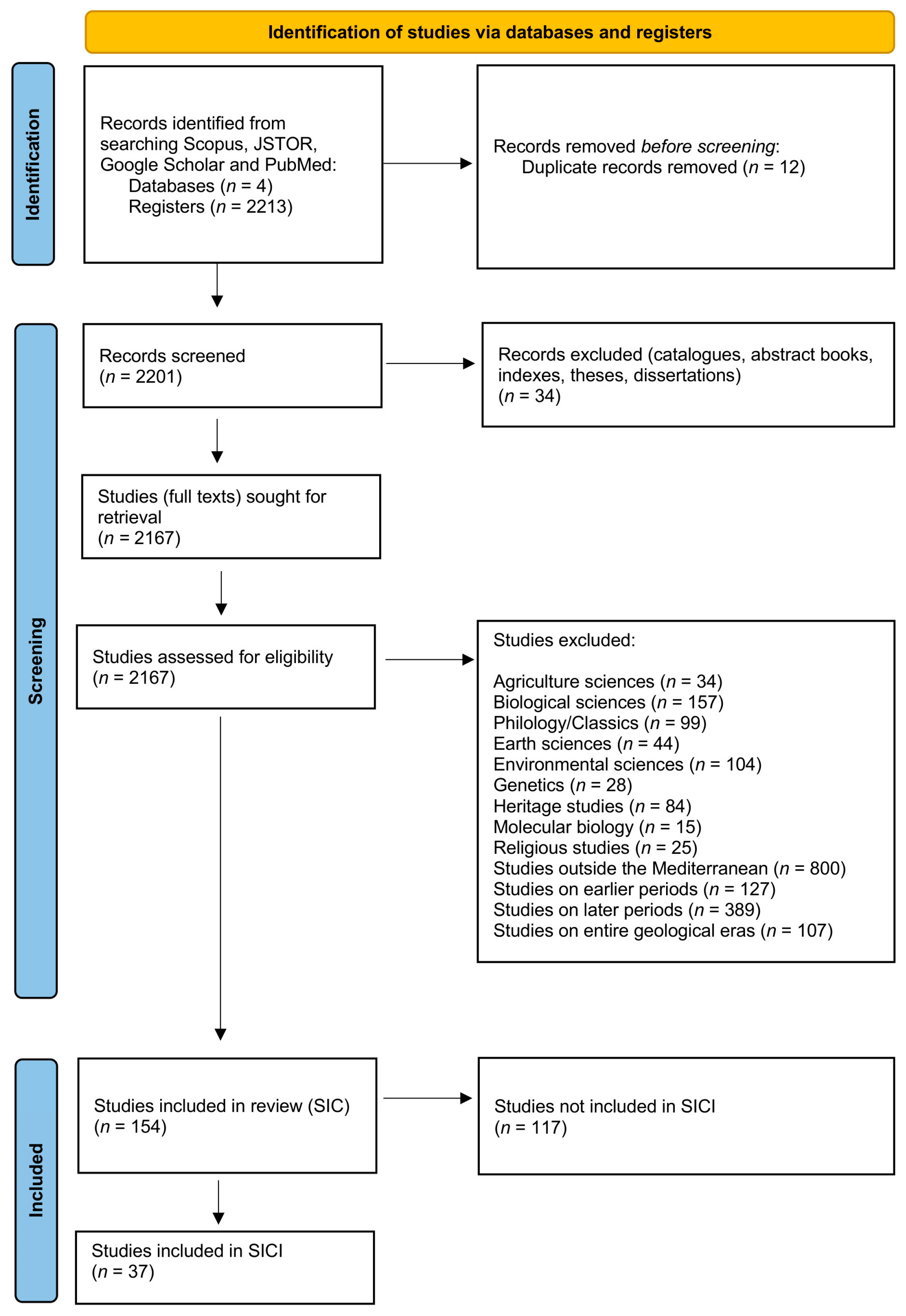
From the original 2213 search results, we filtered out 12 duplicated results before screening; we then screened out 34 results that were not eligible for the review (publication catalogues, abstract books and indexes, dissertations and theses). Of the remaining 2167 studies whose full texts could be accessed, we excluded 2013 that were not directly related to the topic of interest, namely: studies primarily in the fields of Environmental Sciences; Earth and Planetary Sciences; Agriculture and Biological Sciences (including animal and botanical studies); Biochemistry, Genetics and Molecular Biology; Heritage; and studies in ancient religion and Classics or Philology. Along with these, we also excluded studies focusing on historical periods other than those selected for the present review (e.g., Pleistocene, Early Neolithic, Medieval, Early Modern, Contemporary), as well as studies on entire Geological eras (e.g., Holocene), and/or concerning geographical areas outside the Mediterranean (Figure 1). We jointly developed data charting, analysis, interpretation and synthesis.
Outside the scoping review, we carried out additional, tailored Google Scholar searches in February 2026 to better pinpoint research gaps and nascent trends of interest. We created the baseline search string (ancient Mediterranean OR Mediterranean Archaeology) AND (Inequality) AND (climate change), to which were added terms of interest, e.g., “Big Data”. More details on these searches and their rationale are provided in the study’s protocol. Both the scoping review and the Google Scholar searches only yielded publications in English.

3. Results

The scoping review produced 154 publications, which we organised in two databases, named SIC (“Search and Inclusion Criteria”) and SICI (“Search and Inclusion Criteria Interlinked”) (Figure 1, Supplementary Material Table S2). SIC contains all 154 publications that matched the search criteria, after filtering. The publications included in SIC can, for example, discuss climate change in the ancient Mediterranean but mention inequality only briefly; or otherwise discuss inequality in detail, but climate change only tangentially. SICI, on the other hand, is a subset of SIC with 37 publications that, to different extents, address both inequality and climate change as interlinked themes. The inclusion of papers in SICI was based on qualitative judgement, keyword presence, and in-depth analytical assessment. The publications in both SIC and SICI are heterogeneous in scope and scale. They mostly include research articles, but also monographs, edited volumes, book chapters and two reviews. All publications cited below are in SIC unless otherwise stated. The review allowed us to identify major focuses of scientific inquiry as regards climate change and inequality in the ancient Mediterranean, as well as gaps in current research, and nascent topics that remain to be fully explored in the literature (Table 1).

3.1. Rise and Fall of World Systems, Macroscale Causal Links, and Collapse Research

One recurrent topic in the scoping review concerns how climatic shifts affected the rise and fall of ancient states, empires and world systems, such as the Late Bronze Age (LBA) world system (e.g., Knapp and Manning, in SICI [13]; Levitt [14]) and the Roman empire (e.g., McConnell and colleagues on Alaskan eruptions and the fall of the Roman republic [15]; also Harper outside the scoping review [16]). This trend usually centres on élite groups, large cities and/or macro-regions. It prioritises macroscale causal links between climate and sociocultural change, as in Clarke and colleagues on “aridity spikes” and cultural ruptures in North Africa and the Near East during the fourth millennium BC [17]. When this approach intersects with inequality research, it is generally from a broad perspective that highlights major historical and economic trends such as the supply networks of imperial capitals and/or large-scale famines, and ensuing inequalities (such as Haldon and colleagues [18,19], both in SICI). A subset of this trend concerns the link between climatic shifts, health patterns and pathological profiles of populations. Epidemics such as the Antonine and Justinianic plagues are given prominence, in view of their links to sociopolitical and economic unrest (e.g., Elliott on the Antonine plague and local violence in Roman Egypt [20], in SICI), and processes of imperial downfall (e.g., Elliott, in SICI [21]; also Harper [16] outside the scoping review).
Such interest in macro-level causal links between climatic shifts and inequality overlaps to some extent with research on ancient collapse, though inequality is generally not the primary focus. Manning and colleagues, for example, address the link between drought and the fall of the Hittite empire [22]; while Joffee assesses the demise of the Copper Age in the Levant [23]; Hosek and colleagues discuss the LBA collapse from a microenvironmental perspective, focusing on the impact of the LBA “seismic storm” on settlement patterns on the local and regional levels [24]. Within collapse research, there has been comparatively less attention to the phenomenon of “micro-collapse”, and the impact of collapse and crisis on marginalised communities, where the effects of climate change become especially complex and multifaceted. Exceptions include Perego and colleagues, on the first-millennium BC central Mediterranean [25]; and Perego and Scopacasa (all in SICI) on the impact of flooding and climate change on middling, sub-élite and marginalised groups in Iron Age Veneto, Northern Italy, c. 800–500 BC [26,27,28]. The paucity of studies focusing on the non-élites/marginalised and their experience of sociopolitical and/or environmental instability highlights a significant research gap, indicating that the concept of “crisis” in the ancient Mediterranean requires rethinking.

3.2. Inequality, Subalternity, and Marginality

Our search criteria yielded many studies of ancient inequality in the scoping review. For example, Liu addresses urban poverty in the Roman empire [29], while Redfern and Bond discuss, respectively, enslavement and low-status professions in the Roman world [30,31]. We note, however, that this trend only occasionally intersects with research on climatic and environmental change. When both inequality and climate change are considered, the approach tends to favour the macroscale. Broad socioeconomic groups, such as enslaved people and/or the urban poor in imperial centres like Rome, are often given prominence, rather than single individuals and smaller communities. Peregrine addresses broader social resilience and the climatic anomaly of AD 536–540 in the Roman world [32]. For earlier periods, Meyer and Knapp focus on social resilience in LBA Cyprus [33], while Lai and Crispu address social change and settlement patterns in Bronze Age Sardinia [34] (all in SICI). Other studies focus on rural areas and peasant populations, normally in contexts where ample written evidence is available. For instance, Huebner (SICI) addresses the end of the Roman Climate Optimum, c. AD 200–300, and its impact on peasant communities in the Fayum in Egypt [35]. Grey, also in SICI, discusses climatic variability and agricultural labour in the Roman empire [36].
A sub-trend involves studies that approach marginality, subalternity and extreme social exclusion as complex intersectional phenomena. Within this approach, studies on climate change and marginality, especially at the microscale, remain relatively rare: for example, Perego and Scopacasa address human–climate interactions in small rural communities inhabiting the karst and arid-prone coastal plateaus of southern Italy c. 350–100 BC, during a phase of potential warming connected with the onset of the Roman Climate Optimum [27,28,37] (all in SICI). Rieger addresses adaptation strategies of rural communities in arid landscapes of ancient North Africa [38]. In addition, Perego and Scopacasa [26,27,28] (all in SICI) and Perego and colleagues [39,40] (outside the scoping review), discuss burial practices involving marginalised people and/or middling groups in the intricate, flood-prone riverine micro-landscapes of Veneto, northern Italy, during a phase of potential climatic cooling, connected with the so-called Homer Minimum of c. 700 BC. The relative paucity of studies on this topic reveals an important study gap in ancient Mediterranean Archaeology.

3.3. Agriculture, Crops, and Diet

Another key topic to emerge from the scoping review was the impact of climate change on agriculture and the cultivation of specific crops. These studies are well represented in SIC, e.g., [41]. Rarer are studies addressing any links with patterns in dietary practice and inequality, which could be included in SICI, e.g., [42]. Overall, studies on these topics tend to focus on long-term processes which involve extensive geographical areas, such as entire islands (e.g., Columbu and colleagues [43] on land use in Nuragic Sardinia), and macro-regions such as the southern Levant (e.g., [44]). Another field of inquiry investigates patterns in agriculture over centuries or millennia: e.g., Roberts, on vegetation shifts and the rural economy in the first-millennium AD Eastern Mediterranean [45]; and Mora-González and colleagues, on changes in agriculture in the second millennium BC [46]. Overall, whenever a focus on inequality is present, it usually concerns the uneven distribution of resources that derive from agricultural regimes (e.g., Meyer and Knapp [33] on changes in the political economy of LBA Cyprus), or the material resources accessible to rural labourers or subaltern urban workers (e.g., in Herculaneum: Soncin and colleagues [47] outside the scoping review). In general, however, there is little attention to the impact of climate change at the microscale of marginalised individuals or small communities/social units.
A sub-trend concerns the cultivation of vines and wine production, e.g., [48,49]. Wine consumption has long been considered a prerogative of the upper echelons of the ancient Mediterranean ([50,51,52] outside the scoping review). Yet, some studies have explored the significance of alcohol consumption in potential non-élite contexts: for example, Iaia on Tyrrhenian Italy, although with no focus on climate change and outside the scoping review [52]. However, Perego and colleagues, outside the scoping review, address alcohol and food consumption among the non-élite and marginalised in a phase of increasing inequality, potentially linked to climate cooling and flooding, in the marshlands of NE Italy (Padua, Veneto) [39].

3.4. Natural Resource Management and Water Supply

Another key topic that emerged from our scoping review involves the management of natural resources, including in the long term and on a macro-regional scale: for example, Veal on forest exploitation in Greco-Roman antiquity [53]. Water management and supply is a common focus of these studies, which often centre on well-preserved urban contexts such as Pompeii [54]. Fiorentino and colleagues, on the other hand, address water resources in the Salpi Lagoon, Puglia (southern Italy) across several millennia [55]. The topic of climate change is usually not the main emphasis of such studies. Rather, this research tends to highlight social and environmental factors pertaining to water availability, management and access. For example, Locicero addresses social justice, the distribution of water resources, and pollution in the North African Roman city of Volubilis [56]. Outside the scoping review, Ronin discusses the maintenance of Roman imperial hydraulic infrastructure, with attention to how it both enabled and constrained water-access negotiations in daily life [57].

3.5. Epistemology and Methodology

A further trend identified in the scoping review involves epistemological and theoretical–methodological issues in the study of ancient climate change and inequality. Many such contributions address the problem of environmental and/or climatic determinism, to elucidate the role of phenomena such as climate forcing in major historical trends; Manning, for example, discusses the rise and collapse of large-scale political formations such as empires [58]. A minority of studies sampled in SICI explicitly frames this topic in view of limitations in evidence and methods, as regards the study of sub-élite or marginalised communities at the microscale, in the context of the Roman expansion [27,28,37]. Outside the scoping review, Padilla Peralta highlights similar challenges in relation to epistemicide and the erasure of ecological cultural archives as a result of imperial conquest and plunder [59]. This trend is in line with a nascent paradigm shift in Roman History, which foregrounds the climatic and environmental dimensions of the early Roman expansion: Perego and Scopacasa, in SICI, focus on non-élite rural communities in southern Italy [27,28,37]. On the other hand, Bernard and colleagues (SICI) provide broad-ranging assessments of the climatic dimension of the Roman conquest [60]. These topics, however, remain comparatively unexplored.

3.6. Natural Archives and Climate Proxy Datasets

Among the results in SIC were many studies on specific natural archives, focusing primarily on scientific methods and results in the production and analysis of paleoclimatic and paleoenvironmental data, e.g., [61]. Although the term “inequality” may occur in some of these studies, they generally do not include detailed investigations of social inequality, but rather the generation of scientific data for addressing human–climate interactions in the ancient Mediterranean more broadly. A stronger integration of climate proxy datasets with inequality and marginality is therefore a topic to highlight for future research on the ancient Mediterranean.

3.7. Isotope Analysis

In the scoping review, we also found scattered occurrences of isotope analyses that address human–climate dynamics and inequality (e.g., [34], in SICI). However, these results were far less numerous than we had expected, given the potential of isotope analysis to further research in the field, as also suggested in Kyle and Reitsema [62]. In view of this, we carried out an additional Google Scholar search tailored to identifying isotope research potentially of interest to our review, by adding the terms (stable isotope analysis OR isotope analysis) to the baseline search string detailed above. As a result, we identified a few more studies of interest. Some address environmental factors and/or natural shocks, although not specifically climate-related: for example, Reitsema and colleagues on diet and inequality in the Greek colonial settlement of Himera in Sicily [63]; Reinberger and colleagues on geographic heterogeneity in Greek mercenary armies [64]; and Soncin and colleagues on diet and inequality among the Vesuvius eruption victims of 79 AD [47]. Other studies build scientific approaches to human–animal and animal–environment interactions, e.g., Lai and colleagues, in SICI [65]; also Trentacoste and colleagues outside the scoping review [66]. Looking beyond the range of our scoping review, a key focus of isotope studies is the generation of large-scale raw data samples, e.g., [67,68]. Other major topics of interest include mobility, life histories, diet, and human–environment interactions, sometimes with a focus on inequalities, but not climate change, e.g., [69,70]. Overall, therefore, our review suggests that isotope analysis is still to be widely employed in research addressing both inequality and climate change in the ancient Mediterranean.

3.8. Biomedicine and Archaeology

We highlight that our search on PubMed yielded no results matching the search and inclusion criteria of the scoping review. This indicates, firstly, a considerable gap in bioarchaeological research addressing ancient inequality and climate change from a biomedical perspective; and secondly, that whenever such research is carried out, it is not usually submitted to journals indexed in PubMed, though exceptions outside our scoping review are possible [71]. This shows that Mediterranean Archaeology and Biomedicine have yet to become more integrated. Some studies addressing past health in relation to climate change and inequality did emerge from the scoping review and are addressed in Section 3.1. However, such publications were not available in PubMed.
Moreover, while disability is a topic of growing interest in Archaeology [72,73], our scoping review did not identify any studies focused on disability in connection with both climate change and inequality in the ancient Mediterranean.

3.9. Subaltern Perceptions and Experiences

A nascent study theme identified through this research, but basically absent from the scoping review, concerns non-élite perceptions and experiences of climatic shifts and shocks in antiquity. Table 2 pinpoints some ongoing projects that address this topic; their existence indicates that formal literature on these subjects could be produced in the coming years. From a related methodological standpoint, though outside the scoping review, Williams-Reed addresses ancient subaltern experiences of climatic stress through the theoretical lens of ecological grief [74]. By focusing on Safaitic inscriptions from ancient North Arabia c. 100 BC–AD 300, she analyses the emotional responses of desert nomadic pastoralists to water scarcity and droughts. The paucity of studies addressing such topics suggests a considerable research gap in ancient Mediterranean Archaeology. A tailored Google Scholar search was also done by adding (Subaltern OR non-élite) AND (perceptions OR experiences) to the baseline search string. The search did not yield any relevant results: it confirmed the importance of inequality as a research topic in ancient Mediterranean Archaeology, but not as regards subaltern perceptions or experiences of climate change.

3.10. Big Data

Big Data, while a topic of growing interest in Archaeology [75], yielded almost null results in our scoping review. The tailored Google Scholar search, with “Big Data” added to the baseline search string, identified a nascent interest in Big Data research in the ancient Mediterranean, although generally with no specific focus on climate change and inequality. For example, outside the scoping review, Murray addresses the challenges of employing Big Data in Bronze and Iron Age Greek Archaeology [76], while Chelazzi and Bonzano call for the integration of Big Data in Digital Archaeology of the ancient Mediterranean [77]. On the other hand, Perego and Scopacasa [78] (SICI) and [79] (outside the scoping review) address Big Data, inequality and climate change head-on, by using databases with thousands of entries to investigate marginality via funerary data, in phases of climatic oscillations in first-millennium BC Italy (Table 2). The databases used, however, are relatively small compared to Big Data projects in other disciplines. Big Data, therefore, offer major scope for development in relation to the topics addressed in this review.

3.11. Environmental and Climate Change Activism

Our scoping review did not uncover publications on ancient Mediterranean Archaeology in relation to environmental and climate change activism. This is noteworthy, considering that other areas of activism have come to the fore in the field, such as Hill and Beeler on antiracism [80]. To this end, we conducted a supplementary search on Google Scholar, by adding (environmental activism OR climate activism OR climate justice) to the baseline search string. Our results were again virtually null, excepting heritage studies that fell well beyond our inclusion criteria (e.g., chronologically). While conducting the original search in December 2025, we noted, however, the presence of analyses of climate justice in its connection with Archaeology outside the ancient Mediterranean; for example, Douglas and Cooper’ influential article on environmental justice, climate change and Archaeology in the Caribbean [81]; the article, however, does not seem to have entered the radar of ancient Mediterranean studies so far. Overall, environmental and climate change activism remain to be incorporated in Mediterranean Archaeology. We note that Archaeology and activism is a theme at the flagship European Association of Archaeologists (EAA) 2026 conference, which foregrounds interest in such topics in the field (Table 2).

3.12. Artificial Intelligence (AI)

While the topic of AI is receiving growing attention in Archaeology [82], both our scoping review and tailored Google Scholar search did not uncover publications on AI that matched our search and inclusion criteria. This highlights another significant gap, which is beginning to be identified in nascent scholarship (Table 2).

4. Discussion

The scoping review and tailored Google Scholar searches allowed us to identify major trends where climate change and inequality research intersect to different extents in ancient Mediterranean Archaeology (Figure 1), as well as research gaps and rising themes. The major trends identified are: 1. the rise and fall of world systems, macroscale causal links, and collapse research; 2. inequality, subalternity, and marginality; 3. agriculture, crops, and diet; 4. natural resource management and water supply; 5. epistemology and methodology; 6. natural archives and climate proxy datasets; and, sporadically, 7. isotope analysis (Table 1). Of the publications meeting the search and inclusion criteria (SIC dataset), only a minority address the link between climate change and inequality more in depth (SICI). Therefore, the topics of inequality and climate change are often not closely interlinked in the sampled literature. This is confirmed by the high heterogeneity in scope, scale and topics in both SIC and SICI, which suggests uneven interest and fragmentation in scholarship.
The review also allowed us to pinpoint research gaps on climate change and inequality in the ancient Mediterranean, by foregrounding a series of topics that have hitherto received comparatively minor attention in the field. The theme of marginality, intended as a nuanced, intersectional social construct, remains comparatively underdiscussed across all the trends of major interest identified above. In collapse research, the topics of micro-collapse and the impact of crises on marginalised individuals or communities, within the framework of climate change, display significant potential for further development. Similarly, the role of human–climate interaction as regards the Roman expansion invites further attention. Large datasets of climate proxies remain to be integrated with inequality research on a regular basis. We also highlight a lack of broader application of isotope analysis at the intersection of climate change and inequality research. In addition, biomedical studies addressing these topics were lacking, as shown by the null results registered in PubMed for the scoping review.
Finally, we identified topics as yet unexplored, which are emerging mainly in ongoing projects and grey literature such as conference abstracts (Table 2). We pinpoint, as a nascent research theme, the perceptions and lived experiences of climate and environmental instability among non-élite people in ancient Mediterranean Archaeology. Moreover, we also flag the following “uncharted territories”: (i) Big Data in Archaeology and its potential to both inform and cloud our understanding of past and present climate change; (ii) climate justice and activism; and (iii) AI. These last three themes are of special interest in the present historical juncture, marked by severe socioecological uncertainty and astounding (if concerning) scientific and technological breakthroughs, such as AI itself. Overall, it remains to be seen whether these prospective research themes will become established in ancient Mediterranean Archaeology.

5. Conclusions

Our scoping review and tailored Google Scholar searches allowed us to identify (i) main trends in research on climate change and inequality in the ancient Mediterranean between 2015 and 2025; (ii) gaps to address in the field as of early 2026; and (iii) possible nascent trends and “uncharted territories” as of early 2026.
This review has some limitations. The search period of 2015–2025 restricted the coverage of our research to studies published in that decade. The selected timeframe limited the results of the study to c. 4000 BC–AD 500. The choice of keywords and search terms, as well as our sampling strategies, for example in Google Scholar, might have prevented us from identifying some relevant studies (see Protocol File S1). This is also indicated by our awareness, and citation in the present article, of some publications which could have met the search and inclusion criteria, but did not emerge in the scoping review. An issue in this regard involves potentially relevant publications not being indexed in the sampled search platforms. Our use of English keywords likely excluded any relevant literature published in other languages such as Portuguese, Spanish, French, Turkish or Italian. Our criteria for inclusion in SICI possess a margin of subjectivity, which could be reduced by developing additional, more sensitive criteria or tools for analysis (e.g., a code). Moreover, the titles and abstracts of the publications included in our review are not necessarily fully representative of the actual scope of the contributions: this was a potential issue when full texts were inaccessible. Our research expertise guided the choice of some topics included in the tailored Google Scholar searches, mostly topics 3.9 to 3.12 (Table 2).
Further research is indicated to expand the results of our review. A systematic review is recommended. We encourage research in ancient Mediterranean Archaeology to close the gaps identified here, such as by incrementing biomedical, isotope analysis, marginality, disability, and micro-collapse approaches to climate change and inequality. Moreover, research is recommended on topics of pressing social significance, such as AI, Big Data, lived experience and climate justice. Ultimately, this review is offered as a scaffold for further endeavours, by pinpointing priority areas of investigation in the field.

Supplementary Materials

The following supporting information can be downloaded at https://www.mdpi.com/article/10.3390/encyclopedia6050110/s1, File S1: PRISMA-ScR-based protocol; Table S1: PRISMA-ScR checklist; Table S2: Complete list of publications included in the SIC/SICI databases. References [10,83] are cited in the Supplementary Materials.

Author Contributions

Conceptualization, E.P. and R.S.; methodology, E.P. and R.S.; validation, E.P. and R.S.; formal analysis, E.P. and R.S.; investigation, E.P. and R.S.; resources, E.P. and R.S.; data curation, E.P. and R.S.; writing—original draft preparation, E.P. and R.S.; writing—review and editing, E.P. and R.S.; visualisation, E.P. and R.S.; supervision, E.P. and R.S.; project administration, E.P. and R.S. All authors have read and agreed to the published version of the manuscript.

Funding

This specific review received no external funding. The review is linked to a broader research project funded by the Brazilian Research Council–CNPq, grant n. 310061/2025-3 awarded to R. Scopacasa.

Institutional Review Board Statement

Not applicable.

Informed Consent Statement

Not applicable.

Data Availability Statement

The data supporting the reported results can be found in the Supplementary Materials. The full list of exported results from Scopus, JSTOR and Google Scholar is available upon reasonable request from the corresponding authors.

Conflicts of Interest

The authors declare no conflicts of interest.

Abbreviations

The following abbreviations are used in this manuscript:
AIArtificial Intelligence
LBALate Bronze Age

References

  1. Smith, G.S.; Anjum, E.; Francis, C.; Deanes, L.; Acey, C. Climate Change, Environmental Disasters, and Health Inequities: The Underlying Role of Structural Inequalities. Curr. Environ. Health Rep. 2022, 9, 80–89. [Google Scholar] [CrossRef]
  2. Nystrom, K.C.; Robbins Schug, G. A bioarchaeology of social inequality and environmental change. In The Routledge Handbook of the Bioarchaeology of Climate and Environmental Change; Robbins Schug, G., Ed.; Routledge: London, UK, 2024; pp. 159–188. [Google Scholar]
  3. Parsons, E.S.; Jowell, A.; Veidis, E.; Barry, M.; Israni, S.T. Climate change and inequality. Pediatr. Res. 2025, 98, 1238–1245. [Google Scholar] [CrossRef]
  4. Drake Brandon, L. The influence of climatic change on the Late Bronze Age Collapse and the Greek Dark Ages. J. Archaeol. Sci. 2012, 39, 1862–1870. [Google Scholar] [CrossRef]
  5. McCormick, M.; Büntgen, U.; Cane, M.A.; Cook, E.R.; Harper, K.; Huybers, P.; Litt, T.; Manning, S.W.; Mayewski, P.A.; More, A.F.M.; et al. Climate Change during and after the Roman Empire: Reconstructing the Past from Scientific and Historical Evidence. J. Interdiscip. Hist. 2012, 43, 169–220. [Google Scholar] [CrossRef]
  6. Robb, J. Achieving Equality: Why There Was Not as Much Inequality in Prehistoric Europe as We Imagine. Am. Antiq. 2025, 90, 446–466. [Google Scholar] [CrossRef]
  7. Perego, E.; Scopacasa, R. (Eds.) Burial and Social Change in First Millennium BC Italy: Approaching Social Agents; Gender, Personhood and Marginality; Oxbow Books: Oxford, UK, 2016. [Google Scholar]
  8. Courrier, C.; Magalhães de Oliveira, J.C. (Eds.) Ancient History from Below: Subaltern Experiences and Actions in Context; Routledge: London, UK, 2021. [Google Scholar]
  9. Bentz, M.; Zeidler, P. (Eds.) Dependency and Social Inequality in Pre-Roman Italy; De Gruyter: Berlin, Germany, 2024. [Google Scholar]
  10. Tricco, A.C.; Lillie, E.; Zarin, W.; O’Brien, K.K.; Colquhoun, H.; Levac, D.; Moher, D.; Peters, M.D.J.; Horsley, T.; Weeks, L.; et al. PRISMA extension for scoping reviews (PRISMA-ScR): Checklist and explanation. Ann. Intern. Med. 2018, 169, 467–473. [Google Scholar] [CrossRef]
  11. Kristiansen, K. Towards a New Paradigm? The Third Science Revolution and its Possible Consequences in Archaeology. Curr. Swed. Archaeol. 2014, 22, 11–34. [Google Scholar] [CrossRef]
  12. Page, M.J.; McKenzie, J.E.; Bossuyt, P.M.; Boutron, I.; Hoffmann, T.C.; Mulrow, C.D.; Shamseer, L.; Tetzlaff, J.M.; Akl, E.A.; Brennan, E.S.; et al. The PRISMA 2020 statement: An updated guideline for reporting systematic reviews. BMJ 2021, 372, 71. [Google Scholar] [CrossRef] [PubMed]
  13. Knapp, A.B.; Manning, S.W. Crisis in Context: The End of the Late Bronze Age in the Eastern Mediterranean. Am. J. Archaeol. 2016, 120, 99–149. [Google Scholar] [CrossRef]
  14. Levitt, M. Mycenaean Palace States. In Why Did Ancient States Collapse?: The Dysfunctional State; Archaeopress: Bicester, UK, 2019; pp. 15–20. [Google Scholar] [CrossRef]
  15. McConnell, J.R.; Sigl, M.; Plunkett, G.; Burke, A.; Kim, W.M.; Raible, C.C.; Wilson, A.I.; Manning, J.G.; Ludlow, F.; Chellman, N.J.; et al. Extreme climate after massive eruption of Alaska’s Okmok volcano in 43 BCE and effects on the late Roman Republic and Ptolemaic Kingdom. Proc. Natl. Acad. Sci. USA 2020, 117, 15443–15449. [Google Scholar] [CrossRef]
  16. Harper, K. The Fate of Rome: Climate, Disease and the End of an Empire; Princeton University Press: Princeton, NJ, USA, 2017. [Google Scholar]
  17. Clarke, J.; Brooks, N.; Banning, E.B.; Bar-Matthews, M.; Campbell, S.; Clare, L.; Cremaschi, M.; di Lernia, S.; Drake, N.; Gallinaro, M.; et al. Climatic changes and social transformations in the Near East and North Africa during the ‘long’ 4th millennium BC: A comparative study of environmental and archaeological evidence. Quat. Sci. Rev. 2016, 136, 96–121. [Google Scholar] [CrossRef]
  18. Haldon, J.; Eisenberg, M.; Mordechai, L.; Izdebski, A.; White, S. Lessons from the past, policies for the future: Resilience and sustainability in past crises. Environ. Syst. Decis. 2020, 40, 287–297. [Google Scholar] [CrossRef]
  19. Haldon, J.; Binois-Roman, A.; Eisenberg, M.; Izdebski, A.; Mordechai, L.; Newfield, T.; Slavin, P.; White, S.; Wnęk, K. Between Resilience and Adaptation: A Historical Framework for Understanding Stability and Transformation of Societies to Shocks and Stress. In COVID-19: Systemic Risk and Resilience; Linkov, I., Keenan, J.M., Trump, B.D., Eds.; Risk, Systems and Decisions; Springer: Cham, Switzerland, 2021. [Google Scholar] [CrossRef]
  20. Elliott, C.P. The Antonine plague, climate change and local violence in Roman Egypt. Past Present 2016, 231, 3–31. [Google Scholar] [CrossRef]
  21. Elliott, C.P. Pox Romana: The Plague That Shook the Roman World; Princeton University Press: Princeton, NJ, USA, 2024; pp. 213–232. [Google Scholar] [CrossRef]
  22. Manning, S.W.; Kocik, C.; Lorentzen, B.; Sparks, J.P. Severe multi-year drought coincident with Hittite collapse around 1198–1196 bc. Nature 2023, 614, 719–724. [Google Scholar] [CrossRef] [PubMed]
  23. Joffee, A. New Models for the End of the Chalcolithic in the Southern Levant. In Transitions During the Early Bronze Age in the Levant, Methodological Problems and Interpretative Perspectives; Adams, M.J., Roux, V., Eds.; Zaphon: Muenster, Germany, 2022; pp. 81–115. [Google Scholar]
  24. Hošek, J.; Verčík, M.; Pokorný, P.; Beneš, J.; Komárková, V.; Radoměřský, T.; Atanasoska, N.; Todoroska, V.; Ardjanliev, P. Geoarchaeological evidence on a Late Bronze Age earthquake, Ohrid Basin (North Macedonia). J. Quat. Sci. 2021, 36, 1003–1012. [Google Scholar] [CrossRef]
  25. Perego, E.; Amicone, S.R.; Scopacasa, R. (Eds.) Collapse or Survival? Crisis and Social Change in the Ancient Central Mediterranean; Oxbow: Oxford, UK, 2019. [Google Scholar]
  26. Perego, E.; Scopacasa, R. Micro-Dynamics of Crisis Following Disaster Events in Late Bronze and Iron Age Northern Italy. In Collapse or Survival: Micro-Dynamics of Crisis and Endurance in the Ancient Central Mediterranean; Perego, E., Scopacasa, R., Amicone, S., Eds.; Oxbow: Oxford, UK, 2019; pp. 1–28. [Google Scholar]
  27. Perego, E.; Scopacasa, R. Natural Disaster, Climate Change, and Marginalized Social Agents in Pre-Roman Italy: Case Studies from Veneto and Puglia. In Dependency and Social Inequality in Pre-Roman Italy; Bentz, M., Zeidler, P., Eds.; De Gruyter: Berlin, Germany, 2024. [Google Scholar]
  28. Perego, E.; Scopacasa, R. Landscapes of power in different ecosystems in 1st-millennium BC Italy: Veneto and Puglia. Stud. Hercynia 2025, 29, 47–60. [Google Scholar] [CrossRef]
  29. Liu, J. Urban Poverty in the Roman Empire: Material Conditions. In Paul and Economics: A Handbook; Blanton, T.R., Pickett, R., Eds.; Augsburg Fortress: Minneapolis, MN, USA, 2017; pp. 23–56. Available online: https://doi-org.uoelibrary.idm.oclc.org/10.2307/j.ctt1kgqtgr.7 (accessed on 5 January 2026).
  30. Redfern, R. ‘Becoming darkness’ and the invisible slave economy: Archaeological approaches to the study of enslavement in the Roman world. In Materialising the Roman Empire; Tanner, J., Gardner, A., Eds.; UCL Press: London, UK, 2024; pp. 147–180. [Google Scholar] [CrossRef]
  31. Bond, S.E. Trade and Taboo: Disreputable Professions in the Roman Mediterranean; University of Michigan Press: Ann Arbor, MI, USA, 2016. [Google Scholar] [CrossRef]
  32. Peregrine, P.N. Chapter 4. Political Participation and Social Resilience to the 536/540 CE Atmospheric Catastrophe. In Going Forward by Looking Back: Archaeological Perspectives on Socio-Ecological Crisis, Response, and Collapse; Riede, F., Sheets, P., Eds.; Berghahn Books: New York, NY, USA, Oxford, UK, 2020; pp. 108–133. [Google Scholar] [CrossRef]
  33. Meyer, N.; Knapp, A.B. Resilient Social Actors in the Transition from the Late Bronze to the Early Iron Age on Cyprus. J. World Prehist. 2021, 34, 433–487. [Google Scholar] [CrossRef]
  34. Lai, L.; Crispu, S. Social Organization, Intersections, and Interactions in Bronze Age Sardinia. Reading Settlement Patterns in the Area of Sarrala with the Contribution of Applied Sciences. Open Archaeol. 2024, 10, 20220358. [Google Scholar] [CrossRef]
  35. Huebner, S.R. Reconstructing the Nile: Climate, agriculture, and socio-economic change in Roman Egypt. J. Anc. Hist. 2025, 13, 307–362. [Google Scholar] [CrossRef]
  36. Grey, C. Writing agrarian histories of the Roman world: Seasonality and scale as tools of analysis. Int. Labor Work.-Cl. Hist. 2018, 93, 228–238. [Google Scholar] [CrossRef]
  37. Perego, E.; Scopacasa, R. The agency of the displaced? Roman expansion, environmental forces, and the occupation of marginal lanscapes in ancient Italy. Humanities 2018, 7, 116. [Google Scholar] [CrossRef]
  38. Rieger, A.-K. ‘Un-Central’ Landscapes of NE-Africa and W-Asia—Landscape Archaeology as a Tool for Socio-Economic History in Arid Landscapes. Land 2019, 8, 1. [Google Scholar] [CrossRef]
  39. Perego, E.; Tamorri, V.; Scopacasa, R. Marginal Identities in Iron Age Veneto: A Case Study Based on Micro-Scale Contextual Analysis and Burial Taphonomy. In Multiple Identities in Prehistory, Early History and Presence; Bistáková, A., Březinová, G., Ramsl, P.C., Eds.; Archeologický ústav SAV: Nitra, Slovakia, 2020; pp. 81–96. [Google Scholar]
  40. Perego, E.; Tamorri, V.; Scopacasa, R. Child Personhood in Iron Age Veneto: Insights from Micro-Scale Contextual Analysis and Burial Taphonomy. In Ages and Abilities: The Stages of Childhood and Their Social Recognition in Prehistoric Europe and Beyond; Rebay-Salisbury, K., Pany-Kucera, D., Eds.; Archaeopress: Oxford, UK, 2020; pp. 174–192. [Google Scholar]
  41. Riehl, S.; Deckers, K.; Hinojosa-Baliño, I.; Gröcke, D.R.; Lawrence, D. Fluctuations of viti- and oleiculture traditions in the Bronze and Iron Age Levant. PLoS ONE 2025, 20, e0330032. [Google Scholar] [CrossRef]
  42. Fuller, B.T.; Riehl, S.; Linseele, V.; Marinova, E.; De Cupere, B.; Bretschneider, J.; Richards, M.P.; Van Neer, W. Agropastoral and dietary practices of the northern Levant facing Late Holocene climate and environmental change: Isotopic analysis of plants, animals and humans from Bronze to Iron Age Tell Tweini. PLoS ONE 2024, 19, e0301775. [Google Scholar] [CrossRef]
  43. Columbu, A.; Pérez-Mejías, C.; Regattieri, E.; Lugli, F.; Dong, X.; Depalmas, A.; Melis, R.; Cipriani, A.; Cheng, H.; Zanchetta, G.; et al. Speleothems uncover Late Holocene environmental changes across the Nuragic period in Sardinia (Italy): A possible human influence on land use during bronze to post-Iron Age cultural shifts. Quat. Sci. Rev. 2024, 328, 108534. [Google Scholar] [CrossRef]
  44. Langgut, D.; Finkelstein, I.; Litt, T.; Neumann, F.H.; Stein, M. Vegetation and Climate Changes during the Bronze and Iron Ages (~3600–600 BCE) in the Southern Levant Based on Palynological Records. Radiocarbon 2015, 57, 217–235. [Google Scholar] [CrossRef]
  45. Roberts, N. Revisiting the Beyşehir Occupation Phase: Land-Cover Change and the Rural Economy in the Eastern Mediterranean during the First Millennium AD. In Environment and Society in the Long Late Antiquity; Brill: Leiden, The Netherlands, 2019. [Google Scholar] [CrossRef]
  46. Mora-González, A.; Delgado-Huertas, A.; Granados-Torres, A.; Cortés, F.C.; Soldevila, I.P.; Espino, D.D. Complex agriculture during the second millennium BC: Isotope composition of carbon studies (δ13C) in archaeological plants of the settlement Cerro del Castillo de Alange (SW Iberian Peninsula, Spain). Veg. Hist. Archaeobotany 2018, 27, 453–462. [Google Scholar] [CrossRef]
  47. Soncin, S.; Talbot, H.M.; Fernandes, R.; Harris, A.; von Tersch, M.; Robson, H.K.; Bakker, J.K.; Richter, K.K.; Alexander, M.; Ellis, S.; et al. High-resolution dietary reconstruction of victims of the 79 CE Vesuvius eruption at Herculaneum by compound-specific isotope analysis. Sci. Adv. 2021, 7, eabg5791. [Google Scholar] [CrossRef] [PubMed]
  48. Bernigaud, N.; Bondeau, A.; Guiot, J.; Bouby, L.; Bertoncello, F.; Ouriachi, M.J. Reconstructing vineyard’s geography, yields and profitability of wine production in Roman empire: New insights of spatial-analysis, Agent-based modelling, and climate-vegetation models. In Methods in Ancient Wine Archaeology, Scientific Approaches in Roman Contexts; Dodd, E., Van Limbergen, D., Eds.; Bloomsbury: London, UK, 2024; pp. 215–226. [Google Scholar]
  49. Fuks, D.; Bar-Oz, G.; Tepper, Y.; Erickson-Gini, T.; Langgut, D.; Weissbrod, L.; Weiss, E. The rise and fall of viticulture in the Late Antique Negev Highlands reconstructed from archaeobotanical and ceramic data. Proc. Natl. Acad. Sci. USA 2020, 117, 19780–19791. [Google Scholar] [CrossRef]
  50. Nencini, P. Ubriachezza e Sobrietà nel Mondo Antico. Alle Radici del bere Moderno; Gruppo Editoriale Muzzio srl: Roma, Italy, 2009. [Google Scholar]
  51. Riva, C. The Urbanization of Etruria: Funerary Practices and Social Change, 700–600 BC; Cambridge University Press: Cambridge, UK, 2010. [Google Scholar]
  52. Iaia, C. Styles of drinking and the burial rites of Early Iron Age Middle-Tyrrhenian Italy. In Burial and Social Change in First Millennium BC Italy: Approaching Social Agents; Perego, E., Scopacasa, R., Eds.; Oxbow Books: Oxford, UK, 2016; Volume 11, pp. 31–54. Available online: http://www.jstor.org/stable/j.ctt1kw29j0.7 (accessed on 18 March 2026).
  53. Veal, R. The Politics and Economics of Ancient Forests: Timber and Fuel as Levers of Greco-Roman Control; Hardt Foundation: Westlake Village, CA, USA, 2017. [Google Scholar] [CrossRef]
  54. Bonnie, R.; Klingborg, P. (Eds.) Water in Ancient Mediterranean Households, 1st ed.; Routledge: London, UK, 2023. [Google Scholar] [CrossRef]
  55. Fiorentino, G.; Goffredo, R.; Mazzini, I.; Susini, D.; Totten, D.M. Diachronic human-wetland interactions on the Salpi Lagoon (Apulia, Italy): Paleoenvironmental and archaeological reconstruction from the pre-Roman period to the Early Middle Ages. In Waterscapes Archaeology: Multi-Scalar Human-Environment Interactions in Coastal Lagoons; Bivolaru, A., Cottica, D., Morhange, C., Eds.; Archaeopress: Bicester, UK, 2025; pp. 38–70. [Google Scholar] [CrossRef]
  56. Locicero, M.A. Posthumanism, Social Justice, and Pollution in the Waters of Roman Volubilis. In Water in Ancient Mediterranean Households; Routledge: London, UK, 2023; pp. 118–132. [Google Scholar]
  57. Ronin, M. Sharing water in the roman countryside: Environmental issues, economic interests, and legal solutions. In Water Management in Ancient Civilizations; Topoi: Berlin, Germany, 2018; pp. 107–115. [Google Scholar]
  58. Manning, S.W. Climate and the Ancient World: Beyond Present Concerns to Complications, Where Details Matter. Heritage 2025, 8, 168. [Google Scholar] [CrossRef]
  59. Padilla Peralta, D.E. Epistemicide: The Roman Case. Class. Rev. Bras. Estud. Clássicos 2020, 33, 151–186. [Google Scholar] [CrossRef]
  60. Bernard, S.; McConnell, J.; Di Rita, F.; Michelangeli, F.; Magri, D.; Sadori, L.; Masi, A.; Zanchetta, G.; Bini, M.; Celant, A.; et al. An Environmental and Climate History of the Roman Expansion in Italy. J. Interdiscip. Hist. 2023, 54, 1–41. [Google Scholar] [CrossRef]
  61. Mass, T.; Drake, J.; Martinez, S.; Stolarski, J.; Sharvit, J. Bridging Archaeology and Marine Ecology: Coral Archives of Hellenistic Coastal Change. Sustainability 2025, 17, 8893. [Google Scholar] [CrossRef]
  62. Kyle, B.; Reitsema, L. Social variation in an urban environment and its impacts on stress: Preliminary results from Ancient Greek Himera (Sicily). In The Routledge Handbook of the Bioarchaeology of Climate and Environmental Change, 1st ed.; Robbins Schug, G., Ed.; Routledge: London, UK, 2020. [Google Scholar] [CrossRef]
  63. Reitsema, L.J.; Kyle, B.; Vassallo, S. Food traditions and colonial interactions in the ancient Mediterranean: Stable isotope evidence from the Greek Sicilian colony Himera. J. Anthropol. Archaeol. 2020, 57, 10114. [Google Scholar] [CrossRef]
  64. Reinberger, K.L.; Reitsema, L.J.; Kyle, B.; Vassallo, S.; Kamenov, G.; Krigbaum, J. Isotopic evidence for geographic heterogeneity in Ancient Greek military forces. PLoS ONE 2021, 16, e0248803. [Google Scholar] [CrossRef] [PubMed]
  65. Lai, L.; Fonzo, O.; Tykot, R.H.; Goddard, E.; Hollander, D.; Medda, L.; Tanda, G. Intensified exploitation of animal products in the Mediterranean Copper Age: Isotopic evidence from Scaba’e Arriu (Sardinia). Archaeol. Anthropol. Sci. 2024, 16, 53. [Google Scholar] [CrossRef]
  66. Trentacoste, A.; Nieto-Espinet, A.; Chiarelli, S.G.; Valenzuela-Lamas, S. Systems change: Investigating climatic and environmental impacts on livestock production in lowland Italy between the Bronze Age and Late Antiquity (c. 1700 BC–AD 700). Quat. Int. 2023, 662–663, 26–36. [Google Scholar] [CrossRef]
  67. Farese, M.; Soncin, S.; Robb, J.; Fernandes, R.; Tafuri, M.A. The Mediterranean archive of isotopic data, a dataset to explore lifeways from the Neolithic to the Iron Age. Sci. Data 2023, 10, 917. [Google Scholar] [CrossRef]
  68. Formichella, G.; Soncin, S.; Lubritto, C.; Tafuri, M.A.; Fernandes, R.; Cocozza, C. Introducing Isotòpia: A stable isotope database for Classical Antiquity. bioRxiv 2023. [Google Scholar] [CrossRef]
  69. Cavazzuti, C.; Cardarelli, A.; Quondam, F.; Salzani, L.; Ferrante, M.; Nisi, S.; Millard, A.R.; Skeates, R. Mobile elites at Frattesina: Flows of people in a Late Bronze Age ‘port of trade’ in northern Italy. Antiquity 2019, 93, 624–644. [Google Scholar] [CrossRef]
  70. Laffranchi, Z.; Cavalieri Manasse, G.; Salzani, L.; Milella, M. Patterns of funerary variability, diet, and developmental stress in a Celtic population from NE Italy (3rd-1st c BC). PLoS ONE 2019, 14, e0214372. [Google Scholar] [CrossRef] [PubMed]
  71. Finné, M.; Holmgren, K.; Shen, C.-C.; Hu, H.-M.; Boyd, M.; Stocker, S. Late Bronze Age climate change and the destruction of the Mycenaean Palace of Nestor at Pylos. PLoS ONE 2017, 12, e0189447. [Google Scholar] [CrossRef]
  72. Byrnes, J.F.; Muller, J.L. (Eds.) Bioarchaeology of impairment and disability. In Theoretical, Ethnohistorical, and Methodological Perspectives; Springer: Cham, Switzerland, 2018. [Google Scholar]
  73. Bohling, S.; Croucher, K.; Buckberry, J. The Bioarchaeology of Disability: A population-scale approach to investigating disability, physical impairment, and care in archaeological communities. Int. J. Paleopathol. 2022, 38, 76–94. [Google Scholar] [CrossRef]
  74. Williams Reed, E.B. Ecological Grief and the Safaitic Inscriptions of Ancient North Arabia. In Conversing with Chaos in Graeco-Roman Antiquity: Writing and Reading Environmental Disorder in Ancient Texts; Eidinow, E., Schliephake, C., Eds.; Bloomsbury Academic: London, UK, 2024; pp. 135–148. [Google Scholar] [CrossRef]
  75. Green, C. Big data in Archaeology. In Handbook of Archaeological Sciences; Pollard, M., Armitage, R.A., Makarewicz, C.A., Eds.; Blackwell: London, UK, 2023; Volume 2, pp. 1249–1259. [Google Scholar]
  76. Murray, S. Chapter 2 Big Data and Greek Archaeology: Potential, Hazards, and a Case Study from Early Greece. In New Approaches to Ancient Material Culture in the Greek & Roman World; Brill: Leiden, The Netherlands, 2020. [Google Scholar] [CrossRef]
  77. Chelazzi, F.; Bonzano, S. Thinking Data. Integrative Big Data Approaches towards an ‘Introspective’ Digital Archaeology in the Ancient Mediterranean. In Broadening Horizons 5. Proceedings of the 5th “Broadening Horions” Conference (Udine 5–8 June 2017). Volume 3: Interactions and New Directions in Near Eastern Archaeology; Coppini, C., Simi, F., Eds.; EUT Edizioni Università di Trieste: Trieste, Italy, 2021; pp. 59–76. [Google Scholar]
  78. Perego, E.; Scopacasa, R. MARGA—The MARGinality in Archaeology database: Insights and gaps in the bioarchaeological study of marginalized communities, c.1200 BC–25 AD. SocArXiv 2024. [Google Scholar] [CrossRef]
  79. Perego, E.; Scopacasa, R. Big Data for the study of lifeways in ancient Italy: The “Inhumation Veneto” and “Samnium” databases. Preist. Alp. 2024, 54, 183–196. [Google Scholar]
  80. Hill, N.; Beeler, M. Teaching an antiracist Archaeology of the Ancient Mediterranean. In Ethics in Archaeological Practice; Costello, S.K., Lepinsky, S., Eds.; American Society of Overseas Research: Alexandria, VA, USA, 2024; pp. 71–90. [Google Scholar]
  81. Douglass, K.; Cooper, J. Archaeology, environmental justice, and climate change on islands of the Caribbean and southwestern Indian Ocean. Proc. Natl. Acad. Sci. USA 2020, 117, 8254–8262. [Google Scholar] [CrossRef] [PubMed]
  82. Klein, K.; Muller, A.; Wohde, A.; Gorelik, A.V.; Heyd, V.; Lämmel, R.; Diekmann, Y.; Brami, M. An AI-assisted workflow for object detection and data collection from archaeological catalogues. J. Archaeol. Sci. 2025, 179, 106244. [Google Scholar] [CrossRef]
  83. Tricco, A.; Zarin, W. Social Media for Pharmacovigilance. Available online: https://osf.io/h7ets/files/kv9hu (accessed on 18 March 2026).
Figure 1. A PRISMA flowchart of the scoping review. Source of template from [12].
Encyclopedia 06 00110 g001
Table 1. The topics identified in the scoping review and in the additional Google Scholar searches. Topics 1–6 are prominent in the scoping review. Topic 7 is sporadically attested in the scoping review and in additional Google Scholar searches. Topics 8–12 are mostly or totally absent from the scoping review but might be attested in additional Google Scholar searches or in grey literature.
Topics IdentifiedFeatures/Sub-Topics Discussed
(Including Rising Ones)
1. Rise and fall of world systems, macroscale causal links, and collapse research
  • causal links between climate and sociopolitical/economic change
  • focus on large urban centres, imperial capitals, and/or the élites
  • collapse research
  • climate, health, disease
2. Inequality, subalternity, marginality
  • occasionally intersects with research on climatic and environmental change
  • favours macroscale approaches in the connection with climate change
  • foregrounds broad socioeconomic groups, such as enslaved people and the urban poor in imperial centres
  • occasionally addresses marginality as a complex social construct at the microscale (very rare)
3. Agriculture, crops, diet
  • climate and agricultural regimes in the long term and extensive geographical areas
  • rural landscapes
  • viticulture and wine production/consumption
  • patterns in dietary practices
4. Natural resource management and water supply
  • emphasis on water supply, hydraulic infrastructure
  • access to water and social inequality
  • does not often foreground climate change specifically
5. Epistemology and methodology
  • tackles climatic/environmental determinism
  • epistemicide of non-Greco-Roman and/or non-élite ecological knowledge in antiquity (minority)
  • methodological and epistemological challenges in the study of human–climate interactions among non-élites at the microscale (minority)
6. Natural archives and climate proxy datasets
  • research techniques in the production and interpretation of paleoclimate data
  • presentation and analysis of climate proxy datasets
7. Isotope analysis
  • inequality in view of diet, mobility, human–environment interactions
  • human–animal and animal–environment interactions
  • still to be widely employed in research on inequality in relation to climate change
8. Biomedicine and Archaeology
  • a considerable gap in research addressing ancient inequality and climate change from a biomedical perspective (e.g., disability in connection with both climate change and inequality)
9. Subaltern perceptions and experiences
  • perceptions and lived experiences of climatic shifts and shocks among non-élites
  • nascent research theme, basically absent from the scoping review
  • emotional responses and ecological grief
10. Big Data
  • nascent interest in Mediterranean Archaeology
  • almost no specific focus on climate change and inequality
11. Environmental and climate change activism
  • remains to be incorporated into the field of Mediterranean Archaeology
12. Artificial intelligence
  • remains to be incorporated into the field of Mediterranean Archaeology
  • how can AI both aid and hinder our understanding of past climate change?
Table 2. Nascent research themes and uncharted territories (all links last accessed on 18 March 2026).
Ongoing InitiativesScope/FeaturesLink
EAA 2026
General Conference Theme,
“Resonant Pasts”
This topic includes many themes around activism and the value of Archaeology in today’s world.https://www.e-a-a.org
EAA 2026 Conference Key Theme n.5, “Changing worlds and environments in the past, present and futureThe theme aims to explore “human adaptations to climate change through foraging and agricultural practice: resilience, innovation and change”.https://www.e-a-a.org/EAA2026/EAA2026/Programme_tabs/Themes.aspx?hkey=03e8f972-aece-417e-ac08-dbb06ec07ff5
EAA 2026 Conference Key Theme n.2, “Crossing the divide: Archaeology and the open world”The theme includes among its subjects “Archaeology and social movements”, which can connect with climate and environmental justice movements, and “Ethics of Artificial Intelligence (AI) in archaeology”.https://www.e-a-a.org/EAA2026/EAA2026/Programme_tabs/Themes.aspx?hkey=03e8f972-aece-417e-ac08-dbb06ec07ff5
EAA 2026 Session #15, “Marginality and environmental shifts: from socioecological perspectives on the Ancient Mediterranean to present-day ramifications”This session explores the impact of climate and environmental shifts on marginalised/underprivileged groups, from the vantage point of the ancient Mediterranean. It addresses AI, climate activism and Big Data (organisers: R. Scopacasa, E. Perego, K.S. Lee).https://submissions.e-a-a.org/eaa2026/sessions/overview/index
The End of the Spectrum: Towards an Archaeology of MarginalityAn international, interdisciplinary research network on inequality and social marginality. Major topics of interest include marginality in times of climate change and environmental instability (co-coordinators E. Perego, A. Gardner, A. Reynolds).https://www.ucl.ac.uk/social-historical-sciences/archaeology/research/research-directory/networks-and-centres/end-spectrum-towards-archaeology-marginality-network
MARGA—The MARGinality in Archaeology DatabaseA database and project on marginalised individuals that includes material culture and bioarchaeological data such as isotopes. It addresses the meaning of Big Data in Archaeology (PI E. Perego and R. Scopacasa).https://osf.io/preprints/socarxiv/fjsm8_v1
CALAMITAS: Perceptions and experiences of climatic and environmental disasters in the Roman MediterraneanA research project on cultural perceptions and lived experiences of climate and environmental shocks in the Roman Mediterranean c. 100 BC–AD 200, including in non-élite, everyday contexts (PI R. Scopacasa).(website under development)
CoPOWER—Government of Life and Death: the rise of coercive power in European Late PrehistoryA research project which adopted state-of-the-art archaeological and bioarchaeological approaches to investigate the transition to urban society and the rise of increasingly sophisticated control mechanisms in Europe, including Italy, c. 2000–500 BC, with a focus on marginalised individuals, disability, and human–environment interactions (PI E. Perego).https://www.oeaw.ac.at/en/oeai/research/prehistory-wana-archaeology/prehistoric-identities/copower
Disclaimer/Publisher’s Note: The statements, opinions and data contained in all publications are solely those of the individual author(s) and contributor(s) and not of MDPI and/or the editor(s). MDPI and/or the editor(s) disclaim responsibility for any injury to people or property resulting from any ideas, methods, instructions or products referred to in the content.