
Climate Change and Inequality in the Ancient Mediterranean: A Scoping Review

Abstract
1. Introduction
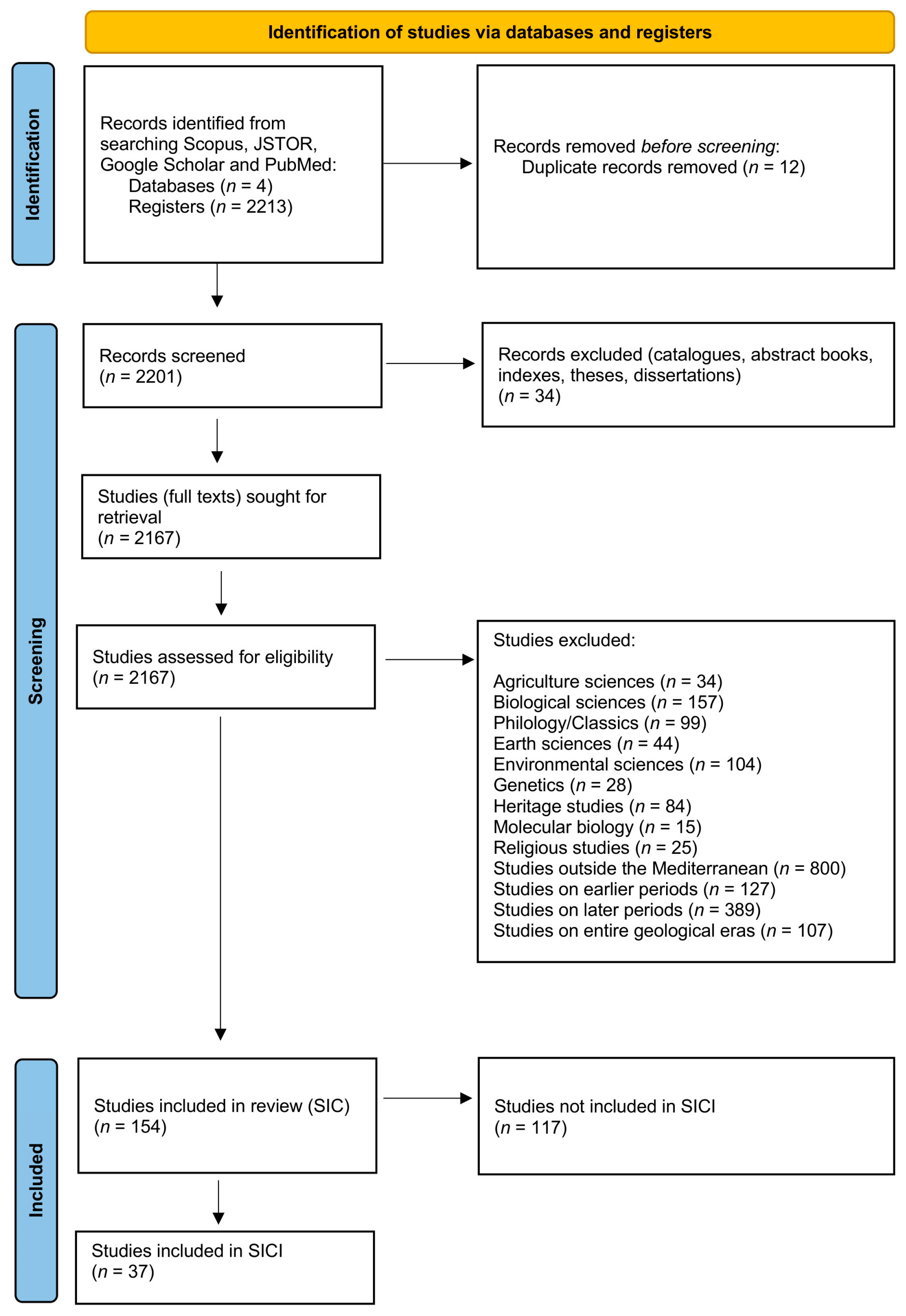
2. Methods
3. Results
3.1. Rise and Fall of World Systems, Macroscale Causal Links, and Collapse Research
3.2. Inequality, Subalternity, and Marginality
3.3. Agriculture, Crops, and Diet
3.4. Natural Resource Management and Water Supply
3.5. Epistemology and Methodology
3.6. Natural Archives and Climate Proxy Datasets
3.7. Isotope Analysis
3.8. Biomedicine and Archaeology
3.9. Subaltern Perceptions and Experiences
3.10. Big Data
3.11. Environmental and Climate Change Activism
3.12. Artificial Intelligence (AI)
4. Discussion
5. Conclusions
Supplementary Materials
Author Contributions
Funding
Institutional Review Board Statement
Informed Consent Statement
Data Availability Statement
Conflicts of Interest
Abbreviations
| AI | Artificial Intelligence |
| LBA | Late Bronze Age |
References
- Smith, G.S.; Anjum, E.; Francis, C.; Deanes, L.; Acey, C. Climate Change, Environmental Disasters, and Health Inequities: The Underlying Role of Structural Inequalities. Curr. Environ. Health Rep. 2022, 9, 80–89. [Google Scholar] [CrossRef]
- Nystrom, K.C.; Robbins Schug, G. A bioarchaeology of social inequality and environmental change. In The Routledge Handbook of the Bioarchaeology of Climate and Environmental Change; Robbins Schug, G., Ed.; Routledge: London, UK, 2024; pp. 159–188. [Google Scholar]
- Parsons, E.S.; Jowell, A.; Veidis, E.; Barry, M.; Israni, S.T. Climate change and inequality. Pediatr. Res. 2025, 98, 1238–1245. [Google Scholar] [CrossRef]
- Drake Brandon, L. The influence of climatic change on the Late Bronze Age Collapse and the Greek Dark Ages. J. Archaeol. Sci. 2012, 39, 1862–1870. [Google Scholar] [CrossRef]
- McCormick, M.; Büntgen, U.; Cane, M.A.; Cook, E.R.; Harper, K.; Huybers, P.; Litt, T.; Manning, S.W.; Mayewski, P.A.; More, A.F.M.; et al. Climate Change during and after the Roman Empire: Reconstructing the Past from Scientific and Historical Evidence. J. Interdiscip. Hist. 2012, 43, 169–220. [Google Scholar] [CrossRef]
- Robb, J. Achieving Equality: Why There Was Not as Much Inequality in Prehistoric Europe as We Imagine. Am. Antiq. 2025, 90, 446–466. [Google Scholar] [CrossRef]
- Perego, E.; Scopacasa, R. (Eds.) Burial and Social Change in First Millennium BC Italy: Approaching Social Agents; Gender, Personhood and Marginality; Oxbow Books: Oxford, UK, 2016. [Google Scholar]
- Courrier, C.; Magalhães de Oliveira, J.C. (Eds.) Ancient History from Below: Subaltern Experiences and Actions in Context; Routledge: London, UK, 2021. [Google Scholar]
- Bentz, M.; Zeidler, P. (Eds.) Dependency and Social Inequality in Pre-Roman Italy; De Gruyter: Berlin, Germany, 2024. [Google Scholar]
- Tricco, A.C.; Lillie, E.; Zarin, W.; O’Brien, K.K.; Colquhoun, H.; Levac, D.; Moher, D.; Peters, M.D.J.; Horsley, T.; Weeks, L.; et al. PRISMA extension for scoping reviews (PRISMA-ScR): Checklist and explanation. Ann. Intern. Med. 2018, 169, 467–473. [Google Scholar] [CrossRef]
- Kristiansen, K. Towards a New Paradigm? The Third Science Revolution and its Possible Consequences in Archaeology. Curr. Swed. Archaeol. 2014, 22, 11–34. [Google Scholar] [CrossRef]
- Page, M.J.; McKenzie, J.E.; Bossuyt, P.M.; Boutron, I.; Hoffmann, T.C.; Mulrow, C.D.; Shamseer, L.; Tetzlaff, J.M.; Akl, E.A.; Brennan, E.S.; et al. The PRISMA 2020 statement: An updated guideline for reporting systematic reviews. BMJ 2021, 372, 71. [Google Scholar] [CrossRef] [PubMed]
- Knapp, A.B.; Manning, S.W. Crisis in Context: The End of the Late Bronze Age in the Eastern Mediterranean. Am. J. Archaeol. 2016, 120, 99–149. [Google Scholar] [CrossRef]
- Levitt, M. Mycenaean Palace States. In Why Did Ancient States Collapse?: The Dysfunctional State; Archaeopress: Bicester, UK, 2019; pp. 15–20. [Google Scholar] [CrossRef]
- McConnell, J.R.; Sigl, M.; Plunkett, G.; Burke, A.; Kim, W.M.; Raible, C.C.; Wilson, A.I.; Manning, J.G.; Ludlow, F.; Chellman, N.J.; et al. Extreme climate after massive eruption of Alaska’s Okmok volcano in 43 BCE and effects on the late Roman Republic and Ptolemaic Kingdom. Proc. Natl. Acad. Sci. USA 2020, 117, 15443–15449. [Google Scholar] [CrossRef]
- Harper, K. The Fate of Rome: Climate, Disease and the End of an Empire; Princeton University Press: Princeton, NJ, USA, 2017. [Google Scholar]
- Clarke, J.; Brooks, N.; Banning, E.B.; Bar-Matthews, M.; Campbell, S.; Clare, L.; Cremaschi, M.; di Lernia, S.; Drake, N.; Gallinaro, M.; et al. Climatic changes and social transformations in the Near East and North Africa during the ‘long’ 4th millennium BC: A comparative study of environmental and archaeological evidence. Quat. Sci. Rev. 2016, 136, 96–121. [Google Scholar] [CrossRef]
- Haldon, J.; Eisenberg, M.; Mordechai, L.; Izdebski, A.; White, S. Lessons from the past, policies for the future: Resilience and sustainability in past crises. Environ. Syst. Decis. 2020, 40, 287–297. [Google Scholar] [CrossRef]
- Haldon, J.; Binois-Roman, A.; Eisenberg, M.; Izdebski, A.; Mordechai, L.; Newfield, T.; Slavin, P.; White, S.; Wnęk, K. Between Resilience and Adaptation: A Historical Framework for Understanding Stability and Transformation of Societies to Shocks and Stress. In COVID-19: Systemic Risk and Resilience; Linkov, I., Keenan, J.M., Trump, B.D., Eds.; Risk, Systems and Decisions; Springer: Cham, Switzerland, 2021. [Google Scholar] [CrossRef]
- Elliott, C.P. The Antonine plague, climate change and local violence in Roman Egypt. Past Present 2016, 231, 3–31. [Google Scholar] [CrossRef]
- Elliott, C.P. Pox Romana: The Plague That Shook the Roman World; Princeton University Press: Princeton, NJ, USA, 2024; pp. 213–232. [Google Scholar] [CrossRef]
- Manning, S.W.; Kocik, C.; Lorentzen, B.; Sparks, J.P. Severe multi-year drought coincident with Hittite collapse around 1198–1196 bc. Nature 2023, 614, 719–724. [Google Scholar] [CrossRef] [PubMed]
- Joffee, A. New Models for the End of the Chalcolithic in the Southern Levant. In Transitions During the Early Bronze Age in the Levant, Methodological Problems and Interpretative Perspectives; Adams, M.J., Roux, V., Eds.; Zaphon: Muenster, Germany, 2022; pp. 81–115. [Google Scholar]
- Hošek, J.; Verčík, M.; Pokorný, P.; Beneš, J.; Komárková, V.; Radoměřský, T.; Atanasoska, N.; Todoroska, V.; Ardjanliev, P. Geoarchaeological evidence on a Late Bronze Age earthquake, Ohrid Basin (North Macedonia). J. Quat. Sci. 2021, 36, 1003–1012. [Google Scholar] [CrossRef]
- Perego, E.; Amicone, S.R.; Scopacasa, R. (Eds.) Collapse or Survival? Crisis and Social Change in the Ancient Central Mediterranean; Oxbow: Oxford, UK, 2019. [Google Scholar]
- Perego, E.; Scopacasa, R. Micro-Dynamics of Crisis Following Disaster Events in Late Bronze and Iron Age Northern Italy. In Collapse or Survival: Micro-Dynamics of Crisis and Endurance in the Ancient Central Mediterranean; Perego, E., Scopacasa, R., Amicone, S., Eds.; Oxbow: Oxford, UK, 2019; pp. 1–28. [Google Scholar]
- Perego, E.; Scopacasa, R. Natural Disaster, Climate Change, and Marginalized Social Agents in Pre-Roman Italy: Case Studies from Veneto and Puglia. In Dependency and Social Inequality in Pre-Roman Italy; Bentz, M., Zeidler, P., Eds.; De Gruyter: Berlin, Germany, 2024. [Google Scholar]
- Perego, E.; Scopacasa, R. Landscapes of power in different ecosystems in 1st-millennium BC Italy: Veneto and Puglia. Stud. Hercynia 2025, 29, 47–60. [Google Scholar] [CrossRef]
- Liu, J. Urban Poverty in the Roman Empire: Material Conditions. In Paul and Economics: A Handbook; Blanton, T.R., Pickett, R., Eds.; Augsburg Fortress: Minneapolis, MN, USA, 2017; pp. 23–56. Available online: https://doi-org.uoelibrary.idm.oclc.org/10.2307/j.ctt1kgqtgr.7 (accessed on 5 January 2026).
- Redfern, R. ‘Becoming darkness’ and the invisible slave economy: Archaeological approaches to the study of enslavement in the Roman world. In Materialising the Roman Empire; Tanner, J., Gardner, A., Eds.; UCL Press: London, UK, 2024; pp. 147–180. [Google Scholar] [CrossRef]
- Bond, S.E. Trade and Taboo: Disreputable Professions in the Roman Mediterranean; University of Michigan Press: Ann Arbor, MI, USA, 2016. [Google Scholar] [CrossRef]
- Peregrine, P.N. Chapter 4. Political Participation and Social Resilience to the 536/540 CE Atmospheric Catastrophe. In Going Forward by Looking Back: Archaeological Perspectives on Socio-Ecological Crisis, Response, and Collapse; Riede, F., Sheets, P., Eds.; Berghahn Books: New York, NY, USA, Oxford, UK, 2020; pp. 108–133. [Google Scholar] [CrossRef]
- Meyer, N.; Knapp, A.B. Resilient Social Actors in the Transition from the Late Bronze to the Early Iron Age on Cyprus. J. World Prehist. 2021, 34, 433–487. [Google Scholar] [CrossRef]
- Lai, L.; Crispu, S. Social Organization, Intersections, and Interactions in Bronze Age Sardinia. Reading Settlement Patterns in the Area of Sarrala with the Contribution of Applied Sciences. Open Archaeol. 2024, 10, 20220358. [Google Scholar] [CrossRef]
- Huebner, S.R. Reconstructing the Nile: Climate, agriculture, and socio-economic change in Roman Egypt. J. Anc. Hist. 2025, 13, 307–362. [Google Scholar] [CrossRef]
- Grey, C. Writing agrarian histories of the Roman world: Seasonality and scale as tools of analysis. Int. Labor Work.-Cl. Hist. 2018, 93, 228–238. [Google Scholar] [CrossRef]
- Perego, E.; Scopacasa, R. The agency of the displaced? Roman expansion, environmental forces, and the occupation of marginal lanscapes in ancient Italy. Humanities 2018, 7, 116. [Google Scholar] [CrossRef]
- Rieger, A.-K. ‘Un-Central’ Landscapes of NE-Africa and W-Asia—Landscape Archaeology as a Tool for Socio-Economic History in Arid Landscapes. Land 2019, 8, 1. [Google Scholar] [CrossRef]
- Perego, E.; Tamorri, V.; Scopacasa, R. Marginal Identities in Iron Age Veneto: A Case Study Based on Micro-Scale Contextual Analysis and Burial Taphonomy. In Multiple Identities in Prehistory, Early History and Presence; Bistáková, A., Březinová, G., Ramsl, P.C., Eds.; Archeologický ústav SAV: Nitra, Slovakia, 2020; pp. 81–96. [Google Scholar]
- Perego, E.; Tamorri, V.; Scopacasa, R. Child Personhood in Iron Age Veneto: Insights from Micro-Scale Contextual Analysis and Burial Taphonomy. In Ages and Abilities: The Stages of Childhood and Their Social Recognition in Prehistoric Europe and Beyond; Rebay-Salisbury, K., Pany-Kucera, D., Eds.; Archaeopress: Oxford, UK, 2020; pp. 174–192. [Google Scholar]
- Riehl, S.; Deckers, K.; Hinojosa-Baliño, I.; Gröcke, D.R.; Lawrence, D. Fluctuations of viti- and oleiculture traditions in the Bronze and Iron Age Levant. PLoS ONE 2025, 20, e0330032. [Google Scholar] [CrossRef]
- Fuller, B.T.; Riehl, S.; Linseele, V.; Marinova, E.; De Cupere, B.; Bretschneider, J.; Richards, M.P.; Van Neer, W. Agropastoral and dietary practices of the northern Levant facing Late Holocene climate and environmental change: Isotopic analysis of plants, animals and humans from Bronze to Iron Age Tell Tweini. PLoS ONE 2024, 19, e0301775. [Google Scholar] [CrossRef]
- Columbu, A.; Pérez-Mejías, C.; Regattieri, E.; Lugli, F.; Dong, X.; Depalmas, A.; Melis, R.; Cipriani, A.; Cheng, H.; Zanchetta, G.; et al. Speleothems uncover Late Holocene environmental changes across the Nuragic period in Sardinia (Italy): A possible human influence on land use during bronze to post-Iron Age cultural shifts. Quat. Sci. Rev. 2024, 328, 108534. [Google Scholar] [CrossRef]
- Langgut, D.; Finkelstein, I.; Litt, T.; Neumann, F.H.; Stein, M. Vegetation and Climate Changes during the Bronze and Iron Ages (~3600–600 BCE) in the Southern Levant Based on Palynological Records. Radiocarbon 2015, 57, 217–235. [Google Scholar] [CrossRef]
- Roberts, N. Revisiting the Beyşehir Occupation Phase: Land-Cover Change and the Rural Economy in the Eastern Mediterranean during the First Millennium AD. In Environment and Society in the Long Late Antiquity; Brill: Leiden, The Netherlands, 2019. [Google Scholar] [CrossRef]
- Mora-González, A.; Delgado-Huertas, A.; Granados-Torres, A.; Cortés, F.C.; Soldevila, I.P.; Espino, D.D. Complex agriculture during the second millennium BC: Isotope composition of carbon studies (δ13C) in archaeological plants of the settlement Cerro del Castillo de Alange (SW Iberian Peninsula, Spain). Veg. Hist. Archaeobotany 2018, 27, 453–462. [Google Scholar] [CrossRef]
- Soncin, S.; Talbot, H.M.; Fernandes, R.; Harris, A.; von Tersch, M.; Robson, H.K.; Bakker, J.K.; Richter, K.K.; Alexander, M.; Ellis, S.; et al. High-resolution dietary reconstruction of victims of the 79 CE Vesuvius eruption at Herculaneum by compound-specific isotope analysis. Sci. Adv. 2021, 7, eabg5791. [Google Scholar] [CrossRef] [PubMed]
- Bernigaud, N.; Bondeau, A.; Guiot, J.; Bouby, L.; Bertoncello, F.; Ouriachi, M.J. Reconstructing vineyard’s geography, yields and profitability of wine production in Roman empire: New insights of spatial-analysis, Agent-based modelling, and climate-vegetation models. In Methods in Ancient Wine Archaeology, Scientific Approaches in Roman Contexts; Dodd, E., Van Limbergen, D., Eds.; Bloomsbury: London, UK, 2024; pp. 215–226. [Google Scholar]
- Fuks, D.; Bar-Oz, G.; Tepper, Y.; Erickson-Gini, T.; Langgut, D.; Weissbrod, L.; Weiss, E. The rise and fall of viticulture in the Late Antique Negev Highlands reconstructed from archaeobotanical and ceramic data. Proc. Natl. Acad. Sci. USA 2020, 117, 19780–19791. [Google Scholar] [CrossRef]
- Nencini, P. Ubriachezza e Sobrietà nel Mondo Antico. Alle Radici del bere Moderno; Gruppo Editoriale Muzzio srl: Roma, Italy, 2009. [Google Scholar]
- Riva, C. The Urbanization of Etruria: Funerary Practices and Social Change, 700–600 BC; Cambridge University Press: Cambridge, UK, 2010. [Google Scholar]
- Iaia, C. Styles of drinking and the burial rites of Early Iron Age Middle-Tyrrhenian Italy. In Burial and Social Change in First Millennium BC Italy: Approaching Social Agents; Perego, E., Scopacasa, R., Eds.; Oxbow Books: Oxford, UK, 2016; Volume 11, pp. 31–54. Available online: http://www.jstor.org/stable/j.ctt1kw29j0.7 (accessed on 18 March 2026).
- Veal, R. The Politics and Economics of Ancient Forests: Timber and Fuel as Levers of Greco-Roman Control; Hardt Foundation: Westlake Village, CA, USA, 2017. [Google Scholar] [CrossRef]
- Bonnie, R.; Klingborg, P. (Eds.) Water in Ancient Mediterranean Households, 1st ed.; Routledge: London, UK, 2023. [Google Scholar] [CrossRef]
- Fiorentino, G.; Goffredo, R.; Mazzini, I.; Susini, D.; Totten, D.M. Diachronic human-wetland interactions on the Salpi Lagoon (Apulia, Italy): Paleoenvironmental and archaeological reconstruction from the pre-Roman period to the Early Middle Ages. In Waterscapes Archaeology: Multi-Scalar Human-Environment Interactions in Coastal Lagoons; Bivolaru, A., Cottica, D., Morhange, C., Eds.; Archaeopress: Bicester, UK, 2025; pp. 38–70. [Google Scholar] [CrossRef]
- Locicero, M.A. Posthumanism, Social Justice, and Pollution in the Waters of Roman Volubilis. In Water in Ancient Mediterranean Households; Routledge: London, UK, 2023; pp. 118–132. [Google Scholar]
- Ronin, M. Sharing water in the roman countryside: Environmental issues, economic interests, and legal solutions. In Water Management in Ancient Civilizations; Topoi: Berlin, Germany, 2018; pp. 107–115. [Google Scholar]
- Manning, S.W. Climate and the Ancient World: Beyond Present Concerns to Complications, Where Details Matter. Heritage 2025, 8, 168. [Google Scholar] [CrossRef]
- Padilla Peralta, D.E. Epistemicide: The Roman Case. Class. Rev. Bras. Estud. Clássicos 2020, 33, 151–186. [Google Scholar] [CrossRef]
- Bernard, S.; McConnell, J.; Di Rita, F.; Michelangeli, F.; Magri, D.; Sadori, L.; Masi, A.; Zanchetta, G.; Bini, M.; Celant, A.; et al. An Environmental and Climate History of the Roman Expansion in Italy. J. Interdiscip. Hist. 2023, 54, 1–41. [Google Scholar] [CrossRef]
- Mass, T.; Drake, J.; Martinez, S.; Stolarski, J.; Sharvit, J. Bridging Archaeology and Marine Ecology: Coral Archives of Hellenistic Coastal Change. Sustainability 2025, 17, 8893. [Google Scholar] [CrossRef]
- Kyle, B.; Reitsema, L. Social variation in an urban environment and its impacts on stress: Preliminary results from Ancient Greek Himera (Sicily). In The Routledge Handbook of the Bioarchaeology of Climate and Environmental Change, 1st ed.; Robbins Schug, G., Ed.; Routledge: London, UK, 2020. [Google Scholar] [CrossRef]
- Reitsema, L.J.; Kyle, B.; Vassallo, S. Food traditions and colonial interactions in the ancient Mediterranean: Stable isotope evidence from the Greek Sicilian colony Himera. J. Anthropol. Archaeol. 2020, 57, 10114. [Google Scholar] [CrossRef]
- Reinberger, K.L.; Reitsema, L.J.; Kyle, B.; Vassallo, S.; Kamenov, G.; Krigbaum, J. Isotopic evidence for geographic heterogeneity in Ancient Greek military forces. PLoS ONE 2021, 16, e0248803. [Google Scholar] [CrossRef] [PubMed]
- Lai, L.; Fonzo, O.; Tykot, R.H.; Goddard, E.; Hollander, D.; Medda, L.; Tanda, G. Intensified exploitation of animal products in the Mediterranean Copper Age: Isotopic evidence from Scaba’e Arriu (Sardinia). Archaeol. Anthropol. Sci. 2024, 16, 53. [Google Scholar] [CrossRef]
- Trentacoste, A.; Nieto-Espinet, A.; Chiarelli, S.G.; Valenzuela-Lamas, S. Systems change: Investigating climatic and environmental impacts on livestock production in lowland Italy between the Bronze Age and Late Antiquity (c. 1700 BC–AD 700). Quat. Int. 2023, 662–663, 26–36. [Google Scholar] [CrossRef]
- Farese, M.; Soncin, S.; Robb, J.; Fernandes, R.; Tafuri, M.A. The Mediterranean archive of isotopic data, a dataset to explore lifeways from the Neolithic to the Iron Age. Sci. Data 2023, 10, 917. [Google Scholar] [CrossRef]
- Formichella, G.; Soncin, S.; Lubritto, C.; Tafuri, M.A.; Fernandes, R.; Cocozza, C. Introducing Isotòpia: A stable isotope database for Classical Antiquity. bioRxiv 2023. [Google Scholar] [CrossRef]
- Cavazzuti, C.; Cardarelli, A.; Quondam, F.; Salzani, L.; Ferrante, M.; Nisi, S.; Millard, A.R.; Skeates, R. Mobile elites at Frattesina: Flows of people in a Late Bronze Age ‘port of trade’ in northern Italy. Antiquity 2019, 93, 624–644. [Google Scholar] [CrossRef]
- Laffranchi, Z.; Cavalieri Manasse, G.; Salzani, L.; Milella, M. Patterns of funerary variability, diet, and developmental stress in a Celtic population from NE Italy (3rd-1st c BC). PLoS ONE 2019, 14, e0214372. [Google Scholar] [CrossRef] [PubMed]
- Finné, M.; Holmgren, K.; Shen, C.-C.; Hu, H.-M.; Boyd, M.; Stocker, S. Late Bronze Age climate change and the destruction of the Mycenaean Palace of Nestor at Pylos. PLoS ONE 2017, 12, e0189447. [Google Scholar] [CrossRef]
- Byrnes, J.F.; Muller, J.L. (Eds.) Bioarchaeology of impairment and disability. In Theoretical, Ethnohistorical, and Methodological Perspectives; Springer: Cham, Switzerland, 2018. [Google Scholar]
- Bohling, S.; Croucher, K.; Buckberry, J. The Bioarchaeology of Disability: A population-scale approach to investigating disability, physical impairment, and care in archaeological communities. Int. J. Paleopathol. 2022, 38, 76–94. [Google Scholar] [CrossRef]
- Williams Reed, E.B. Ecological Grief and the Safaitic Inscriptions of Ancient North Arabia. In Conversing with Chaos in Graeco-Roman Antiquity: Writing and Reading Environmental Disorder in Ancient Texts; Eidinow, E., Schliephake, C., Eds.; Bloomsbury Academic: London, UK, 2024; pp. 135–148. [Google Scholar] [CrossRef]
- Green, C. Big data in Archaeology. In Handbook of Archaeological Sciences; Pollard, M., Armitage, R.A., Makarewicz, C.A., Eds.; Blackwell: London, UK, 2023; Volume 2, pp. 1249–1259. [Google Scholar]
- Murray, S. Chapter 2 Big Data and Greek Archaeology: Potential, Hazards, and a Case Study from Early Greece. In New Approaches to Ancient Material Culture in the Greek & Roman World; Brill: Leiden, The Netherlands, 2020. [Google Scholar] [CrossRef]
- Chelazzi, F.; Bonzano, S. Thinking Data. Integrative Big Data Approaches towards an ‘Introspective’ Digital Archaeology in the Ancient Mediterranean. In Broadening Horizons 5. Proceedings of the 5th “Broadening Horions” Conference (Udine 5–8 June 2017). Volume 3: Interactions and New Directions in Near Eastern Archaeology; Coppini, C., Simi, F., Eds.; EUT Edizioni Università di Trieste: Trieste, Italy, 2021; pp. 59–76. [Google Scholar]
- Perego, E.; Scopacasa, R. MARGA—The MARGinality in Archaeology database: Insights and gaps in the bioarchaeological study of marginalized communities, c.1200 BC–25 AD. SocArXiv 2024. [Google Scholar] [CrossRef]
- Perego, E.; Scopacasa, R. Big Data for the study of lifeways in ancient Italy: The “Inhumation Veneto” and “Samnium” databases. Preist. Alp. 2024, 54, 183–196. [Google Scholar]
- Hill, N.; Beeler, M. Teaching an antiracist Archaeology of the Ancient Mediterranean. In Ethics in Archaeological Practice; Costello, S.K., Lepinsky, S., Eds.; American Society of Overseas Research: Alexandria, VA, USA, 2024; pp. 71–90. [Google Scholar]
- Douglass, K.; Cooper, J. Archaeology, environmental justice, and climate change on islands of the Caribbean and southwestern Indian Ocean. Proc. Natl. Acad. Sci. USA 2020, 117, 8254–8262. [Google Scholar] [CrossRef] [PubMed]
- Klein, K.; Muller, A.; Wohde, A.; Gorelik, A.V.; Heyd, V.; Lämmel, R.; Diekmann, Y.; Brami, M. An AI-assisted workflow for object detection and data collection from archaeological catalogues. J. Archaeol. Sci. 2025, 179, 106244. [Google Scholar] [CrossRef]
- Tricco, A.; Zarin, W. Social Media for Pharmacovigilance. Available online: https://osf.io/h7ets/files/kv9hu (accessed on 18 March 2026).


| Topics Identified | Features/Sub-Topics Discussed (Including Rising Ones) |
|---|---|
| 1. Rise and fall of world systems, macroscale causal links, and collapse research |
|
| 2. Inequality, subalternity, marginality |
|
| 3. Agriculture, crops, diet |
|
| 4. Natural resource management and water supply |
|
| 5. Epistemology and methodology |
|
| 6. Natural archives and climate proxy datasets |
|
| 7. Isotope analysis |
|
| 8. Biomedicine and Archaeology |
|
| 9. Subaltern perceptions and experiences |
|
| 10. Big Data |
|
| 11. Environmental and climate change activism |
|
| 12. Artificial intelligence |
|
| Ongoing Initiatives | Scope/Features | Link |
|---|---|---|
| EAA 2026 General Conference Theme, “Resonant Pasts” | This topic includes many themes around activism and the value of Archaeology in today’s world. | https://www.e-a-a.org |
| EAA 2026 Conference Key Theme n.5, “Changing worlds and environments in the past, present and future | The theme aims to explore “human adaptations to climate change through foraging and agricultural practice: resilience, innovation and change”. | https://www.e-a-a.org/EAA2026/EAA2026/Programme_tabs/Themes.aspx?hkey=03e8f972-aece-417e-ac08-dbb06ec07ff5 |
| EAA 2026 Conference Key Theme n.2, “Crossing the divide: Archaeology and the open world” | The theme includes among its subjects “Archaeology and social movements”, which can connect with climate and environmental justice movements, and “Ethics of Artificial Intelligence (AI) in archaeology”. | https://www.e-a-a.org/EAA2026/EAA2026/Programme_tabs/Themes.aspx?hkey=03e8f972-aece-417e-ac08-dbb06ec07ff5 |
| EAA 2026 Session #15, “Marginality and environmental shifts: from socioecological perspectives on the Ancient Mediterranean to present-day ramifications” | This session explores the impact of climate and environmental shifts on marginalised/underprivileged groups, from the vantage point of the ancient Mediterranean. It addresses AI, climate activism and Big Data (organisers: R. Scopacasa, E. Perego, K.S. Lee). | https://submissions.e-a-a.org/eaa2026/sessions/overview/index |
| The End of the Spectrum: Towards an Archaeology of Marginality | An international, interdisciplinary research network on inequality and social marginality. Major topics of interest include marginality in times of climate change and environmental instability (co-coordinators E. Perego, A. Gardner, A. Reynolds). | https://www.ucl.ac.uk/social-historical-sciences/archaeology/research/research-directory/networks-and-centres/end-spectrum-towards-archaeology-marginality-network |
| MARGA—The MARGinality in Archaeology Database | A database and project on marginalised individuals that includes material culture and bioarchaeological data such as isotopes. It addresses the meaning of Big Data in Archaeology (PI E. Perego and R. Scopacasa). | https://osf.io/preprints/socarxiv/fjsm8_v1 |
| CALAMITAS: Perceptions and experiences of climatic and environmental disasters in the Roman Mediterranean | A research project on cultural perceptions and lived experiences of climate and environmental shocks in the Roman Mediterranean c. 100 BC–AD 200, including in non-élite, everyday contexts (PI R. Scopacasa). | (website under development) |
| CoPOWER—Government of Life and Death: the rise of coercive power in European Late Prehistory | A research project which adopted state-of-the-art archaeological and bioarchaeological approaches to investigate the transition to urban society and the rise of increasingly sophisticated control mechanisms in Europe, including Italy, c. 2000–500 BC, with a focus on marginalised individuals, disability, and human–environment interactions (PI E. Perego). | https://www.oeaw.ac.at/en/oeai/research/prehistory-wana-archaeology/prehistoric-identities/copower |
Disclaimer/Publisher’s Note: The statements, opinions and data contained in all publications are solely those of the individual author(s) and contributor(s) and not of MDPI and/or the editor(s). MDPI and/or the editor(s) disclaim responsibility for any injury to people or property resulting from any ideas, methods, instructions or products referred to in the content. |
© 2026 by the authors. Licensee MDPI, Basel, Switzerland. This article is an open access article distributed under the terms and conditions of the Creative Commons Attribution (CC BY) license.
Share and Cite
Perego, E.; Scopacasa, R. Climate Change and Inequality in the Ancient Mediterranean: A Scoping Review. Encyclopedia 2026, 6, 110. https://doi.org/10.3390/encyclopedia6050110
Perego E, Scopacasa R. Climate Change and Inequality in the Ancient Mediterranean: A Scoping Review. Encyclopedia. 2026; 6(5):110. https://doi.org/10.3390/encyclopedia6050110
Chicago/Turabian StylePerego, Elisa, and Rafael Scopacasa. 2026. "Climate Change and Inequality in the Ancient Mediterranean: A Scoping Review" Encyclopedia 6, no. 5: 110. https://doi.org/10.3390/encyclopedia6050110
APA StylePerego, E., & Scopacasa, R. (2026). Climate Change and Inequality in the Ancient Mediterranean: A Scoping Review. Encyclopedia, 6(5), 110. https://doi.org/10.3390/encyclopedia6050110