

Spatiotemporal Data Science
 ,
,  , ,
, ,  ,
,  ,
,  ,
,
Definition
1. Introduction
- Domain sciences, which provide a mechanistic understanding of environmental, climatic, public health, engineering, economic, and social systems [28];
- Advanced computational infrastructure, such as cloud-native architectures, GPU acceleration, Field-Programmable Gate Array (FPGA) systems, and edge computing platforms, supporting scalable, real-time intelligence [30];
2. Historical Development and Key Advances
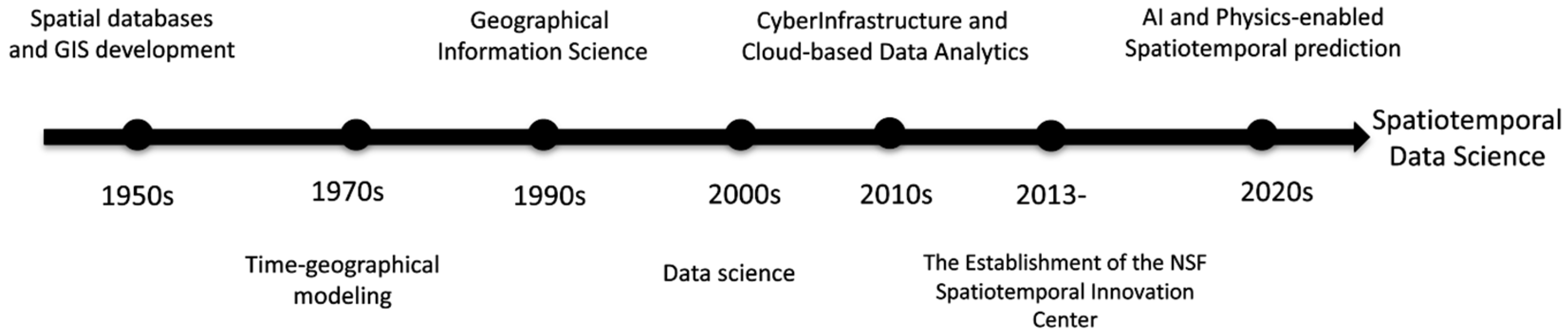
2.1. Milestones of Spatiotemporal Data Science Evolution
- Spatial databases and GIS architectures [37], which established the computational foundations for digital representation, querying, and structured management of spatial information. They laid the groundwork for machine-readable geospatial knowledge [38]. Analytical methods such as spatial autocorrelation [9], modifiable area unit [39], and geostatistics [40] were further introduced to enrich the functionality. The success of GIS in the past decades has expanded the architecture from single workstations to cloud-computing-based GIS, which paved one of the architectural foundations for Spatiotemporal Data Science.
- Time-geographic and temporal modeling frameworks [11], which introduced formal representations of movement, constraints, and dynamic processes, enabling reasoning about change and evolution rather than static patterns [41]. This research has been further enhanced in the past decade to analyze dynamic patterns in various applications, such as detecting GIS objects [42] and human motion [43].
- Spatiotemporal indexing and scalable storage mechanisms [44], which made it possible to manage and retrieve massive, high-velocity datasets—an essential prerequisite for real-time analytics and adaptive learning [45]. This key advancement not only enabled us to store big spatiotemporal data, but also enabled the efficient analyses and mining of the big data [26,46].
- Big data frameworks [47] for Earth observation and environmental monitoring, which enabled distributed processing, data exchange, and large-scale model integration across heterogeneous sensing systems. These frameworks paved the path for us to leverage distributed big spatiotemporal data assets in a federated fashion for interoperable access and analyses [48,49].
- Cloud-native and distributed geospatial computing [18], which introduced elastic, on-demand computational infrastructure capable of supporting continuous model updating and scalable simulation. Cloud and distributed computing provide the on-demand and sometimes real-time processing capabilities for big spatiotemporal data to address emergencies such as flooding [20] and global conflict [24].
- AI-enabled spatiotemporal prediction and pattern discovery [50], which shifted the field from descriptive analysis toward predictive intelligence, enabling systems to learn evolving dynamics from complex data streams. The last decadal advancement in AI and machine learning helped provide the surrogate models to process big spatiotemporal data for patterns and principles toward prediction and discovery [51,52].
2.2. Relationship to GIScience and Data Science
3. Foundations of Spatiotemporal Data Science
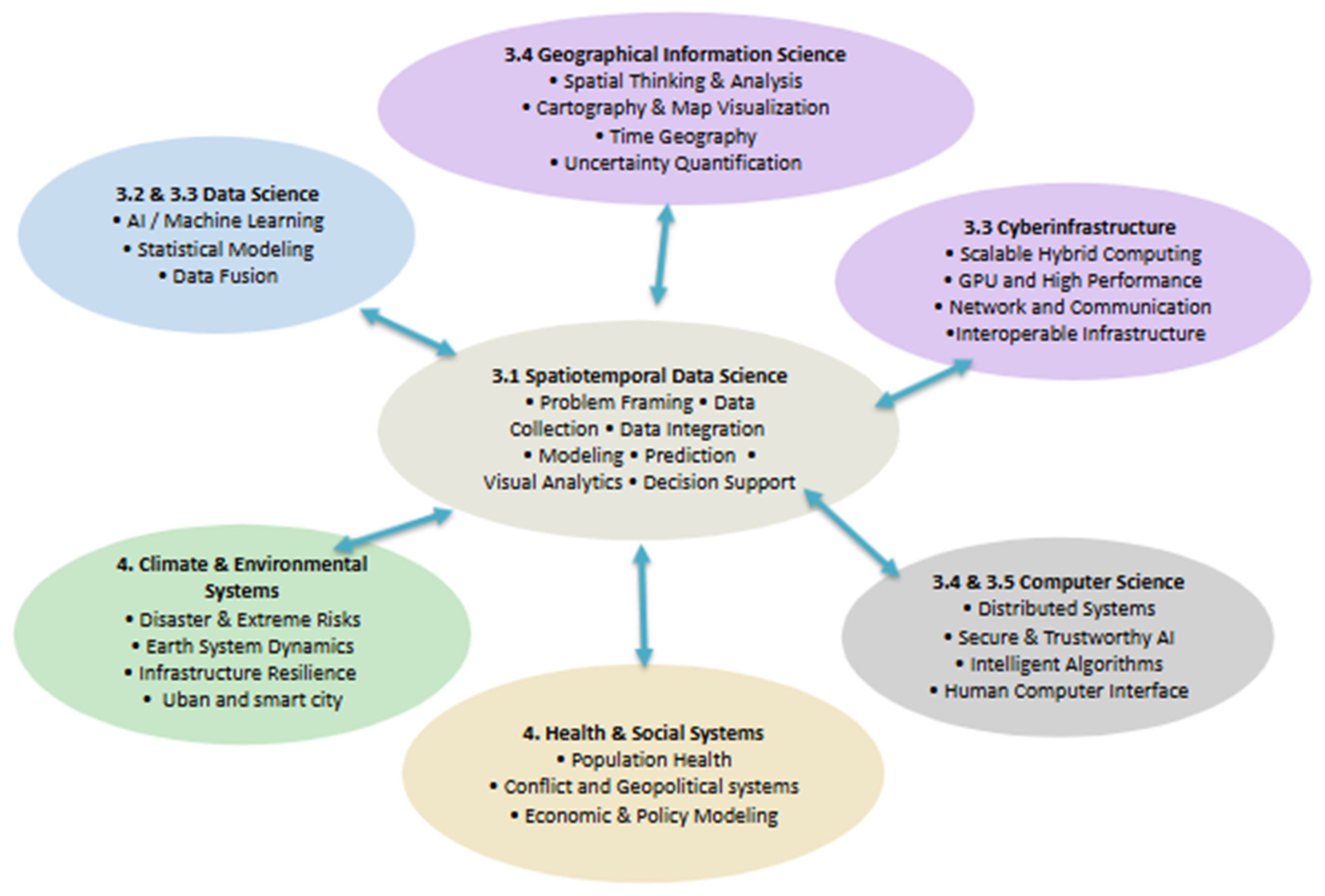
3.1. Conceptual Architecture
- Dynamic problem framing and contextual reasoning: Domain knowledge, physical principles, and policy objectives are formalized into computational representations that define system goals, constraints, and performance metrics. Rather than a static problem definition, this phase enables evolving objective refinement as new evidence emerges in a dynamic manner. For example, wildfire intelligence systems dynamically update risk thresholds and response strategies as environmental conditions change [56].
- Multi-modal data perception and acquisition: Heterogeneous spatiotemporal data streams—including environmental, infrastructural, and social signals—are continuously ingested to support real-time situational awareness. Data requirements are adaptively adjusted based on evolving model states and uncertainty levels.
- Cross-scale harmonization and knowledge integration: Data are aligned across spatiotemporal scales, resolutions, and semantic frameworks to construct coherent system representations. This integration enables consistent reasoning across heterogeneous domains and supports modeling and decision synchronization across space and time.
- Hybrid analytical modeling and predictive reasoning: AI-driven learning models and physics-based simulations interact to generate forecasts, detect anomalies, and evaluate alternative solutions. Models are continuously validated and refined as new spatiotemporal data streams become available, enabling learning-based and self-improving intelligence.
- Cognitive visualization and human–AI interactive analytics: Multi-dimensional visualization environments and interactive interfaces translate predictive outputs into interpretable insights. They facilitate collaborative reasoning between human experts and intelligent systems in real time.
- Decision support, proactive response, and feedback integration: Analytical outputs continuously inform policy, operational, or automated responses. Outcomes of these actions are fed back into the system, enabling continuous learning, performance calibration, and refinement of predictive and decision models for dynamic systems.
3.2. Data Collection and Generation Mechanisms
- In situ sensor networks, deployed near observed phenomena to provide high-spatiotemporal-resolution, ground-based measurements such as rainfall, air quality, soil moisture, and infrastructure stress. These sensors enable real-time environmental awareness and localized reactive response [58].
- Satellite and airborne remote sensing platforms, which provide large-scale, synoptic observation of Earth systems continuously, including wildfire detection, land surface temperature monitoring, atmospheric dynamics, and ocean circulation. These systems enable continuous global surveillance and cross-scale monitoring.
- IoT devices and edge computing systems, embedded in smartphones, wearable technologies, smart infrastructure, and industrial systems. These devices support distributed sensing and on-device processing in high-velocity, continuous streams, enabling low-latency perception and localized decision-making.
- Crowdsourced and participatory sensing, capturing near-real-time human-generated signals such as mobility traces, social media activity, and public opinion indicators. These data streams extend environmental perception into social and behavioral domains.
- Simulation outputs and computational forecasts, including high-resolution weather prediction, wildfire spread modeling, and conflict evolution simulations. These synthetic high-velocity data streams act as predictive extensions of observational systems, enabling anticipatory intelligence.
- Administrative and transactional datasets, representing economic activities, infrastructure projects, policy interventions, and supply chain dynamics [59]. When integrated with physical observations, these datasets enable cross-domain reasoning about coupled human–environment systems.
3.3. Data Management and Infrastructure
- Distributed and resilient storage architectures, capable of ingesting streaming data from geographically dispersed sources while ensuring redundancy, fault tolerance, and persistent knowledge representation for high-value datasets.
- High-speed networking and low-latency communication systems, enabling rapid data synchronization, model updating, and coordination across distributed computational nodes and digital twin instances.
- Cloud-native and hybrid computing platforms, providing elastic, on-demand computational capacity for large-scale simulation, self-learning, and event-driven analytics, while maintaining long-term operational stability.
- GPU-accelerated and parallel processing frameworks, supporting large-scale simulation, real-time inference, and the training of foundation and generative models within evolving spatiotemporal environments.
- Advanced spatiotemporal indexing, compression, and retrieval mechanisms, enabling efficient querying of massive, multi-resolution datasets and supporting near real-time analytical responsiveness [60].
- Interoperable and federated cyberinfrastructure ecosystems, facilitating secure data exchange, distributed learning, and coordinated model execution across institutions, regions, and domains.
3.4. Analytical Methods
- Spatiotemporal data mining, which extracts evolving patterns, anomalies, and dependencies from large-scale and streaming datasets, forming the foundation for dynamic situational awareness.
- Machine learning and deep learning architectures, capable of learning nonlinear spatiotemporal representations and continuously refining predictive models as new data streams become available.
- Generative AI and foundation models, which generalize knowledge across domains and scales, enabling transfer learning, scenario simulation, and adaptive forecasting within complex environments.
- Physics-based and geophysical simulations [61], which encode a mechanistic understanding of natural and engineered systems—providing structured constraints and interpretability to complement data-driven learning.
- Network and time-geographic models, which capture movement, interaction, and constraint structures across social, economic, and infrastructure systems—supporting anticipatory modeling of cascading effects.
- Uncertainty quantification and explainable AI frameworks, which provide transparency, probabilistic reasoning, and trust calibration—essential for semi-autonomous and autonomous decision support systems.
3.5. Visualization and Human Interaction
- Multi-dimensional visualization (2D, 3D, and 4D) environments that dynamically represent evolving phenomena, enabling users to explore patterns, simulate alternative scenarios, and evaluate trade-offs across space and time.
- Virtual and augmented reality platforms, which provide immersive environments for interacting with complex application systems, supporting intuitive spatial reasoning, training, and operational planning in real time.
- Immersive analytics frameworks, combining visualization, interaction, and real-time data streams to support deeper cognitive engagement with dynamic systems.
- Interactive and intelligent dashboards, capable of integrating high-velocity streaming data, predictive models, and uncertainty quantification, allowing users to query, test, and refine hypotheses across spatial and temporal scales within specific spatiotemporal contexts.
- Intelligent decision-support interfaces, customized for operational contexts, that prioritize actionable insights, compress cognitive load, and enable rapid response in high-stakes environments such as disaster management, conflict monitoring, and public health emergencies.
4. Applications
- Climate and environmental intelligence systems, enabling continuous monitoring, risk forecasting, and self-adjusting insurance and policy decisions for coastal resilience, wildfire-driven air quality, and climate-induced hazards.
- Autonomous disaster risk management systems, fusing multi-source spatiotemporal data to anticipate flooding, hurricane impacts, water quality degradation, and cascading infrastructure failures through predictive modeling and dynamic risk assessment.
- Transportation and infrastructure intelligence networks, continuously assessing safety zones, aging assets, traffic dynamics, and climate-induced vulnerabilities to enable proactive maintenance, resilience planning, and intelligent mobility management.
- Public health and pandemic intelligence platforms, integrating real-time surveillance, predictive epidemiological modeling, and scenario simulation to support responsive interventions, policy optimization, and resilient governance during crises such as COVID-19.
- Conflict monitoring and geopolitical intelligence systems, fusing satellite imagery, social media signals, and ground observations to update evolving front lines and detect emerging tensions in near real time [24].
- Economic and supply chain intelligence architectures, modeling spatially distributed production networks and trade flows to anticipate policy impacts, mitigate disruptions, and support resilient logistics under uncertainty.
5. Future Directions: From Analytics to Autonomous Intelligence
- Autonomous spatiotemporal reasoning systems that integrate domain knowledge, physical principles, and data-driven learning to enable self-adjusting understanding of dynamic environments across scales.
- Explainable, trustworthy, and self-improving AI architectures capable of continuously discovering patterns from streaming spatiotemporal data, updating models in real time, and quantifying uncertainty to support reliable autonomous decision-making.
- Real-time digital twin ecosystems that evolve in synchrony with physical systems, enabling simulation, prediction, and intelligent intervention for complex real-world challenges through closed-loop feedback mechanisms.
- Cross-domain interoperable intelligence infrastructures that integrate heterogeneous spatiotemporal datasets across regional, national, and global systems—supporting coordinated, autonomous responses to interconnected crises such as pandemics, climate extremes, and infrastructure disruptions [19].
- Open, collaborative intelligence platforms that enable shared data, models, computing resources, and AI agents to co-evolve through federated learning, distributed analytics, and interoperable cyberinfrastructure.
- Ethical governance frameworks for autonomous spatiotemporal intelligence systems, ensuring transparency, accountability, fairness, and human oversight in digital twin–enabled decision environments.
- Self-optimizing, resilient societal systems empowered by continuously learning spatiotemporal intelligence, enabling proactive risk mitigation, anticipatory governance, and sustainable system optimization.
Author Contributions
Funding
Institutional Review Board Statement
Informed Consent Statement
Data Availability Statement
Acknowledgments
Conflicts of Interest
Abbreviations
| IoT | Internet of Things |
| AI | Artificial Intelligence |
| GPU | Graphics Processing Unit |
| GPS | Global Positioning System |
| COVID-19 | Coronavirus Disease 2019 |
| FPGA | Field-Programmable Gate Array |
| 2D | Two-Dimensional |
| 3D | Three-Dimensional |
| 4D | Four-Dimensional |
| NSF | National Science Foundation |
| NASA | National Aeronautics and Space Administration |
| NOAA | National Oceanic and Atmospheric Administration |
| CISTO | Computational and Information Sciences and Technology Office |
| AIST | Advanced Information Systems Technology |
| IUCRC | Industry-University Cooperative Research Center |
References
- Kraus, S.; Jones, P.; Kailer, N.; Weinmann, A.; Chaparro-Banegas, N.; Roig-Tierno, N. Digital Transformation: An Overview of the Current State of the Art of Research. SAGE Open 2021, 11, 21582440211047576. [Google Scholar] [CrossRef]
- Goodchild, M.F. Citizens as sensors: The world of volunteered geography. GeoJournal 2007, 69, 211–221. [Google Scholar] [CrossRef]
- Gore, A. The Digital Earth: Understanding our planet in the 21st century. Aust. Surv. 1998, 43, 89–91. [Google Scholar] [CrossRef]
- Hey, A.J.; Tansley, S.; Tolle, K.M. The Fourth Paradigm: Data-Intensive Scientific Discovery; Microsoft research: Redmond, WA, USA, 2009; Volume 1. [Google Scholar]
- Grieves, M.; Vickers, J. Digital twin: Mitigating unpredictable, undesirable emergent behavior in complex systems. In Transdisciplinary Perspectives on Complex Systems: New Findings and Approaches; Springer International Publishing: Cham, Switzerland, 2016; pp. 85–113. [Google Scholar]
- Geiger, A.; Lenz, P.; Urtasun, R. Are we ready for autonomous driving? The KITTI vision benchmark suite. In Proceedings of the 2012 IEEE Conference on Computer Vision and Pattern Recognition (CVPR), Providence, RI, USA, 16–21 June 2012; pp. 3354–3361. [Google Scholar]
- De Jong, T.; Van Joolingen, W.R. Scientific discovery learning with computer simulations of conceptual domains. Rev. Educ. Res. 1998, 68, 179–201. [Google Scholar] [CrossRef]
- Anderson, J.K. Hunting in the Ancient World; University of California Press: Berkeley, CA, USA, 1985; p. 192. [Google Scholar]
- Moran, P.A. Notes on continuous stochastic phenomena. Biometrika 1950, 37, 17–23. [Google Scholar] [CrossRef] [PubMed]
- Tobler, W.R. A computer movie simulating urban growth in the Detroit region. Econ. Geogr. 1970, 46, 234–240. [Google Scholar] [CrossRef]
- Hägerstrand, T. What about people in regional science. Transp. Sociol. Soc. Asp. Transp. Plan. 1970, 35, 143–158. [Google Scholar] [CrossRef]
- Jones, J.W.; Colwick, R.F.; Threadgi, E.D. A simulated environmental model of temperature, rainfall, evaporation, and soil moisture. Agric. Eng. 1970, 51, 291. [Google Scholar]
- Isard, W.; Bramhall, D.F.; Carrothers, G.A.P.; Cumberland, J.H.; Moses, L.N.; Price, D.O.; Schooler, E.W. Methods of Regional Analysis: An Introduction to Regional Science; The MIT Press: Cambridge, MA, USA, 1966. [Google Scholar]
- Griffith, D.A. Towards a theory of spatial statistics. Geogr. Anal. 1980, 12, 325–339. [Google Scholar] [CrossRef]
- Cressie, N.; Wikle, C.K. Statistics for Spatio-Temporal Data; John Wiley & Sons: Hoboken, NJ, USA, 2011. [Google Scholar]
- Yuan, M. Temporal GIS and spatio-temporal modeling. In Proceedings of the Third International Conference Workshop on Integrating GIS and Environment Modeling, Santa Fe, NM, USA, 21–26 January 1996; Volume 33. [Google Scholar]
- Bradshaw, G.F.; Langley, P.W.; Simon, H.A. Studying scientific discovery by computer simulation. Science 1983, 222, 971–975. [Google Scholar] [CrossRef] [PubMed]
- Yang, C.; Huang, Q. Spatial Cloud Computing: A Practical Approach; CRC Press: Boca Raton, FL, USA, 2013. [Google Scholar]
- Yang, C.; Bao, S.; Guan, W.; Howell, K.; Hu, T.; Lan, H.; Li, Y.; Liu, Q.; Smith, J.; Srirenganathan, A.; et al. Challenges and opportunities of the spatiotemporal responses to the global pandemic of COVID-19. Ann. GIS 2022, 28, 425–434. [Google Scholar] [CrossRef]
- Cian, F.; Marconcini, M.; Ceccato, P. Normalized Difference Flood Index for rapid flood mapping: Taking advantage of EO big data. Remote. Sens. Environ. 2018, 209, 712–730. [Google Scholar] [CrossRef]
- Westerling, A.L.; Hidalgo, H.G.; Cayan, D.R.; Swetnam, T.W. Warming and earlier spring increase western US forest wildfire activity. Science 2006, 313, 940–943. [Google Scholar] [CrossRef]
- Dockery, D.W.; Pope, C.A.; Xu, X.; Spengler, J.D.; Ware, J.H.; Fay, M.E.; Ferris, B.G., Jr.; Speizer, F.E. An association between air pollution and mortality in six US cities. New Engl. J. Med. 1993, 329, 1753–1759. [Google Scholar] [CrossRef] [PubMed]
- Ivanov, D. Two views of supply chain resilience. Int. J. Prod. Res. 2023, 62, 4031–4045. [Google Scholar] [CrossRef]
- Wang, Z.; Masri, Y.; Malarvizhi, A.S.; Stover, T.; Ahmed, S.; Wong, D.; Jiang, Y.; Li, Y.; Bere, M.; Rothbert, D.; et al. Optimizing context-based location extraction by tuning open-source LLMs with RAG. Int. J. Digit. Earth 2025, 18, 2521786. [Google Scholar] [CrossRef]
- Jiang, Z.; Shekhar, S. Spatial and spatiotemporal big data science. In Spatial Big Data Science: Classification Techniques for Earth Observation Imagery; Springer Nature: Berlin/Heidelberg, Germany, 2017; pp. 15–44. [Google Scholar]
- Yang, C.; Clarke, K.; Shekhar, S.; Tao, C.V. Big Spatiotemporal Data Analytics: A research and innovation frontier. J. Geogr. Inf. Sci. 2020, 34, 1075–1088. [Google Scholar] [CrossRef]
- Amato, F.; Lombardo, L.; Tonini, M.; Marvuglia, A.; Castro-Camilo, D.; Guignard, F. Spatiotemporal data science: Theoretical advances and applications. Stoch Env. Res Risk Assess 2022, 36, 2027–2029. [Google Scholar] [CrossRef]
- Doshi-Velez, F.; Kim, B. Towards a rigorous science of interpretable machine learning. arXiv 2017, arXiv:1702.08608. [Google Scholar]
- LeCun, Y.; Bengio, Y.; Hinton, G. Deep learning. Nature 2015, 521, 436–444. [Google Scholar] [CrossRef]
- Dikaiakos, M.D.; Katsaros, D.; Mehra, P.; Pallis, G.; Vakali, A. Cloud Computing: Distributed Internet Computing for IT and Scientific Research. IEEE Internet Comput. 2009, 13, 10–13. [Google Scholar] [CrossRef]
- Northoff, G.; Wolman, A.; Zhang, J. Brain dynamics shape cognition–Spatiotemporal Neuroscience. Phys. Life Rev. 2025, 54, 173–201. [Google Scholar] [CrossRef]
- Sun, L.; Jia, K.; Yeung, D.Y.; Shi, B.E. Human action recognition using factorized spatio-temporal convolutional networks. In Proceedings of the IEEE International Conference on Computer Vision, Santiago, Chile, 7–13 December 2015; pp. 4597–4605. [Google Scholar]
- Lu, J. Empowering Community College Students’ Geospatial Education Through Virtual Practical Training. J. Geogr. 2024, 123, 123–128. [Google Scholar] [CrossRef]
- Lingard, B. Relations and locations: New topological spatio-temporalities in education. Eur. Educ. Res. J. 2022, 21, 983–993. [Google Scholar] [CrossRef]
- Anselin, L. Spatial Econometrics: Methods and Models; Springer Science & Business Media: Berlin/Heidelberg, Germany, 1988; Volume 4. [Google Scholar]
- Laurini, M.P. A spatio-temporal approach to estimate patterns of climate change. Environmetrics 2019, 30, e2542. [Google Scholar] [CrossRef]
- Smith, D.A.; Tomlinson, R.F. Assessing costs and benefits of geographical information systems: Methodological and implementation issues. Int. J. Geogr. Inf. Syst. 1992, 6, 247–256. [Google Scholar] [CrossRef]
- Shekhar, S.; Xiong, H. (Eds.) Encyclopedia of GIS; Springer Science & Business Media: Berlin/Heidelberg, Germany, 2007. [Google Scholar]
- Fotheringham, A.S.; Wong, D.W.S. The Modifiable Areal Unit Problem in Multivariate Statistical Analysis. Environ. Plan. A Econ. Space 1991, 23, 1025–1044. [Google Scholar] [CrossRef]
- Journel, A.G. Geostatistics for conditional simulation of ore bodies. Econ. Geol. 1974, 69, 673–687. [Google Scholar] [CrossRef]
- Chen, B.Y.; Yuan, H.; Li, Q.; Shaw, S.L.; Lam, W.H.; Chen, X. Spatiotemporal data model for network time geographic analysis in the era of big data. Int. J. Geogr. Inf. Sci. 2016, 30, 1041–1071. [Google Scholar] [CrossRef]
- Ardeshir, S.; Zamir, A.R.; Torroella, A.; Shah, M. GIS-assisted object detection and geospatial localization. In Proceedings of the European Conference on Computer Vision, Zurich, Switzerland, 6–12 September 2014; Springer International Publishing: Cham, Switzerland, 2014; pp. 602–617. [Google Scholar]
- Liu, J.; Mahdavi-Amiri, A.; Savva, M. Paris: Part-level reconstruction and motion analysis for articulated objects. In Proceedings of the IEEE/CVF International Conference on Computer Vision, Paris, France, 2–6 October 2023; pp. 352–363. [Google Scholar]
- Theodoridis, Y.; Sellis, T.; Papadopoulos, A.N.; Manolopoulos, Y. Specifications for efficient indexing in spatiotemporal databases. In Proceedings of the Tenth International Conference on Scientific and Statistical Database Management, Capri, Italy, 1–3 July 1998; IEEE: New York, NY, USA, 1998; pp. 123–132. [Google Scholar]
- Xia, J.; Yang, C.; Li, Q. Building a spatiotemporal index for earth observation big data. Int. J. Appl. Earth Obs. Geoinf. 2018, 73, 245–252. [Google Scholar] [CrossRef]
- Vatsavai, R.R.; Ganguly, A.; Chandola, V.; Stefanidis, A.; Klasky, S.; Shekhar, S. Spatiotemporal data mining in the era of big spatial data: Algorithms and applications. In Proceedings of the 1st ACM SIGSPATIAL international workshop on analytics for big geospatial data, Redondo Beach, CA, USA, 6 November 2012; pp. 1–10. [Google Scholar]
- Han, D.; Stroulia, E. Hgrid: A data model for large geospatial data sets in hbase. In Proceedings of the 2013 IEEE sixth international conference on cloud computing, Santa Clara, CA, USA, 28 June–3 July 2013; pp. 910–917. [Google Scholar]
- Alam, M.M.; Torgo, L.; Bifet, A. A survey on spatio-temporal data analytics systems. ACM Comput. Surv. 2022, 54, 219. [Google Scholar] [CrossRef]
- Mohamed, A.; Najafabadi, M.K.; Wah, Y.B.; Zaman, E.A.K.; Maskat, R. The state of the art and taxonomy of big data analytics: View from new big data framework. Artif. Intell. Rev. 2020, 53, 989–1037. [Google Scholar] [CrossRef]
- Xu, L.; Chen, N.; Chen, Z.; Zhang, C.; Yu, H. Spatiotemporal forecasting in earth system science: Methods, uncertainties, predictability and future directions. Earth-Sci. Rev. 2021, 222, 103828. [Google Scholar] [CrossRef]
- Shekhar, S.; Jiang, Z.; Ali, R.Y.; Eftelioglu, E.; Tang, X.; Gunturi, V.M.; Zhou, X. Spatiotemporal data mining: A computational perspective. ISPRS Int. J. Geo-Inf. 2015, 4, 2306–2338. [Google Scholar] [CrossRef]
- Wang, J.; Tang, J.; Xu, Z.; Wang, Y.; Xue, G.; Zhang, X.; Yang, D. Spatiotemporal modeling and prediction in cellular networks: A big data enabled deep learning approach. In Proceedings of the IEEE Infocom 2017—IEEE Conference on Computer Communications, Atlanta, GA, USA, 1–4 May 2017; IEEE: New York, NY, USA, 2017; pp. 1–9. [Google Scholar]
- Goodchild, M.F. Geographical information science. Int. J. Geogr. Inf. Syst. 1992, 6, 31–45. [Google Scholar] [CrossRef]
- Cleveland, W.S. Data science: An action plan for expanding the technical areas of the field of statistics. Int. Stat. Rev. 2001, 69, 21–26. [Google Scholar] [CrossRef]
- Longley, P.A.; Goodchild, M.F.; Maguire, D.J.; Rhind, D.W. Geographic Information Science and Systems; John Wiley & Sons: Hoboken, NJ, USA, 2015. [Google Scholar]
- Koh, J.; Pimont, F.; Dupuy, J.L.; Opitz, T. Spatiotemporal wildfire modeling through point processes with moderate and extreme marks. Ann. Appl. Stat. 2023, 17, 560–582. [Google Scholar] [CrossRef]
- Li, Z.; Ning, H.; Gao, S.; Janowicz, K.; Li, W.; Arundel, S.T.; Yang, C.; Bhaduri, B.; Wang, S.; Hodgson, M.E. Giscience in the era of artificial intelligence: A research agenda towards autonomous gis. Ann. GIS 2025, 31, 501–536. [Google Scholar] [CrossRef]
- Smith, S.; Trefonides, T.; Srirenganathan Malarvizhi, A.; LaGarde, S.; Liu, J.; Jia, X.; Wang, Z.; Cain, J.; Huang, T.; Pourhomayoun, M. A Systematic Study of Popular Software Packages and AI/ML Models for Calibrating In Situ Air Quality Data: An Example with Purple Air Sensors. Sensors 2025, 25, 1028. [Google Scholar] [CrossRef]
- Wang, X.; Wang, L.; Zhang, X.; Fan, F. The spatiotemporal evolution of COVID-19 in China and its impact on urban economic resilience. China Econ. Rev. 2022, 74, 101806. [Google Scholar] [CrossRef] [PubMed]
- Li, Z.; Hu, F.; Schnase, J.L.; Duffy, D.Q.; Lee, T.; Bowen, M.K.; Yang, C. A spatiotemporal indexing approach for efficient processing of big array-based climate data with MapReduce. Int. J. Geogr. Inf. Sci. 2017, 31, 17–35. [Google Scholar] [CrossRef]
- Rohrlich, F. Computer simulation in the physical sciences. In PSA: Proceedings of the Biennial Meeting of the Philosophy of Science Association; Cambridge University Press: Cambridge, UK, 1990; Volume 19, pp. 507–518. [Google Scholar]
- Batty, M. The New Science of Cities; MIT Press: Cambridge, MA, USA, 2013. [Google Scholar]
- Tang, L.; Gao, J.; Ren, C.; Zhang, X.; Yang, X.; Kan, Z. Detecting and evaluating urban clusters with spatiotemporal big data. Sensors 2019, 19, 461. [Google Scholar] [CrossRef] [PubMed]
- Franklin, G.; Stephens, R.; Piracha, M.; Tiosano, S.; Lehouillier, F.; Koppel, R.; Elkin, P.L. The sociodemographic biases in machine learning algorithms: A biomedical informatics perspective. Life 2024, 14, 652. [Google Scholar] [CrossRef]
- Chen, Y.; Esmaeilzadeh, P. Generative AI in Medical Practice: In-Depth Exploration of Privacy and Security Challenges. J. Med. Internet Res. 2024, 26, e53008. [Google Scholar] [CrossRef]
- Török, I. Qualitative Assessment of Social Vulnerability to Flood Hazards in Romania. Sustainability 2018, 10, 3780. [Google Scholar] [CrossRef]
- Malarvizhi, A.S.; Smith, K.; Yang, C. Uncertainty quantification in geospatial AI/ML applications: Methods, metrics, and open-source support with an air quality use case. Big Earth Data 2026, 1–34. [Google Scholar] [CrossRef]



| Dimension | Data Science | GIScience | Spatiotemporal Data Science |
|---|---|---|---|
| Primary Focus | Patterns in data | Spatial representation and analysis | Dynamic systems across space and time |
| Space | Optional | Central | Fundamental |
| Time | Often simplified | Limited/secondary | Core (continuous, evolving) |
| Scale | Dataset-level | Map/layer-level | Multi-scale, real-time, streaming |
| Methods | Statistics, ML | Spatial analysis, cartography | AI + physics + spatial-temporal modeling |
| Goal | Insight and prediction | Understanding spatial relationships | Prediction, simulation, and decision support |
| System Type | Analytical workflows | GIS systems | Intelligent, adaptive infrastructures |
| Intelligence Level | Analytical | Spatial reasoning | Adaptive/predictive/autonomous |
Disclaimer/Publisher’s Note: The statements, opinions and data contained in all publications are solely those of the individual author(s) and contributor(s) and not of MDPI and/or the editor(s). MDPI and/or the editor(s) disclaim responsibility for any injury to people or property resulting from any ideas, methods, instructions or products referred to in the content. |
© 2026 by the authors. Licensee MDPI, Basel, Switzerland. This article is an open access article distributed under the terms and conditions of the Creative Commons Attribution (CC BY) license.
Share and Cite
Yang, C.; Malarvizhi, A.S.; Yu, M.; Huang, Q.; Liu, L.; Wang, Z.; Duffy, D.Q.; Wang, S.; Smith, S.; Bao, S.; et al. Spatiotemporal Data Science. Encyclopedia 2026, 6, 84. https://doi.org/10.3390/encyclopedia6040084
Yang C, Malarvizhi AS, Yu M, Huang Q, Liu L, Wang Z, Duffy DQ, Wang S, Smith S, Bao S, et al. Spatiotemporal Data Science. Encyclopedia. 2026; 6(4):84. https://doi.org/10.3390/encyclopedia6040084
Chicago/Turabian StyleYang, Chaowei, Anusha Srirenganathan Malarvizhi, Manzhu Yu, Qunying Huang, Lingbo Liu, Zifu Wang, Daniel Q. Duffy, Siqin Wang, Seren Smith, Shuming Bao, and et al. 2026. "Spatiotemporal Data Science" Encyclopedia 6, no. 4: 84. https://doi.org/10.3390/encyclopedia6040084
APA StyleYang, C., Malarvizhi, A. S., Yu, M., Huang, Q., Liu, L., Wang, Z., Duffy, D. Q., Wang, S., Smith, S., Bao, S., & Ding, N. (2026). Spatiotemporal Data Science. Encyclopedia, 6(4), 84. https://doi.org/10.3390/encyclopedia6040084