



Representations of Victimhood in Media Reporting of Armed Conflicts

Definition
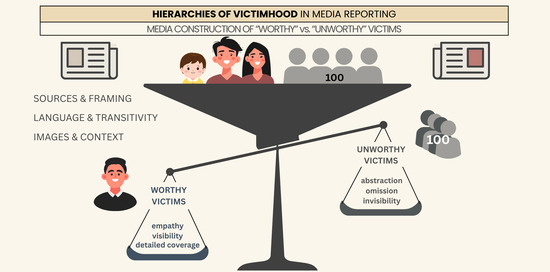
1. Introduction
2. Worthiness
On France’s BFM [Business FM] TV, Phillipe Corbé stated this about Ukraine: “We’re not talking here about Syrians fleeing the bombing of the Syrian regime backed by Putin. We’re talking about Europeans leaving in cars that look like ours to save their lives.”[…]An ITV [Independent Television] journalist reporting from Poland said: “Now the unthinkable has happened to them. And this is not a developing, third world nation. This is Europe!”[…]And writing in the Telegraph, Daniel Hannan explained: “They seem so like us. That is what makes it so shocking. Ukraine is a European country. Its people watch Netflix and have Instagram accounts, vote in free elections and read uncensored newspapers. War is no longer something visited upon impoverished and remote populations” [22].
3. Key Features of Representation
3.1. Use of Sources
3.2. Use of Evaluative Language
3.3. Transitivity
3.4. Use of Personal and Historical Context
The coverage of the Popieluszko murder was notable for the fullness of the details regarding his treatment by the police and the condition of the recovered body. What is more, these details were repeated at every opportunity […] At the trial, the emotional strain and guilt manifested by police officers were described time and again, interspersed with the description of how Popieluszko pleaded for his life, and evidence of the brutality of the act. […] Popieluszko himself was humanized, with descriptions of his physical characteristics and personality that made him into something more than a distant victim [3] (p. 43).
3.5. Use of Framing
Patriotic post 9/11 television news graphics provided related shorthand frames, with ‘America strikes back’ mutating into ‘America’s new war’. Placing the issue primarily in the military realm privileges armed strength at the expense of the international political, diplomatic, and law enforcement areas, where conflicts may also be mediated. We are led to ask simply whether we will win, not whether we are in the right fight with the right strategy [53] (p. 23).
3.6. Use of Images
Photographs have the kind of authority over imagination to-day, which the printed word had yesterday, and the spoken word before that. They seem utterly real. They come, we imagine, directly to us without human meddling, and they are the most effortless food for the mind conceivable. Any description in words, or even any inert picture, requires an effort of memory before a picture exists in the mind. But on the screen the whole process of observing, describing, reporting, and then imagining, has been accomplished for you [47] (p. 81).
4. Conclusions
Funding
Institutional Review Board Statement
Informed Consent Statement
Data Availability Statement
Acknowledgments
Conflicts of Interest
References
- Hall, S.; Evans, J.; Nixon, S. (Eds.) Representation, 2nd ed.; SAGE Publications Ltd.: London, UK, 2013. [Google Scholar]
- Goatly, A. Critical Reading and Writing; Routledge: London, UK, 2000. [Google Scholar] [CrossRef]
- Herman, E.; Chomsky, N. Manufacturing Consent: The Political Economy of the Mass Media; Pantheon Books: New York, NY, USA, 2002. [Google Scholar]
- Elejalde, E.; Ferres, L.; Herder, E. On the nature of real and perceived bias in the mainstream media. PLoS ONE 2018, 13, e0193765. [Google Scholar] [CrossRef]
- Galtung, J.; Ruge, M.H. The Structure of Foreign News: The Presentation of the Congo, Cuba and Cyprus Crises in Four Norwegian Newspapers. J. Peace Res. 1965, 2, 64–90. [Google Scholar] [CrossRef]
- Cook, T.E. Governing with the News: The News Media as a Political Institution, 2nd ed.; The University of Chicago Press: Chicago, IL, USA, 2005. [Google Scholar]
- Tuchman, G. Objectivity as Strategic Ritual: An Examination of Newsmen’s Notions of Objectivity. Am. J. Sociol. 1972, 77, 660–679. [Google Scholar]
- Greer, C. News Media, Victims and Crime. In Victims, Crime and Society: An Introduction, 2nd ed.; Davies, P., Francis, P., Greer, C., Eds.; Sage: London, UK, 2017; pp. 20–49. [Google Scholar]
- Christie, N. The Ideal Victim. In From Crime Policy to Victim Policy; Fattah, E.A., Ed.; Palgrave Macmillian: London, UK, 1986; pp. 17–30. [Google Scholar] [CrossRef]
- Lewis, J.A.; Hamilton, J.C.; Elmore, J.D. Describing the ideal victim: A linguistic analysis of victim descriptions. Curr. Psychol. 2021, 40, 4324–4332. [Google Scholar] [CrossRef]
- McCloskey, S. The War in Ukraine Has Revealed a Hierarchy of Victims. Policy Pract. Dev. Educ. Rev. 2022, 34, 138–149. [Google Scholar]
- Entman, R.M.; Rojecki, A. The Black Image in the White Mind; The University of Chicago Press: Chicago, IL, USA, 2000. [Google Scholar]
- Chouliaraki, L. The Spectatorship of Suffering; Sage Publications: London, UK, 2016. [Google Scholar]
- Ginosar, A.; Cohen, I. Patriotic journalism: An appeal to emotion and cognition. Media War Confl. 2019, 12, 3–18. [Google Scholar] [CrossRef]
- Springer, N.; Nygren, G.; Widholm, A.; Orlova, D.; Taradai, D. Narrating “Their War” and “Our War”—The Patriotic Journalism Paradigm in the Context of Swedish and Ukrainian Conflict Coverage. Cent. Eur. J. Commun. 2022, 2, 178–201. [Google Scholar] [CrossRef]
- Mueller, J.E. Presidential popularity from Truman to Johnson. Am. Political Sci. Rev. 1970, 64, 18–34. [Google Scholar] [CrossRef]
- Boyd-Barrett, O.; Rantanen, T. The Globalization of News; SAGE Publications Ltd.: London, UK, 1998. [Google Scholar]
- MacLeod, A.I. Assessing the strength of the five filters today. In Propaganda in the Information Age—Still Manufacturing Consent; MacLeod, A.I., Ed.; Routledge: London, UK, 2019; pp. 45–64. [Google Scholar]
- Philo, G.; Berry, M. More Bad News from Israel; Pluto Press: London, UK, 2011. [Google Scholar]
- Philo, G.; Briant, E.; Donald, P. Bad News for Refugees; Pluto Press: London, UK, 2013. [Google Scholar]
- Said, E. Covering Islam: How the Media and the Experts Determine How We See the Rest of the World; Vintage Books: New York, NY, USA, 1997. [Google Scholar]
- Bayoumi, M. They Are ‘Civilised’ and ‘Look Like Us’: The Racist Coverage of Ukraine. The Guardian. Available online: https://www.theguardian.com/commentisfree/2022/mar/02/civilised-european-look-like-us-racist-coverage-ukraine (accessed on 10 September 2025).
- Arab and Middle-Eastern Journalists Association (AMEJA). Statement in Response to Coverage of the Ukraine Crisis. Available online: https://www.meltingpot.org/app/uploads/2022/03/AMEJAStatementinresponsetoUkraineCoverage-2.pdf (accessed on 11 September 2025).
- Hall, S.; Critcher, C.; Jefferson, T.; Clarke, J.; Roberts, B. Policing the Crisis: Mugging, the State, and Law and Order; Hall, S., Critcher, C., Jefferson, T., Clarke, J., Roberts, B., Eds.; Macmillan: London, UK, 1978. [Google Scholar] [CrossRef]
- Hallin, D.C. The Uncensored War: The Media and Vietnam; Oxford University Press: Oxford, UK, 1986. [Google Scholar]
- Manning, P. News and News Sources: A Critical Introduction; Sage Publications: London, UK, 2001. [Google Scholar] [CrossRef]
- Scherling, J. A tale of two cities: A comparative study of media narratives of the battles for Aleppo and Mosul. Media War Confl. 2019, 14, 191–220. [Google Scholar] [CrossRef]
- el-Nawawy, M.; Elmasry, M.H. Worthy and Unworthy Refugees: Framing the Ukrainian and Syrian Refugee Crises in Elite American Newspapers. J. Pract. 2025, 19, 2155–2175. [Google Scholar] [CrossRef]
- Talbot, M. The construction of gender in a teenage magazine. In Critical Language Awareness; Fairclough, N., Ed.; Longman: Harlow, UK, 1992; pp. 174–199. [Google Scholar]
- Scherling, J.; Foltz, A. The Age of the Expert—COVID-19, Expertise, and Conflicts of Interest in Austrian Media Reporting. J. Media 2024, 5, 163–188. [Google Scholar] [CrossRef]
- van Leeuwen, T.; Wodak, R. Legitimizing immigration control: A discourse-historical analysis. Discourse Stud. 1999, 1, 83–118. [Google Scholar] [CrossRef]
- Richardson, J.E. (Mis)representing Islam: The Racism and Rhetoric of British Broadsheet Newspapers; John Benjamins: Amsterdam, The Netherlands, 2004. [Google Scholar] [CrossRef]
- Inlakesh, R. From Gaza to Lebanon: Israel’s bombing campaign backed by media propaganda. MintPress News, 26 September 2024. Available online: https://www.mintpressnews.com/lebanon-bias-media-israel-bombing/288359/ (accessed on 12 September 2025).
- El Damanhoury, K.; Saleh, F.; Lebovic, M. Covering the Israeli–Palestinian Conflict: A Critical Discourse Analysis of Al Jazeera English and BBC’s Online Reporting on the 2023 Gaza War. J. Media 2025, 6, 9. [Google Scholar] [CrossRef]
- Hunston, S.; Thompson, G. Evaluation: An Introduction. In Evaluation in Text: Authorial Stance and the Construction of Discourse; Huston, S., Thompson, G., Eds.; Oxford University Press: Oxford, UK, 1999; pp. 1–27. [Google Scholar]
- Partington, A.; Taylor, C. The Language of Persuasion in Politics; Routledge: New York, NY, USA, 2018. [Google Scholar] [CrossRef]
- AllSides. Available online: https://www.allsides.com/story/politics-charlie-kirk-reportedly-shot-utah-event (accessed on 12 September 2025).
- Freedman, D. Gaza: The Language Behind the Media Bias; Counterfire: London, UK, 2024; Available online: https://www.counterfire.org/article/gaza-the-language-behind-the-media-bias/ (accessed on 12 September 2025).
- MacLeod, A. Chavista ‘thugs’ vs. opposition ‘civil society’: Western media on Venezuela. Race Cl. 2019, 60, 46–64. [Google Scholar] [CrossRef]
- Mooney, A.; Stilwell Peccei, J.; LaBelle, S. Language, Society and Power: An Introduction, 3rd ed.; Taylor & Francis: New York, NY, USA, 2010. [Google Scholar] [CrossRef]
- Abramski, K.; Ciringione, L.; Rossetti, G.; Stella, M. Voices of rape: Cognitive networks link passive voice usage to psychological distress in online narratives. Comput. Hum. Behav. 2024, 158, 108266. [Google Scholar] [CrossRef]
- Bucaria, C. Lexical and syntactic ambiguity as a source of humor: The case of newspaper headlines. Humor 2004, 17, 279–309. [Google Scholar] [CrossRef]
- Hanick, M. The Not-So-Subtle Price of Writing in the Passive Voice. The Review of Journalism, 30 April 2025. Available online: https://reviewofjournalism.ca/the-not-so-subtle-price-of-writing-in-the-passive-voice/ (accessed on 12 September 2025).
- Norton, B. Media Spin Headlines to Downplay US Responsibility for Mosul Massacre. FAIR Report, 30 March 2017. Available online: https://fair.org/home/media-spin-headlines-to-downplay-us-responsibility-for-mosul-massacre/ (accessed on 12 September 2025).
- Johnson, A. ‘War’ is not killing Palestinians, Israel is. Our media should frame it this way. The Real News Network, 21 June 2024. Available online: https://therealnews.com/war-is-not-killing-palestinians-israel-is-our-media-should-frame-it-this-way (accessed on 12 September 2025).
- Muwafi, D.W.; Fareh, S.; Jarad, N. Al-Jazeera Arabic and Al-Jazeera English headlines on the Russian-Ukrainian conflict: A Hallidayan transitivity analysis. Crit. Discourse Stud. 2024, 22, 299–317. [Google Scholar] [CrossRef]
- Lippmann, W. Public Opinion; BNPublishing: Hawthorne, CA, USA, 2008. [Google Scholar]
- Jackson, R. Writing the War on Terrorism: Language, Politics and Counter-Terrorism; Manchester University Press: Manchester, UK, 2005. [Google Scholar]
- MacLeod, A. Bad News from Venezuela; Routledge: London, UK, 2018. [Google Scholar]
- Entman, R. Framing: Toward Clarification of a Fractured Paradigm. J. Commun. 1993, 43, 51–58. [Google Scholar] [CrossRef]
- Entman, R. Projections of Power: Framing News, Public Opinion and U.S. Foreign Policy; The University of Chicago Press: Chicago, IL, USA, 2004. [Google Scholar] [CrossRef]
- Entman, R.; Framing, U.S. Coverage of International News: Contrasts in Narratives of the KAL and Iran Air Incidents. J. Commun. 1991, 41, 6–27. [Google Scholar] [CrossRef]
- Reese, S. Finding Frames in a Web of Culture: The Case of the War on Terror. In Doing News Framing Analysis: Empirical and Theoretical Perspectives; D’Angelo, P., Kuypers, J.A., Eds.; Routledge: London, UK, 2010; pp. 17–42. [Google Scholar] [CrossRef]
- Iyengar, S. Framing Responsibility for Political Issues. Ann. Am. Acad. Political Soc. Sci. 1996, 546, 59–70. [Google Scholar] [CrossRef]
- Correa-Chica, A.; Caicedo-Moreno, A.; Rincón-Unigarro, C.; Castro-Abril, P.; López-López, W. Episodic versus thematic media framing of violence against social leaders and human rights defenders in Colombia. Int. J. Psychol. 2024, 59, 390–397. [Google Scholar] [CrossRef]
- Fishman, J.M. Death Makes the News—How the Media Censor and Display the Dead; New York University Press: New York, NY, USA, 2017. [Google Scholar] [CrossRef]
- Bleiker, R.; Campbell, D.; Hutchison, E.; Nicholson, X. The visual dehumanisation of refugees. Aust. J. Political Sci. 2013, 48, 398–416. [Google Scholar] [CrossRef]
- Romano, M.; Porto, M.D. Framing CONFLICT in the Syrian Refugee Crisis: Multimodal Representations in the Spanish and British Press. In Discursive Approaches to Sociopolitical Polarization and Conflict; Filardo, L., Morales, E., Floyd, A., Eds.; Routledge: London, UK, 2021; pp. 153–173. [Google Scholar] [CrossRef]
- Hellmueller, L.; Zhang, A.X. Shifting Toward a Humanized Perspective? Visual Framing Analysis of the Coverage of Refugees on CNN and Spiegel Online Before and After the Iconic Photo Publication of Alan Kurdi. Vis. Commun. 2019, 25, 160–183. [Google Scholar] [CrossRef]
- Fahmy, S. Photojournalists’ and Photo Editors’ Attitudes and Perceptions: The Visual Coverage of 9/11 and the Afghan War. Vis. Commun. Q. 2005, 12, 146–163. [Google Scholar] [CrossRef] [PubMed]
Disclaimer/Publisher’s Note: The statements, opinions and data contained in all publications are solely those of the individual author(s) and contributor(s) and not of MDPI and/or the editor(s). MDPI and/or the editor(s) disclaim responsibility for any injury to people or property resulting from any ideas, methods, instructions or products referred to in the content. |
© 2026 by the author. Licensee MDPI, Basel, Switzerland. This article is an open access article distributed under the terms and conditions of the Creative Commons Attribution (CC BY) license.
Share and Cite
Scherling, J. Representations of Victimhood in Media Reporting of Armed Conflicts. Encyclopedia 2026, 6, 54. https://doi.org/10.3390/encyclopedia6030054
Scherling J. Representations of Victimhood in Media Reporting of Armed Conflicts. Encyclopedia. 2026; 6(3):54. https://doi.org/10.3390/encyclopedia6030054
Chicago/Turabian StyleScherling, Johannes. 2026. "Representations of Victimhood in Media Reporting of Armed Conflicts" Encyclopedia 6, no. 3: 54. https://doi.org/10.3390/encyclopedia6030054
APA StyleScherling, J. (2026). Representations of Victimhood in Media Reporting of Armed Conflicts. Encyclopedia, 6(3), 54. https://doi.org/10.3390/encyclopedia6030054

