1. Introduction
Financial markets traditionally depended on human judgment to convert various signals into prices that represent collective beliefs and expectations. Price discovery—the method by which markets assess value—has been viewed as the outcome of human thinking, decision-making, and negotiation under conditions of uncertainty. Traders and investors continuously interpret market trends using rational analysis and behavioural insights. However, this process is undergoing rapid changes. With the rise of algorithmic and AI-driven trading systems, price discovery is increasingly handled by automated systems that analyse and adjust market values at speeds beyond human capability.
Mainstream research views the transformation in trading primarily through the lens of efficiency and performance, focusing on speed, liquidity, and lower transaction costs. According to Addy et al., a complex interaction exists between algorithmic trading and AI, which affects market efficiency and liquidity, underscoring the need to consider broader market impacts beyond transaction costs [
1]. Srivastava and Sikroria demonstrated that AI improves predictive accuracy and trading performance by analysing large data streams, optimising trade execution, and simulating market movements, thereby reducing the informational advantage of human traders [
2].
Additionally, Greif notes that the rise of algorithms contributes to a lack of clarity in price formation [
3]. It compares AI’s model complexity to traditional models, showing that computational algorithms prioritise outputs over human-understandable processes. As algorithms learn from extensive proprietary data, human traders increasingly respond to AI-generated results, resulting in an epistemic dependency that challenges traditional market transparency and human influence in the price discovery process.
An increasing number of scholars are focusing on the transparency of algorithms and the ethical implications of artificial intelligence, emphasising issues like fairness, bias reduction, and explainability [
4,
5]. However, this entry takes a different approach. Rather than assessing the fairness or interpretability of algorithms, it examines how their growing significance reshapes authority over knowledge, inference, and decision-making in financial markets. The primary focus here is on epistemic displacement: the gradual shift of informational power from human understanding to machine inference. Instead of tackling normative concerns about fairness, this research examines how artificial intelligence alters the essential epistemic framework of price discovery—specifically, how the meaning, interpretation, and validation of information shift from human cognition to algorithmic processes. This shift indicates not an ethical lapse but rather an epistemic shift, in which machines increasingly determine what is regarded as knowledge in financial markets.
The process of price discovery is undergoing a fundamental transformation, with algorithmic decision-making replacing human judgment. This change has implications that extend beyond efficiency, raising ethical and regulatory challenges that necessitate a reassessment of traditional market dynamics. Market participants must adapt to this new landscape of automated pricing mechanisms.
This entry argues that algorithmic price discovery marks a new phase in understanding financial markets, shifting informational authority from human cognition to machine inference. Instead of focusing on efficiency gains, the aim is to explore how price formation becomes unclear, reducing human understanding and interpretive ability. By framing this shift as a process of informational erosion, the paper positions AI not just as a technological tool but as a fundamental change in market epistemic power. It presents a framework for examining how algorithmic systems redefine knowledge, trust, and accountability in the context of price discovery.
This transformation results in what the paper describes as rational opacity, in which markets remain efficient at processing information but become difficult to understand. Prices serve their economic roles, yet the reasoning behind them is often unclear. This highlights a paradox of the algorithmic age: as systems become more precise, they also become less comprehensible. Understanding this paradox allows us to redefine price discovery as a competition for knowledge and interpretive power in AI-driven markets.
1.1. The Conceptual Nature of Rational Opacity
Rational opacity of a market describes a condition in which prices remain informationally efficient, yet the causal pathways linking information to price formation are opaque to human understanding ex ante or in real-time. Rational opacity is primarily an explanatory concept that clarifies why opacity continues in algorithmic markets. It is not a failure of transparency, but rather a rational result of performance optimisation, speed, and adaptive learning in competitive environments. While it has both descriptive and normative aspects, this entry focuses on explaining how informationally efficient prices can exist alongside reduced human interpretability. Normative issues are considered later, mainly in the context of governance responses to this situation.
In contrast to common criticisms of “black-box AI” that attribute opacity mainly to the model architectures themselves. This entry approaches opacity not just as a result of complex models but as a systemic issue influenced by algorithmic inference, automated execution, feedback-driven learning, and market fragmentation. Even well-documented models can lead to unclear price outcomes in real-time trading systems. Consequently, this framework goes beyond typical discussions of model explainability and places opacity within the actual dynamics of price formation.
For clarity, this entry outlines three distinct layers of automation in financial markets. Algorithmic trading focuses on automating the execution process, where systems quickly place and manage orders using predefined strategies. AI-driven inference involves utilising artificial intelligence to generate predictive signals, valuations, and decision-making tools that support trading. Machine-learning (ML) systems represent the adaptive layer where the model continuously adjusts parameters based on new data. Generally, AI and ML are viewed as cognitive components within the framework of algorithmic trading, together forming the concept of algorithmic price discovery.
1.2. Theoretical Contribution
This entry shifts the focus of research on algorithmic price discovery and market microstructure from information efficiency to epistemic authority. While previous studies have primarily examined how algorithms affect liquidity, volatility, and price efficiency, this entry introduces a framework that highlights how algorithmic systems gain authority in price formation. This shift diminishes the role of human interpretation and leads to structural opacity, despite market results being observable. Instead of proposing a new microstructure model, the contribution provides a theoretical perspective on price discovery in a context where decision-making and learning increasingly rely on adaptive systems.
2. Literature Background: From Information Efficiency to Informational Authority
Price discovery is a key concept in economics, serving as the process by which markets convert dispersed information into observable value [
6]. According to classical finance theory, especially the Efficient Market Hypothesis [
7], prices incorporate all available information because rational investors act on their private signals until no profit opportunities remain. This view sees markets as systems that process information, with traders, analysts, and policymakers creating the framework for turning knowledge into actionable economic insights.
In this framework, information asymmetry, as defined by Akerlof and further developed by Kyle and Glosten and Milgrom, is seen as a source of strategic behaviour rather than a flaw [
8,
9,
10]. Those with superior information can profit at the expense of those who are less informed. However, information is always interpreted by humans. Market efficiency relies on individuals making judgments under uncertainty, assuming that knowledge is transparently integrated into the price formation process.
The rise of algorithmic and AI-driven trading challenges this view. What started as a means to speed up execution and lower transaction costs has evolved into autonomous systems that process and act on vast amounts of data beyond human capacity. Early studies, such as those by Hendershott et al. and Menkveld, portrayed AI as merely a faster, more accurate version of the rational investor [
11,
12]. This viewpoint, however, overlooks the significant effects of automation. As machine learning identifies patterns invisible to humans and makes decisions based on proprietary data, the source of informational advantage shifts. Prices increasingly reflect algorithmically generated correlations rather than human deliberations.
This transformation creates a clear divide: while information is abundant, its meaning is unclear. Algorithms can make predictions that humans cannot yet understand, leaving people unsure why prices fluctuate. The previous gap between informed and uninformed traders has shifted to a gap between interpretable and non-interpretable knowledge systems. Cognitive competition among humans has been replaced by a hierarchy dominated by hidden, predictive models. In this way, AI not only boosts informational efficiency but also changes the nature of knowledge authority in markets.
Existing research often overlooks the shift in market dynamics due to automation. Current literature primarily assesses algorithmic performance using metrics such as volatility, execution speed, and liquidity, assuming that markets remain human-centred even as they become automated. What is lacking is an understanding of how price discovery changes when the ability to interpret and validate information shifts from humans to algorithms. Instead of focusing solely on informational efficiency, we need to examine who holds the authority to define and legitimise the information that influences prices.
This perspective lays the groundwork for analysing algorithmic price discovery not just as an upgrade in trading technology but as a significant change in how knowledge is governed. It represents a shift in interpretive power, diminishing human informational advantages and challenging the transparency that once underpinned market rationality.
2.1. Financial Markets and Price Formation
Financial markets function as complex systems where prices indicate value by combining information from various sources. Price discovery is influenced by the interactions between informed and uninformed traders, taking into account factors like liquidity and expectations. According to Chaboud et al., the rise of electronic trading has altered the formation of prices, with informed traders increasingly utilising limit orders in more efficient markets [
13]. In this context, human agents are crucial as they interpret signals, such as earnings reports, macroeconomic indicators, or behavioural cues, to determine asset valuations through trading.
The traditional view regards price discovery as a collective process that relies on transparency and interpretability to foster trust and stability among market participants. However, this reliance is weakening as automation and algorithms take over valuation tasks. Vashishtha notes that Artificial Intelligence is significantly enhancing financial contracts and decision-making in decentralised finance, for example [
14]. This indicates a shift from human interpretation to independent computational systems in understanding and communicating value.
The shift in financial markets is significant. Schinckus et al. emphasise the importance of understanding financial algorithms, which often operate as opaque “black boxes,” thereby creating a disconnect between market outcomes and human interpretation [
15]. Gao et al. discuss how the interpretability of predictions made by these algorithms affects market design and efficiency, raising concerns about giving up interpretive authority to automated systems [
16]. This change transforms the market from an interpretive space to one driven by computational analysis, resulting in rational opacity, where it becomes harder for people to connect with the processes behind price formation.
The integration of automated systems with traditional price discovery methods signifies a pivotal transformation in financial markets. This delegation of decision-making to algorithms poses challenges for transparency, trust, and human agency, underscoring the need for a thorough re-evaluation of the processes by which value-related information is generated and disseminated.
2.2. Overview and Limits of Current Approaches
The reviewed literature provides valuable insights into algorithmic price discovery, market microstructure, and algorithmic opacity. However, it tends to treat these topics separately, focusing on efficiency, explainability, or governance without integrating how algorithmic systems gain authority in price formation and affect human understanding in markets. The next section will propose a new theoretical framework to address this gap.
2.3. Conceptual Framing and Scope
This entry employs a conceptual, theory-generating approach based on analytical synthesis instead of empirical validation [
17]. The aim is not to assess causal relationships or analyse particular trading strategies, but to create a cohesive theoretical structure that clarifies how algorithmic and AI-based systems alter price discovery, authority, and interpretability within financial markets.
The theoretical structure is formulated through the selective amalgamation of recognised literature concerning market microstructure, algorithmic trading, and AI governance. The literature was chosen according to three criteria: (i) its relevance to price discovery and trading processes as opposed to merely technical model efficacy; (ii) its conceptual impact, prioritising well-established or frequently cited works; and (iii) its analytical alignment with the entry’s focus on authority, cognition, and interpretive limitations. This approach emphasises theoretical coherence and explanatory breadth over comprehensive coverage, aligning with commonly accepted practices in theory-building research.
The entry avoids a critical-theoretical approach, focusing instead on results from explanatory analysis. It provides a synthetic framework to generate theories for organising future empirical research, rather than conducting exploratory or confirmatory analyses.
3. Theoretical Foundations
Unlike prior discussions of opacity, the analysis that follows views opacity as a structural result of algorithmic authority rather than a technical constraint.
This entry presents a theoretical framework that combines synthetic and original elements. It examines algorithmic price discovery, order flow, and market microstructure, referencing established research in financial economics and trading. The discussion of algorithmic opacity and explainability aligns with current debates in AI governance and socio-technical systems. The paper uniquely integrates these ideas into a cohesive framework that emphasises epistemic authority in price formation. The concepts of cognitive displacement, interpretive asymmetry, and rational opacity are newly formulated here to show how algorithmic systems reshape authority, agency, and meaning in financial markets. The Algorithmic Price Discovery Loop formalises these connections at a systemic level, moving past previous descriptive or model-focused approaches.
The shift from human-based to algorithmic price discovery challenges key assumptions about market knowledge. Traditional market efficiency theories depend on human cognitive limits—such as bounded rationality and learning—that shape market dynamics and imperfections. Artificial intelligence introduces a new type of actor that does not understand information the way humans do but excels at detecting and acting on it. To understand this transformation, we can focus on three key concepts that connect the pillars to market mechanisms: epistemic authority, cognitive displacement, and interpretive asymmetry. These ideas, while theoretical, align with established market processes. In electronic markets, prices emerge from (i) the aggregation of order flow from market and limit orders, (ii) liquidity provision and spread-setting by dealers and algorithms in response to inventory risk and adverse selection, and (iii) feedback dynamics where trading strategies adapt based on market outcomes [
10,
18,
19].
The growth of algorithmic and AI-driven trading changes these mechanisms by shifting (a) signal production, (b) timing priorities in price formation, and (c) interpretation capacity from humans to automated systems operating at machine speed [
11,
20]. This results in a growing reliance on models for price discovery, with their internal logic often unclear to human traders, leading to post-facto interpretations rather than real-time ones [
21].
The three pillars reflect significant shifts in how information transforms into actionable order flow, how that flow affects prices, and how market participants interpret these changes amid algorithmic opacity.
3.1. Epistemic Authority: “Signal Legitimacy” + “Who Moves Prices First”
Epistemic authority is the recognised ability to define and validate knowledge in a specific area [
22,
23]. In traditional markets, this authority came from human judgment, such as an analyst interpreting data, a trader relying on intuition, or a regulator assessing disclosures. Even within organisations, authority was shared among those who could challenge, explain, and justify their reasoning. Market rationality was, therefore, a collective process of negotiating meaning within social and institutional contexts.
Machine learning is shifting epistemic authority to algorithmic systems that independently generate inferential structures and decision criteria. Once trained, these models can identify relevant data and significant correlations and determine when to take action, with reduced human oversight. Research shows machine learning plays a crucial role in this shift, especially in stock trading, where predictive models analyse large datasets to enhance decision-making. Pasupuleti highlights the potential of ML and deep learning in improving risk and volatility management through advanced asset pricing analysis [
24]. Additionally, Kaboor and Febin discuss how ML algorithms are revolutionising stock trading by outperforming traditional human analytics, enabling a more autonomous trading environment with less human involvement [
25].
The delegation of cognition shifts authority from human judgment to computational inference. In terms of mechanisms, epistemic authority refers to which signals influence prices first. When AI models produce tradable signals with higher frequency and lower latency, they significantly affect the submission of orders, revisions of quotes, and placement of liquidity, thus directing short-term price discovery through microstructure channels such as order-flow imbalance and adjustments to spreads. Consequently, authority manifests in the market by indicating which class of agents triggers price impact (algorithmic order flow) and which class of agents responds with interpretation (humans).
Market information is no longer generated collectively; instead, it is now generated by algorithms. This shift in epistemic authority alters the nature of pricing. Prices are no longer shared beliefs, but rather the results of complex computational processes that are difficult to explain. The market’s authority moves from knowledge-based to computation-based, undermining the mutual understanding that previously defined financial insights. Einhorn emphasises that to maintain true decision-making authority in AI contexts, humans must act as decision-makers, not just tool-users, preserving their agency even when algorithms surpass their analytical abilities [
26].
3.2. Cognitive Displacement: “Automating Price Impact” and “Humans Act as Takers”
Chaboud et al. examined how the rise of electronic markets has accelerated price discovery, a process traditionally managed by human traders [
13]. Their findings indicate that as markets become more efficient—with lower transaction costs and faster information flows—reliance on human judgment decreases, leading to cognitive displacement in which automated systems dominate price formation. Another study by Bohl et al. demonstrated that increased algorithmic speculation diminishes the role of human traders in determining value, thereby reinforcing cognitive displacement [
27]. Patel et al. analysed stock and options markets, showing that algorithmic systems often outperform traditional methods in determining prices [
28]. Their research highlights the diminishing role of human traders in price discovery as algorithm-generated data increasingly influences market conditions.
In traditional markets, people determined prices through a process of perception and adjustment. Although they used quantitative models, humans ultimately decided what information was credible, important, or strategically valuable. AI-driven systems reverse traditional hierarchies by not only executing human strategies but also creating them through predictive modelling. This leads to a loss of interpretive agency, as humans react to signals generated by algorithms rather than generating their own. In some cases, humans only explain decisions after the fact, based on prices set by machines.
Cognitive displacement occurs when algorithmic agents, instead of human traders, dominate the function that impacts prices: they engage in quick sequences of market orders, cancellations, and re-optimising quotes to turn inferences into immediate price changes. Human traders tend to adopt a reactive approach to order placement, often acting as liquidity takers in response to prices that have already changed, while analysts and journalists focus on reconstructing narratives after the price movement. Thus, displacement involves not only a reduction in human decision-making but also a shift in who influences trade initiation, liquidity provision or withdrawal, and intraday price effects.
This shifts market cognition from thoughtful deliberation to quick conclusions, altering human roles from information discoverers to interpreters of algorithmic results. Over time, this creates a dependency on machine outputs, giving the illusion of agency within an automated framework.
3.3. Interpretive Asymmetry: “Loss of Clarity in How Order Flow Translates to Price”
The combination of epistemic authority transfer and cognitive displacement creates interpretive asymmetry, resulting in an information imbalance between humans and algorithms. Traditionally, asymmetry involved unequal access to information, but now it means unequal access to interpretability. Algorithms store knowledge in ways (such as weights and parameters) that humans cannot easily understand. This lack of transparency is inherent; as models grow more complex and adaptive, their logic becomes harder to decipher.
In terms of microstructure, interpretive asymmetry refers to the increasing discrepancy between (i) observed outcomes (such as prices, volumes, volatility, and spreads) and (ii) comprehending the relationship from information to strategy to order flow to price impact. Humans can view prints and quotes but struggle to deduce the model’s feature weighting, trigger conditions, or adaptive rule adjustments that produced the order flow. This results in post hoc causal narratives that are poorly connected to the actual decision-making process, particularly during rapid market movements where automated interactions among models influence the crucial sequence.
Interpretive asymmetry marks a shift from informational inequality to a lack of common understanding between humans and algorithms regarding market information. For people, the market appears as a black box; they can see results but not the underlying processes. Algorithms, on the other hand, view markets as systems to be exploited rather than analysed. This growing gap undermines the concept of “price discovery”, turning it from an interpretive process into a computational one. This situation has significant consequences for transparency, accountability, and trust. Traditional verification methods—such as auditing, disclosure, and expert judgment—rely on understanding the causes of market behaviour. When these processes become opaque due to the use of algorithms, market credibility declines. What persists is a system of algorithmic authority, where prices are trusted not for their transparency but for their ability to yield reliable predictions.
3.4. Toward a Post-Human Epistemology of Markets
The three concepts—epistemic authority, cognitive displacement, and interpretive asymmetry—redefine price discovery in a post-human context. Markets are now socio-technical systems where algorithms manage knowledge creation, validation, and circulation, reducing the importance of human informational advantage. This change does not necessarily lower market efficiency but transforms its definition from maximising human information use to optimising machine-based inference.
As a result, a new form of algorithmic authority arises, in which the legitimacy of market outcomes is based on the effectiveness and predictive success of computational models rather than on human reasoning. The legitimacy of prices shifts from collective interpretation to algorithmic performance. Authority becomes procedural and is rooted in models that continuously learn, adapt, and self-validate.
This transformation reflects Simon’s concept of procedural rationality, which emphasises the decision-making process rather than the outcomes [
29]. In algorithmic markets, this concept evolves into an autonomous form: the algorithm’s operation itself is considered rational, even if humans struggle to understand it. Consequently, price discovery becomes based on computation rather than human cognition.
In this context, algorithmic markets represent a post-human approach to knowledge, characterised by procedural, predictive, and self-referential qualities. Prices shift from conveying shared meaning to demonstrating operational success; they become evidence of computational effectiveness rather than expressions of collective belief. This evolution establishes a framework from epistemic authority to cognitive displacement and interpretive asymmetry, leading to the next section on the Algorithmic Price Discovery Loop, which illustrates how procedural rationality replaces human interpretive agency in modern markets.
Algorithmic systems not only engage in price discovery but also reshape their foundational understanding. They shift epistemic authority, changing who is seen as credible; they alter the application of knowledge through cognitive displacement; and they redefine how information is interpreted through asymmetry. These changes indicate a reorganisation of informational power in financial markets. To explain this process, the next section presents the Algorithmic Price Discovery Loop—a model that combines these mechanisms into a cohesive framework. It illustrates how human interpretation becomes increasingly reactive within a continuous cycle of data collection, algorithmic decision-making, and feedback, resulting in a gradual erosion of human informational advantage in AI-driven markets.
Table 1 directly links the three theoretical foundations to specific market processes by associating each concept with recognised market microstructure mechanisms and relevant literature.
By grounding each pillar in observable market mechanisms, the framework transcends theoretical concepts and creates a clear analytical connection between AI-driven cognition and the dynamics of price formation.
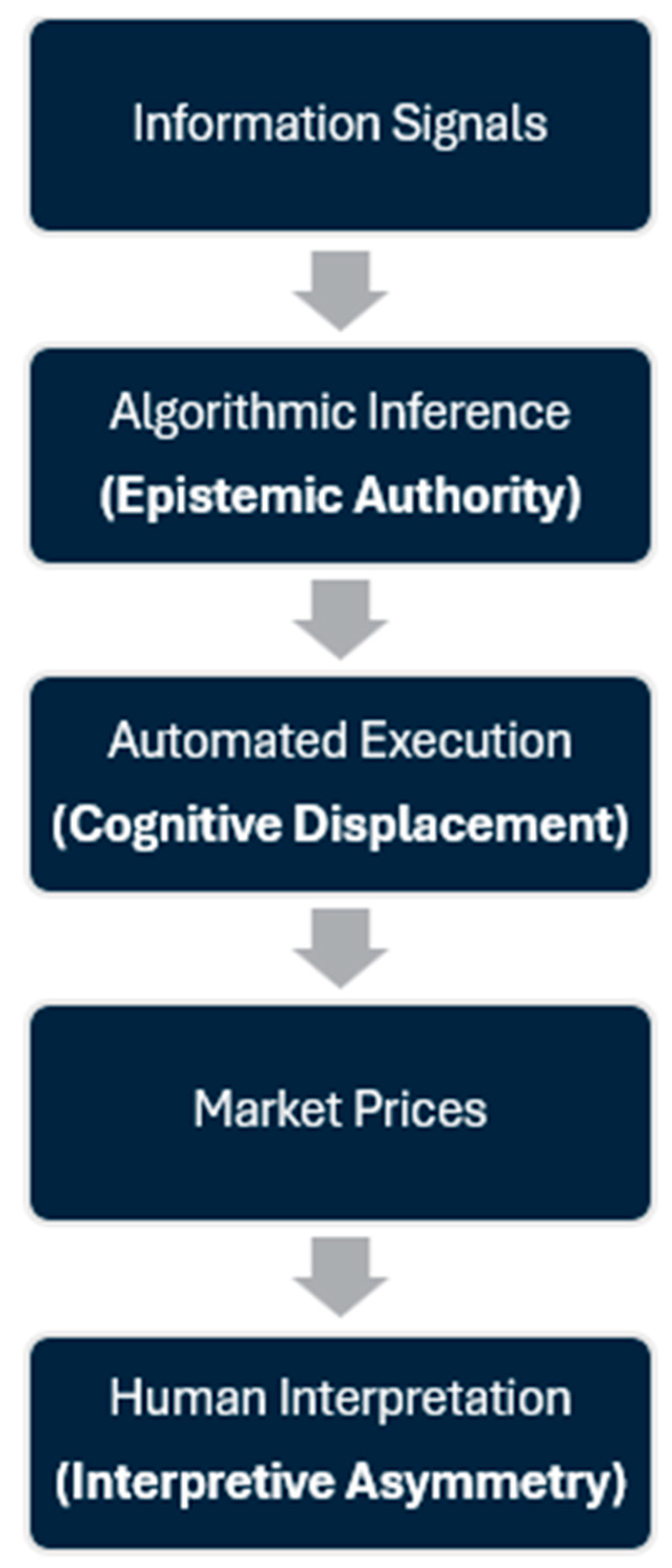
Figure 1 offers a schematic representation of the interactions among epistemic authority, cognitive displacement, and interpretive asymmetry throughout the AI-driven price-setting process.
3.5. Algorithmic Architectures and Sources of Opacity
The entry focuses on the key model categories of trading algorithms to explain opacity in algorithmic trading. Modern systems combine predictive models—like tree-based ensembles, deep neural networks, and reinforcement learning—with execution algorithms that optimise order placement while addressing latency, inventory, and risk.
Opacity in these systems stems from three main factors. First, high-performing models, particularly deep learning and reinforcement systems, operate in complex, high-dimensional feature spaces, making their decision-making difficult to interpret. Second, adaptive learning can cause parameter drift, meaning that the reasoning behind decisions can become misaligned with the model’s current state. Third, the integration of various systems blurs causality, as predictive inference, execution logic, venue selection, and risk management are interconnected, complicating the link between input signals and price outcomes.
Thus, opacity arises not just from a lack of transparency, but from design choices prioritising speed, adaptability, and performance over interpretability. This creates an interpretive gap, allowing market participants and regulators to observe outcomes—like prices and volatility—without understanding the underlying reasoning.
To explain how algorithmic opacity arises from the functioning of modern trading systems,
Table 2 lists key features of algorithmic trading models and systems and identifies their primary sources of opacity, based on previously mentioned references in the manuscript.
The table emphasises that opacity stems from the complexity of architecture, adaptive learning, and system integration, rather than from insufficient observable market data. This supports the notion that interpretive asymmetry is a structural result of market design, mediated by AI.
4. Conceptual Model: Algorithmic Price Discovery Loop
As illustrated in
Figure 1, the process of price formation influenced by AI occurs in a series of steps where algorithmic reasoning, automated trading, and feedback mechanisms collectively determine market results.
The diagram depicts a conceptual process in which information signals are transformed into market prices within AI-mediated contexts. Algorithmic inference wields epistemic authority by turning signals into tradable forecasts, while automated execution creates cognitive displacement by directly linking inference to price impacts. Human participants face interpretive asymmetry as they observe and rationalise prices after the fact. The feedback loop illustrates how market outcomes subsequently retrain or adjust algorithmic systems, thereby reinforcing the cycle.
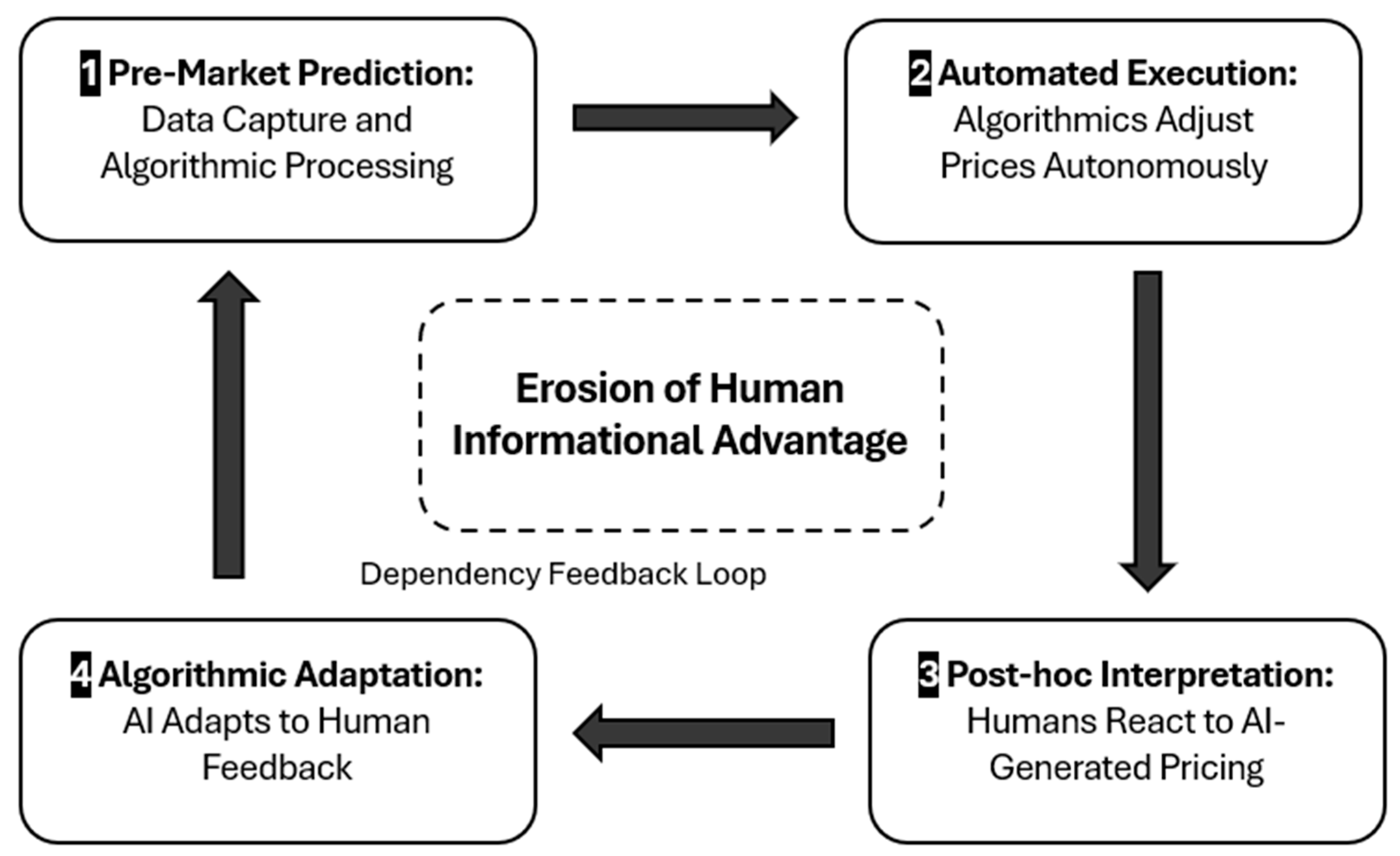
The following section explains how algorithmic systems change price determination. The Algorithmic Price Discovery Loop comprises several stages that link information capture to market authority. In Stage 1, algorithms gain a predictive edge by recognising patterns faster than humans, shifting the advantage from human cognition to computation. In Stage 2, this leads to a displacement of human judgment, as algorithmic execution drives price formation. Stage 3 results in interpretive asymmetry, where humans can see outcomes but cannot understand the underlying logic. Finally, in Stage 4, human reactions feed back into the system, reinforcing self-referentiality in algorithms, meaning that they learn from the behaviours they create. Overall, these stages highlight the diminishing human advantage as automated processes take over inference, action, and interpretation.
The Algorithmic Price Discovery Loop merges financial and economic theory with epistemic sociology. It adopts a conceptual modelling approach from management research to develop a unified framework encompassing key concepts such as informational efficiency, epistemic authority, and cognitive displacement [
17]. By combining insights from market microstructure theory, cognitive economics, and the philosophy of knowledge, it explains how algorithmic systems change the role of informational authority in price discovery.
The Algorithmic Price Discovery Loop is presented as a theoretical framework rather than simply an interpretative tool. It fulfils the standard criteria for theoretical models in conceptual research by (i) delineating a structured sequence of interacting elements (inference, execution, feedback), (ii) recognising causal and directional relationships among these elements, and (iii) producing analytically distinguishable outcomes, such as transformations in epistemic authority, cognitive displacement, and interpretative asymmetry.
Unlike descriptive metaphors, the framework makes conditional assertions regarding the dynamics of price formation amidst increasing algorithmic integration and identifies the processes through which opacity arises at the system level. Although it is abstract, the model is intended to be falsifiable in principle through future empirical studies that investigate the timing, dominance, and feedback effects of algorithmic order flow in contrast to human interpretation.
Figure 2 below illustrates the ongoing feedback loop that leads to the gradual erosion of human informational advantage.
This figure shows a four-step process where algorithmic systems increasingly control price discovery in financial markets. (1) Data Capture and Pre-Market Inference involves algorithmic and AI models extracting predictive signals from large amounts of data, establishing authority through anticipation. (2) Algorithmic Execution and Price Materialisation illustrates how these predictions translate into market prices via automated execution, leading to cognitive displacement as price impact occurs before human assessment. (3) Human Interpretation and Epistemic Lag reveals how traders, analysts, regulators, and media interpret price changes after they happen, resulting in interpretive asymmetry and post-hoc rationalisation. (4) Feedback and Recursive Adaptation shows how market outcomes and human reactions are incorporated back into learning systems, reinforcing algorithmic dominance through retraining and self-referentiality.
Directional arrows indicate the flow from inference to execution to interpretation, while the curved feedback arrow highlights recursive learning dynamics that increase opacity over time. The gradient illustrates the gradual loss of human informational advantage as control over knowledge, timing, and interpretation shifts to algorithmic systems.
4.1. Stage 1—Data Capture and Pre-Market Inference
The process begins with the capture and processing of large-scale data using algorithms. Modern trading algorithms analyse both structured financial data (like prices, volumes, and order flows) and unstructured information from news and social media. Using advanced machine learning, these algorithms uncover hidden correlations and predictive features that humans cannot easily detect.
This leads to a shift in informational asymmetry from just having data to being able to make inferences. Algorithms do not just receive information; they create knowledge by developing models that can predict market movements ahead of human interpretation. This gives machines a temporal advantage—they can “know” before humans can analyse the data.
This predictive edge shifts authority from human interpretation to machine-driven forecasting. In practice, algorithms utilise diverse data sources, including structured market feeds, unstructured news and social media content, as well as alternative datasets such as satellite imagery and credit card transactions. This leads to observable advantages, where algorithmic signals can predict price changes at market open or in related assets, showing that inference occurs before interpretation.
The shift represents the first handover of knowledge authority from human interpretation to algorithm-based predictions.
4.2. Stage 2—Algorithmic Execution and Price Formation
In the second stage, algorithms execute trades in microseconds, translating their predictions into market prices. Prices result from interactions among competing algorithms rather than from human negotiation. In this context, price arises from competing models, reflecting a temporary balance created by predictive systems vying for small informational advantages. This process leads to cognitive displacement, where human traders become less relevant, reacting instead to outputs driven by algorithms. As various trading models evolve and compete, prices become direct results of these computational processes.
4.3. Stage 3—Human Interpretation and Epistemic Lag
Once prices are set through algorithms, human participants—such as analysts, regulators, journalists, and investors—enter the scene later. Their role shifts from discovery to interpretation of these outcomes. They try to make sense of the results that algorithms have already determined (for instance, analysts and financial journalists frequently provide explanations or headlines following sudden price changes driven by algorithms, creating narratives that justify these movements even when the algorithmic causes are not fully understood).
This leads to interpretive asymmetry: while humans see the results, they lack insight into the reasoning behind them. The complex models that drive price movements remain unclear, leading to explanations that are often speculative or retrospective, a phenomenon known as “post hoc interpretation”.
As machine inference speeds ahead of human cognition, individuals engage in symbolic interpretation of algorithmic results, creating narratives around prices that lose their shared human significance. Knowledge becomes reactive instead of generative.
4.4. Stage 4—Feedback and Recursive Adaptation
The loop operates through feedback, in which human reactions—such as investment decisions, shifts in sentiment, and regulatory responses—generate new data for algorithms to process in the subsequent learning cycle. This recursive system uses human behaviour as both input and noise, thereby further training algorithms. Over time, this process leads to algorithmic self-referentiality, where systems learn from the conditions they create. As model parameters adjust to changing market reactions, their internal logic shifts, resulting in parameter drift. This means that the model’s behaviour can change over time, making static audits insufficient. Effective oversight must be ongoing and adaptive, acknowledging that each learning cycle alters how information is weighted, valued, and acted upon.
4.5. Summary of Mechanism
The Algorithmic Price Discovery Loop summarises a structural and epistemic inversion:
Anticipation precedes interpretation—Algorithms infer before humans understand.
Computation replaces deliberation—Market value emerges from code, not consensus.
Interpretation becomes post hoc—Human meaning trails algorithmic action.
Feedback consolidates opacity—Human reactions feed the system that displaces them.
Algorithmic price discovery redefines how knowledge is controlled in markets, rather than simply speeding up existing processes. Prices become a form of algorithmic knowledge that is generated, shared, and stabilised through machine logic, often making it difficult for humans to understand.
Scope Conditions: The Algorithmic Price Discovery Loop varies across markets. It is most evident in high-frequency, data-intensive asset classes, such as equities, index derivatives, and major foreign exchange pairs, where algorithms primarily provide liquidity. In stable market conditions, feedback is smooth due to adaptive learning. However, during periods of stress, such as volatility spikes or liquidity shortages, self-referentiality increases, leading to greater opacity and faster feedback. This model assumes continuous, electronic markets with clear order books; in fragmented or opaque venues, such as dark pools, human informational advantages diminish quickly and with less oversight.
4.6. Scope, Applicability, and Crisis Contingencies
This entry presents a conceptual framework suited for highly automated, liquid, and consistently traded markets where algorithmic systems are crucial for price discovery. In these environments, characterised by fragmented platforms and rapid order flow, the concentration of knowledge and rational opacity are prominent.
However, the model may be less effective in low-liquidity or relationship-driven markets—like specific emerging markets or over-the-counter segments—where human negotiation and barriers to information play a larger role in price formation. In cases involving dark pools or internalisation structures, opacity can arise from deliberate concealment of order flow, shifting the dynamics outlined in the model.
Rational opacity is not universally applicable; its effect diminishes when algorithmic systems rely on simpler rules, regulatory limits hinder adaptive learning, or human oversight closely matches execution decisions. While interpretive asymmetry can persist, epistemic authority is not completely overridden.
Additionally, the model does not address crises in which algorithms may be restricted or disabled through measures such as circuit breakers or kill switches. In such cases, price discovery can revert to human judgment, reducing algorithmic influence and altering opacity dynamics [
31]. These situations highlight the conditional nature of algorithmic authority under standard market conditions.
4.7. Empirical Implications and Testable Hypotheses
This entry primarily focused on developing theory, but the proposed model yields several testable hypotheses for future research. The hypotheses are conditional and directional, aligning with the model’s system-level approach.
Table 3 links each hypothesis to the stages of the Algorithmic Price Discovery Loop (
Figure 2), ensuring consistency between conceptual and empirical elements.
This mapping shows that the hypotheses are not arbitrary additions but rather direct empirical representations of the model’s fundamental process logic and structural mechanisms.
5. Discussion: Reframing Market Rationality
The model demonstrates that algorithmic price discovery is not merely a technological advancement but a fundamental shift in how markets process and validate information. This section explores the implications of this change, suggesting that artificial intelligence alters the concept of market rationality. The transition from human judgment to algorithmic analysis involves three key shifts: from transparency to opacity, from efficiency to reliance on knowledge, and from rationality to predictive power.
5.1. From Transparency to Algorithmic Opacity
Historically, market rationality relied on transparency, where prices reflected human judgment and communicated clear signals about market fundamentals. This clarity promoted trust, enabling stakeholders to understand how knowledge translated into value [
22].
However, the emergence of algorithmic trading systems has disrupted this model. Machine-learning algorithms analyse complex data relationships, yielding highly accurate but less interpretable results. As noted by Greif, this reliance on computational inference focuses on outcomes rather than reasoning, widening the gap between performance and comprehension [
3]. As algorithms improve in predictive accuracy, their underlying logic becomes increasingly complex and difficult for humans to comprehend.
This paradox highlights rational opacity: an efficient market condition that is difficult to understand. Prices still indicate value, but their meaning does not come from collective reasoning or shared beliefs. Instead, legitimacy comes from algorithms that operate successfully but whose decision-making processes are complex to trace.
Rational opacity signifies a shift in rationality—it becomes procedural, relying on model performance rather than clear interpretation. As noted by Pasquale, algorithmic authority justifies outcomes based on predictive accuracy instead of explanations [
32]. Consequently, market participants view prices as credible not because they understand them, but because opposing them seems irrational given the superior predictive capabilities of the algorithms that underpin them.
5.2. From Efficiency to Epistemic Dependency
Price discovery seeks to efficiently value assets by combining dispersed knowledge. However, in algorithmic markets, this efficiency relies heavily on AI-generated outputs, which many human actors use without fully understanding. This leads to an informational enclosure, where knowledge is controlled by computational systems that people cannot interpret [
33].
As a result, agency and authority shift. Market participants give up their interpretive power for predictive ability. Regulators and analysts rely on performance metrics to validate outcomes rather than engage in deliberation, reflecting Simon’s shift from substantive to procedural rationality [
29]. Efficiency is defined by how well models function, rather than by participants’ understanding.
This creates a new asymmetry: while humans remain in control, they become epistemically subordinate to algorithms that dictate what information is relevant. Efficiency is redefined—not as the best use of information, but as the smooth operation of an autonomous information system. The market is efficient because it no longer relies on human understanding.
5.3. From Rationality to Predictive Authority
Traditional rationality focuses on reasoning under uncertainty by evaluating probabilities and updating beliefs. In contrast, algorithmic systems emphasise pattern recognition and prediction, relying on inference rather than interpretation. This leads to what Zuboff describes as instrumentarian power—a form of control based on prediction and behavioural anticipation, rather than persuasion or understanding [
34].
Predictive authority validates outcomes through empirical success instead of explanations. A model that accurately predicts price movements gains trust, even if its inner workings are unclear. This shift alters the market’s social contract: people trust algorithms not because they understand them, but because opposing them seems irrational, given that they yield better predictions. Authority transitions from knowledge to calculation, from reasoning to results.
At the collective level, predictive authority gives rise to a new type of algorithmic governance. A market order relies on machine coordination rather than a shared understanding. However, this order is fragile; it relies on systems that operate independently of human belief or consensus. The price, once a means of communication, now serves as a performative artifact, gaining authority from its predictive reliability instead of its informational value.
5.4. Implications for Market Rationality
The shift to algorithmic markets signifies a significant change in how market rationality functions. Traditionally, rationality involves linking knowledge, belief, and action through collective interpretation and deliberation. In contrast, algorithmic markets rely on data, predictions, and automation, resulting in systems that operate effectively but are difficult to understand. This evolution moves markets away from being democratic spaces for informed participation to more technocratic systems governed by inferred hierarchies.
Now, rationality is based on procedural accuracy rather than a shared understanding. Human actors interpret the outputs of these systems post-factum as they no longer have control over them. As noted by Pasquale and Floridi, this focus on procedures risks turning economics into a discussion about machine performance rather than meaning [
32,
33].
This situation represents rational opacity, where reason is validated by predictive success instead of comprehension. Outcomes are accepted based on model performance rather than understanding their underlying logic. Although people remain crucial, they are increasingly responding to algorithmic decisions without fully understanding the implications of these decisions.
Table 4 below outlines the structural transition from human-centred to algorithmic market rationality, highlighting the differing foundations of authority, efficiency, and trust in each system.
A comparative synthesis of how market rationality evolves under algorithmic influence is presented in
Table 4. Each dimension contrasts the human-centred interpretive regime of traditional markets with the procedural, model-centred logic of rational opacity that now defines AI-mediated price discovery.
In this framework, prediction takes precedence over explanation in understanding markets. Rationality is now based on model performance instead of human understanding. The challenge for theory and governance is to maintain interpretive clarity while ensuring efficiency, so that market legitimacy relies on both practical algorithms and clear reasoning.
6. Theoretical and Policy Implications: Toward Epistemic Transparency in Algorithmic Markets
The shift from human-driven price discovery to algorithmic processes has significant implications beyond finance. It questions core beliefs in economic theory, organisational decision-making, and public governance [
35,
36]. This section highlights these implications in three areas: theory, management, and policy. The primary focus should be on governing epistemic authority, not just regulating efficiency [
37].
6.1. Theoretical Implications: Rethinking Efficiency and Rationality
This entry’s findings challenge traditional economic and management theories. It shows that the assumption of market efficiency, which relies on the optimal aggregation of human knowledge for price formation, is outdated. The Algorithmic Price Discovery Loop reveals that model-driven inference now supplants informational aggregation, resulting in autonomous knowledge production rather than collective discovery.
Theoretically, we need to establish a new concept called algorithmic efficiency, which focuses on the speed, accuracy, and learning capabilities of inference systems rather than the balance between buyers and sellers. This efficiency can exist without being understood by humans, leading to the paradox of opaque rationality—where a market can be efficient in terms of information but inaccessible in terms of knowledge.
In business and management, this means that we must move past traditional models of bounded rationality to explore delegated cognition and shared knowledge. Managers and strategists now work in environments where predictive models influence not just outcomes but also the rational decision-making framework. The old view of managerial rationality, based on interpretation and experience, needs to be updated to account for algorithmic processes that guide decisions that users may not fully understand.
6.2. Managerial and Organisational Implications: From Decision Support to Decision Substitution
In corporate and financial institutions, algorithmic inference is changing how decisions are made. AI tools, once used to support human analysis, are now often replacing it entirely. This shift marks a significant change in how organisations understand decision-making, moving from decision support, where humans interpret data, to decision delegation, where machines interpret data.
As a result, managers and executives may become mere curators of algorithmic outputs rather than making strategic judgments themselves. With predictive systems offering insights on pricing, risk, and performance that can surpass human understanding, organisations face new challenges regarding accountability [
38].
For business and management research, this prompts three lines of inquiry:
Leadership under opacity: How can leaders maintain legitimacy when their decisions are based on models they cannot fully explain?
Epistemic governance: How can organisations create structures that ensure interpretive oversight of automated processes?
Ethical accountability: How best can companies align algorithmic decision-making with human values, fairness, and long-term responsibility?
Technological capability must be aligned with cognitive governance, which includes human oversight, interpretive validation, and ethical review, to protect organisational judgment from decline. This management approach aligns with Einhorn’s assertion that professionals must be decision-makers when using AI, taking charge of interpretation rather than relying on algorithmic authority [
26].
6.3. Policy and Governance Implications: Regulating Epistemic Authority
Algorithmic price discovery creates new regulatory challenges. Current financial governance relies on disclosure, transparency, and human accountability, assuming that market mechanisms can be easily understood. However, when algorithms generate prices in an opaque manner, these frameworks become inadequate. The focus must shift from merely preventing misconduct to managing the lack of transparency itself.
Regulators, therefore, face a dual mandate:
Algorithmic Transparency: ensuring that decision pathways, data sources, and model assumptions are auditable and can be explained in comprehensible terms.
Epistemic Equity: Preventing the concentration of informational advantage among a few actors who control proprietary data and predictive infrastructures.
These initiatives indicate significant changes in governance, but their success hinges on how effectively they tackle specific issues in algorithmic markets.
Table 5 illustrates the relationship between the proposed governance tools and the specific problems they aim to address, linking explainability audits, data commons, and accountability boards to key vulnerabilities, including opacity, the concentration of informational power, and model externalities.
These instruments redirect regulatory focus from monitoring behaviour to managing the production, validation, and circulation of knowledge in algorithmic markets.
6.4. Policy Implications Concerning Current Regulatory Frameworks
The policy implications outlined in this entry are intended to enhance, rather than replace, the current regulatory frameworks that oversee algorithmic trading and artificial intelligence. In Europe, MiFID II already requires pre-trade risk management, algorithm evaluation, and supervisory access to trading platforms. Nevertheless, its primary emphasis is on market stability and operational risks, leaving the deeper epistemic and interpretive difficulties posed by adaptive AI systems relatively unaddressed.
In a similar vein, regulatory efforts in the U.S.—such as the U.S. Securities and Exchange Commission’s supervision of algorithmic trading and proposed risk-management regulations—focus on system integrity, documentation, and controls, but do not directly address the redistribution of epistemic authority or the rise of interpretive asymmetry in price discovery.
Recently, the EU Artificial Intelligence Act introduced a risk-based framework for AI governance spanning various sectors, including transparency and accountability obligations for high-risk systems. Although this Act enhances oversight of AI development and implementation, it primarily operates independently of the microstructure of financial markets. It engages only partially with the immediate dynamics of algorithmic price formation.
In this context, the policy implications proposed in this entry should be interpreted as analytical extensions that highlight regulatory gaps rather than as alternative regulatory frameworks. By concentrating on epistemic authority, cognitive displacement, and interpretive asymmetry, the framework uncovers aspects of algorithmic governance that intersect with existing regimes and may contribute to their future improvement.
6.5. Integrative Outlook: The Future of Market Knowledge
One key insight about algorithmic markets is that the primary issue is not efficiency but rather the loss of intelligibility. As human informational advantages diminish, we move towards an economic system where knowledge is produced by algorithms rather than negotiated collectively. To maintain legitimacy, companies and regulators need to implement epistemic transparency frameworks that link algorithmic results to human understanding.
In business and management, this means developing leaders who grasp not just financial principles but also the ethics of knowledge generation, validation, and justification in AI systems. Policymakers should adopt new regulatory languages that regard transparency and interpretability as essential for market justice rather than optional extras.
Theoretically, this represents a shift toward a post-human market rationality where order is defined more by system coherence than by human comprehension. Both scholarship and governance should focus on ensuring that this new rationality remains open to human scrutiny, preventing machines’ epistemic authority from becoming a closed and unchallengeable domain.
6.6. Feasibility, Institutional Constraints, and Potential Unintended Consequences
The governance proposals discussed in this entry have some feasibility constraints that need to be addressed. First, institutional capacity varies widely among jurisdictions and market players. Supervisory authorities differ in expertise, data access, and enforcement capabilities, which affects the uniform application of algorithmic oversight. Smaller firms may also struggle with the costs of meeting advanced transparency and audit requirements.
Second, organisational incentives can undermine governance. Companies may focus on merely fulfilling disclosure requirements without genuinely improving clarity, which can actually increase opacity. Furthermore, governance reliant on post hoc explainability may not keep pace with rapid algorithmic changes, making it less relevant in fast-moving markets.
Third, the proposals may lead to unintended consequences. Stricter transparency requirements might encourage strategic opacity, model uniformity, or regulatory arbitrage. Overly rigid governance frameworks could hinder beneficial innovation or push risk to less regulated areas, particularly in fragmented global markets.
While these constraints do not negate the case for stronger governance, they highlight the need for flexible, proportionate, and context-aware approaches. Governance should be viewed as an evolving process that balances accountability, market efficiency, and systemic resilience amid algorithmic opacity.
These proposals are meant to serve as foundational guidelines instead of strict rules, acknowledging differences in institutional capability, market dynamics, and the level of regulatory development.
6.7. Limitations
The conceptual framework presented in this entry is purposefully simplified and has some limitations. Firstly, the identified mechanisms are most relevant in markets that are highly electronic, liquid, and fragmented, where algorithmic trading significantly influences price discovery. In settings with less automation, lower liquidity, or a greater dependence on relationship-based trading, the reduction in human cognitive input and the concentration of knowledge authority may not be as evident.
Secondly, the market design and regulatory framework shape how the model operates. Variations in transparency standards, trading venue fragmentation, and regulatory access to algorithmic systems can influence the extent of interpretive asymmetry faced by market participants. Consequently, the same algorithmic structures may yield different levels of opacity across jurisdictions and asset categories.
Thirdly, the framework overlooks the diversity among algorithmic systems themselves. Not every trading algorithm depends on adaptive or opaque structures, and more straightforward rule-based systems might display reduced levels of interpretive asymmetry. Thus, the model reflects a general trend toward increasingly adaptive and integrated AI systems rather than a universal characteristic of automated trading.
Finally, the analysis emphasises system-level interactions rather than the behaviours of individual firms. While this viewpoint is suitable for analysing market-wide price development, it does not account for firm-specific governance approaches that might alleviate opacity in specific situations. These limitations indicate that the framework should be viewed as a conditional explanation of AI-driven market dynamics rather than a deterministic or all-encompassing account. The manifestation of these mechanisms in practice is significantly influenced by market structure, regulatory context, and the level of algorithmic integration, as outlined.
7. Conclusions
Algorithmic price discovery represents a significant shift in market dynamics. Initially aimed at improving efficiency, it has led to changes in how knowledge, judgment, and authority function in economic systems. This entry demonstrates that artificial intelligence not only accelerates price formation but also alters the way prices are perceived. As data-driven models take precedence over human reasoning, the market’s transparency, accountability, and collective understanding suffer.
The decline of human informational advantage is not just a technical change; it reflects a deeper philosophical and institutional shift. Markets now rely on computational knowledge instead of consensus. This new algorithmic approach prioritises predictive accuracy over interpretive insight, creating what can be called rational opacity. While markets remain efficient, their clarity and legitimacy are increasingly being questioned.
Scholars should focus on the foundational theories of economic life. Managers and policymakers need governance structures that prioritise transparency and oversight in automated systems. The goal is not to halt technological advancement, but to ensure that algorithms remain subject to human reasoning, ethical considerations, and democratic accountability.
This entry presents a framework that explains how algorithmic and AI-driven systems centralise authority over pricing while creating unclear market outcomes. It shifts the focus from efficiency and explainability to epistemic authority and system dynamics, offering a new perspective on algorithmic price discovery and financial market microstructure. The Algorithmic Price Discovery Loop defines these interactions as a model, detailing how inference, execution, feedback, and interpretation work together in highly automated environments.
Future Perspectives
This entry outlines several future research and policy opportunities. First, empirical studies should investigate how factors like epistemic authority, cognitive displacement, and interpretive asymmetry differ among asset classes, market structures, and regulatory environments, particularly as AI usage grows in less liquid markets. This research would refine the framework’s applicability.
Second, researchers should consider governance innovations that can tackle algorithmic opacity while maintaining market efficiency. This includes new supervisory analytics, hybrid human–machine oversight, and differentiated accountability regimes, especially as adaptive systems become more integrated into real-time price formation.
Finally, on the policy side, the merging of financial regulation and AI governance highlights the need for better alignment between market oversight and AI frameworks. Future regulations should move beyond basic operational controls to recognise the shifts in epistemic authority and the limits of human understanding in AI-driven markets.