
Technologies for Supporting Academic Development


Definition
1. Introduction
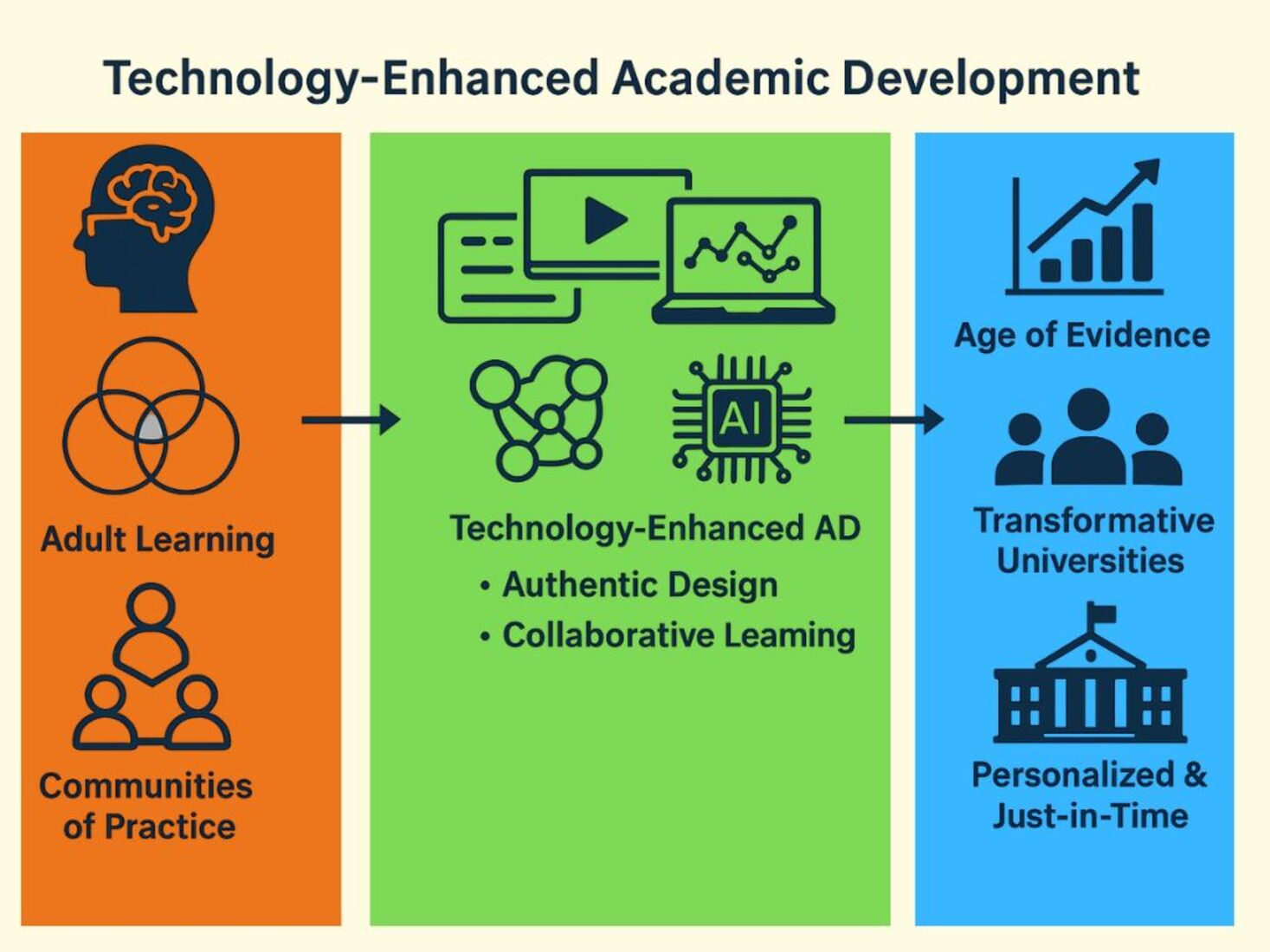
2. Theoretical Framework
2.1. Evolution of AD: From Practice to Discipline
2.2. Foundational Pedagogical Frameworks: From Shulman to TPACK
2.3. Adult Learning Theories and Collaborative Models
3. Technologies and AD Models
3.1. Technological Ecosystem: Platforms and Learning Environments
3.2. Technologically Mediated Didactic Approaches
3.3. TPACK Development: Evidence-Based Strategies
3.4. Technologically Mediated Assessment and Dialogic Feedback
3.5. Digital Communities of Practice and Social Learning
3.6. Emerging Technologies: AI, VR/AR, Gaming, and Makerspaces in AD
4. Critical Perspectives and Challenges
4.1. Structural Barriers and Systemic Resistances
4.2. Competency Gaps and Technological Criticalities
4.3. Professional Identity and Power Dynamics
4.4. Evaluation, Evidence, and Accountability
4.5. Diversity, Equity, and Inclusion
5. Future Perspectives and Research Directions
5.1. The “Age of Evidence”: Toward Evidence-Based Programs
5.2. Personalization and Flexibility: Toward Just-in-Time Approaches
5.3. Emerging Technologies: Opportunities and Ethical Questions: Opportunities and Ethical Questions
5.4. Global Challenges and Transformative Universities
5.5. Integrated Systems for Teaching Quality Support
6. Conclusions
Strategic Recommendations
Supplementary Materials
Author Contributions
Funding
Institutional Review Board Statement
Informed Consent Statement
Data Availability Statement
Conflicts of Interest
References
- Rapanta, C.; Botturi, L.; Goodyear, P.; Guàrdia, L.; Koole, M. Online university teaching during and after the COVID-19 crisis: Refocusing teacher presence and learning activity. Postdigital Sci. Educ. 2020, 2, 923–945. [Google Scholar] [CrossRef]
- Sorcinelli, M.D.; Austin, A.E.; Eddy, P.L.; Beach, A.L. Creating the Future of Faculty Development: Learning from the Past, Understanding the Present; Jossey-Bass: San Francisco, CA, USA, 2005. [Google Scholar]
- Lampugnani, P.A. Faculty Development: Origini, framework teorico, evoluzioni, traiettorie. In Faculty Development in Italia: Valorizzazione Delle Competenze Didattiche dei Docenti Universitari; Lotti, A., Lampugnani, P.A., Eds.; Genova University Press: Genova, Italy, 2020; p. 2741. [Google Scholar]
- Steinert, Y. Faculty Development: From workshops to communities of practice. Med. Teach. 2010, 32, 425–428. [Google Scholar] [CrossRef] [PubMed]
- Steinert, Y. Faculty Development in the Health Professions: A Focus on Research and Practice; Springer: New York, NY, USA, 2014. [Google Scholar]
- De Rossi, M.; Ferranti, C.; Castelli, L. Esperienze sul campo di didattica universitaria con l’uso delle ICT—Information and Communication Technology. In Preparare alla Professionalità Docente e Innovare la Didattica Universitaria; Felisatti, E., Serbati, A., Eds.; Franco Angeli Edizioni: Milano, Italy, 2017. [Google Scholar]
- Inamorato dos Santos, A.; Gaušas, S.; Mackevičiūtė, R.; Jotautytė, A.; Martinaitis, Ž. Innovating Professional Development in Higher Education: An Analysis of Practices; Publications Office of the European Union: Luxembourg, 2019. [Google Scholar]
- Tondeur, J.; van Braak, J.; Ertmer, P.A.; Ottenbreit-Leftwich, A. Understanding the relationship between teachers’ pedagogical beliefs and technology use in education: A systematic review of qualitative evidence. Educ. Technol. Res. Dev. 2023, 71, 555–575. [Google Scholar]
- Bond, M.; Marín, V.I.; Dolch, C.; Bedenlier, S.; Zawacki-Richter, O. Digital transformation in German higher education: Student and teacher perceptions and usage of digital media. Int. J. Educ. Technol. High. Educ. 2023, 20, 48. [Google Scholar] [CrossRef]
- Mishra, P.; Koehler, M.J. Technological pedagogical content knowledge: A framework for teacher knowledge. Teach. Coll. Rec. 2006, 108, 1017–1054. [Google Scholar] [CrossRef]
- Hodson, J.; Wong, P.P.Y. Teaching the “heads, hearts, and hands” of futures literacy in sustainability education using radical seeds of change. Ecol. Soc. 2025, 30, 48. [Google Scholar] [CrossRef]
- Sabato, A. Integral Human Development. Contemporary Humanism Network. 2022. Available online: https://www.contemporaryhumanism.net/wp-content/uploads/2022/05/Sabato_LUMSA.pdf (accessed on 16 December 2025).
- Steinert, Y. Commentary: Faculty Development—The road less traveled. Acad. Med. 2011, 86, 409–411. [Google Scholar] [CrossRef]
- Shulman, L.S. Those who understand: Knowledge growth in teaching. Educ. Res. 1986, 15, 414. [Google Scholar] [CrossRef]
- Shulman, L.S. Knowledge and teaching: Foundations of the new reform. Harv. Educ. Rev. 1987, 57, 123. [Google Scholar] [CrossRef]
- Zou, R.; Jiang, L.; Cao, Y. Mapping Fifteen Years of Technological Pedagogical and Content Knowledge (TPACK) Model Applications in Higher Education. Preprint 2024. [Google Scholar] [CrossRef]
- Koehler, M.J.; Mishra, P. The technological pedagogical content knowledge framework. In Handbook of Research on Educational Communications and Technology; Spector, J.M., Merrill, M.D., Elen, J., Bishop, M.J., Eds.; Springer: New York, NY, USA, 2014; pp. 101–111. [Google Scholar]
- Voogt, J.; Fisser, P.; Pareja Roblin, N.; Tondeur, J.; van Braak, J. Technological pedagogical content knowledge—A review of the literature. J. Comput. Assist. Learn. 2023, 29, 109–121. [Google Scholar] [CrossRef]
- Angeli, C.; Valanides, N. Epistemological and methodological issues for the conceptualization, development, and assessment of ICTTPCK: Advances in technological pedagogical content knowledge. Comput. Educ. 2024, 52, 154–168. [Google Scholar] [CrossRef]
- Knowles, M.S.; Holton, E.F., III; Swanson, R.A. The Adult Learner: The Definitive Classic in Adult Education and Human Resource Development, 6th ed.; Elsevier: Burlington, MA, USA, 2005. [Google Scholar]
- King, E.; Boyatt, R. Exploring factors that influence adoption of e-learning within higher education. Br. J. Educ. Technol. 2023, 46, 1272–1280. [Google Scholar] [CrossRef]
- Mezirow, J. Transformative learning in practice. In Transformative Learning in Practice: Insights from Community, Workplace, and Higher Education; Mezirow, J., Taylor, E.W., Eds.; Jossey-Bass: San Francisco, CA, USA, 2011; p. 1832. [Google Scholar]
- Wenger, E.; McDermott, R.A.; Snyder, W. Coltivare Comunità di Pratica: Prospettive ed Esperienze di Gestione della Conoscenza; Guerini e Associati: Milano, Italy, 2007. [Google Scholar]
- Karlsson, P.S.; Shafti, F.; Duffy, K. Pragmatic approach to conceptualising learning community. Int. J. Med. Educ. 2025, 16, 101141. [Google Scholar] [CrossRef]
- Cox, M.D. The impact of communities of practice in support of early-career academics. Int. J. Acad. Dev. 2013, 18, 1830. [Google Scholar] [CrossRef]
- Graham, C.R.; Allen, S.; Ure, D. Benefits and challenges of blended learning environments. In Encyclopedia of Information Science and Technology; Khosrow-Pour, M., Ed.; IGI Global: Hershey, PA, USA, 2005; pp. 253–259. [Google Scholar]
- Trentin, G.; Bocconi, S. Didattica ibrida e insegnamento universitario: Guideline per una progettazione efficace. G. Ital. Della Ric. Educ. 2015, 15, 2742. [Google Scholar]
- Bergmann, J.; Sams, A. Flip Your Classroom: Reach Every Student in Every Class Every Day; International Society for Technology in Education: Eugene, OR, USA, 2012. [Google Scholar]
- Anderson, L.W.; Krathwohl, D.R.; Airasian, P.W.; Cruikshank, K.A.; Mayer, R.E.; Pintrich, P.R.; Raths, J.; Wittrock, M.C. A Taxonomy for Learning, Teaching, and Assessing: A Revision of Bloom’s Taxonomy of Educational Objectives; Longman: New York, NY, USA, 2005. [Google Scholar]
- Talbert, R. Flipped Learning: A Guide for Higher Education Faculty; Stylus Publishing: Sterling, VA, USA, 2017. [Google Scholar]
- Raffaghelli, J.E. Does flipped classroom work? Critical analysis of empirical evidences on its effectiveness for learning. Form@re—Open J. Form. Rete 2017, 17, 116–134. [Google Scholar]
- Kalir, J.; Morales, E.; Fleerackers, A.; Alperin, J.P. “When I saw my peers annotating”: Student perceptions of social annotation for learning in multiple courses. J. Inf. Learn. Sci. 2020, 121, 207–230. [Google Scholar] [CrossRef]
- Mazur, E. Peer Instruction: A User’s Manual; Prentice Hall: Upper Saddle River, NJ, USA, 1997. [Google Scholar]
- Harris, J.B.; Hofer, M.J. Technological pedagogical content knowledge (TPACK) in action: A descriptive study of secondary teachers’ curriculum-based, technology-related instructional planning. J. Res. Technol. Educ. 2011, 43, 211–229. [Google Scholar] [CrossRef]
- Huang, Z.; Fu, X.; Zhao, J. Research on AIGC-Integrated Design Education for Sustainable Teaching: An Empirical Analysis Based on the TAM and TPACK Models. Sustainability 2024, 17, 5497. [Google Scholar] [CrossRef]
- Niess, M.L. Preparing teachers to teach science and mathematics with technology: Developing a technology pedagogical content knowledge. Teach. Teach. Educ. 2005, 21, 509–523. [Google Scholar] [CrossRef]
- Nicol, D. From monologue to dialogue: Improving written feedback processes in mass higher education. Assess. Eval. High. Educ. 2010, 35, 501–517. [Google Scholar] [CrossRef]
- Black, P.; Harrison, C.; Lee, C.; Marshall, B.; Wiliam, D. Working inside the black box: Assessment for learning in the classroom. Phi Delta Kappan 2004, 86, 821. [Google Scholar] [CrossRef]
- Serbati, A.; Grion, V. IMPROVe: Six research-based principles to realise peer assessment in educational contexts. Form@re—Open J. Form. Rete 2019, 19, 89105. [Google Scholar]
- Bolisani, E.; Fedeli, M.; Bierema, L.; De Marchi, V. United we adapt: Communities of practice to face the coronavirus crisis in higher education. Knowl. Manag. Res. Pract. 2021, 19, 454–458. [Google Scholar] [CrossRef]
- Harper, F.; Nicolson, M. Online peer observation: Its value in teacher professional development, support and wellbeing. Int. J. Acad. Dev. 2013, 18, 264–275. [Google Scholar] [CrossRef]
- Murphy, R.; Weinhardt, F.; Wyness, G. Who Teaches the Teachers? A RCT of Peer-to-Peer Observation and Feedback in 181 Schools; CEP Discussion Paper No. 1565; Centre for Economic Performance: London, UK, 2018. [Google Scholar]
- Zawacki-Richter, O.; Marín, V.I.; Bond, M.; Gouverneur, F. Systematic review of research on artificial intelligence applications in higher education—Where are the educators? Int. J. Educ. Technol. High. Educ. 2023, 16, 39. [Google Scholar] [CrossRef]
- Selwyn, N. Should Robots Replace Teachers? AI and the Future of Education; Polity Press: Cambridge, UK, 2024. [Google Scholar]
- Radianti, J.; Majchrzak, T.A.; Fromm, J.; Wohlgenannt, I. A systematic review of immersive virtual reality applications for higher education. Comput. Educ. 2024, 147, 103778. [Google Scholar] [CrossRef]
- Subhash, S.; Cudney, E.A. Gamified learning in higher education: A systematic review of the literature. Comput. Hum. Behav. 2023, 87, 192–206. [Google Scholar] [CrossRef]
- Morocz, R.; Levy, B.; Forest, C.; Nagel, R.; Newstetter, W.; Talley, K.; Linsey, J. University maker spaces: Discovery, optimization and measurement of impacts. In Proceedings of the 2015 ASEE Annual Conference & Exposition, Seattle, WA, USA, 14–17 June 2015. [Google Scholar]
- High Level Group on the Modernisation of Higher Education. Report to the European Commission on Improving the Quality of Teaching and Learning in Europe’s Higher Education Institutions; Publications Office of the European Union: Luxembourg, 2014. [Google Scholar]
- Oleson, A.; Hora, M.T. Teaching the way they were taught? Revisiting the sources of teaching knowledge and the role of prior experience in shaping faculty teaching practices. High. Educ. 2013, 68, 2945. [Google Scholar] [CrossRef]
- Felisatti, E.; Scialdone, O.; Cannarozzo, M.; Pennisi, S. Il mentoring nella docenza universitaria: Il progetto “Mentori per la didattica” nell’Università di Palermo. Ital. J. Educ. Res. 2019, 23, 178–193. [Google Scholar]
- Sorcinelli, M.D. Faculty Development in the age of evidence. In Faculty Development in the Age of Evidence: Current Practices, Future Imperatives; Beach, A.L., Sorcinelli, M.D., Austin, A.E., Rivard, J.K., Eds.; Stylus Publishing: Sterling, VA, USA, 2016; p. 130. [Google Scholar]
- Ertmer, P.A.; Ottenbreit-Leftwich, A.T. Teacher technology change: How knowledge, confidence, beliefs, and culture intersect. J. Res. Technol. Educ. 2010, 42, 255–284. [Google Scholar] [CrossRef]
- Mei, B.; Brown, G.T.; Teo, T. Toward an understanding of preservice English as a Foreign Language teachers’ acceptance of computer-assisted language learning 2.0 in the People’s Republic of China. J. Educ. Comput. Res. 2017, 56, 74–104. [Google Scholar] [CrossRef]
- Hsu, L. Examining EFL teachers’ technological pedagogical content knowledge and the adoption of mobile-assisted language learning: A partial least square approach. Comput. Assist. Lang. Learn. 2016, 29, 1287–1297. [Google Scholar] [CrossRef]
- Farnell, T.; Skledar Matijević, A.; Šćukanec Schmidt, N. The Impact of COVID-19 on Higher Education: A Review of Emerging Evidence; Publications Office of the European Union: Luxembourg, 2021. [Google Scholar]
- Prensky, M. From Digital Natives to Digital Wisdom: Hopeful Essays for 21st Century Learning; Corwin Press: Thousand Oaks, CA, USA, 2012. [Google Scholar]
- Trowler, P.; Cooper, A. Teaching and learning regimes: Implicit theories and recurrent practices in the enhancement of teaching and learning through educational development programmes. High. Educ. Res. Dev. 2002, 21, 221–240. [Google Scholar] [CrossRef]
- Fedeli, M. Linking faculty to organization development and change: Teaching4Learning@Unipd. In Connecting Adult Learning and Knowledge Management; Fedeli, M., Bierema, L.L., Eds.; Springer: Cham, Switzerland, 2019; p. 5168. [Google Scholar]
- Steinert, Y.; Mann, K.; Anderson, B.; Barnett, B.M.; Centeno, A.; Naismith, L.; Prideaux, D.; Spencer, J.; Tullo, E.; Viggiano, T.; et al. A systematic review of Faculty Development initiatives designed to enhance teaching effectiveness: A 10-year update. Med. Teach. 2016, 38, 769–786. [Google Scholar] [CrossRef]
- Little, D. Reflections on the state of the scholarship of educational development. Improv. Acad. 2014, 33, 113. [Google Scholar] [CrossRef]
- Brookfield, S.D. Powerful Techniques for Teaching Adults; Jossey-Bass: San Francisco, CA, USA, 2013. [Google Scholar]
- CAST Universal Design for Learning Guidelines Version 2.2. 2018. Available online: http://udlguidelines.cast.org (accessed on 15 November 2024).
- Beach, A.L.; Sorcinelli, M.D.; Austin, A.E.; Rivard, J.K. Faculty Development in the Age of Evidence: Current Practices, Future Imperatives; Stylus Publishing: Sterling, VA, USA, 2016. [Google Scholar]
- Suyo-Vega, J.A.; Fernández-Bedoya, V.H.; Meneses-La-Riva, M.E. Beyond traditional teaching: A systematic review of innovative pedagogical practices in higher education. F1000Research 2024, 13, 22. [Google Scholar] [CrossRef] [PubMed]
- Boyer, E.L. Scholarship Reconsidered: Priorities of the Professoriate; Carnegie Foundation for the Advancement of Teaching: Princeton, NJ, USA, 1990. [Google Scholar]
- Guo, M. What Drives Teachers to Engage in the Scholarship of Teaching and Learning in China’s Application-Oriented Universities? A Qualitative Content Analysis. Sage Open 2025, 15, 21582440251392812. [Google Scholar] [CrossRef]
- Trigwell, K. Evidence of the impact of scholarship of teaching and learning purposes. Teach. Learn. Inq. 2013, 1, 95–105. [Google Scholar] [CrossRef]
- European University Association (EUA). Exploring Strategies for Institutions to Leverage the Scholarship of Teaching and Learning; EUA Learning & Teaching Thematic Peer Group Report. 2025. Available online: https://www.eua.eu/publications/reports/exploring-strategies-for-institutions-to-leverage-the-scholarship-of-teaching-and-learning.html (accessed on 16 December 2025).
- Daniel, C.; Gajjala, R.; Herman, C.; Kirkup, G.; Lockard, J.; Sharma, M. A Feminist Scholars Collective Supporting the Growth and Dissemination of a Digital Guide: A Collaborative Autoethnography. J. Electron. Publ. 2025, 28, 1–18. [Google Scholar]
- Boileau, E.; Audétat, M.C.; St-Onge, C. Just-in-time faculty development: A mobile application helps clinical teachers verify and describe clinical reasoning difficulties. BMC Med. Educ. 2019, 19, 120. [Google Scholar] [CrossRef]
- Jobin, A.; Ienca, M.; Vayena, E. The global landscape of AI ethics guidelines. Nat. Mach. Intell. 2019, 1, 389–399. [Google Scholar] [CrossRef]
- Mandinach, E.B.; Gummer, E.S. Building a conceptual framework for data literacy. Teach. Coll. Rec. 2015, 117, 1–22. [Google Scholar] [CrossRef]
- European University Association. Universities Without Walls: A Vision for 2030; EUA: Brussels, Belgium, 2021. [Google Scholar]
- Sandri, O. Exploring the role and value of creativity in education for sustainability. Environ. Educ. Res. 2023, 29, 867–885. [Google Scholar] [CrossRef]
- Lotti, A.; Lampugnani, P.A. (Eds.) Faculty Development in Italia: Valorizzazione delle Competenze Didattiche dei Docenti Universitari; Genova University Press: Genova, Italy, 2020. [Google Scholar]
- Hofer, B.K. Personal epistemology research: Implications for learning and teaching. Educ. Psychol. Rev. 2001, 13, 353–383. [Google Scholar] [CrossRef]
- Hofer, B.K. Personal epistemology and culture. In Knowing, Knowledge and Beliefs: Epistemological Studies Across Diverse Cultures; Springer: Dordrecht, The Netherlands, 2008; pp. 3–22. [Google Scholar]
Disclaimer/Publisher’s Note: The statements, opinions and data contained in all publications are solely those of the individual author(s) and contributor(s) and not of MDPI and/or the editor(s). MDPI and/or the editor(s) disclaim responsibility for any injury to people or property resulting from any ideas, methods, instructions or products referred to in the content. |
© 2026 by the authors. Licensee MDPI, Basel, Switzerland. This article is an open access article distributed under the terms and conditions of the Creative Commons Attribution (CC BY) license.
Share and Cite
Fusco, P.; Di Paolo, A.; Todino, M.D. Technologies for Supporting Academic Development. Encyclopedia 2026, 6, 18. https://doi.org/10.3390/encyclopedia6010018
Fusco P, Di Paolo A, Todino MD. Technologies for Supporting Academic Development. Encyclopedia. 2026; 6(1):18. https://doi.org/10.3390/encyclopedia6010018
Chicago/Turabian StyleFusco, Paolo, Alessio Di Paolo, and Michele Domenico Todino. 2026. "Technologies for Supporting Academic Development" Encyclopedia 6, no. 1: 18. https://doi.org/10.3390/encyclopedia6010018
APA StyleFusco, P., Di Paolo, A., & Todino, M. D. (2026). Technologies for Supporting Academic Development. Encyclopedia, 6(1), 18. https://doi.org/10.3390/encyclopedia6010018