
The Impact of a Mathematical Mindset Approach on Learning


Abstract
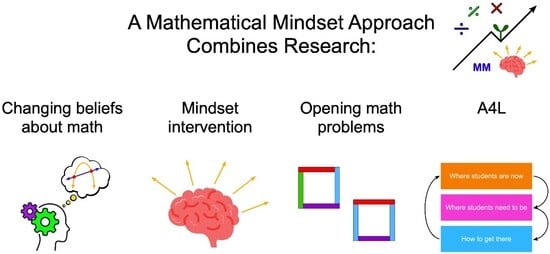
1. Introduction
2. Foundational Beliefs
2.1. Mathematical Beliefs
2.2. Self-Belief
3. Educational Practices Supporting Growth Mindset Ideas
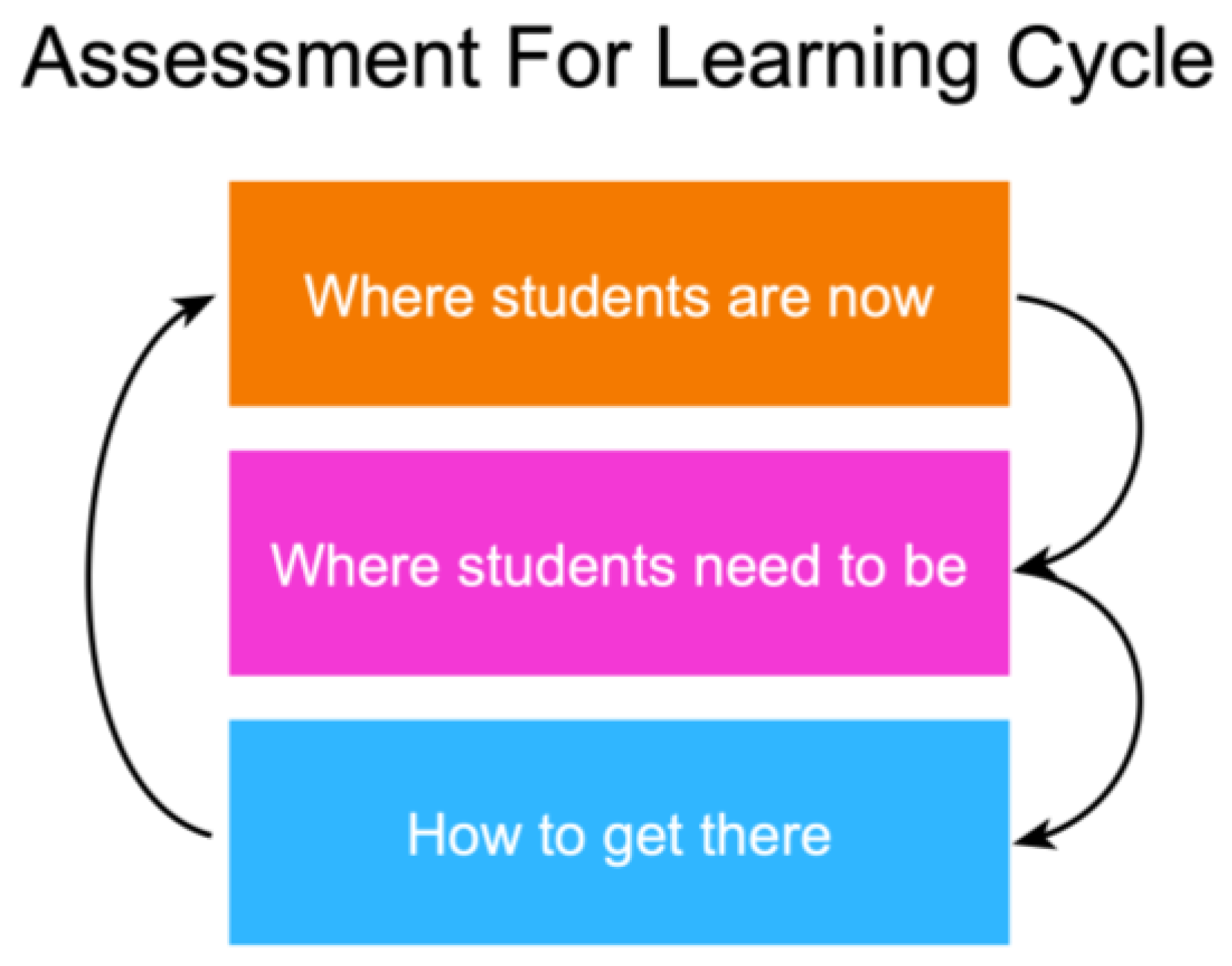
3.1. Educational Practice: Assessment and Grading
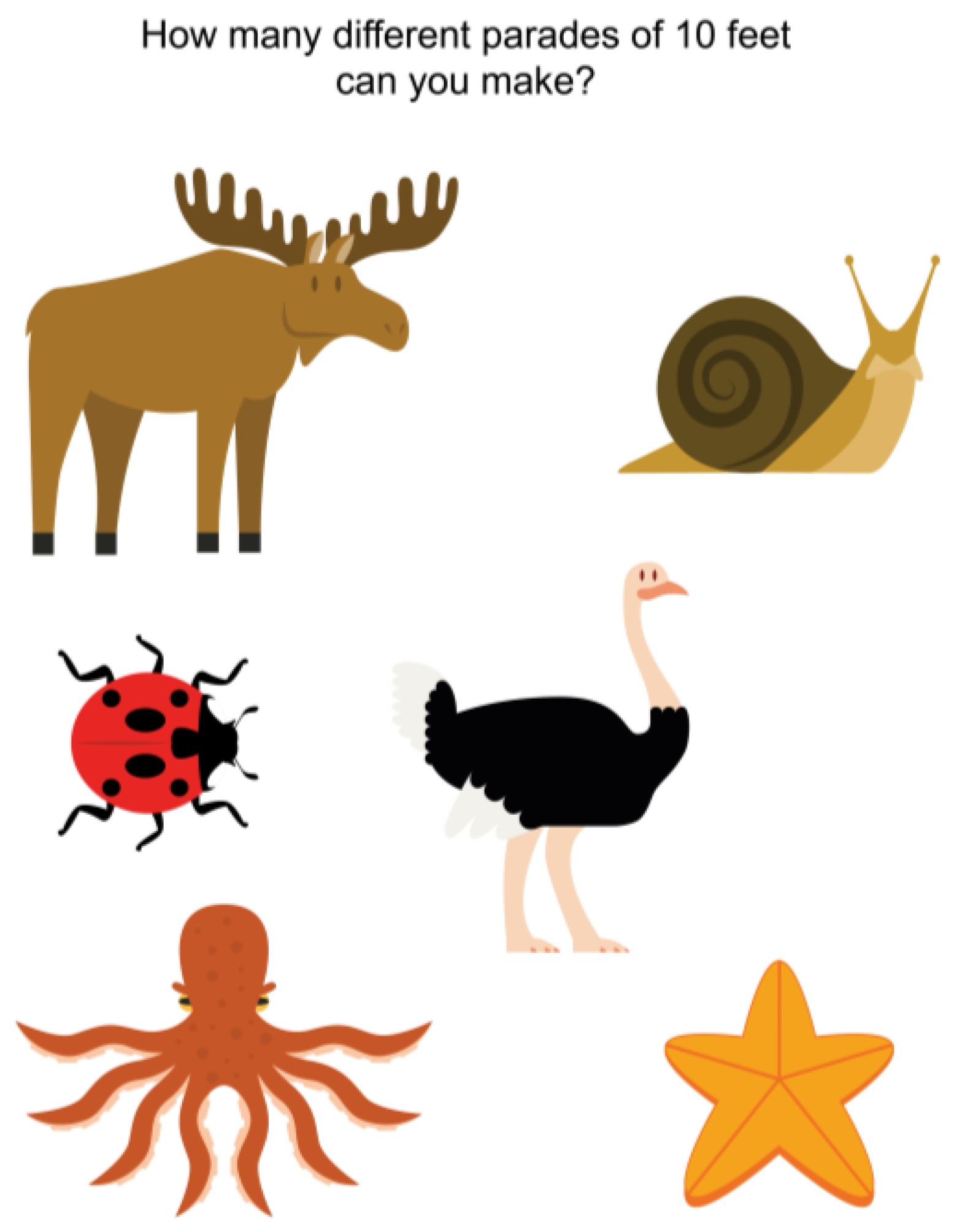
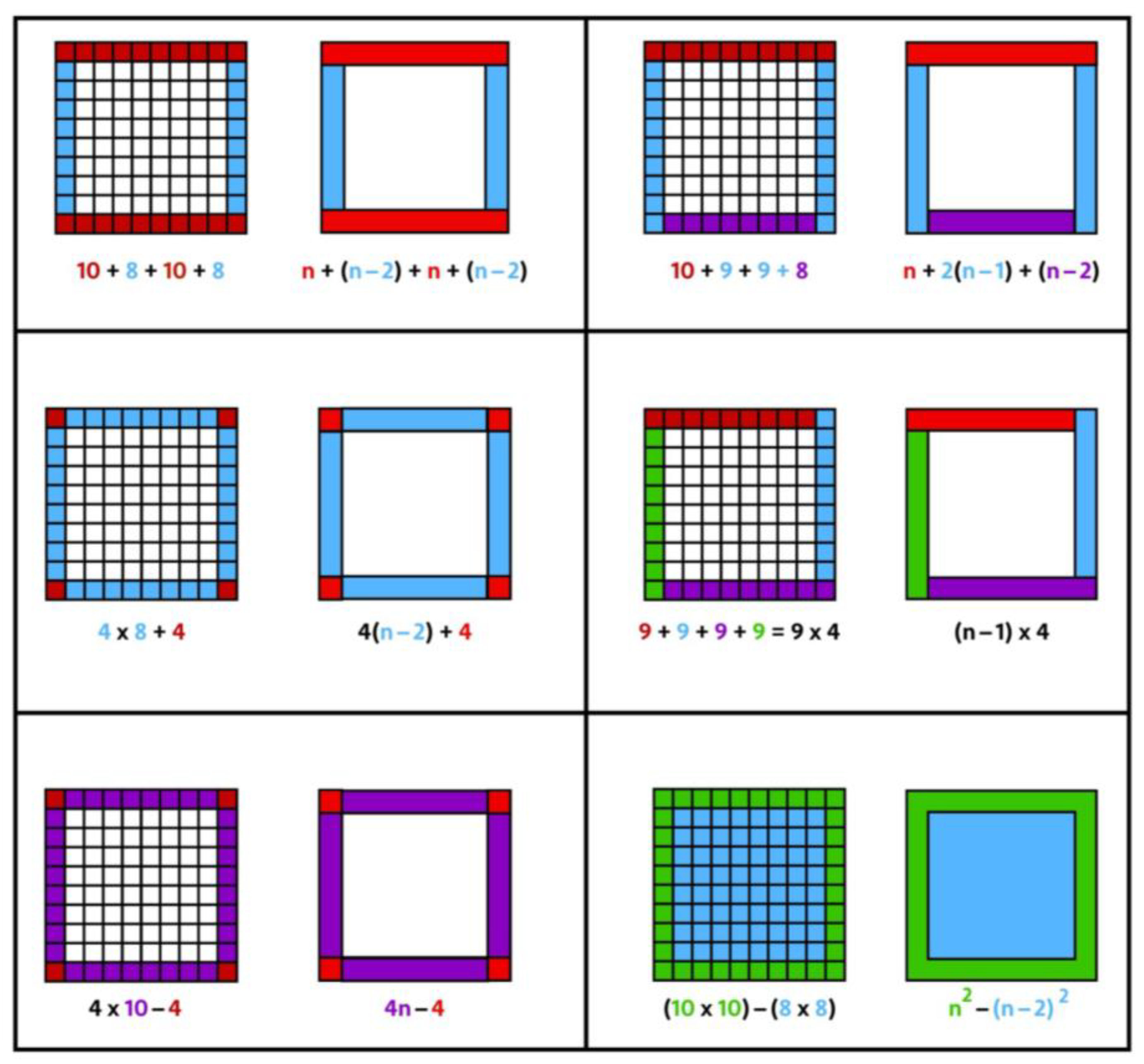
3.2. Educational Practice: Open Mathematical Problems and Tasks
4. Findings: The Impact of a Mathematical Mindset Approach
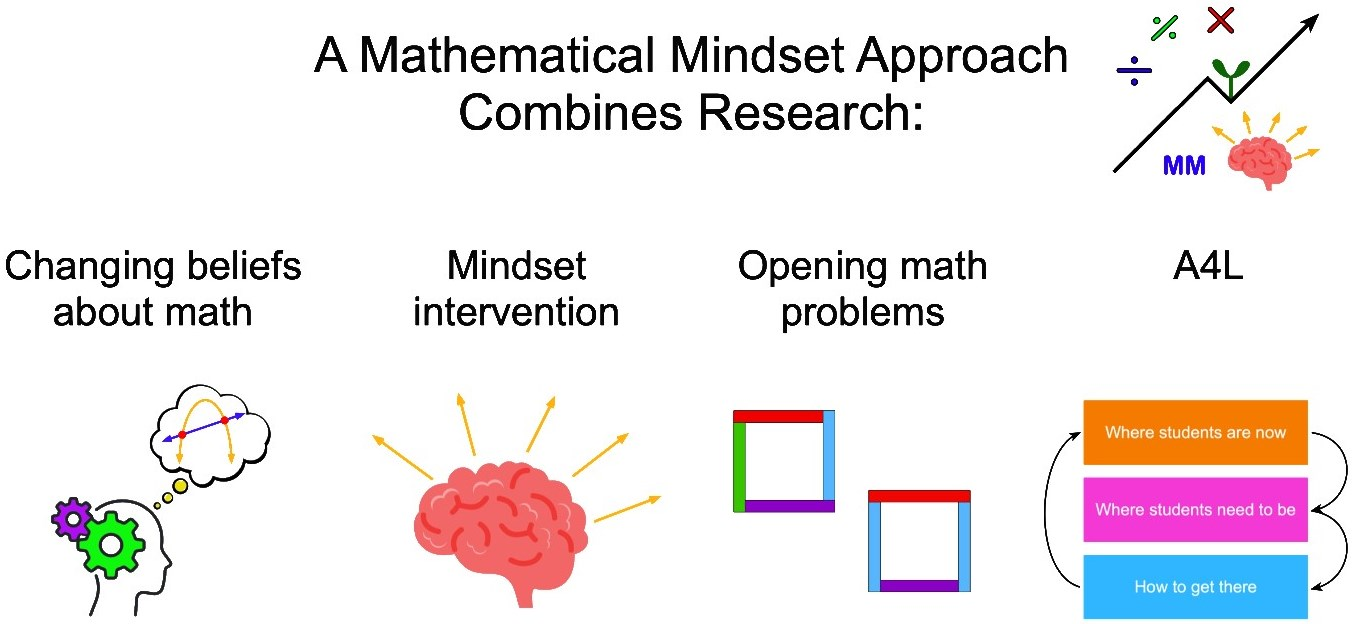
4.1. Conceptualizing of Mathematical Mindset Approach
4.2. Studying a Mathematical Mindset Approach
5. Conclusions
Author Contributions
Funding
Institutional Review Board Statement
Informed Consent Statement
Data Availability Statement
Conflicts of Interest
References
- OECD. Skills Matter: Additional Results from the Survey of Adult Skills; OECD Skills Studies; OECD Publishing: Paris, France, 2019. [Google Scholar] [CrossRef]
- Fries, L.; Son, J.Y.; Givvin, K.B.; Stigler, J.W. Practicing Connections: A Framework to Guide Instructional Design for Developing Understanding in Complex Domains. Educ. Psychol. Rev. 2020, 33, 739–762. [Google Scholar] [CrossRef]
- Hecht, C.A.; Murphy, M.C.; Dweck, C.S.; Bryan, C.J.; Trzesniewski, K.H.; Medrano, F.N.; Giani, M.; Mhatre, P.; Yeager, D.S. Shifting the mindset culture to address global educational disparities. Npj Sci. Learn. 2023, 8, 29. [Google Scholar] [CrossRef]
- Suárez-Pellicioni, M.; Núñez-Peña, M.I.; Colomé, À. Math anxiety: A review of its cognitive consequences, psychophysiological correlates, and brain bases. Cogn. Affect. Behav. Neurosci. 2016, 16, 3–22. [Google Scholar] [CrossRef] [PubMed]
- Driscoll, M. Fostering Algebraic Thinking: A Guide for Teachers, Grades 6–10; Heinemann: Portsmouth, NH, USA, 1999. [Google Scholar]
- Blum, W. Can modelling be taught and learnt? Some answers from empirical research. In Trends in Teaching and Learning of Mathematical Modelling (ICTMA 14); Kaiser, G., Stillman, G.A., Eds.; Springer: Dordrecht, The Netherlands, 2011; pp. 15–30. [Google Scholar]
- Schoenfeld, A.H.; Sloane, A.H. Mathematical Thinking and Problem Solving; Routledge: Abingdon, UK, 2016. [Google Scholar]
- Gutierrez, R. Advancing African-American, urban youth in mathematics: Unpacking the success of one math department. Am. J. Educ. 2000, 109, 63–111. [Google Scholar] [CrossRef]
- Boaler, J. Mathematical Mindsets: Unleashing Students’ Potential Through Creative Mathematics, Inspiring Messages and Innovative Teaching; John Wiley & Sons: Hoboken, NJ, USA, 2022. [Google Scholar]
- Chingos, M.; Whitehurst, G. Choosing Blindly: Instructional Materials, Teacher Effectiveness, and the Common Core; Brookings Institution: Washington, DC, USA, 2012. [Google Scholar]
- Steiner, D. Curriculum Research: What We Know and Where We Need to Go. Johns Hopkins Institute for Education Policy. 2017. Available online: https://jscholarship.library.jhu.edu/bitstreams/c40cb1d9-cc79-416c-a842-bd2a83e62758/download (accessed on 13 December 2025).
- Lubienski, S.T. Examining Instruction, Achievement, and Equity with NAEP Mathematics Data. Educ. Policy Anal. Arch. 2006, 14, 14. [Google Scholar] [CrossRef]
- Boaler, J.; Williams, C.; Confer, A. Fluency without fear: Research evidence on the best ways to learn math facts. Reflections 2015, 40, 7–12. [Google Scholar]
- Steele, C.M. A threat in the air: How stereotypes shape intellectual identity and performance. Am. Psychol. 1997, 52, 613–629. [Google Scholar] [CrossRef]
- Spencer, S.J.; Steele, C.M.; Quinn, D.M. Stereotype threat and women’s math performance. J. Exp. Soc. Psychol. 1999, 35, 4–28. [Google Scholar] [CrossRef]
- Shah, N. Race, ideology, and academic ability: A relational analysis of racial narratives in mathematics. Teach. Coll. Rec. 2017, 119, 1–42. [Google Scholar] [CrossRef]
- Cheng, E. What If Nobody Is Bad at Maths? The Guardian, 29 May 2023. Available online: https://www.theguardian.com/books/2023/may/29/what-if-nobody-is-bad-at-maths (accessed on 17 November 2025).
- Suri, M. The Big Bang of Numbers; W. W. Norton & Company: New York, NY, USA, 2023. [Google Scholar]
- DiME. Culture, race, power, and mathematics education. In Handbook of Research on Mathematics Teaching and Learning, 2nd ed.; Lester, F., Ed.; Information Age Publishing: Charlotte, NC, USA, 2007; pp. 405–433. [Google Scholar]
- Joseph, N.M.; Hailu, M.; Boston, D. Black women’s and girls’ persistence in the P–20 mathematics pipeline: Two decades of children, youth, and adult education research. Rev. Res. Educ. 2017, 41, 203–227. [Google Scholar] [CrossRef]
- Martin, D.B. Mathematics Success and Failure Among African-American Youth: The Roles of Sociohistorical Context, Community Forces, School Influence, and Individual Agency; Routledge: New York, NY, USA, 2000. [Google Scholar]
- Joseph, N.M.; Cobb, F. AntiBlackness is in the air: Problematizing Black students’ mathematics education pathways from curriculum to standardized assessments. In Critical Race Theory in Mathematics Education; Routledge: New York, NY, USA, 2019; pp. 140–163. [Google Scholar]
- Chen, L.; Bae, S.R.; Battista, C.; Qin, S.; Chen, T.; Evans, T.M.; Menon, V. Positive attitude toward math supports early academic success: Behavioral evidence and neurocognitive mechanisms. Psychol. Sci. 2018, 29, 390–402. [Google Scholar] [CrossRef]
- Young, C.B.; Wu, S.S.; Menon, V. The neurodevelopmental basis of math anxiety. Psychol. Sci. 2012, 23, 492–501. [Google Scholar] [CrossRef]
- Schoenfeld, A.H. Making sense of “out loud” problem-solving protocols. J. Math. Behav. 1985, 4, 171–191. [Google Scholar]
- Dweck, C.S. Mindset: The New Psychology of Success; Random House: New York, NY, USA, 2006. [Google Scholar]
- Ernest, P. The impact of beliefs on the teaching of mathematics. In Mathematics Teaching: The State of the Art; Ernest, P., Ed.; Falmer Press: London, UK, 1989; pp. 249–254. [Google Scholar]
- Thompson, A.G. Teachers’ beliefs and conceptions: A synthesis of the research. In Handbook of Research on Mathematics Teaching and Learning; Grouws, D.A., Ed.; Macmillan: New York, NY, USA, 1992; pp. 127–146. [Google Scholar]
- Pehkonen, E.; Pietilä, A. On relationships between beliefs and knowledge in mathematics education. In Proceedings of the 27th Conference of the International Group for the Psychology of Mathematics Education; Pateman, N.A., Dougherty, B.J., Zilliox, J., Eds.; PME: Honolulu, HI, USA, 2003; Volume 4, pp. 37–44. [Google Scholar]
- Liljedahl, P.; Rolka, K.; Rösken, B.; Törner, G. Beliefs as dynamic and socially situated. In Proceedings of the Fifth Congress of the European Society for Research in Mathematics Education (CERME 5); Pitta-Pantazi, D., Philippou, G., Eds.; University of Cyprus: Larnaca, Cyprus, 2007. [Google Scholar]
- Goldin, G.A.; Rösken, B.; Törner, G. Beliefs—No longer a hidden variable in mathematical teaching and learning processes. In Beliefs and Attitudes in Mathematics Education; Maaß, J., Schlöglmann, W., Eds.; Sense Publishers: Rotterdam, The Netherlands, 2009; pp. 1–18. [Google Scholar]
- Op ’t Eynde, P.; De Corte, E.; Verschaffel, L. Framing students’ mathematics-related beliefs: A multidimensional model. In Beliefs: A Hidden Variable in Mathematics Education? Leder, G.C., Pehkonen, E., Törner, G., Eds.; Kluwer Academic Publishers: Dordrecht, The Netherlands, 2002; pp. 13–37. [Google Scholar]
- Blackwell, L.S.; Trzesniewski, K.H.; Dweck, C.S. Implicit theories of intelligence predict achievement across an adolescent transition: A longitudinal study and an intervention. Child Dev. 2007, 78, 246–263. [Google Scholar] [CrossRef]
- Yeager, D.S.; Hanselman, P.; Walton, G.M.; Murray, J.S.; Crosnoe, R.; Muller, C.; Tipton, E.; Schneider, B.; Hulleman, C.S.; Hinojosa, C.P.; et al. A national experiment reveals where a growth mindset improves achievement. Nature 2019, 573, 364–369. [Google Scholar] [CrossRef] [PubMed]
- Bjork, R.A. Memory and metamemory considerations in the training of human beings. In Metacognition: Knowing About Knowing; Metcalfe, J., Shimamura, A., Eds.; MIT Press: Cambridge, MA, USA, 1994; pp. 185–205. [Google Scholar]
- Kapur, M. Productive failure in learning math. Cogn. Sci. 2014, 38, 1008–1022. [Google Scholar] [CrossRef]
- Deslauriers, L.; McCarty, L.S.; Miller, K.; Callaghan, K.; Kestin, G. Measuring actual learning versus feeling of learning in response to being actively engaged in the classroom. Proc. Natl. Acad. Sci. USA 2019, 116, 19251–19257. [Google Scholar] [CrossRef]
- Anderson, R.K.; Boaler, J.; Dieckmann, J.A. Achieving elusive teacher change through challenging myths about learning: A blended approach. Educ. Sci. 2018, 8, 98. [Google Scholar] [CrossRef]
- Dweck, C. What having a “growth mindset” actually means. Harv. Bus. Rev. 2016, 94, 2–5. [Google Scholar]
- Yeager, D.S.; Carroll, J.M.; Buontempo, J.; Cimpian, A.; Woody, S.; Crosnoe, R.; Muller, C.; Murray, J.; Mhatre, P.; Kersting, N.; et al. Teacher mindsets help explain where a growth mindset intervention does and doesn’t work. Psychol. Sci. 2022, 33, 18–32. [Google Scholar] [CrossRef]
- Tulis, M.; Kinskofer, F.; Fischer, E. Results of the quantitative survey on AI use in higher education institutions [Ergebnisse der quantitativen Erhebung zur KI-Nutzung an Hochschulen]. In Learning From AI, Teaching with AI: The Future of Higher Education; Brandhofer, G., Gröblinger, O., Jadin, T., Raunig, M., Schindler, J., Eds.; Forum Neue Medien in der Lehre Austria: Vienna, Austria, 2024. [Google Scholar]
- Dweck, C.S.; Yeager, D.S. Mindsets: A view from two eras. Perspect. Psychol. Sci. 2019, 14, 481–496. [Google Scholar] [CrossRef] [PubMed]
- Black, P.; Wiliam, D. Assessment and classroom learning. Assess. Educ. Princ. Policy Pract. 1998, 5, 7–74. [Google Scholar] [CrossRef]
- Black, P.; Harrison, C.; Lee, C.; Marshall, B.; Wiliam, D. Working inside the black box: Assessment for learning in the classroom. Phi Delta Kappan 2004, 86, 8–21. [Google Scholar] [CrossRef]
- William, D.; Leahy, S. Embedding Formative Assessment: Practical Techniques for K–12 Classrooms; Learning Sciences International: Arlington, VA, USA, 2015. [Google Scholar]
- Butler, R. Task-involving and ego-involving properties of evaluation: Effects of different feedback conditions on motivational perceptions, interest and performance. J. Educ. Psychol. 1987, 79, 474–482. [Google Scholar]
- Butler, R. Enhancing and undermining intrinsic motivation: The effects of task-involving and ego-involving evaluation on interest and performance. Br. J. Educ. Psychol. 1988, 58, 1–14. [Google Scholar]
- Pulfrey, C.; Buchs, C.; Butera, F. Why grades engender performance-avoidance goals: The mediating role of autonomous motivation. J. Educ. Psychol. 2011, 103, 683–697. [Google Scholar] [CrossRef]
- Hattie, J.; Fisher, D.; Frey, N.; Gojak, L.M.; Moore, S.D.; Mellman, W. Visible Learning for Mathematics, Grades K–12: What Works Best to Optimize Student Learning; Corwin Press: Thousand Oaks, CA, USA, 2016. [Google Scholar]
- Cockett, A.; Jackson, C. The use of assessment rubrics to enhance feedback in higher education: An integrative literature review. Nurse Educ. Today 2018, 69, 8–13. [Google Scholar] [CrossRef]
- Karaman, P. Effects of using rubrics in self-assessment with instructor feedback on pre-service teachers’ academic performance, self-regulated learning and perceptions of self-assessment. Eur. J. Psychol. Educ. 2024, 39, 2551–2574. [Google Scholar] [CrossRef]
- Vasileiadou, D.; Karadimitriou, K. Examining the impact of self-assessment with the use of rubrics on primary school students’ performance. Int. J. Educ. Res. Open 2021, 2, 100031. [Google Scholar] [CrossRef]
- Panadero, E.; Jonsson, A.; Pinedo, L.; Fernández-Castilla, B. Effects of rubrics on academic performance, self-regulated learning, and self-efficacy: A meta-analytic review. Educ. Psychol. Rev. 2023, 35, 113. [Google Scholar] [CrossRef]
- Foster, H. The Impact of Formative Assessment on Student Learning Outcomes: A Meta-Analytical Review. Acad. Educ. Leadersh. J. 2024, 28, 1–3. [Google Scholar]
- Xuan, Q.; Cheung, A.; Sun, D. The effectiveness of formative assessment for enhancing reading achievement in K–12 classrooms: A meta-analysis. Front. Psychol. 2022, 13, 990196. [Google Scholar] [CrossRef]
- Boström, E.; Palm, T. The effect of a formative assessment practice on student achievement in mathematics. Front. Educ. 2023, 8, 1101192. [Google Scholar] [CrossRef]
- Boaler, J.; Dieckmann, J.; Loos, R.A. Changing mathematical beliefs and achievement: The synergies of mindset ideas and effective teaching. Quadrante 2023, 32, 195–208. [Google Scholar]
- Maher, C.A.; Martino, A.M. The development of the idea of mathematical proof: A 5-year case study. J. Res. Math. Educ. 1996, 27, 194–214. [Google Scholar] [CrossRef]
- Hiebert, J.; Carpenter, T.P.; Fennema, E.; Fuson, K.C.; Wearne, D.; Murray, H.; Olivier, A.; Human, P. Making Sense: Teaching and Learning Mathematics with Understanding; Heinemann: Portsmouth, NH, USA, 1997. [Google Scholar]
- Hiebert, J.; Grouws, D.A. The effects of classroom mathematics teaching on students’ learning. In Second Handbook of Research on Mathematics Teaching and Learning; Lester, F., Ed.; Information Age Publishing: Charlotte, NC, USA, 2007; pp. 371–404. [Google Scholar]
- Boaler, J. Open and closed mathematics: Student experiences and understandings. J. Res. Math. Educ. 1998, 29, 41–62. [Google Scholar] [CrossRef]
- Boaler, J.; Staples, M. Creating mathematical futures through an equitable teaching approach: The case of Railside School. Teach. Coll. Rec. 2008, 110, 608–645. [Google Scholar] [CrossRef]
- YouCubed. Foot Parade (1-2). YouCubed—Week of Inspirational Math. Available online: https://www.youcubed.org/wim/foot-parade-1-2/ (accessed on 3 January 2026).
- Boaler, J. Math-ish: Finding Creativity, Diversity, and Meaning in Mathematics; HarperCollins: New York, NY, USA, 2024. [Google Scholar]
- YouCubed. Mathematical Mindset Algebra. YouCubed. Available online: https://www.youcubed.org/algebra/ (accessed on 3 January 2026).
- Lakoff, G.; Núñez, R. Where Mathematics Comes From; Basic Books: New York, NY, USA, 2000. [Google Scholar]
- Alibali, M.W.; Nathan, M.J. Embodiment in mathematics teaching and learning: Evidence from learners’ and teachers’ gestures. J. Learn. Sci. 2012, 21, 247–286. [Google Scholar] [CrossRef]
- Skemp, R.R. Relational understanding and instrumental understanding. Math. Teach. 1976, 77, 20–26. [Google Scholar]
- Hiebert, J.; Carpenter, T.P. Learning and Teaching with Understanding. In Handbook of Research on Mathematics Teaching and Learning; Grouws, D.A., Ed.; Macmillan: New York, NY, USA, 1992; pp. 65–97. [Google Scholar]
- Bransford, J.D.; Brown, A.L.; Cocking, R.R. How People Learn; National Academy Press: Washington, DC, USA, 2000. [Google Scholar]
- Schoenfeld, A.H. Learning to think mathematically: Problem solving, metacognition, and sense-making in mathematics. In Handbook for Research on Mathematics Teaching and Learning; Grouws, D.A., Ed.; Macmillan: New York, NY, USA, 1992; pp. 334–370. [Google Scholar]
- Schoenfeld, A.H. Making mathematics work for all children: Issues of standards, testing, and equity. Educ. Res. 2002, 31, 13–25. [Google Scholar] [CrossRef]
- Boaler, J. The ‘psychological prisons’ from which they never escaped: The role of ability grouping in reproducing social class inequalities. Forum 2005, 47, 125–134. [Google Scholar] [CrossRef]
- Boaler, J. Urban success: A multidimensional mathematics approach with equitable outcomes. Phi Delta Kappan 2006, 87, 364–369. [Google Scholar] [CrossRef]
- Boaler, J. Promoting ‘relational equity’ and high mathematics achievement through an innovative mixed-ability approach. Br. Educ. Res. J. 2008, 34, 167–194. [Google Scholar] [CrossRef]
- Boaler, J.; Selling, S.K. Psychological imprisonment or intellectual freedom? A longitudinal study of contrasting school mathematics approaches and their impact on adults’ lives. J. Res. Math. Educ. 2017, 48, 78–105. [Google Scholar] [CrossRef]
- Mueller, M.; Maher, C. Learning to reason in an informal math after-school program. Math. Educ. Res. J. 2009, 21, 7–35. [Google Scholar] [CrossRef]
- Carpenter, T.P.; Fennema, E.; Franke, M.L.; Levi, L.; Empson, S.B. Children’s Mathematics: Cognitively Guided Instruction, 2nd ed.; Heinemann: Portsmouth, NH, USA, 2014. [Google Scholar]
- Carpenter, T.P.; Fennema, E.; Franke, M.L. Cognitively guided instruction: A knowledge base for reform in primary mathematics instruction. Elem. Sch. J. 1996, 97, 3–20. [Google Scholar]
- Carpenter, T.P.; Fennema, E.; Franke, M.L.; Levi, L.; Empson, S.B. Cognitively Guided Instruction: A Research-Based Teacher Professional Development Program for Elementary School Mathematics (Research Report); Wisconsin Center for Education Research: Madison, WI, USA, 2000. [Google Scholar]
- Remillard, J.T. Examining key concepts in research on teachers’ use of mathematics curricula. Rev. Educ. Res. 2005, 75, 211–246. [Google Scholar] [CrossRef]
- Remillard, J.T.; Herbel-Eisenmann, B.A.; Lloyd, G.M. (Eds.) Mathematics Teachers at Work: Connecting Curriculum Materials and Classroom Instruction; Routledge: New York, NY, USA, 2008. [Google Scholar]
- Van de Walle, J.A.; Karp, K.S.; Bay-Williams, J.M. Elementary and Middle School Mathematics: Teaching Developmentally, 11th ed.; Pearson: London, UK, 2022. [Google Scholar]
- Verschaffel, L.; De Corte, E.; Lasure, S. Realistic considerations in mathematical modeling of school word problems. Learn. Instr. 1994, 4, 273–294. [Google Scholar] [CrossRef]
- Darling-Hammond, L.; Flook, L.; Cook-Harvey, C.; Barron, B.; Osher, D. Implications for educational practice of the science of learning and development. Appl. Dev. Sci. 2020, 24, 97–140. [Google Scholar] [CrossRef]
- Daly, I.; Bourgaize, J.; Vernitski, A. Mathematical mindsets increase student motivation: Evidence from the EEG. Trends Neurosci. Educ. 2019, 15, 18–28. [Google Scholar] [CrossRef]
- Boaler, J. Prove it to me! Math. Teach. Middle Sch. 2019, 24, 422–428. [Google Scholar] [CrossRef]
- Boaler, J.; Dieckmann, J.A.; LaMar, T.; Leshin, M.; Selbach-Allen, M.; Pérez-Núñez, G. The transformative impact of a mathematical mindset experience taught at scale. Front. Educ. 2021, 6, 784393. [Google Scholar] [CrossRef]
- Leshin, M.; LaMar, T.; Boaler, J. Teachers’ mixed implementation of Mindset mathematics practices during and after a novel approach to teacher learning. Educ. Sci. 2024, 14, 1229. [Google Scholar] [CrossRef]
- Boaler, J.; Dieckmann, J.A.; Pérez-Núñez, G.; Sun, K.L.; Williams, C. Changing students’ minds and achievement in mathematics: The impact of a free online student course. Front. Educ. 2018, 3, 26. [Google Scholar] [CrossRef]
- Wang, A.Y.; Fuchs, L.S.; Fuchs, D.; Gilbert, J.K.; Krowka, S.; Abramson, R. Embedding self-regulation instruction within fractions intervention for third graders with mathematics difficulties. J. Learn. Disabil. 2019, 52, 337–348. [Google Scholar] [CrossRef]
- Bonne, L.; Johnston, M. Students’ beliefs about themselves as mathematics learners. Think. Ski. Creat. 2016, 20, 17–28. [Google Scholar] [CrossRef]
- Boyd, P.; Ash, A. Mastery mathematics: Changing teacher beliefs around in-class grouping and mindset. Teach. Teach. Educ. 2018, 75, 214–223. [Google Scholar] [CrossRef]
- Lee, J.; Lee, H.J.; Song, J.; Bong, M. Enhancing children’s math motivation with a joint intervention on mindset and gender stereotypes. Learn. Instr. 2021, 73, 101416. [Google Scholar] [CrossRef]
- O’Rourke, E.; Haimovitz, K.; Ballweber, C.; Dweck, C.; Popović, Z. Brain points: A growth mindset incentive structure boosts persistence in an educational game. In Proceedings of the SIGCHI Conference on Human Factors in Computing Systems, Toronto, ON, Canada, 26 April–1 May 2014; pp. 3339–3348. [Google Scholar]
- O’Rourke, E.; Peach, E.; Dweck, C.S.; Popović, Z. Brain points: A deeper look at a growth mindset incentive structure for an educational game. In Proceedings of the Third (2016) ACM Conference on Learning @ Scale, Edinburgh, UK, 25–26 April 2016; pp. 41–50. [Google Scholar]
- Ericsson, K.A. The influence of experience and deliberate practice on the development of superior expert performance. In Cambridge Handbook of Expertise and Expert Performance; Ericsson, K.A., Charness, N., Feltovich, P.J., Hoffman, R.R., Eds.; Cambridge University Press: Cambridge, UK, 2006; pp. 685–706. [Google Scholar]
- Balan, A.; Sjöwall, D. Evaluation of a deliberate practice and growth mindset intervention on mathematics in 7th-grade students. Scand. J. Educ. Res. 2023, 67, 549–558. [Google Scholar] [CrossRef]
- Star, J.R.; Chen, J.A.; Taylor, M.W.; Durkin, K.; Dede, C.; Chao, T. Studying technology-based strategies for enhancing motivation in mathematics. Int. J. STEM Educ. 2014, 1, 7. [Google Scholar] [CrossRef]
- Sarrasin, J.B.; Nenciovici, L.; Foisy, L.M.B.; Allaire-Duquette, G.; Riopel, M.; Masson, S. Effects of teaching the concept of neuroplasticity to induce a growth mindset on motivation, achievement, and brain activity: A meta-analysis. Trends Neurosci. Educ. 2018, 12, 22–31. [Google Scholar] [CrossRef]
- Bui, P.; Pongsakdi, N.; Mcmullen, J.; Lehtinen, E.; Hannula-Sormunen, M.M. A systematic review of mindset interventions in mathematics classrooms: What works and what does not? Educ. Res. Rev. 2023, 40, 100554. [Google Scholar] [CrossRef]
- Stigler, J.W.; Hiebert, J. The Teaching Gap: Best Ideas from the World’s Teachers for Improving Education in the Classroom; Simon and Schuster: New York, NY, USA, 2009. [Google Scholar]



| Study | Focus | Method | Key Findings | Mindset Relevant Implications |
|---|---|---|---|---|
| [43] | Assessment and Learning | Review | Formative assessment strongly improves learning | Feedback and student agency matter more than grades |
| [44] | Assessment for Learning | Classroom synthesis | A4L improves achievement & motivation | Emphasizes growth, not performance ranking |
| [46,47] | Feedback types | Experiments | Task-focused feedback boosts motivation; ego-focused harms | Praise effort/process, avoid normative comparison |
| [54] | Formative assessment | Meta-analysis | Significant gains across ages & subjects | Clear guidance supports growth beliefs |
| [53] | Rubrics | Meta-analysis | Improves performance & self-regulation | Clarifies learning goals, supports self-belief |
| [48] | Grades & motivation | Quantitative | Grades trigger avoidance goals | De-emphasize grades to support growth |
| Study | Focus | Method | Key Findings | Implications |
|---|---|---|---|---|
| [74,75] | Reform math approaches | Longitudinal & comparative | Higher achievement & equity with open tasks | Rich tasks promote flexible thinking |
| [62] | Mixed Ability Teaching using Open Tasks | Case study | Strong achievement without tracking | Challenges fixed-ability beliefs |
| [78,79,80] | CGI | Longitudinal & Professional Development studies | Conceptual understanding improves | Student thinking drives instruction |
| [71,72] | Problem solving | Theoretical & empirical | Sense-making is central | Open problems develop agency |
| [68] | Understanding types | Conceptual | Relational > instrumental learning | Deep understanding counters fixed views |
| Study | Focus | Method | Key Findings | Limitations |
|---|---|---|---|---|
| [33] | Growth mindset | Longitudinal + intervention | Improved trajectories | Effects context-dependent |
| [34] | National mindset trial | Randomized Control Trial (RCT) | Small but significant effects | Stronger when context supports |
| [98] | Math mindset | Quasi-experimental | Modest gains | Limited without pedagogy change |
| Study | Focus | Method | Key Findings | Implications |
|---|---|---|---|---|
| [90,92] | Integrated mindset courses | Large-scale studies | Improved beliefs & achievement | Mindset most powerful when embedded |
| [38] | Teacher change | Mixed methods | Shifts in pedagogy & beliefs | Challenging myths enables reform |
| [101] | Mindset in math | Systematic review | Integrated approaches most effective | Tasks + assessment matter |
| [3] | Mindset culture | Large-scale analysis | Cultural shifts reduce disparities | Whole-school approach needed |
Disclaimer/Publisher’s Note: The statements, opinions and data contained in all publications are solely those of the individual author(s) and contributor(s) and not of MDPI and/or the editor(s). MDPI and/or the editor(s) disclaim responsibility for any injury to people or property resulting from any ideas, methods, instructions or products referred to in the content. |
© 2026 by the authors. Licensee MDPI, Basel, Switzerland. This article is an open access article distributed under the terms and conditions of the Creative Commons Attribution (CC BY) license.
Share and Cite
Boaler, J.; Dieckmann, J. The Impact of a Mathematical Mindset Approach on Learning. Encyclopedia 2026, 6, 20. https://doi.org/10.3390/encyclopedia6010020
Boaler J, Dieckmann J. The Impact of a Mathematical Mindset Approach on Learning. Encyclopedia. 2026; 6(1):20. https://doi.org/10.3390/encyclopedia6010020
Chicago/Turabian StyleBoaler, Jo, and Jack Dieckmann. 2026. "The Impact of a Mathematical Mindset Approach on Learning" Encyclopedia 6, no. 1: 20. https://doi.org/10.3390/encyclopedia6010020
APA StyleBoaler, J., & Dieckmann, J. (2026). The Impact of a Mathematical Mindset Approach on Learning. Encyclopedia, 6(1), 20. https://doi.org/10.3390/encyclopedia6010020