1. Introduction
Wages are not simply determined by the forces of supply and demand; they are strongly mediated by institutional arrangements that govern how labor markets function. These wage-setting institutions play a central role in shaping wage levels, wage inequality, employment, and broader macroeconomic outcomes [
1,
2]. Historically, wage-setting institutions evolved in response to the limitations of unregulated labor markets. In the post-war decades, coordinated bargaining systems in Europe sought to balance full employment with wage stability, while liberal economies emphasized firm-level flexibility. Since the 1980s, globalization and declining union density have challenged traditional corporatist arrangements, leading to institutional reforms and hybrid models such as ‘organized decentralization’. This historical trajectory highlights the adaptive nature of WSIs as mechanisms for reconciling efficiency with social equity.
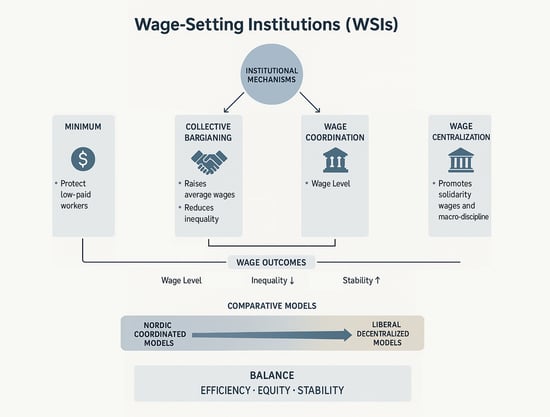
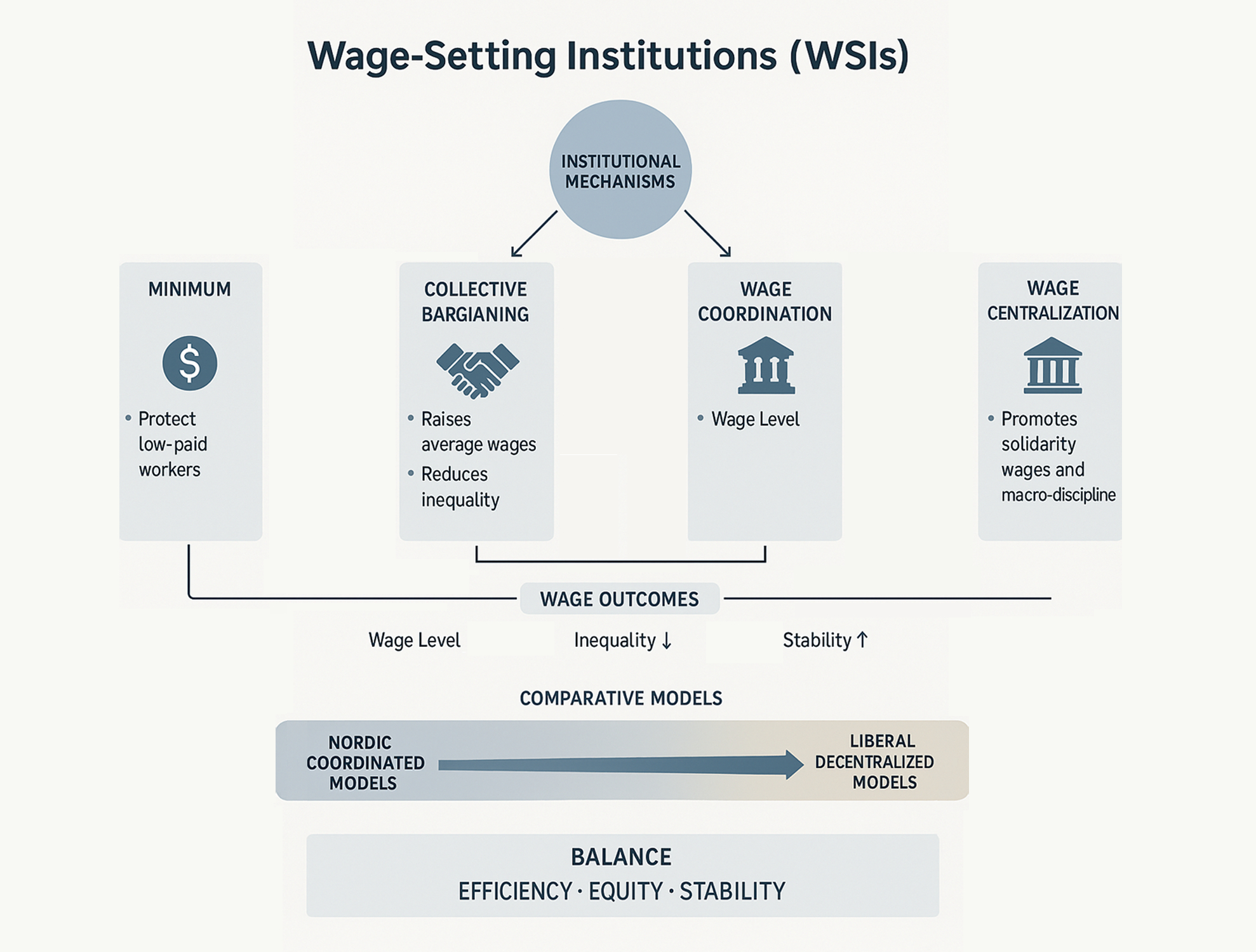
In the comparative political economy and labor economics literature, four mechanisms are generally highlighted as the main wage-setting institutions: minimum wages, collective bargaining, wage coordination, and wage centralization [
3,
4]. Minimum wages are statutory wage floors that prevent wages from falling below a legal threshold. Collective bargaining involves negotiations between unions and employers (or their associations) over wages and conditions. Wage coordination refers to the degree to which different bargaining units align their settlements, while wage centralization describes the firm, sector, or national level, at which binding wage agreements are reached.
These institutions interact in complex ways. For example, strong minimum wages may compress the lower end of the wage distribution, while coordinated or centralized bargaining can contribute to wage moderation and wage compression across industries [
5,
6]. From a theoretical perspective, wage-setting institutions influence the distribution of bargaining power, wage rigidity, and the responsiveness of wages to shocks. The well-known “Calmfors–Driffill hypothesis” suggests a hump-shaped relationship between the degree of centralization in wage bargaining and macroeconomic performance [
3]. Later work emphasizes that outcomes depend heavily on institutional context, globalization, and enforcement capacity [
7,
8].
Empirical studies have investigated the effects of these institutions extensively. Neumark and Wascher (2008) provide a comprehensive review of minimum wage effects, finding mixed evidence but some negative impacts on low-skilled employment [
9]. On collective bargaining, Fanfani et al. (2023) find that wage agreements in Italy increase wages but also influence employment adjustments [
10]. Cross-national work by the OECD (2017) and Eurofound (2024) highlights how differences in coordination and centralization explain much of the variation in wage inequality across advanced economies [
11,
12].
This entry aims to analyze how wage-setting institutions shape wage outcomes, integrating theoretical perspectives, empirical findings, and cross-country comparisons.
Section 2 introduces the four wage-setting mechanisms.
Section 3 analyses the theoretical expectations of their impact on wages.
Section 4 reviews the literature, while
Section 5 examines institutional variation across countries. Finally,
Section 6 discusses the policy implications, and
Section 7 presents the conclusions of the analysis.
2. Wage-Setting Institutions
Wage-setting institutions constitute the frameworks through which wages are determined, enforced, and adjusted across economies. While labor market outcomes are influenced by a mix of supply, demand, and productivity, institutions structure the bargaining power of workers and employers, shape wage dispersion, and affect how wages respond to macroeconomic shocks. This section outlines four key wage-setting mechanisms commonly emphasized in labor economics: minimum wages, collective bargaining, wage coordination, and wage centralization.
2.1. Minimum Wages
Minimum wages are statutory wage floors established by law or regulation [
13]. They are designed to prevent wages from falling below a socially or politically determined minimum, protecting workers from exploitation and poverty wages [
9]. Minimum wages can be set at the national level (e.g., France, Germany), regional level (e.g., the U.S., Canada), or vary by sector/occupation (e.g., domestic workers in parts of Latin America).
In the United States, the federal minimum wage currently stands at $7.25 per hour for most covered non-exempt workers, serving as a national floor. However, numerous states and municipalities have enacted higher minimum wages, reflecting local cost-of-living differences and political preferences. This layered system illustrates how decentralized wage-setting arrangements can coexist with a statutory baseline.
The impact of minimum wages depends on their “bite” (the ratio of the minimum wage to the median wage), enforcement capacity, and interaction with other institutions. Research shows mixed effects: while minimum wages compress the wage distribution and raise earnings at the bottom [
14], they may also lead to reduced employment or hours for low-wage workers if set too high [
9]. In coordinated bargaining systems, statutory minimum wages often play a weaker role, as sectoral agreements already establish wage floors [
6].
Germany provides an instructive case of institutional innovation. After long relying on sectoral agreements without a statutory wage floor, Germany introduced a national minimum wage in 2015. Empirical evaluations (e.g., Dustmann et al., 2022 [
14]) show that the reform raised earnings at the bottom of the distribution and reduced overall wage inequality, with only limited adverse employment effects—mostly confined to marginal ‘mini-jobs’. The German case demonstrates how a statutory minimum can complement rather than replace collective bargaining, particularly in sectors with weak union coverage.
2.2. Collective Bargaining
Collective bargaining refers to negotiations between trade unions (representing workers) and employers or employer associations. The scope of bargaining extends beyond wages to include benefits, working conditions, and employment security [
4]. Collective bargaining coverage varies widely: in the United States, it is under 12% of the workforce, while in Scandinavian countries it covers more than 70% [
11].
The level of bargaining matters. Firm-level bargaining allows flexibility but often increases wage inequality, while sectoral or national-level bargaining tends to equalize wages across industries and firms [
5]. Evidence suggests that collective bargaining increases average wages and reduces inequality but can also reduce employment flexibility and raise labor costs [
10,
15].
The functioning of collective bargaining is also conditioned by the organizational and institutional characteristics of trade unions. Unions that are financially dependent on government subsidies or employer support may face constraints on their bargaining autonomy, while those financed primarily by member contributions tend to display stronger accountability to their membership. The scope of collective agreements also matters: where agreements are legally extended to all workers, regardless of union membership, the level of affiliation may decline, even as coverage remains high. Such dynamics can influence unions’ incentives and the perceived legitimacy of collective bargaining, highlighting that institutional design and union independence are critical to understanding variation in bargaining effectiveness across countries.
2.3. Wage Coordination
Wage coordination describes the degree to which bargaining outcomes across different sectors, firms, or regions are aligned. Coordination can occur formally, through cross-sectoral agreements, or informally, through pattern bargaining where one powerful sector (e.g., export-oriented manufacturing in Sweden) sets a wage standard followed by others [
16].
Highly coordinated systems internalize macroeconomic externalities, such as inflationary wage spirals, by promoting moderation in wage growth [
3]. They also reduce inter-firm wage competition, helping to compress wage inequality [
7]. However, they may reduce responsiveness to firm-specific productivity shocks. Research by Kenworthy (2001) shows that coordinated systems are associated with lower unemployment and wage inequality compared to fragmented systems [
17].
2.4. Wage Centralization and Mixed Wage-Setting Systems
Wage centralization refers to the institutional level at which binding wage agreements are negotiated: firm, sector, or national. Centralized bargaining systems (e.g., Austria, Sweden in the 1970s–1980s) negotiate wages at the national or confederation level, while decentralized systems (e.g., the U.S., U.K.) leave wage determination largely to individual firms. Intermediate systems combine sectoral or occupational bargaining with firm-level flexibility [
4].
The degree of centralization has long been debated. The Calmfors-Driffill hypothesis suggests a hump-shaped relationship: both highly centralized and highly decentralized systems perform better than intermediate ones in terms of unemployment and inflation [
3]. Centralization fosters wage compression and solidarity but may reduce adaptability; decentralization fosters flexibility but often increases inequality [
18]. Contemporary trends in Europe show a move toward “organized decentralization”, where central agreements set frameworks but leave space for local adjustments [
11,
19].
In the Nordic economies, wage-setting institutions have evolved toward what Traxler (1995) [
19] and Visser (2016) [
6] term ‘organized decentralization’. While central confederations continue to set broad frameworks, greater scope is now allowed for firm-level flexibility within sectors. Sweden’s ‘pattern bargaining’ model, led by the export sector, illustrates how coordination can be preserved even as local autonomy increases. This hybrid structure has maintained wage compression and macroeconomic stability while enabling firms to adjust to productivity differences and globalization pressures.
3. Theoretical Expectations of the Impact of Wage-Setting Institutions on Wage
Theoretical perspectives on wage-setting institutions emphasize their role in shaping wage levels, wage dispersion, and labor market adjustment. Economic theory provides predictions about how each institution, i.e., minimum wages, collective bargaining, wage coordination, and wage centralization, affects wage outcomes. While models often highlight trade-offs between equity and efficiency, institutional interactions and country-specific contexts can yield different effects.
3.1. Minimum Wages
Standard competitive labor market theory predicts that a statutory minimum wage set above the market-clearing wage reduces employment by creating excess supply of labor [
20]. However, alternative models show more nuanced outcomes. In monopsonistic labor markets, where employers exert wage-setting power, a minimum wage can increase both wages and employment by countering employer monopsony power [
21]. Similarly, in search and matching models, minimum wages can improve job matches and worker productivity by raising reservation wages [
22].
The effects of wage-setting institutions depend not only on their presence but also on their intensity and scope of implementation. Minimum wages set close to or below the market-clearing level have little to no impact on aggregate wages or employment. Conversely, when the statutory minimum significantly exceeds the productivity of marginal workers, employment effects may become negative, especially in low-skill sectors. Even in monopsonistic labor markets, where moderate wage increases can raise both employment and efficiency, overly ambitious minimum wages risk reducing hiring or incentivizing informal employment. Similar logic applies to collective bargaining and wage coordination: the breadth and strength of coverage determine whether such mechanisms stabilize wages and employment or instead introduce rigidities and cost pressures.
From a distributional perspective, minimum wages compress the lower end of the wage distribution, raising wages for low-paid workers [
9]. Yet, if set too high relative to productivity, they may reduce demand for low-skilled labor or induce substitution toward informal work in weaker institutional contexts [
23].
3.2. Collective Bargaining
Theoretically, collective bargaining increases workers’ bargaining power relative to employers, leading to higher negotiated wages compared to individual bargaining [
2]. Union wage effects can be modeled as a union mark-up over the competitive wage, with magnitude depending on union density and bargaining coverage [
24].
Collective bargaining also affects wage dispersion. Sectoral or national agreements compress wages by setting uniform standards across firms, thereby reducing inter-firm and inter-industry inequality [
15]. However, collective bargaining can also create insider–outsider effects: insiders benefit from higher wages and job security, while outsiders face barriers to entry or higher unemployment [
25].
3.3. Wage Coordination
Wage coordination is theorized to reduce negative externalities in decentralized bargaining systems. By aligning wage growth across sectors, coordination prevents wage-price spirals and reduces competitive wage undercutting between firms [
26]. Coordinated systems often produce wage moderation: unions internalize the employment effects of high wage demands on the broader economy [
3].
Wage moderation in coordinated systems arises because bargaining actors internalize the macroeconomic consequences of excessive wage claims. When employer and union confederations align their settlements, they take into account the risk that high wage growth could fuel inflation, erode export competitiveness, or raise unemployment. This coordination encourages restraint in wage demands, thereby stabilizing employment and prices. At the same time, it can sustain international competitiveness by keeping unit-labor-cost growth aligned with productivity. However, this equilibrium may involve trade-offs: excessive moderation can dampen domestic demand and limit wage differentiation across high- and low-productivity sectors, potentially constraining long-term innovation incentives. Hence, wage coordination promotes stability and equity but must be balanced against the need for structural adaptability.
High coordination tends to compress wage inequality by ensuring similar wage standards across sectors [
17]. Yet, critics argue that coordination may weaken responsiveness to firm- or sector-specific productivity differences, potentially reducing allocative efficiency [
18].
3.4. Wage Centralization and Mixed Wage-Setting Systems
Centralization refers to the institutional level of wage bargaining. The Calmfors–Driffill hypothesis suggests a non-linear relationship: both highly centralized and highly decentralized systems achieve better macroeconomic outcomes than intermediate systems [
3]. Centralized systems foster solidarity wages, wage compression, and inflation control, while decentralized systems allow flexibility and adaptation to firm-level productivity. Intermediate systems, by contrast, may produce the “worst of both worlds”: high wage pressure without sufficient coordination [
27].
From a comparative efficiency perspective, empirical and theoretical work suggests that institutional performance follows a non-linear pattern. Highly centralized systems internalize macroeconomic externalities, achieving wage moderation and stable employment through coordinated bargaining. Conversely, highly decentralized systems allow wage flexibility and efficient resource allocation at the firm level. Intermediate or fragmented systems, however, often suffer from coordination failures, resulting in wage drift and inflationary pressures (Calmfors & Driffill (1988) [
3]; Traxler & Brandl (2012) [
16]). This theoretical insight helps explain cross-country differences in the efficiency and adaptability of wage-setting regimes.
Moreover, over time, wage-setting institutions can become increasingly complex and bureaucratic, sometimes reinforcing insider advantages within the labor market. Long-established bargaining frameworks and employment protections may primarily benefit incumbent workers with stable contracts, while making it more difficult for new entrants—such as youth, migrants, or workers in non-standard employment—to gain access to formal jobs. This insider–outsider divide, identified in comparative political economy literature, can limit labor-market dynamism and reduce the adaptability of wage institutions to changing economic conditions.
Centralized bargaining also tends to reduce wage inequality by compressing wage structures [
28]. However, it may reduce incentives for firms and workers to invest in productivity-enhancing activities if relative wage differentiation is suppressed [
29].
Wage-setting institutions inherently involve trade-offs between equity and efficiency. In well-governed economies with effective rule of law, moderate and predictable institutions, such as collective bargaining coverage or minimum-wage policies, can enhance social cohesion and macroeconomic stability. However, when institutional intervention becomes excessive or poorly calibrated, it may introduce rigidities, reduce competitiveness, or distort incentives. The challenge for policymakers lies in maintaining this balance, ensuring that protective frameworks remain compatible with labor-market flexibility and productivity growth.
Finally, the effectiveness of wage-setting institutions also depends on the extent of labor-market formality. In contexts with weak governance or limited enforcement, high levels of coordination or centralized bargaining can unintentionally expand informal employment. When wage floors or bargaining outcomes significantly exceed productivity in the formal sector, firms may shift part of their workforce into informal arrangements, thereby reducing the apparent coverage and impact of institutions. As shown by Verhaest and Adriaenssens (2022), compensating wage differentials between formal and informal jobs illustrate that institutional wage policies may not capture the full spectrum of labor-market adjustments [
30]. Recognizing this interaction is essential to interpreting cross-country differences in measured outcomes.
3.5. Causal Mechanisms
The causal mechanisms linking wage-setting institutions to wage outcomes operate through several interrelated channels. First, institutions modify the distribution of bargaining power between employers and workers, directly influencing negotiated wage levels. Second, they affect productivity incentives and firm behavior, since wage compression or coordination can shape investment and training decisions. Third, WSIs influence macroeconomic adjustment channels, including inflation expectations, labor mobility, and wage–price dynamics. The strength of these effects depends on contextual factors such as union density, coverage, enforcement capacity, and exposure to international competition. For instance, the wage-raising effect of collective bargaining is typically amplified in coordinated economies with strong employer associations, whereas minimum wages exert weaker effects where enforcement is limited or informal employment is widespread.
3.6. Short-Run Versus Long-Run Effects of Wage-Setting Institutions
The effects of wage-setting institutions unfold over different time horizons. In the short run, changes in institutions such as minimum wages or collective agreements primarily influence wage levels and distribution through immediate adjustments in negotiated pay and employment contracts. For example, an increase in the statutory minimum wage quickly raises wages at the bottom but may temporarily affect hiring or hours worked.
In contrast, the long-run effects operate through structural adjustments in labor markets and firm behavior. Over time, institutions influence productivity growth, investment in skills, and wage bargaining norms, as firms and workers adapt to new incentive structures. Empirical studies show that coordinated and centralized bargaining systems can stabilize wage growth and sustain competitiveness over decades [
17,
26], while fragmented systems may exhibit greater cyclical volatility. Recognizing these temporal dimensions helps interpret divergent findings in the literature and underscores that institutional impacts often materialize gradually rather than instantaneously.
4. Literature Review
A substantial body of empirical research has investigated the impact of wage-setting institutions on wage levels, inequality, and employment. While findings vary across countries and time periods, some broad patterns emerge.
4.1. Minimum Wages
Empirical studies on minimum wages have long debated their effects on wages and employment. Early U.S. evidence found small but negative employment effects, especially for teenagers and low-skilled workers [
31]. A study by Neumark and Wascher (2008) concluded that most studies show modest negative effects on employment, but also significant wage gains for low-paid workers [
9].
More recent quasi-experimental approaches have challenged earlier consensus. Card and Krueger’s (1994) seminal study found no negative employment effects from a minimum wage increase in New Jersey fast-food restaurants, sparking renewed debate [
32]. Subsequent research has emphasized heterogeneous effects depending on the “bite” of the minimum wage, regional labor market conditions, and enforcement [
33].
4.2. Collective Bargaining
Cross-country research shows that collective bargaining raises average wages and reduces wage inequality. Card et al. (2004) demonstrate that union wage premia are stronger for low-skilled workers, contributing to wage compression [
15]. Blanchflower and Bryson (2004) confirm significant union wage mark-ups across OECD countries, though magnitudes have declined with falling union density [
24].
Collective bargaining coverage also matters. Visser (2016) reports that countries with sectoral or national bargaining (e.g., Sweden, Austria) maintain high bargaining coverage even with declining union membership, sustaining more egalitarian wage structures [
6]. Conversely, in liberal market economies such as the U.S. and U.K., where bargaining is firm-level, lower coverage has coincided with rising wage inequality [
11]. Recent studies from Italy show that collective agreements raise wages but also lead to adjustments in employment, highlighting trade-offs [
10].
4.3. Wage Coordination
Coordination across bargaining units helps internalize macroeconomic externalities and stabilize wage growth. Kenworthy (2001) finds that higher levels of coordination are associated with lower wage inequality and more stable employment [
17]. Similarly, Soskice (1990) emphasizes the importance of “pattern bargaining” in export-oriented industries (e.g., Germany, Sweden), which constrains wage inflation and sustains competitiveness [
26].
Empirical evidence suggests coordinated systems produce wage moderation and compressed wage structures, contributing to both equity and efficiency. However, Flanagan (1999) cautions that coordination may reduce flexibility at the firm level, especially in sectors with heterogeneous productivity [
18].
4.4. Wage Centralization and Mixed Wage-Setting Systems
The degree of centralization in bargaining has been a central focus of comparative labor economics. Calmfors and Driffill (1988) famously proposed a hump-shaped relationship: both highly centralized and highly decentralized systems yield better macroeconomic outcomes than intermediate systems [
3]. Subsequent studies provide mixed evidence. Wallerstein (1999) shows that centralized bargaining reduces wage inequality [
28], while Teulings and Hartog (1998) find that centralization fosters wage compression but may limit wage responsiveness to productivity differences [
34].
More recent literature suggests a trend toward “organized decentralization”, where framework agreements are set at higher levels, but flexibility is left to firm-level actors [
11,
19]. This hybrid approach appears to balance the benefits of coordination and centralization with the adaptability of decentralized systems.
5. Wage-Setting Institutions Data Across Countries
This section begins by presenting cross-country data regarding all four wage-setting institutions, i.e., minimum wages, collective bargaining/coverage, wage coordination, and wage centralization, along with sources.
Table 1 shows the data/measure for all WSIs along with their sample or trends and the source by which they were obtained.
Table 1 provides a structured overview of the main data sources and indicators that can be used to operationalize the four wage-setting institutions (WSIs): minimum wages, collective bargaining, wage coordination, and wage centralization. Concerning the minimum wages, the table shows that statutory minimum wages can be measured in several ways: presence/absence (binary indicator), nominal levels in local currency or euros (e.g., Eurostat data for EU), and the relative “bite” compared to median wages. This distinction is crucial because the existence of a minimum wage does not tell us much about its effectiveness. Indicators like the “bite” or coverage provide richer information on their real labor-market impact. With respect to the collective bargaining/coverage, the table highlights the importance of using coverage rates (proportion of workers under agreements), not just union density. The reference to the OECD/AIAS ICTWSS database is particularly important, since it provides harmonized cross-country coverage rates adjusted for extension mechanisms. Regarding wage coordination, the table notes that coordination is typically measured through indices or scores, such as those developed by Kenworthy and Visser. These indices capture whether wage bargaining across sectors is aligned formally (via peak-level agreements) or informally (via pattern bargaining). As for wage centralization, centralization is represented through categorical indices (centralized, intermediate, decentralized) as in the Calmfors–Driffill framework. In addition, the table points to both classic sources (Calmfors & Driffill) and more recent applications, showing that centralization has direct implications for how firms adjust wages and employment during shocks such as recessions.
In sum,
Table 1 highlights both quantitative indicators (coverage rates, minimum wage levels) and qualitative codings (coordination and centralization indices). It also makes clear that there is no single dataset covering all WSIs simultaneously at a granular level; instead, researchers must combine sources like ICTWSS, OECD, and specialized indices. Finally, the table underscores the methodological point that these indicators are not always continuous measures; many are ordinal or categorical, reflecting institutional diversity rather than precise numeric scales.
An additional indicator frequently used to assess the impact of minimum wages is the proportion of employees earning at or near the statutory minimum. This measure provides a sense of the policy’s effective coverage within the wage distribution. OECD data show that this share varies widely across countries—from below 5% in the United States and Nordic economies to around 10–15% in France, Portugal, and Eastern Europe—highlighting differences in enforcement and bargaining structures.
Table 2 illustrates a cross-country table that covers all four wage-setting institutions for a broad set of OECD countries, using the ICTWSS framework. Since ICTWSS provides categorical/ordinal codings (and countries can shift over time), I show qualitative categories that align with ICTWSS variables for a recent pre-pandemic benchmark year (around 2019, which is the latest complete wave for many variables). Exact numeric scores/coverage rates are available directly in ICTWSS.
Table 2 illustrates the diversity of wage-setting institutions across OECD countries, highlighting clear clusters. First, for minimum wages, a statutory minimum wage exists in most OECD countries, but eight countries (Austria, Denmark, Finland, Iceland, Italy, Norway, Sweden, Switzerland) rely on collective agreements to set wage floors instead of a national law. This reflects a broader institutional divide between liberal economies (e.g., U.S., U.K., Canada, New Zealand) that combine statutory minimum wages with decentralized bargaining, and Nordic/continental economies where bargaining institutions substitute for statutory minima. Second, for collective bargaining coverage, coverage is high in coordinated and centralized systems (e.g., Scandinavia, Austria, France, Belgium, the Netherlands), often exceeding 70–80%. It is low in liberal market economies (e.g., U.S., Canada, Japan, U.K.), where bargaining is primarily firm-level. ICTWSS data also shows that coverage rates remain high in some countries even with declining union density, due to extension mechanisms. Third, for wage coordination, coordination is strongest in Nordic and continental Europe, where bargaining units align wage outcomes (often via pattern bargaining). In contrast, countries like the U.S., U.K., Japan, and Mexico display low coordination, leading to more fragmented wage setting and higher wage dispersion. Fourth, for wage centralization, highly centralized or sectoral bargaining systems (e.g., Sweden, Denmark, Austria, Belgium) are associated with compressed wage structures and solidarity wages. Decentralized systems (e.g., U.S., U.K., Canada, Japan) allow greater firm-level flexibility but often result in wider wage inequality. Furthermore, a trend toward “organized decentralization” is visible in some continental countries (e.g., Germany, Spain, Italy), where framework agreements are set centrally but leave room for local adaptation.
Overall,
Table 2 reflects the institutional variety within the OECD: from highly coordinated/corporatist models (the Nordics, Austria, Belgium) to liberal fragmented models (U.S., U.K., Canada), with hybrid systems in between (Germany, Spain, France). This diversity aligns with theories such as the Calmfors–Driffill hypothesis, suggesting that both highly centralized and highly decentralized systems can perform relatively well, while intermediate systems may struggle with wage pressure and inflationary dynamics.
The data presented here covers a representative sample of OECD economies and provides an important cross-sectional view of institutional wage-setting mechanisms. Within the European Union, for instance, statutory minimum wages in 2025 ranged from approximately €550 in Bulgaria to €2222 in Luxembourg, illustrating substantial variation in wage-floor levels even within a single regulatory framework. These differences reflect diverse institutional designs, enforcement capacities, and cost-of-living conditions. The same diversity characterizes bargaining coverage and coordination indices, which together underscore that institutional wage-setting cannot be treated as a uniform global phenomenon [
38].
6. Wage-Setting Institutions in the Context of COVID-19
The COVID-19 pandemic constituted an unprecedented shock that temporarily reshaped wage-setting dynamics across advanced economies. Emergency policies—such as job-retention schemes, furlough arrangements, and temporary wage subsidies—often substituted for or complemented existing bargaining institutions. In several countries, social partners engaged in rapid tripartite negotiations to maintain employment and income stability, demonstrating the adaptability of coordinated and centralized systems. For example, Nordic and continental European models relied on strong coordination to extend short-time work schemes, while more decentralized systems (e.g., the United States, the United Kingdom) experienced wider wage dispersion and slower recovery of real wages.
At the same time, the crisis accelerated underlying trends toward digital bargaining processes and the inclusion of non-standard workers in collective agreements. The post-pandemic inflation surge further tested the capacity of wage coordination to contain wage-price spirals. These developments suggest that wage-setting institutions remain crucial buffers against macroeconomic turbulence and that their resilience during the pandemic highlights the value of institutionalized dialogue between governments, employers, and labor representatives.
7. Policy Implications
The evidence reviewed in this entry demonstrates that wage-setting institutions have powerful effects on wage levels, distribution, and macroeconomic performance. Policymakers therefore face important trade-offs when designing and reforming these institutions. Policy design must therefore recognize that institutional effects are highly sensitive to calibration. Institutions that are too weak fail to reduce inequality, whereas those applied too intensively may distort incentives or reduce competitiveness. The balance between equity and efficiency depends on institutional scope, enforcement, and the economic context.
Minimum wages remain a central instrument of wage policy, particularly in liberal economies with fragmented bargaining systems. The policy challenge is to set minimum wages at levels that protect low-paid workers without undermining employment prospects for the least skilled. This requires institutionalized adjustment mechanisms—such as automatic indexation to median wages or productivity growth—as well as effective enforcement to avoid evasion in informal or precarious labor markets. The German case illustrates how carefully calibrated statutory minima can reduce inequality without large negative employment effects, but excessive increases risk unemployment in marginal sectors.
While statutory minimum wages are essential for protecting low-paid workers, their level relative to collectively bargained wages requires careful calibration. When the statutory minimum approaches the wage rates typically negotiated through collective agreements, the result may be an overly compressed wage structure that limits differentiation based on skills or productivity. Such a ‘flat’ system, though equitable, can reduce incentives for performance and innovation. Effective policy therefore entails maintaining a reasonable gap between legal minima and average negotiated wages to preserve both fairness and productivity dynamics.
Collective bargaining institutions continue to play a crucial role in shaping equitable wage outcomes. The decline of union density and bargaining coverage in many OECD countries raises concerns about growing wage inequality. Policy instruments such as administrative extensions of collective agreements, or state support for sectoral bargaining, can sustain coverage even in the face of weakening unions. The European Commission’s recent directive on adequate minimum wages and collective bargaining promotion underscores this policy turn. However, excessive rigidity in bargaining systems may reduce firm-level adaptability, suggesting that balance is needed between equity and flexibility.
The effectiveness of wage-setting institutions is conditional on governance quality and institutional credibility. Strong enforcement mechanisms and transparent social dialogue allow moderate interventions to generate inclusive outcomes. Conversely, in contexts with weaker rule of law or fragmented representation, similar interventions may produce inefficiencies or unintended distributional effects. This reinforces the importance of institutional calibration and policy coherence.
Wage coordination is particularly important for macroeconomic stability. Systems with strong coordination, often through peak-level or pattern bargaining, help to avoid wage–price spirals and maintain competitiveness in open economies. Policymakers can encourage coordination by institutionalizing tripartite dialogue, promoting sectoral pattern agreements, or linking wage developments to productivity benchmarks. Such arrangements are especially relevant in the context of the European Monetary Union, where national wage moderation has external spillovers on competitiveness and employment.
Wage centralization presents perhaps the most complex policy trade-off. Highly centralized systems deliver wage compression and solidarity but may limit wage differentiation where it is economically justified. Fully decentralized systems foster flexibility but exacerbate inequality. The trend toward “organized decentralization” suggests that hybrid models—where central agreements set general frameworks while leaving room for firm-level adaptations—may offer a pragmatic compromise. Policymakers should therefore consider strengthening framework-level bargaining institutions while granting firms greater scope for productivity-based wage setting.
While the general principles outlined above apply broadly, the optimal design of wage-setting institutions depends on the underlying type of political-economic system. In liberal market economies (LMEs) such as the United States, the United Kingdom, or Canada, collective bargaining is typically decentralized and coverage is limited. Here, policy efforts should focus on strengthening wage floors and institutional supports for bargaining coverage—through mechanisms such as sectoral extensions, statutory minimum-wage adjustments indexed to productivity, and promoting social dialogue in low-coverage sectors. These steps can mitigate wage dispersion and complement flexible labor markets without compromising employment.
In contrast, coordinated market economies (CMEs)—such as Germany, Sweden, or Austria—already possess robust collective bargaining and coordination structures. The main policy challenge in these contexts is to sustain coordination while allowing sufficient firm-level adaptability. Policies can therefore emphasize ‘organized decentralization’, ensuring that framework agreements set inclusive wage standards yet leave room for productivity-based differentiation. Moreover, maintaining institutionalized tripartite dialogue and updating coordination mechanisms for digital and green-transition sectors can preserve the effectiveness of WSIs in the long term.
Recognizing these institutional differences helps tailor reforms to national contexts and underscores that there is no one-size-fits-all model for equitable and efficient wage setting.
Finally, the interaction of institutions matters. A statutory minimum wage may be redundant in highly coordinated systems with extensive coverage, but essential in fragmented labor markets. Similarly, the effectiveness of collective bargaining depends on whether it is coordinated across sectors or left to competitive fragmentation. Policy design should therefore focus on institutional complementarities rather than isolated reforms.
Overall, the evidence indicates that wage-setting institutions are not simply rigidities to be dismantled, but policy tools that can be adapted to achieve a combination of efficiency, equity, and stability. The challenge for policymakers is to calibrate these institutions to national economic structures, social preferences, and global competitive pressures.
Closing this section, it must be noted that contemporary wage-setting challenges must be viewed against the backdrop of heightened political polarization, technological transformation, and global economic instability. While governments often focus on ensuring macroeconomic stability, workers primarily experience wage policy through its effect on real purchasing power and employment security. The rapid diffusion of Artificial Intelligence (AI) and automation technologies introduces additional uncertainty-potentially displacing certain routine or manual jobs while creating new roles requiring higher qualifications. These developments reinforce the need for adaptable wage-setting frameworks capable of addressing widening inequality, skill mismatches, and the distributive consequences of technological change.
8. Limitations and Future Research
Although this entry provides a comprehensive overview of wage-setting institutions (WSIs) and their effects on wages, several limitations should be acknowledged. First, the analysis remains primarily comparative and descriptive, relying on secondary sources rather than original econometric estimation. Future research could extend the discussion by using harmonized panel data (e.g., OECD, ICTWSS) to quantify the magnitude of institutional effects across countries and time.
Second, while the study considers data up to 2024, rapid changes in digitalization, platform work, and green-transition sectors may alter the functioning of WSIs in ways that existing indicators do not yet capture. Third, although the paper highlights cross-national diversity, it does not explore in depth the interaction between national and supranational institutions, such as the role of EU directives or global supply chain pressures.
Future research could therefore examine how institutional complementarities evolve under technological and geopolitical transformation, how bargaining mechanisms adapt to new forms of employment, and how WSIs interact with macroeconomic policies in post-pandemic recovery contexts. Such work would deepen understanding of how wage-setting frameworks can remain both equitable and adaptable in an era of accelerating change.
9. Conclusions
This entry has analyzed how wage-setting institutions shape wages through both theoretical perspectives and empirical evidence. The review demonstrates that no single institution alone determines outcomes; rather, it is the interaction of mechanisms—minimum wages, collective bargaining, wage coordination, and centralization—that defines how wages are set, distributed, and adjusted.
Minimum wages remain an important safeguard against in-work poverty, but their effectiveness depends on careful calibration and enforcement. Collective bargaining continues to serve as a powerful driver of wage equality, although declining union density in many countries raises challenges for sustaining coverage. Coordination and centralization contribute to wage moderation and reduced inequality, yet overly rigid structures may impede adaptation to productivity differences and economic shocks.
Cross-country comparisons underscore the diversity of institutional arrangements within the OECD, from highly coordinated and centralized Nordic models to decentralized liberal systems. These findings align with the Calmfors–Driffill hypothesis, suggesting that both highly centralized and highly decentralized systems can achieve favorable outcomes, while intermediate arrangements may face greater challenges.
Overall, the evidence confirms that wage-setting institutions are not simple distortions to competitive markets but essential frameworks that structure bargaining power, wage distribution, and macroeconomic stability. Policymakers should recognize the complementarities among institutions and design reforms that enhance both equity and efficiency. The future of wage-setting lies not in dismantling institutions but in adapting them to evolving labor markets, technological change, and global economic pressures.
The diversity of wage-setting arrangements across OECD countries reflects their distinct economic structures, political traditions, and social preferences. Far from representing inconsistency, this diversity constitutes an adaptive strength, enabling each system to address its most pressing labor-market challenges. Recognizing this pluralism is essential to understanding that effective wage-setting institutions must be context-sensitive rather than uniform.