1. Introduction
Scattering parameters (S-parameters) are crucial for microwave characterization, and are primarily measured using vector network analyzers (VNA). With increasing measurement bandwidth and diverse devices under test (DUT), fixtures are often necessary to connect VNA to DUT. Early studies have analyzed the statistical characteristics of network analyzer measurements [
1], laying the groundwork for the subsequent development of calibration techniques. Methods such as the six-port reflectometer [
2] and the open-circuit-less calibration technique [
3] have further advanced the precision of VNA measurements. To improve measurement accuracy by eliminating fixture effects, de-embedding has emerged [
4], aligning with SOLT (Short-Open-Load-Thru) and TRL (Thru-Reflection-Line) calibration principles. It uses algorithms to remove fixture S-parameter errors, extending VNA capabilities beyond calibration limitations [
5,
6].
De-embedding is increasingly applied in various scenarios, such as de-embedding asymmetric fixtures via circuit models [
7], comparing on-wafer and coaxial calibration results after de-embedding probes [
8], studying the influence of fixture S-parameter errors on de-embedding results [
9], and so on. More recently, novel techniques based on multi-port configurations have provided new approaches for reference impedance renormalization [
10], thereby further extending the applicability of de-embedding in high-frequency measurements. Since the performance of fixtures and the accuracy of de-embedding algorithms directly affect the measurement results of S-parameters, assessing S-parameter measurement uncertainty under de-embedding is essential.
However, existing uncertainty evaluation methods often treat de-embedding as an idealized mathematical operation, neglecting the additional uncertainties introduced by the algorithm itself and the propagation of errors through cascaded networks. This simplification may lead to an underestimation of the overall measurement uncertainty, particularly under non-ideal fixture conditions or at higher frequencies. Moreover, traditional approaches based on the Guide to the Uncertainty in Measurement (GUM) often overlook the correlations among multiple variables, which are crucial for accurately capturing the coupling effects in de-embedding processes [
11,
12].
In the field of engineering practice for VNA measurement uncertainty assessment, several well-established software tools have been developed and widely adopted. For instance, the VNA Tools suite released by the Swiss Federal Institute of Metrology (METAS) provides comprehensive uncertainty analysis for radio-frequency and microwave measurements, with one of its core methodologies being the propagation of errors using covariance matrices derived from measurement data [
13]. The National Institute of Standards and Technology (NIST) has also conducted a systematic comparative study of various VNA uncertainty evaluation tools, clarifying the characteristics and applicable scopes of different approaches [
14]. These tools generally follow the framework established by the Guide to the Expression of Uncertainty in Measurement (GUM) and its supplementary documents, enabling the quantification of multiple systematic and random errors throughout the calibration and measurement processes. However, such general-purpose tools are typically oriented toward uncertainty evaluation under standard calibration procedures (e.g., SOLT, TRL) or are integrated as part of commercial VNA firmware/software packages. Their flexibility and specificity can be insufficient when dealing with non-standard, highly customized measurement scenarios—particularly those requiring de-embedding techniques to remove errors introduced by fixtures, adapters, or other interconnecting components. Existing tools often treat the de-embedding operation as an idealized mathematical step, failing to adequately model the additional uncertainties introduced by the algorithm itself and the complex propagation of errors through cascaded networks. Moreover, the user interfaces and algorithmic workflows of these tools frequently act as “black boxes,” presenting a barrier for researchers who wish to gain deeper insight into uncertainty sources or need to integrate the assessment process into custom-developed measurement systems. Therefore, the development of a transparent, traceable, and accurate uncertainty evaluation method tailored specifically to the de-embedding process holds significant theoretical and practical importance.
Research on de-embedding algorithm uncertainty remains limited. In combining calibration and de-embedding techniques, National Institute of Standards and Technology has developed an electrical model to accurately characterize electro-optic sampling systems [
15]. Intel Corporation studied the difference in measurement uncertainty of S-parameters before and after de-embedding using its developed de-embedding algorithm [
16], while Swedish researchers studied circuit model based de-embedding algorithms and the impact of circuit parameter uncertainties on S-parameter measurements [
17]. However, the focus is on practical de-embedding algorithm applications with VNA, treating the algorithm as a step in S-parameter uncertainty assessment.
International metrological comparisons play a critical role in ensuring global measurement consistency [
18], while the implementation of automated measurement systems offers a viable pathway to enhancing the efficiency of RF and microwave measurements [
19]. In S-parameter uncertainty assessment, covariance matrices are considered the optimal method for handling multi-frequency complex variables with inter-variable correlations [
20], simplifying the process compared to traditional GUM methods [
21,
22]. A key component of S-parameter uncertainty arises from VNA calibration kits [
23,
24], which will be gradually propagated to the S-parameters as the VNA measurement steps proceed. Uncertainty analysis typically categorizes uncertainty into two types: Type A, arising from random variations, and Type B, stemming from systematic factors. In the context of S-parameter measurements, the complex propagation relationships of uncertainty are primarily influenced by the systematic limitations of the VNA, which contribute to Type B uncertainty [
25]. The covariance matrix approach is applicable to both time-domain and frequency-domain VNA measurements for uncertainty propagation [
26].
This paper presents a novel method for assessing the uncertainty associated with S-parameter measurements under de-embedding conditions. By employing a specific algorithm, the impact of the end fixtures on the DUT measurements is eliminated, enabling a more accurate uncertainty evaluation. This paper analyzes the various sources of uncertainty and their propagation to the final S-parameter measurement uncertainty, considering the specific de-embedding algorithm employed. The proposed method is applied to assess the uncertainty of S-parameters for power dividers and orthogonal couplers. The results obtained using the covariance matrix method are compared to those from traditional approaches that neglect correlations between parameters. Following the S-parameters’ uncertainty assessment, the impact of uncertainty on other device performance metrics is investigated. The contribution of individual uncertainty components to S-parameter uncertainty is analyzed, tracing their origins back to uncertainties associated with the calibration standards.
3. Uncertainty Assessment Algorithm
This section focuses on uncertainty propagation algorithms employed in VNA calibration and de-embedding models, providing a comprehensive flowchart for uncertainty assessment.
3.1. Calibration Error Model
VNA calibration error models mitigate the impact of error networks, enabling accurate S-parameter measurements. While established calibration methods—for instance, SOLT, SOLR, and TRL—are well-documented, this paper concentrates on the step-by-step propagation of uncertainty from calibration standards to S-parameter measurements.
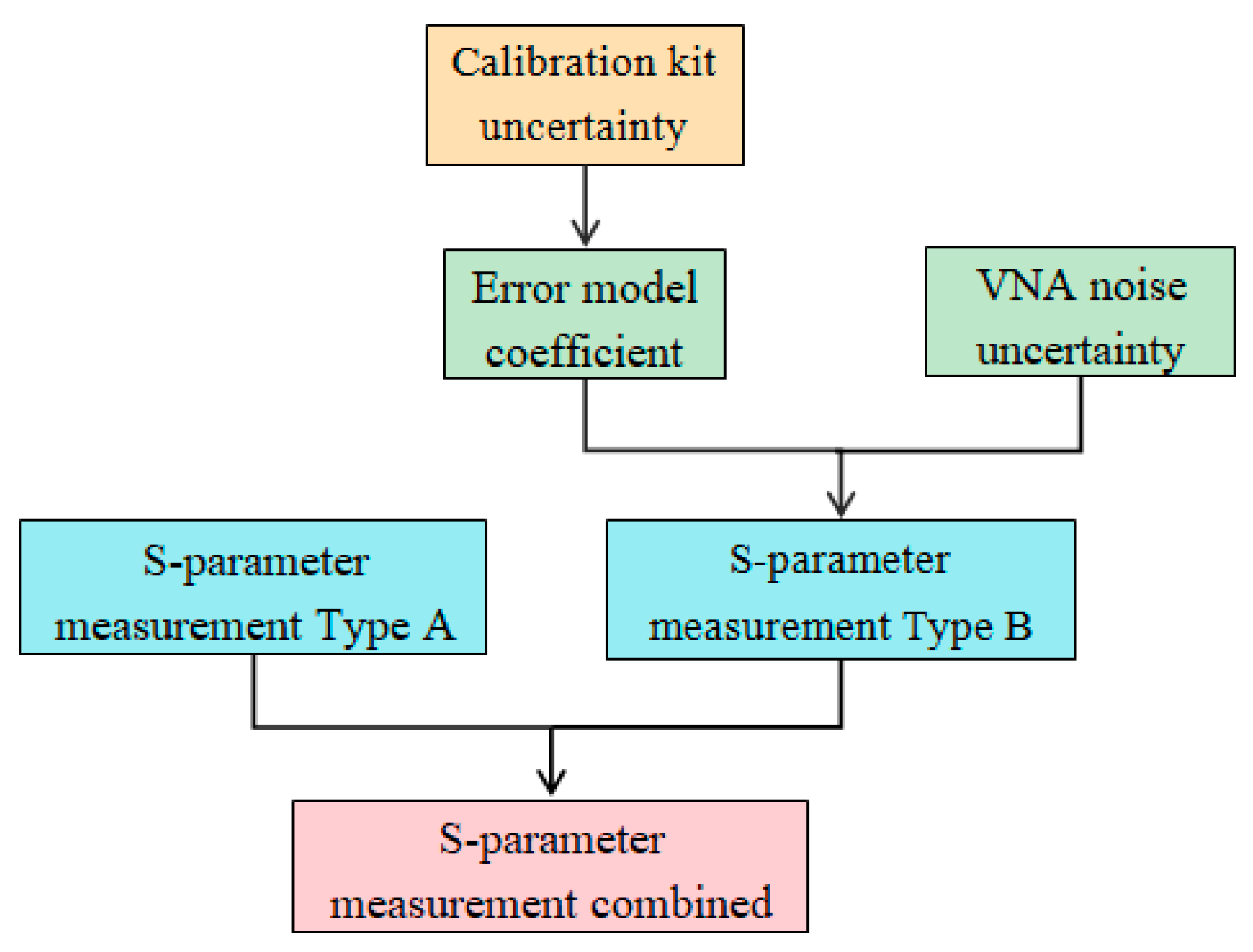
Common two-port calibration methods, such as SOLT, SOLR, and TRL, employ error networks to model measurement inaccuracies. SOLT, with its 12-term error model (often simplified to 10-term), is more complex than SOLR and TRL, which use an 8-term model. The process of uncertainty propagation in these calibration methods is largely similar, differing primarily in the specific error terms and their associated computational relationships. In essence, uncertainty propagates from the calibration standard’s uncertainty to the error model coefficients. Subsequently, incorporating noise-induced uncertainty, it is jointly propagated to the S-parameter uncertainty. For uncertainty assessment, each complex variable is divided into real and imaginary components to simplify calculations.
Figure 1 outlines the flowchart for assessing the uncertainty of VNA S-parameter measurements.
Using the SOLT calibration model as an example, the following method outlines the calculation of S-parameter uncertainty. Following the calculation method outlined in
Section 2.2.1), the uncertainty covariance matrices of the four calibration standards (Short, Open, Load, Thru) are combined into a block diagonal matrix to yield the total uncertainty of the calibration standard
.
where
signifies an 8 × 8 matrix, which contains the variances of the real and imaginary components of the four S-parameters S11, S12, S21, and S22 for the through standard along its main diagonal. The remaining three matrices are 4 × 4 matrices, each containing the variances of the real and imaginary components of S11 and S22 along their main diagonals. For single-port calibration standards, S11 and S22 represent the reflection coefficients at the two VNA measurement ports during calibration. For simplicity, this paper assumes no correlation between these coefficients.
A Jacobian matrix can be constructed based on the functional relationship between the error model coefficients and the calibration standards. The (10) presents the general calculation method, and the corresponding function relationships can be derived from the SOLT signal flow graph. Omitting crosstalk terms, the remaining 10 error terms are directional error (
,
), reflection sweep error (
,
), source matching error (
,
), load matching error (
,
), and transmission sweep error (
,
). Given the complex nonlinear relationship between calibration standard uncertainty and error model coefficients, and the typically small measurement values of calibration standards, it is crucial to determine the significance of higher-order terms L in the Taylor expansion (1) when constructing the Jacobian matrix in (9). In cases where this condition is not met, second-order terms must be evaluated, and the corresponding elements in the calculated covariance matrix must be adjusted accordingly.
According to the uncertainty propagation principle in (11), the Jacobian matrix transfers uncertainty from the calibration kit to the error model coefficients:
Similarly, the covariance matrix for the VNA’s two noise terms can be calculated using the method described in
Section 2.2.2. We assume no correlation between the noise and error terms. Combining it with
as a block diagonal matrix, yields the overall covariance matrix of the VNA,
.
A Jacobian matrix
is constructed, comprising the partial derivatives of the four S-parameters, concerning each error model coefficient and noise term, as detailed in (12). The (13) then propagates the uncertainty to the four S-parameter measurements.
where the covariance matrix of the four S-parameters of the measured object is yielded, enabling point-wise uncertainty evaluation of the S-parameters. If further uncertainty analysis for S-parameter amplitudes and phases is required, or if S-parameter uncertainties need to be propagated to other parameters, the above method can be extended by constructing additional Jacobian matrices for uncertainty propagation.
3.2. Auxiliary De-Embedding Model
For general coaxial measurements, calibration kits directly align the measurement plane with the actual measurement port. While, in certain cases where the interface dimensions are non-uniform—requiring adapters, connectors, or fixtures between the calibrated VNA and the DUT—the measured S-parameters will reflect the combined effects of all connecting components. In such cases, a de-embedding algorithm (a form of secondary calibration) is required to isolate the true S-parameters of the DUT. Previous work [
30]. on grounded coplanar waveguide (GCPW) uncertainty assessment included the uncertainty of the entire system, comprising both the connector and GCPW. This approach led to a substantial deviation from the true uncertainty. This study presents a refined uncertainty assessment method based on a de-embedding model.
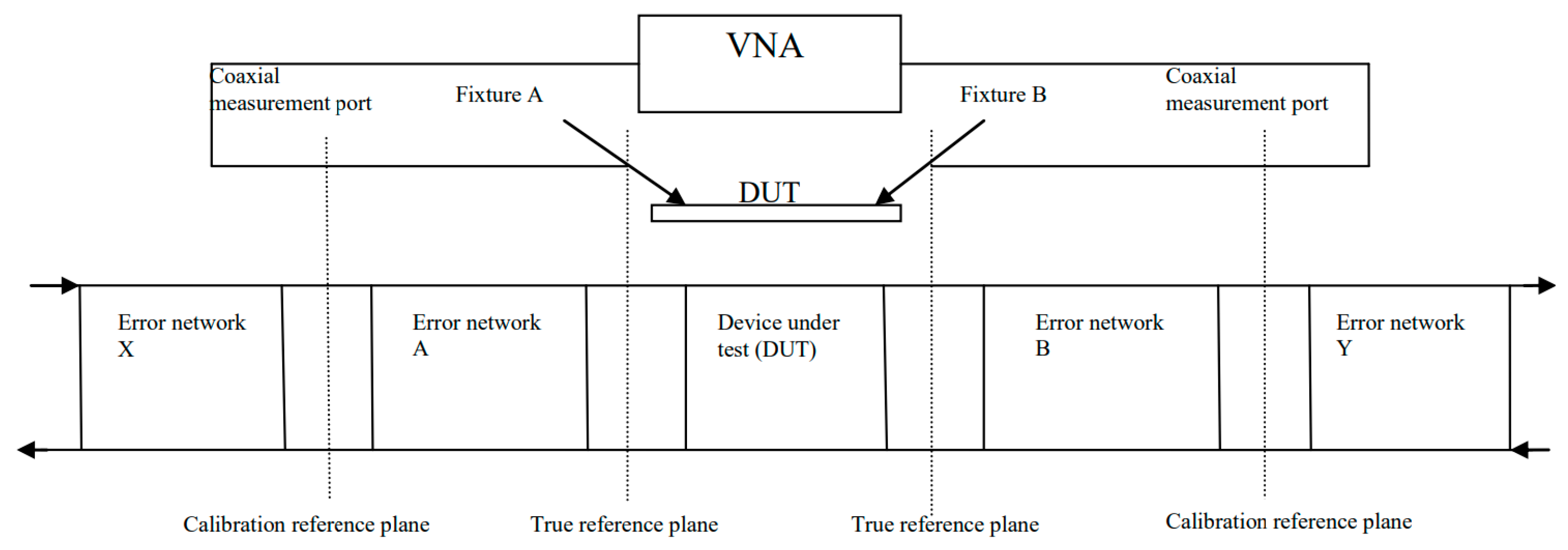
As illustrated in
Figure 2, traditional calibration methods effectively eliminate the influence of error networks X and Y (located between the instrument port plane and the DUT plane). Following calibration, the measurement plane aligns with the calibration reference plane. However, the fixtures introduce additional errors, embodied by error networks A and B. Components namely adapters, connectors, and fixtures can generally be modeled as transmission lines. The entire error network is most effectively represented using transmission parameters (T-parameters). Possessing the S-parameters of the fixtures, the equivalent transmission network method may be utilized to eliminate the effects of error networks A and B. Let error networks A and B, introduced by the left and right fixtures A and B of the DUT, respectively [
11], be denoted as follows:
The relationship between T-parameters and S-parameters is expressed as follows:
Solving the matrix (14), and applying the transformation relationship in (15), we can establish the relationship between the de-embedded S-parameter measurements and the actual S-parameters of the DUT (
). We can calculate the partial derivatives of the DUT’s S-parameters with regard to the fixtures’ S-parameters, constructing the corresponding Jacobian matrix for uncertainty propagation. This method is comparable to the eight-term error model used in TRL calibration, and the specific calculation method can be found in equivalent signal flow diagrams of the eight-term error model [
2].
Appendix A provides proof of the applicability of this de-embedding method. Modern VNAs often include de-embedding functions, typically compensating for an inverse network at each end of the error network to achieve port matching. This approach is conceptually akin to the de-embedding method described in this paper, and uncertainty propagation can also be performed based on the S-parameters of the inverse network.
The S-parameter values and uncertainties of the fixtures can be obtained either through measurements using another VNA or by using the nominal parameters provided by the manufacturer. Given that fixtures primarily exhibit transmission line characteristics, their inherent uncertainty is typically minimal. Consequently, the uncertainty propagated to the DUT through the de-embedding algorithm will also be negligible. However, when the loss of the fixture is large, the uncertainty introduced will not be ignored.
Fixture S parameter extraction and uncertainty evaluation algorithm: The S parameters of the fixture are obtained by measurement (such as single-port calibration at both ends of the fixture, and the S parameters of the fixture are obtained by two error models, but the equivalent model requires the fixture to have a different structure, that is, S12 = S21 to equalize the error term
in the network, and the S parameter extraction of the fixture will also introduce the uncertainty of the VNA of the measuring fixture). This method is usually used in the case where both ends of the fixture can be calibrated, such as if the fixture is an adapter or probe. According to the difference between the error network X and the error network A + X in
Figure 2, the S-parameter of the fixture is solved, which will introduce the uncertainty of the calibration piece transmitted to the error model coefficient in the two calibrations, and then jointly transmitted to the S-parameter measurement uncertainty of the fixture.
While propagating uncertainties, the covariance matrices of fixtures A and B, along with the S-parameter uncertainty matrices from
Section 3.1, are concatenated into a block diagonal matrix, assuming statistical independence among them:
By analogy with (12) and (13), the covariance matrix of the actual DUT S-parameters can be derived.
In the specific experiment, when constructing the covariance matrix of the calibration kits, the phase of the Short and Open, the return loss and the insertion loss of the Load and the Thru can be consulted in the calibration kits manual to set the covariance matrix of the calibration kits. The error model value can be read out from the VNA after calibration, and all the data for calculating the Jacobian matrix can be obtained by measuring the calibrated and measured parts with the VNA before and after calibration. The corresponding Jacobian matrix is constructed according to the functional relationship, and the uncertainty is transmitted step by step.
Finally, an algorithm outlining the uncertainty assessment for VNA-measured S-parameters under fixture de-embedding conditions is presented, using a two-port calibration with four calibration kits as an example, as shown in Algorithm 1.
| Algorithm 1. S-Parameter Uncertainty Assessment Process Under Fixture De-Embedding |
| Conditions |
| Initial Setup:
|
- 2.
Define the covariance matrices for the real and imaginary part uncertainties of the calibration kit, and , - 3.
Define the covariance matrices for the VNA noise uncertainties, and ,
- 4.
Define the covariance matrix for the uncertainty of in the calibration kit .
|
Calibration:
- 5.
Propagate the uncertainties from steps 1 and 4 to the real and imaginary parts, yielding and , - 6.
Combine the uncertainties from steps 2 and 5 using a block diagonal matrix to obtain the overall covariance matrix of the calibration piece, , - 7.
Propagate the calibration kit uncertainties to the error model coefficients to attain the covariance matrix , - 8.
Combine the uncertainties from steps 3 and 7 using a block diagonal matrix to obtain the overall VNA covariance matrix, , - 9.
Propagate the VNA uncertainties to the S-parameter measurement values to yield the covariance matrix .
De-embedding Setup:
- 10.
For the two end fixtures, utilize a high-performance VNA to repeat steps 1–9 for obtaining and .
De-embedding:
- 11.
Combine the uncertainties from steps 9 and 10 into a block diagonal matrix to obtain the total error network uncertainty, , - 12.
Propagate the total error network uncertainty to the DUT’s S-parameters, to obtain the covariance matrix , - 13.
Repeat steps 8–12 to yield the Type B uncertainty covariance matrix from multiple measurements, - 14.
Calculate the Type A uncertainty covariance matrix for the DUT’s S-parameters, - 15.
Combine (13) and (14) to obtain the combined uncertainty covariance matrix for the DUT’s S-parameters.
Subsequent Data Processing:
- 16.
Determine the uncertainties associated with the four S-parameters using the uncertainty covariance matrix, - 17.
Propagate the uncertainties from the S-parameter covariance matrix to derived parameters such as amplitude, phase, or other relevant indicators.
|
4. Experiment
This study leverages an Anritsu MS4642B VNA [
29] and its 3652A calibration kits [
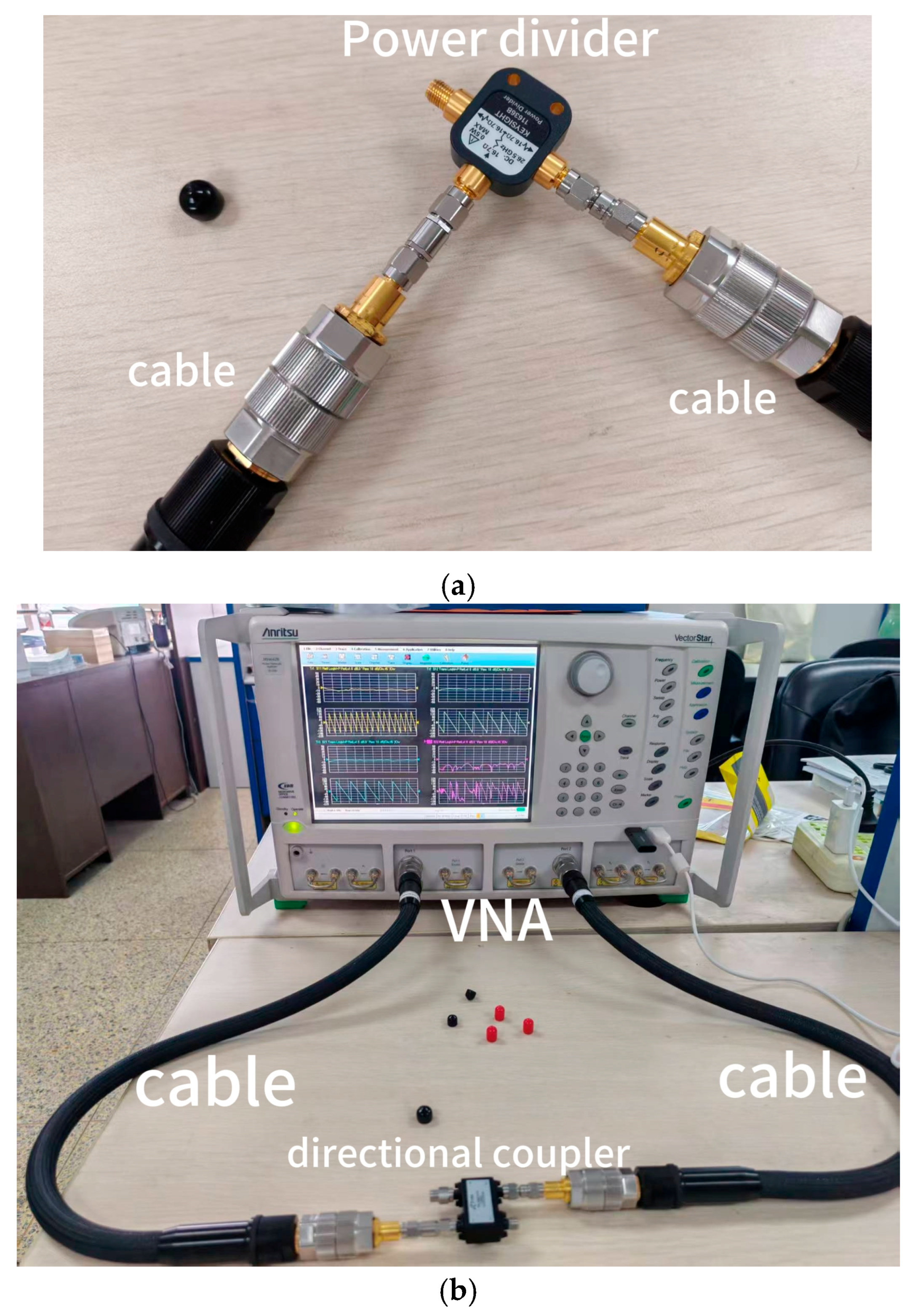
31] to construct an experimental measurement system. The system’s operational bandwidth spans 1–20 GHz, with 201 equally spaced frequency points and a 10.5 GHz intermediate frequency bandwidth. The DUTs, comprising a power divider and a directional coupler, exhibit operational frequency ranges of DC to 26.5 GHz and 2–40 GHz, respectively. The connecting cable of VNA is SMA adapter, and the measurement bandwidth is less than 18 GHz, so it may lead to slightly poor measurement results in high frequency band. At the same time, the noise of the VNA and the residual error after calibration (both can be known from the device‘s standard manual, the latter is also related to the model of the calibration kits and the calibration method used), and the bending of the connecting cable during measurement is a factor leading to uncertainty. The measurement process necessitates the use of adapters to connect the DUT to the VNA measurement port. Consequently, the actual measurement configuration, as depicted in
Figure 3, incorporates the DUT and the two adapters following the application of the SOLT calibration algorithm. This necessitates the implementation of a de-embedding algorithm to enhance the accuracy of the measurement results. The S-parameters of adapters used are measured by another VNA.
The evaluation method of uncertainty of Type B is based on the algorithm given in
Section 3; to assess Type A uncertainty, 10 repeated measurements were conducted on the same DUT to account for random errors inherent to the measurement process. The Type B uncertainty covariance matrix, driven from 10 measurements, is integrated with the Type A uncertainty covariance matrix to compute uncertainty as per (6).
4.1. Power Divider
This study employs the Keysight 11636B power divider [
32] as a key assessment object. This device is designed to divide a single input signal into two output signals.
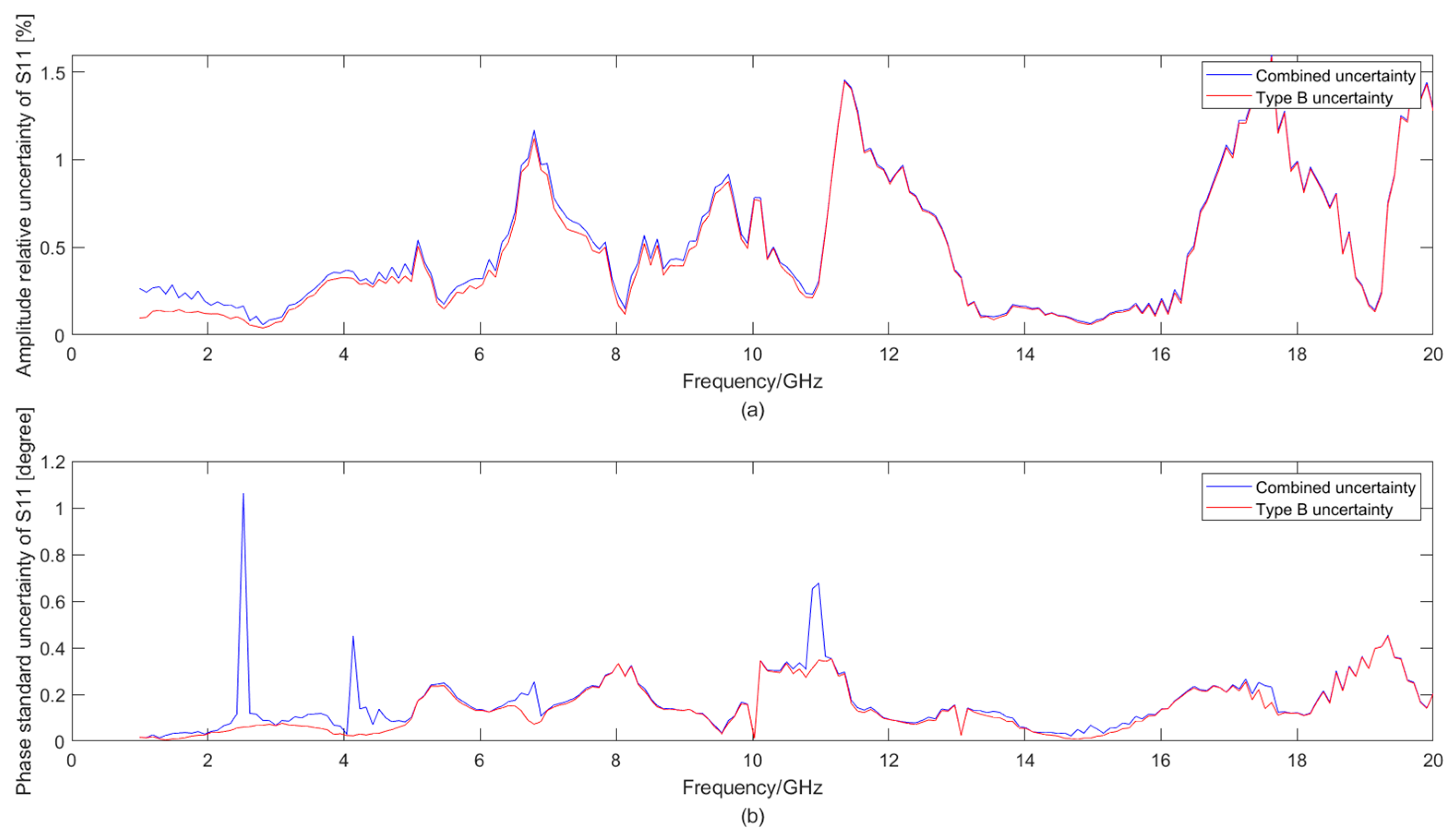
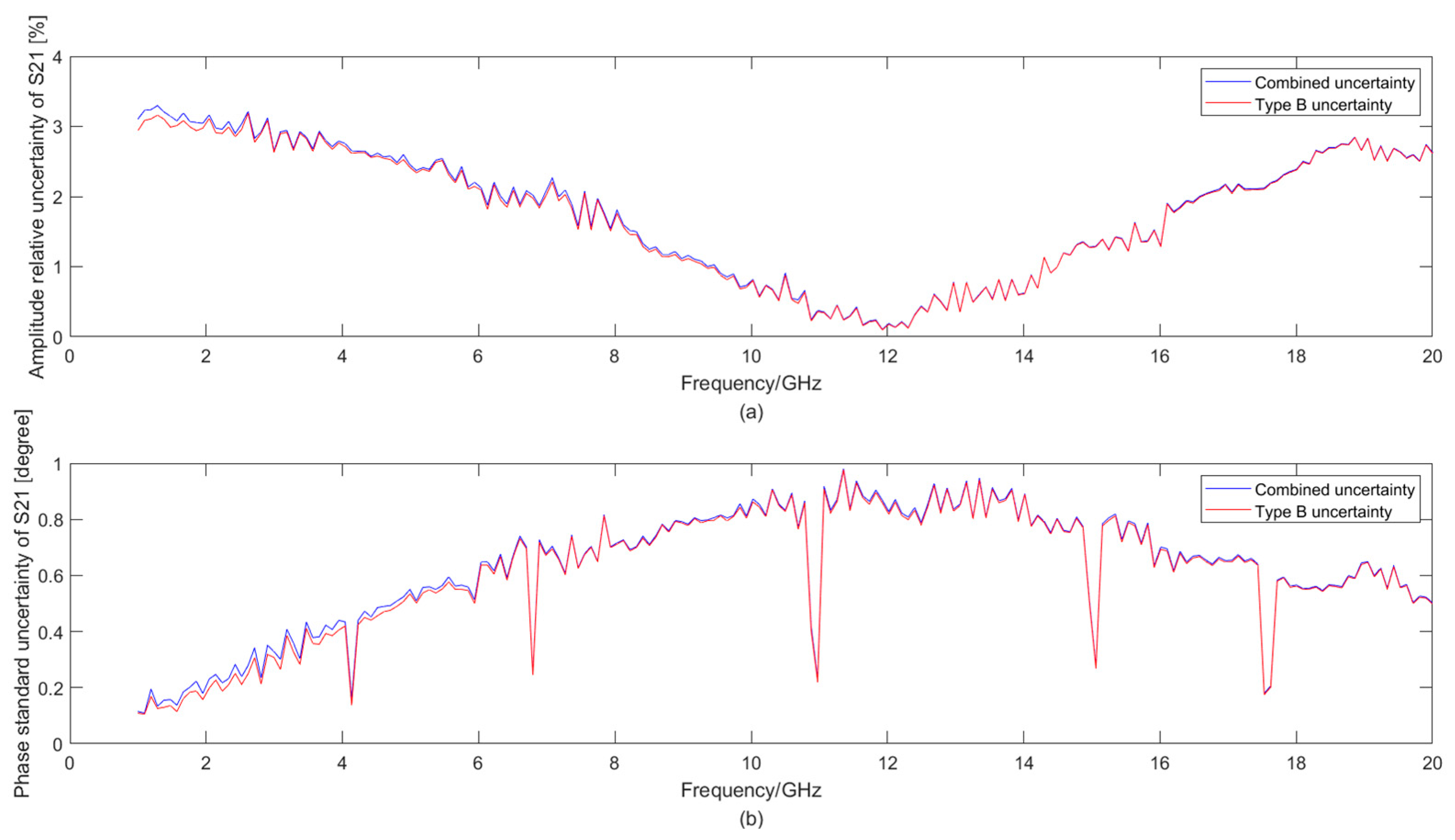
Figure 4 and
Figure 5 present the uncertainty assessment results for the power divider’s S-parameters (amplitude and phase). The combined uncertainty plots for the S22 and S12 parameters have been omitted as their results exhibit a strong similarity to those of S11 and S12. Given the large number of frequency points and the wide dynamic range, continuous curves are used to illustrate the uncertainty across frequency, providing a clearer representation than traditional error bars.
The amplitude and phase uncertainty demonstrate satisfactory overall performance. The relative uncertainty of the amplitude remains below 4%, while the standard uncertainty of the phase does not exceed 1 degree—a very small value. This indicates that the covariance matrix method is suitable for the S-parameter uncertainty evaluation in this study.
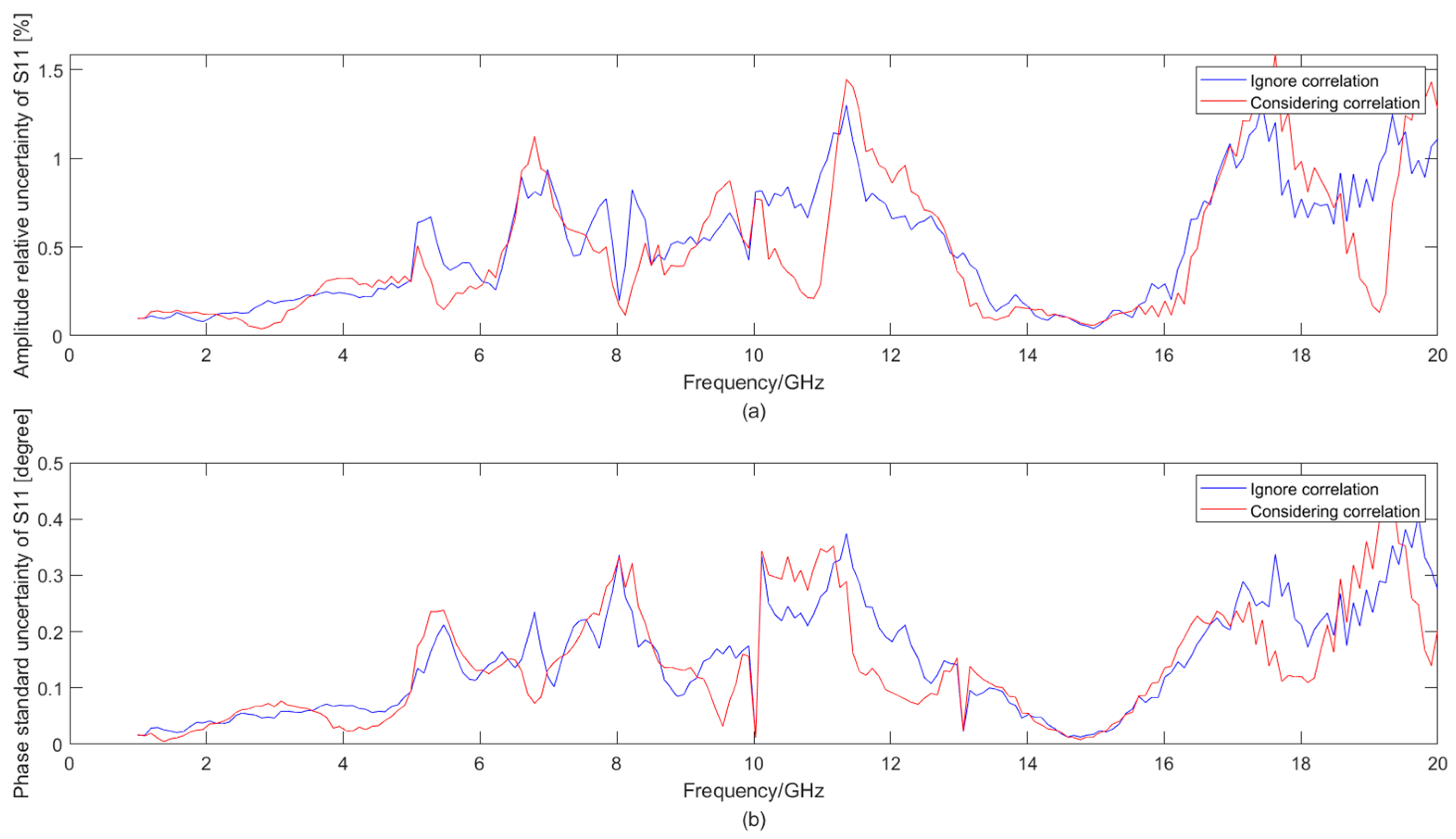
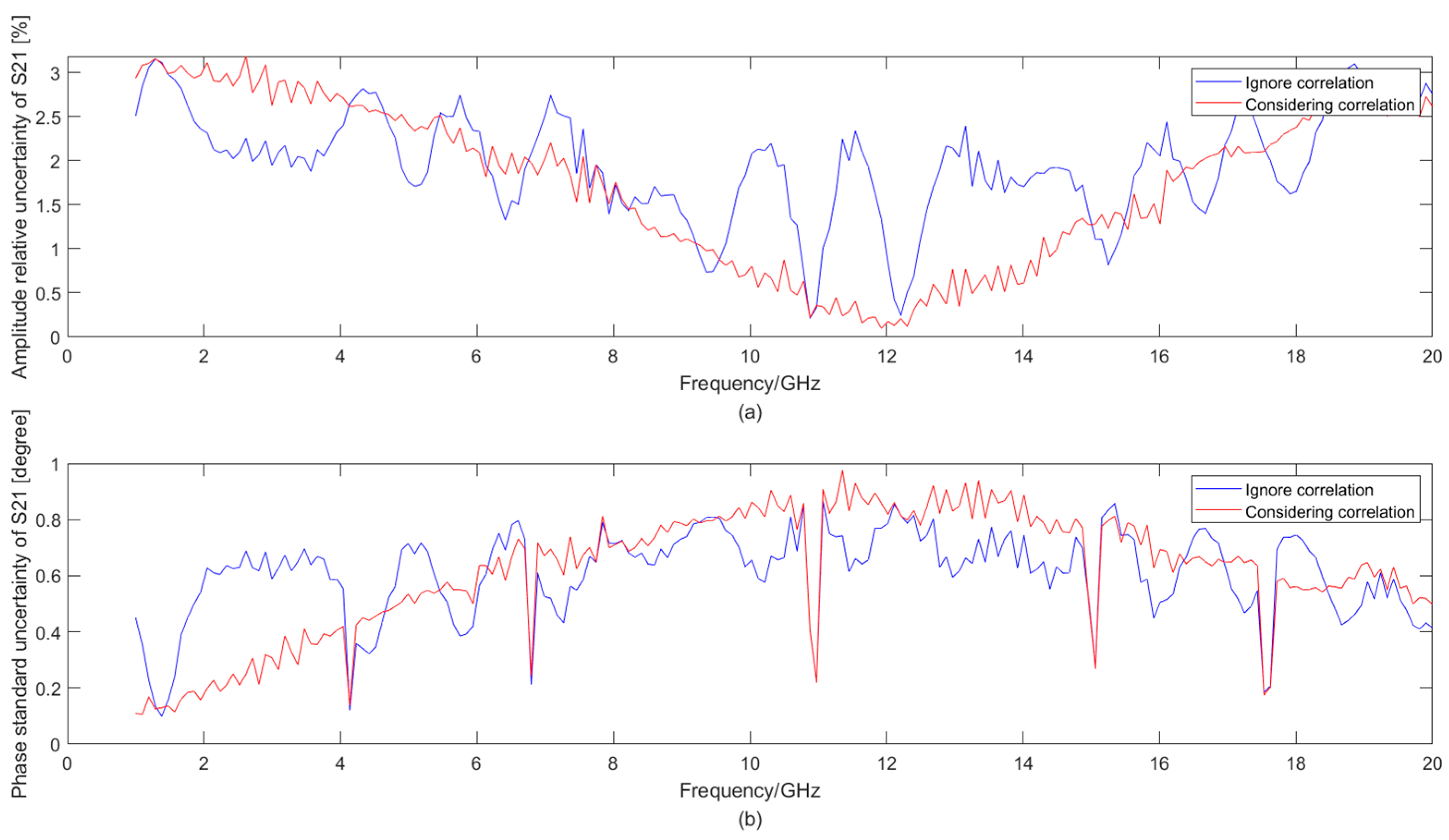
The proposed method accounts for variable correlations and their impact on overall uncertainty. While the Type A uncertainty calculation method remains unchanged compared to ignore correlation, the divergence in uncertainty assessment results is primarily reflected in the Type B uncertainty component.
Figure 6 and
Figure 7 illustrate the uncertainty comparisons between the two methods. While the overall trend of the uncertainty assessment results remains consistent, the correlation between variables exerts an influence on the uncertainty values. It is noteworthy that amplitude uncertainty is more substantially influenced by correlation, possibly due to the smaller amplitude measurement values, which render them more vulnerable to correlation-related factors. The influence of correlation on uncertainty at each frequency point is both positive and negative, and it cannot be simply generalized. Compared with S11, the amplitude of S21 is more affected by correlation, and the introduction of correlation at some frequency points in the middle frequency band will significantly reduce the uncertainty.
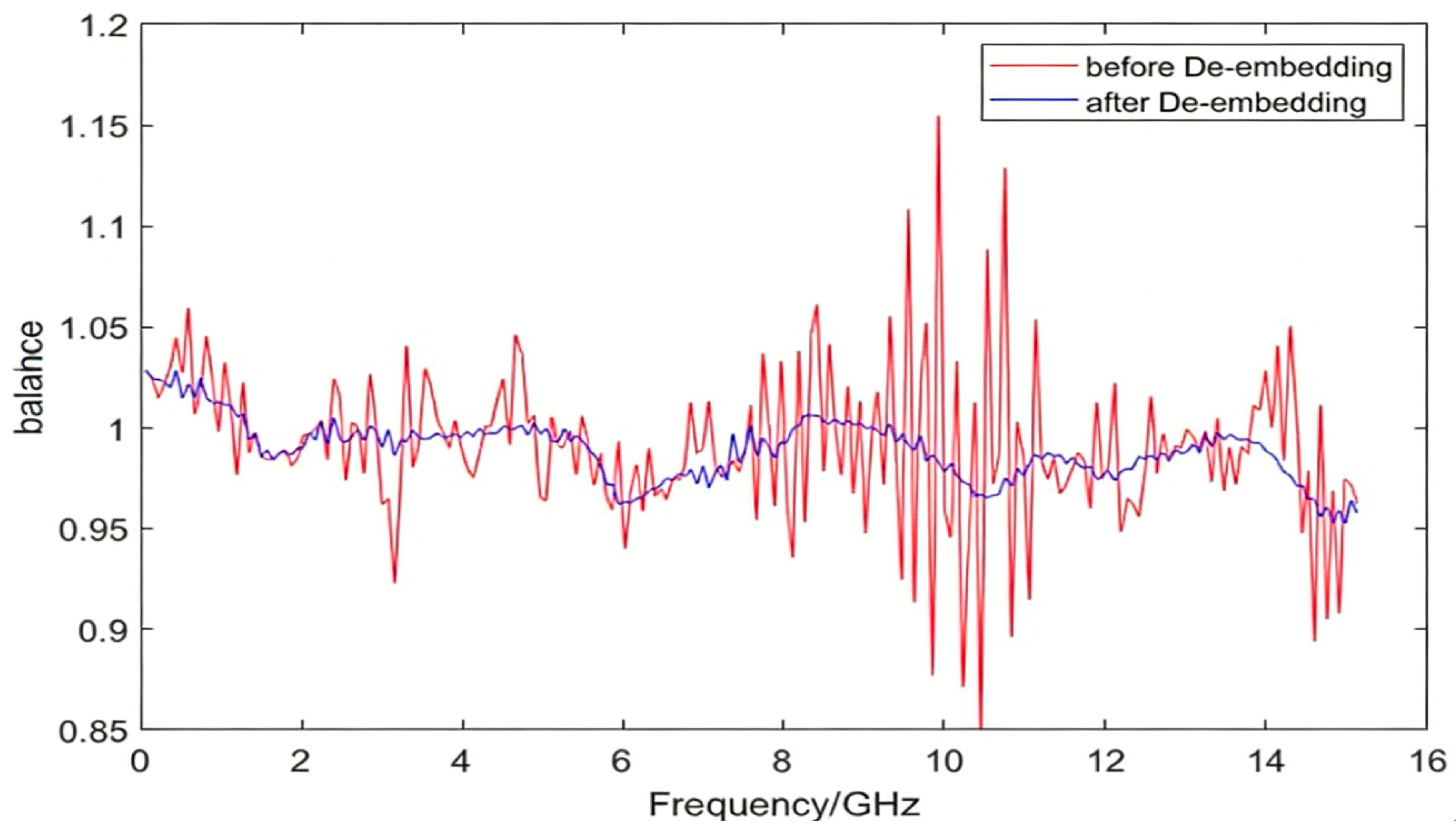
While this study directly assesses the uncertainty of the four S-parameters, numerous applications, including antenna and power meter systems, often necessitate the calculation of additional parameters derived from the measured S-parameters. A critical performance metric for power dividers is balance, denoted as ρ, which is defined as the ratio of the transmission coefficients of the two output ports:
As the power divider contributes to a three-port device, S21 and S31 in (17) correspond to the transmission coefficients from the input port to the two output ports. When employing a four-port VNA, these measurements can be acquired in a single operation. Due to the constraints of the experimental apparatus employed in this study, the calculation of balance requires two distinct measurements of the transmission coefficients. Both measurements are conducted under the identical calibration conditions. In this instance, the correlation between the error model coefficients is retained prior to propagation through the error model. Conversely, the correlation between the error model coefficients and the S-parameter values during the two measurements is disregarded. This decision is based on the physical coupling mechanisms represented by these correlations. In a VNA error model, inherent correlations exist between error terms, such as between source match and load match errors, and between directivity and reflection tracking errors. These correlations arise because multiple calibration standards jointly constrain the same set of error terms during the calibration process. When considered, such correlations can either increase the overall uncertainty if the terms are positively correlated or decrease it if they are negatively correlated (partial error cancellation). While the correlation between error coefficients across two independent measurement sequences is typically weak and complex to quantify, its neglect in this specific balance calculation is a conservative simplification that does not alter the primary conclusions regarding uncertainty composition. Notably, amplitude uncertainty, especially for S21, is particularly sensitive to correlations involving transmission tracking and load match errors, as observed in the main uncertainty analysis.
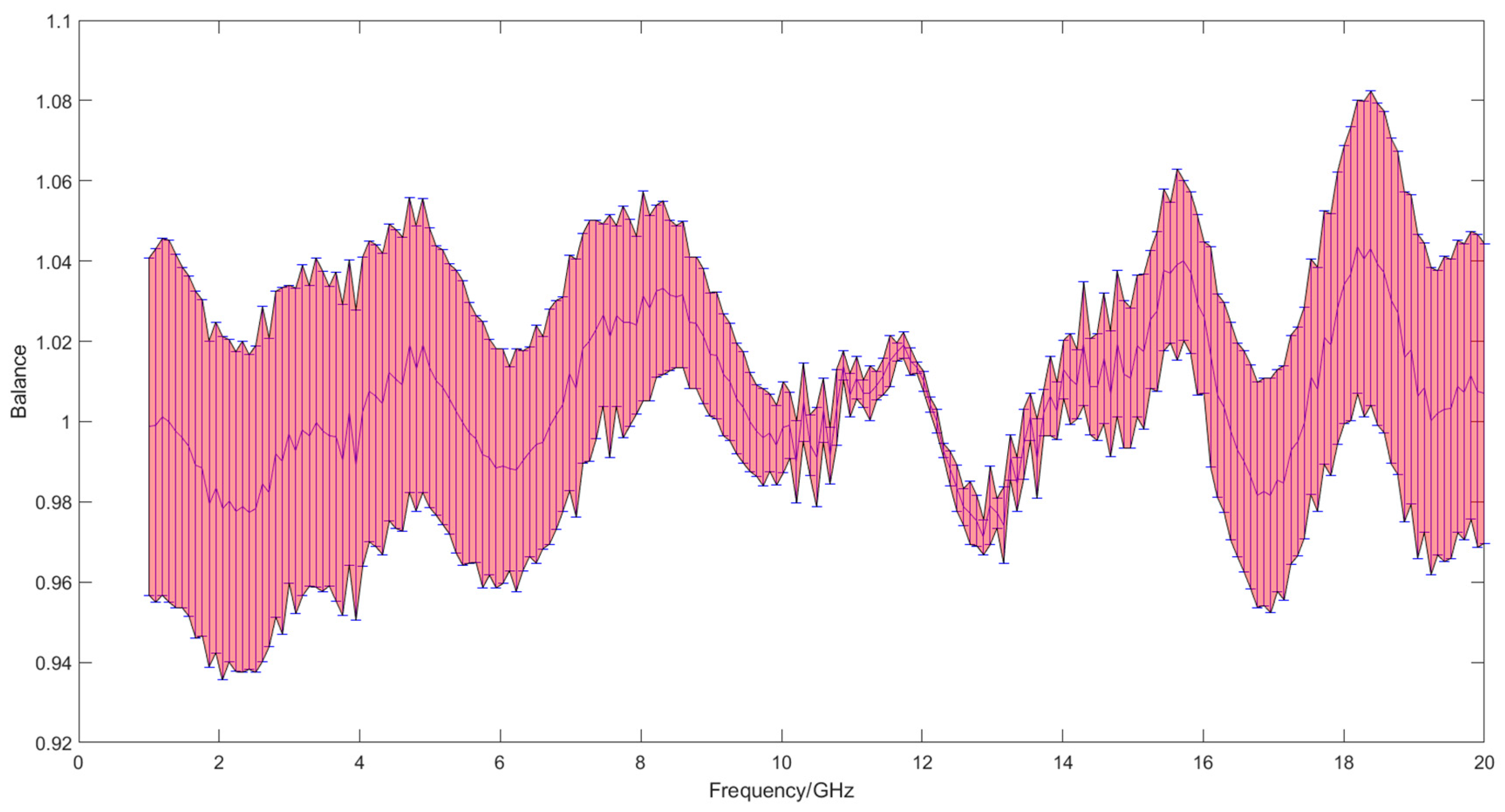
Ideally, the power divider exhibits a balance of 0 dB, indicating equal output power at both ports.
Figure 8 presents the uncertainty assessment results for the power divider’s balance.
As depicted in
Figure 8, the calculated balance value is approximately 1 within the measurement bandwidth. Accounting for uncertainty, the balance range is determined to be between 0.94 and 1.08, which is within the 10 error limit.
4.2. Directional Coupler
This study further investigates a directional coupler from Tai-Li Microwave (China) [
33]. As a four-port device, it splits an input signal into two orthogonal output signals, where the phase relationship between the output ports constitutes a critical performance parameter. Theoretical and experimental studies on coupled oscillators have emphasized the significance of phase characteristics in such devices, particularly for applications demanding precise phase matching [
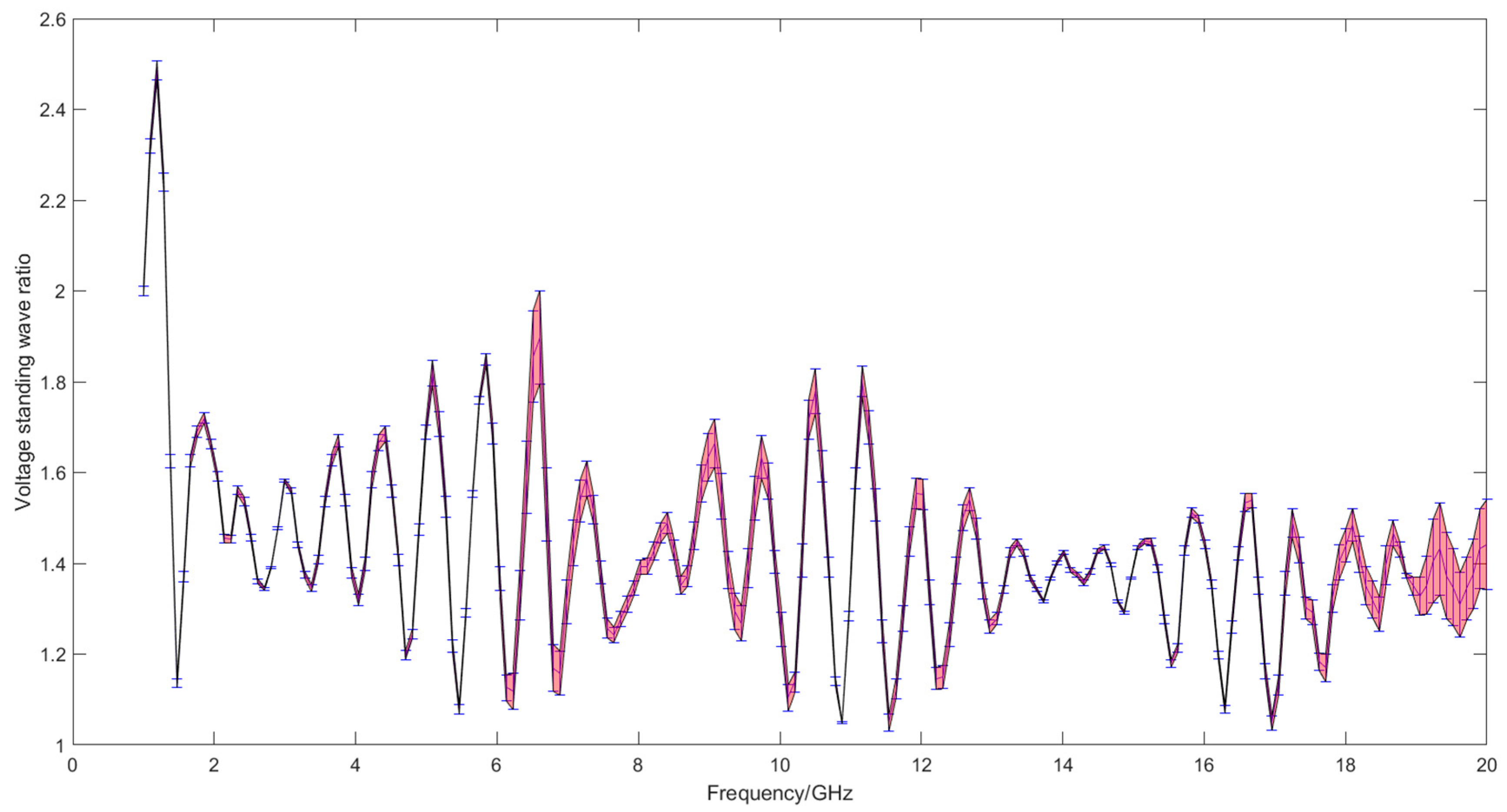
34]. In the present experimental configuration, one port is terminated with a 50 Ω load to optimize the coupler’s performance. While a detailed uncertainty analysis for individual S-parameters is excluded, we directly present an uncertainty assessment for VSWR and coupling. The VSWR is primarily influenced by S11 amplitude, while coupling is more significantly affected by S21 phase information.
The coupler’s VSWR, a measure of port matching, is computed using (18). An ideal VSWR = 1 denotes perfect impedance matching.
Figure 9 depicts the uncertainty in the calculated VSWR.
As shown in
Figure 9, the relative uncertainty associated with VSWR measurements of the directional coupler is generally less than 5% across the 2–20 GHz operating band. This is consistent with the device’s nominal specifications (typical: 1.5; maximum: 1.8) provided in the manual.
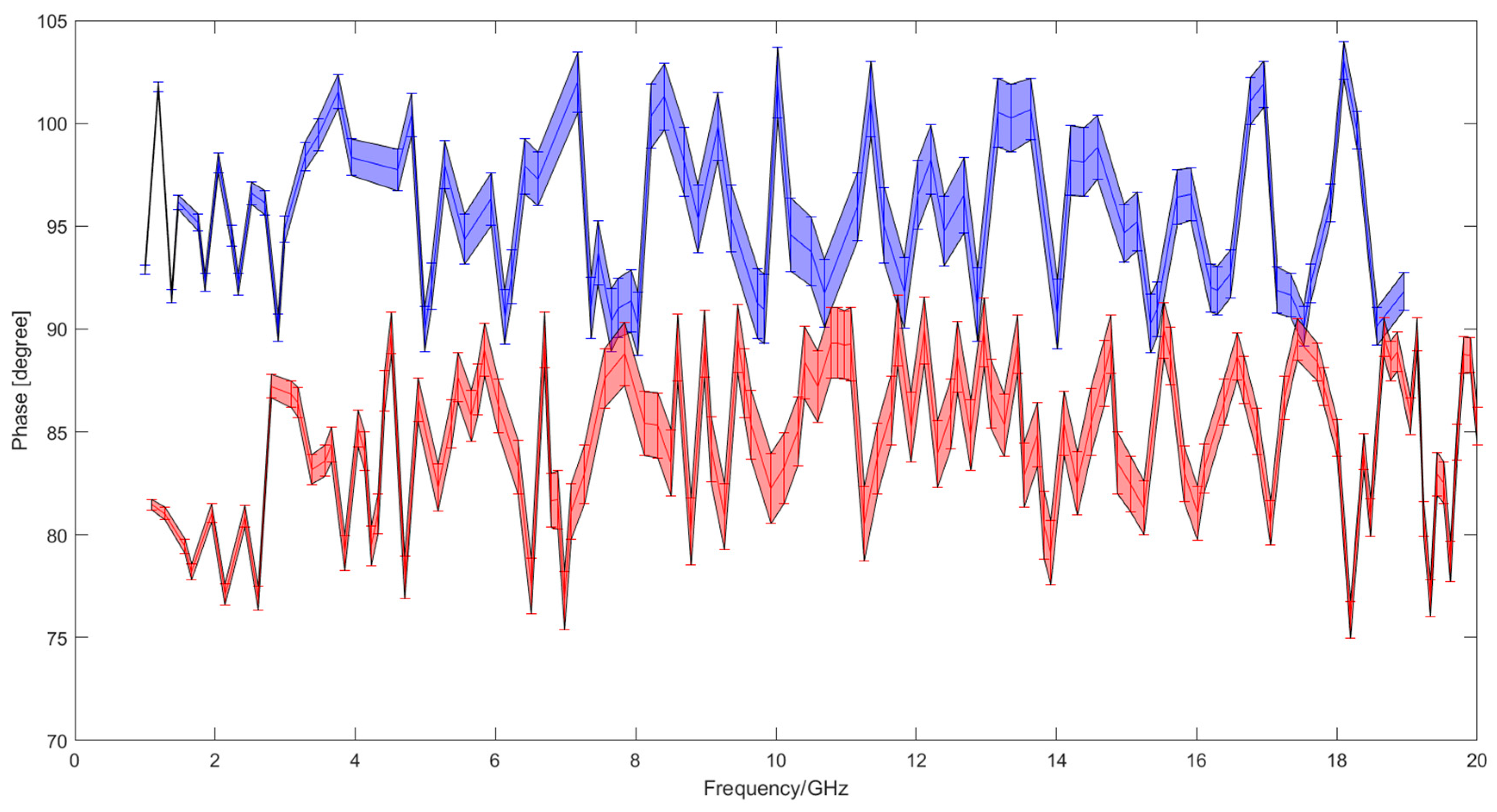
The coupling of a directional coupler is characterized by the phase difference between its two output signals, ideally 90°. Similarly to a power divider, a two-port VNA requires two measurements to obtain the transmission coefficients for the coupler’s two output ports. Correlation analysis between these measurements is performed in the same way as for power divider balance assessment. The (19) presents the coupling formula p, and
Figure 10 illustrates the corresponding uncertainty range.
Figure 10 demonstrates that the coupling of the directional coupler generally falls within a range of 75–105°, satisfying the device manual’s specification of ±14° for phase balance. Incorporating the standard uncertainty range, only a few frequency points within the 18–20 GHz high-frequency range exhibit phases below 75°. Most frequency range points still adhere to the device’s specified requirements. The observed anomalies in the high-frequency range might be due to the limitations of the VNA’s connection cables and adapters.
4.3. Analysis of Uncertainty Component Ratios
By decomposing the overall uncertainty into its constituent components, we can identify the dominant factors influencing S-parameter measurement uncertainty. This analysis enables targeted improvements in measurement equipment and calibration techniques. To isolate the contribution of a specific variable, a sensitivity analysis is employed, setting other variables to zero and examining the resulting impact on total uncertainty.
The source matching error term is often negligible, potentially leading to situations where
is not satisfied. Consider second-order effects when propagating uncertainty. However, during the analysis of individual uncertainty components, their magnitudes are negligible, typically on the order of
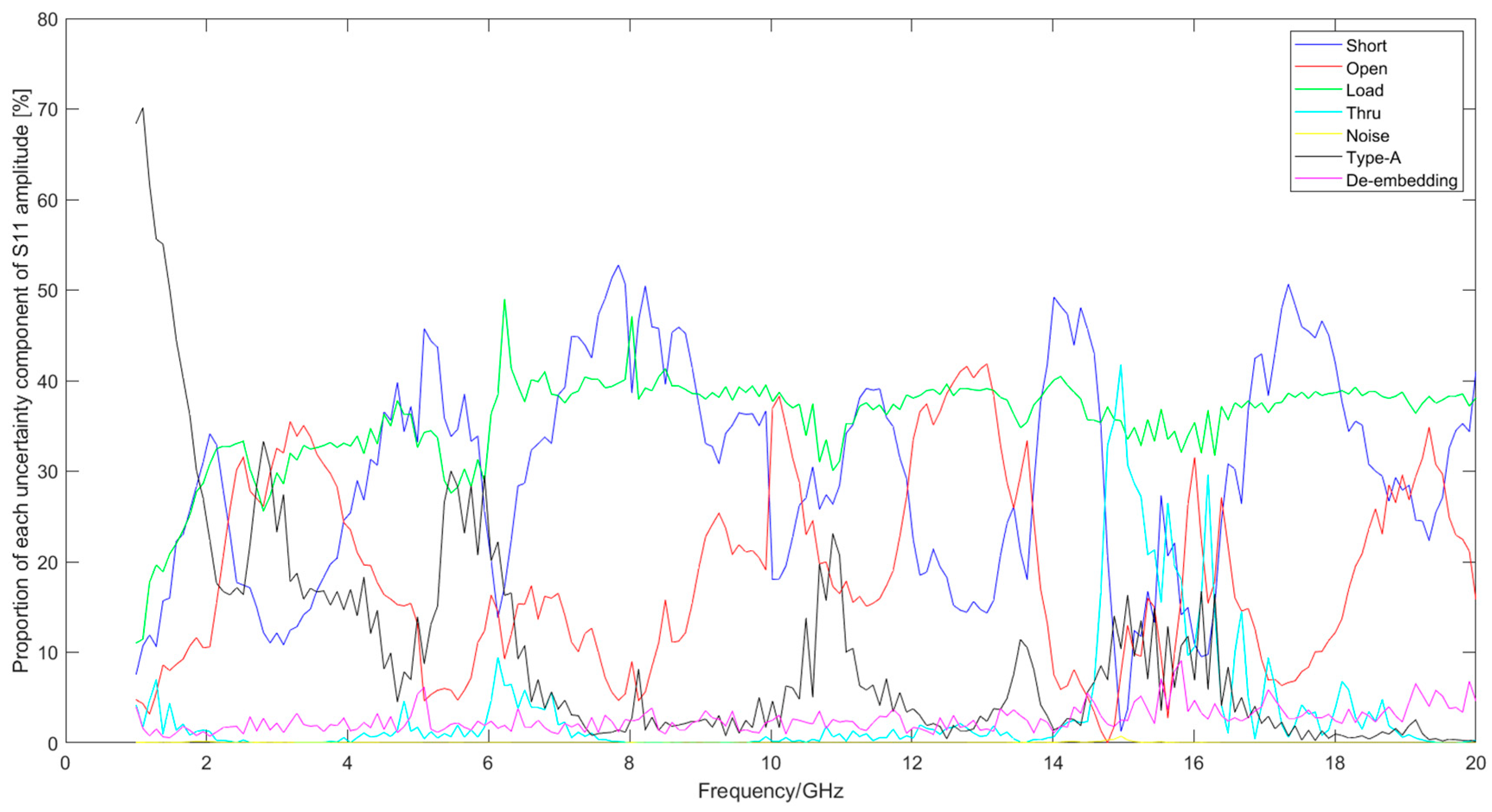
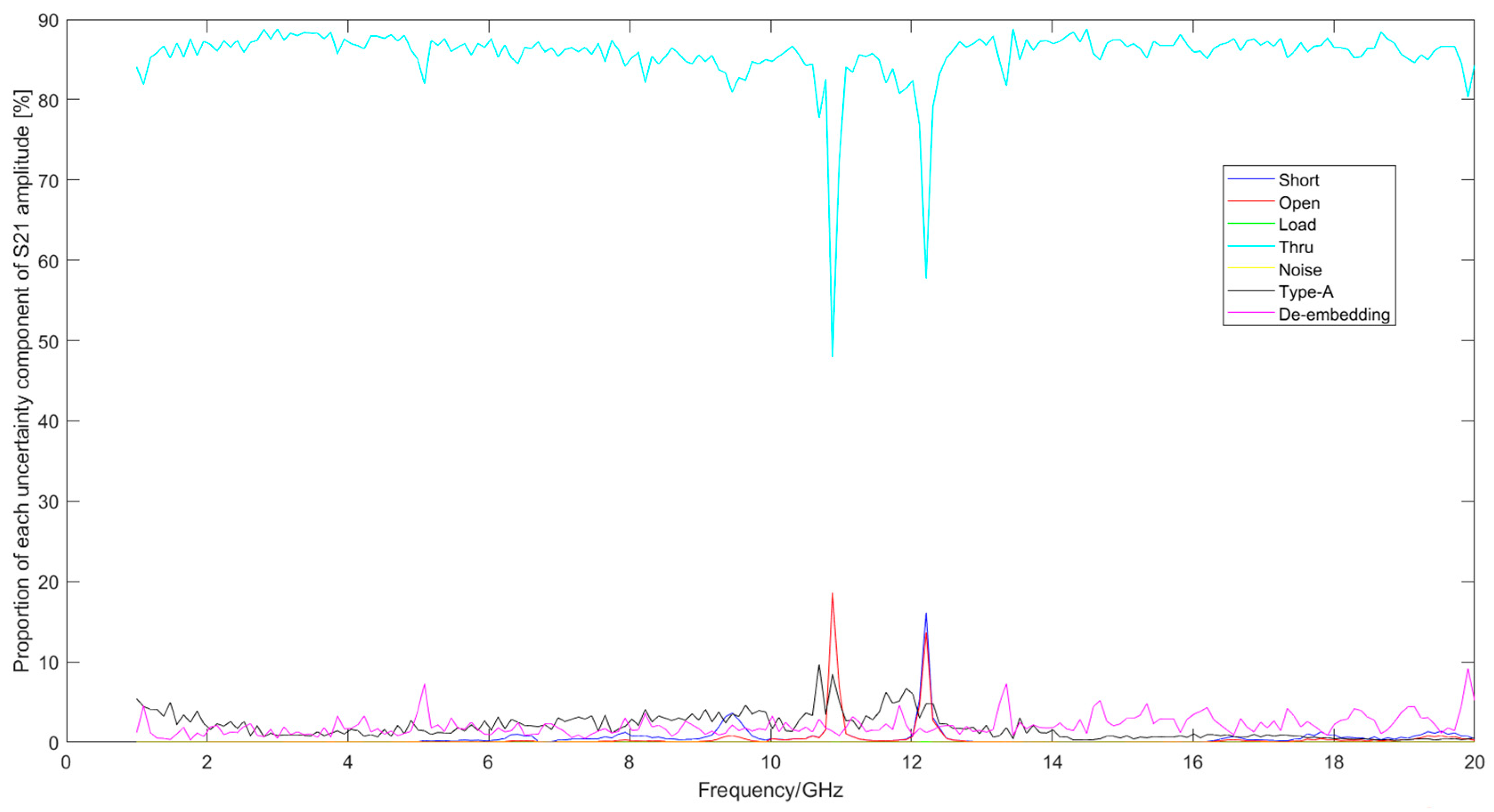
. Therefore, the inclusion of second-order term calculations has a minimal impact on the S-parameter uncertainty. Consequently, these terms can be disregarded for simplified computations. This paper analyzes the uncertainty component ratios derived from the amplitude measurements of S11 and S21 for a power divider. The analysis, tracing uncertainty sources back to calibration standards, is presented in
Figure 11 and
Figure 12. The analysis of phase uncertainty component ratios is excluded due to space constraints.
Figure 11 indicates that the primary uncertainty contributors to the S11 parameter are short-circuit, open-circuit, and load calibration standards. For the S11 parameter, the load standard’s uncertainty is the most significant and remains constant across the entire frequency range. Type A uncertainty is more prominent at lower frequencies, diminishing with increasing frequency. Noise uncertainty has a negligible impact, remaining below 1%. The de-embedding algorithm contributes approximately 5% to the total uncertainty.
Figure 12 indicates that the through standard is the primary source of uncertainty for the S21 parameter, with negligible contributions from other calibration standards. This dominant role stems from its central function in transmission calibration: the insertion loss and phase error of the through standard directly dictate the accuracy of the transmission coefficient calibration. After de-embedding, this error is further propagated to the S21 parameter of the DUT. Type A uncertainty comprises less than 10%, suggesting a smaller impact compared to S11, potentially due to the lower S11 measurement values being more sensitive to such uncertainty. The de-embedding algorithm introduces a consistent 5% uncertainty.
The majority of the uncertainty components originate from the inherent uncertainties of the calibration standards, significantly influencing the overall S-parameter measurement uncertainty. Given the minimal impact of noise uncertainty, its analysis can be excluded in scenarios where high precision is not paramount, simplifying the error model.
5. Conclusions
This study addresses the issue of uncertainty evaluation for S-parameter measurements under de-embedding conditions by proposing an uncertainty propagation method based on the covariance matrix approach. By introducing a de-embedding algorithm after VNA calibration, the errors introduced by connectors and fixtures are effectively eliminated, thereby improving measurement accuracy. The research systematically analyzes the main sources of uncertainty in VNA measurements, including calibration standards, instrument noise, and repeatability, and utilizes the error model obtained from calibration to progressively propagate the uncertainty to the final measured S-parameters via the covariance matrix.
An experimental measurement system was constructed for power dividers and couplers to validate the proposed method. The results demonstrate that, compared to traditional approaches neglecting parameter correlations, the presented method provides a more comprehensive reflection of the composition and propagation of uncertainty. Specifically, magnitude uncertainty is more significantly influenced by correlations among parameters.
Furthermore, the study extends the propagation of S-parameter uncertainty to key performance indicators such as balance, voltage standing wave ratio (VSWR), and coupling. The resulting uncertainty ranges for these metrics all fall within the nominal specifications provided in the device manuals, confirming the practicality and effectiveness of the proposed evaluation method. Through a traceability analysis of the uncertainty components for the power divider’s S-parameters, it was found that the S11 parameter is predominantly influenced by the short, open, and load standards, whereas the uncertainty of the S21 parameter is mainly attributable to the through standard. This analysis provides a theoretical basis for developing more precise VNA calibration methods and optimizing error models in the future.
In summary, this work not only provides a complete and applicable uncertainty evaluation workflow for S-parameter measurements under de-embedding conditions but also experimentally verifies its reliability and advantages in real measurement scenarios. It serves as an effective tool for the precise metrology and performance assessment of high-frequency microwave devices.