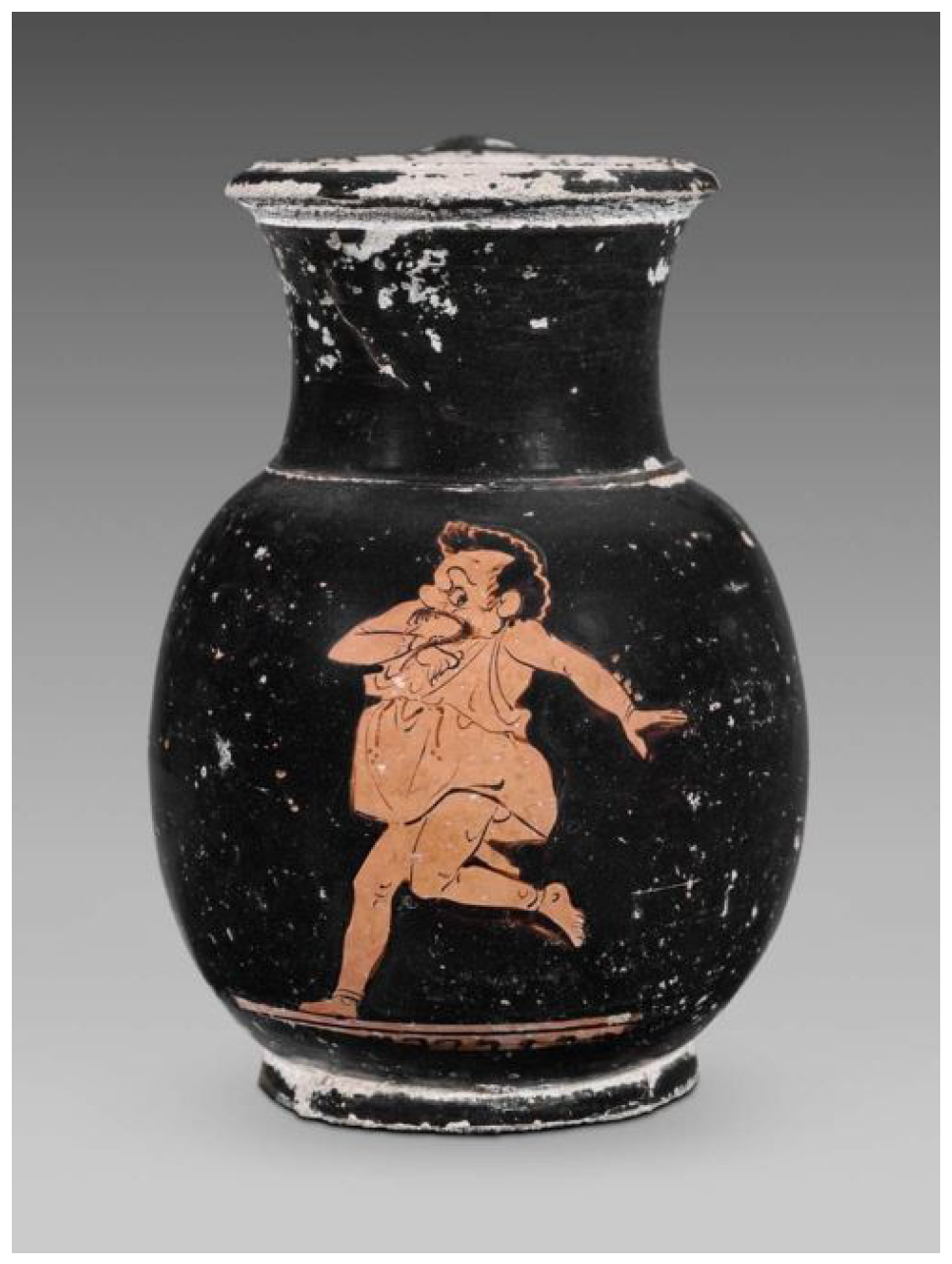
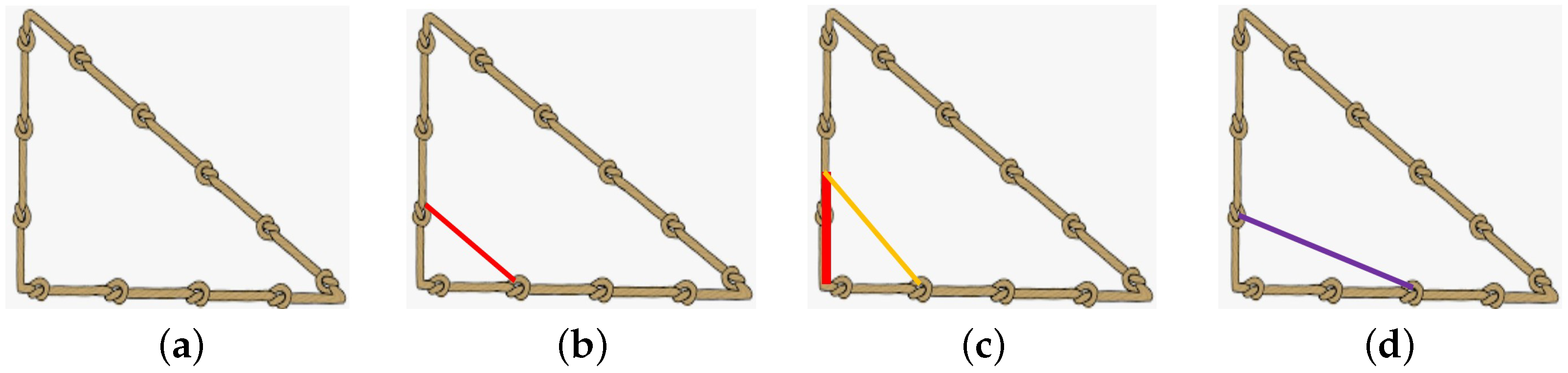
1. Introduction
A lot of information is known about vases from Ancient Greece. The Greek vase is one way to show that ancient Greek civilization emphasized geometric harmony in art and design [
1,
2,
3]. Scholars such as Boardman [
4,
5,
6], Walters [
7], Oakley [
8], researchers at the J. Paul Getty Museum [
9,
10], Matheson at the Yale University Art Gallery [
11], and Richter and Milne at the Metropolitan Museum [
12] have investigated the artistic narratives and historical contexts of these vases.
The world’s largest dataset of ancient Greek painted pottery is the Beazley Archive Pottery Database (BAPD) at Oxford University [
13]. This database contains detailed records on more than 130,000 ancient vases and over 250,000 images. These records include information on vase shape, technique, provenance, inscription, artist name, dimensions, and many other attributes.
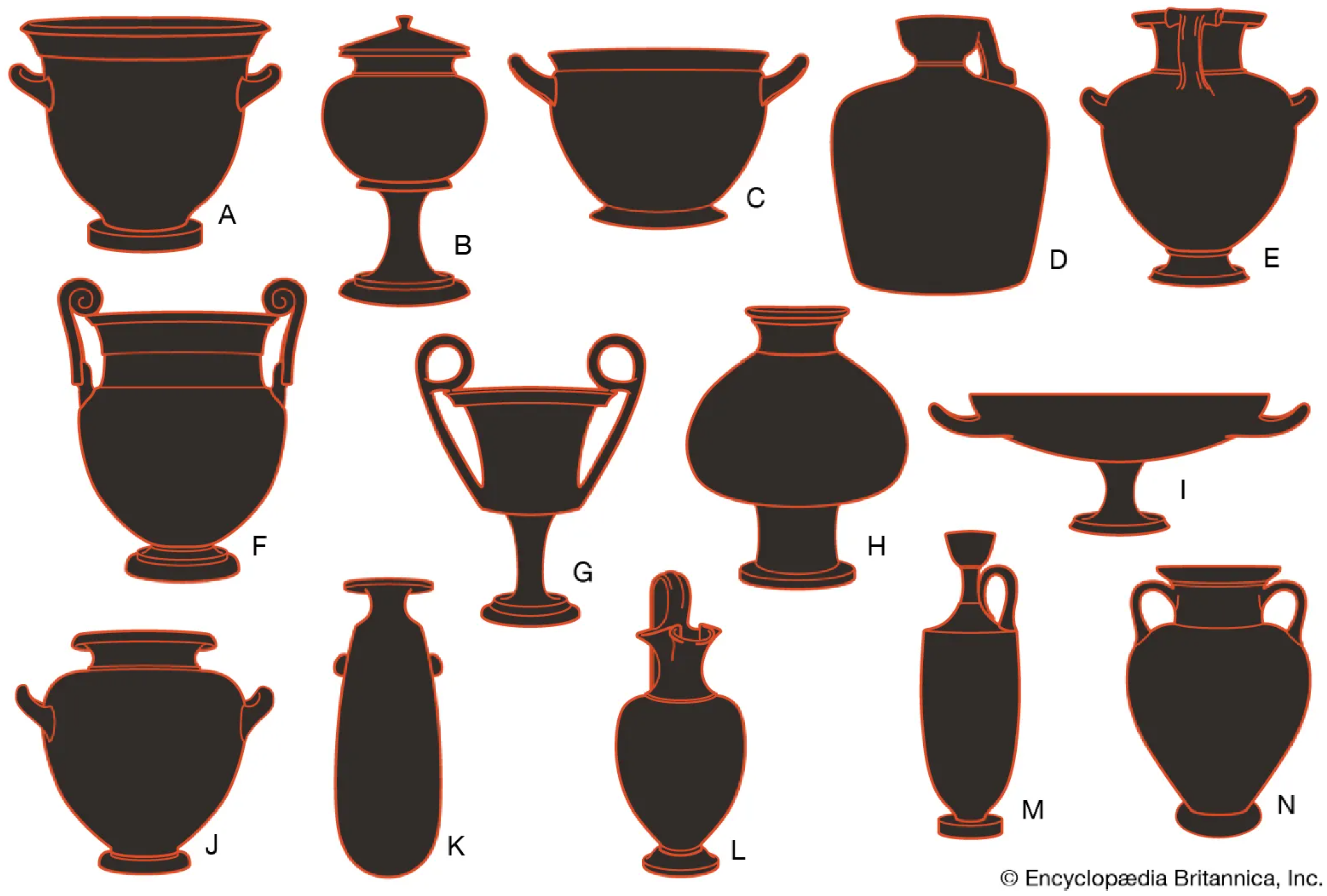
Artifacts in archaeology are often classified by their shapes, and Greek vases are no exception. A typology of some Greek vase shapes from
Encyclopaedia Britannica is shown in
Figure 1:
Of these, the amphora is perhaps the most important type, as it was used for storage, transportation, and trade of wine, olive oil, and other merchandise [
14,
15,
16]. Knowing the count of amphorae and their capacities allows approximate estimation of consumption and trade flows [
17].
It is important to distinguish between two broad categories of Greek pottery that served different functions and employed different production standards.
Luxury vases—finely painted vessels produced in limited quantities primarily for symposia, religious offerings, and funerary contexts—prioritized aesthetic beauty, artistic imagery, and visual proportion over volumetric precision [
6,
18]. These vases, which form the primary focus of Caskey’s measurements and consequently of our mathematical analysis, were valued as prestige objects and art pieces rather than as standardized containers [
19].
By contrast,
utility amphorae—mass-produced transport containers for wine, olive oil, and grain in commercial trade—required greater volumetric standardization to facilitate taxation, pricing, and quality control [
17,
20]. Archaeological evidence indicates that commercial amphora capacities showed moderate standardization within specific production centers and time periods, though with considerably more variation than modern consumers would expect. For instance, Rhodian wine amphorae of circa 230–200 BCE exhibited capacities ranging from about 25.4 to 29.1 L (variation within roughly
of the mean) [
20,
21]. Similar variation patterns appear in other major amphora-producing regions [
17,
20].
The mathematical models developed in this paper derive primarily from measurements of luxury vases and are most directly applicable to understanding the aesthetic and geometric principles governing high-quality decorated pottery. The applicability of these logarithmic spiral models to commercial transport amphorae remains an open question requiring separate investigation. While commercial amphorae certainly exhibited proportional relationships between height, maximum diameter, and shoulder dimensions, the degree to which these proportions conformed to specific mathematical ratios (such as
,
, or
) would need to be verified through systematic measurement of archaeological assemblages from kiln sites and shipwrecks [
17,
22]. We acknowledge this limitation and suggest that future research examine whether our volume calculation methods can be adapted for commercial amphora types, particularly given the practical importance of volumetric estimation for understanding ancient Mediterranean trade patterns [
17].
As noted by Mackay [
23], the study of Greek vase shapes has been almost entirely qualitative, with few studies containing numerical data or explicit tables [
24]. Many of these focus on the direct measurement profiles (the outer shape) of a vase. It is also possible to design machine-learning classifiers to analyze shapes from the vast number of photographs available in the BAPD and other databases [
23].
What is largely missing from this literature is an accurate estimate of vase volume. As noted in recent work on vessel capacity [
25], calculating the volume of ceramic vessels found whole or in fragments on archaeological sites is a key analytical endeavor that can have implications for economic and social activity, including storage, feasting, and trade. Direct measurements of volume are often infeasible due to age, condition, cracks, and restoration issues. As a result, other methods are needed, many of them based on advances in digital imaging and computer-assisted reconstruction [
25,
26]. Most established methods for estimating volumes are based on the assumption that vessel shapes approximate circular or elliptical forms in plan view, or on other geometric simplifications [
25].
In this work, we make extensive use of square roots that appear in the dimensions of Greek vases. The geometric construction of
and the proof of its irrationality were well known at the time of Euclid. Procedures to compute
and similar square roots or approximate a hypotenuse were known to Babylonian mathematicians around the 16th century B.C.E. [
27]. It is unlikely that the Greeks would use such complicated formulae or even later formulas, such as Heron’s method [
28] or Archimedes’ (3rd century B.C.E.) methods of continuously improving and estimating upper and lower bounds using simpler solids [
29]. Most likely, they used simple fractions that are fairly close to these square roots. For example,
,
, and
. Artisans of the time could likely reproduce the same proportions without any numerical concept of square roots (e.g.,
,
,
) by relying solely on geometric constructions (squares, diagonals, circular arcs, and cord/straightedge/compass). It is also interesting to note that the measuring system used in Ancient Greece involved only a few simple fractions, such as
and
[
30]. Therefore, although irrationals like square roots were not numerical tools at the time, artisans could set shapes without using
,
,
directly, but by using corresponding simple fractions.
One should note that many of the mathematical constructs known to the Greeks were already known in Ancient Egypt [
31,
32,
33,
34,
35]. One of the primary sources of Ancient Egyptian mathematics is the so-called Rhind Papyrus [
36]. This document, from the northern part of Egypt, dates from about 1650 BCE. This papyrus, just as a few others that we have today (e.g., the Berlin papyrus and the Moscow papyrus), contains both arithmetic and geometric problems and their solutions. For example, one of the most famous problems is problem #48 in the Rhind papyrus, which suggests the number
as
. This is a very close approximation (about 0.5% relative error) to
when rounded to 4 decimal points. A number of problems in the Rhind papyrus are related to computing volumes of cylinders (problems 41–43), rectangular solids (problems 44–46), and a few other geometrical problems computing volumes (cylinders and pyramids) and areas (problems 48–60). There are no mentioned problems dealing with computing volumes generated by rotation, except for the cylinders.
Before Euclid provided proofs and rules for geometric ratios, the Egyptians had already invented mathematical rules and construction techniques [
37]. Rossi [
35] has shown that the Egyptians used limited geometric tools to control dimensions, often relying on grids and proportional settings. They could draw circles, squares, triangles, and vertical lines to measure and construct buildings and utilities, and were especially skilled at squaring and aligning long structures, as well as constructing right triangles. At that time, geometry was a practical activity that involved using ropes and measurements rather than abstract numerical concepts or formulas. The pyramid slope (sequence), which expresses a ratio geometrically, is another example. Many temples and pyramids can be explained by practical geometry. For example, the Egyptians applied mathematical rules in pyramid construction by first establishing a base square on the ground, marking the pyramid’s center, drawing the vertical height from that center, using the seqed to determine the face’s slope, and then using a measuring rod or squared grid to mark this distance to complete the pyramid’s floor plan [
35]. This procedure represents geometry based on mathematical rules and construction techniques without relying on numerical theories or formal formulas.
The Greeks observed, abstracted, and applied this practical knowledge from the Egyptians to create harmonious shapes such as squares, diagonals, and arcs. Coulton’s study showed that Greek architects used cords, measuring rods, and right-angle tools to draw building parts, such as squares and diagonals, directly on working surfaces. It means that the Greeks obtained the same proportions through drawing without any numerical concept of irrationals. They used a common method, which involved choosing a module and drawing it repeatedly. If they consistently constructed the same modules in the same way, they would eventually achieve the same proportions. More specifically, they could draw a square as a module, then its diagonal, and use that diagonal as a new length or intersect arcs from fixed points, repeating these operations to produce the same ratios [
38]. This demonstrates that geometric ratios can be reproduced through repeated construction procedures rather than through numerical calculations. Hahn argued that Greek artisans, before Euclid, used plumb lines, cords, or straightedges to square, draw diagonals or perpendiculars, and inscribe circles in their constructions [
39]. These operations created order and proportion without naming them. The Greeks followed these operations from the Egyptians and reproduced the same geometric ratios, such as the golden ratio and root rectangles [
40]. Euclid later summarized and transformed those practical rules and construction techniques into a formal mathematical system that included definitions, propositions, and proofs.
However, it is crucial to distinguish between the foundational geometric principles that the Greeks learned from Egypt and the sophisticated refinements they independently developed. While the Egyptians provided practical geometric methods for construction [
32,
35], the Greeks advanced far beyond these foundations, developing techniques unknown in Ancient Egypt. Notable examples include
entasis—the subtle convex curvature of temple columns designed to correct optical illusions and potentially enhance structural strength [
41,
42]—and the precision construction of column drums that fit together with tolerances accurate to fractions of a millimeter [
38,
43]. Greek architects also employed non-planar temple floors with intentional curvature to counteract visual sagging [
42] and achieved remarkable accuracy in tunnel construction through sophisticated surveying techniques [
44]. These refinements represent distinctly Greek innovations in architectural and engineering precision that went well beyond the practical geometry of Egyptian rope-and-grid methods. The mathematical principles underlying Greek pottery design studied in this paper should be understood within this context of Greek geometric sophistication, not merely as applications of imported Egyptian knowledge.
Currently, there is an increased interest in calculating the volume of vessels to assess commodity trade transported in sharp-bottomed amphorae [
15,
22], including the pithos (“pythoid” or ovoid) amphorae. As pointed out in [
45], “
…Ancient Egyptians could calculate the volume of a sphere correctly, and Democritus (5th–4th centuries BC) was the first to calculate the volume of a cone correctly. However, until now, it was not known that there was a formula for calculating the volume of an ovoid amphorae body during antiquity. Formulas by Heron of Alexandria (1st century AD) for the volume of “pithoid” and “spheroid” pithos are known. However, Heron did not specify the meaning of some terms in these formulas. Therefore, the geometry of these vessels and the exact meaning of the formulas have remained unclear.”
The contribution of this work: In this paper, a novel approach to computing vase volumes is proposed. It is based on ideas of dynamic symmetry of Hambidge [
46]. A conjecture is proposed that the shape of a Greek vase is described by a logarithmic spiral. With this assumption, an explicit formula for vase volume is derived. The exact formula is quite complex, and therefore, some simple approximations are considered. Results are compared with computer-based approximations based on profile analysis and show that the suggested approximations are quite precise. Approximation results are compared with exact volume computations reported for some vases and the proposed approximations give close results. The obtained results suggest a simple way to compute the volume that could be used in antiquity.
This paper is organized as follows.
Section 2 gives a summary of some of the existing methods for computing vase volume, including a comparison of volume units used in antiquity.
Section 3 reviews some background on the “dynamic symmetry” by Hambidge as applied to Greek vases.
Section 4 presents an alternative explanation for the logarithmic spiral for the contour of the vases.
Section 5 provides some geometric background on self-similar rectangles and the construction of logarithmic curves. The self-similarity in Greek vases is illustrated with additional examples.
Appendix A describes a workshop protocol that ancient potters would probably use to realize the vase proportions.
Section 6 reviews Caskey’s dataset used in the computation of volumes. In particular, some details on the statistics of different ratios are provided.
Section 7 presents the derivation of the exact formulae for computing vase volumes (with some derivation details presented in
Appendix B and
Appendix C) and compares them with the values obtained by numerical integration.
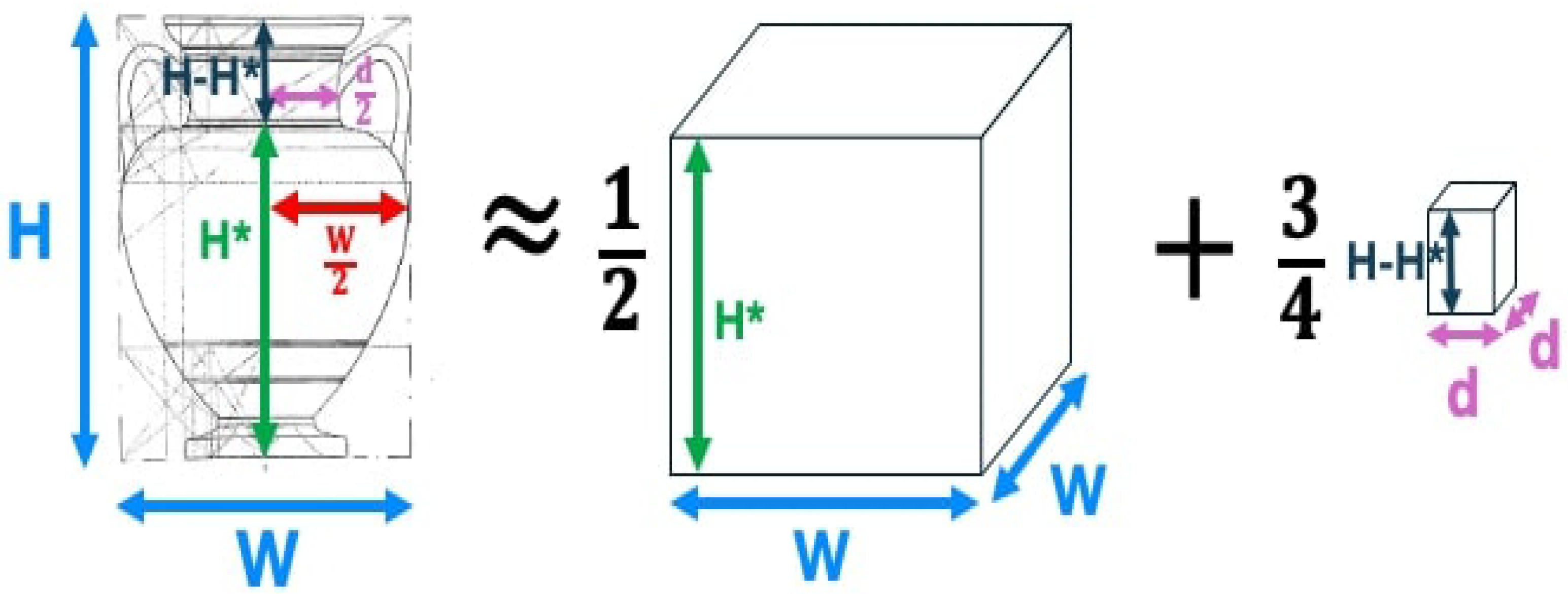
Section 8 presents some approximations and explains them in terms of volumes of simple solids.
Section 9 presents a number of case studies to illustrate the suggested approach, including the detailed computations and comparison with exact values reported for the amphorae at the Getty Museum and with a set of amphorae from the Boston Museum of Fine Arts (MFA). Results and final conclusions are presented in
Section 11.
2. Volume Computation Methods
The problem of computing vessel volume is an ancient one. The volume of a sphere was known to the Ancient Egyptians. The formula for the volume of a cone has been known since the 4th century B.C.E. (by Democritus). The volume of an ellipsoid of revolution was probably suggested by Archimedes (3rd century B.C.E.), and the formulas for spheroid and pithoid were computed by Heron of Alexandria around 100 B.C.E. (for a detailed discussion, see [
45]). As noted in [
45], the geometry of some of these vessels and the meaning of some formulas remain unclear. The computation of the volume of ancient vessels is therefore still relevant and important.
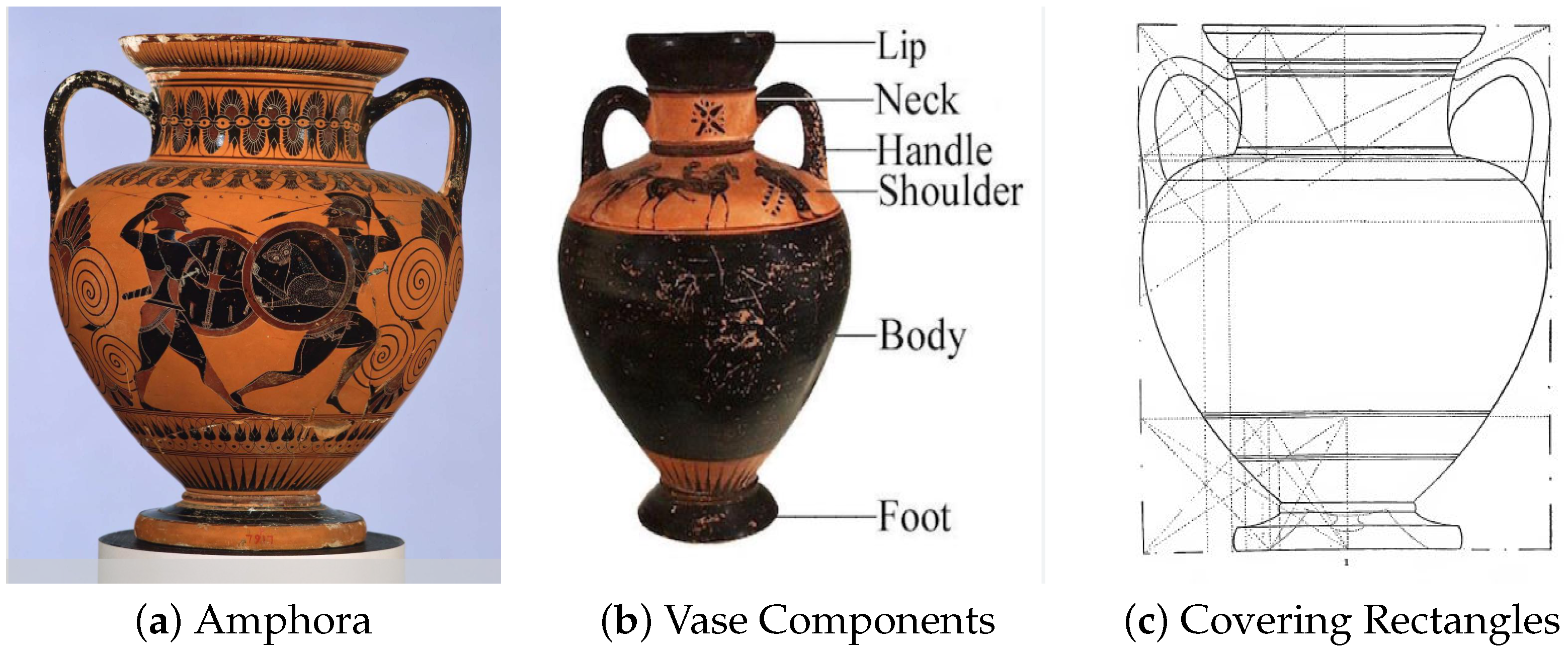
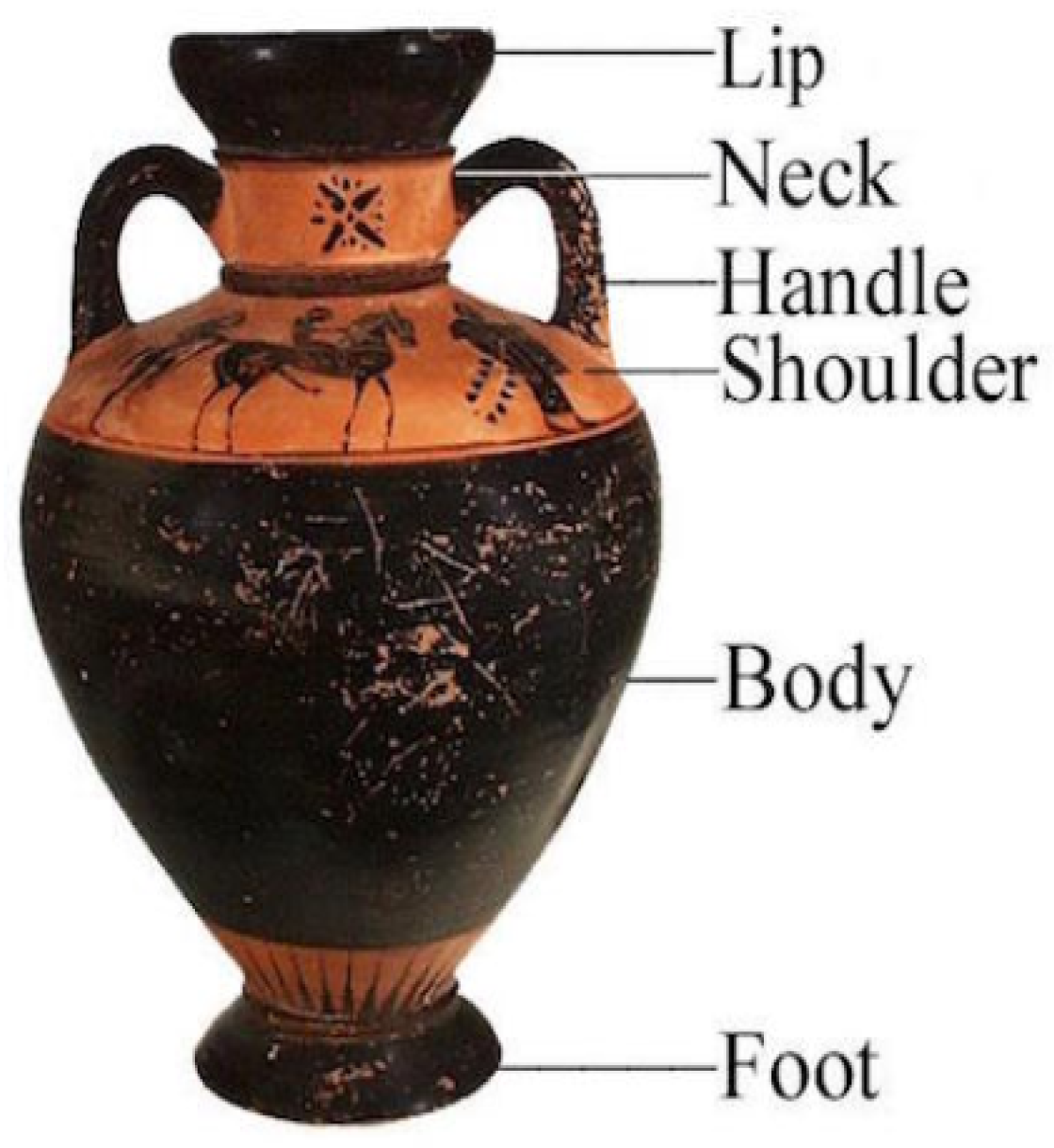
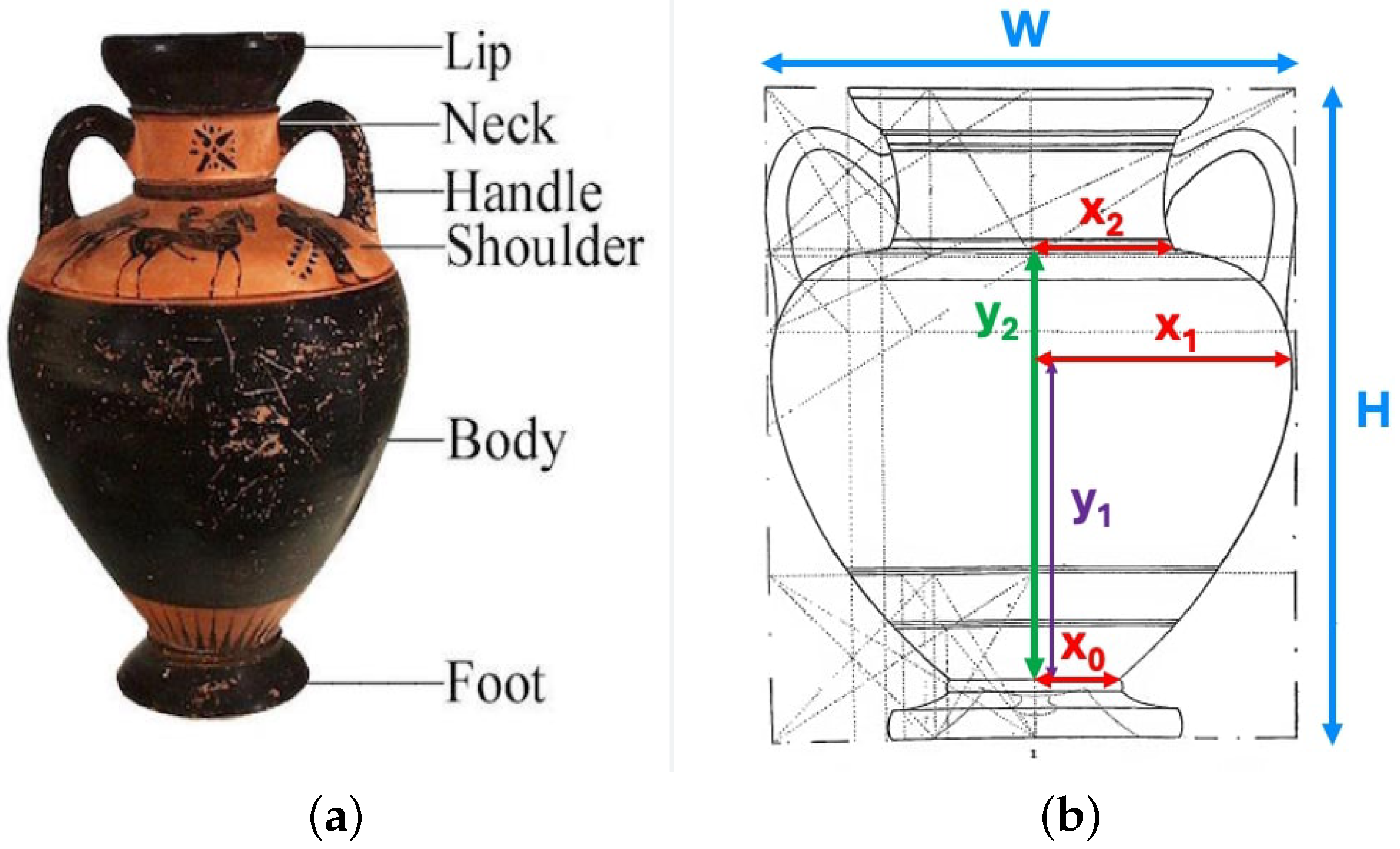
We start our discussion by illustrating the vase components in
Figure 2:
Note that there is no standard definition of the volume or capacity of a ceramic vase. One possibility is the maximum possible capacity when the vase is filled to the top of the lip. Another is the so-called “effective” volume of a vessel [
47] where the container is considered full. For the purpose of this paper, the effective capacity is the capacity to the shoulder. One can consider the following volume estimation methods [
48]:
Fluid volume method: Measure the volume of the water. This is a simple and straightforward way, but it has some limitations, such as water absorption, fragmented vessels, or fear of damage.
Dry volume method: Measure the volume using some solid material such as lightweight polystyrene packing material.
Density method: Estimate the volume by estimating the difference in weights of a vase filled with filling material, an empty container, and using the density of the filling material to compute the volume.
Using volumes of geometric solids. In this approach, standard geometric shapes to estimate volume are used [
49,
50,
51,
52]. The simplest possibility is the frustum: if
a and
c are the radii of the bottom and the shoulder of the vase, and
H is the height from the bottom to the shoulder, then the volume of the frustum is
If the vase is not circular and can be better described by an ellipse with bottom radii
a and
b and shoulder radii
c and
d, then the volume of such an elliptical frustum becomes
- 5.
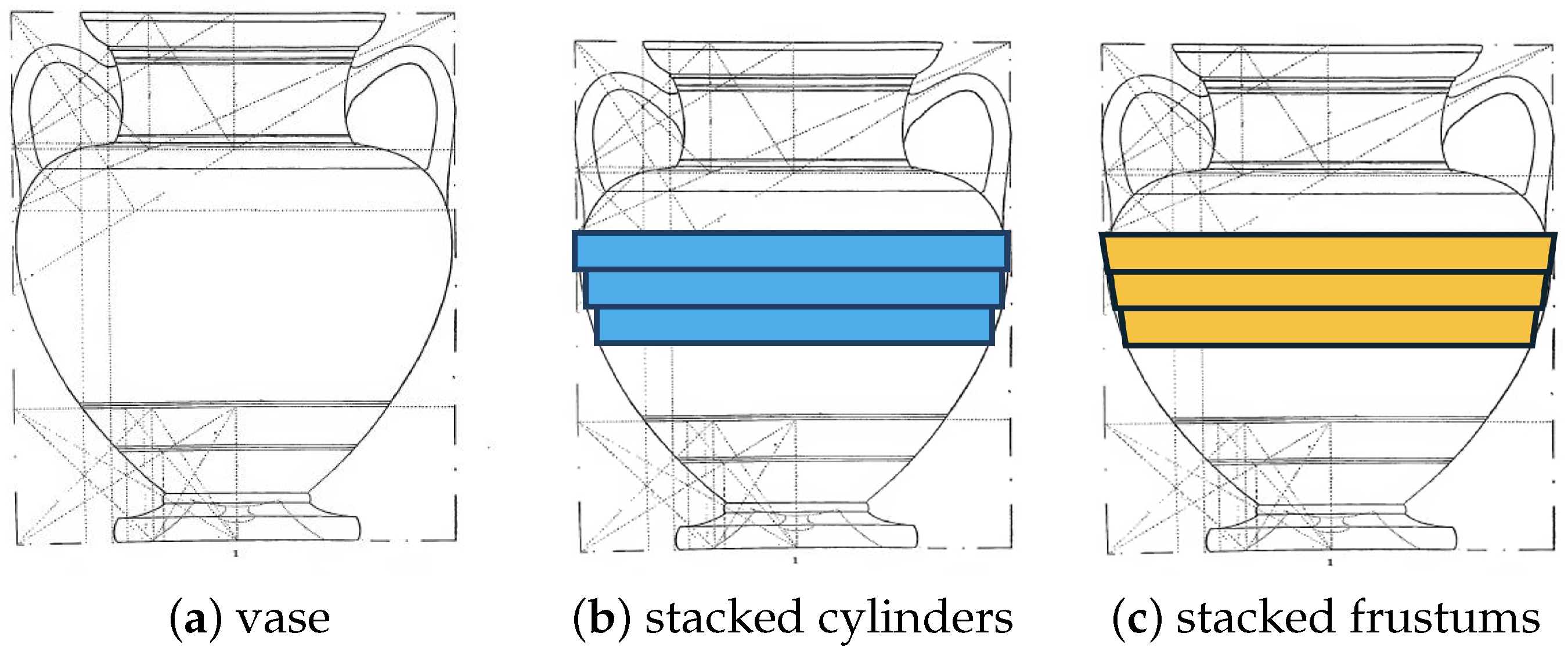
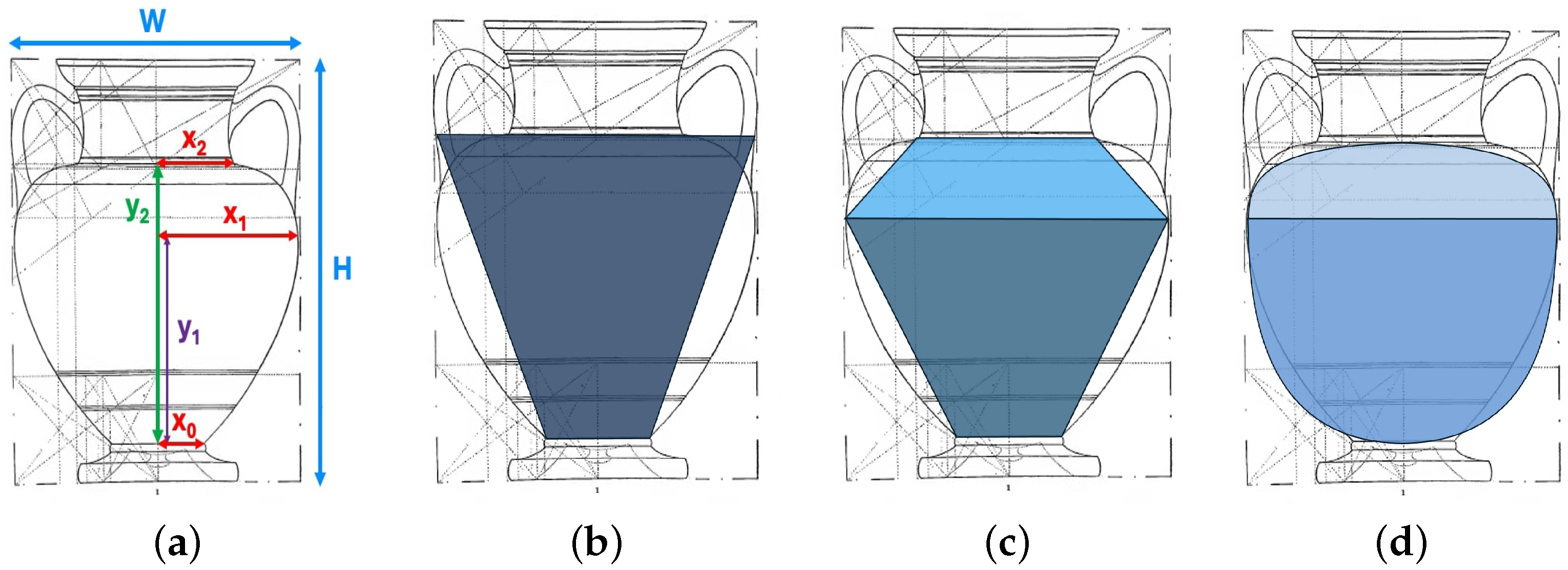
Stacked-cylinders method: In this method, one computes the volume as a sum of stacked cylinders. The height is divided into n cylinders with radii and heights . The total volume is computed as the sum of volumes of these n disks:
This requires computing the radii of the cylinders—these can be estimated from a photograph without the physical presence of a vase [
53]. Note that this method assumes the circular form of the vase. Unless one takes a very large number of cylinders, this method significantly underestimates the vase volume [
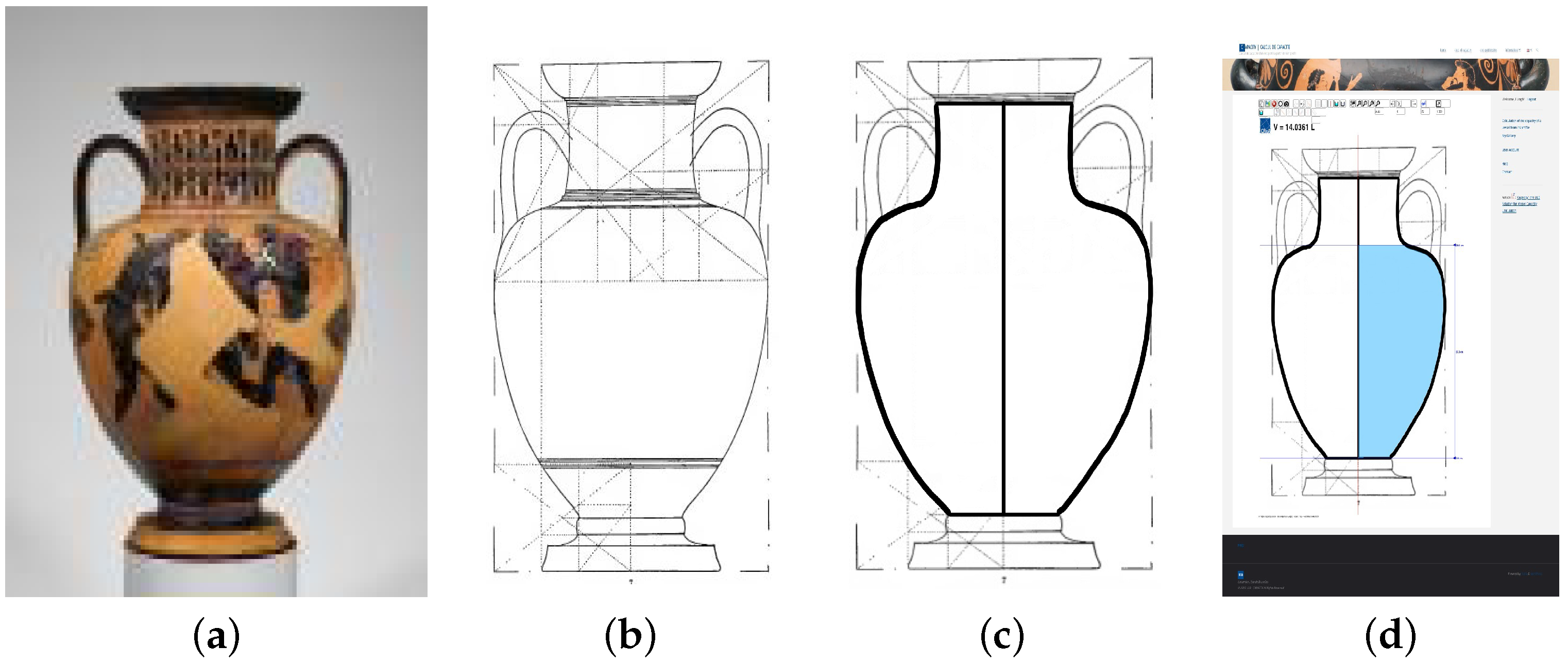
25]. This issue can be resolved programmatically, and several solutions are available. For example, a computer program developed at Université Libre de Bruxelles (
https://capacity.ulb.be/index.php/en/—last accessed on 15 October 2025) allows one to upload the profile picture and specify the height of the vase. The application estimates the volume by adding small cylinders to give very accurate estimates of the volume. This program is used to compare our results.
- 6.
Stacked frustums (bi = level cylinders): In this method height
H is divided into
n slices. Each slice
i is a frustum with bottom radii
and top radius
and heights
. The volume is then the sum of volumes of these
n frustra (see
Figure 3c).
As pointed out in [
23], methods that assume circularity produce less accurate volumetric estimates than approaches that accept that a less regular elliptical shape may be closer to reality. Statistical analysis allows the accuracy of the different methods to be compared and evaluated.
- 7.
Integrating the profile curve around the axis of symmetry: To use this, one needs to know the equation that fits the vessel profile [
54]. In [
55], a polynomial expression is derived for each vessel profile. This could be accurate if these polynomials describe the profile shape accurately. One disadvantage of the methods is that there is no recipe to choose such polynomials. Many profiles cannot be described by low-degree polynomials, such as parabolas, since these profiles do not appear symmetric, leading to possible large errors.
From a mathematical standpoint, if a generic explicit equation for the profiles is known, then volume can be calculated by integrating this equation around the
y axis of symmetry. This provides an explicit closed-form formula for the volume and a universal approach to consider approximations. In this paper, such a universal approach is suggested based on the so-called “dynamic symmetry” of Hambidge [
56]: Analyzing self-similarity in vase design yields a logarithmic spiral equation for the profile. From this formula, a closed-form expression for the vase volume is obtained.
It is interesting to compare standard units for liquid measurements in Ancient Greece and other regions [
30]. This is shown in
Table 1. Note that the units in Ancient Greece relate to each other via simple ratios of 2 and 3 (and their combinations like 4, 6, 12). There are no 5 or 10 factors that are found in other systems like Ancient Rome or Mesopotamia.
Compared to other regions, the system of units in Ancient Greece appears to be much simpler. A similar simplicity in terms of geometric ratios and shapes is observed in the geometry and structure of Greek vases, as suggested by the theory of “dynamic symmetry”.
3. “Dynamic Symmetry” of Jay Hambidge and Greek Vase
Jay Hambidge (1867–1924) was an American artist who formulated the “dynamic symmetry” theory as a geometric basis of artistic design [
56,
57,
58,
59], including Greek vases [
46]. According to Hambidge in his introduction [
58], “
…Symmetry is the rhythm base of design. It is impossible to introduce rhythm into design components without first introducing symmetry…”.
The base of symmetry, according to Hambidge, is squares and rectangles. The symmetry itself can be static or dynamic. If an area is composed of squares (or equilateral triangles), then it has a static symmetry. By contrast, in dynamic symmetry, one uses squares and dynamic rectangles. In the language of modern mathematics, these are self-similar rectangles described in more detail in
Section 5. In dynamic symmetry, these rectangles have ratios of length to height as
(“root-two” rectangles),
(“root-three” rectangles),
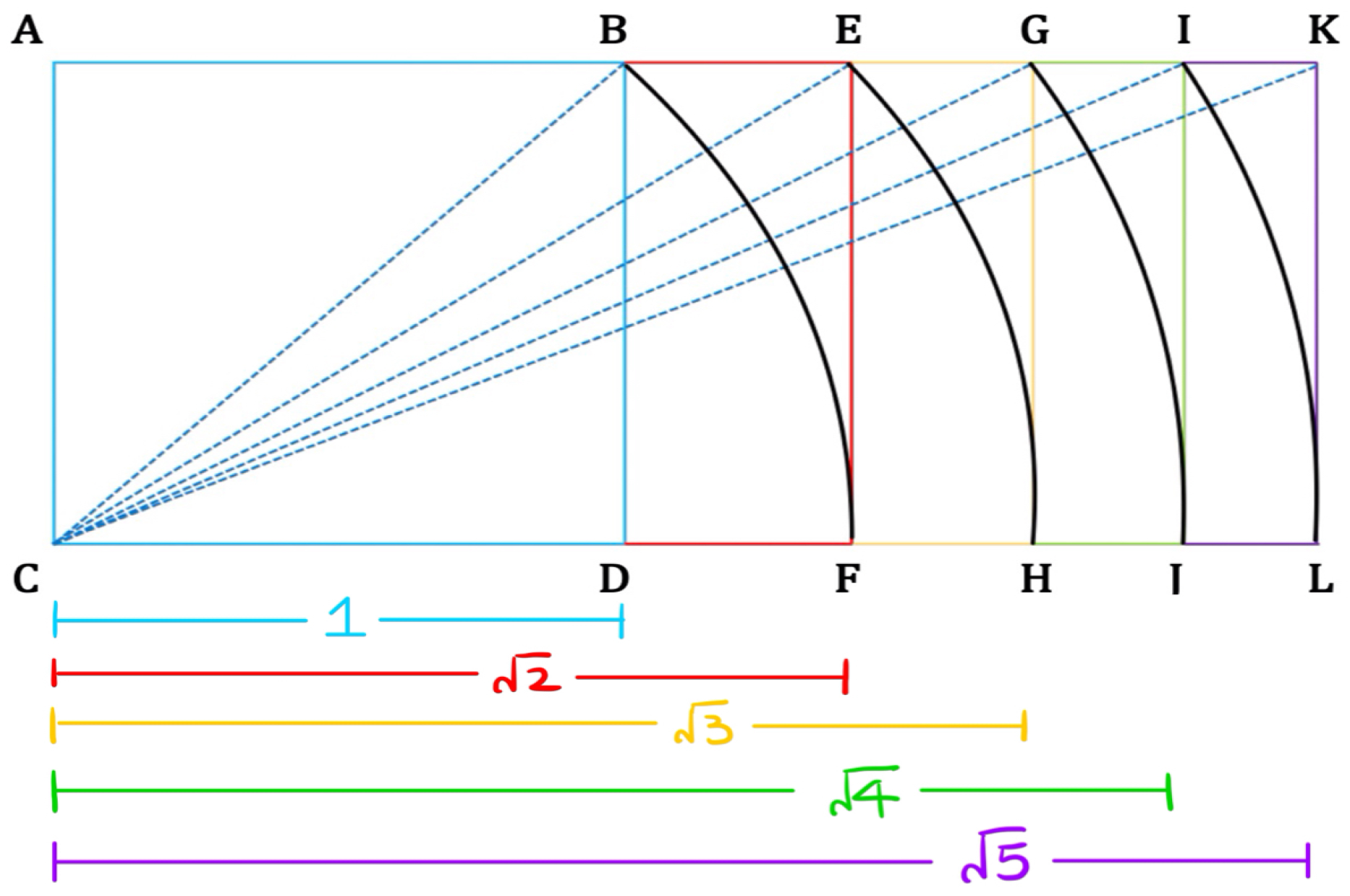
(“root-five” rectangles), and their inverses and variants such as “silver” or “golden” ratio (“whirling square” rectangles). The important feature of these rectangles is that they are “incommensurable”: the ratio of length to width can only be expressed as never-ending fractions. Dynamic symmetry, therefore, is expressed by root rectangles (or their inverses) whose lengths are incommensurable but are measurable in squares. Although square root lengths
,
, and
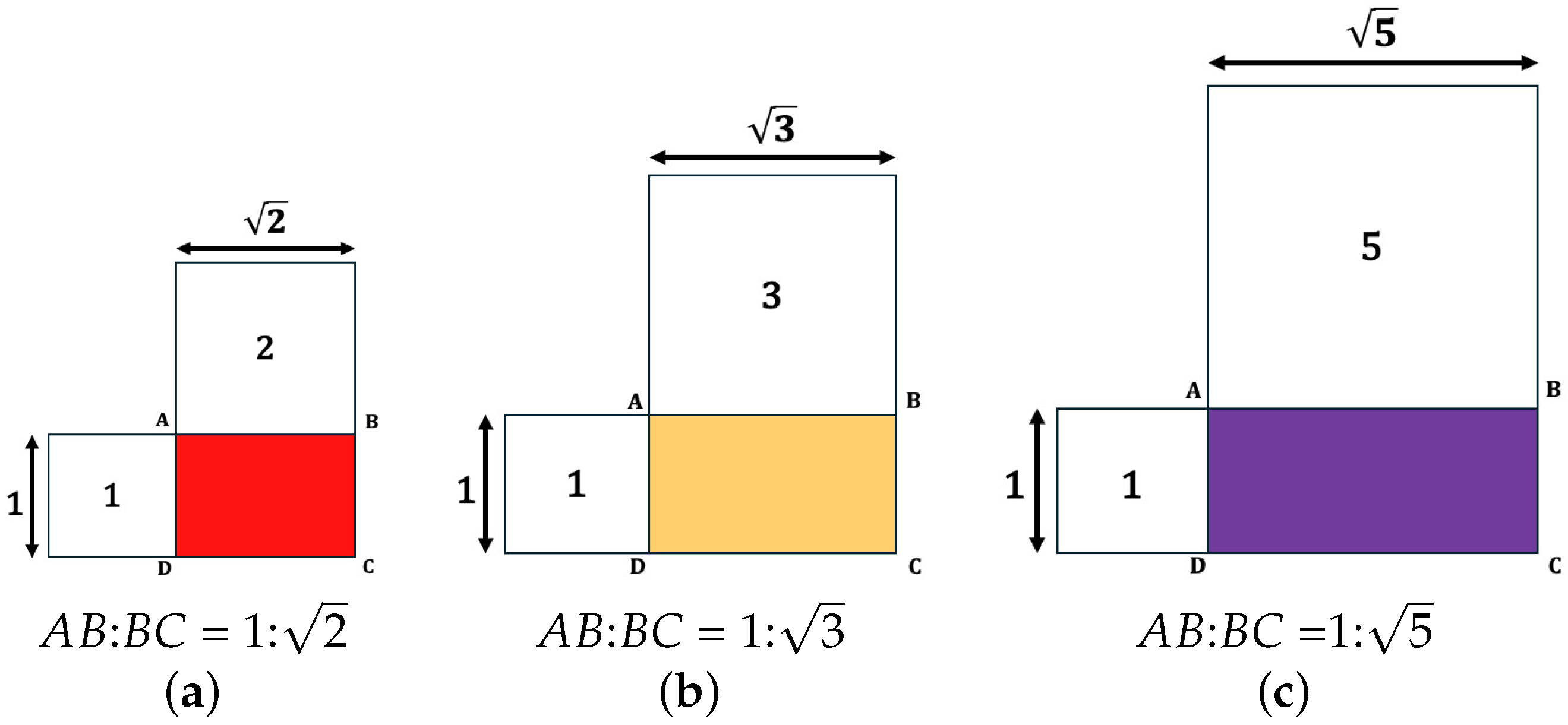
are not commensurable, their construction by using a compass and a straightedge was known in Ancient Greece and is illustrated in
Figure 4.
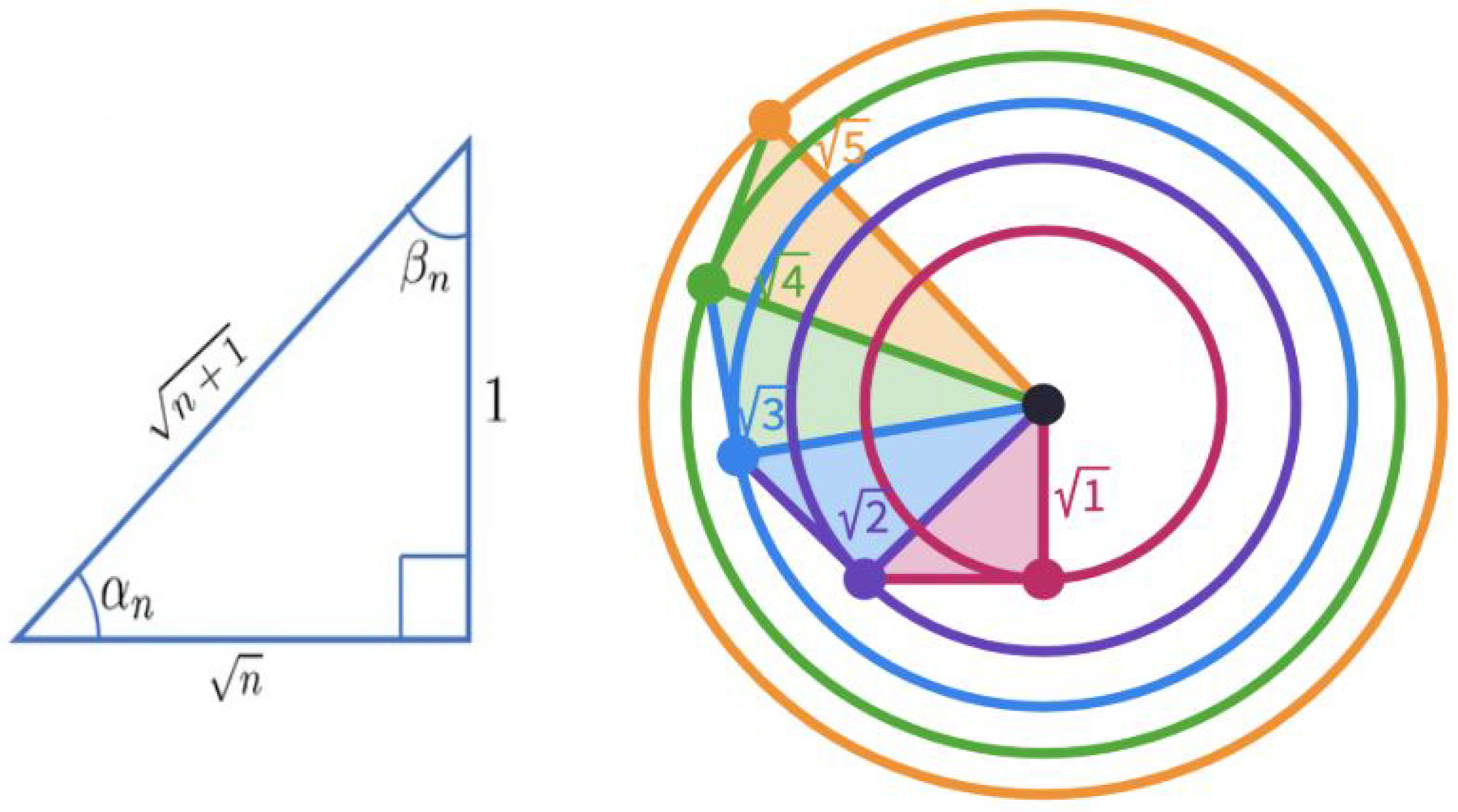
There are other methods of constructing these lengths that were known in ancient Greece, such as the spiral of Theodorus [
29] in
Figure 5.
Once these lengths are constructed, one can construct root rectangles. These rectangles are shown in
Figure 6. Note that dynamic symmetry is built around rectangles, not just the commensurability of areas. An ellipse and a circle with twice the area of an ellipse are not an instance of dynamic symmetry [
61].
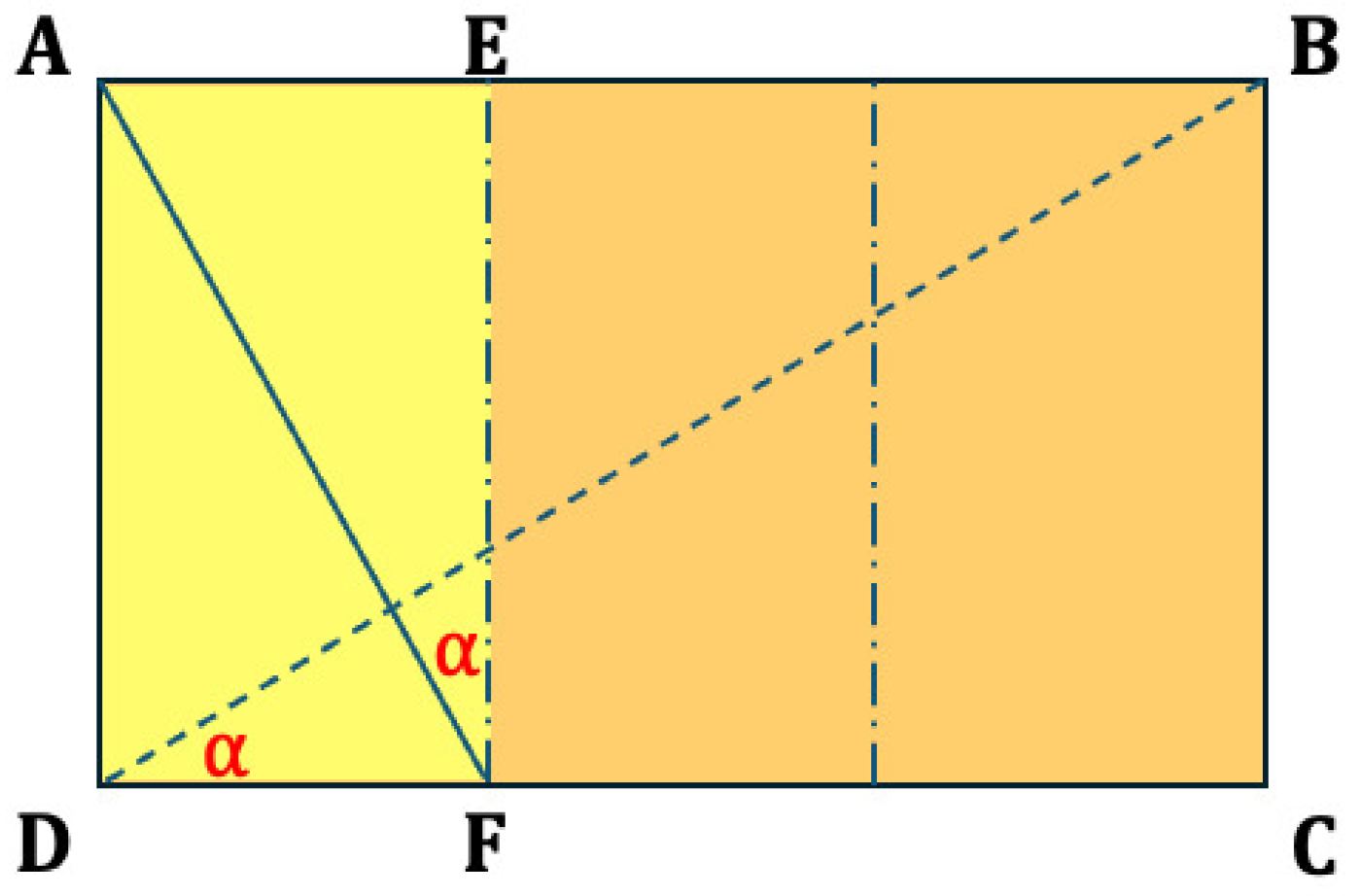
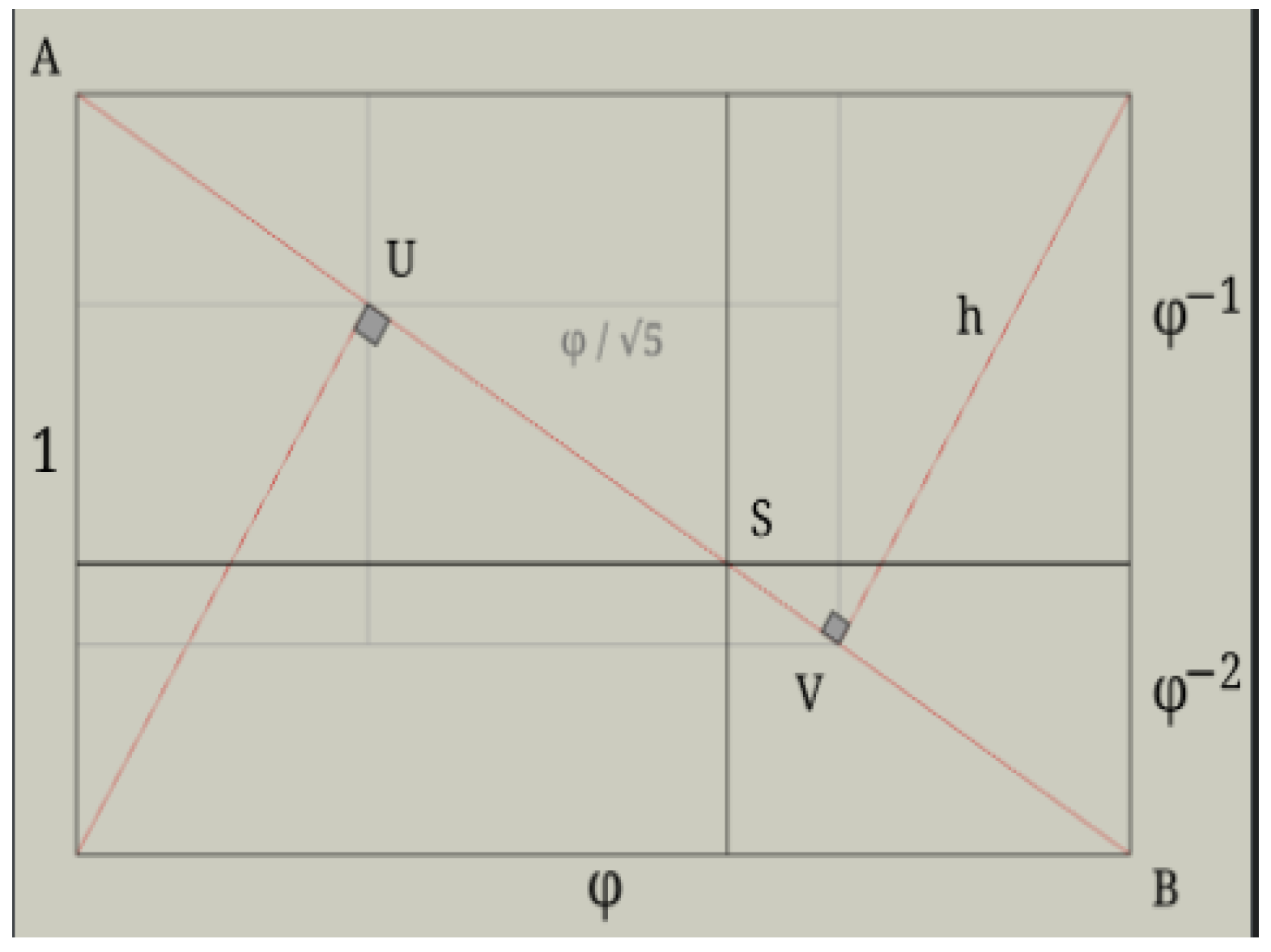
From these root rectangles, reciprocal triangles can be constructed by drawing diagonals and perpendicular lines. The construction of a reciprocal root-three rectangle is shown in
Figure 7.
In this figure, one takes a root-three rectangle
and draws a diagonal
. From vertex
A the segment
is drawn perpendicular to the constructed diagonal
(
Figure 7). It is easy to show that triangles
and
are similar to each other giving
:
=
:
or
:1 = 1:
giving
= 1:
.
The dynamic symmetry of Hambidge is based on the proportion of such root-square rectangles. Many artists have promoted this theory in analyzing art and architecture [
62,
63,
64,
65] (for a survey, see [
66,
67]). In particular, one of Hambidge’s disciples, Lacey Caskey [
68] performed extensive measurements at the Boston Museum of Fine Arts in the 1920s and published detailed drawings and measurements of the extensive collection of Ancient Greek vases available at the museum in his book
A Geometry of Greek Vases [
68]. In particular, he found that the same type of vases could be described by rectangles with the same length ratios. These ratios of Greek vases vary according to Caskey’s measurements, but most of them can be categorized into groups such as the golden ratio [
69,
70,
71]. These ratios for vases are summarized in
Table 2.
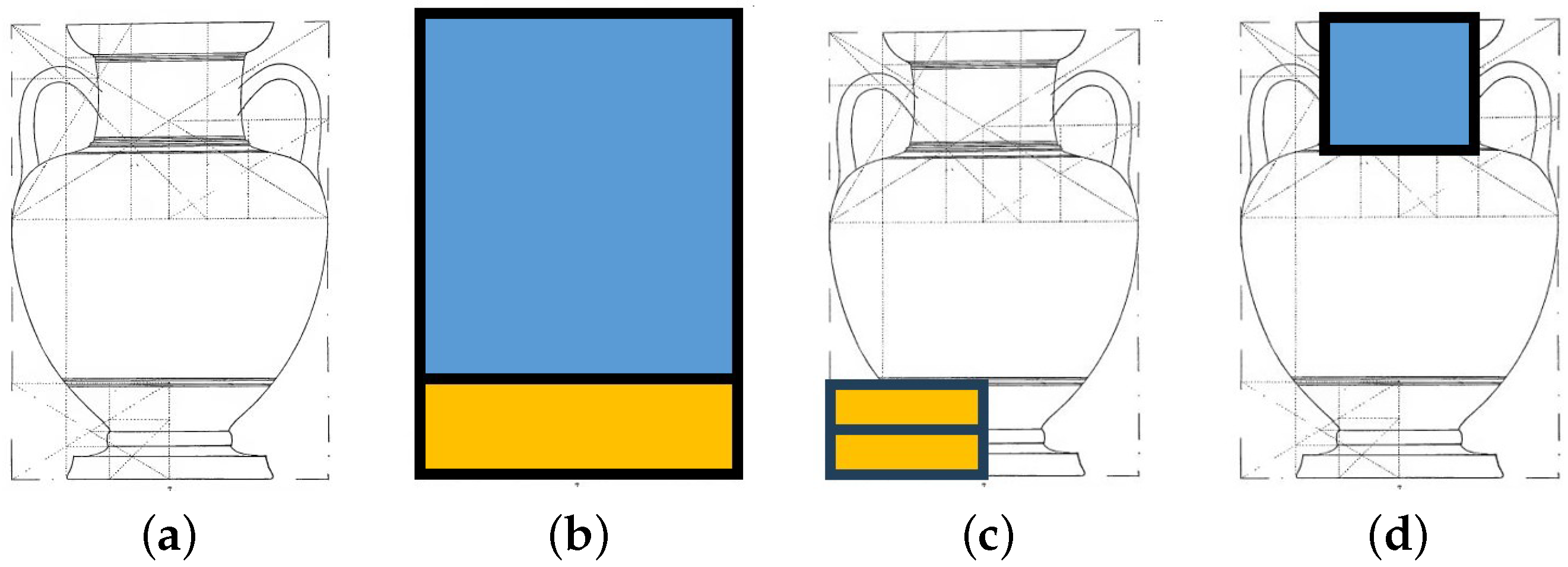
Consider an example of a Greek vase, describing size components, covering rectangles, and Caskey’s measurement computations. To start, consider the very first example in Caskey’s book, neck amphora #1, page 36–37, depicting two fighting warriors. Details of this vase can be found at
https://collections.mfa.org/objects/153414 (last accessed 15 October 2025).
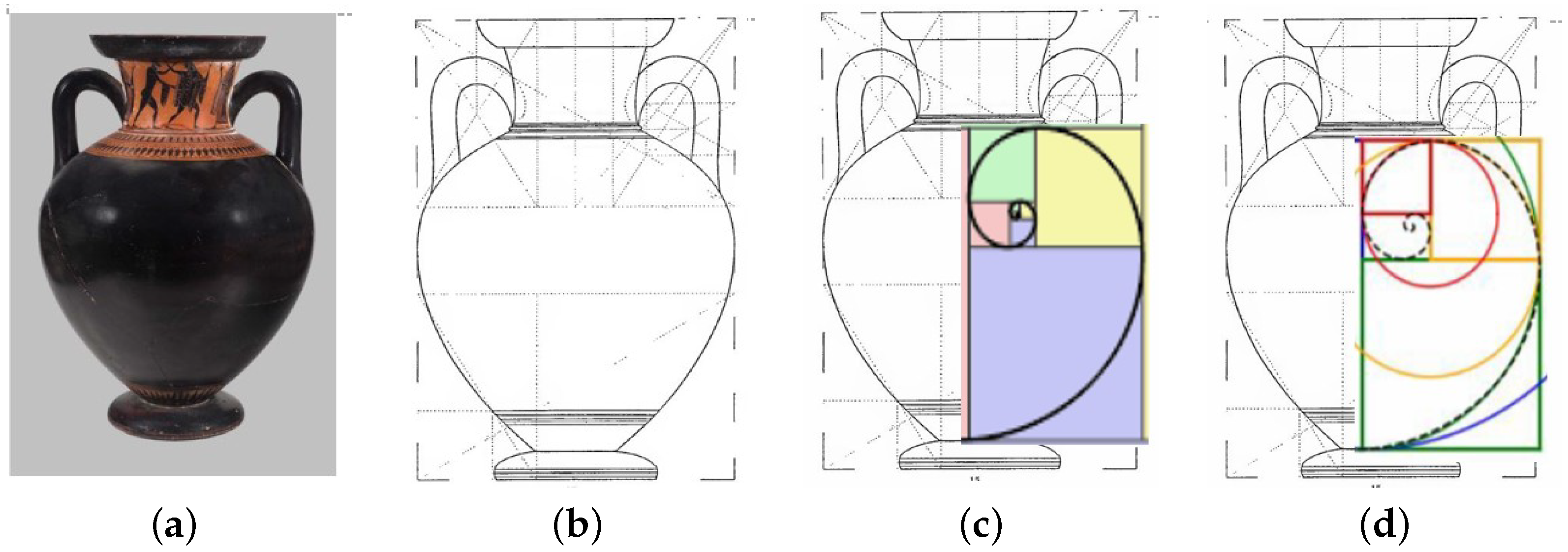
This vase is illustrated in
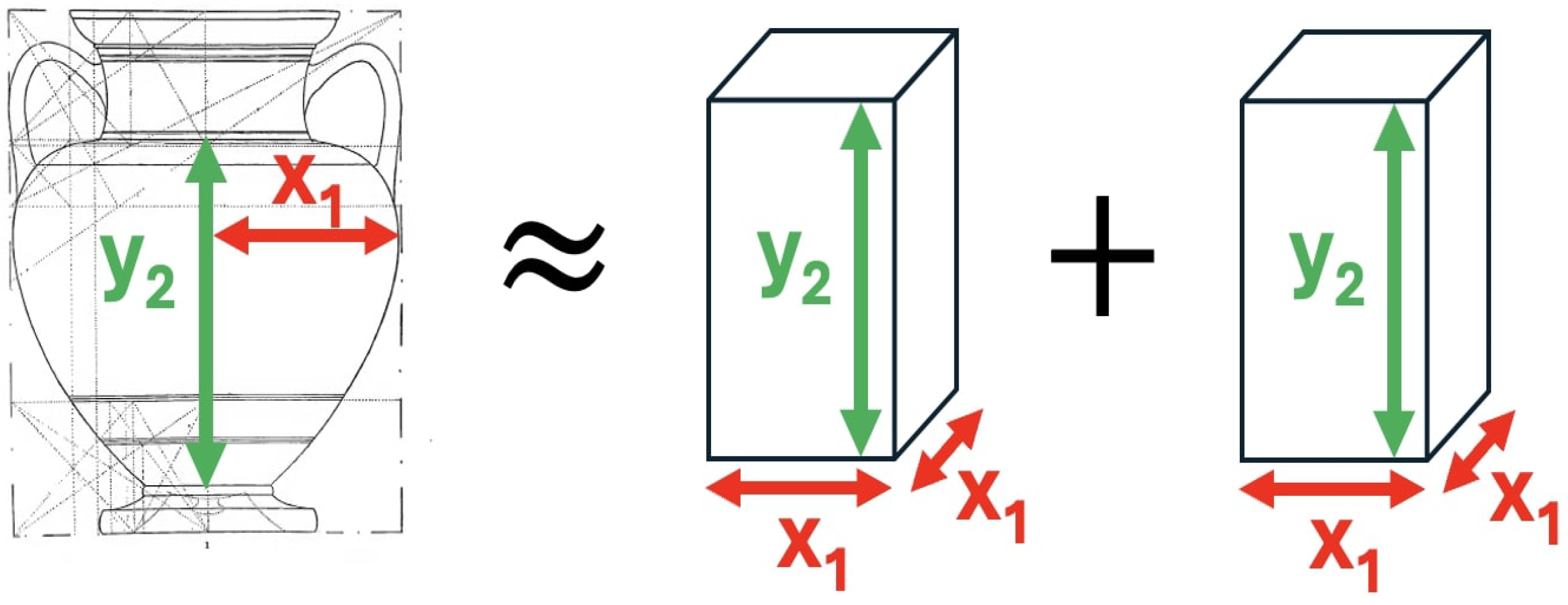
Figure 8. The generic measures for vases are shown in
Figure 8a.
Figure 8b shows the vase itself, whereas the covering rectangles for this vase are shown in
Figure 8c.
For this vase, the height is
cm. Its width, handle to handle, is
cm. The diameter of the bowl is
cm. The diameter of the lip is
cm. Finally, the diameter of the foot is
cm. To compute the covering rectangles, Caskey “normalizes” the width of the vase as 1 and looks for ratios from detailed measurements for vases. For this particular example, Caskey’s “normalized” values for the above vase are summarized in
Table 3.
In the above example, Caskey shows that covering rectangles are based on .
This self-similarity of rectangles naturally leads to the notion of a logarithmic spiral. The logarithmic spiral (“spira mirabilis”, Latin for “miraculous spiral”) is a classical model for natural patterns and has been widely studied since the 17th century [
72] and is used in the study of biological structures and artistic design.
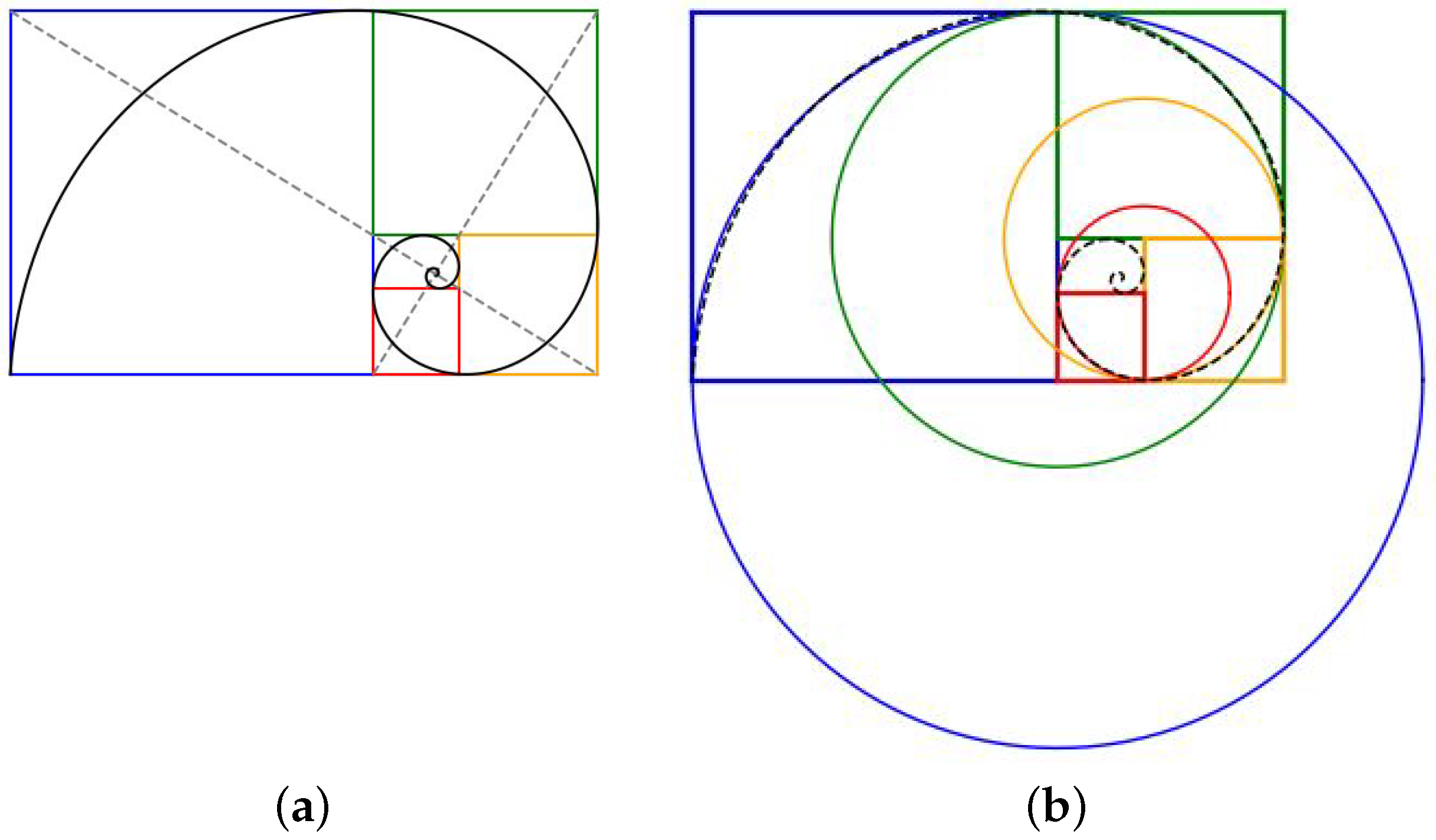
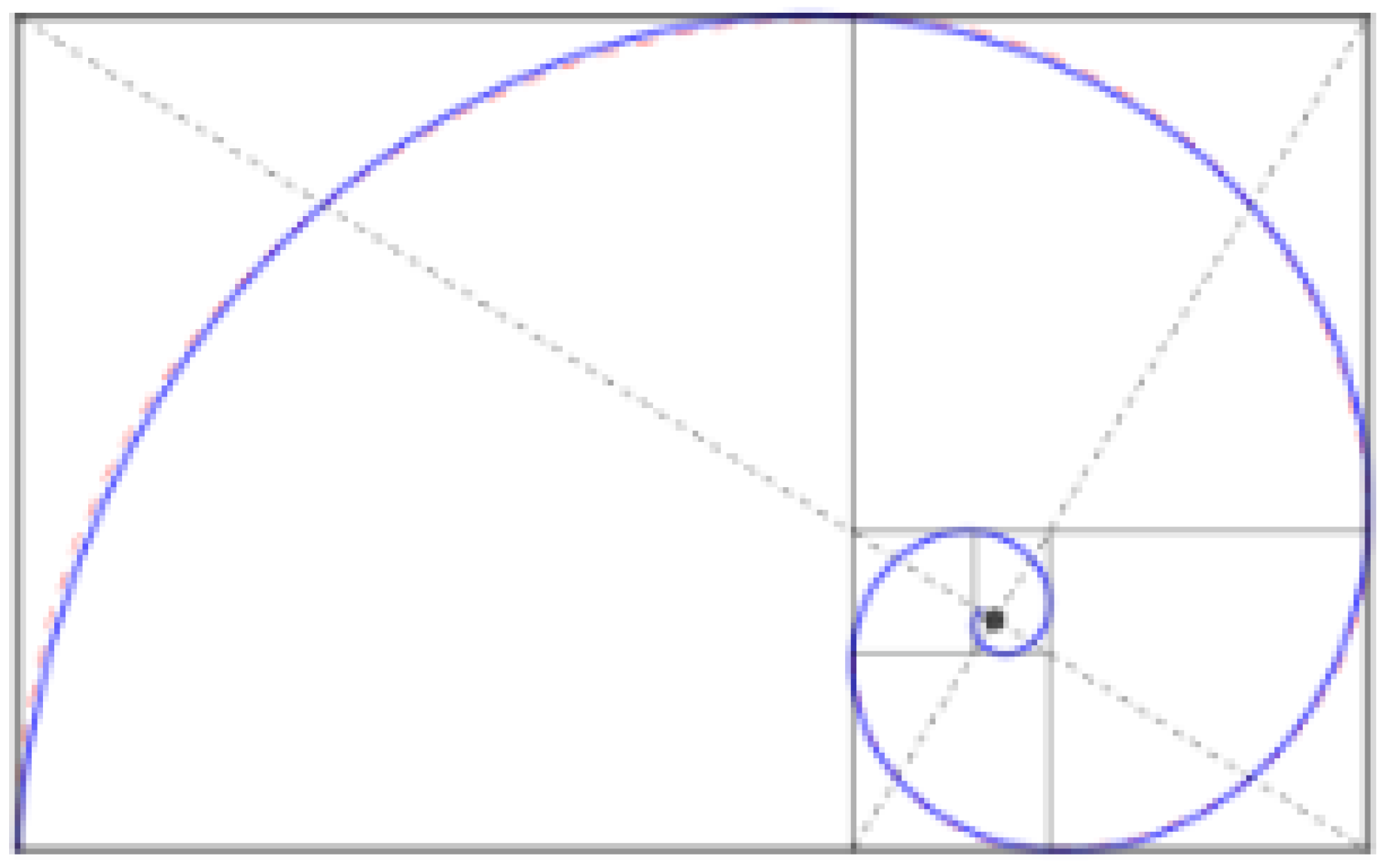
For example, if one takes rectangles with a 2:1 ratio of width to length and cuts out the largest square, what is left over is another smaller rectangle. Notice that this leftover rectangle has the same 2:1 proportion as the original. That means one repeats the same process over and over again. Each time, one removes a square, leaving a smaller, similar rectangle. Now, if one draws a smooth quarter-circle inside each square, the arcs link together seamlessly. As one keeps repeating the above procedure, the arcs “spiral” inward. The resulting shape is a logarithmic spiral as shown in
Figure 9. For more discussion, see [
73,
74,
75].
Hambidge and his followers, such as Caskey, argue that most vases following the principle of dynamic symmetry can be analyzed by enclosing each one in a rectangle. This rectangle can be composed of several squares and similar smaller rectangles, allowing geometric proportions to explain the shape of the vase. The basic rectangles are the so-called root rectangles described above.
By using diagonals of squares, reciprocal rectangles, and overlaying or subdividing squares on rectangles, these basic forms are generated [
76,
77,
78]. By attaching a square to one side of a rectangle and using it to determine new boundaries or divisions, new ratios can be produced. By continually applying squares, reciprocals, and diagonals, one produces a series of self-similar rectangles and squares in a logarithmic spiral to infinity, which Hambidge called the “whirling square rectangle.” Greek vases can be placed within these rectangles. Sometimes the entire vase, sometimes only the body of the vase; and the ratios of details often correspond to the ratios produced by applying squares, reciprocals, and diagonals to the rectangle. The ratios used in this paper are based on the method of Caskey [
68].
One of the most commonly used is the golden ratio
or its reciprocal
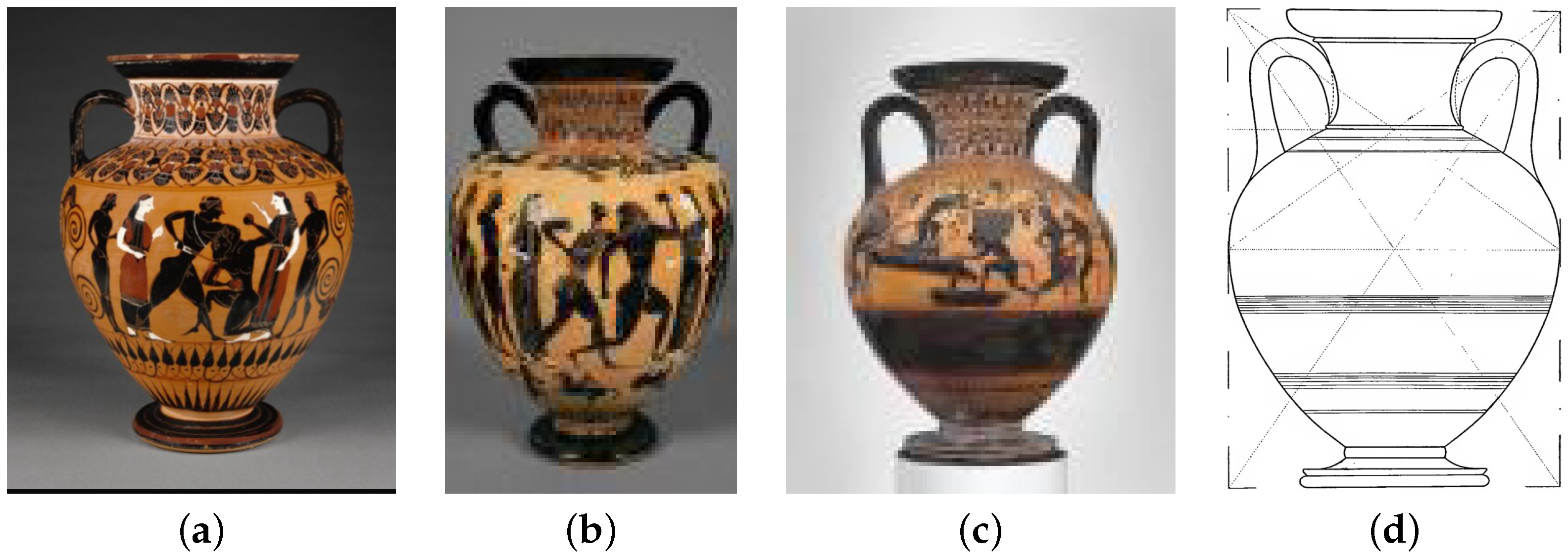
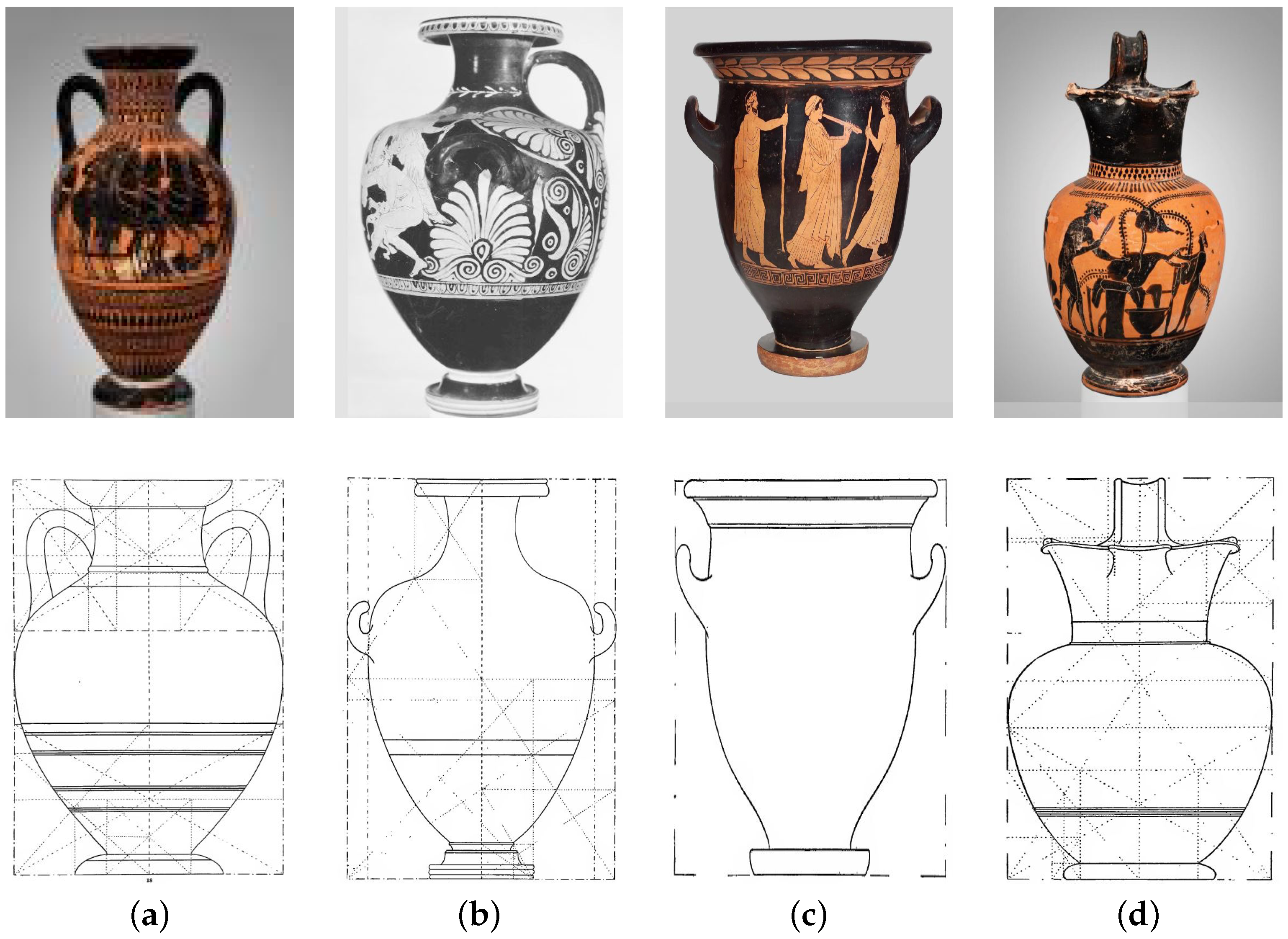
. These ratios are common across all types of vases. Consider the following four “golden-ratio” examples from Caskey [
68]:
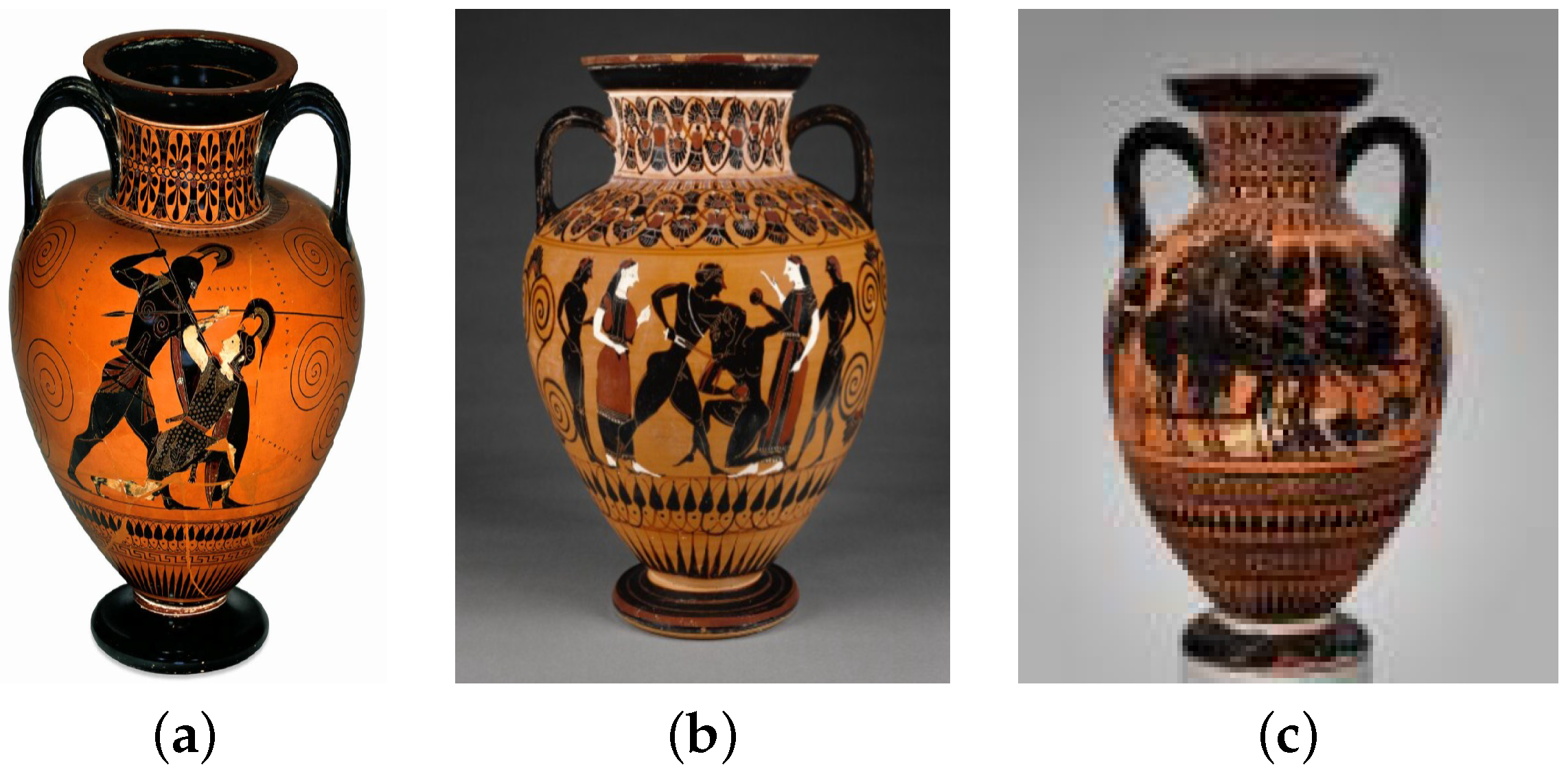
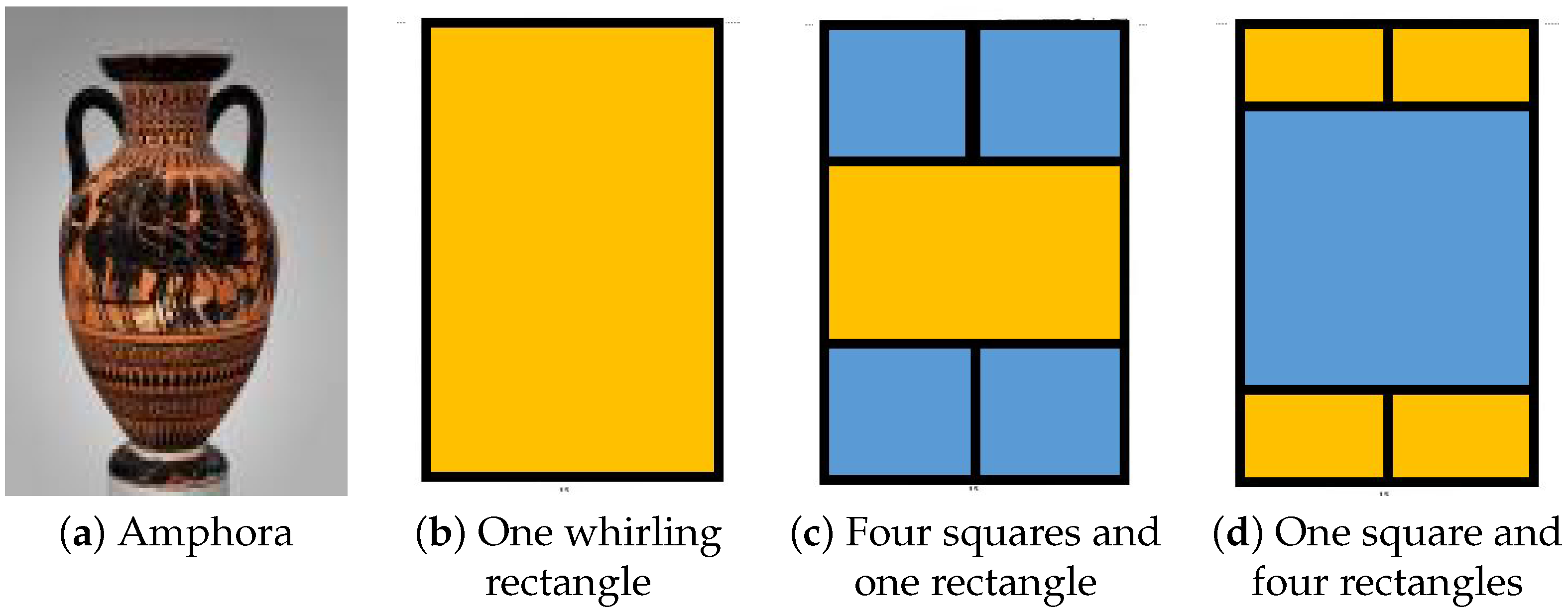
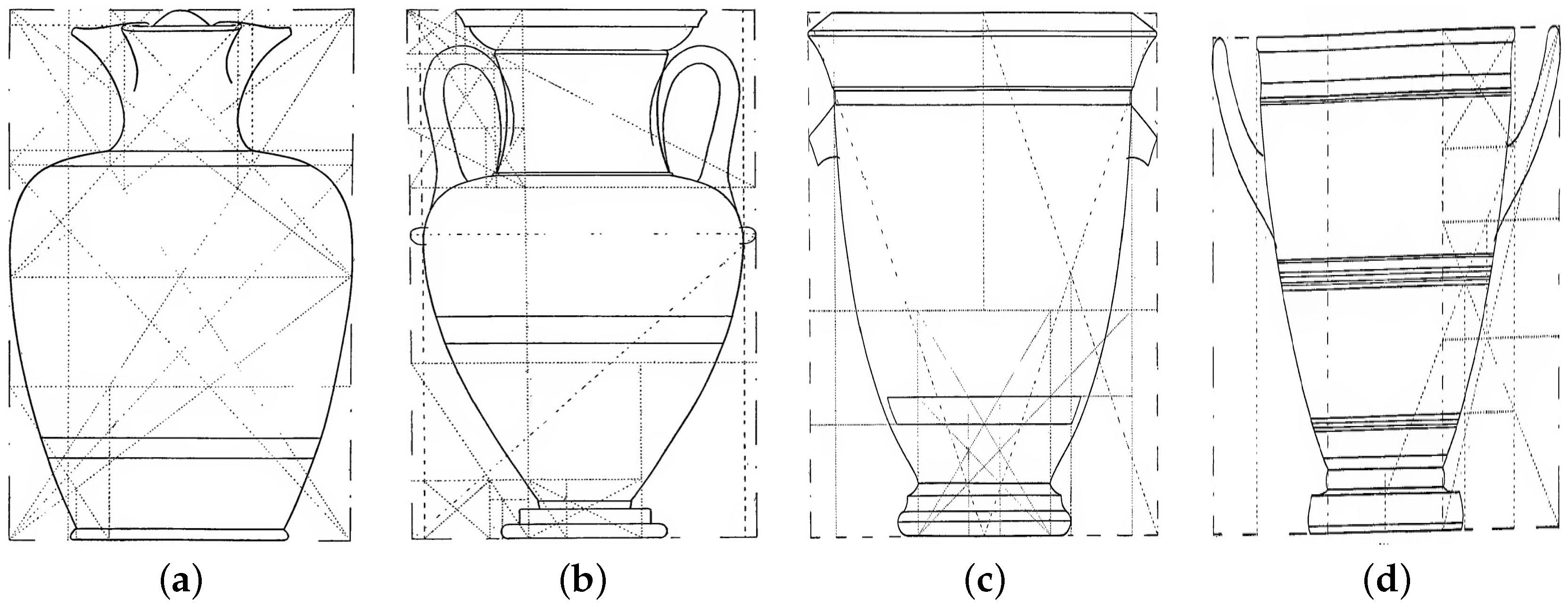
These four vases and the corresponding division into self-similar rectangles and squares are shown in
Figure 10.
For the golden ratio, these vases can be inscribed into squares and rectangles with the same golden ratio or its reciprocal (the so-called “whirling” rectangles). This is illustrated in
Figure 11.
One can recursively continue dividing the obtained “whirling” rectangles into smaller “whirling” rectangles and obtain further decompositions. Note that the example above shows that such decompositions are not unique for the same ratio of the vase’s height to its width.
Based on this similarity between the construction of logarithmic spirals via self-similar rectangles and the self-similarity of Greek vase parts, a conjecture is proposed that Greek vase contours (between the foot and the shoulder) can be described by logarithmic spirals. Using mathematical equations, a simple but effective method is introduced for calculating the volume of Greek vases by using their ratios with certain parameters in a formula based on Caskey’s studies and measurements. In addition, the arc length of Greek vases will be explored and calculated with a specific formula. This paper provides a mathematical approach to understanding the geometric features of Greek vases.
5. Self-Similar Rectangles and Greek Vases
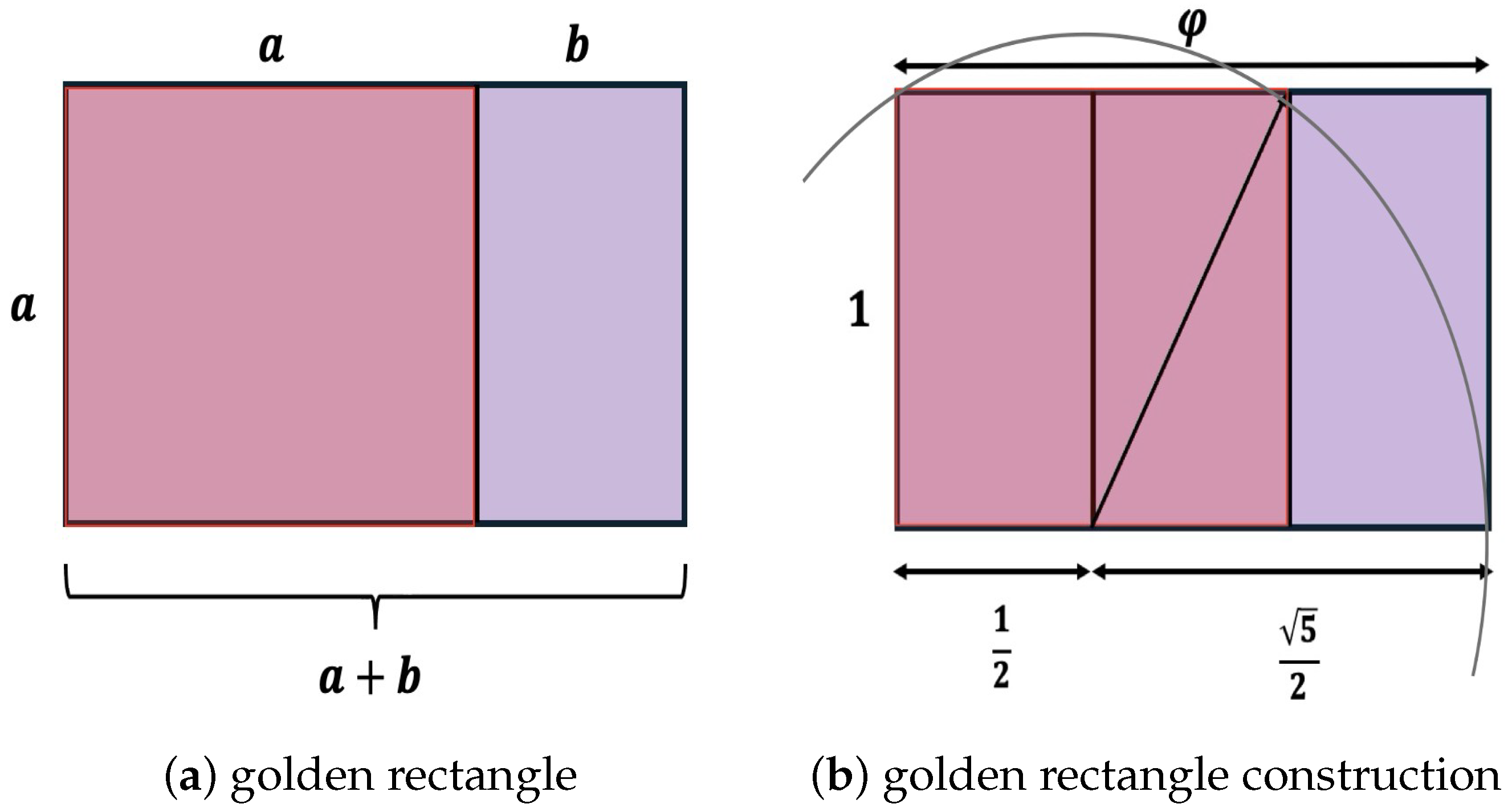
Recall that
a and
b are in the golden ratio
k if their ratio
is the same as the ratio of their sum
to the larger of the two quantities (assume
). In other words,
and this gives the golden ratio
. This is illustrated in
Figure 12.
This can be generalized, and other self-similar rectangles can be considered that satisfy a more general relationship:
Some special cases for
c can be considered:
Caskey took many measurements, and for a vase like in
Table 3, he has many different ratios with
. He struggled to describe the correct self-similarity (fractal) metric since math tools were not available to him. One could make an argument that, in fact, there are only
,
, and
vases and no other types.
One should check the following hypothesis. Assume the height
a is larger than the width. Find
c from Equation (
6) and use this to find the index for the logarithmic curve.
The process of constructing self-similar rectangles is simple: designate the longer side as having unit length. The shorter side is
. If
n such rectangles are taken and joined along their long side, then a new rectangle is obtained with shorter side 1 and longer side
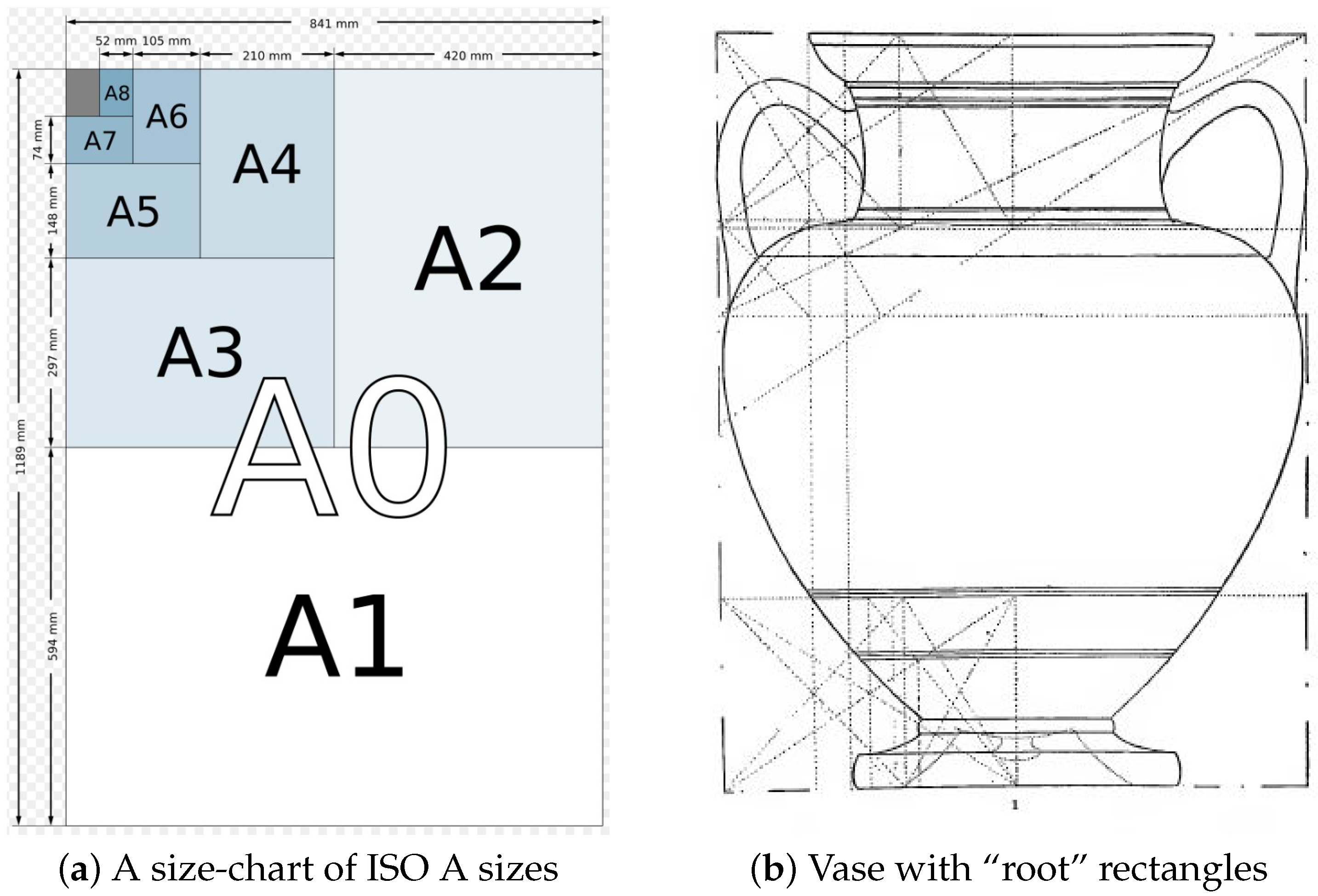
in the same ratio as the original rectangle. For a simple example, consider the A4 ISO 216 standard [
88] ) paper sheets shown in
Figure 13.
A similar observation can be made by examining the Greek vase construction. Caskey refers to these as “root-rectangles” and presents a simple method of constructing them using a square and a compass. There are other methods of constructing these that were known in ancient Greece, such as the spiral of Theodorus. These are illustrated in
Figure 4 and
Figure 5.
The basic principle advocated by dynamic geometry when applied to shapes of Greek vases is what today one calls self-similarity. Each vase is constructed in terms of squares and self-similar rectangles. The self-similar rectangles use primarily
,
, and
rectangles, and the rectangles built around the golden ratio
(or its inverse). These latter rectangles are called “whirling” rectangles [
64].
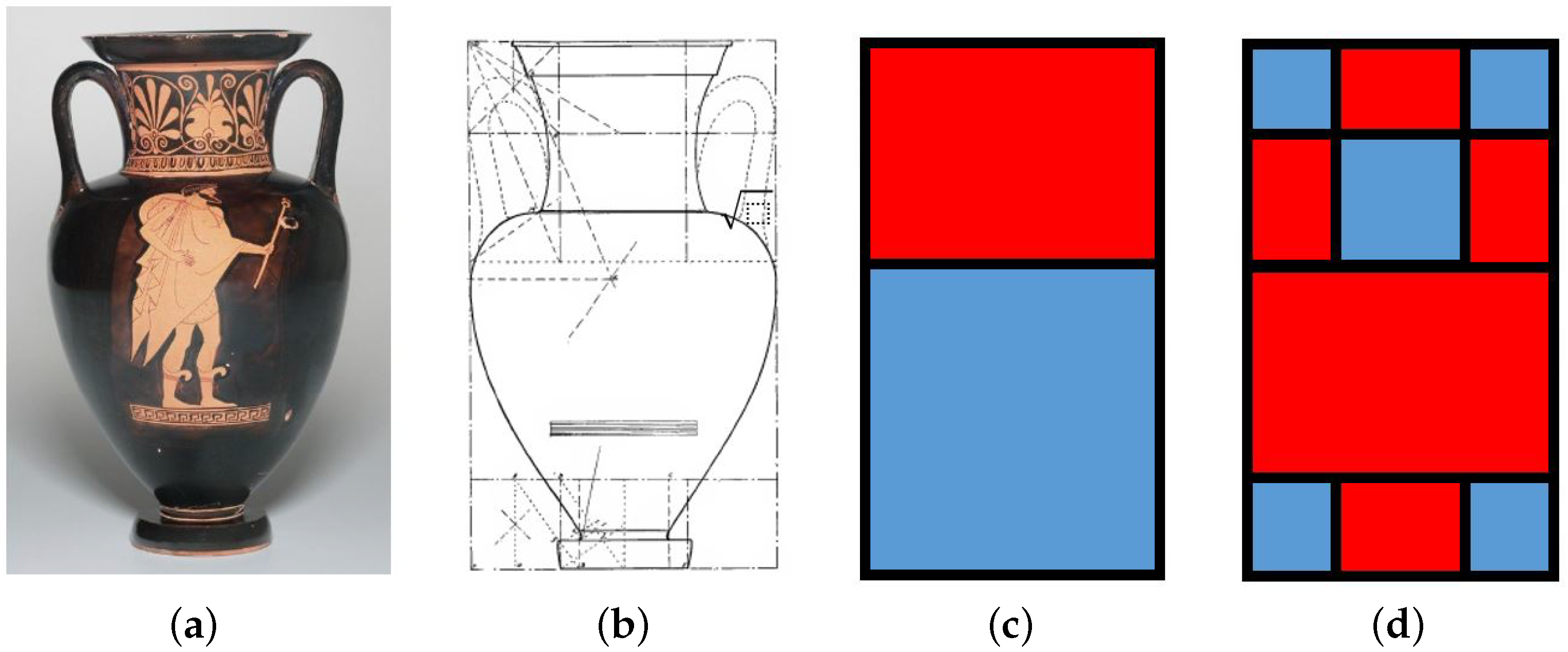
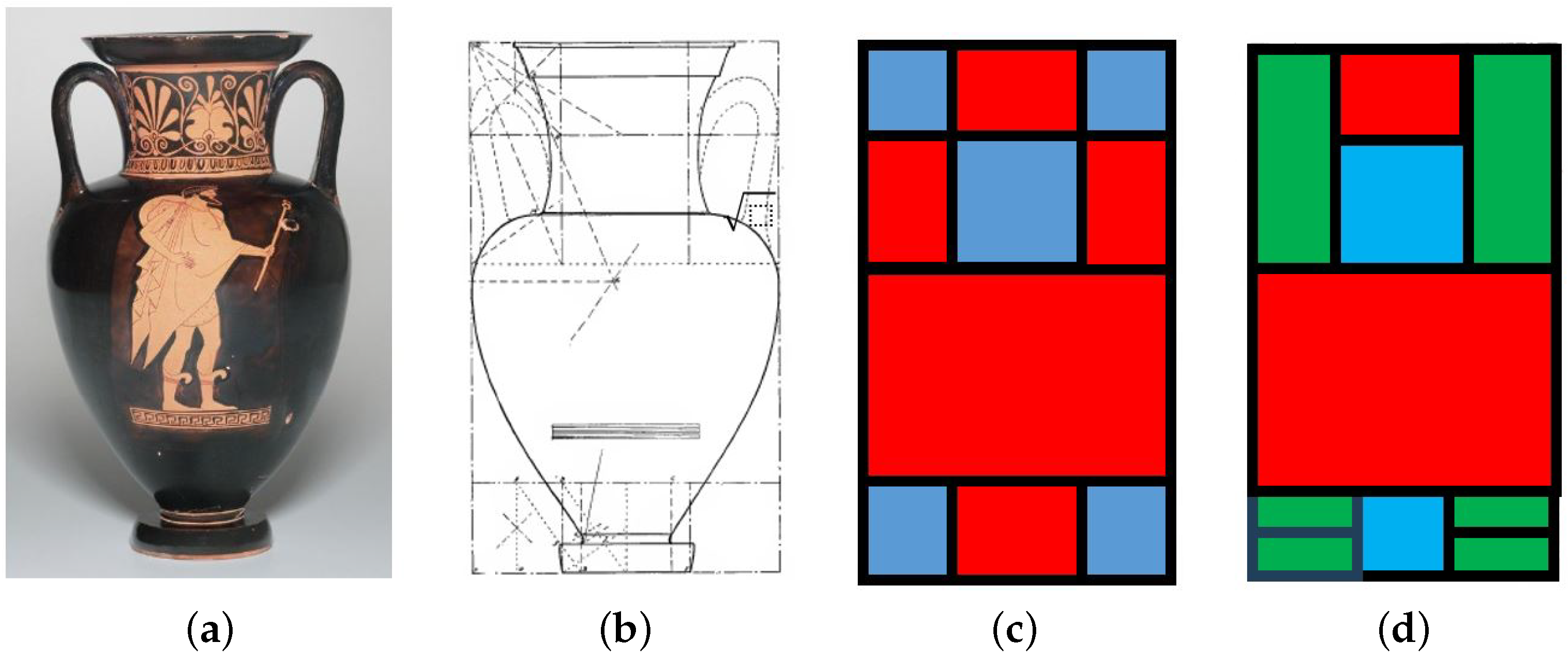
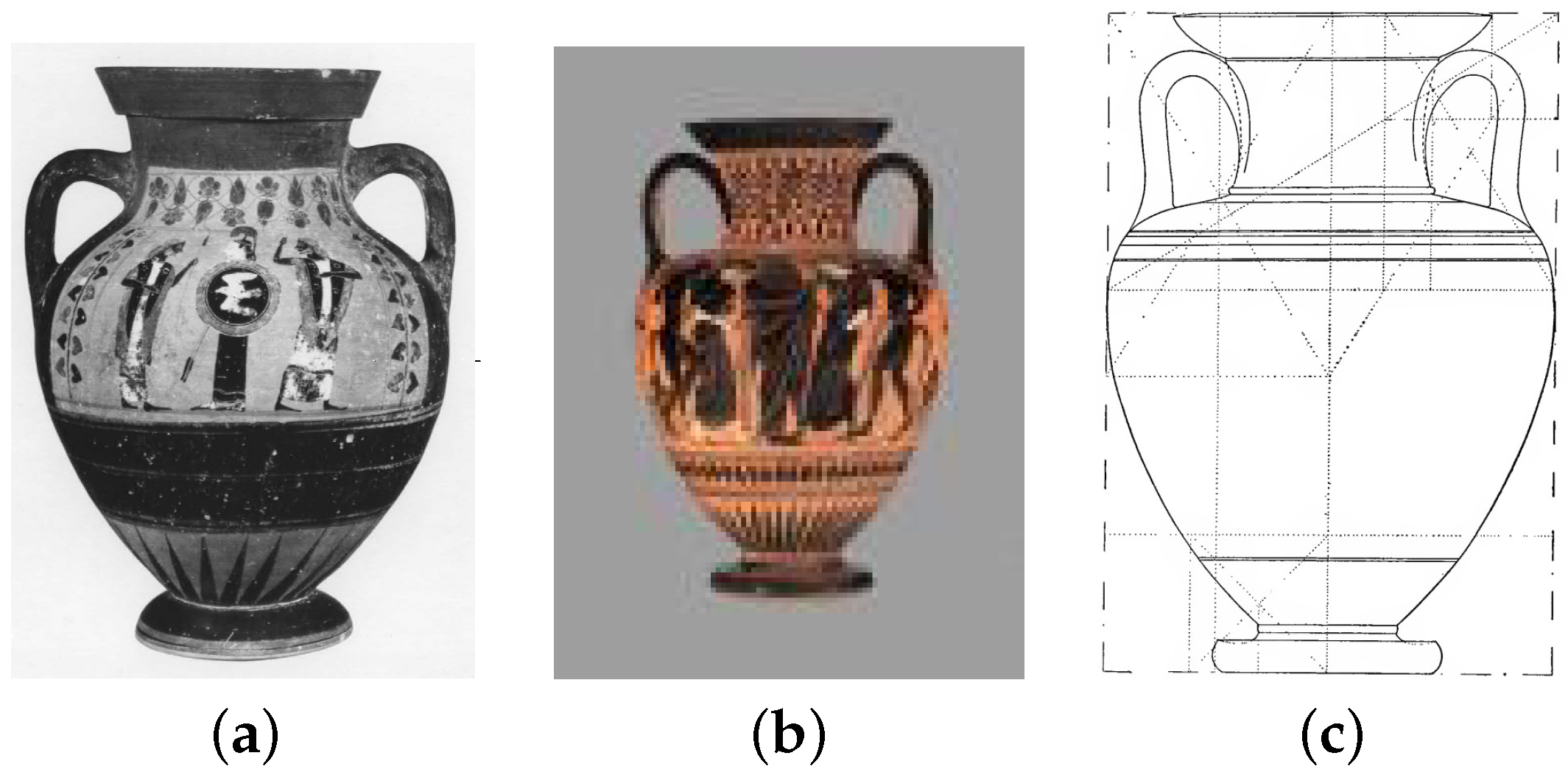
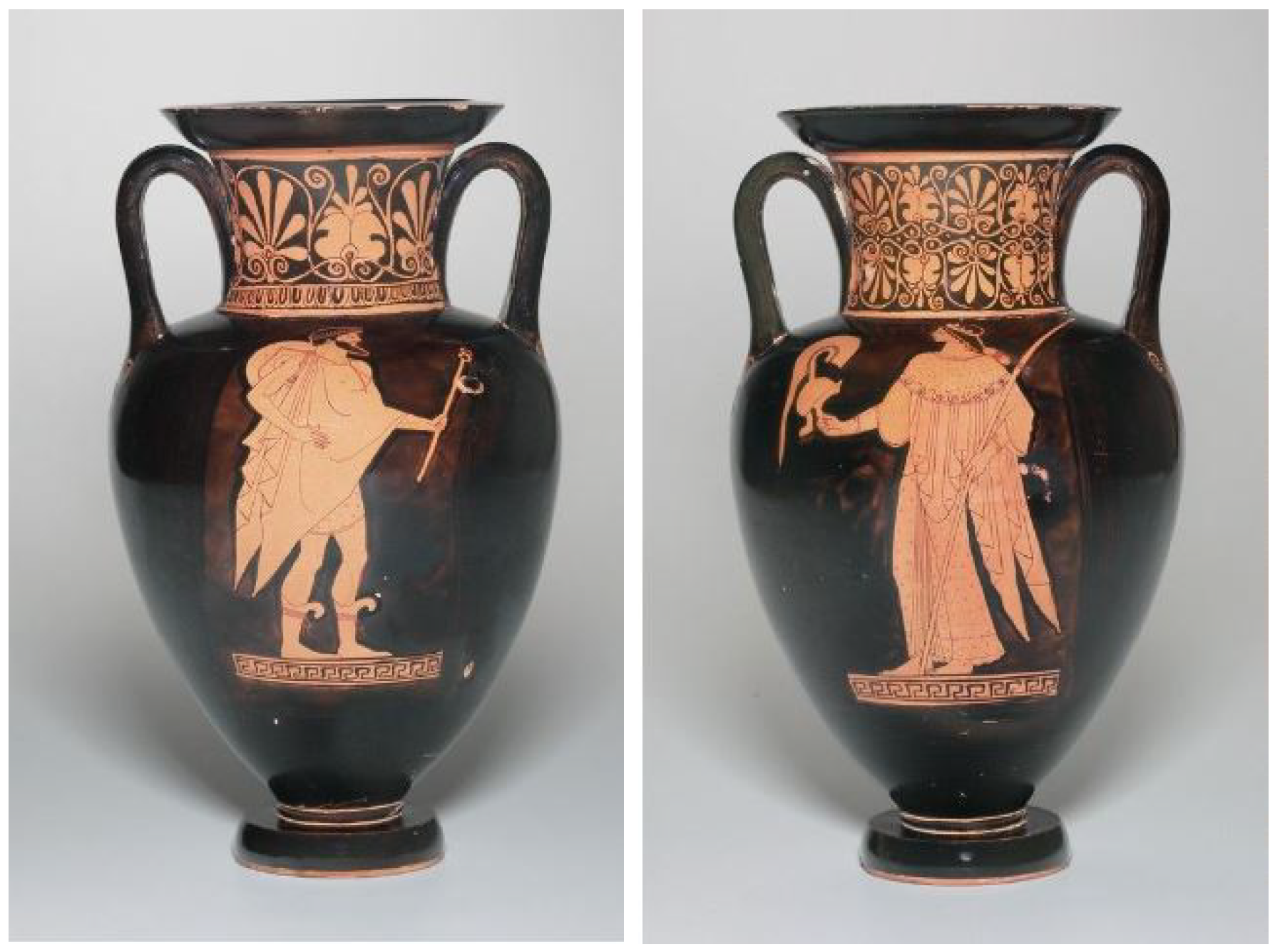
As an example, consider the Nolan Amphora showing Athena and Hermes. This amphora is in the art collection of Yale University and is shown in
Figure 14.
The details are described at
https://artgallery.yale.edu/collections/objects/1726 (last accessed on 15 October 2025). This amphora has dimensions
cm). This gives a ratio of
. This number is approximately
and can be constructed in terms of squares (blue color) and
rectangles (red color). This is shown in
Figure 15. Its dimensions and layout are similar to the Nolan vase described [
68].
As mentioned before, in dynamic symmetry, the most common ratios were
,
, and
and their variants, especially the golden ratio (“whirling” rectangle), are closely related to
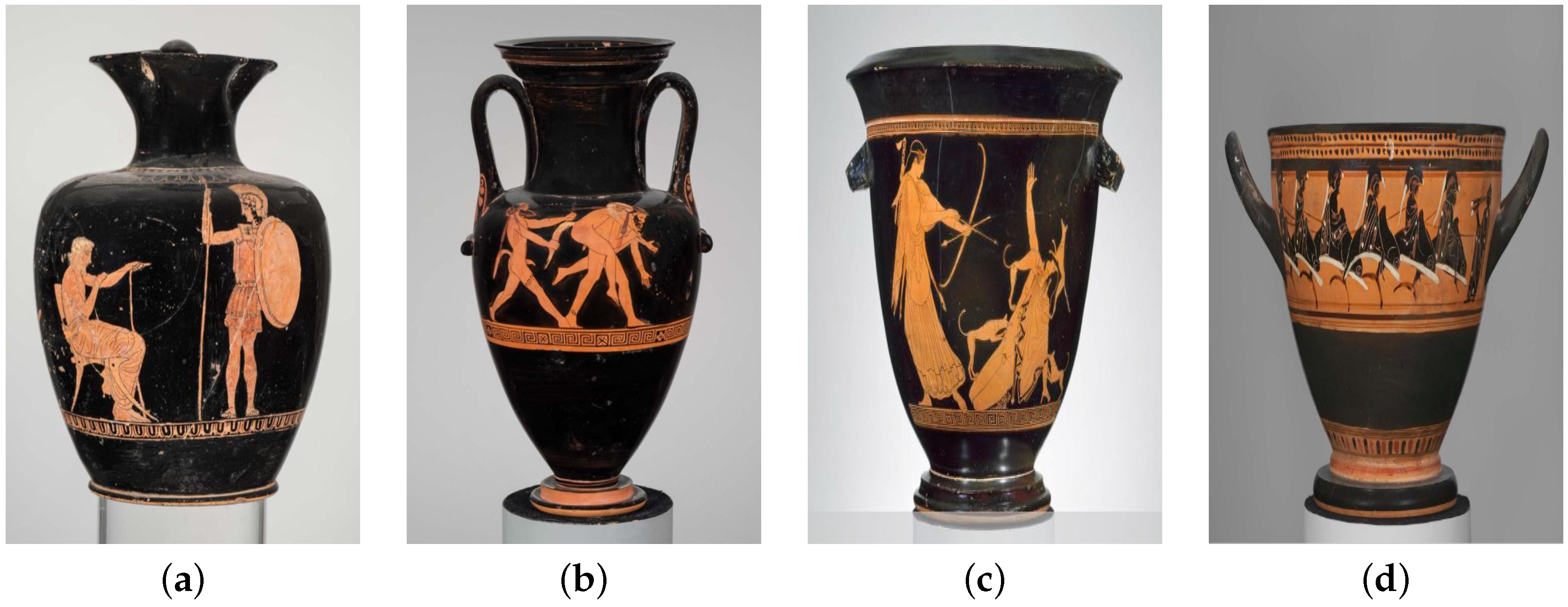
(root-five rectangle). Consider the following four examples with these ratios shown in
Figure 16.
Oinoche #90, page 138: “Old Man and Warrior Departing”, height cm,
Amphora #29, page 65: Satyr carrying a silenos on his back, height , diameter cm,
Bell krater vase #79, page 126: “Artenis Killing Aktaeon”, height cm,
Skyphos #104, page 149: “Chorus Scenes”, height cm, ratio
The above vases are examples of what Hambidge calls “Dynamic Symmetry”. In dynamic symmetry, the basic building blocks are squares and rectangles of certain proportions, namely root-two, root-three, and the root-five rectangles, and the most important of all, the so-called “whirling squares” (golden ratio rectangles). According to Hambidge [
64], such dynamic rectangles represent the idea of growth, harmony, motion, and development.
By contrast, the static symmetry, according to Hambidge, is radial: rectangles in static symmetry have proportions based on squares and equilateral triangles, as well as their corresponding inscribed and escribed circles. Therefore, these circles have radii in proportion 1:2:3:4:…. To quote Hambidge (page 141 in [
46]):
“For example, a Greek design whose greatest width is some even multiple of its greatest length, as 1:2, 1:
, 1:1, 1:
, 1:
etc. is almost sure to have its details expressible in logical subdivisions of the containing shape. Any of the static examples of Greek pottery shapes in this book exemplifies the idea.”
Static symmetry examples with simple fractions and integer values for the ratios are, therefore, possible but are quite rare (with just a few in Caskey’s dataset). The four examples of such ratios are illustrated in
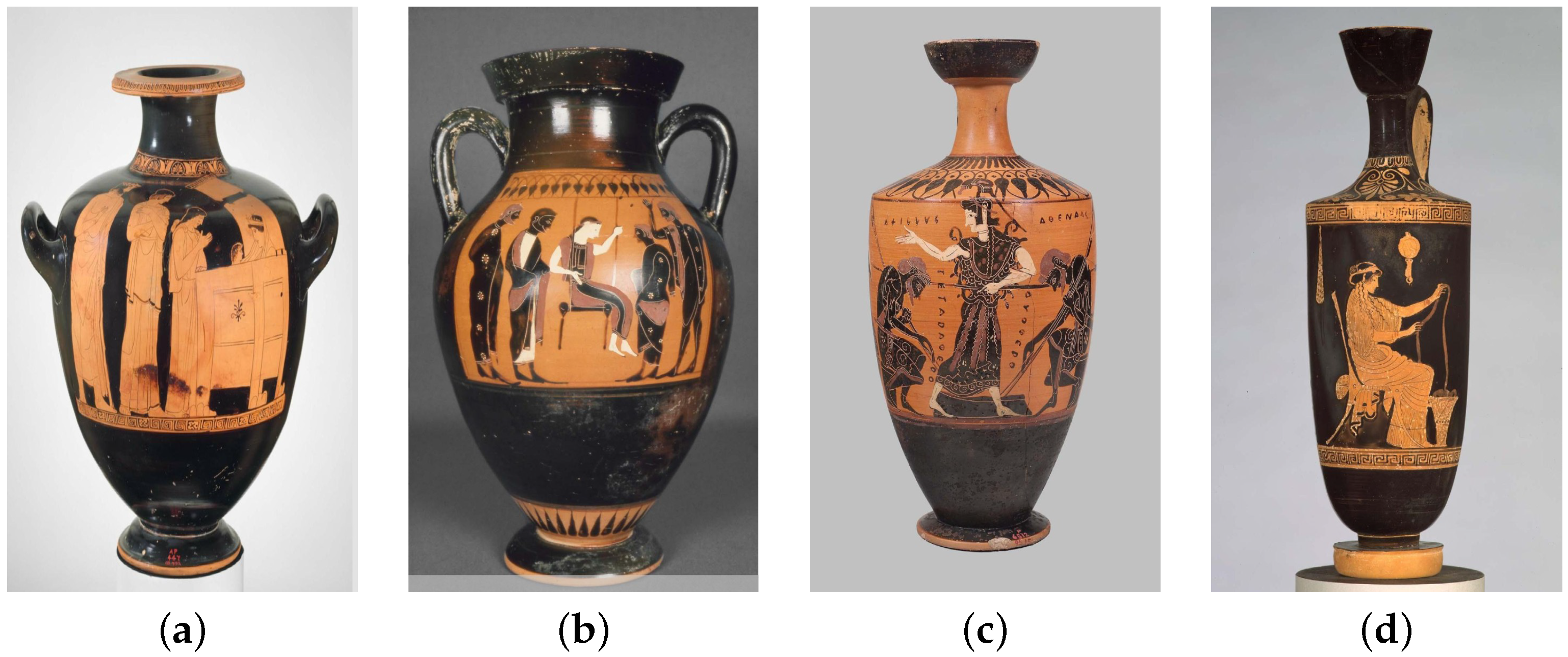
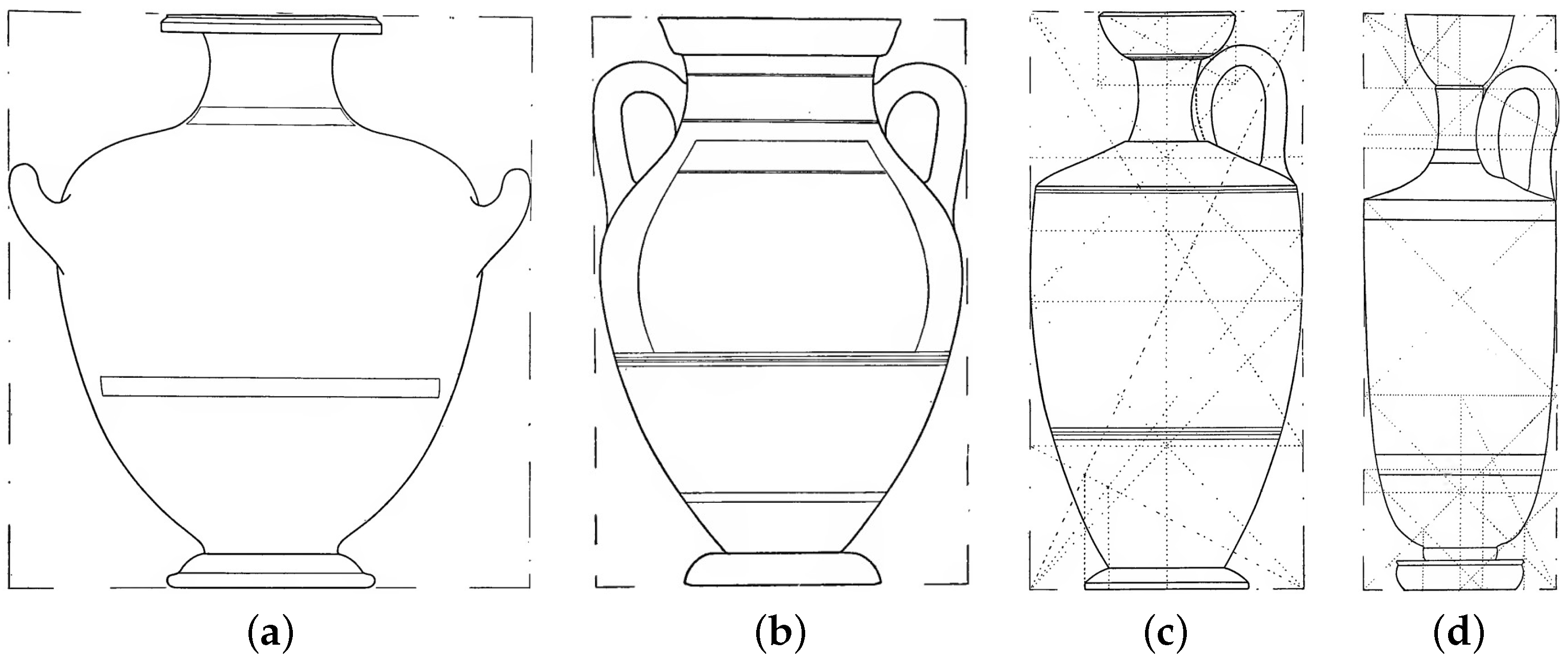
Figure 18:
These four vases are as follows:
Hydria #65, page 111: “Danae with Perseus seated in Chest”, height cm, width cm with (approximate) ratio k = 1:1
Amphora vase #23, page 59: “Girl Seated in a Swing”, cm, k = 3:2
Lekythos #164, page 210 “Achilles, Ajax and Athena”, height cm, diameter (width) , (approximate) ratio k = 2:1
Lekythos #171, page 216 “Woman Working Wool”, height cm, diameter cm, (approximate) ratio k = 3:1
The layout of these four vases with static symmetry is shown in
Figure 19:
For any vase, the determination of the index
k is carried out by examining the ratio of the sides of the enclosing rectangle, and then looking for squares and self-similar rectangles by examining subsequent ratios and diagonals. For the golden ratio, these have geometric relationships, as shown in
Figure 20.
The curve connecting the centers of these rectangles is a “golden spiral” [
74,
75]. The golden ratio
has many interesting relationships:
From these, one can immediately obtain the Fibonacci sequence.
The Fibonacci sequence is a simple recursive relationship connecting subsequent self-similar rectangles. Note that one can write .
It is our hypothesis that the outer contours of Greek vases are described by such logarithmic spirals, reflecting the self-similarity of the underlying covering by self-similar rectangles. The logarithmic spiral has a long history in mathematics and has been used to describe many forms in nature, science, and engineering [
69,
70,
71,
72,
89,
90,
91]. For a detailed discussion, see [
92].
Finally, note that dynamic symmetry was not without its critics [
61,
93]. One of the main criticisms is the ad hoc rules for identifying self-similar rectangles and their ratios. Another is the argument that there is no unique way to represent areas in terms of these rectangles. As an example, consider again the Athena and Hermes amphora in
Figure 14.
Figure 15 shows that this amphora can be represented in terms of five squares and five root-two self-similar rectangles. An alternative way in terms of self-similar root-two and silver-ratio rectangles are shown in
Figure 21, where the same vase is represented in terms of two squares, six silver ratios, and two root-two self-similar rectangles.
Note that in both representations (
Figure 21c,d) one has the “
” term. The argument advocated in this paper is the following: Hambidge, Caskey, and others have provided very strong evidence of self-similarity in vases. The type of rectangle is computed simply by the ratio of the height of a vase to its width, giving the index of the logarithmic spiral that describes the contour of the vase (from lip to shoulder).
To summarize: Mathematically, the dynamic symmetry is based on the following three equations:
The first equation in Equation (
10) defines the “Whirling-Square” (golden ratio) rectangle. The second equation in Equation (
10) defines root rectangles. Finally, the last equation in Equation (
10) shows the decomposition of the root-5 rectangle into a square and two “whirling-square” rectangles. In practice, only the following five types of rectangles are used (shown in
Figure 16 and
Figure 18):
Square 1:1 and static symmetry ratios;
Root-two rectangle: :1;
Root-three rectangle: :1;
Root-five rectangle: :1;
Whirling square rectangle: :1.
6. Caskey’s Vase Dataset
Based on Hambidge’s findings about the relationship between vases and rectangles, Caskey measured many Greek vases and suggested that the vases and their components could be described by rectangles with a consistent ratio, representing the proportion between sides. Although there were more than 300 vases described in Caskey’s book, only 185 vases have graphs with full or partial measurements. The full measurement data include vase heights (height with cover, height without cover, height of cover, height of neck and lip, height of shoulder), widths, and diameters (diameter of the vase, diameter of lip, diameter of bottom of body, diameter of shoulder, diameter of foot, diameter of bowl, diameter of cover), as well as the ratio of the vase and types (type of vase, general type of vase).
The dataset is used to explore the relationship between geometric ratios and the types of Greek vases, as well as to calculate the volume of the vases based on our formula. Specifically, geometric ratios demonstrate how the ancient Greeks applied the principle of mathematical harmony to achieve balance and artistry in their vase designs. This section presents a discussion of some common ratios, such as the golden ratio and , and how vase types or periods favored particular ratios according to stylistic tendencies and Greek cultural influences. The next section extends the analysis by explaining how the volume formula is derived and how to apply ratios in calculating vase volumes, thereby connecting geometric art to its practical function.
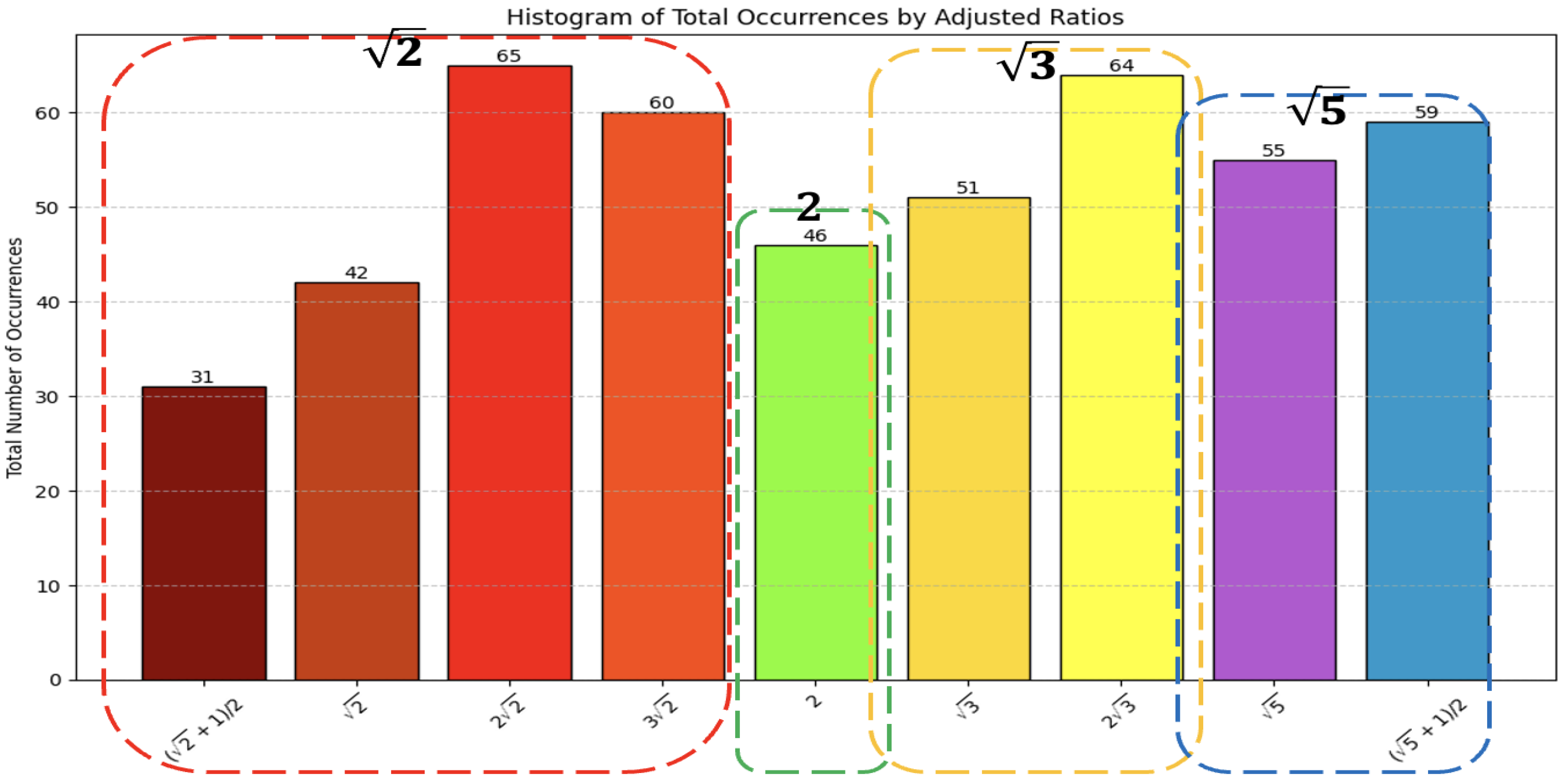
Each group has similar color bars:
(red), 2 (green),
(yellow), and
(blue), as shown in
Figure 22. Four bars are in the
group, which means the most common ratios are in
. Two bars have more than 60 vases:
and
. The
group has the second most vases, and
has 64 vases. For the
group, the golden ratio has the most vases, which is 59, but the
group also has 55 vases. The group with the fewest vases is the 2 group, which has only 46 vases. By calculation, about 42% of vases are in the
group, the
and
groups both have around 24% of the total vases, and the 2 group has 10%.
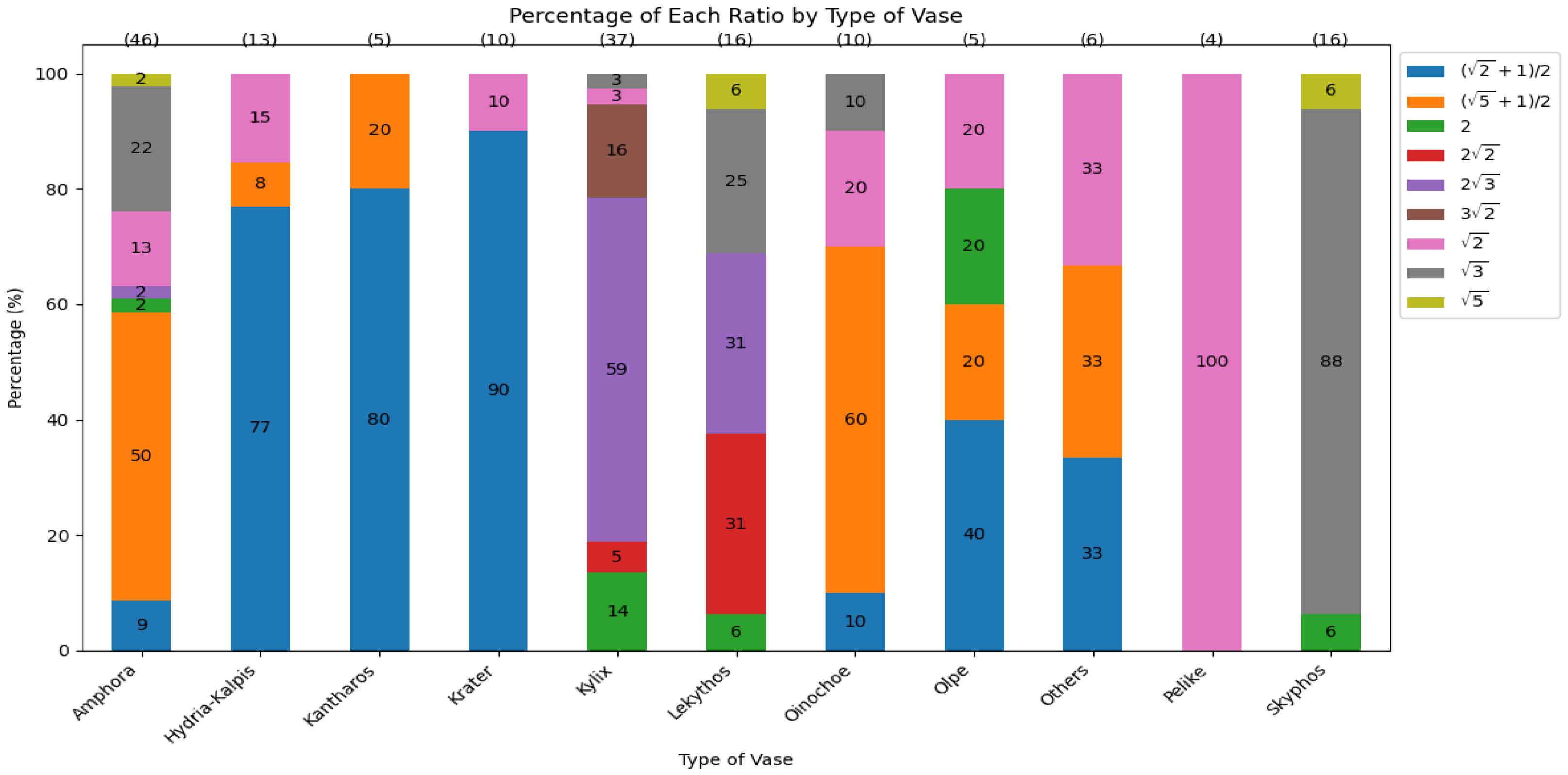
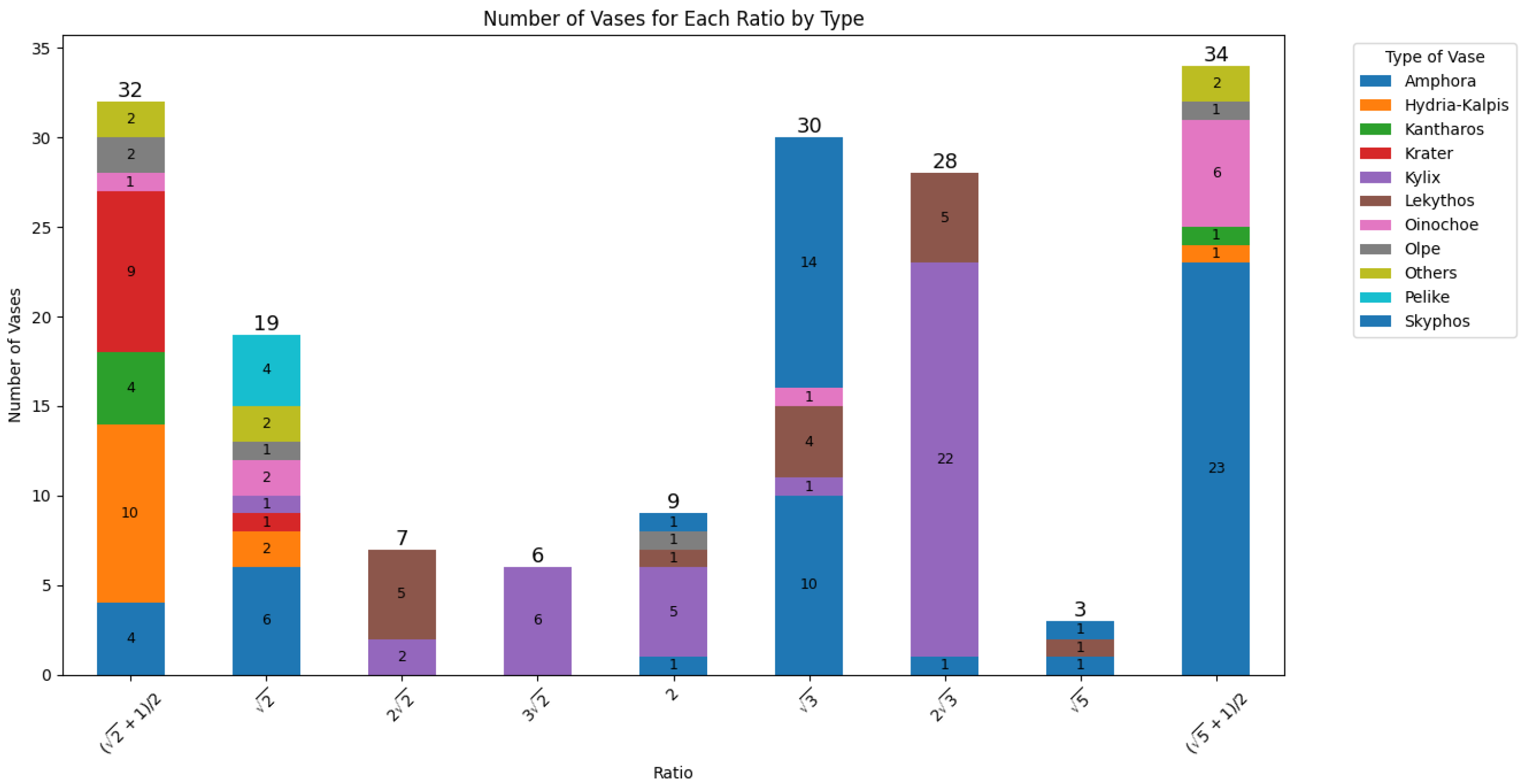
As mentioned before, 185 vases have graphs with full or partial measurements in Caskey’s books. From these 185 vases, 168 vases have a listed ratio with their type, and the results were presented in two graphs. One shows the number of vases for each ratio by type, and the other shows the percentage.
Let us discuss the number of vases first in
Figure 23. Four ratios that have more than 28 vases:
,
,
, and the golden ratio
. The golden ratio was the most common ratio in these vases, with 34, followed by
with 32 and
with 30. In the golden ratio, most of the vases are amphora (23), and for
, vase types are varied. Krater and hydria-kalpis are the main ones in
, with 9 and 10 vases, respectively. In the
group, 10 amphora and 14 skyphos are the top vase types, and for the
group, kylix was the most common type with 22 out of 28 vases.
In
Figure 24, the amphora type has varied ratios, but the top ratio is the golden ratio
with 50%, followed by
with 22%. The ratios of hydria-kalpis, kantharos, and krater are mainly
, with 77%, 80%, and 90%, respectively. Kylix has almost 60% in
. In Lekythos, three ratios total more than 85%:
and
are both 31%, and
has 25%. Oinochoe is mainly the golden ratio at 60%, followed by
at 20%. Olpe has 40% in
, and golden ratio, 2, and
are all 20%, respectively. Surprisingly, pelike vases are all
ratio. Last but not least, skyphos are mainly
ratio at 88%.
From the 168 vases, it is interesting that the results compared to all vases’ ratios are similar. The group is still the most common ratio among all vases, followed by and groups. The 2 group has the fewest vases. The difference is that the group has more than the group, compared to all vases, where they have almost the same number. By calculation, the group accounts for 38% of total vases, the group has 35%, the group has 22%, and the 2 group has 5%.