1. Introduction
Post-COVID condition (also referred to as post-acute COVID-19 syndrome or long COVID) affects a substantial proportion of individuals following acute SARS-CoV-2 infection and represents a growing public health challenge [
1]. According to the World Health Organization (WHO), post-COVID condition occurs in individuals with a history of probable or confirmed SARS-CoV-2 infection, usually three months from the onset of COVID-19, with symptoms that last for at least two months and cannot be explained by an alternative diagnosis [
2]. This WHO clinical case definition [
1] will be used as the eligibility criterion for participant inclusion in the present study. This clinical entity is characterized by persistent symptoms lasting weeks or months beyond the initial infection, with fatigue being one of the most prevalent, disabling, and multifactorial manifestations [
3]. Although many individuals recover fully following acute SARS-CoV-2 infection, a clinically significant subset develops persistent functional limitations and long-term disability requiring structured rehabilitation interventions [
4]. Identifying and stratifying this population according to symptom burden and functional impairment is essential to inform healthcare planning, rehabilitation pathways, and resource allocation [
5,
6,
7,
8].
Post-COVID fatigue is not limited to physical exhaustion but frequently includes cognitive and emotional components, directly interfering with personal autonomy, daily functioning, and overall quality of life [
9]. Fatigue in post-COVID condition has been strongly associated with reduced functional capacity, loss of independence in activities of daily living (ADLs), and significant deterioration in health-related quality of life [
6,
7]. One of the most pressing unmet needs in individuals living with post-COVID condition is the prevention of functional decline and long-term disability. Difficulties in performing daily activities are common and contribute to increased healthcare utilization and a broader social and economic burden [
5].
Rehabilitation is widely recognized as a key component of post-COVID management [
7]; however, a major challenges in this population are exercise intolerance and post-exertional malaise (PEM), also referred to as post-exertional symptom exacerbation (PESE), which significantly limit participation in conventional exercise-based rehabilitation programs [
8]. PEM/PESE is characterized by a worsening of symptoms following physical, cognitive, or emotional exertion and represents a key clinical feature of post-COVID condition that complicates the implementation of traditional exercise-based interventions [
9]. Symptoms frequently requiring rehabilitation include persistent fatigue, reduced physical endurance, post-exertional malaise, and functional impairment [
8]. This phenomenon has important implications for rehabilitation, as inappropriate exercise dosing may worsen symptoms and hinder recovery, highlighting the need for carefully monitored and low-load interventions. Given the heterogeneity and complexity of symptoms, multidisciplinary rehabilitation teams are recommended to address individual needs in a personalized manner [
8,
10].
Despite the recognized importance of rehabilitation, current evidence remains limited and heterogeneous. Most international guidelines rely largely on expert consensus or extrapolated evidence from other chronic conditions rather than robust intervention studies specifically designed for post-COVID populations [
11,
12] Consequently, there is a clear need for innovative, safe, and low-burden interventions that can be delivered in home settings and promote functional recovery without exacerbating symptoms [
7].
In this context, electromyostimulation (EMS) emerges as a promising training technology to improve physical health and muscle performance [
13]. EMS consists of stimulating muscle groups through electrical currents of variable intensity delivered via surface electrodes [
14]. Whole-body electromyostimulation (WB-EMS) represents an evolution of traditional localized EMS, allowing for the simultaneous activation of multiple large muscle groups through synchronized stimulation. This technological advancement enables the activation of entire kinetic chains and the performance of global movements under electrical stimulation [
15].
In healthy populations, WB-EMS has been widely used to improve physical fitness and muscular strength, particularly in individuals engaged in physical activity or sports [
15,
16,
17]. Furthermore, WB-EMS has demonstrated therapeutic benefits in clinical populations. For example, it has been shown to effectively reduce chronic low back pain [
18] and improve muscle strength, functional status, and exercise tolerance in patients with advanced cancer undergoing oncological treatment [
19]. These findings support the safety and functional potential of WB-EMS in populations with compromised physical capacity. These effects are underpinned by the simultaneous activation of both slow and fast motor units across large muscle areas through externally applied electrical current, which bypasses the central voluntary drive and thereby reduces perceived exertion during exercise. This physiological mechanism may be particularly relevant in individuals with post-COVID condition, where post-exertional symptom exacerbation (PESE) limits participation in conventional exercise programs, as WB-EMS can promote neuromuscular activation and improve muscle performance without imposing high mechanical or metabolic load [
14,
19].
In post-COVID condition specifically, non-invasive electrical stimulation techniques such as transcranial direct current stimulation (tDCS) and transcutaneous electrical nerve stimulation (TENS) have shown preliminary benefits in reducing fatigue and pain [
4,
20] These findings support the biological plausibility of electrical stimulation approaches in this population. However, to date, no randomized pilot studies have evaluated the use of WB-EMS integrated into activities of daily living in individuals with post-COVID condition.
Given the need for low-mechanical-load interventions that minimize symptom exacerbation while promoting muscle activation and functional recovery, WB-EMS may represent a suitable therapeutic alternative for individuals with post-COVID condition. Exploring this technology in home-based settings could contribute to improving physical capacity, independence, and ultimately quality of life in this population.
Therefore, the aim of this study will be to evaluate the potential effects of a whole-body electromyostimulation suit in improving functional capacity and independence in individuals with post-COVID condition. We hypothesize that a 12-session home-based WB-EMS program may contribute to improvements in fatigue, physical condition, and functional status in this population.
2. Aims and Objectives
The primary aim of this pilot randomized controlled trial is to evaluate the intervention’s feasibility, safety, and acceptability. Changes in fatigue severity and functional capacity (CFQ-11 and 6 MWT) will be evaluated as exploratory clinical outcomes of a home-based functional activation intervention combining whole-body electromyostimulation (WB-EMS) with activities of daily living in adults with post-COVID condition.
The intervention protocol will be informed by expert consensus, using a Delphi process to define WB-EMS parameters, progression criteria, and clinically relevant functional outcomes.
Specifically, this study will assess the feasibility of recruitment, adherence, and retention within a home-based intervention program, as well as the safety and tolerability of the intervention, with particular attention to symptom exacerbation and post-exertional fatigue. In addition, the study will explore the preliminary effects of the intervention on fatigue levels compared with a placebo control group and examine potential changes in functional capacity, tolerance to activities of daily living, functional independence, and handgrip strength as objective indicators of functional performance.
To address these objectives, a randomized, placebo-controlled, participant-blinded pilot trial with a 12-week home-based intervention will be conducted.
The findings of this study are expected to inform the design of future larger-scale trials and contribute to the development of targeted and scalable rehabilitation strategies for individuals with post-COVID condition.
3. Methods
3.1. Study Design
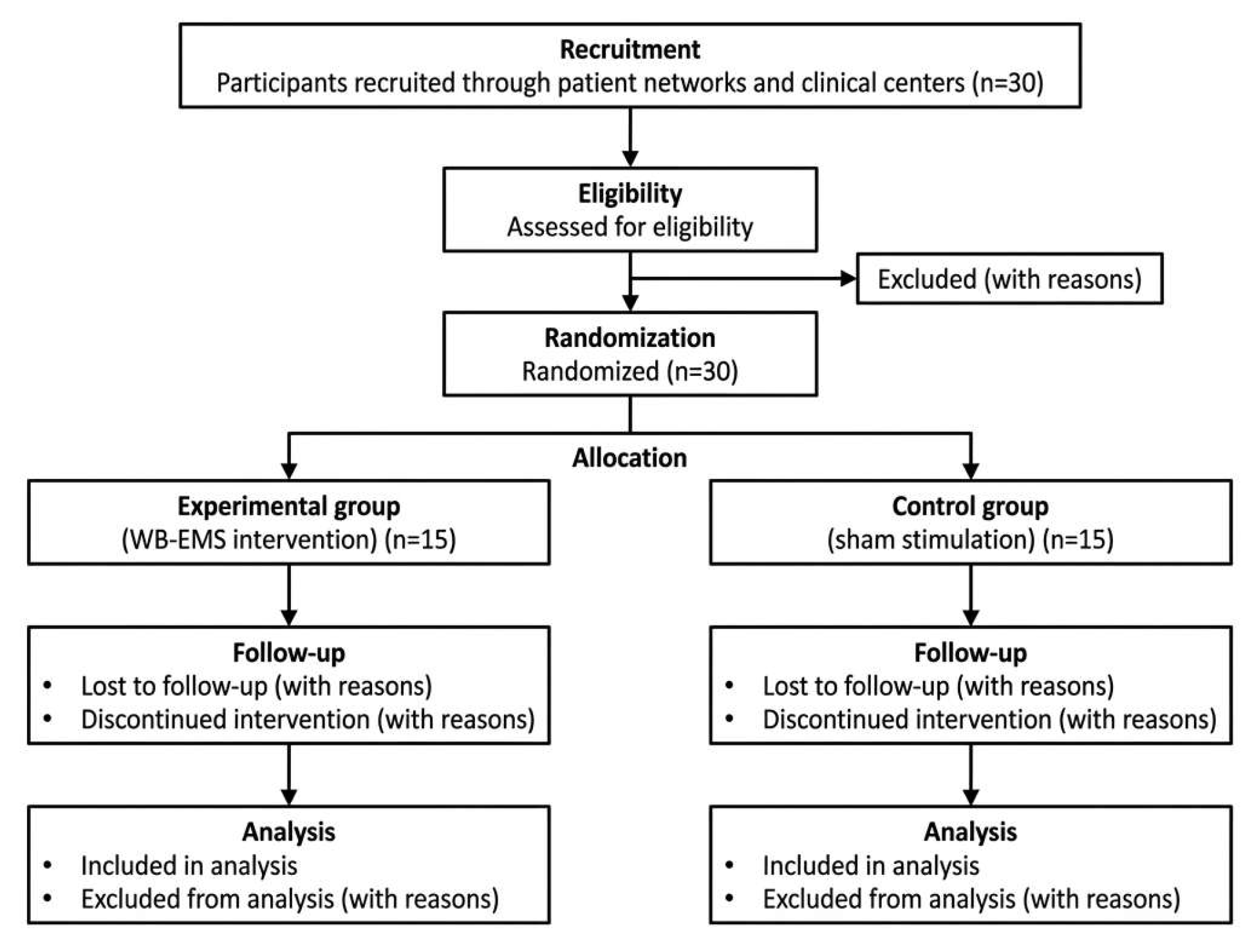
A randomized, placebo-controlled, participant-blinded pilot clinical trial with two parallel groups and a three-month post-intervention follow-up period will be conducted. Outcome assessors will be blinded whenever feasible; however, due to the nature of the intervention, full assessor blinding cannot be completely ensured. Prior to implementation, the intervention parameters, progression criteria, and functional outcome indicators will be defined through a Delphi process involving expert consensus to enhance clinical relevance and applicability. To minimize potential assessment bias, standardized outcome measures and predefined assessment protocols will be used. The flow of participants throughout the study, including recruitment, allocation, follow-up, and analysis, is presented in
Figure 1.
This study is designed as a pilot trial; therefore, its primary purpose is to assess feasibility, safety, and acceptability, rather than to determine definitive efficacy. The development of this study protocol followed the SPIRIT 2025 guidelines [
21]. The study is registered at ClinicalTrials.gov (Identifier: NCT07312357) and will adhere to the CONSORT 2025 guidelines for randomized controlled trials [
22].
3.2. Participants and Recruitment
A total of 30 adults (15 participants per group) will be recruited through the Spanish Network for Research in Post-COVID Condition (REICOP) and collaborating clinical centers. Given the absence of previous studies evaluating whole-body electromyostimulation integrated into functional activities of daily living in individuals with post-COVID condition, this study is designed as a randomized pilot clinical trial to assess the feasibility, acceptability, and preliminary effects of the intervention.
In line with methodological recommendations for pilot trials, a sample size of 15 participants per group (n = 30) is considered sufficient to explore feasibility outcomes and estimate parameters for future larger-scale studies [
23,
24]. This sample size is not powered to detect statistically significant between-group differences but to estimate variability and inform sample size calculations for future definitive trials.
Eligible participants will be invited to participate voluntarily and will receive written and verbal information about the study procedures, potential risks, and expected benefits before providing written informed consent. After enrolment, basic sociodemographic information (e.g., age, sex, and current treatments) will be collected. Additionally, the predominant clinical phenotype will be recorded at baseline as a descriptive variable, categorised as fatigue-dominant, respiratory, neurological, or autonomic dysfunction. This information will be used to contextualize the findings and to generate subgroup hypotheses for future definitive trials. Clinically significant fatigue is defined for screening purposes using the following single-item question: ‘On average, how would you rate your fatigue over the past week?’ (0 = no fatigue; 10 = worst fatigue imaginable). A score ≥ 5 is used as a pragmatic threshold consistent with approaches reported in post-COVID fatigue research [
25]. This item is not a validated standalone scale but serves to ensure that enrolled participants present with clinically meaningful fatigue at baseline. Each participant will be assigned a unique identification code to ensure data pseudonymization and confidentiality. Eligibility criteria are summarized in
Table 1.
All personal data will be processed in accordance with the European Union General Data Protection Regulation (EU Regulation 2016/679) and stored in a secure database accessible only to authorized members of the research team. Study data will be recorded in a secure electronic database and subsequently analysed using IBM SPSS Statistics (version 27), with descriptive statistics used to summarize participant characteristics and study outcomes.
3.3. Randomization, Allocation Concealment, and Blinding
Participants will be randomly allocated in a 1:1 ratio to either the experimental group (active WB-EMS) or the control group (sham stimulation). Randomization will be performed using the Spanish-language adaptation of OxMaR (Oxford Minimization and Randomization) software [
26], a free, open-source, web-based platform with no conventional version numbering, originally developed at the University of Oxford, Oxford, UK [original development].
A restricted randomization design with permuted blocks of variable sizes will be used to ensure balanced allocation between groups. Randomization will be stratified by sex and baseline fatigue severity to reduce potential baseline imbalances.
The allocation sequence will be generated and managed by an independent researcher not involved in participant recruitment, intervention delivery, outcome assessment, or data analysis. Allocation concealment will be ensured through a centralized electronic system accessible only to this researcher [
23].
Participants will receive either active WB-EMS or sham stimulation delivered using minimal, non-therapeutic parameters while maintaining identical equipment configuration and activity protocols. This approach is intended to ensure participant blinding [
27].
Due to the nature of the intervention, blinding of the intervention provider is not feasible. Outcome assessors will be blinded whenever possible; however, complete blinding cannot be fully guaranteed. To assess the success of participant blinding, participants will be asked at post-intervention to indicate which group they believe they were allocated to (active, control, or unsure).
To minimize potential bias, standardized assessment procedures will be used, and participants will be instructed not to disclose their group allocation during evaluations. Data analysts will perform statistical analyses using anonymized group codes. Unblinding will only occur if required for participant safety and will be documented accordingly.
Given the pilot nature of this single-center, non-pharmacological study and the minimal anticipated risks, a Data Monitoring Committee will not be established. Participant safety and protocol adherence will be overseen by the principal investigator and research team, in accordance with SPIRIT 2025 and ICH-GCP E6(R2) guidelines [
21].
All adverse events will be recorded, classified by severity (mild, moderate, or severe), and assessed for relatedness to the intervention. Serious adverse events will be reported to the ethics committee according to institutional procedures.
3.4. Expert Consensus (Delphi Method)
The intervention protocol will be validated through a consensus process using the Delphi technique [
28]. A multidisciplinary panel of 12 experts will be invited to participate, including specialists in occupational therapy, physiotherapy, medicine, and post-COVID condition, as well as one expert in whole-body electromyostimulation (WB-EMS) and one patient representative with technical knowledge in this area. Experts will be identified through scientific publications, professional networks, and collaborating clinical centers.
The Delphi method will be implemented prior to participant recruitment and before finalization of WB-EMS parameters and ADL progression criteria. The intervention parameters described in the current protocol represent working values based on existing WB-EMS literature and will be refined through the Delphi process. Should the Delphi results necessitate substantive changes to the protocol, the ClinicalTrials.gov registration will be updated accordingly before recruitment commences. The Delphi process will consist of two structured rounds aimed at achieving consensus (≥70% agreement) on (1) criteria for grading and progression of activities of daily living, (2) WB-EMS application parameters (frequency, intensity, pulse width, and session duration), and (3) functional success indicators relevant to post-COVID condition.
Expert panelists will be selected based on the following criteria: (1) a minimum of five years of clinical or research experience in their field; (2) authorship of at least one peer-reviewed publication relevant to post-COVID rehabilitation, WB-EMS, or functional assessment; and (3) active affiliation with a clinical center or academic institution. Experts will be contacted individually and invited to participate on a voluntary basis.
In each round, items will be rated on a 9-point Likert scale (1 = strongly disagree, 9 = strongly agree). Consensus will be operationally defined as ≥70% of panelists rating an item ≥ 7. Items for which consensus is reached after round 1 will be incorporated into the final protocol. Items for which consensus is not reached will return in round 2 with individual and group feedback. If consensus is not achieved after round 2 on a specific item, the research team will adopt the median response and document the rationale. The Delphi process will be conducted prior to trial commencement, and its results will be used to finalize WB-EMS parameters and ADL progression criteria before participant recruitment begins.
This approach aims to ensure that the intervention protocol is supported by expert consensus, enhancing its methodological rigor, clinical applicability, and relevance for individuals with post-COVID condition [
29]. The Delphi technique has been widely used to establish consensus in contexts of clinical uncertainty and innovation, including the development of physiotherapy recommendations for individuals with post-COVID condition [
30].
To minimize risks related to exercise intolerance and post-exertional symptom exacerbation, a two-week pre-intervention phase will be conducted before the start of the 12-week program. This phase will consist of two individual sessions in which the WB-EMS suit will be fitted and stimulation parameters will be tested at sub-therapeutic levels. Tolerance will be assessed using the Modified Borg Scale (target ≤ 3/10) and by monitoring for PESE within 24–72 h of each session. Participants reporting Borg scores > 5 or clinically significant symptom worsening will be excluded from the intervention and documented as screen failures in the CONSORT flow diagram.
3.5. Intervention
The intervention consists of a home-based functional activation program combining whole-body electromyostimulation (WB-EMS) with activities of daily living (ADL). The protocol is informed by previously reported WB-EMS applications in clinical populations with reduced physical capacity [
19] and by established training parameters used in healthy individuals [
15].
Participant safety will be monitored according to the following predefined stopping criteria: (1) Borg score > 5 before session start → session postponed until next scheduled appointment; (2) worsening of ≥2 points on any symptom diary item within 72 h of a session → mandatory contact with the supervising therapist, individual clinical review, and dose reduction or session postponement as appropriate; (3) two or more PESE episodes within three consecutive sessions → protocol review by the principal investigator and potential withdrawal from the intervention; (4) any severe adverse event → immediate withdrawal and notification of the Research Ethics Committee. All adverse events will be classified by severity (mild, moderate, or severe) and assessed for relatedness to the intervention.
The intervention follows a three-phase progressive structure. During the conditioning phase (weeks 1–4), participants will receive WB-EMS in a seated or resting position, starting with 10 min sessions and increasing duration gradually. The subsequent functional phase (weeks 5–8) will integrate WB-EMS into goal-directed ADL tasks designed and supervised by an occupational therapist, including transfers and mobility, reaching and object manipulation, and selected household-related activities. A standardized framework of functional tasks will be used across participants to ensure consistency, while allowing for individualized adaptations based on functional capacity and symptom tolerance [
23]. Finally, during the consolidation phase (weeks 9–12), stimulation intensity and task demands will be progressively adjusted to optimize functional performance. Adherence will be monitored through session logs completed after each session and regular contact with the research team to ensure protocol compliance. Sessions will be supervised by a trained occupational therapist through scheduled remote or in-person follow-up to ensure correct execution and safety.
Participants in the control group will receive sham stimulation using the same WIEMSPRO device and full-body suit as the experimental group. Sham parameters will be set at a frequency of 1 Hz, pulse width of 50 µs, and intensity ≤ 1 mA per channel—levels that are perceptible as a faint skin sensation but are insufficient to produce neuromuscular activation or visible muscle contraction. Session structure, electrode placement, positioning, duration, and activity protocols will be identical to the experimental condition. Participants will be informed that two different stimulation modes are being evaluated and instructed not to discuss their sensations with other participants or with the supervising therapist during assessments. To evaluate blinding success, participants will be asked at post-intervention to indicate which group they believe they were allocated to (active stimulation, minimal stimulation, or unsure).
Participants will be withdrawn from the intervention in case of clinically significant symptom worsening, adverse reactions related to electromyostimulation, voluntary withdrawal of consent, or repeated non-attendance compromising adherence to the protocol. Post-exertional symptom exacerbation (PESE) will be operationally defined as a worsening of symptoms (e.g., fatigue, dyspnea, cognitive dysfunction) within 24–72 h following exertion. In such cases, session intensity will be reduced, postponed, or discontinued according to predefined safety criteria. PESE monitoring will be conducted prospectively using a brief daily symptom diary completed by participants via the study platform (Microsoft Office Forms®) for 72 h following each session. The diary will assess fatigue, dyspnea, and cognitive symptoms on a 0–10 numerical rating scale. A worsening of ≥2 points on any item compared to the pre-session baseline will trigger contact with the supervising therapist and potential session modification. All 12 intervention sessions will be supervised remotely in real time via video call (Microsoft Teams or equivalent), with the supervising occupational therapist available to guide correct execution and respond to adverse events. A contingency plan for connectivity failure includes a telephone call and a deferred in-person session where clinically indicated.
The WB-EMS system used in this study will be the WIEMSPRO Revolution Pro (WIEMSPRO S.L., Málaga, Spain), a wireless stimulation device connected to a full-body suit with 10 independent stimulation channels covering the following muscle groups: abdominals, lumbar extensors, pectorals, biceps, triceps, quadriceps, hamstrings, and gluteal region. Electrode placement will follow a standardised configuration documented in the study intervention manual, which will be made available upon request. Channel intensity will be individually calibrated via the WIEMSPRO tablet application at the start of each session by the supervising occupational therapist. A standardised framework of functional tasks will be used across all participants to ensure consistency, while allowing for individualized adaptations based on functional capacity and symptom tolerance.
A detailed summary of the intervention parameters is presented in
Table 2.
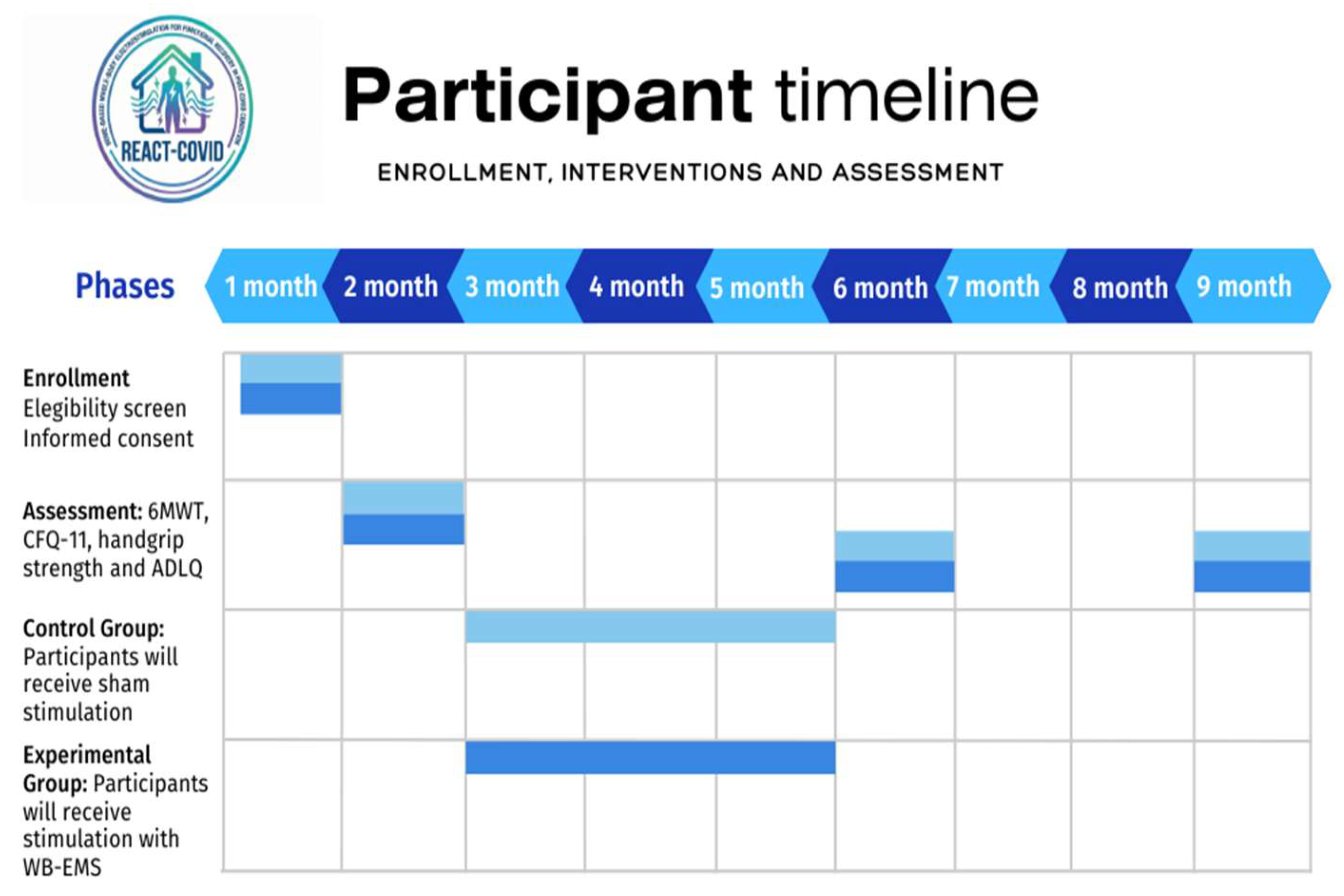
The schedule of enrolment, interventions, and assessments is presented in
Figure 2.
4. Outcome Measures
Data will be collected using an online form developed through the Universidad Rey Juan Carlos institutional license (Microsoft Office Forms®). The questionnaire will include sociodemographic and clinical variables, followed by standardized assessment instruments.
All outcomes will be assessed at three points: baseline (prior to intervention), post-intervention, and three-month follow-up. To enhance retention and minimize missing data, participants will receive regular contact and flexible scheduling adapted to symptom fluctuations. Whenever possible, outcome data will be collected even in cases of intervention discontinuation to support intention-to-treat analyses.
4.1. Feasibility and Safety Outcomes
As exploratory clinical outcomes, fatigue severity and functional capacity will be evaluated to generate preliminary effect size estimates for the design of a future definitive trial.
Fatigue severity will be assessed using the Chalder Fatigue Questionnaire (CFQ-11), a widely used and validated self-report instrument that captures both physical and mental dimensions of fatigue [
24]. The CFQ-11 has demonstrated good psychometric properties across a range of clinical populations, including individuals with chronic fatigue and post-COVID condition [
26,
27,
28] A difference of approximately 2 points on the Likert scale has been reported as clinically meaningful in chronic fatigue populations [
31]. Its sensitivity to change and ability to detect clinically meaningful differences make it particularly suitable for intervention studies targeting fatigue-related outcomes. A validated Spanish version will be used [
25].
Functional capacity will be evaluated using the Six-Minute Walk Test (6 MWT), which measures the maximum distance an individual can walk over six minutes and reflects submaximal aerobic capacity and functional performance in daily life [
32] The test will be conducted following standardized procedures in a flat, unobstructed 30 m corridor, with participants receiving consistent instructions and encouragement without influencing walking pace. The 6 MWT has been extensively validated across clinical populations and has shown strong reliability and responsiveness [
31], including in individuals with respiratory and cardiovascular conditions [
33]. It has also been widely used in post-COVID populations to assess persistent functional limitations and monitor recovery trajectories [
25]. The 6 MWT will be administered by a trained occupational therapist or physiotherapist at each assessment timepoint following standardised procedures. Handgrip dynamometry will be administered by the same trained professional.
The combined use of subjective (CFQ-11) and objective (6 MWT) measures allows for a comprehensive assessment of fatigue and functional capacity, capturing both perceived symptom burden and performance-based outcomes relevant to daily functioning in individuals with post-COVID condition.
4.2. Exploratory Clinical Outcomes
Muscle strength will be assessed using handgrip dynamometry, a widely accepted and objective measure of overall muscle strength. Handgrip strength has demonstrated good reliability and validity across different populations and is considered a proxy indicator of general physical function and health status [
34]. Normative values have been established for the Spanish population, allowing for comparison and interpretation of individual performance [
35]. In the context of post-COVID condition, reduced muscle strength has been associated with functional impairment and decreased exercise capacity. Previous studies have reported correlations between handgrip strength and performance in functional tests such as the Six-Minute Walk Test, suggesting its relevance as an indicator of recovery [
36].
Functional independence in activities of daily living will be evaluated using the Activities of Daily Living Questionnaire (ADLQ), a validated self-report instrument designed to assess the degree of independence across a range of everyday activities [
37]. The ADLQ has been widely used in clinical populations and has demonstrated adequate validity and reliability [
38]. Its application in individuals with post-COVID condition has been recently reported, supporting its relevance for capturing functional limitations and changes in daily performance in this population [
39]. The T-ADLQ has been validated in Spanish-speaking populations [
40] and applied in individuals with post-COVID condition [
41], supporting its appropriateness for the target population of this study.
Additionally, the Post-COVID-19 Functional Status Scale (PCFS) will be included as an exploratory patient-reported outcome measure. The PCFS captures the degree of functional limitations across a spectrum from no limitations to severe disability and has been validated and widely used in post-COVID populations. Its inclusion will allow a broader assessment of participation restrictions and functional recovery beyond performance-based measures.
The inclusion of these secondary outcomes complements the primary measures by providing additional objective and functional information on physical performance and independence, contributing to a more comprehensive evaluation of the intervention effects. A summary of outcome measures and assessment timepoints is presented in
Table 3.
5. Statistical Analyses
Statistical analyses will be conducted using IBM SPSS Statistics (version 27). Descriptive statistics will be used to summarize sociodemographic and baseline characteristics, reporting means and standard deviations for continuous variables and frequencies and percentages for categorical variables.
5.1. Feasibility and Safety Analyses
Feasibility and safety outcomes will be summarized descriptively and will include the recruitment rate (proportion of eligible participants enrolled within the planned timeframe), adherence (proportion of scheduled sessions completed per participant), retention (proportion of participants completing follow-up assessments), incidence and severity of adverse events, and blinding success (proportion of participants unable to correctly identify their group allocation at post-intervention). Acceptability will be explored through participant feedback and adherence patterns. These outcomes will be evaluated against the following predefined progression thresholds: recruitment rate ≥ 60%; adherence ≥ 70%; retention ≥ 80%; serious adverse event rate < 10%; blinding success > 50%.
5.2. Exploratory Clinical Analyses
Changes in exploratory clinical outcomes (CFQ-11, 6 MWT, handgrip strength, and ADLQ) will be analysed using linear mixed-effects models, including fixed effects for group, time, and group-by-time interaction and a random effect for participants to account for repeated measures. Baseline values will be included as covariates where appropriate. If model assumptions are not met, appropriate transformations or non-parametric longitudinal methods will be considered. Given the pilot nature of the study, emphasis will be placed on effect size estimation (Cohen’s d) and 95% confidence intervals rather than statistical significance testing. Both intention-to-treat (primary) and per-protocol (sensitivity) analyses will be conducted. Missing data will be handled under a missing-at-random assumption within the mixed-effects framework.
In line with recommendations for pilot trials, the following predefined feasibility thresholds will be used to inform the decision to proceed to a future definitive trial: (1) recruitment rate ≥ 60% of eligible participants enrolled within the planned timeframe; (2) adherence ≥ 70% of scheduled sessions completed per participant; (3) retention ≥ 80% of participants completing the post-intervention assessment (week 12); (4) a serious adverse event rate < 10%; and (5) blinding success > 50% of participants unable to correctly identify their group allocation at post-intervention.
6. Ethical Considerations and Gender Dimension
This study involves adult participants diagnosed with post-COVID condition and does not include the use of human biological samples, embryos, or animals. All participants will provide written informed consent prior to enrolment, and several measures have been incorporated to minimize potential risks, including defined inclusion and exclusion criteria, a structured adaptation phase, and continuous safety monitoring during the intervention. The independence of data collection, management, analysis, and reporting from the commercial funder is explicitly guaranteed.
Ethical approval was obtained from the Research Ethics Committee of Universidad Rey Juan Carlos (approval code: 020620254862025). The study will be conducted in accordance with the Declaration of Helsinki and the principles of Good Clinical Practice (ICH-GCP), as well as relevant European and national regulations, including Spanish Law 14/2007 on Biomedical Research and the EU General Data Protection Regulation (EU 2016/679). Sex and gender variables will be collected and considered in the analyses to account for potential differences in the prevalence and presentation of post-COVID condition.
Potential Risks and Benefits
Participation in this study involves low to moderate risk, comparable to supervised low-intensity functional exercise combined with neuromuscular electrical stimulation. Potential adverse effects may include transient muscle soreness, mild discomfort related to stimulation, temporary fatigue, post-exertional symptom exacerbation, or minor skin irritation at electrode sites. To minimize these risks, participants will undergo an individualized baseline assessment, and the intervention will include a gradual adaptation phase with progressive intensity adjustments and continuous monitoring of fatigue and perceived exertion. Vital signs will be recorded during sessions, and predefined criteria for session modification or suspension will be applied if needed.
Potential benefits may include improvements in fatigue, functional capacity, tolerance to daily activities, and overall functional independence. The study will also generate preliminary evidence on the feasibility and safety of integrating WB-EMS into rehabilitation strategies for individuals with post-COVID condition.
7. Discussion
Post-COVID condition is characterized by persistent, fluctuating, and often disabling symptoms, among which fatigue represents one of the most prevalent and functionally limiting manifestations [
36]. The heterogeneity of post-COVID trajectories and the variable degree of functional impairment across individuals further underscore the importance of stratifying patients according to symptom burden and disability level to inform rehabilitation planning and resource allocation [
41]. Beyond physical exhaustion, post-COVID fatigue frequently includes cognitive and emotional components, contributing to reduced autonomy and diminished participation in activities of daily living. The heterogeneity of clinical presentation and the presence of post-exertional symptom exacerbation (PESE) in a subgroup of patients complicate the implementation of conventional exercise-based rehabilitation programs [
7]. Consequently, there is a need for innovative rehabilitation strategies that promote functional recovery while minimizing mechanical and metabolic overload.
The REACT-COVID protocol addresses this need by integrating whole-body electromyostimulation into functional, occupation-based activities delivered in a home-based format. This approach aligns with current recommendations emphasizing individualized, low-burden, and symptom-adapted rehabilitation strategies to treat post-COVID condition. Electrical stimulation modalities have shown preliminary promise in individuals with persistent post-COVID symptoms. For example, Zulbaran-Rojas et al. (2024) reported improvements in fatigue and pain following TENS in a randomized pilot study [
20]. Although TENS and WB-EMS differ in mechanism and physiological impact, these findings support the biological plausibility of neuromodulatory approaches in this population. However, to date, no randomized clinical trials have examined WB-EMS integrated into daily functional tasks in individuals with post-COVID condition, highlighting the novelty of the present protocol.
WB-EMS has demonstrated beneficial effects on muscle strength, functional performance, and physical capacity in both healthy and clinical populations [
14,
19]. Importantly, international recommendations emphasize strict safety protocols, individualized intensity progression, and appropriate supervision to minimize risks [
14,
19]. These considerations are particularly relevant in individuals with post-COVID condition, where symptom fluctuation and exercise intolerance require careful dose adjustment. The present protocol incorporates these principles through a structured adaptation phase, conservative progression criteria, continuous monitoring, and predefined discontinuation rules, aiming to ensure both safety and tolerability.
It should be acknowledged, however, that WB-EMS is unlikely to produce permanent effects in the absence of continued application or integration into a broader rehabilitation program. Evidence from clinical populations suggests that gains in muscle strength and functional performance tend to diminish following cessation of the intervention, consistent with the general detraining literature [
15,
19]. The 3-month follow-up included in this protocol will provide preliminary data on the durability of effects, but future trials should explore maintenance protocols and longer-term follow-up periods to assess the sustainability of gains in individuals with post-COVID condition.
The selection of outcome measures reflects the multidimensional nature of post-COVID condition. The Chalder Fatigue Questionnaire (CFQ-11) is widely used in chronic fatigue and post-COVID research and has demonstrated adequate reliability and sensitivity to change [
25,
33]. Evidence from systematic reviews suggests that clinically meaningful changes in fatigue-related outcomes typically fall within small-to-moderate effect size ranges [
2,
42]. Complementing subjective fatigue assessment, the Six-Minute Walk Test (6 MWT) provides an objective measure of functional exercise capacity and endurance and has been extensively validated in clinical populations [
35,
36]. The inclusion of additional measures such as handgrip strength and the Activities of Daily Living Questionnaire (ADLQ) supports a broader evaluation of functional recovery, capturing both perceived and performance-based outcomes.
From a methodological perspective, this pilot randomized controlled trial is designed to generate preliminary evidence on feasibility, safety, and potential effects rather than to establish definitive efficacy. In this context, the study will provide important information regarding recruitment strategies, adherence, tolerability, and variability of outcomes, which are essential for planning adequately powered future trials. The integration of a home-based model may also offer insights into the scalability and real-world applicability of the intervention, particularly in populations with limited access to conventional rehabilitation services. Future definitive trials should consider extended follow-up periods of six to twelve months to assess the long-term durability of functional gains and the potential need for booster or maintenance sessions.
Overall, this protocol will contribute to the emerging evidence base on rehabilitation strategies for post-COVID condition by exploring a novel, low-mechanical-load intervention that combines neuromuscular stimulation with functional, meaningful activities. The findings will inform the design of future larger-scale studies and support the development of more accessible and person-centered rehabilitation approaches for this population.
If feasibility and safety are confirmed, the WB-EMS protocol described here could be integrated into existing home-based rehabilitation pathways for individuals with post-COVID condition. Remote delivery via video call, combined with occupational therapist-led task adaptation, aligns with current telerehabilitation models and could complement existing remote physiotherapy and occupational therapy services [
4,
7]. This is particularly relevant for individuals with limited access to outpatient rehabilitation due to symptom severity, geographical barriers, or reduced mobility. The role of the occupational therapist in this protocol extends beyond supervision to include personalized activity selection, grading of task complexity, and ongoing monitoring of functional tolerance, consistent with occupation-based rehabilitation principles.
It is also important to acknowledge the phenotypic heterogeneity of post-COVID condition and its potential implications for response to WB-EMS. Individuals with fatigue-dominant presentations may respond differently from those with predominantly respiratory, neurological, or autonomic dysfunction phenotypes. For example, those with significant autonomic dysfunction may require additional monitoring of heart rate and blood pressure responses during stimulation, while individuals with neurological symptoms may need adapted task selection. This heterogeneity underscores the importance of collecting phenotype data at baseline, as described in this protocol, and of designing future definitive trials with sufficient sample sizes to conduct meaningful subgroup analyses across clinical phenotypes [
7,
9].
8. Conclusions
The REACT-COVID trial will evaluate the feasibility, safety, and preliminary effects of integrating whole-body electromyostimulation into a structured home-based rehabilitation program for individuals with post-COVID condition. By targeting fatigue and functional limitations within real-life contexts, the study aims to inform the development of innovative, scalable, and person-centered rehabilitation strategies for this expanding clinical population.
Author Contributions
Conceptualization, M.P.R.-P. and S.G.-B.; methodology, M.P.R.-P., S.L.-H. and R.G.-B.; investigation, M.P.R.-P., S.L.-H., R.G.-B., E.H.-H., P.R.-L. and C.G.-B.; writing—original draft preparation, M.P.R.-P. and S.G.-B.; writing—review and editing, all authors; supervision, S.G.-B. and P.R.-L.; project administration, S.G.-B.; funding acquisition, S.G.-B. All authors have read and agreed to the published version of the manuscript.
Funding
This work is funded through an international R&D contract with WIEMSPRO S.L. (Project Reference: A717).
Institutional Review Board Statement
The study was conducted in accordance with the Declaration of Helsinki and approved by the Research Ethics Committee of Universidad Rey Juan Carlos (protocol code 020620254862025, on 17 July 2025).
Informed Consent Statement
Informed consent will be obtained from all subjects involved in the study.
Data Availability Statement
Data will be made available upon reasonable request after trial completion, subject to ethical and legal restrictions regarding participant confidentiality.
Acknowledgments
The authors thank the REICOP network and all collaborating clinical centers for their support in participant recruitment.
Conflicts of Interest
This work is funded through an international R&D contract with WIEMSPRO S.L. (Project Reference: A717), a company that manufactures the WB-EMS device used in this study. The funder reviewed the project protocol as part of the award process but had no role in the design of the sham condition, randomization procedure, eligibility criteria, or outcome selection. Device selection was determined independently by the research team based on existing literature and available infrastructure. Therapist training will be conducted by the research team using standardised protocols developed independently of the funder. Data will be collected, managed, and analysed exclusively by the research team. The funder will have no access to individual participant data and no role in data interpretation or publication decisions. No author holds equity, shares, or paid consultancy with the company beyond the research contract described above. All other authors declare no conflicts of interest.
References
- Soriano, J.B.; Murthy, S.; Marshall, J.C.; Relan, P.; Diaz, J.V. A clinical case definition of post-COVID-19 condition by a Delphi consensus. Lancet Infect. Dis. 2022, 22, e102–e107. [Google Scholar] [CrossRef] [PubMed]
- World Health Organization. Post COVID-19 Condition (Long COVID); WHO: Geneva, Switzerland, 2022; Available online: https://www.who.int/news-room/fact-sheets/detail/post-covid-19-condition-(long-covid) (accessed on 1 April 2025).
- Calabria, M.; García-Sánchez, C.; Grunden, N.; Pons, C.; Arroyo, J.A.; Gómez-Anson, B.; García, M.d.C.E.; Belvís, R.; Morollón, N.; Igual, J.V.; et al. Post-COVID-19 fatigue: The contribution of cognitive and neuropsychiatric symptoms. J. Neurol. 2022, 269, 3990–3999. [Google Scholar] [CrossRef] [PubMed]
- Davis, H.E.; McCorkell, L.; Vogel, J.M.; Topol, E.J. Long COVID: Major findings, mechanisms and recommendations. Nat. Rev. Microbiol. 2023, 21, 133–146. [Google Scholar] [CrossRef] [PubMed]
- Malesevic, S.; Sievi, N.A.; Baumgartner, P.; Roser, K.; Sommer, G.; Schmidt, D.; Vallelian, F.; Jelcic, I.; Clarenbach, C.F.; Kohler, M. Impaired health-related quality of life in long-COVID syndrome after mild to moderate COVID-19. Sci. Rep. 2023, 13, 7717. [Google Scholar] [CrossRef] [PubMed]
- Mitrović-Ajtić, O.; Stanisavljević, D.; Miljatović, S.; Dragojević, T.; Živković, E.; Šabanović, M.; Čokić, V.P. Quality of life in post-COVID-19 patients after hospitalization. Healthcare 2022, 10, 1666. [Google Scholar] [CrossRef] [PubMed]
- Chuang, H.-J.; Lin, C.-W.; Hsiao, M.-Y.; Wang, T.-G.; Liang, H.-W. Long COVID and rehabilitation. J. Formos. Med. Assoc. 2024, 123, S61–S69. [Google Scholar] [CrossRef] [PubMed]
- Oliver-Mas, S.; Delgado-Alonso, C.; Delgado-Álvarez, A.; Díez-Cirarda, M.; Cuevas, C.; Fernández-Romero, L.; Matias-Guiu, A.; Valles-Salgado, M.; Gil-Martínez, L.; Gil-Moreno, M.J.; et al. Transcranial direct current stimulation for post-COVID fatigue: A randomized, double-blind, controlled pilot study. Brain Commun. 2023, 5, fcad117. [Google Scholar] [CrossRef] [PubMed]
- Vernon, S.D.; Hartle, M.; Sullivan, K.; Bell, J.; Abbaszadeh, S.; Unutmaz, D.; Bateman, L. Post-exertional malaise among people with long COVID compared to myalgic encephalomyelitis/chronic fatigue syndrome (ME/CFS). Work 2023, 74, 1179–1186. [Google Scholar] [CrossRef] [PubMed]
- Nopp, S.; Moik, F.; Klok, F.A.; Gattinger, D.; Petrovic, M.; Vonbank, K.; Koczulla, A.R.; Ay, C.; Zwick, R.H. Outpatient pulmonary rehabilitation in patients with long COVID improves exercise capacity, functional status, dyspnea, fatigue, and quality of life. Respiration 2022, 101, 593–601. [Google Scholar] [CrossRef] [PubMed]
- Cirulli, E.T.; Schiabor Barrett, K.M.; Riffle, S.; Bolze, A.; Neveux, I.; Dabe, S.; Grzymski, J.J.; Lu, J.T.; Washington, N.L. Long-term COVID-19 symptoms in a large unselected population. medRxiv 2020. [Google Scholar] [CrossRef]
- Ashraf, N.; Abou Shaar, B.; Taha, R.M.; Arabi, T.Z.; Sabbah, B.N.; Alkodaymi, M.S.; Omrani, O.A.; Makhzoum, T.; Almahfoudh, N.E.; Al-Hammad, Q.A.; et al. A systematic review of trials currently investigating therapeutic modalities for post-acute COVID-19 syndrome and registered on WHO International Clinical Trials Platform. Clin. Microbiol. Infect. 2023, 29, 570–577. [Google Scholar] [CrossRef] [PubMed]
- Pano-Rodriguez, A.; Beltran-Garrido, J.V.; Hernández-González, V.; Reverter-Masia, J. Effects of whole-body electromyostimulation on health and performance: A systematic review. BMC Complement. Altern. Med. 2019, 19, 87. [Google Scholar] [CrossRef] [PubMed]
- Paillard, T.; Noé, F.; Edeline, O. Effets neuromusculaires de l’électrostimulation transcutanée surimposée et combinée à l’activité volontaire: Une revue. Ann. Réadapt. Méd. Phys. 2005, 48, 126–137. [Google Scholar] [CrossRef] [PubMed]
- Kemmler, W.; Bebenek, M.; Engelke, K.; Von Stengel, S. Impact of whole-body electromyostimulation on body composition in elderly women at risk for sarcopenia: The Training and ElectroStimulation Trial (TEST-III). Age 2014, 36, 395–406. [Google Scholar] [CrossRef] [PubMed]
- Beier, M.; Schoene, D.; Kohl, M.; von Stengel, S.; Uder, M.; Kemmler, W. Non-athletic cohorts enrolled in longitudinal whole-body electromyostimulation trials—An evidence map. Sensors 2024, 24, 972. [Google Scholar] [CrossRef] [PubMed]
- Miller, C.; Thépaut-Mathieu, C. Strength training by electrostimulation conditions for efficacy. Int. J. Sports Med. 1993, 14, 20–28. [Google Scholar] [CrossRef] [PubMed]
- Silvestri, A.; Ruscello, B.; Rosazza, C.; Briotti, G.; Gabrielli, P.R.; Tudisco, C.; D’OTtavio, S. Acute effects of whole-body electrostimulation combined with stretching on lower back pain. Int. J. Sports Med. 2023, 44, 820–829. [Google Scholar] [CrossRef] [PubMed]
- Schink, K.; Herrmann, H.J.; Schwappacher, R.; Meyer, J.; Orlemann, T.; Waldmann, E.; Wullich, B.; Kahlmeyer, A.; Fietkau, R.; Lubgan, D.; et al. Effects of whole-body electromyostimulation combined with individualized nutritional support on body composition in patients with advanced cancer: A controlled pilot trial. BMC Cancer 2018, 18, 886. [Google Scholar] [CrossRef] [PubMed]
- Zulbaran-Rojas, A.; Bara, R.O.; Lee, M.; Bargas-Ochoa, M.; Phan, T.; Pacheco, M.; Camargo, A.F.; Kazmi, S.M.; Rouzi, M.D.; Modi, D.; et al. Transcutaneous electrical nerve stimulation for fibromyalgia-like syndrome in patients with Long-COVID: A pilot randomized clinical trial. Sci. Rep. 2024, 14, 27224. [Google Scholar] [CrossRef] [PubMed]
- Chan, A.-W.; Boutron, I.; Hopewell, S.; Moher, D.; Schulz, K.F.; Collins, G.S.; Tunn, R.; Aggarwal, R.; Berkwits, M.; A Berlin, J.; et al. SPIRIT 2025 statement: Updated guideline for protocols of randomised trials. BMJ 2025, 389, e081477. [Google Scholar] [CrossRef] [PubMed]
- Hopewell, S.; Chan, A.-W.; Collins, G.S.; Hróbjartsson, A.; Moher, D.; Schulz, K.F.; Tunn, R.; Aggarwal, R.; Berkwits, M.; A Berlin, J.; et al. CONSORT 2025 statement: Updated guideline for reporting randomised trials. BMJ 2025, 389, e081123. [Google Scholar] [CrossRef] [PubMed]
- Julious, S.A. Sample size of 12 per group rule of thumb for a pilot study. Pharm. Stat. 2005, 4, 287–291. [Google Scholar] [CrossRef]
- Whitehead, A.L.; Julious, S.A.; Cooper, C.L.; Campbell, M.J. Estimating the sample size for a pilot randomised trial to minimise the overall trial sample size for the external pilot and main trial for a continuous outcome variable. Stat. Methods Med. Res. 2016, 25, 1057–1073. [Google Scholar] [CrossRef] [PubMed]
- Chalder, T.; Berelowitz, G.; Pawlikowska, T.; Watts, L.; Wessely, S.; Wright, D.; Wallace, E.P. Development of a fatigue scale. J. Psychosom. Res. 1993, 37, 147–153. [Google Scholar] [CrossRef] [PubMed]
- Guillaumes, S.; O’Callaghan, C.A. OxMaR: Free open-source web application for online minimization and randomization for clinical trials. PLoS ONE 2019, 14, e0224254. [Google Scholar] [CrossRef] [PubMed]
- Boutron, I.; Moher, D.; Altman, D.G.; Schulz, K.F.; Ravaud, P.; CONSORT Group. Extending the CONSORT statement to randomized trials of nonpharmacologic treatment: Explanation and elaboration. Ann. Intern. Med. 2008, 148, 295–309. [Google Scholar] [CrossRef] [PubMed]
- Okoli, C.; Pawlowski, S.D. The Delphi method as a research tool: An example, design considerations and applications. Inf. Manag. 2004, 42, 15–29. [Google Scholar] [CrossRef]
- Varela-Ruiz, M.; Díaz-Bravo, L.; García-Durán, R. Descripción y usos del método Delphi en investigaciones del área de la salud. Investig. Educ. Médica 2012, 1, 90–95. [Google Scholar] [CrossRef]
- Schorderet, C.; Hilfiker, R.; Allet, L. Base for physiotherapeutic treatment recommendations for long COVID-19 patients after questioning experienced physiotherapists using a Delphi method. J. Rehabil. Ther. 2023, 5, 17–40. [Google Scholar] [CrossRef]
- Morriss, R.; Wearden, A.; Mullis, R. Exploring the validity of the Chalder Fatigue Scale in chronic fatigue syndrome. J. Psychosom. Res. 1998, 45, 411–417. [Google Scholar] [CrossRef] [PubMed]
- Knoop, H.; van Kessel, K.; Moss-Morris, R. Which cognitions and behaviours mediate the positive effect of cognitive behavioural therapy on fatigue in patients with multiple sclerosis? Psychol. Med. 2012, 42, 205–213. [Google Scholar] [CrossRef] [PubMed]
- Townsend, L.; Dyer, A.H.; Jones, K.; Dunne, J.; Mooney, A.; Gaffney, F.; O’Connor, L.; Leavy, D.; O’Brien, K.; Dowds, J.; et al. Persistent fatigue following SARS-CoV-2 infection is common and independent of severity of initial infection. PLoS ONE 2020, 15, e0240784. [Google Scholar] [CrossRef] [PubMed]
- Ceballos-Munuera, C.; Senín-Calderón, C.; Rosales-Becerra, Á.; Rodríguez-Testal, J.F. Psychometric properties of the Spanish version of the Chalder Fatigue Scale in clinical and general populations. An. Psicol. 2024, 40, 242–253. [Google Scholar] [CrossRef]
- Guyatt, G.H.; Sullivan, M.J.; Thompson, P.J.; Fallen, E.L.; Pugsley, S.O.; Taylor, D.W.; Berman, L.B. The 6-minute walk: A new measure of exercise capacity in patients with chronic heart failure. Can. Med. Assoc. J. 1985, 132, 919–923. [Google Scholar] [PubMed]
- Casanova, C.; Celli, B.R.; Barria, P.; Casas, A.; Cote, C.; de Torres, J.; Jardim, J.; Lopez, M.; Marin, J.; de Oca, M.M.; et al. The 6-min walk distance in healthy subjects: Reference standards from seven countries. Eur. Respir. J. 2011, 37, 150–156. [Google Scholar] [CrossRef] [PubMed]
- Huesa Jiménez, F.; García Díaz, J.; Vargas Montes, J. Dinamómetría isocinética. Rehabilitación 2005, 39, 288–296. [Google Scholar] [CrossRef]
- do Amaral, C.M.S.S.B.; da Luz Goulart, C.; da Silva, B.M.; Valente, J.; Rezende, A.G.; Fernandes, E.; Cubas-Vega, N.; Borba, M.G.S.; Sampaio, V.; Monteiro, W.; et al. Low handgrip strength is associated with worse functional outcomes in long COVID. Sci. Rep. 2024, 14, 2049. [Google Scholar] [CrossRef] [PubMed]
- Johnson, N.; Barion, A.; Rademaker, A.; Rehkemper, G.; Weintraub, S. The Activities of Daily Living Questionnaire: A validation study in patients with dementia. Alzheimer Dis. Assoc. Disord. 2004, 18, 223–230. [Google Scholar] [PubMed]
- Idiáquez, J.; Torres, F.; Madrid, E.; Vega, J.; Slachevsky, A. Cuestionario de actividades de la vida diaria (T-ADLQ): Utilidad en pacientes con accidente cerebrovascular menor. Rev. Med. Chile 2017, 145, 188–193. [Google Scholar] [CrossRef] [PubMed]
- Rodríguez-Pérez, M.P.; Sánchez-Herrera-Baeza, P.; Rodríguez-Ledo, P.; Serrada-Tejeda, S.; García-Bravo, C.; Pérez-De-Heredia-Torres, M. Headaches and dizziness as disabling, persistent symptoms in patients with long COVID–A national multicentre study. J. Clin. Med. 2022, 11, 5904. [Google Scholar] [CrossRef] [PubMed]
- Chiaramonte, R.; Civello, T.; Laganga Senzio, G.; Longo, L.; De Caro, A.S.; Li Gotti, F.; Vecchio, M. Multidimensional Stratification of Severe Disability: Demographic, Clinical, Geographic, Socio-Economic Profiles and Healthcare Pathways in a Cross-Sectional Italian Cohort. Healthcare 2025, 13, 3200. [Google Scholar] [CrossRef] [PubMed]
| Disclaimer/Publisher’s Note: The statements, opinions and data contained in all publications are solely those of the individual author(s) and contributor(s) and not of MDPI and/or the editor(s). MDPI and/or the editor(s) disclaim responsibility for any injury to people or property resulting from any ideas, methods, instructions or products referred to in the content. |




 ,
,