Article

Global Shock, Uneven Impact: State Capacity and Economic Resilience from COVID-19

by
Joseph Amazuwa Chirwa
1,
Emmanuel George Yusufu
2 and
Lloyd George Banda
2,3,*
1
Political Science and International Affairs Department, Northern Arizona University, Flagstaff, AZ 86011, USA
2
Department of Economics, School of Law, Economics & Government, University of Malawi, Zomba P.O. Box 280, Malawi
3
African Synthesis Centre for Climate Change, Environment, and Development (ASCEND), University of Cape Town, Cape Town 7700, South Africa
*
Author to whom correspondence should be addressed.
COVID 2026, 6(7), 117; https://doi.org/10.3390/covid6070117
Submission received: 24 May 2026 / Revised: 23 June 2026 / Accepted: 30 June 2026 / Published: 2 July 2026
(This article belongs to the Section COVID Public Health and Epidemiology)

Abstract

While conventional theories posit that stronger institutions buffer economies against crises, the COVID-19 pandemic presents a puzzle: despite substantial variation in institutional capacity, the global economic contraction of 2020 was both severe and widespread. Motivated by this puzzle, we constructed a global panel dataset from 2014 to 2024 and employed two-way fixed-effect estimation with Driscoll–Kraay robust standard errors to examine the differential role of state capacity across COVID-19 crisis phases. The results confirm that the shock caused by the pandemic reduced GDP per capita growth across countries, with the Americas experiencing disproportionately deeper contractions and stronger rebounds relative to other regions. Most importantly, the findings reveal a temporal asymmetry in institutional effectiveness: our constructed composite resource-based measure of state capacity does not mitigate the initial economic contraction but exerts a positive, statistically significant effect on post-pandemic recovery. Unsurprisingly, model re-estimation with the conventional perception-based measure of state capacity fails to replicate this dynamic, underscoring the importance of measurement strategy in institutional research. These results challenge the assumption that institutions uniformly buffer shocks, demonstrating instead that state capacity is more consequential for recovery than crisis prevention.

1. Introduction

The COVID-19 pandemic constituted one of the most severe and synchronised global economic shocks in modern history, triggering widespread contractions in output, trade, and investment across both advanced and developing economies [1,2]. For example, the 2.8 percent increase in GDP in 2019 was completely offset by a 3.0 percent contraction in 2020 [3]. Specifically, the contraction in the global economy was associated with a decline in sectoral value-added output in manufacturing (−4.2%) and services (−3.3%), and an overall 12% decline in terms of trade, while tourism alone accounted for a 74% decline [4,5,6]. While early evidence documents a sharp global downturn in 2020 [7,8,9], followed by a partial and uneven recovery [10,11], the central unresolved question concerns the extent to which these economic effects varied systematically across countries and regions, and the structural factors underlying such heterogeneity.
This study draws on the political economy literature that emphasises the role of good governance in development outcomes, including crisis management. Scholars in this domain contend that the severity of crises is not uniform but contingent on various tenets of governance structures, as they influence a country’s ability to absorb shocks and implement effective policy outcomes [12,13,14]. Using this argument, we advance a comparative political economy perspective by treating the COVID-19 global shock as an external perturbation and examining cross-country variation in its economic consequences. Sequentially, we (1) examine the aggregate impact of COVID-19 on economic growth, (2) assess whether the impact varies across world regions, (3) evaluate the extent to which state capacity mitigates the adverse economic effects of the COVID-induced economic shock, and (4) examine whether higher state capacity is associated with stronger post-pandemic recovery trajectories.
Despite the rapidly expanding literature on institutions, governance, and the economic consequences of COVID-19, three important gaps persist. First, studies examining the relationship between governance or institutions and economic growth [15,16,17] generally treat institutional effects as constant over time and rarely distinguish between different phases of a crisis. Their approach hardly offers sufficient insight into whether institutional effectiveness varies during periods of shock and recovery. Second, while a growing body of literature has explored the economic growth effects of the COVID-19 pandemic [2,7,10,18], most studies focus on the average effect of the shock and devote limited attention to the role of institutional capacity in shaping economic outcomes across different stages of the crisis. Regarding the strand of literature examining the role of state capacity, the outcome variables were mostly health-related, such as lower mortality, rapid vaccine rollout, and more credible macroeconomic responses [19,20]. Third, existing studies predominantly rely on perception-based governance indicators, such as government effectiveness [1], which may capture institutional reputation rather than the material and operational capacities governments deploy during periods of crisis. Consequently, it remains unclear whether institutions matter equally during crisis onset and recovery, and whether tangible state resources or perceived governance quality are more important for economic resilience.
The study addresses these gaps in several ways. First, we develop a phase-specific institutional effectiveness framework that explicitly distinguishes between the pre-pandemic period (2014–2019), the pandemic shock (2020), and the post-pandemic/recovery phase (2021–2024), allowing us to examine whether the role of state capacity varies across different stages of a global crisis. Second, we move beyond estimating the average economic effects of COVID-19 by examining how state capacity conditions both the severity of economic contraction and the strength of subsequent recovery across a global sample of countries. Third, we construct a resource-based indicator that comprises a state’s fiscal extraction capacity, administrative implementation, and crisis-response capacity, and compare its performance with a conventional perception-based governance measure. In doing so, the study identifies a temporal asymmetry in institutional effectiveness: state capacity does not significantly mitigate the initial economic contraction but plays a statistically significant role in facilitating post-pandemic recovery. These findings contribute to the literature on economic resilience, state capacity, and crisis governance by demonstrating that institutions are more consequential for recovery than for crisis prevention during globally synchronised shocks.
The remainder of the paper is organised as follows. Section 2 presents a review of theory and existing empirical work. Section 3 presents the data and methods, followed by the results and discussion in Section 4. Section 5 concludes the study.

2. Institutions, State Capacity and Economic Performance

The theoretical foundation of this study is grounded in the concept of comparative political economy and institutional economic performance. According to institutional theory, an economy’s performance within a given country is determined by that nation’s institutional structures. More specifically, laws, regulations, governments, and policies enacted by those entities directly impact the country’s economy [21,22]. Countries with more effective institutions tend to experience better economic outcomes than those with less effective institutions [23,24,25]. Within the concept of institutions, the idea of state capacity is often applied to help explain economic performance. State capacity is a concept that describes the extent to which a country’s government can effectively perform certain tasks to manage its economy [26,27]. State capacity encompasses fiscal, administrative, legal, and infrastructural power within a country [26,27,28]. Each one of these aspects of state power operates in relation to the others. For instance, a government that cannot provide adequate funding to perform certain tasks or implement certain policies will find that its administrative apparatus is unable to effectively provide for the nation’s citizens. The same is true of the legal and infrastructural aspects of that government and its management of the tasks of that nation. The concept of state capacity relates to the COVID-19 pandemic and its economic impacts, as it was both a health and an economic crisis for the nations where it emerged and spread. As such, those governments were required to take a variety of actions to mitigate the impacts of the pandemic, both upon the health of the individuals within those nations and upon the economic future of those countries [20,29]. Thus, a government with higher levels of state capacity will be better able to manage those tasks than a government lacking such a capacity.

2.1. State Capacity as an Economic Shock-Absorbing Mechanism

It is generally expected that if there is a relationship between state capacity and economic performance, stronger states will generally experience fewer adverse effects of economic crises. Such an expectation rests on the idea that stronger states can employ countercyclical economic policies to mitigate the effects of downturns [22,26]. During economic crises, markets alone typically fail to find a way out of the downturn. As such, the state is expected to act to prevent economic crises from developing into permanent economic damage. Theories of state capacity postulate at least four ways in which state capacity can reduce the severity of economic contractions. First, fiscal capacity can allow governments to provide financial support to citizens and economic sectors during contractions without creating a crisis in the government’s finances. Second, administrative capacity can enable governments to effectively and efficiently support those experiencing economic hardship. Third, governmental regulatory and legal powers can enable governments to enact policies necessary to mitigate the impact of economic crises, such as public health policies or trade restrictions. Finally, governmental coordination capacity can enable governments at different levels within a given country to coordinate their responses to the economic crisis, reducing the potential for fragmentation or uncertainty in the country’s economy.
The COVID-19 pandemic introduced some complications to the theory that governmental capacity is a means of absorbing economic shocks. Unlike many economic crises, the COVID-19 pandemic simultaneously impacted almost every aspect of the economies of every nation on the planet. Additionally, even the countries with the strongest governmental and economic infrastructure experienced contractions due to the pandemic’s impact on their economies and on governments’ abilities to provide for their citizens. The pandemic, therefore, suggests a theoretical adjustment to the concept of governmental capacity: even the strongest governments and economies may not be able to prevent economic contractions caused by simultaneous external global economic crises. The distinction between these two types of crises is crucial to understanding the impact of the COVID-19 pandemic on the world’s economies. While many aspects of governmental power are correlated with economic outcomes, it is also essential to recognise that even the strongest governments may not be able to prevent economic contractions caused by external factors, such as COVID-19. For instance, a strong governmental government may be able to contain the spread of the coronavirus, implement economic policies that are effective in maintaining public trust and adherence to the policies, and even mount an effective and rapid recovery effort following the pandemic; however, there may be limits to the power of the state to prevent economic contractions caused by factors external to the nation, such as the restrictions on movement of individuals across the planet, the breakdown of the global supply chain, the collapse of tourism industries, and the economic declines of those nations’ economies due to the reduction in demand for their products and services. Thus, while the government’s capacity to manage and contain economic issues may still be important for enabling the countries’ economies to recover from the initial COVID-19 crisis, their effectiveness in preventing economic contractions during the crisis is limited.

2.2. Economic Resilience: Contraction, Recovery and Adaptation

To further sharpen the theoretical contribution of this paper, a link can be drawn between state capacity and the concept of economic resilience. Economic resilience is the ability of an economy to weather adverse economic shocks [30,31]. More specifically, economic resilience is often understood as the ability of an economy to avoid contracting during a crisis and to recover from any contraction that may have occurred. Martin [31] explains that there are four dimensions of economic resilience that can be applied to analysing the economic impacts of the COVID-19 pandemic. Each of these dimensions can help describe how the analysed countries’ economies responded to the pandemic. The first dimension is the resistance of an economy to the pandemic’s impact, or the extent to which it avoided a contraction in 2020. The second dimension is the recovery of that economy after the pandemic shock, or the extent to which it began to grow again after the contraction. The third dimension is the reorientation of an economy after the pandemic, or the extent to which it adapted to the pandemic and its impacts. Finally, the last dimension is the renewal of the economy, or the extent to which the economy began to transform in response to the pandemic, such as adopting new public policies, investing in healthcare systems, or restructuring the nation’s public administration.
The concept of economic resilience is essential to understanding state capacity in the aftermath of the COVID-19 pandemic, as different aspects of state capacity may be more important at different stages of the pandemic. For instance, during the initial COVID-19 pandemic, the aspect of state capacity that may have been more essential was the economy’s resilience, especially in countries reliant on sectors affected by the pandemic. However, after the pandemic, the aspect of state capacity that became more essential may have been those related to pandemic recovery. Importantly, the temporal distinction advanced in this study does not imply that state capacity is relevant only during recovery. Existing political economy and state-capacity theories suggest that stronger states may be better positioned to mitigate economic shocks through fiscal intervention, administrative coordination, and policy implementation. Consequently, higher state capacity is expected to reduce the severity of economic contractions during crises. At the same time, the mechanisms underpinning recovery differ from those associated with shock absorption. Recovery requires governments to mobilise resources, coordinate reopening strategies, restore economic confidence, support firms and households, and strengthen crisis-response systems. Because these functions depend heavily on administrative and fiscal capabilities, the influence of state capacity may differ across crisis phases. This possibility motivates the separate examination of shock mitigation and recovery enhancement in the hypotheses that follow.

2.3. Hypotheses

The economic consequences of the COVID-19 pandemic have generated a large body of empirical research across comparative health, political economy, and development economics. The studies unanimously demonstrate that the COVID-19 shock posed a serious threat, simultaneously disrupting production, markets, systems of exchange, investment, tourism, and public finance. The World Bank [5] shows that global output significantly contracted in 2020, while the International Monetary Fund [9,31] dubbed the COVID-19 shock as the deepest synchronised downturn with no recovery certainty since the Great Depression. Cross-national evidence reports that the contraction in output in both developing and developed countries was heightened due to states’ restrictions on movements, which disrupted the supply chain, leading to a decrease in total consumption [32,33]. Similarly, studies at the firm and sector levels report significant losses in manufacturing, services, aviation, and hospitality [34,35]. Even though the contraction was uneven, the broader conclusion is that COVID-19 led to a major decline in global output. Consequently, we hypothesise the following:
H1. 
COVID-19 was a significant global economic shock that reduced economic growth.
While COVID-19 was a global shock, affecting both developing and developed economies, its economic effects were not uniform across countries and regions. However, most studies show that the effects of the pandemic shock were contingent on contextual factors such as structural vulnerabilities, health system readiness, fiscal capacity, economic openness, and overdependence on contact-intensive industries. Cross-country studies show that tourism-dependent economies, raw product exporters, and highly specialised economies dependent on global value chains experienced deeper contractions [7,31]. Some studies show that developed economies initially experienced large declines in construction output due to stringent pandemic containment measures and high urban population density, while developing economies experienced prolonged economic effects due to weak financial buffers and insufficient vaccination rollouts [36,37,38]. At the regional level, evidence suggests that Latin America recorded particularly severe economic and health consequences, while parts of Asia rebounded earlier through stronger manufacturing recoveries and faster reopening strategies. African economies, though initially less integrated into global manufacturing chains, faced indirect shocks through trade, remittances, commodity prices, and debt stress [36]. These findings imply that aggregate global estimates conceal substantial regional heterogeneity. Foregrounding from this literature, we hypothesise the following:
H2. 
World regions experienced varying levels of the economic impact of COVID-19.
Beyond structural exposure, scholars increasingly emphasise the importance of state capacity in mediating crisis outcomes [10]. State capacity generally refers to the ability of governments to raise revenue, implement policy, coordinate bureaucracies, and deliver public goods effectively [12,26]. Empirical evidence indicates that countries with stronger administrative institutions and higher governance quality were better able to implement targeted containment measures, support firms and households, and maintain public compliance during the pandemic [28,37]. In addition, these countries with stronger institutions were associated with lower mortality, faster vaccine rollout, and more credible macroeconomic responses [18,19]. Conversely, weak-capacity states may struggle to mobilise revenue, enforce measures, or stabilise markets, thereby magnifying downturns, hence our following hypothesis:
H3. 
Higher state capacity attenuates the negative economic effects of COVID-19.
State capacity may be especially consequential during the post-pandemic period, as countries recover or are recovering differently. Historical research on crises suggests that post-shock rebounds depend not only on the depth of the downturn but also on governments’ policy choices, such as those that coordinate reopening, restore investor confidence, sustain public investment, and protect vulnerable households [38]. Recent comparative studies find that countries with stronger state capacity, fiscal institutions, and more capable bureaucracies recovered employment, production, and mobility more quickly after the initial shock [1]. Higher-capacity states were also better positioned to absorb supply shocks, accelerate vaccination campaigns, and manage inflationary pressures during reopening [39]. Therefore, state capacity not only helps countries contain shocks but also the speed of recovery and the sustainability of post-pandemic adjustment. Consequently, we hypothesise the following:
H4. 
Higher state capacity is associated with stronger post-pandemic recovery.
The reviewed body of knowledge on the economic effects of the pandemic outbreak suggests that COVID-19 was a common global shock, but one filtered through regional structures and domestic institutional capacity. This study contributes by constructing a unique state capacity index and jointly examining average shock effects, regional heterogeneity, and the conditioning role of state capacity by identifying a temporal contingency in institutional effectiveness, distinguishing between shock absorption and recovery facilitation.

3. Materials and Methods

3.1. Data and Variable Measurement

This study utilised a global sample of 193 United Nations (UN) recognised states, further categorised into five regions: Africa (54), the Americas (35), Asia (47), Europe (42), and Oceania (14). Secondary data from 2014 to 2024 were collected for all countries from various World Bank indicators, as detailed in Table 1. The choice of the starting year ensures a sufficiently long pre-treatment period to establish baseline economic performance and mitigate concerns about short-term volatility or pre-existing cyclical fluctuations, such as those resulting from the 2009 and 2010 global economic depression. On the other hand, the terminal year is determined by the availability of the latest data from World Bank indicators, but it sufficiently identifies the immediate economic shock induced by the COVID-19 pandemic shock in 2020 and the subsequent recovery dynamics. We contend that extending the analysis beyond 2021 is crucial because global economic shocks are not confined to a single year; rather, they persist dynamically through phases of disruption, policy responses, and adjustment.

3.1.1. Measuring COVID-19

While a large volume of COVID-19 studies focused on its impact on various aspects of human life use the number of cases, death rates, mental health, time spent at home, and vaccination uptake [1,7,33,37,40,41,42], this study uses the “period” variable. Thus, we created a period variable consisting of the pre-pandemic period (2014–2019), shock (2020), and the recovery or post-pandemic period (2021–2024). The classification of 2020 as the pandemic shock period and 2021–2024 as the recovery period reflects the broad global chronology of the COVID-19 crisis rather than country-specific experiences. While the pandemic constituted a globally synchronised shock, substantial variation existed across countries in infection waves, containment policies, vaccination campaigns, fiscal interventions, and reopening strategies. Consequently, some countries entered recovery earlier than others, while others continued to experience significant disruptions beyond 2020. The period indicators employed in this study should therefore be interpreted as capturing the average global phases of the pandemic rather than identical crisis trajectories across all countries. This approach facilitates cross-country comparability but may conceal important heterogeneity in national experiences.

3.1.2. Measuring Economic Growth

We employed gross domestic product (GDP) per capita growth (annual %) as a measure of economic growth. The variable measures the annual average rate of change in GDP per capita at market prices, expressed in constant local currency, for a given national economy over a specified period of time. It expresses the difference between GDP per capita values from one period to the next as a proportion of the GDP/cap from the earlier period, usually multiplied by 100 [43]. The variable is widely used to measure and compare the economic performance of global economies [1].

3.1.3. Measuring State Capacity

State capacity is widely recognised as a multidimensional concept encompassing the ability of governments to extract resources, implement policies, provide public goods, and respond effectively to crises [12,14,44]. Existing studies employ diverse measures of state capacity. Some rely on perception-based indicators such as the worldwide governance indicators (WGIs), especially government effectiveness, which capture expert and citizen assessments of institutional quality [45,46]. Others use fiscal measures such as tax revenue as a percentage of GDP to proxy a state’s extractive capacity [14,47]. However, these approaches face limitations. Perception-based measures may reflect institutional reputation rather than actual operational capacity, while single fiscal indicators capture only one dimension of state capability [46].
To address these limitations, we adopt a multidimensional resource-based approach that is particularly relevant to understanding state responses during a health-induced global economic crisis. Following the broader state-capacity literature and recent multidimensional frameworks (Adaid et al. [12]), we construct a composite index using principle component analysis (PCA) based on three worldwide development indicators (WDIs): (1) tax revenue (% of GDP), (2) government consumption (% of GDP), and (3) health expenditure (% of GDP). These indicators capture three complementary dimensions of state capacity: state fiscal extraction capacity, administrative implementation capacity, and crisis-response capacities, respectively. Unlike perception-based measures, these indicators reflect tangible resources and operational capabilities available to governments during periods of crisis. The inclusion of health expenditure is especially important in the context of COVID-19 because pandemic management depended heavily on governments’ abilities to mobilise public health systems and deploy emergency resources. While this index does not capture all dimensions of state capacity, such as coercive or legal capacity, it provides a theoretically grounded and policy-relevant measure of the state’s material capacity to respond to and recover from pandemic-induced economic disruption [12].
Nevertheless, we also used the WGI’s index of government effectiveness from Kauffman, Aart, and Kraay [48] for robustness checks. The index is perception-based as it captures citizens’ opinions about the state’s ability to implement and commit to its policy goals through its administrative capacities. The indicator is widely used in studies examining the role of state capacity in development issues, including those related to COVID-19 [1,17]. This comparison allows us to evaluate whether the results depend on a resource-based or perception-based conceptualisation of state capacity.

3.1.4. Measuring Control Variables

Since the dependent variable is economic growth, we controlled for its various determinants, including investment, inflation, trade openness, and climatic risk factors. Regarding investment, we used WDI of gross capital formation (% of GDP), formerly known as gross domestic investment. The indicator consists of outlays on additions to the economy’s fixed assets plus net changes in the level of inventories. Fixed assets include land improvements, plant, machinery, and equipment, as well as infrastructure [49]. We also control for inflation, as measured by the consumer price index, which reflects the annual percentage change in the cost to the average consumer of acquiring a basket of goods and services, using 2015 as the base year [50]. Like Rodrik et al. [22], we created the trade openness variable (% of GDP) by dividing the sum of exports and imports by GDP and multiplying by 100. Importantly, both imports and exports of goods and services and GDP are measured at 2015 dollar prices. Lastly, we controlled for environmental factors as measured by the percentage change in carbon dioxide (CO2) emissions (total) excluding LULUCF. Studies contend that all climatic risk factors emanate from the destruction of the atmospheric ozone layer, predominantly due to greenhouse gases, of which over 70% are carbon dioxide [44].

3.2. Econometric Specification

To examine the baseline average economic effects of COVID-19 and post-pandemic recovery, we created a period variable consisting of the pre-pandemic period (2014–2019), shock (2020), and the recovery or post-pandemic period (2021–2024). Thus, we specified the model as follows:
y i t = α + β 1 S h o c k i t + β 2 R e c o v e r y i t + X i t β + μ i + τ t + ε i t
where y i t is economic growth, β 1 captures the relative effects of the pandemic shock (1 for 2020 and 0 otherwise) and β 2 is the coefficient of recovery (1 for 2021–2024 and 0 otherwise), X i t is a vector of control variables, μ i denotes unobserved, time-invariant country-specific effects, τ t captures the year fixed effects, and ε i t is the idiosyncratic error term.
Then, we endeavoured to examine whether the average economic effect of the pandemic shock varied across regions according to the World Bank classification: Africa, the Americas, Asia, Europe, and Oceania. To achieve the objective, we interacted the “period” variable with regional categories as follows:
y i t = α + β 1 S h o c k i t + β 2 R e c o v e r y i t + r = 1 R 1 δ r S h o c k i t × R e g i o n i r + r = 1 R 1 ϕ r R e c o v e r y i t × R e g i o n i r + X i t β + μ i + τ t + ε i t
where R e g i o n i r captures regional dummies, with Africa excluded as the reference category and its direct effects absorbed by the country fixed effects ( μ i ), since they do not vary over time. Considering that the severity and pace of post-pandemic recovery are likely to vary across regions, we examined possible factors underlying the uneven impact of the shock and post-pandemic resilience. Specifically, our interest was in institutional capacity within the state capacity literature, which contends that countries with high state capacity experience a strong rebound from economic shocks [1,20].
Thus, we interacted our state capacity indicators with pandemic period indicators as follows:
y i t = α + β 1 S h o c k i t + β 2 R e c o v e r y i t + θ 1 S h o c k i t × S t a t e C a p i t + θ 2 R e c o v e r y i t × S t a t e C a p i t + X i t β + μ i + τ t + ε i t
where θ i   denotes the extent to which state capacity moderates the pandemic shock in 2020 and enhances the growth stabilisation in the post-2020 period. Finally, we endeavoured to assess whether state capacity plays a distinct role in shaping recovery dynamics. To achieve this objective, we isolated recovery dynamics as a binary indicator ( R e c o v e r y i t = 1 ,   for   period 2021   all   else   =   0 ) and then interacted with state capacity as follows:
y i t = α + β 1 R e c o v e r y i t + θ R e c o v e r y i t × S t a t e C a p i t + X i t β + μ i + τ t + ε i t
where the interaction term ( θ ) indicates whether countries with stronger state capacity experience systematically fast-paced recovery trajectories.

3.3. Estimation Techniques

The study employed a fixed-effects panel estimator to analyse data. The choice of the fixed effect over its counterpart, the random effects estimator, is justified by its ability to account for unobserved, time-invariant heterogeneity for our cross-section. In this case, the random-effects estimator would yield inconsistent and biased estimates. We computed the Hausman test, but it was inconclusive due to a non-positive definite variance matrix. Thus, our use of fixed effects is theoretically motivated, since country-specific covariates ( μ i ) such as state capacity, economic consumption, and region are more likely to be correlated with the explanatory variables ( X i t ). Prior to model estimation, panel unit root tests were conducted using the Fisher-type augmented Dickey–Fuller (ADF) test to assess the stationarity properties of the variables. The Fisher test was selected because it accommodates unbalanced panel structures and heterogeneous autoregressive processes across panels. Due to their large magnitudes and positive values, only scale variables, government consumption, imports, exports, and GDP per capita, were log-transformed so as to reduce heteroskedasticity, improve normality, stabilise variance, and facilitate elasticity-based interpretation of coefficients. On the other hand, covariates captured as indices, percentages, or bounded indicators were retained in their raw form to preserve interpretability.
A potential methodological concern in studies examining state capacity and economic performance is endogeneity arising from reverse causality, simultaneity, and omitted variables. Countries experiencing stronger economic growth may subsequently expand fiscal resources and public-sector capacity, while unobserved policy, institutional, or geopolitical factors may jointly influence both state capacity and economic outcomes. To mitigate these concerns, the study employs country fixed effects to control for time-invariant heterogeneity and year fixed effects to absorb global shocks and common temporal trends. The COVID-19 pandemic itself also constitutes an externally generated global shock, reducing concerns that the crisis period was caused by domestic economic performance. Nevertheless, these procedures do not fully eliminate the possibility of time-varying omitted factors or feedback effects between state capacity and growth. Consequently, the estimated coefficients should be interpreted as conditional associations rather than definitive causal effects.

4. Results and Discussion

4.1. Descriptive Statistics

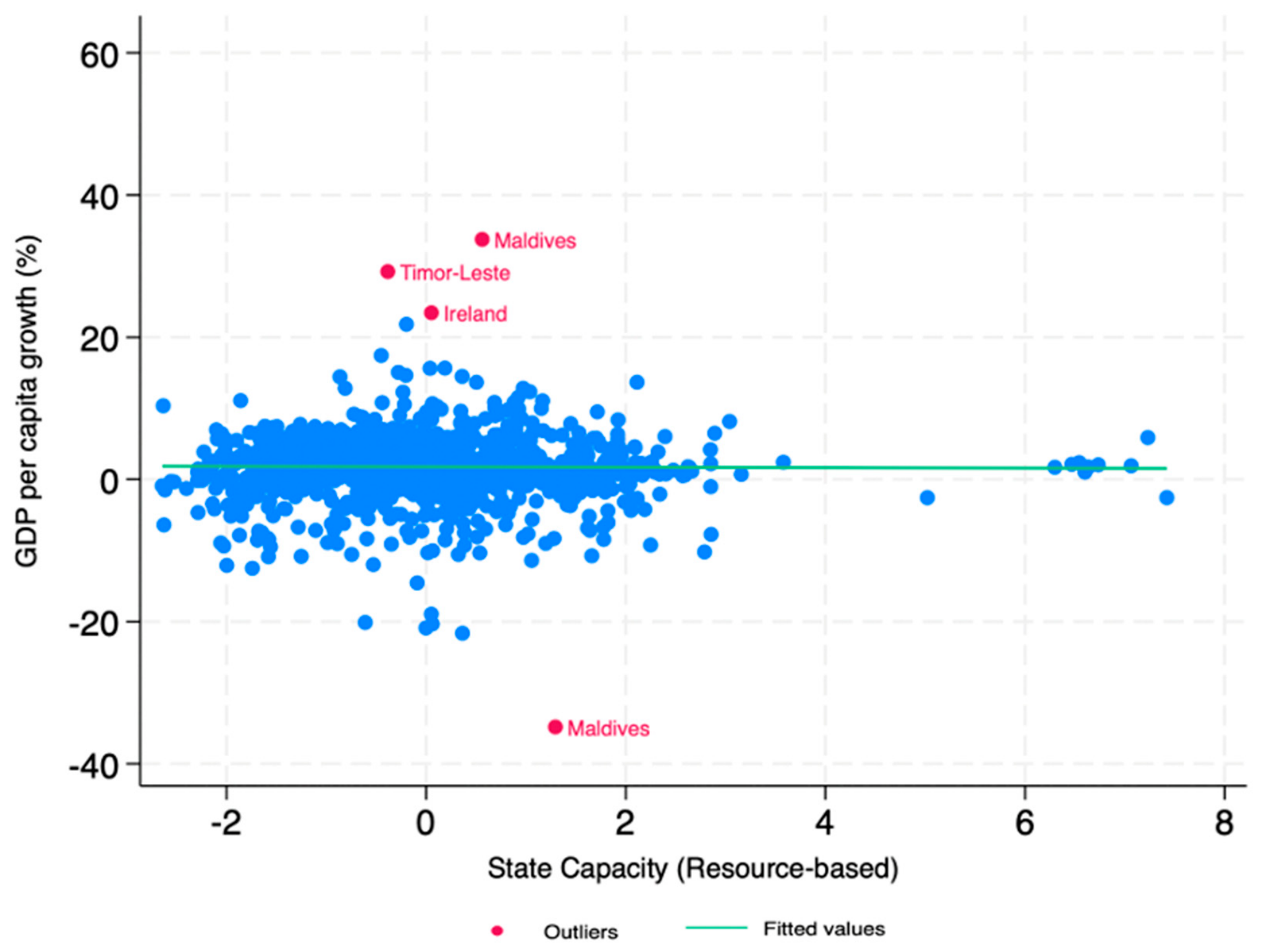
Figure 1 and Figure 2 provide an initial visual assessment of the relationship between state capacity and economic growth. Figure 1 shows a broadly dispersed cloud of observations with a near-flat fitted line, indicating no strong unconditional relationship between state capacity and GDP per capita growth. While most countries cluster around modest growth rates, several outliers exhibit extreme positive or negative performance, reflecting country-specific shocks or rebound effects. This dispersion suggests that economic growth is influenced by multiple structural and contextual factors beyond state capacity alone, underscoring the need for a strategic multivariate analysis.
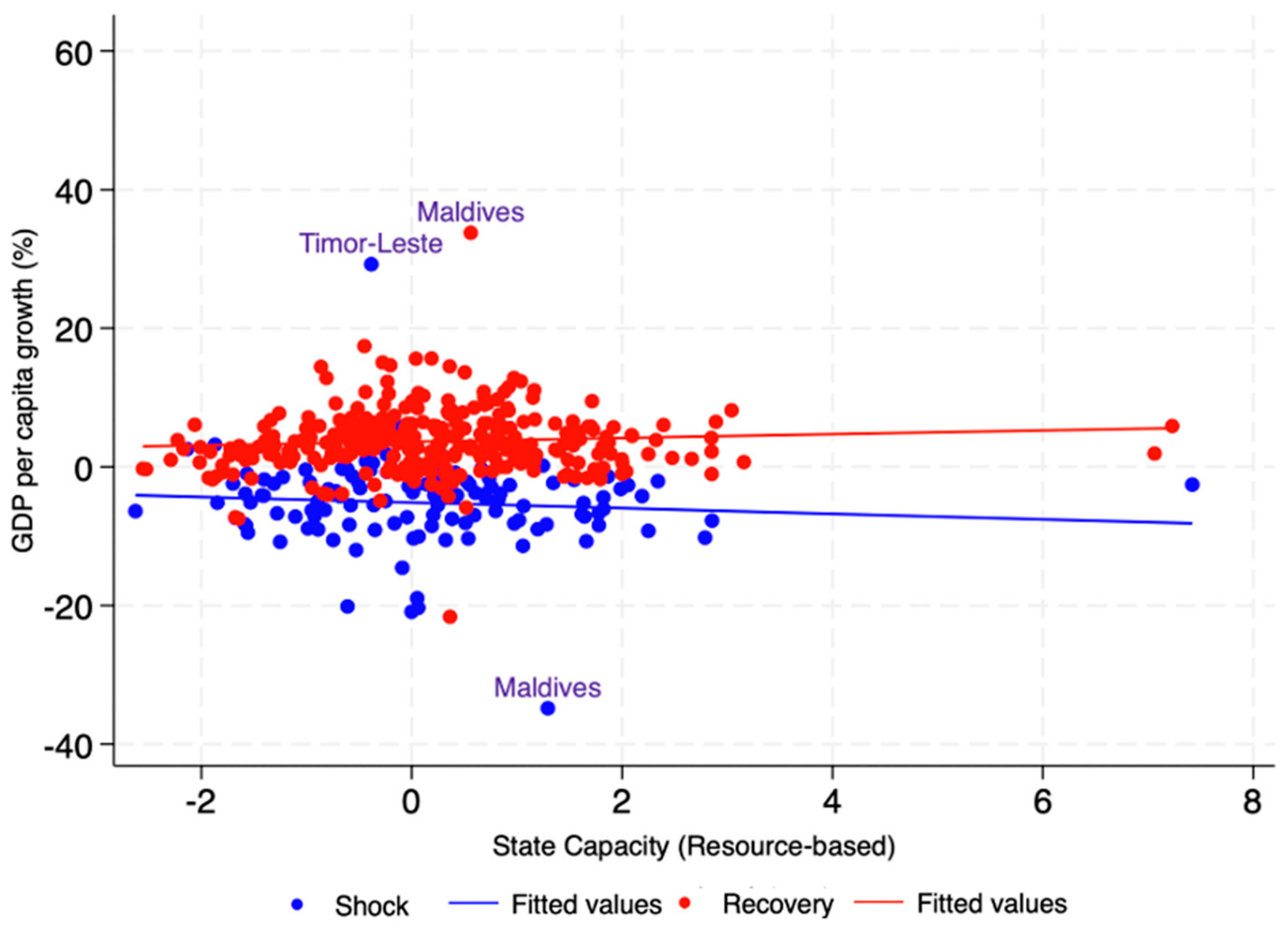
Figure 2 refines this descriptive picture by distinguishing between the COVID-19 shock (2020) and the recovery period (2021–2024). During the shock, the relationship between state capacity and growth appears slightly negative, implying that higher-capacity countries experienced deeper contractions. In contrast, during the recovery period, the relationship becomes positive, suggesting that countries with stronger state capacity achieved relatively better economic rebounds. These contrasting patterns indicate that while state capacity may not appear as a strong predictor of growth in normal times, it may play a more important role under crisis conditions, particularly in shaping recovery trajectories rather than cushioning the initial shock.

4.2. Stationarity Test

To assess the stationarity properties of the variables, the study employed the Fisher-type panel unit root test based on augmented Dickey–Fuller regressions. Log transformation is applied selectively to variables measured in large absolute monetary units: government consumption, imports, exports, and GDP per capita. Among the reasons, first, these variables exhibit substantial right-skew and heteroskedasticity due to the vast differences in economic size across the 193-country sample, and log transformation stabilises variance and improves the normality of residuals. Second, log transformation reduces the undue influence of extreme outliers that would otherwise distort coefficient estimates. Third, it facilitates elasticity-based interpretation of coefficients, expressing relationships in proportional rather than absolute terms, which is more meaningful for cross-country comparisons. Fourth, variables already expressed as percentages, indices, or bounded ratios, such as trade openness, inflation, investment, CO2 emissions, and the state capacity index, are retained in raw form because they are already scale-invariant and log transformation would distort their interpretability without conferring distributional benefits [51,52]. The test was conducted with one lag and a deterministic trend included. The null hypothesis states that all panels contain unit roots, while the alternative hypothesis suggests that at least one panel is stationary.
The results of the Fisher-type panel unit root tests in Table 2 indicate that all variables are stationary at level, as the null hypothesis of unit roots was rejected at conventional significance levels (p < 0.05). The findings therefore suggest that the variables are integrated of order zero, I(0), implying the absence of non-stationarity concerns in the panel dataset. Consequently, the study proceeded with estimation using the variables in levels within the fixed effects framework.

4.3. Cross-Section Dependence Test

Prior to model estimation, we also conducted the Pesaran cross-section dependence (CD) test under the null hypothesis that there is no correlation between error terms in our panel. That is
C o v ε i t , ε j t = 0 .                       f o r   i j
where ε i t is the error term for country i at time t, and ε j t   is the error term for country j at time t.
The results of our CD test using the residuals of the two-way fixed effects model are significant, such that we reject the null hypothesis and conclude that there is cross-sectional dependence across panel units (CD = 19.998, p < 0.001). This indicates the presence of common shocks and interdependence among countries. Consequently, the study employed fixed effects estimation with Driscoll–Kraay standard errors to account for the presence of cross-sectional dependence, heteroskedasticity, and serial correlation [53,54].

4.4. Resource-Based State Capacity Index

Table 3 presents the results of the principal component analysis in the measurement of our objective resource-based state capacity index from (1) tax revenue (% of GDP), (2) government consumption (% of GDP), and (3) health expenditure (% of GDP), which captures state extraction, administrative, and crisis-response capacities.
The eigenvalue for the first component (Comp1) of 1.627 makes up 54.2% of the total variance, the rest of which is shared between the remaining two eigenfactors. This component, therefore, is the principal component for state capacity. Importantly, all variables, namely tax revenue, government consumption, and health expenditure, depict strong positive loadings above 0.5. Comp2 and Comp3 have negative factor loadings, which suggest diversion in the relationship among the variables.

4.5. Model Estimation Results

This section presents the empirical results in Table 4 in a sequential manner, consistent with the study’s theoretical expectations. First, we present a baseline fixed-effects specification that estimates the average economic impact of the COVID-19 shock and subsequent recovery period, controlling for macroeconomic fundamentals and global time trends (Model 1a). This establishes the within-country effect of the pandemic on economic growth. We then examine whether these effects vary systematically across geographic regions by interacting the pandemic period indicators with regional classifications (Model 2a), thereby assessing cross-regional heterogeneity in both the severity of the shock and the pace of recovery. Building on this, Model 3a introduces an interaction between the pandemic period and our resource-based state capacity to evaluate whether state capacity conditions the economic impact of COVID-19. Finally, Model 4a isolates the post-pandemic period to assess whether state capacity plays a distinct role in shaping recovery dynamics. Across all models, we include country fixed effects to account for time-invariant heterogeneity, year fixed effects to control for common global shocks and trends, and Driscoll–Kraay standard errors at the country level. This progressive modelling strategy allows us to move from documenting the average effect of the pandemic to explaining cross-country variation in its economic consequences.
To begin with, the baseline results in Model 1 provide strong support for the first hypothesis. The estimated coefficient for the pandemic outbreak—“Shock (2020)”—is negative and highly statistically significant, indicating a substantial contraction in economic growth. Relative to the pre-COVID-19 period, the pandemic shock reduced GDP per capita growth by approximately 6.6 percentage points (β = −6.57, p < 0.001). This magnitude is consistent with emerging cross-country evidence showing that COVID-19 generated one of the most severe synchronised global downturns in modern economic history, driven by disruptions to production, labour markets, trade, and mobility [33,34]. Recent studies demonstrate that containment measures, while necessary for public health, imposed high short-term economic costs by restricting firm activity and reducing aggregate demand [34,55]. These findings support the interpretation that the COVID-19 shock operated through multiple transmission channels, amplifying its overall economic impact.
In contrast, the recovery (2021–2024) or post-2020 period is characterised by a modest but statistically significant recovery in economic growth. Specifically, growth increased by approximately 2.9 percentage points during 2021–2024 (β = 2.864, p < 0.001), indicating a partial rebound relative to the pandemic-induced contraction. However, the magnitude of recovery remains smaller than the initial decline, suggesting an incomplete adjustment process. This asymmetry aligns with a large body of macroeconomic research showing that the effects of major global shocks tend to persist over time, with recoveries often slower and uneven across countries [56,57]. Evidence from previous crises, such as the Global Financial Crisis, SARS, and Ebola, demonstrates that output losses can have long-lasting effects due to structural damage to firms, labour markets, and investment dynamics [58,59]. The observed gap between contraction and recovery in this study therefore reflects the persistent, path-dependent nature of large-scale economic disruptions.
Turning to regional heterogeneity, Model 2a reveals that the effects of the COVID-19 shock varied systematically across world regions. Using Africa as the reference category, the results indicate that countries in the Americas experienced significantly deeper economic contractions during the initial pandemic period. Specifically, the shock reduced economic growth in the Americas by an additional 2.9 percentage points relative to Africa (β = −2.939, p < 0.001). This finding is consistent with recent empirical work highlighting that economies in the Americas are more exposed to global financial cycles, international trade fluctuations, and service-sector disruptions, particularly in tourism and urban-based activities [60,61]. More broadly, regional differences should not be interpreted as the effects of geography per se. Rather, geographic regions capture clusters of structural and institutional characteristics that shape countries’ vulnerability to global shocks. Existing research suggests that factors such as dependence on tourism and contact-intensive services, integration into global value chains, fiscal space for stimulus measures, healthcare system preparedness, and levels of economic openness all influence the severity of pandemic-related economic disruptions and the pace of recovery. For example, many countries in the Americas are highly integrated into international trade and financial markets and exhibit relatively large service sectors, making them more vulnerable to disruptions in mobility and global demand [52]. At the same time, greater fiscal capacity and access to international capital markets may have facilitated stronger recovery efforts once restrictions were eased [62]. Consequently, the regional estimates reported here should be interpreted as reflecting broader structural differences across regions rather than the independent effect of geographic location itself.
By contrast, the results show no statistically significant differences between Africa and other regions (Asia, Europe, and Oceania) during the initial shock. This suggests that, despite differences in levels of development and institutional capacity, the immediate economic impact of COVID-19 was broadly homogeneous across most regions. Such findings are consistent with studies emphasising the global and synchronised nature of the pandemic shock, which affected both advanced and developing economies simultaneously through interconnected trade and financial systems [55].
With respect to the recovery period (2021–2024), the results in Model 2a indicate that countries in the Americas experienced a significantly stronger rebound than those in Africa, with growth increasing by approximately 2.8 percentage points (β = 2.771, p < 0.001). This represents a partial recovery of about 42.49% of the initial contraction, suggesting that economies most severely affected during the shock phase also exhibited stronger recovery dynamics. This pattern is consistent with evidence that economies with greater exposure to global markets may experience sharper downturns but also faster recoveries due to stronger policy responses, fiscal capacity, and reintegration into global economic activity [32,33]. In contrast, no statistically significant differences in recovery trajectories are observed between Africa and other regions, indicating broadly similar recovery paths.
Regarding the post-pandemic period (2021–2024) across regions, the interaction results in Model 2a show that countries in the Americas, which experienced the most severe economic contractions, also exhibited a statistically significant rebound relative to other regions. Specifically, the Americas recorded an increase in economic growth of approximately 3.4 percentage points, fully offsetting the initial pandemic-induced contraction. This suggests that countries most exposed to the initial shock also experienced relatively stronger recovery dynamics. In contrast, the pace of recovery in Africa does not differ systematically from that observed in Asia, Europe, and Oceania, as no statistically significant differences are detected across these regions.
This pattern is consistent with a growing body of literature showing that economies in the Americas tend to be more deeply integrated into global financial markets, trade networks, and capital flows, making them more susceptible to global downturns but also enabling faster rebounds when global conditions improve [60]. Higher levels of urbanisation, financial openness, and reliance on globally connected sectors, particularly services, tourism, and commodity exports, amplify both the depth of contractions and the speed of recovery, reflecting the cyclical nature of globally integrated economies. These findings support the second hypothesis that, while the COVID-19 pandemic was a global shock, its economic effects and recovery patterns varied dynamically across regions, most notably between the Americas and the rest of the world.
Building on these regional differences, we next examine whether the economic consequences of the pandemic are contingent on state capacity. Specifically, Model 3a introduces an interaction term between pandemic periods (pre-COVID, shock, and recovery) and state capacity. Relative to the pre-pandemic period, the results show that state capacity did not significantly affect the impact of the COVID-19 shock in 2020. However, the results show that state capacity significantly influenced the post-pandemic recovery between 2021 and 2024. These findings stand in contrast to a large body of literature that emphasises the role of strong institutions in buffering economic shocks; instead, they align with this literature on the role of state capacity in attenuating the effects of economic shocks [14,24,27]. However, recent empirical work on COVID-19 suggests that even high-capacity states faced substantial economic disruptions due to the global and synchronised nature of the shock, which limited the effectiveness of domestic policy responses [34,55].
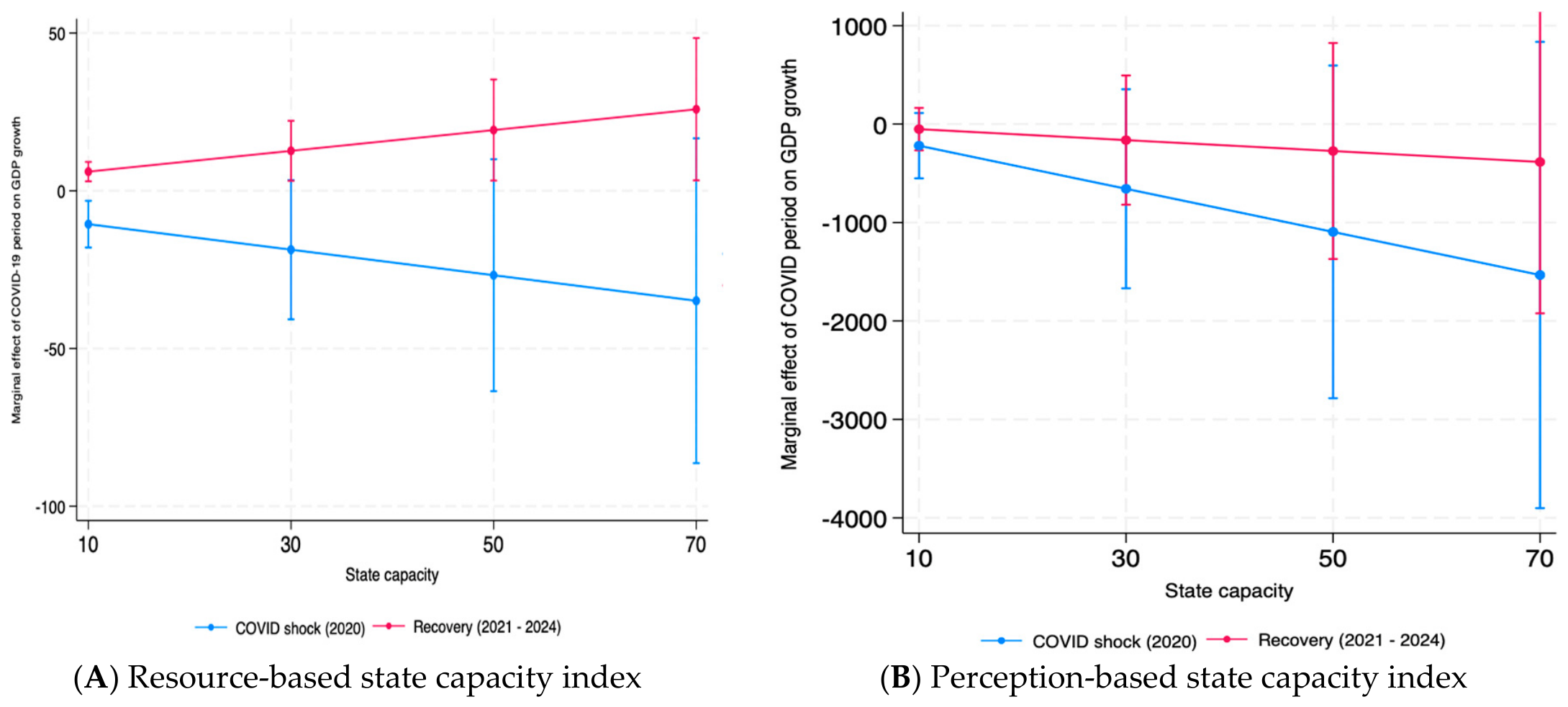
Further insight is provided by the marginal effects presented in Figure 3, which plots the impact of COVID-19 periods across different levels of state capacity. Consistent with Model 3a, the results in panel “A”, which uses a resource-based index of state capacity, show that the marginal effect of the COVID-19 crisis on GDP growth is uniformly negative across all observed levels of state capacity, yet the gradient is notably downward-sloping, which counterintuitively indicates that higher state capacity is associated with greater economic contraction. This may reflect the fact that higher-capacity states are more deeply integrated into global trade and financial networks, rendering them more exposed to the initial demand and supply-side disruptions of the pandemic [60]. Recovery trajectory, however, tells a markedly different story. The marginal effect during 2021–2024 is positive and statistically distinguishable from zero across most of the state capacity distribution, with the magnitude increasing monotonically as capacity rises. This pattern is consistent with the hypothesis that institutional strength, encompassing fiscal responsiveness, administrative efficiency, and policy implementation, is the primary determinant of post-crisis economic resilience. Indeed, high-state-capacity states implemented and monitored stricter containment measures, which, while effective in managing public health risks, imposed short-term economic costs and long-term recovery response [34].
As for the perception-based state capacity index measured by government effectiveness, the marginal effects show no clear evidence that state capacity conditions the pandemic’s economic effects. Across all levels of state capacity (ranging from very low to high), the estimated effect of the COVID-19 shock remains negative and, if anything, becomes more pronounced at higher levels of capacity. However, the associated confidence intervals are wide and overlap substantially, indicating that these differences are not statistically significant. This divergence justifies the anticipated measurement issues in our contribution to the development of an objective resource-based state capacity index.
Finally, Model 4a isolates the post-pandemic recovery period to assess whether state capacity plays a distinct role in shaping recovery dynamics. The results indicate that the recovery period is positively and significantly associated with economic growth (β = 6.591, p < 0.001), suggesting that, on average, countries experienced improved economic performance following the initial shock. However, both the direct effect of state capacity (β = −5.274, p > 0.05) and its interaction with the recovery period (β = 0.319, p > 0.05) remain statistically insignificant. This leads us to reject the hypothesis that state capacity significantly conditions post-pandemic recovery.
Overall, these findings suggest that while global and regional structural factors played a critical role in shaping economic outcomes during the COVID-19 pandemic, state capacity—at least in its conventional institutional form—did not systematically determine the depth of economic contraction but the strength of recovery. This underscores the importance of considering the global nature of shocks and the limits of domestic institutional capacity in mitigating their economic consequences.
The model incorporates several theoretically grounded control variables whose estimates largely conform to prior expectations. Government consumption (lnGCONS) exerts a consistently negative and statistically significant effect on GDP growth across all specifications, a finding consistent with the Keynesian crowding-out hypothesis, wherein expansionary public consumption displaces private-sector activity. Gross capital formation (INV), by contrast, carries a positive coefficient that achieves statistical significance in Model 4a (β = 0.131, p < 0.01), consistent with neoclassical growth theory’s emphasis on physical capital accumulation as a driver of output expansion, though its conditional significance across specifications suggests that its growth contribution is mediated by broader institutional and macroeconomic environments. Inflation (INF) is negative and highly significant across all models (ranging from −0.132 to −0.166, p < 0.01), reaffirming the well-established macroeconomic consensus that price instability erodes growth by distorting investment incentives and undermining real purchasing power. Trade openness (OPN) and CO2 emissions yield small, statistically insignificant coefficients throughout, suggesting that once structural factors are accounted for, neither global market integration nor emission intensity exerts a robust independent effect on GDP growth within a global sample. Most notably, state capacity (STATE) is positive and statistically significant across Models 1a to 3a (β ≈ 1.64–1.79, p < 0.01), corroborating the theoretical proposition that institutional quality constitutes a foundational determinant of economic performance and directly motivating the interaction specifications central to this analysis.

4.6. Robustness Checks

The robustness check substitutes the resource-based state capacity index with the World Bank’s government effectiveness indicator (GEFF). This indicator is a perception-based measure and yields results that are broadly consistent with the primary models in their directional patterns but diverge in statistical precision and magnitude, warranting careful interpretation. The COVID-19 shock coefficients remain negative and significant in Models 1b and 2b (β = −5.838 and −4.726, p < 0.01), mirroring the primary Table 5 findings, though the shock coefficient loses significance in Model 3b, suggesting that the interaction with GEFF absorbs some of its direct effect. The recovery period coefficients remain positive across specifications, consistent with Table 4, though significance is attenuated—reaching conventional thresholds only in Model 4b (β = 6.591, p < 0.05) compared to the robust significance observed throughout Table 4. Critically, GEFF itself is statistically insignificant across all models, in stark contrast to STATE’s consistently positive and significant coefficients in the primary analysis, and neither the Shock × GEFF nor Recovery × GEFF interaction terms achieve significance. The control variables behave consistently: lnGCONS remains negative and significant, INV positive and significant, and INF negative and highly significant throughout, lending confidence to the model’s broader specification.
The divergence between the two sets of results is theoretically instructive and likely reflects the fundamentally different dimensions of state capacity each index captures. The resource-based index, which we constructed from tax revenue, government health expenditure, and government consumption, measures the material and functional dimensions of state capacity: the actual crisis-response and the fiscal and administrative resources a state mobilises and deploys. Government effectiveness, by contrast, is a perception-based composite drawn from expert and citizen surveys, capturing reputational and procedural quality rather than concrete resource deployment. During an acute economic crisis such as the COVID-19 pandemic, it is plausible that what drives growth outcomes is not how a government is perceived to function but whether it actually possesses the fiscal and administrative machinery to intervene. This distinction aligns with Andrews’s [63] critique of isomorphic reform, wherein states may score well on perception-based governance indicators while lacking substantive operational capacity. The attenuated significance of GEFF may therefore reflect measurement noise inherent in survey-based indices, or a genuine theoretical proposition, that in crisis contexts, tangible state resources matter more than institutional reputation.

4.7. Limitations

The study acknowledges several limitations. First, although it employs a two-way fixed-effects framework with Driscoll–Kraay standard errors, this approach does not fully eliminate potential endogeneity concerns. For example, state capacity and economic performance may be jointly determined over the long term, while unobserved time-varying factors may simultaneously influence both variables. Second, although the COVID-19 pandemic represents an exogenous global shock that strengthens the empirical design, the findings should not be interpreted as providing definitive evidence of causality. Future research could build on these results by employing instrumental variable techniques, dynamic panel estimators, or quasi-experimental methods to better isolate the causal effects of state capacity on economic resilience during global crises.
A further limitation concerns the temporal classification of the pandemic. Although the study distinguishes between pre-pandemic, shock, and recovery periods, the COVID-19 crisis evolved differently across countries. Variations in lockdown intensity, vaccination rollout, fiscal stimulus programmes, and reopening strategies imply that recovery did not occur simultaneously across all national contexts. Consequently, the period indicators used in this study capture broad global phases of the pandemic rather than precise country-specific crisis dynamics. Future research could build on this framework by incorporating more granular measures of pandemic exposure, policy stringency, vaccination coverage, or country-specific recovery pathways.

5. Conclusions

This study has examined the economic effects of the COVID-19 pandemic across countries and over time, with particular attention paid to the role of state capacity. The findings demonstrate that the economic consequences of the COVID-19 pandemic were both substantial and uneven across countries, but more importantly, that the role of state capacity is fundamentally contingent on the phase of the crisis. While the pandemic generated a sharp and globally synchronised contraction in economic growth—reflected in the consistently large and statistically significant negative shock coefficients across all primary model specifications (β ≈ −5.663 to −6.565, p < 0.01)—these results confirm H1 that COVID-19 constituted a significant global economic shock that reduced growth. Recovery has been partial and heterogeneous across regions, with the Americas experiencing both deeper initial losses and stronger rebounds, as evidenced by the significant Shock × Americas (β = −2.939, p < 0.05) and Recovery × Americas (β = 3.428, p < 0.01) interaction terms in Model 2a, thereby confirming H2 that world regions experienced varying levels of economic impact.
The evidence with respect to the institutional hypotheses is more nuanced and theoretically instructive. H3, that higher state capacity attenuates the negative economic effects of the COVID-19 shock, is disconfirmed: the Shock × STATE interaction in Model 3a is statistically indistinguishable from zero (β = −0.405, p > 0.10), indicating that domestic institutional capacity provided no significant buffer against the acute phase of a globally synchronised crisis. H4—that higher state capacity is associated with stronger post-pandemic recovery—is confirmed: the positive and significant Recovery × STATE coefficients in Models 3a and 4a (β = 0.329 and 0.339, p < 0.05 and p < 0.01) establish that state capacity exerts a statistically and substantively important role in shaping post-pandemic recovery dynamics.
This temporal asymmetry—the disconfirmation of H3 alongside the confirmation of H4—challenges conventional expectations in the state capacity literature, which often assumes that stronger institutions uniformly buffer economies against shocks. Instead, the empirical evidence suggests that during globally synchronised crises, domestic institutional capacity is constrained in preventing economic downturns but becomes decisive in enabling recovery through fiscal support, administrative coordination, and crisis-response systems. Furthermore, the results highlight the importance of measurement: while the perception-based government effectiveness indicator fails to replicate these dynamics, yielding uniformly insignificant interaction terms across the robustness specifications in Table 4, the resource-based index reveals a significant and robust recovery-enhancing effect, underscoring that what matters in crisis contexts is the material and functional dimension of state capacity rather than its reputational or procedural proxy.
The policy implications of these findings are significant. First, the results suggest that governments should shift attention from the unrealistic goal of fully insulating economies from globally synchronised shocks toward strengthening the institutional foundations of recovery. Even high-capacity states were unable to prevent economic contractions during the initial COVID-19 shock; however, they were substantially better positioned to restore economic activity once the immediate crisis had passed.
Second, policymakers should prioritise investments in fiscal capacity. Strengthening domestic revenue mobilisation systems, improving tax administration, and expanding governments’ abilities to generate and deploy public resources can increase flexibility during future crises. Countries with stronger fiscal systems are better positioned to finance emergency interventions, support vulnerable households and firms, and sustain recovery programmes without compromising macroeconomic stability.
Third, the findings underscore the importance of administrative preparedness. Effective recovery depends not only on financial resources but also on the ability of public institutions to coordinate policy implementation, distribute support efficiently, and respond rapidly to changing circumstances. Investments in public-sector management, digital governance systems, and intergovernmental coordination mechanisms may therefore enhance resilience to future crises.
Fourth, the inclusion of health expenditure within the state-capacity framework highlights the importance of maintaining robust crisis-response institutions. Public health systems should be viewed not merely as social-sector expenditures but as strategic economic resilience assets. Investments in healthcare infrastructure, surveillance systems, emergency preparedness mechanisms, and public health workforce capacity can strengthen governments’ abilities to respond effectively to future epidemiological shocks.
Finally, international development partners should recognise that crisis resilience depends not only on short-term emergency assistance but also on long-term investments in state capacity. Programmes that strengthen fiscal institutions, administrative effectiveness, and public service delivery may generate substantial returns by improving countries’ ability to recover from future global disruptions. The evidence presented here suggests that recovery capacity, rather than shock prevention alone, should become a central objective of development and resilience-building strategies.

Author Contributions

Conceptualization, L.G.B. and J.A.C.; methodology, L.G.B. and E.G.Y.; software, L.G.B.; validation, J.A.C., E.G.Y., and L.G.B.; formal analysis, J.A.C., E.G.Y., and L.G.B.; investigation, J.A.C., E.G.Y., and L.G.B.; resources, J.A.C.; data curation, E.G.Y.; writing—original draft preparation, J.A.C., E.G.Y., and L.G.B.; writing—review and editing, J.A.C. and L.G.B.; visualization, E.G.Y.; supervision, L.G.B.; project administration, J.A.C.; funding acquisition, J.A.C. All authors have read and agreed to the published version of the manuscript.

Funding

This research received no external funding and the APC was funded by J.C.

Institutional Review Board Statement

Not applicable.

Informed Consent Statement

Not applicable.

Data Availability Statement

The datasets produced and examined in this investigation can be obtained from the corresponding author upon reasonable request.

Conflicts of Interest

The authors declare no conflicts of interest.

References

  1. Sunge, R.; Mudzingiri, C.; Mkhize, N. The COVID-19 pandemic and economic recovery: The mediating role of governance, a global perspective. Heliyon 2024, 10, e39869. [Google Scholar] [CrossRef] [PubMed]
  2. Gagnon, J.E.; Kamin, S.B.; Kearns, J. The impact of the COVID-19 pandemic on global GDP growth. J. Jpn. Int. Econ. 2023, 68, 101258. [Google Scholar] [CrossRef] [PubMed]
  3. International Monetary Fund (IMF). World Economic Outlook: Countering the Cost-of-Living Crisis; International Monetary Fund (IMF): Washington, DC, USA, 2022. [Google Scholar]
  4. World Trade Organization. World Trade Statistical Review 2021. 2021. Available online: https://www.wto.org/english/res_e/statis_e/wts2021_e/wts2021_e.pdf (accessed on 5 June 2023).
  5. World Bank. World Bank Open Data. GDP per Capita (Current US$) [Data Set]. 2023. Available online: https://data.worldbank.org/indicator/NY.GDP.PCAP.CD (accessed on 27 September 2025).
  6. World Tourism Organisation. COVID-19 and Tourism. 2020: A Year in Review. 2023. Available online: https://webunwto.s3.eu-west-1.amazonaws.com/s3fs-public/2020-12/2020_Year_in_Review_0.pdf (accessed on 5 June 2023).
  7. Maliszewska, M.; van der Mensbrugghe, D.; Mattoo, A. The Potential Impact of COVID-19 on GDP and Trade: A Preliminary Assessment; World Bank: Washington, DC, USA, 2020. [Google Scholar] [CrossRef]
  8. World Bank. Global Economy is Resilient, But Vulnerable Countries Lag; World Bank: Washington, DC, USA, 2021. [Google Scholar]
  9. International Monetary Fund. I. A Crisis Like No Other, An Uncertain Recovery. In World Economic Outlook Update; International Monetary Fund: Washington, DC, USA, 2020. [Google Scholar]
  10. McKibbin, W.; Fernando, R. The global economic impacts of the COVID-19 pandemic. Econ. Model. 2023, 129, 106551. [Google Scholar] [CrossRef]
  11. Mohamed, A.A.; de Araujo, J.M.; Cintado, A.C.G. Navigating post-COVID-19 economic recovery in WAEMU: A DSGE approach. Econ. Anal. Policy 2024, 84, 707–724. [Google Scholar] [CrossRef]
  12. Adaid, F.A.P.; Banda, L.G.; Chirwa, J.A.; Chidzanja, C.; Mavhura, B. State capacity and growth in Sub-Saharan Africa: A dynamic panel examination of the pillars of prosperity. Front. Polit. Sci. 2025, 6, 1487658. [Google Scholar] [CrossRef]
  13. Acemoglu, D.; Robinson, J. Why Nations Fail: The Origins of Power, Prosperity and Poverty, 1st ed.; Crown: New York, NY, USA, 2012; 529p. [Google Scholar]
  14. Besley, T.; Persson, T. Pillars of Prosperity; Princeton University Press: Princeton, NJ, USA, 2011; Available online: http://princeton.universitypressscholarship.com/view/10.23943/princeton/9780691152684.001.0001/upso-9780691152684 (accessed on 19 April 2026).
  15. Pradhan, R.P.; Nair, M.S.; Arvin, M.B.; Hall, J.H. Institutional quality, financial development and sustainable economic growth among lower income countries. Nat. Resour. Forum 2023, 47, 435–483. [Google Scholar] [CrossRef]
  16. Ramzan, M.; Yao, H.; Abbas, Q.; Fatima, S.; Hussain, R.Y. Role of institutional quality in debt-growth relationship in Pakistan: An econometric inquiry. Heliyon 2023, 9, e18574. [Google Scholar] [CrossRef] [PubMed]
  17. Banda, L. Good Governance and Human Welfare Development in Malawi: An ARDL Approach. Malawi J. Soc. Sci. 2023, 22, 89–119. [Google Scholar] [CrossRef]
  18. Banda, L.G.; Kamanga, B. The Global Economic Effects of Pandemic Outbreak, COVID-19 in Malawi. SSRN Electron. J. 2020, 8, 1–14. [Google Scholar] [CrossRef]
  19. Chen, D.; Peng, D.; Rieger, M.O.; Wang, M. Institutional and cultural determinants of speed of government responses during COVID-19 pandemic. Humanit. Soc. Sci. Commun. 2021, 8, 171. [Google Scholar] [CrossRef]
  20. Serikbayeva, B.; Abdulla, K.; Oskenbayev, Y. State Capacity in Responding to COVID-19. Int. J. Public Adm. 2021, 44, 920–930. [Google Scholar] [CrossRef]
  21. North, D.C. Instititutions. J. Econ. Perspect. 1991, 5, 97–112. [Google Scholar] [CrossRef]
  22. Rodrik, D.; Subramanian, A.; Trebbi, F. Institutions Rule: The Primacy of Institutions over Geography and Integration in Economic Development. J. Econ. Growth 2004, 9, 131–165. [Google Scholar] [CrossRef]
  23. Acemoglu, D.; Johnson, S.; Robinson, J. Institutions as a fundamental cause of long-run growth. In Handbook of Economic Growth; Aghion, P., Durlauf, S., Eds.; Elsevier: Armstedam, The Netherlands, 2005; pp. 385–472. Available online: https://www.sciencedirect.com/science/chapter/handbook/abs/pii/S1574068405010063 (accessed on 12 May 2026).
  24. Acemoglu, D.; Naidu, S.; Restrepo, P.; Robinson, J.A. Democracy Does Cause Growth. J. Polit. Econ. 2019, 127, 47–100. [Google Scholar] [CrossRef] [PubMed]
  25. Banda, L.G. The Impact of the Institution of Rule of Law and Inclusive Economic Development in the African Union. SSRN 2026, 14, 1–20. [Google Scholar] [CrossRef]
  26. Besley, T.; Persson, T. The Origins of State Capacity: Property Rights, Taxation, and Politics. Am. Econ. Rev. 2009, 99, 1218–1244. [Google Scholar] [CrossRef]
  27. Hanson, J.K.; Sigman, R. Leviathan’s Latent Dimensions: Measuring State Capacity for Comparative Political Research. J. Polit. 2021, 83, 1495–1510. [Google Scholar] [CrossRef]
  28. Evans, P.; Rauch, J.E. Bureaucracy and Growth: A Cross-National Analysis of the Effects of “Weberian” State Structures on Economic Growth. Am. Sociol. Rev. 1999, 64, 748. [Google Scholar] [CrossRef]
  29. Greer, S.L.; King, E.J.; da Fonseca, E.M.; Peralta-Santos, A. The comparative politics of COVID-19: The need to understand government responses. Glob. Public Health 2020, 15, 1413–1416. [Google Scholar] [CrossRef] [PubMed]
  30. Briguglio, L.; Cordina, G.; Farrugia, N.; Vella, S. Economic Vulnerability and Resilience: Concepts and Measurements. Oxf. Dev. Stud. 2009, 37, 229–247. [Google Scholar] [CrossRef]
  31. Martins, N.O. The Capability Approach as a Human Development Paradigm and its Critiques. In Encyclopedia of Life Support Systems (EOLSS); Eolss Publishers Co., Ltd.: Abu Dhabi, United Arab Emirates, 2012; Available online: http://www.eolss.net/sample-chapters/c11/e1-20-39.pdf (accessed on 22 April 2026).
  32. International Monetary Fund. Recovery During a Pandemic: Health Concerns, Supply Disruptions, and Price Pressures; IMF: Washington, DC, USA, 2021. [Google Scholar]
  33. Chetty, R.; Friedman, J.N.; Stepner, M. The Economic Impacts of COVID-19: Evidence from a New Public Database Built Using Private Sector Data. Q. J. Econ. 2024, 139, 829–889. [Google Scholar] [CrossRef] [PubMed]
  34. Deb, P.; Furceri, D.; Ostry, J.D.; Tawk, N. The Economic Effects of COVID-19 Containment Measures. Open Econ. Rev. 2022, 33, 1–32. [Google Scholar] [CrossRef]
  35. Athira, A.; Ramesh, V.K.; Sinu, M. COVID-19 pandemic and firm performance: An empirical investigation using a cross-country sample. IIMB Manag. Rev. 2024, 36, 269–281. [Google Scholar] [CrossRef]
  36. UNECA. Delivering the African Economic Community: Towards an African Continental Customs Union and African Continental Common Market; UNECA: Addis Ababa, Ethiopia, 2025. [Google Scholar]
  37. Muthu, K.; Wesson, N. The impact of COVID-19 on company performance per industry sector: Evidence from South Africa. J. Econ. Financ. Sci. 2023, 16, a801. [Google Scholar] [CrossRef]
  38. Djankov, S.; Panizza, U. COVID-19 in Developing Economies; Centre for Economic Policy Research: London, UK, 2020. [Google Scholar]
  39. Loayza, N.V.; Sanghi, A.; Shaharuddin, N.; Wuester, L. Recovery from the Pandemic Crisis; World Bank: Washington, DC, USA, 2020. [Google Scholar] [CrossRef]
  40. Edwards, F.L.; Ott, J.S. Governments’ Responses to the COVID-19 Pandemic. Int. J. Public Adm. 2021, 44, 879–884. [Google Scholar] [CrossRef]
  41. Barthélémy, S.; Binet, M.E.; Pentecôte, J.S. Worldwide economic recoveries from financial crises through the decades. J. Int. Money Financ. 2020, 105, 102204. [Google Scholar] [CrossRef]
  42. Tevdovski, D.; Jolakoski, P.; Stojkoski, V. The impact of state capacity on the cross-country variations in COVID-19 vaccination rates. Int. J. Health Econ. Manag. 2022, 22, 237–255. [Google Scholar] [CrossRef] [PubMed]
  43. World Bank. GDP per Capita Growth (Annual %). 2026. Available online: https://data.worldbank.org/indicator/NY.GDP.PCAP.KD.ZG (accessed on 23 May 2026).
  44. Banda, L.G.; Chirwa, G.C.; Chasukwa, M. Policy Effectiveness, Climate Change, and Agricultural Production in Africa and Asia. In Africa’s External Engagement, Africa’s Global Engagement: Perspectives from Emerging Countries, 1st ed.; Dubey, A., Solomon, H., Eds.; Palgrave MacMillan: Basingstoke, UK, 2026; pp. 145–168. [Google Scholar] [CrossRef]
  45. Savoia, A.; Sen, K. Measurement, evolution, determinants, and consequencies of state capacity: A review of recent research. J. Econ. Surv. 2015, 29, 441–458. [Google Scholar] [CrossRef]
  46. Vaccaro, A. Measures of state capacity: So similar, yet so different. Qual. Quant. 2023, 57, 2281–2302. [Google Scholar] [CrossRef]
  47. Andersen, D.; Møller, J.; Rørbæk, L.; Skaaning, S.E. The State-Democracy Nexus; Møller, J., Skaaning, S.E., Eds.; Routledge: Abingdon, UK, 2016. [Google Scholar] [CrossRef]
  48. Kaufmann, D.; Kraay, A. The Worldwide Governance Indicators: Methodology and 2024 Update; World Bank: Washington, DC, USA, 2023. [Google Scholar]
  49. World Bank. World Bank Open Data. Gross Capital Formation (% of GDP), World Development Indicators (WDI). 2026. Available online: https://databank.worldbank.org/source/jobs/Series/NE.GDI.TOTL.ZS (accessed on 14 May 2026).
  50. World Bank. Inflation, Consumer Prices (Annual %). World Development Indicators (WDI). 2026. Available online: https://data.worldbank.org/indicator/FP.CPI.TOTL.ZG (accessed on 14 May 2026).
  51. Wooldridge, J.M. Econometric Analysis of Cross Section and Panel Data; MIT Press: Cambridge, UK, 2010. [Google Scholar]
  52. Kassam, Z.Z.; Banda, L.G. E-commerce and household consumption in the United States: An arrangement of convenience. Cogent Bus. Manag. 2023, 10, 2275360. [Google Scholar] [CrossRef]
  53. Driscoll, J.C.; Kraay, A.C. Consistent Covariance Matrix Estimation with Spatially Dependent Panel Data. Rev. Econ. Stat. 1998, 80, 549–560. [Google Scholar] [CrossRef]
  54. Vogelsang, T.J. Heteroskedasticity, autocorrelation, and spatial correlation robust inference in linear panel models with fixed-effects. J. Econom. 2012, 166, 303–319. [Google Scholar] [CrossRef]
  55. Bonadio, B.; Huo, Z.; Levchenko, A.A.; Pandalai-Nayar, N. Global supply chains in the pandemic. J. Int. Econ. 2021, 133, 103534. [Google Scholar] [CrossRef] [PubMed]
  56. Cerra, V.; Fatás, A.; Saxena, S.C. Hysteresis and Business Cycles. J. Econ. Lit. 2023, 61, 181–225. [Google Scholar] [CrossRef]
  57. Jordà, Ò.; Singh, S.R.; Taylor, A.M. Longer-Run Economic Consequences of Pandemics. Rev. Econ. Stat. 2022, 104, 166–175. [Google Scholar] [CrossRef]
  58. Barro, R.; Ursúa, J.; Weng, J. The Coronavirus and the Great Influenza Pandemic: Lessons from the “Spanish Flu” for the Coronavirus’s Potential Effects on Mortality and Economic Activity; National Bureau of Economic Research: Cambridge, MA, USA, 2020. [Google Scholar] [CrossRef]
  59. Ma, C.; Rogers John, H.; Zhou, S. Global economic and financial effects of 21st century pandemics and epidemics. In COVID Economics, Vetted and Real-Time Papers; CEPR Press: Paris, France, 2020; pp. 56–78. [Google Scholar]
  60. Ayhan Kose, M.; Ohnsorge, F. Emerging and Developing Economies: Ten Years After the Global Recession. SSRN Electron. J. 2020. [Google Scholar] [CrossRef]
  61. Banda, L. Tourism development and economic growth nexus in Malawi—A time-series data analysis. Int. J. Tour. Hosp. 2021. [Google Scholar] [CrossRef]
  62. Goldstein, I.; Koijen, R.S.J.; Mueller, H.M. COVID-19 and Its Impact on Financial Markets and the Real Economy. Rev. Financ Stud. 2021, 34, 5135–5148. [Google Scholar] [CrossRef]
  63. Andrews, M. The Limits of Institutional Reform in Development; Cambridge University Press: Cambridge, UK, 2013. [Google Scholar] [CrossRef]
Figure 1. State capacity and global economic growth. Note: Scatter plot of GDP per capita growth and state capacity (WGI). Highlighted observations represent outliers, and the fitted line indicates the overall linear association.
Covid 06 00117 g001
Figure 2. State capacity and growth during COVID-19. Note: Scatter plots of GDP per capita growth and state capacity during the COVID-19 periods. Blue points represent the 2020 shock, and red points represent the recovery period (2021–2024), with fitted lines illustrating conditional trends.
Covid 06 00117 g002
Figure 3. Marginal effects of the COVID-19 period on GDP growth at different levels of state capacity (95% CI).
Covid 06 00117 g003
Table 1. Variable details.
VariableCodeParameterSignSource
Economic growthGDPGROGDP per capita growth (annual %)World Bank
Government consumptionGCONSGeneral government final consumption expenditure (constant 2015 US$)−veWorld Bank
Health expenditureHEXPCurrent health expenditure (% of GDP)+veWorld Bank
Government effectivenessGEFFGovernment effectiveness: standard error+veWorld Bank
InflationINFInflation consumer prices (annual %)−veWorld Bank
ImportsIMPImports of goods and services (constant 2015 US$)−veWorld Bank
ExportsEXPExports of goods and services (constant 2015 US$)+veWorld Bank
Trade opennessOPNSum of exports and imports by GDP and multiplying by 100.+veWorld Bank
Carbon emissionsCO2Carbon dioxide (CO2) emissions (total) excluding LULUCF (% change from 1990)−veWorld Bank
Note: expected sign (sign) = −ve, negative; +ve, positive. Source: Authors’ compilation. … not applicable.
Table 2. Fischer-type panel unit root test results.
VariableFischer-ADF (No Trend)Fischer-ADF (with Trend)
Chi-Statisticp-ValueChi-Statisticp-ValueDecision
lnCONS229.970.9998410.050.0002I(0)
INV639.770.00001212.010.0000I(0)
GEFF86.620.8049626.110.0000I(0)
INF780.760.00001113.190.0000I(0)
OPN484.890.0000588.970.0000I(0)
CO2374.370.3981549.930.0000I(0)
lnGDP294.450.9995402.140.0000I(0)
lnIMP247.450.9978647.230.0000I(0)
lnEXP258.430.9903389.790.0000I(0)
Note: Fisher-type panel unit root tests are based on augmented Dickey–Fuller regressions with one lag and deterministic trend included. The null hypothesis states that all panels contain unit roots.
Table 3. Principal component analysis for resource-based state capacity index.
ComponentEigen Values% of VarianceCumulativeEigenvectors
PCETTAJ
Component 11.6270.5420.5420.5150.7360.526
Component 21.0390.3470.8890.469−0.6780.489
Component 30.3330.1111.0000.7180.005−0.696
Source: Authors’ analysis.
Table 4. Stagist model estimation results.
VariablesModel 1aMode 2aModel 3aModel 4a
Period (Pre-COVIDRef)
    Shock (2020)−6.565 ***
(0.605)
−5.663 ***
(1.038)
−6.522 ***
(0.604)
    Recovery (2021–2024)2.864 ***
(0.461)
2.160 ***
(0.606)
2.771 ***
(0.472)
6.934 ***
(0.651)
Period × Region
    Shock × Americas−2.939 **
(1.519)
    Shock × Asia−1.581
(2.103)
    Shock × Europe−0.676
(1.140)
    Shock × Oceania1.948
(1.366)
    Recovery × Americas3.428 ***
(0.947)
    Recovery × Asia0.542
(1.061)
    Recovery × Europe0.219
(0.579)
    Recovery × Oceania−0.299
(1.109)
lnGCONS−3.419 ***
(0.997)
−3.425 **
(1.002)
−3.321 ***
(1.009)
−8.121 ***
(1.506)
INV0.052
(0.040)
0.044
(0.041)
0.049
(0.041)
0.131 ***
(0.047)
STATE1.639 ***
(0.487)
1.791 ***
(0.480)
1.693 ***
(0.471)
INF−0.133 ***
(0.024)
−0.136 ***
(0.021)
−0.132 ***
(0.023)
−0.166 ***
(0.032)
Shock × STATE−0.405
(0.375)
Recovery × STATE0.329 **
(0.166)
0.339 ***
(0.206)
OPN0.026
(0.019)
0.030
(0.020)
0.026
(0.019)
0.027
(0.023)
CO2−0.008
(0.001)
0.024
(0.001)
−0.288
(0.008)
Constant30.269 ***
(8.805)
30.156 ***
(8.667)
29.452 ***
(8.898)
68.727 ***
(13.591)
Obs.1124112411241124
Groups129129129129
R20.3490.4160.39300.284
Year Fixed EffectsYesYesYesYes
Country Fixed EffectsYesYesYesYes
Note: * p < 0.10; ** p < 0.05; *** p < 0.01; … not applicable; Driscoll–Kraay standard errors in paratheses. All models are jointly significant at 1% level (F1 = 26.42, F2 = 22.59, F3 = 22.59, F4 = 19.61).
Table 5. Model estimation results with a perception-based state capacity index.
VariablesModel 1bMode 2bModel 3bModel 4b
Period (Pre-COVIDRef)
    Shock (2020)−5.838 ***
(0.759)
−4.726 ***
(1.019)
−0.506
(4.038)
    Recovery (2021–2024)2.688 ***
(0.880)
2.842 ***
(0.883)
4.024
(2.580)
6.591 **
(3.336)
Period × Region
    Shock × Americas−3.546 **
(1.459)
    Shock × Asia−1.083
(1.801)
    Shock × Europe−1.114
(1.105)
    Shock × Oceania1.536
(1.559)
    Recovery × Americas2.482 **
(0.777)
    Recovery × Asia−0.404
(0.857)
    Recovery × Europe−0.734
(0.538)
    Recovery × Oceania−1.803
(01.090)
lnGCONS−2.607 **
(1.177)
−2.821 **
(1.177)
−2.643 **
(1.183)
−5.553 ***
(1.686)
INV0.077 **
(0.034)
0.077 **
(0.034)
0.079 **
(0.035)
0.116 ***
0.035
GEFF−20.793
(18.058)
−23.976
(19.326)
−16.565
(16.908)
−54.274
(32.999)
INF−0.019 ***
(0.006)
−0.020 ***
(0.006)
−0.021 **
(0.006)
−0.027 ***
(0.008)
Shock × GEFF−21.897
(17.322)
Recovery × GEFF−5.554
(11.244)
0.319
(15.424)
OPN0.016
(0.016)
0.019
(0.016)
0.012
(0.015)
0.021
(0.019)
CO2−0.004
(0.008)
0.003
(0.007)
−0.001
(0.001)
−0.002
(0.001)
_cons26.503 **
(11.662)
28.782 **
(11.591)
26.189 **
(11.222)
Obs.1449144914491449
Groups155155155155
R20.36710.31770.29890.2283
Year Fixed EffectsYesYesYesYes
Country Fixed EffectsYesYesYesYes
Note: * p < 0.10; ** p < 0.05; *** p < 0.01; … not applicable; Driscoll–Kraay standard errors in paratheses. All models are jointly significant at 1% level (F1 = 35.88, F2 = 23.09, F3 = 23.09, F4 = 17.91).
Disclaimer/Publisher’s Note: The statements, opinions and data contained in all publications are solely those of the individual author(s) and contributor(s) and not of MDPI and/or the editor(s). MDPI and/or the editor(s) disclaim responsibility for any injury to people or property resulting from any ideas, methods, instructions or products referred to in the content.