Next Article in Journal
Traditional Versus Intentionally Created Severity Scores for COVID-19 Prognosis: Evidence from a Portuguese Cohort
Previous Article in Journal
Evaluation of the Post-COVID-19 Functional Status Scale Based on Its Use During a One-Year Follow-Up of COVID-19 Survivors
Previous Article in Special Issue
Intra-Rater Reliability of 30 s Sit-To-Stand and Timed-Up-and-Go Tests in Older Adults with Post-COVID-19 Syndrome: A Pilot Study
 
 
covid-logo
Article Menu
Article

Heart Rate Recovery After Six-Minute Walk Test, Pulmonary Function, Dyspnea, and Functional Status After COVID-19


by
Adriano Luis Fonseca
1,
Miriã Cândida Oliveira
1,
Daniela Rosana Pedro Fonseca
1,
João Pedro R. Afonso
1,
Heren Nepomuceno Costa Paixão
1,
Jairo Belém Soares Ribeiro Júnior
2,
Larissa Rodrigues Alves
2,
Tiago Vieira Fernandes
2,3,
Daniel Grossi Marconi
3,4,
Rodrigo A. C. Andraus
1,
Carlos Hassel Mendes Silva
2,
Iransé Oliveira-Silva
1,
Orlando Aguirre Guedes
5,
Claudia S. Oliveira
1,2,3,
Natasha Yumi Matsunaga Spicacci
6,
Maria Clara Real Pedro Fonseca
7,
Wilson Rodrigues Freitas Júnior
1,2,
Paolo Capodaglio
8,9 and
Luis Vicente F. Oliveira
1,2,3,*
1
Graduate Program in Human Movement and Rehabilitation (PPGMHR), Evangelical University of Goiás (UNIEVANGELICA), Anápolis 75083-515, Brazil
2
Health Sciences Graduate Program (PPGCS), Faculty of Medical Sciences (FCMSCSP), Irmandade da Santa Casa de Misericórdia de São Paulo, São Paulo 01238-010, Brazil
3
Centro Especializado em Reabilitação (CER), Barretos Cancer Hospital, Araguaína 65907-230, Brazil
4
Professional Master’s Program in Health Innovation, Hospital de Câncer de Barretos, Barretos 14784-400, Brazil
5
Dentistry Graduate Program (PPGO), Evangelical University of Goiás, Anápolis 75083-515, Brazil
6
Functional Health Department, Institute of Tropical Pathology and Public Health (IPTSP), Federal University of Goiás (UFG), Goiânia 74690-900, Brazil
7
Institute of Medical Education—IDOMED/Estácio, Castanhal 68746-360, Brazil
8
Orthopaedic Rehabilitation Unit, Research Laboratory for Biomechanics, Rehabilitation and Ergonomics, Ospedale San Giuseppe, 20123 Milan, Italy
9
Physical and Rehabilitation Medicine Sector, Department of Biomedical, Surgical and Dental Sciences, University of Milan, 20122 Milan, Italy
*
Author to whom correspondence should be addressed.
COVID 2026, 6(5), 82; https://doi.org/10.3390/covid6050082 (registering DOI)
Submission received: 8 April 2026 / Revised: 8 May 2026 / Accepted: 9 May 2026 / Published: 14 May 2026
(This article belongs to the Special Issue Post-COVID-19 Muscle Health and Exercise Rehabilitation)

Abstract

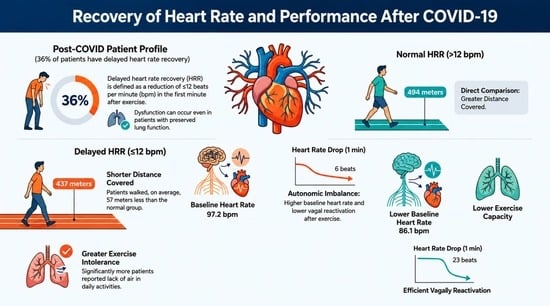
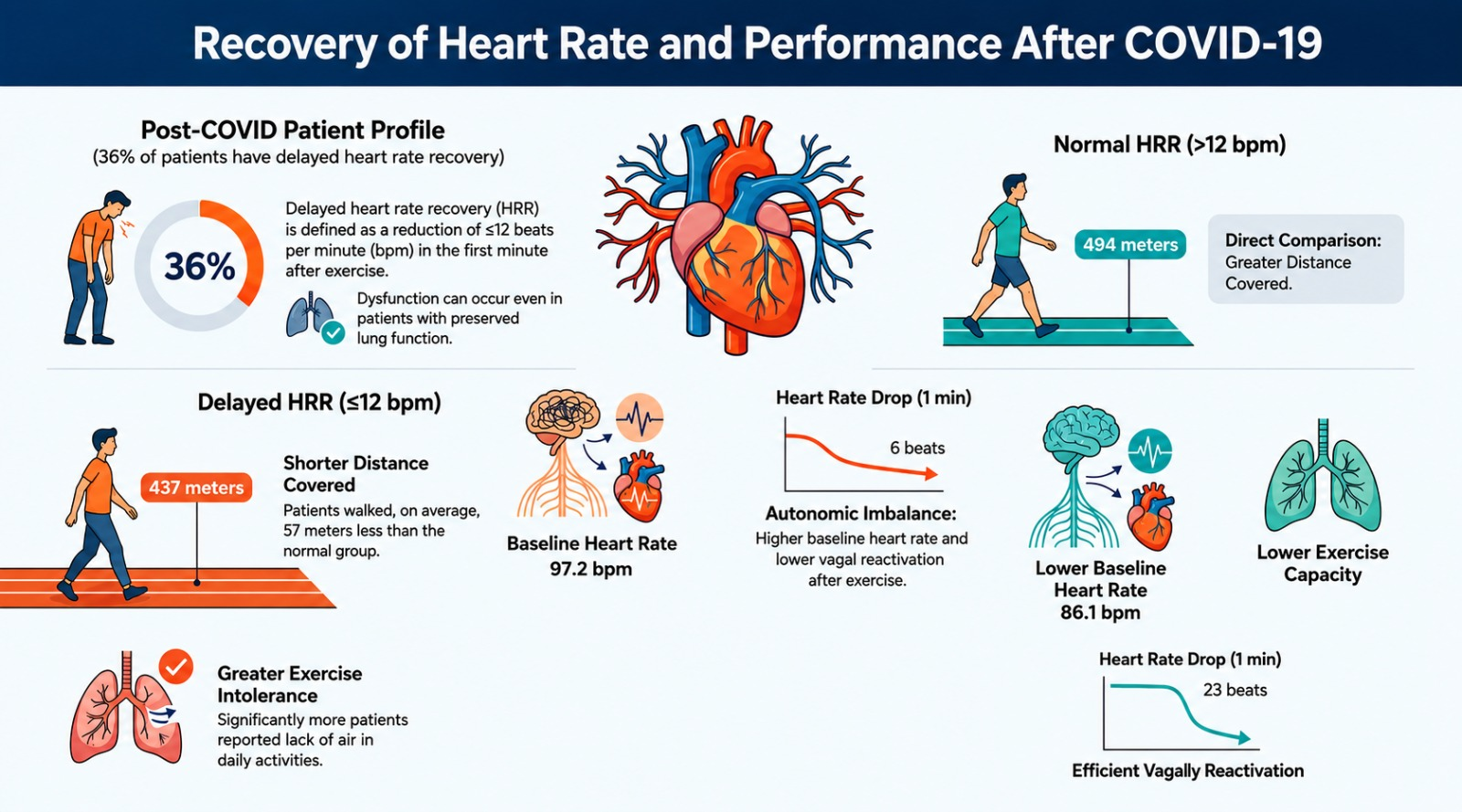
Introduction: Coronavirus disease 2019 (COVID-19) can cause persistent cardiovascular alterations, including autonomic dysfunction. Heart rate (HR) recovery (HRR) after exercise is a simple marker of autonomic modulation associated with functional capacity and clinical prognosis. Evaluating HRR during the six-minute walk test (6MWT) may help identify residual functional limitations in diverse patients. Objective: To compare pulmonary function, maximal inspiratory pressure (MIP), functional capacity, dyspnea, fatigue, and functional status in post-COVID-19 patients. Methods: This cross-sectional study included 75 adults (mean age: 47.6 ± 13.1 years; 54.7% male) who recovered from COVID-19 divided into 2 groups based on HRR 1 min after the 6MWT: delayed (≤12 beats/min); and non-delayed (>12 beats/min). Pulmonary function, MIP, exercise capacity (via 6MWT), dyspnea, muscle fatigue, and functional status were assessed. Results: Based on HRR 1 min after 6MWT, 27 (36%) participants were classified with abnormal HRR and 48 (64%) with normal HRR. There were statistical differences between the groups regarding demographic or clinical characteristics, pulmonary function, MIP, muscle fatigue, or functional status (p > 0.05). The delayed HRR group exhibited a smaller reduction in HR in first minute of recovery (ΔHR = 6 vs. 23 beats/min), higher baseline HR (p = 0.010), and greater dyspnea (p = 0.020). Furthermore, this group exhibited worse functional performance in the 6MWT, with shorter distance walked (437.33 vs. 494.27 m; p = 0.019) and a lower percentage of predicted distance (74.66 ± 12.98% vs. 82.94 ± 15.71%; p = 0.023) compared with the non-delayed HRR group. Conclusion: Delayed HRR post-COVID-19 was associated with poorer functional performance and greater dyspnea, regardless of pulmonary function. The blunted reduction in HRR after exertion suggests impaired cardiovascular autonomic modulation, possibly related to attenuated vagal reactivation, which may contribute to exercise intolerance observed in this population.

Graphical Abstract

1. Introduction

Infection with severe acute respiratory syndrome coronavirus 2 (SARS-CoV-2) begins with the dissemination of viral particles through the respiratory tract, promoting the invasion of epithelial cells and triggering intense immune activation. This process induces a “cytokine storm”, culminating in immune system dysfunction, increased metabolic demand, and pro-coagulant activity, which contributes to a higher risk for adverse outcomes in individuals diagnosed with coronavirus disease 2019 (COVID-19)-related cardiovascular disease [1,2,3]. Furthermore, systemic inflammation may destabilize atherosclerotic plaques, and viral infection intensifies cytokine activity and elevates cardiac workload [4].
In addition to these effects, recent evidence suggests that infection with SARS-CoV-2 can cause direct myocardial damage [5], resulting in cardiovascular complications that increase mortality among those affected [6,7]. Notable alterations include myocardial injury, myocarditis, acute myocardial infarction, heart failure, arrhythmias, and venous thromboembolic events [8]. In this scenario, understanding how alterations in heart rate (HR) reflect autonomic dysfunction or reduced physiological reserve is fundamental to the evaluation of individuals recovering from COVID-19 [9].
In this context, HR is a sensitive marker reflecting the balance between sympathetic and parasympathetic autonomic activity modulation [10]. Under physiological conditions, this balance ensures an adequate chronotropic response to exertion and efficient post-exercise recovery. When parasympathetic modulation is reduced, abnormal HR recovery occurs, characterized by a smaller decline in the first minute. The literature indicates that reductions of <12 beats/min after exercise suggest cardiovascular impairment, reinforcing the utility of simple autonomic indicators in the early detection of post-infectious dysfunctions [11].
Based on this understanding, HR recovery (HRR) has been applied not only in traditional cardiopulmonary tests but also in the 6 min walk test (6MWT) because it is an accessible and widely used method [11,12,13,14]. The distance covered in the 6MWT is an established prognostic marker in chronic respiratory diseases [15], whereas HR responses to the test predict the capacity for daily physical activity [16] and mortality [17,18]. Additionally, delayed HRR is associated with lower functional capacity, poorer quality of life, and slower recovery of peripheral oxygen saturation (SpO2) [12].
After recovery from COVID-19 (i.e., “post-COVID-19”), studies have shown that autonomic alterations may persist even after mild or moderate cases. Women evaluated 3 months after SARS-CoV-2 infection exhibited an attenuated HR response during the 6MWT and a delay in HR reduction during the first minutes of recovery, despite walking distances similar to those of non-infected individuals. These findings reinforce that HRR can act as a sensitive functional marker to identify residual limitations not detected using traditional measures [19].
Therefore, it is expected that post-COVID-19, those who experience abnormal HRR will exhibit lower levels of physical activity and poorer functional status than those with preserved recovery. Identifying these alterations requires simple and reproducible methods. As such, the use of HR monitors associated with the 6MWT constitutes an accessible strategy for clinical assessment. Accordingly, the present study aimed to compare pulmonary function, maximal inspiratory pressure (MIP), physical activity level, muscle fatigue, functional status, and dyspnea among a group of individuals post-COVID-19 with or without delayed HRR 1 min after the 6MWT.

2. Materials and Methods

2.1. Study Design

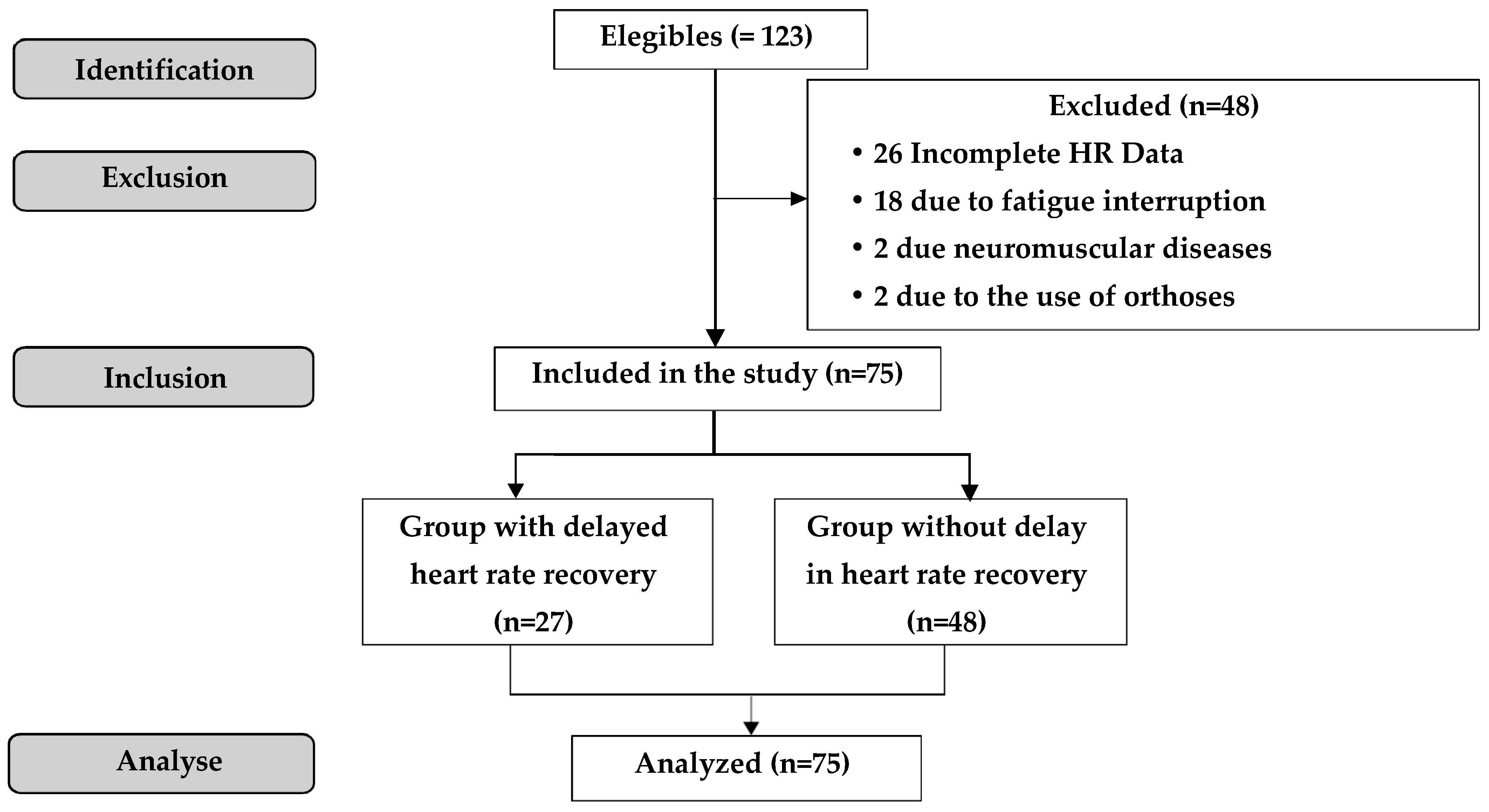
This cross-sectional study included participants presenting with persistent symptoms approximately 1 month post-COVID-19. The study is reported in accordance with the Strengthening the Reporting of Observational Studies in Epidemiology (STROBE) [20] guidelines for cross-sectional studies (Figure 1). The study was conducted at the Pulmonary Rehabilitation Laboratory of the Evangelical University of Goiás (UniEVANGÉLICA) in Anápolis, Goiás, Brazil.

2.2. Ethics Statements

The present study was approved by the Research Ethics Committee of UniEVANGÉLICA under protocol number 4.296.707 on 24 September 2020, and duly registered on the ClinicalTrials.gov platform under identifier NCT04982042 (COVID-19 Pulmonary Rehab). All participants received detailed information about the objectives and procedures of the research and expressed their agreement with such by signing the consent form. During all stages of data collection and evaluation, international biosafety standards were rigorously observed, ensuring the protection of researchers and volunteers from the risk of exposure to SARS-CoV-2.

2.3. Participant Selection

Volunteer recruitment occurred between May and December 2021, using social media outreach and informative banners placed in referral hospitals dedicated to COVID-19 treatment. Individuals who spontaneously sought follow-up care in public and private health services in the city of Anápolis (GO), Brazil, were also included.

2.4. Inclusion and Exclusion Criteria

The study included adults 18 to 75 years of age of both sexes, who presented with persistent symptoms or sequelae associated with a diagnosis of COVID-19, as confirmed by serological testing. Inclusion was restricted to clinically stable individuals who provided formal written consent to participate. Participants were excluded if they were unable to complete the 6MWT without interruption or if they required the use of lower limb orthoses. Additional exclusion criteria included incomplete clinical data, failure to adequately perform respiratory maneuvers during spirometry, and clinical decompensation during execution of the tests.

2.5. Outcomes and Measures

Initially, participants underwent a structured clinical evaluation to collect sociodemographic data, pre-existing comorbidities, COVID-19 complications, length of hospital and intensive care unit stay, and the required ventilatory support, such as oxygen therapy, non-invasive ventilation (NIV), and/or invasive mechanical ventilation (IMV).
All stages of data collection were performed by previously trained physical therapists to ensure procedural uniformity and reproducibility of results. The same professionals conducted evaluations for all participants. Data were recorded on outcome-specific forms, reviewed for consistency, and subsequently entered into spreadsheet software (Excel, Microsoft Corporation, Redmond, WA, USA) for analysis and statistical validation. All 6MWTs were supervised by a physical therapist, who also supervised the administration of dyspnea, functional capacity, and fatigue scales. Spirometry tests were conducted by a specialized technician and reported by a pulmonologist on the research team.

2.6. Group Allocation

Participants were divided into 2 groups based on HRR at 1 min after the 6MWT. Those who exhibited a HR reduction of ≤12 beats/min were classified with abnormal HRR delay, while those with a reduction of >12 beats/min were classified with normal (non-delayed) HRR. The threshold of 12 beats/min used in this study was based on the study by Morita et al. [16], where it was established as a marker of impaired parasympathetic reactivation associated with worse functional outcomes in individuals with COPD undergoing the 6-Minute Walk Test (6MWT). The authors demonstrated that late HRR was associated with reduced exercise capacity, more sedentary physical behaviour, and worse functional status. Thus, this cutoff value was adopted to classify HRR in the sample of post-COVID-19 patients involved in this study.

2.7. Pulmonary Function—Spirometry

Spirometry was performed using a spirometer (Sx 1000, Koko PFT, Fordham, Longmont, CO, USA), adhering to the technical and acceptability criteria recommended by the American Thoracic Society (ATS), the European Respiratory Society (ERS) [21,22], and the Guidelines of the Brazilian Society of Pulmonology and Tisiology (SBPT) [23]. All participants underwent post-bronchodilator testing, performed after inhalation of salbutamol (400 µg) via spacer (Volumatic, GlaxoSmithKline Ltd., London, UK). The following variables were analyzed: forced vital capacity (FVC [L and % predicted]); forced expiratory volume in 1 s (FEV1 [L and % predicted]); and the FEV1/FVC ratio. For all analyses, the highest values obtained for each variable were considered, regardless of the best overall curve, in accordance with the ATS/ERS acceptability and reproducibility criteria, which require ≥3 acceptable, artifact-free, expiratory maneuvers.

2.8. MIP

Inspiratory muscle strength was evaluated using an electronic threshold device (PowerBreathe Medic KH2; IMT Technologies Ltd., Birmingham, UK), coupled with real-time feedback software (Breathe-Link Plus Medic version), in accordance with ATS/ERS guidelines [24]. To minimize the learning effect, 2 familiarization attempts were performed, followed by 5 valid and reproducible maneuvers. A variation < 10% between the 2 highest values was required, with a 1 min interval between repetitions. For analysis, the highest absolute value of MIP and its percentage of the predicted value were used, calculated from reference equations for the Brazilian population, adjusted for age, sex, and weight [25].

2.9. Exercise Capacity—6MWT

The 6MWT measures the maximum distance an individual can walk at their usual pace over a 6 min period [26,27]. In this study, the 6MWT was performed in accordance with the 2002 ATS guidelines, with continuous monitoring of vital signs and assessment of perceived exertion (PE). The test was conducted on a 30 m flat, hard-surface track located at the UniEVANGÉLICA Polysports Gymnasium [28]. HR was monitored and recorded at rest and during the test using a commercially available HR monitor (H10 sensor, Polar Electro, São Paulo, Brazil). Peripheral oxygen saturation (SpO2) was continuously monitored using a digital organic light-emitting diode (i.e., “OLED”) graph pulse oximeter (G-Tech, Beijing, China). Systolic blood pressure (SBP) and diastolic blood pressure (DBP) were measured at the beginning and end of the test using a manual sphygmomanometer and stethoscope. PE was quantified using the modified Borg scale for dyspnea and lower limb fatigue. Predicted distance percentages were calculated using reference values for the healthy Brazilian population [29]. Participants who interrupted the test were excluded from the sample.

2.10. Muscle Fatigue—Fatigue Severity Scale

The Fatigue Severity Scale (FSS) measures the impact of fatigue on physical and functional performance [30,31,32,33]. The instrument consists of 9 statements addressing motivation, physical performance, functionality, and limitations in the activities of daily living (ADLs), with each item evaluated using a seven-point Likert scale. Participants responded based on their condition over the previous 7 days. The final score is the mean of the 9 items, with scores ≥ 4 indicating clinically significant fatigue [30,34].

2.11. Dyspnea Severity—Medical Research Council Dyspnea Scale

The Medical Research Council (MRC) Dyspnea Scale consists of 5 categories describing progressive levels of respiratory limitation during ADLs, from no dyspnea to the inability to perform basic tasks due to shortness of breath [35]. Patients select the item that best represents their degree of limitation [36,37].

2.12. Functional Status—Post-COVID-19 Functional Status Scale

The Post-COVID-19 Functional Status Scale (PCFS) quantifies the degree of limitation in ADLs after infection with SARS-CoV-2 [38,39,40,41]. The scale ranges from 0 (no functional limitation) to 4 (severe functional limitation). Grade 5 (death) was excluded from this study. Scores are based on patient self-assessment of their health and functional capacity over the preceding 7 days [41,42].

2.13. Sample Size Calculation

Sample size was calculated using G*Power version 3.1.9.7 based on 1 min HRR data from the 6MWT [19]. A one-sample t-test was performed using an effect size (d) of 0.7, a significance level (α) of 0.05, and statistical power (1 − β) of 0.80. The calculation indicated a minimum requirement of 52 participants. Ten additional patients were included to compensate for potential dropouts.

2.14. Data Analysis

Statistical analyses were performed using SPSS version 21.0 (IBM Corporation, Armonk, NY, USA) for Windows (Microsoft Corporation, Redmond, WA, USA). Differences with p ≤ 0.05 (i.e., 5%) were considered to be statistically significant. Qualitative variables are expressed as absolute and relative frequency, and differences were analyzed using the chi-squared test, Fisher’s exact test, or Fisher–Freeman–Halton test (Monte Carlo method). Normality was assessed using the Kolmogorov–Smirnov test. Quantitative variables exhibiting a normal distribution are expressed as mean with standard deviation (SD), whereas non-normal data are expressed as median (minimum [min]–maximum [max]). Comparisons between groups (with versus [vs.] without 1 min HRR delay) were performed using the Student’s t-test or the Mann–Whitney U test.

3. Results

3.1. Sample Characteristics and Group Allocation

A total of 123 individuals were initially evaluated post-COVID-19. After applying the eligibility and exclusion criteria, 75 participants comprised the final sample and, based on 1 min HRR after the 6MWT, 27 (36%) were classified with abnormal HRR delay (reduction ≤ 12 beats/min), and 48 (64%) with normal HRR recovery (reduction > 12 beats/min).

3.2. HR Analysis

In the delayed HRR group, the median post-6MWT HR was 119 beats/min (min–max, 81–161 beats/min) and the 1 min recovery HR was 113 beats/min (min–max, 81–160), resulting in a delta (Δ) HR of 6 beats/min. In contrast, the non-delayed HRR group exhibited a median post-6MWT HR of 120 beats/min (80–176) and a 1 min recovery HR of 97 beats/min (61–156), corresponding to a ΔHR of 23 beats/min, demonstrating a significantly greater HR reduction during the recovery period.
In the intergroup comparison, there was no significant difference in post-6MWT HR (p = 0.8214); however, the HR at the first minute of recovery was significantly lower in the non-delayed HRR group than that in the delayed HRR group (p = 0.0001).

3.3. Demographic and Clinical Data

The mean (±SD) age of the sample (54.7% male) was 47.6 ± 13.1 years. The mean body mass index (BMI) was 30.7 ± 6.3 kg/m2, indicating a predominance of overweight or mild obesity. Among the 60 hospitalized individuals (80% of the sample), all required oxygen therapy, and 15% progressed to IMV. There were no statistically significant differences between groups in terms of age, sex, ethnicity, BMI, length of hospital stay, ventilatory support, or the presence of pre-existing comorbidities (p > 0.05) (Table 1).
The most frequent comorbidities included anxiety (30.7%), systemic arterial hypertension (25.3%), obesity (14.7%), and type 2 diabetes mellitus (10.7%) (Table 2). Regarding self-reported symptoms, dyspnea (74.1% vs. 54.2%; p = 0.092) and muscle weakness (74.1% vs. 66.7%; p = 0.511) were the most prevalent manifestations in both groups, followed by persistent cough (51.9% vs. 39.6%; p = 0.311) and tachycardia (51.9% vs. 35.4%; p = 0.170). Symptoms such as vertigo (48.1% vs. 27.1%; p = 0.067) and myalgia (48.1% vs. 33.3%; p = 0.211) also showed higher relative frequencies in the group with delayed HRR. The most observed post-COVID-19 complications included renal alterations (8%) and hepatic steatosis (8%). None of these variables exhibited a significant difference between the groups with and without delayed HRR. However, a higher relative frequency of metabolic comorbidities and a consistent trend toward greater symptom frequency were observed in the delayed HRR group, particularly for cardiorespiratory and autonomic symptoms, suggesting a possible subclinical association with cardiovascular autonomic dysfunction.

3.4. Pulmonary Function and Clinical Scales

A comparison of pulmonary function, MIP, fatigue, dyspnea, and functional status among the study participants is presented in Table 3. Mean spirometry parameter values indicated overall preservation of pulmonary function (FVC = 3.7 ± 1.0 L; FEV1 = 2.9 ± 0.9 L; FEV1/FVC = 0.8). Intergroup comparison revealed no statistically significant differences for any pulmonary function variable (p > 0.05). The mean values for %predicted FEV1 (approximately 87.5%) and %predicted FVC (approximately 90.7%) suggested a mild restrictive ventilatory pattern, consistent with the standard profile described in patients post-COVID-19, although without relevant functional repercussions.
There was no evidence of bronchial obstruction (FEV1/FVC > 0.7 in both groups). Mean MIP values were 74.3 cmH2O in the delayed HRR group and 85.2 cmH2O in the non-delayed HRR group, with a 12.7% difference in favor of those with normal recovery, although this difference did not reach statistical significance.
Dyspnea severity, assessed using the modified MRC (mMRC) scale, differed significantly between the groups (p = 0.020). The delayed HRR group exhibited higher scores, indicating greater limitations in ADL. Muscle fatigue and the degree of functional limitation did not differ significantly; however, the delayed HRR group exhibited a trend toward higher median values, reflecting a subjective decline in physical performance.
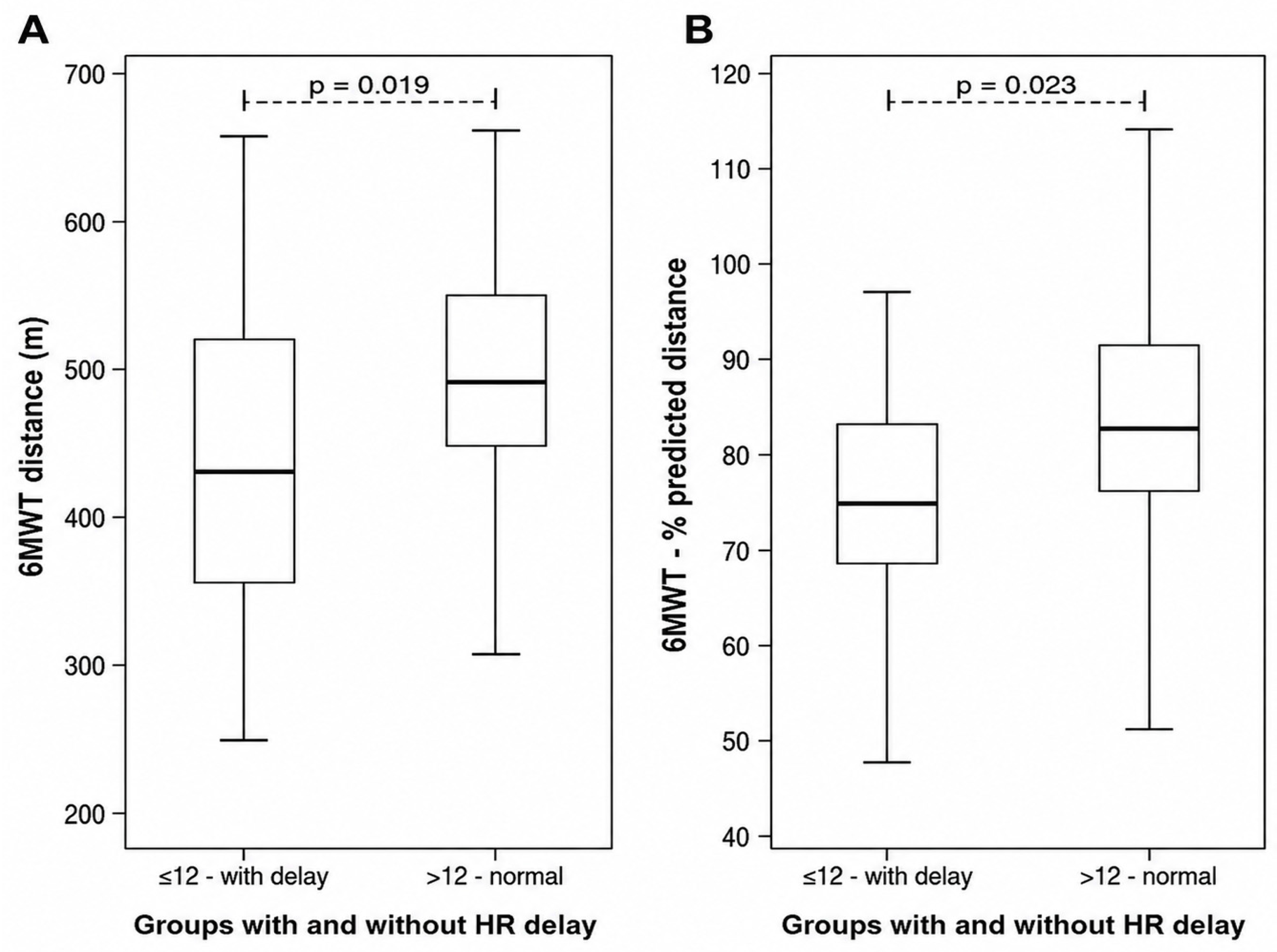
There was a statistically significant difference in functional performance of the 6MWT between the groups (Figure 2). Participants with delayed HRR covered a shorter average distance and a lower percentage of the predicted distance compared with those with normal HRR. The group with delayed HRR covered, on average, 437.33 ± 100.76 m, corresponding to 74.66 ± 12.98% of the predicted distance, while the group without delayed HRR covered an average of 494.27 ± 97.28 m and 82.94 ± 15.71% of the predicted distance, with a statistically significant difference for both the distance covered (p = 0.019; Δ = 56.94 m) and percentage of the predicted distance (p = 0.023; Δ = 8.28%).
These results indicate that delayed autonomic recovery of HR is associated with lower functional capacity, as reflected by lower tolerance to physical exertion. This finding may suggest impaired parasympathetic cardiac autonomic dysfunction and possible impairment of cardiorespiratory fitness in these individuals.
When analyzing the physiological variables during the 6MWT and at 1 min of HRR, a distinct behavior was observed between the evaluated groups (Table 4). At the start of the test, baseline HR was significantly higher in the delayed HRR group (97.2 ± 19.0 beats/min) than that in the non-delayed group (86.1 ± 16.5 beats/min; p = 0.010). This suggests lower baseline autonomic adjustment and potential sympathetic predominance in individuals with post-COVID-19 autonomic dysfunction. This difference did not persist at the end of the test, as both groups achieved similar mean HR values (p = 0.821), indicating physical exertion of comparable intensity.
Other hemodynamic and respiratory variables, including SBP, DBP, SpO2, and Borg scores for dyspnea and fatigue, showed no statistically significant differences (p > 0.05) and remained stable at the initial, final, and 1 min recovery time points.
These findings suggest that the primary contrast between the groups lies in the initial chronotropic response and autonomic HRR, rather than in hemodynamic or ventilatory alterations. This reinforces the hypothesis of cardiac autonomic dysfunction in individuals with COVID-19 who present with delayed HRR.

4. Discussion

Results of the present study indicate that 36% of the individuals evaluated exhibited delayed HRR (≤12 beats/min), representing a subgroup associated with worse functional performance in the post-COVID-19 period. Despite the absence of differences in clinical characteristics, infection severity, or pulmonary function, participants with delayed HRR demonstrated shorter 6MWT distances, greater dyspnea, higher baseline HR, and a smaller reduction in HR during the first minute of recovery. These findings suggest impaired vagal reactivation with possible sympathetic predominance, which may reflect residual cardiovascular autonomic dysfunction associated with reduced functional capacity in post-COVID-19 individuals.
It is important to emphasize that HRR represents an indirect, non-invasive marker of autonomic function, reflecting the balance between sympathetic withdrawal and parasympathetic reactivation after exercise [11,13]. Although widely used in clinical and research settings, HRR does not provide a direct measurement of autonomic nervous system activity and should therefore be interpreted as a surrogate indicator of cardiovascular autonomic modulation [12,16]. This consideration is particularly relevant in post-COVID-19 populations, in which altered HRR has been associated with impaired functional responses and possible autonomic imbalance [19].
In the study conducted by Carrijo et al. [43], a high incidence of post-traumatic stress, anxiety, and depression was observed in post-COVID-19 patients. According to the authors, early psychotherapeutic interventions are crucial to combat psychiatric manifestations in these patients, aiming to improve functional capacity and quality of life, consequently reducing the chances of developing neurocognitive deficits that will compromise the autonomic system. Thus, it is essential to develop strategies to address autonomic, cognitive, and behavioural changes due to isolation, treatment in a hospital environment, and/or in the ICU. Factors that increase the fear of death and generate negative beliefs that compromise the quality of life after discharge from the hospitalisation period [43].
Similarly, Campos et al. [44] reported that approximately 20% of patients with post-acute COVID-19 syndrome exhibited chronotropic incompetence during cardiopulmonary exercise testing. This condition was associated with lower predicted maximal oxygen consumption (i.e., “VO2max”) and a higher probability of sedentary behavior, suggesting that inadequate HR responses to exertion contribute to reduced aerobic capacity post-COVID-19. Oliveira et al. [45] corroborated these findings, demonstrating a progressive decline in functional capacity and poorer quality of life according to COVID-19 severity, independent of preserved lung function.
Amput et al. [46] demonstrated that post-COVID-19 patients with ≤6 months of recovery show worse performance in the 6MWT (503 m vs. 541 m in healthy controls and vs. 542 m in patients >6 months), greater muscle fatigue, and an exacerbated cardiovascular response to effort. However, in another study by the same group, Amput et al. [47] observed that mild hypertensive patients post-COVID-19 normalised post-effort heart rate, distance in the 6MWT, and quality of life within 3 months, contrasting with the 36% attenuated vagal recovery in the present study. This suggests that the persistence of autonomic dysfunction depends not only on the time elapsed since the infection and hypertension, present in 25.3% of the sample in this present study, but also on the severity of the infection and other comorbidities, highlighting the heterogeneity of post-COVID-19 recovery.
Longobardi et al. [48] reported that an elevated HR relative to metabolic demand may restrict oxygen delivery to tissues, which may partially explain the smaller HR variations and poorer functional performance. This reinforces the role of autonomic dysfunction as a central mechanism of exercise intolerance in patients post-COVID-19. Singh et al. [49] also observed that individuals in the post-COVID-19 period may present with persistent autonomic dysfunction characterized by reduced parasympathetic activity and sympathetic predominance, manifested by delayed HRR and inadequate cardiovascular responses to exercise.
Traditionally, the evaluation of 1 min HRR is performed through maximal tests on a treadmill or cycle ergometer [11,13,50]. However, in accordance with the methodologies described by Shiroishi et al. [12] and Morita et al. [16], this study used the 6MWT, demonstrating that submaximal field tests constitute a simple, safe, and effective alternative for identifying autonomic variations, especially in clinical populations. In clinical rehabilitation settings, HRR assessment may be complemented by additional tools that provide a more comprehensive evaluation of functional and autonomic status. Cardiopulmonary exercise testing (CPET) remains the gold standard for assessing aerobic capacity and chronotropic response, allowing detailed analysis of oxygen uptake kinetics and ventilatory efficiency [49].
Furthermore, heart rate variability (HRV) analysis offers a more direct assessment of autonomic nervous system modulation, particularly under resting conditions. Functional field tests, such as the sit-to-stand test and the incremental shuttle walk test, may also provide complementary information on exercise tolerance and physical performance, as recommended by international guidelines [15,37]. In addition, patient-reported outcome measures—including fatigue scales, dyspnea indices, and functional status questionnaires—are essential to capture the multidimensional impact of post-COVID-19 syndrome and may enhance the interpretation of HRR findings in clinical practice [16,19,51].
From a clinical perspective, HRR may represent a practical and accessible tool to support rehabilitation strategies in post-COVID-19 individuals. Impaired HRR may help identify patients with reduced autonomic adaptability and lower exercise tolerance, who may benefit from individualized rehabilitation programs. In addition, HRR can be used to assist in exercise intensity prescription, as attenuated post-exercise recovery may reflect an inadequate physiological response to exertion, suggesting the need for gradual progression and closer monitoring. Furthermore, serial assessment of HRR over time may provide a simple method to monitor rehabilitation progress and cardiovascular adaptation to training. This approach is particularly relevant in post-COVID-19 populations, in which persistent autonomic dysfunction and exercise intolerance have been reported [19,49,51].
In the present study, the analysis of post-exercise HR behavior revealed marked differences between the groups in both the immediate post-exercise response and after 1 min of recovery (p < 0.001). Previous studies using this approach have also observed that individuals with delayed HRR cover shorter distances in the 6MWT, particularly those with impaired autonomic recovery [16,19]. This reinforces that the distance walked, even in submaximal tests, is sensitive to the presence of autonomic dysfunction.
Regarding dyspnea, a trend toward higher mMRC scores was observed among those with delayed HRR, suggesting a more intense perception of ventilatory limitation during ADL; although, the difference did not reach statistical significance (p = 0.08). Additional studies have indicated that individuals with persistent dyspnea present lower peak VO2, shorter 6MWT distances, and poorer quality of life, even with normal resting cardiopulmonary parameters. This suggests that mechanisms, such as ventilatory inefficiency, ventilation–perfusion mismatch, or exertional hyperventilation patterns, may contribute to exercise intolerance [52,53].
Collectively, these previous findings corroborate those of the present study, in which no statistically significant differences in pulmonary function were observed between groups. However, the mildly reduced predicted values of FVC and FEV1 observed in the overall sample suggest the presence of subtle ventilatory impairment in post-COVID-19 individuals. Therefore, these findings should be interpreted with caution, as the absence of intergroup differences does not necessarily indicate normal pulmonary function, but rather a similar functional profile between groups [54].
Regarding physiological variables, our results are consistent with those reported by Morita et al. [16] given that no significant differences were found in peripheral SpO2, respiratory rate, blood pressure, or other hemodynamic markers between the groups. Similarly, Baranauskas and Carter [19] reported no significant hemodynamic changes in women evaluated after the acute phase of COVID-19.
MIP measurements did not differ significantly between the groups (p > 0.05). Nevertheless, a trend toward lower performance was observed in the delayed HRR group (74.3 cmH2O [76.1% predicted]) compared with the non-delayed group (85.2 cmH2O [87.2% predicted]), suggesting a possible reduction in inspiratory muscle reserve. Although not statistically significant, these values align with the greater functional limitation observed in the group with attenuated vagal recovery.
Quantitative analyses of muscle fatigue (FSS), dyspnea (mMRC), and functional limitation (PCFS) reinforce the trend in poorer functional status among individuals with delayed HRR. These findings are consistent with previous studies demonstrating associations between reduced HR variability, poorer functional status, and lower quality of life in patients with chronic respiratory diseases [16,55]. Furthermore, Serviente et al. [55] highlighted that persistent physical sequelae after SARS-CoV-2 infection involve not only the cardiorespiratory system but also peripheral muscle alterations and impaired integration between cardiovascular and muscular responses.
Given these alterations, there is a clear need for rehabilitation strategies focused on autonomic modulation and exercise tolerance in individuals post-COVID-19. The results of supervised pulmonary rehabilitation interventions have shown that an individualized eight-week program significantly improves resting HR and HRR, while increasing 6MWT distance in survivors of severe COVID-19, evidencing favorable cardiovascular adaptations to physical training [56].
Interpretation of these findings should be approached with caution. The cross-sectional design precludes the establishment of causal relationships between delayed heart rate recovery and functional impairment. Despite the small number of patients involved in this study, the sample exceeded what was proposed by the sample size calculation, which allows for the extrapolation of the results to other future studies.
Another limitation is the absence of a comprehensive assessment of cardiovascular function using gold-standard methods, which restricts a more detailed understanding of the underlying autonomic mechanisms. Furthermore, information regarding pre-COVID-19 physical activity levels was not systematically collected. In addition, more direct measures of autonomic function, such as heart rate variability and assessment of chronotropic incompetence, were not included, limiting a more comprehensive interpretation of the mechanisms underlying impaired HRR. These factors may have influenced functional performance and heart rate recovery, representing potential confounding variables in the interpretation of autonomic dysfunction.
Another limitation of this study is the absence of a control group composed of healthy individuals without prior COVID-19. The inclusion of such a group would allow for a more robust comparison and a clearer understanding of the extent to which the observed findings are specifically related to post-COVID-19 conditions. Nevertheless, the internal comparison between individuals with and without delayed HRR provides relevant insights into functional differences within this population. Additionally, the cutoff value used to define delayed HRR (≤12 beats/min) was derived from previous studies in other clinical populations, particularly those with cardiopulmonary diseases, and has not been specifically validated for post-COVID-19 individuals or for the 6MWT, requiring cautious interpretation. Finally, the analysis was limited to HRR at 1 min after the 6MWT. Although this time point is widely used and reflects early parasympathetic reactivation, additional recovery time points (e.g., 2 min HRR) may provide further insights into autonomic regulation. Future studies should incorporate longitudinal designs, matched control groups, detailed symptom profiling, and comprehensive cardiovascular assessments to further elucidate these relationships.

5. Conclusions

Results of the present study indicate that delayed heart rate recovery after the 6MWT is associated with poorer functional performance and greater dyspnea in post-COVID-19 individuals, regardless of pulmonary function. These results suggest that attenuated HRR may reflect impaired cardiovascular autonomic modulation, potentially contributing to exercise intolerance in this population. From a clinical perspective, HRR appears to be a simple, non-invasive, and accessible tool that may support functional assessment and guide rehabilitation strategies, including exercise prescription and monitoring of patient progress. In this context, the integration of HRR assessment into clinical practice may help identify individuals who could benefit from targeted rehabilitation interventions. However, given the cross-sectional nature of this study, causal relationships cannot be established. Therefore, future longitudinal studies are warranted to better understand the temporal dynamics of HRR and its relationship with functional recovery in post-COVID-19 populations.

Author Contributions

Conceptualization, A.L.F., M.C.O., P.C. and L.V.F.O.; methodology, J.P.R.A., I.O.-S., H.N.C.P., J.B.S.R.J., M.C.R.P.F., C.S.O., O.A.G., L.V.F.O. and W.R.F.J.; software, J.P.R.A., O.A.G., N.Y.M.S., L.R.A. and L.V.F.O.; formal analysis, L.R.A., N.Y.M.S., H.N.C.P., J.B.S.R.J., T.V.F., D.R.P.F., R.A.C.A. and C.H.M.S.; investigation, A.L.F., M.C.R.P.F., T.V.F., L.R.A., W.R.F.J., D.G.M., I.O.-S., C.H.M.S., O.A.G., T.V.F., M.C.O. and L.V.F.O.; resources, A.L.F., M.C.O., I.O.-S., L.V.F.O. and C.H.M.S.; data curation, A.L.F., L.R.A., T.V.F., J.B.S.R.J., H.N.C.P., C.S.O., D.R.P.F., R.A.C.A., W.R.F.J., L.V.F.O. and D.G.M.; writing—original draft preparation, A.L.F., W.R.F.J., P.C., L.V.F.O. and C.H.M.S.; writing—review and editing, A.L.F., J.P.R.A., I.O.-S., D.R.P.F., C.H.M.S., L.V.F.O. and P.C.; visualisation, W.R.F.J., A.L.F., D.G.M., R.A.C.A., C.S.O., L.V.F.O., C.H.M.S. and N.Y.M.S.; supervision, L.V.F.O., W.R.F.J. and P.C.; project administration, A.L.F., L.V.F.O., P.C. and M.C.O. All authors have read and agreed to the published version of the manuscript.

Funding

LVFO received grants from Research Productivity, modality PQII; process no. 310241/2022-7 of Conselho Nacional de Desenvolvimento Cientifico e Tecnologico (local acronym CNPq), Brazil. CSO received grants from Research Productivity, modality PQII; process no. 302716/2025-4 of Conselho Nacional de Desenvolvimento Cientifico e Tecnologico (local acronym CNPq), Brazil. The funders had no role in study design, data collection and analysis, decision to publish, or preparation of the manuscript.

Institutional Review Board Statement

The study was conducted in accordance with the Declaration of Helsinki, and approved by the Research Ethics Committee of UniEVANGÉLICA under protocol number 4.296.707, on 24 September 2020, and duly registered on the ClinicalTrials.gov platform under identifier NCT04982042 (COVID-19 Pulmonary Rehab).

Informed Consent Statement

Informed consent was obtained from all subjects involved in the study.

Data Availability Statement

The data generated by this study will be made available by the corresponding author upon request.

Acknowledgments

The authors would like to thank Evangelical University of Goiás UniEVANGELICA, Fundação de Amparo à Pesquisa do Estado de Goiás (FAPEG), and Conselho Nacional de Desenvolvimento Cientifico e Tecnologico—CNPQ who allowed this study to be conducted.

Conflicts of Interest

The authors declare no conflicts of interest.

Abbreviations

COVID-19, coronavirus disease 2019; SARS-CoV-2, severe acute respiratory syndrome coronavirus 2; HR, heart rate; HRR, heart rate recovery; 6MWT, 6 min walk test; FEV1, forced expiratory volume in 1 s; FVC, forced vital capacity; ADL, activities of daily living; SpO2, oxygen saturation; NIV, non-invasive ventilation; IMV, invasive mechanical ventilation; ATS, American Thoracic Society; ERS, European Respiratory Society; SBPT, Brazilian Society of Pulmonology and Tisiology; SBP, systolic blood pressure; DBP, diastolic blood pressure.

References

  1. Georgieva, E.; Ananiev, J.; Yovchev, Y.; Arabadzhiev, G.; Abrashev, H.; Abrasheva, D.; Atanasov, V.; Kostandieva, R.; Mitev, M.; Petkova-Parlapanska, K.; et al. COVID-19 Complications: Oxidative Stress, Inflammation, and Mitochondrial and Endothelial Dysfunction. Int. J. Mol. Sci. 2023, 24, 14876. [Google Scholar] [CrossRef]
  2. Chang, X.; Lai, Y.; Zhao, Y.; Zhao, J.; Zhang, Y.; Qian, X.; Zhang, G. Co-Infections Exacerbate Inflammatory Responses in COVID-19 Patients, Promoting Coagulopathy and Myocardial Injury, Leading to Increased Disease Severity. Front. Immunol. 2025, 16, 1522313. [Google Scholar] [CrossRef]
  3. Poyatos, P.; Luque, N.; Sabater, G.; Eizaguirre, S.; Bonnin, M.; Orriols, R.; Tura-Ceide, O. Endothelial Dysfunction and Cardiovascular Risk in Post-COVID-19 Patients after 6- and 12-Months SARS-CoV-2 Infection. Infection 2024, 52, 1269–1285. [Google Scholar] [CrossRef]
  4. Shao, H.-H.; Yin, R.-X. Pathogenic Mechanisms of Cardiovascular Damage in COVID-19. Mol. Med. 2024, 30, 92. [Google Scholar] [CrossRef] [PubMed]
  5. Chen, L.; Li, X.; Chen, M.; Feng, Y.; Xiong, C. The ACE2 Expression in Human Heart Indicates New Potential Mechanism of Heart Injury among Patients Infected with SARS-CoV-2. Cardiovasc. Res. 2020, 116, 1097–1100. [Google Scholar] [CrossRef]
  6. Lawal, I.O.; Kgatle, M.M.; Mokoala, K.; Farate, A.; Sathekge, M.M. Cardiovascular Disturbances in COVID-19: An Updated Review of the Pathophysiology and Clinical Evidence of Cardiovascular Damage Induced by SARS-CoV-2. BMC Cardiovasc. Disord. 2022, 22, 93. [Google Scholar] [CrossRef]
  7. Changal, K.; Veria, S.; Mack, S.; Paternite, D.; Sheikh, S.A.; Patel, M.; Mir, T.; Sheikh, M.; Ramanathan, P.K. Myocardial Injury in Hospitalized COVID-19 Patients: A Retrospective Study, Systematic Review, and Meta-Analysis. BMC Cardiovasc. Disord. 2021, 21, 626. [Google Scholar] [CrossRef] [PubMed]
  8. Zhao, Y.-H.; Zhao, L.; Yang, X.-C.; Wang, P. Cardiovascular Complications of SARS-CoV-2 Infection (COVID-19): A Systematic Review and Meta-Analysis. Rev. Cardiovasc. Med. 2021, 22, 159–165. [Google Scholar] [CrossRef]
  9. Arantes, F.S.; Rosa Oliveira, V.; Leão, A.K.M.; Afonso, J.P.R.; Fonseca, A.L.; Fonseca, D.R.P.; Mello, D.A.C.P.G.; Costa, I.P.; Oliveira, L.V.F.; da Palma, R.K. Heart rate variability: A biomarker of frailty in older adults? Front. Med. 2022, 9, 1008970. [Google Scholar] [CrossRef] [PubMed] [PubMed Central]
  10. Mooren, F.C.; Böckelmann, I.; Waranski, M.; Kotewitsch, M.; Teschler, M.; Schäfer, H.; Schmitz, B. Autonomic Dysregulation in Long-Term Patients Suffering from Post-COVID-19 Syndrome Assessed by Heart Rate Variability. Sci. Rep. 2023, 13, 15814. [Google Scholar] [CrossRef] [PubMed]
  11. Gupta, M.; Bansal, V.; Chhabra, S.K. Abnormal Heart Rate Recovery and Chronotropic Incompetence on Exercise in Chronic Obstructive Pulmonary Disease. Chronic Respir. Dis. 2013, 10, 117–126. [Google Scholar] [CrossRef] [PubMed]
  12. Shiroishi, R.; Kitagawa, C.; Miyamoto, N.; Kakuno, N.; Koyanagi, H.; Rikitomi, N.; Senjyu, H. Heart Rate Recovery after the 6-Min Walk Test Is Related to 6-Min Walk Distance and Percutaneous Oxygen Saturation Recovery in Patients with COPD. Respirology 2015, 20, 671–673. [Google Scholar] [CrossRef] [PubMed]
  13. Lacasse, M.; Maltais, F.; Poirier, P.; Lacasse, Y.; Marquis, K.; Jobin, J.; LeBlanc, P. Post-Exercise Heart Rate Recovery and Mortality in Chronic Obstructive Pulmonary Disease. Respir. Med. 2005, 99, 877–886. [Google Scholar] [CrossRef] [PubMed]
  14. Rodríguez, D.A.; Kortianou, E.A.; Alison, J.A.; Casas, A.; Giavedoni, S.; Barberan-Garcia, A.; Arbillaga, A.; Vilaró, J.; Gimeno-Santos, E.; Vogiatzis, I.; et al. Heart Rate Recovery After 6-Min Walking Test Predicts Acute Exacerbation in COPD. Lung 2017, 195, 463–467. [Google Scholar] [CrossRef]
  15. Holland, A.E.; Spruit, M.A.; Troosters, T.; Puhan, M.A.; Pepin, V.; Saey, D.; McCormack, M.C.; Carlin, B.W.; Sciurba, F.C.; Pitta, F.; et al. An Official European Respiratory Society/American Thoracic Society Technical Standard: Field Walking Tests in Chronic Respiratory Disease. Eur. Respir. J. 2014, 44, 1428–1446. [Google Scholar] [CrossRef]
  16. Morita, A.A.; Silva, L.K.O.; Bisca, G.W.; Oliveira, J.M.; Hernandes, N.A.; Pitta, F.; Furlanetto, K.C. Heart Rate Recovery, Physical Activity Level, and Functional Status in Subjects With COPD. Respir. Care 2018, 63, 1002–1008. [Google Scholar] [CrossRef] [PubMed]
  17. Holland, A.E.; Hill, C.J.; Glaspole, I.; Goh, N.; Dowman, L.; McDonald, C.F. Impaired Chronotropic Response to 6-Min Walk Test and Reduced Survival in Interstitial Lung Disease. Respir. Med. 2013, 107, 1066–1072. [Google Scholar] [CrossRef]
  18. Swigris, J.J.; Swick, J.; Wamboldt, F.S.; Sprunger, D.; du Bois, R.; Fischer, A.; Cosgrove, G.P.; Frankel, S.K.; Fernandez-Perez, E.R.; Kervitsky, D.; et al. Heart Rate Recovery after 6-Min Walk Test Predicts Survival in Patients with Idiopathic Pulmonary Fibrosis. Chest 2009, 136, 841–848. [Google Scholar] [CrossRef]
  19. Baranauskas, M.N.; Carter, S.J. Evidence for Impaired Chronotropic Responses to and Recovery from 6-min Walk Test in Women with Post-acute COVID-19 Syndrome. Exp. Physiol. 2022, 107, 722–732. [Google Scholar] [CrossRef]
  20. Von Elm, E.; Altman, D.G.; Egger, M.; Pocock, S.J.; Gøtzsche, P.C.; Vandenbroucke, J.P.; STROBE Initiative. The Strengthening the Reporting of Observational Studies in Epidemiology (STROBE) Statement: Guidelines for Reporting Observational Studies. J. Clin. Epidemiol. 2008, 61, 344–349. [Google Scholar] [CrossRef]
  21. Graham, B.L.; Steenbruggen, I.; Miller, M.R.; Barjaktarevic, I.Z.; Cooper, B.G.; Hall, G.L.; Hallstrand, T.S.; Kaminsky, D.A.; McCarthy, K.; McCormack, M.C.; et al. Standardization of Spirometry 2019 Update. An Official American Thoracic Society and European Respiratory Society Technical Statement. Am. J. Respir. Crit. Care Med. 2019, 200, e70–e88. [Google Scholar] [CrossRef]
  22. Miller, M.R.; Hankinson, J.; Brusasco, V.; Burgos, F.; Casaburi, R.; Coates, A.; Crapo, R.; Enright, P.; van der Grinten, C.P.M.; Gustafsson, P.; et al. Standardisation of Spirometry. Eur. Respir. J. 2005, 26, 319–338. [Google Scholar] [CrossRef] [PubMed]
  23. Pereira, C.A.D.C.; Sato, T.; Rodrigues, S.C. New Reference Values for Forced Spirometry in White Adults in Brazil. J. Bras. Pneumol. 2007, 33, 397–406. [Google Scholar] [CrossRef] [PubMed]
  24. American Thoracic Society/European Respiratory Society. ATS/ERS Statement on Respiratory Muscle Testing. Am. J. Respir. Crit. Care Med. 2002, 166, 518–624. [Google Scholar] [CrossRef] [PubMed]
  25. Pessoa, I.M.B.S.; Houri Neto, M.; Montemezzo, D.; Silva, L.A.M.; Andrade, A.D.D.; Parreira, V.F. Predictive Equations for Respiratory Muscle Strength According to International and Brazilian Guidelines. Braz. J. Phys. Ther. 2014, 18, 410–418. [Google Scholar] [CrossRef]
  26. Enright, P.L.; McBurnie, M.A.; Bittner, V.; Tracy, R.P.; McNamara, R.; Arnold, A.; Newman, A.B. Cardiovascular Health Study The 6-Min Walk Test: A Quick Measure of Functional Status in Elderly Adults. Chest 2003, 123, 387–398. [Google Scholar] [CrossRef]
  27. Casanova, C.; Cote, C.; Marin, J.M.; Pinto-Plata, V.; de Torres, J.P.; Aguirre-Jaíme, A.; Vassaux, C.; Celli, B.R. Distance and Oxygen Desaturation during the 6-Min Walk Test as Predictors of Long-Term Mortality in Patients with COPD. Chest 2008, 134, 746–752. [Google Scholar] [CrossRef]
  28. ATS Committee on Proficiency Standards for Clinical Pulmonary Function Laboratories. ATS Statement: Guidelines for the Six-Minute Walk Test. Am. J. Respir. Crit. Care Med. 2002, 166, 111–117. [Google Scholar] [CrossRef]
  29. Britto, R.R.; Probst, V.S.; de Andrade, A.F.D.; Samora, G.A.R.; Hernandes, N.A.; Marinho, P.E.M.; Karsten, M.; Pitta, F.; Parreira, V.F. Reference Equations for the Six-Minute Walk Distance Based on a Brazilian Multicenter Study. Braz. J. Phys. Ther. 2013, 17, 556–563. [Google Scholar] [CrossRef]
  30. Krupp, L.B.; LaRocca, N.G.; Muir-Nash, J.; Steinberg, A.D. The Fatigue Severity Scale. Application to Patients with Multiple Sclerosis and Systemic Lupus Erythematosus. Arch. Neurol. 1989, 46, 1121–1123. [Google Scholar] [CrossRef]
  31. Valko, P.O.; Bassetti, C.L.; Bloch, K.E.; Held, U.; Baumann, C.R. Validation of the Fatigue Severity Scale in a Swiss Cohort. Sleep. 2008, 31, 1601–1607. [Google Scholar] [CrossRef]
  32. Michielsen, H.J.; De Vries, J.; Van Heck, G.L. Psychometric Qualities of a Brief Self-Rated Fatigue Measure: The Fatigue Assessment Scale. J. Psychosom. Res. 2003, 54, 345–352. [Google Scholar] [CrossRef] [PubMed]
  33. Valderramas, S.; Feres, A.C.; Melo, A. Reliability and Validity Study of a Brazilian-Portuguese Version of the Fatigue Severity Scale in Parkinson’s Disease Patients. Arq. Neuropsiquiatr. 2012, 70, 497–500. [Google Scholar] [CrossRef] [PubMed]
  34. Lerdal, A.; Wahl, A.; Rustøen, T.; Hanestad, B.R.; Moum, T. Fatigue in the General Population: A Translation and Test of the Psychometric Properties of the Norwegian Version of the Fatigue Severity Scale. Scand. J. Public Health 2005, 33, 123–130. [Google Scholar] [CrossRef]
  35. Bestall, J.C.; Paul, E.A.; Garrod, R.; Garnham, R.; Jones, P.W.; Wedzicha, J.A. Usefulness of the Medical Research Council (MRC) Dyspnoea Scale as a Measure of Disability in Patients with Chronic Obstructive Pulmonary Disease. Thorax 1999, 54, 581–586. [Google Scholar] [CrossRef]
  36. Kovelis, D.; Segretti, N.O.; Probst, V.S.; Lareau, S.C.; Brunetto, A.F.; Pitta, F. Validação do Modified Pulmonary Functional Status and Dyspnea Questionnaire e da escala do Medical Research Council para o uso em pacientes com doença pulmonar obstrutiva crônica no Brasil. J. Bras. Pneumol. 2008, 34, 1008–1018. [Google Scholar] [CrossRef]
  37. Simonelli, C.; Paneroni, M.; Vitacca, M.; Ambrosino, N. Measures of Physical Performance in COVID-19 Patients: A Mapping Review. Pulmonology 2021, 27, 518–528. [Google Scholar] [CrossRef]
  38. Klok, F.A.; Barco, S.; Siegerink, B. Measuring Functional Limitations after Venous Thromboembolism: A Call to Action. Thromb. Res. 2019, 178, 59–62. [Google Scholar] [CrossRef]
  39. Boon, G.J.a.M.; Barco, S.; Bertoletti, L.; Ghanima, W.; Huisman, M.V.; Kahn, S.R.; Noble, S.; Prandoni, P.; Rosovsky, R.P.; Sista, A.K.; et al. Measuring Functional Limitations after Venous Thromboembolism: Optimization of the Post-VTE Functional Status (PVFS) Scale. Thromb. Res. 2020, 190, 45–51. [Google Scholar] [CrossRef]
  40. Klok, F.A.; Kruip, M.J.H.A.; van der Meer, N.J.M.; Arbous, M.S.; Gommers, D.; Kant, K.M.; Kaptein, F.H.J.; van Paassen, J.; Stals, M.a.M.; Huisman, M.V.; et al. Confirmation of the High Cumulative Incidence of Thrombotic Complications in Critically Ill ICU Patients with COVID-19: An Updated Analysis. Thromb. Res. 2020, 191, 148–150. [Google Scholar] [CrossRef] [PubMed]
  41. Klok, F.A.; Boon, G.J.A.M.; Barco, S.; Endres, M.; Geelhoed, J.J.M.; Knauss, S.; Rezek, S.A.; Spruit, M.A.; Vehreschild, J.; Siegerink, B. The Post-COVID-19 Functional Status Scale: A Tool to Measure Functional Status over Time after COVID-19. Eur. Respir. J. 2020, 56, 2001494. [Google Scholar] [CrossRef] [PubMed]
  42. Machado, F.V.C.; Meys, R.; Delbressine, J.M.; Vaes, A.W.; Goërtz, Y.M.J.; van Herck, M.; Houben-Wilke, S.; Boon, G.J.A.M.; Barco, S.; Burtin, C.; et al. Construct Validity of the Post-COVID-19 Functional Status Scale in Adult Subjects with COVID-19. Health Qual. Life Outcomes 2021, 19, 40. [Google Scholar] [CrossRef]
  43. Carrijo, M.M.; Oliveira, M.C.; Canedo, W.A.O.; Afonso, J.P.R.; Paixão, H.N.C.; Alves, L.R.; Palma, R.K.; Oliveira-Silva, I.; Silva, C.H.M.; Oliveira, R.F.; et al. Post-Traumatic Stress Disorder, Anxiety, and Depression in Post-COVID-19 Patients Undergoing Psychotherapy: A Nonrandomized Clinical Trial. COVID 2025, 5, 184. [Google Scholar] [CrossRef]
  44. Campos, M.D.S.B.; de Brito, G.M.G.; Santos, K.S.D.C.; Santos, M.A.A.; Martins-Filho, P.R.; Sousa, A.C.S. Chronotropic Incompetence Is Associated with Reduced Aerobic Conditioning and Sedentary Behavior in Patients with Post-Acute COVID-19 Syndrome. Rev. Inst. Med. Trop. Sao Paulo 2024, 66, e32. [Google Scholar] [CrossRef] [PubMed]
  45. Oliveira, M.C.; Alves, L.R.; Soares, J.M.P.; Souza, S.K.A.; Silva, B.M.R.; Fonseca, A.L.; Silva, C.H.M.; Oliveira, C.S.; Vieira, R.P.; Oliveira, D.A.A.P.; et al. Health-Related Quality of Life and Functional Status of Post-COVID-19 Patients. Int. J. Environ. Res. Public Health 2025, 22, 338. [Google Scholar] [CrossRef]
  46. Amput, P.; Udomkichpagon, P.; Wongphon, S. Impact of Duration of Recovery from COVID-19 Infection on Physical Performance in Post-COVID-19 Patients. COVID 2025, 5, 140. [Google Scholar] [CrossRef]
  47. Amput, P.; Poncumhak, P.; Wongphon, S.; Konsanit, S.; Phrompao, P. Follow-Up on the Recovery of Cardiorespiratory Parameters and Quality of Life in Post-COVID-19 with Hypertension. COVID 2025, 5, 161. [Google Scholar] [CrossRef]
  48. Longobardi, I.; Prado, D.M.L.D.; Goessler, K.F.; Meletti, M.M.; de Oliveira Júnior, G.N.; de Andrade, D.C.O.; Gualano, B.; Roschel, H. Oxygen Uptake Kinetics and Chronotropic Responses to Exercise Are Impaired in Survivors of Severe COVID-19. Am. J. Physiol. Heart Circ. Physiol. 2022, 323, H569–H576. [Google Scholar] [CrossRef]
  49. Singh, I.; Joseph, P.; Heerdt, P.M.; Cullinan, M.; Lutchmansingh, D.D.; Gulati, M.; Possick, J.D.; Systrom, D.M.; Waxman, A.B. Persistent Exertional Intolerance After COVID-19: Insights From Invasive Cardiopulmonary Exercise Testing. Chest 2022, 161, 54–63. [Google Scholar] [CrossRef]
  50. Seshadri, N.; Gildea, T.R.; McCarthy, K.; Pothier, C.; Kavuru, M.S.; Lauer, M.S. Association of an Abnormal Exercise Heart Rate Recovery with Pulmonary Function Abnormalities. Chest 2004, 125, 1286–1291. [Google Scholar] [CrossRef]
  51. Serviente, C.; Decker, S.T.; Layec, G. From Heart to Muscle: Pathophysiological Mechanisms Underlying Long-Term Physical Sequelae from SARS-CoV-2 Infection. J. Appl. Physiol. 2022, 132, 581–592. [Google Scholar] [CrossRef] [PubMed]
  52. Aparisi, Á.; Ybarra-Falcón, C.; García-Gómez, M.; Tobar, J.; Iglesias-Echeverría, C.; Jaurrieta-Largo, S.; Ladrón, R.; Uribarri, A.; Catalá, P.; Hinojosa, W.; et al. Exercise Ventilatory Inefficiency in Post-COVID-19 Syndrome: Insights from a Prospective Evaluation. J. Clin. Med. 2021, 10, 2591. [Google Scholar] [CrossRef]
  53. Debeaumont, D.; Boujibar, F.; Ferrand-Devouge, E.; Artaud-Macari, E.; Tamion, F.; Gravier, F.-E.; Smondack, P.; Cuvelier, A.; Muir, J.-F.; Alexandre, K.; et al. Cardiopulmonary Exercise Testing to Assess Persistent Symptoms at 6 Months in People With COVID-19 Who Survived Hospitalization: A Pilot Study. Phys. Ther. 2021, 101, pzab099. [Google Scholar] [CrossRef]
  54. Rinaldo, R.F.; Mondoni, M.; Parazzini, E.M.; Pitari, F.; Brambilla, E.; Luraschi, S.; Balbi, M.; Sferrazza Papa, G.F.; Sotgiu, G.; Guazzi, M.; et al. Deconditioning as Main Mechanism of Impaired Exercise Response in COVID-19 Survivors. Eur. Respir. J. 2021, 58, 2100870. [Google Scholar] [CrossRef] [PubMed]
  55. Camillo, C.A.; Pitta, F.; Possani, H.V.; Barbosa, M.V.R.A.; Marques, D.S.O.; Cavalheri, V.; Probst, V.S.; Brunetto, A.F. Heart Rate Variability and Disease Characteristics in Patients with COPD. Lung 2008, 186, 393–401. [Google Scholar] [CrossRef] [PubMed]
  56. Del Valle, M.F.; Valenzuela, J.; Marzuca-Nassr, G.N.; Cabrera-Inostroza, C.; Del Sol, M.; Lizana, P.A.; Escobar-Cabello, M.; Muñoz-Cofre, R. Eight Weeks of Supervised Pulmonary Rehabilitation Are Effective in Improving Resting Heart Rate and Heart Rate Recovery in Severe COVID-19 Patient Survivors of Mechanical Ventilation. Medicina 2022, 58, 514. [Google Scholar] [CrossRef]
Figure 1. Flowchart of the study according to the Strengthening the Reporting of Observational Studies in Epidemiology (STROBE).
Covid 06 00082 g001
Figure 2. Distance traveled (in meters) and percentage of predicted distance between patients with and without delayed heart rate recovery. Note: (A) 6MWT: 6-min walk test; HR: heart rate. (B) 6MWT: 6-min walk test; HR: heart rate.
Covid 06 00082 g002
Table 1. Anthropometric, demographic and clinical characteristics.
TotalWith Delay in
RHR (n = 27)
Without Delay in RHR (n = 48)p
Anthropometric data
Age47.6 ± 13.150.3 ± 11.246.1 ± 13.90.183 a
Height165.9 ± 9.7166.1 ± 9.3165.8 ± 10.00.888 a
Weight83.8 ± 17.185.7 ± 17.382.8 ± 17.10.495 a
BMI30.7 ± 6.331.0 ± 5.830.5 ± 6.60.740 a
Gender
Male4116 (39.0)25 (61.0)0.529 b
Female3411 (32.4)23 (67.6)
Ethnicity
Caucasian268 (30.8)18 (69.2)0.292 b
Brown3411 (32.4)23 (67.6)
Afro-descendants158 (53.3)7 (46.7)
COVID-19
Hospitalisation6024 (40.0)36 (60.0)0.149 b
Ward 6024 (40.0)36 (60.0)N/A
ICU258 (32.0)17 (68.0)0.285 b
Days of
hospitalisation
Ward5 [0–24]7 [0–24]5 [0–21]0.195 d
ICU10 [3–45]17 [3–22]10 [3–45]0.619 d
Total of days11 [0–52]11 [0–32]10 [3–52]0.845 d
Management
Oxygen therapy6024 (40.0)36 (60.0)N/A
NIV4016 (40.0)24 (60.0)1.000 b
MV93 (33.3)6 (66.7)0.729 c
Tracheostomy41 (25.0)3 (75.0)1.000 c
Note: RHR: Recovery heart rate; BMI: Body mass index; ICU: Intensive Care Unit; NIV: Non-invasive ventilation; MV: Invasive mechanical ventilation; Quantitative data presented as median, minimum, and maximum. Qualitative data presented as absolute and relative frequency. N/A: Not applicable. Statistical tests: (a) Student’s t-test; (b) Chi-square test; (c) Fisher’s exact test; (d) Mann–Whitney test.
Table 2. Comorbidities, self-reported symptoms and post-coronavirus disease 2019 complications.
TotalWith Delay in
RHR (n = 27)
Without Delay in RHR (n = 48)p
Comorbidities
  SAH196 (31.6)13 (68.4)0.642 a
  DM282 (25.0)6 (75.0)0.703 b
  Asthma31 (33.3)2 (66.7)1.000 b
  COPD10 (0.0)1 (100.0)1.000 b
  Dyslipidaemia62 (33.3)4 (66.7)1.000 b
  Hypothyroidism50 (0.0)5 (100.0)0.153 b
  Obesity116 (54.5)5 (45.5)0.188 b
  Depression62 (33.3)4 (66.7)1.000 b
  Anxiety239 (39.1)14 (60.9)0.707 a
  Hepatic steatosis63 (50.0)3 (50.0)0.661 a
Self-reported symptoms
  Persistent cough3314 (51.9)19 (39.6)0.311 b
  Anosmia158 (29.6)7 (14.6)0.133 b
  Ageusia168 (29.6)8 (16.7)0.193 b
  Dyspnea4620 (74.1)26 (54.2)0.092 b
  Tachycardia3114 (51.9)17 (35.4)0.170 b
  Balance deficit2911 (40.7)18 (37.5)0.839 c
  Muscle weakness5220 (74.1)32 (66.7)0.511 b
  Myalgia2913 (48.1)16 (33.3)0.211 b
  Arthralgia166 (22.2)10 (20.8)0.890 b
  Vertigo2613 (48.1)13 (27.1)0.067 b
Complications
  AMI30 (0.0)3 (100.0)0.549 b
  Stroke32 (66.7)1 (33.3)0.293 b
  PTE21 (50.0)1 (50.0)1.000 b
  Renal dysfunction63 (50.0)3 (50.0)0.661 b
Note: RHR: Recovery heart rate; SAH: Systemic Arterial Hypertension; DM2: Diabetes Mellitus 2; COPD: Chronic Obstructive Pulmonary Disease; AMI: Acute myocardial infarction; PTE: Pulmonary thromboembolism. Percentage relative to the line. Quantitative data presented as median, minimum, and maximum. Qualitative data presented as absolute and relative frequency. Statistical tests: (a) Chi-square test; (b) Fisher’s exact test.
Table 3. Pulmonary function, maximum inspiratory pressure, fatigue, dyspnea, and functional status according to heart rate recovery.
TotalWith Delay in HRR (n = 27)Without Delay in HRR (n = 48)p
CVF (L)3.7 ± 1.03.5 ± 1.03.7 ± 1.00.468 a
FVC (%pred)90.7 ± 18.587.6 ± 14.292.3 ± 20.30.327 a
FEV1 (L)2.9 ± 0.92.8 ± 0.92.9 ± 0.90.645 a
FEV1 (%pred)87.5 ± 21.285.4 ± 16.788.6 ± 23.20.564 a
FEV1/FVC(L)0.8 [0.3–0.9]0.8 [0.6–0.9]0.8 [0.3–0.9]0.832 b
FEV1/FVC (%)100 [38–120]99 [79–110]100 [38–120]0.406 b
MIP (cmH2O)74.3 ± 31.985.2 ± 35.881.3 ± 34.60.203 ᵃ
MIP (%pred)76.1 ± 26.887.2 ± 32.183.2 ± 30.60.141 ᵃ
FSS4.4 [1.3–7.0]4.2 [1.0–6.9]4.4 [1.0–7.0]0.276 b
MRC4 [1–5]2 [1–5]3 [1–5]0.020 b
PCFS3 [0–4]2 [1–4]3 [0–4]0.365 b
Note: HRR: Heart rate recovery; FVC: Forced vital capacity; L: liters; %pred: Percentage of predicted; FEV1: Forced expiratory volume in the first second; MIP: Maximum inspiratory pressure; cmH2O: centimeters of water; FSS: Fatigue Severity Scale; MRC: Medical Research Council; PCFS: Post-COVID-19 Functional Status. Statistical tests: (a) Student’s t-test; (b) Mann–Whitney test.
Table 4. Physiological variables measured in participants with and without delayed heart rate recovery.
TotalWith Delay in HRR (n = 27)Without Delay in HRR (n = 48)p
6MWT initial
  SBP120 [100–150]120 [100–150]120 [100–150]0.453 b
  DBP80 [60–120]80 [60–110]80 [60–120]0.099 b
  HR90.1 ± 18.197.2 ± 19.086.1 ± 16.50.010 a
  SpO296 [89–99]96 [93–99]96 [89–99]0.525 b
  Borg dyspnoea0 [0–8]0 [0–7]0 [0–8]0.580 b
  Borg fatigue0 [0–8]3 [0–7]0 [0–8]0.166 b
6MWT final
  SBP120 [100–160]130 [110–150]120 [100–160]0.616 b
  DBP80 [60–130]80 [60–110]80 [60–130]0.320 b
  HR120.3 ± 19.1120.9 ± 20.7119.9 ± 18.30.821 a
  SpO294 [85–98]94 [86–97]94 [85–98]0.532 b
  Borg dyspnoea3 [0–9]3 [0–7]3 [0–9]0.744 b
Note: HRR: Heart rate recovery; 6MWT: 6 min walk test; SBP: Systolic blood pressure; DBP: Diastolic blood pressure; SpO2: Peripheral oxygen saturation. Statistical tests: (a) Student’s t-test; (b) Mann–Whitney test.
Disclaimer/Publisher’s Note: The statements, opinions and data contained in all publications are solely those of the individual author(s) and contributor(s) and not of MDPI and/or the editor(s). MDPI and/or the editor(s) disclaim responsibility for any injury to people or property resulting from any ideas, methods, instructions or products referred to in the content.