Article

Evaluation of the Post-COVID-19 Functional Status Scale Based on Its Use During a One-Year Follow-Up of COVID-19 Survivors


by
Cindy M. M. de Jong
1,*,
Bas F. M. van Raaij
2,
Louisa (M. L.) Antoni
3,
Sesmu (M. S.) Arbous
4,
Miranda (J. J. M.) Geelhoed
5,6,
Michiel A. de Graaf
3,
Geert H. Groeneveld
7,8,
Chris (S. C. H.) Hinnen
9,
Veronica R. Janssen
10,
Moniek M. ter Kuile
10,
Anna H. E. Roukens
8,
Lauran (J. L.) Stöger
11,12,
Maarten S. Werkman
13,14,
Frederikus A. Klok
1,
Bob Siegerink
15 and
on behalf of the COVID-19 LUMC Group
1
Department of Medicine—Thrombosis and Hemostasis, Leiden University Medical Center, 2300 RC Leiden, The Netherlands
2
Department of Internal Medicine, Section of Geriatrics and Gerontology, Leiden University Medical Center, 2300 RC Leiden, The Netherlands
3
Department of Cardiology, Leiden University Medical Center, 2300 RC Leiden, The Netherlands
4
Department of Intensive Care, Leiden University Medical Center, 2300 RC Leiden, The Netherlands
5
Department of Pulmonary Diseases, Leiden University Medical Center, 2300 RC Leiden, The Netherlands
6
ILD Center of Excellence, St. Antonius Hospital, 3435 CM Nieuwegein, The Netherlands
7
Department of Acute Internal Medicine, Leiden University Medical Center, 2300 RC Leiden, The Netherlands
8
Department of Infectious Diseases, Leiden University Medical Center, 2300 RC Leiden, The Netherlands
9
Department of Oncology, Psycho-Oncology Unit, Leiden University Medical Center, 2300 RC Leiden, The Netherlands
10
Department of Psychiatry and Psychology, Leiden University Medical Center, 2300 RC Leiden, The Netherlands
11
Department of Radiology, Leiden University Medical Center, 2300 RC Leiden, The Netherlands
12
Department of Radiology, Division Imaging and Oncology, University Medical Center Utrecht, 3508 GA Utrecht, The Netherlands
13
Department of Physiotherapy, Leiden University Medical Center, 2300 RC Leiden, The Netherlands
14
Department of Rehabilitation, Physiotherapy Science and Sports, UMC Utrecht Brain Center, University Medical Center Utrecht, Utrecht University, 3508 GA Utrecht, The Netherlands
15
Department of Clinical Epidemiology, Leiden University Medical Center, 2300 RC Leiden, The Netherlands
*
Author to whom correspondence should be addressed.
Membership of the COVID-19 LUMC Group is provided in the Acknowledgments.
COVID 2026, 6(5), 81; https://doi.org/10.3390/covid6050081 (registering DOI)
Submission received: 25 February 2026 / Revised: 30 April 2026 / Accepted: 6 May 2026 / Published: 14 May 2026
(This article belongs to the Section Long COVID and Post-Acute Sequelae)

Abstract

Since the introduction of the Post-COVID-19 Functional Status (PCFS) scale early in the COVID-19 pandemic, the scale has been incorporated in research and clinical guidelines to assess and monitor functional status. In this explorative study, we aimed to evaluate characteristics of the PCFS scale based on its use during a 12-month follow-up of COVID-19 survivors to increase understanding of the scale over a longer period of time. Adult COVID-19 patients who were evaluated by multidisciplinary measures at 6 weeks and 12 months post-discharge at the Leiden University Medical Center (The Netherlands) were included. The distribution of PCFS scale grades, as well as descriptive patterns between PCFS grades and patient-reported outcome measures (PROMs), pulmonary function and physical function were evaluated with descriptive analyses; no statistical tests were performed due to data availability. Of the 79 included patients, 62% had a change in PCFS grade between the 6-week and 12-month follow-ups, of whom 63% improved over time. At 12 months, abnormal PROMs regarding psychological symptoms (according to clinical cut-offs), relatively lower quality of life (EQ VAS) scores, and MRC dyspnea grades ≥ 2 were observed in patients scoring PCFS grade ≥ 2. With increasing PCFS grade, a decrease in pulmonary function and physical function outcomes was observed. Higher PCFS grades (worse functional status) seemed related to worse outcomes at 12-month follow-up. Future studies are needed to investigate whether changes in PCFS grade reflect clinically relevant changes in patients’ self-perceived functioning.

1. Introduction

The Post-COVID-19 Functional Status (PCFS) scale was introduced early in the COVID-19 pandemic as an ordinal measure to assess functional status and monitor functional recovery after severe acute respiratory coronavirus 2 (SARS-CoV-2) infection [1]. The basis for the PCFS scale was the Post-Venous Thromboembolism Functional Status (PVFS) scale, which was developed in 2019 to meet the need for a novel outcome measure that could better capture the consequences of venous thromboembolism (VTE) on patients’ daily functioning [2,3]. The PCFS scale can be used to measure functional outcome and quantify patient-relevant functional limitations after COVID-19. The instrument covers key aspects of daily life, by focusing both on the patient’s functional ability in usual activities and duties, and changes in lifestyle. Assessment of functional status over time allows for the evaluation of the course of symptoms and recovery, and enables the recognition of individuals with worsening functional status or impaired recovery.
The scale has been well incorporated into the COVID-19 research community, and its use was considered to be helpful based on a review of the literature and users’ experiences [4,5]. Psychometric properties of the PCFS scale have been evaluated in several validation studies and cross-cultural adaptation studies or as part of translation processes. Most studies showed adequate validity and reliability [6,7,8,9,10,11,12,13,14,15,16,17,18,19,20,21]. One study evaluating the Danish version only partially supported its construct validity, and a review of PROMs for long COVID suggested insufficient internal consistency [22,23]. The scale has also served as an outcome measure in multiple studies; most studies have a follow-up of less than one year, but studies with longer follow-up durations are becoming available. In addition to hospitalized COVID-19 patients, the PCFS scale has been evaluated in non-hospitalized patients and in patients with long COVID to assess functional status, including a functional assessment after rehabilitation programs [24,25,26,27,28,29,30,31]. The scale is believed to be valuable in clinical practice to capture the construct of patients’ self-perceived physical function, and has been included in guidelines and position papers that recommend its use in clinical practice, such as the World Health Organization (WHO) guidelines on the clinical management of COVID-19 patients [32,33,34,35,36,37,38].
With the current study, we aimed to explore characteristics of the PCFS scale based on application in clinical practice, rather than focus on the clinical outcomes, to gain a more comprehensive understanding of what the PCFS scale measures during a longer follow-up period of 12 months. We specifically aimed to explore the distribution of PCFS scale grades over time between 6 weeks and 12 months follow-up of adult COVID-19 survivors who were followed during their first year after acute COVID-19. Secondary objectives were to explore how PCFS scale grades compare to other outcomes assessed at 12-month follow-up after hospital discharge, including patient-reported outcome measures (PROMs), pulmonary function, and physical function and fitness.

2. Materials and Methods

Adult patients who had been admitted with polymerase chain reaction (PCR)-confirmed COVID-19 to the general ward and/or intensive care unit (ICU) of the Leiden University Medical Center (LUMC; Leiden, The Netherlands) between March 23rd and June 23rd 2020 were invited for evaluation at the outpatient clinic during the first 12 months after hospital discharge, according to a multidisciplinary post-COVID-19 follow-up care pathway. All patients had been infected with SARS-CoV-2 wild-type, based on national surveillance assumptions [39]. Patients were eligible for the current study after visiting the outpatient clinic at 6 weeks and 12 months of follow-up.
This study was approved by the Institutional Review Board of the LUMC for observational COVID-19 studies (protocol number 2021-012; the study protocol can be found online) [40]. Informed consent was obtained by an opt-out procedure: all admitted COVID-19 patients, or their relatives if the patients themselves were not responsive, were informed about the potential use of data from routine care for research purposes. They were provided with a subject information sheet and were offered to opt out (verbally; documented by the treating physician) if they did not consent to the use of their data. Patient records were verified for the opt-out possibility before extracting data. All data were pseudonymized.
This manuscript follows the STROBE guidelines for observational studies.
At the 6-week and 12-month follow-up visits during the multidisciplinary post-COVID-19 follow-up care pathway, patients’ functional status was evaluated, pulmonary function tests were performed, and patients were asked to complete paper-and-pencil self-report questionnaires (PROMs) for assessment of symptoms of depression, anxiety, post-traumatic stress disorder (PTSD), cognitive failure, and quality of life.
At the 12-month follow-up, COVID-19 survivors were asked about their perceived dyspnea based on the grades of the Medical Research Council (MRC) dyspnea scale [41]. In addition, physical function and fitness were evaluated at the physiotherapy outpatient clinic at the 12-month follow-up through assessment of handgrip strength (HGS) as a measure of skeletal muscle strength, a six-minute walking test (6MWT) as a measure for cardiorespiratory fitness, and the Chelsea Critical Care Physical Assessment Tool (CPAx) as a measure of physical function.
The PCFS scale is an ordinal measure that covers a broad spectrum of functional outcomes in six scale grades (Table 1) [42,43]. Grade 0 on the PCFS scale reflects absence of any symptoms and functional limitations. In Grade 1, all usual activities can be performed despite some symptoms (negligible functional limitations). In Grade 2, daily activities are performed at a lower intensity due to symptoms (slight functional limitations). Grade 3 reflects structural modification of activities due to symptoms (moderate functional limitations), and Grade 4 patients are dependent on assistance in activities of daily living due to symptoms (severe functional limitations). Grade 5 (or ‘D’) correlates to the death of the patient before assessment.
In a previous 6-week follow-up study conducted at the LUMC to evaluate the prognosis of admitted COVID-19 patients during the first weeks after hospital discharge, a PCFS scale grade was assigned to each patient by two independent observers based on their medical charts [44]. PCFS scale grades after 12 months of follow-up were assigned by one investigator who was blinded to the 6-week PCFS grade based on interviews with patients (the short structured interview for PCFS assessment is detailed in the PCFS scale manual) [43]. A pre-COVID-19 PCFS scale grade was not collected, since the data for this assessment was not available.
Dutch versions of the PROMs were used. Quality of life was assessed using the EuroQoL visual analog scale (EQ VAS), where the patient’s perceived health was recorded on a scale from 0 to 100 (worst–best imaginable health) [45].
For the PROMs to assess depression, anxiety, PTSD and cognitive failure, generally accepted cut-off values were applied to determine abnormal outcomes. The Patient Health Questionnaire-9 (PHQ-9) was used to assess symptoms of depression, with a cut-off value for moderate and severe depression of ≥10 [46]. The Generalized Anxiety Disorder (GAD-7) questionnaire was used to assess anxiety, with a cut-off value for moderate and severe anxiety of ≥10 [47]. Symptoms of PTSD were assessed with the PTSD Checklist for DSM-5 (PCL-5), with a cut-off value of ≥33 indicating clinically significant PTSD [48,49]. Subjective cognitive functioning in everyday life was assessed using the Cognitive Failure Questionnaire (CFQ), with scores ≥ 44 indicating self-perceived cognitive failure [50,51].
Self-perceived dyspnea was assessed using the MRC dyspnea scale. This scale consists of five statements, ranging from Grade 1 (‘I only get breathless with strenuous exercise’) to Grade 5 ‘I am too breathless to leave the house or I am breathless when dressing or undressing’) [41]. We used an additional grade when patients had no dyspnea: Grade 0 (‘no breathlessness’).
Spirometry was performed to assess the forced vital capacity (FVC), forced expiratory volume in one second (FEV1) in liters, and the diffusing capacity of the lungs for carbon monoxide corrected for hemoglobin (DLCOc) in mmol/min/kPa. The pulmonary function test protocol and calibration of the pulmonary function equipment followed the European Respiratory Society (ERS)/American Thoracic Society (ATS) standards and specified reference values [52,53,54]. The technicians were blinded to PCFS scale grades. Pulmonary function test outcomes are presented as the percentage of predicted values using Global Lung Function Initiative reference values [52,55].
HGS of the dominant hand was measured in kilograms using a Jamar dynamometer (JAMAR Handgrip Dynamometer; Sammons Preston Rolyan, Bolingbrook, IL, USA) and shown as the percentage of predicted values according to the British normative data for adults [56,57]. HGS measurement was performed in a sitting upright position with the elbows at 90 degrees flexion. Measurements were repeated three times to achieve and measure the highest value. Patients were instructed to squeeze as hard as possible for at least three seconds. The 6MWT was performed using a standard 35 m flat trajectory under monitoring of rest and peak heart rate (HRrest and HRpeak, respectively; beats per minute) and peripheral oxygenation saturation (SpO2) measured with pulse oximetry (OxiMax N-65, Tyco Healthcare Group L.P., Nellcor Puritan Bennett Division, Pleasanton, CA, USA). Instructions and encouragement were given during the test according to standardized phrases using a standardized protocol. Pause breaks were allowed without resuming the timer [58]. The main outcome measured was the total distance covered in 6 min in meters, presented as a percentage of predicted according to healthy adult reference values using the same protocol [59,60]. The CPAx was used to measure physical function during follow-up. This assessment tool encompasses ten aspects of physical functioning graded on a six-point scale ranging from complete dependence to independence [61].
The analysis was primarily focused on providing a descriptive analysis of the PCFS over time. More specifically, the distribution of PCFS scale grades was evaluated using descriptive statistics and assessed cross-sectionally at the 6-week and 12-month follow-up timepoints. Changes in PCFS scale grades over time are presented visually in an alluvial plot and heatmap, and differences in PCFS outcome between 6 weeks and 12 months are expressed as improvement, stable outcome, or deterioration on an individual level. In addition to analysis of the PCFS as an ordinal endpoint, changes over time were analyzed using a clinically relevant cut-off point (moderate–severe functional limitations if PCFS grade ≥ 3; no, negligible or slight functional limitations if PCFS grade < 3) to evaluate whether individuals declined or improved in such a way that they moved from one category to the other, to put the results in a broader context. For the secondary objective, PCFS scale grades at 12 months were plotted against the questionnaire outcomes, pulmonary function outcomes, and physical function and fitness outcomes at 12 months in swarm plots. Due to a limited amount of available data for each of the outcomes, no formal statistical tests were conducted: no hypothesis testing or adjustment for confounding factors was performed, so the findings are descriptive and at most can be used to generate hypotheses for future research. PCFS scale grades at 12 months versus MRC dyspnea scale grades at 12 months are graphically presented in a heatmap. Descriptive patterns between PCFS scale grades and other outcomes were primarily evaluated at the 12-month follow-up to explore how the ordinal scale compares to other measures when applied to patients one year after acute COVID-19. Similar analyses for the 6-week visit are provided in the Supplementary Material.
Missing data were not imputed. For each of the analyses, individuals with available data regarding the outcomes of interest were evaluated. Analyses were performed in IBM SPSS version 29.0 and RStudio version 2022.02.3+492.

3. Results

A total of 79 COVID-19 survivors who were hospitalized during the acute phase of COVID-19 and who received follow-up at the LUMC up to 12 months after hospital admission were included (Supplementary Figure S1). Baseline characteristics of the study patients are summarized in Table 2. The mean age was 60 years, and 50/79 (63%) were male. A total of 32 patients (41%) were admitted to the ICU, and 19 patients (24%) were diagnosed with pulmonary embolism during admission. No patients died during the 12-month follow-up period.
All patients were assigned PCFS scale grades at both the 6-week and 12-month follow-up. The number of patients with available data differed across outcomes (Supplementary Figure S1). Individuals with available PROMs, pulmonary function and physical function data at 12 months were not dissimilar regarding baseline characteristics compared with the overall study population, in which data were missing with respect to the different outcomes. Mean age and BMI were comparable, as were comorbidities. A critical note regarding admission is that these patients may have potentially undergone shorter hospitalization (median of 8 versus 12 days), and may have required ICU admission (30% versus 41%) and mechanical ventilation (30% versus 39%) less often, compared with the overall study population.
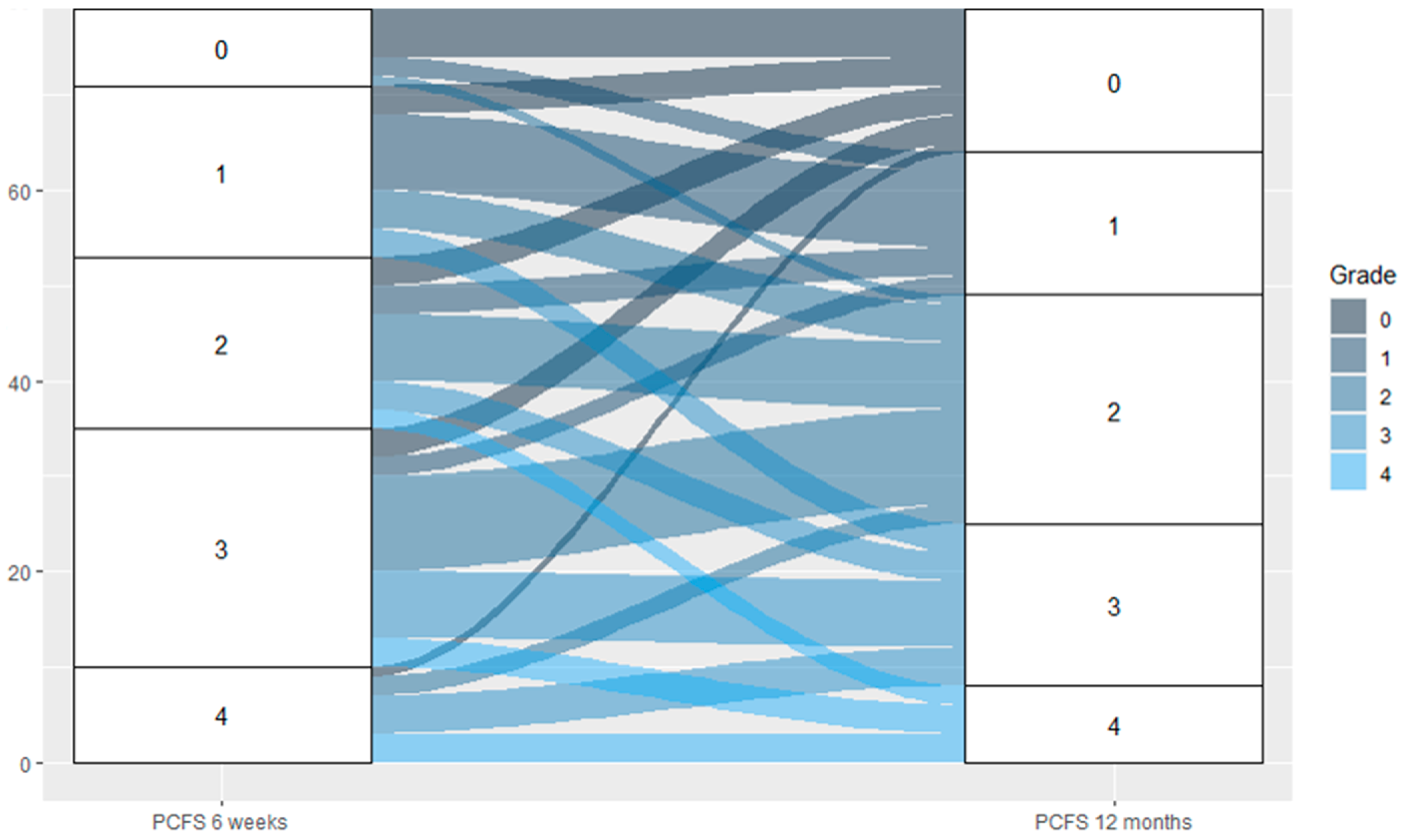
The distribution of individuals on the PCFS scale at 6 weeks and 12 months post-discharge is shown in Figure 1. At the 6-week follow-up, eight of the total 79 individuals (10%) were assigned to scale Grade 0, 18 (23%) to scale Grade 1, 18 (23%) to scale Grade 2, 25 (32%) to scale Grade 3, and 10 (13%) to scale Grade 4. At the 12-month follow-up, 15 individuals (19%) were assigned to scale Grade 0, 15 (19%) to scale Grade 1, 24 (30%) to scale Grade 2, 17 (22%) to scale Grade 3, and eight (10%) to scale Grade 4.
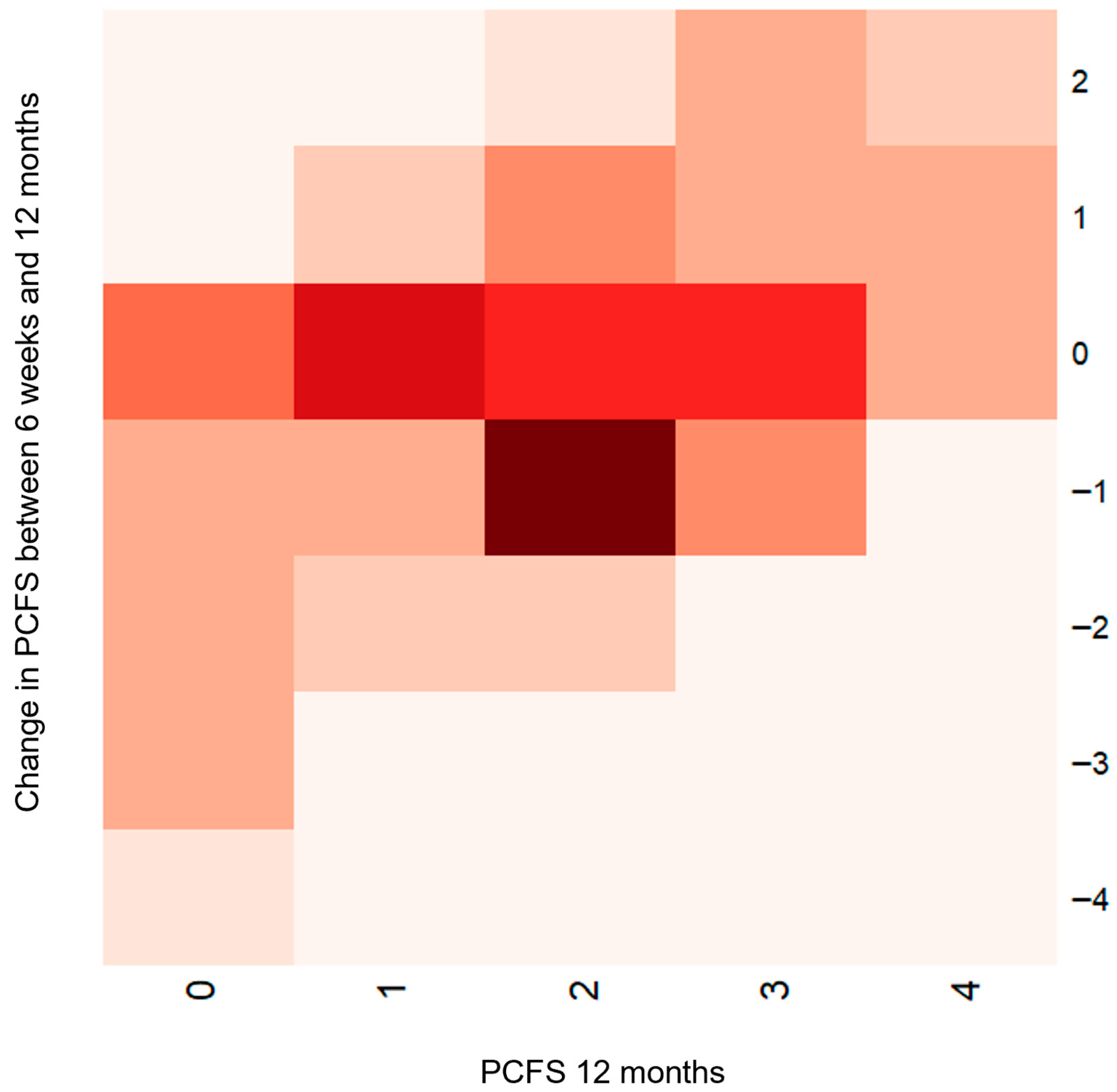
Between 6 weeks and 12 months follow-up, the PCFS scale grade changed in 49/79 (62%) of the participants. The change in PCFS scale grade between the two follow-up timepoints is shown in Figure 2. An improvement in functional status over time (i.e., decline in PCFS scale grade between 6 weeks and 12 months) was observed in 31/49 (63%): 20 individuals improved by one step, seven individuals improved by two steps, three individuals by three steps, and one improved by four steps. Of the 31 individuals who improved, 18 (58%) moved from a PCFS grade ≥3 at 6 weeks to a grade < 3 at 12 months, nine (29%) had a PCFS grade < 3 at both timepoints, and four (13%) had a PCFS grade ≥ 3 at both timepoints.
A deterioration in functional status (i.e., increase in PCFS scale grade between 6 weeks and 12 months) was observed in 18/49 (37%) patients: 12 individuals by one step and six by two steps. Of those 18 individuals, eight (44%) moved from a PCFS grade < 3 at 6 weeks to a grade ≥ 3 at 12 months, seven (39%) had a PCFS grade < 3 at both timepoints, and three (17%) had a PCFS grade ≥ 3 at both timepoints.
Interestingly, the 30 individuals with stable PCFS scale grades between 6 weeks and 12 months (30/79, 38%) were distributed across the scale, with five out of 30 (17%) in Grade 0, the largest proportions in Grade 1 (8/30, 27%), Grade 2 (7/30, 23%) or Grade 3 (7/30, 23%), and three individuals (10%) in Grade 4.
Overall, 17 of the 79 (22%) individuals had a PCFS grade ≥3 both at 6 weeks and 12 months, indicating moderate–severe functional limitations. Of these 17 individuals, 10 had stable functional status during follow-up (seven in Grade 3; three in Grade 4), four improved over time (i.e., change in scale grade from 4 to 3), and three deteriorated over time (from Grade 3 to 4).
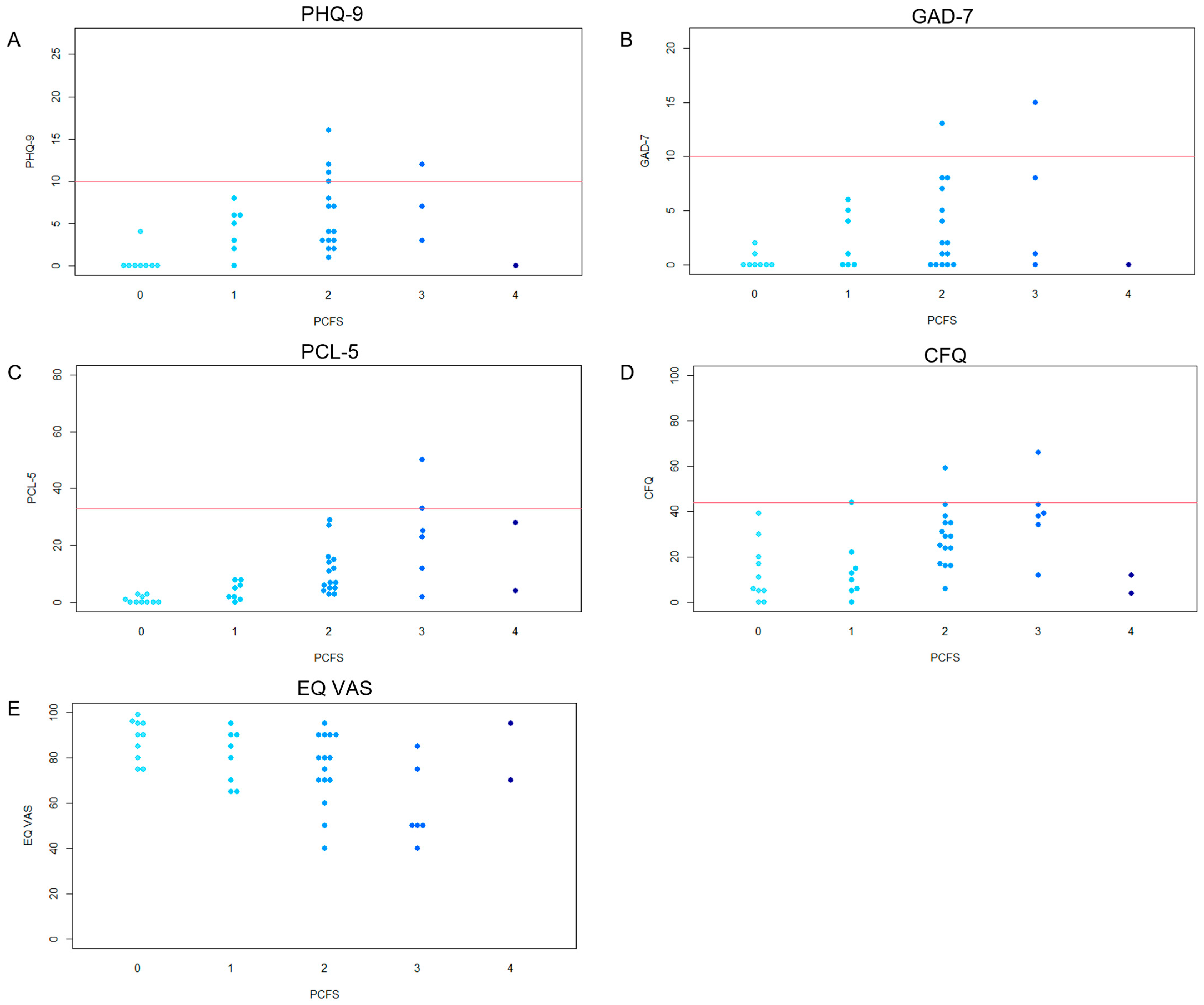
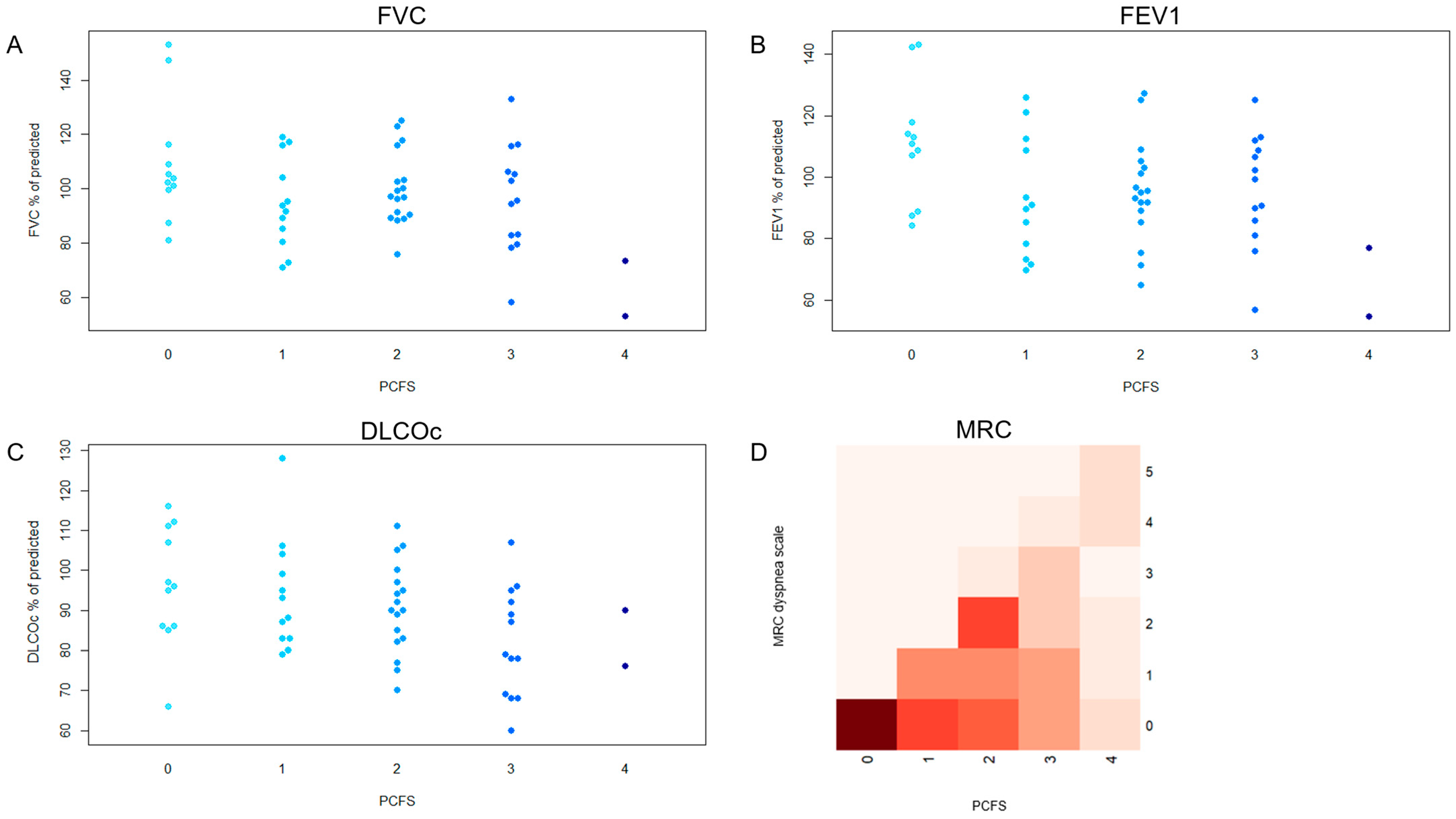
Regarding the secondary objective to explore how the PCFS scale compares to the questionnaire outcomes, pulmonary function, and physical function and fitness after 12 months of follow-up, it should be noted that the findings are exploratory and that the subgroup of study patients with PCFS scale Grade 4 consisted of only one or two individuals, depending on the outcome, due to missing data. In Figure 3, the PCFS scale grades at 12 months plotted against the PROM scores measured at the same timepoint are presented. Only individuals with PCFS scale grade 2 or 3 revealed abnormal outcomes in the PHQ-9 (depression), GAD-7 (anxiety), and PCL-5 (PTSD) questionnaires according to cut-off values; none of the scores of individuals with PCFS scale Grade 0 and 1 exceeded the cut-offs for these questionnaires. Most individuals with PCFS Grade 0 had PHQ-9, GAD-7 and PCL-5 scores of 0 (Supplementary Table S1). Based on inspection of the plotted values, higher PROM scores seemed to appear more frequently in individuals with higher PCFS scale grades. EQ VAS scores ranged from 75 to 99 for PCFS Grade 0, from 65 to 95 for Grade 1, 40–95 for Grade 2, and 40–85 for Grade 3; the lowest absolute EQ VAS scores among the study patients were observed in PCFS scale Grade 2 and 3.
With increasing PCFS scale grade, visual comparison of the plotted values suggested a decrease in pulmonary function outcomes (Figure 4A–C). For FVC and FEV1, all individuals with PCFS scale Grade 0 (n = 11) had values higher than 80% of predicted values. All individuals with PCFS Grade 0 (n = 15) had an MRC grade of 0 (Figure 4D). MRC grades of 2 and higher were only observed in individuals with a PCFS grade of at least 2, and MRC grades of 4 were only observed in individuals with PCFS grades of 3 or 4. The two individuals with MRC Grade 5 both had a PCFS grade of 4.
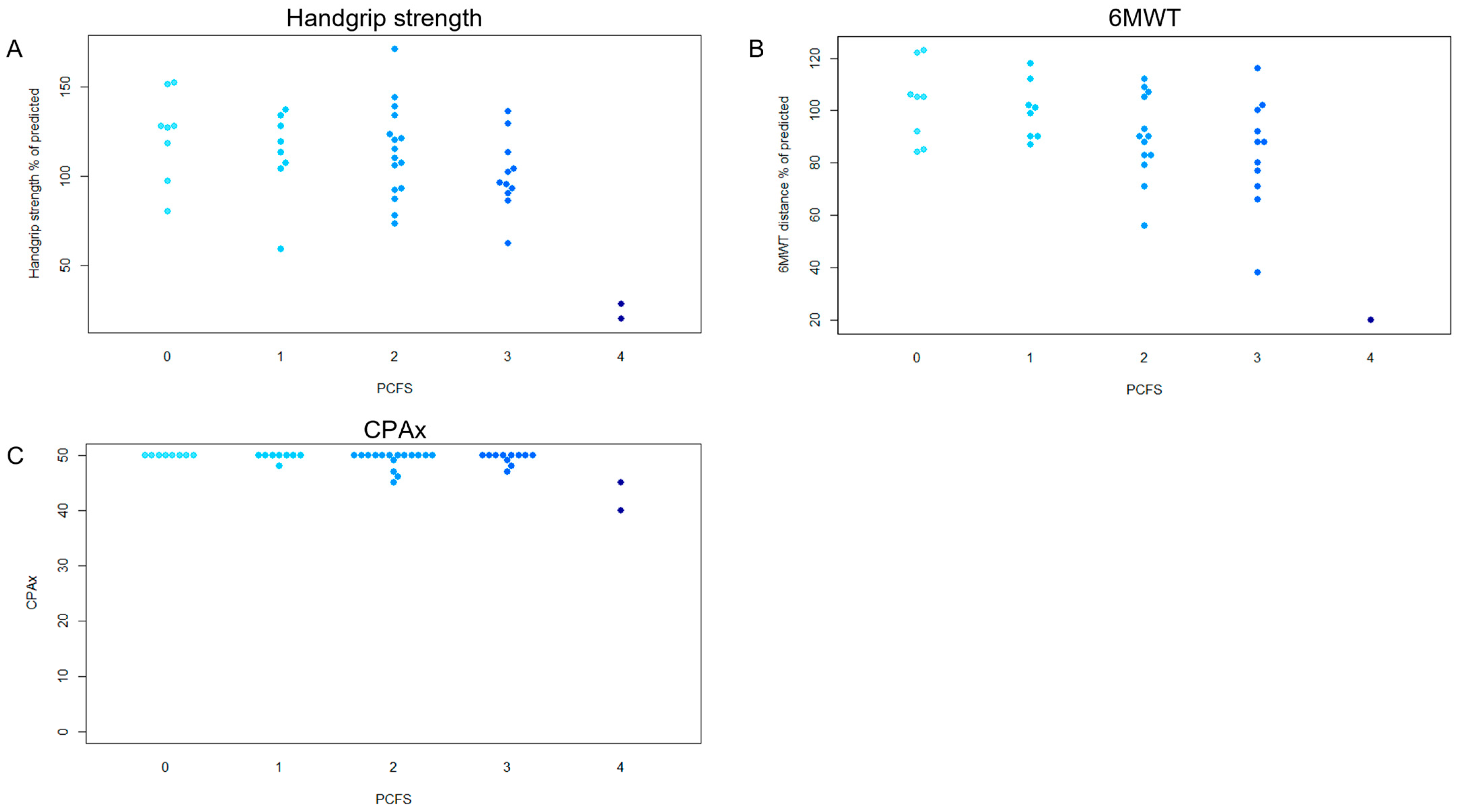
In Figure 5A,B, visual comparison suggests lower HGS and 6MWT distance when PCFS scale grades were higher. For the CPAx assessment tool, the majority of individuals (35/45, 78%), including all with PCFS scale Grade 0 (n = 8), had a maximum score of 50 (Figure 5C).
All these findings are less pronounced at the 6-week visit (Supplementary Figures S2 and S3).

4. Discussion

In this study, we evaluated the application of the PCFS scale in clinical practice over a longer time period among patients in our COVID-19 outpatient clinic, who received follow-up for 12 months after hospital discharge. We observed most patients had a change in their PCFS grade over time (49/79, 62%), and out of those 49, 31 patients (63%) experienced an improvement over time. Also, just more than half of the study patients (44/79, 56% PCFS grade < 3) had no, negligible, or slight functional limitations at 6 weeks post-discharge, which increased to two thirds (54/79, 68%) at 12 months. Notably, one fifth (17/79, 22%) had sustained moderate–severe impaired functional status (PCFS grade ≥3) at both follow-up timepoints, and 8/79 (10%) individuals deteriorated from no, negligible, or slight functional limitations to moderate–severe limitations during the first year after hospitalization for acute COVID-19. Identifying those individuals with deteriorating functional status or (stable) impaired functional status enables the initiation of adequate treatment or support, which could help improve functional outcomes.
Furthermore, based on our descriptive results, we mainly observed abnormal PHQ-9, GAD-7, PCL-5, and CFQ scores, an MRC of 2 and higher, and relatively lower EQ VAS and CPAx scores at 12-month follow-up in those with PCFS grade 2 or higher. Having no functional limitations or symptoms corresponded with absence of dyspnea, and having negligible functional limitations corresponded with having no dyspnea or only dyspnea on exertion. Moreover, descriptive patterns of decreasing pulmonary function outcomes, HGS, and 6MWT distance with increasing PCFS scale grades were suggested based on graphical inspection. As described in the Methods, no formal statistical tests were performed. These exploratory observations provide more descriptive insights into the overlap between the PCFS scale and other outcome measures at one year after acute COVID-19 that would be valuable when applying the scale in a clinical setting.
The one-item easy-to-assess PCFS scale is intended to be applied in addition to other validated (patient-reported) outcome measures to assess a broad concept of functional status following COVID-19. A pre-COVID-19 scale grade could be obtained to take patient’s pre-COVID-19 functioning into account when evaluating functional status over time, especially in a clinical setting [5,43]. Measuring functional status over time provides the opportunity to monitor functional recovery. As such, the PCFS scale is recommended in clinical guidelines to be assessed during the follow-up of COVID-19 survivors [32,33,34,35,36,38]. In the living WHO guidelines on the clinical management of COVID-19 patients, the PCFS scale is included in the section regarding the early referral of adults with post-COVID-19 condition for rehabilitation as a validated tool for the measurement of functional status, both at initial assessment and over time, without mentioning referral thresholds [37]. An individualized assessment is suggested. A European Respiratory Society statement on long COVID follow-up mentions that prolonged symptoms after the acute phase, affecting functional performance and daily activities, are to be systematically followed up; no specific outcome measures or thresholds are recommended [62]. No definitive thresholds that inform clinical decisions have yet been determined for the PCFS scale. As reported in the literature, it is important that referral pathways (from primary care into specialist services for long COVID, and to associated specialties including rehabilitation medicine) should be clearly defined [63]. A Canadian study recently evaluated thresholds based on objective tests and PROMs (PCFS scale not included), measuring both symptom burden and functional impairment, to determine rehabilitation needs among individuals experiencing long COVID [64]. In most studies that evaluated the PCFS scale or included the scale as an outcome measure, a 3-month or 6-month follow-up period was used [6,7,8,9,10,12,13,14,16,18,24,26,65,66,67,68,69,70,71,72,73,74,75,76,77,78,79,80,81,82,83,84,85,86,87,88,89,90,91,92,93,94,95]. Assessment of functional status at 4–12 weeks or more after acute COVID-19 could contribute to the recognition of individuals who may benefit from targeted treatment or rehabilitation [37,38].
In order to better capture the impact and effects of long COVID, new questionnaires and long-COVID-specific instruments have been developed [96,97,98,99]. An international Delphi consensus study resulted in a core outcome set of measurement instruments for adults with post-COVID-19 condition, including two long COVID specific instruments [96].
The findings of this study should be considered in relation to other long-term studies. In a prospective cohort study in which COVID-19 survivors were followed over one year, 29% (12/41) experienced slight to moderate functional limitations (i.e., PCFS grade 2–3), 10/41 had negligible functional limitations (i.e., PCFS grade 1), and almost half of the individuals (19/41) had no symptoms and no limitations (i.e., PCFS 0) at 12 months post-discharge [100]. Another prospective study had similar findings at 12 months after COVID-19 diagnosis [101]. In both studies, the majority of patients were mildly affected or did not experience functional limitations one year after acute COVID-19 and none scored a PCFS grade 4 indicating severe limitations, contrary to our study in which we observed higher proportions of COVID-19 survivors with PCFS grades 2 or 3 at 12 months (30% and 22%, respectively) and 10% assigned to PCFS grade 4, despite overall improvement in functional status compared to the 6-week assessment (Figure 1). This might be explained by the COVID-19 severity in the patients included in these studies: in the first study, a lower proportion of patients were admitted to the ICU (14%, versus 41% in our study) [100], and the second study evaluated individuals who were not hospitalized due to COVID-19 diagnosis [101]. In addition, the accessibility of post-discharge care and the organization of rehabilitation may influence recovery and functional status. In the first study, some patients were offered a pulmonary rehabilitation program based on the outcomes of post-discharge evaluation; however, data from these patients were excluded from their analysis. In a cross-sectional study that evaluated 225 patients who underwent mechanical ventilation due to COVID-19 one-year post-discharge, patients experienced more functional limitations one year after discharge compared to the two aforementioned studies, but better functional status than our study patients (37% PCFS scale Grade 0, 24% Grade 1, 25% Grade 2, 9% Grade 3, and 5% Grade 4; notably, some patients had received ambulatory rehabilitation therapy) [102]. Another cross-sectional study evaluated the feasibility of the 30 s sit-to-stand test in long COVID patients who had not been hospitalized, and also assessed the PCFS (after a median of 17 months, range 2–28 months, following COVID-19 infection): in this population, the majority had Grade 3 (40/79, 51%) or 4 (32/79, 41%), six patients had Grade 2, and one had Grade 1 [103]. In our study, we observed descriptive patterns (no formal statistical test performed) between PCFS scale grades and other outcomes at 12 months following acute COVID-19, which has not been evaluated in these studies. In one of the two aforementioned prospective studies with one-year follow-up, six-minute walking distance, pulmonary function, and modified MRC dyspnea scale were assessed at 12 months; however, correlation between PCFS and other outcomes was not specifically evaluated [100]. A study with a shorter follow-up duration of a median of 7 months (range 3–18 months) did report PHQ-9 and GAD-7 scores per PCFS scale grade [104]. With increasing PCFS grade, mean PHQ-9 and GAD-7 scores increased. The mean PHQ-9 scores were ≥10 for PCFS grade 3 and 4. Mean GAD-7 scores were below the cut-off value of 10 for all PCFS grades. A study evaluating a post-COVID symptom questionnaire (PCQ) score in a post-COVID cohort showed correlation between the PCFS and four of the five EQ-5D-5L dimensions (not with the anxiety dimension), and also that this PCQ score correlated with the PCFS [97]. Another study found that worse HGS was associated with more impaired physical functioning in patients with long COVID [105]. These findings are not dissimilar to our results, indicating that the PCFS correlates with relevant existing and validated instruments for both the short- and long-term. In patients with acute COVID-19 and long COVID, a worse functional status was associated with a poorer quality of life (measured using the Short Form 12 [SF-12]), as were lower physical activity (measured using the International Physical Activity Questionnaire [IPAQ]) and higher fatigue severity (measuring using the Fatigue Severity Scale [FSS]) [106]. Furthermore, a higher number of long COVID symptoms was found to be associated with more severe functional limitations, measured using the PCFS scale, with fatigue, dizziness, and memory loss as independent predictors of a worse functional status [28]. One prospective cohort study followed patients for up to 3 years after the initial infection [107]. After 2 years of follow-up, 70% (172/245) of the patients had no or negligible functional limitations (PCFS 0–1), compared with 63% (155/245) at the 1-year follow-up.
Our study has limitations. First, we note that data were collected in a clinical setting. Even though all adult patients hospitalized due to COVID-19 were invited for evaluation at our outpatient clinic after hospital discharge, not all patients came to each of the follow-up visits due to the absence of symptoms, being unable to attend the appointments due to severe impairments, or follow-up scheduled at another hospital as a result of transfers between hospitals due to hospital capacity during the pandemic. Patients transferred to other facilities and the most impaired patients may be underrepresented, while patients with ongoing symptoms who were able to attend follow-up may be overrepresented. This selection of patients will have affected the presence and severity of symptoms and outcomes and has affected the external validity of our results, as is typical in clinically based cohort studies. In addition, each 12-month outcome was based on a different set of patients from the study sample who had available data for that outcome, which may complicate the interpretation and generalizability of the findings. Although the characteristics of patients with complete outcome data did not differ largely from those in the total study population (except for potentially shorter hospital stays, and potentially less frequent ICU admissions and treatment with mechanical ventilation compared with the full cohort), the groups may differ in factors we did not or could not measure. We can only speculate about the underlying reasons that determined whether patients did or did not undergo (part of) the follow-up evaluations. One potential explanation could be that patients with worse functional status were not able to attend (complete) follow-up, which could have introduced systematic selection bias since these data are likely to be missing. Underrepresentation of the more impaired patients may result in an overestimation of the outcomes (PROMs, pulmonary function, and physical function and fitness) and an underestimation of the descriptive patterns observed between the PCFS and the outcomes. In the subgroup of PCFS grade 4 (and Grade 3 for the PROM outcomes), relatively more data seemed missing. Importantly, the findings in these subgroups (particularly the scale Grade 4 subgroup) should be interpreted with caution due to the small subgroup sizes. However, we still believe that our results provide relevant insights into the PCFS distribution over time of a group that was structurally under our care. Based on observation of the data, there is no indication that the individuals with available data for PROMs, pulmonary function, as well as physical function outcomes at 12 months had better or worse outcomes at 6 weeks, but strong conclusions cannot be drawn due to small numbers. Regarding external validity, we must also note that in this early pre-vaccination period of the pandemic, all patients in the study population had wild-type SARS-CoV-2 infections. Second, we must note that the number of patients in our sample and the number of patients with available data for each of the outcomes did not allow for statistical analyses, such as correlation analyses, ordinal regression or trajectory analyses, and thus we can only provide descriptive results. The presented observations regarding PCFS scale grades and other outcomes should be interpreted as exploratory rather than definitive. Notably, the PCFS scale Grade 4 subgroup is very small, resulting in only very limited information about these most impaired patients. Third, the PCFS was assessed by two methods at the two visits. At the 6-week follow-up, the PCFS was graded by two independent raters based on medical charts, while the 12-month PCFS was assigned using the short structured interview by one investigator. The interview approach is not dependent on data availability in charts and is therefore believed to be more reliable and recommended by the PCFS manual to be used in research settings. However, since the PCFS scale was just introduced at the beginning of the COVID-19 pandemic and the study patients were all hospitalized in the first months of the pandemic, assessment of the PCFS at the 6-week timepoint through the structured interview was not performed due to feasibility at that time. The difference in methods should be taken into account when interpreting the change over time, with the observed change reflecting both true change and method difference. Functional nuances such as work-related problems or lifestyle changes may be under-recorded with the chart assessments, likely underestimating functional limitations at the 6-week timepoint and consequently underestimating improvement over time. On the other hand, the interview assessments might better capture subtle functional changes, which could also lead to apparent deterioration if subtle limitations are detected at the 12-month timepoint. The suggested descriptive patterns, based on inspection of the plotted values, between PCFS and other outcomes at 12 months seemed less pronounced at the 6-week visit. This might indicate that the 6-week chart-based assessment may be suboptimal. The improvement in PCFS over time may represent an underestimation when specific information (e.g., regarding work and lifestyle changes) was not available in the charts, inappropriately leading to more favorable scale grades, or when subtle limitations were captured with the 12-month interview assessments. One might also speculate that functional limitations have been overstated at 6 weeks when certain nuances were not available in the charts, resulting in an overestimation of functional change over time. Both directions may have occurred. Combined with the second limitation, some questions cannot be answered with the aid of our data. Also, the data did not allow the identification of patients with symptoms compatible with long COVID. Questions on triggers, causes or markers for improvement over time in COVID-19 survivors can only be answered with larger studies. Furthermore, the application of the cut-off point for the PCFS scale in the analysis of changes over time does affect the benefits of this ordinal outcome, but also provides clarity when interpreting changes in PCFS over time. This cut-off is considered clinically relevant and has been used in earlier publications [44,108]. A minimal clinically important difference (MCID) has not been established for the PCFS scale. Lastly, we used the CPAx to measure physical function during follow-up. Originally, the CPAx was validated as a measurement tool for physical function during ICU stay [61]. However, recent studies also used the CPAx post-ICU stay, even post-discharge 3 to 12 months after ICU discharge [109,110]. In both studies, sub-maximal CPAx levels were still described at 3 months, and, to a lesser degree, at one-year follow-up, suggesting its sensibility for measuring physical recovery in the post-hospital phase, especially in patient cohorts with initial large physical functional constraints.
In summary, based on our descriptive study, we gained more understanding of the distribution of PCFS over time and how PCFS scale grades compare to other outcomes at 12 months post-discharge. Lower PCFS scale grades of 0 and 1 seemed to correspond with PROM scores below the cut-off values and MRC scale grades of 0 and 1, and were suggested to correspond with relatively higher EQ VAS scores and relatively better pulmonary function outcomes and physical function and fitness outcomes based on observed descriptive patterns. These exploratory findings provide informative insights into characteristics of the PCFS scale based on its use in a clinical setting during the one-year follow-up of COVID-19 survivors. Future studies with larger sample sizes are needed to investigate whether changes in PCFS over time reflect changes that are clinically relevant and meaningful to patients.

Supplementary Materials

The following supporting information can be downloaded at: https://www.mdpi.com/article/10.3390/covid6050081/s1, Table S1: Outcomes at 12-month follow-up after hospitalization due to acute COVID-19, per PCFS scale grade; Figure S1: Flow diagram; Figure S2: PCFS scale grades plotted against patient-reported outcome measures at 6-week follow-up; Figure S3: PCFS scale grades plotted against pulmonary function outcomes at 6-week follow-up.

Author Contributions

Conceptualization, C.M.M.d.J., B.F.M.v.R., L.A., S.A., M.G., M.A.d.G., G.H.G., C.H., V.R.J., M.M.t.K., A.H.E.R., L.S., M.S.W., F.A.K. and B.S.; methodology, C.M.M.d.J., F.A.K. and B.S.; formal analysis, C.M.M.d.J.; investigation, C.M.M.d.J., B.F.M.v.R., L.A., S.A., M.G., M.A.d.G., G.H.G., C.H., V.R.J., M.M.t.K., A.H.E.R., L.S., M.S.W., F.A.K. and B.S.; writing—original draft preparation, C.M.M.d.J. and B.S.; writing—review and editing, B.F.M.v.R., L.A., S.A., M.G., M.A.d.G., G.H.G., C.H., V.R.J., M.M.t.K., A.H.E.R., L.S., M.S.W. and F.A.K.; visualization, C.M.M.d.J.; supervision, F.A.K. and B.S.; project administration, C.M.M.d.J. and B.S. The COVID-19 LUMC Group contributed to the data collection. All authors have read and agreed to the published version of the manuscript.

Funding

This research received no external funding.

Institutional Review Board Statement

The study was conducted in accordance with the Declaration of Helsinki, and approved by the Institutional Review Board of the Leiden University Medical Center for observational COVID-19 studies (protocol number 2021-012 and date of approval 8 June 2021).

Informed Consent Statement

Informed consent was obtained by an opt-out procedure: all admitted COVID-19 patients, or their relatives if the patients themselves were not responsive, were informed about the potential use of data from routine care for research purposes. They were provided with a subject information sheet and were offered to opt out if they did not consent to the use of their data.

Data Availability Statement

The dataset analyzed during the current study is available from the corresponding author on reasonable request: complete deidentified participant data collected for this study will be made available after publication to researchers whose proposed use of the data has been approved with a signed data access agreement. Requests for access to the clinical study data can be submitted via e-mail to the corresponding author.

Acknowledgments

We are indebted to all the patients with COVID-19 who participated in this research. We sincerely thank all medical students and staff (Josine A. Oud; Meryem Baysan; Jeanette Wigbers; Lieke J. van Heurn; Susan B. ter Haar; Alexandra G. L. Toppenberg; Laura Heerdink; Annekee A. van IJlzinga Veenstra; Anna M. Eikenboom; Julia Wubbolts; Jonathan Uzorka; Willem Lijferink; Romy Meier; Ingeborg de Jonge; Sesmu M. Arbous; Mark G. J. de Boer; Anske G. van der Bom; Olaf M. Dekkers; Frits Rosendaal) who contributed to obtaining the data from the electronic medical files and secured and organized the database according to good research practices.

Conflicts of Interest

F.A. Klok reports grants or contracts from Bayer, BMS, BSCI, MSD, Leo Pharma, Actelion, VarmX, The Netherlands Organisation for Health Research and Development, The Dutch Thrombosis Association, The Dutch Heart Foundation and the Horizon Europe Program, all unrelated to this work and paid to his institution. C.M.M. de Jong, B.F.M. van Raaij, M.L. Antoni, M.S. Arbous, J.J.M. Geelhoed, M.A. de Graaf, G.H. Groeneveld, S.C.H. Hinnen, V.R. Janssen, M.M. ter Kuile, A.H.E. Roukens, J.L. Stöger, M.S. Werkman, and B. Siegerink declare no conflicts of interest.

Abbreviations

The following abbreviations are used in this manuscript:
ATSAmerican Thoracic Society
CFQCognitive Failure Questionnaire
COVID-19Coronavirus disease 2019
CPAxChelsea Critical Care Physical Assessment Tool
DLCOcDiffusing capacity of the lungs for carbon monoxide corrected for hemoglobin
EQ VASEuroQoL visual analog scale
ERSEuropean Respiratory Society
FEV1Forced expiratory volume in one second
FSSFatigue Severity Scale
FVCForced vital capacity
GAD-7Generalized Anxiety Disorder-7
ICUIntensive care unit
IPAQInternational Physical Activity Questionnaire
LUMCLeiden University Medical Center
MRCMedical Research Council
PCFSPost-COVID-19 Functional Status
PCL-5PTSD Checklist for DSM-5
PCRPolymerase chain reaction
PHQ-9Patient Health Questionnaire-9
PROMPatient-reported outcome measure
PTSDPost-traumatic stress disorder
PVFSPost-Venous Thromboembolism Functional Status
SARS-CoV-2Severe acute respiratory syndrome coronavirus 2
SF-12Short Form 12
VTEVenous thromboembolism
WHOWorld Health Organization
6MWTSix-minute walking test

References

  1. Klok, F.A.; Boon, G.J.A.M.; Barco, S.; Endres, M.; Geelhoed, J.J.M.; Knauss, S.; Rezek, S.A.; Spruit, M.A.; Vehreschild, J.; Siegerink, B. The Post-COVID-19 Functional Status scale: A tool to measure functional status over time after COVID-19. Eur. Respir. J. 2020, 56, 2001494. [Google Scholar] [CrossRef] [PubMed]
  2. Klok, F.A.; Barco, S.; Siegerink, B. Measuring functional limitations after venous thromboembolism: A call to action. Thromb. Res. 2019, 178, 59–62. [Google Scholar] [CrossRef]
  3. Boon, G.J.A.M.; Barco, S.; Bertoletti, L.; Ghanima, W.; Huisman, M.V.; Kahn, S.R.; Noble, S.; Prandoni, P.; Rosovsky, R.P.; Sista, A.K.; et al. Measuring functional limitations after venous thromboembolism: Optimization of the Post-VTE Functional Status (PVFS) Scale. Thromb. Res. 2020, 190, 45–51. [Google Scholar] [CrossRef]
  4. Siegerink, B.; Klok, F.A.; Le, Y.N.J. Use of the PCFS Two Years After Its Introduction—A Literature Review and Survey Amongst Users. Available online: https://osf.io/h5equ/ (accessed on 29 September 2023).
  5. de Jong, C.M.M.; Le, Y.N.J.; Boon, G.; Barco, S.; Klok, F.A.; Siegerink, B. Eight lessons from 2 years of use of the Post-COVID-19 Functional Status scale. Eur. Respir. J. 2023, 61, 2300416. [Google Scholar] [CrossRef]
  6. Machado, F.V.C.; Meys, R.; Delbressine, J.M.; Vaes, A.W.; Goërtz, Y.M.J.; van Herck, M.; Houben-Wilke, S.; Boon, G.; Barco, S.; Burtin, C.; et al. Construct validity of the Post-COVID-19 Functional Status Scale in adult subjects with COVID-19. Health Qual. Life Outcomes 2021, 19, 40. [Google Scholar] [CrossRef] [PubMed]
  7. Leite, L.C.; Carvalho, L.; Queiroz, D.M.; Farias, M.S.Q.; Cavalheri, V.; Edgar, D.W.; Nery, B.; Vasconcelos Barros, N.; Maldaner, V.; Campos, N.G.; et al. Can the post-COVID-19 functional status scale discriminate between patients with different levels of fatigue, quality of life and functional performance? Pulmonology 2022, 28, 220–223. [Google Scholar] [CrossRef]
  8. Benkalfate, N.; Eschapasse, E.; Georges, T.; Leblanc, C.; Dirou, S.; Melscoet, L.; Chéné, A.L.; Horeau-Langlard, D.; Bry, C.; Chambellan, A.; et al. Evaluation of the Post-COVID-19 Functional Status (PCFS) Scale in a cohort of patients recovering from hypoxemic SARS-CoV-2 pneumonia. BMJ Open Respir. Res. 2022, 9, e001136. [Google Scholar] [CrossRef]
  9. Du, H.W.; Fang, S.F.; Wu, S.R.; Chen, X.L.; Chen, J.N.; Zhang, Y.X.; Huang, H.Y.; Lei, H.H.; Chen, R.H.; Pan, X.B.; et al. Six-month follow-up of functional status in discharged patients with coronavirus disease 2019. BMC Infect. Dis. 2021, 21, 1271. [Google Scholar] [CrossRef]
  10. Tran, V.T.; Riveros, C.; Clepier, B.; Desvarieux, M.; Collet, C.; Yordanov, Y.; Ravaud, P. Development and Validation of the Long Coronavirus Disease (COVID) Symptom and Impact Tools: A Set of Patient-Reported Instruments Constructed From Patients’ Lived Experience. Clin. Infect. Dis. 2022, 74, 278–287. [Google Scholar] [CrossRef]
  11. Betancourt-Peña, J.; Ávila-Valencia, J.C.; Palacios-Gómez, M.; Rodríguez-Castro, J.; Benavides-Córdoba, V. Traducción y adaptación cultural de la escala The Post-COVID-19 Functional Status (PCFS) Scale al español (Colombia). Rev. Cuba. Investig. Biomédicas 2021, 40, e1551. [Google Scholar]
  12. Çalik Kütükcü, E.; Çakmak, A.; Kinaci, E.; Uyaroğlu, O.A.; Vardar Yağli, N.; Sain Güven, G.; Sağlam, M.; Özişik, L.; Çalik Başaran, N.; Inal Ince, D. Reliability and validity of the Turkish version of Post-COVID-19 Functional Status Scale. Turk. J. Med. Sci. 2021, 51, 2304–2310. [Google Scholar] [CrossRef]
  13. Moreno-Torres, L.A.; Ventura-Alfaro, C.E. Validation of the Post-COVID-19 Functional Status Scale into Mexican-Spanish. J. Rehabil. Med. Clin. Commun. 2021, 4, 1000070. [Google Scholar] [CrossRef]
  14. Lorca, L.A.; Torres-Castro, R.; Ribeiro, I.L.; Benavente, P.; Pizarro, M.; San Cristobal, B.; Ugarte, J.; Laura, C.; Huanchicay, C.; Mamani, A. Linguistic Validation and Cross-Cultural Adaptation of the Post-COVID-19 Functional Status Scale for the Chilean Population. Am. J. Phys. Med. Rehabil. 2021, 100, 313–320. [Google Scholar] [CrossRef]
  15. Lorca, L.A.; Leão Ribeiro, I.; Torres-Castro, R.; Sacomori, C.; Rivera, C. [Psychometric properties of the Post-COVID 19 Functional Status scale for adult COVID 19 survivors]. Rehabilitacion 2022, 56, 337–343. [Google Scholar] [CrossRef]
  16. Sacristán-Galisteo, C.; Del Corral, T.; Ríos-León, M.; Martín-Casas, P.; Plaza-Manzano, G.; López-de-Uralde-Villanueva, I. Construct validity of the Spanish version of the Post-COVID-19 Functional Status scale and validation of the web-based form in COVID-19 survivors. PLoS ONE 2022, 17, e0269274. [Google Scholar] [CrossRef]
  17. Verma, C.; Thakkar, K.; Parekh, A. Translation and psychometric properties of the Gujarati version post-COVID functional status scale. IP Indian J. Immunol. Respir. Med. 2022, 7, 11–15. [Google Scholar] [CrossRef]
  18. de Facio, C.A.; Guimarães, F.S.; da Cruz, A.G.T.; Bomfim, R.F.; Miranda, S.; Viana, D.R.; Dos Santos Couto Paz, C.C.; Sato, T.O.; Lorenzo, V. Post-COVID-19 functional status scale: Cross-cultural adaptation and measurement properties of the Brazilian Portuguese version. Braz. J. Phys. Ther. 2023, 27, 100503. [Google Scholar] [CrossRef]
  19. Tsekoura, M.; Fousekis, K.; Billis, E.; Dionyssiotis, Y.; Tsepis, E. Cross-cultural adaptation of the Greek version of post-COVID-19 Functional Status Scale: Assessment of non-hospitalised post-COVID-19 survivors. Eur. J. Transl. Myol. 2023, 33, 11328. [Google Scholar] [CrossRef]
  20. Garcia Morales, O.M.; Botero, J.D.; Moreno Luna, S.; Delgado Ramirez, M.; Gil Laverde, F. Validation of the ‘Post-COVID-19 Functional Status Scale (PCSF)’ in patients with COVID-19 infection. Eur. Respir. J. 2024, 64, PA301. [Google Scholar] [CrossRef]
  21. Ejalonibu, H.; Amah, A.; Aburub, A.; Kumar, P.; Frederick, D.E.; Groot, G. A review of Patient Reported Outcome Measures (PROMs) for characterizing Long COVID (LC)-merits, gaps, and recommendations. J. Patient Rep. Outcomes 2024, 8, 101. [Google Scholar] [CrossRef]
  22. Sørensen, L.; Agergaard, J.; Nielsen, T.B.; Schiøttz-Christensen, B.; Laursen, C.H.; Leth, S.; Nielsen, C.V.; Oestergaard, L.G. Construct validity of self-reported and interview-guided administration methods of the Danish version of the post-COVID-19 functional Status scale. Front. Rehabil. Sci. 2025, 6, 1690892. [Google Scholar] [CrossRef]
  23. Baalmann, A.K.; Blome, C.; Stoletzki, N.; Donhauser, T.; Apfelbacher, C.; Piontek, K. Patient-reported outcome measures for post-COVID-19 condition: A systematic review of instruments and measurement properties. BMJ Open 2024, 14, e084202. [Google Scholar] [CrossRef]
  24. Koullias, E.; Fragkiadakis, G.; Papavdi, M.; Manousopoulou, G.; Karamani, T.; Avgoustou, H.; Kotsi, E.; Niakas, D.; Vassilopoulos, D. Long-Term Effect on Health-Related Quality of Life in Patients with COVID-19 Requiring Hospitalization Compared to Non-hospitalized COVID-19 Patients and Healthy Controls. Cureus 2022, 14, e31342. [Google Scholar] [CrossRef]
  25. Islam, M.T.; Mahjabin, A.; Islam, M.M.; Tasnim, A.; Al-Mahmood, M.R.; Khasru, M.R.; Salek, A.K.M.; Uddin, T. Assessment of Post-COVID-19 Functional Status and Complications Among Survivors at a Tertiary Healthcare Center in Bangladesh. Cureus 2025, 17, e82866. [Google Scholar] [CrossRef]
  26. Nopp, S.; Moik, F.; Klok, F.A.; Gattinger, D.; Petrovic, M.; Vonbank, K.; Koczulla, A.R.; Ay, C.; Zwick, R.H. Outpatient Pulmonary Rehabilitation in Patients with Long COVID Improves Exercise Capacity, Functional Status, Dyspnea, Fatigue, and Quality of Life. Respiration 2022, 101, 593–601. [Google Scholar] [CrossRef]
  27. Asimakos, A.; Spetsioti, S.; Mentzelopoulos, S.; Vogiatzis, I.; Vassiliou, A.G.; Gounopoulos, P.; Antonoglou, A.; Spaggoulakis, D.; Pappa, S.; Zakynthinos, S.; et al. Rehabilitation Is Associated with Improvements in Post-COVID-19 Sequelae. Respir. Care 2024, 69, 1361–1370. [Google Scholar] [CrossRef]
  28. Escrivá, N.; Moreno-Galarraga, L.; Barado, E.; Torres, M.G.; Fernández-Montero, A. Assessment of long COVID-19 symptoms and functional status: Insights from a cross-sectional study. Front. Med. 2025, 12, 1715786. [Google Scholar] [CrossRef]
  29. Sevdimbaş, S.H.; İnal, A.S.; Kuşcu, F.; Kurtaran, B.; Candevir, A.; Taşova, Y.; Kömür, S. Follow-up evaluation of long COVID syndrome in patients with SARS-CoV-2 infection. Rev. Soc. Bras. Med. Trop. 2025, 58, e00462025. [Google Scholar] [CrossRef]
  30. Macej, M.; Grus, C.; Čuj, J.; Demjanovič Kendrová, L.; Mikuľaková, W.B.; Kubincová, A.; Takáč, P. Quality of Life and Functional Status in Individuals with Persistent Post-COVID Symptoms: A Cross-Sectional Comparison by Reported Rehabilitation. Medicina 2025, 61, 2214. [Google Scholar] [CrossRef]
  31. Honchar, O.; Ashcheulova, T.; Bobeiko, A.; Blazhko, V.; Khodosh, E.; Matiash, N.; Syrota, V. 12-Month trajectories of physical and mental symptom scores after COVID-19 hospitalization and their role in predicting “very long” COVID. Front. Rehabil. Sci. 2025, 6, 1568291. [Google Scholar] [CrossRef]
  32. Sociedades Científicas y Colegios Profesionales del área de rehabilitación. Consenso Interdisciplinario de Rehabilitación para Personas Adultas Post COVID-19; Recomendaciones Para la Práctica Clínica; Sociedad Chilena de Medicina Física y Rehabilitación (SOCHIMFYR): Santiago, Chile, 2020. [Google Scholar]
  33. Rabady, S.; Altenberger, J.; Brose, M.; Denk-Linnert, D.M.; Fertl, E.; Götzinger, F.; de la Cruz Gomez Pellin, M.; Hofbaur, B.; Hoffmann, K.; Hoffmann-Dorninger, R.; et al. Long COVID: Differenzialdiagnostik und Behandlungsstrategien. [Guideline S1: Long COVID: Diagnostics and treatment strategies]. Wien. Klin. Wochenschr. 2021, 133, 237–278. [Google Scholar] [CrossRef] [PubMed]
  34. Koczulla, A.R.; Ankermann, T.; Behrends, U.; Berlit, P.; Böing, S.; Brinkmann, F.; Franke, C.; Glöckl, R.; Gogoll, C.; Hummel, T.; et al. [S1 Guideline Post-COVID/Long-COVID]. Pneumologie 2021, 75, 869–900. [Google Scholar] [CrossRef]
  35. Servei Català de la Salut. Guia Clínica per a L’atenció de les Persones Amb Símptomes Persistents de COVID-19; Generalitat de Catalunya: Barcelona, Spain, 2021.
  36. Swaminathan, N.; Jiandani, M.; Surendran, P.J.; Jacob, P.; Bhise, A.; Baxi, G.; Devani, P.; Agarwal, B.; Kumar, V.S.; Pinto, N.M.; et al. Beyond COVID-19: Evidence-Based Consensus Statement on the Role of Physiotherapy in Pulmonary Rehabilitation in the Indian Context. J. Assoc. Physicians India 2020, 68, 82–89. [Google Scholar]
  37. World Health Organization. Clinical Management of COVID-19: Living Guideline, June 2025; World Health Organization: Geneva, Switzerland, 2025. [Google Scholar] [CrossRef]
  38. Visca, D.; Centis, R.; Pontali, E.; Zampogna, E.; Russell, A.M.; Migliori, G.B.; Andrejak, C.; Aro, M.; Bayram, H.; Berkani, K.; et al. Clinical standards for diagnosis, treatment and prevention of post-COVID-19 lung disease. Int. J. Tuberc. Lung Dis. 2023, 27, 729–741. [Google Scholar] [CrossRef]
  39. Rijksoverheid. [Government the Netherlands]. Coronavirus Dashboard: Coronavirus Variants. Available online: https://coronadashboard.government.nl/landelijk/varianten (accessed on 29 September 2023).
  40. Protocol. Further evaluation of the Post-COVID-19 Functional Status scale. April 2021. Available online: https://osf.io/w9ke2 (accessed on 16 October 2023).
  41. Bestall, J.C.; Paul, E.A.; Garrod, R.; Garnham, R.; Jones, P.W.; Wedzicha, J.A. Usefulness of the Medical Research Council (MRC) dyspnoea scale as a measure of disability in patients with chronic obstructive pulmonary disease. Thorax 1999, 54, 581–586. [Google Scholar] [CrossRef]
  42. Siegerink, B.; Boon, G.J.A.M.; Barco, S.; Klok, F.A.; Le, Y.N.J. Open Science Framework (OSF). The Post-COVID-19 Functional Status (PCFS) Scale: A Tool to Measure Functional Status over Time After COVID-19. Available online: https://osf.io/qgpdv/ (accessed on 22 August 2023).
  43. Post-COVID-19 Functional Status Scale Manual; 2020. Available online: https://osf.io/mpfvy (accessed on 16 October 2023).
  44. de Graaf, M.A.; Antoni, M.L.; Ter Kuile, M.M.; Arbous, M.S.; Duinisveld, A.J.F.; Feltkamp, M.C.W.; Groeneveld, G.H.; Hinnen, S.C.H.; Janssen, V.R.; Lijfering, W.M.; et al. Short-term outpatient follow-up of COVID-19 patients: A multidisciplinary approach. EClinicalMedicine 2021, 32, 100731. [Google Scholar] [CrossRef]
  45. EuroQol Group. EuroQol—A new facility for the measurement of health-related quality of life. Health Policy 1990, 16, 199–208. [Google Scholar] [CrossRef]
  46. Kroenke, K.; Spitzer, R.L.; Williams, J.B. The PHQ-9: Validity of a brief depression severity measure. J. Gen. Intern. Med. 2001, 16, 606–613. [Google Scholar] [CrossRef]
  47. Spitzer, R.L.; Kroenke, K.; Williams, J.B.; Löwe, B. A brief measure for assessing generalized anxiety disorder: The GAD-7. Arch. Intern. Med. 2006, 166, 1092–1097. [Google Scholar] [CrossRef]
  48. Blevins, C.A.; Weathers, F.W.; Davis, M.T.; Witte, T.K.; Domino, J.L. The Posttraumatic Stress Disorder Checklist for DSM-5 (PCL-5): Development and Initial Psychometric Evaluation. J. Trauma. Stress 2015, 28, 489–498. [Google Scholar] [CrossRef]
  49. Bovin, M.J.; Marx, B.P.; Weathers, F.W.; Gallagher, M.W.; Rodriguez, P.; Schnurr, P.P.; Keane, T.M. Psychometric properties of the PTSD Checklist for Diagnostic and Statistical Manual of Mental Disorders-Fifth Edition (PCL-5) in veterans. Psychol. Assess. 2016, 28, 1379–1391. [Google Scholar] [CrossRef]
  50. Broadbent, D.E.; Cooper, P.F.; FitzGerald, P.; Parkes, K.R. The Cognitive Failures Questionnaire (CFQ) and its correlates. Br. J. Clin. Psychol. 1982, 21, 1–16. [Google Scholar] [CrossRef] [PubMed]
  51. Ponds, R.; Boxtel, M.; Jolles, J. De ‘Cognitive Failure Questionnaire’ als maat voor subjectief cognitief functioneren. Tijdschr. Voor Neuropsychol. 2006, 1, 37–45. [Google Scholar]
  52. Stanojevic, S.; Graham, B.L.; Cooper, B.G.; Thompson, B.R.; Carter, K.W.; Francis, R.W.; Hall, G.L. Official ERS technical standards: Global Lung Function Initiative reference values for the carbon monoxide transfer factor for Caucasians. Eur. Respir. J. 2017, 50, 1700010. [Google Scholar] [CrossRef]
  53. Graham, B.L.; Brusasco, V.; Burgos, F.; Cooper, B.G.; Jensen, R.; Kendrick, A.; MacIntyre, N.R.; Thompson, B.R.; Wanger, J. 2017 ERS/ATS standards for single-breath carbon monoxide uptake in the lung. Eur. Respir. J. 2017, 49, 1600016. [Google Scholar] [CrossRef] [PubMed]
  54. Graham, B.L.; Steenbruggen, I.; Miller, M.R.; Barjaktarevic, I.Z.; Cooper, B.G.; Hall, G.L.; Hallstrand, T.S.; Kaminsky, D.A.; McCarthy, K.; McCormack, M.C.; et al. Standardization of Spirometry 2019 Update. An Official American Thoracic Society and European Respiratory Society Technical Statement. Am. J. Respir. Crit. Care Med. 2019, 200, e70–e88. [Google Scholar] [CrossRef]
  55. Quanjer, P.H.; Stanojevic, S.; Cole, T.J.; Baur, X.; Hall, G.L.; Culver, B.H.; Enright, P.L.; Hankinson, J.L.; Ip, M.S.; Zheng, J.; et al. Multi-ethnic reference values for spirometry for the 3-95-yr age range: The global lung function 2012 equations. Eur. Respir. J. 2012, 40, 1324–1343. [Google Scholar] [CrossRef]
  56. Gilbertson, L.; Barber-Lomax, S. Power and Pinch Grip Strength Recorded Using the Hand-Held Jamar® Dynamometer and B+L Hydraulic Pinch Gauge: British Normative Data for Adults. Br. J. Occup. Ther. 1994, 57, 483–488. [Google Scholar] [CrossRef]
  57. Lee, S.H.; Gong, H.S. Measurement and Interpretation of Handgrip Strength for Research on Sarcopenia and Osteoporosis. J. Bone Metab. 2020, 27, 85–96. [Google Scholar] [CrossRef]
  58. ATS Committee on Proficiency Standards for Clinical Pulmonary Function Laboratories. ATS statement: Guidelines for the six-minute walk test. Am. J. Respir. Crit. Care Med. 2002, 166, 111–117. [Google Scholar] [CrossRef] [PubMed]
  59. Enright, P.L.; Sherrill, D.L. Reference equations for the six-minute walk in healthy adults. Am. J. Respir. Crit. Care Med. 1998, 158, 1384–1387. [Google Scholar] [CrossRef]
  60. Holland, A.E.; Spruit, M.A.; Troosters, T.; Puhan, M.A.; Pepin, V.; Saey, D.; McCormack, M.C.; Carlin, B.W.; Sciurba, F.C.; Pitta, F.; et al. An official European Respiratory Society/American Thoracic Society technical standard: Field walking tests in chronic respiratory disease. Eur. Respir. J. 2014, 44, 1428–1446. [Google Scholar] [CrossRef]
  61. Corner, E.J.; Wood, H.; Englebretsen, C.; Thomas, A.; Grant, R.L.; Nikoletou, D.; Soni, N. The Chelsea critical care physical assessment tool (CPAx): Validation of an innovative new tool to measure physical morbidity in the general adult critical care population; an observational proof-of-concept pilot study. Physiotherapy 2013, 99, 33–41. [Google Scholar] [CrossRef]
  62. Antoniou, K.M.; Vasarmidi, E.; Russell, A.M.; Andrejak, C.; Crestani, B.; Delcroix, M.; Dinh-Xuan, A.T.; Poletti, V.; Sverzellati, N.; Vitacca, M.; et al. European Respiratory Society statement on long COVID follow-up. Eur. Respir. J. 2022, 60, 2102174. [Google Scholar] [CrossRef]
  63. Greenhalgh, T.; Sivan, M.; Perlowski, A.; Nikolich, J. Long COVID: A clinical update. Lancet 2024, 404, 707–724. [Google Scholar] [CrossRef]
  64. Petry Moecke, D.M.; Kwong, E.H.; Cressman, S.; Yao, J.; Singh, C.; Taylor, C.; Camp, P.G. Rehabilitation needs of long COVID patients in British Columbia. PM&R 2026. Available online: https://pubmed.ncbi.nlm.nih.gov/41603315/ (accessed on 16 October 2023). [CrossRef]
  65. Foged, F.; Rasmussen, I.E.; Bjørn Budde, J.; Rasmussen, R.S.; Rasmussen, V.; Lyngbæk, M.; Jønck, S.; Krogh-Madsen, R.; Lindegaard, B.; Ried-Larsen, M.; et al. Fidelity, tolerability and safety of acute high-intensity interval training after hospitalisation for COVID-19: A randomised cross-over trial. BMJ Open Sport Exerc. Med. 2021, 7, e001156. [Google Scholar] [CrossRef]
  66. Hess, C.N.; Capell, W.H.; Bristow, M.R.; Ruf, W.; Szarek, M.; Morrow, D.A.; Nicolau, J.C.; Graybill, C.A.; Marshall, D.; Hsia, J.; et al. Rationale and design of a study to assess the safety and efficacy of rNAPc2 in COVID-19: The Phase 2b ASPEN-COVID-19 trial. Am. Heart J. 2022, 246, 136–143. [Google Scholar] [CrossRef]
  67. Taboada, M.; Cariñena, A.; Moreno, E.; Rodríguez, N.; Domínguez, M.J.; Casal, A.; Riveiro, V.; Diaz-Vieito, M.; Valdés, L.; Álvarez, J.; et al. Post-COVID-19 functional status six-months after hospitalization. J. Infect. 2021, 82, e31–33. [Google Scholar] [CrossRef]
  68. Taboada, M.; Moreno, E.; Cariñena, A.; Rey, T.; Pita-Romero, R.; Leal, S.; Sanduende, Y.; Rodríguez, A.; Nieto, C.; Vilas, E.; et al. Quality of life, functional status, and persistent symptoms after intensive care of COVID-19 patients. Br. J. Anaesth. 2021, 126, e110–e113. [Google Scholar] [CrossRef]
  69. Mohamed Hussein, A.A.; Saad, M.; Zayan, H.E.; Abdelsayed, M.; Moustafa, M.; Ezzat, A.R.; Helmy, R.; Abd-Elaal, H.; Aly, K.; Abdelrheem, S.; et al. Post-COVID-19 functional status: Relation to age, smoking, hospitalization, and previous comorbidities. Ann. Thorac. Med. 2021, 16, 260–265. [Google Scholar] [CrossRef]
  70. INSPIRATION-INVESTIGATORS. Durable functional limitation in patients with coronavirus disease-2019 admitted to intensive care and the effect of intermediate-dose vs standard-dose anticoagulation on functional outcomes. Eur. J. Intern. Med. 2022, 103, 76–83. [Google Scholar] [CrossRef]
  71. Boon, G.J.A.M.; Janssen, S.M.J.; Barco, S.; Bogaard, H.J.; Ghanima, W.; Kroft, L.J.M.; Meijboom, L.J.; Ninaber, M.K.; Nossent, E.J.; Spruit, M.A.; et al. Efficacy and safety of a 12-week outpatient pulmonary rehabilitation program in Post-PE Syndrome. Thromb. Res. 2021, 206, 66–75. [Google Scholar] [CrossRef]
  72. Barco, S.; Voci, D.; Held, U.; Sebastian, T.; Bingisser, R.; Colucci, G.; Duerschmied, D.; Frenk, A.; Gerber, B.; Götschi, A.; et al. Enoxaparin for primary thromboprophylaxis in symptomatic outpatients with COVID-19 (OVID): A randomised, open-label, parallel-group, multicentre, phase 3 trial. Lancet Haematol. 2022, 9, e585–593. [Google Scholar] [CrossRef]
  73. Vaes, A.W.; Goërtz, Y.M.J.; Van Herck, M.; Machado, F.V.C.; Meys, R.; Delbressine, J.M.; Houben-Wilke, S.; Gaffron, S.; Maier, D.; Burtin, C.; et al. Recovery from COVID-19: A sprint or marathon? 6-month follow-up data from online long COVID-19 support group members. ERJ Open Res. 2021, 7, 00141–02021. [Google Scholar] [CrossRef]
  74. Boglione, L.; Meli, G.; Poletti, F.; Rostagno, R.; Moglia, R.; Cantone, M.; Esposito, M.; Scianguetta, C.; Domenicale, B.; Di Pasquale, F.; et al. Risk factors and incidence of long-COVID syndrome in hospitalized patients: Does remdesivir have a protective effect? QJM 2022, 114, 865–871. [Google Scholar] [CrossRef]
  75. Szarvas, Z.; Fekete, M.; Horvath, R.; Shimizu, M.; Tsuhiya, F.; Choi, H.E.; Kup, K.; Fazekas-Pongor, V.; Pete, K.N.; Cserjesi, R.; et al. Cardiopulmonary rehabilitation programme improves physical health and quality of life in post-COVID syndrome. Ann. Palliat. Med. 2023, 12, 548–560. [Google Scholar] [CrossRef]
  76. Ferreira, J.C.; Moreira, T.C.L.; de Araújo, A.L.; Imamura, M.; Damiano, R.F.; Garcia, M.L.; Sawamura, M.V.; Pinna, F.R.; Guedes, B.F.; Gonçalves, F.A.R.; et al. Clinical, sociodemographic and environmental factors impact post-COVID-19 syndrome. J. Glob. Health 2022, 12, 05029. [Google Scholar] [CrossRef] [PubMed]
  77. Schmidt, D.; Margarites, A.G.; Alvarenga, L.; Paesi, P.M.; Friedman, G.; Sbruzzi, G. Post-COVID-19 Intensive Care Unit Acquired Weakness Compromises Long-Term Functional Status. Phys. Ther. 2023, 103, pzad117. [Google Scholar] [CrossRef] [PubMed]
  78. Dos Santos, T.D.; Alves Souza, J.; Cardoso, D.M.; Berni, V.B.; Pasqualoto, A.S.; de Albuquerque, I.M. Predictors of Post-COVID-19 Functional Status Scale in hospitalized patients recovering from SARS-CoV-2 infection. Am. J. Phys. Med. Rehabil. 2023, 103, 143–148. [Google Scholar] [CrossRef] [PubMed]
  79. Hennigs, J.K.; Huwe, M.; Hennigs, A.; Oqueka, T.; Simon, M.; Harbaum, L.; Körbelin, J.; Schmiedel, S.; Schulze Zur Wiesch, J.; Addo, M.M.; et al. Respiratory muscle dysfunction in long-COVID patients. Infection 2022, 50, 1391–1397. [Google Scholar] [CrossRef]
  80. Hasenoehrl, T.; Palma, S.; Huber, D.F.; Kastl, S.; Steiner, M.; Jordakieva, G.; Crevenna, R. Post-COVID: Effects of physical exercise on functional status and work ability in health care personnel. Disabil. Rehabil. 2023, 45, 2872–2878. [Google Scholar] [CrossRef]
  81. Afsin, E.; Demirkol, M.E. Post-COVID Pulmonary Function Test Evaluation. Turk. Thorac. J. 2022, 23, 387–394. [Google Scholar] [CrossRef]
  82. Omar, A.; Ferreira, A.S.; Hegazy, F.A.; Alaparthi, G.K. Cardiorespiratory Response to Six-Minute Step Test in Post COVID-19 Patients-A Cross Sectional Study. Healthcare 2023, 11, 1386. [Google Scholar] [CrossRef]
  83. Giurgi-Oncu, C.; Tudoran, C.; Pop, G.N.; Bredicean, C.; Pescariu, S.A.; Giurgiuca, A.; Tudoran, M. Cardiovascular Abnormalities and Mental Health Difficulties Result in a Reduced Quality of Life in the Post-Acute COVID-19 Syndrome. Brain Sci. 2021, 11, 1456. [Google Scholar] [CrossRef]
  84. Dierckx, W.; De Backer, W.; Ides, K.; De Meyer, Y.; Lauwers, E.; Franck, E.; De Backer, J. Unraveling pathophysiologic mechanisms contributing to symptoms in patients with post-acute sequelae of COVID-19 (PASC): A retrospective study. Physiol. Rep. 2023, 11, e15754. [Google Scholar] [CrossRef] [PubMed]
  85. Hossain, M.A.; Hossain, K.M.A.; Saunders, K.; Uddin, Z.; Walton, L.M.; Raigangar, V.; Sakel, M.; Shafin, R.; Hossain, M.S.; Kabir, M.F.; et al. Prevalence of Long COVID symptoms in Bangladesh: A prospective Inception Cohort Study of COVID-19 survivors. BMJ Glob. Health 2021, 6, e006838. [Google Scholar] [CrossRef] [PubMed]
  86. Banić, M.; Janković Makek, M.; Samaržija, M.; Muršić, D.; Boras, Z.; Trkeš, V.; Baričević, D.; Koršić, M.; Basara, L.; Jalušić Glunčić, T.; et al. Risk factors and severity of functional impairment in long COVID: A single-center experience in Croatia. Croat. Med. J. 2022, 63, 27–35. [Google Scholar] [CrossRef] [PubMed]
  87. Vejen, M.; Hansen, E.F.; Al-Jarah, B.N.I.; Jensen, C.; Thaning, P.; Jeschke, K.N.; Ulrik, C.S. Hospital admission for COVID-19 pneumonitis—Long-term impairment in quality of life and lung function. Eur. Clin. Respir. J. 2022, 9, 2024735. [Google Scholar] [CrossRef]
  88. Shanbehzadeh, S.; Zanjari, N.; Yassin, M.; Yassin, Z.; Tavahomi, M. Association between long COVID, functional activity, and health-related quality of life in older adults. BMC Geriatr. 2023, 23, 40. [Google Scholar] [CrossRef]
  89. Brehon, K.; Niemeläinen, R.; Hall, M.; Bostick, G.P.; Brown, C.A.; Wieler, M.; Gross, D.P. Return-to-Work Following Occupational Rehabilitation for Long COVID: Descriptive Cohort Study. JMIR Rehabil. Assist. Technol. 2022, 9, e39883. [Google Scholar] [CrossRef]
  90. Riachy, M.A.; Ismail, A.; Awali, M.; Farah, F.; Haddad, S.F.; Kerbage, A.; Aoun, N.; Sleilaty, G. Pulmonary Artery Enlargement: An Independent Risk Factor for Mortality in Patients Hospitalized With COVID-19. Mayo Clin. Proc. Innov. Qual. Outcomes 2022, 6, 399–408. [Google Scholar] [CrossRef]
  91. Rasmussen, I.E.; Løk, M.; Durrer, C.G.; Foged, F.; Schelde, V.G.; Budde, J.B.; Rasmussen, R.S.; Høvighoff, E.F.; Rasmussen, V.; Lyngbæk, M.; et al. Impact of high-intensity interval training on cardiac structure and function after COVID-19: An investigator-blinded randomized controlled trial. J. Appl. Physiol. 2023, 135, 421–435. [Google Scholar] [CrossRef]
  92. Haberland, E.; Haberland, J.; Richter, S.; Schmid, M.; Hromek, J.; Zimmermann, H.; Geng, S.; Winterer, H.; Schneider, S.; Kollum, M. Seven Months after Mild COVID-19: A Single-Centre Controlled Follow-Up Study in the District of Constance (FSC19-KN). Int. J. Clin. Pr. 2022, 2022, 8373697. [Google Scholar] [CrossRef]
  93. Bayat, M.; Raeissadat, S.A.; Lashgari, S.; Bolandnazar, N.S.; Taheri, S.N.; Soleimani, M. Post-COVID-19 functional limitations in hospitalized patients and associated risk factors: A 3-month follow-up study. Physiother. Res. Int. 2022, 27, e1965. [Google Scholar] [CrossRef]
  94. Steinmetz, A.; Gross, S.; Lehnert, K.; Lücker, P.; Friedrich, N.; Nauck, M.; Bahlmann, S.; Fielitz, J.; Dörr, M. Longitudinal Clinical Features of Post-COVID-19 Patients-Symptoms, Fatigue and Physical Function at 3- and 6-Month Follow-Up. J. Clin. Med. 2023, 12, 3966. [Google Scholar] [CrossRef]
  95. El Kik, A.; Eid, H.; Nassim, N.; Hoyek, K.; Riachy, A.; Habr, B.; Sleilaty, G.; Riachy, M. Predictors of Functional Impairment in Severe COVID-19 Patients Two Months After Discharge. Ther. Adv. Pulm. Crit. Care Med. 2024, 19, 29768675241305102. [Google Scholar] [CrossRef]
  96. Gorst, S.L.; Seylanova, N.; Dodd, S.R.; Harman, N.L.; O’Hara, M.; Terwee, C.B.; Williamson, P.R.; Needham, D.M.; Munblit, D.; Nicholson, T.R. Core outcome measurement instruments for use in clinical and research settings for adults with post-COVID-19 condition: An international Delphi consensus study. Lancet Respir. Med. 2023, 11, 1101–1114. [Google Scholar] [CrossRef]
  97. Agergaard, J.; Ullahammer, W.M.; Gunst, J.D.; Østergaard, L.; Schiøttz-Christensen, B. Characteristics of a Danish Post-COVID Cohort Referred for Examination due to Persistent Symptoms Six Months after Mild Acute COVID-19. J. Clin. Med. 2022, 11, 7338. [Google Scholar] [CrossRef]
  98. Cianciulli, A.; Santoro, E.; Manente, R.; Pacifico, A.; Comunale, G.; Finizio, M.; Capunzo, M.; De Caro, F.; Franci, G.; Moccia, G.; et al. Validation of a Questionnaire on the Post-COVID-19 Condition (Long COVID): A Cross-Sectional Study in Italy. Infect. Dis. Rep. 2025, 17, 69. [Google Scholar] [CrossRef]
  99. Cianciulli, A.; Santoro, E.; Manente, R.; Pacifico, A.; Barberio, I.; Satriani, V.; Boccia, G. Clinical and Symptom Profiles of Long-COVID Patients in Italy: A Cross-Sectional Analysis. Healthcare 2025, 13, 2706. [Google Scholar] [CrossRef]
  100. Betschart, M.; Rezek, S.; Unger, I.; Ott, N.; Beyer, S.; Böni, A.; Gisi, D.; Shannon, H.; Spruit, M.A.; Sieber, C. One year follow-up of physical performance and quality of life in patients surviving COVID-19: A prospective cohort study. Swiss Med. Wkly. 2021, 151, w30072. [Google Scholar] [CrossRef]
  101. Laskovski, L.; Felcar, J.M.; Fillis, M.M.A.; Trelha, C.S. Risk factors associated with limited functional status among out-of-hospital patients 30 days and one year after a diagnosis of COVID-19: A cohort study. Sci. Rep. 2023, 13, 3584. [Google Scholar] [CrossRef]
  102. Rodriguez Lima, D.R.; Rubio Ramos, C.; Diaz Quiroz, M.A.; Rodríguez Aparicio, E.E.; Gómez Cortes, L.A.; Otálora González, L.; Hernández-Herrera, G.; Pinzón Rondón, Á.M.; Ruiz Sternberg, Á.M. Resilience and quality of life in patients who underwent mechanical ventilation due to COVID-19, one year after discharge: A cross-sectional study. J. Patient Rep. Outcomes 2024, 8, 70. [Google Scholar] [CrossRef] [PubMed]
  103. Núñez-Cortés, R.; Flor-Rufino, C.; Martínez-Arnau, F.M.; Arnal-Gómez, A.; Espinoza-Bravo, C.; Hernández-Guillén, D.; Cortés-Amador, S. Feasibility of the 30 s Sit-to-Stand Test in the Telehealth Setting and Its Relationship to Persistent Symptoms in Non-Hospitalized Patients with Long COVID. Diagnostics 2022, 13, 24. [Google Scholar] [CrossRef]
  104. Baum, P.; Do, L.; Deterding, L.; Lier, J.; Kunis, I.; Saur, D.; Classen, J.; Wirtz, H.; Laufs, U. Cardiac function in relation to functional status and fatigue in patients with post-COVID syndrome. Sci. Rep. 2022, 12, 19575. [Google Scholar] [CrossRef]
  105. Vieira, J.E.A.; Ferreira, A.S.; Monnerat, L.B.; Cal, M.S.D.; Ghetti, A.T.A.; Mafort, T.T.; Lopes, A.J. Prediction models for physical function in COVID-19 survivors. J. Bodyw. Mov. Ther. 2024, 37, 70–75. [Google Scholar] [CrossRef]
  106. Vélez-Santamaría, R.; Fernández-Solana, J.; Méndez-López, F.; Domínguez-García, M.; González-Bernal, J.J.; Magallón-Botaya, R.; Oliván-Blázquez, B.; González-Santos, J.; Santamaría-Peláez, M. Functionality, physical activity, fatigue and quality of life in patients with acute COVID-19 and Long COVID infection. Sci. Rep. 2023, 13, 19907. [Google Scholar] [CrossRef]
  107. Kohler, A.K.; Richter, S.; Schmid, M.; Zimmermann, H.; Winterer, H.; Schneider, S.; Kollum, M. Three-Year Follow-Up of COVID-19 Cases in District of Constance, Germany. A Prospective, Controlled Cohort Study (FSC19-KN). J. Clin. Med. 2025, 14, 1439. [Google Scholar] [CrossRef] [PubMed]
  108. van Raaij, B.F.M.; Stöger, J.L.; Hinnen, C.; Penfornis, K.M.; de Jong, C.M.M.; Klok, F.A.; Roukens, A.H.E.; Veldhuijzen, D.S.; Arbous, M.S.; Noordam, R.; et al. Fibrotic-like abnormalities notably prevalent one year after hospitalization with COVID-19. Respir. Med. Res. 2022, 82, 100973. [Google Scholar] [CrossRef]
  109. Estrup, S.; Kjer, C.K.W.; Vilhelmsen, F.; Poulsen, L.M.; Gøgenur, I.; Mathiesen, O. Physical function and actigraphy in intensive care survivors-A prospective 3-month follow-up cohort study. Acta Anaesthesiol. Scand. 2019, 63, 647–652. [Google Scholar] [CrossRef]
  110. Ahmed, N.; Olesen, K.; Poulsen, L.M.; Gøgenur, I.; Mathiesen, O.; Estrup, S. Recovery after acute illness after hospital discharge—A prospective cohort study. Acute Med. 2020, 19, 118–124. [Google Scholar] [CrossRef]
Figure 1. Distribution of PCFS scale grades at 6-week and 12-month follow-up of COVID-19 survivors. Abbreviations: PCFS, Post-COVID-19 Functional Status. Absolute numbers presented in an alluvial plot (n = 79). Note: the number of study participants with PCFS scale Grade 4 is limited.
Covid 06 00081 g001
Figure 2. Change in PCFS scale grades between 6-week and 12-month follow-up. Abbreviations: PCFS, Post-COVID-19 Functional Status. Delta PCFS is shown for PCFS scale grades at 12-month follow-up. Heatmap: darker colors indicate a larger number of individuals; the lightest color represents zero individuals. Note: the number of study participants with PCFS scale Grade 4 is limited.
Covid 06 00081 g002
Figure 3. PCFS scale grades plotted against patient-reported outcome measures at 12-month follow-up. Abbreviations: PCFS, Post-COVID-19 Functional Status; PHQ-9, Patient Health Questionnaire-9; GAD-7, Generalized Anxiety Disorder-7; PCL-5, Post-traumatic stress disorder (PTSD) Checklist for DSM-5; CFQ, Cognitive Failure Questionnaire; EQ VAS, EuroQoL visual analog scale. The red horizontal line represents the cut-off value for abnormal scores for each of the PROMs, as specified in the Methods. Note: the data points in PCFS scale Grade 3 and 4 should be considered in view of the low number of study patients in these subgroups. PCFS scale grades were plotted against the following. (A) Scores of PHQ-9, assessing depression (n = 34). (B) Scores of GAD-7 questionnaire, assessing anxiety (n = 35). (C) Scores of PCL-5, assessing post-traumatic stress disorder (n = 41). (D) Scores of CFQ, assessing cognitive failure (n = 41). (E) Scores of EQ VAS, assessing quality of life (n = 41).
Covid 06 00081 g003
Figure 4. PCFS scale grades plotted against pulmonary function and MRC dyspnea scale grades at 12-month follow-up. Abbreviations: PCFS, Post-COVID-19 Functional Status; FVC, forced vital capacity; FEV1, forced expiratory volume in one second; DLCOc, diffusing capacity of the lungs for carbon monoxide corrected for hemoglobin; MRC, Medical Research Council. Note: the data points in PCFS scale Grade 4 should be considered in view of the low number of study patients in this subgroup. PCFS scale grades were plotted against the following. (A) FVC percentage of predicted values (n = 55). (B) FEV1 percentage of predicted values (n = 55). (C) DLCOc percentage of predicted values (n = 55). (D) MRC dyspnea scale grades (n = 79).
Covid 06 00081 g004
Figure 5. PCFS scale grades plotted against physical function and fitness outcomes at 12-month follow-up. Abbreviations: PCFS, Post-COVID-19 Functional Status; 6MWT, six-minute walking test; CPAx, Chelsea Critical Care Physical Assessment Tool. Note: the data points in PCFS scale Grade 4 should be considered in view of the low number of study patients in this subgroup. PCFS scale grades were plotted against the following. (A). Handgrip strength percentage of predicted values (n = 45). (B) 6MWT distance percentage of predicted values (n = 41). (C) Scores of CPAx, assessing physical functioning (n = 45).
Covid 06 00081 g005
Table 1. The Post-COVID-19 Functional Status scale.
PCFS Scale GradeDescription
0No functional limitationsNo symptoms, pain, depression, or anxiety.
1Negligible functional limitationsAll usual duties/activities at home or at work can be carried out at the same level of intensity, despite some symptoms, pain, depression, or anxiety.
2Slight functional limitationsUsual duties/activities at home or at work are carried out at a lower level of intensity or are occasionally avoided due to symptoms, pain, depression, or anxiety.
3Moderate functional limitationsUsual duties/activities at home or at work have been structurally modified (reduced) due to symptoms, pain, depression, or anxiety.
4Severe functional limitationsAssistance needed in activities of daily living due to symptoms, pain, depression, or anxiety: nursing care and attention are required.
DDeathDeath occurred before assessment.
Abbreviation: PCFS, Post-COVID-19 Functional Status.
Table 2. Baseline characteristics of adult hospitalized COVID-19 patients.
CharacteristicsAll (n = 79)
Age at admission—years (mean, SD)60 (13)
Male sex (number, %)50 (63)
BMI—kg/m2 (mean, SD) (categories as n, %)28 (4.5)
     <203 (3.8)
     20–24.921 (27)
     25–29.936 (46)
     30–39.919 (24)
Medical history (n, %)
No medical history11 (14)
Diabetes mellitus (type 1 or type 2)17 (22)
Cardiovascular disease30 (38)
Chronic kidney disease (eGFR < 60 mL/min/1.73 m2)6 (7.6)
Chronic liver disease0
Chronic lung disease15 (19)
Venous thromboembolism4 (5.1)
Stroke3 (3.8)
Active cancer *4 (5.1)
Immunocompromised state **8 (10)
Smoking—never49 (62)
Smoking—former30 (38)
Admission details
Duration of hospitalization in days (median, IQR)12 (5–24)
Admission to ICU (n, %)32 (41)
Duration of ICU admission in days (median, IQR)17 (10–27)
Treatment during admission (n, %)
Oxygen suppletion74 (94)
Invasive mechanical ventilation31 (39)
Duration of mechanical ventilation in days (median, IQR)14 (10–21)
Hydroxychloroquine45 (57)
Antiviral or COVID-19 targeted agent23 (29)
Corticosteroids7 (8.9)
Antibiotic agent46 (58)
Antifungal agent8 (10)
Thromboembolic complications during admission (n, %)
Pulmonary embolism19 (24)
Abbreviations: SD, standard deviation; n, number; BMI, body mass index; eGFR, estimated glomerular filtration rate; IQR, interquartile range; ICU, intensive care unit. * Active cancer defined as solid organ of hematological malignancy, excluding non-melanoma skin cancers or cancers declared cured more than 5 years ago with no evidence of ongoing disease. ** Immunocompromised state defined as chronic use of immunosuppressives, primary or secondary immunodeficiency, organ transplant, stem cell or bone marrow transplant, including HIV, rheumatoid arthritis treated with methotrexate, and psoriasis treated with methotrexate.
Disclaimer/Publisher’s Note: The statements, opinions and data contained in all publications are solely those of the individual author(s) and contributor(s) and not of MDPI and/or the editor(s). MDPI and/or the editor(s) disclaim responsibility for any injury to people or property resulting from any ideas, methods, instructions or products referred to in the content.