
COVID-19 Stress and Children’s Behavioural Problems: Exploratory Moderation by Child Resilience and Sex Assigned at Birth in a Canadian-Based Longitudinal Cohort


Abstract
1. Introduction
1.1. Children’s Behavioural Problems and the Role of Child SAAB
1.2. Children’s Behavioural Problems Are a Public Health Concern
1.3. Role of COVID-19 Stress in Predicting Child Behaviour
1.4. Children’s Resilience and Behavioural Problems
1.5. Potential Confounding Variables
1.6. Purpose of the Study
2. Methods
2.1. Participant Eligibility and Sample Size Calculation
2.2. Measures
2.2.1. Predictor

| Level of Stressor | Description |
|---|---|
| Individual | |
| Social Inactivity | Youth social activity with friends and family through social networking or online platforms was determined. This was measured via maternal report in the COVID-19 Impact Survey of Mothers and Their 7–11 Year Old Children [62] and reverse scored. |
| Social Disconnection | Youth perspectives on the strength of important relationships were determined. This was measured via youth report in the COVID-19 Impact Survey of Youth [62], which includes the Child and Youth Resilience Measure [65]; this subscale was reverse-scored. |
| Stress from COVID-19 Infection Exposure | Whether or not youth, parents, close family members or friends contracted COVID-19 was determined. This was measured via maternal report questions derived from the COVID-19 Impact Survey of Mothers and Their 7–11 Year Old Children [62]. |
| Family | |
| Financial Hardship | Whether or not parents experienced the loss of a main source of income or a reduction in employment hours was determined. This was measured via maternal report using questions from the Statistics Canada Perspective Survey [67]. If either parent had experienced financial hardship, the stressor was deemed present. |
| Conflict among Parents | Whether or not parents experienced conflict regardless of marital or co-habitation status was determined. This was measured via maternal report using items selected from the Dyadic Adjustment Scale [66] and relationship quality, strain, and violence items from the COVID-19 Impact Survey of Mothers and Their 7–11 Year Old Children [62]. |
| Maternal Mental Health and Stress | The presence of anxiety, depression, stress, and/or low resilient coping among mothers was determined using various self-reported measures. Anxiety was measured via the Spielberg State-Trait Anxiety Inventory [69], depression via the Center for Epidemiologic Studies Depression Scale [70], stress via the Perceived Stress Scale [71], and coping via the Brief Resilient Coping Scale [72] and reverse scored. The following cut-offs were used for each measure, whereby scoring above the cut-off for one or more of these measures indicated that this stressor was present: Spielberg State-Trait Anxiety Inventory: >40 [73]; Center for Epidemiologic Studies Depression Scale: >16 [70]; Perceived Stress Scale: >13 [71]; and Brief Resilient Coping Scale: >4 [72]. |
| Excessive Parental Alcohol and Drug Use | Whether parents consumed alcohol and/or recreational drugs was determined via maternal report. Excessive alcohol use was proxied by the consumption of 4 or more drinks per day and/or more than 28 drinks per week, on average. Excessive recreational drug use was proxied by use on one or more occasions. If either parent engaged in excessive alcohol or recreational drug use, this was scored as the stressor being present. |
| Community | |
| Supervision of Child’s School Activities | Stressors associated with the supervision of children’s school activities were measured. This was measured via maternal report using three items on the COVID-19 Impact Survey of Mothers and Their 7–11 Year Old Children [62]. This measure was scored on a three-point Likert scale from “not difficult” to “very difficult”. If mothers answered “somewhat difficult” or “very difficult” to any of the items, this stressor was deemed as being present. |
| Childcare | Childcare stressors, including lack of availability, affordability, and/or loss of childcare, were determined. This was measured via maternal report using three items on the COVID-19 Impact Survey of Mothers and Their 7–11 Year Old Children [62]. This measure was scored on a three-point Likert scale from “not difficult” to “very difficult”. If mothers answered “somewhat difficult” or “very difficult” to any of the items, this stressor was recorded as present. |
2.2.2. Outcomes
2.2.3. Moderators
2.2.4. Covariates
2.3. Missing Data
2.4. Data Analysis
3. Results
3.1. Pooled Linear Regression Analysis
3.2. Moderation by Children’s Self-Reported Resilience
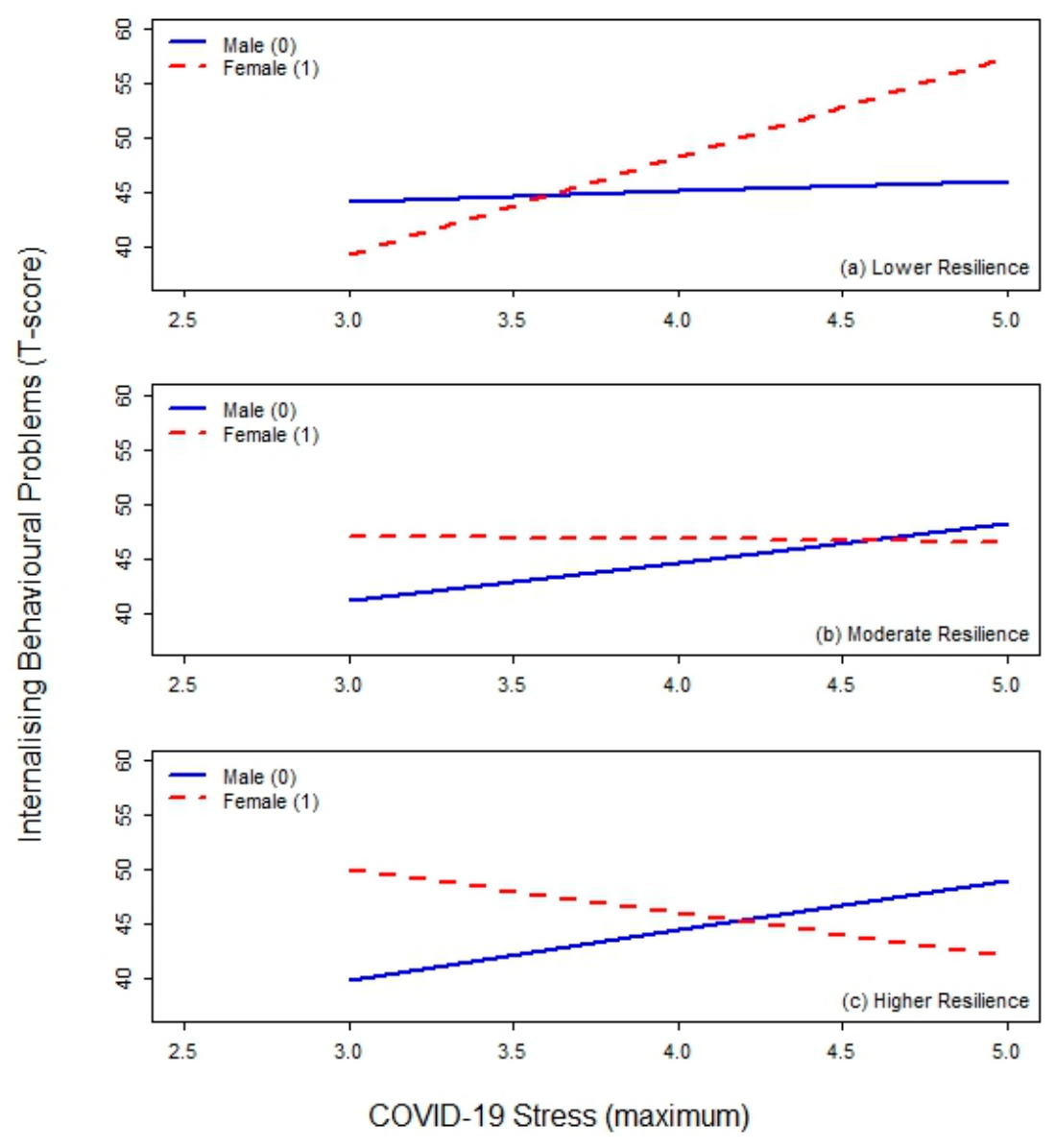
3.2.1. Internalising Problems
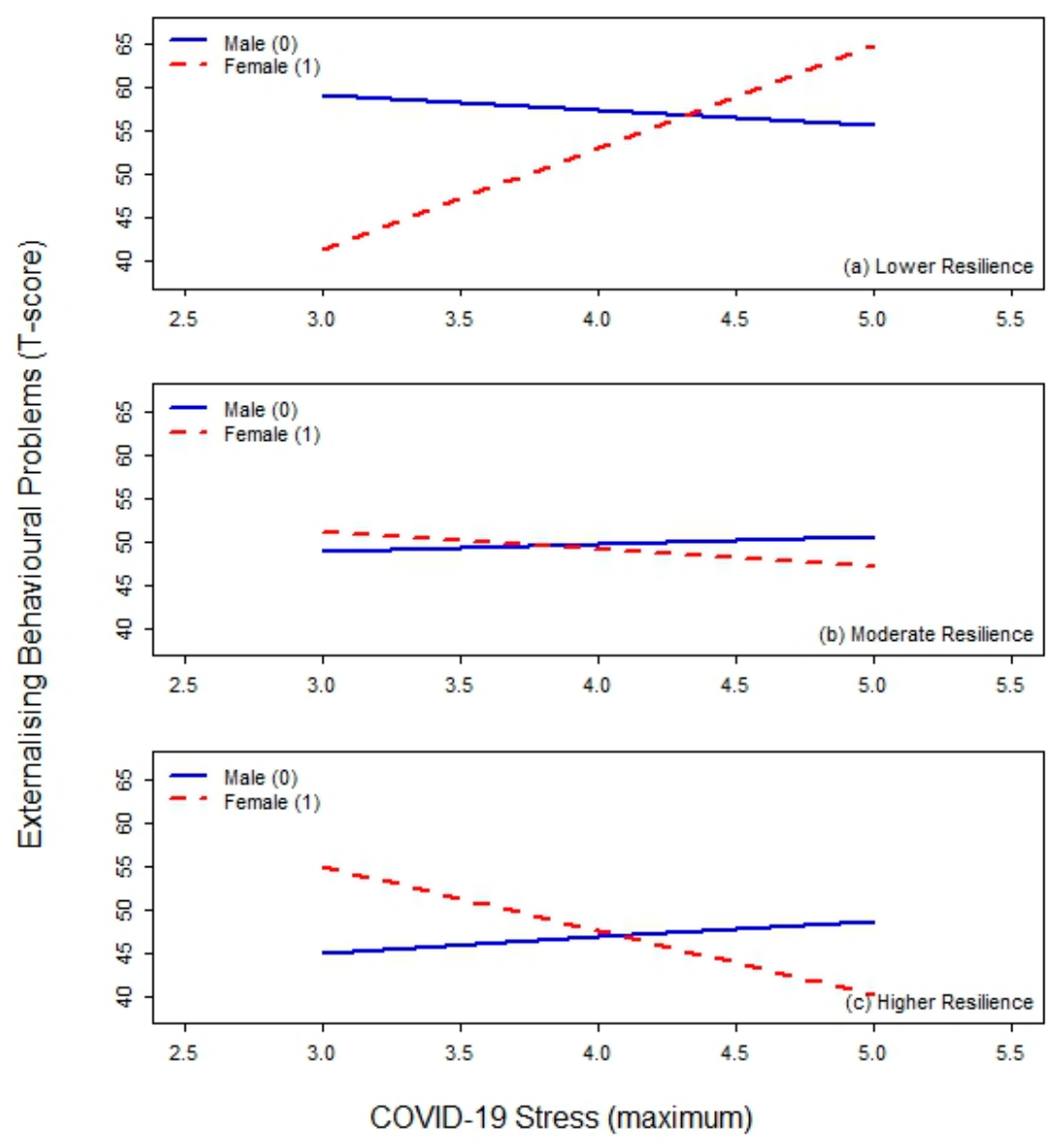
3.2.2. Externalising Problems
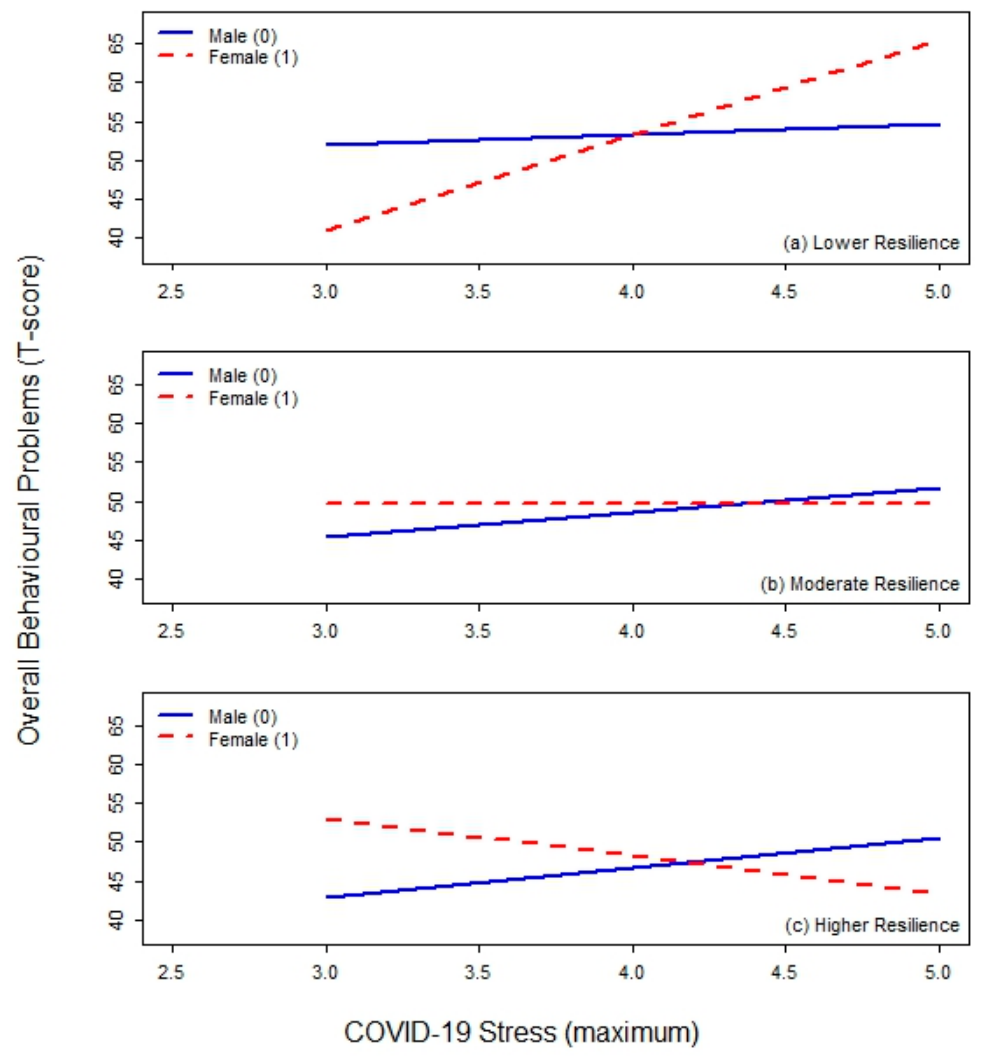
3.2.3. Overall Behavioural Symptoms
4. Discussion
4.1. COVID-19 Stress and Child Internalising and Overall Behavioural Symptoms
4.2. Patterns Consistent with the “Classic” Resilience Buffering Hypothesis Among Female Children
4.3. Role of Sociodemographic Characteristics
4.4. Limitations and Strengths
5. Conclusions
Supplementary Materials
Author Contributions
Funding
Institutional Review Board Statement
Informed Consent Statement
Data Availability Statement
Acknowledgments
Conflicts of Interest
References
- Cucinotta, D.; Vanelli, M. WHO declares COVID-19 a pandemic. Acta Bio Medica Atenei Parm. 2020, 91, 157. [Google Scholar]
- Atalan, A. Is the lockdown important to prevent the COVID-19 pandemic? Effects on psychology, environment and economy-perspective. Ann. Med. Surg. 2020, 56, 38–42. [Google Scholar] [CrossRef] [Scilit] [PubMed]
- Ferrara, P.; Franceschini, G.; Corsello, G.; Mestrovic, J.; Giardino, I.; Vural, M.; Pop, T.L.; Namazova-Baranova, L.; Somekh, E.; Indrio, F.; et al. Effects of Coronavirus Disease 2019 (COVID-19) on family functioning. J. Pediatr. 2021, 237, 322–323.e322. [Google Scholar] [CrossRef] [Scilit] [PubMed]
- Clayborne, Z.M.; Nilsen, W.; Torvik, F.A.; Gustavson, K.; Bekkhus, M.; Gilman, S.E.; Khandaker, G.M.; Fell, D.B.; Colman, I. Prenatal maternal stress, child internalizing and externalizing symptoms, and the moderating role of parenting: Findings from the Norwegian mother, father, and child cohort study. Psychol. Med. 2023, 53, 2437–2447. [Google Scholar] [CrossRef] [Scilit]
- Ng, C.S.M.; Ng, S.S.L. Impact of the COVID-19 pandemic on children’s mental health: A systematic review. Front. Psychiatry 2022, 13, 975936. [Google Scholar] [CrossRef] [Scilit]
- Masten, A.S.; Barnes, A.J. Resilience in children: Developmental perspectives. Children 2018, 5, 98. [Google Scholar] [CrossRef] [Scilit] [PubMed]
- Okwori, G. Role of individual, family, and community resilience in moderating effects of adverse childhood experiences on mental health among children. J. Dev. Behav. Pediatr. 2022, 43, e452–e462. [Google Scholar] [CrossRef] [Scilit]
- Zhu, Y.; Zhang, G.; Anme, T. Adverse Childhood Experiences, Resilience, and Emotional Problems in Young Chinese Children. Int. J. Environ. Res. Public Health 2023, 20, 6327. [Google Scholar] [CrossRef] [Scilit]
- Schore, A.N. All our sons: The developmental neurobiology and neuroendocrinology of boys at risk. Infant Ment. Health J. 2017, 38, 15–52. [Google Scholar] [CrossRef] [Scilit]
- Baillargeon, R.H.; Zoccolillo, M.; Keenan, K.; Côté, S.; Pérusse, D.; Wu, H.X.; Boivin, M.; Tremblay, R.E. Gender differences in physical aggression: A prospective population-based survey of children before and after 2 years of age. Dev. Psychol. 2007, 43, 13–26. [Google Scholar] [CrossRef] [Scilit]
- Hill, J.; Pickles, A.; Wright, N.; Quinn, J.; Murgatroyd, C.; Sharp, H. Maternal depression and child behaviours: Sex-dependent mediation by glucocorticoid receptor gene methylation in a longitudinal study from pregnancy to age 5 years. bioRxiv 2017. [Google Scholar] [CrossRef] [Scilit]
- Liu, J.; Chen, X.; Lewis, G. Childhood internalizing behaviour: Analysis and implications. J. Psychiatr. Ment. Health Nurs. 2011, 18, 884–894. [Google Scholar] [CrossRef] [Scilit] [PubMed]
- Nikstat, A.; Riemann, R. On the etiology of internalizing and externalizing problem behavior: A twin-family study. PLoS ONE 2020, 15, e0230626. [Google Scholar] [CrossRef] [Scilit] [PubMed]
- Lorber, M.F.; Del Vecchio, T.; Slep, A.M.S. The emergence and evolution of infant externalizing behavior. Dev. Psychopathol. 2015, 27, 663–680. [Google Scholar] [CrossRef] [Scilit] [PubMed]
- Gutman, L.M.; Codiroli McMaster, N. Gendered pathways of internalizing problems from early childhood to adolescence and associated adolescent outcomes. J. Abnorm. Child Psychol. 2020, 48, 703–718. [Google Scholar] [CrossRef] [Scilit]
- Khan, B.; Avan, B.I. Behavioral problems in preadolescence: Does gender matter? PsyCh J. 2020, 9, 583–596. [Google Scholar] [CrossRef] [Scilit]
- Sarfnaz, B.; Manizheh, K.; Majid, D. Behavioural problems compared to female and male students in Tabriz. Procedia—Soc. Behav. Sci. 2012, 46, 1781–1785. [Google Scholar] [CrossRef] [Scilit]
- Li, R.; Xiao, W.; Wu, J.; Zhou, Y.; Zha, J.; Wang, D.; Xing, T.; Wan, Y. Patterns of maternal adverse childhood experiences and the intergenerational association of preschool children’s emotional and behavioral problems. Front. Psychiatry 2024, 15, 1431475. [Google Scholar] [CrossRef] [Scilit]
- Letourneau, N.; Dewey, D.; Kaplan, B.J.; Ntanda, H.; Novick, J.; Thomas, J.C.; Deane, A.J.; Leung, B.; Pon, K.; Giesbrecht, G.F. Intergenerational transmission of adverse childhood experiences via maternal depression and anxiety and moderation by child sex. J. Dev. Orig. Health Dis. 2019, 10, 88–99. [Google Scholar] [CrossRef] [Scilit]
- Sun, H.-L.; He, F.; Rao, W.-W.; Qi, Y.; Rao, S.-Y.; Ho, T.I.; Su, Z.; Cheung, T.; Wong, K.K.; Smith, R.D.; et al. Gender differences in behavioral and emotional problems among school children and adolescents in China: National survey findings from a comparative network perspective. J. Affect. Disord. 2025, 369, 227–233. [Google Scholar] [CrossRef] [Scilit]
- Yoon, Y.; Eisenstadt, M.; Lereya, S.T.; Deighton, J. Gender difference in the change of adolescents’ mental health and subjective wellbeing trajectories. Eur. Child Adolesc. Psychiatry 2023, 32, 1569–1578. [Google Scholar] [CrossRef] [Scilit]
- Abd Rahim, M.H.; Ibrahim, M.I.; Ab Rahman, A.; Yaacob, N.M.; Hashim, N.S.F. Emotional and behavioural problems among preschool children in northeast peninsular malaysia: Parent Report version. Healthcare 2023, 11, 1828. [Google Scholar] [CrossRef] [Scilit]
- Finegan, J.A.; Bartleman, B.; Wong, P.Y. A window for the study of prenatal sex hormone influences on postnatal development. J. Genet. Psychol. 1989, 150, 101–112. [Google Scholar] [CrossRef] [Scilit]
- Körner, L.M.; Pause, B.M.; Meinlschmidt, G.; Tegethoff, M.; Fröhlich, S.; Kozlowski, P.; Rivet, N.; Jamey, C.; Reix, N.; Kintz, P.; et al. Prenatal testosterone exposure is associated with delay of gratification and attention problems/overactive behavior in 3-year-old boys. Psychoneuroendocrinology 2019, 104, 49–54. [Google Scholar] [CrossRef] [Scilit]
- Rotem, R.S.; Nguyen, V.T.; Chodick, G.; Davidovitch, M.; Shalev, V.; Hauser, R.; Coull, B.A.; Bellavia, A.; Weisskopf, M.G. Associations of maternal androgen-related conditions with risk of autism spectrum disorder in progeny and mediation by cardiovascular, metabolic, and fertility factors. Am. J. Epidemiol. 2021, 190, 600–610. [Google Scholar] [CrossRef] [Scilit]
- Kopsida, E.; Stergiakouli, E.; Lynn, P.M.; Wilkinson, L.S.; Davies, W. The role of the Y chromosome in brain function. Open Neuroendocrinol. J. 2009, 2, 20–30. [Google Scholar] [CrossRef] [Scilit]
- Loke, H.; Harley, V.; Lee, J. Biological factors underlying sex differences in neurological disorders. Int. J. Biochem. Cell Biol. 2015, 65, 139–150. [Google Scholar] [CrossRef] [Scilit]
- Halim, M.L.D.; Sakamoto, D.J.; Russo, L.N.; Echave, K.N.; Portillo, M.A.; Tawa, S. Early gender differences in valuing strength. Arch. Sex. Behav. 2022, 51, 2169–2182. [Google Scholar] [CrossRef] [Scilit] [PubMed]
- Hannigan, L.J.; Rijsdijk, F.V.; Ganiban, J.M.; Reiss, D.; Spotts, E.L.; Neiderhiser, J.M.; Lichtenstein, P.; McAdams, T.A.; Eley, T.C. Shared genetic influences do not explain the association between parent–offspring relationship quality and offspring internalizing problems: Results from a Children-of-Twins study. Psychol. Med. 2018, 48, 592–603. [Google Scholar] [CrossRef] [Scilit] [PubMed]
- Canadian Institute for Health Information. Children and Youth Mental Health in Canada; Canadian Institute for Health Information: Ottawa, ON, Canada, 2025. [Google Scholar]
- Meade, J. Mental health effects of the COVID-19 pandemic on children and adolescents: A review of the current research. Pediatr. Clin. N. Am. 2021, 68, 945–959. [Google Scholar] [CrossRef] [Scilit] [PubMed]
- Auro, K.; Holopainen, I.; Perola, M.; Havulinna, A.S.; Raevuori, A. Attention-deficit/hyperactivity disorder diagnoses in Finland during the COVID-19 pandemic. JAMA Netw. Open 2024, 7, e2418204. [Google Scholar] [CrossRef] [Scilit] [PubMed]
- Guzman Holst, C.; Bowes, L.; Waite, P.; Skripkauskaite, S.; Shum, A.; Pearcey, S.; Raw, J.; Patalay, P.; Creswell, C. Examining children and adolescent mental health trajectories during the COVID-19 pandemic: Findings from a year of the Co-SPACE study. JCPP Adv. 2023, 3, e12153. [Google Scholar] [CrossRef] [Scilit] [PubMed]
- Kaman, A.; Devine, J.; Wirtz, M.A.; Erhart, M.; Boecker, M.; Napp, A.K.; Reiss, F.; Zoellner, F.; Ravens-Sieberer, U. Trajectories of mental health in children and adolescents during the COVID-19 pandemic: Findings from the longitudinal COPSY study. Child Adolesc. Psychiatry Ment. Health 2024, 18, 89. [Google Scholar] [CrossRef] [Scilit]
- Casaburo, G.; Yzaguirre, M.; Subramaniam, S.; Holtrop, K. A systematic review of family stress theory in mental health research (2010–2020). Fam. Soc. 2023, 104, 557–569. [Google Scholar] [CrossRef] [Scilit]
- Hwang, T.-J.; Rabheru, K.; Peisah, C.; Reichman, W.; Ikeda, M. Loneliness and social isolation during the COVID-19 pandemic. Int. Psychogeriatr. 2020, 32, 1217–1220. [Google Scholar] [CrossRef] [Scilit]
- Smith, K.E.; Pollak, S.D. Social relationships and children’s perceptions of adversity. Child Dev. Perspect. 2021, 15, 228–234. [Google Scholar] [CrossRef] [Scilit]
- Almeida, I.L.L.; Rego, J.F.; Teixeira, A.C.G.; Moreira, M.R. Social isolation and its impact on child and adolescent development: A systematic review. Rev. Paul. De Pediatr. 2021, 40, e2020385. [Google Scholar] [CrossRef] [Scilit]
- Li, J.; Luo, H.; Tang, W.; Qian, H.; Yang, H.; Luo, Q. Qualitative study on emotional experiences and coping strategies in patients with COVID-19 during the early stage of Wuhan crisis. Depress. Anxiety 2024, 2024, 6696049. [Google Scholar] [CrossRef] [Scilit]
- Bai, M.S.; Miao, C.Y.; Zhang, Y.; Xue, Y.; Jia, F.Y.; Du, L. COVID-19 and mental health disorders in children and adolescents (Review). Psychiatry Res. 2022, 317, 114881. [Google Scholar] [CrossRef] [Scilit]
- Statistics Canada. Survey on COVID-19 and Mental Health, February to May 2021; Statistics Canada: Ottawa, ON, Canada, 2021.
- Letourneau, N.; Luis, M.A.; Kurbatfinski, S.; Ferrara, H.J.; Pohl, C.; Marabotti, F.; Hayden, K.A. COVID-19 and family violence: A rapid review of literature published up to 1 year after the pandemic declaration. EClinicalMedicine 2022, 53, 101634. [Google Scholar] [CrossRef] [Scilit] [PubMed]
- Franzoi, D.; Bockting, C.L.; Bennett, K.F.; Odom, A.; Lucassen, P.J.; Pathania, A.; Lee, A.; Brouwer, M.E.; van de Schoot, R.; Wiers, R.W.; et al. Which individual, social, and urban factors in early childhood predict psychopathology in later childhood, adolescence and young adulthood? A systematic review. SSM—Popul. Health 2024, 25, 101575. [Google Scholar] [CrossRef] [Scilit]
- Jiang, Y.; Harrison, S.E.; Li, X. Resilience-based intervention to promote mental and behavioral health in children. Pediatr. Clin. N. Am. 2022, 69, 795–805. [Google Scholar] [CrossRef] [Scilit] [PubMed]
- Tosto, S.A.; Alyahya, J.; Espinoza, V.; McCarthy, K.; Tcherni-Buzzeo, M. Online learning in the wake of the COVID-19 pandemic: Mixed methods analysis of student views by demographic group. Soc. Sci. Humanit. Open 2023, 8, 100598. [Google Scholar] [CrossRef] [Scilit] [PubMed]
- MacCallum-Bridges, C.L.; Admon, L.K.; Daw, J.R. Childcare disruptions and maternal health during the COVID-19 pandemic. Health Aff. Sch. 2024, 2, qxae061. [Google Scholar] [CrossRef] [Scilit]
- Pakpahan, M.; Kartika, L.; Sampepadang, M. Factors related to family resilience during the COVID-19 pandemic. Bali Med. J. 2022, 11, 1603–1607. [Google Scholar] [CrossRef] [Scilit]
- Ribas, L.H.; Montezano, B.B.; Nieves, M.; Kampmann, L.B.; Jansen, K. The role of parental stress on emotional and behavioral problems in offspring: A systematic review with meta-analysis. J. Pediatr. 2024, 100, 565–585. [Google Scholar] [CrossRef] [Scilit]
- Thomason, E.; Volling, B.L.; Flynn, H.A.; McDonough, S.C.; Marcus, S.M.; Lopez, J.F.; Vazquez, D.M. Parenting stress and depressive symptoms in postpartum mothers: Bidirectional or unidirectional effects? Infant Behav. Dev. 2014, 37, 406–415. [Google Scholar] [CrossRef] [Scilit]
- Hatun, O.; Kütük-Yılmaz, P.; Topal-Özgen, G. Nurturing bonds: Social support as a mediator in the association between parenting stress and the mother–child relationship among Turkish mothers. Fam. J. 2025, 10664807241308900. [Google Scholar] [CrossRef] [Scilit]
- Qian, G.; Li, B.; Xu, L.; Ai, S.; Li, X.; Lei, X.; Dou, G. Parenting style and young children’s executive function mediate the relationship between parenting stress and parenting quality in two-child families. Sci. Rep. 2024, 14, 8503. [Google Scholar] [CrossRef] [Scilit]
- Kurbatfinski, S.; Dosani, A.; Dewey, D.M.; Letourneau, N. Proposed physiological mechanisms underlying the association between adverse childhood experiences and mental health conditions: A narrative review. Children 2024, 11, 1112. [Google Scholar] [CrossRef] [Scilit] [PubMed]
- Bethell, C.; Gombojav, N.; Solloway, M.; Wissow, L. Adverse childhood experiences, resilience and mindfulness-based approaches: Common denominator issues for children with emotional, mental, or behavioral problems. Child Adolesc. Psychiatr. Clin. N. Am. 2016, 25, 139–156. [Google Scholar] [CrossRef] [Scilit]
- Mesman, E.; Vreeker, A.; Hillegers, M. Resilience and mental health in children and adolescents: An update of the recent literature and future directions. Curr. Opin. Psychiatry 2021, 34, 586. [Google Scholar] [CrossRef] [Scilit]
- National Scientific Council on the Developing Child. Supportive Relationships and Active Skill-Building Strengthen the Foundations of Resilience: Working Paper 13. 2015. Available online: https://developingchild.harvard.edu/resources/supportive-relationships-and-active-skill-building-strengthen-the-foundations-of-resilience/ (accessed on 14 April 2026).
- Breiner, H.; Ford, M.; Gadsden, V.L.; National Academies of Sciences, Engineering, and Medicine; Division of Behavioral and Social Sciences and Education; Board on Children, Youth, and Families; Committee on Supporting the Parents of Young Children. Parenting knowledge, attitudes, and practices. In Parenting Matters: Supporting Parents of Children Ages 0–8; National Academies Press: Washington, DC, USA, 2016. [Google Scholar]
- Arpi, E.; Ferrari, F. Preterm birth and behaviour problems in infants and preschool-age children: Areview of the recent literature. Dev. Med. Child Neurol. 2013, 55, 788–796. [Google Scholar] [CrossRef] [Scilit] [PubMed]
- Olukotun, M.; Olanlesi-Aliu, A.; Idi, Y.; Ladha, T.; Bailey, P.; King, R.; Salami, B. Institutional and systemic barriers and facilitators affecting healthcare access for Black women in Alberta. SSM—Qual. Res. Health 2024, 6, 100485. [Google Scholar] [CrossRef] [Scilit]
- Copeland, K.A.; King, A.; Ladipo, J.; Bennett, D.; Amsterdam, A.; White, C.; Gerker, H.; Karbeah, J.M. Barriers to early childhood education for Black families and calls for equitable solutions from a qualitative study using peer researchers and an antiracist lens. Early Child. Res. Q. 2024, 69, S26–S38. [Google Scholar] [CrossRef] [Scilit]
- Pandya, N.K. Disparities in youth sports and barriers to participation. Curr. Rev. Musculoskelet. Med. 2021, 14, 441–446. [Google Scholar] [CrossRef] [Scilit]
- Letourneau, N.; Aghajafari, F.; Bell, R.C.; Deane, A.J.; Dewey, D.; Field, C.; Giesbrecht, G.; Kaplan, B.; Leung, B.; Ntanda, H. The Alberta Pregnancy Outcomes and Nutrition (APrON) longitudinal study: Cohort profile and key findings from the first three years. BMJ Open 2022, 12, e047503. [Google Scholar] [CrossRef] [Scilit] [PubMed]
- Letourneau, N.; McDonald, S.; MacKay, L.J.; Bell, R.C.; Hetherington, E.; Deane, A.J.; Dewey, D.; Edwards, S.; Field, C.J.; Giesbrecht, G.F.; et al. Cross-sectional study protocol for the COVID-19 Impact Survey of Mothers and Their 7-11 Year Old Children in Alberta, Canada. Front Psychiatry 2021, 12, 597759. [Google Scholar] [CrossRef] [Scilit]
- Canadian Institutes of Health Research; Natural Sciences and Engineering Research Council of Canada; Social Sciences and Humanities Research Council of Canada. Tri-Council Policy Statement: Ethical Conduct for Research Involving Humans (TCPS2); Government of Canada: Ottawa, ON, Canada, 2018.
- Faul, F.; Erdfelder, E.; Lang, A.; Buchner, A. G*Power 3: A flexible statistical power analysis program for the social, behavioural, and biomedical sciences. Behav. Res. Methods 2007, 39, 175–191. [Google Scholar] [CrossRef] [Scilit]
- Ungar, M.; Liebenberg, L. Child and Youth Resilience Measure. J. Mix. Methods Res. 2011, 5, 126–149. [Google Scholar] [CrossRef] [Scilit]
- Spanier, G. Dyadic Adjustment Scale; Multi-Health Systems: North Tonawanda, NY, USA, 1989. [Google Scholar] [CrossRef] [Scilit]
- Statistics Canada. Canadian perspectives survey series 1: Impacts of COVID-19. The Daily, 8 April 2020.
- Chen, Y.-H.; Ferguson, K.K.; Meeker, J.D.; McElrath, T.F.; Mukherjee, B. Statistical methods for modeling repeated measures of maternal environmental exposure biomarkers during pregnancy in association with preterm birth. Environ. Health 2015, 14, 9. [Google Scholar] [CrossRef] [Scilit]
- Spielberger, C. State-trait anxiety inventory. In The Corsini Encyclopedia of Psychology; Wiley: Hoboken, NJ, USA, 2010; Volume 1. [Google Scholar]
- Radloff, L.S. The CES-D scale: A self-report depression scale for research in the general population. Appl. Psychol. Meas. 1977, 1, 385–401. [Google Scholar] [CrossRef] [Scilit]
- Roberti, J.; Harrington, L.; Storch, E. Further psychometric support for the 10-Item version of the Perceived Stress Scale. J. Coll. Couns. 2006, 9, 135–147. [Google Scholar] [CrossRef] [Scilit]
- Sinclair, V.G.; Wallston, K.A. The development and psychometric evaluation of the Brief Resilient Coping Scale. Assessment 2004, 11, 94–101. [Google Scholar] [CrossRef] [Scilit]
- Spielberger, C.; Gorsuch, R.; Lushene, R.; Vagg, P.R.; Jacobs, G. Manual for the State-Trait Anxiety Inventory (Form Y1–Y2); Consulting Psychologists Press: Palo Alto, CA, USA, 1983; Volume IV. [Google Scholar]
- Reynolds, C.; Kamphaus, R. Behavior Assessment System for Children, 3rd ed.; Pearson: London, UK, 2015. [Google Scholar]
- Gladman, M.; Lancaster, S. A Review of the Behaviour Assessment System for Children. Sch. Psychol. Int.—Sch. Psychol. Int. 2003, 24, 276–291. [Google Scholar] [CrossRef] [Scilit]
- Jefferies, P.; McGarrigle, L.; Ungar, M. The CYRM-R: A Rasch-Validated Revision of the Child and Youth Resilience Measure. J. Evid. Based Soc. Work 2019, 16, 70–92. [Google Scholar] [CrossRef] [Scilit] [PubMed]
- Azur, M.J.; Stuart, E.A.; Frangakis, C.; Leaf, P.J. Multiple imputation by chained equations: What is it and how does it work? Int. J. Methods Psychiatr. Res. 2011, 20, 40–49. [Google Scholar] [CrossRef] [Scilit]
- Hayes, A.F.; Allison, P.D.; Alexander, S.M. Errors-in-variables regression as a viable approach to mediation analysis with random error-tainted measurements. Estimation, effectiveness, and an easy-to-use implementation. Behav. Res. Methods 2025, 57, 323. [Google Scholar] [CrossRef] [Scilit] [PubMed]
- Hayes, A.F. Introduction to Mediation, Moderation, and Conditional Process Analysis: A Regression-Based Approach; Guilford Publications: New York, NY, USA, 2017. [Google Scholar]
- Tetzner, J.; Bondü, R.; Krahé, B. Family risk factors and buffering factors for child internalizing and externalizing problems. J. Appl. Dev. Psychol. 2022, 80, 101395. [Google Scholar] [CrossRef] [Scilit]
- Turgeon, J.; Racine, N.; McDonald, S.; Tough, S.; Madigan, S. Maternal adverse childhood experiences, child resilience factors, and child mental health problems: A multi-wave study. Child Abus. Negl. 2024, 154, 106927. [Google Scholar] [CrossRef] [Scilit]
- Eaton, S.; Cornwell, H.; Hamilton-Giachritsis, C.; Fairchild, G. Resilience and young people’s brain structure, function and connectivity: A systematic review. Neurosci. Biobehav. Rev. 2022, 132, 936–956. [Google Scholar] [CrossRef] [Scilit]
- Mendes-Sousa, M.M.; Perrone, M.B.; de Melo, R.B.; Ribeiro, M.V.V.; Chao, Q.; Torres, C.; Sanchez, Z.M.; Surkan, P.J.; Martins, S.S.; Fidalgo, T.M.; et al. The impact of family stress and resilience on child development: A scoping review. Trends Psychiatry Psychother. 2025, 47, e20220556. [Google Scholar] [CrossRef] [Scilit]
- Breehl, L.; Caban, O. Physiology, Puberty; StatParls Publishing: Treasure Island, FL, USA, 2018. [Google Scholar]
- Holder, M.K.; Blaustein, J.D. Puberty and adolescence as a time of vulnerability to stressors that alter neurobehavioral processes. Front. Neuroendocrinol. 2014, 35, 89–110. [Google Scholar] [CrossRef] [Scilit]
- Yu, X.; Kong, X.; Cao, Z.; Chen, Z.; Zhang, L.; Yu, B. Social support and family functioning during adolescence: A two-wave cross-lagged study. Int. J. Environ. Res. Public Health 2022, 19, 6327. [Google Scholar] [CrossRef] [Scilit] [PubMed]
- Marquez, J.; Francis-Hew, L.; Humphrey, N. Protective factors for resilience in adolescence: Analysis of a longitudinal dataset using the residuals approach. Child Adolesc. Psychiatry Ment. Health 2023, 17, 140. [Google Scholar] [CrossRef] [Scilit] [PubMed]
- Galligan, S.; Barnett, R.; Brennan, M.; Israel, G. The Effects of Gender Role Conflict on Adolescent and Emerging Adult Male Resiliency. J. Men’s Stud. 2010, 18, 3–21. [Google Scholar] [CrossRef] [Scilit]
- Knafo, A.; Spinath, F.M. Genetic and environmental influences on girls’ and boys’ gender-typed and gender-neutral values. Dev. Psychol. 2011, 47, 726–731. [Google Scholar] [CrossRef] [Scilit] [PubMed]


| n (%) | Mean (SD) | |
|---|---|---|
| Covariates | ||
| Child Sex-Assigned-at-Birth | ||
| Male | 32 (47.06) | |
| Female | 36 (52.94) | |
| Child Age (years) | 10.21 (0.43) | |
| Maternal Age (years) | 42.37 (3.72) | |
| Gestational Age (weeks) | 39.53 (1.28) | |
| Birthweight (grams) | 3472.12 (503.92) | |
| Maternal Highest Level of Education | ||
| Post-Graduate | 11 (16.18) | |
| University Degree | 39 (57.35) | |
| Trade School | 15 (22.06) | |
| High School or Less | 3 (4.41) | |
| Maternal Self-Identified Ethnicity | ||
| White | 66 (97.01) | |
| Chinese | 1 (1.47) | |
| Arab | 1 (1.47) | |
| Total Household Annual Income (CAD dollars) | ||
| <20,000 | 1 (1.47) | |
| 20,000 to 39,999 | 1 (1.47) | |
| 40,000 to 69,999 | 7 (10.29) | |
| 70,000 to 99,999 | 16 (23.53) | |
| >100,000 | 43 (63.24) | |
| Predictor Variable | Median | |
| COVID-19 Stress | 4 | |
| Moderator Variable | Mean (SD) | |
| Children’s Self-Reported Resilience | 45.78 (3.78) | |
| Outcome Variable | Mean (SD) | |
| Internalising Problems | 46.41 (6.92) | |
| Externalising Problems | 51.06 (9.01) | |
| Overall Behavioural Symptoms | 50.75 (7.86) |
Disclaimer/Publisher’s Note: The statements, opinions and data contained in all publications are solely those of the individual author(s) and contributor(s) and not of MDPI and/or the editor(s). MDPI and/or the editor(s) disclaim responsibility for any injury to people or property resulting from any ideas, methods, instructions or products referred to in the content. |
© 2026 by the authors. Licensee MDPI, Basel, Switzerland. This article is an open access article distributed under the terms and conditions of the Creative Commons Attribution (CC BY) license.
Share and Cite
Kurbatfinski, S.; Dewey, D.; Letourneau, N. COVID-19 Stress and Children’s Behavioural Problems: Exploratory Moderation by Child Resilience and Sex Assigned at Birth in a Canadian-Based Longitudinal Cohort. COVID 2026, 6, 71. https://doi.org/10.3390/covid6040071
Kurbatfinski S, Dewey D, Letourneau N. COVID-19 Stress and Children’s Behavioural Problems: Exploratory Moderation by Child Resilience and Sex Assigned at Birth in a Canadian-Based Longitudinal Cohort. COVID. 2026; 6(4):71. https://doi.org/10.3390/covid6040071
Chicago/Turabian StyleKurbatfinski, Stefan, Deborah Dewey, and Nicole Letourneau. 2026. "COVID-19 Stress and Children’s Behavioural Problems: Exploratory Moderation by Child Resilience and Sex Assigned at Birth in a Canadian-Based Longitudinal Cohort" COVID 6, no. 4: 71. https://doi.org/10.3390/covid6040071
APA StyleKurbatfinski, S., Dewey, D., & Letourneau, N. (2026). COVID-19 Stress and Children’s Behavioural Problems: Exploratory Moderation by Child Resilience and Sex Assigned at Birth in a Canadian-Based Longitudinal Cohort. COVID, 6(4), 71. https://doi.org/10.3390/covid6040071