
Article

COVID-19 Stress and Children’s Behavioural Problems: Exploratory Moderation by Child Resilience and Sex Assigned at Birth in a Canadian-Based Longitudinal Cohort

by
Stefan Kurbatfinski
1,2,
Deborah Dewey
2,3,4 and
Nicole Letourneau
2,4,5,6,*
1
Department of Community Health Sciences, Cumming School of Medicine, University of Calgary, Calgary, AB T2N 1N4, Canada
2
Owerko Centre, Alberta Children’s Hospital Research Institute, Calgary, AB T2N 1N4, Canada
3
Departments of Pediatrics and Community Health Sciences, Cumming School of Medicine, University of Calgary, Calgary, AB T2N 1N4, Canada
4
Hotchkiss Brain Institute, University of Calgary, Calgary, AB T2N 1N4, Canada
5
Faculty of Nursing, University of Calgary, Calgary, AB T2N 1N4, Canada
6
Departments of Pediatrics, Psychiatry, and Community Health Sciences, Cumming School of Medicine, University of Calgary, Calgary, AB T2N 1N4, Canada
*
Author to whom correspondence should be addressed.
COVID 2026, 6(4), 71; https://doi.org/10.3390/covid6040071
Submission received: 22 February 2026 / Revised: 9 April 2026 / Accepted: 15 April 2026 / Published: 21 April 2026
(This article belongs to the Section COVID Public Health and Epidemiology)

Abstract

Background: The COVID-19 pandemic increased stress experienced by children through individual-, family-, and community-level factors, with potential sex-specific impacts on behavioural outcomes. Children’s resilience may buffer these effects. This exploratory study investigated associations between COVID-19 stress and children’s internalising, externalising, and overall behavioural symptoms, and whether child resilience and sex assigned at birth moderated these associations. Methods: Data (N = 68) came from the longitudinal COVID-19 Impact Study of the Canadian APrON pregnancy cohort of mothers and their children followed for more than 9 years. COVID-19 stress, combining individual-, family-, and community-level stressors, was reported by mothers (mean age = 42.37, SD = 3.72) and their children (53% female; mean age = 10.21 years, SD = 0.43) across three timepoints (October–December 2020; February–May 2021; June–August 2021). Children’s behavioural problems and self-reported resilience were assessed between April and September 2022. Results: COVID-19 stress was not significantly associated with children’s behavioural problems. Moderated-moderation suggested that the association between COVID-19 stress and children’s internalising (T-score estimate = −2.38, 95% CI [−4.08, −0.68]), externalising (T-score estimate = −3.21, 95% CI [−5.09, −1.33]), and overall (T-score estimate = −2.79, 95% CI [−4.45, −1.12]) symptoms may vary by child resilience and child sex assigned at birth. Among females, COVID-19 stress appeared to be associated with more behavioural problems at lower levels of resilience and fewer problems at higher levels of resilience. Significance: The association between COVID-19 stress and children’s behavioural symptoms across children’s resilience levels may vary based on sex assigned at birth, with effects suggested among females. Null findings may reflect the modest sample size and limited statistical power.

1. Introduction

On 11 March 2020, the World Health Organization (WHO) declared Coronavirus 2019 (COVID-19) a global pandemic [1]. To limit transmission of this airborne virus, numerous public health strategies were implemented, including stay-at-home and lockdown restrictions, transition to online schooling, social distancing regulations, closure of recreational areas, and travel restrictions across the globe [2]. Consequently, this increased exposure to individual (e.g., social deprivation)-, family (e.g., employment loss)-, and community (e.g., transitions to online schooling)-level stressors [3]. Increased stress vis-à-vis COVID-19 experienced by families could be of relevance to child health since exposure to stress has been linked to children’s internalising and externalising behaviours [4]. Indeed, converging evidence points to an association between higher COVID-19 stress experienced by families and more childhood behavioural problems [5], indicating the need to examine factors that may influence the direction and magnitude of this association.
Resilience in children, defined as children’s capacity to adapt and succeed despite stress [6], has been associated with more optimal behavioural outcomes among children exposed to adverse conditions such as poverty or parental mental health problems [7,8]. Although studies have observed associations between higher COVID-19 stress and greater behavioural problems (e.g., anxiety, attention-deficit hyperactivity disorder) in children [5], to our knowledge, research has not yet explored whether child resilience moderates this association. Further, given that differences in children’s behaviour have also been linked to child sex assigned at birth (SAAB) [9,10,11], considering the influence of SAAB on the association between COVID-19 stress and child behaviour could be important. Examining whether the association between COVID-19 stress and children’s behavioural problems is moderated by children’s self-reported resilience and child SAAB may help guide interventions should similar pandemics emerge in the future.

1.1. Children’s Behavioural Problems and the Role of Child SAAB

Internalising and externalising behavioural problems are reflective of underlying mental health concerns in children [12,13]. Internalising problems encompasses psychological concerns that are inwardly expressed, such as anxiety, depression, and somatic complaints [12]. The inward nature of internalising problems can make them challenging to identify, especially at younger ages [12]. Externalising problems include behaviours that are outwardly expressed and physical in nature, and include aggression, hyperactivity, and attention concerns [13]. Externalising problems are usually easier to identify and can be observed as early as 8 months of age [14].
Behavioural problems in children have been associated with child SAAB. Findings from studies show that female children are more likely to develop internalising problems, whereas male children are more likely to display externalising problems [9,10,11,15]. Other studies have noted that male children are more likely to develop both types of behavioural problems [16,17,18,19,20], while other research has reported that female children displayed more emotional and behavioural problems [21,22]. These inconsistent findings suggest that sex differences in behavioural problems are not uniform and may depend on contextual factors [23,24,25,26,27,28,29], underscoring the importance of examining whether associations between COVID-19 stress and behavioural outcomes differ according to child SAAB. In the present study, the measured variable reflects child SAAB, although gendered expectations may also shape behavioural differences [28].

1.2. Children’s Behavioural Problems Are a Public Health Concern

In Canada, an 18% increase in mood and anxiety medications prescribed per 100,000 individuals aged 5 to 24 years was observed from 2019 to 2023 [30]. In line with increasing medication use, higher rates of internalising and externalising problems were observed among Canadian children following the emergence of the COVID-19 pandemic [31,32]. Findings from trajectory analyses suggest that at least 10% of children experienced high levels of emotional and behavioural problems at the start of the pandemic, which persisted over time [33,34], highlighting the need for research that examines predictor variables of behavioural problems during the COVID-19 pandemic.

1.3. Role of COVID-19 Stress in Predicting Child Behaviour

Stress experienced by families can be conceptualised as individual-, family-, or community-level stressors [35]. Individual-level factors directly impacted by the COVID-19 pandemic included increased social inactivity and deprivation [36]. These individual-level changes were linked to public health measures such as lockdowns and social distancing that inhibited individuals’ capacities to engage normally with their friends and family [2,3]. In turn, social isolation among children has been associated with the emergence of behavioural problems [37,38]. Additionally, the contraction of COVID-19 and its impacts on health led to increased stress for many, particularly among those with pre-existing medical conditions [39,40]. The COVID-19 pandemic also exacerbated the likelihood of family-level stressors emerging, such as parents experiencing mental health and substance use conditions [41], financial instability [3], and intimate partner violence [42], all of which are closely tied to increased stress within the household [19] and more behavioural problems in children [43]. Community-level factors refer to societal interactions that are mostly outside of the control of families [44]. In the context of the pandemic, COVID-19 public health measures caused changes in schooling for children (e.g., shifts to online schooling) [45] and access to childcare [46]. Children were thus required to spend greater amounts of time at home and adapt to virtual schooling. Given that these individual-, familial-, and community-level stressors were concomitantly triggered following the institution of COVID-19 public health measures [5,47], it could be critical to examine their cumulative, additive effects on children’s behavioural problems, as opposed to separately.
Stress experienced by families has been observed to predict children’s behavioural problems [48], likely through influences on familial mental health [49] and parents’ capacity to sensitively and reliably engage with children [50,51]. A recently conducted meta-analysis of 24 studies revealed robust, positive associations between parental stress and children’s emotional and behavioural problems prior to the pandemic [48]. Studies conducted during the pandemic have also linked pandemic-related stressors to children’s mental health conditions [5]; however, most studies have focused on direct associations between pandemic stressors and behavioural outcomes, with limited attention to factors that may moderate these relationships. These findings underscore the importance of examining factors, such as children’s resilience, that may influence the magnitude of the association between COVID-19 stress and children’s behavioural problems.

1.4. Children’s Resilience and Behavioural Problems

Researchers studying resilience theory posit that children are exposed to various protective and risk factors that influence their capacity to overcome stressors [6]. Children who struggle or are unable to adapt when exposed to adversities are more likely to remain in dysregulated stress response states (e.g., experience elevated levels of cortisol), which can negatively affect their physiological systems and exacerbate their risk of developing behavioural problems [52].
In one cross-sectional study conducted in North America, children whose parents reported that their children were unable to stay calm and regulated vis-à-vis a challenge, but were exposed to one adverse childhood experience, had 4.61 times the odds of experiencing emotional, mental, or behavioural conditions compared to children who could stay calm and in control vis-à-vis exposure to adversities [53]. Further, children whose parents reported high parenting stress, in the absence of adversity, had 3.62 times the risk of experiencing emotional, mental, and behavioural conditions compared to children whose parents reported low parenting stress [53]. A systematic review of 25 studies further revealed positive associations between lower resilience among children and greater numbers of behavioural problems [54]. However, most studies were cross-sectional, with only one of 25 conducted in Canada, limiting insight into whether resilience influences the relationship between COVID-19 stress and children’s behavioural problems in a Canadian context [54]. Thus, more Canadian research is warranted to examine whether children’s resilience influences associations between COVID-19 stress and children’s behavioural outcomes.
Although psychobiological and environmental features represent different underlying contributors to a child’s resilience, all were influenced by the public health measures instituted during the COVID-19 pandemic [5,47]. Since stress is linked to both children’s resilience [55] and behavioural problems [48], it is important to examine whether children’s resilience moderates the association between COVID-19 stress and children’s behavioural problems, and whether this differs by child SAAB.

1.5. Potential Confounding Variables

Other factors, such as gestational age, birthweight, maternal ethnicity, maternal highest level of education obtained, total household annual income, and child and maternal age, have also been discussed in the context of behavioural problems among children [56]. Full maturation during fetal development underlies more optimal behavioural outcomes; children born preterm or at low birthweight are at an increased risk of developing behavioural problems [57]. Sociodemographic factors, including parental ethnicity, age, education, and total household annual income, can also influence children’s behavioural outcomes and quality of life [56]. Racialised mothers and children often experience oppressions, which undermine their engagement within healthcare [58], educational [59], and recreational settings [60], all relevant to children’s behavioural development [56]. Mothers with lower educational attainment may not be aware of typical children′s development patterns, while lower household income can result in insecurity related to the attainment of basic needs such as food and housing, both associated with children’s behavioural outcomes [56]. Controlling for these factors, when possible, can minimise distortion of the association between COVID-19 stress and children’s behavioural problems.

1.6. Purpose of the Study

The purpose of this Canadian exploratory study was to investigate associations between COVID-19 stress and children’s internalising, externalising, and overall behavioural symptoms. We also investigated whether children’s resilience and child SAAB moderated these associations. It was hypothesised that COVID-19 stress would be positively associated with children’s externalising, internalising, and overall behavioural symptoms, and that the association would be stronger among children who self-reported lower resilience for both male and female children.

2. Methods

Data from the COVID-19 Impact Study of the longitudinal APrON Study were used in this study [61,62]. Established in Alberta, Canada, the COVID-19 Impact Study commenced shortly after the emergence of the COVID-19 pandemic to collect data on COVID-19 stress, children’s mental health and resilience, and health changes (e.g., COVID-19 infection) [62]. Data were collected across four waves: (1) survey wave 1 collected responses from 21 October 2020 to 15 December 2020; (2) survey wave 2 collected responses from 11 February 2021 to 19 May 2021; (3) survey wave 3 collected responses from 14 June 2021 to 5 August 2021; and (4) survey wave 4 collected responses from 22 April 2022 to 27 October 2022. Data collection within each wave was time-unstructured, meaning participants were able to complete the survey at any time within the timeframe set for the survey.
Ethics approval for this study was provided by the University of Calgary Health Research Ethics Board (REB14-1702) and the University of Alberta Health Research Ethics 11 Biomedical Panel (Pro00002954). Mothers provided informed consent for themselves at enrolment and at subsequent timepoints, along with assent for their children to participate during the COVID-19 data collection period. In Canada, pregnant adolescents may give their own consent under the mature minor doctrine when they demonstrate adequate decision-making capacity, in accordance with national research ethics guidelines [63].

2.1. Participant Eligibility and Sample Size Calculation

Mothers were initially recruited into the APrON Study if they could speak and read English, were at least 16 years of age, were able to come to the University of Calgary or University of Edmonton for intake assessments and follow-up visits during pregnancy and at least up to 3 months after delivery, were less than 27 weeks’ gestation at recruitment, and planned to reside in the region until at least three months postpartum [61]. Participants were not required to be first-time mothers at enrolment. The COVID-19 Impact Study participants, including both mothers and their children aged 7 to 10 years, were recruited from the larger APrON cohort and invited to participate during each wave. Compensation was provided for participation at each respective timepoint of data collection.
In this study, mothers who completed at least one COVID-19 stress questionnaire throughout the first three waves and reported on their children’s behavioural problems at the fourth wave, and whose children self-reported on their resilience at the fourth wave, were included in the analyses (N = 68). Specific demographic characteristics are presented in Table 2 in Section 3. Using GPower [64], statistical power was estimated to be 0.73 to detect a moderate effect size (f2 = 0.10) at α = 0.05 for a three-way interaction with a sample size of 68.

2.2. Measures

2.2.1. Predictor

COVID-19 stress in families was measured using a nine-item composite index capturing stressors across individual- (i.e., social inactivity, social disconnection, stress from COVID-19 infection exposure), family- (i.e., financial hardship, conflict among parents, maternal mental health and stress, excessive parental alcohol and drug use), and community- (i.e., supervision of child’s school activities, childcare) level stressors (Table 1). Information was obtained through maternal report and youth self-report questionnaires. Each stressor was scored as present (1) or absent (0) and summed to generate a composite COVID-19 stress score ranging from 0 to 9, with higher scores indicating greater COVID-19 stress.
This composite measure was developed by one of the authors (NL) to capture multidimensional pandemic-related stress experienced by families with school-aged children. Items were drawn from previously validated measures and national surveys assessing psychosocial stressors, family functioning, and pandemic-related disruptions. These included the COVID-19 Impact Survey of Mothers and Their 7–11-Year-Old Children [62], the COVID-19 Impact Survey of Youth [62], and items derived from established measures, including the Child and Youth Resilience Measure (CYRM) [65], the Dyadic Adjustment Scale [66], and national survey items from Statistics Canada [67]. Although the social disconnection stressor was informed by a relational resilience item derived from the CYRM, it was measured during Waves 1 to 3 as part of the COVID-19 composite index, whereas resilience as the moderator was assessed at Wave 4 using the CYRM-Revised, which has fewer items. As such, the social disconnection indicator was intended to capture earlier pandemic-related relational disruption rather than the same construct operationalised as the moderator. For stressors composed of multiple indicators (e.g., maternal mental health and stress, substance use), the presence of any qualifying component resulted in the stressor being coded as present. The final composite index, therefore, represents the cumulative burden of pandemic-related stressors experienced by families.
COVID-19 stress was measured across the first three waves during the COVID-19 pandemic. To capture peak exposure, the maximum observed value across waves was used as the COVID-19 stress score. This approach can be used in longitudinal studies to summarise repeated exposure measures by representing the highest level of exposure experienced during the observation period [68]. Stress measured at Wave 4 was not included in the composite to ensure that temporality between COVID-19 stress and children’s behavioural problems (the outcome of interest) could be established.
Table 1. COVID-19 stress measure.
Level of StressorDescription
Individual
Social InactivityYouth social activity with friends and family through social networking or online platforms was determined. This was measured via maternal report in the COVID-19 Impact Survey of Mothers and Their 7–11 Year Old Children [62] and reverse scored.
Social DisconnectionYouth perspectives on the strength of important relationships were determined. This was measured via youth report in the COVID-19 Impact Survey of Youth [62], which includes the Child and Youth Resilience Measure [65]; this subscale was reverse-scored.
Stress from COVID-19 Infection ExposureWhether or not youth, parents, close family members or friends contracted COVID-19 was determined. This was measured via maternal report questions derived from the COVID-19 Impact Survey of Mothers and Their 7–11 Year Old Children [62].
Family
Financial HardshipWhether or not parents experienced the loss of a main source of income or a reduction in employment hours was determined. This was measured via maternal report using questions from the Statistics Canada Perspective Survey [67]. If either parent had experienced financial hardship, the stressor was deemed present.
Conflict among ParentsWhether or not parents experienced conflict regardless of marital or co-habitation status was determined. This was measured via maternal report using items selected from the Dyadic Adjustment Scale [66] and relationship quality, strain, and violence items from the COVID-19 Impact Survey of Mothers and Their 7–11 Year Old Children [62].
Maternal Mental Health and StressThe presence of anxiety, depression, stress, and/or low resilient coping among mothers was determined using various self-reported measures. Anxiety was measured via the Spielberg State-Trait Anxiety Inventory [69], depression via the Center for Epidemiologic Studies Depression Scale [70], stress via the Perceived Stress Scale [71], and coping via the Brief Resilient Coping Scale [72] and reverse scored. The following cut-offs were used for each measure, whereby scoring above the cut-off for one or more of these measures indicated that this stressor was present: Spielberg State-Trait Anxiety Inventory: >40 [73]; Center for Epidemiologic Studies Depression Scale: >16 [70]; Perceived Stress Scale: >13 [71]; and Brief Resilient Coping Scale: >4 [72].
Excessive Parental Alcohol and Drug UseWhether parents consumed alcohol and/or recreational drugs was determined via maternal report. Excessive alcohol use was proxied by the consumption of 4 or more drinks per day and/or more than 28 drinks per week, on average. Excessive recreational drug use was proxied by use on one or more occasions. If either parent engaged in excessive alcohol or recreational drug use, this was scored as the stressor being present.
Community
Supervision of Child’s School ActivitiesStressors associated with the supervision of children’s school activities were measured. This was measured via maternal report using three items on the COVID-19 Impact Survey of Mothers and Their 7–11 Year Old Children [62]. This measure was scored on a three-point Likert scale from “not difficult” to “very difficult”. If mothers answered “somewhat difficult” or “very difficult” to any of the items, this stressor was deemed as being present.
ChildcareChildcare stressors, including lack of availability, affordability, and/or loss of childcare, were determined. This was measured via maternal report using three items on the COVID-19 Impact Survey of Mothers and Their 7–11 Year Old Children [62]. This measure was scored on a three-point Likert scale from “not difficult” to “very difficult”. If mothers answered “somewhat difficult” or “very difficult” to any of the items, this stressor was recorded as present.
Note: for continuous measures without suggested clinical cut-offs, values exceeding + 1 standard deviations above the sample mean were used to identify relatively elevated levels within the sample.

2.2.2. Outcomes

Children’s internalising and externalising behavioural problems were measured at the fourth wave using the Behaviour Assessment System for Children 3rd Edition (BASC-3) [74]. The BASC-3 was standardised in a general American population that included clinical samples. The clinical samples were composed of children with various diagnoses, including anxiety, depression, and attention-deficit hyperactivity disorder [74]. The BASC-3 is a non-diagnostic tool that has been used extensively in research with strong evidence of validity and reliability in child behavioural problems assessment [74,75]. In this study, internalising and externalising problems composites and the Behavioural Symptoms Index of the Parent-Report scale were used [74]. The internalising problem composite includes the Anxiety, Depression, and Somatization scales and the externalising problem composite includes Aggression, Hyperactivity, and Conduct Problems scales [74]. The Behavioural Symptoms Index is a composite score derived from the Externalising and Internalising Problems composite and three additional scales, Attention Problems, Atypicality, and Withdrawal. Raw scores are converted into T-scores with a mean of 50 and a standard deviation of 10. T-scores can range from 0 to 90 for each composite. T-scores below 60 suggest that children are at low-to-no-risk of behavioural problems, scores between 60 and 70 suggest that children may be at-risk, and those above 70 are indicative of a clinically significant risk of behavioural problems [74].

2.2.3. Moderators

Child SAAB was reported by parents at birth and confirmed via birth records. Children self-reported on their own resilience at wave four using the Child and Youth Resilience Measure-Revised (CYRM-R) [76]. The CYRM-R is a 17-item questionnaire. Children answer the questions on a 3-point Likert scale (i.e., 1 = “no”, 2 = “sometimes”, and 3 = “yes”). A total score is obtained by summing children’s scores on each item; total scores range from 17 to 51, with higher scores indicative of greater resilience [76]. The CYRM-R is composed of items that reflect personal (e.g., self-esteem) and caregiver-related (e.g., feeling safe with the caregiver) aspects of resilience [76]. The CYRM-R has been used in research and clinical settings to quantify children’s resilience and has been found to demonstrate high validity and reliability [76].

2.2.4. Covariates

Descriptive and covariate data used in the present study included gestational age, birthweight, maternal self-identified ethnicity, maternal highest level of education obtained, total annual household income, child age, and maternal age. Gestational age and birthweight were obtained from birth records. Maternal self-identified ethnicity, maternal highest level of education obtained, and total annual household income were self-reported by mothers at study recruitment; however, maternal self-identified ethnicity was not included as only two mothers self-identified their ethnicity as different than white. Child and maternal age were calculated by subtracting the children’s and mothers’ birthdates from the date of completion of survey wave 4.

2.3. Missing Data

Little’s Test suggested that the data were missing completely at random (p = 0.41). To handle missing data and maximise the analytic sample, multiple imputed chained equations (MICE) were used to generate 10 imputed datasets using predictive mean matching, using 50 iterations [77]. The random seed was set to 500 for reproducibility.
Because the moderation analyses were conducted using the PROCESS macro, which does not support pooling estimates across multiply imputed datasets, the primary analyses were conducted using one randomly selected imputed dataset. A sensitivity check was completed to evaluate the stability of the findings by repeating the analysis with the other nine imputed datasets, with results summarised under each behavioural outcome subsection.

2.4. Data Analysis

To characterise the sample, means, standard deviations, and/or proportions were calculated for demographic variables and for predictor, moderator, and outcome variables as appropriate. All analyses were conducted in RStudio (R version 4.3.2). Covariates were included a priori based on theoretical justification to account for potential confounding; however, maternal self-identified ethnicity was excluded due to insufficient variability in the sample (only two mothers self-identified as racialised). An alpha value of 0.05 was used in all analyses when determining statistical significance. All regression coefficients represent changes in behavioural symptoms in T-score units.
Because the PROCESS macro does not permit pooling moderation regression estimates across multiply imputed datasets, different analytic strategies were used for the linear regression and moderation analyses. Pooled linear regressions were first conducted to examine whether COVID-19 stress and children’s self-reported resilience were associated with children’s internalising, externalising, and overall behavioural symptoms.
Moderation analyses were then conducted using the PROCESS macro (v5), which provides established procedures for estimating and probing conditional effects in moderated regression models [78]. A moderated-moderation analysis was conducted to examine whether child SAAB further moderated the interaction between COVID-19 stress and children’s self-reported resilience in predicting children’s behavioural problems. Continuous predictors were automatically mean-centred prior to constructing interaction terms, consistent with standard procedures for moderation analysis implemented in the PROCESS macro [78]. Significant three-way interactions were probed using the Johnson–Neyman technique to ascertain at which levels the interactions were significant [79]. Through this technique, conditional effects are estimated at the 16th (lower), 50th (moderate), and 84th (higher) percentiles of the moderator, corresponding approximately to one standard deviation below the mean, at the mean, and above the mean.

3. Results

Demographic information for the analytical sample (N = 68) is provided (Table 2). More than half of the children were female (53%) and the mean age was just over 10 years (Table 2). Most mothers in the sample were non-racialised (97%), had at least an undergraduate degree (~74%), and had a total household annual income greater than $99,999 CAD (63%; Table 2). The median value for the maximum level of COVID-19 stress experienced by families was 4, approximately half of the total possible score (Table 2). Children’s mean self-reported resilience was quite high (approximately 46 out of a total 51) and the mean values for the behavioural problems T-scores were near the population average of 50, all below the at-risk cut-off score of 60 (Table 2).

3.1. Pooled Linear Regression Analysis

Pooled linear regression models indicated that COVID-19 stress was not significantly associated with children’s internalising problems, externalising problems, or overall behavioural symptoms after controlling for relevant covariates (all p > 0.05). However, children’s self-reported resilience was significantly associated with fewer externalising problems (b = −0.98, p < 0.01) and fewer overall behavioural symptoms (b = −0.62, p = 0.03). Therefore, moderation models were subsequently tested to examine whether the association between COVID-19 stress and behavioural outcomes varied across levels of children’s resilience and child SAAB.

3.2. Moderation by Children’s Self-Reported Resilience

Full regression tables for all moderated-moderation models, including coefficients for main effects, interaction terms, and covariates, are provided in the Supplementary Materials (Tables S1–S3).

3.2.1. Internalising Problems

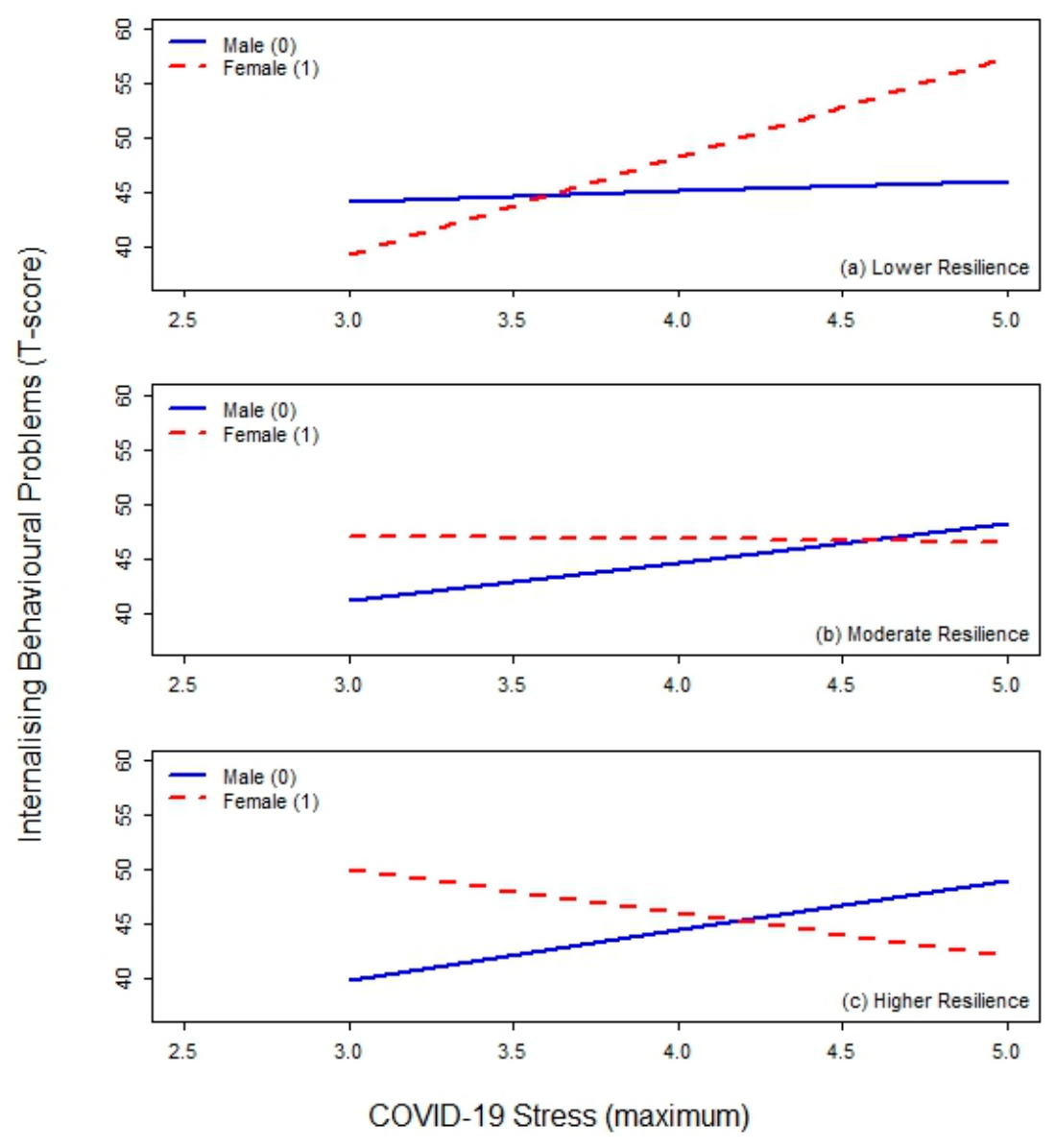
A moderated-moderation model predicting children’s Internalising Symptoms Index revealed a significant three-way interaction between COVID-19 stress, children’s self-reported resilience, and child SAAB (b = −2.37, t = −2.82, p = 0.01, 95% CI [−4.05, −0.68]). The conditional interaction between COVID-19 stress and resilience was significant among female children (p = 0.01) but not among male children (p = 0.23). Probing the interaction suggested that among female children, COVID-19 stress was associated with greater internalising problems at lower levels of resilience (Figure 1). At higher levels of resilience, COVID-19 stress was associated with fewer internalising problems among females; however, this effect only bordered statistical significance (p = 0.08). Sensitivity analyses conducted across the remaining imputed datasets indicated that the direction and magnitude of the three-way interaction were generally consistent across imputations, although statistical significance varied, with some models yielding marginal (n = 3) or non-significant (n = 2) estimates. This pattern suggests some uncertainty in the magnitude of the interaction but provides partial support for the robustness of the observed effect.
The overall model accounted for 26.88% of the variance in internalising problems (R2 = 0.27, F(13, 54) = 1.53, p = 0.14). The three-way interaction between COVID-19 stress, resilience, and child SAAB accounted for an additional 10.77% of the variance in internalising symptoms (ΔR2 = 0.11, F(1, 54) = 7.95, p = 0.01), indicating a moderate interaction effect. This effect size suggests that the interaction may have contributed modestly to explaining variation in children’s internalising behavioural problems.

3.2.2. Externalising Problems

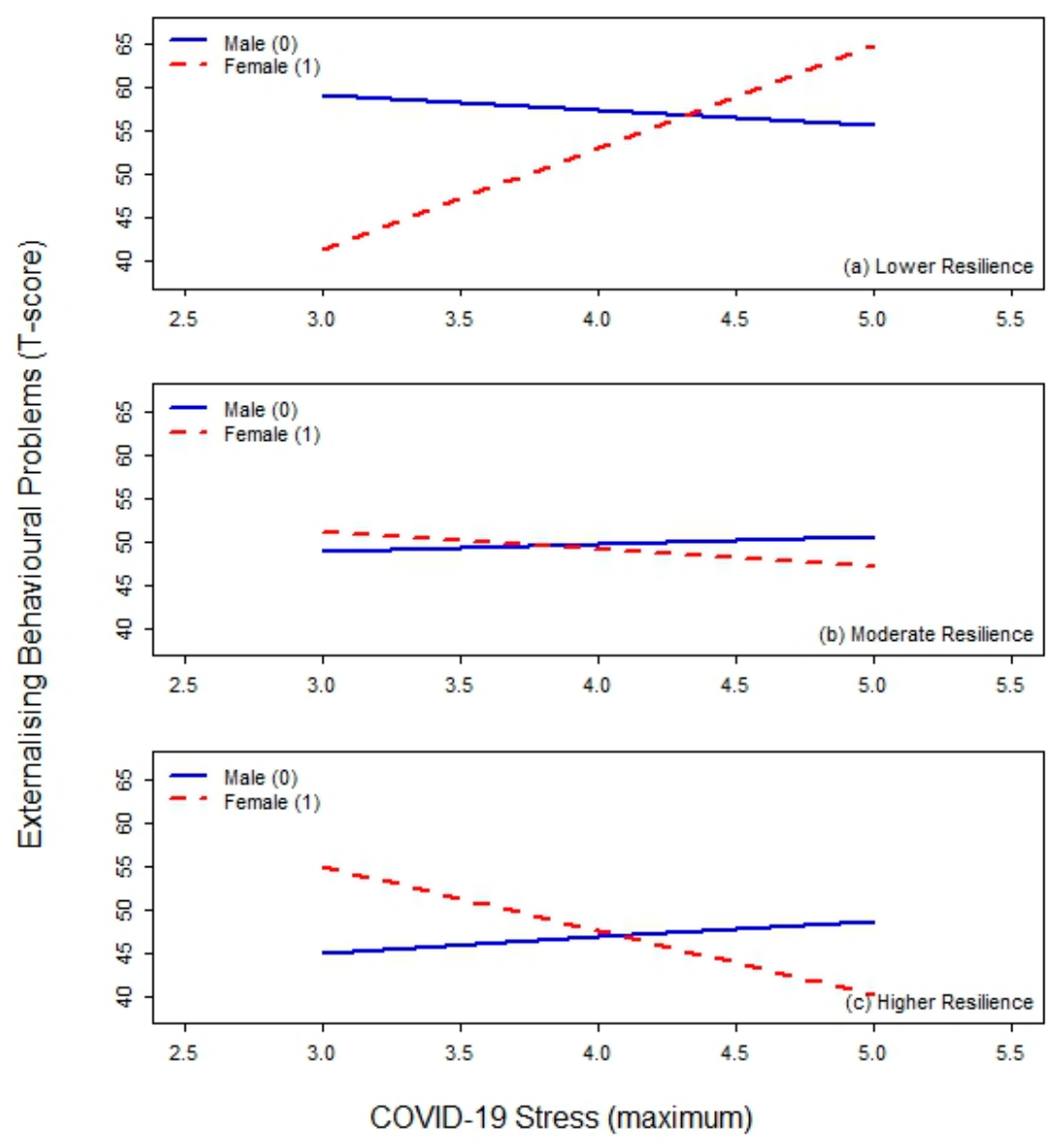
A moderated-moderation model predicting children’s Externalising Symptoms Index revealed a significant three-way interaction between COVID-19 stress, children’s self-reported resilience, and child SAAB (b = −3.25, t = −3.46, p < 0.01, 95% CI [−5.13, −1.37]). The conditional interaction between COVID-19 stress and resilience was significant among female children (p < 0.01) but not among male children (p = 0.28). Probing the interaction suggested that among female children, COVID-19 stress was associated with greater externalising problems at lower levels of resilience and fewer externalising problems at higher levels of resilience (Figure 2). Sensitivity analyses across the remaining imputed datasets yielded consistent three-way interaction estimates in both directions and statistical significance, supporting the robustness of the findings.
The overall model accounted for 45.98% of the variance in externalising problems (R2 = 0.46, F(13, 54) = 3.54, p < 0.01). The three-way interaction between COVID-19 stress, resilience, and child SAAB accounted for an additional 11.99% of the variance in externalising symptoms (ΔR2 = 0.12, F(1, 54) = 11.99, p < 0.01), indicating a moderate interaction effect. This effect size suggests that the interaction contributed meaningfully to explaining variation in children’s externalising behavioural problems.

3.2.3. Overall Behavioural Symptoms

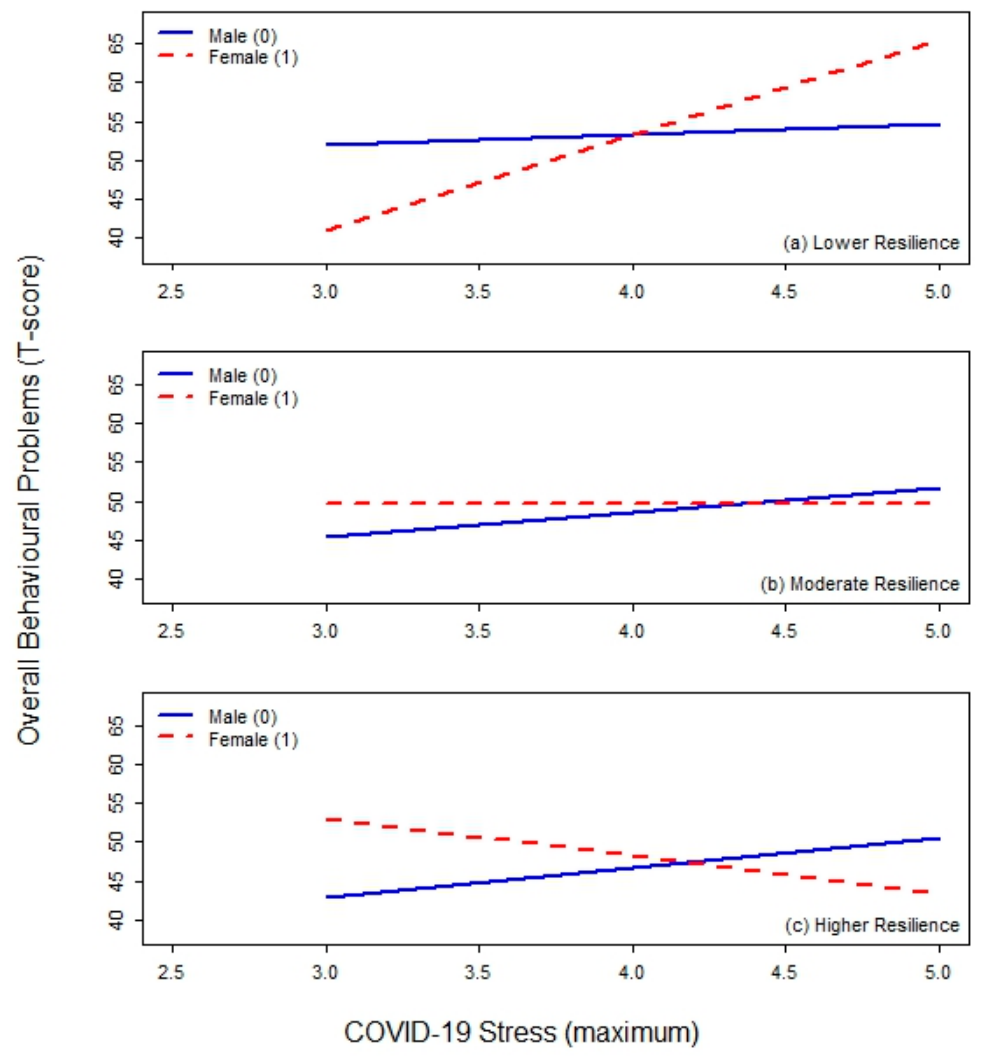
A moderated-moderation model predicting children’s Behavioural Symptoms Index revealed a significant three-way interaction between COVID-19 stress, children’s self-reported resilience, and child SAAB (b = −2.80, t = −3.40, p < 0.01, 95% CI [−4.45, −1.15]). The conditional interaction between COVID-19 stress and resilience was significant among female children (p < 0.01) but not among male children (p = 0.40). Probing the interaction suggested that among female children, COVID-19 stress was associated with greater overall behavioural problems at lower levels of resilience and fewer overall problems at higher levels of resilience (Figure 3). Sensitivity analyses across the remaining imputed datasets yielded consistent three-way interaction estimates in both directions and statistical significance, supporting the robustness of the findings.
The overall model accounted for 45.46% of the variance in overall behavioural problems (R2 = 0.45, F(13, 54) = 3.46, p < 0.01). The three-way interaction between COVID-19 stress, resilience, and child SAAB accounted for an additional 11.68% of the variance in overall symptoms (ΔR2 = 0.12, F(1, 54) = 11.57, p < 0.01), indicating a moderate interaction effect. This effect size suggests that the interaction contributed meaningfully to explaining variation in children’s overall behavioural problems.

4. Discussion

Findings from this exploratory study indicated that COVID-19 stress was not significantly associated with children’s internalising, externalising, or overall behavioural symptoms in pooled linear regression models when controlling for relevant covariates. However, examination of three-way interactions suggested that COVID-19 stress was associated with the three measures of behavioural problems among female children based on their self-reported resilience. Specifically, among female children, higher levels of resilience appeared to coincide with fewer behavioural problems, whereas lower levels of resilience appeared to coincide with greater behavioural problems, in the context of COVID-19 stress. However, sensitivity analyses suggested less consistent conditional effects when internalising problems were examined as the outcome, with some variation in the statistical significance of the three-way interaction across imputations. In contrast, for male children, self-reported resilience did not moderate the association between COVID-19 stress and behavioural problems. These findings are consistent with the possibility that higher resilience may buffer the association between COVID-19 stress and behavioural problems among female children, whereas lower resilience may be associated with greater behavioural symptoms. Importantly, T-scores for female and male children’s internalising, externalising, and overall behavioural symptoms were within normal ranges, indicating that children in this sample were at low clinical risk of behavioural problems.

4.1. COVID-19 Stress and Child Internalising and Overall Behavioural Symptoms

In pooled linear regression models that included all children, COVID-19 stress was not significantly associated with internalising, externalising, or overall behavioural symptoms. These findings differ from previous research demonstrating links between stress and behavioural symptoms in children [48], including evidence that pandemic-related stressors may increase risk for children’s mental health concerns [5]. Given the small sample size and the complex analyses investigated, it is possible that these null findings were an artefact of low statistical power. Another possibility is that the relatively low-risk nature of the current sample, reflected in overall normative T-scores and high sociodemographic homogeneity, may have reduced the likelihood of detecting direct associations between COVID-19 stress and behavioural outcomes. Importantly, the absence of significant main effects does not preclude conditional associations. Indeed, subsequent moderation analyses suggested that the association between COVID-19 stress and behavioural outcomes varied as a function of children’s resilience and SAAB, suggesting that the impact of COVID-19 stress may be more nuanced and context-dependent than indicated by simpler regression models.

4.2. Patterns Consistent with the “Classic” Resilience Buffering Hypothesis Among Female Children

Significant three-way interaction effects were observed in predicting children’s internalising, externalising, and overall behavioural symptoms, although the stability of findings was less consistent for internalising symptoms. The three-way interactions suggested that the association between COVID-19 stress and children’s behavioural problems varied across resilience levels in female children, but not males. It should be noted, however, that resilience was measured contemporaneously with behavioural outcomes at Wave 4; therefore, the findings should be interpreted as associational rather than establishing resilience as a temporally prior protective factor. These findings partially support current understandings regarding the influence of stress on children’s behavioural outcomes in the context of resilience and are consistent with the classic resilience buffering hypothesis, whereby higher resilience attenuates the association between stress exposure and mental health concerns [55,80]. However, given that higher resilience in children generally operates to reduce behavioural problems across children [81], the absence of a significant moderating effect among male children was somewhat unexpected.
Lower resilience in children has been associated with increased vulnerability to negative effects resulting from stress, and a higher risk of both internalising and externalising behavioural problems [54,55,82]. Also, several studies conducted outside the pandemic period demonstrate that children with greater perceived resilience are at lower risk of developing behavioural problems when exposed to various stressors [83]. While some of the literature points to female children being particularly at risk of developing internalising problems [9,10,11,15], the present findings indicate that among female children, lower levels of resilience were associated with stronger positive associations between COVID-19 stress and internalising, externalising, and overall behavioural symptoms. This suggests that resilience may buffer the association between COVID-19 stress and behavioural symptoms among female children.
While not analysed in this study, several mechanisms are speculated to help explain the findings. First, given that children’s mean age in this sample was just over 10 years, female children, who tend to enter puberty earlier than male children [84], could have been more likely to have experienced their COVID-19 stress during the initial stages of puberty. As puberty involves emotional, physical, and hormonal changes [84], it can be a confusing and challenging developmental period [85], especially for female children who report lower resilience [86]. This may have been particularly challenging for female children concomitantly navigating COVID-19 stress, though this requires further examination. Second, physical activity has been found to be a particularly important mental health resilience factor for male children relative to females [87], a factor that was drastically impacted with the introduction of COVID-19 public health measures [2,5]. However, the CYRM-R does not inquire about children’s physical activity or access to sports. Third, developmental processes associated with early puberty and evolving gender norms may shape how male children perceive and report resilience and emotional difficulties [28,88,89]. Specifically, male children may tend to overestimate their levels of resilience to appear stronger [28,88], which may reduce variability in reported resilience and attenuate detectable moderation effects. Given the modest sample size and the absence of direct measures of pubertal status or physical activity in the context of resilience, these interpretations should be viewed as exploratory and require replication in larger and more diverse samples.

4.3. Role of Sociodemographic Characteristics

Beyond developmental and gender-related mechanisms, another important consideration when contextualising these findings is the high sociodemographic homogeneity of the sample. Most mothers reported high household income and educational attainment, and nearly all self-identified as non-racialised. Since these characteristics are related to both resilience and behavioural outcomes in children [14,27], they could have contributed to the null associations observed between COVID-19 stress and children’s behavioural problems in the pooled regression. Higher household income may reflect greater access to resources that supported children during the COVID-19 pandemic, such as larger living spaces, reliable internet access, and virtual tutoring supports [56]. Similarly, higher maternal educational attainment may have enabled mothers to more effectively support their children with online learning and coping during the pandemic [56]. Together, these sociodemographic characteristics may have served protectively in this sample, potentially buffering children from the emergence of behavioural problems despite various COVID-19 stressors. Accordingly, these findings may be most applicable to populations with similar sociodemographic characteristics.

4.4. Limitations and Strengths

The sample size was smaller than generally desired, which limited our capacity to determine small (f2 = 0.02) three-way interaction effects. This may be of particular concern in this study, given the complex three-way interactions that were investigated with multiple predictor variables. Therefore, the findings should be considered exploratory, and null results should be interpreted with caution as they may reflect limited statistical power rather than the absence of an association. However, the study was adequately powered in determining moderate-to-high effects, with various three-way interactions being observed. Although covariates were selected a priori based on theoretical relevance, the modest sample size relative to the number of predictors may limit model stability and warrant caution when interpreting findings. The small sample size, in addition to the high socioeconomic homogeneity of the sample (e.g., high maternal educational attainment, high annual household income), may also limit generalisability to populations outside similar sociopolitical contexts. Nevertheless, when considering the repercussions of COVID-19 on research recruitment and engagement, the rigorous and comprehensive data collected remain valuable for generating insights into the potential implications of COVID-19 stress on children’s behavioural outcomes.
Because the PROCESS macro does not permit pooling of parameter estimates across multiply imputed datasets, the primary models were estimated using a single imputed dataset, with the remaining imputations examined as sensitivity analyses. Although the findings for overall and externalising problems were stable across imputations, less consistency was observed for internalising symptoms. Future studies using analytic approaches that allow pooled estimation of moderated-moderation models across imputations may provide stronger statistical inference.
Measurement bias could have been introduced through the self-report nature of the measures used for most variables, likely underestimating effects; however, almost all measures are considered gold standards and exhibit high validity and reliability in similar sociodemographic samples. Additionally, resilience was measured at the same wave as behavioural problems, which limits the ability to interpret resilience as a temporally prior protective factor and raises the possibility of reverse causation. The measure for COVID-19 stress was novel, but it was developed using items from validated tools to ensure rigorous data collection and was collected across three waves, allowing us to capitalise on maximum values. Also, the COVID-19 stress measure included a composite of individual-, family-, and community-level stressors, making it a more comprehensive measure of COVID-19 stress. Lastly, the longitudinal design established partial temporality between the exposure and outcome, supporting the examination of prospective associations.

5. Conclusions

Although physical safety was the main rationale for introducing COVID-19 restrictions, findings from this exploratory study highlight some of the unintended mental health implications of pandemic-related stressors for children. While COVID-19 stress was not directly associated with behavioural outcomes in pooled linear models, resilience appeared to condition these associations among female children. Specifically, lower resilience was associated with a stronger positive association between COVID-19 stress and behavioural symptoms, whereas higher resilience was associated with a weaker association. These findings raise the possibility that promoting resilience among female children may represent a promising area for future investigation in mitigating the mental health implications of pandemic-related stressors. Additional research on larger samples and on factors affecting the associations between COVID-19 stress and male children’s behavioural problems across levels of resilience is needed. Taken together, while physical safety during a pandemic is important, it is also important to emphasise mental health to help prevent potential negative behavioural outcomes among children.

Supplementary Materials

The following supporting information can be downloaded at: https://www.mdpi.com/article/10.3390/covid6040071/s1, Table S1: Moderated Moderation Model Predicting Internalizing Problems; Table S2: Moderated Moderation Model Predicting Externalizing Symptoms; Table S3: Moderated Moderation Model Predicting Overall Behavioural Problems.

Author Contributions

S.K. was involved in conceptualisation, data curation, formal analysis, investigation, methodology, project administration, supervision, resources, visualisation, writing—original draft, and writing—review and editing. D.D. was involved in conceptualisation, methodology, investigation, and writing—review and editing. N.L. led original conceptualisation, data curation, project administration, investigation, methodology, supervision, resources, funding, and writing—review and editing. All authors have read and agreed to the published version of the manuscript.

Funding

The APrON Study was funded by the Alberta Children′s Hospital Foundation, Alberta Innovates Health Solutions Foundation (formerly Alberta Heritage Foundation for Medical Research), and the Canadian Institutes of Health Research. Additional funding was provided by the Canadian Institutes of Health Research shortly after the emergence of the COVID-19 pandemic.

Institutional Review Board Statement

Ethics approval for this study was provided by the University of Calgary Health Research Ethics Board (REB14-1702) and the University of Alberta Health Research Ethics 11 Biomedical Panel (Pro00002954), 6 January 2026.

Informed Consent Statement

Mothers provided informed written consent for themselves at enrolment and at subsequent timepoints, along with assent for their children to participate during the COVID-19 data collection period.

Data Availability Statement

Although the dataset is not currently housed in an open access repository, it may be obtained upon reasonable request from the corresponding author.

Acknowledgments

We thank all of the COVID-19 Impact Study participants for supporting this research, especially during the COVID-19 pandemic. Also, we thank all APrON study members who supported data collection and organisation.

Conflicts of Interest

The authors have no conflicts of interest to declare.

References

  1. Cucinotta, D.; Vanelli, M. WHO declares COVID-19 a pandemic. Acta Bio Medica Atenei Parm. 2020, 91, 157. [Google Scholar]
  2. Atalan, A. Is the lockdown important to prevent the COVID-19 pandemic? Effects on psychology, environment and economy-perspective. Ann. Med. Surg. 2020, 56, 38–42. [Google Scholar] [CrossRef] [Scilit] [PubMed]
  3. Ferrara, P.; Franceschini, G.; Corsello, G.; Mestrovic, J.; Giardino, I.; Vural, M.; Pop, T.L.; Namazova-Baranova, L.; Somekh, E.; Indrio, F.; et al. Effects of Coronavirus Disease 2019 (COVID-19) on family functioning. J. Pediatr. 2021, 237, 322–323.e322. [Google Scholar] [CrossRef] [Scilit] [PubMed]
  4. Clayborne, Z.M.; Nilsen, W.; Torvik, F.A.; Gustavson, K.; Bekkhus, M.; Gilman, S.E.; Khandaker, G.M.; Fell, D.B.; Colman, I. Prenatal maternal stress, child internalizing and externalizing symptoms, and the moderating role of parenting: Findings from the Norwegian mother, father, and child cohort study. Psychol. Med. 2023, 53, 2437–2447. [Google Scholar] [CrossRef] [Scilit]
  5. Ng, C.S.M.; Ng, S.S.L. Impact of the COVID-19 pandemic on children’s mental health: A systematic review. Front. Psychiatry 2022, 13, 975936. [Google Scholar] [CrossRef] [Scilit]
  6. Masten, A.S.; Barnes, A.J. Resilience in children: Developmental perspectives. Children 2018, 5, 98. [Google Scholar] [CrossRef] [Scilit] [PubMed]
  7. Okwori, G. Role of individual, family, and community resilience in moderating effects of adverse childhood experiences on mental health among children. J. Dev. Behav. Pediatr. 2022, 43, e452–e462. [Google Scholar] [CrossRef] [Scilit]
  8. Zhu, Y.; Zhang, G.; Anme, T. Adverse Childhood Experiences, Resilience, and Emotional Problems in Young Chinese Children. Int. J. Environ. Res. Public Health 2023, 20, 6327. [Google Scholar] [CrossRef] [Scilit]
  9. Schore, A.N. All our sons: The developmental neurobiology and neuroendocrinology of boys at risk. Infant Ment. Health J. 2017, 38, 15–52. [Google Scholar] [CrossRef] [Scilit]
  10. Baillargeon, R.H.; Zoccolillo, M.; Keenan, K.; Côté, S.; Pérusse, D.; Wu, H.X.; Boivin, M.; Tremblay, R.E. Gender differences in physical aggression: A prospective population-based survey of children before and after 2 years of age. Dev. Psychol. 2007, 43, 13–26. [Google Scholar] [CrossRef] [Scilit]
  11. Hill, J.; Pickles, A.; Wright, N.; Quinn, J.; Murgatroyd, C.; Sharp, H. Maternal depression and child behaviours: Sex-dependent mediation by glucocorticoid receptor gene methylation in a longitudinal study from pregnancy to age 5 years. bioRxiv 2017. [Google Scholar] [CrossRef] [Scilit]
  12. Liu, J.; Chen, X.; Lewis, G. Childhood internalizing behaviour: Analysis and implications. J. Psychiatr. Ment. Health Nurs. 2011, 18, 884–894. [Google Scholar] [CrossRef] [Scilit] [PubMed]
  13. Nikstat, A.; Riemann, R. On the etiology of internalizing and externalizing problem behavior: A twin-family study. PLoS ONE 2020, 15, e0230626. [Google Scholar] [CrossRef] [Scilit] [PubMed]
  14. Lorber, M.F.; Del Vecchio, T.; Slep, A.M.S. The emergence and evolution of infant externalizing behavior. Dev. Psychopathol. 2015, 27, 663–680. [Google Scholar] [CrossRef] [Scilit] [PubMed]
  15. Gutman, L.M.; Codiroli McMaster, N. Gendered pathways of internalizing problems from early childhood to adolescence and associated adolescent outcomes. J. Abnorm. Child Psychol. 2020, 48, 703–718. [Google Scholar] [CrossRef] [Scilit]
  16. Khan, B.; Avan, B.I. Behavioral problems in preadolescence: Does gender matter? PsyCh J. 2020, 9, 583–596. [Google Scholar] [CrossRef] [Scilit]
  17. Sarfnaz, B.; Manizheh, K.; Majid, D. Behavioural problems compared to female and male students in Tabriz. Procedia—Soc. Behav. Sci. 2012, 46, 1781–1785. [Google Scholar] [CrossRef] [Scilit]
  18. Li, R.; Xiao, W.; Wu, J.; Zhou, Y.; Zha, J.; Wang, D.; Xing, T.; Wan, Y. Patterns of maternal adverse childhood experiences and the intergenerational association of preschool children’s emotional and behavioral problems. Front. Psychiatry 2024, 15, 1431475. [Google Scholar] [CrossRef] [Scilit]
  19. Letourneau, N.; Dewey, D.; Kaplan, B.J.; Ntanda, H.; Novick, J.; Thomas, J.C.; Deane, A.J.; Leung, B.; Pon, K.; Giesbrecht, G.F. Intergenerational transmission of adverse childhood experiences via maternal depression and anxiety and moderation by child sex. J. Dev. Orig. Health Dis. 2019, 10, 88–99. [Google Scholar] [CrossRef] [Scilit]
  20. Sun, H.-L.; He, F.; Rao, W.-W.; Qi, Y.; Rao, S.-Y.; Ho, T.I.; Su, Z.; Cheung, T.; Wong, K.K.; Smith, R.D.; et al. Gender differences in behavioral and emotional problems among school children and adolescents in China: National survey findings from a comparative network perspective. J. Affect. Disord. 2025, 369, 227–233. [Google Scholar] [CrossRef] [Scilit]
  21. Yoon, Y.; Eisenstadt, M.; Lereya, S.T.; Deighton, J. Gender difference in the change of adolescents’ mental health and subjective wellbeing trajectories. Eur. Child Adolesc. Psychiatry 2023, 32, 1569–1578. [Google Scholar] [CrossRef] [Scilit]
  22. Abd Rahim, M.H.; Ibrahim, M.I.; Ab Rahman, A.; Yaacob, N.M.; Hashim, N.S.F. Emotional and behavioural problems among preschool children in northeast peninsular malaysia: Parent Report version. Healthcare 2023, 11, 1828. [Google Scholar] [CrossRef] [Scilit]
  23. Finegan, J.A.; Bartleman, B.; Wong, P.Y. A window for the study of prenatal sex hormone influences on postnatal development. J. Genet. Psychol. 1989, 150, 101–112. [Google Scholar] [CrossRef] [Scilit]
  24. Körner, L.M.; Pause, B.M.; Meinlschmidt, G.; Tegethoff, M.; Fröhlich, S.; Kozlowski, P.; Rivet, N.; Jamey, C.; Reix, N.; Kintz, P.; et al. Prenatal testosterone exposure is associated with delay of gratification and attention problems/overactive behavior in 3-year-old boys. Psychoneuroendocrinology 2019, 104, 49–54. [Google Scholar] [CrossRef] [Scilit]
  25. Rotem, R.S.; Nguyen, V.T.; Chodick, G.; Davidovitch, M.; Shalev, V.; Hauser, R.; Coull, B.A.; Bellavia, A.; Weisskopf, M.G. Associations of maternal androgen-related conditions with risk of autism spectrum disorder in progeny and mediation by cardiovascular, metabolic, and fertility factors. Am. J. Epidemiol. 2021, 190, 600–610. [Google Scholar] [CrossRef] [Scilit]
  26. Kopsida, E.; Stergiakouli, E.; Lynn, P.M.; Wilkinson, L.S.; Davies, W. The role of the Y chromosome in brain function. Open Neuroendocrinol. J. 2009, 2, 20–30. [Google Scholar] [CrossRef] [Scilit]
  27. Loke, H.; Harley, V.; Lee, J. Biological factors underlying sex differences in neurological disorders. Int. J. Biochem. Cell Biol. 2015, 65, 139–150. [Google Scholar] [CrossRef] [Scilit]
  28. Halim, M.L.D.; Sakamoto, D.J.; Russo, L.N.; Echave, K.N.; Portillo, M.A.; Tawa, S. Early gender differences in valuing strength. Arch. Sex. Behav. 2022, 51, 2169–2182. [Google Scholar] [CrossRef] [Scilit] [PubMed]
  29. Hannigan, L.J.; Rijsdijk, F.V.; Ganiban, J.M.; Reiss, D.; Spotts, E.L.; Neiderhiser, J.M.; Lichtenstein, P.; McAdams, T.A.; Eley, T.C. Shared genetic influences do not explain the association between parent–offspring relationship quality and offspring internalizing problems: Results from a Children-of-Twins study. Psychol. Med. 2018, 48, 592–603. [Google Scholar] [CrossRef] [Scilit] [PubMed]
  30. Canadian Institute for Health Information. Children and Youth Mental Health in Canada; Canadian Institute for Health Information: Ottawa, ON, Canada, 2025. [Google Scholar]
  31. Meade, J. Mental health effects of the COVID-19 pandemic on children and adolescents: A review of the current research. Pediatr. Clin. N. Am. 2021, 68, 945–959. [Google Scholar] [CrossRef] [Scilit] [PubMed]
  32. Auro, K.; Holopainen, I.; Perola, M.; Havulinna, A.S.; Raevuori, A. Attention-deficit/hyperactivity disorder diagnoses in Finland during the COVID-19 pandemic. JAMA Netw. Open 2024, 7, e2418204. [Google Scholar] [CrossRef] [Scilit] [PubMed]
  33. Guzman Holst, C.; Bowes, L.; Waite, P.; Skripkauskaite, S.; Shum, A.; Pearcey, S.; Raw, J.; Patalay, P.; Creswell, C. Examining children and adolescent mental health trajectories during the COVID-19 pandemic: Findings from a year of the Co-SPACE study. JCPP Adv. 2023, 3, e12153. [Google Scholar] [CrossRef] [Scilit] [PubMed]
  34. Kaman, A.; Devine, J.; Wirtz, M.A.; Erhart, M.; Boecker, M.; Napp, A.K.; Reiss, F.; Zoellner, F.; Ravens-Sieberer, U. Trajectories of mental health in children and adolescents during the COVID-19 pandemic: Findings from the longitudinal COPSY study. Child Adolesc. Psychiatry Ment. Health 2024, 18, 89. [Google Scholar] [CrossRef] [Scilit]
  35. Casaburo, G.; Yzaguirre, M.; Subramaniam, S.; Holtrop, K. A systematic review of family stress theory in mental health research (2010–2020). Fam. Soc. 2023, 104, 557–569. [Google Scholar] [CrossRef] [Scilit]
  36. Hwang, T.-J.; Rabheru, K.; Peisah, C.; Reichman, W.; Ikeda, M. Loneliness and social isolation during the COVID-19 pandemic. Int. Psychogeriatr. 2020, 32, 1217–1220. [Google Scholar] [CrossRef] [Scilit]
  37. Smith, K.E.; Pollak, S.D. Social relationships and children’s perceptions of adversity. Child Dev. Perspect. 2021, 15, 228–234. [Google Scholar] [CrossRef] [Scilit]
  38. Almeida, I.L.L.; Rego, J.F.; Teixeira, A.C.G.; Moreira, M.R. Social isolation and its impact on child and adolescent development: A systematic review. Rev. Paul. De Pediatr. 2021, 40, e2020385. [Google Scholar] [CrossRef] [Scilit]
  39. Li, J.; Luo, H.; Tang, W.; Qian, H.; Yang, H.; Luo, Q. Qualitative study on emotional experiences and coping strategies in patients with COVID-19 during the early stage of Wuhan crisis. Depress. Anxiety 2024, 2024, 6696049. [Google Scholar] [CrossRef] [Scilit]
  40. Bai, M.S.; Miao, C.Y.; Zhang, Y.; Xue, Y.; Jia, F.Y.; Du, L. COVID-19 and mental health disorders in children and adolescents (Review). Psychiatry Res. 2022, 317, 114881. [Google Scholar] [CrossRef] [Scilit]
  41. Statistics Canada. Survey on COVID-19 and Mental Health, February to May 2021; Statistics Canada: Ottawa, ON, Canada, 2021.
  42. Letourneau, N.; Luis, M.A.; Kurbatfinski, S.; Ferrara, H.J.; Pohl, C.; Marabotti, F.; Hayden, K.A. COVID-19 and family violence: A rapid review of literature published up to 1 year after the pandemic declaration. EClinicalMedicine 2022, 53, 101634. [Google Scholar] [CrossRef] [Scilit] [PubMed]
  43. Franzoi, D.; Bockting, C.L.; Bennett, K.F.; Odom, A.; Lucassen, P.J.; Pathania, A.; Lee, A.; Brouwer, M.E.; van de Schoot, R.; Wiers, R.W.; et al. Which individual, social, and urban factors in early childhood predict psychopathology in later childhood, adolescence and young adulthood? A systematic review. SSM—Popul. Health 2024, 25, 101575. [Google Scholar] [CrossRef] [Scilit]
  44. Jiang, Y.; Harrison, S.E.; Li, X. Resilience-based intervention to promote mental and behavioral health in children. Pediatr. Clin. N. Am. 2022, 69, 795–805. [Google Scholar] [CrossRef] [Scilit] [PubMed]
  45. Tosto, S.A.; Alyahya, J.; Espinoza, V.; McCarthy, K.; Tcherni-Buzzeo, M. Online learning in the wake of the COVID-19 pandemic: Mixed methods analysis of student views by demographic group. Soc. Sci. Humanit. Open 2023, 8, 100598. [Google Scholar] [CrossRef] [Scilit] [PubMed]
  46. MacCallum-Bridges, C.L.; Admon, L.K.; Daw, J.R. Childcare disruptions and maternal health during the COVID-19 pandemic. Health Aff. Sch. 2024, 2, qxae061. [Google Scholar] [CrossRef] [Scilit]
  47. Pakpahan, M.; Kartika, L.; Sampepadang, M. Factors related to family resilience during the COVID-19 pandemic. Bali Med. J. 2022, 11, 1603–1607. [Google Scholar] [CrossRef] [Scilit]
  48. Ribas, L.H.; Montezano, B.B.; Nieves, M.; Kampmann, L.B.; Jansen, K. The role of parental stress on emotional and behavioral problems in offspring: A systematic review with meta-analysis. J. Pediatr. 2024, 100, 565–585. [Google Scholar] [CrossRef] [Scilit]
  49. Thomason, E.; Volling, B.L.; Flynn, H.A.; McDonough, S.C.; Marcus, S.M.; Lopez, J.F.; Vazquez, D.M. Parenting stress and depressive symptoms in postpartum mothers: Bidirectional or unidirectional effects? Infant Behav. Dev. 2014, 37, 406–415. [Google Scholar] [CrossRef] [Scilit]
  50. Hatun, O.; Kütük-Yılmaz, P.; Topal-Özgen, G. Nurturing bonds: Social support as a mediator in the association between parenting stress and the mother–child relationship among Turkish mothers. Fam. J. 2025, 10664807241308900. [Google Scholar] [CrossRef] [Scilit]
  51. Qian, G.; Li, B.; Xu, L.; Ai, S.; Li, X.; Lei, X.; Dou, G. Parenting style and young children’s executive function mediate the relationship between parenting stress and parenting quality in two-child families. Sci. Rep. 2024, 14, 8503. [Google Scholar] [CrossRef] [Scilit]
  52. Kurbatfinski, S.; Dosani, A.; Dewey, D.M.; Letourneau, N. Proposed physiological mechanisms underlying the association between adverse childhood experiences and mental health conditions: A narrative review. Children 2024, 11, 1112. [Google Scholar] [CrossRef] [Scilit] [PubMed]
  53. Bethell, C.; Gombojav, N.; Solloway, M.; Wissow, L. Adverse childhood experiences, resilience and mindfulness-based approaches: Common denominator issues for children with emotional, mental, or behavioral problems. Child Adolesc. Psychiatr. Clin. N. Am. 2016, 25, 139–156. [Google Scholar] [CrossRef] [Scilit]
  54. Mesman, E.; Vreeker, A.; Hillegers, M. Resilience and mental health in children and adolescents: An update of the recent literature and future directions. Curr. Opin. Psychiatry 2021, 34, 586. [Google Scholar] [CrossRef] [Scilit]
  55. National Scientific Council on the Developing Child. Supportive Relationships and Active Skill-Building Strengthen the Foundations of Resilience: Working Paper 13. 2015. Available online: https://developingchild.harvard.edu/resources/supportive-relationships-and-active-skill-building-strengthen-the-foundations-of-resilience/ (accessed on 14 April 2026).
  56. Breiner, H.; Ford, M.; Gadsden, V.L.; National Academies of Sciences, Engineering, and Medicine; Division of Behavioral and Social Sciences and Education; Board on Children, Youth, and Families; Committee on Supporting the Parents of Young Children. Parenting knowledge, attitudes, and practices. In Parenting Matters: Supporting Parents of Children Ages 0–8; National Academies Press: Washington, DC, USA, 2016. [Google Scholar]
  57. Arpi, E.; Ferrari, F. Preterm birth and behaviour problems in infants and preschool-age children: Areview of the recent literature. Dev. Med. Child Neurol. 2013, 55, 788–796. [Google Scholar] [CrossRef] [Scilit] [PubMed]
  58. Olukotun, M.; Olanlesi-Aliu, A.; Idi, Y.; Ladha, T.; Bailey, P.; King, R.; Salami, B. Institutional and systemic barriers and facilitators affecting healthcare access for Black women in Alberta. SSM—Qual. Res. Health 2024, 6, 100485. [Google Scholar] [CrossRef] [Scilit]
  59. Copeland, K.A.; King, A.; Ladipo, J.; Bennett, D.; Amsterdam, A.; White, C.; Gerker, H.; Karbeah, J.M. Barriers to early childhood education for Black families and calls for equitable solutions from a qualitative study using peer researchers and an antiracist lens. Early Child. Res. Q. 2024, 69, S26–S38. [Google Scholar] [CrossRef] [Scilit]
  60. Pandya, N.K. Disparities in youth sports and barriers to participation. Curr. Rev. Musculoskelet. Med. 2021, 14, 441–446. [Google Scholar] [CrossRef] [Scilit]
  61. Letourneau, N.; Aghajafari, F.; Bell, R.C.; Deane, A.J.; Dewey, D.; Field, C.; Giesbrecht, G.; Kaplan, B.; Leung, B.; Ntanda, H. The Alberta Pregnancy Outcomes and Nutrition (APrON) longitudinal study: Cohort profile and key findings from the first three years. BMJ Open 2022, 12, e047503. [Google Scholar] [CrossRef] [Scilit] [PubMed]
  62. Letourneau, N.; McDonald, S.; MacKay, L.J.; Bell, R.C.; Hetherington, E.; Deane, A.J.; Dewey, D.; Edwards, S.; Field, C.J.; Giesbrecht, G.F.; et al. Cross-sectional study protocol for the COVID-19 Impact Survey of Mothers and Their 7-11 Year Old Children in Alberta, Canada. Front Psychiatry 2021, 12, 597759. [Google Scholar] [CrossRef] [Scilit]
  63. Canadian Institutes of Health Research; Natural Sciences and Engineering Research Council of Canada; Social Sciences and Humanities Research Council of Canada. Tri-Council Policy Statement: Ethical Conduct for Research Involving Humans (TCPS2); Government of Canada: Ottawa, ON, Canada, 2018.
  64. Faul, F.; Erdfelder, E.; Lang, A.; Buchner, A. G*Power 3: A flexible statistical power analysis program for the social, behavioural, and biomedical sciences. Behav. Res. Methods 2007, 39, 175–191. [Google Scholar] [CrossRef] [Scilit]
  65. Ungar, M.; Liebenberg, L. Child and Youth Resilience Measure. J. Mix. Methods Res. 2011, 5, 126–149. [Google Scholar] [CrossRef] [Scilit]
  66. Spanier, G. Dyadic Adjustment Scale; Multi-Health Systems: North Tonawanda, NY, USA, 1989. [Google Scholar] [CrossRef] [Scilit]
  67. Statistics Canada. Canadian perspectives survey series 1: Impacts of COVID-19. The Daily, 8 April 2020.
  68. Chen, Y.-H.; Ferguson, K.K.; Meeker, J.D.; McElrath, T.F.; Mukherjee, B. Statistical methods for modeling repeated measures of maternal environmental exposure biomarkers during pregnancy in association with preterm birth. Environ. Health 2015, 14, 9. [Google Scholar] [CrossRef] [Scilit]
  69. Spielberger, C. State-trait anxiety inventory. In The Corsini Encyclopedia of Psychology; Wiley: Hoboken, NJ, USA, 2010; Volume 1. [Google Scholar]
  70. Radloff, L.S. The CES-D scale: A self-report depression scale for research in the general population. Appl. Psychol. Meas. 1977, 1, 385–401. [Google Scholar] [CrossRef] [Scilit]
  71. Roberti, J.; Harrington, L.; Storch, E. Further psychometric support for the 10-Item version of the Perceived Stress Scale. J. Coll. Couns. 2006, 9, 135–147. [Google Scholar] [CrossRef] [Scilit]
  72. Sinclair, V.G.; Wallston, K.A. The development and psychometric evaluation of the Brief Resilient Coping Scale. Assessment 2004, 11, 94–101. [Google Scholar] [CrossRef] [Scilit]
  73. Spielberger, C.; Gorsuch, R.; Lushene, R.; Vagg, P.R.; Jacobs, G. Manual for the State-Trait Anxiety Inventory (Form Y1–Y2); Consulting Psychologists Press: Palo Alto, CA, USA, 1983; Volume IV. [Google Scholar]
  74. Reynolds, C.; Kamphaus, R. Behavior Assessment System for Children, 3rd ed.; Pearson: London, UK, 2015. [Google Scholar]
  75. Gladman, M.; Lancaster, S. A Review of the Behaviour Assessment System for Children. Sch. Psychol. Int.—Sch. Psychol. Int. 2003, 24, 276–291. [Google Scholar] [CrossRef] [Scilit]
  76. Jefferies, P.; McGarrigle, L.; Ungar, M. The CYRM-R: A Rasch-Validated Revision of the Child and Youth Resilience Measure. J. Evid. Based Soc. Work 2019, 16, 70–92. [Google Scholar] [CrossRef] [Scilit] [PubMed]
  77. Azur, M.J.; Stuart, E.A.; Frangakis, C.; Leaf, P.J. Multiple imputation by chained equations: What is it and how does it work? Int. J. Methods Psychiatr. Res. 2011, 20, 40–49. [Google Scholar] [CrossRef] [Scilit]
  78. Hayes, A.F.; Allison, P.D.; Alexander, S.M. Errors-in-variables regression as a viable approach to mediation analysis with random error-tainted measurements. Estimation, effectiveness, and an easy-to-use implementation. Behav. Res. Methods 2025, 57, 323. [Google Scholar] [CrossRef] [Scilit] [PubMed]
  79. Hayes, A.F. Introduction to Mediation, Moderation, and Conditional Process Analysis: A Regression-Based Approach; Guilford Publications: New York, NY, USA, 2017. [Google Scholar]
  80. Tetzner, J.; Bondü, R.; Krahé, B. Family risk factors and buffering factors for child internalizing and externalizing problems. J. Appl. Dev. Psychol. 2022, 80, 101395. [Google Scholar] [CrossRef] [Scilit]
  81. Turgeon, J.; Racine, N.; McDonald, S.; Tough, S.; Madigan, S. Maternal adverse childhood experiences, child resilience factors, and child mental health problems: A multi-wave study. Child Abus. Negl. 2024, 154, 106927. [Google Scholar] [CrossRef] [Scilit]
  82. Eaton, S.; Cornwell, H.; Hamilton-Giachritsis, C.; Fairchild, G. Resilience and young people’s brain structure, function and connectivity: A systematic review. Neurosci. Biobehav. Rev. 2022, 132, 936–956. [Google Scholar] [CrossRef] [Scilit]
  83. Mendes-Sousa, M.M.; Perrone, M.B.; de Melo, R.B.; Ribeiro, M.V.V.; Chao, Q.; Torres, C.; Sanchez, Z.M.; Surkan, P.J.; Martins, S.S.; Fidalgo, T.M.; et al. The impact of family stress and resilience on child development: A scoping review. Trends Psychiatry Psychother. 2025, 47, e20220556. [Google Scholar] [CrossRef] [Scilit]
  84. Breehl, L.; Caban, O. Physiology, Puberty; StatParls Publishing: Treasure Island, FL, USA, 2018. [Google Scholar]
  85. Holder, M.K.; Blaustein, J.D. Puberty and adolescence as a time of vulnerability to stressors that alter neurobehavioral processes. Front. Neuroendocrinol. 2014, 35, 89–110. [Google Scholar] [CrossRef] [Scilit]
  86. Yu, X.; Kong, X.; Cao, Z.; Chen, Z.; Zhang, L.; Yu, B. Social support and family functioning during adolescence: A two-wave cross-lagged study. Int. J. Environ. Res. Public Health 2022, 19, 6327. [Google Scholar] [CrossRef] [Scilit] [PubMed]
  87. Marquez, J.; Francis-Hew, L.; Humphrey, N. Protective factors for resilience in adolescence: Analysis of a longitudinal dataset using the residuals approach. Child Adolesc. Psychiatry Ment. Health 2023, 17, 140. [Google Scholar] [CrossRef] [Scilit] [PubMed]
  88. Galligan, S.; Barnett, R.; Brennan, M.; Israel, G. The Effects of Gender Role Conflict on Adolescent and Emerging Adult Male Resiliency. J. Men’s Stud. 2010, 18, 3–21. [Google Scholar] [CrossRef] [Scilit]
  89. Knafo, A.; Spinath, F.M. Genetic and environmental influences on girls’ and boys’ gender-typed and gender-neutral values. Dev. Psychol. 2011, 47, 726–731. [Google Scholar] [CrossRef] [Scilit] [PubMed]
Figure 1. COVID-19 stress predicting children’s internalising behavioural problems: (a) reflects lower child resilience; (b) reflects moderate child resilience; and (c) reflects higher child resilience.
Covid 06 00071 g001
Figure 2. COVID-19 stress predicting children’s externalising behavioural problems: (a) reflects lower child resilience; (b) reflects moderate child resilience; and (c) reflects higher child resilience.
Covid 06 00071 g002
Figure 3. COVID-19 stress predicting children’s overall behavioural problems: (a) reflects lower child resilience; (b) reflects moderate child resilience; and (c) reflects higher child resilience.
Covid 06 00071 g003
Table 2. Sample characteristics and demographic information (N = 68).
n (%)Mean (SD)
Covariates
Child Sex-Assigned-at-Birth
   Male32 (47.06)
   Female36 (52.94)
Child Age (years) 10.21 (0.43)
Maternal Age (years) 42.37 (3.72)
Gestational Age (weeks) 39.53 (1.28)
Birthweight (grams) 3472.12 (503.92)
Maternal Highest Level of Education
   Post-Graduate11 (16.18)
   University Degree39 (57.35)
   Trade School15 (22.06)
   High School or Less3 (4.41)
Maternal Self-Identified Ethnicity
   White66 (97.01)
   Chinese1 (1.47)
   Arab1 (1.47)
Total Household Annual Income (CAD dollars)
   <20,0001 (1.47)
   20,000 to 39,9991 (1.47)
   40,000 to 69,9997 (10.29)
   70,000 to 99,99916 (23.53)
   >100,00043 (63.24)
Predictor Variable Median
COVID-19 Stress 4
Moderator Variable Mean (SD)
Children’s Self-Reported Resilience 45.78 (3.78)
Outcome Variable Mean (SD)
Internalising Problems 46.41 (6.92)
Externalising Problems 51.06 (9.01)
Overall Behavioural Symptoms 50.75 (7.86)
Note: SD = standard deviation; % = percent.
Disclaimer/Publisher’s Note: The statements, opinions and data contained in all publications are solely those of the individual author(s) and contributor(s) and not of MDPI and/or the editor(s). MDPI and/or the editor(s) disclaim responsibility for any injury to people or property resulting from any ideas, methods, instructions or products referred to in the content.