1. Introduction
In January 2020, the SARS-CoV-2 virus was identified as the causative agent of severe pneumonia and was officially designated as coronavirus disease 2019 (COVID-19) by the World Health Organization (WHO). On 11 March 2020, COVID-19 was declared a pandemic and recognized as a Public Health Emergency of International Concern (PHEIC) [
1].
In response to this unprecedented situation, health authorities in Bosnia and Herzegovina, as well as in other countries worldwide, implemented active surveillance measures, early case detection, isolation and clinical management of confirmed cases, contact tracing, and infection prevention and control strategies aimed at limiting the spread of the virus. In Sarajevo Canton, with a total population of 413,593 inhabitants, a substantial burden of disease was recorded during the Omicron wave (December 2021–February 2022) with 3225 confirmed cases of COVID-19 [
2]. Cumulatively, across all pandemic waves, a total of 106,346 confirmed cases and 1912 COVID-19 related deaths were reported in the Canton, corresponding to a case fatality rate of 1.8% [
3,
4].
The epidemiological crisis led to substantial structural and organizational changes in the healthcare system of Sarajevo Canton. The most profound reorganization occurred at the level of primary care, where service delivery models, clinical workflows, and patient management strategies underwent rapid and extensive adaptation [
4,
5].
A study conducted in Argentina examining the presence of anxiety and depressive symptoms in the general population during the pandemic reported a progressive increase in anxiety symptoms and depressive symptoms [
6].
Elevated psychosocial stress, social isolation, and economic insecurity have been identified as key risk factors for adverse mental health outcomes during the COVID-19 pandemic. Evidence from systematic reviews indicates that increased levels of psychological distress and stress were observed across general populations in multiple countries, including China, Spain, Italy, Iran, the USA, Turkey, Nepal, and Denmark [
7]. Additionally, population-based studies have shown that mental health outcomes varied across sociodemographic groups, with higher levels of distress reported among individuals living in urban areas, those who were unemployed or economically inactive, and those experiencing greater social vulnerability [
8].
Although a growing body of literature has documented increased levels of anxiety and depressive symptoms during and after the COVID-19 pandemic, findings remain heterogeneous, particularly regarding the independent impact of prior COVID-19 infection. Most studies have focused on hospitalized patients, clinical cohorts, or vulnerable groups and often report elevated psychological distress [
9,
10]. In contrast, evidence from primary healthcare and community-based populations is more limited and less consistent after adjustment for relevant confounders. Furthermore, data from Southeast Europe, including Bosnia and Herzegovina, remain scarce. To our knowledge, no study has specifically examined whether prior COVID-19 infection is independently associated with anxiety and depressive symptoms in a primary healthcare population in Sarajevo Canton.
Therefore, the aim of the study was to compare the levels of anxiety and depressive symptoms between primary healthcare patients with and without a history of COVID-19 infection.
2. Materials and Methods
2.1. Study Design and Participants
A cross-sectional observational study was conducted in April 2022 in Sarajevo Canton, during a period when the COVID-19 epidemic was still ongoing and access to family medicine outpatient clinics was limited. The study was carried out in five family medicine teams. Participants were recruited through non-probability convenience sampling among patients attending routine visits to family medicine clinics. Given the exploratory nature of the study and the organizational constraints during the COVID-19 pandemic, a convenience sampling approach was considered appropriate for capturing patients routinely attending primary healthcare services. The study was conducted and reported in accordance with the STROBE guidelines (
Table A1).
Adult patients (≥18 years) registered with one of the participating family medicine teams were eligible for inclusion if they were able to understand and independently complete the questionnaire and had basic digital literacy, including possession of an active email account and the ability to access the Google platform.
Prior to invitation, medical records were reviewed in order to exclude patients with previously documented depressive, anxiety, or other mental disorders, as well as individuals with cognitive impairments or other conditions preventing independent completion of the questionnaire. Patients without access to an email account or the Google platform were also excluded.
Patients who agreed to participate provided written informed consent during their visit to the clinic and confirmed their willingness to receive an email invitation with a link to the online questionnaire. Subsequently, they received an email containing the survey link administered through the Google Forms platform. Participation was voluntary and responses were collected anonymously.
2.2. Data Collection and Instruments
A total of 600 patients (120 from each participating team) were invited to participate in the study. Participants received an email containing a link to the online questionnaire administered via the Google Forms platform.
Sociodemographic variables included age (continuous), sex (male/female), years of education (≤12 years/>12 years), marital status (married/not married), and employment status (employed/unemployed). Chronic conditions were categorized as present or absent, and smoking status as smoker or non-smoker. COVID-19 infection status was categorized as previously infected or not infected. For participants with a history of COVID-19 infection, additional information regarding the year of infection and hospitalization status was collected. COVID-19 vaccination status was recorded as vaccinated or not vaccinated.
Participants who self-reported depressive, anxiety, or other mental disorders in the questionnaire, despite no documented diagnosis in medical records, were excluded in accordance with the predefined exclusion criteria.
Anxiety symptoms were assessed using the Generalized Anxiety Disorder-7 (GAD-7) scale, while depressive symptoms were evaluated with the Patient Health Questionnaire-9 (PHQ-9) scale. The questionnaires were validated in the official languages used in the territory of Bosnia and Herzegovina [
11,
12].
The total GAD-7 scores ranged from 0 to 21 points, with scores of 5–9 indicating mild anxiety, 10–14 indicating moderate anxiety, and scores ≥ 15 indicating severe anxiety. The total PHQ-9 scores ranged from 0 to 27, with scores < 5 suggesting the absence of depressive symptoms, 5–9 indicating mild depressive symptoms, 10–14 indicating moderate depressive symptoms, 15–19 indicating moderately severe depressive symptoms, and 20–27 indicating severe depressive symptoms. Both scales have been widely applied and validated across diverse populations, demonstrating good internal consistency (GAD-7: α = 0.81–0.91; PHQ-9: α = 0.81–0.86) and confirmed factor structures in psychometric studies [
13,
14,
15].
In the present study, both scales were analyzed as continuous variables, as well as dichotomized according to predefined clinically relevant cut-off values. The cut-off scores were set at ≥10 for GAD-7 and ≥9 for PHQ-9, consistent with validated and widely accepted clinical thresholds [
13]. Internal consistency of the scales was assessed in the present sample using Cronbach’s alpha coefficient. The GAD-7 demonstrated good internal consistency (Cronbach’s α = 0.89), as did the PHQ-9 (Cronbach’s α = 0.87).
2.3. Statistical Analysis
Statistical analyses were conducted using predefined analytic procedures. Categorical variables were presented as absolute numbers and percentages, while continuous variables were described using medians and interquartile ranges (IQR) due to deviations from the normal distribution.
For comparisons of continuous variables between two independent groups, the Mann–Whitney U test was used, while categorical variables were compared using the χ2 test or Fisher’s exact test, as appropriate.
The primary analysis compared anxiety and depressive symptoms between participants with a history of COVID-19 infection (COVID+) and those without (COVID−). Secondary analyses included stratification of participants with prior COVID-19 by year of infection (2020, 2021, or 2022) and by hospitalization status due to COVID-19.
To assess the independent association of COVID-19 status with anxiety and depressive symptoms, multivariable regression models were employed. Continuous outcomes (GAD-7 and PHQ-9 scores) were analysed using ordinary least squares (OLS) linear regression, while binary outcomes (clinically significant symptoms based on cut-off values) were analysed using logistic regression. In all regression models, robust standard errors (HC3) were applied to reduce the impact of heteroscedasticity and improve the reliability of the estimates.
The multivariable models included the following covariates: age, sex, educational level, marital status, employment status, smoking status, presence of chronic conditions, and COVID-19 vaccination status. Results are presented as regression coefficients (β) or odds ratios (OR) with 95% confidence intervals and corresponding p-values. Two-sided p-values <0.05 were considered statistically significant.
All primary statistical analyses were performed using IBM SPSS Statistics version 26 (IBM Corp., Armonk, NY, USA). Propensity score matching and covariate balance diagnostics were conducted using Python (version 3.8).
2.4. Ethical Considerations
The study was approved by the Ethics Committee of the Public Institution “Primary Health Care Centre” Sarajevo Canton (approval number: 01-06/3-5078-3/21, dated 22 September 2021) and conducted in accordance with the principles of the Declaration of Helsinki [
16]. All participants provided written informed consent at their clinic visit prior to enrolment, including permission to receive an email containing a link to the online questionnaire.
While physicians were aware of the list of patients invited from their teams, they did not know which individuals completed the questionnaire. The online survey did not contain names, email addresses, or other direct identifiers, and it was not possible to link individual responses to specific participants.
The collected data were stored on a secure, encrypted virtual drive accessible only to authorized members of the research team. Data collection and storage complied with the applicable. Personal Data Protection Act (Official Gazette of BiH, Nos.49/2006, 76/21, and 89/2011) and the provisions of the General Data Protection Regulation (GDPR) [
17].
3. Results
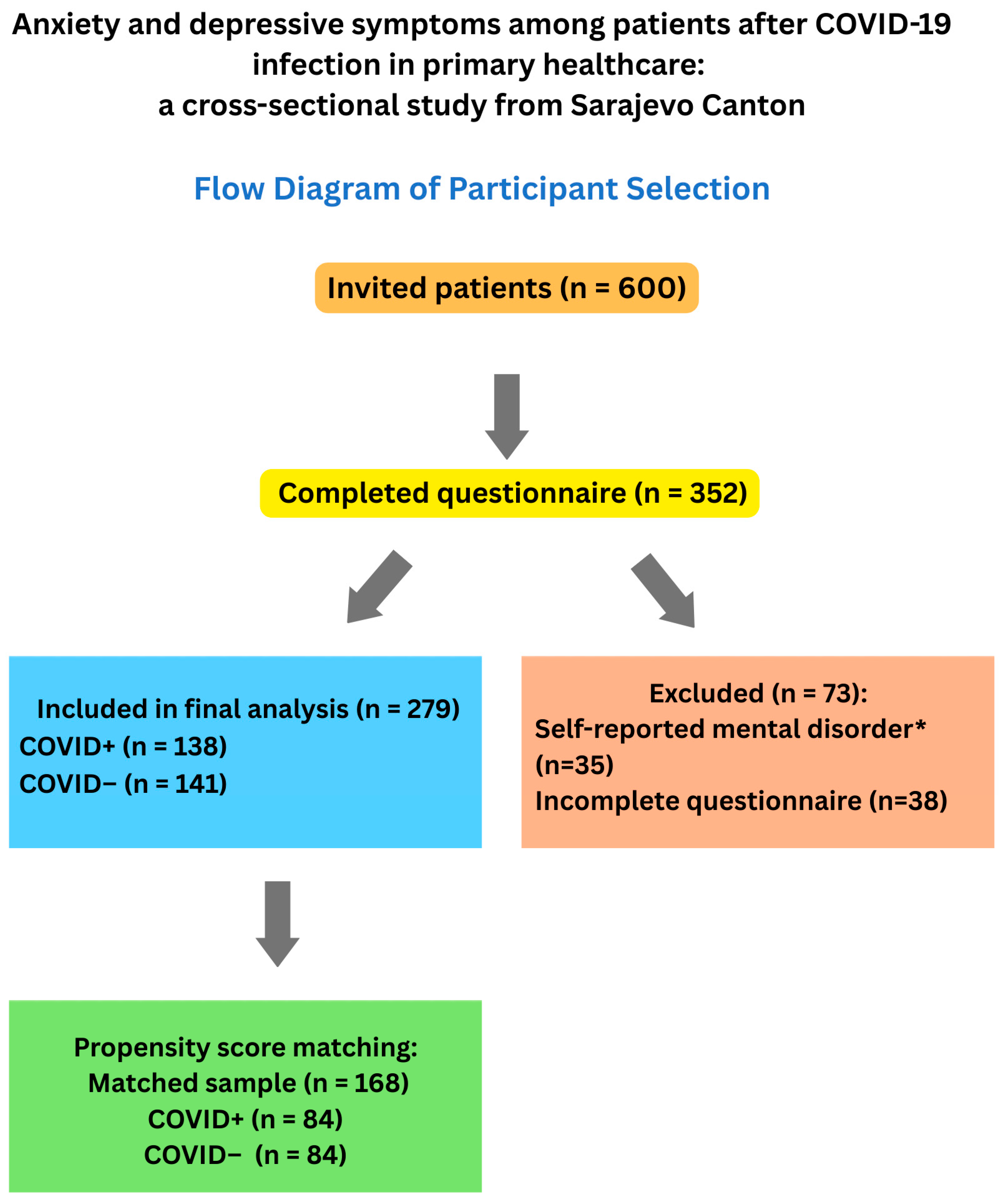
A total of 352 participants responded to the questionnaire (response rate: 58.7%). Although participants with documented mental disorders were initially excluded based on medical records, 35 participants reported a depressive, anxiety, or other mental disorder in the questionnaire and were therefore excluded from the analysis. An additional 38 participants were excluded due to incomplete questionnaire data. Exclusions were similar across groups, reducing the likelihood of substantial differential bias. The final analytical sample comprised 279 participants who completed the questionnaire in full and did not report a depressive or other mental disorder.
Baseline demographic and health characteristics of the participants are presented in
Table 1. No statistically significant differences were observed between the groups in terms of age (Mann–Whitney U = 9241.0,
p = 0.461), sex (χ
2(1) = 1.87,
p = 0.171), or COVID-19 vaccination status (χ
2(1) = 0.13,
p = 0.720).
However, several sociodemographic and health-related differences were identified. Participants who had recovered from COVID-19 were more frequently employed (85.5% vs. 60.3%; χ2(1) = 21.13, p< 0.001) and married (70.3% vs. 54.6%; χ2(1) = 6.65, p = 0.010), and had a higher level of education (>12 years; χ2(1) = 5.03, p = 0.025). They were also less likely to be smokers (25.4% vs. 41.8%; χ2(1) = 7.76, p = 0.005) and less likely to report the presence of chronic diseases (28.3% vs. 44.7%; χ2(1) = 7.41, p = 0.006).
Standardized mean differences (SMD) indicated meaningful baseline imbalance for several covariates, particularly employment status (SMD = 0.59), smoking status (SMD = 0.36), and chronic disease prevalence (SMD = 0.34).
No statistically significant differences were found between the groups with respect to age, sex, or vaccination status.
The observed differences in employment status, educational level, and the presence of chronic diseases indicated an initial imbalance between the groups, with standardized mean differences (SMDs) exceeding 0.30 for certain variables and reaching 0.59 for employment status.
Given that these characteristics are established determinants of mental health, they were treated as potential confounders. Therefore, this imbalance was further addressed using multivariable regression models and propensity score matching analysis.
3.1. Comparison of Anxiety and Depressive Symptoms (Unadjusted Analyses)
In bivariate analyses, no statistically significant differences were observed in anxiety or depressive symptoms between participants with and without a history of COVID-19 infection. The median GAD-7 score was 6 (IQR 4–9) in the COVID+ groupand5 (IQR 3–8) in the COVID− group(Mann–Whitney U = 10,758.5, p = 0.125).
Similarly, the median PHQ-9 score was 5 (IQR 3–8) in the COVID+ group and 4 (IQR 2–7) in the COVID− group (Mann–Whitney U = 10,657.5,
p = 0.166). When analysed according to predefined clinical cut-off values, no statistically significant differences were observed in the prevalence of clinically significant anxiety (GAD-7 ≥ 10; χ
2(1) = 0.29,
p = 0.593) or depressive symptoms (PHQ-9 ≥ 9; χ
2(1) = 0.18,
p = 0.670) between the groups (
Table 2).
In the subsample of participants who had recovered from COVID-19, anxiety and depressive symptoms did not differ significantly according to the year of infection (2020, 2021, or 2022). No statistically significant trend was observed in either GAD-7 or PHQ-9 scores.
Furthermore, no significant differences in anxiety or depressive symptom levels were found according to hospitalization due to COVID-19. The number of hospitalized participants was small, which limits the interpretation of these findings.
3.2. Multivariable Analyses
After adjusting for age, sex, education, marital status, employment, smoking, presence of chronic diseases, and vaccination status, COVID-19 status was not independently associated with either anxiety or depressive symptoms.
In linear models with robust HC3 standard errors, participants who had recovered from COVID-19 had, on average, a 0.61-point higher GAD-7 score (95% CI −0.40 to 1.63; p = 0.236) and a 0.75-point higher PHQ-9 score (95% CI−0.12 to +1.71; p = 0.124), with no statistically significant differences.
In logistic models, COVID-19 status was not associated with clinically significant anxiety (OR 1.40; 95% CI 0.74–2.65;
p = 0.307) or depression (OR 0.97; 95% CI 0.47–1.98;
p = 0.928) (
Table 3).
In contrast, female sex was independently associated with higher GAD-7 scores (β = +1.63; p = 0.002), while the presence of chronic diseases was associated with an increased likelihood of clinically significant anxiety (OR = 2.70; p = 0.005). No statistically significant associations were found for depressive symptoms for any of the variables analysed.
3.3. Propensity Score Matching Analysis
Given the observed imbalance in baseline characteristics between the groups, an additional analysis using propensity score matching (PSM) was conducted.
The propensity score was estimated using logistic regression, including age, sex, education, employment, marital status, smoking, chronic diseases, and vaccination status. Participants were matched 1:1 using the nearest neighbour method without replacement, with a calliper of 0.2 standard deviations of the logit of the propensity score.
Matching yielded 84 pairs (n = 168). Standardized mean differences (SMDs) indicated a substantial improvement in balance between the groups; the largest initial imbalance (employment; SMD = 0.590) was eliminated after matching (SMD = 0.000). Most covariates had SMDs < 0.10, while a moderate residual imbalance remained for chronic diseases (SMD ≈ 0.19) (
Table A2).
In the matched population, no statistically significant differences were observed in GAD-7 (Wilcoxon p = 0.229) or PHQ-9 scores (p = 0.139). The prevalence of clinically significant anxiety was 22.6% in the COVID+ group and 21.4% in the COVID−group (McNemar p = 1.000), while the prevalence of depressive symptoms was 16.7% versus 19.9% (p = 0.839).
An additional sensitivity analysis controlling for chronic diseases within the matched sample did not alter these findings.
Across unadjusted analyses, multivariable models, and propensity score matching, no statistically significant independent association was detected between a history of COVID-19 infection and level of anxiety or depressive symptoms in primary care.
4. Discussion
In this cross-sectional study conducted in primary healthcare during the COVID-19 epidemic in Sarajevo Canton, no independent association was found between a history of COVID-19 infection and levels of anxiety or depressive symptoms. The findings indicate that, although anxiety and depressive symptoms were slightly more pronounced among participants who had recovered from COVID-19, these differences were not statistically significant after adjusting for relevant sociodemographic and health-related factors. These findings suggest that psychological burden during the study period may have been more strongly associated with individual sociodemographic and health characteristics than with infection history.
Although no statistically significant association between prior COVID-19 infection and anxiety or depressive symptoms was observed, these findings should be interpreted cautiously. The confidence intervals around several estimates were relatively wide and remain compatible with small to moderate effects, indicating that a Type II error cannot be excluded. Furthermore, COVID-19 infection status was based on self-report, which may introduce non-differential exposure misclassification and bias the results toward the null. The cross-sectional design also limits causal inference; reverse causation cannot be excluded, as pre-existing or subclinical psychological symptoms may have influenced both the likelihood of infection reporting and participation in the study. Finally, the proportion of severe COVID-19 cases in our sample was low, which is typical for primary care populations but may further attenuate potential associations between infection and psychological outcomes.
Our findings are consistent with part of the international literature indicating that, after adjustment for relevant confounders, differences in anxiety and depression levels between individuals with and without a history of COVID-19 infection become less pronounced or disappear [
8,
18,
19]. Other studies have reported high levels of depressive symptoms and COVID-19-related fear during the pandemic [
18,
19,
20], and a recent systematic review examining mental health among adults in primary care across Europe also documented a high prevalence of depressive and anxiety symptoms in the post-pandemic period [
7].
However, studies reporting stronger associations between COVID-19 infection and adverse mental health outcomes were often conducted in hospital-based or post-COVID clinical cohorts, were patients more frequently experienced severe disease or persistent symptoms [
7,
21]. In contrast, studies conducted in primary care or community populations, where mild or asymptomatic infections predominate, frequently report weaker or non-significant associations after adjustment for sociodemographic and health-related factors. In our study, the limited statistical power and the low proportion of severe COVID-19 cases may have reduced the ability to detect small but clinically relevant differences between groups. Moreover, the study was conducted during a period of prolonged psychological stress related to the pandemic and socioeconomic uncertainty, which may have elevated anxiety and depressive symptoms in both groups and attenuated the specific effect of infection. Importantly, the absence of a statistically significant association remained consistent across unadjusted analyses, multivariable regression models, and propensity score-matched analyses.
Accordingly, the low proportion of severe COVID-19 cases in our sample aligns with findings from previous studies conducted in primary healthcare settings, where most participants experienced mild to moderate illness [
5,
8,
22]. This sample composition may further explain the absence of significant differences in psychological outcomes between the groups studied.
In contrast, female sex and the presence of chronic diseases emerged as independent factors associated with higher levels of anxiety symptoms, consistent with numerous previous studies conducted during the COVID-19 pandemic across different populations [
23]. These findings suggest that individual and health-related characteristics of participants are stronger predictors of psychological burden than a history of COVID-19 infection itself and highlight the need for a more targeted approach to mental health support in primary care settings.
In the broader pandemic context, our results contribute to the understanding that the psychological effects of the COVID-19 pandemic are largely associated with broader social and health-related stressors rather than solely with the direct experience of infection.
The findings of this study should also be interpreted in the context of primary healthcare populations. Because participants were recruited from family medicine practices and the majority experienced mild to moderate COVID-19, the results may be most generalizable to community-based adult populations rather than hospitalised or post-COVID clinical cohorts. Differences in healthcare systems, pandemic response measures, and population characteristics may also influence the external validity of the findings in other countries.
Study Limitations
This study has several limitations that should be considered when interpreting the findings. Due to its cross-sectional design, it is not possible to draw conclusions about causal relationships between a history of COVID-19 infection and levels of anxiety or depressive symptoms.
Although slightly higher anxiety and depressive scores were observed in the group of participants who had recovered from COVID-19, the study may have lacked sufficient statistical power to detect smaller, yet potentially clinically relevant, differences between groups, particularly after the reduction in effective sample size in the propensity score-matched analysis.
Differences between the groups were observed in certain sociodemographic and health-related characteristics, including employment, education, and the presence of chronic diseases. Although multivariable models and propensity score matching substantially improved group comparability, the possibility of residual confounding cannot be entirely excluded.
Data were collected using self-report instruments, which carry a risk of information bias, including the potential misclassification of COVID-19 infection status and psychiatric history. Voluntary participation and the use of online questionnaires may have further introduced selection bias, favouring motivated participants and individuals with better digital access, thereby limiting the generalizability of the findings.
We acknowledge that identification of pre-existing mental disorders relied on both medical records and self-reported information. Although participants with documented or self-reported mental disorders were excluded, discrepancies between records and self-reports may reflect under-recognition or incomplete documentation of psychiatric conditions in routine primary care. Some psychiatric disorders may also impair insight, meaning participants might have been unaware of their condition, which could lead to residual misclassification.
Furthermore, the small number of hospitalized participants and the predominance of mild to moderate disease in the sample limit the ability to extrapolate the results to individuals with severe COVID-19. The study was conducted during a period of widespread and prolonged psychological stress associated with the pandemic, which may have contributed to elevated levels of anxiety and depression in both groups and potentially reduced the ability to detect the specific effect of the infection itself.




 ,
,