


Long COVID with Symptoms Persisting for More than Six Months in Unvaccinated Patients: Investigation of Biochemical Changes Associated with Chronic Manifestations

 ,
,  , , ,
, , ,
Abstract
1. Introduction
2. Materials and Methods
2.1. Study Design and Participants
2.2. Biochemical Analysis
2.3. Statistical Analysis
3. Results

| Symptoms | N (%) | Affected Women (%) | Affected Men (%) | N Persistent (%) | Persistent Symptoms Women (%) | Persistent Symptoms Men (%) |
|---|---|---|---|---|---|---|
| Altered Taste | 44 (73.33) | 55.26 | 31.82 | 27 (45.00) | 52.63 | 31.82 |
| Fever | 41 (68.33) | 57.89 | 86.36 | 0 (0.00) | 0.00 | 0.00 |
| Myalgia | 40 (66.67) | 63.16 | 72.73 | 12 (20.00) | 28.95 | 4.55 |
| Altered Smell | 39 (65.00) | 71.05 | 54.55 | 24 (40.00) | 47.37 | 27.27 |
| Cough | 37 (61.67) | 60.53 | 63.64 | 6 (10.00) | 13.16 | 4.55 |
| Altered appetite | 28 (46.67) | 55.26 | 31.82 | 3 (5.00) | 7.89 | 0.00 |
| Headache | 27 (45.00) | 47.37 | 40.91 | 14 (23.33) | 36.84 | 0.00 |
| Diarrhea | 24 (40.00) | 44.47 | 31.82 | 0 (0.00) | 0.00 | 0.00 |
| Nausea | 20 (33.33) | 31.58 | 36.36 | 1 (1.67) | 2.63 | 0.00 |
| Weight loss | 16 (26.67) | 26.32 | 27.27 | 1 (1.67) | 2.63 | 0.00 |
| Sneeze | 15 (25.00) | 28.95 | 18.18 | 2 (3.33) | 5.26 | 0.00 |
| Dizziness | 14 (23.33) | 31.58 | 9.09 | 4 (6.67) | 10.53 | 0.00 |
| Throat pain/irritation | 13 (21.67) | 23.68 | 18.18 | 0 (0.00) | 0.00 | 0.00 |
| Asthenia/fatigue | 49 (81.67) | 76.32 | 90.91 | 30 (50.00) | 52.63 | 45.45 |
| Symptoms | N (%) | Affected Women (%) | Men Affected (%) | N Persistent (%) | Persistent Symptoms Women (%) | Persistent Symptoms Men (%) |
|---|---|---|---|---|---|---|
| Dyspnea | 35 (58.33) | 63.16 | 50.00 | 19 (31.67) | 39.47 | 18.18 |
| Chest pain | 2 (3.33) | 2.63 | 4.55 | 0 (0.00) | 0.00 | 0.00 |
| Palpitation | 1 (1.67) | 0 | 4.55 | 0 (0.00) | 0.00 | 0.00 |
| Lower limb edema | 1 (1.67) | 0 | 4.55 | 1 (1.67) | 0.00 | 4.55 |
| Symptoms | N (%) | Affected Women (%) | Affected Men (%) |
|---|---|---|---|
| Memory loss | 32 (53.33) | 55.26 | 50.00 |
| Cognitive Loss | 31 (51.67) | 55.26 | 45.45 |
| Alopecia | 22 (36.27) | 52.63 | 9.09 |
| Myalgia | 11 (18.33) | 21.05 | 13.64 |
| Psychiatric complaints | 9 (15.00) | 15.79 | 13.64 |
| Increase/New infections | 7 (11.67) | 13.16 | 9.09 |
| Ophthalmic changes | 5 (8.33) | 10.53 | 4.55 |
| Smell Alteration | 3 (5.00) | 5.26 | 4.55 |
| Glycemic uncontrolled | 3 (5.00) | 5.26 | 4.55 |
| Hormonal changes | 2 (3.33) | 5.26 | 0.00 |
| Symptoms | N (%) | Affected Women (%) | Affected Men (%) |
|---|---|---|---|
| Hypertension | 5 (8.33) | 7.89 | 9.09 |
| Tachycardia | 3 (5.00) | 5.26 | 4.55 |
| Paroxysmal nocturnal dyspnea | 1 (1.67) | 0.00 | 4.55 |
| Lowe limb edema | 1 (1.67) | 2.63 | 0.00 |
| Heart failure | 1 (1.67) | 2.63 | 0.00 |
| Angina | 1 (1.67) | 2.63 | 0.00 |
| Fatigue | 1 (1.67) | 0.00 | 4.55 |
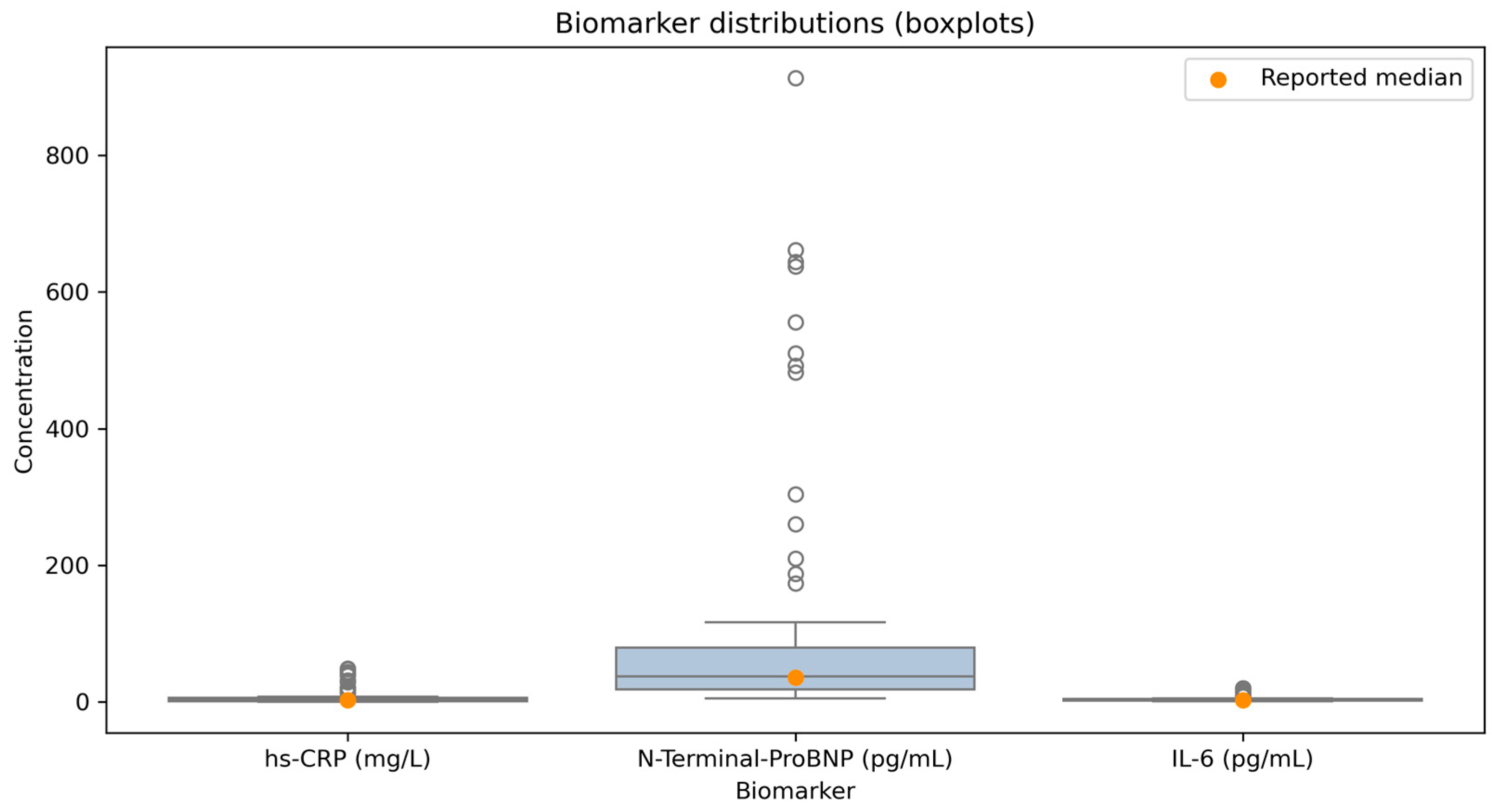
| hs-CPR (mg/L) | N-Terminal-ProBNP (pg/mL) | IL-6 (pg/mL) | |
|---|---|---|---|
| Number of patients | 60 | 60 | 60 |
| Minimum | 0.40 | 5.00 | 1.50 |
| 25% percentile | 1.42 | 18.00 | 1.83 |
| Median | 2.74 | 36.00 | 2.57 |
| 75% percentile | 5.72 | 72.00 | 3.83 |
| Maximum | 49.17 | 913.00 | 20.40 |
| Range | 48.77 | 908.00 | 18.90 |
| Mean | 5.16 | 71.50 | 6.94 |
| Standard Deviation | 7.75 | 130.83 | 3.27 |
| Standard error of the mean | 1.00 | 16.89 | 0.42 |
| Lower estimate of confidence interval (95%) | 3.2 | 38.39 | 6.12 |
| Upper estimate of confidence interval (95%) | 7.12 | 104.60 | 7.77 |
4. Discussion
5. Conclusions
Author Contributions
Funding
Institutional Review Board Statement
Informed Consent Statement
Data Availability Statement
Conflicts of Interest
Abbreviations
| ACE2 | Angiotensin-Converting Enzyme 2 |
| BDNF | Brain-Derived Neurotrophic Factor |
| COVID-19 | Coronavirus Disease 2019 |
| CRP | C-Reactive Protein |
| FMABC | Faculdade de Medicina do ABC |
| HIV | Human Immunodeficiency Virus |
| hs-CRP | High-Sensitivity C-Reactive Protein |
| IgG | Immunoglobulin G |
| IgM | Immunoglobulin M |
| IL-6 | Interleukin 6 |
| NT-proBNP | N-terminal pro-B-type Natriuretic Peptide |
| RNA | Ribonucleic Acid |
| RT-PCR | Reverse Transcription Polymerase Chain Reaction |
| SARS-CoV-2 | Severe Acute Respiratory Syndrome Coronavirus 2 |
| STROBE | Strengthening the Reporting of Observational Studies in Epidemiology |
| WHO | World Health Organization |
References
- Li, Q.; Guan, X.; Wu, P.; Wang, X.; Zhou, L.; Tong, Y.; Ren, R.; Leung, K.S.M.; Lau, E.H.Y.; Wong, J.Y.; et al. Early transmission dynamics in Wuhan, China, of novel coronavirus-infected pneumonia. N. Engl. J. Med. 2020, 382, 1199–1207. [Google Scholar] [CrossRef] [PubMed]
- Bourgonje, A.R.; Abdulle, A.E.; Timens, W.; Hillebrands, J.L.; Navis, G.J.; Gordijn, S.J.; Bolling, M.C.; Dijkstra, G.; Voors, A.A.; Osterhaus, A.D.M.E.; et al. Angiotensin-converting enzyme-2 (ACE2), SARS-CoV-2 and pathophysiology of coronavirus disease 2019 (COVID-19). J. Pathol. 2020, 251, 228–248. [Google Scholar] [CrossRef] [PubMed]
- Samidurai, A.; Das, A. Cardiovascular complications associated with COVID-19 and potential therapeutic~strategies. Int. J. Mol. Sci. 2020, 21, 6790. [Google Scholar] [CrossRef]
- Al-Aly, Z.; Topol, E. Solving the puzzle of Long COVID. Science 2024, 383, 830–832. [Google Scholar] [CrossRef]
- CDC. Centers for Disease Control and Prevention. Chronic Disease Prevention and Health Promotion. Available online: http://www.cdc.gov/chronicdisease/overview/index.htm#ref2 (accessed on 15 July 2020).
- Mateu, L.; Tebe, C.; Loste, C.; Santos, J.R.; Lladós, G.; López, C.; España-Cueto, S.; Toledo, R.; Font, M.; Chamorro, A.; et al. Determinants of the onset and prognosis of the post-COVID-19 condition: A 2-year prospective observational cohort study. Lancet Reg. Health–Eur. 2023, 33, 100724. [Google Scholar] [CrossRef]
- Ceban, F.; Ling, S.; Lui, L.M.W.; Lee, Y.; Gill, H.; Teopiz, K.M.; Rodrigues, N.B.; Subramaniapillai, M.; Di Vincenzo, J.D.; Cao, B.; et al. Fatigue and cognitive impairment in Post-COVID-19 syndrome: A systematic review and meta-analysis. Brain Behav. Immun. 2022, 101, 93–135. [Google Scholar] [CrossRef] [PubMed]
- Ceban, F.; Kulzhabayeva, D.; Rodrigues, N.B.; Di Vincenzo, J.D.; Gill, H.; Subramaniapillai, M.; Lui, L.M.W.; Cao, B.; Mansur, R.B.; Ho, R.C.; et al. COVID-19 vaccination for the prevention and treatment of long COVID: A systematic review and meta-analysis. Brain Behav. Immun. 2023, 111, 211–229. [Google Scholar] [CrossRef]
- Jason, L.A.; Dorri, J.A. ME/CFS and Post-exertional malaise among patients with long COVID. Neurol. Int. 2022, 15, 1–11. [Google Scholar] [CrossRef]
- Zhao, J.; Yuan, Q.; Wang, H.; Liu, W.; Liao, X.; Su, Y.; Wang, X.; Yuan, J.; Li, T.; Li, J.; et al. Antibody responses to SARS-CoV-2 in patients of novel coronavirus disease 2019. Clin. Infect. Dis. 2020, 71, 2027–2034. [Google Scholar] [CrossRef]
- Martino, L.; Morello, R.; De Rose, C.; Buonsenso, D. Persistent respiratory symptoms associated with post-COVID condition (Long COVID) in children: A systematic review and analysis of current gaps and future perspectives. Expert Rev. Respir. Med. 2023, 17, 837–852. [Google Scholar] [CrossRef]
- Cai, H.; Chen, Y.; Feng, Y.; Asadi, M.; Kaufman, L.; Lee, K.; Kehrer, T.; Miorin, L.; Garcia-Sastre, A.; Gusella, G.L.; et al. SARS-CoV-2 viral protein ORF3A injures renal tubules by interacting with TRIM59 to induce STAT3 activation. Mol. Ther. 2023, 31, 774–787. [Google Scholar] [CrossRef]
- Chen, B.; Julg, B.; Mohandas, S.; Bradfute, S.B.; Force, R.M.P.T. Viral persistence, reactivation, and mechanisms of long COVID. Elife 2023, 12, e86015. [Google Scholar] [CrossRef]
- Menezes, S.M.; Jamoulle, M.; Carletto, M.P.; Moens, L.; Meyts, I.; Maes, P.; Van Weyenbergh, J. Blood transcriptomic analyses reveal persistent SARS-CoV-2 RNA and candidate biomarkers in post-COVID-19 condition. Lancet Microbe 2024, 5, 100849. [Google Scholar] [CrossRef] [PubMed]
- Davis, H.E.; Assaf, G.S.; McCorkell, L.; Wei, H.; Low, R.J.; Re’em, Y.; Redfield, S.; Austin, J.P.; Akrami, A. Characterizing long COVID in an international cohort: 7 months of symptoms and their impact. EClinicalMedicine 2021, 38, 101019. [Google Scholar] [CrossRef] [PubMed]
- Klein, J.; Wood, J.; Jaycox, J.R.; Dhodapkar, R.M.; Lu, P.; Gehlhausen, J.R.; Tabachnikova, A.; Greene, K.; Tabacof, L.; Malik, A.A.; et al. Distinguishing features of long COVID identified through immune profiling. Nature 2023, 623, 139–148. [Google Scholar] [CrossRef]
- Ciabattini, A.; Garagnani, P.; Santoro, F.; Rappuoli, R.; Franceschi, C.; Medaglini, D. Shelter from the cytokine storm: Pitfalls and prospects in the development of SARS-CoV-2 vaccines for an elderly population. Semin. Immunopathol. 2020, 42, 619–634. [Google Scholar] [CrossRef]
- Hammarström, P.; Nyström, S. Viruses and amyloids—A vicious liaison. Prion 2023, 17, 82–104. [Google Scholar] [CrossRef]
- Guarnieri, J.W.; Dybas, J.M.; Fazelinia, H.; Kim, M.S.; Frere, J.; Zhang, Y.; Soto Albrecht, Y.; Murdock, D.G.; Angelin, A.; Singh, L.N.; et al. Core mitochondrial genes are down-regulated during SARS-CoV-2 infection of rodent and human hosts. Sci. Transl. Med. 2023, 15, eabq1533. [Google Scholar] [CrossRef]
- Davanço, G.Y.; Torres, M.F.; Murad, N.; Veiga, G.L.d.; Reis, P.H.A.; Barbosa, J.d.V.; Alves, B.d.C.A.; Gascón, T.M.; Raimundo, R.D.; Fonseca, F.L.A. Post-COVID-19 syndrome and the autonomic repercussions on cardiovascular variables. ABC Heart Fail. Cardiomyopathy 2023, 3, e20230056. [Google Scholar] [CrossRef]
- Al-Aly, Z.; Bowe, B.; Xie, Y. Long COVID after breakthrough SARS-CoV-2 infection. Nat. Med. 2022, 28, 1461–1467. [Google Scholar] [CrossRef]
- Marra, A.R.; Kobayashi, T.; Callado, G.Y.; Pardo, I.; Gutfreund, M.C.; Hsieh, M.K.; Lin, V.; Alsuhaibani, M.; Hasegawa, S.; Tholany, J.; et al. The effectiveness of COVID-19 vaccine in the prevention of post-COVID conditions: A systematic literature review and meta-analysis of the latest research. Antimicrob. Steward. Healthc. Epidemiol. 2023, 3, e168. [Google Scholar] [CrossRef]
- Huang, L.; Li, X.; Gu, X.; Zhang, H.; Ren, L.; Guo, L.; Liu, M.; Wang, Y.; Cui, D.; Zhang, X.; et al. Health outcomes in people 2 years after surviving hospitalisation with COVID-19: A longitudinal cohort study. Lancet Respir. Med. 2022, 10, 863–876. [Google Scholar] [CrossRef]
- von Elm, E.; Altman, D.G.; Egger, M.; Pocock, S.J.; Gøtzsche, P.C.; Vandenbroucke, J.P.; Initiative, S. The strengthening the reporting of observational studies in epidemiology (strobe) statement: Guidelines for reporting observational studies. J. Clin. Epidemiol. 2008, 61, 344–349. [Google Scholar] [CrossRef]
- Pearson, T.A.; Mensah, G.A.; Alexander, R.W.; Anderson, J.L.; Cannon, R.O.; Criqui, M.; Fadl, Y.Y.; Fortmann, S.P.; Hong, Y.; Myers, G.L.; et al. Markers of inflammation and cardiovascular disease: Application to clinical and public health practice: A statement for healthcare professionals from the centers for disease control and prevention and the American heart association. Circulation 2003, 107, 499–511. [Google Scholar] [CrossRef]
- McDonagh, T.A.; Metra, M.; Adamo, M.; Gardner, R.S.; Baumbach, A.; Böhm, M.; Burri, H.; Butler, J.; Čelutkienė, J.; Chioncel, O.; et al. 2021 ESC Guidelines for the diagnosis and treatment of acute and chronic heart failure. Eur. Heart J. 2021, 42, 3599–3726. [Google Scholar] [CrossRef] [PubMed]
- Herold, T.; Jurinovic, V.; Arnreich, C.; Lipworth, B.J.; Hellmuth, J.C.; von Bergwelt-Baildon, M.; Klein, M.; Weinberger, T. Elevated levels of IL-6 and CRP predict the need for mechanical ventilation in COVID-19. J. Allergy Clin. Immunol. 2020, 146, 128–136.e4. [Google Scholar] [CrossRef]
- National Institute for Health and Care Excellence. COVID-19 Rapid Guideline: Managing the Long-Term Effects of COVID-19; National Institute for Health and Care Excellence: London, UK, 2024.
- Curvelo, R.D.; Ribeiro, A.C.; da Silva André Uehara, S.C. Health care for patients with long COVID: A scoping review. Rev. Esc. Enferm. USP 2024, 58, e20240056. [Google Scholar] [CrossRef] [PubMed]
- Clemente, I.; Sinatti, G.; Cirella, A.; Santini, S.J.; Balsano, C. Alteration of inflammatory parameters and psychological post-traumatic syndrome in Long-COVID patients. Int. J. Environ. Res. Public Health 2022, 19, 7103. [Google Scholar] [CrossRef] [PubMed]
- Gaiatto, A.C.M.; Bibo, T.A.; de Godoy Moreira, N.; Raimundo, J.R.S.; da Costa Aguiar Alves, B.; Gascón, T.; Carvalho, S.S.; Pereira, E.C.; Fonseca, F.L.A.; da Veiga, G.L. COVID-19 compromises iron homeostasis: Transferrin as a target of investigation. J. Trace Elem. Med. Biol. 2023, 76, 127109. [Google Scholar] [CrossRef]
- Fisicaro, F.; Di Napoli, M.; Liberto, A.; Fanella, M.; Di Stasio, F.; Pennisi, M.; Bella, R.; Lanza, G.; Mansueto, G. Neurological sequelae in patients with COVID-19: A histopathological perspective. Int. J. Environ. Res. Public Health 2021, 18, 1415. [Google Scholar] [CrossRef]
- Pierce, J.D.; Shen, Q.; Cintron, S.A.; Hiebert, J.B. Post-COVID-19 syndrome. Nurs. Res. 2022, 71, 164–174. [Google Scholar] [CrossRef] [PubMed]
- Bellan, M.; Soddu, D.; Balbo, P.E.; Baricich, A.; Zeppegno, P.; Avanzi, G.C.; Baldon, G.; Bartolomei, G.; Battaglia, M.; Battistini, S.; et al. Respiratory and psychophysical sequelae among patients with COVID-19 four months after hospital discharge. JAMA Netw. Open 2021, 4, e2036142. [Google Scholar] [CrossRef]
- Ali, A.M.; Rostam, H.M.; Fatah, M.H.; Noori, C.M.; Ali, K.M.; Tawfeeq, H.M. Serum troponin, D-dimer, and CRP level in severe coronavirus (COVID-19) patients. Immun. Inflamm. Dis. 2022, 10, e582. [Google Scholar] [CrossRef]
- Gonçalves, F.A.R.; Besen, B.A.M.P.; Lima, C.A.; Corá, A.P.; Pereira, A.J.R.; Perazzio, S.F.; Gouvea, C.P.; Fonseca, L.A.M.; Trindade, E.M.; Sumita, N.M.; et al. Use and misuse of biomarkers and the role of D-dimer and C-reactive protein in the management of COVID-19: A post-hoc analysis of a prospective cohort study. Clinics 2021, 76, e3547. [Google Scholar] [CrossRef]
- Beliero, A.M.; Lázaro, A.P.P.; Zaranza, M.S.; Lima, G.M.C.; Guimarães, Á.; Aragão, N.L.; Meneses, G.C.; Holanda, M.A.; Albuquerque, P.L.M.M.; Silva Júnior, G.B.D.; et al. ELMO CPAP: An innovative type of ventilatory support for COVID-19-related acute respiratory distress syndrome. J. Bras. Pneumol. 2024, 49, e20230227. [Google Scholar] [CrossRef]
- Gudowska-Sawczuk, M.; Mroczko, B. What is currently known about the role of CXCL10 in SARS-CoV-2 infection? Int. J. Mol. Sci. 2022, 23, 3673. [Google Scholar] [CrossRef]
- Krishna, B.A.; Lim, E.Y.; Metaxaki, M.; Jackson, S.; Mactavous, L.; Lyons, P.A.; Doffinger, R.; Bradley, J.R.; Smith, K.G.C.; Sinclair, J.; et al. Spontaneous, persistent, T cell-dependent IFN-γ release in patients who progress to long COVID. Sci. Adv. 2024, 10, eadi9379. [Google Scholar] [CrossRef]
- Colarusso, C.; Maglio, A.; Terlizzi, M.; Vitale, C.; Molino, A.; Pinto, A.; Vatrella, A.; Sorrentino, R. Post-COVID-19 patients who develop lung fibrotic-like changes have lower circulating levels of IFN-β but higher levels of IL-1α and TGF-β. Biomedicines 2021, 9, 1931. [Google Scholar] [CrossRef]
- Douaud, G.; Lee, S.; Alfaro-Almagro, F.; Arthofer, C.; Wang, C.; McCarthy, P.; Lange, F.; Andersson, J.L.R.; Griffanti, L.; Duff, E.; et al. SARS-CoV-2 is associated with changes in brain structure in UK Biobank. Nature 2022, 604, 697–707. [Google Scholar] [CrossRef] [PubMed]
- Guedj, E.; Campion, J.Y.; Horowitz, T.; Barthelemy, F.; Cammilleri, S.; Ceccaldi, M. The impact of COVID-19 lockdown on brain metabolism. Hum. Brain Mapp. 2022, 43, 593–597. [Google Scholar] [CrossRef] [PubMed]
- Guedj, E.; Campion, J.Y.; Dudouet, P.; Kaphan, E.; Bregeon, F.; Tissot-Dupont, H.; Guis, S.; Barthelemy, F.; Habert, P.; Ceccaldi, M.; et al. F-FDG brain PET hypometabolism in patients with long COVID. Eur. J. Nucl. Med. Mol. Imaging 2021, 48, 2823–2833. [Google Scholar] [CrossRef]
- Navarro-Prados, A.B.; Rodríguez-Ramírez, Y.; Delhom, I.; Bueno, C.; Satorres, E.; Meléndez, J.C. Anxiety among workers in institutions for older adults during the COVID-19 pandemic. J. Occup. Environ. Med. 2025, 67, 632–637. [Google Scholar] [CrossRef]
- Masuda, Y.; Otsuka, Y.; Tokumasu, K.; Honda, H.; Sakurada, Y.; Matsuda, Y.; Nakano, Y.; Takase, R.; Omura, D.; Hasegawa, T.; et al. Interrelationships between plasma levels of brain natriuretic peptide and prolonged symptoms due to long COVID. J. Clin. Med. 2025, 14, 817. [Google Scholar] [CrossRef]
- Puntmann, V.O.; Martin, S.; Shchendrygina, A.; Hoffmann, J.; Ka, M.M.; Giokoglu, E.; Vanchin, B.; Holm, N.; Karyou, A.; Laux, G.S.; et al. Long-term cardiac pathology in individuals with mild initial COVID-19 illness. Nat. Med. 2022, 28, 2117–2123. [Google Scholar] [CrossRef]
- Bowe, B.; Xie, Y.; Al-Aly, Z. Postacute sequelae of COVID-19 at 2 years. Nat. Med. 2023, 29, 2347–2357. [Google Scholar] [CrossRef]
- McKie, P.M.; Burnett, J.C. NT-proBNP: The gold standard biomarker in heart failure. J. Am. Coll. Cardiol. 2016, 68, 2437–2439. [Google Scholar] [CrossRef]
- Tawfeeq, R.D.; Alwan, M.H.; Ismael, A.T.; Hamad, B.K. The impact of COVID-19 on BNP, NT-proBNP and ANP in heart failure. Cell. Mol. Biol. 2023, 69, 143–148. [Google Scholar] [CrossRef] [PubMed]
- Bichali, S.; Ouldali, N.; Godart, F.; Maboudou, P.; Houeijeh, A.; Leteurtre, S. NT-proBNP course during MIS-C post-COVID-19: An observational study. Eur. J. Pediatr. 2024, 183, 1667–1674. [Google Scholar] [CrossRef] [PubMed]
- Zhang, M.; Chen, J.; Wu, L.; Xi, G.; Li, X.; Jin, L.; Li, Z. Assessment of cardiac dysfunction in COVID-19 patients using layer-specific strain echocardiography in short-axis and long-axis views. BMC Cardiovasc. Disord. 2025, 25, 602. [Google Scholar] [CrossRef] [PubMed]
- Bernard, A.; Weiss, S.; Rahman, M.; Ulin, S.S.; D’Souza, C.; Salgat, A.; Panzer, K.; Stein, J.D.; Meade, M.A.; McKee, M.M.; et al. The impact of COVID-19 and pandemic mitigation measures on persons with sensory impairment. Am. J. Ophthalmol. 2022, 234, 49–58. [Google Scholar] [CrossRef]
- Nikolic, V.N.; Popadic, V.; Jankovic, S.M.; Govedarović, N.; Vujić, S.; Andjelković, J.; Stosic, L.S.; Stevanović, N.; Zdravkovic, M.; Todorovic, Z. The silent predictors: Exploring galectin-3 and Irisin’s tale in severe COVID-19. BMC Res. Notes 2024, 17, 324. [Google Scholar] [CrossRef] [PubMed]
- Mińko, A.; Turoń-Skrzypińska, A.; Rył, A.; Mańkowska, K.; Cymbaluk-Płoska, A.; Rotter, I. The significance of selected myokines in predicting the length of rehabilitation of patients after COVID-19 infection. Biomedicines 2024, 12, 836. [Google Scholar] [CrossRef] [PubMed]
- Mendez-Gutierrez, A.; Aguilera, C.M.; Osuna-Prieto, F.J.; Martinez-Tellez, B.; Rico Prados, M.C.; Acosta, F.M.; Llamas-Elvira, J.M.; Ruiz, J.R.; Sanchez-Delgado, G. Exercise-induced changes on exerkines that might influence brown adipose tissue metabolism in young sedentary adults. Eur. J. Sport Sci. 2023, 23, 625–636. [Google Scholar] [CrossRef] [PubMed]
- Tenforde, M.W.; Self, W.H.; Naioti, E.A.; Ginde, A.A.; Douin, D.J.; Olson, S.M.; Talbot, H.K.; Casey, J.D.; Mohr, N.M.; Zepeski, A.; et al. Sustained effectiveness of Pfizer-BioNTech and Moderna vaccines against COVID-19 associated hospitalizations among adults—United States, March–July 2021. MMWR Morb. Mortal. Wkly. Rep. 2021, 70, 1156–1162. [Google Scholar] [CrossRef]
- Tartof, S.Y.; Slezak, J.M.; Frankland, T.B.; Puzniak, L.; Hong, V.; Ackerson, B.K.; Stern, J.A.; Zamparo, J.; Simmons, S.; Jodar, L.; et al. Estimated effectiveness of the BNT162b2 XBB vaccine against COVID-19. JAMA Intern. Med. 2024, 184, 932–940. [Google Scholar] [CrossRef]
- Ayoubkhani, D.; Bermingham, C.; Pouwels, K.B.; Glickman, M.; Nafilyan, V.; Zaccardi, F.; Khunti, K.; Alwan, N.A.; Walker, A.S. Trajectory of long COVID symptoms after COVID-19 vaccination: Community based cohort study. BMJ 2022, 377, e069676. [Google Scholar] [CrossRef]
- Man, M.A.; Rosca, D.; Bratosin, F.; Fira-Mladinescu, O.; Ilie, A.C.; Burtic, S.R.; Fildan, A.P.; Fizedean, C.M.; Jianu, A.M.; Negrean, R.A.; et al. Impact of pre-infection COVID-19 vaccination on the incidence and severity of post-COVID syndrome: A systematic review and meta-analysis. Vaccines 2024, 12, 189. [Google Scholar] [CrossRef]
- Wang, X.; Zein, J.; Ji, X.; Lin, D.Y. Impact of vaccination, prior infection, and therapy on omicron infection and mortality. J. Infect. Dis. 2023, 227, 970–976. [Google Scholar] [CrossRef]
- Chalupka, A.; Richter, L.; Chakeri, A.; El-Khatib, Z.; Theiler-Schwetz, V.; Trummer, C.; Krause, R.; Willeit, P.; Benka, B.; Ioannidis, J.P.A.; et al. Effectiveness of a fourth SARS-CoV-2 vaccine dose in previously infected individuals from Austria. Eur. J. Clin. Investig. 2024, 54, e14136. [Google Scholar] [CrossRef]
| Persistent Respiratory Symptoms (r2) | p | Persistent Musculoskeletal Symptoms (r2) | p | Persistent Sensory Symptoms (r2) | p | |
|---|---|---|---|---|---|---|
| hs-CRP | 0.288 | 0.026 | 0.561 | 0.000 | - | - |
| NT-pro-BNP | - | - | −0.229 | 0.078 | - | |
| IL-6 | - | - | 0.442 | 0.000 | - | - |
| Irisin | - | - | - | 0.464 | 0.001 |
Disclaimer/Publisher’s Note: The statements, opinions and data contained in all publications are solely those of the individual author(s) and contributor(s) and not of MDPI and/or the editor(s). MDPI and/or the editor(s) disclaim responsibility for any injury to people or property resulting from any ideas, methods, instructions or products referred to in the content. |
© 2026 by the authors. Licensee MDPI, Basel, Switzerland. This article is an open access article distributed under the terms and conditions of the Creative Commons Attribution (CC BY) license.
Share and Cite
Torres, M.; Davanço, G.; de Paula Destro, I.; Murad, N.; da Veiga, G.L.; Reis, P.H.A.; de Lion Botero Martins, R.; da Costa Aguiar Alves, B.; Raimundo, R.D.; Zangirolami-Raimundo, J.; et al. Long COVID with Symptoms Persisting for More than Six Months in Unvaccinated Patients: Investigation of Biochemical Changes Associated with Chronic Manifestations. COVID 2026, 6, 39. https://doi.org/10.3390/covid6030039
Torres M, Davanço G, de Paula Destro I, Murad N, da Veiga GL, Reis PHA, de Lion Botero Martins R, da Costa Aguiar Alves B, Raimundo RD, Zangirolami-Raimundo J, et al. Long COVID with Symptoms Persisting for More than Six Months in Unvaccinated Patients: Investigation of Biochemical Changes Associated with Chronic Manifestations. COVID. 2026; 6(3):39. https://doi.org/10.3390/covid6030039
Chicago/Turabian StyleTorres, Matheus, Giulia Davanço, Isabela de Paula Destro, Neif Murad, Glaucia Luciano da Veiga, Pedro Henrique Alves Reis, Renata de Lion Botero Martins, Beatriz da Costa Aguiar Alves, Rodrigo Daminello Raimundo, Juliana Zangirolami-Raimundo, and et al. 2026. "Long COVID with Symptoms Persisting for More than Six Months in Unvaccinated Patients: Investigation of Biochemical Changes Associated with Chronic Manifestations" COVID 6, no. 3: 39. https://doi.org/10.3390/covid6030039
APA StyleTorres, M., Davanço, G., de Paula Destro, I., Murad, N., da Veiga, G. L., Reis, P. H. A., de Lion Botero Martins, R., da Costa Aguiar Alves, B., Raimundo, R. D., Zangirolami-Raimundo, J., & Fonseca, F. L. A. (2026). Long COVID with Symptoms Persisting for More than Six Months in Unvaccinated Patients: Investigation of Biochemical Changes Associated with Chronic Manifestations. COVID, 6(3), 39. https://doi.org/10.3390/covid6030039

