
Article

Psychometric Validation of the Fear of COVID-19 Scale (FCV-19S) in a US Academic Health Sciences Center


1
Department of Psychiatry and Behavioral Sciences, College of Medicine, University of Oklahoma Health Campus, Oklahoma City, OK 73114, USA
2
Department of Family and Preventive Medicine, College of Medicine, University of Oklahoma Health Campus, Oklahoma City, OK 73114, USA
3
Department of Biostatistics and Epidemiology, Hudson College of Public Health, University of Oklahoma Health Campus, Oklahoma City, OK 73114, USA
4
Division of Alcohol, Drugs, and Addiction, McLean Hospital, Belmont, MA 02478, USA
5
Department of Psychiatry, Harvard Medical School, Boston, MA 02115, USA
*
Author to whom correspondence should be addressed.
COVID 2026, 6(2), 26; https://doi.org/10.3390/covid6020026
Submission received: 24 December 2025 / Revised: 27 January 2026 / Accepted: 2 February 2026 / Published: 4 February 2026
(This article belongs to the Section COVID Public Health and Epidemiology)

Abstract

The COVID-19 pandemic (2020–2023) profoundly disrupted healthcare systems and imposed sustained psychological burdens on healthcare professionals and trainees. Reliable instruments are essential for assessing these impacts. This study evaluated the construct validity and reliability of the Fear of COVID-19 Scale (FCV-19S) in a convenience sample of 1761 healthcare professionals, trainees, and academic staff at a single U.S. academic health sciences center (the University of Oklahoma Health Campus). Participants completed the FCV-19S; confirmatory factor analysis (CFA) examined its dimensional structure; and internal consistency was assessed using Cronbach’s α and McDonald’s ω. The one-factor model demonstrated good internal consistency (α = 0.89; ω = 0.89) but exhibited sub-optimal model fit (CFI = 0.89; TLI = 0.83; SRMR = 0.06; RMSEA = 0.18). The two-factor model, distinguishing emotional and somatic fear, showed substantially improved fit (CFI = 0.97; TLI = 0.96; SRMR = 0.03; RMSEA = 0.09) and acceptable internal consistency for both factors (α = 0.85 and 0.86; ω = 0.85 and 0.87), although RMSEA remained above conventional thresholds for close fit. Overall, findings support a two-factor structure as a comparatively superior and more nuanced representation of fear responses among an academic health workforce. The validated FCV-19S offers a reliable tool for assessing COVID-19-related distress in clinical and educational health settings, informing targeted interventions to strengthen workforce resilience.

1. Introduction

The COVID-19 pandemic, which unfolded in region-specific waves from 2020 to 2023, placed unprecedented strain on global healthcare systems and public health infrastructure [1,2,3,4,5,6]. Successive variants, including Delta and Omicron, generated repeated surges, resulting in significant morbidity and mortality [1,2]. According to World Health Organization and U.S. Centers for Disease Control and Prevention reports, as of January 2026 more than 779 million confirmed cases and approximately 7.1 million deaths have been reported globally, with over 103 million cases and more than 1.2 million deaths in the United States alone [7,8].
Beyond its physical consequences, the pandemic exerted profound psychological effects. Elevated rates of anxiety, depression, insomnia, post-traumatic stress symptoms, and psychological distress were observed across populations, often intensified by prolonged uncertainty, social isolation, and economic disruption [4,5]. These effects were not uniformly distributed: marginalized communities and occupational groups with elevated exposure risk experienced disproportionate psychological burden, underscoring the importance of population- and context-specific mental health assessment [9].
Healthcare workers have been consistently identified as a population at heightened psychological risk during infectious disease outbreaks. Theoretical and empirical literature describes healthcare workers as occupying a distinct occupational context characterized by sustained exposure to health threats, moral and professional responsibility for patient outcomes, constrained autonomy, and heightened concern about transmitting illness to others [10]. These factors may amplify fear responses and alter their emotional and somatic expression relative to non-clinical populations. Medical trainees face additional stressors, including disrupted training trajectories, role ambiguity, and limited control over clinical assignments, which may further shape fear-related responses [11]. Together, these features support conceptualizing healthcare workers and trainees as a distinct psychosocial population for whom fear may manifest differently and warrant separate psychometric evaluation.
During the early phase of the pandemic in 2020, large academic health campuses were uniquely characterized by the simultaneous exposure of diverse professional groups, including clinicians, trainees, faculty, and essential administrative staff, to unprecedented health risk. At the University of Oklahoma Health Campus, leadership rapidly transitioned academic coursework to online delivery and restricted clinical care and training to essential services to mitigate viral transmission. Although these measures were implemented to reduce risk, the speed and scale of the pandemic precluded systematic, pre-emptive assessment of COVID-19-related fear across occupational roles. As a result, little was known about how fear is differentially manifested within integrated academic health systems during this critical early period.
The Fear of COVID-19 Scale (FCV-19S) was developed by Ahorsu and colleagues in 2020 as a brief, seven-item instrument to assess fear specific to COVID-19 [12]. Since its introduction, the FCV-19S has been translated and validated across multiple languages and populations. Importantly, English-language validations have demonstrated strong reliability and construct validity in U.S. college student samples, an academic health science center, and large English-speaking community cohorts [13,14,15]. These studies provided essential early evidence supporting the scale’s psychometric soundness, primarily identifying a unidimensional structure using exploratory or Rasch-based approaches. As the pandemic progressed, broader instruments such as the COVID-19 Pandemic Mental Health Questionnaire (CoPaQ) were introduced to assess sleep disturbances and trauma-related symptoms [16]. Additional scales, including those for insomnia and PTSD, were employed to capture pandemic-related stress manifestations, particularly after DSM-5 diagnostic criteria were met [3,4,5,6].
Early in the pandemic, however, prior English-language studies did not examine the FCV-19S using a two-factor model within academic health workforces or academic health systems. Student samples, while valuable, do not capture the occupational exposure, professional accountability, or sustained clinical risk characteristic of healthcare environments. Likewise, community samples may differ substantially from healthcare workers in perceived vulnerability, responsibility for others’ health, and somatic stress responses. These contextual differences raise the possibility that the dimensional structure of fear—particularly the balance between emotional and somatic components—may differ in healthcare settings. Accordingly, validation of the FCV-19S within a U.S. academic health sciences workforce represents a necessary contextual extension of prior research rather than a replication of existing English-language validations.
Notably, our research group previously reported early psychometric findings for the FCV-19S within an academic health sciences center during the initial phase of the pandemic [13]. That initial report established internal consistency reliability and supported a unidimensional structure, using approaches consistent with early validation studies. However, the analysis was intentionally conservative and did not examine alternative dimensional structures, including two-factor models, which had not yet been widely proposed in the literature. As subsequent international studies began to report evidence supporting a two-factor structure that distinguishes emotional fear from somatic fear responses [17,18,19], re-examination of these data using a theoretically informed confirmatory framework became both justified and necessary. Somatic symptoms such as palpitations, sleep disturbance, and physiological arousal may be especially salient among healthcare workers exposed to prolonged occupational stress and infection risk, suggesting that a two-factor model offers a more robust representation of fear responses in healthcare-related populations. The present study, therefore, extends—not duplicates—our prior work by formally evaluating competing factor structures within a U.S. academic health sciences workforce. Such findings may motivate future evaluation of strategies, including counseling services, leadership support, and structured self-care initiatives, which have been associated with reductions in burnout, absenteeism, and workforce attrition in prior studies [20,21]. Accurate measurement of fear and anxiety is foundational to these efforts and can help safeguard healthcare systems during future public health crises [22].

1.1. Study Aim

The aim of this study was to evaluate the psychometric properties of the FCV-19S within a single U.S. academic health sciences center during the early phase of the COVID-19 pandemic. Specifically, the study examined the scale’s internal consistency, factor structure, and construct validity across an academic health workforce comprising clinicians, healthcare trainees, and other campus personnel embedded within a healthcare delivery system.

1.2. Hypotheses

Guided by prior validation studies and theoretical models of occupational stress and fear, we hypothesized that:
  • The FCV-19S would demonstrate adequate internal consistency reliability within this U.S. academic health workforce;
  • A two-factor model distinguishing emotional and somatic fear would demonstrate improved model fit relative to a unidimensional model, consistent with prior findings in non-U.S. and healthcare-adjacent populations.

2. Materials and Methods

2.1. Study Design

This study employed a cross-sectional design using secondary analysis of survey data collected during the early phase of the COVID-19 pandemic (May–June 2020). The study was designed to evaluate the psychometric properties of the Fear of COVID-19 Scale (FCV-19S) within a U.S. academic health sciences campus population embedded in a healthcare delivery environment.

2.2. Participants and Sampling

Participants were recruited through convenience sampling from the University of Oklahoma Health Campus, an integrated academic health campus comprising clinicians, healthcare trainees, faculty, and essential administrative staff involved in healthcare delivery, training, or institutional operations. These groups were included to capture the broader academic health workforce exposed to pandemic-related occupational risks, institutional responsibilities, and clinical system disruptions.
At the time of data collection, the campus population included approximately 9851 individuals (faculty, staff, residents, fellows, and students). Eligible participants were invited via institutional email to complete an anonymous online survey. Data collection occurred between 21 May and 18 June 2020, during a period of restricted clinical operations and remote academic instruction. Participation was voluntary, and no incentives were offered. The total number of responses obtained is reported in Section 3. This framing is consistent with health systems research that conceptualizes academic health campuses as integrated academic health workforces rather than discrete occupational groups.

2.3. Measures

2.3.1. Fear of COVID-19 Scale (FCV-19S)

The FCV-19S is a seven-item self-report instrument developed by Ahorsu et al. [12] to assess emotional and somatic fear responses related to COVID-19, as shown in Table 1. Items are rated on a 5-point Likert scale ranging from 1 (strongly disagree) to 5 (strongly agree), with higher scores indicating greater fear. Items capture emotional fear (e.g., fear of dying, distress related to media exposure) and somatic symptoms (e.g., palpitations, sleep disturbance). The scale has demonstrated good reliability and validity across multiple populations and languages [13,14,15].

2.3.2. Demographic and Health-Related Variables

In addition to the FCV-19S, the survey included 15 demographic and health-related items assessing age, gender, professional role, trainee status, clinical involvement, work setting, and self-reported COVID-19 exposure and health impact [13]. These variables were used for sample description and were not included in the psychometric modeling. Additional demographic, occupational, and health-related variables collected for sample characterization are listed in Supplementary Table S1.

2.4. Procedure

The survey was administered using Qualtrics, a secure web-based platform. Participants provided informed consent electronically before beginning the survey. All responses were anonymous and de-identified at the point of collection. Original IRB approval for survey data collection was obtained on 5 May 2020. Approval for secondary analysis of the de-identified dataset for the present psychometric study was obtained in March 2021 (IRB #12034), consistent with federal guidance for retrospective analysis of existing data.

2.5. Statistical Analysis

SAS (version 9.4, SAS Institute Inc., Cary, NC, USA) was used for descriptive analyses and confirmatory factor analyses to maintain consistency with prior institutional analytic workflows. All other analyses were conducted using R (version 4.1.1; R Foundation for Statistical Computing, Vienna, Austria), with RStudio (version 2021.09.0, RStudio, PBC, Boston, MA, USA) used as the integrated development environment.

2.5.1. Exploratory Factor Analysis (EFA)

An exploratory factor analysis was conducted to examine the underlying structure of the FCV-19S in this population. Principal axis factoring was used as the extraction method with oblique (promax) rotation, given the theoretical expectation that emotional and somatic fear dimensions would be correlated [17,18,19,23,24,25,26,27]. Sampling adequacy was evaluated using the Kaiser–Meyer–Olkin (KMO) measure and Bartlett’s test of sphericity. Factor retention was guided by eigenvalues (>1), the scree plot, and theoretical interpretability. Factor loadings ≥ 0.40 were considered meaningful.

2.5.2. Confirmatory Factor Analysis (CFA)

Confirmatory factor analyses were conducted to compare one-factor and two-factor models of the FCV-19S, consistent with prior psychometric studies [17,18,19,23,24,25,26,27]. Given the ordinal nature of the Likert-scale data, models were estimated using the robust weighted least squares estimator (WLSMV). Model fit was evaluated using the comparative fit index (CFI), Tucker–Lewis index (TLI), standardized root mean square residual (SRMR), and root mean square error of approximation (RMSEA) [28,29,30,31,32]. Model comparisons were further informed by χ2 difference testing and information criteria, including the Akaike information criterion (AIC) and Bayesian information criterion (BIC).

2.5.3. Reliability

Internal consistency reliability was evaluated using Cronbach’s alpha and McDonald’s omega coefficients [33]. Values ≥ 0.70 were considered acceptable.

2.5.4. Analytic Limitation

Because EFA and CFA were conducted on the same dataset, results should be interpreted with appropriate caution, and replication in independent samples is warranted.

2.6. Ethical Considerations

This study was approved by the University of Oklahoma Health Sciences Center Institutional Review Board (IRB #12034). All procedures adhered to the ethical standards outlined in the Declaration of Helsinki. Participation was voluntary, anonymous, and uncompensated.

3. Results

3.1. Demographic Characteristics of the Sample

The survey received 1761 responses from an institution of 9851, including students, staff, and faculty at the University of Oklahoma Health Campus, yielding a response rate of 17.9%. The respondents’ brief demographic and descriptive statistics are presented in Table 2 [19]. The respondent cohort represented a diverse range of occupational specializations. The “Other” category had 841 respondents, constituting the majority and indicating a pronounced representation of non-faculty administrative personnel and healthcare practitioners. Faculty members, both clinical and non-clinical, constituted the second-largest respondent group, with 461 individuals, highlighting their crucial role in the institutional workforce.
An analysis of the survey’s representativeness revealed specific disparities compared to the institution’s demographic composition. Faculty members were disproportionately represented in the study, accounting for 26.2% of responses, compared to their institutional prevalence of 17.6% at the time of the survey. This discrepancy suggests either a heightened propensity among faculty members to participate in the study or a potential sampling bias favoring this subgroup. Conversely, student participation was notably low; students comprised only 21.3% of the survey respondents, significantly lower than their 31.2% institutional representation. This underrepresentation was anticipated, coinciding with the conclusion of the spring semester and the first few months of the pandemic, which could have influenced their availability and willingness to participate. Additionally, the representation of Residents/Fellows in the survey was 4.8%, falling short of their 7.9% institutional presence, indicating underrepresentation in this subgroup. The distribution of respondents across clinical and non-clinical settings was nearly equanimous, with 850 individuals from clinical backgrounds and 911 from non-clinical domains. This near parity highlights the survey’s comprehensive engagement across diverse operational realms within the institution. Most respondents identified as female (75.0%), were non-smokers (84.6%), and were between 25 and 44 years of age (47.6%). Educational attainment varied, with about one-third holding a bachelor’s degree and nearly one-quarter reporting a doctorate.

3.2. Reliability and Factor Analysis

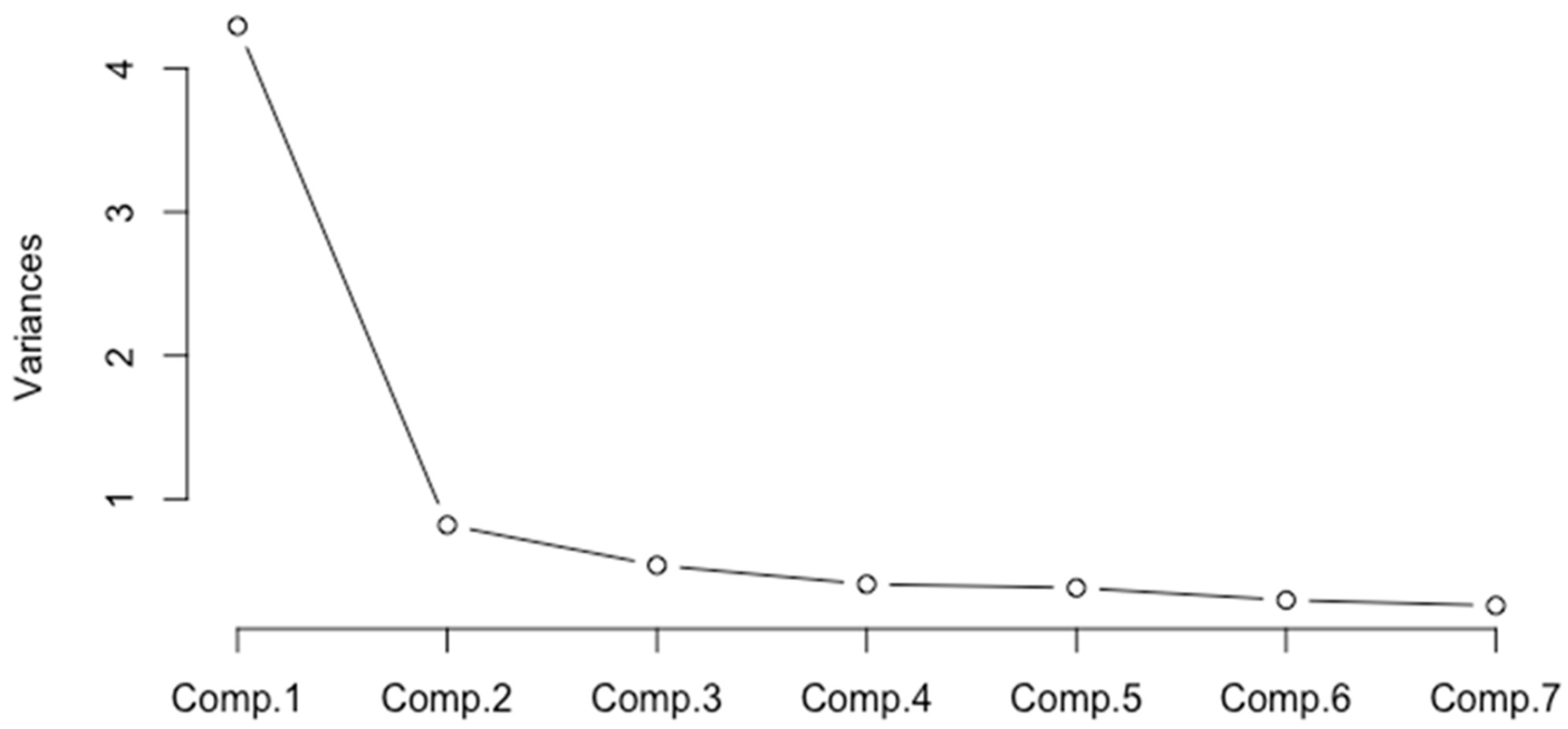
A scree plot, visualized in Figure 1, indicated that a one-factor solution explained 61.4% of the variance in responses. A second component with an eigenvalue near one suggests that a two-factor solution should also be considered to reveal distinct patterns and relationships within each subgroup that may be less evident in a one-factor analysis. Confirmatory factor analysis was conducted to evaluate the factor structure of the FCV-19S. Cronbach’s alpha (0.89) and McDonald’s Omega (0.89) for the one-factor model were satisfactory, indicating good internal consistency. The chi-square test (χ2) yielded a significant result (p < 0.001), indicating that the data do not fit the model. The goodness-of-fit indices, including CFI (0.89), TLI (0.83), IFI (0.89), NFI (0.88), SRMR (0.06), and RMSEA (0.18), all fell below the recommended thresholds for a good fit, suggesting the one-factor model is just a suboptimal fit to the data (Table 3).
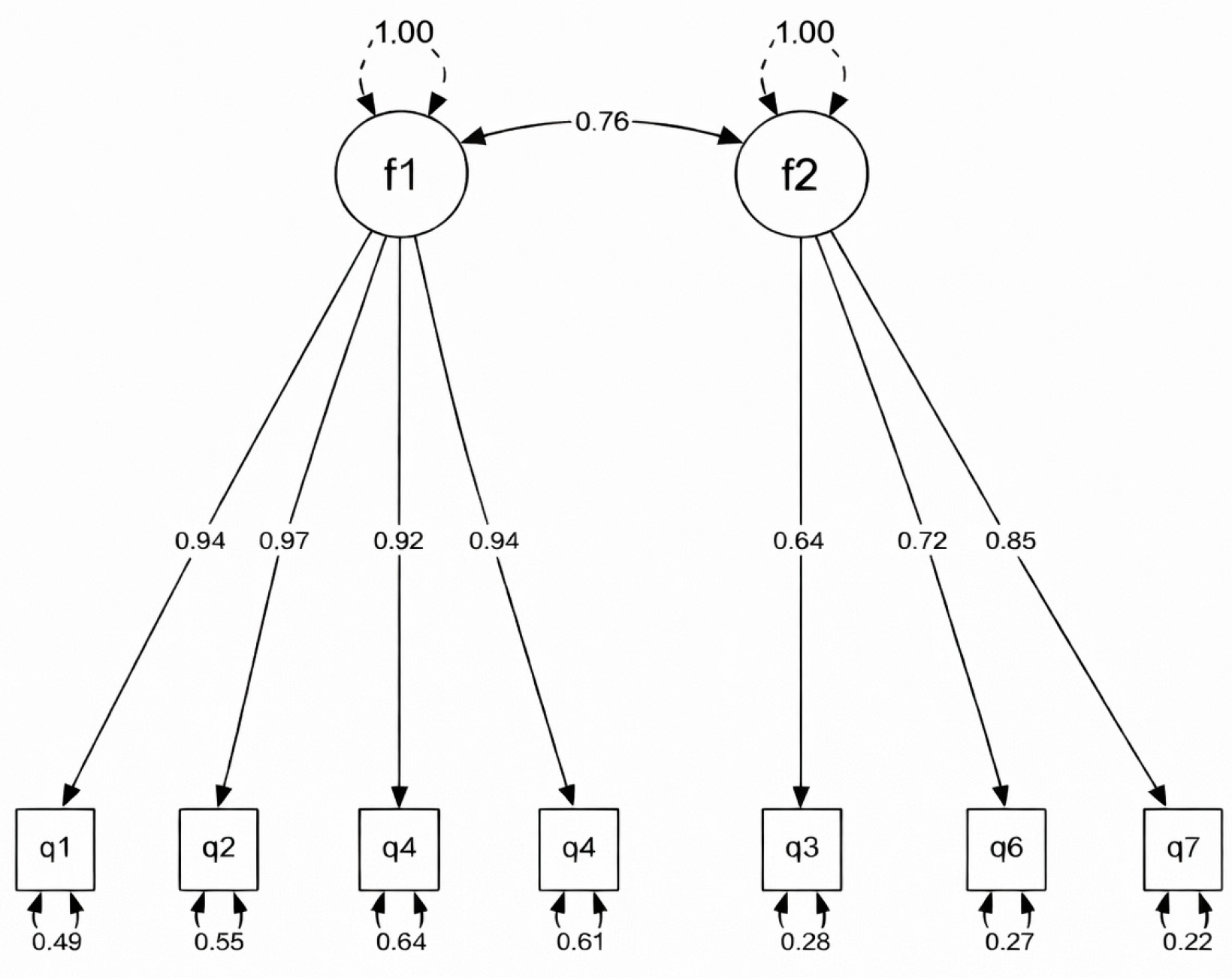
A two-factor CFA was subsequently performed, consistent with previous literature (Figure 2). The two-factor model included factor 1, which described participants’ emotional fear responses (items 1, 2, 4, and 5), and factor 2, which described somatic fear responses (items 3, 6, and 7). For the two-factor model, the internal consistency and reliability of the scale, as indicated by Cronbach’s alpha (0.85 and 0.86) and McDonald’s Omega (0.85 and 0.87), were acceptable. The two-factor model provided a significantly better fit to the data than the one-factor model. The chi-square test (χ2) was significant (p < 0.001); however, the chi-square difference test (Δχ2) indicated that the two-factor model provided a significantly better fit than the one-factor model (Δχ2 = 587.20, p < 0.001). Information criteria further supported the two-factor model. Compared to the one-factor model (AIC = 809.83, BIC = 891.94), the two-factor model yielded markedly lower values (AIC = 226.64, BIC = 319.69), indicating a superior fit while accounting for model complexity. Similarly, the two-factor model yielded higher fit indices (CFI = 0.97, TLI = 0.96, IFI = 0.97, and NFI = 0.97) and lower error indices (SRMR = 0.03), meeting or exceeding the recommended thresholds for a good fit. Although the RMSEA value (0.09) was slightly above the commonly recommended cutoff for good fit, it was notably lower than the one-factor model (0.18). These results suggest that FCV-19S is internally consistent and reliable within the academic health workforce, and that the two-factor model provides a superior fit to the data and can delineate distinct dimensions of fear responses.

4. Discussion

This validation is particularly relevant given the unique stressors faced by healthcare workers, including heightened exposure risk, extended work hours, and the emotional toll of crisis care. Importantly, data were collected before COVID-19 vaccines became available, capturing fear responses during a period of heightened uncertainty. This enhances the scale’s potential utility in future public health emergencies, particularly in the early stages before immunizations are developed or widely distributed.
The aim of this study was to evaluate the psychometric properties of the Fear of COVID-19 Scale (FCV-19S) within an academic health sciences campus population during the early phase of the COVID-19 pandemic. The sample included a heterogeneous academic health workforce comprising clinical staff, trainees, faculty, and essential administrative personnel embedded within a healthcare delivery environment. Overall, the findings support the FCV-19S as a reliable and structurally valid instrument for assessing COVID-19-related fear in this specific institutional context.
Consistent with prior international and English-language validations, the FCV-19S demonstrated strong internal consistency reliability for both the one-factor and two-factor models [17,18,19,23,24,25,26,27]. However, confirmatory factor analyses indicated that a two-factor structure, distinguishing emotional and somatic fear responses, provided superior relative model fit compared to a unidimensional solution. Although the RMSEA for the two-factor model remained slightly above conventional thresholds for close fit, other indices consistently supported improved fit, and the magnitude of RMSEA improvement relative to the one-factor model suggests meaningful structural differentiation. These findings extend existing psychometric evidence by demonstrating that the emotional–somatic distinction is also observable within an academic health system population during a period of heightened occupational uncertainty.
Importantly, data were collected before vaccine availability, capturing fear responses during an early, highly uncertain phase of the pandemic. In this context, somatic fear responses—such as sleep disturbance, palpitations, and physiological arousal—may have been particularly salient. The observed factor structure suggests that fear related to infectious disease threats may manifest in both emotional and physiological domains within health systems environments, supporting the value of multidimensional measurement approaches when assessing occupational stress responses in crisis settings.
While prior English-language studies have validated the FCV-19S in student and community samples, the present findings indicate that similar psychometric properties are observed within a mixed academic health workforce exposed to clinical system disruption and institutional risk. This contextual extension supports the utility of the FCV-19S for research conducted within integrated academic health systems, although replication in independent healthcare-specific samples is necessary to establish broader generalizability.
Several limitations warrant consideration. First, the study employed a convenience sample from a single academic health sciences center, which limits external generalizability. Second, the sample was heterogeneous, comprising clinical and non-clinical personnel, and subgroup-specific psychometric analyses were not conducted. Third, differential nonresponse across occupational groups suggests the possibility of nonresponse bias. Fourth, exploratory and confirmatory factor analyses were conducted on the same dataset, which may inflate model fit and should be addressed in future studies using independent samples. Finally, fear was assessed via self-report during a specific phase of the pandemic, and psychometric properties may differ across later stages or in post-pandemic contexts.
Future research should replicate these findings across multiple health systems, examine measurement invariance across occupational subgroups, and assess longitudinal stability of the two-factor structure as pandemic-related stressors evolve.

5. Conclusions

This study provides evidence that the Fear of COVID-19 Scale (FCV-19S) demonstrates acceptable reliability and construct validity within a U.S. academic health sciences campus population during the early phase of the COVID-19 pandemic. A two-factor structure distinguishing emotional and somatic fear responses offered improved model fit relative to a unidimensional model, supporting the multidimensional nature of fear in this context. Although results are specific to a single institution and a heterogeneous academic health workforce, they indicate that the FCV-19S can capture distinct fear dimensions relevant to health systems environments during periods of acute public health threat.
Broader applications of the FCV-19S, including its use in other healthcare systems, populations, and phases of public health emergencies, should be evaluated in future research. Continued psychometric evaluation across diverse settings will be essential to determine the scale’s generalizability and utility for informing targeted mental health monitoring and intervention strategies in future crises.

Supplementary Materials

The following supporting information can be downloaded at: https://www.mdpi.com/article/10.3390/covid6020026/s1, Table S1: Description of supplemental variables collected to characterize the study sample and institutional context during the early phase of the COVID-19 pandemic.

Author Contributions

Conceptualization, K.B., G.D. and M.W.B.; Methodology, K.B., G.D. and B.R.; Software, B.W., K.B. and B.R.; Validation, K.B., G.D. and B.R.; Formal Analysis, K.B., G.D. and B.R.; Investigation, B.W. and M.W.B.; Resources, M.W.B. and K.G.K.; Data Curation, B.W.; Writing—Original Draft Preparation, B.W. and K.B.; Writing—Review & Editing, B.W., B.T.H., M.T., K.G. and B.R.; Visualization, B.R. and K.B.; Supervision, M.W.B. and K.G.K.; Project Administration, M.W.B.; Funding Acquisition, M.W.B. and K.G.K. All authors have read and agreed to the published version of the manuscript.

Funding

This research received no external funding.

Institutional Review Board Statement

The study was conducted in accordance with the Declaration of Helsinki and approved by the University of Oklahoma Health Campus Institutional Review Board (IRB #12034, approved 4 March 2021).

Informed Consent Statement

Informed consent was obtained from all subjects involved in the study.

Data Availability Statement

Raw data presented in this study are not publicly available due to institutional data-sharing restrictions; however, additional categorical descriptive statistics for all demographic variables are available upon reasonable request from the corresponding author.

Acknowledgments

The authors used AI-assisted language editing to improve clarity and flow (Microsoft CoPilot) and the visual quality of Figure 2 (ChatGPT 5.2); all content was verified and finalized by the authors.

Conflicts of Interest

The authors declare no conflicts of interest.

Abbreviations

The following abbreviations are used in this manuscript:
AICAkaike Information Criterion
BICBayesian Information Criterion
CFAConfirmatory Factor Analysis
CFIComparative Fit Index
dfDegrees of Freedom
FCV-19SFear of COVID-19 Scale
IFIIncremental Fit Index
IRBInstitutional Review Board
NFINormed Fit Index
RMSEARoot Mean Square Error of Approximation
SRMRStandardized Root Mean Square Residual
TLITucker–Lewis Index

References

  1. Grimm, C.A. Hospitals Reported That the COVID-19 Pandemic Has Significantly Strained Health Care Delivery; U.S. Department of Health and Human Services, Office of Inspector General: Washington, DC, USA, 2021.
  2. Lauring, A.S.; Tenforde, M.W.; Chappell, J.D.; Gaglani, M.; Ginde, A.A.; McNeal, T.; Ghamande, S.; Douin, D.J.; Talbot, H.K.; Casey, J.D.; et al. Clinical severity of, and effectiveness of mRNA vaccines against, COVID-19 from omicron, delta, and alpha SARS-CoV-2 variants in the United States: Prospective observational study. BMJ 2022, 376, e069761. [Google Scholar]
  3. El Abiddine, F.Z.; Aljaberi, M.A.; Gadelrab, H.F.; Lin, C.Y.; Muhammed, A. Mediated effects of insomnia in the association between problematic social media use and subjective well-being among university students during COVID-19 pandemic. Sleep Epidemiol. 2022, 2, 100030. [Google Scholar] [CrossRef]
  4. Aljaberi, M.A.; Al-Sharafi, M.A.; Uzir, M.U.H.; Sabah, A.; Ali, A.M.; Lee, K.H.; Alsalahi, A.; Noman, S.; Lin, C.Y. Psychological Toll of the COVID-19 Pandemic: An in-Depth Exploration of Anxiety, Depression, and Insomnia and the Influence of Quarantine Measures on Daily Life. Healthcare 2023, 11, 2418. [Google Scholar] [CrossRef]
  5. Aljaberi, M.A.; Alareqe, N.A.; Alsalahi, A.; Qasem, M.A.; Noman, S.; Uzir, M.U.H.; Mohammed, L.A.; Fares, Z.E.A.; Lin, C.Y.; Abdallah, A.M.; et al. A cross-sectional study on the impact of the COVID-19 pandemic on psychological outcomes: Multiple indicators and multiple causes modeling. PLoS ONE 2022, 17, e0277368. [Google Scholar]
  6. Aljaberi, M.A.; Lee, K.H.; Alareqe, N.A.; Qasem, M.A.; Alsalahi, A.; Abdallah, A.M.; Noman, S.; Al-Tammemi, A.A.B.; Mohamed Ibrahim, M.I.; Lin, C.Y. Rasch Modeling and Multilevel Confirmatory Factor Analysis for the Usability of the Impact of Event Scale-Revised (IES-R) during the COVID-19 Pandemic. Healthcare 2022, 10, 1858. [Google Scholar] [CrossRef]
  7. World Health Organization. COVID-19 Cases Dashboard. 2026. Available online: https://data.who.int/dashboards/covid19/cases (accessed on 26 January 2026).
  8. Centers for Disease Control and Prevention. Provisional COVID-19 Death Counts by Week. 2026. Available online: https://www.cdc.gov/nchs/nvss/vsrr/covid19/ (accessed on 26 January 2026).
  9. McKnight-Eily, L.R. Racial and Ethnic Disparities in the Prevalence of Stress and Worry, Mental Health Conditions, and Increased Substance Use Among Adults During the COVID-19 Pandemic—United States, April and May 2020. MMWR Morb. Mortal. Wkly. Rep. 2021, 70, 162–166. [Google Scholar] [CrossRef]
  10. Xiang, Y.T.; Yang, Y.; Li, W.; Zhang, L.; Zhang, Q.; Cheung, T.; Ng, C.H. Timely mental health care for the 2019 novel coronavirus outbreak is urgently needed. Lancet Psychiatry 2020, 7, 228–229. [Google Scholar] [CrossRef]
  11. Medina Fernández, I.A.; Carreño Moreno, S.; Chaparro Díaz, L.; Gallegos-Torres, R.M.; Medina Fernández, J.A.; Hernández Martínez, E.K. Fear, Stress, and Knowledge regarding COVID-19 in Nursing Students and Recent Graduates in Mexico. Investig. Educ. Enferm. 2021, 39, e05. [Google Scholar] [CrossRef]
  12. Ahorsu, D.K.; Lin, C.Y.; Imani, V.; Saffari, M.; Griffiths, M.D.; Pakpour, A.H. The Fear of COVID-19 Scale: Development and Initial Validation. Int. J. Ment. Health Addict. 2022, 20, 1537–1545. [Google Scholar] [CrossRef]
  13. Brand, M.W.; Wiskur, B.; Rojas, J.I. Assessing fear of COVID-19 at an academic medical center. J. Emerg. Manag. 2021, 18, 91–98. [Google Scholar]
  14. Rangachari, P.; Woods, L.J. Preserving Organizational Resilience, Patient Safety, and Staff Retention during COVID-19 Requires a Holistic Consideration of the Psychological Safety of Healthcare Workers. Int. J. Environ. Res. Public Health 2020, 17, 4267. [Google Scholar] [CrossRef]
  15. Whelehan, D.F.; Algeo, N.; Brown, D.A. Leadership through crisis: Fighting the fatigue pandemic in healthcare during COVID-19. BMJ Lead. 2021, 5, 108–112. [Google Scholar] [CrossRef]
  16. Rek, S.V.; Bühner, M.; Reinhard, M.A.; Freeman, D.; Keeser, D.; Adorjan, K.; Falkai, P.; Padberg, F. The COVID-19 Pandemic Mental Health Questionnaire (CoPaQ): Psychometric evaluation and compliance with countermeasures in psychiatric inpatients and non-clinical individuals. BMC Psychiatry 2021, 21, 426. [Google Scholar] [CrossRef]
  17. Bitan, D.T.; Grossman-Giron, A.; Bloch, Y.; Mayer, Y.; Shiffman, N.; Mendlovic, S. Fear of COVID-19 scale: Psychometric characteristics, reliability and validity in the Israeli population. Psychiatry Res. 2020, 289, 113100. [Google Scholar] [CrossRef]
  18. Midorikawa, H. Confirming validity of The Fear of COVID-19 Scale in Japanese with a nationwide large-scale sample. PLoS ONE 2021, 16, e0246840. [Google Scholar] [CrossRef]
  19. Hwang, K.S.; Choi, H.J.; Yang, C.M.; Hong, J.; Lee, H.J.; Park, M.C.; Jang, S.H.; Lee, S.Y. The Korean Version of Fear of COVID-19 Scale: Psychometric Validation in the Korean Population. Psychiatry Investig. 2021, 18, 332–339. [Google Scholar] [CrossRef]
  20. Stanton, R.; To, Q.G.; Khalesi, S.; Williams, S.L.; Alley, S.J.; Thwaite, T.L.; Fenning, A.S.; Vandelanotte, C. Depression, Anxiety and Stress during COVID-19: Associations with Changes in Physical Activity, Sleep, Tobacco and Alcohol Use in Australian Adults. Int. J. Environ. Res. Public Health 2020, 17, 4065. [Google Scholar] [CrossRef]
  21. Nawaz, W.; Imtiaz, S.; Kausar, E. Self-care of Frontline Health Care Workers: During COVID-19 Pandemic. Psychiatr. Danub. 2020, 32, 557–562. [Google Scholar] [CrossRef]
  22. Pakpour, A.H.; Griffiths, M.D.; Lin, C.Y. Assessing Psychological Response to the COVID-19: The Fear of COVID-19 Scale and the COVID Stress Scales. Int. J. Ment. Health Addict. 2021, 19, 2407–2410. [Google Scholar] [CrossRef]
  23. Al-Shannaq, Y.; Mohammad, A.A.; Khader, Y. Psychometric Properties of the Arabic Version of the Fear of COVID-19 Scale (FCV-19S) Among Jordanian Adults. Int. J. Ment. Health Addict. 2022, 20, 3205–3218. [Google Scholar] [CrossRef]
  24. Campo-Arias, A.; Tirado-Otálvaro, A.F.; Alvarez-Solorza, I.; Cassiani-Miranda, C.A. Confirmatory Factor Analysis, Internal Consistency, Gender Differential Item Functioning and Discriminant Validity of the Fear of COVID-5 Scale Amidst Emerging Adult University Students in Mexico. Omega 2023, 87, 4–19. [Google Scholar] [CrossRef]
  25. Chen, W.; Liang, Y.; Yin, X.; Zhou, X.; Gao, R. The Factor Structure and Rasch Analysis of the Fear of COVID-19 Scale (FCV-19S) Among Chinese Students. Front. Psychol. 2021, 12, 678979. [Google Scholar] [CrossRef]
  26. Magano, J.; Vidal, D.G.; Sousa, H.F.P.E.; Dinis, M.A.P.; Leite, A. Validation and Psychometric Properties of the Portuguese Version of the Coronavirus Anxiety Scale (CAS) and Fear of COVID-19 Scale (FCV-19S) and Associations with Travel, Tourism and Hospitality. Int. J. Environ. Res. Public Health 2021, 18, 427. [Google Scholar] [CrossRef]
  27. Soraci, P.; Ferrari, A.; Abbiati, F.A.; Del Fante, E.; De Pace, R.; Urso, A.; Griffiths, M.D. Validation and Psychometric Evaluation of the Italian Version of the Fear of COVID-19 Scale. Int. J. Ment. Health Addict. 2022, 20, 1913–1922. [Google Scholar] [CrossRef]
  28. Tucker, L.R.; Lewis, C. A reliability coefficient for maximum likelihood factor analysis. Psychometrika 1973, 38, 1–10. [Google Scholar] [CrossRef]
  29. Bentler, P.M. Comparative fit indexes in structural models. Psychol. Bull. 1990, 107, 238–246. [Google Scholar] [CrossRef] [PubMed]
  30. Hu, L.T.; Bentler, P.M. Cutoff Criteria for Fit Indexes in Covariance Structure Analysis: Conventional Criteria Versus New Alternatives. Struct. Equ. Model.-A Multidiscip. J. 1999, 6, 1–55. [Google Scholar] [CrossRef]
  31. Bollen, K.A. Structural Equations with Latent Variables; John Wiley & Sons: Hoboken, NJ, USA, 1989. [Google Scholar]
  32. Steiger, J.H. Structural Model Evaluation and Modification: An Interval Estimation Approach. Multivar. Behav. Res. 1990, 25, 173–180. [Google Scholar] [CrossRef]
  33. Cronbach, L.J. Coefficient Alpha and the Internal Structure of Tests. Psychometrika 1951, 16, 297–334. [Google Scholar] [CrossRef]
Figure 1. Scree plot to visualize variance of Fear of COVID-19 Scale. The Scree plot displays the eigenvalues of the components on the y-axis (labeled “Variances”) and the components themselves on the x-axis (labeled “Comp.1” through “Comp.7”). The eigenvalues are the amounts of variance accounted for by each component; a higher value indicates that a component accounts for more variance in the data. The plot shows that a one-factor solution explained 61.4% of the variance in responses. The presence of a second component with an eigenvalue close to 1 suggests that a two-factor solution should also be considered.
Covid 06 00026 g001
Figure 2. Two-Factor Confirmatory Factor Analysis of Fear of COVID-19 Scale. Notes: The figure presents a two-factor confirmatory factor analysis (CFA) model of the Fear of COVID-19 construct. Two correlated latent variables are specified: Factor 1 (f1), reflecting emotional fear responses, and Factor 2 (f2), reflecting somatic fear responses, with observed indicators corresponding to survey items listed in Table 1. Single-headed arrows denote standardized factor loadings, which indicate the strength of association between each latent factor and its observed indicators. Loadings for f1 (q1, q2, q4, q5) are uniformly strong, whereas loadings for f2 (q3, q6, q7) range from acceptable to strong by conventional CFA standards. Values displayed beneath each observed variable represent standardized residual (error) variances (1 − R2), indicating the proportion of variance in each item not explained by its corresponding latent factor. All standardized factor loadings were statistically significant.
Covid 06 00026 g002
Table 1. Fear of COVID-19 Scale Items and Proposed Factors.
Question NumberQuestion 1Type of Response
1I am most afraid of coronavirus-19.Emotional
2It makes me uncomfortable to think about coronavirus-19.Emotional
3My hands become clammy when I think about coronavirus-19.Somatic
4I am afraid of losing my life because of coronavirus-19.Emotional
5When watching news and stories about coronavirus-19 on social media, I become nervous or anxious.Emotional
6I cannot sleep because I’m worrying about getting coronavirus-19.Somatic
7My heart races or palpitates when I think about getting coronavirus-19Somatic
1 The items consisted of a seven-question metric originally developed by Ahorsu et al. [12]. “Proposed” factor assignment is theory-driven.
Table 2. Demographic Characteristics of the Sample and Institution.
CategorySub-CategorySurvey Respondents (N)Survey Respondents (%)
Professional Focus 1
Faculty46126.2
Other84147.8
Resident/Fellow844.8
Student37521.3
Clinical or Non-Clinical 2
Clinical85048.3
Non-Clinical91151.7
Sex
Female132075.0
Male41723.7
Prefer not to say241.3
Age
<25 years22512.8
25–34 years45325.7
35–44 years38521.9
45–54 years32318.3
55–64 years27115.4
65 years and older1045.9
Education
Associate’s degree or less42424.1
Bachelor’s degree56131.9
Master’s degree35920.4
Doctorate41723.7
Smoking
Yes23813.5
No148984.6
Prefer not to say341.9
Overall 1761
1 Occupational specialization was subcategorized into four professional focuses. Respondents in the Other category consisted of non-faculty administrative personnel and healthcare practitioners. 2 Respondents were nearly evenly divided between clinical and non-clinical professional settings. The overall survey response rate was 17.9%. Clinical and non-clinical staff within the institution columns were not listed as the University was in active transition to remote work, where possible, during the time of the survey, and categorization was not verified.
Table 3. Confirmatory Factor Analyses (CFA) of the Fear of COVID-19 Scale 1.
χ 2 (df) pCFITLIIFINFISRMRRMSEACronbach’s Alpha 3McDonald’s
Omega 3
AICBIC
One-factor 4780.3 (14)<0.0010.890.830.890.880.060.180.890.89809.83891.94
Two-factor 4192.8 (13)<0.0010.970.960.970.970.030.090.85;
0.86
0.85;
0.87
226.64319.69
1 The CFA indices used to assess model fit to the data were CFI, TLI, IFI, NFI, SRMR, and RMSEA. 2 Chi-square (χ2) statistics were used to evaluate absolute model fit, and chi-square difference testing (Δχ2) was used for nested model comparisons between the one-factor and two-factor solutions. 3 Cronbach’s alpha and McDonald’s Omega were also calculated to evaluate the internal consistency and reliability of the FCV-19S. 4 The one-factor and two-factor models yielded a significant χ2 (p < 0.001). The two-factor model showed improved goodness-of-fit indices with lower AIC and BIC than the one-factor model.
Disclaimer/Publisher’s Note: The statements, opinions and data contained in all publications are solely those of the individual author(s) and contributor(s) and not of MDPI and/or the editor(s). MDPI and/or the editor(s) disclaim responsibility for any injury to people or property resulting from any ideas, methods, instructions or products referred to in the content.