1. Background
Coronavirus disease 2019 (COVID-19) is caused by the novel coronavirus: severe acute respiratory syndrome coronavirus 2 (SARS-CoV-2). Following the first recorded cases in December 2019, COVID-19 was declared a pandemic by the World Health Organisation (WHO) on 11 March 2020 [
1]. The virus caused high numbers of deaths worldwide and had a significant economic impact [
2]. By November 2024, statistics from the World Health Organisation show that the total number of cases worldwide had reached over 776 million, with over 7 million deaths worldwide [
3].
This study examines risk factors for mortality among patients with COVID-19 admitted to a non-acute hospital, with particular focus on frailty, comorbidity burden, and social deprivation during the first wave of the pandemic.
Studies have demonstrated that older age, male sex, and raised body mass index (BMI) were independent risk factors for disease severity and complications. Co-morbidities appearing to convey an increased risk include hypertension and diabetes [
4,
5,
6,
7]. Chronic obstructive lung disease (COPD) did not appear to be a prominent risk factor, but may confer a high mortality [
8]. Guan et al. [
9] also confirmed that those with existing health issues were at a higher risk, with 25.1% recorded as having at least one comorbidity. Hypertension was the most prevalent (16.9%), followed by diabetes (8.2%), cardiovascular disease (3.7%), and cerebrovascular disease (1.9%) [
9]. This finding is similar to those in other studies [
10,
11,
12]. Smoking prevalence appears to be relatively low in hospitalised patients with COVID-19, with only 40 patients (8.2%) being recorded as smokers [
11].
Frailty may be an independent predictor of mortality in COVID-19 infection [
13]. Social deprivation is known to be a risk factor for other diseases, both infectious and non-infectious, such as cardiovascular disease, and may contribute to an increased risk of COVID-19 infection or adverse outcomes [
14].
2. Methods
This is a single-centre retrospective study of patients admitted to a non-acute hospital in South Wales, UK. This hospital provides ongoing inpatient care for older and frailer patients, rehabilitation, and some general medical care for general medical patients, as well as the specialties Haematology, Oncology, and Obstetrics, and some elective anaesthesia work. There is a 4-bed enhanced medical unit to support deteriorating patients, but the hospital lacks an emergency department and intensive care unit, with the majority of acute admissions and patients requiring intensive care unit (ICU)-level support being admitted or transferred to a neighbouring hospital.
Data collection was carried out during the first wave of the COVID-19 pandemic, between December 2019 and June 2020, by a retrospective review of clinical notes. All patients had confirmed polymerase chain reaction (PCR) testing, either in hospital following admission or in the community prior to admission. A total of 205 patients were included. The association between COVID-19 and mortality and the following factors is discussed in this article: patient sex, age, comorbidities, frailty, level of social deprivation.
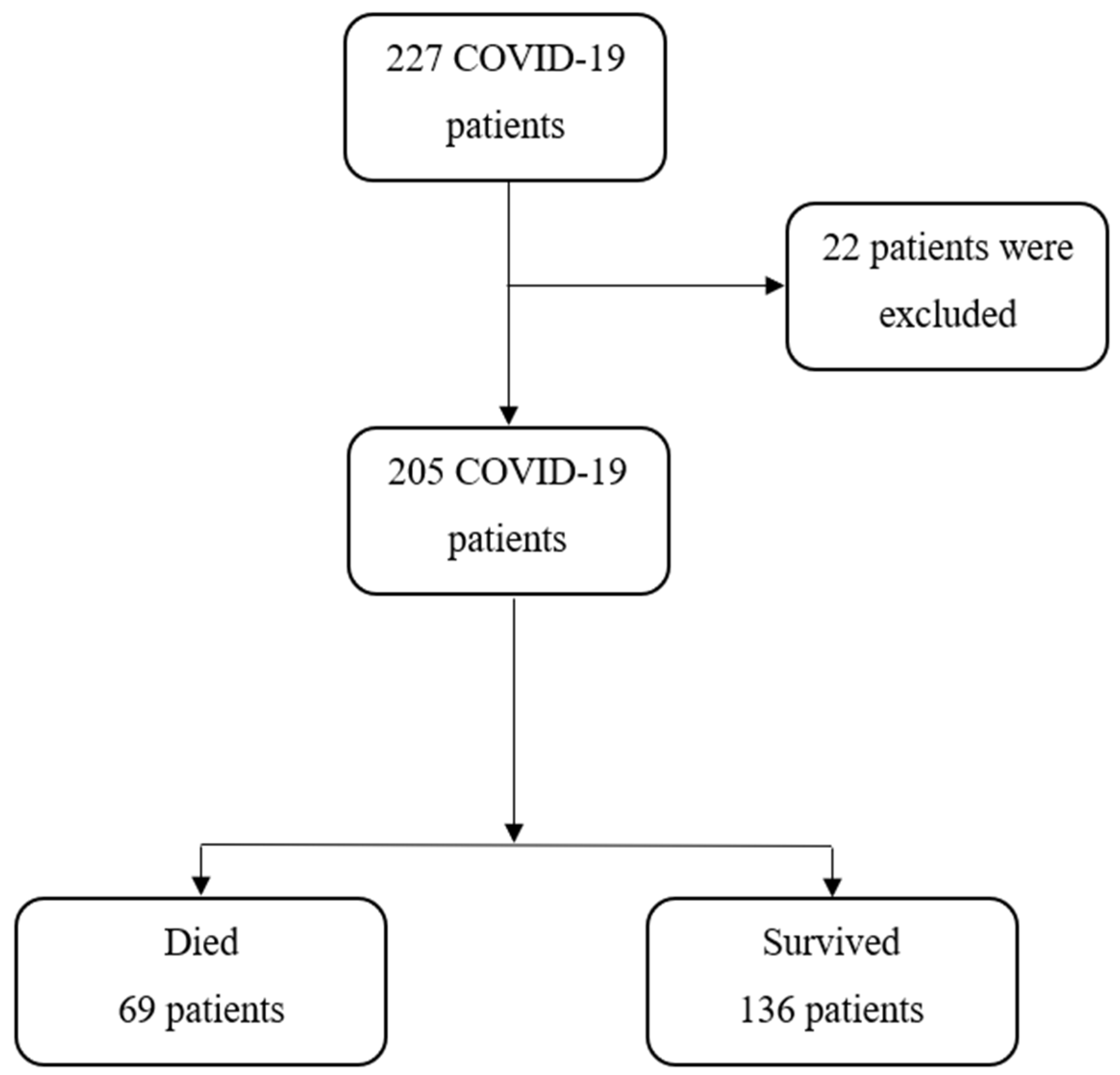
A total of 227 patients were initially noted to have COVID-19. In total, 22 of these patients were admitted for other reasons under specialty care (Haematology, Oncology, and Obstetrics) and later diagnosed as having COVID-19. These patients were excluded, and the analysis focused only on 205 patients.
Data on the level of frailty of all patients was collected using the Clinical Frailty Score (CFS) (also known as the Rockwood Frailty Scale) and the Charlson Comorbidity Index (CCI). We used the Rockwood clinical frailty scale to quantify the degree of disability from frailty, given that it is a well-validated and commonly used scale in both clinical practice and research worldwide [
15]. It is a clinical judgement-based frailty tool developed from the Canadian Study of Health and Aging in 2005 and updated in 2007 and 2020 [
16]. Individuals are given a number from 1 (very fit) to 9 (terminally ill) depending on their performance on mobility, balance, use of walking aids, the ability to eat, dress, shop, cook, and bank. Pictographs are included for easy visualisation. A person with a score of more than or equal to 5 is considered frail. To predict long-term outcomes, we used the Charlson Comorbidity Index (CCI), which is a method of categorising the comorbidities of patients to predict 1-year mortality. It consists of 17 items corresponding to different medical conditions and is weighted to scores of 1, 2, 3, and 6 [
17]. The summation of these scores, together with age, predicts mortality; the higher the score, the higher the mortality.
Statistics
Data is presented as mean ± Standard Deviation where appropriate, and comparisons between groups are undertaken using a two-sample
t-test. Case numbers are reported with percentages, and comparisons are undertaken using the chi-squared test. The relative risk (RR), its standard error, and 95% confidence interval are calculated according to the method of Altman, 1991 [
18]. Multivariate regression analysis was not performed, and the results are therefore presented as univariate associations. Statistical analyses were performed using standard statistical methods.
In addition to univariate analyses, a binary multivariable logistic regression was performed to identify independent predictors of mortality. Re-analysis was then done with the addition of HLOS and WMID to the model. The primary outcome variable was in-hospital mortality. Statistical significance was defined as a two-sided p-value < 0.05.
3. Results
A total of 205 patients admitted with COVID-19 were included, noting the exclusion of 22 specialty patients later diagnosed with COVID-19. A majority of 112 patients (55%) in this study were female, with the remaining 93 patients (45%) being male. Overall mortality was 34%, with a total of 69 deaths (see
Figure 1). A total of 137 patients (66%) survived, either reaching discharge home or being transferred to an alternative site such as a rehabilitation hospital. In total, 32/69 deaths were of male patients (46%), with 37 deaths being of female patients (54%). Mortality was slightly higher amongst males, with a mortality of 34% in male patients, compared with 33% in females.
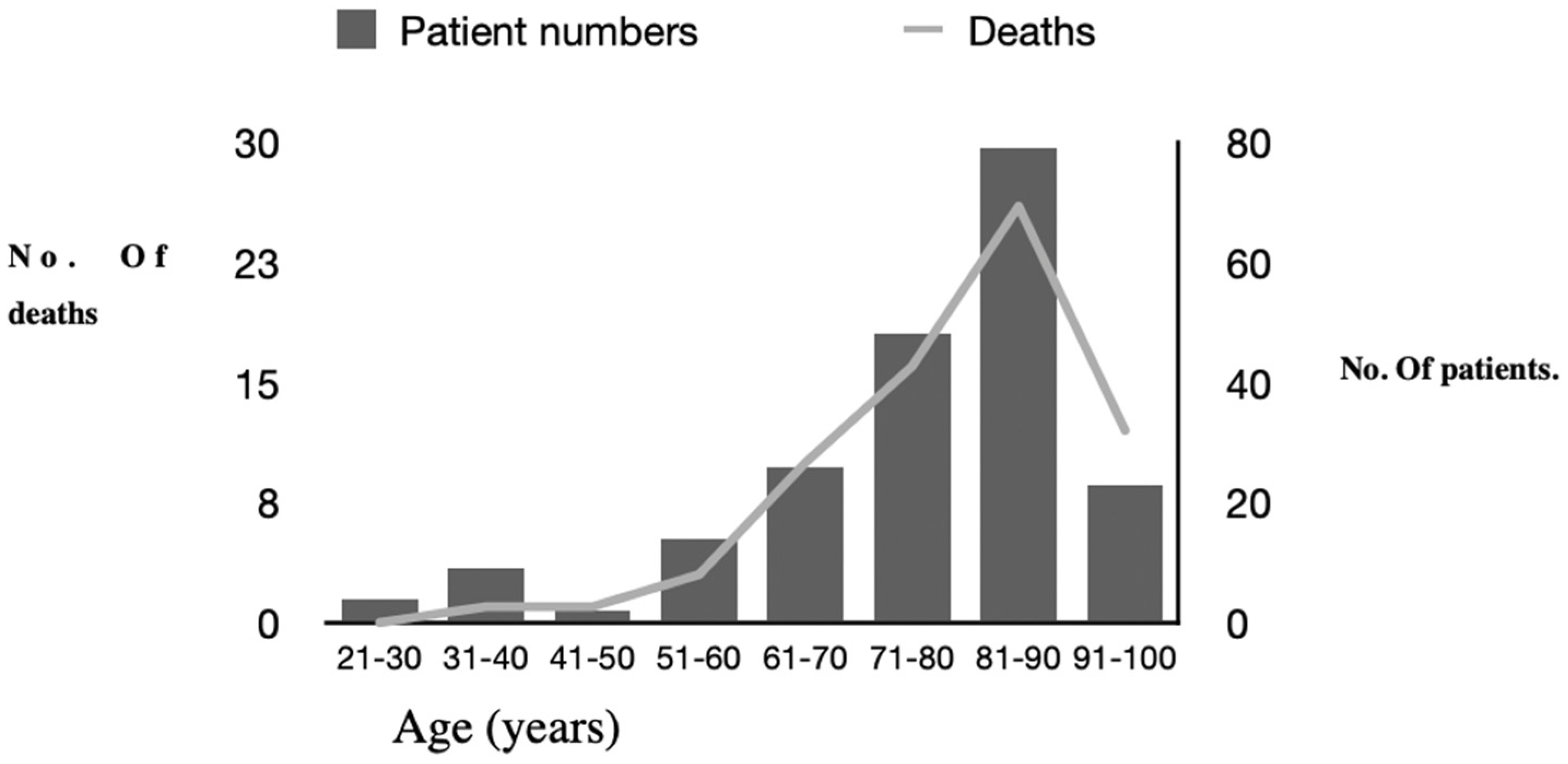
In our study, increased age is associated with a higher mortality, as can be seen in
Figure 2 and
Table 1, with an average age of 79 ± 12 in the group that died compared with 74 ± 17 in the survival group. There were no deaths of patients below the age of 40. The majority of admitted patients were aged between 81 and 90 years of age (
Table 1). The most common comorbidities are listed in
Table 1, with ischaemic heart disease (IHD) being the most commonly seen, particularly amongst the patient group that died, followed by diabetes and hypertension. Hospital length of stay did not appear to be a risk factor for increased mortality in this cohort, with the average length of stay being longer in the survival group compared with the group that died (8 vs. 6 days). Patients who died did appear to have, on average, a higher frailty score and Charleson score, suggesting increased frailty and comorbidity in this group compared with survivors (see
Table 1).
Table 2 shows the risk ratios of mortality. The documented NEWS (national early warning score) was significantly higher in the group that died. Smoking and BMI are not discussed in this study due to poor recording of smoking status and weight, and the potential risk of inaccurate representation of true association.
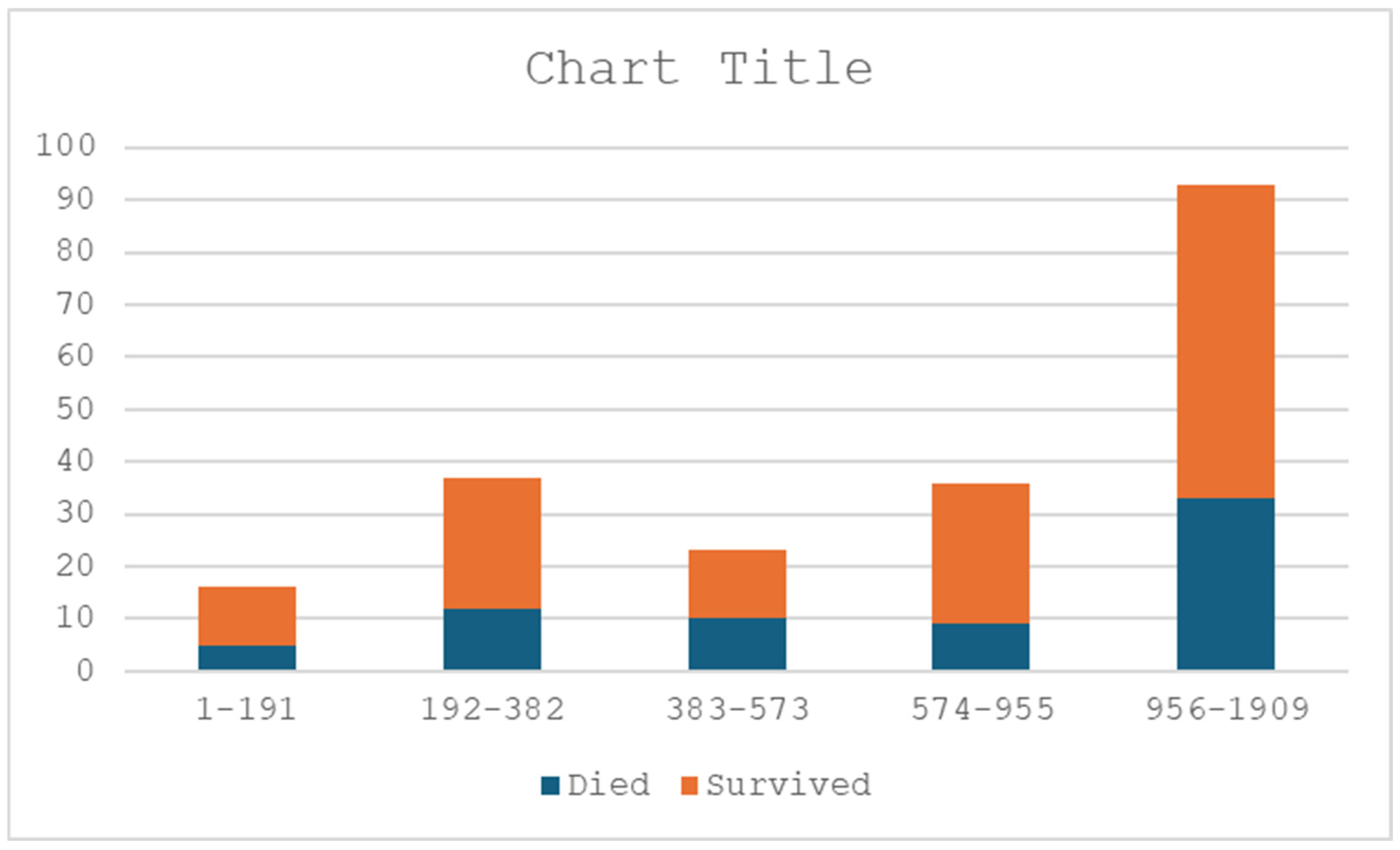
As part of this study, we carried out a review of the level of social deprivation for all patients included, using the Welsh Index of Multiple Deprivation (WIMD) and postcode address, in order to explore any association between social deprivation and admission to hospital or mortality associated with COVID-19 in our cohort of patients [
19]. The WIMD ranks all areas in Wales from the most deprived (1) to the least deprived (1909).
Figure 3 shows that the majority of patients admitted in this study were from the least deprived areas, making up the majority of patients in both the group that died and the survival group.
Multivariable logistic regression was undertaken to identify independent predictors of mortality among patients admitted with COVID-19. In the initial model, a higher Charlson score, increased Frailty score, and higher C-reactive protein (CRP) levels were all independently associated with increased mortality (
Table 3). Age, while significant in univariate analysis, was no longer a significant predictor after adjustment for these variables. This is not unusual in multivariable models, as the effect of age is almost certainly overwhelmed by the other three factors.
A second model incorporating hospital length of stay (HLOS) and Welsh Index of Multiple Deprivation (WIMD) demonstrated that HLOS remained independently associated with mortality, whereas WIMD did not contribute significantly to the model. Charlson Comorbidity Index, frailty, and CRP remained significant independent predictors.
4. Discussion
This study reflects outcomes during the first wave of the COVID-19 pandemic, prior to the emergence of later viral variants, vaccination programmes, and routine antiviral treatment. Although case fatality rates have since declined, understanding risk factors during this early period remains important for contextualising subsequent improvements in care and for informing preparedness for future pandemics.
This study included 205 patients, all admitted to a non-acute hospital. In contrast to what is seen in the literature, a higher number of women were admitted in this cohort, with 112 women (55%) compared to 93 men (45%). Despite this, however, the number of deaths was still higher in male patients, supporting previous evidence that male patients are at higher risk of severe disease and death due to COVID-19.
The vast majority of patients were over the age of 60 (86%). Most frequently, patients were between the ages of 81 and 90, with 79 patients (39%) within this age bracket. This is in keeping with the literature, suggesting that older age is a risk factor for admission to hospital due to COVID-19. Increased age is associated with a higher mortality, with a higher average age of patients who died compared with those who survived. Overall mortality was 34%, with a majority (54%) of these being male, despite the lower number of patients. The high mortality in our study likely reflects the early stage of the pandemic and the more frail population in this setting.
We can see from our data that the vast majority of patients had multiple comorbidities. Hypertension is frequently the most common comorbidity seen in other studies, followed by diabetes and cardiovascular disease. These also occur frequently in our study; however, ischaemic heart disease is the most common, present in 40 patients. It also appears to confer increased mortality risk, with higher representation in the group that died (33%) compared with those that survived (13%). Dementia appears to be more prevalent here than in other studies, which may represent a frailer population at this site.
As part of this study, we carried out an investigation into the association between social deprivation and admission to hospital with COVID-19. This was done using the Welsh Index of Multiple Deprivation (WIMD). The WIMD represents an official measure of relative deprivation for different areas throughout Wales, produced by statisticians at the Welsh Government [
19]. Using this system, we were able to assess the levels of deprivation of all patients included in this study.
Higher social deprivation is known to be a risk for some infectious diseases and for cardiovascular disease, and is suggested to contribute to higher mortality in COVID-19 [
14]. Greater social deprivation may contribute to an increased risk of infection and adverse outcomes in COVID-19 in a number of ways, with potentially increased vulnerability, increased susceptibility, and higher risk of exposure or transmission in more deprived areas. This may be partly due to several lifestyle factors associated with areas of higher deprivation, such as smoking, being more prevalent in areas of greater social deprivation. Greater social deprivation also contributes to an increased risk of contracting COVID-19 infection, likely relating to an increased likelihood of transmission in deprived areas, potentially with greater population density and poorer housing conditions, with a greater likelihood of overcrowding [
20]. Research exploring an association between deprivation and COVID-19 mortality in England found higher mortality rates in the most deprived northern regions. Similar data has been found for other pandemics, such as the H1N1 influenza pandemic in England and the Zika virus in Brazil [
21].
In contrast to other studies, this study actually shows that the majority of patients admitted here were from the least deprived areas in Wales, suggesting against an increased risk of admission to hospital and death in COVID-19 due to increased deprivation. It is unclear whether this is a true association or whether there is bias or a confounding contributor to the result. For example, the lack of association between social deprivation and mortality may reflect selection bias related to referral patterns, admission thresholds, or the demographic profile of patients typically admitted to this hospital. Additional research to further explore this would be needed to clarify this.
We included an investigation into the association between frailty and COVID-19 in this study. With increasing life expectancy and an ageing population, exploring the impact of older age and frailty on various diseases, such as COVID-19, is becoming increasingly important. Frailty is likely an independent risk factor in many diseases, contributing to greater costs and resource demands on the healthcare system; it may, however, be used as an additional screening parameter to support clinical decision-making for patient care. Frailty is more than just age, however, and is multifactorial in aetiology, characterised by a progressive decline in physiological function. It is associated with weakness and with an increased vulnerability to stressors, with increased risk of hospitalisation and death. The expectation was that increased frailty would also lead to a greater risk of hospitalisation and adverse outcomes in COVID-19. Assessment of frailty can be very variable, however, and there are many different scoring systems available to estimate frailty, such as the Edmonton Frail Scale (EFS) and the Frailty Index [
13].
Fernandes and Perieria investigated the association of frailty with COVID-19 during the pandemic, and suggested that increased frailty is associated with an increased short-term mortality risk due to COVID-19 (death within 30 days), with a number of studies showing an association between the level of frailty and increased mortality due to COVID-19, with others not demonstrating frailty as an independent risk factor when adjusting for covariates such as age [
13].
To investigate frailty in this study, we collected data on patients using the Clinical Frailty Scale (or Rockwood Scale) and the Charlson Comorbidity Index (CCI). The Clinical Frailty Scale is an easy-to-use, well-validated method of assessing frailty [
15]. Applying this scale to patients, however, requires the clinical judgement of the examining clinician and thus may be subject to inter-observer variation. Moreover, it focuses less on patient-oriented measures such as quality of life. Despite those relatively small disadvantages, it is a quick and easy test that does not require specific training and can easily be administered in a variety of clinical settings. It is validated in many settings to predict mortality and morbidity to guide patient care and health policy development. The CCI uses patient comorbidities to predict 1-year mortality, with the summation of scores together with patient age yielding the result [
17]. The inter-rater reliability of the CCI is validated to be excellent, and there is extremely high agreement between self-report and medical charts.
Importantly, multivariable analysis demonstrated that frailty, comorbidity burden, and inflammatory response were independent predictors of mortality, while age was no longer significant after adjustment. This suggests that multifactorial vulnerability, particularly frailty, rather than chronological age alone, is more strongly associated with adverse outcomes in this cohort. Social deprivation, as measured by the WIMD, was not independently associated with mortality after adjustment. This supports the possibility that the observed lack of association in univariate analyses may reflect local referral patterns or population characteristics, rather than a true protective effect of lower deprivation.
Our results support the notion that frailer patients are at an increased risk of adverse outcomes from COVID-19, with higher average frailty and Charlson scores in the group that died compared with the group that survived.