Article

Functional Dependence in Brazilian Adults One Year After COVID-19 Infection: Prevalence and Risk Factors in a Cross-Sectional Study


by
Natália Milan
1,†,
Carlos Laranjeira
2,3,4,*,†,
Stéfane Lele Rossoni
5,
Amira Mohammed Ali
6,
Feten Fekih-Romdhane
7,8,
Wanessa Baccon
1,
Lígia Carreira
1 and
Maria Aparecida Salci
1
1
Department of Postgraduate Nursing, State University of Maringá, Avenida Colombo, 5790-Campus Universitário, Maringá 87020-900, Brazil
2
School of Health Sciences, Polytechnic University of Leiria, Campus 2, Morro do Lena, Alto do Vieiro, Apartado 4137, 2411-901 Leiria, Portugal
3
Centre for Innovative Care and Health Technology (ciTechCare), Polytechnic University of Leiria, Campus 5, Rua das Olhalvas, 2414-016 Leiria, Portugal
4
Comprehensive Health Research Centre (CHRC), University of Évora, 7000-801 Évora, Portugal
5
Postgraduate Department of Health Sciences, State University of Maringá, Avenida Colombo, 5790-Campus Universitário, Maringá 87020-900, Brazil
6
Department of Psychiatric Nursing and Mental Health, Faculty of Nursing, Alexandria University, Smouha, Alexandria 21527, Egypt
7
Faculty of Medicine of Tunis, Tunis El Manar University, Tunis 2092, Tunisia
8
The Tunisian Center of Early Intervention in Psychosis, Department of Psychiatry, Ibn Omrane, Razi Hospital, Tunis 2010, Tunisia
*
Author to whom correspondence should be addressed.
These authors contributed equally to this work and shared the first authorship.
COVID 2026, 6(1), 23; https://doi.org/10.3390/covid6010023
Submission received: 28 November 2025 / Revised: 14 January 2026 / Accepted: 16 January 2026 / Published: 20 January 2026
(This article belongs to the Special Issue Post-COVID-19 Muscle Health and Exercise Rehabilitation)

Abstract

One of the challenges post-COVID-19 is reducing the negative impacts on quality of life, performance, and independence in activities of daily living. Assessing functional dependence in adults one year after acute infection can help to understand the long-term consequences, evaluate the impact on quality of life, plan rehabilitation and healthcare, identify the most vulnerable groups, measure the socioeconomic impact, and support public policies and clinical decisions. Objectives: The objectives of this study are as follows: (a) to assess the prevalence of functional dependence in Brazilian adults with COVID-19; (b) to analyze the association between the study variables; and (c) to determine the factors associated with functional dependence. Methods: This was an observational, cross-sectional study with 987 adults (18 to 59 years old) living in the State of Paraná (Brazil) hospitalized for COVID-19 between March and December 2020. Data were collected by telephone 12 months after the acute infection using an instrument to retrieve sociodemographic and health information, and a functional dependence scale to assess dependence before COVID-19 retrospectively (using participant recall information) and at the time of the interview. Data were analyzed using penalized logistic regression after imputing missing data. Data were analyzed using penalized logistic regression after imputing missing data. Results: Functional dependence after COVID-19 was 5.0% and was associated with low levels of education, not having a partner, living with someone, not owning a home, experiencing job changes, requiring care, obesity, smoking, multimorbidity, ICU admission in the acute phase, use of invasive ventilation, or having Long COVID. Individuals who required care or used invasive ventilation support were, respectively, 9.3 and 6.5 times more likely to develop dependence after COVID-19. Despite adjustment for multiple factors, the magnitude of the observed effects warrants cautious interpretation, as unmeasured or residual confounding effects may still be present. Sample recall bias due to collection after 12 months and the presence of the alpha variant without COVID-19 vaccination coverage may limit data generalization. Conclusions: The results highlight the need to emphasize the public health implications of identifying functional dependence. In this vein, it is necessary to implement preventive measures, identify and monitor more vulnerable groups, plan rehabilitation programs, and develop public health policies.

1. Introduction

The COVID-19 pandemic, caused by the novel coronavirus SARS-CoV-2, constituted a public health emergency with global impact. As of October 2023, more than 600 million people worldwide had contracted the disease. In Brazil, more than 37 million cases of infection were reported, with a case-fatality rate of 1.9% [1]. By 2025, nearly 40 million cases and 716,448 deaths had been recorded in the country [2,3]. The World Health Organization (WHO), through the World Health Statistics, indicates that the COVID-19 pandemic reversed the previous upward trend in life expectancy and healthy life expectancy [3]. However, beyond the reduction in these survival indicators, the pandemic also led to a substantial increase in the burden of disability. An increase in years lived with disability and loss of functioning has been observed, reflecting persistent symptoms and physical and cognitive limitations after SARS-CoV-2 infection [3]. Thus, increased survival following COVID-19 has frequently been accompanied by functional dependence and restrictions in performing activities of daily living, making the assessment of functional independence a relevant outcome in the post-COVID-19 context [3]. Functional independence is understood as the ability to perform activities of daily living without requiring assistance from another person.
Available evidence confirms that patients who undergo invasive mechanical ventilation are more prone to complications such as infections and prolonged hospital stays, and inappropriate ventilator management is associated with increased dependency and mortality [4]. Mechanical ventilation was a critical life-saving intervention during the COVID-19 pandemic [5]. In most facilities, mortality rates among mechanically ventilated patients with COVID-19 ranged from 30% to 97%, even with lung-protective strategies [5]. In addition to being an indicator of disease severity, invasive mechanical ventilation is associated with several ICU-acquired sequelae, such as muscle weakness, peripheral neuropathy, prolonged immobilization, and cognitive impairment. These complications may persist after hospital discharge and negatively affect patients’ ability to perform activities of daily living, contributing to functional decline and long-term dependence [6]. These patients, therefore, require extensive monitoring, as they are at higher risk for post-COVID-19 complications [7].
According to the WHO, worldwide, 6% of people with COVID-19 developed a post-COVID-19 condition (Long COVID) [8]. Furthermore, 10% to 20% of people with COVID-19 developed some long-term complications that impacted their health and quality of life [9,10,11]. Due to its novelty and many manifestations, numerous labels and descriptions of Long COVID have been proposed. According to the WHO, Long COVID is characterized by the persistence or new onset of symptoms following SARS-CoV-2 infection, usually three months after the acute phase, lasting at least two months and not explained by alternative diagnoses [8,9,10,11,12,13].
Evidence indicates that Long COVID is associated with substantial functional impairment, including limitations in activities of daily living (ADLs) and restrictions in social participation [14,15,16,17,18,19]. Likewise, people living with Long COVID face longer periods of absence from work, reduced working hours, or even the risk of unemployment and financial difficulties. The current challenge is to reduce the negative impacts the disease has had on quality of life, impairing functional performance and directly affecting individuals’ independence in carrying out daily activities [20,21,22,23]. A systematic review with a meta-analysis demonstrated persistent functional limitations and decreased independence in ADLs among individuals with post-COVID-19 conditions compared with controls [24]. Population-based studies have also reported significant associations between persistent Long COVID symptoms and functional disability in both basic and instrumental activities of daily living, as well as reductions in task performance quality [25,26,27,28,29,30]. Furthermore, long-term follow-up assessments using standardized disability measures have documented sustained functional deficits up to three years after acute infection, underscoring the enduring impact of Long COVID on everyday functioning [14,15,16,17,18]. However, although functional limitations after COVID-19 have increasingly been reported, most available studies focus on older adults and rely mainly on self-reported measures. Few studies have specifically assessed functional dependence in younger adults using validated instruments such as the Functional Independence Measure (FIM), representing an important gap in the literature that the present study aims to address. In addition, investigating the functional status of patients who recovered from the acute infection is relevant, as well as analyzing changes in functional capacity post-COVID-19. Such data provides relevant information for planning rehabilitation strategies that target these conditions in order to preserve or improve independence in ADLs.
Therefore, this study sought to (a) assess the prevalence of functional dependence in Brazilian adults who had COVID-19; (b) analyze the association between the variables under study; and (c) determine the factors associated with functional dependence. We hypothesize that factors such as the need for invasive ventilation, multimorbidity, and persistent Long COVID symptoms are associated with increased functional dependence post-COVID-19.

2. Materials and Methods

2.1. Study Design

This observational and cross-sectional study is part of a broader project: “Longitudinal Monitoring of Adults and Older People Discharged from Hospital Due to COVID-19—COVID-19 Cohort Paraná/UEM” [31]. The recommendations proposed by the STROBE (Strengthening the Reporting of Observational Studies in Epidemiology) verification checklist were followed [32] (Supplementary File S1).

2.2. Setting, Sample, and Recruitment

The study setting was the State of Paraná, located in the southern region of Brazil, with an estimated population of 11,444,380 inhabitants in 2022 and a territorial extension of 199,298.981 km2 [33]. Participants were selected from two complementary surveillance databases: the Influenza Syndrome Epidemiological Surveillance System (SIVEP-Gripe) [34] and Notifica COVID-19 Paraná [35]. Notifica COVID-19 Paraná is a state-level system established by the Paraná State Health Department (SESA) that interfaces with the Central Laboratory of the State of Paraná (LACEN/PR) and primarily compiles laboratory-confirmed COVID-19 cases, including mild and non-hospitalized infections. In contrast, SIVEP-Gripe is a national surveillance system focused on cases of severe acute respiratory syndrome, encompassing hospitalized cases and deaths. The combined use of these databases allowed coverage of the full clinical spectrum of COVID-19 severity, reducing sampling bias that would result from reliance on a single source and improving representativeness of COVID-19 cases in the population. Duplicate records across databases were identified using deterministic matching based on exact agreement of full name, date of birth, and parental names; when duplicates were identified, the SIVEP-Gripe record was retained due to its more detailed clinical information.

Eligibility Criteria

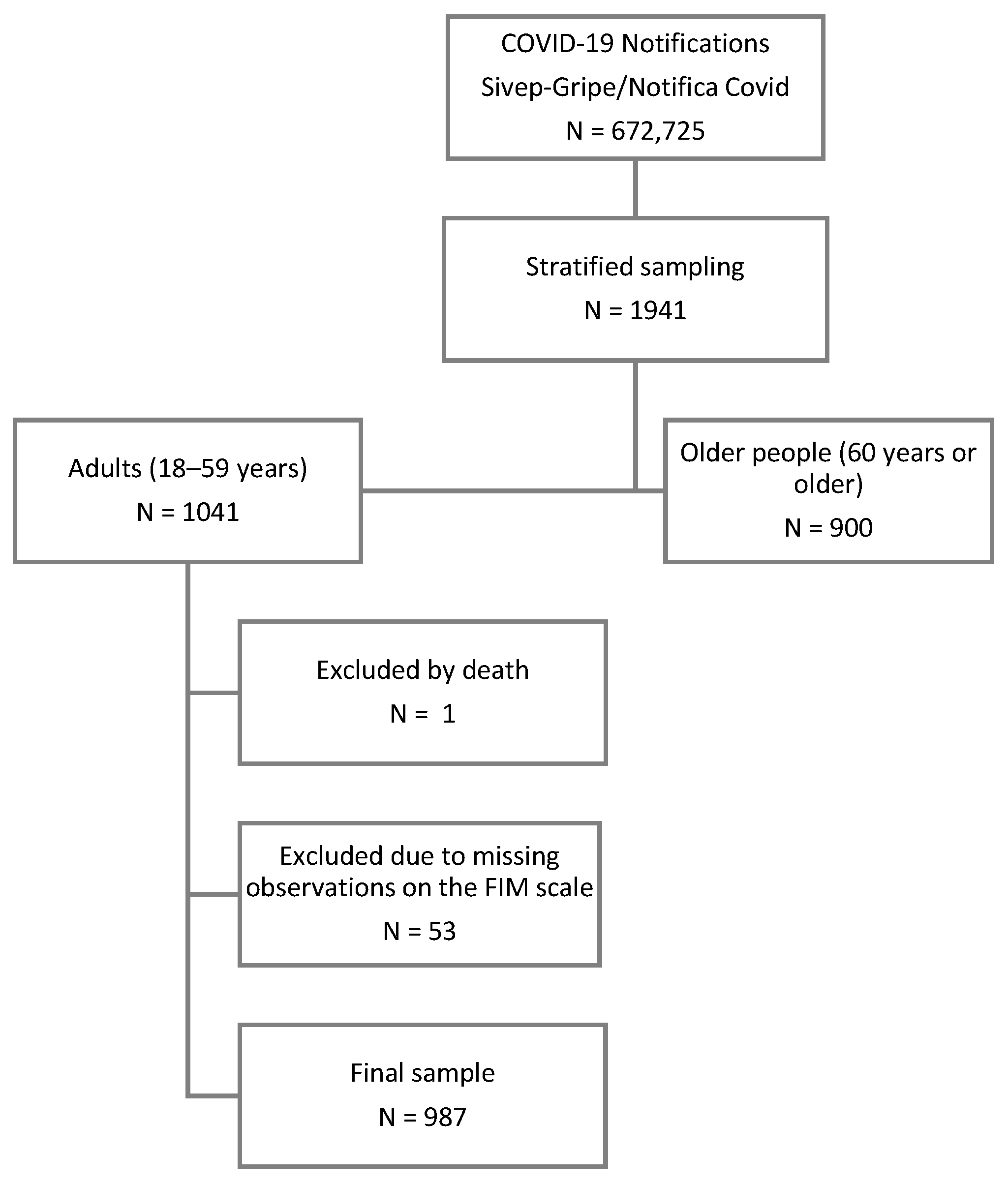
Subjects eligible for participation in this study were selected in accordance with the following inclusion criteria: (a) adults (ages between 18 and 59 years); (b) residents of the State of Paraná; and (c) diagnosis of SARS-CoV-2, confirmed by a Reverse Transcription Polymerase Chain Reaction (RT-PCR) test between March and December 2020. The diagnostic timeframe includes people whose symptoms commenced before 7 June 2021, when over 75% of patients were infected with the alpha variant [36]. Cases in which the patient’s death was reported by the interviewer were removed. Cases with incomplete observations on the FIM scale were also disregarded. This resulted in 987 participants (Figure 1).

2.3. Data Collection Instrument

Data were collected using an electronic form through telephone interviews, during which eligible participants were invited to take part in the study. Prior to data collection, interviewers received standardized training focused on interactive interviewing techniques, including strategies to ensure response consistency and minimize information bias. Retrospective FIM scoring was conducted using standardized interviews with temporal anchoring to the pre-infection period and structured prompts to improve recall consistency. Initially, participants were contacted via a messaging application (WhatsApp Version 22.13.74) to schedule the interview and received standardized information about the study and the affiliated educational institution. Informed consent was read aloud during the call and, upon agreement, the consent form was sent to participants by mail or email according to their preference. The interviews lasted 40 to 60 min and took place between March and December 2021 (twelve months after acute infection).

2.3.1. Independent Variables

Information was collected regarding three groups of independent variables.
Group I (sociodemographic characteristics): Region of Paraná where they live (East, West, North, or Northwest); sex (male or female); race (white or non-white); years of education (up to 8 years or more than 8 years); has a partner (no or yes); lives alone (no or yes); housing conditions (owned, rented, or other); changed employment status (no, yes due to COVID-19, or yes due to other causes); receives any financial support (no or yes); and source of income affected by the pandemic (no or yes).
Group II (health variables): Received care from a family member, friend, or professional during or after COVID-19 (no or yes); overweight/obesity (no or yes); physical activity [“Currently, do you practice any type of physical exercise?”] (no or yes); smoker (no or yes); presence of multimorbidity, that is, presence of multiple chronic diseases (no or yes); location of treatment in the acute phase of COVID-19 (outpatient clinic, ward, or ICU); need for ventilatory support in the acute phase of COVID-19 (no; yes; no, invasive; or yes, invasive); and presence of signs or symptoms after the primary coronavirus infection that are not explained by alternative diagnoses [Long COVID] (no or yes).
Group III (symptoms, present in both the acute phase of COVID-19 [from onset of symptoms to the point at which replication-competent SARS-CoV-2 is not detected] and Long COVID, were grouped according to the organic systems involved): Neurological (changes in vision, smell, taste, speech, hearing, ringing in the ears, dizziness, loss of motor coordination, loss/decrease in memory, tingling/numbness, or fainting); respiratory (runny nose, sore throat, hoarse voice, cough, phlegm production, chest pain, or shortness of breath); and cardiovascular (edema) and endocrine (hair loss and sweating), which may indirectly influence fatigue, vitality, and functional vulnerability after COVID-19.

2.3.2. Dependent Variable

The outcome variable was the functional dependence of individuals assessed using the Functional Independence Measure (FIM), which aims to assess independence in activities of daily living (ADLs). For this study, we used the Brazilian Portuguese version of the FIM, translated and validated by Riberto et al. [37]. The domains of the FIM scale are divided into self-care, mobility/locomotion transfer, sphincter control, communication, and social cognition. The scale score was divided according to the degrees of dependence, which range from 1 to 7 levels (7 = complete independence and 1 = total help). The total FIM score can be divided into four subscores, according to the total score obtained: (a) 18 points: complete dependence (total assistance); (b) 19 to 60 points: modified dependence (assistance in up to 50% of the tasks); (c) 61 to 103 points: modified dependence (assistance in up to 25% of tasks); and (d) 104 to 126 points: complete independence [37,38]. Thus, the lower the score, the greater the person’s degree of dependence. The sum of the points obtained in each dimension has a minimum score of 18 and a maximum of 126 points, which characterizes the level of dependence [37]. For the pre-pandemic period, the internal consistency of the adapted version of the FIM scale was very good (Cronbach’s alpha reliability = 0.86) [37]. In the current study, the internal consistency coefficient of the scale presents a similar value (α = 0.88).
A cut-off value for the FIM scale (global score < 104) was employed to differentiate between dependent and independent performance in ADLs, consistent with other studies [39]. Based on the dependency ratings from the FIM scale before and after COVID-19, it was possible to create a dichotomous variable that indicates whether the individual became dependent after contracting the disease, assigning “Yes” to cases in which the individual went from independent to dependent status and “No” to cases in which the individual remained as they were or went from dependent to independent. The FIM scale was applied in reference to two moments: before the COVID-19 infection (the question was asked retroactively) and after the COVID-19 infection.

2.4. Statistical Analysis

Descriptive statistical analyses were performed on the absolute and relative frequencies of categorical variables (in general and divided by whether or not cases became dependent after COVID-19) and summary measures of numerical variables, in addition to statistical tests such as chi-square and Fisher’s exact test, to verify whether there is a significant difference (at <5%) between the percentage of individuals with dependence after COVID-19 and the levels of each variable. For group comparisons, McNemar’s test and Student’s t-test were performed. Given the large sample size ( N 1.000 ), formal normality tests were unnecessary, as justified by the Central Limit Theorem, which guarantees the approximate normality of the sampling distribution of the mean. In addition, logistic regression models of the Binomial family (considering the dichotomous response variable “1 = Became dependent after COVID-19”; “0 = Did not become dependent after COVID-19”) were used to identify factors that influence the chance of the individual becoming dependent after contracting the disease. Although some variables presented a relatively high proportion of missing data (>30%), the assumption of Missing at Random (MAR) was considered plausible. Missingness was primarily related to incomplete clinical records and self-reported information, which were included in the imputation models, corroborating the MAR assumption. To minimize overfitting and improve model stability, we addressed missing data, limited events per variable, and outcome imbalance using a structured modeling strategy. Missing data were handled through multiple imputation (m = 5) [40] using the Multivariate Imputation by Chained Equations (MICE) approach, applying the package’s default imputation methods according to variable type. To reduce model complexity under a low events-per-variable ratio [40], an initial univariable screening (p < 0.20) was performed in each imputed dataset, restricting the final model to a parsimonious set of predictors. Logistic regression models were then fitted using inverse frequency weighting to account for outcome imbalance. Estimates were combined across imputations using Rubin’s rules, providing pooled coefficients and confidence intervals. Model performance was evaluated on a held-out sample using discrimination metrics, including ROC-AUC, PR-AUC, and the optimal cut-off based on the F1-score [40]. The robustness of the imputation process was indirectly assessed by evaluating model performance and coefficient stability across multiple imputed datasets and through validation on a held-out sample using pooled predicted probabilities.
The interaction terms between the model’s covariates were tested pairwise through sensitivity analyses, observing the ROC-AUC, PR-AUC, F1, accuracy, sensitivity and specificity metrics. Given the risk of overfitting due to the limited number of events and to follow the EPV recommendations, interaction analyses were exploratory and guided by clinical plausibility and model performance. Only interactions that demonstrated consistent predictive gains and satisfied EPV constraints were retained.
The final multivariable model was intentionally restricted to a small number of predictors to ensure stable estimation under a limited events-per-variable ratio. As such, the model should be interpreted as a parsimonious representation of the strongest associations rather than a comprehensive explanatory model. Therefore, the absence of these variables in the final model does not imply a lack of clinical relevance.
The statistical significance considered in this study was 5%. All analyses were performed using R software (version 4.3.2.) [41].

2.5. Ethical Procedures

The project was approved by the Human Research Ethics Committee (COPEP) of the State University of Maringá (approval nº 4,165,272/2020), and under Opinion number 4,214,589 granted by Hospital do Trabalho (Certificate of Presentation of Ethical Appreciation: 34787020.0.3001.5225). All ethical procedures on research with human beings (Resolution 466/2012 and 510/16) were respected.

3. Results

3.1. Characterization of Participants

Of the 987 individuals analyzed, the majority were male (54.2%) and white (44.5%) (Table 1). The ages ranged from 18 to 59, with a mean age of 43 ± 10.84 years. The majority (57.4%) had more than eight years of education, 57.9% had a partner, and 74.3% lived with someone. Regarding housing, the majority reported living in their own homes (48.1%) and 12.3% lived in rented homes.
Regarding health variables, 42.5% were obese, 47.2% were physically active, 14.1% were smokers, and 17.2% had multimorbidity. Among the interviewees’ self-reported exposures, 40.6% indicated an outpatient clinic, 28.6% the ICU, and 30.8% a medical ward. Furthermore, 47.6% did not use ventilatory support, 27.8% used non-invasive ventilatory support, and 9.73% required invasive ventilatory support. Long COVID symptoms were self-reported by 60.6% of the sample.
Some demographic and clinical variables, particularly years of study, housing condition, and obesity, presented substantial proportions of missing data (>30%), which are explicitly reported in Table 1.

3.2. Prevalence and Associations Between Variables Under Study

The overall prevalence of functional dependence after acute COVID-19 infection was 4.8% (Table 1). Significant differences were observed between the percentage of individuals who developed dependence after COVID-19 according to years of schooling: 15.2% of those with up to 8 years of schooling, followed by 4.8% of participants with 8 or more years of schooling. The number of individuals who developed dependence after COVID-19 was higher among those who did not have a partner (5.8%). However, among those who lived with a partner, 5.6% faced a significant difference in dependence after COVID-19, compared to those who lived alone (4.7%). Regarding housing conditions, those renting or with other housing had a statistically higher percentage of individuals who developed dependence after COVID-19 (8.26%), while the percentage for those who owned their own home was 6.7%.
When observing those who changed jobs, there was a significant difference among those who became dependent after COVID-19 infection versus other causes. Among those who did not experience job changes, only 4.7% became dependent after COVID-19, while among those who experienced job changes due to COVID-19, 13.2% became dependent after the disease.
Among those who required care, 16.8% became dependent after COVID-19, a considerably higher figure compared to those who did not require care (only 0.6%). The percentage of individuals with obesity was also higher among those dependent after COVID-19: 8.3% for those who were obese and 3.6% for those who were not. Conversely, levels of dependence after COVID-19 were higher among smokers (6.5%) than among non-smokers (5.7%).
Significant differences were also found regarding the acute infection treatment settings: 11.5% of individuals who remained in the ICU developed post-COVID-19 dependence, 2.5% for those who remained in the ward, and 1.3% for those treated as outpatients. Differences were also found regarding self-reported Long COVID symptoms, with 7.4% of individuals experiencing post-COVID-19 dependence compared with 0.8% of those who did not experience Long COVID.
The characterization of post-COVID-19 dependence in relation to Long COVID symptoms grouped by body system revealed distinct patterns (Table 1). Among those who reported neurological symptoms, 87.5% did not experience post-COVID-19 dependence, and 12.5% did. Among participants who reported respiratory symptoms, the majority (90.8%) did not develop post-COVID-19 dependence, while 9.2% did. For individuals with cardiovascular symptoms, 92.8% remained without post-COVID-19 dependence, and 7.3% developed dependence. For participants with endocrine symptoms, 92.3% did not present dependence, while 7.7% did. Only for respiratory and endocrine symptoms were there statistically significant differences between those who developed and those who did not develop post-COVID-19 dependence.
Based on the dependency classifications (FIM scale) of the sample before and after COVID-19 infection, a contingency table for paired data (Table 2) was constructed, which depicts the transitions between participants’ independence/dependence states. Considering the proportion of individuals developing dependence after acute COVID-19 infection, among the 925 individuals who were independent before COVID-19, 5.1% became dependent. Furthermore, among the 61 participants who were already dependent, 72.1% remained so after the acute infection, and 27.9% became independent due to various factors unrelated to the disease. The McNemar test indicates a significant difference in state change (independent → dependent; dependent → independent), and the calculated odds ratio (OR = 2.76) represents the ratio between discordant pairs and indicates that changes from independence to dependence occurred substantially more often than changes in the opposite direction (Table 2).
Significant differences were found between the mean age, BMI, total morbidities, and total symptoms in the acute and long phases between those who developed dependency after COVID-19 and those who did not. The former were older, had a higher BMI, a greater number of morbidities, and a higher mean number of symptoms, both in the acute and post-COVID-19 phases. Effect sizes (Cohen’s d) indicated moderate difference in age, BMI, multimorbidity and total symptoms in the acute phase, in addition to a larger difference observed in the total symptoms of Long COVID, indicating that group differences were substantial and clinically meaningful, beyond statistical significance (Table 3).

3.3. Factors Associated with Functional Dependence

To analyze the factors associated with functional dependence, only covariates with more than 50% of the completed observations were considered initially: “sex,” “age,” “race/color,” “care,” “obesity,” “smoker,” “total morbidity,” “total symptoms in the acute phase,” “self-reported exposure,” “ventilatory support,” and “Long COVID-19.” Among these, the variables submitted to the missing data imputation process were “race/color” (29.78% of NAs), “obesity” (32.11% of NAs), “smoker” (21.68% of NAs), and “ventilatory support” (14.89% of NAs). In each of the five imputation rounds, a logistic regression was adjusted for each covariate, with the response variable acting as a univariate screening. The more times a covariate had a p-value < 0.2 indicates greater consistency and stability. The variables “age,” “care,” “obesity,” “total morbidities,” “total symptoms in the acute phase,” and “Long COVID” had p-values <0.2 in all five imputation stages, while the other variables did not have p-values at all. Those with p-values <0.2 in at least half of the stages advanced to the next stage. The new selection criterion was based on the ranking of the lowest average p-value among the five stages, with “care” having the lowest p-value, followed by “total symptoms in the acute phase,” “total morbidities,” “long COVID,” “age,” and “obesity.” Based on the EPV (events per variable) rules, it is recommended that, for each variable in the model, there be 10 events/cases to ensure stable estimates. Thus, based on the 47 events in the response variable, the recommended number of variables was three. These were chosen according to the criterion of the lowest average p-value in the imputation steps (“care”, “total symptoms in the acute phase,” and “total morbidities”).
A logistic regression model with weights from the combination of all imputations indicated that the need for care, the total number of symptoms in the acute phase, and the total number of morbidities were significant (considering an α < 5%), meaning these variables can influence an individual’s likelihood of becoming dependent after COVID-19 infection. OR estimates suggest that those who required care during this period are 21 times more likely to become dependent. Each increase in a symptom in the acute phase increased the chance of dependence by 5%, while each increase in morbidity increased the chance of dependence by 28%. In sensitivity analyses including interaction terms, the combined effect of care × number of comorbidities increased the risk of becoming dependent after COVID-19 by 56% for each additional comorbidity among individuals who required care (OR = 1.56). For care × number of symptoms, each additional symptom was associated with a 2.45-fold-higher risk of post-COVID-19 functional dependence in those who required care (OR = 2.45). Finally, the interaction between the number of comorbidities × number of symptoms indicated that the simultaneous presence of more symptoms and more comorbidities multiplied the risk of developing functional dependence by 2.56 times (OR = 2.56). Although clinically plausible, extremely large odds ratios may be influenced by residual overfitting or multicollinearity due to correlated covariates and a limited events-per-variable ratio (Table 4).
The performance of the retained sample (20%) obtained an accuracy of 0.77 (95% CI: 0.70–0.82), sensitivity ≥ 0.99, specificity = 0.76, ROC-AUC = 0.88, PR-AUC = 0.14, and threshold (F1) = 0.26. The results indicate good accuracy metrics and ROC curves. When there is low prevalence (e.g., only 4.7% of events), the PR-AUC naturally tends to be low. Although a PR-AUC = 0.14 is better than random, it is not considered optimal. F1 = 0.26 indicates reasonable recall but with some false positives, an expected result in a model with few events (Table 5).
The pairwise interactions were statistically significant (p-value < 0.001) (Table 4) but did not provide substantial improvements in predictive performance (Table 5). Hence, the main-effects model (additive model) was retained as the final model for parsimony and interpretability.

4. Discussion

The observed association between invasive mechanical ventilation, increased care needs, and functional dependence is clinically plausible and consistent with the previous literature. Patients who require invasive ventilation generally present more severe acute disease, prolonged immobilization, and a higher risk of ICU-acquired weakness, all of which are related to poorer functional outcomes. However, because our study has an observational design, these findings should not be interpreted as evidence of a causal relationship. It is possible that the need for invasive ventilation reflects greater baseline vulnerability and disease severity, which in turn are associated with worse functional status after COVID-19. Thus, rather than indicating that mechanical ventilation per se causes functional dependence, our results demonstrate associations that may be partially explained by confounding factors such as severity of illness, comorbidities, and access to rehabilitation services [42,43].
The prevalence of Long COVID symptoms observed in this study (60.6%) should be interpreted in the context of the case definition and follow-up period. A recent meta-analysis reported that approximately 57% of patients exhibited at least one persistent symptom at 12 months after acute COVID-19 infection [44], with consistent findings from studies indicating that around 53% of individuals continued to report symptoms one year after infection [45]. These estimates are comparable to the prevalence observed in the present study and reinforce that high proportions of persistent symptoms are expected when broad symptom-based definitions and long-term follow-up are applied, particularly in samples that include individuals with more severe acute disease and higher comorbidity burden.
Concurrently, the present study analyzed functional dependence associated with sociodemographic characteristics, persistent COVID-19 symptoms, previous comorbidities, and the location of treatment during the acute phase of the disease. Although no significant differences were found between sex and race in this sample, some epidemiological studies conducted in Brazil and other countries have demonstrated differences in susceptibility to infection, clinical manifestations, and outcomes based on sex [42,46,47,48,49,50]. In this regard, the severity of acute illness, intensive care admission rates, and COVID-19-related mortality were observed to be higher among males. However, an opposite trend was observed with Long COVID syndrome, with women being affected more frequently [42,47,48,49]. Differences in hormonal and immunological responses might explain the differences in risk, severity of infection, and mortality rates between men and women [48,49].
In our study, sex and race were not significantly associated with post-COVID-19 functional dependence, which contrasts with some previous reports that have suggested a higher burden of adverse outcomes among women and racial/ethnic minorities. Several factors may explain these discrepancies. First, our sample included a large proportion of younger adults, whereas many prior studies focused primarily on older populations, among which functional decline is more prevalent. Second, we evaluated functional dependence using a validated instrument (FIM), while many earlier studies relied on self-reported symptoms or generic health-status measures, which may capture different constructs. Third, contextual differences in access to health services, rehabilitation availability, and social support across settings may modify the relationship between sex, race, and functional outcomes.
Other studies conducted in Brazil, found that individuals living in regions with low development in education, health, and living conditions were more susceptible to infection and higher mortality from COVID-19 [47,51]. In parallel, Volpe et al. [43] identified worsening conditions in individuals with multimorbidity, leading to ICU admission or death when two or three conditions were present (such as hypertension or metabolic decompensation, such as hyperglycemia). The findings obtained in the current study are in line with the evidence that establishes a relationship between multimorbidity and the need for ICU treatment, and the consequent use of invasive ventilatory support [43,48]. In addition, our findings reveal significant improvements in functional dependence measures for 27.9% of participants, reiterating the role of acute inpatient rehabilitation after COVID-19 in improving functional gains and outcomes [52].
Beyond the overall burden of multimorbidity, it is also plausible that specific comorbidities are driving part of the association with post-COVID-19 functional dependence. Cardiometabolic conditions such as obesity, hypertension, and diabetes are linked to systemic inflammation, endothelial dysfunction, and reduced exercise tolerance, which may contribute to persistent fatigue and physical deconditioning. Chronic respiratory diseases may further limit functional capacity through residual dyspnea and impaired ventilatory mechanics, whereas neurological and psychiatric conditions can affect cognition, motivation, and task performance, thereby increasing dependence in activities of daily living. These mechanisms are biologically plausible and consistent with prior studies reporting poorer functional outcomes among individuals with cardiometabolic or respiratory comorbidities.
Other studies have also shown that the presence of comorbidities, notably hypertension, diabetes mellitus, and respiratory and neurological diseases, is associated with greater severity and a worse prognosis of COVID-19 [42]. Additionally, smoking appears to be associated with a higher likelihood of ICU admission [14,53,54]. Obesity is also mentioned in the literature as a risk factor for hospitalization and worsening of COVID-19 infection [55,56,57].
In the Brazilian context, these social determinants must be interpreted within a setting characterized by marked regional inequalities and heterogeneous access to health services. Although the Unified Health System (Sistema Único de Saúde—SUS) provides universal coverage, the availability of specialized services such as post-COVID-19 rehabilitation, mental health care, and long-term follow-up remains uneven across regions, with important gaps in rural areas and in the North and Northeast of the country [51]. Informal employment and lower levels of education are also highly prevalent and may limit health literacy, continuity of care, and adherence to rehabilitation programs. In addition, income inequality and overcrowded housing conditions, which are more frequent in socially vulnerable territories, can hinder recovery and increase the risk of persistent functional limitations. These Brazil-specific structural and organizational characteristics likely modulate the relationship between Long COVID, multimorbidity, and functional dependence.

4.1. Study Limitations

This study has some limitations that should be considered. The first is related to the use of self-reported information, in addition to the fact that the interviews were conducted 12 months after the acute phase of COVID-19. This approach is susceptible to recall bias, as participants may inaccurately reconstruct their functional abilities, as well as other factors, particularly after a prolonged follow-up period. To mitigate this, standardized forms and instructions were used for each interview. The relatively long duration of the telephone interviews (40–60 min) may have contributed to participant fatigue, which could have affected response consistency, particularly for self-reported measures. This possibility should be considered when interpreting the results. Additionally, the study’s cross-sectional design does not allow for causal inferences. The absence of a non-COVID-19 control group restricts causal inference and limits the ability to disentangle functional decline attributable to COVID-19 from age-related changes or pre-existing conditions. All participants were diagnosed with COVID-19 before June 2021, a period when the alpha variant predominated and without widespread COVID-19 vaccination coverage [36], limiting the generalizability of the findings when applied to later variants. Furthermore, the dichotomization of variables such as BMI, income, and education may have resulted in loss of information, reduced statistical power, and limited ability to capture potential nonlinear associations. Another limitation is the appearance of symptoms that may not be related to SARS-CoV-2 infection. Therefore, a comparison group would be desirable; however, the consulted databases lacked information on individuals without the disease. Even with these limitations, it was possible to determine the association between functional dependence in adults who had COVID-19 and sociodemographic characteristics, health variables, and symptoms of acute and long-term COVID-19. Regardless of the regional limitation (State of Paraná), data were obtained from the most relevant health databases, covering all official records from the period. Despite good discrimination based on the ROC curve, the low PR-AUC value highlights limited usefulness for accurate case identification in a low-prevalence setting.

4.2. Implications for Practice

The findings of this study have important implications for rehabilitation planning, particularly in regions with limited resources. The identification of factors associated with post-COVID-19 functional dependence, such as multimorbidity, Long COVID symptoms, and exposure to invasive mechanical ventilation, may help prioritize high-risk individuals for early functional assessment and referral to rehabilitation services. In settings where specialized programs are scarce, low-cost, community-based strategies—including structured exercise programs, health literacy promotion, tele-rehabilitation, and primary-care-based follow-up—may represent feasible approaches to mitigate functional decline [58]. In Brazil, these strategies could be incorporated into existing SUS networks, strengthening the integration between primary care and rehabilitation services. Furthermore, because Brazil shares epidemiological profiles, health system challenges, and social inequalities with other Latin American countries, the patterns observed in this study are likely to be relevant beyond the national context. Thus, our results may contribute to informing regional guidelines and policies aimed at improving access to post-COVID-19 rehabilitation across Latin America, particularly in underserved populations.

5. Conclusions

This study identified that the variables “need for care/caregiver” and “invasive ventilatory support” were associated with an increased likelihood of becoming functionally dependent after COVID-19 infection. Using the Functional Independence Measure (FIM), 5.1% of participants transitioned from independence to dependence after contracting COVID-19. Individuals who became dependent after COVID-19 were more likely to have lower educational attainment, live with others and not own their home, report work changes after the disease, require healthcare, present obesity (BMI > 30), smoke, present multimorbidity, be admitted to the ICU with invasive ventilatory support during the acute phase, and report persistent symptoms compatible with Long COVID. In sum, our findings indicate important associations between clinical severity, social vulnerability, and post-COVID-19 functional dependence. However, due to the observational design and the number of outcome events, these relationships should not be interpreted as proof of causality, and residual confounding and reverse causation cannot be fully excluded. Finally, the study was conducted in a regionally restricted sample, which limits external validity. Future studies with larger and more diverse populations, including vaccinated cohorts and different variant contexts, are needed to confirm these results and to further elucidate the determinants of post-COVID-19 functional dependence.

Supplementary Materials

The following supporting information can be downloaded at https://www.mdpi.com/article/10.3390/covid6010023/s1, Strengthening the Reporting of Observational Studies in Epidemiology (STROBE) checklist.

Author Contributions

Conceptualization, N.M.; methodology, N.M., S.L.R. and C.L.; software, S.L.R.; validation, L.C., M.A.S. and C.L.; formal analysis, S.L.R.; investigation, N.M.; resources, N.M.; data curation, S.L.R.; writing—original draft preparation, N.M., W.B. and C.L.; writing—review and editing, C.L., M.A.S., L.C., A.M.A., F.F.-R. and N.M.; visualization, N.M., A.M.A., F.F.-R. and C.L.; supervision, C.L.; project administration, M.A.S.; funding acquisition, C.L. All authors have read and agreed to the published version of the manuscript.

Funding

This work was funded by Coordenação de Aperfeiçoamento de Pessoal de Nível Superior (CAPES)—grant number: 001/2023. It was also supported by the FCT (Fundação para a Ciência e a Tecnologia), I.P. [UID/05704/2025; https://doi.org/10.54499/UID/05704/2025, accessed on 6 January 2025], and by the Scientific Employment Stimulus—Institutional Call [https://doi.org/10.54499/CEECINST/00051/2018/CP1566/CT0012, accessed on 6 January 2026].

Institutional Review Board Statement

The study was approved by the Research Ethics Committee of the State University of Maringá (reference: 4165272 and CAAE: 34787020.0.0000.0104, on 21 July 2020), in accordance with the National Health Council Resolution No. 466/2012. Regarding the data obtained from Notifica COVID, authorization was granted by Hospital do Trabalho (reference: 4,214,589 and CAAE: 34787020.0.3001.5225, on 15 August 2020). All subjects gave their informed consent for inclusion before they participated in the study.

Informed Consent Statement

All participants provided their informed consent to participate in the study.

Data Availability Statement

The raw data supporting the conclusions of this article will be made available by the authors on request.

Acknowledgments

We acknowledge all the volunteers who made this study possible.

Conflicts of Interest

The authors declare no conflicts of interest.

Abbreviations

The following abbreviations are used in this manuscript:
ADLsActivities of daily living
FIMFunctional Independence Measure
RT-PCRReverse Transcription Polymerase Chain Reaction
WHOWorld Health Organization

References

  1. Rocha, R.P.S.; Andrade, A.C.S.; Melanda, F.N.; Muraro, A.P. Post-COVID-19 syndrome among hospitalized COVID-19 patients: A cohort study assessing patients 6 and 12 months after hospital discharge. Cad. Saude Publica 2024, 40, e00027423. [Google Scholar] [CrossRef] [PubMed]
  2. Brasil Ministério da Saúde. Painel Coronavírus. 2025. Available online: https://covid.saude.gov.br/ (accessed on 15 July 2025).
  3. PAHO. Pós-COVID na Atenção Primária à Saúde e Ambulatorial Especializada: Reunindo Evidências Para o Sistema Único De Saúde e à Plataforma Clínica Global da OMS. 2024. Available online: https://iris.paho.org/handle/10665.2/59245 (accessed on 10 June 2025).
  4. Hoshino, T.; Uchiyama, A.; Tokuhira, N.; Ishigaki, S.; Koide, M.; Kubo, N.; Enokidani, Y.; Sakaguchi, R.; Koyama, Y.; Yoshida, T.; et al. Factors Associated With Prolonged Ventilation in Patients Receiving Prone Positioning Protocol With Muscle Relaxants for Severe COVID-19 Pneumonia. Respir. Care 2023, 68, 1075–1086. [Google Scholar] [CrossRef]
  5. Richardson, S.; Hirsch, J.S.; Narasimhan, M.; Crawford, J.M.; McGinn, T.; Davidson, K.W. the Northwell COVID-19 Research Consortium. Presenting characteristics, comorbidities, and outcomes among 5700 patients hospitalized with COVID-19 in the New York city area. JAMA 2020, 323, 2052–2059. [Google Scholar] [CrossRef]
  6. Khan, W.; Safi, A.; Muneeb, M.; Mooghal, M.; Aftab, A.; Ahmed, J. Complications of invasive mechanical ventilation in critically Ill COVID-19 patients—A narrative review. Ann. Med. Surg. 2022, 80, 104201. [Google Scholar] [CrossRef]
  7. Virseda-Berdices, A.; Behar-Lagares, R.; Martínez-González, O.; Blancas, R.; Bueno-Bustos, S.; Brochado-Kith, O.; Manteiga, E.; Poyato, M.J.M.; Matamala, B.L.; Parra, C.M.; et al. Longer ICU stay and invasive mechanical ventilation accelerate telomere shortening in COVID-19 patients 1 year after recovery. Crit. Care 2024, 28, 267. [Google Scholar] [CrossRef] [PubMed]
  8. World Health Organization (WHO). Post COVID-19 Condition (Long COVID). Available online: https://www.who.int/news-room/fact-sheets/detail/post-covid-19-condition-(Long-COVID) (accessed on 10 October 2025).
  9. Allan, M.; Lièvre, M.; Laurenson-Schafer, H.; de Barros, S.; Jinnai, Y.; Andrews, S.; Stricker, T.; Formigo, J.P.; Schultz, C.; Perrocheau, A.; et al. Correction to: The World Health Organization COVID-19 surveillance database. Int. J. Equity Health 2023, 22, 95, Erratum in Int. J. Equity Health 2022, 21, 167. https://doi.org/10.1186/s12939-022-01767-5. [Google Scholar] [CrossRef]
  10. Batista, L.E.; Proença, A.; Silva, A. COVID-19 and the Black Population. Interface Comun. Saúde Educ. 2021, 25, 1–6. [Google Scholar] [CrossRef]
  11. Salci, M.A.; Carreira, L.; Baccon, W.C.; Marques, F.R.D.M.; Höring, C.F.; Oliveira, M.L.F.; Milan, N.S.; de Souza, F.C.S.; Gallo, A.M.; Covre, E.R.; et al. Perceived quality of life and associated factors in long COVID syndrome among older Brazilians: A cross-sectional study. J. Clin. Nurs. 2024, 33, 178–191. [Google Scholar] [CrossRef]
  12. Sahin, M.E.; Satar, S.; Ergün, P. Predictors of Reduced Incremental Shuttle Walk Test Performance in Patients With Long Post-COVID-19. J. Bras. de Pneumol. 2023, 49, e20220438. [Google Scholar] [CrossRef]
  13. Ely, E.W.; Brown, L.M.; Fineberg, H.V. Long COVID Defined. N. Engl. J. Med. 2024, 391, 1746–1753. [Google Scholar] [CrossRef] [PubMed]
  14. Marques, F.R.D.M.; Laranjeira, C.; Carreira, L.; Gallo, A.M.; Baccon, W.C.; Goes, H.F.; Salci, M.A. Managing long COVID symptoms and accessing health services in Brazil: A grounded theory analysis. Heliyon 2024, 10, e28369. [Google Scholar] [CrossRef]
  15. Marques, F.R.D.M.; Laranjeira, C.; Carreira, L.; Gallo, A.M.; Baccon, W.C.; Paiano, M.; Baldissera, V.D.A.; Salci, M.A. Illness Experiences of Brazilian People Who Were Hospitalized Due to COVID-19 and Faced Long COVID Repercussions in Their Daily Life: A Constructivist Grounded Theory Study. Behav. Sci. 2024, 14, 14. [Google Scholar] [CrossRef]
  16. Salci, M.A.; Carreira, L.; Oliveira, N.N.; Pereira, N.D.; Covre, E.R.; Pesce, G.B.; Oliveira, R.R.; Höring, C.F.; Baccon, W.C.; Puente Alcaraz, J.; et al. Long COVID among Brazilian Adults and Elders 12 Months after Hospital Discharge: A Population-Based Cohort Study. Healthcare 2024, 12, 1443. [Google Scholar] [CrossRef]
  17. Vieira, Y.P.; da Silva, L.N.; Nunes, B.P.; Gonzalez, T.N.; Duro, S.M.S.; de Oliveira Saes, M. Relationship between long COVID and functional disability in adults and the seniors in the south of Brazil. BMC Public Health 2025, 25, 1458. [Google Scholar] [CrossRef]
  18. Santos, G.A.; Laranjeira, C.; Carreira, L.; Baldissera, V.D.A.; Tostes, M.F.D.P.; Meireles, V.C.; Ageno, R.S.; Salci, M.A. Living With Persistent Respiratory Symptoms of Long COVID: Qualitative Study Among Brazilian Adults 12 Months After Acute Infection. Health Expect. 2025, 28, e70409. [Google Scholar] [CrossRef]
  19. Covre, E.R.; Laranjeira, C.; Carreira, L.; Höring, C.F.; Góes, H.L.d.F.; Baldissera, V.D.A.; Marques, P.G.; Meireles, V.C.; Tostes, M.F.D.P.; de Oliveira, R.R.; et al. Prevalence and Predictors of Long COVID in a Cohort of Brazilian Adults 12 Months After Acute Infection: A Cross-Sectional Study. Health Expect. 2025, 28, e70467. [Google Scholar] [CrossRef]
  20. Nittas, V.; Gao, M.; West, E.A.; Ballouz, T.; Menges, D.; Wulf Hanson, S.; Puhan, M.A. Long COVID Through a Public Health Lens: An Umbrella Review. Public Health Rev. 2022, 43, 1604501. [Google Scholar] [CrossRef] [PubMed]
  21. de Souza, F.C.S.; Laranjeira, C.; Salci, M.A.; Höring, C.F.; Góes, H.L.d.F.; Baldissera, V.D.A.; Moura, D.; Meireles, V.C.; Prado, M.F.; Betiolli, S.E.; et al. Functional Capacity Among Brazilian Older Adults 12 Months After COVID-19 Infection: A Cross-Sectional Study. J. Clin. Med. 2025, 14, 9. [Google Scholar] [CrossRef]
  22. de Brito, F.A.M.; Laranjeira, C.; Rossoni, S.L.; Ali, A.M.; Salci, M.A.; Carreira, L. Spatial Distribution and Post-COVID-19 Health Complications in Older People: A Brazilian Cohort Study. J. Clin. Med. 2025, 14, 4775. [Google Scholar] [CrossRef] [PubMed]
  23. Schmachtenberg, T.; Müller, F.; Kranz, J.; Dragaqina, A.; Wegener, G.; Königs, G.; Roder, S. How do long COVID patients perceive their current life situation and occupational perspective? Results of a qualitative interview study in Germany. Front. Public Health 2023, 11, 1155193. [Google Scholar] [CrossRef] [PubMed]
  24. Franco, J.V.A.; Garegnani, L.I.; Metzendorf, M.I.; Heldt, K.; Mumm, R.; Scheidt-Nave, C. Post-COVID-19 conditions in adults: Systematic review and meta-analysis of health outcomes in controlled studies. BMJ Med. 2024, 3, e000723. [Google Scholar] [CrossRef] [PubMed]
  25. Arnold, D.T.; Hamilton, F.W.; Milne, A.; Morley, A.J.; Viner, J.; Attwood, M.; Noel, A.; Gunning, S.; Hatrick, J.; Hamilton, S.; et al. Patient outcomes after hospitalisation with COVID-19 and implications for follow-up: Results from a prospective UK cohort. Thorax 2021, 76, 399–401. [Google Scholar] [CrossRef]
  26. Graham, E.L.; Clark, J.R.; Orban, Z.S.; Lim, P.H.; Szymanski, A.L.; Taylor, C.; DiBiase, R.M.; Jia, D.T.; Balabanov, R.; Ho, S.U.; et al. Persistent neurologic symptoms and cognitive dysfunction in non-hospitalized COVID-19 “long haulers”. Ann. Clin. Transl. Neurol. 2021, 8, 1073–1085. [Google Scholar] [CrossRef]
  27. Havervall, S.; Rosell, A.; Phillipson, M.; Mangsbo, S.M.; Nilsson, P.; Hober, S.; Thålin, C. Symptoms and Functional Impairment Assessed 8 Months After Mild COVID-19 Among Health Care Workers. JAMA 2021, 325, 2015–2016. [Google Scholar] [CrossRef] [PubMed]
  28. Logue, J.K.; Franko, N.M.; McCulloch, D.J.; McDonald, D.; Magedson, A.; Wolf, C.R.; Chu, H.Y. Sequelae in Adults at 6 Months After COVID-19 Infection. JAMA Netw Open 2021, 4, e210830, Erratum in JAMA Netw Open 2021, 4, e214572. https://doi.org/10.1001/jamanetworkopen.2021.4572. [Google Scholar] [CrossRef] [PubMed]
  29. Menges, D.; Ballouz, T.; Anagnostopoulos, A.; Aschmann, H.E.; Domenghino, A.; Fehr, J.S.; Puhan, M.A. Burden of post-COVID-19 syndrome and implications for healthcare service planning: A population-based cohort study. PLoS ONE 2021, 16, e0254523. [Google Scholar] [CrossRef]
  30. Xiong, Q.; Xu, M.; Li, J.; Liu, Y.; Zhang, J.; Xu, Y.; Dong, W. Clinical sequelae of COVID-19 survivors in Wuhan, China: A single-centre longitudinal study. Clin. Microbiol. Infect. 2021, 27, 89–95. [Google Scholar] [CrossRef]
  31. Salci, M.A.; Carreira, L.; Facchini, L.A.; Oliveira, M.L.F.; Oliveira, R.R.; Ichisato, S.M.T.; Covre, E.R.; Pesce, G.B.; Santos, J.A.T.; Derhun, F.M.; et al. Post-acute COVID and long-COVID among adults and older adults in the State of Paraná, Brazil: Protocol for an ambispective cohort study. BMJ Open 2022, 12, e061094. [Google Scholar] [CrossRef]
  32. Vandenbroucke, J.P.; von Elm, E.; Altman, D.G.; Gøtzsche, P.C.; Mulrow, C.D.; Pocock, S.J.; Poole, C.; Schlesselman, J.J.; Egger, M.; STROBE Initiative. Strengthening the Reporting of Observational Studies in Epidemiology (STROBE): Explanation and elaboration. Int. J. Surg. 2014, 12, 1500–1524. [Google Scholar] [CrossRef]
  33. IBGE. Cidades e Estados: Paraná. 2022. Available online: https://www.ibge.gov.br/cidades-e-estados/pr.html (accessed on 10 June 2025).
  34. Health Ministry of Brazil. SIVEP Gripe: Sistema de Informação da Vigilância Epidemiológica da Gripe. 2021. Available online: https://sivepgripe.saude.gov.br/sivepgripe/login.html (accessed on 10 June 2025).
  35. Health Department of Paraná. Notifica COVID-19. 2021. Available online: https://covid19.appsesa.pr.gov.br/login_de_acesso/ (accessed on 10 June 2025).
  36. Servier, C.; Porcher, R.; Pane, I.; Ravaud, P.; Tran, V.T. Trajectories of the evolution of post-COVID-19 condition, up to two years after symptoms onset. Int. J. Infect. Dis. 2023, 133, 67–74. [Google Scholar] [CrossRef]
  37. Riberto, M.; Miyazaki, M.H.; Jucá, S.; Sakamoto, H.; Pinto, P.P.; Battistella, L.R. Validação da versão brasileira da Medida de Independência Funcional. Acta Fisiátrica 2004, 11, 72–76. [Google Scholar]
  38. Riberto, M.; Miyazaki, M.H.; Jorge Filho, D.; Sakamoto, H.; Battistella, L.R. Reprodutibilidade da versão brasileira da Medida de Independência Funcional. Acta Fisiátrica 2001, 8, 45–52. [Google Scholar] [CrossRef]
  39. Abentroth, L.R.L.; Osaku, E.F.; da Silva, M.M.M.; Jaskowiak, J.L.; Zaponi, R.S.; Ogasawara, S.M.; Leite, M.A.; Costa, C.R.L.M.; Porto, I.R.P.; Jorge, A.C.; et al. Functional Independence and Spirometry in Adult Post-Intensive Care Unit Patients. Rev. Bras. De Ter. Intensiv. 2021, 33, 243–250. [Google Scholar] [CrossRef]
  40. Marôco, J. Análise Estatística Com o SPSS Statistics, 8th ed.; ReportNumber, Lda: Lisboa, Portugal, 2021; 1022p. [Google Scholar]
  41. R Core Team. R: A Language and Environment for Statistical Computing. 2023. Available online: https://www.R-project.org/ (accessed on 10 June 2025).
  42. da Cunha, J.G.; dos Santos Almeida, R.; dos Santos Pereira, S.; Veiga, R.; Costa, M.; Romão, V. COVID-19, the Reality of An Internal Medicine Ward. Rev. Soc. Port. Med. Interna 2024, 31, 16–22. [Google Scholar] [CrossRef]
  43. Volpe, M.S.; dos Santos, A.C.C.; Gaspar, S.; de Melo, J.L.; Harada, G.; Ferreira, P.R.A.; da Silva, K.R.S.; Souza, N.T.S.; Junior, C.T.; Chiavegato, L.D.; et al. A Comprehensive Physical Functional Assessment of Survivors of Critical Care Unit Stay Due to COVID-19. Crit. Care Sci. 2024, 36, e20240284en. [Google Scholar] [CrossRef] [PubMed]
  44. Mudgal, S.K.; Gaur, R.; Rulaniya, S.; Agarwal, R.; Kumar, S.; Varshney, S.; Kalyani, V. Pooled prevalence of long COVID-19 symptoms at 12 months and above follow-up period: A systematic review and meta-analysis. Cureus 2023, 15, e36325. [Google Scholar] [CrossRef]
  45. Boscolo-Rizzo, P.; Guida, F.; Polesel, J.; Marcuzzo, A.V.; Capriotti, V.; D’Alessandro, A.; Tirelli, G. Sequelae in adults at 12 months after mild-to-moderate coronavirus disease 2019 (COVID-19). Int. Forum Allergy Rhinol. 2021, 11, 1685–1693. [Google Scholar] [CrossRef]
  46. Bai, F.; Tomasoni, D.; Falcinella, C.; Barbanotti, D.; Castoldi, R.; Mulè, G.; Augello, M.; Mondatore, D.; Allegrini, M.; Cona, A.; et al. Female gender is associated with long COVID syndrome: A prospective cohort study. Clin. Microbiol. Infect. 2022, 28, 611.e9–611.e16. [Google Scholar] [CrossRef]
  47. Cardoso, F.S.; Gomes, D.C.K.; Silva, A.S.D. Racial inequality in health care of adults hospitalized with COVID-19. Cad. Saude Publica 2023, 39, e00215222. [Google Scholar] [CrossRef]
  48. Mangion, K.; Morrow, A.J.; Sykes, R.; Kamdar, A.; Bagot, C.; Bruce, G.; Connelly, P.; Delles, C.; Gibson, V.B.; Gillespie, L.; et al. Post-COVID-19 illness and associations with sex and gender. BMC Cardiovasc. Disord. 2023, 23, 389. [Google Scholar] [CrossRef] [PubMed]
  49. Massion, S.P.; Howa, A.C.; Zhu, Y.; Kim, A.; Halasa, N.; Chappell, J.; McGonigle, T.; Mellis, A.M.; Deyoe, J.E.; Reed, C.; et al. Sex differences in COVID-19 symptom severity and trajectories among ambulatory adults. Influ. Other Respir. Viruses 2023, 17, e13235. [Google Scholar] [CrossRef]
  50. Sylvester, S.V.; Rusu, R.; Chan, B.; Bellows, M.; O’Keefe, C.; Nicholson, S. Sex differences in sequelae from COVID-19 infection and in long COVID syndrome: A review. Curr. Med Res. Opin. 2022, 38, 1391–1399. [Google Scholar] [CrossRef] [PubMed]
  51. Martins, M.I.S.; Júnior, A.R.C.; Alcântara, D.G.; Santos, M.A.P.; Abreu, L.D.P.; Moreira, F.J.F. Respiratory severity and sociodemographic factors associated with the clinical outcome of patients with COVID-19 in Ceará. Rev. Saúde Pública Paraná 2022, 5, 1–15. [Google Scholar] [CrossRef]
  52. Tay, S.S.; Visperas, C.A.; Zaw, E.M.; Tan, M.M.J.; Samsudin, F.; Koh, X.H. Functional outcomes of COVID-19 patients who underwent acute inpatient rehabilitation and the exploration of the benefits of adjunct robotic therapy and the effects of frailty. Proc. Singap. Healthc. 2023, 32, 20101058221150078. [Google Scholar] [CrossRef]
  53. Fang, X.; Li, S.; Yu, H.; Wang, P.; Zhang, Y.; Chen, Z.; Li, Y.; Cheng, L.; Li, W.; Jia, H.; et al. Epidemiological, comorbidity factors with severity and prognosis of COVID-19: A systematic review and meta-analysis. Aging 2020, 12, 12493–12503. [Google Scholar] [CrossRef]
  54. Garces, T.S.; Sousa, G.J.B.; Cestari, V.R.F.; Florêncio, R.S.; Damasceno, L.L.V.; Pereira, M.L.D.; Moreira, T.M.M. Diabetes as A Factor Associated With Hospital Deaths Due to COVID-19 in Brazil, 2020. Epidemiol. E Serviços Saúde 2022, 31, e2021869. [Google Scholar] [CrossRef]
  55. Rocha, G.M.; Menezes, A.C.; Cardoso, C.S.; Seixas, A.F.A.M.; Mendes, M.S. Clinical Characteristics and Factors Associated with Hospital Admission Among Patients with COVID-19 Treated by the Teleassistance Service of the Municipality of Divinópolis, Minas Gerais. Braz. J. Infect. Dis. 2023, 27, 48–49. [Google Scholar] [CrossRef]
  56. Petrilli, C.M.; Jones, S.A.; Yang, J.; Rajagopalan, H.; O’Donnell, L.; Chernyak, Y.; Tobin, K.A.; Cerfolio, R.J.; Francois, F.; Horwitz, L.I. Factors associated with hospital admission and critical illness among 5279 people with coronavirus disease 2019 in New York City: Prospective cohort study. BMJ 2020, 369, m1966. [Google Scholar] [CrossRef]
  57. Simonnet, A.; Chetboun, M.; Poissy, J.; Raverdy, V.; Noulette, J.; Duhamel, A.; Labreuche, J.; Mathieu, D.; Pattou, F.; Jourdain, M. LICORN and the Lille COVID-19 and Obesity study group. High Prevalence of Obesity in Severe Acute Respiratory Syndrome Coronavirus-2 (SARS-CoV-2) Requiring Invasive Mechanical Ventilation. Obesity 2020, 28, 1195–1199, Erratum in Obesity 2020, 28, 1994. https://doi.org/10.1002/oby.23006. [Google Scholar] [CrossRef]
  58. Coughlin, S.S.; Vernon, M.; Hatzigeorgiou, C.; George, V. Health Literacy, Social Determinants of Health, and Disease Prevention and Control. J. Environ. Health Sci. 2020, 6, 3061. [Google Scholar] [PubMed]
Figure 1. Flowchart of study design.
Covid 06 00023 g001
Table 1. Characterization of participants and prevalence of post-COVID-19 dependence, according to the FIM scale, with unadjusted (bivariate) comparisons (n = 987).
Post-COVID-19 Dependence
Variables No
(n = 940; 90.4%)
Yes
(n = 47; 4.5%)
p-Value **
SociodemographicN° Total (%)n (%)n (%)
Paraná region 0.01
East474 (48.02)453 (95.57)21 (4.43)
West236 (23.91)223 (94.49)13 (5.51)
North119 (12.06)113 (94.96)6 (5.04)
Northwest158 (16.01)151 (95.57)7 (4.43)
Sex 0.31
Male535 (54.20)515 (96.26)20 (3.74)
Female452 (45.80)425 (94.03)27 (5.97)
Race 0.13
White439 (44.48)412 (93.85)27 (6.15)
Non-white254 (25.73)237 (93.31)17 (6.69)
Not informed294 (29.79)--
Years of study 0.001
Up to 8 years112 (11.35)95 (84.82)17 (15.18)
More than 8567 (57.45)540 (95.24)27 (4.76)
Not informed308 (31.21)--
Have a partner 0.01
No226 (22.90)213 (94.25)13 (5.75)
Yes571 (57.85)541 (94.75)30 (5.25)
Not informed190 (19.25)--
Do you live alone? 0.001
No733 (74.27)692 (94.41)41 (5.59)
Yes107 (10.84)102 (95.33)5 (4.67)
Not informed147 (14.89)--
Housing condition 0.001
Own house475 (48.13)443 (93.26)32 (6.74)
Rented house121 (12.26)111 (91.74)10 (8.26)
Not informed391 (39.61)--
Work changed <0.001
No548 (55.52)522 (95.26)26 (4.74)
Yes (after COVID-19)53 (5.37)46 (86.79)7 (13.21)
Yes (other causes)131 (13.27)119 (90.84)12 (9.16)
Not informed255 (25.84)--
Received financial aid * 0.29
No482 (48.83)457 (94.81)25 (5.19)
Yes215 (21.78)197 (91.63)18 (8.37)
Not informed290 (29.38)--
Source of income affected 0.13
No454 (46.00)437 (96.26)17 (3.74)
Yes261 (26.44)234 (89.66)27 (10.34)
Not informed272 (27.56)--
Health
Need for care/caregiver 0.001
No731 (74.06)727 (99.45)4 (0.55)
Yes256 (25.94)213 (83.20)43 (16.80)
Not informed---
Obesity (BMI > 30) 0.001
No250 (25.33)241 (96.40)9 (3.60)
Yes420 (42.55)385 (91.67)35 (8.33)
Not informed317 (32.12)--
Practice of physical activity 0.13
No292 (29.58)275 (94.18)17 (5.82)
Yes466 (47.21)439 (94.21)27 (5.79)
Not informed229 (23.20)--
Smoker 0.001
No634 (64.24)598 (94.32)36 (5.68)
Yes139 (14.08)130 (93.53)9 (6.47)
Not informed214 (21.68)--
Multimorbidity 0.06
No818 (82.88)788(96.33)30 (3.67)
Yes169 (17.12)152 (89.94)17 (10.06)
Not informed---
Acute COVID-19 treatment site 0.001
Outpatient (mild cases)401 (40.63)396 (98.75)5 (1.25)
Medical Ward (moderate cases)282 (28.57)275 (97.52)7 (2.48)
Intensive Care Unit (severe cases)304(30.80)269 (88.49)35 (11.51)
Not informed---
Ventilatory support 0.07
No470 (47.62)460 (97.87)10 (2.13)
Yes (non-invasive)274 (27.76)263 (95.99)11 (4.01)
Yes (invasive)96 (9.73)75 (78.12)21 (21.88)
Not informed147 (14.89)--
Presence of Long COVID symptoms <0.001
No389 (39.41)386 (99.23)3 (0.77)
Yes598 (60.59)554 (92.64)44 (7.36)
Not informed---
Long COVID symptom clusters
Neurologic 0.101
No963 (97.57)919 (95.43)44 (4.57)
Yes24 (2.43)21(87.50)3 (12.50)
Not informed---
Respiratory <0.001
No911 (92.30)871 (95.61)40 (4.39)
Yes76 (7.70)69 (90.79)7 (9.21)
Not informed---
Cardiovascular 0.47
No715 (72.44)689 (96.36)26 (3.64)
Yes272 (27.56)251 (92.28)21 (7.72)
Not informed---
Endocrine <0.001
No849 (86.02)812 (95.64)37 (4.36)
Yes138 (13.98)128 (92.75)10 (7.25)
Not informed---
* The minimum wage value in Brazil is BRL 1045.00 for the year 2021; ** chi-square test or Fisher’s exact test; bold means p < 0.05.
Table 2. Classification of dependence/independence of participants before and after COVID-19.
After COVID-19 Infection
Before COVID-19Independence
n (%)
Dependence
n (%)
Total
n
p-Value *OR
Independence878 (94.92)47 (5.08)925<0.0012.76
Dependence17 (27.87)44 (72.13)61-1
* McNemar test; bold means p < 0.05.
Table 3. Summary measures of numerical variables of dependent adults after COVID-19 infection.
VariablesPost-COVID-19 DependenceMeanStandard DeviationCohen’s dp-Value *
AgeNo41.9310.88−0.420.001
Yes46.479.89
Obesity (BMI > 30)No29.336.07−0.590.001
Yes32.937.05
Multimorbidity (total)No0.721.18−0.630.01
Yes4.491.91
Acute phase symptomsNo6.836.09−0.750.001
Yes11.386.34
Long COVID SymptomsNo3.724.31−1.590.001
Yes10.685.52
* Student’s t-test; bold means p < 0.05.
Table 4. The adjusted odds of functional dependence among participants.
VariablesEstimate (Βeta)aORCI aOR 95%p-Value *
Additive Model:
Intercept−2.56800.0766(0.05–0.10)<0.001
Need for care/caregiver3.058321.292(15.67–28.91)<0.001
Total number of symptoms in the acute phase0.05351.0549(1.02–1.08)<0.001
Total number of morbidities0.2521.2866(1.15–1.42)<0.001
Interactions (Sensitivity Analysis):
Need for care/caregiver: Total number of morbidities0.44911.5669(1.40–1.80)<0.001
Need for care/caregiver: Total number of symptoms in the acute phase0.89732.4529(2.34–2.56)<0.001
Total number of morbidities: Total number of symptoms in the acute phase0.94282.5671(2.52–2.61)<0.001
* Logistic regression model with weights of the Binomial family; aOR: adjusted odds ratio; CI aOR: confidence interval for aOR; bold means < 0.05.
Table 5. Sensitivity analysis between the additive model and models with interactions.
Model *ROC-AUCPR-AUCF1SensibilitySpecificityAccuracy
Additive Model0.8830.1470.267>0.990.7670.777
Need for care/caregiver: Total number of morbidities0.8790.1450.262>0.990.7620.772
Need for care/caregiver: Total number of symptoms in the acute phase0.8860.150.262>0.990.7620.772
Total number of morbidities: Total number of symptoms in the acute phase0.8910.1910.296>0.990.7990.807
* Metrics of a logistic regression model with weights of the Binomial family.
Disclaimer/Publisher’s Note: The statements, opinions and data contained in all publications are solely those of the individual author(s) and contributor(s) and not of MDPI and/or the editor(s). MDPI and/or the editor(s) disclaim responsibility for any injury to people or property resulting from any ideas, methods, instructions or products referred to in the content.