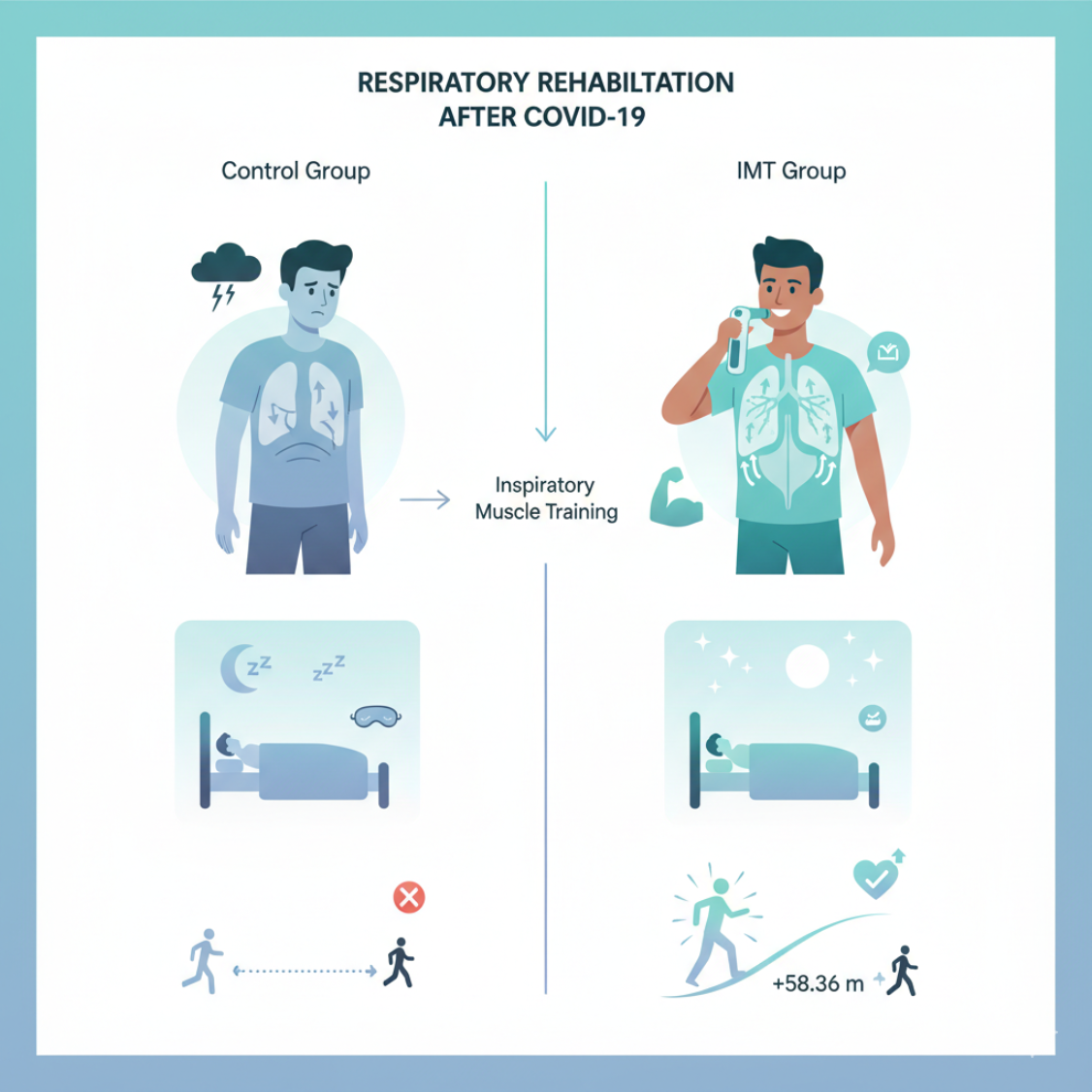

Respiratory Rehabilitation After COVID-19: Efficacy of Inspiratory Muscle Training on Lung Function, Quality of Life and Sleep Quality: A Randomized Clinical Trial

 , , , , , ,
  ,
,  , and
, and
Abstract
1. Introduction
2. Materials and Methods
2.1. Instruments for Data Collection
2.1.1. Inspiratory Muscle Performance
2.1.2. Lung Function
2.1.3. Functional Capacity
2.1.4. Sleep Parameters
Assessment of Daytime Excessive Sleepiness
Sleep Quality Assessment
Quality of Life Assessment
2.2. Intervention
2.3. Sample Size
2.4. Statistical Analysis
3. Results
4. Discussion
5. Conclusions
Author Contributions
Funding
Institutional Review Board Statement
Informed Consent Statement
Data Availability Statement
Acknowledgments
Conflicts of Interest
Abbreviations
| IMT | Inspiratory Muscle Training |
| MIP | Maximum Inspiratory Pressure |
| SMIP | Sustained Maximal Inspiratory Pressure |
| 6MWT | Six-Minute Walk Test |
| FEV1 | Forced Expiratory Volume in 1 Second |
| FVC | Forced Vital Capacity |
| PSQI | Pittsburgh Sleep Quality Index |
| SF-36 | 36-Item Short Form Health Survey |
| EDSS | Epworth Daytime Sleepiness Scale |
| TIRE | Test of Incremental Respiratory Endurance |
| RT-PCR | Reverse Transcription Polymerase Chain Reaction |
| BMI | Body Mass Index |
| FRC | Functional Residual Capacity |
| TLC | Total Lung Capacity |
| ATS | American Thoracic Society |
| ERS | European Respiratory Society |
References
- Carfì, A.; Bernabei, R.; Landi, F. Gemelli Against COVID-19 Post-Acute Care Study Group. Persistent symptoms in patients after acute COVID-19. JAMA 2020, 324, 603–605. [Google Scholar] [CrossRef]
- Tenforde, M.W.; Kim, S.S.; Lindsell, C.J.; Rose, E.B.; Shapiro, N.I.; Files, D.C.; Gibbs, K.W.; Erickson, H.L.; Steingrub, J.S.; Smithline, H.A.; et al. Symptom duration and risk factors for delayed return to usual health among outpatients with COVID-19 in a multistate health care systems network—United States, March–June 2020. MMWR Morb. Mortal. Wkly. Rep. 2020, 69, 993–998. [Google Scholar] [CrossRef]
- Del Corral, T.; Fabero-Garrido, R.; Plaza-Manzano, G.; Fernández-de-Las-Peñas, C.; Navarro-Santana, M.; López-de-Uralde-Villanueva, I. Home-based respiratory muscle training on quality of life and exercise tolerance in long-term post-COVID-19: Randomized controlled trial. Ann. Phys. Rehabil. Med. 2023, 66, 101709. [Google Scholar] [CrossRef]
- McNarry, M.A.; Berg, R.M.G.; Shelley, J.; Hudson, J.; Saynor, Z.L.; Duckers, J.; Lewis, K.; Davies, G.A.; Mackintosh, K.A. Inspiratory muscle training enhances recovery post-COVID-19: A randomised controlled trial. Eur. Respir. J. 2022, 60, 2103101. [Google Scholar] [CrossRef]
- Bahmer, T.; Borzikowsky, C.; Lieb, W.; Horn, A.; Krist, L.; Fricke, J.; Scheibenbogen, C.; Rabe, K.F.; Maetzler, W.; Maetzler, C.; et al. Severity, predictors and clinical correlates of Post-COVID syndrome (PCS) in Germany: A prospective, multi-centre, population-based cohort study. eClinicalMedicine 2022, 51, 101549. [Google Scholar] [CrossRef]
- Formiga, M.F.; Roach, K.E.; Vital, I.; Urdaneta, G.; Balestrini, K.; Calderon-Candelario, R.A.; Campos, M.A.; Cahalin, L.P. Reliability and validity of the test of incremental respiratory endurance measures of inspiratory muscle performance in COPD. Int. J. Chron. Obstruct. Pulmon. Dis. 2018, 13, 1569–1576. [Google Scholar] [CrossRef]
- Laveneziana, P.; Albuquerque, A.; Aliverti, A.; Babb, T.; Barreiro, E.; Dres, M.; Dubé, B.P.; Fauroux, B.; Gea, J.; Guenette, J.A.; et al. ERS statement on respiratory muscle testing at rest and during exercise. Eur. Respir. J. 2019, 53, 1801214. [Google Scholar] [CrossRef]
- Graham, B.L.; Steenbruggen, I.; Barjaktarevic, I.Z.; Miller, M.R.; Cooper, B.G.; Hall, G.L.; Hallstrand, T.S.; Kaminsky, D.A.; McCarthy, K.; McCormack, M.C.; et al. Standardization of spirometry 2019 update: An official American Thoracic Society and European Respiratory Society technical statement. Am. J. Respir. Crit. Care Med. 2019, 200, 1428–1446. [Google Scholar] [CrossRef]
- Pereira, C.A.; Sato, T.; Rodrigues, S.C. New reference values for forced spirometry in white adults in Brazil. J. Bras. Pneumol. 2007, 33, 397–406. [Google Scholar] [CrossRef]
- Fell, B.L.; Hanekom, S.; Heine, M. Six-minute walk test protocol variations in low-resource settings—A scoping review. S. Afr. J. Physiother. 2021, 77, 1549. [Google Scholar] [CrossRef]
- Britto, R.R.; Probst, V.S.; Dornelas de Andrade, A.F.; Samora, G.A.; Hernandes, N.A.; Marinho, P.E.; Karsten, M.; Pitta, F.; Parreira, V.F. Reference equations for the six-minute walk distance based on a Brazilian multicenter study. Braz. J. Phys. Ther. 2014, 18, 556–563. [Google Scholar] [CrossRef]
- Sadeh, A. The role and validity of actigraphy in sleep medicine: An update. Sleep Med. Rev. 2011, 15, 259–267. [Google Scholar] [CrossRef]
- Bertolazi, A.N.; Fagondes, S.C.; Hoff, L.S.; Pedro, V.D.; Menna Barreto, S.S.; Johns, M.W. Validação da escala de sonolência de Epworth em português para uso no Brasil. J. Bras. Pneumol. 2009, 35, 877–883. [Google Scholar] [CrossRef]
- Bertolazi, A.N.; Fagondes, S.C.; Hoff, L.S.; Dartora, E.G.; da Silva Miozzo, I.C.; de Barba, M.E.F.; Barreto, S.S.M. Validation of the Brazilian Portuguese version of the Pittsburgh Sleep Quality Index. Sleep Med. 2011, 12, 70–75. [Google Scholar] [CrossRef]
- Ciconelli, R.M.; Ferraz, M.B.; Santos, W.; Meinão, I.; Quaresma, M.R. Tradução para a língua portuguesa e validação do questionário genérico de avaliação de qualidade de vida SF-36 (Brasil SF-36). Rev. Bras. Reumatol. 1999, 39, 143–150. [Google Scholar]
- Nóbrega-Júnior, J.C.N.; Dornelas de Andrade, A.; de Andrade, E.A.M.; Andrade, M.D.A.; Ribeiro, A.S.V.; Pedrosa, R.P.; Lima, A.M.J.D. Inspiratory muscle training in the severity of obstructive sleep apnea, sleep quality, and excessive daytime sleepiness: A placebo-controlled, randomized trial. Nat. Sci. Sleep 2020, 12, 1105–1113. [Google Scholar] [CrossRef]
- Fritz, C.O.; Morris, P.E.; Richler, J.J. Effect size estimates: Current use, calculations, and interpretation. J. Exp. Psychol. Gen. 2012, 141, 2–18. [Google Scholar] [CrossRef]
- Charususin, N.; Dacha, S.; Gosselink, R.; Decramer, M.; Von Leupoldt, A.; Reijnders, T.; Louvaris, Z.; Langer, D. Respiratory muscle function and exercise limitation in patients with chronic obstructive pulmonary disease: A review. Expert Rev. Respir. Med. 2018, 12, 67–79. [Google Scholar] [CrossRef]
- Anastasio, F.; Barbuto, S.; Scarnecchia, E.; Cosma, P.; Fugagnoli, A.; Rossi, G.; Parravicini, M.; Parravicini, P. Medium-term impact of COVID-19 on pulmonary function, functional capacity, and quality of life. Eur. Respir. J. 2021, 58, 2004015. [Google Scholar] [CrossRef]
- Guler, S.A.; Ebner, L.; Aubry-Beigelman, C.; Bridevaux, P.O.; Brutsche, M.; Clarenbach, C.; Garzoni, C.; Geiser, T.K.; Lenoir, A.; Mancinetti, M.; et al. Pulmonary function and radiological features 4 months after COVID-19: First results from the national prospective observational Swiss COVID-19 lung study. Eur. Respir. J. 2021, 57, 2003690. [Google Scholar] [CrossRef]
- Freeman, D.; Sheaves , B.; Waite , F.; Harvey , A.G.; Harrison, P.J. Sleep disturbance and psychiatric disorders. Lancet Psychiatry 2020, 7, 628–637. [Google Scholar] [CrossRef]
- Tanriverdi, A.; Savci, S.; Kahraman, B.O. Extrapulmonary features of post-COVID-19 patients: Muscle function, physical activity, mood, and sleep quality. Ir. J. Med. Sci. 2022, 191, 969–975. [Google Scholar] [CrossRef]
- Semyachkina-Glushkovskaya, O.; Mamedova, A.; Vinnik, V.; Klimova, M.; Saranceva, E.; Ageev, V.; Yu, T.; Zhu, D.; Penzel, T.; Kurths, J. Brain mechanisms of COVID-19-sleep disorders. Int. J. Mol. Sci. 2021, 22, 6917. [Google Scholar] [CrossRef]
- De Azeredo, L.M.; De Souza, L.C.; Guimarães, B.L.S.; Puga, F.P.; Behrens, N.S.C.S.; Lugon, J.R. Inspiratory muscle training as adjuvant therapy in obstructive sleep apnea: A randomized controlled trial. Braz. J. Med. Biol. Res. 2022, 55, e12331. [Google Scholar] [CrossRef]
- Tseng, T.H.; Chen, H.C.; Wang, L.Y.; Chien, M.Y. Effects of exercise training on sleep quality and heart rate variability in middle-aged and older adults with poor sleep quality: A randomized controlled trial. J. Clin. Sleep Med. 2020, 16, 1483–1492. [Google Scholar] [CrossRef]
- Holland, A.E.; Spruit, M.A.; Troosters, T.; Puhan, M.A.; Pepin, V.; Saey, D.; McCormack, M.C.; Carlin, B.W.; Sciurba, F.C.; Pitta, F.; et al. An official European Respiratory Society/American Thoracic Society technical standard: Field walking tests in chronic respiratory disease. Eur. Respir. J. 2014, 44, 1428–1446. [Google Scholar] [CrossRef]
- Mirenayat, M.S.; Moradkhani, A.; Abedi, M.; Abedini, A.; Zahiri, R.; Karimzadeh, S.; Fakharian, A. Role of inspiratory muscle training on pulmonary rehabilitation in patients with COVID-19: A pilot study. Tanaffos 2022, 21, 466–471. [Google Scholar]
- Chan, J.S.; Mann, L.M.; Doherty, C.J.; Angus, S.A.; Thompson, B.P.; Devries, M.C.; Hughson, R.L.; Dominelli, P.B. The effect of inspiratory muscle training and detraining on the respiratory metaboreflex. Exp. Physiol. 2023, 108, 636–649. [Google Scholar] [CrossRef]
- Aiyegbusi, O.L.; Hughes, S.E.; Turner, G.; Rivera, S.C.; McMullan, C.; Chandan, J.S.; Haroon, S.; Price, G.; Davies, E.H.; Nirantharakumar, K.; et al. Symptoms, complications, and management of long COVID: A review. J. R. Soc. Med. 2021, 114, 428–442. [Google Scholar] [CrossRef]
- Ahmed, H.; Patel, K.; Greenwood, D.C.; Halpin, S.; Lewthwaite, P.; Salawu, A.; Eyre, L.; Breen, A.; O’Connor, R.; Jones, A.; et al. Long-term clinical outcomes in survivors of severe acute respiratory syndrome and Middle East respiratory syndrome coronavirus outbreaks after hospitalization or ICU admission: A systematic review and meta-analysis. J. Rehabil. Med. 2020, 52, 165–177. [Google Scholar] [CrossRef]



| Variables | IMT Group (N = 10) | Sham Group (N = 9) | p-Value |
|---|---|---|---|
| Age (years) | 43.60 ± 12.84 | 57.11 ± 15.66 | 0.079 |
| Weight (kg) | 82.37 ± 14.10 | 79.80 ± 15 | 0.604 |
| Height (m) | 1.61 ± 0.04 | 1.69 ± 0.12 | 0.182 |
| BMI (kg/m2) | 31.73 ± 6.10 | 27.67 ± 2.74 | 0.156 |
| Post-COVID-19 period (months) | 35.63 ± 1.35 | 35.46 ± 0.39 | 0.723 |
| Lung function (% predicted) | |||
| FEV1 | 74.00 ± 16.22 | 79.00 ± 20.35 | 0.560 |
| FVC | 89.70 ± 14.12 | 89.22 ± 14.72 | 0.943 |
| FEV1/FVC | 84.00 ± 20.36 | 88.55 ± 15.81 | 0.596 |
| Inspiratory muscle performance | |||
| MIP (cm H2O) | 68.10 ± 24.38 | 91.22 ± 34.37 | 0.106 |
| SMIP (PTU) | 463.60 ± 157.21 | 504.33 ± 264.89 | 0.685 |
| ID(s) | 10.50 ± 3.25 | 10.72 ± 2.96 | 0.879 |
| Functional capacity | |||
| 6MWD (m) | 463.30 ± 74.32 | 503.00 ± 73.90 | 0.260 |
| 6MWD %pred | 84.99 ± 9.69 | 93.02 ± 14.43 | 0.169 |
| Sleep parameters | |||
| Time in bed (h) | 8.32 ± 1.61 | 7.14 ± 1.32 | 0.103 |
| Total sleep time (h) | 6.82 ± 1.60 | 5.99 ± 1.15 | 0.217 |
| Latency (min) | 3.17 ± 1.97 | 2.65 ± 1.51 | 0.529 |
| Efficacy (%) | 83.75 ± 4.35 | 82.63 ± 6.83 | 0.672 |
| Night awakenings | 10.43 ± 3.33 | 8.51 ± 2.93 | 0.201 |
| EDSS | 11.40 ± 4.08 | 8.67 ± 7.22 | 0.318 |
| PSQI | 9.70 ± 2.40 | 10.33 ± 4.30 | 0.693 |
| Symptoms | |||
| Fatigue | 8 (80%) | 6 (66.6%) | |
| Cough, wheezing | 7 (70%) | 5 (55.5%) | |
| Neurological ailments | 6 (60%) | 7 (77.7%) | |
| Joint and muscle pain | 7 (70%) | 6 (66.6%) | |
| Gastrointestinal ailments | 5 (50%) | 4 (44.4%) | |
| Sleeping disturbance | 8 (80%) | 8 (88.8%) | |
| Exercise intolerance | 6 (60%) | 7 (77.7%) | |
| Infection signs | 0 (0%) | 1 (11.1%) | |
| Chemosensory deficits | 7 (70%) | 8 (88.8%) | |
| Chest pain | 5 (50%) | 7 (77.7%) | |
| Dermatological ailments | 9 (90%) | 9 (100%) | |
| Ear-Nose-Throat ailments | 3 (30%) | 1 (11.1%) | |
| Medications | |||
| Corticosteroids | 3 (30%) | 2 (22.2%) | |
| Beta-blocker | 4 (40%) | 1 (11.1%) | |
| Sedatives | 2 (20%) | 1 (11.1%) | |
| Oral antidiabetic | 2 (20%) | 1 (11.1%) | |
| Antidepressants | 3 (30%) | 3 (33.3%) |
| Variables | IMT Group N = 10 (Mean ± SD) | Sham Group N = 9 (Mean ± SD) | Differences in the Means (95% CI) | p-Value | Effect Size (Cohen’s d) |
|---|---|---|---|---|---|
| Lung Function (% predicted) | |||||
| FEV1 | 93.50 ± 21.73 | 78.55 ± 20.18 | 14.94 (−5.43; 35.32) | 0.140 | 0.40 |
| FVC | 97.20 ± 17.15 | 93.33 ± 15.03 | 3.86 (−11.82; 19.56) | 0.610 | 0.12 |
| FEV1/FVC | 96.60 ± 15.09 | 86.11 ± 12.40 | 10.48 (−2.97; 23.95) | 0.119 | 0.40 |
| Respiratory muscle performance | |||||
| MIP (cm H2O) | 125.50 ± 27.68 | 93.67 ± 33.22 | 31.83 (2.43; 61.32) | 0.036 * | 0.50 |
| SMIP (PTU) | 657.90 ± 147.52 | 554.78 ± 328.32 | 103.12 (−138.74; 344.98) | 0.381 | 0.21 |
| ID(s) | 12.10 ± 1.85 | 11.27 ± 3.50 | 0.82 (−1.84; 3.49) | 0.525 | 0.15 |
| Functional capacity | |||||
| 6MWD (m) | 551.70 ± 69.25 | 493.33 ± 78.41 | 58.36 (−13.08; 129.81) | 0.103 | 0.40 |
| 6MWD %pred | 101.31 ± 6.40 | 91.07 ± 14.43 | 10.23 (−0.37; 20.84) | 0.058 | 0.50 |
| Sleep parameters | |||||
| Time in bed (h) | 7.35 ± 1.11 | 7.59 ± 2.57 | −0.24 (−2.13; 1.64) | 0.787 | 0.06 |
| Total sleep time (h) | 6.53 ± 1.07 | 6.53 ± 2.40 | 0.01 (−1.76; 1.77) | 0.997 | 0.01 |
| Latency (min) | 1.49 ± 0.96 | 2.28 ± 1.46 | −0.78 (−1.97; 0.39) | 0.179 | 0.32 |
| Efficacy (%) | 90.48 ± 5.86 | 82.06 ± 5.34 | 8.42 (2.97; 13.88) | 0.005 * | 0.62 |
| Night awakenings | 6.61 ± 2.46 | 8.54 ± 2.58 | −1.93 (−4.38; 0.51) | 0.113 | 0.40 |
| EDSS | 6.00 ± 4.00 | 10.78 ± 6.62 | −4.77 (−10.01; 0.45) | 0.071 | 0.42 |
| PSQI | 4.40 ± 3.13 | 9.00 ± 3.87 | −4.60 (−7.99; −1.20) | 0.011 * | 0.60 |
Disclaimer/Publisher’s Note: The statements, opinions and data contained in all publications are solely those of the individual author(s) and contributor(s) and not of MDPI and/or the editor(s). MDPI and/or the editor(s) disclaim responsibility for any injury to people or property resulting from any ideas, methods, instructions or products referred to in the content. |
© 2026 by the authors. Licensee MDPI, Basel, Switzerland. This article is an open access article distributed under the terms and conditions of the Creative Commons Attribution (CC BY) license.
Share and Cite
Nóbrega Júnior, J.C.; Brandão, D.; Xavier, D.; Torres, R.; Soares Brandão, S.; Formiga, M.; Fink, J.B.; Ari, A.; Campos, S.; Dornelas de Andrade, A. Respiratory Rehabilitation After COVID-19: Efficacy of Inspiratory Muscle Training on Lung Function, Quality of Life and Sleep Quality: A Randomized Clinical Trial. COVID 2026, 6, 22. https://doi.org/10.3390/covid6010022
Nóbrega Júnior JC, Brandão D, Xavier D, Torres R, Soares Brandão S, Formiga M, Fink JB, Ari A, Campos S, Dornelas de Andrade A. Respiratory Rehabilitation After COVID-19: Efficacy of Inspiratory Muscle Training on Lung Function, Quality of Life and Sleep Quality: A Randomized Clinical Trial. COVID. 2026; 6(1):22. https://doi.org/10.3390/covid6010022
Chicago/Turabian StyleNóbrega Júnior, Jose Carlos, Daniella Brandão, Daiara Xavier, Roberta Torres, Simone Soares Brandão, Magno Formiga, James B. Fink, Arzu Ari, Shirley Campos, and Armèle Dornelas de Andrade. 2026. "Respiratory Rehabilitation After COVID-19: Efficacy of Inspiratory Muscle Training on Lung Function, Quality of Life and Sleep Quality: A Randomized Clinical Trial" COVID 6, no. 1: 22. https://doi.org/10.3390/covid6010022
APA StyleNóbrega Júnior, J. C., Brandão, D., Xavier, D., Torres, R., Soares Brandão, S., Formiga, M., Fink, J. B., Ari, A., Campos, S., & Dornelas de Andrade, A. (2026). Respiratory Rehabilitation After COVID-19: Efficacy of Inspiratory Muscle Training on Lung Function, Quality of Life and Sleep Quality: A Randomized Clinical Trial. COVID, 6(1), 22. https://doi.org/10.3390/covid6010022