
Brief Report

Maternal Mortality During the COVID-19 Pandemic in Tamaulipas, Mexico: A Retrospective Study
by
Hadassa Yuef Martínez-Padrón
1,*,
Ariadne Guadalupe Quintero-Zapata
2,3,
Ares Duvaliere Buenfild-Saldivar
4,
Jorge Luis Valdéz-Báez
5,
Elsa Verónica Herrera-Mayorga
6 and
Rodrigo Vargas-Ruiz
6
1
Subdirección de Enseñanza e Investigación, Hospital Regional de Alta Especialidad Ciudad Victoria, Servicios de Salud del Instituto Mexicano del Seguro Social para el Bienestar (IMSS-BIENESTAR), Libramiento Guadalupe Victoria S/N, Área de Pajaritos, Victoria 87087, Tamaulipas, Mexico
2
Unidad de VIH en embarazadas en los Servicios de Salud de Tamaulipas, Secretaría de Salud de Tamaulipas, Fco. I Madero No 414. Victoria 87000, Tamaulipas, Mexico
3
Unidad de Epidemiología, Hospital Regional de Alta Especialidad Ciudad Victoria, Servicios de Salud del Instituto Mexicano del Seguro Social para el Bienestar (IMSS-BIENESTAR), Victoria 87087, Tamaulipas, Mexico
4
Servicio de Ginecología del Hospital Victoria La Salle, Victoria 87087, Tamaulipas, Mexico
5
Servicio de Neumología, Hospital Regional de Alta Especialidad Ciudad Victoria, Servicios de Salud del Instituto Mexicano del Seguro Social para el Bienestar (IMSS-BIENESTAR), Victoria 87087, Tamaulipas, Mexico
6
Unidad Académica Multidisciplinaria Mante, Universidad Autónoma de Tamaulipas, Mante 89840, Tamaulipas, Mexico
*
Author to whom correspondence should be addressed.
COVID 2025, 5(12), 200; https://doi.org/10.3390/covid5120200
Submission received: 17 October 2025 / Revised: 7 November 2025 / Accepted: 10 November 2025 / Published: 30 November 2025
(This article belongs to the Special Issue COVID and Public Health)

Abstract

Background: Women are at increased risk of developing severe morbidity and mortality during pregnancy, childbirth, and the puerperium, especially in developing countries. In Mexico, during 2020, 27.5% of maternal deaths were attributed to COVID-19. The aim of this study was to describe the sociodemographic and clinical characteristics of maternal deaths among patients with and without COVID-19 in the state of Tamaulipas. Materials and Methods: A non-probabilistic sampling approach was used in this observational, cross-sectional, descriptive, retrospective study of obstetric patients. Results: One hundred and six obstetric patient records were evaluated. Eleven patients died directly from COVID-19 complications. The mean age of the population was 29.5 years, with 7.54% suffering from type 2 diabetes mellitus and 5.66% systemic arterial hypertension. Obstetric complications were late surgical puerperium (11.32%), physiological puerperium (9.43%), and obstetric hemorrhage (7.54%). Lung complications were community-acquired pneumonia (20.75%), of which 50% were due to COVID-19 (10.37%) and respiratory distress syndrome (15.09%). Systemic complications were hypovolemic shock (16.98%), septic shock (15.09%), and multiple organ failure (12.26%). Conclusions: Mortality from COVID-19 in obstetric patients was 10.37%, and 89.63% died from gynecological, lung, and systemic complications.

1. Introduction

The World Health Organization defines maternal mortality as the annual number of deaths in women from any cause related to or aggravated by pregnancy or its management during pregnancy and childbirth or within 42 days after termination of pregnancy [1]. Socioeconomic determinants such as education level, rural residence, and indigenous background significantly influence maternal mortality in Mexico. The latter are linked to inequality in access to health infrastructure, which is highly variable among Mexico states [2,3,4,5,6].
During the COVID-19 pandemic, health systems experienced unprecedented strain due to increased patient acuity and care coordination demands. This situation notably impacted nursing services, which faced higher workload, rapid task reallocation, and emotional stress, directly influencing patient safety and maternal outcomes. The complexity of nursing interventions and interprofessional coordination became a critical determinant of care quality, as reported in contemporary frameworks on nursing complexity and pandemic preparedness [5,6]. Integrating this systemic perspective provides a more comprehensive understanding of the pandemic’s impact on maternal care beyond direct infection.
In Mexico, approximately 60% of maternal deaths occur to young women between 20 and 34 years of age, and 90% of these women have poor prenatal care [2,7]; therefore, pregnant women are more likely to suffer complications and infections because, during pregnancy, there are physiological changes in the adaptive immune response that increase the risk and severity of infections and a physiological increase in adipose tissue contributes to a heightened inflammatory response [8].
Severe acute respiratory syndrome coronavirus 2 (SARS-CoV-2) is a virus that causes coronavirus disease 2019 (COVID-19) and a risk factor in pregnant women [8,9]. Symptoms typically appear 2–14 days after exposure to the virus. Frequent symptoms include fever, chills, cough, dyspnea, fatigue, myalgia, headache, hyposmia, dysphagia, rhinorrhea, nausea, vomiting, and diarrhea; however, 20% of patients present cardiovascular and pulmonary symptoms with a systemic inflammatory response that can result in multiple organ dysfunction (OMD) and a high risk of death [10].
During the COVID-19 pandemic (2020, 2021, and 2022), SARS-CoV-2 was the main cause of maternal death in Mexico, being responsible for 46.0% of deaths in 2023. It was calculated that the mortality ratio was doubled in comparison to the pre-pandemic stage [11]. Other associated risk factors for death due to obstetric complications include postpartum hemorrhage, which has the highest incidence [12,13]. The COVID-19 pandemic profoundly disrupted healthcare systems worldwide, generating an unprecedented increase in patient acuity, complexity of medical management, and demand for critical care resources. In Mexico, the rapid reorganization of services to respond to the pandemic reduced the availability of timely obstetric and surgical care, especially in tertiary centers. This situation not only heightened clinical risk but also intensified the workload and decision-making complexity among medical and nursing teams responsible for managing high-risk pregnancies. The resulting strain on health services underscores the need to analyze maternal mortality within the context of system-wide stress and healthcare coordination challenges [3,4,5].
A preventive tool against COVID-19 complications is vaccination, which does not represent a risk to the fetus or the newborn [14,15]. In the state of Tamaulipas, no scientific articles describe maternal complications related to death from COVID-19. Therefore, this research describes the sociodemographic and clinical characteristics of maternal deaths of patients with and without COVID-19 in the state of Tamaulipas.

2. Materials and Methods

A retrospective descriptive cohort study was conducted using records of obstetric patients who died in Tamaulipas was carried out. Data were obtained from the databases of the Tamaulipas State Health Department (Secretaria de Salud del Estado de Tamaulipas), the Epidemiological Surveillance Systems, and immediate notifications of maternal death from January 2020 to April 2022.

Ethical Approval and Consent

This study was conducted in accordance with the ethical principles of the Declaration of Helsinki. The research protocol was reviewed and approved by the Ethics Committee of the IMSS-Bienestar High Specialty Regional Hospital of Ciudad Victoria (Hospital Regional de Alta Especialidad de Ciudad Victoria “Bicentenario 2010”, IMSS-BIENESTAR) with approval number PI-CEI_005-2025 and approval date 21 June 2025. The Committee also granted a waiver of informed consent due to the retrospective nature of the study, the inclusion of deceased patients’ records, minimal risk to subjects, and strict adherence to confidentiality safeguards. All procedures complied with national and institutional regulations for research ethics and data protection.
Maternal deaths were classified based on official cause-of-death certifications and the surveillance database of the Tamaulipas State Health Department. COVID-19–related maternal deaths were defined as those in which SARS-CoV-2 infection was confirmed by RT-PCR or antigen testing and recorded as the underlying cause of death, with clinical manifestations consistent with COVID-19 pneumonia or its systemic complications. Classification followed WHO and Mexican Ministry of Health criteria (ICD-10 codes O98.5, O99.5, U07.1). Non–COVID-19–related maternal deaths were defined as those resulting from obstetric or systemic causes independent of SARS-CoV-2 infection.
The inclusion criteria comprised obstetric patients who died between January 2020 and April 2022, whose deaths were officially registered in the databases of the Epidemiological Surveillance System and immediate maternal death notifications of the Tamaulipas State Health Department. Only clinical records with complete sociodemographic and clinical information—such as medical history, obstetric and pulmonary complications, and COVID-19–related data—were considered. Exclusion criteria included incomplete medical records, and cases in which the obstetric condition at the time of death could not be confirmed.
Sociodemographic data such as age, number of pregnancies, education level, marital status, health services and prenatal care, and clinical data such as preexisting diseases, obstetric complications and pulmonary complications were obtained from the clinical records of the patients included in the study.
The data were analyzed with SPSS version 22 for Windows. Descriptive statistics were used for the sociodemographic and clinical data of the study population. The percentage was used as a measure of proportion, the mean as the measure of central tendency, and the standard deviation as a measure of dispersion.
Handling of Missing Data. Given the retrospective design and heterogeneity in the quality of medical records, a listwise deletion criterion was applied at the case level: records with incomplete essential anthropometric or clinical data were excluded from the analysis. Consequently, of the 150 records initially identified, 44 were excluded due to incomplete information and 106 were included in the final analysis. No data imputation was performed. The study focused on descriptive comparisons (percentages and measures of central tendency and dispersion) between COVID-19 and non-COVID-19 cases to avoid potentially biased inferences due to low statistical power in small subgroups (COVID-19, n = 11).

3. Results

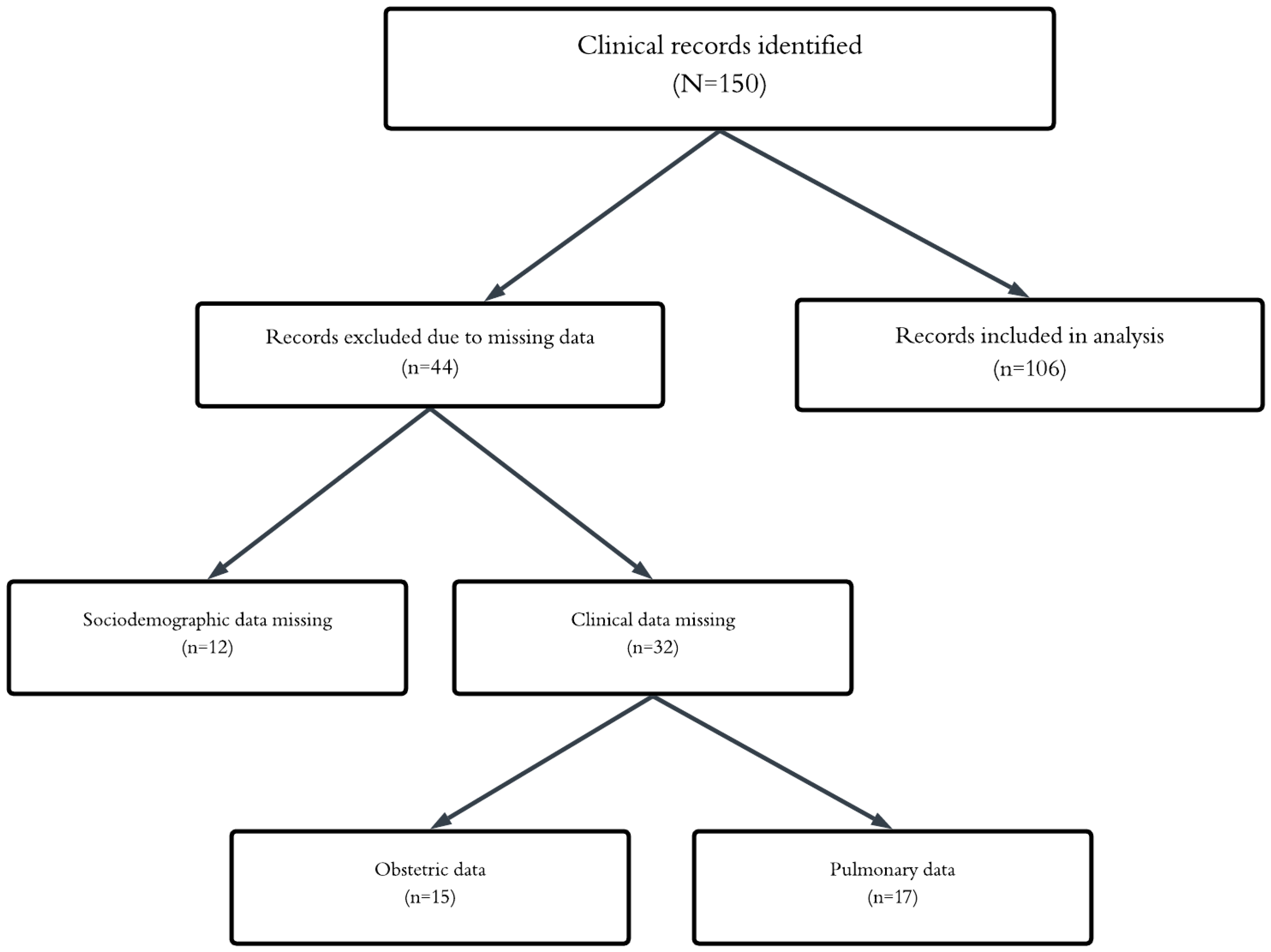
In the study period, a total of 150 records of obstetric patients who died in the state of Tamaulipas were reviewed. Figure 1 illustrates the process of record selection and exclusion. A total of 150 clinical records were identified; 44 were excluded due to missing information. Among excluded records, 12 lacked sociodemographic data and 32 lacked clinical data. Of these, 15 had missing obstetric variables and 17 had missing pulmonary variables. A total of 106 complete records were included in the final analysis. According to official statistics, the annual maternal mortality ratio (MMR) in Tamaulipas was 58.9 per 100,000 live births in 2020, 72.4 in 2021, and 49.3 in 2022, and the total number of births was 44,607, 49,602, and 48,108 in 2020, 2021, and, 2022, respectively.
Age ranged from 14 to 45 years (mean ± SD = 29.5 ± 7.4). The number of pregnancies varied among 1 to 9, with a mean of 2.54. The number of orphans ranged from 1 to 6 (mean ± SD = 1.75 ± 1.2). Among education levels, the predominant level was middle school (33.01%), followed by high school (30.8%), college (22.64%), elementary school (12.26%), and illiterate (1.3%). Regarding marital status, the most frequent was married (45.28%), followed by concubinage (38.67%) and single (16.05%). In respect to prenatal care, 39.62% received medical care in the Mexican Social Security (IMSS); 22.64% did not receive prenatal care; 16.03% received care in the Institute of Health for Well-being (INSABI); 13.20% in the Ministry of Health; 5.66% in the Institute for Social Security and Services for State Workers (ISSSTE); 0.97% in Mexican Petroleum (PEMEX) health services; and 0.94% in IMSS-BIENESTAR. In 0.94%, it was unspecified.
Concerning the patient’s clinical data, in addition to admission complications, 7.54% had pre-pregnancy type 2 diabetes mellitus, 5.66% had pre-pregnancy systemic arterial hypertension, 5.66% disseminated intravascular coagulation, 3.77% obesity, and 2.83% morbid obesity. Among obstetric complications, it was found that late surgical puerperium occurred in 11.32%, followed by physiological puerperium in 9.43%, obstetric hemorrhage in 7.54%, Hemolysis, Elevated Liver Enzymes and Low Platelets (HELLP) syndrome in 6.60%, and uterine atony in 4.71%), among other factors (Table 1).
The pulmonary complications documented were community-acquired pneumonia, with the higher frequency (20.75%); of the latter, 50.0% were due to COVID-19 (10.37%). This condition was followed by respiratory distress syndrome (15.09%), acute respiratory failure (15.09%), and pulmonary thromboembolism (6.60%). Systemic complications included hypovolemic shock (16.98%), followed by septic shock (15.09%), multiple organ failure (12.26%), lethal arrhythmia (3.77%), and cardiorespiratory arrest (3.77%) (Table 2).
For instance, acute respiratory distress syndrome (ARDS) was more frequent among COVID-19-positive cases (15.09%) than non-COVID-19 (7%), and multiple organ failure occurred in 12.26% versus 3.77%, respectively. This stratified presentation underscores the disproportionate pulmonary and systemic burden observed in infected patients.
In Mexico, the date for the application of the first dose of the vaccine against SARS-CoV-2 was 28 July 2021. In this study, we found that 101 patients (95.28%) were not vaccinated against COVID-19, and only 3 patients (2.83%) had 1 dose, while 2 (1.88%) had a complete vaccination scheme. Regarding mortality rates, in 2019, the rate was 14.15%, followed by 2020 with 33.96%, 2021 with 38.67%, and 2022 with 13.22%, according to statistical reports.

4. Discussion

In the present study, we evaluated 106 records of maternal mortality cases in the state of Tamaulipas, Mexico. In 2021, the annual maternal mortality ratio was 72.4, coinciding with the highest number of COVID-19–related maternal deaths reported statewide, representing a 98% increase compared with the pre-pandemic year (2019); the annual maternal mortality ratio (MMR) in Tamaulipas was 23.1 per 100,000 live births in 2019 and 21.1 in 2018 (unpublished data, state public health system).
The data reveal a significant and sustained increase in the maternal mortality ratio (MMR) in Tamaulipas during the COVID-19 pandemic, rising from 23.1 to 34.3 per 100,000 live births in the pre-pandemic years (2017–2019) to 49.3–72.4 between 2020 and 2022. This two- to three-fold escalation mirrors the trend observed nationally and globally, where maternal deaths increased substantially due to both direct and indirect effects of SARS-CoV-2 infection. Similar rises were documented in Mexico, where the national MMR climbed from 31.2 in 2019 to 49.6 in 2021 [6], and in several Latin American countries reporting pandemic-associated surges of 40–80% [7,8,9]. Several factors may explain this marked increase. First, the COVID-19 crisis led to major disruptions in antenatal care coverage, delayed referrals, and the conversion of obstetric hospitals into COVID-19 treatment centers, limiting access to essential perinatal services [5]. Studies across Mexico and Latin America described significant reductions in prenatal consultations, institutional deliveries, and timely management of obstetric emergencies during the pandemic [8]. These barriers, combined with socioeconomic disparities and geographic inequalities, magnified maternal vulnerability to both direct causes (viral pneumonia, thromboembolic complications) and indirect causes (hemorrhage, hypertensive disorders, sepsis) [10].
Beyond individual-level factors, our findings should also be interpreted within the context of the heightened medical and nursing complexity that characterized healthcare delivery during the pandemic. The extraordinary strain on nursing staff, combined with increased patient severity and limited intensive-care capacity, likely contributed to delayed interventions and fragmented care. These systemic pressures compounded the risk of adverse outcomes, especially among patients requiring multidisciplinary management or urgent obstetric surgery. This interpretation aligns with international analyses that link increased workload, reduced staff-to-patient ratios, and coordination deficits with elevated maternal mortality during COVID-19 peaks [13,16]. Therefore, the observed excess mortality reflects not only biological vulnerability to SARS-CoV-2 but also the cascading effects of workforce exhaustion, resource redistribution, and healthcare bottlenecks within tertiary hospitals. Overall, the convergence of delayed access, high clinical severity, and coordination demands concentrated maternal risk during pandemic surges. These results reinforce the need for integrated medical–nursing preparedness metrics and system resilience strategies for future public health crises.
The population evaluated consisted of patients ranging from 14 to 35 years. Age was a risk variable for complications during pregnancy. Scheler et al., in 2021, found that the mean age of pregnant women who died during their study was 31.3 years, a result similar to that reported in this study [17]. The number of pregnancies of the patients was 1–9, with an average of 2.5. The predominant schooling was middle level education with 33.01%, followed by high school with 30.8%, similar to the study by Nwafor et al. 2020 [18] with a total population of 284 pregnant women; 112 had 2 to 4 pregnancies. Of the total population, 107 patients had secondary education; among these patients, 53.27% had inadequate knowledge of preventive measures, and 82.24% had deficient health practice [18]. Therefore, it can be inferred that the level of education is an important factor for self-care in pregnant women during prenatal consultations, which can reduce complications in pregnancy.
In this cohort, 7.54% of patients had type 2 diabetes mellitus and 5.66% had hypertension. These results are similar to those by Ejaz et al., who indicated that people with diabetes and hypertension have a higher risk of developing SARS-CoV-2 infection because the virus uses the ACE-2 receptors found on the surface of host cells to enter the cell. These comorbidities are associated with the expression of these receptors, with increased release of the convertase protein, which facilitates viral entry into cells. This study also found more complications and mortality risks in these patients [19].
On the other hand, studies by Huang and Fajgenbaum confirm that hypertension is associated with increased chronic systemic inflammation and endothelial dysfunction [20]. Considering that the virus initiates its immense immunoinflammatory activity with a more vulnerable person, SARS-CoV-2 triggers increases in inflammatory markers in the blood, including C-reactive protein, ferritin, and D-dimer, increases in the neutrophil-to-lymphocyte ratio, and increases in serum levels of various inflammatory cytokines and chemokines associated with inflammation and lung damage secondary to systemic inflammation and multi-organ dysfunction that can culminate in organ failure [21,22,23,24]. However, the known pathophysiological mechanisms of SARS-CoV-2 in immunocompromised patients let us propose two hypotheses: The first is a possible benefit since this state of immunosuppression can prevent an uncontrolled immune response or “cytokine storm.” Second, it is clear from previous studies that the state of immunosuppression is associated with a greater risk of infection; this situation could be related to the high mortality of these patients [25].
Another comorbidity evaluated in the present investigation was obesity, which was present in 3.77% of the population. This comorbidity has been associated with a reduction in blood oxygen saturation due to compromised ventilation of the lung bases [26], which increases the risk of oxygen requirement. According to Simonnet (2020), up to 68.6% of obese individuals with COVID-19 require invasive mechanical ventilation [27].
Obstetric complications remain a major cause of maternal mortality worldwide. In this study, late surgical puerperium was the obstetric complication in 12 cases, while physiological puerperium occurred in 10 cases. Obstetric hemorrhage was present in 8 cases, followed by HELLP syndrome in 7. This finding relates to the study by Lokken et al., who found that 50% of maternal deaths occurred postpartum [28].
When evaluating pulmonary complications, we found 22 cases of community-acquired pneumonia, of which 50% were due to COVID-19, followed by acute respiratory distress syndrome (ARDS) at 15.09%. A study by Zaim et al. mentions that the most frequent and serious manifestation of COVID-19 is pneumonia, while Chen et al. found that 17% of the patients developed respiratory distress syndrome [4,29]. In addition, 65% of the population deteriorated rapidly and died from multiple organ failure. George et al. concluded that patients with COVID-19 have a 30% to 40% incidence of ARDS. This complication is associated with 70% of fatal cases due to the development of microvascular thrombosis, which contributes to ventilation–perfusion mismatch and right ventricular stress. Disruption of this physiological adaptation in COVID-19 patients results in blood shunting. Therefore, the disease caused by SARS-CoV-2 is a risk factor for mortality in pregnant women [30].
Systemic complications were subsequently evaluated, highlighting hypovolemic shock, which occurred in 16.98%, followed by septic shock in 15.09%, and multiple organ failure in 12.29%. These factors were similar to those reported by Mashak et al., who describe that hypovolemia due to hemorrhage is not tolerated during childbirth and puerperium [31]. Heart function deteriorates, which leads to death.
Finally, of the 106 patients who made up the sample, 101 did not have the SARS-CoV-2 vaccine, while 3 vaccinated patients had only 1 dose of the vaccine, and only 2 had a complete scheme. The low vaccination coverage observed in this cohort (only 2.87% with at least one dose) reflects both structural and behavioral determinants. During the early stages of Mexico’s vaccination campaign (January–June 2021), pregnant women were not initially prioritized as a target group, leading to delayed access until updated national guidelines (June 2021) explicitly recommended vaccination during pregnancy. In 2021, 20,335 women had a complete immunization schedule (two vaccine doses), whereas in 2022, 17,724 women completed their vaccination schedule. This represents a 12.27% decrease in vaccination coverage. This policy lag, coupled with vaccine supply limitations in certain regions and uneven distribution between urban and rural areas, restricted availability during the first pandemic waves. In addition, vaccine hesitancy likely played a significant role. Misconceptions regarding potential risks to the fetus, limited dissemination of evidence supporting vaccine safety, and inconsistent messaging across health institutions contributed to uncertainty among pregnant women. Previous national surveys have documented that more than 40% of women of reproductive age expressed initial reluctance to receive the COVID-19 vaccine, mainly due to perceived fetal risks and misinformation [32]. Access barriers such as transportation difficulties, lack of continuous prenatal care, and reduced service capacity during lockdowns further hindered vaccine uptake. These factors collectively explain the high proportion of unvaccinated patients identified in this study.
Leik et al. (2021) and Polack et al. (2020) concluded in their article that the vaccine against SARS-CoV-2 offers protection against the virus and does not represent a risk for the patient or the fetus [33,34]. Studies conducted by Prabhu et al., evaluating the antibody response to SARS-CoV-2 through mRNA vaccines in pregnant women and their neonates, determined that antibody responses develop rapidly after vaccination, but this effect is not observed with natural infection since the latter tends to produce a more gradual response [35]. In pregnancy, the concentration of IgG and IgM antibodies against COVID-19 considerably increases after vaccination. IgG seroconversion was found to predominate in most of these pregnant women, but IgM seroconversion was also observed, although in a much smaller proportion.
In addition, vaccine hesitancy likely played a significant role. Misconceptions regarding potential risks to the fetus, limited dissemination of evidence supporting vaccine safety, and inconsistent messaging across health institutions contributed to uncertainty among pregnant women. Previous national surveys have documented that more than 40% of women of reproductive age expressed initial reluctance to receive the COVID-19 vaccine, mainly due to perceived fetal risks and misinformation. Access barriers such as transportation difficulties, lack of continuous prenatal care, and reduced service capacity during lockdowns further hindered vaccine uptake. These factors collectively explain the high proportion of unvaccinated patients identified in this study.
The results of this study align with previous national and international reports on maternal mortality during the COVID-19 pandemic. Similar to the findings of Méndez-Domínguez et al. [6], who reported a twofold increase in maternal deaths in Mexico during 2020, our analysis revealed a substantial rise in mortality and a predominance of pulmonary and systemic complications among COVID-19–positive obstetric patients. In Brazil, Scheler et al. [17] and Lokken et al. [28] documented that COVID-19-related maternal deaths occurred mainly among women aged 25–35 years with preexisting comorbidities such as hypertension and obesity, which mirrors the demographic and clinical characteristics observed in our study. Likewise, studies conducted in low- and middle-income countries by Musarandega et al. [3] and Heitkamp et al. [13] emphasized the structural inequities in access to timely intensive care and vaccination, factors that may explain similar adverse outcomes in our cohort. Moreover, our finding that only 4.7% of the women in this study were vaccinated at the time of death is consistent with results reported by Rodríguez-Sibaja et al. [15], who observed low vaccination uptake among pregnant women in middle-income settings, largely due to vaccine hesitancy, misinformation, and initial exclusion from immunization campaigns. Overall, the pattern observed in Tamaulipas reflects global trends in which COVID-19 exacerbated preexisting inequities in maternal health systems, as reported in multi-country analyses by Collier and Molina [5] and the World Health Organization [36]. By providing regional epidemiological evidence, our study contributes to the growing international body of research showing that the pandemic disproportionately affected maternal populations with limited healthcare access and preventive protection.
Although only 10.37% of maternal deaths were directly linked to confirmed COVID-19 infection, the pandemic likely exerted substantial indirect effects that contributed to increased maternal mortality. These effects include delayed access to emergency obstetric care, reductions in prenatal consultations due to fear of contagion, and overburdened healthcare systems that limited timely management of obstetric complications. Similar findings have been reported in multi-country analyses, where disruptions in referral pathways, transportation restrictions, and shortages of healthcare personnel resulted in preventable maternal deaths despite the absence of direct infection [16,37]. Additionally, the stress imposed on hospital capacity during pandemic peaks may have delayed surgical interventions (e.g., for hemorrhage or preeclampsia), leading to secondary complications. Socioeconomic stressors, such as unemployment, reduced income, and limited mobility, also impaired adherence to prenatal care and treatment continuity [37]. Therefore, while most deaths in this study were classified as non-COVID-19-related, the contextual impact of the pandemic likely amplified preexisting health disparities and structural vulnerabilities within the maternal care system.
Maternal mortality is a problem that must be addressed from a multidisciplinary point of view by the Ministry of Health, which addresses the production of strategic information, clarifies doubts and misconceptions about pregnancy, vaccination, and COVID-19, in addition to designing, strengthening, and implementing public policies that favor maternal health, from a human rights approach.

5. Conclusions

The present work describes the sociodemographic and clinical characteristics of the maternal deaths presented in the public healthcare system hospitals through 2020–2022. Education level was identified to be an important factor in the development of obstetrical complications. Also, COVID-19-related maternal deaths accounted for 10.37%, whereas 89.63% were to gynecological, pulmonary, and systemic complications unrelated to COVID-19. Our findings suggest that the pandemic’s influence on maternal mortality extends beyond direct viral infection, highlighting the importance of strengthening healthcare resilience, maintaining continuity of obstetric services, and addressing systemic barriers during health emergencies.

Author Contributions

Conceptualization, A.G.Q.-Z., A.D.B.-S., J.L.V.-B., and H.Y.M.-P.; methodology, A.G.Q.-Z., A.D.B.-S., and H.Y.M.-P.; software, A.G.Q.-Z., A.D.B.-S., J.L.V.-B., E.V.H.-M., R.V.-R., and H.Y.M.-P.; validation, A.G.Q.-Z., A.D.B.-S., J.L.V.-B., and H.Y.M.-P.; formal analysis, A.G.Q.-Z., A.D.B.-S., J.L.V.-B., E.V.H.-M., R.V.-R., and H.Y.M.-P.; investigation, A.G.Q.-Z. and H.Y.M.-P.; resources, A.G.Q.-Z., A.D.B.-S., J.L.V.-B., E.V.H.-M., R.V.-R., and H.Y.M.-P.; data curation, A.G.Q.-Z. and H.Y.M.-P.; writing—original draft preparation, R.V.-R. and H.Y.M.-P.; writing—review and editing, R.V.-R. and H.Y.M.-P.; visualization, A.G.Q.-Z., E.V.H.-M., R.V.-R., and H.Y.M.-P.; supervision, H.Y.M.-P.; project administration, A.G.Q.-Z. and H.Y.M.-P. All authors have read and agreed to the published version of the manuscript.

Funding

This research received no external funding.

Institutional Review Board Statement

The study was conducted in accordance with the Declaration of Helsinki and approved by the Local Institutional Ethics Committee of IMSS-BIENESTAR the approval number: PI-CEI_005-2025, on 21 July 2025.

Informed Consent Statement

Patient consent was waived due to retrospective gathering of the data.

Data Availability Statement

Data will be available upon request to the corresponding author.

Conflicts of Interest

The authors declare no conflicts of interest.

Abbreviations

The following abbreviations are used in this manuscript:
COVID-19Coronavirus Disease 2019
SARS-CoV-2Severe Acute Respiratory Syndrome Coronavirus 2
IMSSMexican Social Security Institute (Instituto Mexicano del Seguro Social)
INSABIInstitute of Health and Well-being (Instituto Mexicano para el Bienestar)
PEMEXMexican Petroleum Health Services
IMSS-BienestarMexican Social Security Welfare Program
HELLPHemolysis, elevated liver enzymes and low platelets syndrome
ARDSAcute Respiratory Distress Syndrome
OMDMultiple organ dysfunction
IgGImmunoglobulin G
IgMImmunoglobulin M
ACE-2Angiotensin Converting Enzyme 2

References

  1. World Health Organization. Maternal Mortality; World Health Organization: Geneva, Switzerland, 2019.
  2. Rodríguez-Aguilar, R. Maternal mortality in Mexico, beyond millennial development objectives: An age-period-cohort model. PLoS ONE 2018, 13, e0194607. [Google Scholar] [CrossRef]
  3. Musarandega, R.; Nyakura, M.; Machekano, R.; Pattinson, R.; Munjanja, S.P. Causes of maternal mortality in SubSaharan Africa: A systematic review of studies published from 2015 to 2020. J. Glob. Health 2021, 11, 04048. [Google Scholar] [CrossRef] [PubMed]
  4. Chen, L.; Feng, P.; Shaver, L.; Wang, Z. Maternal mortality ratio in China from 1990 to 2019: Trends, causes and correlations. BMC Public Health 2021, 21, 1536. [Google Scholar] [CrossRef] [PubMed]
  5. Collier, A.R.Y.; Molina, R.L. Maternal mortality in the united states: Updates on trends, causes, and solutions. Neoreviews 2019, 20, e561–e574. [Google Scholar] [CrossRef]
  6. Mendez-Dominguez, N.; Santos-Zaldívar, K.; Gomez-Carro, S.; Datta-Banik, S.; Carrillo, G. Maternal mortality during the COVID-19 pandemic in Mexico: A preliminary analysis during the first year. BMC Public Health 2021, 21, 1297. [Google Scholar] [CrossRef]
  7. González-De la Mora, V.M. Clasificación de morbilidad y mortalidad materna mediante una escala de disfunción orgánica. Rev. Med. Inst. Mex. Seguro Soc. 2020, 58, 686–697. [Google Scholar]
  8. Böger, B.; Fachi, M.M.; Vilhena, R.O.; Cobre, A.F.; Tonin, F.S.; Pontarolo, R. Systematic review with meta-analysis of the accuracy of diagnostic tests for COVID-19. Am. J. Infect. Control 2021, 49, 21–29. [Google Scholar] [CrossRef]
  9. García-Espinosa, M.; Moreno-Álvarez, O.; Carranza-Lira, S.; Caldiño-Soto, F. Características clínicas, obstétricas y perinatales de embarazadas mexicanas con COVID-19 TT—Clinical, obstetric and perinatal characteristics of Mexican pregnant women with COVID-19. Rev. Méd. Inst. Mex. Seguro Soc. 2022, 60, 116–128. [Google Scholar]
  10. Hadaway, A. COVID-19: Prevent the Spread a Review of www.cdc.gov/coronavirus. J. Consum. Health Internet 2020, 24, 407–415. [Google Scholar] [CrossRef]
  11. Torres-Torres, J.; Martinez-Portilla, R.J.; Espino y Sosa, S.; Solis-Paredes, J.M.; Hernández-Pacheco, J.A.; Mateu-Rogell, P.; Cravioto-Sapien, A.; Zamora-Madrazo, A.; Estrada-Gutierrez, G.; Nares-Torices, M.A.; et al. Maternal Death by COVID-19 Associated with Elevated Troponin T Levels. Viruses 2022, 14, 271. [Google Scholar] [CrossRef]
  12. Elrobaa, I.H.; New, K.J. COVID-19: Pulmonary and Extra Pulmonary Manifestations. Front. Public Health 2021, 9, 711616. [Google Scholar] [CrossRef]
  13. Heitkamp, A.; Meulenbroek, A.; van Roosmalen, J.; Gebhardt, S.; Vollmer, L.; de Vries, J.I.; Theron, G.; van den Akker, T. Maternal mortality: Near-miss events in middle-income countries, a systematic review. Bull. World Health Organ. 2021, 99, 693–707. [Google Scholar] [CrossRef]
  14. Garg, I.; Shekhar, R.; Sheikh, A.B.; Pal, S. COVID-19 vaccine in pregnant and lactating women: A review of existing evidence and practice guidelines. Infect. Dis. Rep. 2021, 13, 685–699. [Google Scholar] [CrossRef]
  15. Rodriguez-Sibaja, M.J.; Acevedo-Gallegos, S.; Campos-Zamora, M.; Arce-Padilla, L.G.; Hernandez-Reguero, J.L.; Lumbreras-Marquez, M.I. COVID-19 vaccination uptake among pregnant individuals in a middle-income setting. Int. J. Gynaecol. Obstet. 2022, 159, 607–609. [Google Scholar] [CrossRef]
  16. Calvert, C.; John, J.; Nzvere, F.P.; Cresswell, J.A.; Fawcus, S.; Fottrell, E.; Say, L.; Graham, W.J. Maternal mortality in the COVID-19 pandemic: Findings from a rapid systematic review. Glob. Health Action. 2021, 14, 1974677. [Google Scholar] [CrossRef]
  17. Scheler, C.A.; Discacciati, M.G.; Vale, D.B.; Lajos, G.J.; Surita, F.; Teixeira, J.C. Mortality in pregnancy and the postpartum period in women with severe acute respiratory distress syndrome related to COVID-19 in Brazil, 2020. Int. J. Gynaecol. Obstet. 2021, 155, 475–482. [Google Scholar] [CrossRef] [PubMed]
  18. Nwafor, J.I.; Aniukwu, J.K.; Anozie, B.O.; Ikeotuonye, A.C.; Okedo-Alex, I.N. Pregnant women’s knowledge and practice of preventive measures against COVID-19 in a low-resource African setting. Int. J. Gynaecol. Obstet. 2020, 150, 121–123. [Google Scholar] [CrossRef] [PubMed]
  19. Ejaz, H.; Alsrhani, A.; Zafar, A.; Javed, H.; Junaid, K.; Abdalla, A.E.; Abosalif, K.O.; Ahmed, Z.; Younas, S. COVID-19 and comorbidities: Deleterious impact on infected patients. J. Infect. Public Health 2020, 13, 1833–1839. [Google Scholar] [CrossRef] [PubMed]
  20. Huang, C.; Wang, Y.; Li, X.; Ren, L.; Zhao, J.; Hu, Y.; Zhang, L.; Fan, G.; Xu, J.; Gu, X.; et al. Clinical features of patients infected with 2019 novel coronavirus in Wuhan, China. Lancet 2020, 395, 497–506. [Google Scholar] [CrossRef] [PubMed]
  21. Fajgenbaum, D.C.; June, C.H. Cytokine Storm. N. Engl. J. Med. 2020, 383, 2255–2273. [Google Scholar] [CrossRef]
  22. Tay, M.Z.; Poh, C.M.; Rénia, L.; MacAry, P.A.; Ng, L.F.P. The trinity of COVID-19: Immunity, inflammation and intervention. Nat. Rev. Immunol. 2020, 20, 363–374. [Google Scholar] [CrossRef] [PubMed]
  23. Cajamarca-Baron, J.; Guavita-Navarro, D.; Buitrago-Bohorquez, J.; Gallego-Cardona, L.; Navas, A.; Cubides, H.; Arredondo, A.M.; Escobar, A.; Rojas-Villarraga, A. SARS-CoV-2 (COVID-19) en pacientes con algún grado de inmunosupresión. Reumatol. Clin. 2021, 17, 408–419. [Google Scholar] [CrossRef]
  24. Najera, H.; Ortega-Avila, A.G. Health and Institutional Risk Factors of COVID-19 Mortality in Mexico, 2020. Am. J. Prev. Med. 2021, 60, 471–477. [Google Scholar] [CrossRef] [PubMed]
  25. Petrova, D.; Salamanca-Fernández, E.; Rodríguez Barranco, M.; Navarro Pérez, P.; Jiménez Moleón, J.J.; Sánchez, M.-J. La obesidad como factor de riesgo en personas con COVID-19: Posibles mecanismos e implicaciones. Aten. Primaria 2020, 52, 496–500. [Google Scholar] [CrossRef]
  26. Onder, G.; Rezza, G.; Brusaferro, S. Case-Fatality Rate and Characteristics of Patients Dying in Relation to COVID-19 in Italy. J. Am. Med. Assoc. 2020, 323, 1775–1776. [Google Scholar] [CrossRef]
  27. Simonnet, A.; Chetboun, M.; Poissy, J.; Raverdy, V.; Noulette, J.; Duhamel, A.; Labreuche, J.; Mathieu, D.; Pattou, F.; Jourdain, M.; et al. High Prevalence of Obesity in Severe Acute Respiratory Syndrome Coronavirus-2 (SARS-CoV-2) Requiring Invasive Mechanical Ventilation. Obesity 2020, 28, 1195–1199. [Google Scholar] [CrossRef]
  28. Lokken, E.M.; Huebner, E.M.; Taylor, G.G.; Hendrickson, S.; Vanderhoeven, J.; Kachikis, A.; Coler, B.; Walker, C.L.; Sheng, J.S.; Al-Haddad, B.J.; et al. Disease severity, pregnancy outcomes, and maternal deaths among pregnant patients with severe acute respiratory syndrome coronavirus 2 infection in Washington State. Am. J. Obstet. Gynecol. 2021, 225, 77.e1–77.e14. [Google Scholar] [CrossRef]
  29. Zaim, S.; Chong, J.H.; Sankaranarayanan, V.; Harky, A. COVID-19 and multiorgan response. Curr. Probl. Cardiol. 2020, 45, 100618. [Google Scholar] [CrossRef]
  30. Hoyert, D.L.; Uddin, S.F.G.; Miniño, A.M. Evaluation of the pregnancy status checkbox on the identification of maternal deaths. Natl. Vital. Stat. Rep. 2020, 69, 1–25. [Google Scholar]
  31. Mashak, B.; Hashemnejad, M.; Fakehi, M.; Heidary, Z.; Mirmajidi, R.; Ghaemi, M. Atypical presentation of cardiomyopathy in a case of maternal mortality that was demonstrated as hypovolemic shock. Clin. Case Rep. 2021, 9, e05010. [Google Scholar] [CrossRef] [PubMed]
  32. Ramonfaur, D.; Hinojosa-González, D.E.; Rodriguez-Gomez, G.P.; Iruegas-Nuñez, D.A.; Flores-Villalba, E. COVID-19 vaccine hesitancy and acceptance in Mexico: A web-based nationwide survey. Rev. Panam. De Salud Pública 2021, 45, e133. [Google Scholar] [CrossRef] [PubMed]
  33. Leik, N.K.O.; Ahmedy, F.; Guad RMac Baharuddin, D.M.P. COVID-19 vaccine and its consequences in pregnancy: Brief review. Ann. Med. Surg 2021, 72, 103103. [Google Scholar] [CrossRef] [PubMed]
  34. Polack, F.P.; Thomas, S.J.; Kitchin, N.; Absalon, J.; Gurtman, A.; Lockhart, S.; Perez, J.L.; Pérez Marc, G.; Moreira, E.D.; Zerbini, C.; et al. Safety and Efficacy of the BNT162b2 mRNA COVID-19 Vaccine. N. Engl. J. Med. 2020, 383, 2603–2615. [Google Scholar] [CrossRef] [PubMed]
  35. Prabhu, M.; Murphy, E.A.; Sukhu, A.C.; Yee, J.; Singh, S.; Eng, D.; Zhao, Z.; Riley, L.E.; Yang, Y.J. Antibody response to SARS-CoV-2 mRNA vaccines in pregnant women and their neonates. bioRxiv 2021. [Google Scholar] [CrossRef]
  36. World Health Organization (WHO). Trends in Maternal Mortality: 2000 to 2020—Estimates by WHO, UNICEF, UNFPA, World Bank Group, and the United Nations Population Division; World Health Organization: Geneva, Switzerland, 2023. Available online: https://www.who.int/publications/i/item/9789240068759 (accessed on 7 October 2025).
  37. Roberton, T.; Carter, E.D.; Chou, V.B.; Stegmuller, A.R.; Jackson, B.D.; Tam, Y.; Sawadogo-Lewis, T.; Walker, N. Early estimates of the indirect effects of the COVID-19 pandemic on maternal and child mortality in low-income and middle-income countries: A modelling study. Lancet Glob. Health 2020, 8, e901–e908. [Google Scholar] [CrossRef]
Figure 1. Flow diagram of the record selection analysis.
Covid 05 00200 g001
Table 1. Sociodemographic and clinical characteristics of gynecologic and obstetric patients who died between 2020 and 2022 in Tamaulipas.
Characteristics of the PopulationNumber of Cases (n)Average
No. of cases106---
Age (years)14 a 4529.5
Number of pregnancies1 a 92.54
Number of orphans1 a 61.75
ComorbiditiesNumber of cases of COVID-19 (n)Number of cases Non COVID-19 (n)Total (n)
Diabetes Mellitus 2628
Systemic arterial hypertension426
Obesity314
Morbid obesity303
Gyneco-obstetric complicationsNumber of cases of COVID-19 (n)Number of cases of non-COVID-19 (n)Total (n)
Late surgical puerperium21012
Physiological puerperium1910
Obstetric hemorrhage538
Disseminated intravascular coagulopathy426
Uterine atony415
Ruptured ectopic pregnancy145
Preeclampsia224
Eclampsia134
Septic abortion014
Pregnancy 1st trimester123
Pregnancy 2nd trimester123
Stillbirth033
Placental accreta022
Late physiological puerperium022
Puerperal sepsis022
Placenta previa202
Complicated surgical puerperium202
Pregnancy 3rd trimester011
Uterine inversion011
Missed abortion011
Surgical puerperium011
Miscarriage011
Cesarean section111
Hysterectomy011
Table 2. Pulmonary and systemic complications of obstetric patients who died between 2020 and 2022 in Tamaulipas, Mexico.
Pulmonary ComplicationsNumber of Cases of COVID-19 (n)Number of Cases of Non-COVID-19 (n)Total (n)
Community-acquired pneumonia41822
Acute respiratory distress syndrome11718
Acute respiratory failure16016
Pulmonary embolism8816
Pulmonary hypertension51116
Ventilator-associated pneumonia21416
Systemic complicationsNumber of cases of COVID-19 (n)Number of cases of Non COVID-19 (n)Total (n)
Hypovolemic shock448
Septic shock257
Multiple organ failure134
Lethal arrhythmia044
Cardiopulmonary arrest044
Ischemic cerebrovascular event044
Brain hemorrhage033
Bowel perforation033
Acute pulmonary edema123
Acute renal failure033
Acute kidney injury022
Acute peritonitis022
Bacterial meningitis022
Hepatic steatosis011
Scleroderma011
Anemia011
Surgical wound infection011
Liver failure011
Malnutrition011
Seizures011
Acquired Immunodeficiency Syndrome011
Metabolic disorder011
Dyslipidemia011
Disclaimer/Publisher’s Note: The statements, opinions and data contained in all publications are solely those of the individual author(s) and contributor(s) and not of MDPI and/or the editor(s). MDPI and/or the editor(s) disclaim responsibility for any injury to people or property resulting from any ideas, methods, instructions or products referred to in the content.