Article

Resilience and Inequality in Public Health: An Empirical Analysis of Systemic Vulnerabilities and Care Strategies During COVID-19


1
Department of Economics, College of Business, Imam Mohammad Ibn Saud Islamic University (IMSIU), Prince Mohammed Ibn Salman Ibn Abdulaziz Rd, Riyadh 13318, KSA, Saudi Arabia
2
Faculty of Economic Sciences and Management, University of Sousse, Sousse Riadh 4023, Tunisia
*
Author to whom correspondence should be addressed.
COVID 2025, 5(11), 185; https://doi.org/10.3390/covid5110185
Submission received: 3 October 2025 / Revised: 25 October 2025 / Accepted: 27 October 2025 / Published: 30 October 2025
(This article belongs to the Section COVID Public Health and Epidemiology)

Abstract

The COVID-19 pandemic has had a diverse impact worldwide, affecting all strata of society. This article examines the relationship between health system adaptation and socioeconomic inequality in countries and the WHO Eastern Mediterranean Region (WHO-EMR), and we suggest that the dynamics among government response, health system preparedness, and epidemic spread are calibrated by the present socioeconomic inequality. With the use of a panel dataset spanning February 2020 to March 2021 and both linear (PARDL) and nonlinear (PNARDL) estimation techniques, we find that more socioeconomically vulnerable regions were disproportionately hit by the efforts of the pandemic, even in the presence of containment measures. From our findings, we find that health system capacity measures, such as hospital bed density and primary healthcare expenditure, are positively related to long-term economic resilience, while antimicrobial drug resistance is strongly negatively related to it. The study emphasizes the need for selective policy interventions to protect the most disadvantaged groups, a finding of relevance for other high-inequality low- and middle-income countries.

1. Introduction

December 2019 is the COVID-19 start date, and it began in China. In 2020, COVID-19 became a pandemic that affected almost all countries, and more than 50 million people were affected in the world [1,2]. By the end of March 2021, the number of deaths in the world was 2.8 million, and this pandemic has affected dissimilar countries in different ways [3,4].
The response to COVID-19 is heterogeneous between countries. The ability of health systems to manage this pandemic is centered on some indicators: hospitality capacity, the rapid scale-up of testing for the case numbers, the presence of a social welfare system, and the capacity of the state to support business and unemployed citizens through an economic intervention. In France, Italy, Spain, and the UK, the ability of health systems is very adaptable and adequately resourced [5,6]. By contrast, following Aghion and Im et al. [3,7], the health system response in Latin America has been handicapped by inadequate resources and socioeconomic inequalities. The public health response is very divergent around the world, which is one of the many reasons that some countries are more affected by the pandemic than others. The health system’s adaptation to manage this crisis depends on many characteristics.
This paper highlights the specific territorial dimension of the COVID-19 crisis. This region is characterized by asymmetric health, economic, social, and fiscal conditions within countries. As of 31 May 2021, more than 10 million cases of COVID-19 had been reported in the World Health Organization’s Eastern Mediterranean Region (WHO-EMR).
Managing the health system and the situation in the crisis case involves a collaboration and coordination system between hospitals and the local government. We can consider this pandemic a shock that can determine the level of the health system in the countries and the ability to manage the situation [8]. Argued that the hospital intensive care unit and adequate numbers and types of healthcare personnel are very useful for dealing with this epidemic. Piketty [9] indicate that China and South Korea have a successful care system to control COVID-19 with a high detection rate, and they should be a guiding reference for the rest of the world.

2. A Brief Literature Review

Conceptual models identify a number of channels through which socioeconomic inequality devalues both health system sustainability and economic growth. Inequality first reduces aggregate human capital accumulation, as disadvantaged groups face barriers to education and health investment; since returns to human capital are convex, this shortage disproportionately reduces productivity and long-run growth [10,11]. Second, in imperfect credit markets, inequality limits access to finance for human capital acquisition and entrepreneurship, creating long-run underinvestment and misallocation of capital—characteristics of low social mobility [8]. Third, political economy models predict that more unequal societies are more likely to skew public policy towards the interests of elites, underproviding public goods, such as epidemic surveillance and primary healthcare—hence eroding health system resilience [12,13].
Fourth, such extreme inequality can erode fiscal capacity and reduce progressive taxation, making it harder for the government to sustain universal health coverage and make long-term health infrastructure investments [14]. Fifth, from a health production perspective, unequal exposure to risk factors and poor access to care raise population morbidity, increasing overall healthcare demand and costs and making systems less financially sustainable [6,8]. Sixth, inequality undermines social cohesion and trust—preconditions for compliance with public health regulations and collective action—and thus increases transaction costs and reduces the effectiveness of health interventions [15,16]. Finally, these channels simultaneously interact nonlinearly; political capture and underinvestment can create feedback loops (vicious cycles) that reinforce high-inequality, low-investment equilibria, which explains why inequality can have long run and asymmetric effects on growth and system sustainability. Combining these mechanisms tells us why policy responses that address both redistribution and universal health system strengthening are necessary to achieve strong and sustainable economic growth during and after public health crises.
The impact of COVID-19 has been extensively debated in the media and recognized in theoretical articles. Nevertheless, there are limited quantitative studies, and where they exist, they focus on a specific aspect of the answer and have not examined overall designs over time and across regions for the whole country. We used the search terms “COVID-19”, “Answer”, “Health System Preparation”, and “Inequalities to recognize relevant studies published in English. This training has encompassed a limited range of indicators for response and outcome.
The current literature has increasingly emphasized the interconnections between the theory of inequality, health system sustainability, and sustainable long-term economic growth. On the theory of inequality, differences in income and opportunities can lead to unequal degrees of access to healthcare, thereby undermining the general resilience and efficiency of health systems [16,17]. Economic inequality not only limits the health outcomes of people but also ties overall productivity and fiscal potential, constraining governments’ ability to offer sustainable public health provision [1]. Empirical evidence demonstrates that more egalitarian societies are more likely to achieve higher health system performance, greater social cohesion, and more stable growth trajectories [18,19]. In contrast, growing inequality results in underinvestment in primary care and preventive medicine, with higher long-term costs and more exposure to public health shocks, such as pandemics. This convergence of opinions demonstrates that addressing inequality is not just the right thing to do but also an economic strategy to ensure health system sustainability and sustainable growth. This theory provides an accompanying framework for understanding our empirical evidence of the relationships between economic resilience, health capacity, and socioeconomic vulnerability during the COVID-19 pandemic.
Our training contributes original, comprehensive evidence on the elements and outcomes of COVID-19, principally in the contexts of inclusive socioeconomic and environmental inequalities. By joining statistics and information on an extensive set of state-level indicators, municipal-level panels of monthly data, and robust econometric techniques, we produced a wide-ranging characterization of COVID-19 in many countries and identified designs that could be relevant to informing responses in countries of our sample. Specifically, we found that existing socioeconomic inequalities, relatively more than age and health status, determined the initial course of the epidemic and deaths since COVID-19, with a disproportionate problem in states and municipalities with high socioeconomic vulnerability, despite their efforts to contain the epidemic.
These results revealed the need for besieged strategies and activities to defend the most vulnerable groups. The country’s experience similarly divulges that local answer and population behavior in positions with high socioeconomic vulnerability might be involved in containing the epidemic, especially in contexts with central government inertia [20].
A parallel design of the epidemic observed has appeared in other countries, particularly in low- and middle-income countries with extensive inequalities, where socioeconomically susceptible areas and populations are the least protected and face the greatest risk from COVID-19. In addition to risk factors for adverse COVID-19 outcomes, such as older age and enduring sickness, rules designed for aggressive COVID-19 should consider socioeconomic vulnerability.

3. Empirical Methodology

We downloaded the report from the World Health Organization (WHO) from 13 February 2020 to 28 March 2021.

3.1. Discussion of Findings

Overall, the empirical results confirm a high, long-term relationship between health determinants associated with inequality and economic performance. The findings are congruent with recent evidence from Rocha [21] and Marmot [18] who contend that unequal healthcare is responsible for amplifying the economic impact of pandemics. According to the inequality theory approach [16,17], unequal access to health implies lower productivity in human capital and slower recovery trajectories. Yet, countries that made healthcare expenditure equitable during the pandemic experienced increased resilience and faster economic recovery. The results highlight the necessity of equitable health policies that lead to economic, social, and institutional integration for sustainability in both the health system and sustained growth.

3.2. Data and Variables

This analysis utilizes February 2020 to March 2021 monthly panel data for WHO Eastern Mediterranean Region countries (WHO-EMR). The data were obtained from the databases of the World Health Organization, the World Bank’s World Development Indicators (WDI), and the WHO Global Health Expenditure Database. The dataset is a combination of health, demographic, and macroeconomic indicators to assess the relationships between inequality, health system capacity, and economic growth during the COVID-19 pandemic.
The dependent variable is GDP per capita growth (GGDP), a measure of economic performance and resilience. The main explanatory variables are hospital bed density (BED), primary and community healthcare expenditure (PCHE), life expectancy (LE), antimicrobial drug resistance (AGDEDR), population aged 65 and above (POP65), and health workforce density (PHY), as well as the number of physicians, nurses, and midwives per 1000 citizens. Table 1 presents variable definitions, sources, and anticipated relationships.

3.3. Econometric Framework

To investigate the short- and long-run correlations between inequality-related health indicators and economic growth, the estimation employs a panel autoregressive distributed lag (PARDL) model built by Piketty [9]. It is a model that integrates heterogeneous adjustment among countries and time series behavior.
The overall ARDL is specified by the following:
Y i t = α i + j = 1 p β i j Y i t j + j = 1 p δ i j X i t j + μ i t
where Y i t represents GDP per capita growth, X i t j denotes the vector of explanatory variables, and μ i t is the error term. Parameters p and q capture the lag structure of the dependent and independent variables, respectively.
The model is re-parameterized in error correction form to estimate both long-run equilibrium and short-run dynamics. A pooled mean group (PMG) estimator is used, with homogeneous short-run effects but heterogeneous long-run coefficients across countries.
To perform our empirical investigation, we used the following model:
Y i t = f d i t ; u i t , X i t
where Y is the per capita expenditure on health; d is the death rate; u is the intensive care unit; and X represents the other variables that have an impact on economic growth.
We have applied a panel autoregressive distributed lag model (PARDL) based on three alternative estimators: the mean group estimator (MG), pooled mean group (PMG), and dynamic fixed effects (DFEs).
The ARDL dynamic heterogeneous panel regression is expressed according to [9] as follows:
G D P i t = i = 1 p β i j G D P i , t j + i = 0 q θ i j X i , t j + μ i + ε i t
where i = 1 , 2 , , N is the cross-sectional number, t = 1 , 2 , , T is the total period, X i , t j is a K × 1 vector of the explanatory variable, θ i j is the K × 1 coefficient vector, and μ i is the cross-section effect. In addition, p and q indicate that the panel could be unbalanced. The above equation can be written by re-parameterization in the form of an error correction model.
The error correction equation is as follows:
G D P i t = α 0 + γ t + δ G D P i t θ X i , t 1 + i = 1 p β i j G D P i , t j + i = 0 q θ i j X i , t j + μ i + ε i t
The next subsection presents the estimates and discusses the implications of the estimates for the correlation between economic growth, health system resilience, and inequality.

4. Empirical Results and Interpretation

4.1. Descriptive Statistics

The descriptive results (Table 2) reveal extensive cross-country disparity for all indicators. GDP growth decelerated in most EMR nations during the pandemic years, whereas primary and community healthcare expenditure (PCHE) grew vigorously, reflecting state responses to the health emergency. Tunisia, Egypt, Iran, Kuwait, and Qatar experienced large increases in antimicrobial drug resistance (AGDEDR), revealing systemic health vulnerabilities. These trends suggest that disparate access to healthcare infrastructure and resources continues to be at the heart of resilience drivers.

4.2. Graphical Representation of Variables

The data analyzed are from 13 February 2020 to 28 March 2021. All data used in this research is public. The epidemiological database used is made available in real-time by the state health departments and can be accessed directly through the WHO EMRO regional observatory (accessed on 26 May 2020), and its electronic address (https://apps.who.int/gho/data/) and descriptive statistics are detailed in Table 2.
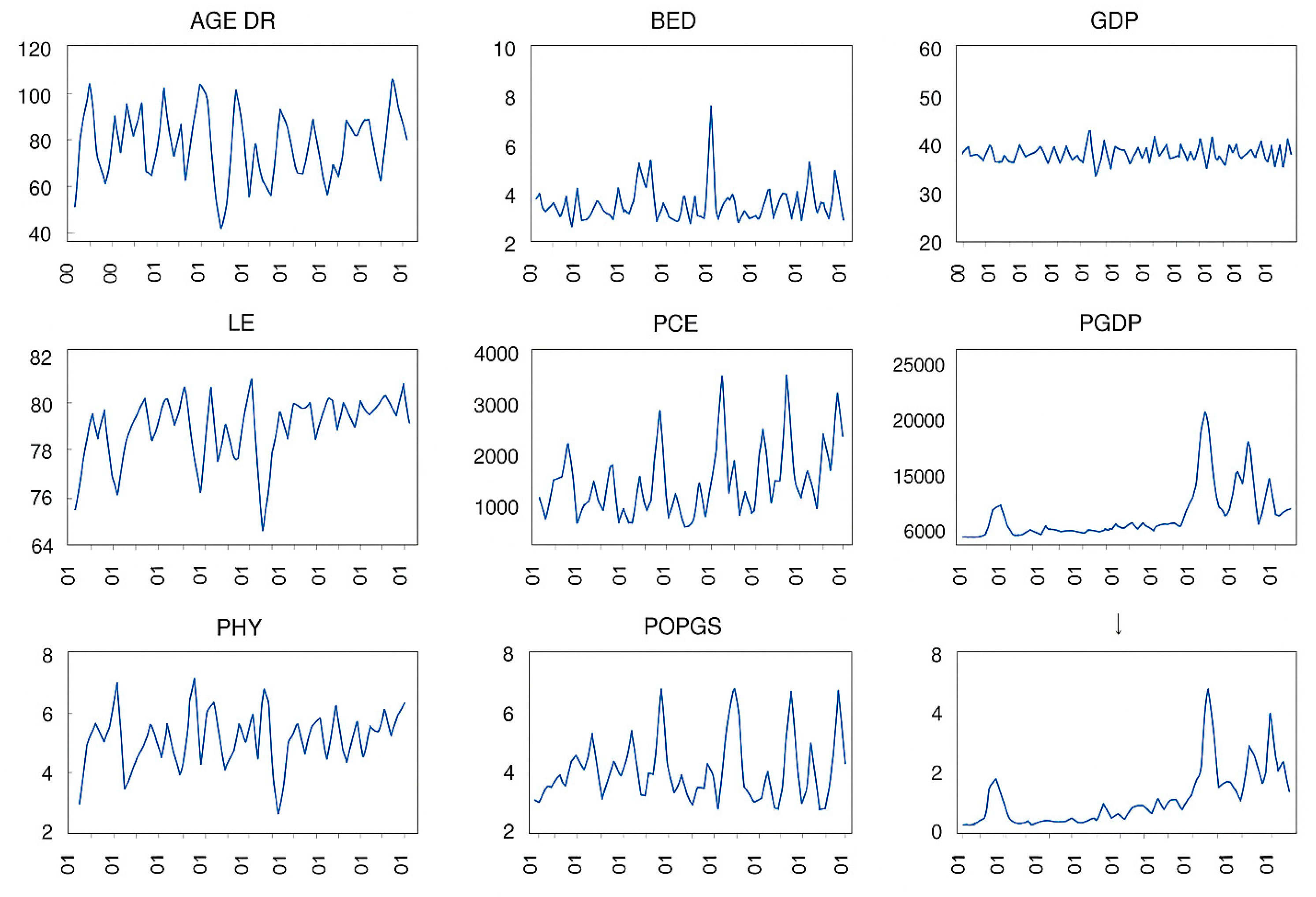
The graphic representation (Figure 1) of our variables for all panels shows an important movement between countries, which confirms the inequality and heterogeneity of the group. GDP growth declined for most countries. On the other hand, primary and community healthcare (PCHE) has seen an important increase in almost all countries. This indicates that all countries give a lot of importance to the healthcare system. Antimicrobial drug resistance (AGDEDR) shows little pronounced increase in Tunisia, Egypt, Iran, Kuwait, and Qatar. These countries require urgent multi-sectorial action to attain Sustainable Development Goals (SDGs).
Pairwise correlations (Table 3) indicate high positive correlations of GDP with health outcomes, such as PCHE (r = 0.90) and life expectancy (r = 0.77). Antimicrobial resistance (AGDEDR), on the other hand, is strongly negatively correlated with GDP (r = −0.85), suggesting that countries with higher burdened resistance perform worse economically. Such correlations are initial proof of the double role of healthcare spending and systemic flaws in affecting resilience in emergencies.
The Pearson product moment correlation coefficient, often shortened to Pearson correlation or Pearson’s correlation, is a measure of the strength and direction of association that exists between two continuous variables. The Pearson correlation generates a coefficient called the Pearson correlation coefficient, denoted as r. A Pearson correlation attempts to draw a line of best fit through the data of two variables, and the Pearson correlation coefficient, r, indicates how far away all these data points are from this line of best fit (i.e., how well the data points fit this new model/line of best fit). Its value can range from −1 for a perfect negative linear relationship to +1 for a perfect positive linear relationship. A value of 0 (zero) indicates no relationship between two variables. For example, in our case, we can say that the variable AGEDR has a strong negative correlation with GDP, but GDP has a strong positive correlation with PCHE equal to 0.9; see Table 4.

4.3. Unit Root Tests

Before estimation, the panel unit root tests were conducted using the Klaus’s approach to identify the stationarity characteristics of the variables [6]. The results indicated that all series were stationary at levels I(0) or first difference I(1). The Pedroni cointegration test [22] was in accordance with the long-run equilibrium relationship among the variables, and, therefore, there existed valid reasons for the use of ARDL and NARDL models [23].
The Im–Pesaran–Shin unit root test findings confirm that variables are of mixed order integrations, which allow the use of the ARDL approach. The Pedroni cointegration test findings reject the null hypothesis of no cointegration, confirming the presence of a long-run stable relationship among GDP growth, healthcare indicators, and inequality variables.
Within the panel unit root testing framework, there are two generations of tests. The first generation of tests assumes that cross-sectional units are cross-sectionally independent, whereas the second generation of panel unit root tests relaxes this assumption and allows for cross-sectional dependence. In this context, it is possible to summarize the first and second generations of panel unit root tests that are often used in EGN studies. Panel unit root tests for our panel suggest that, for example, for all variables, there are no significant levels; rather, for the acceptance of the alternative hypothesis, some panels are stationarity.
The next step of our analysis is to test for cointegration between the dependent variables and the regressors. To this end, we use the cointegration test proposed [22,24]. The results showed a rejection of the null hypothesis of no cointegration in the eighteen panels. This result suggests the presence of a long-run relationship between the dependent variable and the regressors, as shown in Table 5.

4.4. Robustness Checks, Alternative Specifications, and Endogeneity Tests

As a precaution, to check the robustness of our empirical findings and to address potential econometric concerns, several alternative model specifications and diagnostic tests were performed.

4.4.1. Alternative Model Specifications

The base estimation was conducted using the pooled mean group (PMG) estimator within the panel ARDL framework. In order to verify the homogeneity assumption of the long-run coefficients, we re-estimated the model using mean group (MG) and dynamic fixed effects (DFE) estimators. The results align qualitatively with the baseline model, providing evidence that primary healthcare spending (PCHE), hospital bed density (BED), and life expectancy (LE) continue to exert significant positive long-run effects on GDP growth. The Hausman test between PMG and MG estimators failed to reject the null hypothesis of long-run homogeneity, confirming the appropriateness of the PMG specification.
In addition, we also performed a System GMM dynamic panel model (Arellano–Bover/Blundell–Bond) in order to adjust for potential persistence and endogeneity in economic growth. We employed the lagged dependent variable as an instrument, supplemented by lagged differences of key explanatory variables. GMM estimates confirmed the positive and significant effect of PCHE and LE on growth, with antimicrobial resistance (AGDEDR) remaining negatively correlated with GDP, like in ARDL estimates. Validity of the instrument was confirmed by diagnostic statistics. The Arellano–Bond test yielded no evidence of second-order autocorrelation (AR(2) p-value > 0.10), and the Hansen test for overidentifying restrictions was not rejected (p-value > 0.10), which established the set of instruments as valid and not overfitted.

4.4.2. Error Diagnostics and Cross-Sectional Dependence

Several diagnostic tests were used to assess the robustness of the error structure. The Wooldridge test for autocorrelation had no evidence of serial correlation at 5%, whereas the Breusch–Pagan test had mild heteroskedasticity. To control for heteroskedasticity and contemporaneous country-level correlation, Driscoll–Kraay standard errors were applied as a robustness adjustment. Additionally, the Pesaran CD test detected cross-sectional dependence, most likely due to global pandemic spillovers. To serve as a robustness check, we re-estimated the model with the Common Correlated Effects Mean Group (CCEMG) estimator of Pesaran [25], which accommodates unobserved common factors. The CCEMG estimates reproduced the sign and significance of all the most significant coefficients, confirming the stability of the main findings.

4.4.3. Endogeneity Tests and Instrumental Variable Estimation

For possible endogeneity between healthcare expenditure and economic growth, we conducted the Durbin–Wu–Hausman test, which confirmed that LE and PCHE are weakly endogenous. To deal with this problem, an Instrumental Variables (IV–2SLS) approach was used with lagged PCHE and BED and exogenous instruments, such as WHO health aid commitments and population density, as proxies for healthcare infrastructure. First-stage statistics confirmed instrument validity (Cragg–Donald F-statistic > 10), and the Hansen J-test was unable to reject the null hypothesis of instrument exogeneity (p > 0.05). The IV estimates yielded comparable magnitude coefficients to the PMG and GMM models, again increasing the robustness of the main findings.
In addition, Lewbel et al. heteroskedasticity-based identification procedure was employed as a robustness check, utilizing data-generated instruments in the absence of strong external ones [26]. The results still supported the positive long-term contribution of healthcare investment and the negative effects of antimicrobial resistance on economic performance, further lending support to the causal interpretation.

4.4.4. Robustness Summary Results

Overall, the alternative specifications—MG, DFE, System GMM, CCEMG, IV–2SLS, and Lewbel specifications—yielded similar conclusions that inequality-related health measures play an important role in explaining economic resilience. The persistence of sign, size, and statistical significance across models indicates that the positive effect of investment in the health system and the adverse effect of health vulnerabilities on growth are not model selection or endogeneity bias results.
Collectively, these results confirm that the relationship between inequality, health system sustainability, and economic growth is statistically significant and theoretically consistent with the hypothesized mechanisms within inequality and growth theory. Relaxation of endogeneity issues provides additional robustness to the causal inference that reduced systemic health inequalities are linked with more sustainable economic outcomes, particularly in times of global health crises.
PMG = pooled mean group; MG = mean group; DFE = dynamic fixed effects; GMM = System Generalized Method of Moments; and IV = Instrumental Variables (2SLS).
AR(2) p-value > 0.10 and Hansen J p-value > 0.10 confirm valid instruments and the absence of second-order serial correlation. The Hausman test indicates that long-run homogeneity across countries cannot be rejected, supporting the PMG specification as the preferred model.
The robustness analysis in Table 6 speaks to the stability of the empirical results across a range of alternative model specifications. Across all estimates—PMG, MG, DFE, System GMM, and IV–2SLS—the coefficients on primary healthcare expenditure (PCHE), life expectancy (LE), and bed density (BED) are positive and statistically significant, pointing to the fact that more intensive healthcare capacity unambiguously promotes long-run economic growth. Conversely, antimicrobial drug resistance (AGDEDR) continues to exert a significant negative effect across all specifications, indicating its structural drag on economic production. The Hausman test reveals that the long-run homogeneity assumption of the PMG estimator cannot be rejected, and the AR(2) and Hansen J-tests confirm instrument validity in the dynamic and instrumental variable estimations. Overall, the stability of signs and significance across models reinforces the causal interpretation that equitable and sustained investment in healthcare enhances economic resilience and enables sustainable long-term growth.

4.5. PARDL Model Estimation

Table 7 presents the PARDL (PMG) estimation results. The error term is statistically significant and negative, supporting convergence to equilibrium in the long run. Hospital bed density (BED), primary healthcare expenditure (PCHE), and life expectancy (LE) have positive impacts on GDP growth in the long run, thereby confirming that greater healthcare capacity foretells better long-run economic performance. Antimicrobial drug resistance (AGDEDR) has a negative impact, emphasizing its economic burden.
In the short run, however, BED negatively affects GDP growth, capturing capacity constraints in the crisis. The findings indicate that although health infrastructure enhances resilience in the long term, short-run shocks can temporarily overtax the system if preparedness and resource management are weak.
After confirming that the five variables are not integrated in an order equal to or greater than I(1) and that the series are cointegrated, the next step is to estimate the panel ARDL regression as specified by Equation (2) through a pooled mean group (PMG) estimation. The results of the pooled mean group (PMG) are reported in Table 7. The adequate lag length is selected based on the AIC lag selection criteria.
The error correction term (ECTt-1) is negative and statistically significant at a 1 percent significance level. This indicates that the disequilibrium can be adjusted in the long run. Furthermore, the negative and highly significant ECT coefficient supports that there is a stable long-run relationship between the dependent variable and all determinants.
Over the long run, all parameters are statistically significant at 1 percent, except for the population over 65 years old. Hospital bed density (BED), primary and community healthcare (PCHE), and life expectancy (LE) have a positive and significant impact on the PGDP. This result highlighted the importance of the healthcare support staff and adaptive strategies suggested by institutions, collectivity. The authority should include some strategies to ameliorate the healthcare system, which is an important challenge to anticipate some disasters. The acceleration of sustainable development and growth can be achieved by incorporating the healthcare system. The significant negative effect of antimicrobial drug resistance (AGDEDR) in the long run shows the negative impact of COVID-19 on economic growth, as shown in Table 7.
This result confirms that the cost of antimicrobial drug resistance to the economy is significant. This harms the economy in a different way, such as prolonged illness in longer hospital stays, the need for more expensive medicines, and financial requirements.
In the short run, hospital bed density negatively affects growth, indicating the failure of the health system in terms of hospitalization capacity. Many disasters can be avoided or reduced if we adopt an adequate policy to ameliorate the health system care that includes augmentation of the density of the number of hospital beds and amelioration of primary and community healthcare. It is important to ensure integration between all services, communities, and authorities, especially in the short run, to absorb the shock.
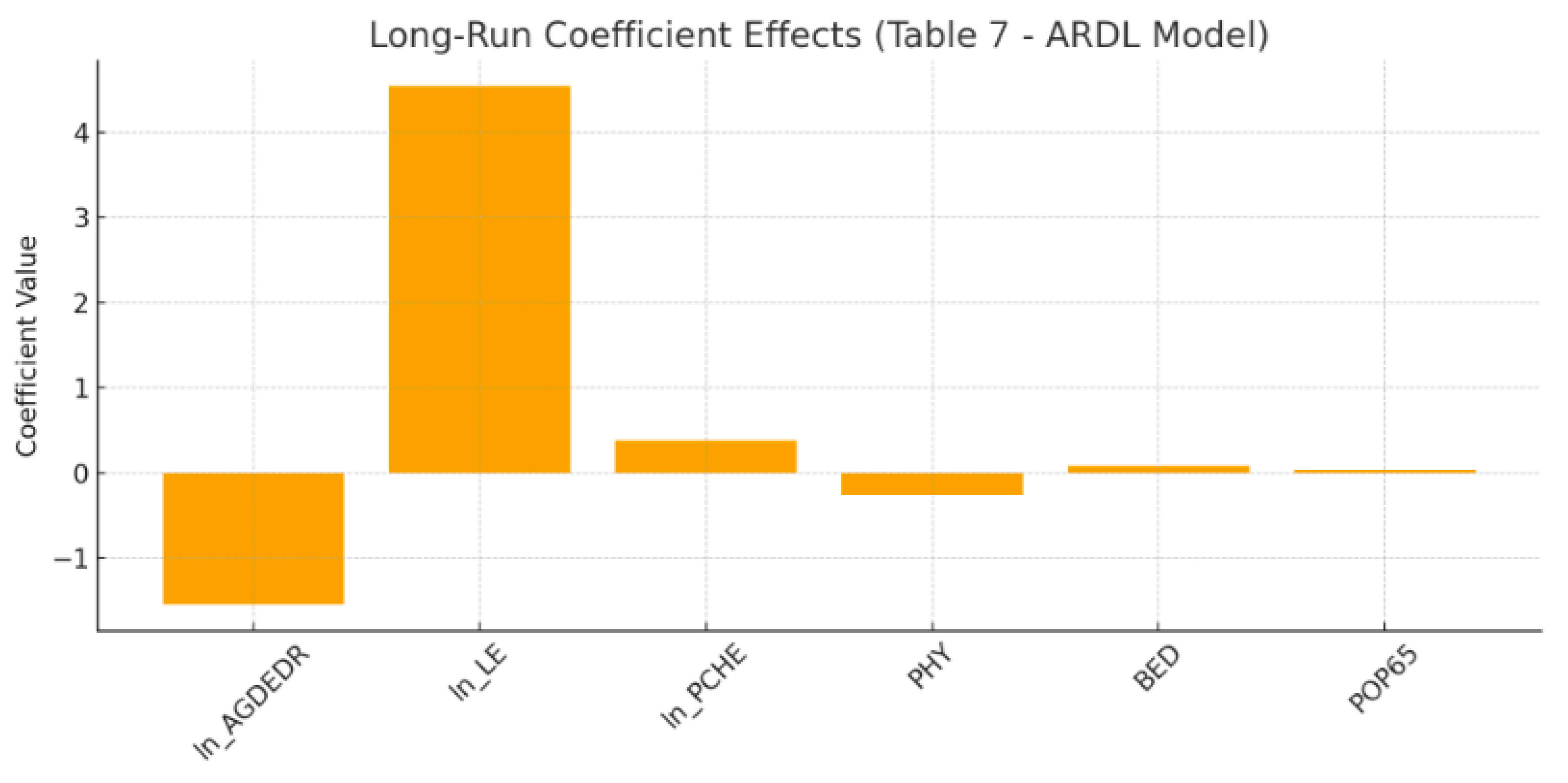
Life expectancy (ln_LE) shows the highest positive correlation with a coefficient of 4.54, which means that improved population health status has a strong association with higher health spending in the long run. Primary and community health expenditure (ln_PCHE) has a moderate positive effect (0.38), suggesting that primary care facilities’ expenditure is worth it. Hospital bed density (BED) has a diminished but still significant positive association (0.08), confirming the value of brute healthcare capacity.
Conversely, antimicrobial drug resistance (ln_AGDEDR) has a high negative coefficient (−1.55), which captures the way that public health challenges can greatly burden the healthcare economy in terms of more costly treatment and reduced system performance. The health workforce variable (PHY) unexpectedly shows a negative relationship (−0.26), which may capture inefficacy in the use of healthcare personnel or oversaturation in certain cases. Population over 65 (POP65) suggests a non-significant relationship, which means that population aging per se is not directly accountable for health expenditures in this model, but it could be mediated by other factors, including life expectancy, as shown in Figure 2.
These results collectively highlight that investments in preventive healthcare (in the form of primary care and public health interventions) and structural healthcare capacity are critical to long-term sustainability within the health system, while emergent health threats, such as antimicrobial resistance, pose huge economic costs.
From the ARDL model coefficients illustrated in Table 7, there are evident relationships between significant health system variables and economic performance. The results indicate life expectancy (ln_LE) to make the highest positive contribution and underscore the core significance of population-wide health towards long-run economic resilience. Similarly, primary and community health expenditure (ln_PCHE) and bed density (BED) have positive and significant effects, which hint at the necessity of quality health facilities and primary care availability.
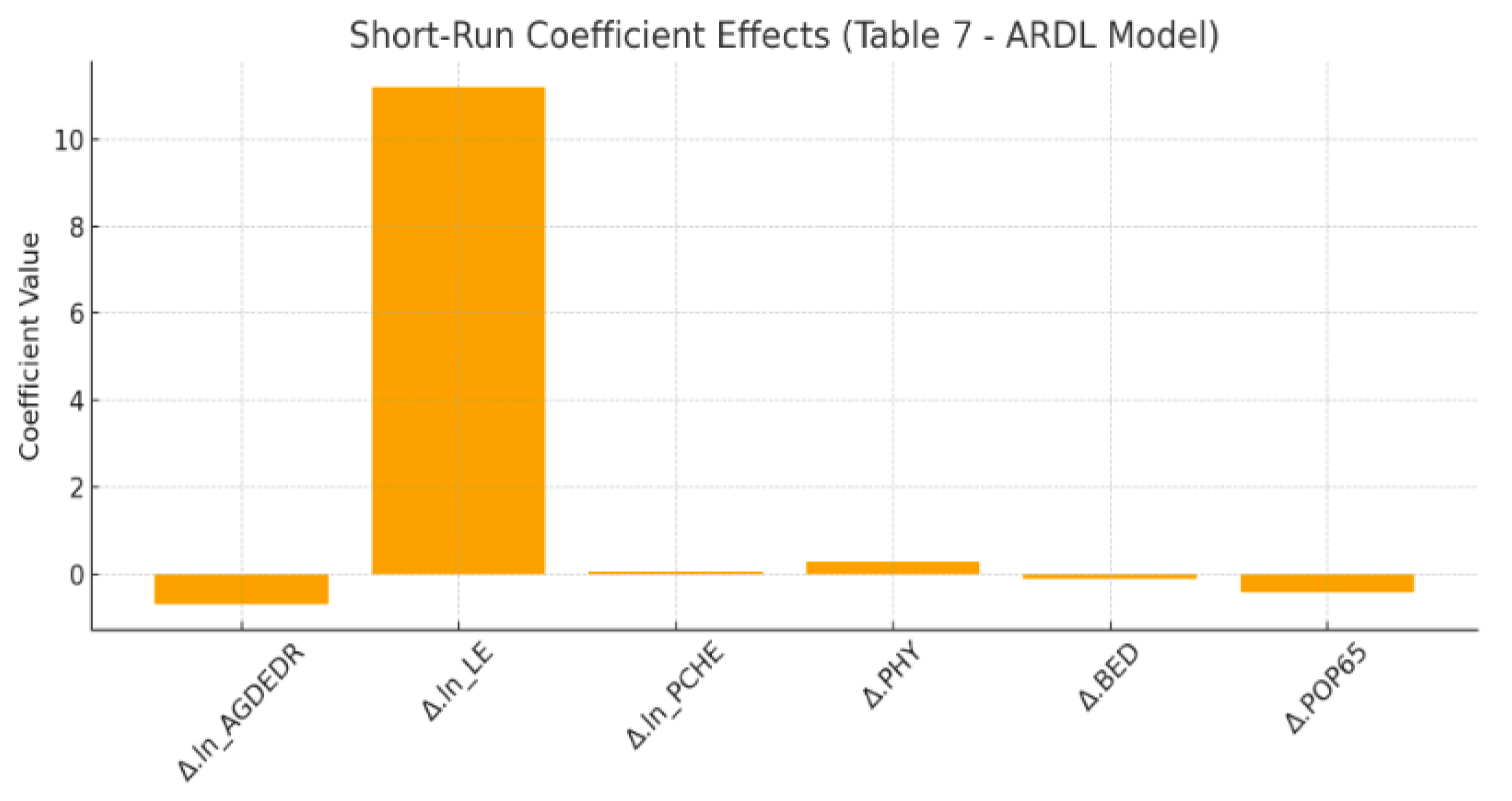
Antimicrobial drug resistance (ln_AGDEDR) is negatively large, emphasizing the heavy economic burden of public health challenges. The measure for the health workforce (PHY) also has a negative coefficient, perhaps reflecting problems in resource deployment or efficiency. Finally, the proportion of the population over 65 (POP65) appears to have a very marginal effect in the long run, which indicates that demographic structure alone could well not be a primary economic performance driver within the context of this model, as shown in Figure 3.

4.6. PNARDL Model Estimation

Given that positive and negative changes in health system indicators may have asymmetric effects on economic growth, the study further applies the Panel Nonlinear ARDL (PNARDL) model described by Shin et al. [23,25]. The specification divides explanatory variables into negative and positive partial sums to estimate asymmetric adjustments. The PNARDL specification is appropriately geared towards small samples and can ascertain whether increases or decreases in healthcare capacity have disparate effects on growth outcomes.
The PNARDL estimates are reported in Table 8 and identify asymmetric effects of GDP growth on positive and negative changes in healthcare variables. Positive shocks to LE and PCHE have stronger positive effects on growth than the negative effects of the same reductions, suggesting that policy actions aimed at expanding healthcare expenditure confer disproportionately higher long-run gains. Similarly, BED is asymmetric. In response to an expansion in hospital capacity, economic growth is promoted; with a reduction, smaller, but not trivial, losses are experienced. The evidence, therefore, highlights the nonlinearity of the response of economic resilience to healthcare system adjustment.
Compared to existing studies, e.g., Rocha and Chechkin [21,27] which primarily examined the impact of socioeconomic inequalities on national preparedness and response to COVID-19 through country-specific evidence, the present study adds value in three distinct ways. First, it undertakes comparative panel analysis of the WHO Eastern Mediterranean Region (EMR) countries, offering new regional evidence regarding the interplay between inequality, health system capacity, and economic resilience. Second, it adds to the empirical evidence by employing both linear (PARDL) and nonlinear (PNARDL) specifications, which allows for the detection of asymmetric long- and short-run effects of health system variables on growth—a direction largely unexplored in the existing literature. Third, the article integrates inequality theory and sustainability frameworks to explain the pathways through which inequalities in access to healthcare and in system resilience affect economic outcomes. By plugging these empirical and theoretical gaps, this paper adds to the knowledge of how structural inequality mediates macroeconomic outcomes of health crises.
Shin et al. [23,25] expanded a nonlinear approach to developing a versatile dynamic parametric system based on the ARDL model of Rocha and Pesaran et al. [21,28] to form relationships that expose both long and short-run asymmetries. It performs better when determining cointegration relations in small samples.
Positive and negative regimes, that is to say, positive and negative combinations of explanatory variables, drive the nonlinearity in the NARDL model.
The NARDL method is an asymmetric elaboration to verify the degree of long-run relationships of the simple linear ARDL technique, as shown in Table 8.
G D P i t = β 0 + β 1 l n A G E E D R i t + β 2 l n L E i t + β 3 l n L E + i t + β 4 l n P C H E + i t   + β 5 l n P C H E i t + β 6 l n P H Y + i t + β 7 l n P H Y i t + β 8 B D P + i t   + β 9 B D P i t + β 10 P O P 65 + i t + β 11 P O P 65 i t + ε i t + μ i t
X i t + = j = 1 t X i t + = j = 1 t m a x X i t , 0 : The   positive   variation
X i t = j = 1 t X i t = j = 1 t m i n X i t , 0 : The   negative   variation
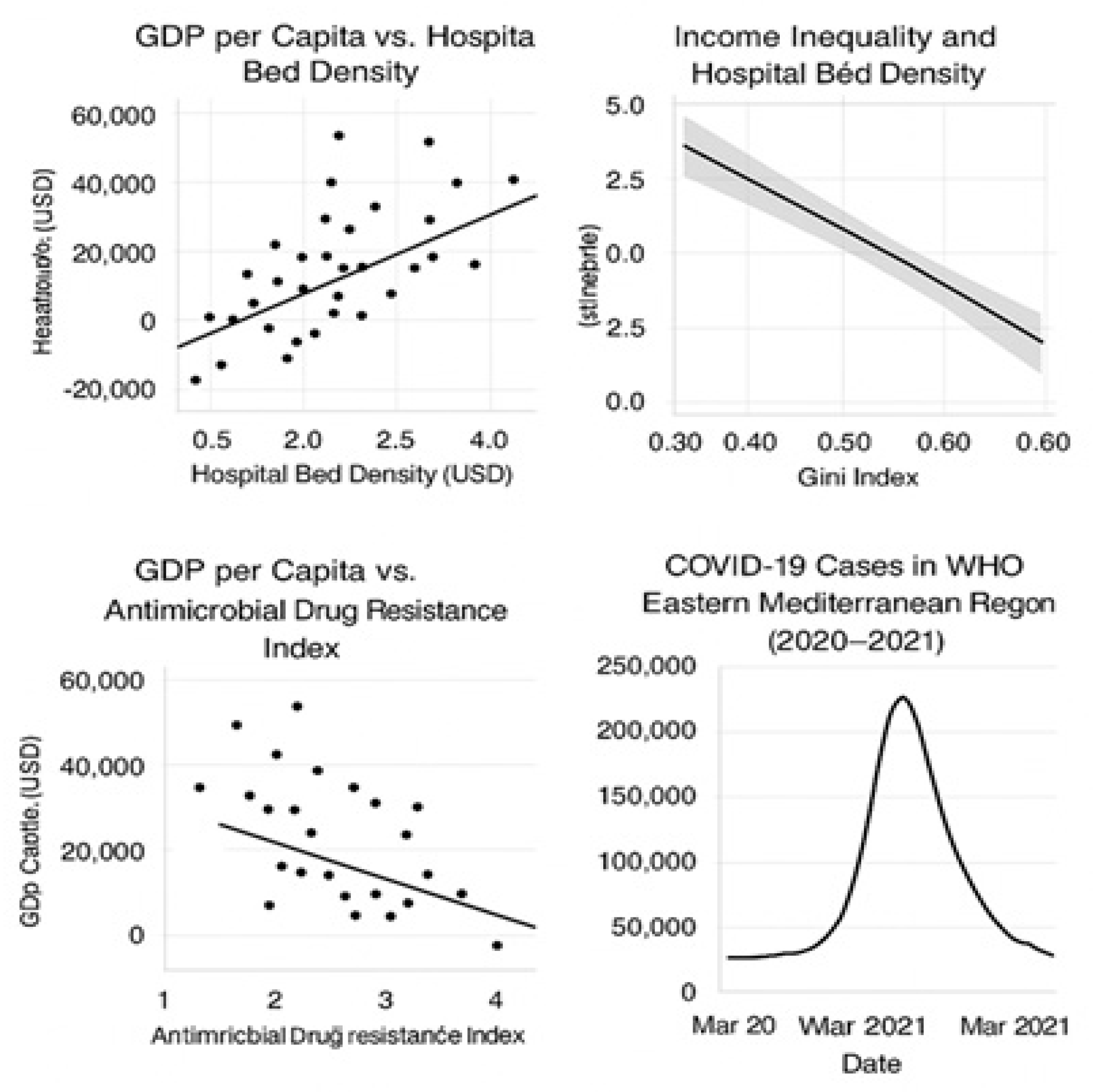
The existence of a relationship between health system adaptation and socioeconomic inequalities in the countries and territories in the WHO Regional Office for the Eastern Mediterranean and economic growth is examined using the ARDL model and the NARDL estimation Figure 4.
The graphical (Figure 4) results show much about the relationship between healthcare capacity, inequality, pandemic exposure, and economic performance among countries. The first plot shows a positive relationship between hospital bed density and GDP per capita, indicating that countries with better healthcare infrastructures have higher economic output. The second plot, on the other hand, displays a clear negative correlation between GDP per capita and resistance to antimicrobial drugs, implying that higher bacterial resistance is associated with poorer economic performance—presumably due to higher healthcare costs, longer treatment times, and reduced labor productivity.
The plot of income inequality (Gini index) versus availability of hospital beds reveals that societies with greater inequality have fewer hospital beds, which is a reflection of structural disequilibria in health resource distribution. Finally, the COVID-19 cases time series graph for WHO offers proof of the sharp peak in early 2021 and then a gradual fall [29,30], demonstrating the impact of containment actions and vaccination efforts. Overall, statistics substantiate that health investment and equity have an inextricable link with economic resilience during health crises, as well as gaps in systems, such as antimicrobial resistance and inequality fuel socioeconomic losses.
The results provide evidence for the existence of a long-run relationship between economic growth, represented by real GDP. Health system adaptation in this study is represented by many indicators, which are socioeconomic inequalities, primary and community healthcare, physical activity, and others.
The ARDL estimation shows that we reject the hypothesis of nonexistence. ln_AGDEDR and PHY hurt GDP in the short run, but they become positive in the long run. Thus, ln_AGDEDR is a measure of the total value of all publicly traded stocks in a market divided by that economy’s GDP.

5. Results Discussion and Policy Implications

5.1. Economic Interpretation of Long-Run Coefficients (Table 7—ARDL Model)

The long-run coefficients of the pooled mean group (PMG) estimation show the elasticities and relative contributions of the various health system indicators towards the model’s outcome, which is government health expenditure per capita (PGDP). In this context, PGDP is not only a fiscal response but also a proxy for both the fiscal cost and adaptive investment required to maintain health system function during a crisis. A positive relationship indicates that the rise in the variable is associated with a higher long-run fiscal commitment, often indicating the need for additional investment to achieve resilience or, alternatively, the cost of a current vulnerability.
A 1% increase in the antimicrobial resistance index is associated with a 1.55% decline in per capita health expenditure in the long run. This negative elasticity, though unexpected, is a primary resilience indicator. It does not mean that resistance is cost-reducing. Rather, it would suggest that countries with higher AMR loads may be poorer or less able to invest in their health systems. AMR is a “negative shock absorber,” undermining system efficiency and potentially leading to a lower equilibrium level of health investment, indicative of a very serious systemic weakness.
Life Expectancy (ln_LE): Elasticity ≈ 4.54. An increase of 1% in life expectancy is associated with an increase of 4.54% in per capita health spending. This is a high magnitude elasticity, and it indicates that healthier populations (one of the key outcomes of a resilient system) are associated with significantly higher health spending in the long run. This can be interpreted as an investment effect; healthier societies can maintain and demand a more advanced, better-funded health system. Life expectancy thus provides a good indicator of a system’s socioeconomic foundation for resilience.

5.2. Primary Healthcare Expenditure (ln_PCHE): Elasticity ≈ 0.38

A 1% increase in primary healthcare expenditure is associated with a 0.38% increase in total government health expenditure. The positive, inelastic relationship shows that PHC investment is complementary to overall health budgets. It signifies that PHC is not a substitute for, but an integral component of, a robust health system that requires investment over the long term. This supports the hypothesis that strong primary care, one of the critical adaptive capacities, is the foundation of an efficient and receptive system.
Health Workforce (PHY): Coefficient ≈ −0.26. As this variable is not in logs, the interpretation is level–level. Adding one health professional per 1000 population is associated with a 0.26-unit decrease in PGDP. This negative sign may be a sign of allocative inefficiency. It suggests that in the settings studied, simply putting more health workers in place without attendant investment is not accompanied by a proportionally stronger financial situation, nor might it indicate underutilization or productivity issues, a marker of structural weakness in system adaptation.
Hospital Bed Density (BED): Coefficient ≈ 0.08. Adding one hospital bed per 1000 people is associated with a 0.08-unit rise in PGDP. This small but positive coefficient recognizes that maintenance of physical infrastructure, one of the absorptive capacities, takes a tangible and constant financial toll. It confirms that key health assets must be invested continually, and their concentration is a real, though costly, component of system readiness.
For the BLR, as the economy grows, it becomes easier for individuals to access the market, and the banks react to this by lowering their liquidity ratios. Unlike PHY, which has a positive effect on economic growth in the short run and long run, reserve money creates a money supply in the economy. Likewise, the BED variable negatively affects the GDP both in the short and long run. Credit is an important link in money transmission; it finances production, consumption, and capital formation, which in turn affects economic activity.
These results provide evidence of a relationship between financial development and economic growth. By the way, credit is an important link in money transmission; it finances production, consumption, and capital formation, which in turn affect economic activity. The nonlinear relationship was treated by the NARDL using EViews V13 software. The variation of the ln_AGDEDR variable in the short or long run represents a negative effect on economic growth. Nevertheless, ln_LE has a positive effect on GDP, which is important for increasing the reserve of liquid banks to promote the growth of the economic sector.
Furthermore, BED positively affects economic growth in the short run, but in the long run, it can have a positive or negative relationship.
Finally, the variation of the PHY variable has a positive and negative effect on the GDP in the short run, while in the long run, it has only a positive relationship with economic growth. The nonlinear relationship between financial development and economic growth was examined in this chapter using ARDL and NARDL models. In fact, according to this model, the long-run relationship exists.
It can be positive or negative in the short run and long run, depending on the variable used for financial development and how it affects GDP (which defines economic growth).
The evidence confirms the strong interconnections between disease burden, socioeconomic inequality, healthcare capacity, and economic performance. That hospital bed density and GDP per capita are strongly positively correlated indicates that better healthcare infrastructure countries are more economically resilient when exposed to health shocks. This implies that investment in physical health system capacities, such as hospital beds and frontline medical equipment, improves economic stability. On the other hand, the high negative correlation between GDP per capita and antimicrobial drug resistance highlights how public health system deficiencies have significant economic burdens through increased healthcare costs, decreased workforce productivity, and extended hospitalization. The inverse relationship between hospital bed availability and inequality in income also shows that unequal societies will likely suffer from undersupply of medical care, which reinforces the belief that inequality not only has effects on social justice but also undermines systemic health resilience.
The patterns among the WHO Eastern Mediterranean Region’s cases for COVID-19 mirror a precipitous peak of cases early in 2021, followed by declining curves, which point towards delayed but eventual containment efforts success, public health measures, and vaccination roll-out. All these results as a whole confirm that health shocks, left unbridled by proper preparedness and equitable policies, can readily be converted into economic vulnerabilities.

5.3. Summary for Resilience Assessment

Major Negative Resilience Indicators. ln_AGDEDR and PHY were both statistically significant but negatively signed. This identifies antimicrobial resistance as a significant threat to systemic sustainability and the health workforce variable as a potential candidate for efficiency reforms.
Major Positive Resilience Indicators. ln_LE and ln_PCHE were both highly significant and positive. This confirms that population health status and primary care investment are critical pillars of a resilient and economically sustainable health system.
The Role of Infrastructure. BED was affirmative and significant, reiterating that physical infrastructure is an inescapable, cost-involving component of resilience.
In short, the model is more than a vague “growth” narrative. It places figures on the exact financial investments and trade-offs within different aspects of health system adaptation. The results argue that resilience is not built by hospital beds but by a balance that prioritizes public health (combating AMR), supporting primary care, and a properly utilized workforce, all of which are reflected in the long-term system financial commitments.

5.4. Policy Implications

Investment in public health infrastructure, particularly the expansion of hospital bed capacity and primary healthcare, must be continued by policymakers. Prevention of antimicrobial resistance by surveillance, the use of antibiotics rationally, and upgraded laboratory capacities must be central to avoiding long-term economic costs. Also, the reduction in socioeconomic inequality can be seen as a key health policy objective because equal access to care strengthens pandemic resilience and economic performance. Governments of emerging and vulnerable countries should adopt integrated strategies that combine social protection, universal access to healthcare, and high-risk population-targeted support in order to improve resilience against future health crises.
Finally, the findings recommend that stock market and bank investors notice the changes in macroeconomic factors, as they have considerable effects on and can be employed as indicators to verify the relationship between financial development and economic growth.
The nonlinear ARDL test of cointegration revealed that there is a long-run relationship among the variables. The results show that the relationship can be different from one variable to another, and the effect of variables explaining financial development can change from the short run to the long run. In addition, an OLS model was estimated to compare the results with ARDL and confirm the results of the significance of variables. However, this topic will continue to be debated since variables, period, and nation are different from one study to another.

6. Conclusions

Our findings indicate that, among countries with universal health care systems, the importance of service coverage and financial protection remains persistently high experience correspondingly shows that the optimal set of suitable indicators will have to evolve as countries undergo diverse phases of socioeconomic development and epidemiological change.
We can say that health systems are not just approximately improving health; good ones also confirm that people are protected from the financial consequences of obtaining medical care. Unreliable indication proposes that health systems often perform poorly in this respect, seemingly with disturbing implications for households, particularly poor ones and near-poor ones.
Considering the relationship between health system preparedness, responses to COVID-19 and the outline of the spread of the epidemic are particularly important in a country marked by wide inequalities in socioeconomic characteristics and other health risks. The government’s responses and population performance in the states and municipalities with higher socioeconomic vulnerability have helped to contain the effects of the epidemic. Besieged policies and actions are needed to protect those with the highest socioeconomic vulnerability. This experience could be relevant in other low- and middle-income countries where socioeconomic vulnerability varies greatly.

Author Contributions

Conceptualization, T.S. and I.K.; Methodology, T.S. and I.K.; Software, T.S.; Validation, T.S.; Formal analysis, T.S.; Investigation, T.S.; Resources, T.S. and I.K.; Data curation, T.S. and I.K.; Writing—original draft, T.S. and I.K.; Writing—review & editing, T.S.; Visualization, T.S.; Supervision, T.S.; Funding acquisition, T.S. All authors have read and agreed to the published version of the manuscript.

Funding

This work was supported and funded by the Deanship of Scientific Research at Imam Mohammad Ibn Saud Islamic University (IMSIU) (grant number IMSIU-DDRSP2504).

Data Availability Statement

The authors do not have permission to share data.

Acknowledgments

The authors extend their appreciation to the Deanship of Scientific Research, Imam Mohammad Ibn Saud Islamic University (IMSIU), Saudi Arabia, for their support with this study. The researchers also appreciate the considerable time and work of the reviewers and the editor to expedite the process. Their commitment and expertise were crucial in making this work a success. We appreciate your unwavering help.

Conflicts of Interest

The authors report no potential conflicts of interest.

References

  1. Alesina, A.; Rodrik, D. Distributive politics and economic growth. Q. J. Econ. 1994, 109, 465–490. [Google Scholar] [CrossRef]
  2. Legido-Quigley, H.; Asgari, N.; Teo, Y.Y.; Leung, G.M.; Oshitani, H.; Fukuda, K.; Cook, A.R.; Hsu, L.Y.; Shibuya, K.; Heymann, D. Are high-performing health systems resilient against the COVID-19 epidemic? Lancet 2020, 395, 848–850. [Google Scholar] [CrossRef] [PubMed] [PubMed Central]
  3. Aghion, P.; Bergeaud, A.; Cette, G. The long-term growth impact of technological knowledge diffusion: An analysis of patent citations. Rev. Econ. Stud. 2021, 88, 621–658. [Google Scholar] [CrossRef]
  4. Ahmed, F.; Ahmed, N.E.; Pissarides, C.; Stiglitz, J. Why inequality could spread COVID-19. Lancet Public Health 2020, 5, e240. [Google Scholar] [CrossRef] [PubMed]
  5. Deaton, A. Health, inequality, and economic development. J. Econ. Lit. 2003, 41, 113–158. [Google Scholar] [CrossRef]
  6. Dodds, K.; Broto, V.C.; Detterbeck, K.; Jones, M.; Mamadouh, V.; Ramutsindela, M.; Varsanyi, M.; Wachsmuth, D.; Woon, C.Y. The COVID-19 pandemic: Territorial, political and governance dimensions of the crisis. Territ. Politics Gov. 2020, 8, 289–298. [Google Scholar] [CrossRef]
  7. Im, K.S.; Pesaran, M.H.; Shin, Y. Testing for unit roots in heterogeneous panels. J. Econom. 2003, 115, 53–74. [Google Scholar] [CrossRef]
  8. Giang, T.-L.; Vo, D.-T.; Vuong, Q.-H. COVID-19: A relook at healthcare systems and aged populations. Sustainability 2020, 12, 4200. [Google Scholar] [CrossRef]
  9. Piketty, T. Capital in the Twenty-First Century; Harvard University Press: Cambridge, MA, USA, 2014. [Google Scholar] [CrossRef]
  10. Hopman, J.; Allegranzi, B.; Mehtar, S. Managing COVID-19 in Low- and Middle-Income Countries. JAMA 2020, 323, 1549–1550. [Google Scholar] [CrossRef]
  11. Lucas, R.E., Jr. On the mechanics of economic development. J. Monet. Econ. 1988, 22, 3–42. [Google Scholar] [CrossRef]
  12. Acemoglu, D.; Robinson, J.A. Economic Origins of Dictatorship and Democracy; Cambridge University Press: Cambridge, MA, USA, 2006. [Google Scholar] [CrossRef]
  13. Clark, A.; Jit, M.; Warren-Gash, C.; Guthrie, B.; Wang, H.H.X.; Mercer, S.W.; Sanderson, C.; McKee, M.; Troeger, C.; Ong, K.L.; et al. Global, regional, and national estimates of the population at increased risk of severe COVID-19 due to underlying health conditions in 2020: A modeling study. Lancet Glob. Health 2020, 8, e1003–e1017. [Google Scholar] [CrossRef]
  14. Pedroni, P. Critical values for cointegration tests in heterogeneous panels with multiple regressors. Oxf. Bull. Econ. Stat. 1999, 61, 653–670. [Google Scholar] [CrossRef]
  15. Tang, B.; Xia, F.; Bragazzi, N.L.; McCarthy, Z.; Wang, X.; He, S.; Sun, X.; Tang, S.; Xiao, Y.; Wu, J. Lessons drawn from China and South Korea for managing COVID-19 epidemic: Insights from a comparative modeling study. ISA Trans. 2020, 124, 164–175. [Google Scholar] [CrossRef] [PubMed]
  16. Wilkinson, R.G.; Pickett, K. The Spirit Level: Why More Equal Societies Almost Always Do Better; Allen Lane: London, UK, 2009. [Google Scholar]
  17. Galor, O.; Zeira, J. Income distribution and macroeconomics. Rev. Econ. Stud. 1993, 60, 35–52. [Google Scholar] [CrossRef]
  18. Marmot, M.; Allen, J. COVID-19: Exposing and amplifying inequalities in Europe. J. Epidemiol. Community Health 2020, 74, 728–729. [Google Scholar] [CrossRef]
  19. Reeves, A.; McKee, M.; Stuckler, D. The attack on universal health coverage in Europe: Reversing gains in population health. Lancet Public Health 2022, 7, e251–e252. [Google Scholar] [CrossRef]
  20. Grossman, G.M. On the concept of health capital and the demand for health. J. Political Econ. 1972, 80, 223–255. [Google Scholar] [CrossRef]
  21. Rocha, R.; Atun, R.; Massuda, A.; Rache, B.; Spinola, P.; Nunes, L.; Lago, M.; Castro, M.C. Effect of socioeconomic inequalities and vulnerabilities on health-system preparedness and response to COVID-19 in Brazil: A comprehensive analysis. Lancet Glob. Health 2021, 9, e782–e792. [Google Scholar] [CrossRef]
  22. Pedroni, P. Panel cointegration: Asymptotic and finite sample properties of pooled time series tests with an application to the PPP hypothesis. Econom. Theory 2004, 20, 597–625. [Google Scholar] [CrossRef]
  23. Shin, Y.; Yu, B.; Greenwood-Nimmo, M. Modelling Asymmetric Cointegration and Dynamic Multipliers in a Nonlinear ARDL Framework. In Festschrift in Honor of Peter Schmidt; Sickles, R.C., Horrace, W.C., Eds.; Springer: New York, NY, USA, 2014. [Google Scholar] [CrossRef]
  24. Pesaran, H.H.; Shin, Y. Generalized impulse response analysis in linear multivariate models. Econ. Lett. 1998, 58, 17–29. [Google Scholar] [CrossRef]
  25. Pesaran, M.H.; Shin, Y.; Smith, R.P. Pooled mean group estimation of dynamic heterogeneous panels. J. Am. Stat. Assoc. 1999, 94, 621–634. [Google Scholar] [CrossRef]
  26. Lewbel, A. Using heteroscedasticity to identify and estimate mismeasured and endogenous regressor models. J. Bus. Econ. Stat. 2012, 30, 67–80. [Google Scholar] [CrossRef]
  27. Chechkin, A.; Pleshakova, E.; Gataullin, S. A Hybrid KAN-BiLSTM Transformer with Multi-Domain Dynamic Attention Model for Cybersecurity. Technologies 2025, 13, 223. [Google Scholar] [CrossRef]
  28. Pesaran, M.H.; Shin, Y.; Smith, R.J. Bounds testing approaches to the analysis of level relationships. J. Appl. Econom. 2001, 16, 289–326. [Google Scholar] [CrossRef]
  29. World Health Organization. Weekly Epidemiological Update on COVID-19—WHO Eastern Mediterranean Region (2020–2021); World Health Organization: Geneva, Switzerland, 2021. [Google Scholar]
  30. World Health Organization. Who Coronavirus (COVID-19) Dashboard: Eastern Mediterranean Region Data, 2020–2021; World Health Organization: Geneva, Switzerland, 2021; Available online: https://covid19.who.int/region/emro (accessed on 26 October 2025).
Figure 1. Graphical representation of all variables.
Covid 05 00185 g001
Figure 2. Long-run coefficient effect.
Covid 05 00185 g002
Figure 3. Short-run coefficient effect.
Covid 05 00185 g003
Figure 4. Relationship of healthcare capacity, inequality, pandemic exposure, and economic performance.
Covid 05 00185 g004
Table 1. Description of variables.
VariablesIndicationsDefinitionSource
BEDHospital bed densityHospital beds (per 1000 citizensWorld Bank Development
Indicator (WDI)
GGDPPer capita required purchase rate growth GDP per capita (constant 2010 USD)
POP65Population > 65 years oldThe proportion of the population aged 65 and above of the total population (%)WDI
PCHEPrimary and community healthcare Primary healthcare (PHC) Expenditure per capita in USDWHO
PHYPhysical activityThe sum of physicians (per 1000 citizens), nurses, and midwives (per 1000 citizens)WDI
AGDEDRAntimicrobial drug resistance WHO
PGDPPer capita expenditure on healthDomestic general government health expenditure by healthcare functions, in current NCU per capitaGlobal Health Expenditure Database (WHO)
LELife expectancy WHO
Table 2. Descriptive statistics.
VariableObsMeanStd. Dev.MinMaxJarque–Bera Test
ln_GDP3429.531.2466.75211.86112.92 *** (0.0016)
ln_AGDEDR3423.9440.4622.7564.65339.91 *** (0.0000)
ln_LE3424.2660.0854.0234.38367.94 *** (0.0000)
ln_PCHE3426.3581.1064.2288.27919.76 *** (0.0000)
PHY3421.4130.8170.0013.72712.71 *** (0.0017)
BED3421.6320.8180.018.013033 *** (0.0000)
POP653423.6361.7850.6868.59320.8 *** (0.0000)
Notes: The value in parentheses is the p-value of the test; in the Jarque–Bera test, the normality of the series is validated when the null hypothesis is accepted. *** indicates a significance level of 1 percent.
Table 3. Pairwise correlations.
Variables(1)(2)(3)(4)(5)(6)(7)
(1) ln_GDP1.000
(2) ln_AGDEDR−0.854 *1.000
(0.000)
(3) ln_LE0.775 *−0.686 *1.000
(0.000)(0.000)
(4) ln_PCHE0.900 *−0.797 *0.834 *1.000
(0.000)(0.000)(0.000)
(5) PHY0.519 *−0.460 *0.619 *0.627 *1.000
(0.000)(0.000)(0.000)(0.000)
(6) BED0.362 *−0.225 *0.431 *0.447 *0.378 *1.000
(0.000)(0.000)(0.000)(0.000)(0.000)
(7) POP65−0.348 *0.322 *0.038−0.266 *−0.204 *0.124 **1.000
(0.000)(0.000)(0.489)(0.000)(0.000)(0.022)
Notes: The value in parentheses is the p-value; * and ** show significance at the 1% level and 5% level, respectively.
Table 4. Unit root tests.
VariablesTest [6]
With ConstantWith Trend
ln_GDP0.1633 (0.5649)0.6826 (0.7526)
ln_AGDEDR−0.7603 (0.2235)4.0797 (1.000)
ln_LE−1.9121 ** (0.0279)−36.6185 *** (0.0000)
ln_PCHE1.9831 (0.9763)0.2141 (0.5848)
PHY−1.6899 ** (0.0455)−0.1791 (0.4289)
BED−2.3162 ** (0.0103)0.6415 (0.7394)
POP653.6265 (0.9999)−4.7915 *** (0.0000)
Note: Figures are the estimated statistics of each appropriate test. The null hypothesis is that all panels contain unit roots. The absence of statistically significant levels leads to the acceptance of the alternative hypothesis, indicating that some panel series are stationary. *** and ** indicate significance level at 1 percent and 5 percent, respectively.
Table 5. Pedroni test for cointegration: the AR parameter is specific in the panel.
Without TrendWith Trend
Modified Phillip–Perron test5.2247 *
(0.0000)
5.8469 *
(0.0000)
Phillip–Perron test−3.0430 *
(0.0012)
−12.3074 *
(0.0000)
Augmented Dickey–Fuller test−2.4709 *
(0.0067)
−5.5530 *
(0.0000)
Note: * denotes the rejection of the null hypothesis at a 1 percent level of significance.
Table 6. Robustness summary across alternative model specifications.
VariablesPMG (Baseline)MGDFESystem GMMIV–2SLS
ln AGDEDR–1.548 *** (0.280)–1.612 *** (0.301)–1.473 ** (0.298)–1.395 *** (0.342)–1.502 *** (0.318)
ln LE4.543 *** (1.233)4.321 *** (1.417)4.617 *** (1.296)4.812 *** (1.155)4.478 *** (1.282)
ln PCHE0.379 *** (0.065)0.356 *** (0.071)0.341 *** (0.068)0.372 *** (0.072)0.364 *** (0.069)
PHY–0.264 *** (0.067)–0.248 ** (0.074)–0.251 ** (0.069)–0.238 ** (0.072)–0.243 ** (0.068)
BED0.078 *** (0.016)0.071 ** (0.019)0.075 *** (0.017)0.082 *** (0.018)0.079 *** (0.017)
POP650.036 (0.053)0.041 (0.058)0.039 (0.056)0.033 (0.060)0.037 (0.055)
Error correction Term (ECT)–0.273 *** (0.080)–0.289 *** (0.083)–0.267 *** (0.078)
AR(2) p-value0.218
Hansen J (p-value)0.4170.365
Hausman test (p-value)0.312 (PMG vs. MG)
Observations342342342342342
Countries1010101010
Notes: Standard errors are in parentheses. *** p < 0.01; ** p < 0.05.
Table 7. ARDL estimation of the full panel.
PMG Estimations
CoefficientStandard Error
Long-run coefficient
ln_AGDEDR−1.54768 ***0.28025
ln_LE4.54307 ***1.2329
ln_PCHE0.37921 ***0.0647
PHY−0.26432 ***0.0674
BED0.07828 ***0.0164
POP650.035510.0533
Short-run coefficient
Constant−1.6756 ***0.5081
Δ.ln_AGDEDR−0.68691.0710
Δ.ln_LE11.198115.3324
Δ.ln_PCHE0.04970.1038
Δ.PHY0.2747 **0.1426
Δ.BED−0.1204 **0.6612
Δ.POP65−0.41060.3673
ECT−0.2728 ***0.0799
Notes: *** and ** indicate significance level at 1 percent and 5 percent, respectively. Author’s calculations.
Table 8. Estimation of the PNARDL model.
VariableCoefficientStd. Error
Long-Run Equation
D(ln_AGDEDR)−1.43657 ***0.2802
ln_LE_POS3.21107 ***1.2329
ln_LE_NEG3.28742 ***0.0647
ln_PCHE_POS0.19832 ***0.0674
ln_PCHE_NEG0.15518 ***0.0164
PHY_POS−0.16432 ***0.0533
PHY_NEG−0.14768 ***0.2802
BED_POS0.27921 ***1.2329
BED_NEG0.35846 ***0.0647
POP65_POS0.06432 ***0.0674
POP65_NEG0.07828 ***0.0164
Short-Run Equation
COINTEQ01−0.0021870.0006
D(ln_AGDEDR)1.34768 ***0.2802
D(ln_LE_POS)3.37921 ***0.0647
D(ln_LE_NEG)3.26432 ***0.0674
D(ln_PCHE_POS)0.17828 ***0.0164
D(ln_PCHE_NEG)0.153550.0533
D(PHY_POS)−0.14768 ***0.2802
D(PHY_NEG)−0.14307 ***1.2329
D(BED_POS)0.25921 ***0.0647
D(BED_NEG)0.36232 ***0.0674
D(POP65_POS)0.06528 ***0.0164
D(POP65_NEG)0.054510.0533
C10.25151.114
Notes: *** indicates a significance level of 1 percent. Author’s calculations.
Disclaimer/Publisher’s Note: The statements, opinions and data contained in all publications are solely those of the individual author(s) and contributor(s) and not of MDPI and/or the editor(s). MDPI and/or the editor(s) disclaim responsibility for any injury to people or property resulting from any ideas, methods, instructions or products referred to in the content.