1. Introduction
‘Hybrid work’ is emerging as the predominant organisational model and what this actually means varies considerably across organisational and institutional contexts. In hybrid work, employees spend some days at the office and others at locations of their choice, dividing their time between the office and other locations. Eurofound [
1] estimates suggest that approximately 20 per cent of full workdays now occur remotely across Europe, representing a fourfold increase from the pre-pandemic baseline of just 5 per cent. This change is not just about moving to a new location. It significantly affects HRM professionals in many areas. These include how they manage people, develop leaders, communicate, improve productivity and most importantly, support employee wellbeing.
The transition to hybrid work has initiated an ongoing global discourse, as employees want more flexibility, but many employers are advocating a return-to-office mandate. These are not just abstract policy debates; they reflect genuine tensions about the future of work. Workers globally are expressing a preference for work-from-home options; however, employers continue to favour on-premises attendance. The Cisco Global Hybrid Work Study [
2] highlights this tension, noting that organisations are still experimenting with optimal configurations. Several large organisations, such as Goldman Sachs and Tesla, have publicly advocated for full-time office attendance. Similarly, politicians are supporting the return to the office as the default arrangement, to support the services offered by small businesses in the vicinity of the organisation.
But is this return warranted? The benefits of hybrid work have been highlighted by the Chartered Institute of Personnel and Development [
3], with the key benefits including improved employee wellbeing and work–life balance. The debate continues, with current off-site work frequencies ranging from two or three days per week to predominantly office-based arrangements. As a result, organisations need to design hybrid work strategies that balance employer and employee needs.
The pandemic-induced distributed work environments taught organisations crucial lessons in employee management and organisational agility. As a result, organisations are now experienced in designing distributed work environments for sustainable hybrid work. HRM professionals are at the forefront of organisational design initiatives aimed at developing sustainable hybrid work initiatives. Research suggests that we need to adapt general ideas about employee engagement and wellbeing to fit specific organisations, especially in the context of hybrid work [
4,
5,
6].
Researchers [
7,
8,
9] highlight the need to address work-related stress through comprehensive wellbeing initiatives, particularly in remote and hybrid work environments. It has been established that HRM practices have a strong impact on workplace relationships and employee outcomes [
6]. This includes employees’ dedication, productivity, innovative behaviour and engagement. The current need is for HRM professionals to design workplace interventions to enhance work engagement and wellbeing across different job types and levels in distributed work environments [
4,
6,
7].
This leads us to the research question: What factors influence employee engagement and wellbeing in hybrid work environments and what processes and interventions are required to optimise these outcomes?
1.1. The Research Case for Employee Engagement and Wellbeing in Hybrid Work
Despite the proliferation and institutionalisation of hybrid and flexible work arrangements, organisations have yet to establish comprehensive long-term strategies for implementing these models and defining the resulting priorities for HRM professionals. There is an urgent need for HRM practitioners to reconceptualise organisational design priorities and establish protective mechanisms in work environments to safeguard worker wellbeing whilst ensuring the effective integration of remote and on-site personnel [
10,
11].
The aim of this study is to provide practical recommendations for HRM professionals for the design of hybrid strategies that support both sustainable development goals and business goals [
12]. This imperative aligns with global priorities articulated through the United Nations’ 17 Sustainable Development Goals [
13]. Within this framework, UNSDG Goal 3 specifically addresses workforce wellbeing: ‘Ensure healthy lives and promote wellbeing for all at all ages.’ Goal 5 emphasises gender equality, ensuring that hybrid work arrangements do not inadvertently disadvantage particular groups, whilst Goal 8 focuses on decent work that enhances economic wellbeing.
The current literature on employee engagement and wellbeing reveals critical gaps. Firstly, the current employee engagement and wellbeing frameworks were developed primarily for traditional, office-based jobs. The Job Demands–Resources model [
14] and engagement theories [
15,
16] should be extended to address the specific demands of hybrid work. Especially demands (such as technostress, isolation, boundary management) and resources (such as flexibility and autonomy) characteristic of hybrid work should be addressed. Secondly, a key emerging dimension of wellbeing, digital wellbeing, now requires monitoring, targeted interventions and strategic approaches [
17,
18]. Traditional wellbeing frameworks do not adequately address the consequences of the influx of technology and related work tools on hybrid work. Thirdly, few studies in the HRM field combine the constructs of employee engagement and wellbeing within the hybrid work context, and a limited few provide actionable guidance on the design of sustainable hybrid work for HRM practitioners.
Researchers have emphasised the importance of enhancing employee engagement and wellbeing in a balanced way so that promoting one outcome, such as productivity, does not negatively affect the other, particularly employee wellbeing. There is a need to redefine and reintegrate HRM interventions within the hybrid work context to achieve optimal engagement and productivity [
9,
19].
To address these research gaps, this paper explores three key objectives: (1) identifying the opportunities and challenges inherent in hybrid work; (2) analysing the factors that influence employee engagement and wellbeing in hybrid work; and (3) synthesising recommendations for HRM professionals regarding the design of effective hybrid work systems.
1.2. Theoretical Foundations of Employee Engagement and Wellbeing
This section sets out the theoretical foundations that underpin the identification of critical factors shaping employee engagement and wellbeing in hybrid work. Rather than treating each framework in isolation, we draw on the Job Demands-Resources (JD-R) model, engagement theory, wellbeing frameworks and digital wellbeing scholarship in an integrated manner. This demonstrates how the theory directly informs what is required to sustain engagement and wellbeing in distributed work environments.
A number of theoretical frameworks have been integrated in this study to understand the foundations of employee engagement and wellbeing. These frameworks are mainly for office-based settings and traditional work, so they were analysed through the lens of their applicability to distributed work environments.
1.2.1. The Job Demands–Resources Model and Its Implications for Hybrid Work Design
The Job Demands–Resources (JD-R) model [
14] states that job characteristics can be categorised into demands (aspects requiring sustained effort such as workload, role ambiguity, conflicts) and resources (aspects that facilitate goal achievement such as autonomy, supervisor support, skill variety). This model suggests that when demands exceed resources, burnout occurs and on the other hand providing adequate resources fosters employee engagement [
20].
The hybrid work context disrupts to some extent, the demand–resource balance that the JD–R model discusses, introducing new demand categories mainly technostress, work–life boundary collapse and erosion of informal support networks [
21]. At the same time, it removes the conventional resources that co-located work provides such as ergonomic infrastructure, managerial visibility and clear temporal boundaries. This disruption demands an extension of the framework: where traditional office settings generated these resources structurally, hybrid work requires organisations to design and provision them deliberately [
11]. It is this disruption that requires organisations to pay attention to crucial factors in hybrid work design.
An important factor in hybrid work design is ‘Workspace and Worktime Flexibility’ [
22], which emerges because the physical and temporal resources that co-location once provided must now be carefully organised, as not everyone may be in the same space at the same time. Another factor, ‘Collaboration Networks and Tools’, is significant as when technology spreads without proper governance, it changes from a useful resource into a growing demand, making it necessary for organisations to limit digital overload [
18].
Also, ‘Training and Support Mechanisms’ are significant here because hybrid workplaces place demands on employees, such as boundary management, digital self-regulation and resilience against isolation [
7]. This makes targeted training interventions necessary to restore the balance. These factors, ‘Workspace and Worktime Flexibility’, ‘Collaboration Networks and Tools’ and ‘Training and Support Mechanisms’, are necessary for improved employee wellbeing in distributed work environments.
1.2.2. Engagement Theory and the Psychological Conditions for Hybrid Engagement
Kahn’s [
15] seminal conceptualisation defined engagement as ‘the harnessing of organisation members’ selves to their work roles; in engagement, people employ and express themselves physically, cognitively and emotionally during role performances. This framework identifies three psychological conditions necessary for engagement: meaningfulness (feeling that work is worthwhile), safety (feeling able to express oneself without negative consequences) and availability (having the physical, emotional and psychological resources to engage). Saks [
16] extended this work by identifying antecedents, including job characteristics, organisational support, and leadership, and the consequences of engagement, mainly job satisfaction, organisational commitment, and organisational citizenship behaviour.
Hybrid work can threaten all three psychological states: meaningfulness is threatened when remote employees feel invisible to decision-makers or are bypassed for development opportunities; safety is eroded when reduced face-to-face interaction takes away the non-verbal cues and relational trust that underpin psychological safety in co-located teams. Availability is compromised when the boundary between work and home collapses, depleting the psychological resources necessary for full engagement [
19]. This disruption demands extending the framework across distributed environments. It is this logic that makes two further factors necessary, ‘Organisational Culture and Leadership’ and ‘Strategic Job and Task Allocation’.
Organisational Culture and Leadership is required because the conditions of safety and meaningfulness can no longer be assumed to emerge from shared physical presence; customised leadership strategies are required that cultivate inclusive, trust-based cultures across distributed teams [
4]. Job and task allocation is important in the flexible work environment as the fair distribution of work based on people’s skills improves the perception of meaningful work and availability [
23]. Together, these two factors indicate what aspects of engagement frameworks are now specifically relevant to the current hybrid work context.
1.2.3. Wellbeing Frameworks and Digital Wellbeing: An Emerging Theoretical Extension
A foundational framework in wellbeing proposed by Guest [
24] links HRM practices, work relationships and work–life balance to employee wellbeing. This was the first mention of the benefits of creating a flexible work environment for employee outcomes. Baptiste [
25] proposed five dimensions of workplace wellbeing: affective, cognitive, social, professional and psychosomatic. Dodge et al. [
26] highlighted that wellbeing is the balance point between resources and challenges.
Wellbeing scholarship, spanning Guest [
24], Baptiste [
25] and Dodge et al. [
26], establishes that employee wellbeing is not a single construct but a multidimensional balance, encompassing five states:
Affective (emotional states and mood);
Cognitive (attentional capacity and absorption);
Social (relational quality and belonging);
Professional (achievement and career development);
Psychosomatic (physical health).
These dimensions are determined by the quality of employment relationships and the dynamic equilibrium between available resources and the challenges encountered.
Hybrid work, however, threatens all five dimensions simultaneously and distinctly: affective wellbeing is undermined by isolation and role overload; cognitive wellbeing by digital fragmentation and task-switching; social wellbeing by the erosion of spontaneous collegial interaction; professional wellbeing by inequitable access to development opportunities and psychosomatic wellbeing by ergonomic deficits and the collapse of recovery boundaries between work and home.
Researchers have recently recognised digital wellbeing as a distinct construct that warrants attention in distributed environments, given an influx of technologies and tools [
17,
18]. Digital wellbeing addresses the optimum use of digital technologies, screen time management, notification management and the maintenance of boundaries between connected and disconnected time. In hybrid work, in particular, employees face an overload of technological demands, and digital wellbeing becomes essential. However, traditional wellbeing frameworks do not consider the influence of digital work and do not adequately address concerns about digital overload [
7]. Therefore, the wellbeing frameworks need to consider this new dimension of digital wellbeing. Training and Support Mechanisms can address digital overload when combined with the right choice of collaboration networks and tools [
10].
1.2.4. Theoretical Synthesis: Grounding the Five-Factor Framework
The factors discussed above, when combined, provide a coherent rationale for the five-factor framework presented later in this paper in
Section 3. The JD–R model explains the balance of the demand–resource logic for space and time flexibility, governed technology and targeted training. The engagement theories explain the psychological conditions that make culture and leadership and equitable task allocation essential. Wellbeing frameworks demonstrate why a multi-dimensional approach across all five factors is required rather than isolated interventions. Digital wellbeing priorities establish why technology governance and digital literacy training are not optional add-ons but core components of any sustainable hybrid work model.
2. Research Approach
A systematic literature review was conducted to comprehensively examine employee engagement and wellbeing within hybrid work contexts. This started with developing a comprehensive search strategy that involved the systematic scanning of relevant databases. The selected databases included ScienceDirect, Sage, Emerald, Business Source Complete and ProQuest, with supplementary manual searches of organisation behaviour and human resources management (HRM) and human resources development (HRD) journals.
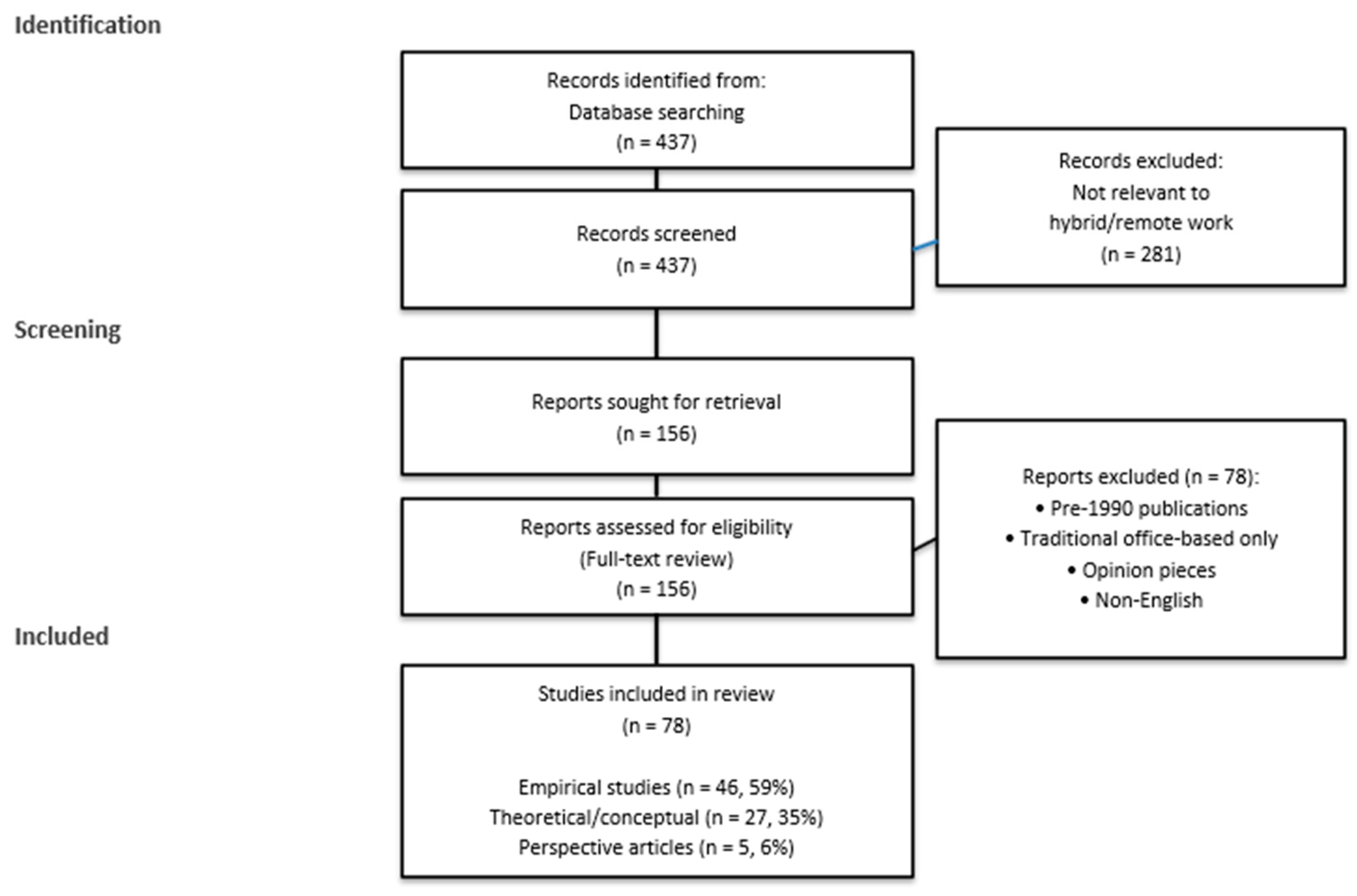
The systematic search and screening process is illustrated in
Figure 1, which presents the PRISMA (Preferred Reporting Items for Systematic Reviews and Meta-Analyses) flow diagram [
27]. PRISMA helps report systematic reviews clearly, ensuring that the work is open and repeatable. The process followed four main steps, which are described as follows. First, a database search was conducted to identify relevant studies. Following this, titles and abstracts were screened to check if they met the inclusion criteria.
The inclusion criteria focused specifically on studies that considered wellbeing in the context of remote, online or virtual work. The following inclusion and exclusion criteria were specified.
The inclusion criteria specified:
Publication in English;
Peer-reviewed journal articles or established institutional reports (such as CIPD, Eurofound);
Focus on employee engagement and/or wellbeing in hybrid, remote, flexible or virtual work contexts;
Empirical, conceptual or theoretical contributions.
The exclusion criteria eliminated:
Pre-1990 publications;
Studies post-2019 focusing exclusively on traditional office-based work;
Conference papers that are not subsequently published in journals;
Opinion pieces lacking empirical or theoretical grounding;
Non-English language publications.
A comprehensive search was subsequently conducted, employing relevant search strings that included combinations of keywords and their variants. These search terms encompassed: Employee Engagement, Work Engagement, Wellbeing, Mental Health, Wellbeing, Hybrid Working, Remote Working, Flexible Working, HRM and Home Working.
A final check of the full-text articles was conducted to determine if they were eligible. Those that met the criteria were downloaded and scanned for relevant data. The search strategy included two complementary components:
- (1)
Seminal theoretical contributions published 1990–2018 that provided foundational frameworks for understanding engagement and wellbeing;
- (2)
Contemporary studies published 2019–2024 that specifically addressed hybrid, remote or flexible work arrangements.
This dual approach ensured both theoretical rigour and contemporary relevance in hybrid work research.
From an initial corpus of 437 articles identified through database searches, 156 proceeded to full-text review after title and abstract screening. Of these, 78 relevant studies met all inclusion criteria. These studies examined the impact of job design, workplace flexibility and leadership factors on employee engagement and wellbeing outcomes. To synthesise the key findings, thematic analysis was undertaken. This facilitated the systematic review and interpretation of the evidence. This methodological approach enabled the researchers to answer the research questions associated with hybrid work, ultimately leading to the development of evidence-based recommendations for practice.
3. Findings
The primary objectives of this study encompass:
Identifying the opportunities and challenges inherent in hybrid work arrangements;
Analysing the factors that influence employee engagement and wellbeing within hybrid work contexts;
Synthesising recommendations for HRM professionals regarding the design of effective hybrid work systems.
3.1. Hybrid Working: Definitions and Context
Vartiainen & Vanharanta [
11] characterise the ‘true nature’ of hybrid work as encompassing not merely location flexibility but temporal, spatial, functional and organisational dimensions. Eurofound [
1] defines hybrid work as arrangements combining remote and on-premises work, typically with employees working from home one to three days weekly. Individual worker circumstances and preferences further contribute to configuration variation.
Hybrid work differs from traditional office work and fully remote arrangements. It requires organisations to maintain physical infrastructure whilst simultaneously supporting distributed work, necessitating new approaches to coordination, communication, and culture maintenance. The model assumes technology-enabled collaboration but recognises the continued value of face-to-face interaction for specific purposes such as relationship building, creative collaboration, and organisational socialisation.
3.2. Opportunities and Challenges in Hybrid Work
Although remote work arrangements had been relatively common among knowledge workers prior to 2020, the COVID-19 pandemic precipitated a dramatic and immediate transition to flexible work arrangements. Examining the opportunities and challenges inherent in hybrid work (Objective 1) reveals a complex picture of benefits alongside significant hindrances.
3.2.1. Opportunities and Benefits
There are several benefits in hybrid work for both employers and employees. As employees report a greater ability to integrate professional and personal responsibilities, enhanced work–life balance emerges as a primary benefit of hybrid work [
2]. As employees save on commuting time, they also save on associated costs and they have more free time for personal and family activities. This results from an increased autonomy over workspace and schedule and helps them to structure their days around personal energy patterns and wellbeing activities.
There are benefits associated with hybrid work for organisations as well; working remotely offers opportunities for talent acquisition from a wider pool of employees, it results in reduced real estate costs and demonstrates maintenance of productivity levels. Recent reports [
2] have demonstrated that hybrid work has minimal adverse effects on productivity or performance as it enables roles that can operate remotely or away from physical office locations with the same efficiency. Within hybrid work arrangements, individuals exercise greater control over their workspace and work scheduling, achieving better integration of professional and personal responsibilities. The increased autonomy characteristic of hybrid work aligns with fundamental psychological needs [
15], potentially enhancing intrinsic motivation and engagement. Employee engagement and productivity improves as a result of flexible working due to improved work–life balance and the resulting supportive organisational environment. This improves the employee experience, reducing turnover and improving employee retention.
3.2.2. Challenges and Hindrances
In spite of the numerous benefits highlighted above, scholars have identified significant challenges in hybrid work. One of the primary concerns is the professional isolation that accompanies hybrid work as a diminished sense of connection to colleagues and organisations emerges [
5,
7]. There is a reduction in spontaneous interactions, corridor conversations, lunch discussions and chance encounters. This reduces opportunities for informal learning, relationship-building and socialisation. Hybrid work may intensify feelings of loneliness and disconnection, especially for employees whose sole social interactions occur at the workplace.
Technostress, the stress arising from constant connectivity, has recently been reported in hybrid work [
7]. This is caused by information overload and the blurring of work–life boundaries, especially notification overload from multiple communication platforms that fragments attention and reduces capacity for deep, focused work. As a result of technostress, employees find it difficult to disconnect from work demands and maintain boundaries between professional and personal life [
23]. The ‘always on’ culture facilitated by digital technologies can lead to extended working hours, reduced recovery time and eventual burnout [
8].
An increasing proportion of employees are experiencing mental health challenges negatively affecting their productivity and job satisfaction, caused mainly by escalating stress and anxiety levels in remote work [
3,
19]. The most prevalent sources of workplace stress include workload and the resulting work–life imbalance and inadequate management support, and these require specific interventions suited to hybrid work.
Research has identified thematic areas that reflect discrepancies between desirable expectations from employees and undesirable realities of remote work [
28]:
Flexitime versus work intensity;
Flexplace versus space limitations;
Technologically feasible work arrangements versus technostress and isolation;
Family-friendly work arrangements versus housework and caregiving intensity.
For employees without dedicated work areas, the space constraints create ergonomic problems and issues with work–home boundaries. Equity concerns have also emerged, with evidence suggesting that hybrid workers may experience ‘proximity bias’, whereby those physically present in offices receive more opportunities, recognition and career advancement than remote workers. Ensuring equitable access to development opportunities, visibility and career progression regardless of work location is a crucial imperative for HRM professionals.
3.3. Five Factors Influencing Employee Engagement and Wellbeing
Five critical factors have emerged from this study that consistently influence employee engagement and wellbeing in hybrid work environments. These factors are interconnected and require an integrated approach rather than interventions that are isolated.
3.3.1. Factor 1: Workspace and Worktime Flexibility
The literature reveals that foundational elements in hybrid work are spatial flexibility (where work occurs) and temporal flexibility (when work occurs), and both these dimensions need careful consideration in hybrid work [
10]. Studies highlight challenges with inadequate home workspace, including poor ergonomics, insufficient technological infrastructure and environmental distractions [
4]. Another point worth noting is that while hybrid work is highly valued, temporal flexibility can blur work–life boundaries and this can lead to extended working hours, as disconnecting from work may not be as scheduled as in-office hours.
Organisations need to issue specific guidelines that complement spatial and temporal flexibility such as providing equipment, technological support and guidance on workspace setup. This should be accompanied by regular surveys and workplace assessments to evaluate the wellbeing outcomes. In addition, core hours’ need to be established for synchronous collaboration so flexibility outside these hours is appropriately designed. HRM professionals, in particular, must pay attention to individual autonomy with collective team coordination needs so that workplace policies must ensure equitable access to opportunities and resources. This should be regardless of the employees’ chosen work location patterns, addressing concerns about proximity bias and career progression [
7].
3.3.2. Factor 2: Organisational Culture and Leadership
Leadership practices and leader–team interactions determine workplace culture and collaboration. Guest [
24] and Saks [
6] emphasise that caring, supportive leadership influences employee wellbeing and engagement, as well as organisational and societal outcomes. In hybrid contexts, leadership competencies must be developed to cultivate appropriate behaviours for managing teams in distributed environments.
Research by Charalampous et al. [
5] and Pass and Ridgway [
19] demonstrates that effective hybrid leadership requires enhanced communication skills and the ability to build trust remotely, fostering psychological safety across distributed teams and creating inclusive practices ensuring all employees feel valued regardless of location. HRM professionals need to focus on leadership development and employee adaptability to build successful flexible working practices.
Organisational culture extends beyond cognitive dimensions (mission, vision, values) to encompass emotional aspects (psychological safety) and functional elements (decision-making processes). In hybrid contexts, culture cultivation is even more significant; without this, organisations are at risk of fragmenting into disconnected sub-groups based on work location. This would undermine the cohesion and shared purpose. HRM professionals must design mechanisms to create stronger connections between employees and organisational culture, purpose, and values, particularly when physical co-location no longer serves this function.
3.3.3. Factor 3: Strategic Job and Task Allocation
A crucial aspect of hybrid working involves the configuration of personnel and task allocation within specific timeframes whilst accounting for geographical dispersion. HRM practitioners can employ various mechanisms to ensure clarity regarding job and task allocation for hybrid workers [
9].
Research [
15,
16] highlighted that the nature of work itself—the job characteristics, meaningfulness and alignment with skills all influence engagement. In hybrid contexts, HRM professionals should support strategic decisions about which tasks are best suited for remote, on-site or hybrid execution. This will have a huge impact on individual productivity and collective coordination. Tasks requiring focus may be better suited to remote work while face-to-face interaction may be better for creative collaboration and relationship building.
HRM professionals must assess the potential for individual flexibility whilst coordinating to achieve optimal collective flexibility, and establish regulatory frameworks for role allocation and coordination [
10]. Qualitative research has demonstrated that people managers and line managers play critical roles in supporting employees working in hybrid modalities, making the development of managerial capability to coach and support virtually working staff a key consideration. To understand collaboration requirements and coordination for optimal flexibility, additional considerations include team-wide training, target setting and process decomposition. In addition, equity must be maintained in allocation decisions to ensure the fair distribution of desirable assignments and development opportunities.
3.3.4. Factor 4: Collaboration Networks and Tools
The provision of appropriate networks and collaboration tools has become essential infrastructure for hybrid work. Research by Monge Roffarello and De Russis [
18] and Nachmias et al. [
9] emphasises that technology alone is insufficient; organisations must establish norms and protocols for effective digital communication. These norms must ensure that technostress and information overload is prevented.
Communication platforms are essential for effective information exchange and videoconferencing. These enable instant messaging and collaborative workspaces making real-time interaction and document collaboration possible. In addition, project management tools that assist in task allocation, progress tracking and deadline management should be provided, as they ensure transparent coordination. Other tools that can help here are virtual whiteboarding and brainstorming tools that facilitate collaboration and problem-solving in distributed environments. The Cisco Global Hybrid Work Study [
2] recommends that organisations must balance synchronous collaboration with asynchronous flexibility.
These collaboration tools need to be managed carefully, as they can contribute to digital overload and technostress if not. HRM professionals need to design clearer guidelines that respect work–life boundaries. These guidelines should include setting expectations for synchronous versus asynchronous communication, discouraging after-hours communication and promoting focused work periods free from notifications.
In addition, organisations need to address the risk of professional isolation in hybrid environments. Regular team check-ins, virtual social events and opportunities for informal interaction promote social connections. HRM practitioners should facilitate the development of communities of practice and peer support networks that transcend physical location boundaries.
3.3.5. Factor 5: Training and Support Mechanisms
To help employees to navigate the challenges of hybrid work, targeted training and support mechanisms must be provided through appropriate interventions. This includes technical skills (digital competencies, collaboration tool proficiency) and personal skills (boundary management, resilience building, stress management).
Delany [
4] and Gifford [
7] highlight that for these interventions to support sustainable hybrid work arrangements, they must address both technical proficiency and psychological wellbeing. The training design should focus on mechanisms to improve awareness of associated challenges and opportunities in hybrid work while also considering social support elements to enhance mental health.
HRM professionals should implement comprehensive wellbeing programmes addressing the unique challenges of hybrid work. These may include mental health resources, stress management training, mindfulness programmes and access to counselling services. Other wellbeing initiatives relate to the physical aspect of wellbeing such as ergonomic assessments for home workspaces and fitness programmes. Creating psychological safety [
15] for employees to seek support when needed is essential.
Individual flexibility mechanisms need to incorporate diverse employee needs and circumstances, such as accommodating caregiving responsibilities, supporting employees with disabilities or health conditions and recognising cultural and personal preferences. It is recommended that a personalised work arrangement based on employee needs be implemented to demonstrate organisational commitment to employee wellbeing, thereby significantly enhancing engagement and retention.
To help organisations monitor employee experience and identify emerging challenges, regular wellbeing assessments and pulse surveys need to be conducted. In addition, HRM professionals should evaluate and act on the data to inform continuous improvement of hybrid work policies and practices. Importantly, wellbeing initiatives should be integrated into performance metrics and adequately resourced to be effective [
19]. When wellbeing initiatives are authentic and supported by organisational leadership, they will have an impact on organisational and consequently societal outcomes [
13].
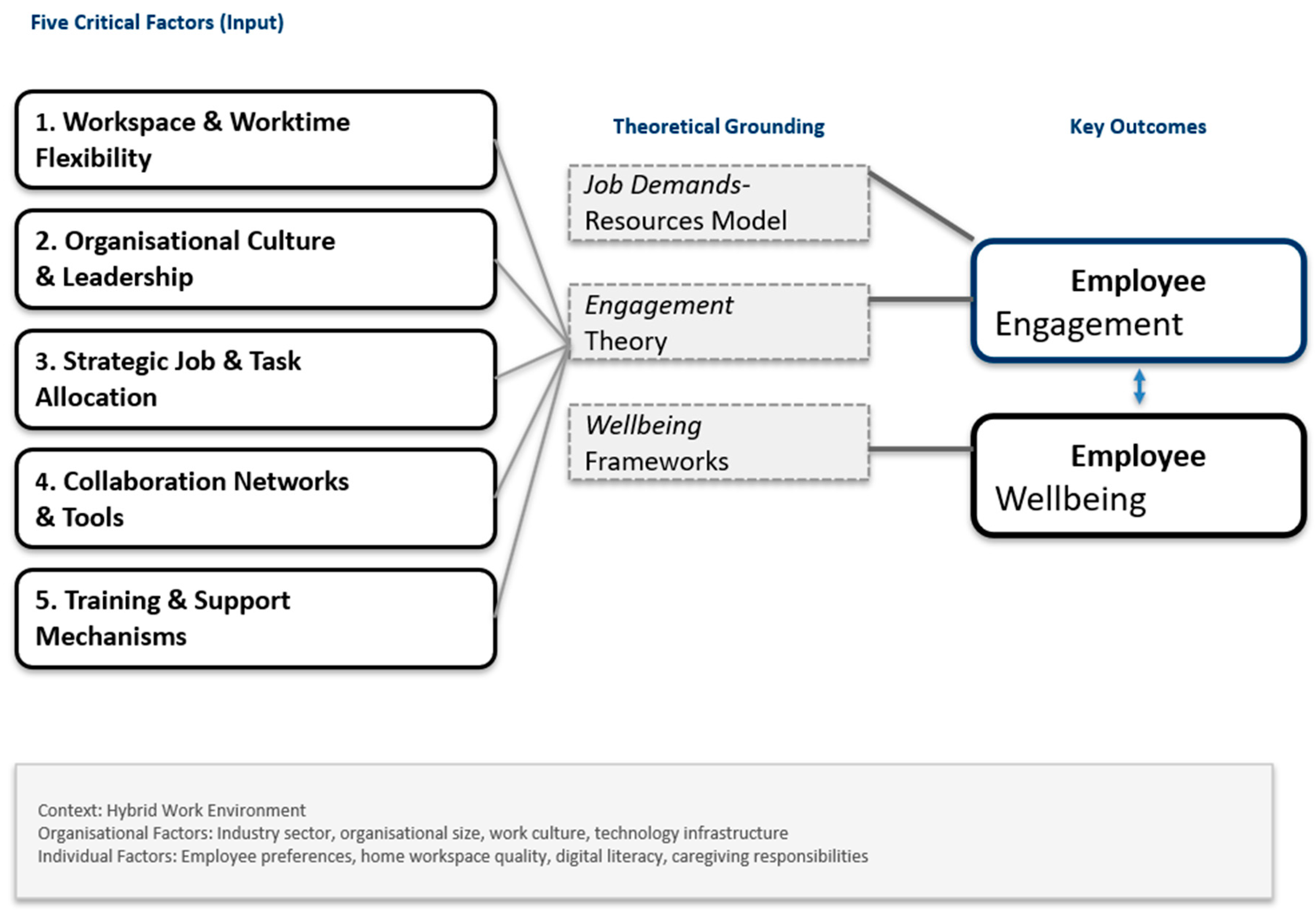
Figure 2 presents the conceptual framework developed from this research. The framework illustrates how the five critical factors—workspace and worktime flexibility, organisational culture and leadership, strategic job and task allocation, collaboration networks and tools, and training and support mechanisms—influence employee engagement and wellbeing through the lens of established theoretical models (JD–R model, engagement theory and wellbeing frameworks). This integrated framework acknowledges the hybrid work context and recognises that relationships are moderated by organisational and individual characteristics.
Figure 2 illustrates the conceptual framework grounded in existing theoretical perspectives for employee engagement and wellbeing. The Job Demands–Resources model provides the foundation for understanding how the five factors operate as resources that buffer against job demands inherent in hybrid work (such as technostress and isolation). Engagement theory explains the psychological conditions through which these factors foster engagement, whilst wellbeing frameworks clarify how they contribute to holistic employee wellbeing. The conceptual framework extends the foundational frameworks in employee engagement and wellbeing to distributed work environments. It does so by acknowledging that these relationships operate within the unique context of hybrid work environments, which require consideration of additional constructs.
4. Discussion
This section provides a deeper analysis of the factors influencing hybrid work identified in
Section 3. It begins by examining their connections to the existing theories from which they are derived. Following that, the section evaluates their implications for practice, focusing on important insights from the findings concerning digital wellbeing.
4.1. Five Key Factors Influencing Employee Engagement and Wellbeing
The systematic literature review highlighted five key factors that influence employee engagement and wellbeing in hybrid work environments. HRM professionals need to pay attention to each factor that is distinct yet interconnected with the other four.
The key factor that is consistent in the current literature relates to workspace and worktime flexibility, although the research highlights that flexibility by itself is inadequate. The reviewed literature suggests that flexibility must be supported by adequate resources such as ergonomic equipment, technological infrastructure and clear policies to translate into wellbeing benefits. Without such support, flexibility can increase stress as employees struggle with inadequate home workspaces or excessive working hours enabled by temporal flexibility. Organisations must therefore view flexibility not as a standalone benefit but as a characteristic requiring active management and support.
To sustain engagement and wellbeing in hybrid work, leadership practices must be designed for a distributed environment. The literature emphasises that leadership behaviours must adapt to hybrid contexts, with increased attention to building trust, maintaining psychological safety and fostering an inclusive culture across distributed teams. Leaders gain trust in hybrid environments when they build a collaborative culture and enhance communication, despite physical distance [
5,
24]. Continued reliance on traditional leadership approaches can lead to isolation and disengagement among remote workers. There is a requirement for targeted leadership development for hybrid work competencies.
Furthermore, the strategic allocation of jobs and tasks is required in hybrid contexts. Line managers must design jobs carefully to determine the mix of remote, on-site, or hybrid work, ensuring inclusive and meaningful work for all employees. This would impact the perception of fairness and inclusion and, in turn, would impact engagement [
16,
29]. Leaders must pay attention to avoiding proximity bias, which can emerge when office-based employees receive more opportunities and recognition than their remote counterparts [
11].
The influx of technology in hybrid work has made it necessary for organisations to provide for appropriate networks and collaboration tools. Collaboration technologies help make hybrid work possible. However, using too many of these tools can lead to stress and information overload [
9,
18]. Organisations must therefore develop mechanisms to balance technology provision with the establishment of norms, guiding employees on communication practices that respect boundaries and work–life balance. This highlights the need to provide appropriate communication practices and policies, in addition to the technological tools and capabilities.
Organisations that invest comprehensively in both technical and psychological training report better wellbeing outcomes. Organisations must implement holistic wellbeing programmes, as managing remote employees requires technical competencies and psychological skills such as boundary management, resilience-building, and stress management [
7,
19]. These are the new capabilities to be built across the workforce.
4.2. Theoretical Integration and Practical Implications
The five factors proposed in the findings and discussion extend the existing HRM literature, adding new dimensions to existing frameworks; for example, new constructs include digital wellbeing and technostress. The Job Demands–Resources (JD-R) model [
14] is revisited and analysed to propose how hybrid work can deplete or replenish employee resources. Job demands such as technostress, isolation and blurred work–life boundaries operate in hybrid contexts, while the job resources relate to flexibility, autonomy and supportive leadership. However, the present research reveals a critical insight: resources that enhance wellbeing in traditional contexts may not function identically in hybrid contexts. For instance, autonomy, which is typically considered a job resource, can become a demand when employees lack clear guidance on work expectations or struggle with self-management in unsupervised contexts. This suggests that the JD–R model requires adaptation to account for context-dependent situations.
Similarly, Kahn’s [
15] engagement framework requires adaptation for hybrid contexts. Meaningfulness in hybrid work relates to equitable task allocation and inclusive communication practices that ensure remote workers feel their contributions are valued. Psychological safety demands intentional cultivation across distributed teams through consistent leadership behaviours and organisational norms. Availability, having the physical, emotional and psychological resources to engage, depends heavily on effective boundary management and adequate support structures. Well-thought organisational interventions are now required to manage these psychological conditions in hybrid work environments.
The integration of these factors with wellbeing frameworks [
24,
25] suggests that the correct design of hybrid work can enhance employee wellbeing. Careful attention to the five identified factors in hybrid work arrangements is required to prevent stress, isolation and burnout [
5,
28]. The critical distinction lies not in whether organisations adopt hybrid work but in how they implement it. Organisations treating hybrid work as merely a location change, without addressing culture, leadership, technology norms and support mechanisms will experience the negative outcomes documented in the literature. Conversely, those adopting comprehensive approaches addressing all five factors report sustained engagement and wellbeing.
A key finding from the theoretical integration relates to digital wellbeing [
17,
18]. Traditional wellbeing frameworks do not adequately address digital wellbeing concerns. The present research suggests that digital wellbeing should be conceptualised as a distinct dimension of overall wellbeing in hybrid contexts and requires specific interventions. Suggested interventions include, but are not limited to, digital detox periods, notification management protocols and boundaries around synchronous communication. This represents a necessary theoretical extension to accommodate the technology-mediated nature of contemporary work.
Practical implications for HRM professionals are substantial. Firstly, organisations must abandon standalone approaches and implement integrated strategies that address all five factors simultaneously. Secondly, HRM professionals must follow evidence-based insights to organisational decision-making, positioning themselves as strategic partners in hybrid work design. Thirdly, organisations must recognise that the success of hybrid work depends on regular employee feedback. Finally, organisations must ensure that career progression and development opportunities are available to all employees, regardless of their work location.
HRM professionals play a critical role in the design and implementation of sustainable hybrid work systems that enhance employee wellbeing and engagement.
5. Conclusions
This systematic review addresses the three key objectives of this study: identifying opportunities and challenges in hybrid work (Objective 1), analysing factors influencing employee engagement and wellbeing (Objective 2) and synthesising evidence-based recommendations for HRM professionals (Objective 3). The synthesis of 78 studies highlights that hybrid work offers significant benefits but also presents challenges related to professional isolation, technostress and boundary management. Five critical factors emerged from this study as significant for sustaining employee engagement and wellbeing in hybrid work:
Workspace and worktime flexibility with appropriate support;
Organisational culture and leadership adapted to distributed environments;
Strategic and equitable job and task allocation;
Collaboration networks and tools governed by healthy communication norms;
Comprehensive training and support mechanisms addressing both technical and psychological needs.
These factors are interconnected and require an integrated approach rather than isolated interventions.
5.1. Implications for HRM Practice
Five evidence-based propositions are derived from the findings to guide HRM professionals in designing sustainable hybrid work systems:
Proposition 1. Provide ongoing support with workspace and workhours in hybrid work.
Comprehensive policies addressing both spatial and temporal flexibility are now required. This includes ensuring home workspaces meet ergonomic and safety standards, providing equipment and technology support and establishing clear guidelines for work scheduling that also respect employee autonomy and team needs. Importantly, the policies must be equitable for all employees, providing access to opportunities and resources regardless of the work location [
4,
10].
Proposition 2. Focus on culture and leadership development to improve trust and inclusion.
Leadership development programmes must focus on the competencies required for managing hybrid teams. Suggested competencies include enhanced communication skills, ability to build trust remotely, fostering psychological safety across distributed teams and creating inclusive practices. Organisations should consider wellbeing as a core component of their culture, rather than treating it as additional programme [
5,
24].
Proposition 3. Allocate jobs and tasks strategically to suit the hybrid environment.
HRM practitioners should work with managers to carry out task assessments so optimal work configurations are designed. Individual flexibility must be balanced with collective coordination so individual and organisational needs are met. Performance management systems must be adapted to focus on outcomes rather than presence, and career progression pathways must remain accessible to employees regardless of their hybrid work patterns [
6,
9].
Proposition 4. Provide appropriate collaboration tools and establish healthy communication norms.
While collaboration technologies are necessary, norms and training are equally important. Organisations should provide clear guidelines to teams for communication channel selection, response time expectations and respecting work–life boundaries. Training should address both technical proficiency and digital wellbeing and help employees manage information overload and maintain healthy technology relationships [
7,
18].
Proposition 5. Design comprehensive support mechanisms for hybrid worker wellbeing.
To address the unique challenges of hybrid work, organisations must implement comprehensive wellbeing programmes. Employees should be provided with a variety of resources such as stress management training and interventions for work–life boundary management. Wellbeing initiatives should be seamlessly integrated into organisational strategy rather than treated as optional at the discretion of managers or employees. The continuous improvement of hybrid work practices should be driven by assessment of employee wellbeing strategies [
3,
19].
5.2. Contributions to Theory and Practice
This research makes several contributions to both scholarship and practice. Theoretically, it extends engagement and wellbeing frameworks for hybrid work contexts by proposing how the established constructs operate differently in distributed work. The five-factor framework provides a tool for understanding how the challenges and opportunities of hybrid work can be addressed. The research demonstrates that existing theories, mainly the JD–R model, Kahn’s engagement framework and traditional wellbeing models, require adaptation to address the unique characteristics of hybrid work, particularly regarding technology-mediated relationships, blurred work–life boundaries and digital wellbeing.
This study offers actionable guidance for HRM professionals using the five-factor model to design and implement sustainable hybrid work systems. The research emphasises that successful hybrid work requires systemic approaches to address multiple factors simultaneously rather than standalone interventions. This study also offers evidence-based propositions for HRM professionals, primarily in the form of practice recommendations. The recommendations are aligned with the United Nations Sustainable Development Goals, particularly those addressing decent work and wellbeing [
12]. Thus, this research positions hybrid work design as both an organisational and societal imperative.
5.3. Limitations and Directions for Future Research
This study has several limitations that could be explored in more detail and through future research. Firstly, findings from a systematic literature review usually reflect the current state of published research and this research evolves rapidly, quicker than the speed of publication. One area for future research could be to design longitudinal studies that examine how these factors and their relationships evolve over time. These would provide valuable insights into the sustainability of hybrid work arrangements.
Secondly, although the review included diverse organisational contexts, most of the studies originated from the Western developed economies. Diversity of context, especially from varied cultures and organisational contexts would enhance understanding of hybrid work in these contexts and provide a more balanced view. In addition, practical insights are now required to compare how different industries and organisations of varied sizes approach hybrid work.
Thirdly, the five identified factors and related interventions could be tested to confirm which ones make an actual difference in HRM practices, in hybrid contexts. Furthermore, research examining the intersection of hybrid work with other contemporary organisational priorities, including diversity and inclusion, environmental sustainability and digital transformation, would be valuable.
5.4. Concluding Remarks
Hybrid work represents a fundamental shift in how organisations structure and manage employment relationships. While hybrid work offers substantial benefits in work–life balance, it also presents challenges that require thoughtful, evidence-based interventions [
30]. The five factors identified in this research provide a framework for designing sustainable hybrid work systems that protect and enhance both employee wellbeing and organisational effectiveness.
As organisations continue to refine their hybrid work approaches, HRM professionals have a critical opportunity to position themselves as strategic partners in organisational design and change. By applying the evidence-based propositions presented here and maintaining commitment to ongoing learning and adaptation, organisations can create hybrid work environments that align with the United Nations Sustainable Development Goals whilst meeting the needs of contemporary workforces. The future of work is hybrid and its success depends on our collective commitment to sustainable, equitable and human-centred design.