
Tourism and Hospitality Students’ Perceptions of Their Employment Prospects and Future Career Paths: A Systematic Literature Review


Abstract
1. Introduction
2. Main Theories on the Relationship Between Tourism and Hospitality Education and Labor Outcomes
2.1. Human Capital Theory
2.2. Social Cognitive Career Theory
2.3. Theory of Planned Behavior
2.4. Krumboltz’s Social Learning Theory
2.5. Career Construction Theory
3. Methodology
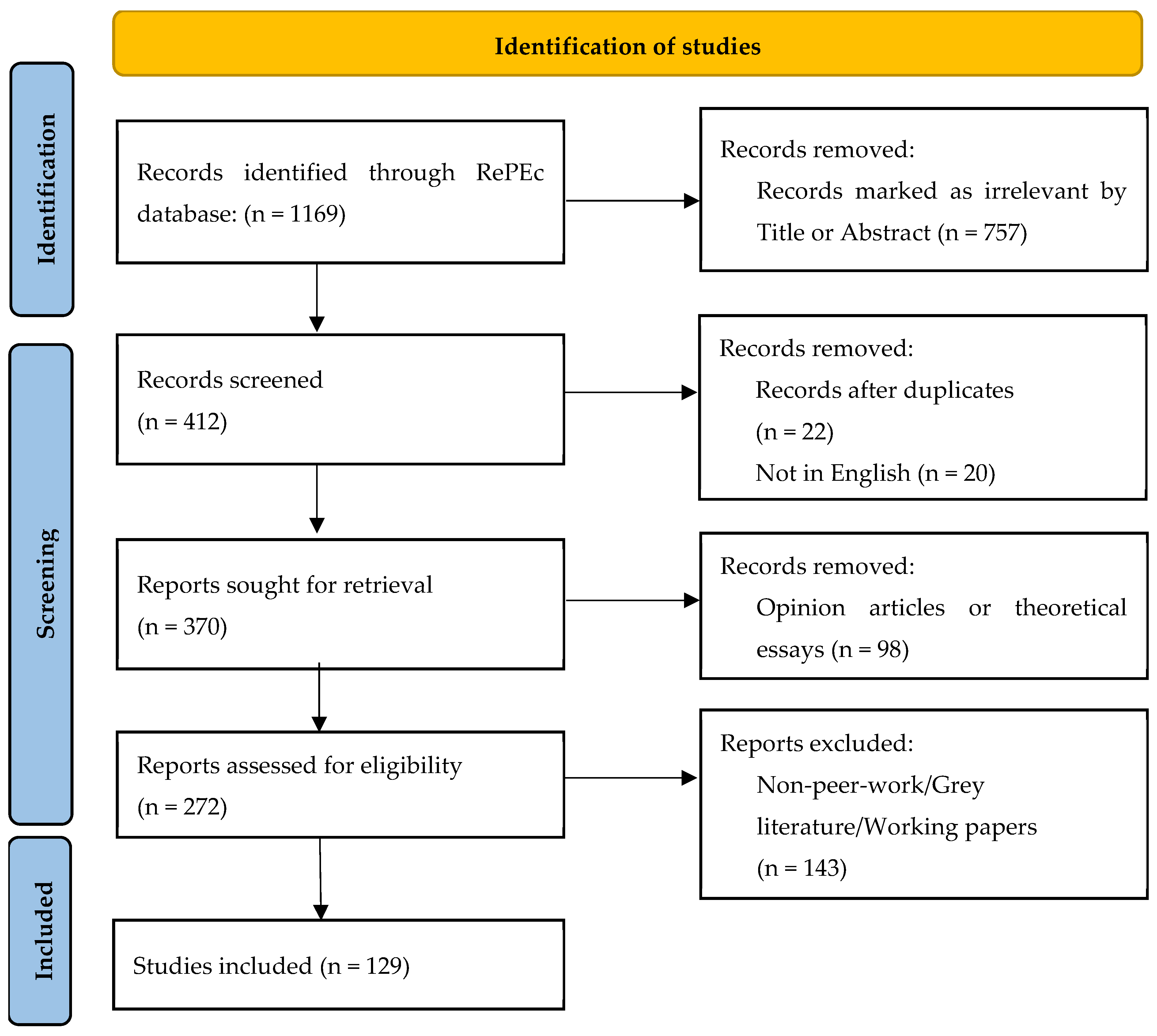
3.1. The Systematic Literature Review Methodology
3.2. Thematic Coding and Synthesis Procedure

| No. | Authors (Year) | Publication | Sample/ No. of Observations | Scopus Indexed |
|---|---|---|---|---|
| 1 | Airey and Frontistis (1997) [26] | Tourism Management | 176 UK and 152 Greece pupils | Yes |
| 2 | Aksu and Köksal (2005) [27] | International Journal of Contemporary Hospitality Management | 689 T&H Students | Yes |
| 3 | Alananzeh (2014) [28] | Journal of Management Research | 100 T&H Students | No |
| 4 | Al-Jubari et al. (2019) [29] | International Journal of Human Potentials Management | 206 T&H Students | No |
| 5 | Alrawadieh (2021) [30] | Journal of Tourismology | 130 Tour Guiding Students | No |
| 6 | Altman and Brothers (1995) [31] | Hospitality Review | 449 Hospitality Graduates | No |
| 7 | Amissah et al. (2020) [32] | Journal of Hospitality & Tourism Education | 441 T&H Students | Yes |
| 8 | Anthony et al. (2021) [33] | Research in Hospitality Management | 1341 Hospitality Students | No |
| 9 | Appietu et al. (2019) [34] | African Journal of Hospitality and Tourism Management | 171 Hospitality Management Students | No |
| 10 | Arcodia and Dickson (2009) [35] | Journal of Hospitality & Tourism Education | 79 T&H Students | Yes |
| 11 | Ardani and Pradini (2023) [36] | ICBMASE 2023 | 73 Tourism Students | No |
| 12 | Armoo and Neequaye (2014) [37] | Worldwide Hospitality and Tourism Themes | 260 T&H Students | Yes |
| 13 | Atef and Al Balushi (2017) [38] | Quality Assurance in Education | 88 T&H Students | Yes |
| 14 | Ayad et al. (2022) [39] | Sustainability | 750 T&H Graduates | Yes |
| 15 | Badulescu et al. (2014) [40] | Amfiteatru Economic | 123 Business Master Students | Yes |
| 16 | Bahcelerli and Sucuoglu (2015) [41] | Procedia Economics and Finance | 97 Tourism Students | Yes |
| 17 | Barron and Anastasiadou (2009) [42] | International Journal of Contemporary Hospitality Management | 150 T&H Students | Yes |
| 18 | Barron et al. (2007) [43] | Journal of Hospitality and Tourism Management | 20 Hospitality Management Students | Yes |
| 19 | Bednarska and Olszewski (2013) [44] | Journal of Entrepreneurship Management and Innovation | 345 T&H Students | Yes |
| 20 | Benaraba et al. (2022) [45] | Journal of Hospitality, Leisure, Sport & Tourism Education | 196 Tourism Management Students | Yes |
| 21 | Birtch et al. (2021) [46] | International Journal of Hospitality Management | 425 Hospitality Management Students | Yes |
| 22 | Blomme et al. (2013) [47] | Journal of Hospitality & Tourism Education | 159 Hotel school Students & 78 Graduates | Yes |
| 23 | Bordean and Sonea (2018) [5] | Entrepreneurship and Sustainability Issues | 114 Tourism Students | Yes |
| 24 | Bouchon et al. (2016) [7] | TEAM Journal of Hospitality and Tourism | 60 Hospitality Students (among other stakeholders) | No |
| 25 | Butkouskaya et al. (2020) [48] | Sustainability | 290 Tourism Students | Yes |
| 26 | Cantos et al. (2019) [49] | Asia Pacific Journal of Education, Arts and Sciences | 305 T&H Students | No |
| 27 | Cesário et al. (2022) [50] | Sustainability | 305 T&H Students | Yes |
| 28 | Chang and Tse (2015) [51] | Journal of Hospitality & Tourism Research | 305 T&H Graduates | Yes |
| 29 | Chen and Shen (2012) [52] | Journal of Hospitality, Leisure, Sport & Tourism Education | 459 Hospitality Students | Yes |
| 30 | Chen et al. (2000) [53] | international Journal of Contemporary Hospitality Management | 311 Hospitality Students | Yes |
| 31 | Chi and Gursoy (2009) [54] | International Journal of Contemporary Hospitality Management | 102 Hospitality Graduates | Yes |
| 32 | Chia and Liang (2016) [55] | Journal of Entrepreneurship, Management and Innovation | 213 Tourism Students | Yes |
| 33 | Choudhary (2019) [56] | Journal of Emerging Technologies and Innovative Research | Unspecified Number of Students in Hospitality Sector | No |
| 34 | Choy and Yeung (2022) [57] | PLoS ONE | 407 Tourism Students | Yes |
| 35 | Chuang and Dellmann-Jenkins (2010) [58] | Journal of Hospitality & Tourism Research | 360 Hospitality Students | Yes |
| 36 | Chuang et al. (2020) [59] | Journal of Hospitality, Leisure, Sport & Tourism Education | 273 Hospitality Students | Yes |
| 37 | Datta and Jha (2015) [60] | EPRA International Journal of Economic and Business Review | 60 Hotel Management Students | No |
| 38 | Datta et al. (2013) [61] | ZENITH International Journal of Multidisciplinary Research | 60 Hotel Management Students | No |
| 39 | Dragin et al. (2022) [62] | Sustainability | 310 T&H Students | Yes |
| 40 | Düzgün (2024) [63] | Journal of Tourism, Sustainability and Well-being | 393 Tourism Students | No |
| 41 | Eminov and Aliyeva (2017) [64] | Yearbook of D. A. Tsenov Academy of Economics | 64 Tourism & Management Students (and 42 Employees of hotels and tourism companies) | No |
| 42 | Fantilio et al. (2022) [65] | Quantum Journal of Social Sciences and Humanities | 105 Tourism Management Students | No |
| 43 | Farmaki (2018) [66] | Journal of Hospitality, Leisure, Sport & Tourism Education | 30 T&H Students | Yes |
| 44 | Getz (1994) [67] | International Journal of Hospitality Management | 50 (first wave) and 96 (second wave) High School Students | Yes |
| 45 | Grobelna (2017) [68] | International Journal of Management and Economics | 168 T&H Students | Νο |
| 46 | Grobelna (2022) [69] | Sustainability | 155 T&H Students | Yes |
| 47 | Grobelna and Skrzeszewska (2019) [70] | Journal of Entrepreneurship, Management and Innovation | 171 T&H Students | Yes |
| 48 | Grobelna and Tokarz-Kocik (2021) [71] | European Research Studies Journal | 60 T&H Students | Yes |
| 49 | Grobelna and Wyszkowska-Wróbel (2021) [72] | European Research Studies Journal | 110 T&H Students | Yes |
| 50 | Hjalager (2003) [73] | Journal of Hospitality, Leisure, Sport & Tourism Education | 159 T&H Master Students | Yes |
| 51 | Hoque and Ahsif (2020) [74] | International Journal of Tourism Policy | 220 T&H Students | Yes |
| 52 | Horng et al. (2021) [75] | Journal of Hospitality, Leisure, Sport & Tourism Education | 122 T&H Students | Yes |
| 53 | Jenkins (2001) [76] | International Journal of Contemporary Hospitality Management | 80 (Netherlands) & 58 Hospitality Students (UK) | Yes |
| 54 | Johns and McKechnie (1995) [77] | International Journal of Contemporary Hospitality Management | 21 Hotel and Catering Graduates | Yes |
| 55 | Kapera (2017) [78] | Tourism | 100 Tourism Students | Yes |
| 56 | Kim et al. (2008) [79] | Journal of Marketing for Higher Education | 365 T&H Students & 175 T&H Graduates | Yes |
| 57 | Kim et al. (2010) [3] | Journal of Hospitality & Tourism Education | 31 T&H Students | Yes |
| 58 | Kim et al. (2016) [80] | Journal of Hospitality, Leisure, Sport & Tourism Education | 1297 T&H Students (Korea = 404, Taiwan = 553, Hong Kong = 338) | Yes |
| 59 | Kipkosgei et al. (2015) [81] | African Journal of Tourism, Hospitality and Leisure | 192 Tourism Students (Plus 5 semi-structured interviews with tourism lecturers) | Yes |
| 60 | Kusluvan and Kusluvan (2000) [82] | Tourism Management | 397 Tourism & Hotel Management Students & two focus groups with 10 Tourism Students | Yes |
| 61 | Lambulira et al. (2022) [83] | African Journal of Hospitality, Tourism and Leisure | 30 T&H Students | Yes |
| 62 | Lashley (2013) [84] | Research in Hospitality Management | 653 T&H Students | Yes |
| 63 | Le et al. (2018) [85] | Empirical Research in Vocational Education and Training | 253 Hospitality Students | Yes |
| 64 | Lee et al. (2019) [86] | Journal of Hospitality & Tourism Education | 558 Hospitality Management Students | Yes |
| 65 | Lewis and Airey (2001) [87] | Tourism and Hospitality Research | 120 Secondary School Students | Yes |
| 66 | Litvin (2000) [88] | Tourism and Hospitality Research | 133 Leisure and Travel Management Students | Yes |
| 67 | Liu et al. (2023) [89] | Economic Research-Ekonomska Istraživanja | 842 H&T Students | Yes |
| 68 | Lu and Adler (2009) [90] | Journal of Teaching in Travel & Tourism | 503 H&T Students | Yes |
| 69 | Maiorescu et al. (2020) [91] | Amfiteatru Economic | 292 Business and Tourism Students (Undergraduate & Master Students) | Yes |
| 70 | Mannaa and Abou-Shouk (2020) [92] | Al-Adab Journal | 227 Tourism Students | No |
| 71 | Martín-Navarro et al. (2023a) [93] | International Entrepreneurship and Management Journal | 464 Tourism Students | Yes |
| 72 | Martín-Navarro et al. (2023b) [94] | Journal of Business Research | 464 Tourism Students | Yes |
| 73 | Maxwell et al. (2010) [95] | Journal of Hospitality and Tourism Management | 122 Hospitality Students | Yes |
| 74 | Mayuzumi (2020) [96] | Asia-Pacifc Journal of Regional Science | 406 Undergraduate Students & 198 High School Students | Yes |
| 75 | McKercher et al. (2023) [97] | International Journal of Tourism Research | 174 in total in Tourism, Hospitality & Events (109 graduates, 53 post-graduates & 12 PhD graduates) | Yes |
| 76 | Mei et al. (2016) [98] | Applied Economics | 267 Tourism Students | Yes |
| 77 | Mohammad and Alsaleh (2013) [99] | International Journal of Asian Social Science | 175 T&H Students | Yes |
| 78 | Mungai et al. (2021) [100] | Research in Business & Social Science | 192 Tourism Management Students (and 12 Departmental Heads) | No |
| 79 | Nachmias and Walmsley (2015) [101] | Journal of Hospitality, Leisure, Sport & Tourism Education | 28 Hospitality Students | Yes |
| 80 | Omar (2014) [102] | Journal of Association of Arab Universities for Tourism and Hospitality | 480 Tourism & Hotel Management Students | No |
| 81 | Ortiz and Coromina (2021) [103] | Ciencia Unemi | 207 students during 2018 & 161 students in 2020 | No |
| 82 | Özişik Yapici et al. (2021) [104] | Journal of Tourism and Gastronomy Studies | 705 Tourism Students | No |
| 83 | Papathanassis (2021) [1] | Current Issues in Tourism | 167 Cruise Management Students | Yes |
| 84 | Park et al. (2017) [105] | Journal of Human Resources in Hospitality & Tourism | 307 T&H Students | Yes |
| 85 | Petrova and Mason (2004) [106] | Education + Training | 187 Tourism Students (and 6 employers) | Yes |
| 86 | Phuc et al. (2020) [107] | Management Science Letters | 388 Tourism Students | Yes |
| 87 | Pol and Patil (2015) [108] | Atithya: A Journal of Hospitality | 74 Hotel Management Students | No |
| 88 | Pranic (2023) [109] | Sustainability | 300 T&H Students | Yes |
| 89 | Rahimi et al. (2016) [110] | Advances in Culture, Tourism and Hospitality Research | 128 T&H Students (Questionnaires) & 15 Students + 2 Lecturers for Focus Groups | Yes |
| 90 | Ramakrishnan and Macaveiu (2019) [111] | Journal of Hospitality and Tourism Management | 23 Tourism Students | Yes |
| 91 | Raybould and Wilkins (2005) [112] | International Journal of Contemporary Hospitality Management | 211 Hospitality Management Students (& 850 Hospitality Managers) | Yes |
| 92 | Reichenberger and Raymond (2021a) [11] | Journal of Hospitality and Tourism Management | 24 Tourism Management Students | Yes |
| 93 | Reichenberger and Raymond (2021b) [113] | Journal of Teaching in Travel & Tourism | 24 Tourism Management Students | Yes |
| 94 | Richardson (2008) [114] | Journal of Teaching in Travel & Tourism | 86 T&H Students | Yes |
| 95 | Richardson (2009) [115] | International Journal of Hospitality Management | 379 T&H Students | Yes |
| 96 | Richardson (2010) [116] | Journal of Hospitality and Tourism Management | 379 T&H Students | Yes |
| 97 | Richardson and Butler (2012) [117] | Asia Pacific Journal of Tourism Research | 429 T&H Students | Yes |
| 98 | Richardson and Thomas (2012) [118] | Journal of Hospitality and Tourism Management | 258 T&H Students | Yes |
| 99 | Roberts (2024) [119] | Journal of Hospitality & Tourism Education | 211 Tourist Students | Yes |
| 100 | Robinson et al. (2016) [120] | Current Issues in Tourism | 34 T&H Students | Yes |
| 101 | Roney et al. (2007) [121] | Journal of Hospitality, Leisure, Sport and Tourism Education | 450 Tourism Students | Yes |
| 102 | Ross (1992) [122] | Tourism Management | 537 High School Students | Yes |
| 103 | Ross (1993) [123] | Visions in Leisure and Business | 594 High School Students | No |
| 104 | Rosyidi (2021) [124] | Jurnal Manajemen dan Kewirausahaan | 422 T&H Students | No |
| 105 | Selçuk et al. (2013) [125] | International Journal of Business and Social Science | 315 Tourism Students | Yes |
| 106 | Şengel (2020) [126] | European Journal of Tourism, Hospitality and Recreation | 270 Tourism Students (and 102 Tourism Business Managers) | No |
| 107 | Seyitoglu et al. (2022) [127] | Journal of Hospitality, Leisure, Sport & Tourism Education | 30 Tourism Students | Yes |
| 108 | Shah et al. (2021) [128] | Journal of Teaching in Travel & Tourism | 308 T&H Students for Quantitative method and 30 T&H students were interviewed for Qualitative | Yes |
| 109 | Sincharoenkul and Witthayasirikul (2022) [129] | Frontiers in Education | 242 T&H Students | Yes |
| 110 | Skiert and Buchta (2012) [130] | Polish Journal of Sport and Tourism | 167 Tourism and Recreation Students | Yes |
| 111 | Tan et al. (2016) [131] | Procedia—Social and Behavioral Sciences | 70 T&H Students | Yes |
| 112 | Teng (2008) [132] | International Journal of Hospitality Management | 483 Hospitality Students | Yes |
| 113 | Thetsane et al. (2020) [133] | Journal of Tourism and Hospitality Management | 421 Tourism, Hospitality and Hotel Management Students | Yes |
| 114 | Tsai et al. (2024) [9] | Sustainability | 588 T&H Students | Yes |
| 115 | Turanligil and Altintaş (2018) [134] | GeoJournal of Tourism and Geosites | 204 Tourism and Hotel Management Students | Yes |
| 116 | Unguren and Huseyinli (2020) [135] | Journal of Hospitality, Leisure, Sport & Tourism Education | 512 Tourism Students | Yes |
| 117 | Vaníček and Jarolimkova (2021) [136] | Management and Business Research Quarterly | 186 Tourism Students (94 in 2020 and 92 in 2021) | No |
| 118 | Verdadero et al. (2020) [137] | Journal of Tourism and Hospitality Research | 134 Tourism Students | Yes |
| 119 | Wakelin-Theron et al. (2018) [138] | African Journal of Hospitality, Tourism and Leisure | 207 Tourism Graduates and 351 Tourism Industry Respondents | Yes |
| 120 | Wan et al. (2014) [139] | Tourism Management | 205 T&H Students | Yes |
| 121 | Wang and Huang (2014) [140] | Journal of Human Resources in Hospitality & Tourism | 611 Tourism Students | Yes |
| 122 | Wen et al. (2018) [141] | Journal of Hospitality, Leisure, Sport & Tourism Education | 525 Hospitality Students | Yes |
| 123 | Wen et al. (2019) [142] | Journal of Hospitality & Tourism Education | 614 Hospitality Students and 10 Interviews with Hospitality Management Students | Yes |
| 124 | Xu et al. (2018) [143] | Current Issues in Tourism | 313 H&T Students | Yes |
| 125 | Yasar & Özturk (2023) [144] | Manas Sosyal Arastirmalar Dergisi | 19 Tourism Management Graduates | No |
| 126 | Zhang and Chen (2024) [145] | SAGE Open | 758 Tourism and Hotel Management Students | Yes |
| 127 | Zhang et al. (2020) [146] | Journal of Hospitality, Leisure, Sport & Tourism Education | 668 T&H Students | Yes |
| 128 | Zhong et al. (2021) [147] | Journal of Hospitality & Tourism Education | 377 H&T Students | Yes |
| 129 | Zhong et al. (2022) [148] | Sustainability | 840 Tourism Students | Yes |
4. SLR Findings and Key Insights
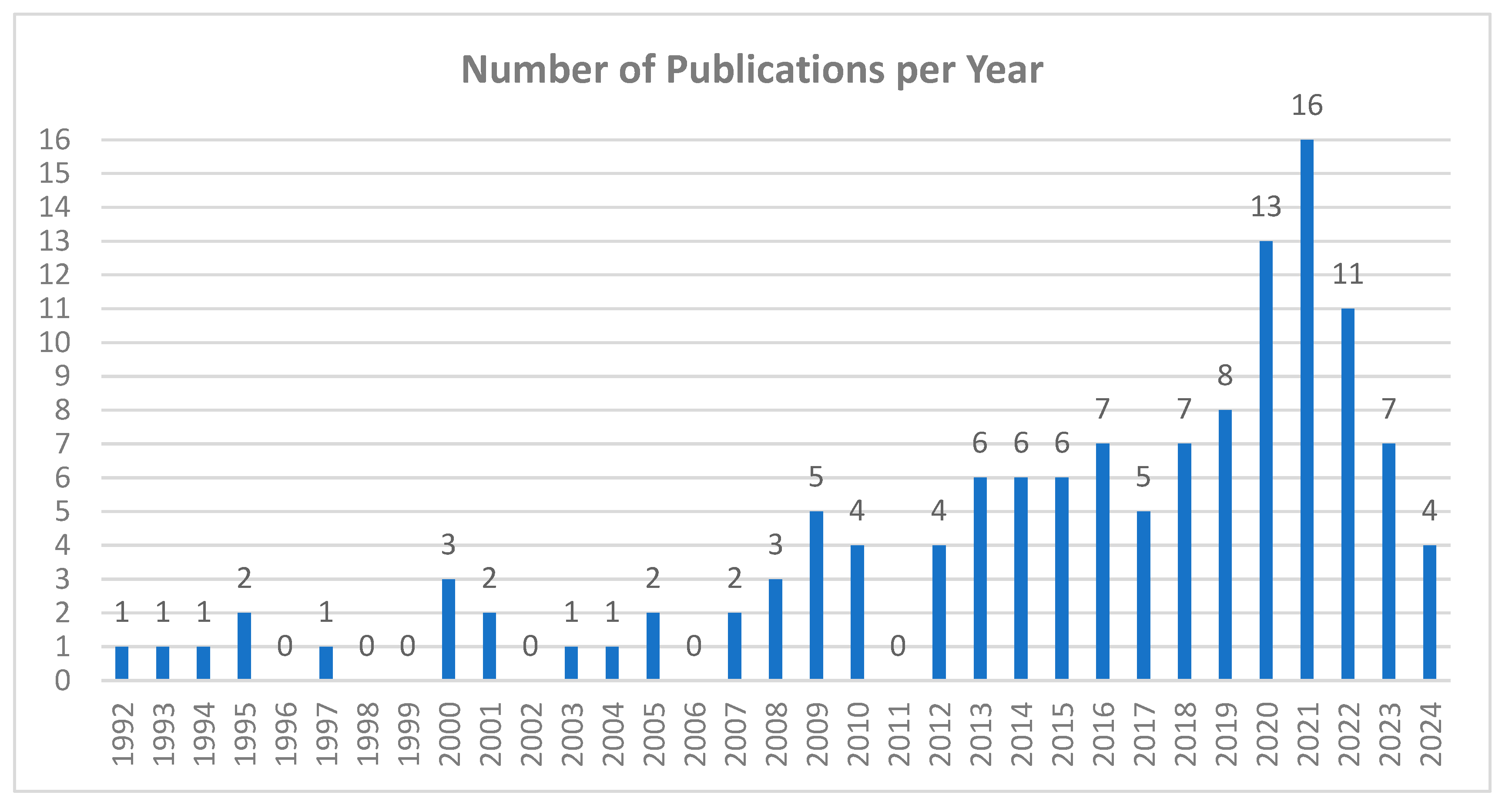
5. Patterns over Time
- From 2016 to 2025. Studies published in post-2015 first reveal that negative perceptions remained but became more nuanced. In addition, entrepreneurial intention skyrocketed, as students increasingly saw entrepreneurship as an alternative to traditional jobs [93,94,98]. Moreover, employment anxiety increased sharply during COVID-19, but some resilience and optimism persisted in many studies [65,148].
6. Thematic Synthesis and Analysis
6.1. Thematic Analysis
6.2. Critical Evaluation of the Thematic Analysis
- 1.
- Negative Career Perceptions
- 2.
- Positive Career Outlook
- 3.
- Entrepreneurial Intentions
- 4.
- Impact of Internships & Education
- 5.
- Employment Anxiety
- 6.
- Cultural & Social Influences
- 7.
- Declining Enthusiasm Over Time
- 8.
- Preference for Leadership/Ownership Roles
7. Theoretical Integration of Findings
- (1)
- Structural factors, including education, internships, and labor market conditions;
- (2)
- Cognitive and affective processes, such as self-efficacy, employment anxiety, and perceived employability;
- (3)
- Career outcomes, including sector commitment, entrepreneurial intention, and potential exit decisions.
8. Gaps in the Literature, Limitations and Future Research Directions
- How do internship experiences recalibrate students’ expectations regarding pay, work–life balance, and career progression?
- What factors predict long-term retention versus early exit from the tourism and hospitality sector?
- How do sustainability values influence career commitment among younger cohorts?
- Does participation in mentorship or entrepreneurship incubator programs increase post-graduation career stability?
9. Concluding Remarks
Funding
Institutional Review Board Statement
Informed Consent Statement
Data Availability Statement
Conflicts of Interest
Appendix A
| No. | Authors (Year) | Country | Sampling Method | Technique | Findings |
|---|---|---|---|---|---|
| 1 | Airey and Frontistis (1997) [26] | Greece and UK | Questionnaire | Statistics | UK pupils have a less favourable view toward tourism. |
| 2 | Aksu and Köksal (2005) [27] | Turkey | Questionnaire | Statistics | The study finds both negative (mainly) and positive perceptions. |
| 3 | Alananzeh (2014) [28] | Jordan | Questionnaire | Statistics, t-test, ANOVA, Regression | Various cultures of visitors and friends, and social & cultural factors affect the choice of specialization in hotel management. |
| 4 | Al-Jubari et al. (2019) [29] | Malaysia | Questionnaire | Regression analysis | The best indicator of entrepreneurial intention is self-efficacy. |
| 5 | Alrawadieh (2021) [30] | Turkey | Questionnaire | Statistics | Anxiety about employability was linked to higher psychological suffering and lower academic major satisfaction. |
| 6 | Altman and Brothers (1995) [31] | USA | Questionnaire | Statistics | 38% of hospitality graduates quit their jobs within five years after graduation, or they decided not to work in the field. |
| 7 | Amissah et al. (2020) [32] | Ghana | Questionnaire | Statistics, t-test, ANOVA | Students’ opinions of jobs in the H&T sector were mostly negative. |
| 8 | Anthony et al. (2021) [33] | Ghana | Questionnaire | Statistics, t-test, ANOVA | In general, students had no interest in pursuing jobs in the field. |
| 9 | Appietu et al. (2019) [34] | Ghana | Questionnaire | Statistics, Wilcoxon test | Most students expressed favourable opinions about working in T&H. |
| 10 | Arcodia and Dickson (2009) [35] | Croatia, Germany, Slovenia, Canada, France, Finland, Iran | Questionnaire | Statistics | Most students were not sure if their studies will help them find work. |
| 11 | Ardani and Pradini (2023) [36] | Indonesia | Questionnaire | Statistics, t-test, Regression | Knowledge and skills were crucial for increasing interest in a career. |
| 12 | Armoo and Neequaye (2014) [37] | Ghana | Questionnaire | Various multivariate techniques | Career choices were influenced by industry-person friendliness, social benefit aspects, professional growth opportunities and job competition. |
| 13 | Atef and Al Balushi (2017) [38] | Oman | Questionnaire | Statistics, t-test, Regression | Almost 41% plan to stay employed in the T&H industry for a while. |
| 14 | Ayad et al. (2022) [39] | Saudi Arabia | Questionnaire | SEM | Correlations between training and entrepreneurship were totally mediated by the graduates’ personal attitudes. |
| 15 | Badulescu et al. (2014) [40] | Romania | Questionnaire | U Mann–Whitney test, Factorial analysis | Students have clearly agreed with the points made on sustainable business practices. |
| 16 | Bahcelerli and Sucuoglu (2015) [41] | Turkey | Questionnaire | Statistics | Students voluntarily opted to study tourism education. |
| 17 | Barron and Anastasiadou (2009) [42] | Scotland | Questionnaire | Statistics | 83% of students were either employed or actively looking for work. |
| 18 | Barron et al. (2007) [43] | UK | Focus Group | Qualitative analysis | Opinions are both positive and negative. |
| 19 | Bednarska and Olszewski (2013) [44] | Poland | Questionnaire | Statistics | Most students plan a short-term career in tourism. |
| 20 | Benaraba et al. (2022) [45] | Philippines | Questionnaire & Focus group | Statistics, t-test, Thematic analysis | Students viewed their job options in the tourism industry during COVID pandemic as being filled with uncertainty. |
| 21 | Birtch et al. (2021) [46] | China | Questionnaire | Statistics, Regression, Bootstrapping Analysis | Study revealed negative emotions of students. |
| 22 | Blomme et al. (2013) [47] | Netherlands | Questionnaire | Statistics, t-test, ANOVA, Tukey’s tests | Pre-entry expectations of respondents affected employment outcome. |
| 23 | Bordean and Sonea (2018) [5] | Romania | Questionnaire | Statistics, t-test, ANOVA, Regression | Students’ interest in starting their own firm was shown to be optimistic. |
| 24 | Bouchon et al. (2016) [7] | Malaysia | Interviews | Analysis of Interviews | Specialized programs should be created that link the academic curriculum with individualized industry engagement. |
| 25 | Butkouskaya et al. (2020) [48] | Spain | Questionnaire | Statistics, t-test | The entrepreneurial goals of students did not influence their assessment of the obstacles hindering them from establishing their own enterprises. |
| 26 | Cantos et al. (2019) [49] | Philippines | Questionnaire | Statistics, ANOVA | Students were very sure of their ability to make good work decisions. |
| 27 | Cesário et al. (2022) [50] | Portugal | Questionnaire | SEM | The study highlighted the need to build links between education and businesses. |
| 28 | Chang and Tse (2015) [51] | Hong Kong | Questionnaire | Statistics | Over half of the graduates’ first jobs were in H&T, and related industries. |
| 29 | Chen and Shen (2012) [52] | Taiwan | Questionnaire | SEM | The design of internship programs and industry participation had the most significant effects. |
| 30 | Chen et al. (2000) [53] | Taiwan | Questionnaire | Statistics | The students were apt to work in the hospitality sector. |
| 31 | Chi and Gursoy (2009) [54] | USA | Questionnaire | Statistics | The most important factor for the success of career was internship. |
| 32 | Chia and Liang (2016) [55] | Taiwan | Questionnaire | Factor and Regression | Stronger business inclinations were demonstrated by more creative tourism students. |
| 33 | Choudhary (2019) [56] | UK | Review | Review analysis | Students exhibited a great desire to start their own business. |
| 34 | Choy and Yeung (2022) [57] | Hong Kong | Questionnaire | SEM | Students frequently had a strong desire to enter the field. |
| 35 | Chuang and Dellmann-Jenkins (2010) [58] | USA | Questionnaire | Logistic regression | Students’ gender, experience, transfer status, and industry outcome expectations were all substantially correlated with their career plans. |
| 36 | Chuang et al. (2020) [59] | USA | Questionnaire | Statistics, Regression | Self-report bias might be present. |
| 37 | Datta and Jha (2015) [60] | India | Questionnaire | Statistics, t-test | Students strongly disagreed with what the business had to offer. |
| 38 | Datta et al. (2013) [61] | India | Questionnaire | Statistics, t-test | Respondents highly disagreed on what the hotel management industry offered them. |
| 39 | Dragin et al. (2022) [62] | Serbia | Questionnaire | Statistics, t-test, ANOVA | Male students and those whose parents were business owners or retired were more likely to have an entrepreneurial intention. |
| 40 | Düzgün (2024) [63] | Turkey | Questionnaire | Regression analysis | Companies with strong psychological resilience and workers who are passionate about their work would have a competitive edge. |
| 41 | Eminov and Aliyeva (2017) [64] | Azerbaijan | Questionnaire | Statistics | Industries and educators should work closely together. |
| 42 | Fantilio et al. (2022) [65] | Philippines | Questionnaire | Statistics | Students were motivated by a desire to work in tourism. |
| 43 | Farmaki (2018) [66] | Cyprus | Interviews | Thematic analysis | Career intentions were influenced by several interrelated factors. |
| 44 | Getz (1994) [67] | Scotland | Questionnaire | Statistics | Over time, perceptions about a possible career in the field had gotten worse. |
| 45 | Grobelna (2017) [68] | Poland and Spain | Questionnaire | Statistics, t-test | Respondents did not believe that a job in the T&H sector provided the motivational factors they desire. |
| 46 | Grobelna (2022) [69] | Poland | Questionnaire | SEM | Students might encounter study-life conflict. |
| 47 | Grobelna and Skrzeszewska (2019) [70] | Poland | Questionnaire | Statistics, Correlations | Students’ opinions about the seasonality of tourism appear to be more favourable. |
| 48 | Grobelna and Tokarz-Kocik (2021) [71] | Poland and Croatia | Questionnaire | Statistics, Correlations | Students’ perceived person-job fit, social support, and work experience were all significantly and favourably correlated. |
| 49 | Grobelna and Wyszkowska-Wróbel (2021) [72] | Poland | Questionnaire | SEM-PLS | Participating in culture can give students valuable elements and resources. |
| 50 | Hjalager (2003) [73] | Sweden | Questionnaire | Statistics | Students appeared to prefer Swedish working cultures. |
| 51 | Hoque and Ahsif (2020) [74] | Bangladesh | Questionnaire | Statistics | Students generally had negative opinions about jobs in H&T. |
| 52 | Horng et al. (2021) [75] | Taiwan | Questionnaire & Interviews | t-tests, ANOVA | Educational intervention greatly improved innovative entrepreneurship. |
| 53 | Jenkins (2001) [76] | Netherlands and UK | Questionnaire | Statistics | Ten years after graduation, the majority anticipated becoming a general manager or corporate manager. |
| 54 | Johns and McKechnie (1995) [77] | UK | Questionnaire | Statistics | Within six months of graduating, nearly all respondents had found work in T&H. Ten years later, over half were still working in the field. |
| 55 | Kapera (2017) [78] | Poland (Ukrainian Students) | Questionnaire | Statistics | In more instances, students paired their degree program with employment, with 58% of the work being in the tourism sector. |
| 56 | Kim et al. (2008) [79] | Korea | Questionnaire | Statistics, t-test | Students were primarily motivated by self-actualization, employment opportunities, and international experience. |
| 57 | Kim et al. (2010) [3] | USA | Questionnaire | Statistics, ANOVA | Job experiences and personal experiences had a considerably greater influence than any other source. |
| 58 | Kim et al. (2016) [80] | Taiwan, Korea, Hong Kong | Questionnaire | Statistics, Factor analysis, t-test | Real-world experience or a desire for work were the most important factors. |
| 59 | Kipkosgei et al. (2015) [81] | Kenya | Questionnaire | Statistics, Regression | A higher percentage of diploma students chose to become entrepreneurs. |
| 60 | Kusluvan and Kusluvan (2000) [82] | Turkey | Questionnaire, & focus groups | Statistics | There were reports of unfavourable or negative assessments of several aspects of working in the tourism sector. |
| 61 | Lambulira et al. (2022) [83] | Malawi | Interviews | Thematic analysis | Most students had positive opinions about careers in the industry. |
| 62 | Lashley (2013) [84] | UK | Interviews | Statistics | Students were drawn to work in the hotel industry. |
| 63 | Le et al. (2018) [85] | Vietnam | Questionnaire | Statistics, Logistic regression | The participants seemed less optimistic to a career in hospitality. |
| 64 | Lee et al. (2019) [86] | USA | Questionnaire | Statistics, t-test | Social media might not have as much of an impact on students’ job decisions as traditional influences did. |
| 65 | Lewis and Airey (2001) [87] | Trinidad and Tobago | Questionnaire | Statistics, t-test, Kruskal–Wallis analysis | Students viewed jobs in the tourism industry favourably. |
| 66 | Litvin (2000) [88] | Singapore | Questionnaire | Statistics | Travel agencies were not viewed as desirable places to work. |
| 67 | Liu et al. (2023) [89] | China | Questionnaire | Statistics, t-test | Career barriers had a significant detrimental impact on career intention. |
| 68 | Lu and Adler (2009) [90] | China | Questionnaire | Statistics | Most students expressed interest in pursuing a career in the H&T sector. |
| 69 | Maiorescu et al. (2020) [91] | Romania | Questionnaire | Statistics | Students believed that their lack of participation is the primary barrier. |
| 70 | Mannaa and Abou-Shouk (2020) [92] | United Arab Emirates | Questionnaire | SEM | Social factors, the nature of the profession, and the perks of compensation and advancement, had a detrimental impact on students’ commitment to working in the tourism industry. |
| 71 | Martín-Navarro et al. (2023a) [93] | Spain | Questionnaire | PLS-SEM | Proactivity, entrepreneurship learning programs, and causal inclination were antecedents of entrepreneurial goals. |
| 72 | Martín-Navarro et al. (2023b) [94] | Spain | Questionnaire | PLS-SEM | Entrepreneurial intentions were influenced by effective propensity. |
| 73 | Maxwell et al. (2010) [95] | Scotland | Questionnaire | Statistics | Gen Y indicated that their early exposure to the hotel business deterred them from seeking a career in the field. |
| 74 | Mayuzumi (2020) [96] | Indonesia | Questionnaire | Statistics, Factor Analysis ML method | Approximately 50% of young people chose to pursue careers in the tourism sector. |
| 75 | McKercher et al. (2023) [97] | Australia | Questionnaire | Statistics | Career anchors appeared to be crucial, at least regarding the aspirational aspects of desired jobs. |
| 76 | Mei et al. (2016) [98] | China | Questionnaire | SEM | Statistically significant relationships existed among personal attitude, subjective norm, perceived behavioural control, and entrepreneurial intention. |
| 77 | Mohammad and Alsaleh (2013) [99] | Jordan | Questionnaire | Factor analysis | Social status and job opportunities were significant factors motivating students to pursue studies in tourism. |
| 78 | Mungai et al. (2021) [100] | Kenya | Questionnaire | SEM, Factor analysis | The most significant factors affecting the student’s choice of tourism degree were tuition fees, employment prospects, and family/parental background. |
| 79 | Nachmias and Walmsley (2015) [101] | UK | Interviews | Thematic analysis | Participants showed conviction about career trajectories. |
| 80 | Omar (2014) [102] | Egypt | Questionnaire | Statistics | A negative stance toward employment in the tourism industry was found. |
| 81 | Ortiz and Coromina (2021) [103] | Ecuador | Questionnaire | Statistics, ANOVA | Most of the students showed strong motivation and dedication to pursue a career in tourism. |
| 82 | Özişik Yapici et al. (2021) [104] | Turkey | Questionnaire | Statistics, t-test, ANOVA | After COVID, those studying gastronomy, cookery, and food and beverage showed a greater willingness to pursue a career. |
| 83 | Papathanassis (2021) [1] | Germany | Questionnaire | SEM-PLS | Study-satisfaction and experience internship both had a significant impact on the students’ career intentions. |
| 84 | Park et al. (2017) [105] | Korea | Questionnaire | Multiple regression | Students who had internship experience were more likely to develop positive attitudes toward T&H. |
| 85 | Petrova and Mason (2004) [106] | UK | Questionnaire | Authors’ analysis | Undergraduates in travel and tourism were eager and hopeful about obtaining jobs in the tourism sector. |
| 86 | Phuc et al. (2020) [107] | Vietnam | Questionnaire | PLS-SEM | Entrepreneurial intention was directly influenced by subjective norms, perceived behavioural control, attitude toward entrepreneurship, and entrepreneurship education. |
| 87 | Pol and Patil (2015) [108] | India | Questionnaire | Statistics | Students responded neutrally to hotel jobs. |
| 88 | Pranic (2023) [109] | Croatia | Questionnaire | Statistics, Multiple regression | Study found correlation between entrepreneurial intentions and factors such as work experience, gender, and entrepreneurial disposition. |
| 89 | Rahimi et al. (2016) [110] | UK | Questionnaire & focus groups | Statistics, factor analysis | The origins of students’ motivation, rooted in their cultural, societal, and familial backgrounds. |
| 90 | Ramakrishnan and Macaveiu (2019) [111] | UK | Interviews | Inductive thematic analysis | The study revealed assurance of desiring to pursue a career in tourism coexisting with uncertainty about positions. |
| 91 | Raybould and Wilkins (2005) [112] | Australia | Questionnaire | Statistics, t-test | Students seemed to have realistic views of the skills that managers prioritize when recruiting hospitality graduates. |
| 92 | Reichenberger and Raymond (2021a) [11] | New Zealand | Interviews | Thematic analysis | Career strategies for the short to medium term were adaptable. |
| 93 | Reichenberger and Raymond (2021b) [113] | New Zealand | Interviews | Thematic analysis | Students mainly exhibited optimistic views about their future careers. |
| 94 | Richardson (2008) [114] | Australia | Questionnaire | Statistics, t-test | Over half of those surveyed were considering careers beyond T&H. |
| 95 | Richardson (2009) [115] | Australia | Questionnaire | Statistics, t-test | Students typically doubted that a profession in T&H would provide them with the factors they deemed important. |
| 96 | Richardson (2010) [116] | Australia | Questionnaire | Statistics, t-test | Students from abroad were more inclined to think that the T&H sector provides the significant elements for selecting a career. |
| 97 | Richardson and Butler (2012) [117] | Malaysia | Questionnaire | Statistics, t-test | Students believed that a career in T&H would not offer them the factors that they found important. |
| 98 | Richardson and Thomas (2012) [118] | USA | Questionnaire | Statistics, t-test | Respondents were mainly satisfied with the career options in T&H. |
| 99 | Roberts (2024) [119] | New Zealand | Questionnaire & Case study | Statistics, Thematic analysis | Students largely believed that the tourism industry provided career prospects that were fun, interesting, and offered access to travel. |
| 100 | Robinson et al. (2016) [120] | Australia | Interview | Thematic analysis | Students frequently modified their career decisions regarding the T&H sectors after work experiences. |
| 101 | Roney et al. (2007) [121] | Turkey | Questionnaire | Statistics, t-test | Students’ perceptions were neutral. |
| 102 | Ross (1992) [122] | Australia | Questionnaire | Statistics | Management employment became the preferred area. |
| 103 | Ross (1993) [123] | Australia | Questionnaire | Statistics | Many students indicated an interest in working in management roles. |
| 104 | Rosyidi (2021) [124] | Indonesia | Questionnaire | Statistics | While career progression and pay were viewed as significant elements, students revealed negative perceptions. |
| 105 | Selçuk et al. (2013) [125] | Turkey | Questionnaire | Statistics, t-test | Students did not consider the tourism business to be interesting. |
| 106 | Şengel (2020) [126] | Turkey | Questionnaire | Statistics, t-test | The aspect students expected the most was communication. |
| 107 | Seyitoglu et al. (2022) [127] | Turkey | Interviews | Content analysis | Students’ perspectives were primarily shaped by vocational development and career planning during the COVID-19 era. |
| 108 | Shah et al. (2021) [128] | India | Questionnaire & Interviews | Statistics, Thematic analysis | Students believed that the industry would bounce back soon, so despite the pandemic downturn, they still opted to work in it. |
| 109 | Sincharoenkul and Witthayasirikul (2022) [129] | Thailand | Questionnaire | Logistic regression | Of the five recruitment attributes, competencies predicted likelihood on three: foundation, employability, and adaptability. |
| 110 | Skiert and Buchta (2012) [130] | Poland | Questionnaire | Statistics | Students expressed a great deal of interest in business proprietorship. |
| 111 | Tan et al. (2016) [131] | Malaysia | Questionnaire | Statistics, Regression | Only social status and pay benefits. were found to have a statistically significant contribution to commitment in the hospitality industry career: |
| 112 | Teng (2008) [132] | Taiwan | Questionnaire | Statistics | Students’ aspirations regarding and attitudes towards hospitality jobs were significantly predicted by the personality trait of extroversion. |
| 113 | Thetsane et al. (2020) [133] | Lesotho | Questionnaire | Statistics, t-test | Several factors deemed crucial when selecting a career in T&H. |
| 114 | Tsai et al. (2024) [9] | Taiwan | Questionnaire | Statistics, Factor analysis, SEM, Mediation analysis | Personality characteristics could impact and shape one’s employability. |
| 115 | Turanligil and Altintaş (2018) [134] | Turkey | Questionnaire | Statistics, Mann–Whitney Test | The respondents felt that their perceptions and expectations of the industry were not significant considering their experience. |
| 116 | Unguren and Huseyinli (2020) [135] | Turkey | Questionnaire | SEM | Students generally possessed a low intention to enter the tourism sector and exhibited high levels of post-graduation employability anxiety. |
| 117 | Vaníček and Jarolimkova (2021) [136] | Czech Republic | Questionnaire | Statistics | Even with the pandemic, students envisioned their future in tourism. |
| 118 | Verdadero et al. (2020) [137] | Philippines | Questionnaire | Statistics, t-test | Most respondents were ready to enter the tourism industry. |
| 119 | Wakelin-Theron et al. (2018) [138] | South Africa | Questionnaire and Interview | Statistics and Data Interview analysis | The key competencies needed included customer service and awareness, ethical behaviour in the workplace, and communication skills. |
| 120 | Wan et al. (2014) [139] | China | Questionnaire | Statistics, t-test | The way the work was viewed did not correlate with career prospects. |
| 121 | Wang and Huang (2014) [140] | China | Questionnaire | Statistics, Factor Analysis, Regression, ANOVA | Students’ perceptions differed based on their varying characteristics. |
| 122 | Wen et al. (2018) [141] | China | Questionnaire | PLS-SEM | Career intentions were positively affected by their attitudes, subjective norms, perceived behavioural control, and prior work experience. |
| 123 | Wen et al. (2019) [142] | China | Interviews & Questionnaire | Statistics, Multiple regression, data analysis | Compensation, benefits, and promotional prospects in the hospitality industry fell short of their expectations. |
| 124 | Xu et al. (2018) [143] | Ecuador | Questionnaire | Regression analyses | Student employees who indicated greater degrees of abusive supervision were more prone to leave the organization. |
| 125 | Yasar & Özturk (2023) [144] | Turkey | Interviews | Content analysis | Individuals who had expectations for the tourism sector lowered these expectations to a minimal level after graduating. |
| 126 | Zhang and Chen (2024) [145] | China | Questionnaire | Descriptive, correlation analysis | Study highlights incentive policies, guaranteeing that universities offer entrepreneurship education in a range of disciplines. |
| 127 | Zhang et al. (2020) [146] | China | Questionnaire | SEM | The results showed education’s beneficial effect on entrepreneurship. |
| 128 | Zhong et al. (2021) [147] | USA | Questionnaire | Statistics, Regression | Students’ experience of engagement was positive despite COVID. |
| 129 | Zhong et al. (2022) [148] | China | Questionnaire | PLS-SEM | The employment situation of students was greatly improved by their growth in professional knowledge reserves, learning skills, innovation skills, teamwork skills, and social ethics. |
References
- Papathanassis, A. Cruise tourism ‘brain drain’: Exploring the role of personality traits, educational experience and career choice attributes. Curr. Issues Tour. 2021, 24, 2028–2043. [Google Scholar] [CrossRef]
- Pranić, L.; Pivčević, S.; Garbin Praničević, D. Top 30 soft skills in tourism and hospitality graduates: A systematic literature review. In 6th International Scientific Conference ToSEE-Tourism in Southern and Eastern Europe 2021: ToSEE-Smart, Experience, Excellence & ToFEEL-Feelings, Excitement, Education, Leisure (ToSEE 2021); Fakultet za menadžment u turizmu i ugostiteljstvu Sveučilišta u Rijeci: Opatija, Croatia, 2021; Volume 6, pp. 637–656. [Google Scholar] [CrossRef]
- Kim, B.P.; McCleary, K.W.; Kaufman, T. The new generation in the industry: Hospitality/tourism students’ career preferences, sources of information and career choice factors. J. Hosp. Tour. Educ. 2010, 22, 5–11. [Google Scholar] [CrossRef]
- Scott, B.; Revis, S. Talent management in hospitality: Graduate career success and strategies. Int. J. Contemp. Hosp. Manag. 2008, 20, 781–791. [Google Scholar] [CrossRef]
- Bordean, O.N.; Sonea, A. Student satisfaction and perceived skills: Any link to employability? Entrep. Sustain. Issues 2018, 6, 356–370. [Google Scholar] [CrossRef]
- Booyens, I. Education and skills in tourism: Implications for youth employment in South Africa. Dev. South. Afr. 2020, 37, 825–839. [Google Scholar] [CrossRef]
- Bouchon, P.; Daya, P.; Neethiahnanthan, A.R. Hospitality higher education talent management programme, STEP: A stepping-stone to develop future hospitality leaders. TEAM J. Hosp. Tour. 2016, 13, 41–53. [Google Scholar]
- Hsu, C.H.C.; Xiao, H.; Chen, N. Hospitality and tourism education research from 2005 to 2014: “Is the past a prologue to the future?”. Int. J. Contemp. Hosp. Manag. 2017, 29, 141–160. [Google Scholar] [CrossRef]
- Tsai, C.-F.; Chang, C.-P.; Chen, T.-L.; Hsu, M.-L. Exploring the Influence of Personality Traits, Self-Efficacy, and Creativity on Employability for Hospitality and Tourism College Students. Sustainability 2024, 16, 1490. [Google Scholar] [CrossRef]
- Byars-Winston, A.; Estrada, Y.; Howard, C.; Davis, D.; Zalapa, J. Influence of social cognitive and ethnic variables on academic goals of underrepresented students in science and engineering: A multiple-groups analysis. J. Couns. Psychol. 2010, 57, 205–218. [Google Scholar] [CrossRef]
- Reichenberger, I.; Raymond, E.M. Tourism students’ career strategies in times of disruption. J. Hosp. Tour. Manag. 2021, 48, 220–229. [Google Scholar] [CrossRef]
- Bosnjak, M.; Ajzen, I.; Schmidt, P. The theory of planned behavior: Selected recent advances and applications. Eur. J. Psychol. 2020, 16, 352–356. [Google Scholar] [CrossRef] [PubMed]
- Krumboltz, J.D. The happenstance learning theory. J. Career Assess. 2008, 17, 135–154. [Google Scholar] [CrossRef]
- Yunus, N.M.; Zainudin, Z.N.; Yusop, Y.M.; Othman, W.N.W.; Kamarudin, E.M.E.; Anuar, M. Understanding career decision-making: Influencing factors and application of Krumboltz’s social learning theory. Int. J. Acad. Res. Bus. Soc. Sci. 2024, 14, 36–51. [Google Scholar] [CrossRef]
- Greenleaf, A.T. Making the best of a bad situation: Career counseling young adults in the aftermath of the great recession. J. Employ. Couns. 2014, 51, 158–169. [Google Scholar] [CrossRef]
- Eidimtas, A.; Jucevičienė, P. Factors influencing school-leavers decision to enrol in higher education. Procedia Soc. Behav. Sci. 2014, 116, 3983–3988. [Google Scholar] [CrossRef]
- Packard, B.W.; Leach, M.; Ruiz, Y.; Nelson, C.; DiCocco, H. School-to-work transition of career and technical education graduates. Career Dev. Q. 2012, 60, 134–144. [Google Scholar] [CrossRef]
- Chen, J.; Zhang, X. The impact of career calling on higher vocational nursing students’ learning engagement: The mediating roles of career adaptability and career commitment. Front. Psychol. 2023, 14, 1111842. [Google Scholar] [CrossRef] [PubMed]
- Del Corso, J.; Rehfuss, M.C. The Role of narrative in career construction theory. J. Vocat. Behav. 2011, 79, 334–339. [Google Scholar] [CrossRef]
- Zhou, X.; Hu, Y.; Li, Y.; Wen, B. Why do hotel interns stay in the hospitality and tourism industry? An interactionist perspective of organizational socialization. Int. J. Contemp. Hosp. Manag. 2022, 34, 1225–1245. [Google Scholar] [CrossRef]
- Wang, D.; Li, Y. Career construction theory: Tools, interventions, and future trends. Front. Psychol. 2024, 15, 1381233. [Google Scholar] [CrossRef]
- Rudolph, C.W.; Lavigne, K.N.; Zacher, H. Career adaptability: A meta-analysis of relationships with measures of adaptivity, adapting responses, and adaptation results. J. Vocat. Behav. 2016, 98, 17–34. [Google Scholar] [CrossRef]
- Zacher, H. Career adaptability predicts subjective career success above and beyond personality traits and core self-evaluations. J. Vocat. Behav. 2013, 84, 21–30. [Google Scholar] [CrossRef]
- Hoang, G.; Yang, M.; Luu, T.T. Ethical leadership in tourism and hospitality management: A systematic literature review and research agenda. Int. J. Hosp. Manag. 2023, 114, 103563. [Google Scholar] [CrossRef]
- Hoang, G.; Wilson-Evered, E.; Lockstone-Binney, L.; Luu, T.T. Empowering leadership in hospitality and hospitality management: A systematic literature review. Int. J. Contemp. Hosp. Manag. 2021, 33, 4182–4214. [Google Scholar] [CrossRef]
- Airey, D.; Frontistis, A. Attitudes to careers in tourism: An Anglo Greek comparison. Tour. Manag. 1997, 18, 149–158. [Google Scholar] [CrossRef]
- Aksu, A.; Köksal, D. Perceptions and attitudes of tourism students in Turkey. Int. J. Contemp. Hosp. Manag. 2005, 17, 436–447. [Google Scholar] [CrossRef]
- Alananzeh, O. Exploring the factors influencing students in enrolling tourism and hospitality management colleges in Jordan: A case study in Aqaba economic zone. J. Manag. Res. 2014, 6, 61–73. [Google Scholar] [CrossRef][Green Version]
- Al-Jubari, I.; Bahari, S.; Kamarudin, N.; Fadzli, A. Examining attitudinal determinants of startup intention among university students of hospitality and tourism. Int. J. Hum. Potentials Manag. 2019, 1, 33–42. [Google Scholar]
- Alrawadieh, D. Does employability anxiety trigger psychological distress and academic major dissatisfaction? A study on tour guiding students. J. Tour. 2021, 7, 55–71. [Google Scholar] [CrossRef]
- Altman, L.; Brothers, L. Career longevity of hospitality graduates. Hosp. Rev. J. 1995, 13, 77–83. [Google Scholar]
- Amissah, E.; Mensah, A.; Mensah, I.; Gamor, E. Students’ perceptions of careers in Ghana’s hospitality and tourism industry. J. Hosp. Tour. Educ. 2019, 32, 1–13. [Google Scholar] [CrossRef]
- Anthony, G.; Mensah, I.; Amissah, E. Undergraduate hospitality students’ perceptions of careers in the industry: The Ghanaian context. Res. Hosp. Manag. 2021, 11, 101–111. [Google Scholar] [CrossRef]
- Appietu, M.E.; Asimah, V.K.; Mensah, C. Does perception of hospitality employment change post internship? Afr. J. Hosp. Tour. Manag. 2019, 1, 116–129. [Google Scholar] [CrossRef]
- Arcodia, C.; Dickson, C. ITHAS: An experiential education case study in tourism education. J. Hosp. Tour. Educ. 2009, 21, 37–43. [Google Scholar] [CrossRef]
- Ardani, P.A.; Pradini, G. Factors influencing career interest in the tourism industry (Case study on students of the National University Tourism Study Program). In Proceedings of the International Conference on Business, Management, Accounting and Sustainable Economy (ICBMASE 2023); Advances in Economics, Business and Management Research; Atlantis Press: Dordrecht, The Netherlands, 2024; Volume 275, pp. 70–75. [Google Scholar] [CrossRef]
- Armoo, A.K.; Neequaye, K. Factors used by Ghanaian students in determining career options in the tourism and hospitality industry: Lessons for developing countries. Worldw. Hosp. Tour. Themes 2014, 6, 166–178. [Google Scholar]
- Atef, T.; Al Balushi, M. Omani tourism and hospitality students’ employment intentions and job preferences: Ramifications on Omanization plans. Qual. Assur. Educ. 2017, 25, 440–461. [Google Scholar] [CrossRef]
- Ayad, T.; Sobaih, A.E.E.; Elshaer, I.A. University incubator support and entrepreneurial intention among tourism graduates: Mediating role of personal attitude. Sustainability 2022, 14, 16045. [Google Scholar] [CrossRef]
- Badulescu, A.; Badulescu, D.; Bac, D.; Sipos-Gug, S. Attitudes and intentions of business master students towards sustainable tourism and entrepreneurship. Amfiteatru Econ. J. 2014, 16, 1110–1124. [Google Scholar]
- Bahcelerli, N.M.; Sucuoglu, E. Undergraduate tourism students’ opinions regarding the work conditions in the tourism industry. Procedia Econ. Financ. 2015, 26, 1130–1135. [Google Scholar] [CrossRef]
- Barron, P.; Anastasiadou, C. Student part-time employment: Implications, challenges and opportunities for higher education. Int. J. Contemp. Hosp. Manag. 2009, 21, 140–153. [Google Scholar] [CrossRef]
- Barron, P.; Maxwell, G.; Broadbridge, A.; Ogden, S. Careers in hospitality management: Generation Y’s experiences and perceptions. J. Hosp. Tour. Manag. 2007, 14, 119–128. [Google Scholar] [CrossRef]
- Bednarska, M.; Olszewski, M. Students’ attitudes towards careers in the tourism industry—Implications for tacit knowledge management. J. Entrep. Manag. Innov. 2013, 9, 119–134. [Google Scholar] [CrossRef]
- Benaraba, C.M.D.; Bulaon, N.J.B.; Escosio, S.M.D.; Narvaez, A.H.G.; Suinan, A.N.A.; Roma, M.N. A comparative analysis on the career perceptions of tourism management students before and during the COVID-19 pandemic. J. Hosp. Leis. Sport Tour. Educ. 2022, 30, 100361. [Google Scholar] [CrossRef] [PubMed]
- Birtch, T.A.; Chiang, F.F.T.; Cai, Z.; Wang, J. Am I choosing the right career? The implications of COVID-19 on the occupational attitudes of hospitality management students. Int. J. Hosp. Manag. 2021, 95, 102931. [Google Scholar] [CrossRef]
- Blomme, R.; Rheede, A.; Tromp, D. The hospitality industry: An attractive employer? An exploration of students’ and industry workers’ perceptions of hospitality as a career field. J. Hosp. Tour. Educ. 2013, 21, 6–14. [Google Scholar] [CrossRef]
- Butkouskaya, V.; Romagosa, F.; Noguera, M. Obstacles to sustainable entrepreneurship amongst tourism students: A gender comparison. Sustainability 2020, 12, 1812. [Google Scholar] [CrossRef]
- Cantos, M.G.; Sauña, M.J.E.; De Ramos, H.H.B.; Dimaano, J.G.L.; Lingon, R.B.; Pulhin, J.C.B. Career decision self-efficacy among students of hospitality and tourism management. Asia Pac. J. Educ. Arts Sci. 2019, 6, 41–51. [Google Scholar]
- Cesário, F.; Sabino, A.; Moreira, A.; Portugal, M.; Correia, A. Students’ motivation for a sustainable career in the hospitality industry in Portugal. Sustainability 2022, 14, 6522. [Google Scholar] [CrossRef]
- Chang, S.; Tse, E.C.-Y. Understanding the initial career decisions of hospitality graduates in Hong Kong. J. Hosp. Tour. Res. 2012, 39, 57–74. [Google Scholar] [CrossRef]
- Chen, T.-L.; Shen, C.-C. Today’s intern, tomorrow’s practitioner?—The influence of internship programmes on students’ career development in the hospitality industry. J. Hosp. Leis. Sport Tour. Educ. 2012, 11, 29–40. [Google Scholar] [CrossRef]
- Chen, J.S.; Chu, K.H.-L.; Wu, W. Tourism students’ perceptions of work values: A case of Taiwanese universities. Int. J. Contemp. Hosp. Manag. 2000, 12, 360–365. [Google Scholar] [CrossRef]
- Chi, C.G.; Gursoy, D. How to help your graduates secure better jobs? An industry perspective. Int. J. Contemp. Hosp. Manag. 2009, 21, 308–322. [Google Scholar] [CrossRef]
- Chia, C.-C.; Liang, C. Influence of creativity and social capital on the entrepreneurial intention of tourism students. J. Entrep. Manag. Innov. 2016, 12, 151–168. [Google Scholar] [CrossRef]
- Choudhary, R. Review on employability of students in hospitality sector. Int. J. Emerg. Technol. Innov. Res. 2019, 6, 663–668. [Google Scholar]
- Choy, M.W.; Yeung, A.S. Career choice of tourism students in a triple-whammy crisis. PLoS ONE 2022, 17, e0279411. [Google Scholar] [CrossRef] [PubMed]
- Chuang, N.-K.; Dellmann-Jenkins, M. Career decision making and intention: A study of hospitality undergraduate students. J. Hosp. Tour. Res. 2010, 34, 512–530. [Google Scholar] [CrossRef]
- Chuang, N.-K.; Lee, P.C.; Kwok, L. Assisting students with career decision-making difficulties: Can career decision-making self-efficacy and career decision-making profile help? J. Hosp. Leis. Sport Tour. Educ. 2020, 26, 100235. [Google Scholar] [CrossRef]
- Datta, A.; Jha, B. Industrial Training and its consequences on the career perception. A study in context of the hotel management students’ at Jaipur. Int. J. Econ. Bus. Rev. 2015, 3, 146–152. [Google Scholar]
- Datta, A. Effect of internship on career perception of hotel management students. ZENITH Int. J. Multidiscip. Res. 2013, 3, 50–63. [Google Scholar]
- Dragin, A.S.; Mijatov, M.B.; Munitlak Ivanović, O.; Jovičić Vuković, A.; Ivkov Džigurski, A.; Košić, K.; Nedeljković Knežević, M.; Tomić, S.; Stankov, U.; Vujičić, M.D.; et al. Entrepreneurial Intention of Students (Managers in Training): Personal and Family Characteristics. Sustainability 2022, 14, 7345. [Google Scholar] [CrossRef]
- Düzgün, M. A reassessment of well-being in vocational preparation: A new model focusing on psychological resilience and occupational identification in tourism education. J. Tour. Sustain. Well-Being 2024, 12, 336–352. [Google Scholar]
- Eminov, A.; Aliyeva, I. Assessment of education and employment cooperation in Azerbaijan tourism industry. Yearb. D. A. Tsenov Acad. Econ. 2017, 1, 121–142. [Google Scholar]
- Fantillo, E.-M.R.; Quierez, R.C.M.; Sardido, E.T. Career perception: Graduating tourism students of 2021–2022 DLSU-D in the new normal. Quantum J. Soc. Sci. Humanit. 2022, 3, 100–117. [Google Scholar] [CrossRef]
- Farmaki, A. Tourism and hospitality internships: A prologue to career intentions? J. Hosp. Leis. Sport Tour. Educ. 2018, 23, 50–58. [Google Scholar] [CrossRef]
- Getz, D. Students’ work experiences, perceptions and attitudes towards careers in hospitality and tourism: A longitudinal case study in Spey Valley, Scotland. Int. J. Hosp. Manag. 1994, 13, 25–37. [Google Scholar] [CrossRef]
- Grobelna, A. The perception of job-related motivators when choosing a career in the tourism and hospitality industry—A comparative study between Polish and Spanish students. Int. J. Manag. Econ. 2017, 53, 84–106. [Google Scholar] [CrossRef]
- Grobelna, A. A study-life conflict and its impact on tourism and hospitality students’ burnout and their employment aspirations. Sustainability 2022, 14, 6608. [Google Scholar] [CrossRef]
- Grobelna, A.; Skrzeszewska, K. Seasonality: Is it a problem or challenge facing future tourism employment? Implications for management. J. Entrep. Manag. Innov. 2019, 15, 205–230. [Google Scholar] [CrossRef]
- Grobelna, A.; Tokarz-Kocik, A. Person-job fit in students’ perspective and its consequences for career aspirations. Eur. Res. Stud. J. 2021, 24, 155–168. [Google Scholar] [CrossRef]
- Grobelna, A.; Wyszkowska-Wrobel, E.M. Understanding employment aspirations of future tourism and hospitality workforce: The critical role of cultural participation and study engagement. Eur. Res. Stud. J. 2021, 24, 1312–1332. [Google Scholar] [CrossRef]
- Hjalager, A.-M. Global tourism careers? Opportunities and dilemmas facing higher education in tourism. J. Hosp. Leis. Sport Tour. Educ. 2003, 2, 26–38. [Google Scholar] [CrossRef]
- Hoque, M.A.; Ashif, A.S.M. Dream career in tourism and hospitality industry: Myth or reality? Int. J. Tour. Policy 2020, 10, 142–162. [Google Scholar] [CrossRef]
- Horng, J.-S.; Hsiao, H.-L.; Liu, C.-H.; Chou, S.-F.; Chung, Y.-C. Learning innovative entrepreneurship: Developing an influential curriculum for undergraduate hospitality students. J. Hosp. Leis. Sport Tour. Educ. 2021, 29, 100289. [Google Scholar] [CrossRef]
- Jenkins, A.K. Making a career of it? Hospitality students’ future perspectives: An Anglo-Dutch study. Int. J. Contemp. Hosp. Manag. 2001, 13, 13–20. [Google Scholar] [CrossRef]
- Johns, N.; McKechnie, M. Career demands and learning perceptions of hotel and catering graduates—Ten years on. Int. J. Contemp. Hosp. Manag. 1995, 7, 9–12. [Google Scholar] [CrossRef]
- Kapera, I. Motives and expectations of students from Ukraine with respect to higher education in Poland in the field of tourism. Turyzm 2017, 27, 17–21. [Google Scholar] [CrossRef][Green Version]
- Kim, S.S.; Lee, M.J.; Chon, K. Study motivations and study preferences in the Korean hospitality and tourism field. J. Mark. High. Educ. 2008, 18, 216–239. [Google Scholar] [CrossRef]
- Kim, S.; Jung, J.; Wang, K.-C. Hospitality and tourism management students’ study and career preferences: Comparison of three Asian regional groups. J. Hosp. Leis. Sport Tour. Educ. 2016, 19, 66–84. [Google Scholar] [CrossRef]
- Kipkosgei, B.; Kivuva, A.K.; Muiruri, J.N. Perceptions of tourism students towards career choice in the Kenyan tourism industry: A comparative study of Moi university and Kenya Utalii College. Afr. J. Tour. Hosp. Leis. 2015, 1, 1–10. [Google Scholar]
- Kusluvan, S.; Kusluvan, Z. Perceptions and attitudes of undergraduate tourism students towards working in the tourism industry in Turkey. Tour. Manag. 2000, 21, 251–269. [Google Scholar] [CrossRef]
- Lambulira, M.; Banda, S.; Mhango, G.M.K.; Bello, F.G. Students’ perceptions towards tourism education and careers after the COVID-19 pandemic in Sub-Saharan Africa. Afr. J. Hosp. Tour. Leis. 2022, 11, 1158–1172. [Google Scholar]
- Lashley, C. Student employment in hospitality and tourism: Insights from a recent study. Res. Hosp. Manag. 2013, 3, 1–8. [Google Scholar] [CrossRef]
- Le, A.H.; Klieve, H.; McDonald, C.V. Tertiary students’ perceptions of hospitality careers in Vietnam. Empir. Res. Vocat. Educ. Train. 2018, 10, 14. [Google Scholar] [CrossRef]
- Lee, P.C.; Jae, M.; Dopson, L.R. Who influences college students’ career choices? An empirical study of hospitality management students. J. Hosp. Tour. Educ. 2019, 31, 74–86. [Google Scholar] [CrossRef]
- Lewis, A.; Airey, D. Tourism careers in Trinidad and Tobago: Perceptions of secondary school students. Tour. Hosp. Res. 2001, 3, 7–20. [Google Scholar] [CrossRef]
- Litvin, S.W. Tourism student perceptions of a travel agency career. Tour. Hosp. Res. 2000, 1, 295–312. [Google Scholar] [CrossRef]
- Liu, F.; Zhang, F.; Wu, N.; James, N.K. Career barriers of hospitality and tourism management students and the impacts on their career intention. Econ. Res.-Ekon. Istraž. 2023, 36, 2129410. [Google Scholar] [CrossRef]
- Lu, T.; Adler, H. Career goals and expectations of hospitality and tourism students in China. J. Teach. Travel Tour. 2009, 9, 63–80. [Google Scholar] [CrossRef]
- Maiorescu, I.; Sabou, G.C.; Bucur, M.; Zota, R.D. Sustainability barriers and motivations in higher education: A students’ perspective. Amfiteatru Econ. 2020, 22, 362–375. [Google Scholar] [CrossRef]
- Mannaa, M.; Abou-Shouk, M. Students’ perceptions towards working in the tourism and hospitality industry in United Arab Emirates. Al-Adab J. 2020, 1, 33–52. [Google Scholar] [CrossRef]
- Martín-Navarro, A.; Velicia-Martín, F.; Medina-Garrido, J.A.; Rodrigues, R.G. Causal propensity as an antecedent of entrepreneurial intentions. Int. Entrep. Manag. J. 2023, 19, 501–522. [Google Scholar] [CrossRef]
- Martín-Navarro, A.; Velicia-Martín, F.; Medina-Garrido, J.A.; Palos-Sánchez, P.R. Impact of effectual propensity on entrepreneurial intention. J. Bus. Res. 2023, 157, 113604. [Google Scholar] [CrossRef]
- Maxwell, G.A.; Ogden, S.M.; Broadbridge, A. Generation Y’s career expectations and aspirations: Engagement in the hospitality industry. J. Hosp. Tour. Manag. 2010, 17, 53–61. [Google Scholar] [CrossRef]
- Mayuzumi, Y. Is there a future for agriculture in world leading tourism resort islands of developing countries? Case study about survey of consciousness about career choice of young generation in Bali, Indonesia. Asia-Pac. J. Reg. Sci. 2020, 4, 91–110. [Google Scholar] [CrossRef]
- McKercher, B.; Jin, X.; Tolkach, D.; Lee, A.; Macionis, N. Career development of tourism, hospitality and events graduates. Int. J. Tour. Res. 2023, 25, 350–358. [Google Scholar] [CrossRef]
- Mei, H.; Zhan, Z.; Fong, P.; Liang, T.; Ma, Z. Planned behaviour of tourism students’ entrepreneurial intentions in China. Appl. Econ. 2016, 48, 1240–1254. [Google Scholar] [CrossRef]
- Mohammad, B.A.A.; Alsaleh, H.T. Motivation of students to study tourism hospitality programs. Int. J. Asian Soc. Sci. 2013, 3, 1637–1647. [Google Scholar]
- Mungai, M.; Kieti, D.; Mapelu, I. Tourism education enrolment among Kenyan public universities: Socioeconomic aspects. Int. J. Res. Bus. Soc. Sci. 2021, 10, 340–348. [Google Scholar] [CrossRef]
- Nachmias, S.; Walmsley, A. Making career decisions in a changing graduate labour market: A Hospitality perspective. J. Hosp. Leis. Sport Tour. Educ. 2015, 17, 50–58. [Google Scholar] [CrossRef]
- Omar, M. Students’ perceptions and attitudes toward working in the tourism industry in Egypt. J. Assoc. Arab Univ. Tour. Hosp. 2014, 11, 77–84. [Google Scholar] [CrossRef]
- Ortiz, M.; Coromina, L. Effect of COVID-19 pandemic on perceptions and career goals of undergraduate tourism students in Ecuador. Cienc. Unemi 2021, 14, 15–28. [Google Scholar] [CrossRef]
- Özişik Yapici, O.; Yildirim, G.; Bal, C. How did Covid-19 affect career intentions of students studying tourism. J. Tour. Gastron. Stud. 2023, 9, 84–98. [Google Scholar] [CrossRef]
- Park, S.A.; Kim, H.-B.; Lee, K.-W. Perceptions of Determinants of job selection in the hospitality and tourism industry: The case of Korean university students. J. Hum. Resour. Hosp. Tour. 2017, 16, 422–444. [Google Scholar] [CrossRef]
- Petrova, P.; Mason, P. The value of tourism degrees: A Luton-based case study. Educ. Train. 2004, 46, 153–161. [Google Scholar] [CrossRef]
- Phuc, P.; Vinh, N.; Do, Q.H. Factors affecting entrepreneurial intention among tourism undergraduate students in Vietnam. Manag. Sci. Lett. 2020, 10, 3675–3682. [Google Scholar] [CrossRef]
- Pol, R.; Patil, H. Perception of Final Year hotel management students towards working in hotel industry. Atithya J. Hosp. 2015, 1, 53–54. [Google Scholar] [CrossRef]
- Pranić, L. What happens to the entrepreneurial intentions of Gen Z in a crony capitalist economy amidst the COVID-19 pandemic? Sustainability 2023, 15, 5750. [Google Scholar] [CrossRef]
- Rahimi, R.; Nadda, V.; Hyseni, B.; Mulindwa, D. Motivations of South Asian students to study tourism and hospitality in the United Kingdom. Adv. Cult. Tour. Hosp. Res. 2016, 12, 223–234. [Google Scholar]
- Ramakrishnan, S.; Macaveiu, C. Understanding aspirations in tourism students. J. Hosp. Tour. Manag. 2019, 39, 40–48. [Google Scholar] [CrossRef]
- Raybould, M.; Wilkins, H. Overqualified and underexperienced: Turning graduates into hospitality managers. Int. J. Contemp. Hosp. Manag. 2005, 17, 203–216. [Google Scholar] [CrossRef]
- Reichenberger, I.; Raymond, E.M. Students’ perceptions of tertiary tourism education and careers during the Covid-19 pandemic. J. Teach. Travel Tour. 2021, 21, 380–402. [Google Scholar] [CrossRef]
- Richardson, S. Undergraduate tourism and hospitality students attitudes toward a career in the industry: A preliminary investigation. J. Teach. Travel Tour. 2008, 8, 23–46. [Google Scholar] [CrossRef]
- Richardson, S. Undergraduates’ perceptions of tourism and hospitality as a career choice. Int. J. Hosp. Manag. 2009, 28, 382–388. [Google Scholar] [CrossRef]
- Richardson, S. Tourism and hospitality students’ perceptions of a career in the industry: A comparison of domestic (Australian) students and international students studying in Australia. J. Hosp. Tour. Manag. 2010, 17, 1–11. [Google Scholar] [CrossRef]
- Richardson, S.; Butler, G. Attitudes of Malaysian tourism and hospitality students’ towards a career in the industry. Asia Pac. J. Tour. Res. 2012, 17, 262–276. [Google Scholar] [CrossRef]
- Richardson, S.; Thomas, N.J. Utilising generation Y: United States hospitality and tourism students’ perceptions of careers in the industry. J. Hosp. Tour. Manag. 2012, 19, 102–114. [Google Scholar] [CrossRef]
- Roberts, M.D. Secondary school students’ views of tourism education and tourism careers. J. Hosp. Tour. Educ. 2024, 36, 13–24. [Google Scholar] [CrossRef]
- Robinson, R.; Ruhanen, L.; Breakey, N. Tourism and hospitality internships: Influences on student career aspirations. Curr. Issues Tour. 2016, 19, 513–527. [Google Scholar] [CrossRef]
- Roney, S.A.; Öztin, P. Career perceptions of undergraduate tourism students: A case study in Turkey. J. Hosp. Leis. Sport Tour. Educ. 2007, 6, 4–17. [Google Scholar] [CrossRef]
- Ross, G. Tourism management as a career path: Vocational perceptions of Australian school leavers. Tour. Manag. 1992, 13, 242–247. [Google Scholar] [CrossRef]
- Ross, G. Tourism and hospitality employment and career perceptions among high school students. Vis. Leis. Bus. 1993, 12, 13–33. [Google Scholar]
- Rosyidi, M.I. Undergraduate students’ perceptions and attitudes towards a career in tourism industry: The case of Indonesia. J. Manag. Kewirausahaan 2021, 23, 40–51. [Google Scholar] [CrossRef]
- Selçuk, G.N.; Erdogan, M.; Güllüce, A.Ç. A research into career considerations of students enrolled In tourism degree programs. Int. J. Bus. Soc. Sci. 2013, 4, 218–226. [Google Scholar]
- Şengel, Ü.; Genç, G.; Zengin, B. Expectation differences between the tourism sector and students: A comparative analysis. Eur. J. Tour. Hosp. Recreat. 2020, 10, 177–189. [Google Scholar] [CrossRef]
- Seyitoğlu, F.; Atsız, O.; Kaya, F.; Taş, S. The two-way perspective of tourism undergraduates towards (post-)viral world: The future of tourism, and vocational development and career. J. Hosp. Leis. Sport Tour. Educ. 2022, 31, 100400. [Google Scholar] [CrossRef]
- Shah, C.; Chowdhury, A.; Gupta, V. Impact of COVID-19 on tourism and hospitality students’ perceptions of career opportunities and future prospects in India. J. Teach. Travel Tour. 2021, 21, 359–379. [Google Scholar] [CrossRef]
- Sincharoenkul, K.; Witthayasirikul, C. Can online learners obtain sufficient competencies in the hospitality and tourism industries? Front. Educ. 2022, 7, 996377. [Google Scholar] [CrossRef]
- Skiert, M.; Buchta, K. Own business enterprise in the professional plans of tourism and recreation students. Pol. J. Sport Tour. 2012, 19, 58–62. [Google Scholar] [CrossRef]
- Tan, Z.M.A.; Baharun, N.; Wazir, N.M.; Ngelambong, A.A.; Ali, N.M.; Ghazali, N.; Tarmazi, S.A.A. Graduates’ perceptions on the factors affecting commitment to pursue career in the hospitality industry. Procedia Soc. Behav. Sci. 2016, 224, 416–420. [Google Scholar] [CrossRef]
- Teng, C.-C. The effects of personality traits and attitudes on student uptake in hospitality employment. Int. J. Hosp. Manag. 2008, 27, 76–86. [Google Scholar] [CrossRef]
- Thetsane, R.; Mokhethi, M.; Malunga, M.; Makatjane, T. Lesotho students career perceptions in tourism and hospitality industry. J. Tour. Hosp. Manag. 2020, 8, 1–9. [Google Scholar] [CrossRef]
- Turanligil, F.G.; Altintaş, V. Analysis of industry perceptions and expectations of tourism students: A case study in Turkey. Geoj. Tour. Geosites 2018, 21, 266–281. [Google Scholar] [CrossRef]
- Unguren, E.; Huseyinli, T. The moderating effect of student club membership on the relationship between career intention in the tourism sector and post-graduate employability anxiety. J. Hosp. Leis. Sport Tour. Educ. 2020, 27, 100265. [Google Scholar] [CrossRef]
- Vaníček, J.; Jarolímková, L. Development of opinions of tourism students at the Prague University of Economics and Business on the COVID-19 pandemic. Manag. Bus. Res. Q. 2021, 18, 60–71. [Google Scholar] [CrossRef]
- Verdadero, D.M.Q.; Alvarez, J.M.S.; Dinglasan, A.D.; Pureza, M.S.; Ramirez, D.B.; Sare, J.J.C.; Felicen, S.S. Students’ preparedness to enter tourism industry. J. Tour. Hosp. Res. 2020, 17, 1–12. [Google Scholar]
- Wakelin-Theron, N.; Ukpere, W.I.; Spowart, J. Perception of tourism graduates and the tourism industry on the important knowledge and skills required in the tourism industry. Afr. J. Hosp. Tour. Leis. 2018, 7, 1–18. [Google Scholar]
- Wan, Y.K.P.; Wong, I.A.; Kong, W.H. Student career prospect and industry commitment: The roles of industry attitude, perceived social status, and salary expectations. Tour. Manag. 2014, 40, 1–14. [Google Scholar] [CrossRef]
- Wang, S.; Huang, X. College Students’ Perceptions of Tourism careers in China: Implications for the Industry and Education Providers. J. Hum. Resour. Hosp. Tour. 2014, 13, 211–233. [Google Scholar] [CrossRef]
- Wen, H.; Leung, X.; Li, X.; Kwon, J. What influences Chinese students’ intentions to pursue hospitality careers? A comparison of three-year versus four-year hospitality programs. J. Hosp. Leis. Sport Tour. Educ. 2008, 23, 70–81. [Google Scholar] [CrossRef]
- Wen, H.; Li, X.; Kwon, J. Undergraduate students’ attitudes toward and perceptions of hospitality careers in mainland China. J. Hosp. Tour. Educ. 2019, 31, 159–172. [Google Scholar] [CrossRef]
- Xu, S.; Martinez, L.R.; Van Hoof, H.; Tews, M.; Torres, L.; Farfan, K. The impact of abusive supervision and co-worker support on hospitality and tourism student employees’ turnover intentions in Ecuador. Curr. Issues Tour. 2018, 21, 775–790. [Google Scholar] [CrossRef]
- Yaşar, E.; Öztürk, İ. Were career expectations realized? Examining the careers of tourism management graduates. MANAS Sos. Araştırmalar Derg. 2023, 12, 641–653. [Google Scholar] [CrossRef]
- Zhang, H.; Chen, H. Entrepreneurship education and entrepreneurial intention among tourism and hotel management students: The mediating role of entrepreneurial self-efficacy and the moderating role of grit. SAGE Open 2024, 14, 1–13. [Google Scholar] [CrossRef]
- Zhang, S.-N.; Li, Y.-Q.; Liu, C.-H.; Ruan, W.-Q. Critical factors identification and prediction of tourism and hospitality students’ entrepreneurial intention. J. Hosp. Leis. Sport Tour. Educ. 2020, 26, 100234. [Google Scholar] [CrossRef]
- Zhong, Y.; Busser, J.; Shapoval, V.; Murphy, K. Hospitality and tourism student engagement and hope during the COVID-19 pandemic. J. Hosp. Tour. Educ. 2021, 33, 194–206. [Google Scholar] [CrossRef]
- Zhong, L.; Li, X.; Sun, S.; Law, R.; Qi, X.; Dong, Y. Influencing factors of students’ learning gains in tourism education: An empirical study on 28 tourism colleges in China. Sustainability 2022, 14, 16601. [Google Scholar] [CrossRef]
- Harkison, T.; Poulston, J.; Kim, J.G. Hospitality graduates and managers: The big divide. Int. J. Contemp. Hosp. Manag. 2011, 23, 377–392. [Google Scholar] [CrossRef]
- El-Houshy, S. Hospitality students’ perceptions towards working in hotels: A case study of the Faculty of Tourism and Hotels in Alexandria University. arXiv 2018, arXiv:1807.09660. [Google Scholar] [CrossRef]


| Main Theme | Number of Studies | % of Total Studies |
|---|---|---|
| Negative career perceptions | 35 | 27% |
| Positive career outlook | 28 | 21% |
| Entrepreneurial intentions | 26 | 20% |
| Impact of internships/education | 24 | 19% |
| Employment anxiety | 22 | 17% |
| Cultural/Social influence | 18 | 14% |
| Preference for management/ownership roles | 17 | 13% |
| Declining enthusiasm over time | 15 | 12% |
| Period | Positive Outlook | Negative Perceptions | Entrepreneurship | Employment Anxiety |
|---|---|---|---|---|
| Pre-2000 | High | Emerging | Rare | Low |
| 2000–2015 | Mixed | Increasing | Emerging | Rising |
| 2016–2025 | Mixed/Low | High | High | High |
| Theme | Key Issues/Insights | Representative Studies |
|---|---|---|
| Positive Career Outlook | Initial enthusiasm; careers perceived as enjoyable, flexible, and exciting. | [26,34,57,65,103,119] |
| Negative Career Perceptions | Concerns about low pay, long/irregular hours, seasonality, limited advancement opportunities. | [30,60,82,89,92,114,115,116] |
| Entrepreneurial Intentions | Rising preference for entrepreneurship over traditional employment; driven by creativity, independence, and opportunity recognition. | [55,62,93,94,98,107,145] |
| Impact of Internships & Education | Practical experiences and well-designed academic programs strongly shape career intentions and employability. | [1,52,54,66,75,105] |
| Employment Anxiety | Concerns about job security, employability, and work–life balance; intensified during crises (e.g., COVID-19). | [30,89,113,128,135] |
| Cultural & Social Influences | Family expectations, social status, gender, and cultural background significantly shape career choices. | [58,99,100,110,122,123] |
| Declining Enthusiasm Over Time | Students begin with optimism but lose enthusiasm after exposure to industry realities. | [76,85,95,101] |
| Preference for Leadership/Ownership Roles | Strong aspirations for managerial or entrepreneurial roles linked to control, creativity, and improved working conditions. | [5,56,79,122,123,130] |
| Theory | Approx. Use | Dominant Research Themes |
|---|---|---|
| Theory of Planned Behavior | High | Entrepreneurial intention, career intention |
| Social Cognitive Career Theory | High | Self-efficacy, career commitment |
| Human Capital Theory | Moderate (mostly implicit) | Internships, employability |
| Career Construction Theory | Low | Career adaptability |
| Krumboltz’s Social Learning Theory | Low | Learning experiences, contextual influence |
| Research Gap | Implications | Future Research Directions |
|---|---|---|
| Limited geographic scope (concentration in a few regions/countries) | Findings lack global generalizability; cultural/economic diversity underexplored. | Expand research into underrepresented regions (e.g., Africa, Latin America, Middle East) to capture varied socio-cultural contexts. |
| Narrow institutional focus (most studies limited to few universities) | Results may not reflect broader spectrum of institutions and student populations. | Broaden samples to include diverse institutions (public/private, vocational/academic, international/local). |
| Overreliance on quantitative surveys | Risk of overlooking nuanced perspectives and deeper insights. | Incorporate mixed-methods and more qualitative approaches (e.g., longitudinal interviews, focus groups). |
| Scarcity of longitudinal studies | Limited understanding of how perceptions evolve over time and impact real career outcomes. | Conduct longitudinal research tracking students from study through early/mid-career stages. |
| Limited exploration of emerging trends (e.g., digitalization, sustainability, global shocks like COVID-19) | Risk of outdated insights; failure to capture students’ adaptation to new realities. | Examine the impact of technology, sustainability, climate change, and global crises on career perceptions and aspirations. |
| Lack of focus on interventions (mentorship, counselling, industry partnerships) | Missed opportunities to evaluate tools that can improve employability and perceptions. | Test and evaluate the effectiveness of career counselling, mentorship programs, internships, and incubators. |
| Underexplored role of family and socio-cultural factors | Influence of social expectations and values on career choices is underestimated. | Investigate how family background, gender norms, cultural expectations, and societal values shape career paths. |
| Insufficient research on industry image improvement | Persistent negative perceptions may deter students from long-term careers. | Explore strategies to enhance sector attractiveness (e.g., fair pay, work–life balance, sustainability branding). |
Disclaimer/Publisher’s Note: The statements, opinions and data contained in all publications are solely those of the individual author(s) and contributor(s) and not of MDPI and/or the editor(s). MDPI and/or the editor(s) disclaim responsibility for any injury to people or property resulting from any ideas, methods, instructions or products referred to in the content. |
© 2026 by the author. Licensee MDPI, Basel, Switzerland. This article is an open access article distributed under the terms and conditions of the Creative Commons Attribution (CC BY) license.
Share and Cite
Giotis, G. Tourism and Hospitality Students’ Perceptions of Their Employment Prospects and Future Career Paths: A Systematic Literature Review. Merits 2026, 6, 13. https://doi.org/10.3390/merits6020013
Giotis G. Tourism and Hospitality Students’ Perceptions of Their Employment Prospects and Future Career Paths: A Systematic Literature Review. Merits. 2026; 6(2):13. https://doi.org/10.3390/merits6020013
Chicago/Turabian StyleGiotis, Georgios. 2026. "Tourism and Hospitality Students’ Perceptions of Their Employment Prospects and Future Career Paths: A Systematic Literature Review" Merits 6, no. 2: 13. https://doi.org/10.3390/merits6020013
APA StyleGiotis, G. (2026). Tourism and Hospitality Students’ Perceptions of Their Employment Prospects and Future Career Paths: A Systematic Literature Review. Merits, 6(2), 13. https://doi.org/10.3390/merits6020013