1. Introduction
Gender equality has become a central concern in international business (IB) and human resource management (HRM) research, particularly in relation to leadership development, talent management, and sustainable careers. At the global level, gender gaps in education and labor force participation have narrowed in many emerging and transitional economies, leading to expectations that institutional reform and economic modernization will expand women’s career opportunities [
1]. These trends are often interpreted as signs of structural progress toward more inclusive labor markets.
However, macro-level progress does not necessarily translate into equal leadership opportunities within organizations. A growing body of research has documented a persistent gap between national gender equality indicators and women’s actual advancement into managerial and decision-making roles [
2,
3]. Even within countries that show relatively strong educational attainment and labor force participation among women, leadership representation remains uneven. This discrepancy raises an important question for IB and international human resource management (IHRM) research: Why do women’s career aspirations and expectations regarding advancement diverge within the same national context?
This issue is particularly relevant in post-socialist economies, where market-oriented reforms coexist with institutional legacies inherited from socialist employment systems. Mongolia provides a theoretically informative case. Since its democratic transition, women have maintained high levels of educational attainment and strong participation in the labor market, and recent global indicators suggest continued progress in women’s economic and political participation [
1]. Therefore, at the macro level, Mongolia appears to reflect substantial gender advancement.
Yet variation persists at the meso (organizational) level. Firms operating within the same national institutional environment often differ significantly in their HRM practices, promotion systems, and reward structures. In Mongolia, foreign-owned firms, domestic private firms, and public-sector organizations coexist, each offering distinct opportunity structures and career pathways. These organizational differences shape not only objective career outcomes but also how employees evaluate the feasibility and desirability of advancement. Despite this heterogeneity, existing IB and HRM research has primarily focused on cross-national comparisons, while paying less attention to within-country organizational variation in women’s career aspirations.
At the micro level, career aspirations are increasingly understood as context-dependent evaluations rather than fixed individual preferences. Earlier gender research emphasized structural barriers such as the glass ceiling as primary explanations for women’s limited advancement [
2]. More recent perspectives suggest that aspirations are continuously recalibrated through organizational experiences and perceived opportunity structures. Women may continue to value leadership roles but adjust their expectations when promotion pathways appear opaque, when evaluation criteria are unclear, or when the economic and symbolic returns of advancement seem limited. From this perspective, career aspiration reflects not only motivation but also an assessment of feasibility.
Research on Mongolia supports this interpretation. Prior studies suggest that gender inequality rarely appears as overt discrimination but instead operates through everyday organizational practices and evaluation systems embedded in work environments [
4,
5,
6]. At the same time, the post-socialist legacy of “working motherhood” has normalized the coexistence of work and family responsibilities, potentially obscuring structural constraints rather than eliminating them [
7]. These findings point to the importance of examining how organizational contexts shape women’s perceptions of career possibilities.
Building on these insights, the present study examines how women’s career aspirations vary across organizational contexts and career stages in post-socialist Mongolia. Using original survey data collected from 191 employed Mongolian women working in foreign-owned firms, domestic private firms, and public-sector organizations, this study adopts an exploratory quantitative approach. Rather than dichotomizing women as aspirants or non-aspirants, it distinguishes between high aspirations, low aspirations, and constrained aspirations, capturing a state in which interest in leadership coexists with uncertainty regarding advancement feasibility.
By focusing on firm type within a single national setting, this study contributes to IB and IHRM research in three ways. First, it shifts attention from cross-national institutional comparisons to within-country organizational variation. Second, it conceptualizes career aspiration as an evaluative process shaped by firm-level HRM environments. Third, it highlights how different organizational contexts influence women’s perceptions of leadership as a realistic and sustainable career pathway under shared macro-institutional conditions.
Accordingly, this study asks the following research question: How does firm type, as a key dimension of organizational context, shape women’s managerial aspirations across career stages within a shared post-socialist institutional environment?
2. Literature Review
Career aspirations have long been recognized as a key mechanism linking individual motivation to career outcomes such as promotion, leadership attainment, and long-term mobility within organizations [
8,
9,
10]. Early career theories conceptualized aspirations primarily as individual preferences shaped by interests, abilities, and self-efficacy. However, research in organizational behavior, international business, and human resource management has increasingly emphasized that career aspirations are contextually shaped rather than purely individual traits.
Building on a macro–meso–micro perspective, this section reviews prior research on career aspirations as organizationally embedded outcomes, with particular attention to gender, organizational context, and post-socialist institutional environments. The review draws on selected theoretical and empirical literature relevant to these themes, ranging from foundational career theories of the 1980s to recent empirical studies published through 2025, identified through targeted searches of key journals in international business, human resource management, and gender studies, as well as backward citation tracking from recent publications on women’s careers in post-socialist economies.
2.1. Macro Level: Post-Socialist Institutions and Gender Regimes
Post-socialist economies are characterized by institutional hybridity, in which market-oriented reforms coexist with legacies inherited from socialist employment and family systems [
11,
12]. Rather than converging toward a single organizational model, firms operating within the same national context often exhibit substantial variation in human resource management practices, reward structures, and career advancement logics. As a result, employees encounter heterogeneous opportunity structures even under shared macro-level institutions.
Prior research on Central and Eastern Europe, China, and Vietnam demonstrates that post-socialist transitions have generated uneven organizational stratification, particularly with respect to wages, promotion incentives, and internal labor markets. Foreign-owned firms tend to adopt more market-oriented pay differentiation and performance-based advancement systems, while domestic firms and public-sector organizations often retain standardized or seniority-based systems that limit vertical differentiation [
13,
14,
15]. These organizational differences are consequential not only for objective career outcomes but also for how employees evaluate the feasibility and desirability of advancement.
Mongolia represents a distinctive yet theoretically informative case within this literature. At the macro level, women’s educational attainment and labor-force participation are relatively high, and formal indicators suggest notable progress toward gender equality.
Historically, women have been institutionally positioned as both workers and mothers under socialist and post-socialist arrangements. State policies have long assumed the compatibility of paid employment and childbirth, supported by maternity benefits, childcare provision, and pronatalist policy frameworks. Consequently, employment continuity and childbearing are not framed as mutually exclusive life choices but rather as parallel and socially expected roles.
Recent empirical research underscores how post-socialist institutional legacies shape women’s perceptions and career orientations in Mongolia. Survey-based studies indicate that employment, childbirth, and family responsibilities are widely understood as coexisting elements of the life course rather than competing alternatives. Importantly, traditional gender role attitudes are not straightforwardly determined by childbirth timing or number of children. Instead, structural expectations of “working motherhood” tend to normalize potential constraints, rendering them less visible and less likely to be articulated as explicit barriers.
2.2. Meso Level: Firm Type and Organizational Opportunity Structures
Organizational context plays a decisive role in shaping perceived career mobility, not only through formal HRM practices but also through the economic returns associated with advancement. Prior research emphasizes that promotion systems, evaluation criteria, and reward structures jointly signal whether leadership roles are likely to result in meaningful differentiation in pay and status [
16,
17].
In emerging and transition economies, firm type is often closely linked to wage stratification. Foreign-owned firms and joint ventures tend to offer higher wage levels and steeper reward gradients, whereas domestic private firms and public-sector organizations are more likely to exhibit lower or bounded wage trajectories [
18,
19]. These differences shape how employees evaluate the potential returns of career advancement, independent of formal promotion rules.
In organizational contexts where leadership advancement is associated with visible economic returns, employees may be more likely to sustain leadership aspirations over time. Conversely, when wage ceilings are perceived as low or advancement yields limited differentiation, aspirations may become more cautious or constrained, even in the absence of explicit discrimination.
While this line of research highlights the importance of organizational environments in shaping career evaluations, it leaves open a critical question in the Mongolian context: how shared institutional expectations are filtered through different firm types. Recent work suggests that women’s career evaluations in Mongolia are shaped less by overt discrimination or traditional gender ideology than by organizationally embedded signals regarding promotion transparency, wage differentiation, and advancement feasibility. Even among highly educated women, leadership aspirations may be recalibrated when promotion pathways appear opaque or when advancement yields limited economic or symbolic returns. However, existing studies have primarily documented these dynamics at an aggregate level, without systematically examining how career aspirations differ across firm types operating within the same national and institutional context.
2.3. Micro Level: Career Aspirations as Gendered Feasibility Evaluations
Contemporary research conceptualizes career aspirations as dynamic and adaptive, evolving in response to organizational experiences and perceived opportunity structures [
20,
21]. Rather than remaining fixed over time, individuals continuously assess whether advancement is realistically attainable within their organizational environment and adjust their aspirations accordingly.
When promotion systems are perceived as opaque, inconsistent, or inaccessible, employees may recalibrate or lower their aspirations even in the presence of strong initial motivation. From this perspective, career aspirations emerge from the interaction between individual agency and organizational constraints.
Social Cognitive Career Theory (SCCT) provides a theoretical foundation for this view, highlighting the role of contextual affordances and barriers in shaping career-related goals and emphasizing that aspirations reflect perceived feasibility as much as personal interest [
10,
20,
21,
22]. This insight is particularly relevant for understanding women’s careers, where aspirations are often shaped by subtle organizational signals rather than explicit exclusion.
A substantial body of gender research demonstrates that women’s career aspirations are not inherently lower than men’s but are frequently constrained by perceived organizational barriers [
23,
24]. Women often recalibrate their aspirations in anticipation of work–family conflict, limited access to role models, and exclusion from informal networks, even when formal barriers appear minimal [
25,
26].
Research on leadership aspirations further suggests that women may express interest in leadership roles while simultaneously doubting their likelihood of success. This reflects confidence gaps shaped by organizational feedback and structural signals rather than individual deficiencies [
2,
27]. This pattern points to a condition in which leadership motivation exists, yet perceived feasibility remains low—a phenomenon increasingly described as constrained aspirations. Importantly, such constrained aspirations reflect organizational and contextual environments rather than a lack of ambition, underscoring the need to examine how organizational settings shape perceived career mobility [
28].
2.4. Integrating the Three Levels: Toward a Firm-Level Comparative Analysis
As summarized in
Table 1, the preceding review suggests that women’s career aspirations in post-socialist economies are shaped at multiple analytical levels. At the macro level, shared post-socialist institutions establish the conditions of women’s labor participation and normalize the coexistence of work and family responsibilities (
Section 2.1). At the meso level, firm type generates differentiated opportunity structures through HRM practices, promotion signals, and wage returns of advancement (
Section 2.2). At the micro level, women’s career aspirations are dynamically shaped by organizational experiences and gendered feasibility assessments, producing distinct aspiration states including constrained aspirations (
Section 2.3). However, these three levels have rarely been examined together within a single national context.
Accordingly, a firm-level comparative analysis is required to understand where and how women’s career aspirations diverge within a shared post-socialist setting. Building on this macro–meso–micro framework, the present study extends prior research by explicitly examining variation in women’s leadership aspirations across firm types and career stages in post-socialist Mongolia.
3. Materials and Methods
3.1. Methodological Positioning
This study adopts an exploratory quantitative approach rather than a hypothesis-testing design. This methodological choice is deliberate: given the limited empirical research on within-country organizational variation in women’s career aspirations in post-socialist Mongolia, the study prioritizes identifying systematic patterns across firm types and career stages before specifying testable causal mechanisms.
While the literature review establishes a theoretical foundation grounded in career aspiration theory, organizational stratification, and post-socialist institutional analysis, the current state of knowledge does not yet provide sufficient empirical basis for formulating directional hypotheses regarding firm-type effects on aspiration categories in this specific context. Rather than testing a fully specified causal model, the analysis aims to identify systematic differences in women’s promotion aspirations across organizational contexts in a post-socialist economy.
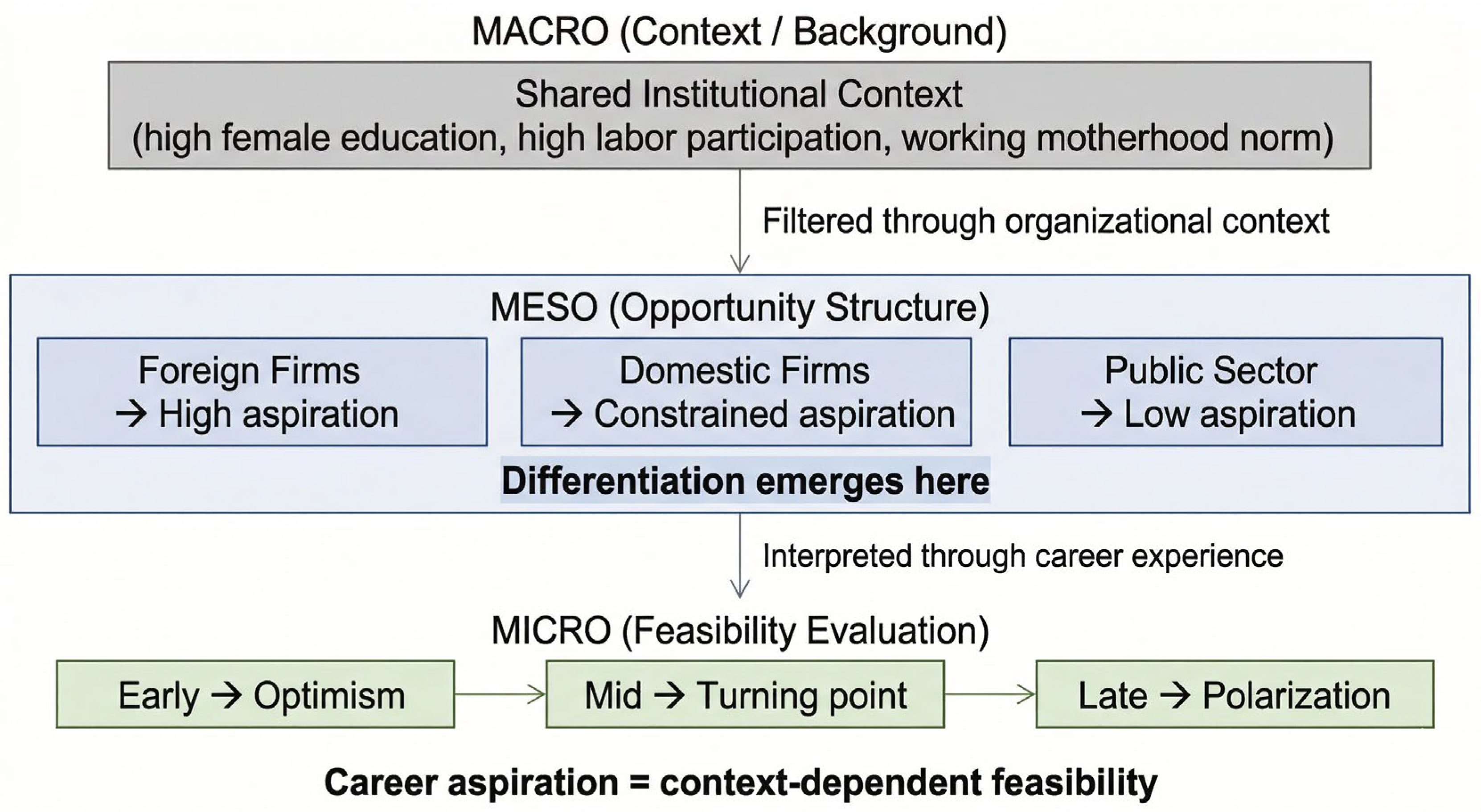
The conceptual framework presented in
Figure 1 serves as an organizing structure that integrates macro-, meso-, and micro-level perspectives, rather than a predictive model with hypothesized relationships. By combining survey data collected at different time points and across distinct organizational sectors, the study provides a nuanced view of how organizational contexts within a shared institutional setting shape perceived career mobility among Mongolian women.
3.2. Data Sources and Sample
This study draws on three waves of original survey data collected among Mongolian women, primarily conducted in connection with the author’s doctoral research and subsequent follow-up studies. The core dataset was collected in 2019, with an additional survey wave conducted in 2023 to supplement underrepresented organizational contexts.
The main data source consists of a questionnaire survey on Mongolian women’s work orientations and career aspirations, originally administered as part of the author’s doctoral dissertation research in 2019. This survey targeted women employed in a broad range of organizations, including foreign-owned firms, domestic private firms, and Japanese-affiliated companies operating in Mongolia. The survey aimed to capture women’s perceptions of career development, promotion opportunities, and leadership aspirations within different organizational environments.
To address sectoral imbalance and enhance comparability across organizational contexts, an additional survey focusing on women employed in public-sector organizations was conducted in 2023. This supplementary data collection was designed to capture career aspirations among women working in bureaucratic and state-affiliated institutions, which are known to retain distinctive institutional legacies in post-socialist Mongolia.
After harmonizing variables across survey waves, the final analytical sample consists of 191 Mongolian women distributed across three organizational contexts:
This multi-wave design allows the study to compare women’s promotion aspirations across organizational contexts characterized by different HRM practices, promotion logics, wage-based opportunity structures, and institutional histories.
The sample size of 191 respondents is considered adequate for the chi-square analyses employed in this study. Following established guidelines for contingency table analysis, the minimum expected cell frequency should be at least 5 in 80% of cells [
29]. This condition was met in the primary analyses (3 × 3 firm type × aspiration category cross-tabulations), supporting the statistical validity of the inferential tests. Additionally, studies examining women’s career aspirations and organizational stratification in post-socialist and emerging economies have commonly employed targeted survey samples in the range of 150–300 respondents for cross-tabulation and subgroup comparison analyses.
3.3. Measures
3.3.1. Promotion Aspiration
Promotion aspiration is the primary outcome variable of this study. Respondents were asked to indicate their attitude toward leadership or managerial roles using the following question:
“How do you feel about becoming a leader or manager in your organization?”
Three response options were provided:
I want to become a leader if I get the opportunity;
I want to become a leader, but I lack confidence;
I do not want to work as a leader even if I have the opportunity.
To capture qualitative differences in aspiration states, responses were recoded into a categorical variable distinguishing:
- ■
High aspiration;
- ■
Constrained aspiration (aspiration accompanied by low confidence);
- ■
Low aspiration.
This operationalization reflects prior research emphasizing that women’s career aspirations are often shaped by perceived organizational constraints rather than a lack of ambition.
The survey instrument, including the promotion aspiration question and response categories, was originally developed by the author for this study. The items were designed based on a review of prior research on women’s career aspirations and leadership motivation and adapted to the Mongolian organizational context. No existing validated scale was used; accordingly, the instrument should be understood as an exploratory measure tailored to the aims of the present study.
3.3.2. Organizational Context
Organizational context was operationalized using a categorical variable indicating firm type, coded as:
- ■
Foreign-owned firm;
- ■
Domestic private firm;
- ■
Public-sector organization.
This classification captures differences in HRM practices, promotion transparency, wage-based opportunity structures, and institutional legacies commonly observed in post-socialist economies.
3.3.3. Demographic and Career Characteristics
The survey also collected background information on:
Age group;
Organizational tenure;
Current position level.
These variables are used descriptively to contextualize aspiration patterns across organizational contexts and career stages.
3.4. Analytical Strategy
The analysis proceeds in three stages.
First, descriptive statistics are used to examine the overall distribution of promotion aspirations among Mongolian women.
Second, cross-tabulation analysis is conducted to compare promotion aspiration patterns across firm types and career stages. Percentages and cell counts are reported to facilitate substantive interpretation.
Third, statistical association tests are employed to assess whether differences across organizational contexts are statistically significant. Pearson’s chi-square test is used as the primary test of association between categorical variables (e.g., firm type and aspiration category). This test evaluates whether the observed distribution of aspiration categories across firm types departs significantly from what would be expected under independence. Given that some cross-tabulations involve cells with small, expected frequencies, Fisher’s exact test is conducted as a robustness check. To evaluate the strength of association beyond statistical significance, Cramér’s V is reported as an effect size measure, with values below 0.10 indicating a negligible association, 0.10–0.30 a small to moderate association, and above 0.30 a moderate to strong association [
29]. All analyses were conducted using R statistical software (Version 2026.04.0+526).
3.5. Ethical Considerations
This study involves human participants and was conducted in accordance with institutional ethical standards. Participation was voluntary, and informed consent was obtained from all respondents prior to data collection. Respondents were informed that their answers would remain anonymous and used solely for academic research purposes.
Ethical approval was obtained for the core survey conducted as part of the author’s doctoral research from the Ethics Committee of the Graduate School of Humanities and Sustainable System Sciences, Osaka Prefecture University (approval date: 22 January 2019). The supplementary survey conducted in 2023 followed the same research design, questionnaire structure, consent procedures, and ethical safeguards as the original study.
3.6. Data Availability
The dataset used in this study contains individual-level survey responses and cannot be made publicly available due to privacy and confidentiality considerations. However, anonymized data may be made available by the author upon reasonable request for academic research purposes.
3.7. Use of AI Tools
During the preparation of this manuscript, generative AI tools were used for language editing and structural refinement. All research design, data collection, analysis, interpretation, and final writing were conducted by the author. The author reviewed and edited all AI-assisted outputs and takes full responsibility for the content of this publication.
4. Results
4.1. Sample Overview and Distribution of Career Aspirations
This section presents an overview of the analytical sample and describes the distribution of career aspirations across organizational contexts. The final sample consists of 191 employed Mongolian women working in three organizational settings: foreign-owned firms, domestic private firms, and public-sector organizations. Respondents include both managerial and non-managerial employees and represent a wide range of ages, organizational tenure, and career stages.
Table 2 presents the demographic and organizational characteristics of the sample. Women employed in foreign-owned firms account for 39.3% of respondents, followed by public-sector employees (34.0%) and those working in domestic private firms (26.7%). The sample is concentrated in the 30s age group (51.8%), with smaller shares in the 20s, 40s, and 50s. Approximately 69.6% of respondents hold non-managerial positions, while the remainder occupy supervisory or managerial roles. Organizational tenure is relatively evenly distributed, with 31.9% reporting five years or less, 29.8% reporting six to nine years, and 38.2% reporting ten years or more.
Across the full sample, women’s aspirations toward leadership roles are heterogeneous. While a substantial share of respondents reports strong interest in becoming leaders, others indicate uncertainty regarding their ability to attain such roles, and some express no desire to pursue leadership positions. This distribution supports the analytical distinction between high aspirations, constrained aspirations, and low aspirations and suggests that leadership orientation varies within the same institutional context.
The following sections examine how career aspirations vary across organizational settings and career stages.
4.2. Organizational Context and Career Aspirations
To assess whether career aspirations differ across organizational contexts, cross-tabulations were conducted between firm type and aspiration categories (high, constrained, and low aspirations). The results are presented in
Table 3.
Variation is observed across organizational settings. Women employed in foreign-owned firms show the highest proportion of high aspirations (70.7%), followed by those in domestic private firms (60.8%) and the public sector (50.8%). Constrained aspirations appear most frequently among women in domestic private firms (25.5%), while the public sector shows the highest share of low aspirations (32.3%).
These patterns indicate that while leadership interest is present across all organizational contexts, the distribution of aspiration types differs. Constrained aspirations appear more frequently in domestic private firms and public-sector organizations, whereas foreign-owned firms show a higher concentration of high aspirations.
A Pearson’s chi-square test indicates that the association between firm type and career aspirations is statistically significant (χ2(4) = 11.34, p = 0.023, Cramér’s V = 0.17).
The effect size suggests a small to moderate relationship between organizational context and aspiration patterns.
4.3. Career Stage and Career Aspirations
Career aspirations were further examined across career stages using position level, organizational tenure, and age group as indicators.
Analysis by position level shows that high aspirations are present across hierarchical levels but are most prevalent among senior leadership positions.
Constrained aspirations are more visible among individuals in early managerial roles, such as section chiefs and middle managers. Although the association between position level and aspiration categories does not reach conventional statistical significance (χ
2(6) = 12.25,
p = 0.057), the distribution suggests variation across hierarchical levels. Organizational tenure reveals a non-linear pattern. Detailed results by position level are reported in
Table 4.
Women with short tenure (≤5 years) report the highest proportion of high aspirations (73.8%). Among those with mid-level tenure (6–9 years), constrained aspirations are more common (24.6%). In the longest-tenure group (10+ years), the distribution becomes more dispersed, with both high and low aspirations present. The association between tenure and aspiration categories is statistically significant (χ
2(4) = 13.08,
p = 0.011, Cramér’s V = 0.19), with a small to moderate effect size. Results for organizational tenure are summarized in
Table 5.
A similar trend is observed across age groups. High aspirations are most common among women in their twenties and thirties, while constrained and low aspirations become more frequent among women in their forties and fifties. Although the association between age group and aspiration categories does not reach statistical significance (χ
2(6) = 10.24,
p = 0.115), the pattern is broadly consistent with the tenure-based results. Age-group differences in career aspirations are shown in
Table 6.
Taken together, these findings suggest that aspiration patterns vary across the career course, with differences becoming more visible at mid-career stages.
4.4. Organizational Context × Career Stage
To explore whether organizational context is associated with differences in aspiration patterns across career stages, cross-tabulations were conducted between firm type, organizational tenure, and career aspirations as shown in
Table 7.
The results show that constrained aspirations appear most prominently among women with mid-level tenure (6–9 years) in domestic private firms and public-sector organizations. In contrast, women in foreign-owned firms maintain relatively high levels of aspiration across tenure groups, including at mid-career stages.
Although some cells contain small numbers and should be interpreted cautiously, the distribution suggests that aspiration patterns across career stages differ by organizational context.
5. Discussion
This study examined how women’s career aspirations are shaped across organizational contexts in post-socialist Mongolia, with particular attention to firm type and career stage. Rather than treating aspirations as stable individual preferences, the findings suggest that women’s leadership aspirations are dynamically recalibrated through ongoing evaluations of feasibility embedded within organizational environments.
Figure 1 summarizes these findings in a macro–meso–micro framework, illustrating how shared institutional conditions (macro level), firm-level opportunity structures (meso level), and career-stage evaluations (micro level) jointly shape women’s career aspirations.
5.1. Macro Level: Shared Post-Socialist Institutions and Gender Coexistence
At the macro level, all respondents operate within the same post-socialist institutional environment characterized by democratic transition, market liberalization, and relatively high female educational attainment and labor-force participation. Formal gender equality indicators suggest notable progress, and overt institutional barriers to women’s employment and advancement appear limited.
Mongolia’s gender regime is shaped by a socialist legacy that has long positioned women simultaneously as workers and mothers. Employment continuity and childbirth are institutionally framed as compatible and socially expected roles rather than mutually exclusive life choices. This pattern aligns with research on post-socialist gender regimes, which highlights the normalization of women’s continuous labor-force participation alongside family responsibilities.
Recent Mongolia-focused research further demonstrates that women broadly accept the coexistence of work and family responsibilities, and that traditional gender role attitudes are not straightforwardly determined by childbirth timing or number of children. Instead, the institutional legacy of “working motherhood” tends to normalize potential constraints, rendering them less visible and less likely to be articulated as explicit barriers to career advancement.
However, the findings of this study indicate that shared macro-level institutions do not translate into uniform career aspirations or leadership expectations. Despite operating under the same national gender regime, women report markedly different evaluations of leadership feasibility. This pattern suggests that macro-level gender progress may mask substantial variation in how opportunities are experienced and interpreted at lower levels. In this sense, national-level indicators alone are insufficient to explain divergence in women’s career aspirations and must be complemented by attention to organizational environments.
5.2. Meso Level: Firm Type as Differentiated Opportunity Structures
At the meso level, the results clearly indicate that firm type functions as a differentiated opportunity structure within the same national context. Women employed in foreign-owned firms were more likely to sustain high leadership aspirations and significantly less likely to report constrained aspirations than those working in domestic private firms and public-sector organizations.
Importantly, these differences are consistent with feasibility assessments shaped by organizational signals rather than simple motivation deficits. Specifically, they are associated with clearer organizational signals regarding advancement feasibility and returns of leadership.
In the Mongolian context, foreign-owned firms are typically embedded in higher-wage environments with more visible performance differentiation. Such environments may make promotion outcomes more legible and advancement trajectories more predictable. These organizational signals appear to reduce uncertainty at critical career junctures and mitigate the emergence of constrained aspirations.
In contrast, domestic private firms are characterized by lower and more uneven wage returns of promotion, alongside mixed or less predictable HRM signals. Public-sector organizations, while offering employment stability and standardized pay structures, provide limited vertical differentiation. These institutional features may dampen incentives for advancement and contribute to higher proportions of constrained or low aspirations, particularly at later career stages.
The interaction analysis further shows that constrained aspirations are most pronounced at mid-career in domestic private firms and the public sector, whereas women in foreign-owned firms maintain relatively high aspirations even at comparable career stages.
These findings suggest that organizational context conditions how career-stage experiences are interpreted and evaluated, reinforcing the importance of meso-level environments in shaping career expectations. These results are also broadly consistent with prior research demonstrating that organizational HRM practices shape women’s career expectations. Hoobler et al. showed that managerial aspirations are sensitive to organizational development signals, while Acker argued that gendered substructures within organizations produce differentiated career outcomes even in the absence of overt discrimination [
5,
17]. The present findings extend this line of research by showing that such organizational effects are observable across firm types within a single national context.
5.3. Micro Level: Career Aspirations as Career-Stage Evaluations of Feasibility
At the micro level, the findings indicate that women’s career aspirations are best understood as career-stage evaluations rather than fixed individual preferences. High aspirations are most prevalent at early career stages, when organizational experiences are limited and expectations regarding advancement remain optimistic.
As women move into mid-career and early managerial positions, aspirations become increasingly constrained. This constrained state does not reflect a lack of interest in leadership but rather heightened uncertainty regarding promotion feasibility. At this stage, women have accumulated sufficient organizational knowledge to assess promotion processes and returns of advancement. When promotion signals are perceived as ambiguous or limited, aspirations appear to be recalibrated accordingly.
In later career stages, aspirations diverge. Some women—particularly those who have already advanced into senior leadership—maintain high aspirations, while others with long tenure report low aspirations, suggesting disengagement from further advancement. These patterns support a dynamic view of career aspirations as ongoing evaluative responses to accumulated organizational experience rather than stable traits rooted in personality or motivation.
This finding aligns with Social Cognitive Career Theory, which posits that career-related goals are continuously revised in response to contextual feedback [
21]. It also resonates with Correll’s work on gendered self-assessments, which demonstrated that women’s career evaluations are shaped by culturally embedded performance expectations rather than objective ability differences [
25]. In the Mongolian context, the recalibration of aspirations at mid-career appears to reflect organizational feasibility signals rather than declining motivation, supporting a contextual rather than dispositional explanation.
5.4. Integrating the Three Levels: Why Career Aspirations Diverge
Taken together, the macro–meso–micro framework helps explain why women’s career aspirations diverge within the same national context. While macro-level institutions establish shared expectations of women’s labor participation and formal equality, meso-level organizational contexts generate differentiated opportunity structures. These organizational signals are then interpreted and evaluated at the micro level across career stages, producing distinct aspiration trajectories.
Foreign-owned firms differ not because women are more ambitious within them, but because these organizations appear to provide clearer signals that leadership advancement is both attainable and worthwhile. In contrast, domestic private firms and public-sector organizations often convey more ambiguous or limited returns of advancement, particularly at mid-career stages, which may contribute to the emergence of constrained or low aspirations.
By integrating insights from post-socialist institutional theory, organizational stratification research, and career-stage perspectives, this study shifts attention away from assumptions of individual ambition deficits and toward organizationally embedded feasibility assessments. In doing so, it offers a more precise explanation for observed differences in women’s career aspirations within a shared institutional environment and highlights the central role of organizational context in shaping leadership expectations.
5.5. Limitations and Future Research
This study has several limitations that should be acknowledged. First, the cross-sectional survey design limits the ability to establish causal relationships between organizational context and career aspirations. Longitudinal research tracking women’s aspiration trajectories across career stages would provide stronger evidence for the dynamic recalibration processes discussed above.
Second, the sample is limited to employed women in Ulaanbaatar and may not fully represent career aspiration patterns in rural areas or other urban centers in Mongolia. Third, the study relies on self-reported aspiration categories rather than behavioral measures of career advancement, which may not fully capture the complexity of women’s career orientations. Fourth, the integration of survey data collected at two time points (2019 and 2023) introduces potential temporal confounds, although robustness checks confirmed that aspiration patterns did not differ substantively by survey wave.
Future research could address these limitations by employing mixed-methods designs that combine survey data with qualitative interviews to explore how women interpret and respond to organizational signals in greater depth. Comparative studies across multiple post-socialist economies would help clarify whether the firm-type effects observed in Mongolia generalize to other transitional contexts. Additionally, examining the role of specific HRM practices—such as mentoring programs, performance evaluation transparency, and pay differentiation—would provide more granular insights into the organizational mechanisms that sustain or constrain women’s leadership aspirations.
6. Conclusions
This study addressed an underexplored question in international business and human resource management research: why women’s leadership aspirations diverge within the same national and institutional context despite shared macro-level gender equality conditions. Using survey data from employed women in post-socialist Mongolia, the analysis demonstrated that career aspirations vary systematically across organizational contexts and career stages.
The findings indicate that firm type operates as a critical meso-level opportunity structure shaping how women evaluate leadership feasibility. Women in foreign-owned firms were more likely to sustain high aspirations and less likely to report constrained aspirations, even at mid-career stages where reassessment typically occurs. In contrast, women in domestic private firms and public-sector organizations more often reported constrained or low aspirations, particularly during mid-career and early managerial stages. These patterns suggest that differences in aspirations reflect not deficits in ambition, but organization-specific feasibility assessments shaped by promotion signals, perceived returns of leadership, and the clarity of advancement pathways.
By integrating macro-, meso-, and micro-level perspectives, this study contributes to IHRM research by highlighting intra-national heterogeneity in gendered career expectations within a shared institutional environment. The findings demonstrate that national-level indicators of gender equality do not fully capture how opportunity structures are experienced within organizations. Instead, organizational context plays a central role in shaping whether leadership is perceived as attainable and worthwhile over the career course.
More broadly, the study suggests that career aspirations should be understood as context-dependent evaluations rather than stable individual traits. By shifting attention from individual motivation to organizationally embedded perceptions of feasibility, this research provides a more nuanced explanation for divergence in women’s leadership aspirations in post-socialist and emerging economies.
The findings also carry practical implications for organizations operating in post-socialist labor markets. For foreign-owned firms, maintaining transparent evaluation systems and visible career trajectories may support the continuation of leadership aspirations across career stages. For domestic private firms and public-sector organizations, the results highlight the importance of reducing uncertainty at mid-career stages. Providing clearer criteria for promotion, strengthening mentoring structures, and making advancement pathways more legible may help prevent the emergence of constrained aspirations among capable employees.