1. Introduction
Sulfur is the element with the most known crystalline forms in the solid state [
1,
2]. Its orthorhombic structure at room temperature consists of
rings with a bond length of 2.055 Å [
3]. After melting at
K (or
°C), a yellow liquid with low viscosity forms [
1,
2]. The melt contains mainly
rings as well as other structural elements of rings and chains. At
K (or
°C), sulfur undergoes a transition into a state with a huge increase (amounting to several orders of magnitude) in viscosity [
4,
5]. Density measurements have shown a discontinuity at the
-transition [
6]. However, later density measurements reported a continuous transition without a minimum or singularity at the transition [
7]. Heat capacity measurements demonstrated a
-shaped maximum at the transition [
8]. The color changes from yellow to red-brown, indicating a change in electronic structure, too. Light absorption was used to probe the optical properties and therefore the electronic properties of the liquid and revealed a change in absorption at the
-transition [
9]. The transition is reversible with cooling, after which the viscous liquid becomes yellow and fluid again. The diffusion coefficients of liquid sulfur have been ascertained using a radioactive isotope tracer diffusion method [
10]. Up to near the
-transition, the diffusion coefficient D increases and can be described through an Arrhenius process. It was reported that crossing of the transition D is reduced by a maximum factor of 20; eventually, above T = 500 K, the coefficient increases again to levels below the transition. It was estimated that the diffusion coefficient changes by a factor of 700 less than the viscosity [
10].
The cause of the transition is supposed to be a shift in the equilibrium composition of the liquid, with a breaking up of the rings into chains, which concatenate into long polymer-like chains—a polymerization transition [
11,
12,
13]. With a further increase in temperature, the viscosity starts to drop, which is conjectured to be a product of the breaking up of the long chains into smaller units. The boiling point of sulfur is at
T = 718 K. The large increase in viscosity during this polymerization transition has been modeled by Tobolsky and Eisenberg through a chemical equilibrium constant, describing the breaking up of the rings and a reaction constant describing the building of polymer-like chains [
11]. The exact details of the transition are still a subject of debate; see, for example, [
14,
15,
16,
17,
18]. More recently, it was suggested that liquid sulfur exhibits a first-order liquid–liquid transition [
19], and the
-transition corresponds to a fragile-to-strong liquid–liquid transition [
20].
Early on, the microscopic structure was investigated to reveal the origin for the polymerization transition. Neutron and X-ray diffraction experiments have been applied below and above the
-transition; see, for example, [
21,
22,
23,
24]. The structure factor
is composed of a main peak at about
Å
−1 and a shoulder at
Å
−1 [
25]. This type of structure factor can not be described by simple hard-sphere modeling and needs a more sophisticated liquid structure model. The nearest-neighbor distance was found to be 2.053 Å [
25], identical to the value for the crystalline state. The number of nearest neighbors at this distance is slightly below two, which can be interpreted that liquid sulfur, even below the
-transition, consists of a mixture of rings and chains [
23,
25].
With an increase in temperature, the main peak decreases, and the pre-peak shoulder increases around the
-transition [
22,
26]. Through analyzing and modeling the pair correlation functions
, it was concluded that when the
-transition is crossed, a reduction of the
rings occurs [
23,
27], and the polymerized state then contains a large fraction of chain-like structures [
25]. However, the modeling of the Fourier-transformed structure factor sometimes leads to conflicting interpretations of the atomic structure in liquid sulfur [
26,
28]. The liquid structure may not be describable with stable molecular units [
29], distinguishing liquid sulfur from a molecular liquid.
In addition to experiments, MD simulations have been performed to reveal the structure of liquid sulfur [
30]. The scenario with
rings in the liquid state, which then eventually break up upon an increase in temperature, was confirmed. Ab initio molecular dynamics calculations were also applied, and it was concluded that the main elements of the liquid structure are
rings [
31], which are then transformed into a mixture of long and short chains at high temperatures [
32]. In summary, the microscopic structure changes gradually through the transition, and the
ring structural motifs become a less important element when crossing the transition. Due to this gradual transformation, a percolation-type of transition was suggested for liquid sulfur [
26]. However, the small local changes in the structure do not reflect the huge increase in viscosity.
The most prominent change at the polymerization transition is the increase in viscosity by several orders of magnitude. Hence, investigating the microscopic dynamics might play an important role in shedding some light on the transition. Description of the dynamics presents a complex picture, because the liquid sulfur structure is a mixture of structural motifs, and the composition thereof changes with temperature. Just after melting, there is a dominant fraction of
-rings, which will exhibit translational and rotational motions. However, there are also other ring structures and small sulfur chains contributing to the dynamics. Beyond the transition, the balance in the composition will move to long chains intermixed with rings and further smaller chains, whereas at even higher temperatures, the long chains will break up. Therefore, sulfur constitutes a molecular liquid mixture where the respective fractions of a large number of different molecular units change with an increase in temperature. Only averages over all the different motions can be extracted in a single scattering experiment. Through choosing a specific time and length scale, different types of motions can be separated. A first hint that the dynamics might be a complex problem can be gleaned through the fact that the diffusion coefficient only changes by a factor of 20 throughout the transition and not a factor of 14,000 as with the viscosity [
10].
Until now, most of the investigations on the microscopic dynamics of liquid sulfur throughout the
-transition primarily have focused on the inelastic collective dynamics. Raman scattering is used to probe the high-frequency optic-type vibrational modes [
33]. In the liquid Raman bands from
rings are still found, and a strong increase in higher-energy modes can be observed above the
-transition, which might be related to deformed rings [
29]. Inelastic neutron scattering and inelastic X-ray scattering have been applied to study the vibrational dynamics in this context. In one of the first inelastic neutron-scattering experiments, the generalized density of states with rising temperature was studied [
34]. The vibrational modes do not change very much with melting, indicating that the underlying structures of the
-rings survive. The low-frequency quasielastic neutron-scattering signal was analyzed with two relaxation modes [
34]. The intensity of the narrower mode decreased strongly throughout the transition, and it was suggested that this mode might be related to the slow diffusive motion of the rings. No further quantitative analysis was performed at that time.
The collective inelastic dynamics were studied with inelastic X-ray scattering over a limited wavevector range wherein collective inelastic excitations are supposed to occur [
35,
36]. Acoustic-type excitations were found for liquid sulfur just above the melting point and up to the critical point. A more recent study on the collective dynamics conducted using inelastic X-ray scattering reported that the inelastic spectrum shows only a modest change when the
-transition is crossed [
37]. However, it was noted that the quasielastic line sharpened when the temperature was increased above the polymerization transition. An inelastic neutron-scattering experiment explored the dynamics in liquid sulfur below the transition over three decades in terms of frequency [
38]. The dynamics from relaxation dynamics over acoustic-type excitations to optic-type modes were studied. Ab initio simulations on a melt of
rings were performed to reveal details about the acoustic-type excitations as measured with inelastic X-ray scattering or inelastic neutron scattering [
39]. All these studies on the vibrational modes of sulfur demonstrate only small changes within the liquid state and are not directly sensitive to the dramatic viscosity increase at the
-transition. Only a few reports mention a reduction in the quasi-elastic line with an increase in temperature, which might be linked to the viscosity increase. Dynamics at even slower time scales were also investigated. A relaxation process in the ms time range was observed after the transition through infrared photon correlation spectroscopy [
40]. The cited study used infrared light and hence covered long spatial correlations, which relaxed correspondingly very slowly. Obviously, liquid sulfur shows relaxation dynamics spanning many decades.
Here, we present a comprehensive study of the relaxation dynamics of liquid sulfur throughout the -transition through neutron-scattering experiments conducted over time scales ranging from 1 ps to 140 ps and over length scales between 3 Å and 20 Å. This study complements the existing measurements in the sub ps time scale of inelastic excitations and the very long time scale in the ms range.
2. Experimental Details and Data Analysis
A neutron-scattering experiment was performed using the indirect ToF-back-scattering spectrometer OSIRIS at the ISIS Facility, UK [
41,
42]. The final energy level was
meV, with an energy resolution of full width at half maximum
meV. A wide dynamic range, −0.7 meV to +1.5 meV, around the elastic line was selected, and wavevectors between 0.25 and
Å
−1 were covered. With this set up, relaxation dynamics from 1 ps to up to 160 ps can be resolved [
43]. The Q-vectors correspond to length scales of around 3 to 20 Å.
A sulfur sample was kept in a cylindrical aluminum container with an outer diameter of 22 mm and a wall thickness of 0.5 mm. The coherent neutron cross section of sulfur is
barn, and the incoherent one is a negligibly small, at
barn [
44]. The negligible incoherent neutron cross section excludes the possibility of using a neutron-scattering experiment to probe single-particle dynamics. As a consequence, the self-diffusion coefficient cannot be extracted from the data, and models for describing the rotational motion of molecular units based on the single-particle localized motion cannot be applied. Such an analysis is based on the incoherent scattering of hydrogen atoms (for example, [
45]). The coherent cross section connects to the dynamic structure factor
, which is the double Fourier transform of the time-dependent van Hove pair correlation function. This correlation function describes the motion of a particle at time zero correlated with a different particle at a later time, and hence it describes the collective dynamics of the system.
In fact, sulfur has one of the smallest neutron cross sections of all elements in the periodic table, and hence rather large sample amounts can be used. The sample dimensions correspond to a scattering power of about 6%, and the contributions of multiple scattering are therefore small. Sulfur of 99.998% purity, based on metal trace analysis, was deposited into an aluminum can. The temperature was controlled by a cryofurnace. Three temperatures around the -transition ( K) were measured—T = 420 K, T = 480 K and T = 530 K—with a temperature stability of K. For each temperature, about 12 h of measurement time was used. The data obtained were monitor-normalized, and detector efficiency was calibrated using a vanadium scan. The spectra were then grouped into 20 Q-vectors, and an energy binning of 2 μeV was applied. An empty-aluminum-can measurement was also performed. Aluminum has no Bragg peaks in the chosen wavelength range and no incoherent cross section; therefore, the contribution from the empty can is negligible small in this set-up.
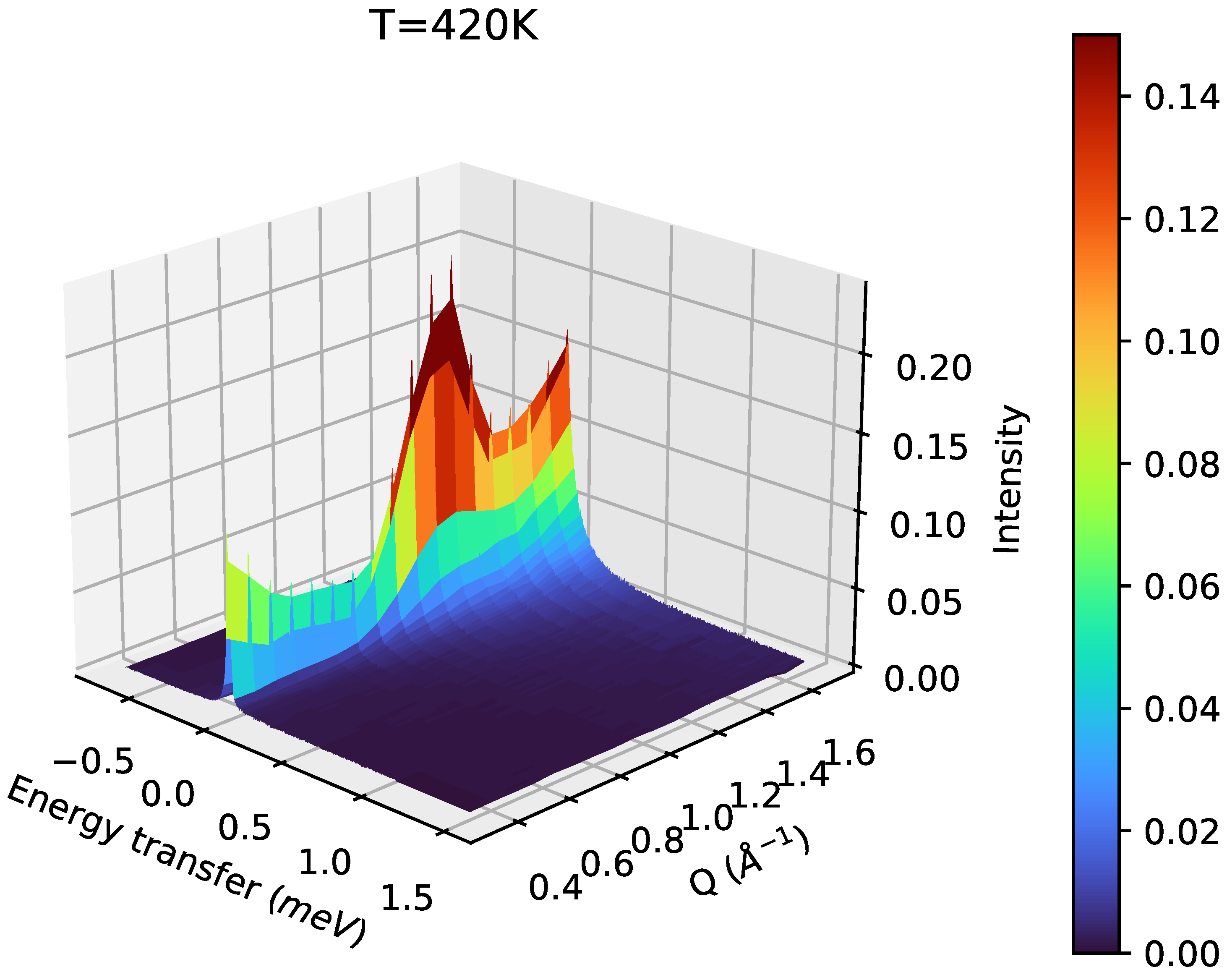
In
Figure 1, an intensity surface plot against the Q-vector and energy transfer is presented for T = 420 K. The intensity of the quasi-elastic line increases strongly with Q when the shoulder in the structure factor around
Å
−1 is approached and towards the main structure factor peak at
Å
−1. Because of the negligible incoherent cross section of sulfur, correlated density fluctuations were recorded. The amplitude of the scattering signal follows the structure factor. Towards a small Q, the amplitude of the quasi-elastic intensity increases, which might be related to non-resolved slow relaxation processes.
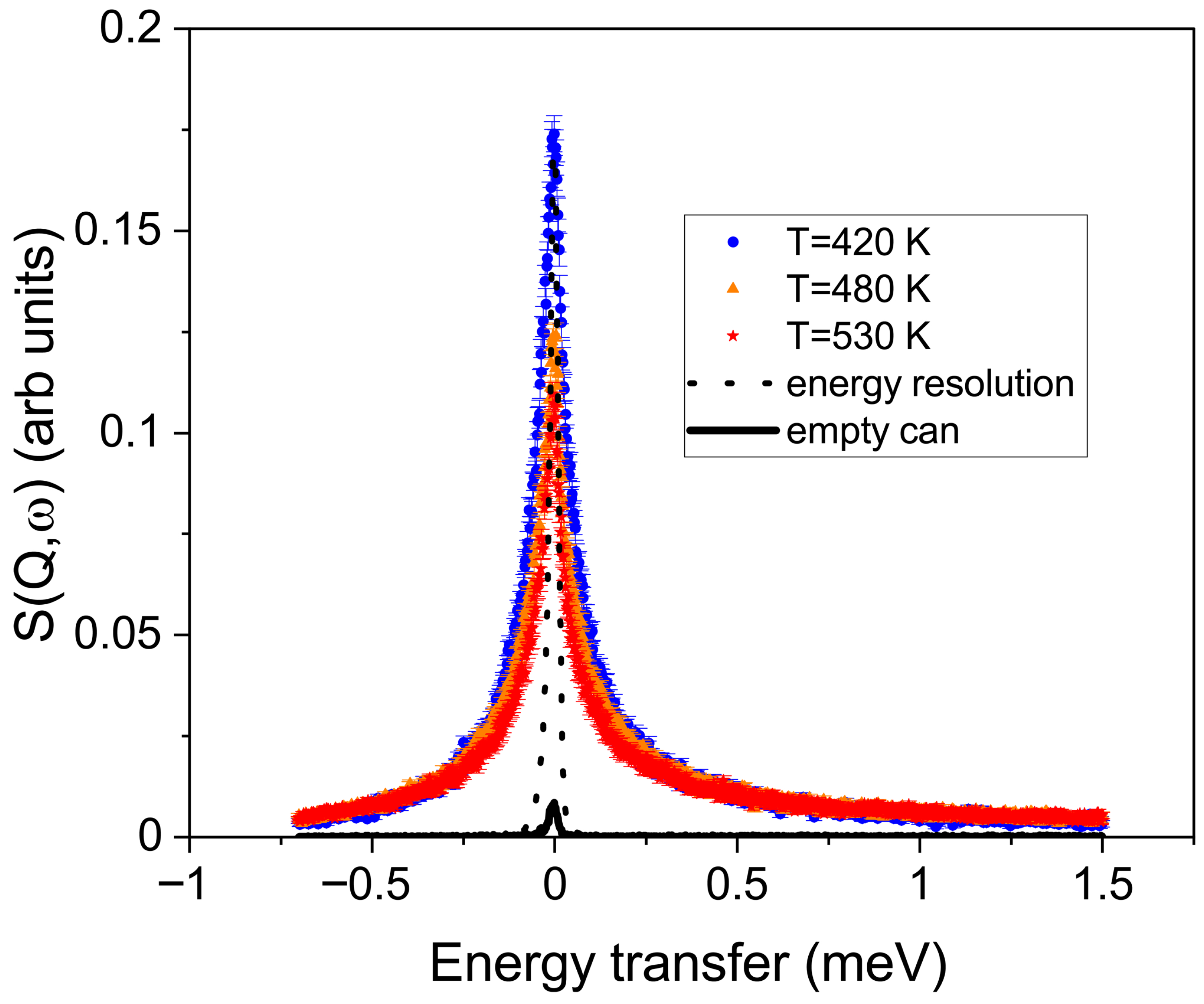
In
Figure 2, spectra for 3 temperatures at one specific wave vector Q = 1.6 Å
−1 are plotted. Included is the energy resolution measured with a vanadium sample. The contribution from the empty can is negligibly small due to the small scattering contribution from aluminum in this wavelength range. The spectra demonstrate only small changes with an increase in temperature, mainly related to a reduction in the amplitude at zero energy transfer. The shape of the spectra around zero energy transfer indicates that not all movements of the particles are resolved by the energy resolution of the spectrometer and that further slow processes might exist.
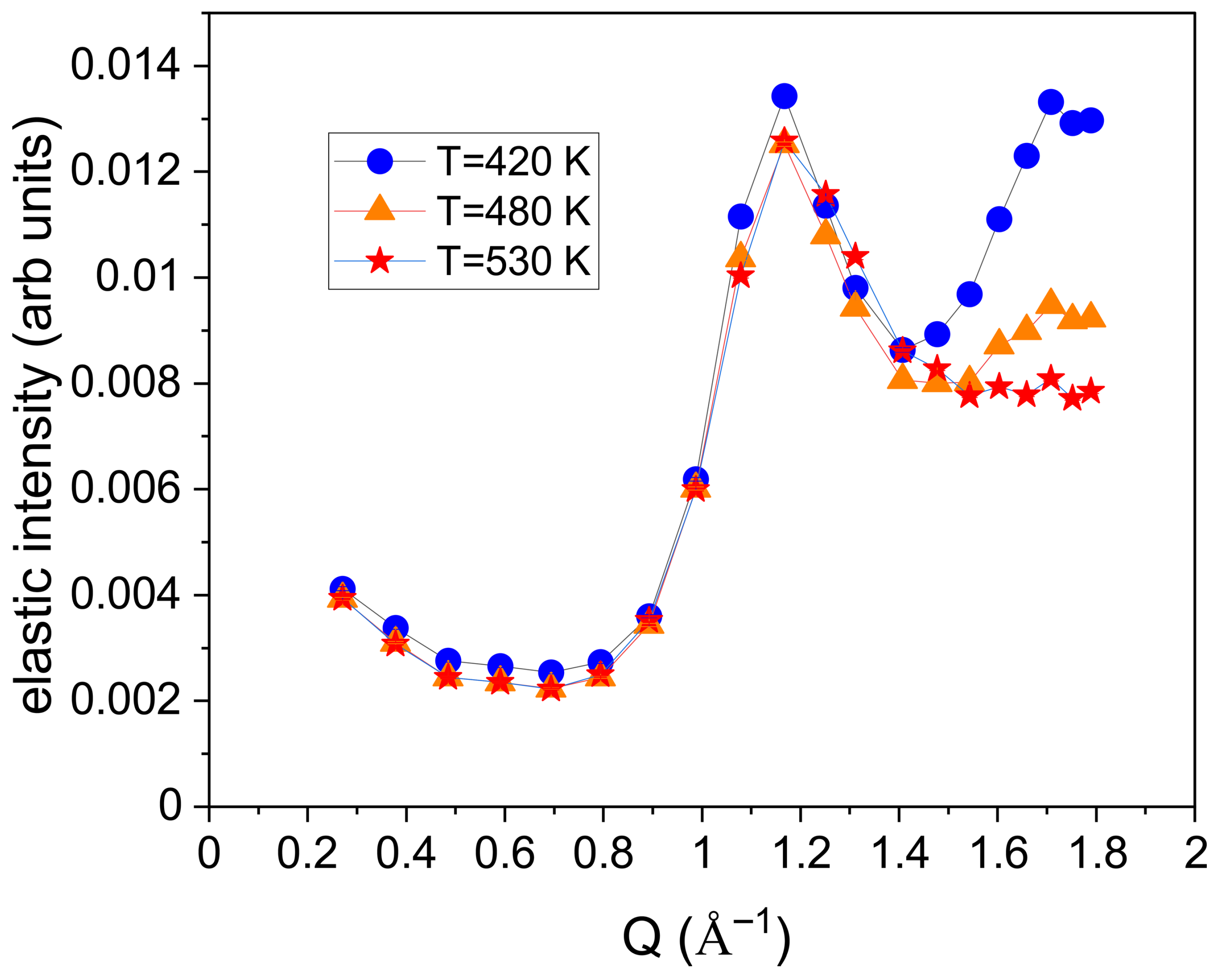
A initial inspection of the evolution with an increase in temperature was achieved through analyzing the changes in elastic intensity. To this end, the intensity around zero energy transfer ±0.05 meV was integrated as a measure of elastic intensity. This intensity covers all relaxation processes that are slower than what the energy resolution (FWHM = 0.025 meV) can resolve.
Figure 3 shows the result of this intensity integration. The integrated elastic intensity shows a peak around
Å
−1, where the structure factor has a shoulder. At this Q-vector, a small change occurs with an increase in temperature, indicating that the slowest relaxation dynamics do not dramatically change throughout the transition. At small Q, there is an increase in intensity towards Q = 0, which can be interpreted to be scattering from larger particles. The situation is different at large wavevectors. Here, with an increase in temperature, the intensity exhibits the largest change with a reduction upon crossing the
-transition.
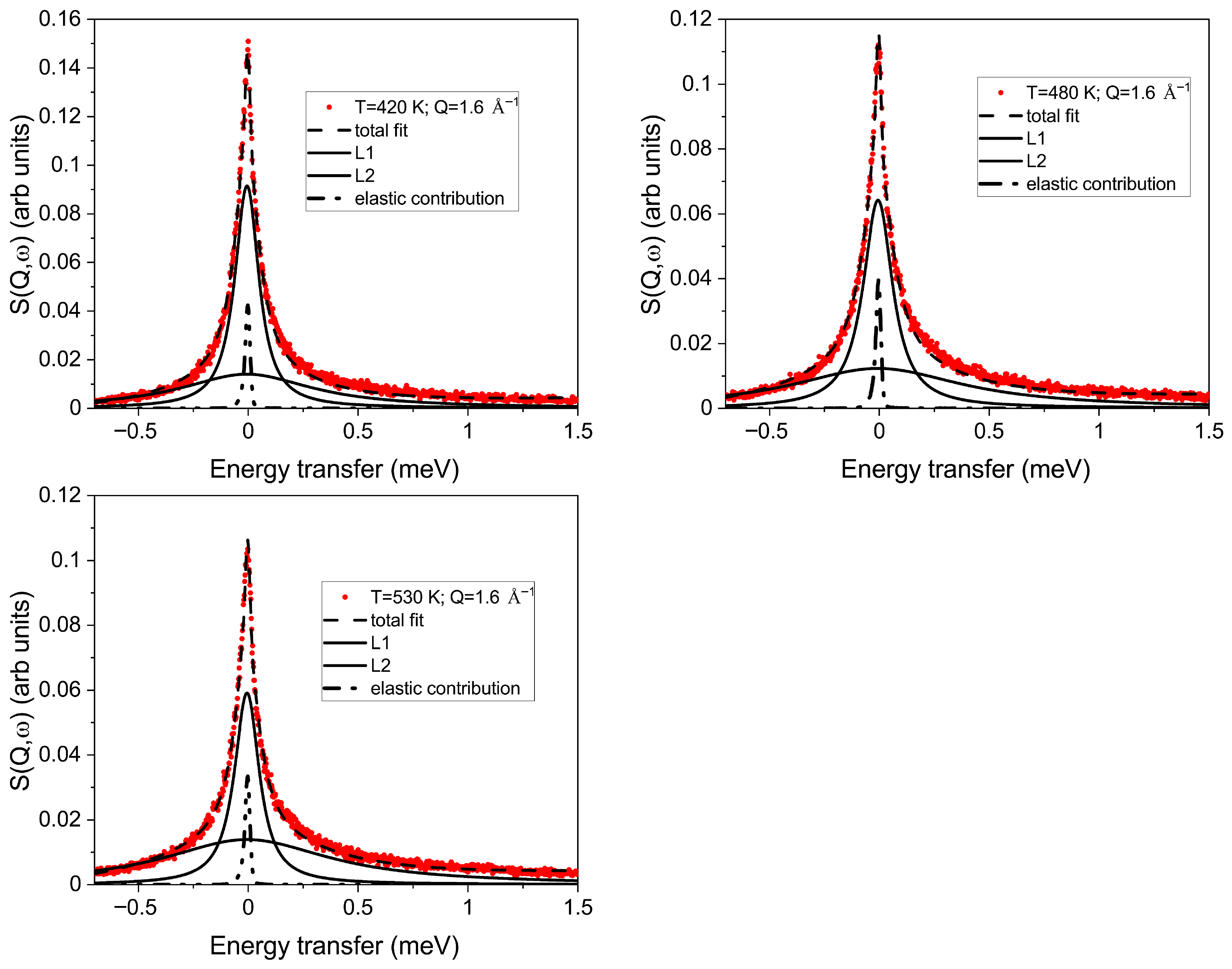
Two approaches were applied to reveal details of the relaxation dynamics. The first one models the measured energy spectra. To reveal the shape of the quasi-elastic line, a fit with the sum of a delta function and two Lorentzian line shapes convoluted (the ⊗ symbol) with the measured energy resolution was performed. A sloping linear background (Bgrd) was added here in the fitting model:
where
describes a Lorentzian line shape,
is the amplitude of the elastic contribution, and
is the resolution function measured with a vanadium sample.
A further possibility is to analyze the data in the time domain. If the shape of the quasi-elastic line is well known because there are a small number of underlying relaxation processes, then a fit with one or two Lorentzians in the energy domain can be performed. For example, simple molecular liquids, which exhibit translational and one rotational movement, can be described in such a way. However, if there are more relaxation processes, perhaps with a non-Lorentzian lineshape involved, the analysis in the energy domain with one or two Lorentzians becomes less and less meaningful. Then, an analysis in the time domain becomes more advantageous. To this end, the
spectra were Fourier-transformed into the time domain to obtain the intermediate scattering function F(Q,t). The use of a Fourier transform in QENS-data analysis was established and assessed some time ago [
46]. In particular, QENS-data of polymeric systems could be analyzed successfully in the time domain [
47,
48].
During the transformation, the resolution function is also Fourier-transformed and can then be divided in the time domain. Therefore, the proper intermediate scattering function is obtained, and no further convolution with a resolution function needs to be performed during modeling. The analysis in the time domain then allows one to combine relaxation functions obtained from different spectrometers covering different time ranges.
In the time domain, a spectrum from a single Lorentzian would correspond to an exponential decay process. More complex dynamics can be modeled through a stretched exponential decay, which is also known as the Kohlrausch–Williams–Watts (KWW) function:
Here, A is amplitude, and
is the stretching parameter, which describes relaxation processes decaying slower than a single exponential decay for
. The characteristic relaxation time, or average relaxation time, of this function is expressed as follows:
with
denoting the Gamma function. The exponential decay
is the limiting case of this more general function. Such a stretched exponential decay process could originate from the fact that in a disordered system, each particle enters a slightly different environment, and hence the dynamics are a distribution of relaxation times or the individual relaxation process is inherently non-exponential. That function is quite popular in modeling experimental data of complex liquids when, for example, the final decay of the relaxation dynamics approaching the glass transition is described; see, for example, [
49,
50]. The F(Q,t) data were modeled with this function, and a constant background was added to the fit. In the time domain, a constant corresponds to the elastic line in the frequency spectra, which is represented by the
-function; see Equation (
1). All the data analysis steps were performed using the Mantid software (Version 6.13) framework [
51]. For most of the fits, the errors in the parameters are smaller than the symbol.
3. Results
Figure 4 shows spectra at Q = 1.6 Å
−1 for three temperatures. Included are the total fit (dashed line), the two Lorentzian components (full lines), and the elastic contribution (dashed dotted line). This fit model with three components describes the lineshape for all temperatures and wave vectors reasonably well.
The elastic part in the spectra evidences further deceleration in the relaxation processes, which cannot be resolved with the present spectrometer’s resolution. Whether this even-slower relaxation process might be linked to diffusive movements of whole chain-like structures or ring elements needs to be investigated with a higher energy resolution.
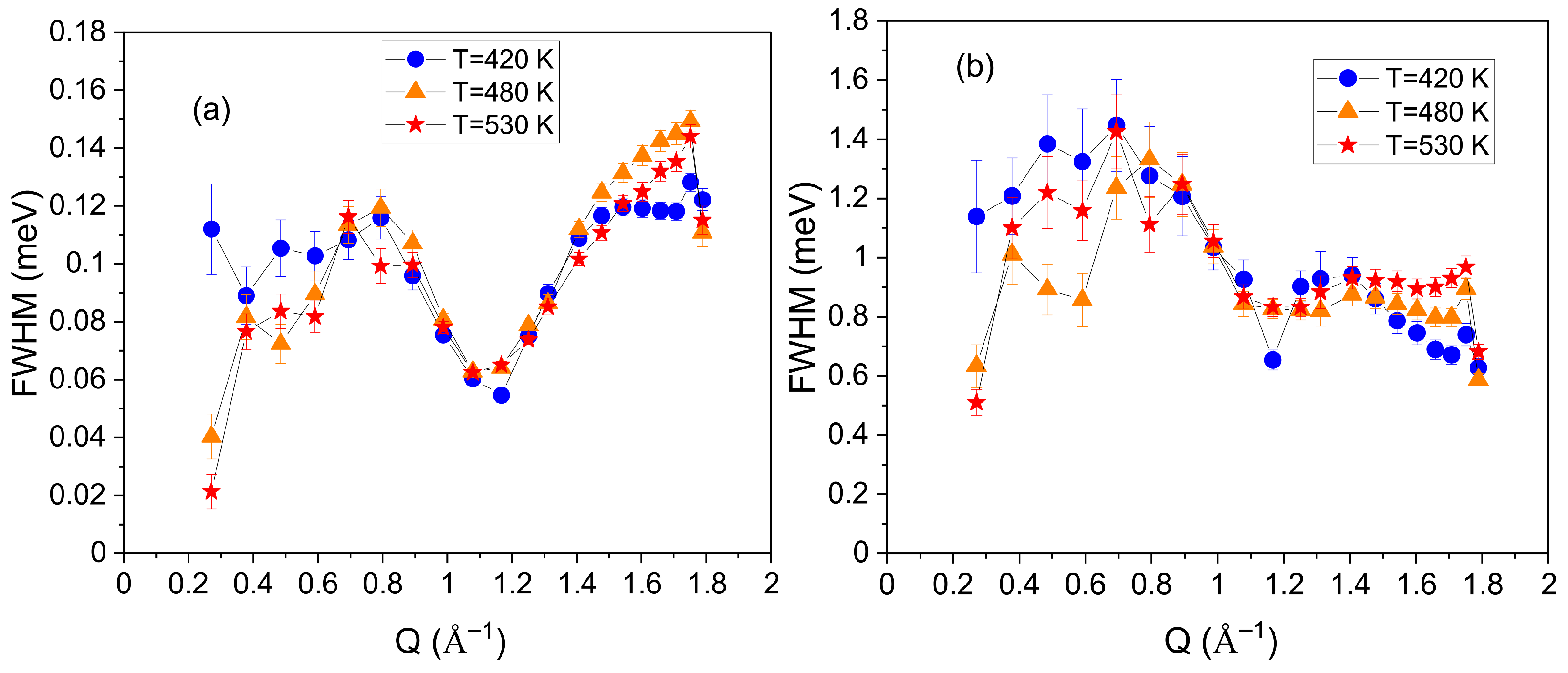
In panel (a) of
Figure 5, the smaller FWHM
of the fitting model is depicted. In a previous investigation using a lower energy resolution, fitting with two Lorentzians resulted in similar values for smaller widths [
34]. Previously, we used a limited dynamic range, and the width obtained from a single Lorentzian fit agrees well with the smaller width obtained here
[
38]. The widths show a characteristic dependence on Q, with a minimum where the shoulder-like pre-peak of the structure factor occurs, at about
Å
−1. This reduction in line width is characteristic of de Gennes narrowing in collective liquid dynamics [
52]. In a dense liquid, the relaxation of a density fluctuation on a wavelength of neighbor distances takes time due to the cooperative rearrangement of the particles to enable the relaxation process, and this increased time is reflected in a reduction in line width. After the
-transition is crossed, the dynamics on these length scales are practically unaffected. However, at small Q values, the width decreases by a factor 6 with an increase temperature, and hence the relaxation dynamics significantly slow down at this length scale. This can be interpreted as the growth of larger structural elements, which need more time to relax. At larger wavevectors around the main structure factor peak at
Å
−1, the dynamics become faster with an increase in temperature.
In panel (b) of
Figure 5, the wider
is plotted. Here, the de Gennes narrowing is only modestly expressed in the data points. At small Q values, we notice that when the transition is crossed, the dynamics become slower upon an increase in temperature, whereas at larger Q values, the dynamics become faster with an increase in temperature. The widths presented here are greater than a previously measured [
34], which might be related to a different dynamic range in the experiments. In summary, the most striking change in the dynamics is observed at the smallest Q vectors when the dynamics slow down with an increasing temperature. The results reveal movements that are a factor of 6 slower at the greatest length scales observed.
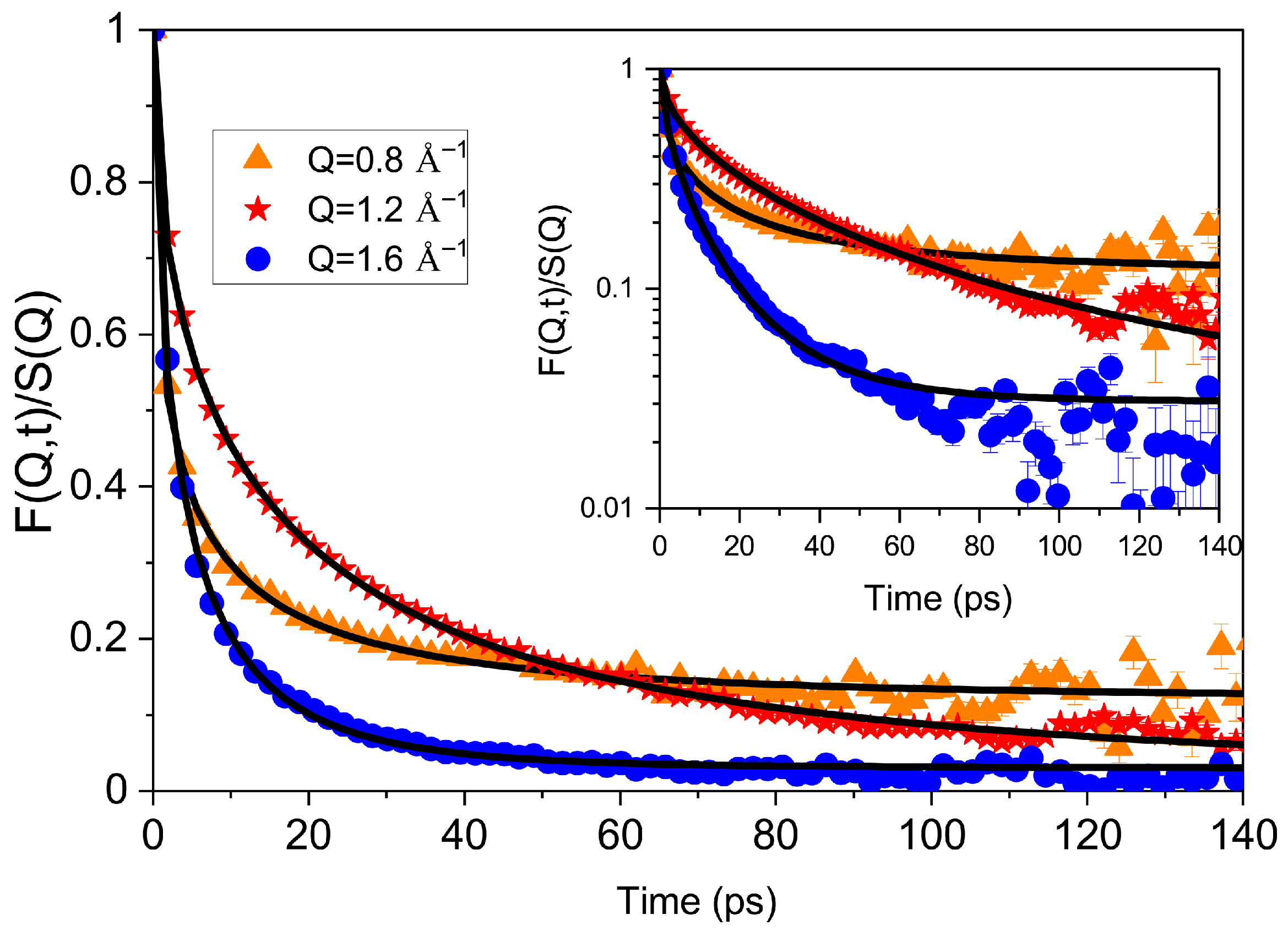
Next, we present the relaxation dynamics in the time domain through the intermediate scattering function F(Q,t). In
Figure 6, the intermediate scattering function F(Q,t) is plotted for three different Q vectors. With the applied dynamic range and energy resolution, the dynamics between 1 ps and 140 ps can be resolved. The three Q-vectors are Q = 0.8 Å
−1, Q = 1.2 Å
−1 at the shoulder of the structure factor, and Q = 1.6 Å
−1 near the main structure factor. We include fits with the stretched exponential decay function, which describes the data points quite well. The inset presents F(Q,t) on a logarithmic scale. If the type of decay were a single exponential process, then a linear line would result. However, the relaxation process deviates considerably from a line, and more than a single exponential relaxation process must occur for all Q-vectors. At large times, the decay seems to level off to a constant value, which corresponds, in the energy domain, to an elastic contribution. This elastic part reduces with an increasing Q-vector. It seems that the decay process has not ended at 140 ps, and a higher energy resolution would be needed to fully resolve the relaxation process. F(Q = 1.2 Å
−1,t) decays slower than the other wavevectors, a consequence of the de Gennes slowing down.
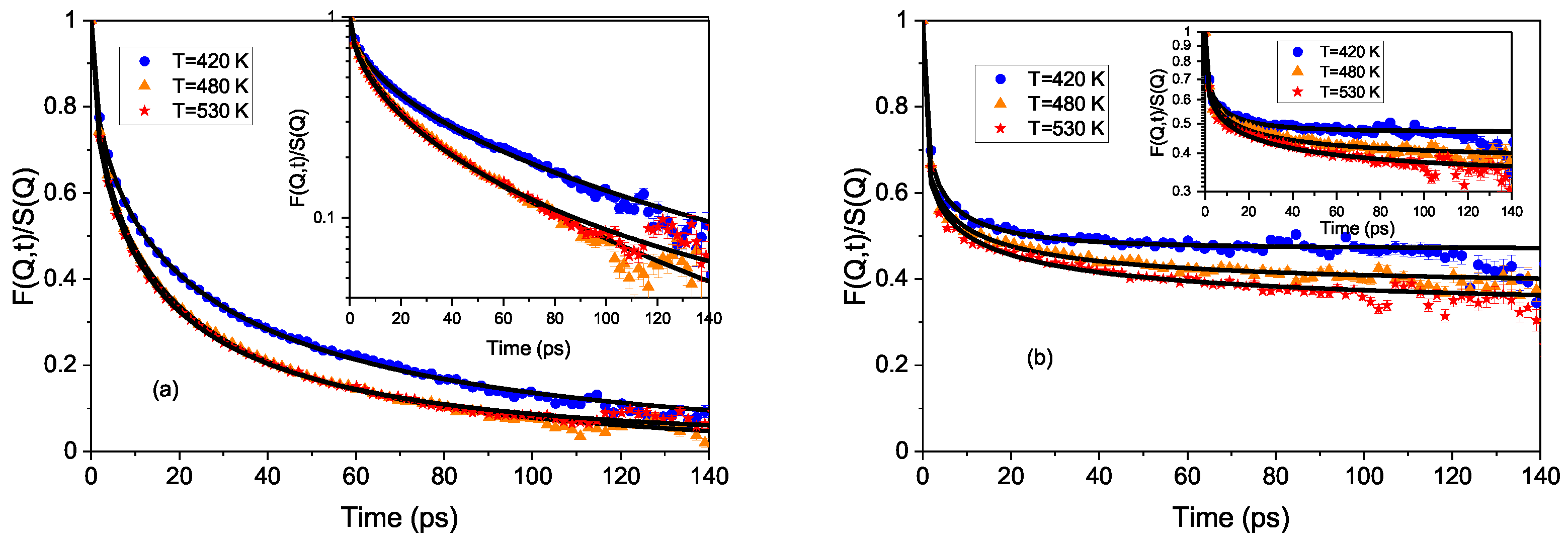
In
Figure 7 panel (a), F(Q,t) spectra are plotted for Q = 1.2 Å
−1, where the slowest decay occurs. The relaxation process becomes faster when crossing the
-transition. The spectra for both temperatures above the transition are very similar and show only few differences after long periods, a finding that agrees with the result from the modeling in energy space; see
Figure 5. The lines depict fits with a KWW-function; see Equation (
2). The inset presents F(Q,t) on a logarithmic scale to demonstrate the non-exponential nature of the decay and furthermore suggests that the full decay of the intermediate scattering function is not completely resolved with this spectrometer for all temperatures. The shape of the decay does not significantly change throughout the transition. In panel (b), F(Q,t) is presented for the smallest measured wavevector (Q = 0.27 Å
−1). The most striking difference to the spectra at Q = 1.2 Å
−1 in panel (a) is a lineshape change with rapid decay at the beginning and then a slowly decaying second part that does not reach zero within the resolved time scale. This large long-duration offset stems from the unresolved elastic scattering, which is most significant at small wave vectors.
In
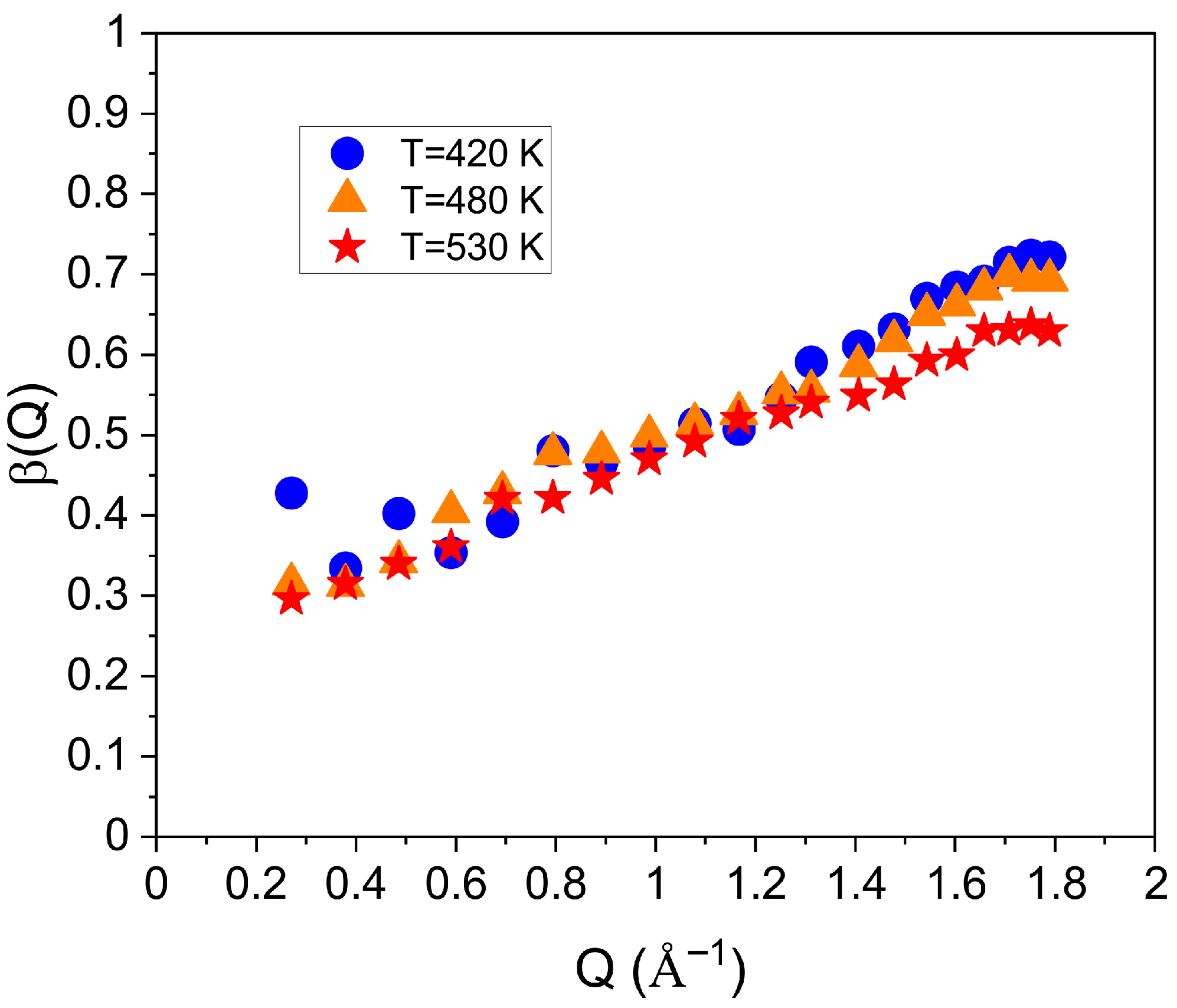
Figure 8, the stretching parameters
are depicted. The stretching parameter deviates from
decisively and shows an increase with Q. However, even at the largest Q-vector, it does not approach 1. There is a factor-of-2 change in
between the smallest and largest Q, evidencing substantial lineshape changes on different length scales. There are subtle changes with temperature; consequently, the overall lineshape of F(Q,t) changes only modestly with temperature. At small Q values,
decreases across the transition, and at large Q values, a decrease can be noted for the highest temperature. Hence, after the
-transition is crossed, the structural relaxation process becomes more stretched on certain length scales.
Stretched exponential decay has been observed in many glass-forming materials when cooled to the glass transition temperature with system specific values for
. For example, in metallic alloys, which are known to form bulk metallic glass, stretched relaxation dynamics are often observed. In Zr-based alloys, stretched relaxation with a
[
53] was reported, and for a Pd-Ni-Cu-P alloy, a
was found [
54]. Moving on to more complex liquids, e.g., for the aqueous solution
, a
was derived for the structural relaxation at the structure factor peak [
55], and a
has been reported for the fragile-glass former ortho-terphenyl [
56], obtained through coherent neutron scattering. For the viscous liquid glycerol,
-values between 0.61 and 0.54 were found from single-particle dynamics [
57]. An even smaller value,
, was reported for glycerol from shear-stress relaxation modulus measurements [
58], which underlines the fact that the exact value depends on the relaxation process investigated.
-values of around 0.5 have been reported for polyethylene chains [
48], and for polymers, even smaller values of between 0.44 and 0.21 were reported, both deduced from single-particle dynamics through neutron scattering [
59]. These values are similar to the ones we obtained for liquid sulfur and suggest that similar processes might be responsible for the relaxation behavior.
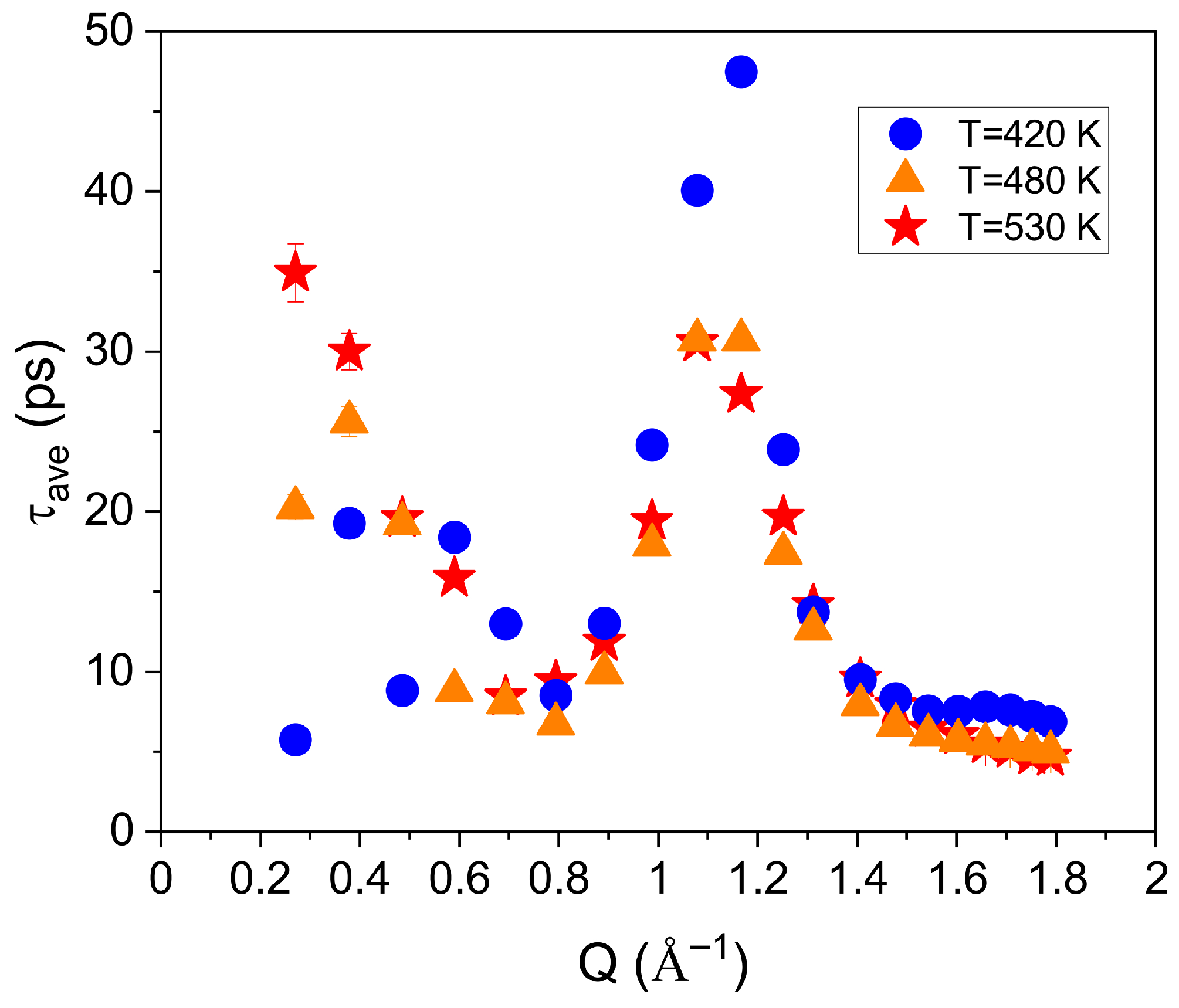
In
Figure 9, the averaged relaxation times
from the fits are plotted. The main differences are below and above the
-transition. At the Q vector where de Gennes slowing occurs and at large momentum transfers, the dynamics become faster with an increase in temperature. In contrast, at small Q values and hence longer length scales, the characteristic relaxation time increases counter-intuitively with an increase in temperature. At the smallest Q vector,
increases by a factor 7, reflecting distinct changes in the dynamics. This change is similar to the change observed in the analysis in the energy domain for the narrower width; see
Figure 5. This slowing down might be evidence of the formation of larger sulfur units with an increase temperature.
The increasing break-up of rings above the -transition transforms the melt into a fluid with chains of different lengths. The sulfur melt might share similarities with a polymer; hence, it might be worth looking for a description of the sulfur dynamics within the field of polymer dynamics. In addition, the derived -values agree with previously reported values for polymers.
In polymer dynamics, a successful model of chain dynamics is the Rouse model [
60]. This model assumes there is a long chain of rigid beads connected by springs and the conformation influenced by stochastic forces [
61]. According to theory-based predictions, for the relaxation dynamics in the Rouse model, there is a square-root dependence on time, which corresponds to a
for the KWW-function [
62]. The
-values obtained here for liquid sulfur are distributed around
; see
Figure 8. This agreement suggests that the dynamics of liquid sulfur are similar to the dynamics of a polymer melt as predicted by the Rouse model. The deviation from the theoretical
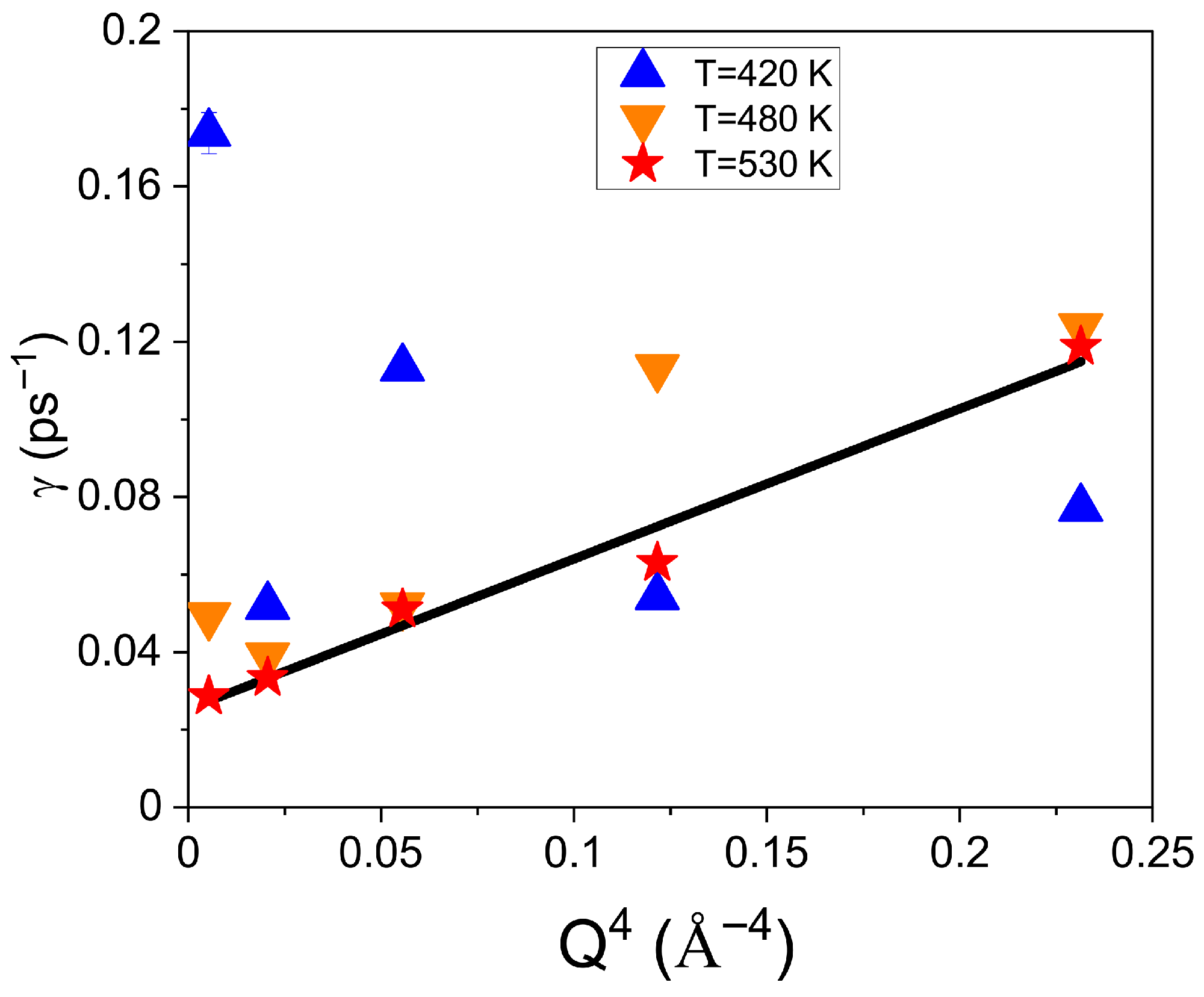
value indicates, however, that liquid sulfur may not be a pure polymer melt but rather a mixture of chain and ring structures. A further prediction of the Rouse model concerns the Q-dependence of the relaxation rate. The relaxation rate is given by
[
60]. This Q dependence is valid for both the incoherent and coherent scattering cases [
60]. In
Figure 10, the relaxation rates are plotted against
for the small Q range where the most distinct changes occur; see
Figure 9. A linear fit is included, as predicted by theory, for the data at T = 530 K, which describes the Q-dependence of the relaxation rate quite well within this limited wavevector range. At T = 480 K, the Q-dependence shows some deviations from the predicted
behavior, and below the
-transition, the results can no longer be described by this Q-dependence. This result can be understood that above the transition temperature, the relaxation dynamics at small momentum transfer are similar to the chain dynamics of polymers. Rubber-like dynamics above the transition temperature were suggested in a previous study [
35]. Below the transition point, sulfur is mainly composed of
-rings, and the dynamics do not emulate polymer dynamics.