
Effect of Critical Processing Stages and Interventions on Campylobacter in Poultry Meat at the Slaughterhouse Level: A Comprehensive Meta-Analysis




Abstract
1. Introduction
2. Materials and Methods
2.1. Study Design and Research Question
2.2. Literature Search Strategy
2.3. Eligibility and Exclusion Criteria
2.4. Data Extraction
- (a)
- Study identification: reference code and full citation.
- (b)
- Country: country in which the study was conducted.
- (c)
- Bacterial species: Campylobacter species investigated.
- (d)
- Bird species carcass/meat: chickens, turkeys or ducks.
- (e)
- Processing stage: refers to bleeding, scalding, plucking, evisceration, washing, chilling, packaging, or any other stage reported in the study.
- (f)
- Intervention: refers to the intervention strategy or treatment adopted to control Campylobacter in poultry, such as use chemical sanitisers, organic acids, plant extracts, freezing, or any other intervention under investigation in the study. Colder climates are defined as processing in autumn and winter, and were included as a risk factor.
- (g)
- Type of treatment application: it refers to how the intervention/treatment was applied, for instance, whether immersion or spraying in the case of chemical sanitisation of carcasses.
- (h)
- Treatment duration: it refers to contact timing (in minutes) between chemical sanitisers and carcasses at the point of evisceration or rinsing.
- (i)
- Treatment concentration: it is the concentration of chemical sanitiser, organic acid or plant extract applied in the treatment (g/L or g/kg).
- (j)
- Temperature: refers to the temperature of water or sanitizing solutions used in stages such as scalding, plucking, evisceration or sanitizing.
- (k)
- Storage time: it refers to the time (days) the meat treated with plant extract or organic acids is cold stored before analysis.
- (l)
- Inoculum size: inoculum concentration in specific cases where studies reported results in which carcasses were artificially contaminated with Campylobacter strains.
- (m)
- Sample type: refers to the type of sample used for microbiological analysis; i.e., feathers, neck skin, breast, cloaca, carcass rinse water, scalding water, wings and drumsticks.
- (n)
- Environmental source: refers to one-group samples taken from the slaughterhouse environment, such as: live animals (cloaca), scalding tank, plucker, eviscerator, chill tank, operator hands/gloves, caecal content, and other miscellaneous.
- (o)
- Sample weight or volume: employed for Campylobacter analysis either for detection or enumeration.
- (p)
- Count results: consisting of sample size (total number of samples), measures of central tendency (mean and/or median concentration in CFU/g, CFU/mL or CFU/carcass) and standard deviation for both control and treated groups. When the standard error of the mean was reported, the sample standard deviation was derived accordingly.
- (q)
- Prevalence results: consisting of the sample size and the number of positive samples for both control and treated groups.
2.5. Meta Regression Models
2.6. Assessment of Heterogeneity, Accuracy and Consistency, and Publication Bias
3. Results
3.1. Description of the Meta-Analytical Data
3.2. Overall Effects of Processing Stages and Interventions on the Concentration of Campylobacter in Poultry
3.3. Univariate Analysis of the Effects of Processing Stages and Interventions on the Concentration of Campylobacter in Poultry
3.4. Multilevel Meta-Analysis on the Effects of Processing Stages on the Concentration of Campylobacter in Poultry
3.4.1. Neck Cutting and Bleeding Stage Meta-Regression Model
3.4.2. Scalding Stage Meta-Regression Model
3.4.3. Plucking Stage Meta-Regression Model
3.4.4. Evisceration Stage Meta-Regression Model
3.4.5. Carcass Rinsing Meta-Regression Model
3.4.6. Sanitisation and Chilling Meta-Regression Model
3.4.7. Packaging Stage Meta-Regression Model
3.4.8. Routinary Cleaning and Disinfection Meta-Analysis Model
3.5. Multilevel Meta-Analysis on the Effects of Interventions on the Concentration of Campylobacter in Poultry
3.5.1. Chemical Sanitisation Meta-Regression Model
3.5.2. Organic Acid Meta-Regression Model
3.5.3. Plant Extract Meta-Regression Model
3.5.4. Freezing and Colder Climate Meta-Analysis Models
3.6. Summarisation of the Effect of Processing Stages and Interventions on the Prevalence of Campylobacter in Poultry
3.7. Multilevel Meta-Analysis on the Effects of Processing Stages on the Prevalence of Campylobacter in Poultry
3.7.1. Neck Cutting and Bleeding Stage Meta-Regression Model
3.7.2. Plucking Stage Meta-Regression Model
3.7.3. Evisceration Stage Meta-Regression Model
3.7.4. Sanitising and Chilling Meta-Regression Model
3.8. Multilevel Meta-Analysis on the Effects of Interventions on the Prevalence of Campylobacter in Poultry
3.9. Multilevel Meta-Analysis on the Prevalence of Campylobacter in the Slaughterhouse Environment
4. Discussion
4.1. Effectiveness of Processing Stages in the Reduction in Campylobacter on Poultry
4.2. Effectiveness of Slaughter-Level Interventions in the Reduction in Campylobacter on Poultry
5. Conclusions
Author Contributions
Funding
Institutional Review Board Statement
Informed Consent Statement
Data Availability Statement
Conflicts of Interest
References
- Havelaar, A.H.; Kirk, M.D.; Torgerson, P.R.; Gibb, H.J.; Hald, T.; Lake, R.J.; Praet, N.; Bellinger, D.C.; de Silva, N.R.; Gargouri, N.; et al. World Health Organization Global Estimates and Regional Comparisons of the Burden of Foodborne Disease in 2010. PLoS Med. 2015, 12, e1001923. [Google Scholar] [CrossRef] [PubMed]
- EFSA Panel (BIOHAZ). Scientific Opinion on Quantification of the Risk Posed by Broiler Meat to Human Campylobacteriosis in the EU. EFSA J. 2010, 8, 1437. [Google Scholar] [CrossRef] [PubMed]
- Bahrndorff, S.; Rangstrup-Christensen, L.; Nordentoft, S.; Hald, B. Foodborne Disease Prevention and Broiler Chickens with Reduced Campylobacter Infection. Emerg. Infect. Dis. 2013, 19, 425–430. [Google Scholar] [CrossRef] [PubMed]
- World Health Organization; Food and Agriculture Organization of the United Nations. Risk Assessment of Campylobacter spp. in Broiler Chickens: Technical Report; World Health Organization: Geneva, Switzerland, 2009. [Google Scholar]
- Wainaina, L.; Merlotti, A.; Remondini, D.; Henri, C.; Hald, T.; Njage, P.M.K. Source Attribution of Human Campylobacteriosis Using Whole-Genome Sequencing Data and Network Analysis. Pathogens 2022, 11, 645. [Google Scholar] [CrossRef] [PubMed]
- Cody, A.J.; Maiden, M.C.; Strachan, N.J.; McCarthy, N.D. A Systematic Review of Source Attribution of Human Campylobacteriosis Using Multilocus Sequence Typing. Euro Surveill. 2019, 24, 1800696. [Google Scholar] [CrossRef] [PubMed]
- Thépault, A.; Méric, G.; Rivoal, K.; Pascoe, B.; Mageiros, L.; Touzain, F.; Rose, V.; Béven, V.; Chemaly, M.; Sheppard, S.K. Genome-Wide Identification of Host-Segregating Epidemiological Markers for Source Attribution in Campylobacter jejuni. Appl. Environ. Microbiol. 2017, 83, e03085-16. [Google Scholar] [CrossRef] [PubMed]
- Cardoso, M.J.; Ferreira, V.; Truninger, M.; Maia, R.; Teixeira, P. Cross-Contamination Events of Campylobacter spp. in Domestic Kitchens Associated with Consumer Handling Practices of Raw Poultry. Int. J. Food Microbiol. 2021, 338, 108984. [Google Scholar] [CrossRef] [PubMed]
- EFSA Panel (BIOHAZ). Scientific Opinion on Campylobacter in Broiler Meat Production: Control Options and Performance Objectives and/or Targets at Different Stages of the Food Chain. EFSA J. 2011, 9, 2105. [Google Scholar] [CrossRef] [PubMed]
- Nauta, M.; Hill, A.; Rosenquist, H.; Brynestad, S.; Fetsch, A.; Van Der Logt, P.; Fazil, A.; Christensen, B.; Katsma, E.; Borck, B.; et al. A Comparison of Risk Assessments on Campylobacter in Broiler Meat. Int. J. Food Microbiol. 2009, 129, 107–123. [Google Scholar] [CrossRef] [PubMed]
- Dogan, O.B.; Clarke, J.; Mattos, F.; Wang, B. A Quantitative Microbial Risk Assessment Model of Campylobacter in Broiler Chickens: Evaluating Processing Interventions. Food Control 2019, 100, 97–110. [Google Scholar] [CrossRef]
- Barbut, S. The Science of Poultry and Meat Processing; University of Guelph: Guelph, Ontario, 2016; ISBN 978-0-88955-626-3. [Google Scholar]
- CODEX ALIMENTARIUS FAO-WHO. Guidelines for the Control of Campylobacter and Salmonella in Chicken Meat. Available online: https://www.fao.org/fao-who-codexalimentarius/codex-texts/guidelines/en/ (accessed on 31 October 2025).
- Habib, I.; Mohamed, M.-Y.I.; Lakshmi, G.B.; Al Marzooqi, H.M.; Afifi, H.S.; Shehata, M.G.; Khan, M.; Ghazawi, A.; Abdalla, A.; Anes, F. Quantitative Assessment and Genomic Profiling of Campylobacter Dynamics in Poultry Processing: A Case Study in the United Arab Emirates Integrated Abattoir System. Front. Microbiol. 2024, 15, 1439424. [Google Scholar] [CrossRef] [PubMed]
- Berrang, M.E.; Dickens, J.A. Presence and Level of Campylobacter spp. on Broiler Carcasses Throughout the Processing Plant. J. Appl. Poult. Res. 2000, 9, 43–47. [Google Scholar] [CrossRef]
- Svobodová, I.; Borilová, G.; Hulanková, R.; Steinhauserová, I. Microbiological Quality of Broiler Carcasses During Slaughter Processing. Acta Vet. Brno. 2012, 81, 37–42. [Google Scholar] [CrossRef]
- Rasschaert, G.; De Zutter, L.; Herman, L.; Heyndrickx, M. Campylobacter Contamination of Broilers: The Role of Transport and Slaughterhouse. Int. J. Food Microbiol. 2020, 322, 108564. [Google Scholar] [CrossRef] [PubMed]
- Rosenquist, H.; Boysen, L.; Borck, B. Interventions to Control Campylobacter in the Broiler Production: Report of an International Expert Consultation, Copenhagen, Denmark, 26–27 November 2007, 1st ed.; National Food Institute, Department of Microbiology and Risk Assessment: Søborg, Denmark, 2008; ISBN 978-87-92158-16-1. [Google Scholar]
- Hugas, M.; Tsigarida, E. Pros and Cons of Carcass Decontamination: The Role of the European Food Safety Authority. Meat Sci. 2008, 78, 43–52. [Google Scholar] [CrossRef] [PubMed]
- Loretz, M.; Stephan, R.; Zweifel, C. Antimicrobial Activity of Decontamination Treatments for Poultry Carcasses: A Literature Survey. Food Control 2010, 21, 791–804. [Google Scholar] [CrossRef]
- Atterbury, R.J.; Connerton, P.L.; Dodd, C.E.R.; Rees, C.E.D.; Connerton, I.F. Application of Host-Specific Bacteriophages to the Surface of Chicken Skin Leads to a Reduction in Recovery of Campylobacter jejuni. Appl. Environ. Microbiol. 2003, 69, 6302–6306. [Google Scholar] [CrossRef] [PubMed]
- Goode, D.; Allen, V.M.; Barrow, P.A. Reduction of Experimental Salmonella and Campylobacter Contamination of Chicken Skin by Application of Lytic Bacteriophages. Appl. Environ. Microbiol. 2003, 69, 5032–5036. [Google Scholar] [CrossRef] [PubMed]
- Micciche, A.; Rothrock, M.J.; Yang, Y.; Ricke, S.C. Essential Oils as an Intervention Strategy to Reduce Campylobacter in Poultry Production: A Review. Front. Microbiol. 2019, 10, 1058. [Google Scholar] [CrossRef] [PubMed]
- Wagle, B.R.; Donoghue, A.M.; Jesudhasan, P.R. Select Phytochemicals Reduce Campylobacter jejuni in Postharvest Poultry and Modulate the Virulence Attributes of C. Jejuni. Front. Microbiol. 2021, 12, 725087. [Google Scholar] [CrossRef] [PubMed]
- Guerin, M.T.; Sir, C.; Sargeant, J.M.; Waddell, L.; O’Connor, A.M.; Wills, R.W.; Bailey, R.H.; Byrd, J.A. The Change in Prevalence of Campylobacter on Chicken Carcasses during Processing: A Systematic Review. Poult. Sci. 2010, 89, 1070–1084. [Google Scholar] [CrossRef] [PubMed]
- Gichure, J.N.; Kamau Njage, P.M.; Wambui, J.M.; Dykes, G.A.; Buys, E.M.; Coorey, R. Systematic-Review and Meta-Analysis on Effect of Decontamination Interventions on Prevalence and Concentration of Campylobacter spp. during Primary Processing of Broiler Chickens. Food Microbiol. 2022, 102, 103923. [Google Scholar] [CrossRef] [PubMed]
- Dogan, O.B.; Aditya, A.; Ortuzar, J.; Clarke, J.; Wang, B. A Systematic Review and Meta-analysis of the Efficacy of Processing Stages and Interventions for Controlling Campylobacter Contamination during Broiler Chicken Processing. Comp. Rev. Food Sci. Food Safe 2022, 21, 227–271. [Google Scholar] [CrossRef] [PubMed]
- Leone, C.; Xu, X.; Mishra, A.; Thippareddi, H.; Singh, M. Interventions to Reduce Salmonella and Campylobacter during Chilling and Post-Chilling Stages of Poultry Processing: A Systematic Review and Meta-Analysis. Poult. Sci. 2024, 103, 103492. [Google Scholar] [CrossRef] [PubMed]
- Haddaway, N.R.; Page, M.J.; Pritchard, C.C.; McGuinness, L.A. PRISMA2020: An R Package and Shiny App for Producing PRISMA 2020-compliant Flow Diagrams, with Interactivity for Optimised Digital Transparency and Open Synthesis. Campbell Syst. Rev. 2022, 18, e1230. [Google Scholar] [CrossRef] [PubMed]
- McKenzie, J.E.; Brennan, S.E.; Ryan, R.E.; Thomson, H.J.; Johnston, R.V.; Thomas, J. Chapter 3: Defining the Criteria for Including Studies and How They Will Be Grouped for the Synthesis. Cochrane Handbook for Systematic Reviews of Interventions Version 6.5. Cochrane. Available online: https://www.cochrane.org/authors/handbooks-and-manuals/handbook/current/chapter-03#section-3-2 (accessed on 8 August 2025).
- Zefanias, O.; Gonzales-Barron, U.; Cadavez, V. Effectiveness of Interventions and Control Measures in the Reduction of Campylobacter in Poultry Farms: A Comprehensive Meta-Analysis. Foods 2026, 15, 307. [Google Scholar] [CrossRef] [PubMed]
- Ouzzani, M.; Hammady, H.; Fedorowicz, Z.; Elmagarmid, A. Rayyan—A Web and Mobile App for Systematic Reviews. Syst. Rev. 2016, 5, 210. [Google Scholar] [CrossRef] [PubMed]
- Deeks, J.J.; Higgins, J.P.T.; Altman, D.G.; McKenzie, J.E.; Veroniki, A.A. Chapter 10: Analysing Data and Undertaking Meta-Analyses. Cochrane Handbook for Systematic Reviews of Interventions Version 6.5. Cochrane. Available online: https://www.cochrane.org/authors/handbooks-and-manuals/handbook/current/chapter-03#section-3-2 (accessed on 28 April 2025).
- Rohatgi, A. WebPlotDigitizer. Version 5.2. Available online: https://automeris.io/v4/ (accessed on 1 August 2025).
- Silva, B.N.; Cadavez, V.; Teixeira, J.A.; Gonzales-Barron, U. Meta-Analysis of the Incidence of Foodborne Pathogens in Vegetables and Fruits from Retail Establishments in Europe. Curr. Opin. Food Sci. 2017, 18, 21–28. [Google Scholar] [CrossRef]
- Wang, N. Conducting Meta-Analyses of Proportions in R. JBDS 2023, 3, 64–126. [Google Scholar] [CrossRef]
- Borenstein, M.; Hedges, L.V.; Higgins, J.P.T.; Rothstein, H.R. Introduction to Meta-Analysis; John Wiley & Sons: Hoboken, NJ, USA, 2011; ISBN 978-1-119-96437-7. [Google Scholar]
- Posit Team. RStudio Integrated Development Environment for R. Posit Software, PBC, Boston, MA, USA. Available online: http://www.posit.co/ (accessed on 13 October 2025).
- Viechtbauer, W. Conducting Meta-Analyses in R with the Metafor Package. J. Stat. Soft. 2010, 36, 1–48. [Google Scholar] [CrossRef]
- Grothendieck, G. sqldf: Manipulate R Data Frames Using SQL, version 0.4-11; R Project: Vienna, Austria, 2007.
- Higgins, J.P.T.; Thompson, S.G. Quantifying Heterogeneity in a Meta-analysis. Stat. Med. 2002, 21, 1539–1558. [Google Scholar] [CrossRef] [PubMed]
- Higgins, J.P.T. Measuring Inconsistency in Meta-Analyses. BMJ 2003, 327, 557–560. [Google Scholar] [CrossRef] [PubMed]
- Galbraith, R.F. Graphical Display of Estimates Having Differing Standard Errors. Technometrics 1988, 30, 271–281. [Google Scholar] [CrossRef]
- Galbraith, R. Some Applications of Radial Plots. J. Am. Stat. Assoc. 1994, 89, 1232–1242. [Google Scholar] [CrossRef]
- Borenstein, M. Common Mistakes in Meta-Analysis and How to Avoid Them; Biostat, Inc.: Englewood, NJ, USA, 2019; ISBN 978-1-7334367-0-0. [Google Scholar]
- Crocetti, E. Systematic Reviews with Meta-Analysis: Why, When, and How? Emerg. Adulthood 2016, 4, 3–18. [Google Scholar] [CrossRef]
- Egger, M.; Smith, G.D.; Schneider, M.; Minder, C. Bias in Meta-Analysis Detected by a Simple, Graphical Test. BMJ 1997, 315, 629–634. [Google Scholar] [CrossRef] [PubMed]
- Beterams, A.; Püning, C.; Wyink, B.; Grosse-Kleimann, J.; Gölz, G.; Schönknecht, A.; Alter, T.; Reich, F. Status Quo: Levels of Campylobacter spp. and Hygiene Indicators in German Slaughterhouses for Broiler and Turkey. Int. J. Food Microbiol. 2024, 414, 110610. [Google Scholar] [CrossRef] [PubMed]
- De Villena, J.F.; Vargas, D.A.; Bueno López, R.; Chávez-Velado, D.R.; Casas, D.E.; Jiménez, R.L.; Sanchez-Plata, M.X. Bio-Mapping Indicators and Pathogen Loads in a Commercial Broiler Processing Facility Operating with High and Low Antimicrobial Intervention Levels. Foods 2022, 11, 775. [Google Scholar] [CrossRef] [PubMed]
- Hutchison, M.L.; Harrison, D.; Tchòrzewska, M.A.; González-Bodí, S.; Madden, R.H.; Corry, J.E.L.; Allen, V.M. Quantitative Determination of Campylobacter on Broilers along 22 United Kingdom Processing Lines to Identify Potential Process Control Points and Cross-Contamination from Colonized to Uncolonized Flocks. J. Food Prot. 2022, 85, 1696–1707. [Google Scholar] [CrossRef] [PubMed]
- Jainonthee, C.; Chaisowwong, W.; Ngamsanga, P.; Meeyam, T.; Sampedro, F.; Wells, S.J.; Pichpol, D. Exploring the Influence of Slaughterhouse Type and Slaughtering Steps on Campylobacter jejuni Contamination in Chicken Meat: A Cluster Analysis Approach. Heliyon 2024, 10, e32345. [Google Scholar] [CrossRef] [PubMed]
- Ae Kim, S.; Hong Park, S.; In Lee, S.; Owens, C.M.; Ricke, S.C. Assessment of Chicken Carcass Microbiome Responses During Processing in the Presence of Commercial Antimicrobials Using a Next Generation Sequencing Approach. Sci. Rep. 2017, 7, 43354. [Google Scholar] [CrossRef] [PubMed]
- Kingsbury, J.M.; Horn, B.; Armstrong, B.; Midwinter, A.; Biggs, P.; Callander, M.; Mulqueen, K.; Brooks, M.; van der Logt, P.; Biggs, R. The Impact of Primary and Secondary Processing Steps on Campylobacter Concentrations on Chicken Carcasses and Portions. Food Microbiol. 2023, 110, 104168. [Google Scholar] [PubMed]
- Iannetti, S.; Calistri, P.; Di Serafino, G.; Marotta, F.; Alessiani, A.; Antoci, S.; Neri, D.; Perilli, M.; Iannitto, G.; Iannetti, L.; et al. Campylobacter jejuni and Campylobacter Coli: Prevalence, Contamination Levels, Genetic Diversity and Antibiotic Resistance in Italy. Vet. Ital. 2020, 56, 23–34. [Google Scholar] [CrossRef] [PubMed]
- Mead, G.C.; Hudson, W.R.; Hinton, M.H. Effect of Changes in Processing to Improve Hygiene Control on Contamination of Poultry Carcasses with Campylobacter. Epidemiol. Infect. 1995, 115, 495–500. [Google Scholar] [CrossRef] [PubMed][Green Version]
- Pacholewicz, E.; Swart, A.; Schipper, M.; Gortemaker, B.G.M.; Wagenaar, J.A.; Havelaar, A.H.; Lipman, L.J.A. A Comparison of Fluctuations of Campylobacter and Escherichia coli Concentrations on Broiler Chicken Carcasses during Processing in Two Slaughterhouses. Int. J. Food Microbiol. 2015, 205, 119–127. [Google Scholar] [CrossRef] [PubMed]
- Seliwiorstow, T.; Baré, J.; Van Damme, I.; Uyttendaele, M.; De Zutter, L. Campylobacter Carcass Contamination throughout the Slaughter Process of Campylobacter-Positive Broiler Batches. Int. J. Food Microbiol. 2015, 194, 25–31. [Google Scholar] [CrossRef] [PubMed]
- Zhang, L.; Singh, P.; Lee, H.C.; Kang, I. Effect of Hot Water Spray on Broiler Carcasses for Reduction of Loosely Attached, Intermediately Attached, and Tightly Attached Pathogenic (Salmonella and Campylobacter) and Mesophilic Aerobic Bacteria. Poult. Sci. 2013, 92, 804–810. [Google Scholar] [CrossRef] [PubMed]
- Althaus, D.; Zweifel, C.; Stephan, R. Analysis of a Poultry Slaughter Process: Influence of Process Stages on the Microbiological Contamination of Broiler Carcasses. Ital. J. Food Saf. 2017, 6, 7097. [Google Scholar] [CrossRef] [PubMed]
- Chen, S.H.; Fegan, N.; Kocharunchitt, C.; Bowman, J.P.; Duffy, L.L. Changes of the Bacterial Community Diversity on Chicken Carcasses through an Australian Poultry Processing Line. Food Microbiol. 2020, 86, 103350. [Google Scholar] [CrossRef] [PubMed]
- Lehner, Y.; Reich, F.; Klein, G. Influence of Process Parameter on Campylobacter spp. Counts on Poultry Meat in a Slaughterhouse Environment. Curr. Microbiol. 2014, 69, 240–244. [Google Scholar] [CrossRef] [PubMed]
- Perez-Arnedo, I.; Gonzalez-Fandos, E. Prevalence of Campylobacter spp. in Poultry in Three Spanish Farms, a Slaughterhouse and a Further Processing Plant. Foods 2020, 8, 111. [Google Scholar]
- Seliwiorstow, T.; Baré, J.; Van Damme, I.; Algaba, I.G.; Uyttendaele, M.; De Zutter, L. Transfer of Campylobacter from a Positive Batch to Broiler Carcasses of a Subsequently Slaughtered Negative Batch: A Quantitative Approach. J. Food Prot. 2016, 79, 896–901. [Google Scholar] [CrossRef] [PubMed]
- Zweifel, C.; Althaus, D.; Stephan, R. Effects of Slaughter Operations on the Microbiological Contamination of Broiler Carcasses in Three Abattoirs. Food Control 2015, 51, 37–42. [Google Scholar] [CrossRef]
- Allen, V.M.; Bull, S.A.; Corry, J.E.L.; Domingue, G.; Jørgensen, F.; Frost, J.A.; Whyte, R.; Gonzalez, A.; Elviss, N.; Humphrey, T.J. Campylobacter spp. Contamination of Chicken Carcasses during Processing in Relation to Flock Colonisation. Int. J. Food Microbiol. 2007, 113, 54–61. [Google Scholar] [CrossRef] [PubMed]
- Berrang, M.E.; Bailey, J.S.; Altekruse, S.F.; Patel, B.; Shaw, W.K., Jr.; Meinersmann, R.J.; Fedorka-Cray, P.J. Prevalence and Numbers of Campylobacter on Broiler Carcasses Collected at Rehang and Postchill in 20 U.S. Processing Plants. J. Food Prot. 2007, 70, 1556–1560. [Google Scholar] [CrossRef] [PubMed]
- Boysen, L.; Nauta, M.; Rosenquist, H. Campylobacter spp. and Escherichia coli Contamination of Broiler Carcasses across the Slaughter Line in Danish Slaughterhouses. Microb. Risk Anal. 2016, 2–3, 63–67. [Google Scholar] [CrossRef]
- Franchin, P.R.; Ogliari, P.J.; Batista, C.R.V. Frequency of Thermophilic Campylobacter in Broiler Chickens during Industrial Processing in a Southern Brazil Slaughterhouse. Br. Poult. Sci. 2007, 48, 127–132. [Google Scholar] [CrossRef] [PubMed]
- Gruntar, I.; Biasizzo, M.; Kušar, D.; Pate, M.; Ocepek, M. Campylobacter jejuni Contamination of Broiler Carcasses: Population Dynamics and Genetic Profiles at Slaughterhouse Level. Food Microbiol. 2015, 50, 97–101. [Google Scholar] [CrossRef] [PubMed]
- Hauge, S.J.; Johannessen, G.S.; Haverkamp, T.H.A.; Bjørkøy, S.; Llarena, A.K.; Spilsberg, B.; Leithaug, M.; Økland, M.; Holthe, J.; Røtterud, O.-J.; et al. Assessment of Poultry Process Hygiene and Bacterial Dynamics along Two Broiler Slaughter Lines in Norway. Food Control 2023, 146, 109526. [Google Scholar]
- Huang, J.; Zang, X.; Zhai, W.; Guan, C.; Lei, T.; Jiao, X. Quantitative Analysis of Campylobacter spp. Contamination in Chicken Slaughtering Lines by “Label Tracking Method” in Eastern China. Food Control 2017, 80, 67–73. [Google Scholar] [CrossRef]
- Meredith, H.; McDowell, D.; Bolton, D.J. An Evaluation of Trisodium Phosphate, Citric Acid and Lactic Acid Cloacal Wash Treatments to Reduce Campylobacter, Total Viable Counts (TVC) and Total Enterobacteriaceae Counts (TEC) on Broiler Carcasses during Processing. Food Control 2013, 32, 149–152. [Google Scholar] [CrossRef]
- Rosenquist, H.; Sommer, H.; Nielsen, N.; Christensen, B. The Effect of Slaughter Operations on the Contamination of Chicken Carcasses with Thermotolerant Campylobacter. Int. J. Food Microbiol. 2006, 108, 226–232. [Google Scholar] [CrossRef] [PubMed]
- Vargas, D.A.; Betancourt-Barszcz, G.K.; Chávez-Velado, D.R.; Sánchez, A.; Bueno López, R.; Sanchez-Plata, M.X. Bio-Mapping of Microbial Indicators and Pathogen Quantitative Loads in Commercial Broiler Processing Facilities in South America. Foods 2023, 12, 3600. [Google Scholar] [CrossRef] [PubMed]
- Vinueza-Burgos, C.; Cevallos, M.; Cisneros, M.; Van Damme, I.; De Zutter, L. Quantification of the Campylobacter Contamination on Broiler Carcasses during the Slaughter of Campylobacter Positive Flocks in Semi-Industrialized Slaughterhouses. Int. J. Food Microbiol. 2018, 269, 75–79. [Google Scholar] [CrossRef] [PubMed]
- Berrang, M.E.; Gamble, G.R.; Bowker, B.C.; Meinersmann, R.J.; Cox, N.A.; Knapp, S.W. Cetylpyridinium Chloride and Peracetic Acid to Lessen Campylobacter, Escherichia coli, and Total Aerobic Bacterial Contamination on Chicken Liver. J. Appl. Poult. Res. 2021, 30, 100212. [Google Scholar] [CrossRef]
- Feye, K.M.; Dittoe, D.K.; Shi, Z.; Woitte, J.; Owens, C.M.; Kogut, M.H.; Ricke, S.C. The Reduction of Pathogen Load on Ross 708 Broilers When Using Different Sources of Commercial Peracetic Acid Sanitizers in a Pilot Processing Plant. Microorganisms 2019, 7, 503. [Google Scholar] [CrossRef] [PubMed]
- Figueroa, G.; Troncoso, M.; López, C.; Rivas, P.; Toro, M. Occurrence and Enumeration of Campylobacter spp. during the Processing of Chilean Broilers. BMC Microbiol. 2009, 9, 94. [Google Scholar] [CrossRef] [PubMed]
- Zhang, L.; Jeong, J.Y.; Janardhanan, K.K.; Ryser, E.T.; Kang, I. Microbiological Quality of Water Immersion-Chilled and Air-Chilled Broilers. J. Food Prot. 2011, 74, 1531–1535. [Google Scholar] [CrossRef] [PubMed]
- Bashor, M.P.; Curtis, P.A.; Keener, K.M.; Sheldon, B.W.; Kathariou, S.; Osborne, J.A. Effects of Carcass Washers on Campylobacter Contamination in Large Broiler Processing Plants. Poult. Sci. 2004, 83, 1232–1239. [Google Scholar] [CrossRef] [PubMed]
- Blevins, R.E.; Dittoe, D.K.; Feye, K.M.; Bench, L.; Bench, B.J.; Ricke, S.C. Campylobacter and Salmonella Levels and Chemical Composition of Commercial Whole Bird Carcass Pre-Chiller Rinses. J. Agric. Food Res. 2020, 2, 100041. [Google Scholar] [CrossRef]
- De Castro Burbarelli, M.F.; Do Valle Polycarpo, G.; Deliberali Lelis, K.; Granghelli, C.A.; Carão De Pinho, A.C.; Ribeiro Almeida Queiroz, S.; Fernandes, A.M.; Moro De Souza, R.L.; Gaglianone Moro, M.E.; De Andrade Bordin, R.; et al. Cleaning and Disinfection Programs against Campylobacter jejuni for Broiler Chickens: Productive Performance, Microbiological Assessment and Characterization. Poult. Sci. 2017, 96, 3188–3198. [Google Scholar] [CrossRef] [PubMed]
- Emanowicz, M.; Meade, J.; Bolton, D.; Golden, O.; Gutierrez, M.; Byrne, W.; Egan, J.; Lynch, H.; O’Connor, L.; Coffey, A.; et al. The Impact of Key Processing Stages and Flock Variables on the Prevalence and Levels of Campylobacter on Broiler Carcasses. Food Microbiol. 2021, 95, 103688. [Google Scholar] [CrossRef] [PubMed]
- McWhorter, A.R.; Weerasooriya, G.; Kumar, S.; Chousalkar, K.K. Comparison of Peroxyacetic Acid and Acidified Sodium Chlorite at Reducing Natural Microbial Contamination on Chicken Meat Pieces. Poult. Sci. 2023, 102, 103009. [Google Scholar] [CrossRef] [PubMed]
- Stella, S.; Tirloni, E.; Bernardi, C.; Grilli, G. Evaluation of Effect of Chilling Steps during Slaughtering on the Campylobacter sp. Counts on Broiler Carcasses. Poult. Sci. 2021, 100, 100866. [Google Scholar] [CrossRef] [PubMed]
- Borges, K.A.; Cisco, I.C.; Furian, T.Q.; Tedesco, D.C.; Rodrigues, L.B.; Do Nascimento, V.P.; Dos Santos, L.R. Detection and Quantification of Campylobacter spp. in Brazilian Poultry Processing Plants. J. Infect. Dev. Ctries. 2020, 14, 109–113. [Google Scholar] [CrossRef] [PubMed]
- Morgan, R.B.; Sierra–Arguello, Y.M.; Perdoncini, G.; Borges, K.A.; Furian, T.Q.; Gomes, M.J.P.; Lima, D.; Salle, C.T.P.; Moraes, H.L.S.; Nascimento, V.P. Comparison of Transport Crates Contamination with Campylobacter spp. before and after the Cleaning and Disinfection Procedure in Broiler Slaughterhouses. Poult. Sci. 2022, 101, 101909. [Google Scholar] [CrossRef] [PubMed]
- Vaddu, S.; Kataria, J.; Belem, T.S.; Sidhu, G.; Moller, A.E.; Leone, C.; Singh, M.; Thippareddi, H. On-Site Generated Peroxy Acetic Acid (PAA) Technology Reduces Salmonella and Campylobacter on Chicken Wings. Poult. Sci. 2021, 100, 101206. [Google Scholar] [CrossRef] [PubMed]
- Bechstein, D.-V.; Popp, J.; Sudhaus-Joern, N.; Krischek, C. Effect of Ethyl-Lauroyl-Arginate Hypochloride in Combination with High Hydrostatic Pressure Processing on the Microbial Load and Physico-Chemical Characteristics of Minced and Portioned Chicken Breast Meat. Poult. Sci. 2019, 98, 966–976. [Google Scholar] [CrossRef] [PubMed]
- Kumar, S.; Singh, M.; Cosby, D.E.; Cox, N.A.; Thippareddi, H. Efficacy of Peroxy Acetic Acid in Reducing Salmonella and Campylobacter spp. Populations on Chicken Breast Fillets. Poult. Sci. 2020, 99, 2655–2661. [Google Scholar] [CrossRef] [PubMed]
- Li, K.; Lemonakis, L.; Glover, B.; Moritz, J.; Shen, C. Impact of Built-up-Litter and Commercial Antimicrobials on Salmonella and Campylobacter Contamination of Broiler Carcasses Processed at a Pilot Mobile Poultry-Processing Unit. Front. Vet. Sci. 2017, 4, 88. [Google Scholar] [CrossRef] [PubMed]
- Smith, J.; Corkran, S.; McKee, S.R.; Bilgili, S.F.; Singh, M. Evaluation of Post-Chill Applications of Antimicrobials against Campylobacter jejuni on Poultry Carcasses. J. Appl. Poult. Res. 2015, 24, 451–456. [Google Scholar] [CrossRef]
- Berrang, M.E.; Meinersmann, R.J.; Cox, N.A.; Fedorka-Cray, P.J. Application of Chlorine Dioxide to Lessen Bacterial Contamination during Broiler Defeathering. J. Appl. Poult. Res. 2011, 20, 33–39. [Google Scholar] [CrossRef]
- Giombelli, A.; Gloria, M.B.A. Prevalence of Salmonella and Campylobacter on Broiler Chickens from Farm to Slaughter and Efficiency of Methods to Remove Visible Fecal Contamination. J. Food Prot. 2014, 77, 1851–1859. [Google Scholar] [CrossRef] [PubMed]
- Nagel, G.M.; Bauermeister, L.J.; Bratcher, C.L.; Singh, M.; McKee, S.R. Salmonella and Campylobacter Reduction and Quality Characteristics of Poultry Carcasses Treated with Various Antimicrobials in a Post-Chill Immersion Tank. Int. J. Food Microbiol. 2013, 165, 281–286. [Google Scholar] [CrossRef] [PubMed]
- Park, S.; Harrison, M.A.; Berrang, M.E. Postchill Antimicrobial Treatments to Control Salmonella, Listeria, and Campylobacter Contamination on Chicken Skin Used in Ground Chicken. J. Food Prot. 2017, 80, 857–862. [Google Scholar] [CrossRef] [PubMed]
- Vetchapitak, T.; Shinki, T.; Sasaki, S.; Taniguchi, T.; Luangtongkum, T.; Misawa, N. Evaluation of Chemical Treatment Combined with Vacuum and Ultrasonication with a Water Resonance System for Reducing Campylobacter on Naturally Contaminated Chicken Carcasses. Food Control 2020, 112, 107087. [Google Scholar] [CrossRef]
- Zakariene, G.; Serniene, L.; Malakauskas, M. Effects of Lactic Acid, Linalool and Cinnamaldehyde against Campylobacter jejuni in Vitro and on Broiler Breast Fillets. Vet. Zootech. 2015, 72, 45–52. [Google Scholar]
- Zhang, L.; Garner, L.J.; Mckee, S.R.; Bilgili, S.F. Effectiveness of Several Antimicrobials Used in a Postchill Decontamination Tank against Salmonella and Campylobacter on Broiler Carcass Parts. J. Food Prot. 2018, 81, 1134–1141. [Google Scholar] [CrossRef] [PubMed]
- Hue, O.; Le Bouquin, S.; Laisney, M.-J.; Allain, V.; Lalande, F.; Petetin, I.; Rouxel, S.; Quesne, S.; Gloaguen, P.-Y.; Picherot, M.; et al. Prevalence of and Risk Factors for Campylobacter spp. Contamination of Broiler Chicken Carcasses at the Slaughterhouse. Food Microbiol. 2010, 27, 992–999. [Google Scholar] [CrossRef] [PubMed]
- Reich, F.; Atanassova, V.; Haunhorst, E.; Klein, G. The Effects of Campylobacter Numbers in Caeca on the Contamination of Broiler Carcasses with Campylobacter. Int. J. Food Microbiol. 2008, 127, 116–120. [Google Scholar] [CrossRef] [PubMed]
- Bertram, R.; Kehrenberg, C.; Seinige, D.; Krischek, C. Peracetic Acid Reduces Campylobacter spp. On Turkey Skin: Effects of a Spray Treatment on Microbial Load, Sensory and Meat Quality during Storage. PLoS ONE 2019, 14, e0220296. [Google Scholar] [CrossRef] [PubMed]
- Shrestha, S.; Wagle, B.R.; Upadhyay, A.; Arsi, K.; Upadhyaya, I.; Donoghue, D.J.; Donoghue, A.M. Edible Coatings Fortified with Carvacrol Reduce Campylobacter jejuni on Chicken Wingettes and Modulate Expression of Select Virulence Genes. Front. Microbiol. 2019, 10, 583. [Google Scholar] [CrossRef] [PubMed]
- Thormar, H.; Hilmarsson, H.; Thráinsson, J.H.; Georgsson, F.; Gunnarsson, E.; Dadadóttir, S. Treatment of Fresh Poultry Carcases with Emulsions of Glycerol Monocaprate (Monocaprin) to Reduce Contamination with Campylobacter and Psychrotrophic Bacteria. Br. Poult. Sci. 2011, 52, 11–19. [Google Scholar] [CrossRef] [PubMed]
- Shrestha, S.; Wagle, B.R.; Upadhyay, A.; Arsi, K.; Donoghue, D.J.; Donoghue, A.M. Carvacrol Antimicrobial Wash Treatments Reduce Campylobacter jejuni and Aerobic Bacteria on Broiler Chicken Skin. Poult. Sci. 2019, 98, 4073–4083. [Google Scholar] [CrossRef] [PubMed]
- Hansson, I.; Ederoth, M.; Andersson, L.; Vagsholm, I.; Olsson Engvall, E. Transmission of Campylobacter spp. to Chickens during Transport to Slaughter. J. Appl. Microbiol. 2005, 99, 1149–1157. [Google Scholar] [CrossRef] [PubMed]
- Perez-Arnedo, I.; Cantalejo, M.J.; Martínez-Laorden, A.; Gonzalez-Fandos, E. Effect of Processing on the Microbiological Quality and Safety of Chicken Carcasses at Slaughterhouse. Int. J. Food Sci. Technol. 2021, 56, 1855–1864. [Google Scholar]
- Bouhamed, R.; Hamdi, T.M. Campylobacter spp. at Different Stages of the Poultry Slaughtering Line in Algeria: Evaluation of Direct and Indirect Modified ISO 10272:2017 Detection Methods and Characterization of the Isolates. Arch. Razi Inst. 2023, 78, 1657–1667. [Google Scholar] [CrossRef]
- Ellerbroek, L.I.; Lienau, J.-A.; Klein, G. Campylobacter spp. in Broiler Flocks at Farm Level and the Potential for Cross-Contamination during Slaughter. Zoonoses Public Health 2010, 57, e81–e88. [Google Scholar] [CrossRef] [PubMed]
- Khalafalla, F.A.; Abdel Atty, N.S.; Nasef, S.; Hanafy, A. Reduction of Microbial Contamination of Whole Broiler Chicken Carcasses During Processing. J. Appl. Vet. Sci. 2019, 4, 5–12. [Google Scholar] [CrossRef][Green Version]
- Stearns, R.; Bowen, K.; Taylor, R.L.; Moritz, J.; Matak, K.; Tou, J.; Freshour, A.; Jaczynski, J.; Boltz, T.; Li, X.; et al. Microbial Profile of Broiler Carcasses Processed at a University Scale Mobile Poultry Processing Unit. Poult. Sci. 2024, 103, 103576. [Google Scholar] [CrossRef] [PubMed]
- Jozwiak, A.; Reichart, O.; Laczay, P. The Occurrence of Campylobacter Species in Hungarian Broiler Chickens from Farm to Slaughter. J. Vet. Med. B Infect. Dis. Vet. Public Health 2006, 53, 291–294. [Google Scholar] [CrossRef] [PubMed]
- Thames, H.T.; Fancher, C.A.; Colvin, M.G.; McAnally, M.; Tucker, E.; Zhang, L.; Kiess, A.S.; Dinh, T.T.N.; Sukumaran, A.T. The Prevalence of Salmonella and Campylobacter on Broiler Meat at Different Stages of Commercial Poultry Processing. Animals 2022, 12, 2460. [Google Scholar] [CrossRef] [PubMed]
- Zhang, X.; Tang, M.; Zhou, Q.; Zhang, J.; Yang, X.; Gao, Y. Prevalence and Characteristics of Campylobacter Throughout the Slaughter Process of Different Broiler Batches. Front. Microbiol. 2018, 9, 2092. [Google Scholar] [CrossRef] [PubMed]
- Yushina, Y.; Bataeva, D.; Makhova, A.; Zayko, E. Prevalence of Campylobacter spp. in a Poultry and Pork Processing Plants. Potravin. Slovak J. Food Sci. 2020, 14, 815–820. [Google Scholar] [CrossRef] [PubMed]
- Berndtson, E.; Danielsson-Tham, M.-L.; Engvall, A. Campylobacter Incidence on a Chicken Farm and the Spread of Campylobacter during the Slaughter Process. Int. J. Food Microbiol. 1996, 32, 35–47. [Google Scholar] [CrossRef] [PubMed]
- Logue, C.M.; Sherwood, J.S.; Elijah, L.M.; Olah, P.A.; Dockter, M.R. The Incidence of Campylobacter spp. on Processed Turkey from Processing Plants in the Midwestern United States. J. Appl. Microbiol. 2003, 95, 234–241. [Google Scholar] [CrossRef] [PubMed]
- Rejab, S.B.M.; Zessin, K.-H.; Fries, R.; Patchanee, P. Campylobacter in Chicken Carcasses and Slaughterhouses in Malaysia. Southeast. Asian J. Trop. Med. Public Health 2012, 43, 96–104. [Google Scholar] [PubMed]
- Takeuchi-Storm, N.; Andersen, J.K.; Viglundsson, T.I.; Kristjansson, J.K.; Abhervé-Gueguen, L.; Jensen, A.N. Reduction of Campylobacter on Broiler Carcasses Using Slurry Ice. LWT 2024, 197, 115906. [Google Scholar] [CrossRef]
- Bourassa, D.V.; Lapidus, J.L.; Kennedy-Smith, A.E.; Morey, A. Efficacy of Neutralizing Buffered Peptone Water for Recovery of Salmonella, Campylobacter, and Enterobacteriaceae from Broiler Carcasses at Various Points along a Commercial Immersion Chilling Process with Peroxyacetic Acid. Poult. Sci. 2019, 98, 393–397. [Google Scholar] [CrossRef] [PubMed]
- CDC Factors Affecting the Efficacy of Disinfection and Sterilization. Available online: https://www.cdc.gov/infection-control/hcp/disinfection-sterilization/efficacy-factors.html (accessed on 11 February 2026).
- Skandamis, P.N.; Tsigarida, E.; Nychas, G.J. The Effect of Oregano Essential Oil on Survival/Death of Salmonella Typhimurium in Meat Stored at 5 ºC under Aerobic, VP/MAP Conditions. Food Microbiol. 2002, 19, 97–103. [Google Scholar] [CrossRef]
- Rattanachaikunsopon, P.; Phumkhachorn, P. Antimicrobial activity of basil (Ocimum basilicum) oil against Salmonella enteritidis in vitro and in food. Biosci. Biotechnol. Biochem. 2010, 74, 1200–1204. [Google Scholar] [CrossRef] [PubMed]
- Wyink, B.; Kirse, A.; Reich, F. Research Note: Evaluation of Microbial Contamination on Broiler Carcasses—An Investigation of Body Parts and Sampling Methods. Poult. Sci. 2025, 104, 105538. [Google Scholar] [CrossRef] [PubMed]
- Baré, J.; Uyttendaele, M.; Habib, I.; Depraetere, O.; Houf, K.; De Zutter, L. Variation in Campylobacter Distribution on Different Sites of Broiler Carcasses. Food Control 2013, 32, 279–282. [Google Scholar] [CrossRef]
- Zhang, X.; Peng, Z.; Li, P.; Mao, Y.; Shen, R.; Tao, R.; Diao, X.; Liu, L.; Zhao, Y.; Luo, X. Complex Internal Microstructure of Feather Follicles on Chicken Skin Promotes the Bacterial Cross-Contamination of Carcasses During the Slaughtering Process. Front. Microbiol. 2020, 11, 571913. [Google Scholar] [CrossRef] [PubMed]
- Rossi, G.A.M.; Link, D.T.; Bertolini, A.B.; Tobias, F.L.; Mioni, M.d.S.R. A Descriptive Review of the Use of Organic Acids and Peracetic Acid as a Decontaminating Strategy for Meat. eFood 2023, 4, e104. [Google Scholar] [CrossRef]
- Cano, C.; Meneses, Y.; Chaves, B.D. Application of Peroxyacetic Acid for Decontamination of Raw Poultry Products and Comparison to Other Commonly Used Chemical Antimicrobial Interventions: A Review. J. Food Prot. 2021, 84, 1772–1783. [Google Scholar] [CrossRef] [PubMed]
- Kotula, K.L.; Kotula, A.W.; Rose, B.E.; Pierson, C.J.; Camp, M. Reduction of Aqueous Chlorine by Organic Material. J. Food Prot. 1997, 60, 276–282. [Google Scholar] [CrossRef] [PubMed]
- Yegin, Y.; Oh, J.K.; Akbulut, M.; Taylor, T. Cetylpyridinium Chloride Produces Increased Zeta-Potential on Salmonella Typhimurium Cells, a Mechanism of the Pathogen’s Inactivation. npj Sci. Food 2019, 3, 21. [Google Scholar] [CrossRef] [PubMed]
- Oyarzabal, O.A. Reduction of Campylobacter spp. by Commercial Antimicrobials Applied during the Processing of Broiler Chickens: A Review from the United States Perspective. J. Food Prot. 2005, 68, 1752–1760. [Google Scholar] [CrossRef] [PubMed]
- Kitis, M. Disinfection of Wastewater with Peracetic Acid: A Review. Environ. Int. 2004, 30, 47–55. [Google Scholar] [CrossRef] [PubMed]
- Kemp, G.; Schneider, K. Validation of Thiosulfate for Neutralization of Acidified Sodium Chlorite in Microbiological Testing. Poult. Sci. 2001, 79, 1857–1860. [Google Scholar] [CrossRef] [PubMed]
- Okada, A.; Hossain, J.; Fuyuki, A.; Inoshima, Y. High Oxygen-Modified Atmosphere Packaging Induces a Viable but Non-Culturable State of Campylobacter jejuni in Chicken Meat. J. Vet. Med. Sci. 2025, 87, 713–717. [Google Scholar] [CrossRef] [PubMed]
- Food Standards Agency Risk of Campylobacteriosis from Low-Throughput Poultry Slaughterhouses: Risk Characterisation. Available online: https://www.food.gov.uk/research/risk-of-campylobacteriosis-from-low-throughput-poultry-slaughterhouses-risk-characterisation (accessed on 14 February 2026).
- Araújo, P.M.; Batista, E.; Fernandes, M.H.; Fernandes, M.J.; Gama, L.T.; Fraqueza, M.J. Assessment of Biofilm Formation by Campylobacter spp. Isolates Mimicking Poultry Slaughterhouse Conditions. Poult. Sci. 2022, 101, 101586. [Google Scholar] [CrossRef] [PubMed]
- Gonzalez, S.V.; Geornaras, I.; Nair, M.N.; Belk, K.E. Evaluation of Immersion and Spray Applications of Antimicrobial Treatments for Reduction of Campylobacter jejuni on Chicken Wings. Foods 2021, 10, 903. [Google Scholar] [CrossRef] [PubMed]
- El-Saadony, M.T.; Saad, A.M.; Yang, T.; Salem, H.M.; Korma, S.A.; Ahmed, A.E.; Mosa, W.F.A.; Abd El-Mageed, T.A.; Selim, S.; Al Jaouni, S.K.; et al. Avian Campylobacteriosis, Prevalence, Sources, Hazards, Antibiotic Resistance, Poultry Meat Contamination, and Control Measures: A Comprehensive Review. Poult. Sci. 2023, 102, 102786. [Google Scholar] [CrossRef] [PubMed]
- Thormar, H.; Hilmarsson, H.; Bergsson, G. Stable Concentrated Emulsions of the 1-Monoglyceride of Capric Acid (Monocaprin) with Microbicidal Activities against the Food-Borne Bacteria Campylobacter jejuni, Salmonella spp., and Escherichia coli. Appl. Environ. Microbiol. 2006, 72, 522–526. [Google Scholar] [CrossRef] [PubMed]
- Kollanoor Johny, A.; Darre, M.J.; Donoghue, A.M.; Donoghue, D.J.; Venkitanarayanan, K. Antibacterial Effect of Trans-Cinnamaldehyde, Eugenol, Carvacrol, and Thymol on Salmonella Enteritidis and Campylobacter jejuni in Chicken Cecal Contents in Vitro1. J. Appl. Poult. Res. 2010, 19, 237–244. [Google Scholar] [CrossRef]
- Eriksson, D.; Råhlén, E.; Bergenkvist, E.; Skarin, M.; Fernström, L.-L.; Rydén, J.; Hansson, I. Survival of Campylobacter jejuni in Frozen Chicken Meat and Risks Associated with Handling Contaminated Chicken in the Kitchen. Food Control 2023, 145, 109471. [Google Scholar] [CrossRef]
- Hazeleger, W.C.; Wouters, J.A.; Rombouts, F.M.; Abee, T. Physiological Activity of Campylobacter jejuni Far below the Minimal Growth Temperature. Appl. Environ. Microbiol. 1998, 64, 3917–3922. [Google Scholar] [CrossRef] [PubMed]
- Murphy, C.; Carroll, C.; Jordan, K.N. Environmental Survival Mechanisms of the Foodborne Pathogen Campylobacter jejuni. J. Appl. Microbiol. 2006, 100, 623–632. [Google Scholar] [CrossRef] [PubMed]
- Lee, A.; Smith, S.C.; Coloe, P.J. Survival and Growth of Campylobacter jejuni after Artificial Inoculation onto Chicken Skin as a Function of Temperature and Packaging Conditions. J. Food Prot. 1998, 61, 1609–1614. [Google Scholar] [CrossRef] [PubMed]
- Latt, K.M.; Urata, A.; Shinki, T.; Sasaki, S.; Taniguchi, T.; Misawa, N. Effect of Morphological Changes in Feather Follicles of Chicken Carcasses after Defeathering and Chilling on the Degree of Skin Contamination by Campylobacter Species. J. Vet. Med. Sci. 2018, 80, 49–54. [Google Scholar] [CrossRef] [PubMed]
- Slader, J.; Domingue, G.; Jørgensen, F.; McAlpine, K.; Owen, R.; Bolton, F.; Humphrey, T. Impact of Transport Crate Reuse and of Catching and Processing on Campylobacter and Salmonella Contamination of Broiler Chickens. Appl. Environ. Microbiol. 2002, 68, 713–719. [Google Scholar] [CrossRef] [PubMed]
- Hastings, R.; Colles, F.M.; McCarthy, N.D.; Maiden, M.C.J.; Sheppard, S.K. Campylobacter Genotypes from Poultry Transportation Crates Indicate a Source of Contamination and Transmission. J. Appl. Microbiol. 2011, 110, 266–276. [Google Scholar] [CrossRef] [PubMed]
- Zhao, G.; Huang, X.; Zhao, J.; Liu, N.; Li, Y.; Wang, L.; Gao, Y.; Wang, J.; Qu, Z.; Liu, J.; et al. Risk Prevention and Control Points Through Quantitative Evaluation of Campylobacter in a Large Broiler Slaughterhouse. Front. Vet. Sci. 2020, 7, 172. [Google Scholar] [CrossRef] [PubMed]
- Smith, D.P.; Cason, J.A.; Berrang, M.E. Effect of Fecal Contamination and Cross-Contamination on Numbers of Coliform, Escherichia coli, Campylobacter, and Salmonella on Immersion-Chilled Broiler Carcasses†. J. Food Prot. 2005, 68, 1340–1345. [Google Scholar] [CrossRef] [PubMed]
- Rouger, A.; Tresse, O.; Zagorec, M. Bacterial Contaminants of Poultry Meat: Sources, Species, and Dynamics. Microorganisms 2017, 5, 50. [Google Scholar] [CrossRef] [PubMed]
- World Health Organization. Risk Assessment of Campylobacter spp. in Broiler Chickens: Technical Report; World Health Organization, Food and Agriculture Organization of the United Nations, Eds.; Microbiological Risk Assessment Series; World Health Organization: Geneva, Switzerland; Food and Agriculture Organization of the United Nations: Geneva, Switzerland, 2009; ISBN 978-92-4-154736-9. [Google Scholar]
- Osiriphun, S.; Tuitemwong, P.; Koetsinchai, W.; Tuitemwong, K.; Erickson, L.E. Model of Inactivation of Campylobacter jejuni in Poultry Scalding. J. Food Eng. 2012, 110, 38–43. [Google Scholar] [CrossRef]
- Belluco, S.; Barco, L.; Roccato, A.; Ricci, A. Escherichia coli and E Nterobacteriaceae Counts on Poultry Carcasses along the Slaughterline: A Systematic Review and Meta-Analysis. Food Control 2016, 60, 269–280. [Google Scholar] [CrossRef]
- Habib, I.; Zutter, L.D.; Uyttendaele, M. Eleven Campylobacter Species. In Food Microbiology; Doyle, M.P., Diez-Gonzalez, F., Hill, C., Eds.; ASM Press: Washington, DC, USA, 2019; pp. 263–287. ISBN 978-1-68367-047-6. [Google Scholar]
- Donnison, A.M.; Ross, C.M. Microbiological Safety of Meat|Thermotolerant Campylobacter. In Encyclopedia of Meat Sciences; Elsevier: Amsterdam, The Netherlands, 2014; pp. 382–388. ISBN 978-0-12-384734-8. [Google Scholar]
- Ntakiyisumba, E.; Tanveer, M.; Won, G. Integrating Meta-Analysis with a Quantitative Microbial Risk Assessment Model to Investigate Campylobacter Contamination of Broiler Carcasses. Food Res. Int. 2024, 178, 113983. [Google Scholar] [CrossRef] [PubMed]
- Goksoy, E.O.; Kirkan, S.; Kok, F. Microbiological Quality of Broiler Carcasses during Processing in Two Slaughterhouses in Turkey. Poult. Sci. 2004, 83, 1427–1432. [Google Scholar] [CrossRef] [PubMed]
- Osiriphun, S.; Iamtaweejaloen, P.; Kooprasertying, P.; Koetsinchai, W.; Tuitemwong, K.; Erickson, L.E.; Tuitemwong, P. Exposure Assessment and Process Sensitivity Analysis of the Contamination of Campylobacter in Poultry Products. Poult. Sci. 2011, 90, 1562–1573. [Google Scholar] [CrossRef] [PubMed]
- Buhr, R.J.; Berrang, M.E.; Cason, J.A. Bacterial Recovery from Breast Skin of Genetically Feathered and Featherless Broiler Carcasses Immediately Following Scalding and Picking. Poult. Sci. 2003, 82, 1641–1647. [Google Scholar] [CrossRef] [PubMed]
- Berrang, M.E.; Buhr, R.J.; Cason, J.A.; Dickens, J.A. Broiler Carcass Contamination with Campylobacter from Feces during Defeathering. J. Food Prot. 2001, 64, 2063–2066. [Google Scholar] [CrossRef] [PubMed]
- Rivera, R.E.; Wang, J.; Mishra, A.; Thippareddi, H.; Kumar, S.; Singh, M. Exposure Assessment Model of Campylobacter Concentration in United States Broiler Processing Plants. Poult. Sci. 2025, 104, 105758. [Google Scholar] [CrossRef] [PubMed]
- Northcutt, J.K.; Smith, D.P.; Musgrove, M.T.; Ingram, K.D.; Hinton, A., Jr. Microbiological Impact of Spray Washing Broiler Carcasses Using Different Chlorine Concentrations and Water Temperatures. Poult. Sci. 2005, 84, 1648–1652. [Google Scholar] [CrossRef] [PubMed]
- Hutchison, M.L.; Tchórzewska, M.A.; Harrison, D.; Madden, R.H.; Corry, J.E.L. Consequences of Using Two Types of Skin Samples from Chilled Chicken Broiler Carcasses to Measure the Degree of Contamination by Campylobacter spp. J. Food Prot. 2019, 82, 1124–1129. [Google Scholar] [CrossRef] [PubMed]
- Langkabel, N.; Merle, R.; Ellerbroek, L. Comparative Examination of Neck and Breast Skin Samples of Broilers after Chilling. J. Food Saf. Food Qual. 2019, 70, 135–137. [Google Scholar] [CrossRef]
- Sukted, N.; Tuitemwong, P.; Tuitemwong, K.; Poonlapdecha, W.; Erickson, L.E. Inactivation of Campylobacter during Immersion Chilling of Chicken Carcasses. J. Food Eng. 2017, 202, 25–33. [Google Scholar] [CrossRef]
- Corry, J.; Jørgensen, F.; Purnell, G.; James, C.; Pinho, R.; James, S.J. Reducing Campylobacter Cross-Contamination during Poultry Processing|Food Standards Agency. Research Report. Available online: https://www.food.gov.uk/research/foodborne-disease/reducing-campylobacter-cross-contamination-during-poultry-processing (accessed on 8 December 2025).
- Dykes, G.E.; He, Y.; Jin, T.; Fan, X.; Lee, J.; Reed, S.; Capobianco, J. Transcriptomic Analysis of Campylobacter jejuni Following Exposure to Gaseous Chlorine Dioxide Reveals an Oxidative Stress Response. Int. J. Mol. Sci. 2025, 26, 3254. [Google Scholar] [CrossRef] [PubMed]
- Kim, S.-H.; Chelliah, R.; Ramakrishnan, S.R.; Perumal, A.S.; Bang, W.-S.; Rubab, M.; Daliri, E.B.-M.; Barathikannan, K.; Elahi, F.; Park, E.; et al. Review on Stress Tolerance in Campylobacter jejuni. Front. Cell Infect. Microbiol. 2021, 10, 596570. [Google Scholar] [CrossRef] [PubMed]
- European Food Safety Authority (EFSA). Opinion of the Scientific Panel on Food Additives, Flavourings, Processing Aids and Materials in Contact with Food (AFC) Related to Treatment of Poultry Carcasses with Chlorine Dioxide, Acidified Sodium Chlorite, Trisodium Phosphate and Peroxyacids. EFSA J. 2006, 4, 297. [Google Scholar] [CrossRef]
- CDC Chemical Disinfectants. Available online: https://www.cdc.gov/infection-control/hcp/disinfection-sterilization/chemical-disinfectants.html (accessed on 17 January 2026).
- Northcutt, J.; Smith, D.; Ingram, K.D.; Hinton, A.; Musgrove, M. Recovery of Bacteria from Broiler Carcasses after Spray Washing with Acidified Electrolyzed Water or Sodium Hypochlorite Solutions. Poult. Sci. 2007, 86, 2239–2244. [Google Scholar] [CrossRef] [PubMed]
- McWhorter, A.R.; Weerasooriya, G.; Willson, N.-L.; Chousalkar, K.K. Peroxyacetic Acid and Acidified Sodium Chlorite Reduce Microbial Contamination on Whole Chicken Carcasses Obtained from Two Processing Points. Food Microbiol. 2022, 106, 104035. [Google Scholar] [CrossRef] [PubMed]
- Chen, X.; Hung, Y.-C. Effects of Organic Load, Sanitizer pH and Initial Chlorine Concentration of Chlorine-Based Sanitizers on Chlorine Demand of Fresh Produce Wash Waters. Food Control 2017, 77, 96–101. [Google Scholar] [CrossRef]
- Arritt, F.M.; Eifert, J.D.; Pierson, M.D.; Sumner, S.S. Efficacy of Antimicrobials Against Campylobacter jejuni on Chicken Breast Skin. J. Appl. Poult. Res. 2002, 11, 358–366. [Google Scholar] [CrossRef]
- Riedel, C.T.; Brøndsted, L.; Rosenquist, H.; Haxgart, S.N.; Christensen, B.B. Chemical Decontamination of Campylobacter jejuni on Chicken Skin and Meat. J. Food Prot. 2009, 72, 1173–1180. [Google Scholar] [CrossRef] [PubMed]
- Koolman, L.; Whyte, P.; Meade, J.; Lyng, J.; Bolton, D. Use of Chemical Treatments Applied Alone and in Combination to Reduce Campylobacter on Raw Poultry. Food Control 2014, 46, 299–303. [Google Scholar] [CrossRef]
- De Rezende, H.C.; De Lima, M.; Santos, L.D. Peracetic Acid Application as an Antimicrobial and Its Residual (HEDP): A Holistic Approach on the Technological Characteristics of Chicken Meat. Poult. Sci. 2023, 102, 103003. [Google Scholar] [CrossRef] [PubMed]
- Rivera, R.E.; Wang, J.; Mishra, A.; Thippareddi, H.; Kumar, S.; Singh, M. Exposure Assessment of Campylobacter in United States Broiler Processing Plants—Part 2: Prevalence Model. Poult. Sci. 2025, 104, 106011. [Google Scholar] [CrossRef] [PubMed]
- Gerzilov, V.; Hristakieva, P. Organic Acids Supplementation in Poultry Nutrition: A Review. Open Vet. J. 2025, 15, 3448–3458. [Google Scholar] [CrossRef] [PubMed]
- Tugnoli, B.; Giovagnoni, G.; Piva, A.; Grilli, E. From Acidifiers to Intestinal Health Enhancers: How Organic Acids Can Improve Growth Efficiency of Pigs. Animals 2020, 10, 134. [Google Scholar] [CrossRef] [PubMed]
- Sorathiya, K.B.; Melo, A.; Hogg, M.C.; Pintado, M. Organic Acids in Food Preservation: Exploring Synergies, Molecular Insights, and Sustainable Applications. Sustainability 2025, 17, 3434. [Google Scholar] [CrossRef]
- Gürbüz, M.; Ercan, A.; Omurtag-Korkmaz, B.İ. The Antimicrobial Effect of Eugenol against Campylobacter jejuni on Experimental Raw Chicken Breast Meat Model. J. Food Saf. 2024, 44, e13104. [Google Scholar] [CrossRef]
- Kovačević, Z.; Čabarkapa, I.; Šarić, L.; Pajić, M.; Tomanić, D.; Kokić, B.; Božić, D.D. Natural Solutions to Antimicrobial Resistance: The Role of Essential Oils in Poultry Meat Preservation with Focus on Gram-Negative Bacteria. Foods 2024, 13, 3905. [Google Scholar] [CrossRef] [PubMed]
- Pires, H.M.; Bastos, L.M.; Da Silva, E.F.; Fonseca, B.B.; Sommerfeld, S.; De Oliveira Junior, R.J.; Ribeiro, L.N.D.M. Antimicrobial Activity of Essential-Oil-Based Nanostructured Lipid Carriers against Campylobacter spp. Isolated from Chicken Carcasses. Pharmaceutics 2024, 16, 922. [Google Scholar] [CrossRef] [PubMed]
- Wagle, B.R.; Arsi, K.; Shrestha, S.; Upadhyay, A.; Upadhyaya, I.; Bhargava, K.; Donoghue, A.; Donoghue, D.J. Eugenol as an Antimicrobial Wash Treatment Reduces Campylobacter jejuni in Postharvest Poultry. J. Food Saf. 2019, 39, e12704. [Google Scholar] [CrossRef]
- Wagle, B.R.; Arsi, K.; Upadhyay, A.; Shrestha, S.; Venkitanarayanan, K.; Donoghue, A.M.; Donoghue, D.J. β-Resorcylic Acid, a Phytophenolic Compound, Reduces Campylobacter jejuni in Postharvest Poultry. J. Food Prot. 2017, 80, 1243–1251. [Google Scholar] [CrossRef] [PubMed]
- Wagle, B.R.; Upadhyay, A.; Shrestha, S.; Arsi, K.; Upadhyaya, I.; Donoghue, A.M.; Donoghue, D.J. Pectin or Chitosan Coating Fortified with Eugenol Reduces Campylobacter jejuni on Chicken Wingettes and Modulates Expression of Critical Survival Genes. Poult. Sci. 2019, 98, 1461–1471. [Google Scholar] [CrossRef] [PubMed]
- Ultee, A.; Bennik, M.H.J.; Moezelaar, R. The Phenolic Hydroxyl Group of Carvacrol Is Essential for Action against the Food-Borne Pathogen Bacillus Cereus. Appl. Environ. Microbiol. 2002, 68, 1561–1568. [Google Scholar] [CrossRef] [PubMed]
- Wijesundara, N.M.; Lee, S.F.; Cheng, Z.; Davidson, R.; Langelaan, D.N.; Rupasinghe, H.P.V. Bactericidal Activity of Carvacrol against Streptococcus Pyogenes Involves Alteration of Membrane Fluidity and Integrity through Interaction with Membrane Phospholipids. Pharmaceutics 2022, 14, 1992. [Google Scholar] [CrossRef] [PubMed]
- Sun, J.; Cheng, Y.; Zhang, T.; Zang, J. Microencapsulation of Carvacrol by Complex Coacervation of Walnut Meal Protein Isolate and Gum Arabic: Preparation, Characterization and Bio-Functional Activity. Foods 2022, 11, 3382. [Google Scholar] [CrossRef] [PubMed]
- Bogun, K.; Peh, E.; Siekmann, L.; Plötz, M.; Kittler, S. Combining Antimicrobial Substances for Campylobacter Post Harvest Mitigation on Chicken Breast Fillet and Chicken Skin—Any Synergistic Effects? J. Appl. Microbiol. 2023, 134, lxad209. [Google Scholar] [CrossRef] [PubMed]
- Bhaduri, S.; Cottrell, B. Survival of Cold-Stressed Campylobacter jejuni on Ground Chicken and Chicken Skin during Frozen Storage. Appl. Environ. Microbiol. 2004, 70, 7103–7109. [Google Scholar] [CrossRef] [PubMed]
- Georgsson, F.; Þorkelsson, Á.E.; Geirsdóttir, M.; Reiersen, J.; Stern, N.J. The Influence of Freezing and Duration of Storage on Campylobacter and Indicator Bacteria in Broiler Carcasses. Food Microbiol. 2006, 23, 677–683. [Google Scholar] [CrossRef] [PubMed]
- Harrison, D.; Corry, J.E.L.; Tchórzewska, M.A.; Morris, V.K.; Hutchison, M.L. Freezing as an Intervention to Reduce the Numbers of Campylobacters Isolated from Chicken Livers. Lett. Appl. Microbiol. 2013, 57, 206–213. [Google Scholar] [CrossRef] [PubMed]
- Sampers, I.; Habib, I.; De Zutter, L.; Dumoulin, A.; Uyttendaele, M. Survival of Campylobacter spp. in Poultry Meat Preparations Subjected to Freezing, Refrigeration, Minor Salt Concentration, and Heat Treatment. Int. J. Food Microbiol. 2010, 137, 147–153. [Google Scholar] [CrossRef] [PubMed]
- Sandberg, M.; Hofshagen, M.; Østensvik, Ø.; Skjerve, E.; Innocent, G. Survival of Campylobacter on Frozen Broiler Carcasses as a Function of Time. J. Food Prot. 2005, 68, 1600–1605. [Google Scholar] [CrossRef] [PubMed]
- Hofshagen, M.; Kruse, H. Reduction in Flock Prevalence of Campylobacter spp. in Broilers in Norway after Implementation of an Action Plan. J. Food Prot. 2005, 68, 2220–2223. [Google Scholar] [CrossRef] [PubMed]
- Lake, I.; Colón-González, F.; Takkinen, J.; Rossi, M.; Sudre, B.; Dias, J.G.; Tavoschi, L.; Joshi, A.; Semenza, J.; Nichols, G. Exploring Campylobacter Seasonality across Europe Using the European Surveillance System (TESSy), 2008 to 2016. Euro Surveill. 2019, 24, 1800028. [Google Scholar] [CrossRef] [PubMed]
- Vandeplas, S.; Dubois-Dauphin, R.; Palm, R.; Beckers, Y.; Thonart, P.; Théwis, A. Prevalence and Sources of Campylobacter spp. Contamination in Free-Range Broiler Production in the Southern Part of Belgium. Biotechnol. Agron. Soc. Environ. 2010, 14, 279–288. [Google Scholar]
- Ozbey, G.; Tasdemir, B. Seasonality and Antibiotic Resistance of Campylobacter in Turkish Chicken Meat. Vet. Ital. 2014, 50, 277–283. [Google Scholar] [CrossRef] [PubMed]
- Boysen, L.; Vigre, H.; Rosenquist, H. Seasonal Influence on the Prevalence of Thermotolerant Campylobacter in Retail Broiler Meat in Denmark. Food Microbiol. 2011, 28, 1028–1032. [Google Scholar] [CrossRef] [PubMed]
- Prinzinger, R.; Preßmar, A.; Schleucher, E. Body Temperature in Birds. Comp. Biochem. Physiol. Part A Physiol. 1991, 99, 499–506. [Google Scholar] [CrossRef]
- Rosenquist, H.; Boysen, L.; Galliano, C.; Nordentoft, S.; Ethelberg, S.; Borck, B. Danish Strategies to Control Campylobacter in Broilers and Broiler Meat: Facts and Effects. Epidemiol. Infect. 2009, 137, 1742–1750. [Google Scholar] [CrossRef] [PubMed]
- Kalupahana, R.S.; Mughini-Gras, L.; Kottawatta, S.A.; Somarathne, S.; Gamage, C.; Wagenaar, J.A. Weather Correlates of Campylobacter Prevalence in Broilers at Slaughter under Tropical Conditions in Sri Lanka. Epidemiol. Infect. 2018, 146, 972–979. [Google Scholar] [CrossRef] [PubMed]
- European Food Safety Authority (EFSA); European Centre for Disease Prevention and Control (ECDC). The European Union Summary Report on Antimicrobial Resistance in Zoonotic and Indicator Bacteria from Humans, Animals and Food in 2023–2024. EFS2 2026, 24, e9887. [Google Scholar] [CrossRef]

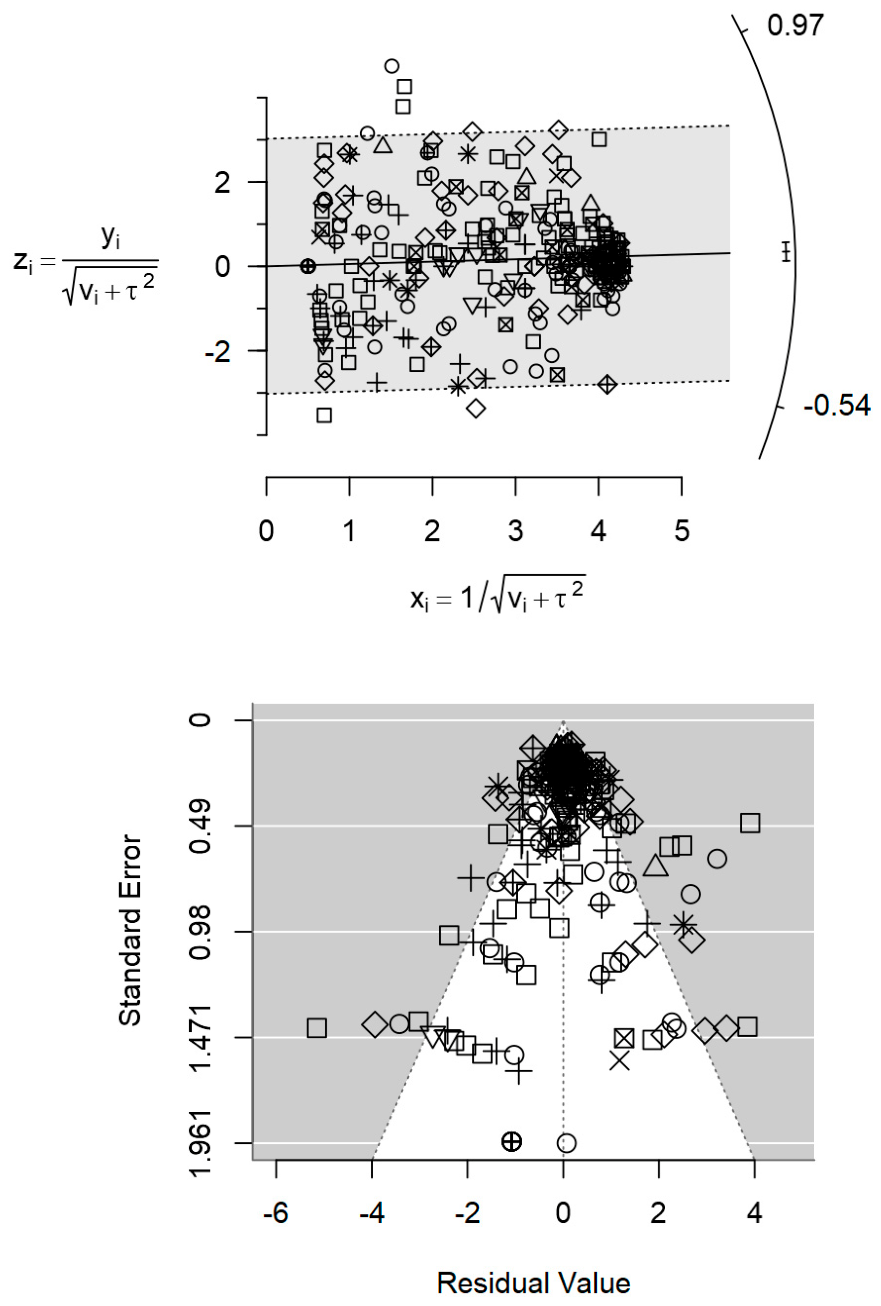
 = Scalding, * = Washing,
  = Chemical sanitisation,
  = Colder climates,
  = Organic acids,
  = Plant extracts.
= Scalding, * = Washing, = Chemical sanitisation, = Colder climates, = Organic acids, = Plant extracts.
= Plant extracts.
= Scalding, * = Washing, = Chemical sanitisation, = Colder climates, = Organic acids, = Plant extracts.
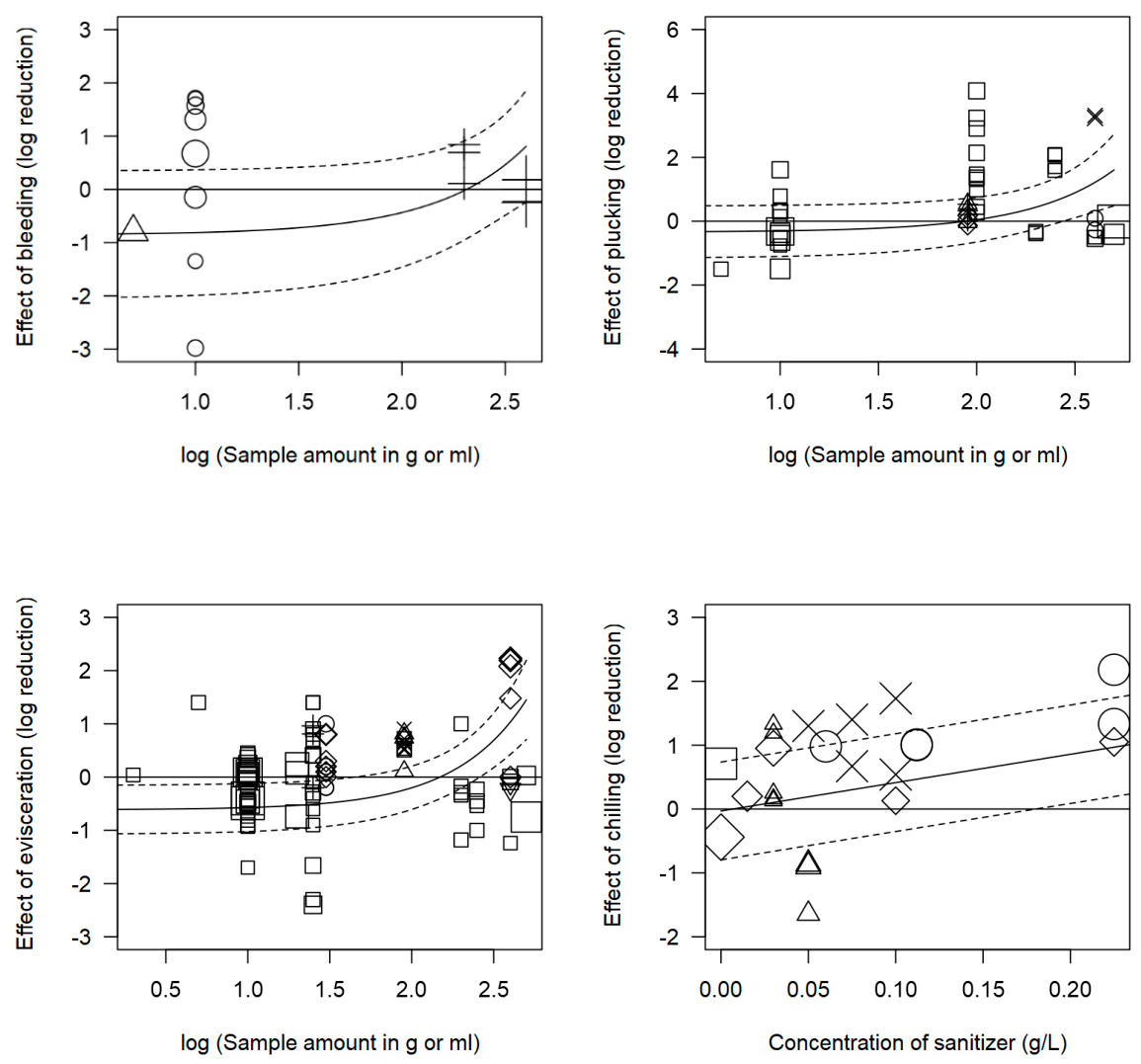
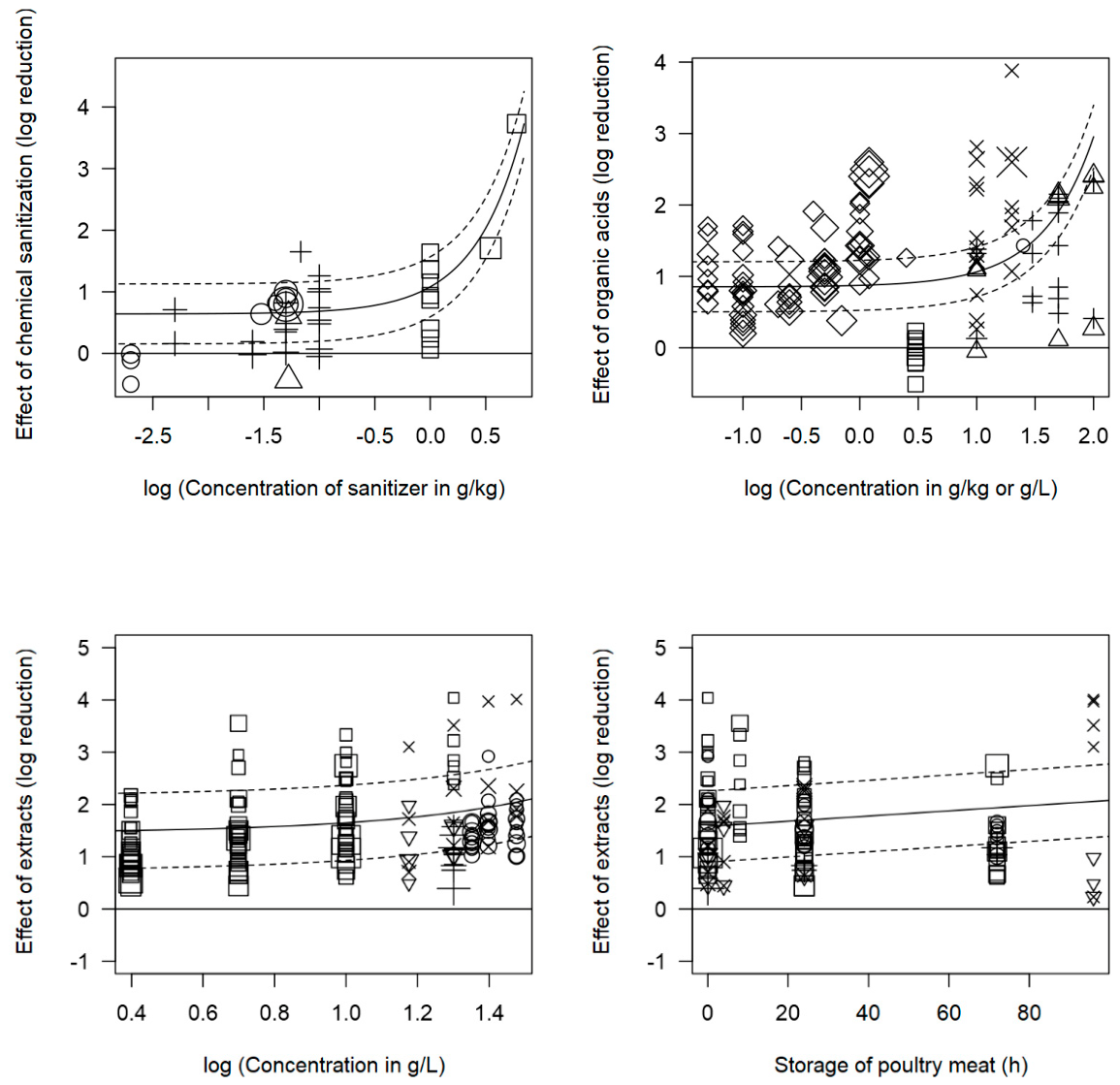
 = Trisodium phosphate; (Bottom right): □ = No sanitiser, ○ = Acidified sodium chlorite, ∆ = Chlorine, × = Peroxyacetic acid, ◊ = Peroxyacetic acid and sodium hydroxide.
= Trisodium phosphate; (Bottom right): □ = No sanitiser, ○ = Acidified sodium chlorite, ∆ = Chlorine, × = Peroxyacetic acid, ◊ = Peroxyacetic acid and sodium hydroxide.
= Trisodium phosphate; (Bottom right): □ = No sanitiser, ○ = Acidified sodium chlorite, ∆ = Chlorine, × = Peroxyacetic acid, ◊ = Peroxyacetic acid and sodium hydroxide.
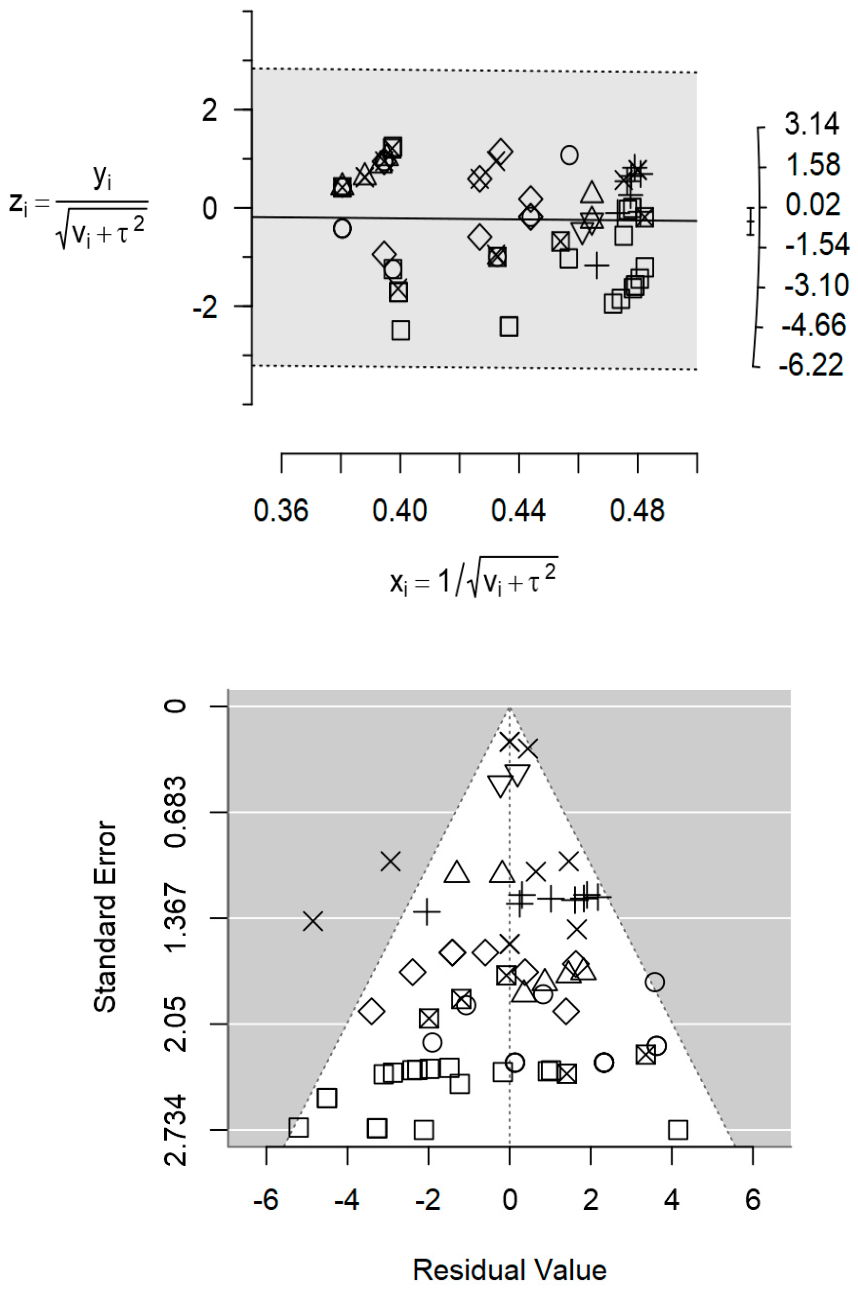
 = Washing, * = Chemical sanitization, = Colder climates, = Organic acids
= Washing, * = Chemical sanitization, = Colder climates, = Organic acids
= Washing, * = Chemical sanitization, = Colder climates, = Organic acids = Scalding tank.
= Scalding tank.
= Scalding tank.

| Stages and Interventions | Log10 Reduction (Control Group/Treated Group) | |||
|---|---|---|---|---|
| Estimate [SE] | p-Value | n/N | Heterogeneity Analysis | |
| Stages | ||||
| Neck cutting and bleeding | −0.315 [0.400] | 0.439 | 19/6 | |
| Scalding | 0.403 [0.329] | 0.221 | 25/9 | I2 = 48.7% |
| Plucking | 0.330 [0.239] | 0.163 | 55/18 | p(Q) < 0.001 |
| Evisceration | −0.110 [0.195] | 0.583 | 138/25 | R2 = 26.2% τres2 = 0.9777 |
| Carcass rinsing with water | 0.523 [0.258] | 0.043 | 35/12 | |
| Sanitisation and chilling | 0.692 [0.176] | <0.001 | 137/30 | |
| Packaging and cold storage | 0.966 [0.570] | 0.088 | 22/3 | |
| Routinary cleaning/disinfection | 0.905 [0.585] | 0.118 | 4/3 | |
| Interventions | Pub.bias | |||
| Colder climate | 1.927 [0.695] | 0.005 | 14/2 | p < 0.001 |
| Freezing | 0.740 [0.697] | 0.288 | 4/2 | |
| Plant extracts (carcasses/meat cuts) | 1.493 [0.563] | 0.008 | 196/3 | |
| Organic acids (carcasses/meat cuts) | 1.192 [0.272] | <0.001 | 144/13 | |
| Chemical sanitisation of carcasses | 1.031 [0.278] | <0.001 | 73/13 | |
| Quantitative Moderators Tested Individually | Log10 Reduction (Control Group–Treated Group) | |||||
|---|---|---|---|---|---|---|
| Sample Weight | Duration of Treatment | Treatment Concentration | Temperature | Storage Time | Inoculum in Challenge Test | |
| Stages | ||||||
| Neck cutting and bleeding | 0.002 (+) | NA | NA | NA | NA | NA |
| Scalding | 0.314 | 0.152 | NA | 0.140 | NA | NA |
| Plucking | 0.010 (+) | 0.001 (+) | 0.666 | 0.005 (−) | NA | NA |
| Evisceration | <0.001 (+) | 0.025 (−) | 0.227 | 0.723 | NA | NA |
| Carcass rinsing with water | 0.574 | NA | NA | NA | NA | NA |
| Sanitizing and chilling | 0.001 (+) | <0.001 (+) | 0.033 (+) | <0.001 (+) | NA | NA |
| Packaging an cold storage | NA | NA | NA | NA | NA | NA |
| Routinary cleaning and disinfection | NA | NA | NA | NA | NA | NA |
| Interventions | ||||||
| Chemical sanitisation | 0.552 | 0.083 (+) | <0.001 (+) | <0.001 (−) | NA | 0.576 |
| Organic acids | <0.001 (+) | <0.001 (+) | <0.001 (+) | <0.001 (+) | <0.001 (+) | 0.449 |
| Plant extracts | <0.001 (+) | NA | <0.001 (+) | NA | <0.001 (+) | 0.036 (−) |
| Freezing | NA | NA | NA | NA | NA | NA |
| Colder climates | NA | NA | NA | NA | NA | NA |
| Measure (Log10 Reduction) | Parameter | Estimate | Standard Error | p-Value | n | Heterogeneity Analysis 1 |
|---|---|---|---|---|---|---|
| Neck cutting and bleeding | Sample weight | 0.003 | 0.001 | 0.014 | s2 = 1.411 | |
| Sample type Breast feathers Neck skin Carcass rinse | 0.546 −0.785 1.135 | 0.185 0.348 0.443 | 0.003 0.024 0.010 | 17 | τ2 = 0.0541 I2 = 3.7% p(QE) < 0.001 R = 0.264 Pub. bias p = 0.941 | |
| Scalding | Sample type Neck skin Carcass rinse | 0.898 1.618 | 0.245 0.253 | <0.001 <0.001 | 24 | s2 = 0.8974 τ2 = 0.5689 I2 = 38.8% p(QE) < 0.001 R = 0.761 Pub. bias p = 0.129 |
| Plucking | Sample weight | 0.003 | 0.001 | 0.040 | s2 = 1.6707 | |
| Treatment with sanitiser None Chlorine Citric acid Lactic acid Sodium hypochlorite Trisodium phosphate | −0.367 0.053 0.061 0.056 2.172 −0.182 | 0.376 0.424 1.088 1.087 1.189 1.089 | 0.328 0.900 0.955 0.959 0.067 0.867 | 47 | τ2 = 1.5963 I2 = 51.1% p(QE) < 0.001 R = 0.338 Pub. bias p = 0.092 | |
| Evisceration | Intercept | −0.623 | 0.194 | 0.001 | s2 = 0.7473 | |
| Sample weight | 0.003 | 0.001 | <0.001 | τ2 = 0.4830 | ||
| Treatment with sanitiser Cetylpyridinium chl. Citric acid Hot water sprayed Lactic acid Peroxyacetic acid Sodium hypochlorite Sodium phosphate None | 0.912 0.923 1.031 1.058 1.025 −0.931 0.903 - | 0.571 0.800 0.134 0.797 0.568 0.816 0.794 - | 0.110 0.249 <0.001 0.184 0.071 0.254 0.258 | 99 | I2 = 39.3% p(QE) < 0.001 R = 0.506 Pub. bias p = 0.556 | |
| Carcass rinsing with water (all by immersion) | Intercept Sample type Breast skin Neck skin Carcass rinse | 0.410 0.023 0.028 0.001 | 0.001 0.011 0.005 0.001 | <0.001 0.040 <0.001 0.035 | 33 | s2 = 0.1121 τ2 = 0.0247 I2 = 18.0% p(QE) < 0.001 R = 0.397 Pub. bias p = 0.124 |
| Sanitizing and chilling | Sample type Unknown Breast skin Neck skin Carcass rinse Swab Thigh skin | 1.362 0.807 0.506 1.017 0.753 0.292 | 0.476 0.459 0.157 0.166 0.444 0.645 | 0.004 0.078 0.001 <0.001 0.089 0.650 | 130 | s2 = 0.8533 τ2 = 0.4798 I2 = 36.0% p(QE) < 0.001 R = 0.644 Pub. bias p = 0.222 |
| Treatment with sanitiser Acidified sodium chl. Chlorine Hot water sprayed Peroxyacetic acid (PA) PA + sodium hydroxide Sodium thiosulfate None | 0.578 −0.860 −0.121 0.410 −0.877 −1.351 - | 0.125 0.345 0.138 0.102 0.261 0.258 - | <0.001 0.013 0.377 <0.001 0.001 <0.001 - | |||
| Packaging | Sample type Neck skin Swab | 1.451 −0.057 | 0.310 0.447 | <0.001 0.897 | 22 | s2 = 1.1552 τ2 = 0.6851 I2 = 37.2% p(QE) < 0.001 R = 0.624 Pub. bias p = 0.403 |
| Routinary cleaning and disinfection | Environmental swabs | 0.879 | 0.255 | <0.001 | 4 | s2 = 0.2967 τ2 = 0.1534 I2 = 34.0% Pub. bias p < 0.001 |
| Measure (Log10 Reduction) | Parameter | Estimate | Standard Error | p-Value | n | Heterogeneity Analysis 1 |
|---|---|---|---|---|---|---|
| Chemical sanitisation of carcasses | Form of application Immersion Spraying | 1.839 1.303 | 0.254 0.268 | <0.001 <0.001 | s2 = 0.9337 τ2 = 0.7155 I2 = 43.4% | |
| Sample type Cloaca Carcass (full rinse, neck, breast) | −2.267 - | 0.758 - | 0.003 | 68 | p(QE) < 0.001 R = 0.559 Pub. bias p = 0.680 | |
| Sanitiser Chlorine Chlorine dioxide Sodium hypochl. None (water) | −1.794 −1.288 −0.777 −1.042 | 0.181 0.755 0.259 0.058 | <0.001 0.088 0.003 <0.001 | |||
| Sanitiser concentration Cetylpyridinium chl. Chlorine Sodium hypochl. Trisodium phosphate | 0.047 17.46 1.743 0.009 | 0.001 3.993 2.511 0.001 | <0.001 <0.001 0.488 <0.001 | |||
| Organic acids on carcass/meat cuts | Intercept | 0.434 | 0.163 | 0.008 | s2 = 0.6824 τ2 = 0.3714 I2 = 35.2% p(QE) < 0.001 | |
| Form of application Spraying Immersion | −0.067 - | 0.028 - | 0.019 | |||
| Sample type Carcass Drumsticks Swabs Wings Breast | 0.213 −0.129 0.419 0.656 - | 0.178 0.244 0.258 0.238 - | 0.232 0.598 0.105 0.006 | 142 | R = 0.686 Pub. bias p = 0.004 | |
| Sanitiser concentration Acetic acid Blends of OA Citric acid Lactic acid Monocaprin emuls. Peroxyacetic acid Water | −0.383 0.036 0.007 0.008 0.104 1.193 - | 0.081 0.024 0.002 0.002 0.005 0.020 - | <0.001 0.129 <0.001 <0.001 <0.001 <0.001 | |||
| Plant extracts on poultry meat | Intercept | −0.174 | 0.080 | 0.030 | s2 = 0.6553 | |
| Sample weight | 0.085 | 0.006 | <0.001 | τ2 = 0.5131 | ||
| Storage time | 0.001 | 0.001 | 0.213 | I2 = 44.0% | ||
| Extract concentration Carvacrol Carvacrol + Chitosan Carvacrol + Gum arabic Chitosan Cinnamaldehyde Linallol | 0.074 0.030 0.002 0.012 0.051 0.031 | 0.006 0.002 0.001 0.003 0.004 0.008 | <0.001 <0.001 <0.001 <0.001 <0.001 <0.001 | 195 | p(QE) < 0.001 R = 0.775 Pub. bias p = 0.082 | |
| Freezing (Carcasses) | Intercept | 0.669 | 0.100 | <0.001 | 4 | s2 = 0.0760 τ2 = 0.0000 I2 = 0.00% Pub. bias p = 0.462 |
| Colder climates (Caecal samples) | Intercept | 1.947 | 1.384 | 0.159 | 14 | s2 = 12.43 τ2 = 3.816 I2 = 23.4% Pub. bias p < 0.001 |
| Stages and Interventions | Log of Risk Ratio (Control Group/Treated Group) | |||
|---|---|---|---|---|
| Estimate [SE] | p-Value | n/N | Heterogeneity Analysis | |
| Stages | ||||
| Neck cutting and bleeding | −0.144 [0.086] | 0.094 | 34/5 | I2 = 3.8% |
| Scalding | 0.019 [0.101] | 0.847 | 14/5 | |
| Plucking | 0.085 [0.060] | 0.150 | 38/16 | p(Q) < 0.001 |
| Evisceration | −0.071 [0.050] | 0.152 | 75/19 | R2 = 20.2% τres2 = 0.0309 |
| Carcass rinsing with water | 0.028 [0.063] | 0.646 | 24/12 | |
| Chilling | 0.082 [0.038] | 0.032 | 96/31 | |
| Packaging and cold storage | −0.076 [0.093] | 0.415 | 9/4 | |
| Interventions | Pub. bias | |||
| Colder climate | 0.045 [0.137] | 0.741 | 8/2 | p = 0.619 |
| Freezing | 0.358 [0.269] | 0.462 | 7/3 | |
| Organic acids (carcasses/meat cuts) | 1.079 [0.422] | 0.009 | 7/2 | |
| Chemical sanitisation of carcasses | 0.128 [0.264] | 0.627 | 5/2 | |
| Measure (Log Risk Ratio) | Parameter | Estimate | Standard Error | p-Value | n | Heterogeneity Analysis 1 |
|---|---|---|---|---|---|---|
| Neck cutting and bleeding | Sample type Breast feathers Cloaca Neck skin | 0.005 −0.726 −0.010 | 0.067 0.155 0.029 | 0.936 <0.001 0.724 | 32 | s2 = 0.8981 τ2 = 0.0837 I2 = 8.5% p(QE) = 0.063 R = 0.274 Pub. bias p = 0.905 |
| Plucking (no added sanitiser) | Sample weight | −0.002 | 0.001 | <0.001 | s2 = 1.2052 | |
| Sample type Breast skin Neck skin Carcass rinse Swabs | −0.016 −0.017 0.635 0.379 | 0.036 0.058 0.085 0.098 | 0.654 0.766 <0.001 <0.001 | 32 | τ2 = 0.0959 I2 = 7.4% p(QE) < 0.001 R = 0.653 Pub. bias p = 0.024 | |
| Evisceration (no added sanitiser) | Intercept | 0.001 | 0.013 | 0.938 | s2 = 0.7301 | |
| Sample weight | −0.001 | 0.001 | <0.001 | τ2 = 0.0440 | ||
| Treatment Hot water sprayed None | 0.263 - | 0.121 - | 0.030 | 71 | I2 = 5.6% p(QE) = 0.010 R = 0.152 Pub. bias p = 0.344 | |
| Sanitising and chilling | Treatment Chlorine Hot water sprayed Ice water Salt Peroxyacetic acid None | 0.017 0.074 0.157 −0.142 −0.085 0.000 | 0.045 0.160 0.070 0.074 0.062 0.026 | 0.711 0.645 0.022 0.053 0.175 0.999 | 78 | s2 = 0.6341 τ2 = 0.1160 I2 = 15.5% p(QE) < 0.001 R = 0.458 Pub. bias p < 0.001 |
| Sample type Neck skin Rinse Swab Breast skin | −0.001 0.231 0.090 - | 0.030 0.040 0.033 - | 0.977 <0.001 0.007 | |||
| Chemical sanitisation of carcasses (all chlorine by immersion) | Intercept | 0.932 | 0.890 | 0.295 | 5 | s2 = 2.2738 τ2 = 1.2121 I2 = 34.8% Pub. bias p = 0.006 |
| Organic acids in meat cuts (by spraying peroxyacetic acid) | Intercept | 1.049 | 0.401 | 0.009 | 7 | s2 = 0.2745 τ2 = 0.0000 I2 = 0.00% Pub. bias p = 0.138 |
| Freezing | Intercept | 0.372 | 0.257 | 0.147 | 7 | s2 = 0.5502 τ2 = 0.1418 I2 = 20.5% Pub. bias p = 0.515 |
| Colder climates | Intercept | 0.029 | 0.029 | 0.324 | 8 | s2 = 0.3134 τ2 = 0.000 I2 = 0.00% Pub. bias p = 0.371 |
| Processing Area Source | Pooled Prevalence | 95% CI | n/N | Heterogeneity Analysis |
|---|---|---|---|---|
| Entrance | ||||
| Live animals (cloaca) | 0.384 | [0.205–0.602] | 8/5 | I2 = 37% |
| Transport crates | 0.833 | [0.765–0.885] | 4/2 | p(Q) < 0.001 |
| Scalding and plucking area | ||||
| Scalding tank | 0.320 | [0.160–0.537] | 5/3 | R2 = 13.6% |
| Plucker | 0.422 | [0.136–0.773] | 2/1 | τres2 = 3.852 |
| Evisceration area | ||||
| Caecal | 0.265 | [0.043–0.742] | 19/5 | |
| Eviscerator | 0.678 | [0.434–0.852] | 6/2 | |
| Chilling room | Publication bias | |||
| Chill tank | 0.226 | [0.067–0.542] | 15/3 | |
| Unknown | p = 0.619 | |||
| Miscellaneous | 0.677 | [0.521–0.801] | 6/2 | |
| Operators | 0.732 | [0.404–0.917] | 8/2 |
Disclaimer/Publisher’s Note: The statements, opinions and data contained in all publications are solely those of the individual author(s) and contributor(s) and not of MDPI and/or the editor(s). MDPI and/or the editor(s) disclaim responsibility for any injury to people or property resulting from any ideas, methods, instructions or products referred to in the content. |
© 2026 by the authors. Licensee MDPI, Basel, Switzerland. This article is an open access article distributed under the terms and conditions of the Creative Commons Attribution (CC BY) license.
Share and Cite
Zefanias, O.; Barros, A.N.; Cadavez, V.; Gonzales-Barron, U. Effect of Critical Processing Stages and Interventions on Campylobacter in Poultry Meat at the Slaughterhouse Level: A Comprehensive Meta-Analysis. Appl. Microbiol. 2026, 6, 77. https://doi.org/10.3390/applmicrobiol6070077
Zefanias O, Barros AN, Cadavez V, Gonzales-Barron U. Effect of Critical Processing Stages and Interventions on Campylobacter in Poultry Meat at the Slaughterhouse Level: A Comprehensive Meta-Analysis. Applied Microbiology. 2026; 6(7):77. https://doi.org/10.3390/applmicrobiol6070077
Chicago/Turabian StyleZefanias, Odete, Ana Novo Barros, Vasco Cadavez, and Ursula Gonzales-Barron. 2026. "Effect of Critical Processing Stages and Interventions on Campylobacter in Poultry Meat at the Slaughterhouse Level: A Comprehensive Meta-Analysis" Applied Microbiology 6, no. 7: 77. https://doi.org/10.3390/applmicrobiol6070077
APA StyleZefanias, O., Barros, A. N., Cadavez, V., & Gonzales-Barron, U. (2026). Effect of Critical Processing Stages and Interventions on Campylobacter in Poultry Meat at the Slaughterhouse Level: A Comprehensive Meta-Analysis. Applied Microbiology, 6(7), 77. https://doi.org/10.3390/applmicrobiol6070077