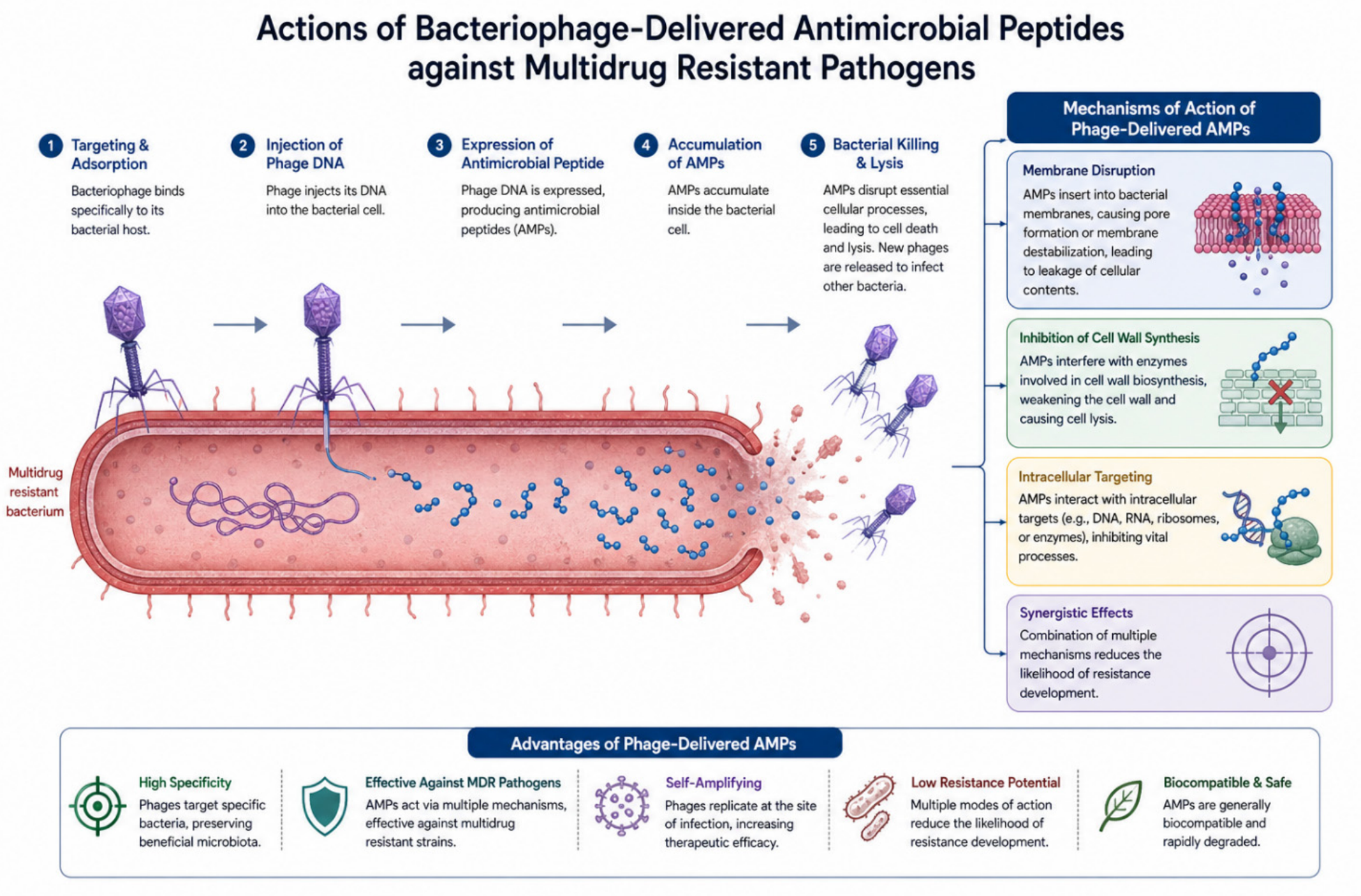

Bacteriophages as Trojan Horses for Antimicrobial Peptides Delivery

Abstract
1. The Rise in MDR Bacteria and Phage Therapy Limitations
2. The Advantages of AMPs
3. Phage–Antibiotic Synergy
4. Engineering Bacteriophages as Trojan Horses for AMP Delivery
Nanoparticle Strategies for AMPs Delivery
5. What Is the Evidence Showing So Far
6. Major Clinical Challenges
- -
- Efficient delivery to the infection site. The engineered phage must reach the target bacteria in sufficient numbers and remain active in the host environment.
- -
- Narrow host range. While advantageous for preserving the microbiota, most bacteriophages infect only specific bacterial species or strains. This requires accurate pathogen identification, limiting effectiveness against polymicrobial infections.
- -
- Bacterial resistance. Bacteria can evolve resistance to phages by altering surface receptors, using restriction-modification systems, or activating CRISPR-Cas defenses.
- -
- Stable AMP expression by engineered phages. Inserted AMP genes can impose a fitness cost on the phage or be lost over time, reducing therapeutic reliability [42].
- -
- Immune clearance. The host’s immune system may still recognize and neutralize bacteriophages, particularly after repeated dosing. Immune clearance may then decrease therapeutic effectiveness before sufficient bacterial killing occurs [42].
- -
- AMP toxicity and expression control. AMPs must be produced at levels high enough to kill bacteria but low enough to avoid unintended toxicity or inflammatory responses [14].
- -
- Scalable manufacturing and regulatory approval pathways. In addition to strict control of purity, potency, genetic stability, and absence of bacterial contaminants such as endotoxins [43]; regulatory pathways for approval are still evolving. This makes clinical development more complex than for conventional antibiotics [44].
7. Using AI for Optimization
8. What Is in the Future
Author Contributions
Funding
Institutional Review Board Statement
Informed Consent Statement
Data Availability Statement
Conflicts of Interest
References
- Kapoor, A.; Mudaliar, S.B.; Bhat, V.G.; Chakraborty, I.; Prasad, A.S.B.; Mazumder, N. Phage therapy: A novel approach against multidrug-resistant pathogens. 3 Biotech 2024, 14, 256. [Google Scholar] [CrossRef] [PubMed]
- Petrović-Fabijan, A.; Abedon, S.T. From hype to hope: Reanimating phage therapy through evidence-based multidisciplinarity. Nat. Commun. 2026, 17, 4107. [Google Scholar] [CrossRef] [PubMed]
- Chung, K.M.; Liau, X.L.; Tang, S.S. Bacteriophages and Their Host Range in Multidrug-Resistant Bacterial Disease Treatment. Pharmaceuticals 2023, 16, 1467. [Google Scholar] [CrossRef] [PubMed]
- Tarasenko, A.; Papudeshi, B.N.; Grigson, S.R.; Mallawaarachchi, V.; Hutton, A.L.K.; Warner, M.S.; Barr, J.J.; Iredell, J.; Eijkelkamp, B.; Edwards, R.A. Reprogramming resistance: Phage-antibiotic synergy targets efflux systems in ESKAPEE pathogens. mBio 2025, 16, e0182225. [Google Scholar] [CrossRef] [PubMed]
- Kim, M.K.; Suh, G.A.; Cullen, G.D.; Rodriguez, S.P.; Dharmaraj, T.; Chang, T.H.W.; Li, Z.; Chen, Q.; Green, S.I.; Lavigne, R.; et al. Bacteriophage therapy for multidrug-resistant infections: Current technologies and therapeutic approaches. J. Clin. Investig. 2025, 135, e187996. [Google Scholar] [CrossRef] [PubMed]
- Liu, C.; Hong, Q.; Chang, R.Y.K.; Kwok, P.C.L.; Chan, H.-K. Phage–Antibiotic Therapy as a Promising Strategy to Combat Multidrug-Resistant Infections and to Enhance Antimicrobial Efficiency. Antibiotics 2022, 11, 570. [Google Scholar] [CrossRef] [PubMed]
- Oechslin, F. Resistance Development to Bacteriophages Occurring during Bacteriophage Therapy. Viruses 2018, 10, 351. [Google Scholar] [CrossRef] [PubMed]
- Zhang, Q.-Y.; Yan, Z.-B.; Meng, Y.-M.; Hong, X.-Y.; Shao, G.; Ma, J.-J.; Cheng, X.-R.; Liu, J.; Kang, J.; Fu, C.-Y. Antimicrobial peptides: Mechanism of action, activity and clinical potential. Mil. Med. Res. 2021, 8, 48. [Google Scholar] [CrossRef] [PubMed]
- Gani, Z.; Kumar, A.; Raje, M.; Raje, C.I. Antimicrobial peptides: An alternative strategy to combat antimicrobial resistance. Drug Discov. Today 2025, 30, 104305. [Google Scholar] [CrossRef] [PubMed]
- van der Weide, H.; Brunetti, J.; Pini, A.; Bracci, L.; Ambrosini, C.; Lupetti, P.; Paccagnini, E.; Gentile, M.; Bernini, A.; Niccolai, N.; et al. Investigations into the killing activity of an antimicrobial peptide active against extensively antibiotic-resistant K. pneumon iae and P. aeruginosa. Biochim. Biophys. Acta (BBA) -Biomembr. 2017, 1859, 1796–1804. [Google Scholar] [CrossRef]
- Shriwastav, S.P.S.; Kaur, N.M.; Hassan, M.; Mohammed, S.P.S.A.; Chauhan, S.; Mittal, D.; Aman, S.; Bibi, A.M. Antimicrobial peptides: A promising frontier to combat antibiotic resistant pathogens. Ann. Med. Surg. 2025, 87, 2118–2132. [Google Scholar] [CrossRef]
- Dijksteel, G.S.; Ulrich, M.M.W.; Middelkoop, E.; Boekema, B.K.H.L. Review: Lessons Learned From Clinical Trials Using Antimicrobial Peptides (AMPs). Front. Microbiol. 2021, 12, 616979. [Google Scholar] [CrossRef] [PubMed]
- de Oliveira, K.B.S.; Leite, M.L.; Melo, N.T.M.; Lima, L.F.; Barbosa, T.C.Q.; Carmo, N.L.; Melo, D.A.B.; Paes, H.C.; Franco, O.L. Antimicrobial Peptide Delivery Systems as Promising Tools Against Resistant Bacterial Infections. Antibiotics 2024, 13, 1042. [Google Scholar] [CrossRef] [PubMed]
- Zheng, S.; Tu, Y.; Li, B.; Qu, G.; Li, A.; Peng, X.; Li, S.; Shao, C. Antimicrobial peptide biological activity, delivery systems and clinical translation status and challenges. J. Transl. Med. 2025, 23, 292. [Google Scholar] [CrossRef] [PubMed]
- Islam, T.; Tamanna, N.T.; Sagor, S.; Zaki, R.M.; Rabbee, M.F.; Lackner, M. Antimicrobial Peptides: A Promising Solution to the Rising Threat of Antibiotic Resistance. Pharmaceutics 2024, 16, 1542. [Google Scholar] [CrossRef] [PubMed]
- Min, K.H.; Kim, K.H.; Ki, M.-R.; Pack, S.P. Antimicrobial Peptides and Their Biomedical Applications: A Review. Antibiotics 2024, 13, 794. [Google Scholar] [CrossRef] [PubMed]
- Moradpour, Z.; Yousefi, N.; Sadeghi, D.; Ghasemian, A. Synergistic bactericidal activity of a naturally isolated phage and ampicillin against urinary tract infecting Escherichia coli O157. Iran. J. Basic. Med. Sci. 2020, 23, 257–263. [Google Scholar]
- Taheri-Araghi, S. Synergistic action of antimicrobial peptides and antibiotics: Current understanding and future directions. Front. Microbiol. 2024, 15, 1390765. [Google Scholar] [CrossRef] [PubMed]
- Talha, M.; Roque-Borda, C.A. Enhanced antibacterial activity of antimicrobial peptide—Antibiotic combinations against multidrug-resistant bacteria. FEMS Microbes 2026, 7, xtag003. [Google Scholar] [CrossRef] [PubMed]
- Zhu, Y.; Hao, W.; Wang, X.; Ouyang, J.; Deng, X.; Yu, H.; Wang, Y. Antimicrobial peptides, conventional antibiotics, and their synergistic utility for the treatment of drug-resistant infections. Med. Res. Rev. 2022, 42, 1377–1422. [Google Scholar] [CrossRef] [PubMed]
- Bleick, C.; Stamper, K.; Mohib, S.; Avery, S.; Biswas, B.; Arias, C.A.; Rybak, M.J. 2110. Enhancing antibiotic efficacy against Enterococcal faecium with Bacteriophage and Antimicrobial Peptides. Open Forum Infect. Dis. 2023, 10, ofad500.1734. [Google Scholar] [CrossRef]
- Tyagi, J.L.; Gupta, P.; Ghate, M.M.; Kumar, D.; Poluri, K.M. Assessing the synergistic potential of bacteriophage endolysins and antimicrobial peptides for eradicating bacterial biofilms. Arch. Microbiol. 2024, 206, 272. [Google Scholar] [CrossRef] [PubMed]
- Rothong, P.; Leungtongkam, U.; Khongfak, S.; Homkaew, C.; Samathi, S.; Tandhavanant, S.; Ngoenkam, J.; Vitta, A.; Thanwisai, A.; Sitthisak, S. Antimicrobial activity and synergistic effect of phage-encoded antimicrobial peptides with colistin and outer membrane permeabilizing agents against Acinetobacter baumannii. PeerJ 2024, 12, e18722. [Google Scholar] [CrossRef] [PubMed]
- Oyenuga, N.; Cobo-Díaz, J.F.; Alvarez-Ordóñez, A.; Alexa, E.-A. Overview of Antimicrobial Resistant ESKAPEE Pathogens in Food Sources and Their Implications from a One Health Perspective. Microorganisms 2024, 12, 2084. [Google Scholar] [CrossRef] [PubMed]
- Elshamy, A.A.; Kamal, S.K.; Mahmoud, M.T.; Elhasany, A.M.; Shady, A.A.; Mohamed, S.A.; Abd-Elmaaboud, H.A.; El-Awady, N.E.; Mohamed, R.A.; El-Mirghany, S.A.; et al. Recent insights on phage therapy against multidrug-resistant Acinetobacter baumannii. AMB Express 2025, 15, 44. [Google Scholar] [CrossRef] [PubMed]
- Lemon, D.J.; Kay, M.K.; Titus, J.K.; Ford, A.A.; Chen, W.; Hamlin, N.J.; Hwang, Y.Y. Construction of a genetically modified T7Select phage system to express the antimicrobial peptide 1018. J. Microbiol. 2019, 57, 532–538. [Google Scholar] [CrossRef] [PubMed]
- Ludwig, T.; Volke, D.; Krizsan, A. Analysis of engineered T7 bacteriophages containing genetic sequences encoding antimicrobial peptides. Front. Antibiot. 2025, 3, 1515874. [Google Scholar] [CrossRef] [PubMed]
- Jo, S.J.; Park, S.C.; Kim, S.G. CRISPR/Cas9-engineered Salmonella phage displaying antimicrobial peptide LL37 for enhanced antibacterial activity. Int. J. Antimicrob. Agents 2026, 67, 107734. [Google Scholar] [CrossRef] [PubMed]
- Krom, R.J.; Bhargava, P.; Lobritz, M.A.; Collins, J.J. Engineered Phagemids for Nonlytic, Targeted Antibacterial Therapies. Nano Lett. 2015, 15, 4808–4813. [Google Scholar] [CrossRef] [PubMed]
- Yang, Y.; Vexler, S.; Jordan, M.C.; Abbondante, S.; Kang, D.; Peng, H.; Marshall, M.; Naini, B.V.; Jain, S.; Lai, Y.-C.; et al. A Synthetic Phage-Peptide Conjugate as a Potent Antibacterial Agent for Pseudomonas aeruginosa Infections. ACS Cent. Sci. 2025, 11, 1715–1735. [Google Scholar] [CrossRef] [PubMed]
- Zhao, M.; Tan, X.; Liu, Z.-Q.; Dou, L.; Liu, D.; Pan, Y.-J.; Ma, Y.-F.; Yu, J.-L. Engineered phage with cell-penetrating peptides for intracellular bacterial infections. mSystems 2023, 8, e0064623. [Google Scholar] [CrossRef] [PubMed]
- Szymczak, M.; Pankowski, J.A.; Kwiatek, A.; Grygorcewicz, B.; Karczewska-Golec, J.; Sadowska, K.; Golec, P. An effective antibiofilm strategy based on bacteriophages armed with silver nanoparticles. Sci. Rep. 2024, 14, 9088. [Google Scholar] [CrossRef] [PubMed]
- Du, J.; Meile, S.; Baggenstos, J.; Jäggi, T.; Piffaretti, P.; Hunold, L.; Matter, C.I.; Leitner, L.; Kessler, T.M.; Loessner, M.J.; et al. Enhancing bacteriophage therapeutics through in situ production and release of heterologous antimicrobial effectors. Nat. Commun. 2023, 14, 4337. [Google Scholar] [CrossRef] [PubMed]
- Ozbek, T.; Demir, H.; Dokuz, S.; Tasdurmazli, S.; Ozbey, U.; Ozbil, M.; Topuzogullari, M.; Cinar, I.; Karamese, M.; Karamese, S.A.; et al. Phage-inspired targeting of antibiotic-loaded polymeric micelles for enhanced therapeutic efficacy against monomicrobial sepsis. J. Control. Release 2025, 380, 773–786. [Google Scholar] [CrossRef] [PubMed]
- Wan, H.; Zhong, X.; Yang, S.; Deng, J.; Song, X.; Liu, Y.; Li, Y.; Yin, Z.; Zhao, X. Enhancing the Therapeutic Potential of Peptide Antibiotics Using Bacteriophage Mimicry Strategies. Adv. Sci. 2025, 12, e2411753. [Google Scholar]
- Patrulea, V.; Borchard, G.; Jordan, O. An Update on Antimicrobial Peptides (AMPs) and Their Delivery Strategies for Wound Infections. Pharmaceutics 2020, 12, 840. [Google Scholar] [CrossRef] [PubMed]
- Karimi, M.; Mirshekari, H.; Basri, S.M.M.; Bahrami, S.; Moghoofei, M.; Hamblin, M.R. Bacteriophages and phage-inspired nanocarriers for targeted delivery of therapeutic cargos. Adv. Drug Deliv. Rev. 2016, 106, 45–62. [Google Scholar] [CrossRef] [PubMed]
- Szymczak, P.; Zarzecki, W.; Wang, J.; Duan, Y.; Wang, J.; Coelho, L.P.; de la Fuente-Nunez, C.; Szczurek, E. AI-Driven Antimicrobial Peptide Discovery: Mining and Generation. Acc. Chem. Res. 2025, 58, 1831–1846. [Google Scholar] [CrossRef] [PubMed]
- Jorge, P.; Pérez-Pérez, M.; Rodríguez, G.P.; Pereira, M.O.; Lourenço, A. A network perspective on antimicrobial peptide combination therapies: The potential of colistin, polymyxin B and nisin. Int. J. Antimicrob. Agents 2017, 49, 668–676. [Google Scholar] [CrossRef] [PubMed]
- Petersen, A.Ø.; Damholt, B.; Grove, M.; Hink, J.; Marotte-Hurbon, T.; Söderqvist, J.; Troy, A.; Zdravkovic, M.; Bayer, L.; Brunner, K.; et al. Safety, recovery, and pharmacodynamics of CRISPR–Cas therapeutic SNIPR001: A phase 1, randomised, double-blind, first-in-human, dose-escalation study. Lancet Microbe 2026, 7, 101257. [Google Scholar] [CrossRef] [PubMed]
- Kim, P.; Sanchez, A.M.; Penke, T.J.R.; Tuson, H.H.; Kime, J.C.; McKee, R.W.; Slone, W.L.; Conley, N.R.; McMillan, L.J.; Prybol, C.J.; et al. Safety, pharmacokinetics, and pharmacodynamics of LBP-EC01, a CRISPR-Cas3-enhanced bacteriophage cocktail, in uncomplicated urinary tract infections due to Escherichia coli (ELIMINATE): The randomised, open-label, first part of a two-part phase 2 trial. Lancet Infect. Dis. 2024, 24, 1319–1332. [Google Scholar] [CrossRef] [PubMed]
- Venkataraman, S.; Shahgolzari, M.; Yavari, A.; Hefferon, K. Bacteriophages as Targeted Therapeutic Vehicles: Challenges and Opportunities. Bioengineering 2025, 12, 469. [Google Scholar] [CrossRef] [PubMed]
- Alzahrani, A.J. Bacteriophage therapy against multidrug resistant bacterial infections demonstrates clinical advances and engineering innovations between 2020–2026. Front. Microbiol. 2026, 17, 1865548. [Google Scholar] [CrossRef] [PubMed]
- Moon, K.; Coxon, C.; Årdal, C.; Botgros, R.; Djebara, S.; Durno, L.; Fiore, C.R.; Perrin, J.-B.; Dixon, D.M.; Cavaleri, M. Considerations and perspectives on phage therapy from the transatlantic taskforce on antimicrobial resistance. Nat. Commun. 2025, 16, 10883. [Google Scholar] [CrossRef] [PubMed]
- Wang, Y.; Zhao, L.; Li, Z.; Xi, Y.; Pan, Y.; Zhao, G.; Zhang, L. A generative artificial intelligence approach for the discovery of antimicrobial peptides against multidrug-resistant bacteria. Nat. Microbiol. 2025, 10, 2997–3012. [Google Scholar] [CrossRef] [PubMed]
- Wang, B.; Lin, P.; Zhong, Y.; Tan, X.; Shen, Y.; Huang, Y.; Jin, K.; Zhang, Y.; Zhan, Y.; Shen, D.; et al. Explainable deep learning and virtual evolution identifies antimicrobial peptides with activity against multidrug-resistant human pathogens. Nat. Microbiol. 2025, 10, 332–347. [Google Scholar] [CrossRef] [PubMed]
- Li, X.; Gong, H.; Wang, Y.; Zhao, Y.; Li, L.; Bao, P.; Kong, Q.; Fu, J.; Wan, B.; Zhang, Y.; et al. De Novo Multi-Mechanism Antimicrobial Peptide Design via Multimodal Deep Learning. Adv. Sci. 2026, 13, e15835. [Google Scholar] [CrossRef]
- Boudza, R.; Bounou, S.; Segura-Garcia, J.; Moukadiri, I.; Maicas, S. Artificial Intelligence as a Catalyst for Antimicrobial Discovery: From Predictive Models to De Novo Design. Microorganisms 2026, 14, 394. [Google Scholar] [CrossRef] [PubMed]
- Keith, M.; de la Torriente, A.P.; Chalka, A.; Vallejo-Trujillo, A.; McAteer, S.P.; Paterson, G.K.; Low, A.S.; Gally, D.L. Predictive phage therapy for Escherichia coli urinary tract infections: Cocktail selection for therapy based on machine learning models. Proc. Natl. Acad. Sci. USA 2024, 121, e2313574121. [Google Scholar] [CrossRef] [PubMed]
- Zhang, Y.; Li, R.; Zou, G.; Guo, Y.; Wu, R.; Zhou, Y.; Chen, H.; Zhou, R.; Lavigne, R.; Bergen, P.J.; et al. Discovery of Antimicrobial Lysins from the “Dark Matter” of Uncharacterized Phages Using Artificial Intelligence. Adv. Sci. 2024, 11, e2404049. [Google Scholar] [CrossRef]
- Doud, M.B.; Robertson, J.M.; Strathdee, S.A. Optimizing phage therapy with artificial intelligence: A perspective. Front. Cell. Infect. Microbiol. 2025, 15, 1611857. [Google Scholar] [CrossRef] [PubMed]
- Malajczuk, C.J.; Vaitekenas, A.; Iszatt, J.J.; Stick, S.M.; Kicic, A.; Karpievitch, Y.V. Towards accurate artificial intelligence models for strain-level phage–host prediction. Brief. Bioinform. 2026, 27, bbag085. [Google Scholar] [CrossRef] [PubMed]
- Getz, L.J.; Patel, P.H.; Maxwell, K.L. A solution to the postantibiotic era: Phages as precision medicine. Curr. Opin. Microbiol. 2025, 86, 102613. [Google Scholar] [CrossRef] [PubMed]
- Piracha, Z.Z.; Saeed, U. Next-generation bacteriophage therapeutic systems: CRISPR-based engineering, near-infrared bioimaging, and precision strategies for treating multidrug-resistant and extensively drug-resistant bacterial infections. Front. Microbiol. 2026, 17, 1748742. [Google Scholar] [CrossRef] [PubMed]
- Abdraimova, N.; Shitikov, E.; Kornienko, M. The Role of Genomics in Advancing and Standardising Bacteriophage Therapy. Antibiotics 2026, 15, 55. [Google Scholar] [CrossRef] [PubMed]
- Luong, T.; Kharrat, L.; Champagne-Jorgensen, K.; Melendez, J.A.; Pride, D.; Conrad, D.J.; Roach, D.R. Ecological partitioning enables phage–antibiotic cooperation in a human Pseudomonas infection. Nat. Commun. 2026, 17, 2615. [Google Scholar] [CrossRef] [PubMed]
- Nkundayezu, P. Rethinking Antimicrobial Strategies: Integrating Microbiome Modulation and Next Generation Therapeutics to Combat Multidrug-Resistant Pathogens. Microb. Bioact. 2026, 9, 1–14. [Google Scholar] [CrossRef]


| Study | Phage System | AMP | Delivery Strategy | Target Organism | Key Findings |
|---|---|---|---|---|---|
| [26] | Engineered T7Select phage, 1018-T7 | 1018 | AMP gene inserted into the T7Select phage genome and expressed during bacterial infection | E. coli | Enhanced killing of planktonic bacteria and improved disruption of established biofilms compared with unmodified T7Select phage. |
| [27] | Engineered T7Select phages | OmpA-Api805, CRAMP, melittin | AMP-encoding sequences inserted into the T7Select phage genome for expression during infection | E. coli | Engineered phages showed similar lysis to unmodified T7Select but partially reduced regrowth of potentially phage-resistant E. coli; melittin expression was directly confirmed. |
| [28] | CRISPR/Cas9-engineered lytic Salmonella phage, pST_PMR_LL37 | LL-37 | LL-37 displayed on the phage capsid surface | Salmonella Typhimurium | Enhanced adsorption, reduced bacterial regrowth and phage-resistant mutant emergence, decreased epithelial cell invasion/intracellular survival, and improved survival in a Galleria mellonella infection model. |
| [29] | Engineered M13-based phagemids | Cecropin PR-39 and apidaecin Ia, with CcdB toxin in optimized constructs | Phagemid particles delivered synthetic antimicrobial gene networks for intracellular expression without bacterial lysis | E. coli | Reduced bacterial viability in vitro and improved survival in a murine E. coli peritonitis model. |
| [30] | Engineered nonlytic M13 phage targeting LPS, PMB-M13αLPS | Polymyxin B | Polymyxin B chemically conjugated to the surface of engineered M13 phage for targeted delivery to Gram-negative bacteria | Multidrug-resistant Pseudomonas aeruginosa | Improved antibacterial potency in vitro and effectively treated P. aeruginosa pneumonia and corneal infection in mice with reduced toxicity compared with free polymyxin B. |
| [31] | Engineered Salmonella phage selzHA-TAT | HA-TAT cell-penetrating peptide | CPP displayed on phage GP94 to enhance mammalian cell uptake | Intracellular Salmonella | Increased intracellular phage uptake and improved killing of intracellular Salmonella in epithelial cell models without detectable cytotoxicity. |
| [32] | Engineered T7Ag-XII phage armed with silver nanoparticles | Silver nanoparticles | AgNP-binding peptide displayed on T7 phage capsid to bind silver nanoparticles | E. coli biofilms | T7 phages armed with AgNPs showed stronger biofilm eradication than phage or nanoparticles alone and were not toxic to eukaryotic cells at effective concentrations. |
| [22] | Phage-derived endolysins T7L and T4L | Colistin, polymyxin B, nisin | Combination of purified bacteriophage endolysins with AMPs | Pseudomonas aeruginosa and Staphylococcus aureus biofilms | T7L with polymyxin B or colistin synergistically eradicated P. aeruginosa biofilms, while T4L with nisin showed synergy against S. aureus biofilms. |
| [33] | Heterologous effector phage therapeutics, HEPTs | Colicin-like bacteriocins and cell wall hydrolases | Effector genes integrated into phage genomes for in situ production and release during host lysis | Uropathogens including E. coli, Klebsiella pneumoniae, and Enterococcus faecalis | HEPTs improved uropathogen killing, suppressed regrowth/resistance, controlled polymicrobial communities, and a colicin E7-producing HEPT improved control of patient E. coli bacteriuria ex vivo. |
| [34] | Phage-inspired targeted polymeric micelles using ϕ11 Gp45 or Gp45-derived peptides | Vancomycin and oxacillin | Phage receptor-binding protein or peptide-conjugated micelles used to target antibiotic delivery | Staphylococcus aureus sepsis model | Targeted micelles reduced MIC values and MiGp45 improved survival, reduced bacterial load, inflammation, lung injury, and oxidative stress in a mouse S. aureus sepsis model. |
| [35] | Bacteriophage-mimicking nanomedicines using RBPsb1 | Nisin | Phage receptor-binding protein conjugated to nisin-loaded modules for infection-responsive release | MRSA/Staphylococcus aureus pneumonia | RBP-targeted nisin nanomedicines localized to infected lungs, reduced nisin toxicity, and improved therapeutic efficacy in a mouse MRSA pneumonia model. |
Disclaimer/Publisher’s Note: The statements, opinions and data contained in all publications are solely those of the individual author(s) and contributor(s) and not of MDPI and/or the editor(s). MDPI and/or the editor(s) disclaim responsibility for any injury to people or property resulting from any ideas, methods, instructions or products referred to in the content. |
© 2026 by the authors. Licensee MDPI, Basel, Switzerland. This article is an open access article distributed under the terms and conditions of the Creative Commons Attribution (CC BY) license.
Share and Cite
Tomer, D.; Sadik, N.; Cervantes, J. Bacteriophages as Trojan Horses for Antimicrobial Peptides Delivery. Appl. Microbiol. 2026, 6, 78. https://doi.org/10.3390/applmicrobiol6070078
Tomer D, Sadik N, Cervantes J. Bacteriophages as Trojan Horses for Antimicrobial Peptides Delivery. Applied Microbiology. 2026; 6(7):78. https://doi.org/10.3390/applmicrobiol6070078
Chicago/Turabian StyleTomer, Daniel, Nabeel Sadik, and Jorge Cervantes. 2026. "Bacteriophages as Trojan Horses for Antimicrobial Peptides Delivery" Applied Microbiology 6, no. 7: 78. https://doi.org/10.3390/applmicrobiol6070078
APA StyleTomer, D., Sadik, N., & Cervantes, J. (2026). Bacteriophages as Trojan Horses for Antimicrobial Peptides Delivery. Applied Microbiology, 6(7), 78. https://doi.org/10.3390/applmicrobiol6070078