Article

New Strains of Serratia sp. from the Rhizosphere of Atriplex prostrata Demonstrate Plant Growth-Promoting Properties and Salt Tolerance


by
Anastasia S. Tugbaeva
*,
Olga V. Voropaeva
,
Gregory I. Shiryaev
,
Alexander A. Ermoshin
and
Irina S. Kiseleva
Department of Experimental Biology and Biotechnology, Institute of Natural Sciences and Mathematics, Ural Federal University, Ekaterinburg 620002, Russia
*
Author to whom correspondence should be addressed.
Appl. Microbiol. 2026, 6(3), 36; https://doi.org/10.3390/applmicrobiol6030036

Submission received: 28 January 2026 / Revised: 19 February 2026 / Accepted: 24 February 2026 / Published: 26 February 2026

Abstract

In a changing climate, sustainable agriculture urgently requires environmentally friendly solutions. Increasing soil salinity severely limits crop productivity, as excess salts induce osmotic and ion-specific toxicity in plants. A promising strategy for mitigating these effects and enhancing plant salt tolerance involves the use of biofertilizers based on plant growth-promoting (PGP) rhizobacteria. In this study, novel salt-tolerant PGP strains were isolated and characterized from the rhizosphere of the halophyte Atriplex prostrata grown in soils with varying salinity levels. Twelve isolates were screened for key PGP traits, including indole-3-acetic acid (IAA) production, phosphate solubilization, siderophore synthesis, and NaCl tolerance. Two strains, AP9 and AP12, demonstrated the most comprehensive PGP potential. Based on 16S rRNA gene sequencing, they were identified as members of the genus Serratia. In an experiment under salt stress (75, 150, and 225 mM NaCl), inoculation of wheat (Triticum aestivum L.) seeds with these strains significantly improved germination rates and stimulated root and shoot development. The treated plants also exhibited reduced levels of key oxidative stress markers—malondialdehyde (MDA) and proline. Thus, the Serratia sp. AP9 and AP12 strains exhibit pronounced PGP activity and efficacy in enhancing the salt tolerance of wheat. These results indicate that these isolates are promising candidates for the development of novel biofertilizers for sustainable agriculture on saline soils.

1. Introduction

Soil salinization is a global agricultural challenge [1]. Under saline conditions, plants experience a range of physiological disturbances, such as water deficit and osmotic stress, toxicity of sodium, chloride, and sulfate ions, as well as enhanced generation of reactive oxygen species (ROS), leading to oxidative stress [2,3]. These processes significantly constrain plant growth and productivity [1]. One of the environmentally safe and effective approaches to enhance plant salt tolerance is the use of rhizospheric and endophytic bacteria with PGP traits [4,5,6]. These microorganisms can produce IAA and cytokinins, as well as the enzyme 1-aminocyclopropane-1-carboxylate (ACC) deaminase, which helps reduce the level of the stress hormone ethylene; synthesize osmoprotectants (including exopolysaccharides); and improve plant mineral nutrition through nitrogen fixation, phosphate solubilization, and siderophore production [4,5,6]. Such microorganisms can provide plants with additional protection against salt stress and promote their growth and development [4,5,6].
The rhizobiome of salt-tolerant plants is a biological resource for the search for salt-tolerant bacteria with PGP properties [7,8]. A variety of bacteria taxa, including Bacillus, Pseudomonas, Enterobacter, Oceanobacillus, Halomonas, and others, have been isolated from halophytes’ rhizosphere and shown to facilitate plant growth in environments characterized by elevated salinity [9,10,11]. Our previous research demonstrated that the microbial community of the Spergularia marina (L.) Griseb rhizosphere, growing on saline soils in the Ural region, exhibits a high diversity of microorganisms with potential PGP properties [8]. In the studied habitats, we also found Atriplex prostrata Boucher ex DC—an annual, salt-tolerant plant [12,13]. In the work of Salma Mukhtar et al. [14], bacterial isolates were obtained from the rhizosphere of Atriplex amnicola P.G. Wilson, and it was shown that most strains were moderate halophiles, exhibiting high activity of hydrolytic enzymes, indicating their potential role in organic matter degradation and plant interaction in saline soils. We hypothesize that the microbiome of A. prostrata can also serve as a source of salt-tolerant PGP bacteria.
Bacteria of the genus Serratia (Enterobacteriaceae) are known as effective PGP rhizobacteria, stimulating plant growth, increasing yield, and enhancing stress tolerance, including salinity [15]. Strains such as S. fonticola S1T1 [16], S. proteamaculans ATCC 35475 [17], S. plymuthica RR-2-5-10 [18], and S. rubidaea ED1 [19] have been shown to stimulate seed germination and root and shoot growth and increase plant yield under saline conditions. Their effects are associated with auxin synthesis, ACC deaminase activity, phosphate solubilization, siderophore production, and osmolyte synthesis, including the production of exopolysaccharides [15,16,17,18,19]. The information on salt-tolerant Serratia sp. strains from the rhizosphere of halophytes remains limited. Therefore, the isolation of new halotolerant Serratia sp. strains may be promising for the creation of biofertilizers for plants in saline soils.
The aim of the present study was the isolation of new Serratia sp. strains from the rhizosphere of halophyte A. prostrata growing on saline soils, as well as the evaluation of their PGP properties and their protective effect in wheat seedlings under salt stress, including an assessment of oxidative stress markers such as MDA and proline levels.

2. Materials and Methods

2.1. Description of Study Sites and Soil Sampling Procedure

Rhizosphere soil samples were collected from A. prostrata plants at the flowering stage in August 2024. Sampling was conducted at two locations: the shore of Lake Atavly (AL; coordinates 54°95′ N, 62°52′ E) in the Kurgan region and the shore of Lake Kurgi (KL; coordinates 55°42′ N, 61°18′ E) in the Chelyabinsk region of the Russian Federation. At each site, five independent plots were established. From each plot, rhizosphere soil and bulk soil were collected using sterile tools, placed in sterile plastic bags, and kept on ice during transport. All samples were delivered to the laboratory within 12 h for immediate processing. Upon arrival, the samples were stored at +4 °C (±2 °C) until the isolation of rhizobacteria was initiated.

2.2. Physicochemical Parameters of Soil

Bulk soil was sieved (2 mm), and chemical properties were analyzed in aqueous extracts prepared according to standard procedures [20]. All measurements were performed in five replicates. Soil pH and water-soluble anions were determined ionometrically using ion-selective electrodes [21]. Sulfate concentration was measured turbidimetrically [22], and bicarbonate content was determined by acid–base titration following a standard protocol [23]. Detailed procedures have been described previously [8].

2.3. Total Viable Count (TVC) of Mesophilic Aerobic Bacteria in Soil

Determination of TVC [24] was performed using the plate count method. A rhizosphere soil sample was mixed with physiological saline solution at a 1:9 ratio (w/v). The resulting suspension was homogenized for 20 min at 190 rpm using an orbital shaker (ES-20/60, BioSan, Riga, Latvia). A series of ten-fold dilutions was then prepared.
From the 4th, 5th, and 6th dilutions, 1 mL aliquots were plated in duplicate via the pour plate method using Luria-Bertani (LB) agar medium. The Petri dishes were incubated at 27 ± 1 °C for 72 h. Colony-forming units (CFUs) were enumerated and expressed per one gram of dry soil. Soil moisture was assessed using the gravimetric method [25].

2.4. Isolation of Salt-Tolerant Rhizobacteria

Rhizobacterial isolates were obtained by homogenizing rhizosphere soil with physiological saline in a 1:9 (w/v) ratio for 20 min at 190 rpm. Aliquots of the resulting suspension were spread-plated onto LB agar medium supplemented with 5%, 7%, or 9% (w/v) NaCl using a sterile Drygalski spatula. Plates were incubated at 28 °C for 3 days in a BF-115 incubator (BINDER, Tuttlingen, Germany). Following incubation, distinct single colonies were picked and inoculated into test tubes containing LB medium with 5% NaCl to obtain pure cultures for subsequent characterizations. For further studies, twelve isolates were selected based on contrasting colony morphology or their predominance within the sample population.

2.5. Morphological and Physiological Characteristics of Rhizobacteria Strains

For the characterization of bacterial colony morphology, isolates were cultured on LB agar medium. The form, profile, margin, size, surface texture, sheen, opacity, and color of individual colonies from each isolate were described using a binocular magnifier [26]. Gram staining was performed on cultures not older than 24 h according to a standard method [27].
To determine the minimum inhibitory concentration (MIC) of NaCl, the isolates were cultured on LB agar medium containing varying concentrations of NaCl (ranging from 10% to 15%, in 1% increments). Incubation was carried out at 28 ± 1 °C for 3 to 5 days [28]. Bacterial growth was assessed by its presence or absence on days 3–5.

2.6. PGP Properties of Rhizobacterial Strains

The ability to produce IAA from L-tryptophan was determined using the method of Bric et al. [29]. Bacterial cultures were inoculated into LB medium supplemented with L-tryptophan (200 mg/L), grown at 28 ± 1 °C, and then centrifuged (10,000 rpm, 6 min). A total of 100 µL of Salkowski’s reagent (35% HClO4 and 0.5 M FeCl3) was added to 100 µL of the supernatant, followed by incubation in the dark for 30 min. Absorbance was measured at 530 nm (Infinite F50, Tecan, Grödig, Austria). Sterile LB medium supplemented with L-tryptophan served as the negative control. A calibration curve was constructed using pure IAA.
The phosphate solubilization test was performed using a modified method by Ribeiro & Cardoso [30]. Bacteria were grown in NBRIP medium containing Ca3(PO4)2 at 28 ± 1 °C for 10 days. Subsequently, the culture was centrifuged (10,000 rpm, 6 min). The supernatant was mixed with a vanadium-molybdate reagent, incubated for 10 min, and the absorbance was measured at 420 nm (Infinite M50, Tecan). Sterile NBRIP medium served as the negative control, and quantitative determination was based on a calibration curve with KH2PO4.
Siderophore production was determined qualitatively. Bacteria were grown on modified 9K medium (Na2HPO4—6 g; KH2PO4—3 g; NH4Cl—1 g; NaCl—0.5 g; glucose—2.0 g; MgSO4·7H2O—0.26 g, 0.1 M CaCl2—1 mL [31]), supplemented with 50 µM 2,2′-bipyridyl, for 5 days at 28 °C, followed by centrifugation. The ability to produce catechol-type siderophores was determined using Arnow’s method [32]. Culture supernatant, 0.5 M HCl, a 10% mixture of NaNO2/Na2MoO4, and 1 M NaOH were added sequentially in a 1:1:1:1 ratio to a well plate. The development of a pink color indicated the presence of catechol-type siderophores. Hydroxamate-type siderophores were detected using Atkin’s method [33]. For this, 50 µL of culture supernatant was mixed with 250 µL of a 5 mM solution of Fe(ClO4)2·6H2O in 0.1 M HClO4. The formation of a yellow color indicated their presence.

2.7. Molecular Genetic Identification and Phylogenetic Analysis of Rhizobacteria Strains

Genomic DNA was extracted from liquid bacterial cultures using the diaGene DNA extraction kit (Product 3318.0050, diaGene LLC, Moscow, Russia) according to the manufacturer’s protocol. The 16S rRNA gene was amplified via polymerase chain reaction (PCR) using the universal primers 27F (5′-AGAGTTTGATCCTGGCTCAG-3′) and 1492R (5′-ACGGYTACCTTGTTACGACTT-3′) and the HS Taq DNA-polymerase kit (PK018, Evrogen, Moscow, Russia) [8]. The PCR amplification was performed under the following conditions: initial denaturation at 95 °C for 3 min; followed by 34 cycles of 95 °C for 30 s, 55.8 °C for 30 s, and 72 °C for 90 s, with a final extension at 72 °C for 5 min [34]. Thermal Cycler T100 (Bio-Rad Laboratories, Inc., Hercules, CA, USA) was used.
PCR amplicons were purified using the Cleanup S-Cap BC041S kit (Evrogen, Moscow, Russia). Bidirectional Sanger sequencing was performed on an ABI 3500 Genetic Analyzer (Applied Biosystems, Foster City, CA, USA). The obtained 16S rRNA gene sequences were assembled and analyzed using the EzBioCloud 16S database (https://www.ezbiocloud.net, accessed on 10 February 2026) for precise similarity calculations against type strains. Reference sequences for phylogenetic analysis were obtained from the NCBI Reference Sequence Database and the EzBioCloud 16S database. The phylogenetic analysis was conducted using the MEGA X software version 10.2.6 [35]. Multiple sequence alignment was performed by ClustalW version 2.1, and a phylogenetic tree was reconstructed via the neighbor-joining approach [36]. The Tamura–Nei method was used for calculation of genetic distances [37]. The robustness of the inferred tree topology was assessed by a bootstrap analysis with 1000 replicates [38]. The resulting 16S rRNA gene sequences were deposited in the NCBI GenBank database under accession numbers PX916349 and PX916359.

2.8. Germination and Growth Tests and Biochemical Characteristics of Plant Seedlings

2.8.1. Seed Sterilization and Inoculation

Seeds of Triticum aestivum cv. Iren 2 were surface-sterilized by washing three times with distilled water, followed by treatment with 5% sodium hypochlorite for 10 min. Subsequently, the seeds were rinsed eight times with sterile distilled water to remove any residual sodium hypochlorite [39].
For seed inoculation, the Serratia sp. strains AP9 and AP12 were cultured in LB medium containing 5% NaCl for 48 h at 27 °C with constant agitation at 160 rpm (ES-20/60 shaker, BioSan, Riga, Latvia). Bacterial cells were harvested by centrifugation (5000 rpm, 10 min; UC-4000E centrifuge, ULAB, Nanjing, China), washed three times with sterile physiological saline to remove the culture medium and metabolites, and resuspended in saline. The cell suspension was adjusted with sterile physiological saline to a concentration of ~108 CFU mL−1 (treatment V1) and ~1016 CFU mL−1 (treatment V2).
The sterilized seeds were inoculated with the adjusted bacterial suspensions supplemented with a sterile NaCl solution at concentrations of 75, 150, and 225 mM for 1 h. The control group seeds were treated for 1 h with NaCl solutions at concentrations of 0 (water), 75, 150, and 225 mM in the absence of bacteria.

2.8.2. Germination and Etiolated Seedling Assay

Seeds were transferred onto sterile filter paper in Petri dishes, each supplemented with 8 mL of sterile water or NaCl solution (75, 150, or 225 mM), with five replicates per treatment. Seeds were cultivated for 7 days in darkness at 23 ± 2 °C. The germination rate was determined on the 7th day and expressed as the percentage of seeds that had germinated [31]. On the 7th day, the length of etiolated shoots and roots, as well as the number of roots, was measured (using at least 50 plants from each treatment).

2.8.3. Light-Grown Plant Assay and Biochemical Analyses

To assess growth under light conditions, sterilized seeds pretreated with a cell suspension of 108 CFU mL−1 (treatment V1) were transferred onto sterile filter paper in 500 mL growth vessels. Each vessel was supplemented with 10 mL of either water (0 mM) or NaCl solution (75, 150, or 225 mM), with five replicates per treatment. Plants were grown for 7 days at 23 ± 2 °C, 60% relative humidity, a photosynthetic photon flux density of 250 µmol m−2 s−1, and a photoperiod of 16 h light/8 h dark.
Leaf pigment content was determined spectrophotometrically in 96% ethanol extracts by measuring absorbance at 470, 649, and 664 nm, with calculations performed according to Lichtenthaler [40]. Proline content in the roots and leaves was determined spectrophotometrically at 520 nm and calculated as µM per g of dry weight (DW) [41]. The content of lipid peroxidation products was assessed by measuring thiobarbituric acid-reactive substances; the absorbance of the solutions was measured at 532 nm and 600 nm, and the results were expressed as nM of MDA per g of DW [42].
All absorbance measurements were conducted with a Shimadzu UV-1800 spectrophotometer (Shimadzu, Kyoto, Japan). Each biochemical parameter was measured with five replicates per treatment group.

2.9. Statistical Analyses

The normality of the data distribution was assessed using the Shapiro–Wilk test. Depending on the data type and distribution, either parametric or non-parametric tests were applied. For the physicochemical soil parameters, the differences between the groups were evaluated using the Mann–Whitney U-test. Data on seed germination (germination energy and rate), morphological parameters (root and shoot length, root number), and plant biochemical parameters (proline and malondialdehyde content, photosynthetic pigment concentrations) were analyzed using a one-way analysis of variance (ANOVA) followed by Tukey’s HSD post hoc test.
All statistical analyses were performed using STATISTICA 13 (TIBCO Software Inc., Palo Alto, CA, USA). Data visualization was performed in Microsoft Excel (Microsoft Corporation, Redmond, WA, USA). Values are reported as mean ± standard deviation (SD). The differences between the groups were considered statistically significant at p < 0.05 and are marked with asterisks or different lowercase letters in the figures and tables.

3. Results

3.1. Soil Physicochemical Properties

The studied habitats were characterized by different soil types: AL—sandy loam; KL—sandy. Data on the physicochemical characteristics of the soils are presented in Table S1. The soil at the AL site had a neutral pH, while the soil at the KL site was slightly acidic.
The level of salinity was higher at the AL site: the electrical conductivity was 2.5 times higher than that at the KL site. This is attributed to a higher content of water-soluble ions, including sodium, potassium, chloride, sulfate, nitrate, and ammonium. The salinity at the AL site was moderate. In the KL habitat, the soil was characterized by a low level of sulfate–chloride salinity; the sulfate content significantly exceeded the chloride ion content in both habitats.

3.2. Characteristics of Bacterial Isolates

The TVC of mesophilic aerobic and aerotolerant bacteria was determined in the soils from the different sites. At site AL, the TVC was 2.0 × 10⁶ CFU g−1 of dry soil, while at site KL, it was 3.8 × 10⁶ CFU g−1. Thus, soil salinity had a negligible influence on the density of culturable populations of mesophilic aerobic and aerotolerant bacteria in the rhizosphere of A. prostrata.
Twelve isolates were obtained from the rhizosphere of A. prostrata at the two sites (Supplementary Materials, Tables S2 and S3). Eleven isolates (AP1–AP11) originated from site AL with moderate salinity levels, and one isolate (AP12) was obtained from site KL with low salinity. All isolates were characterized by high salt tolerance and were able to grow at 11% NaCl. Strains AP9 and AP12 grew at 13 and 15%, respectively. All obtained strains were Gram-negative.
The morphological and biochemical characteristics of the isolates are presented in Tables S2 and S3. IAA production was observed in only four isolates, including AP9 (10.1 µg ml−1) and AP12 (3.9 µg ml−1). All isolates were capable of phosphate solubilization. Strains AP9 and AP12 showed 212.3 and 242.5 µg P ml−1, respectively. Notably, none of the strains produced hydroxamate-type siderophores, whereas catechol-type siderophores were detected in all isolates except AP5.
Based on the combination of morphological and biochemical characteristics, as well as growth at high NaCl concentrations, two strains—AP9 and AP12—isolated from habitats AL and KL, respectively, were selected for further detailed study and vegetation experiments.

3.3. Phylogenetic Analysis of Bacterial Strains

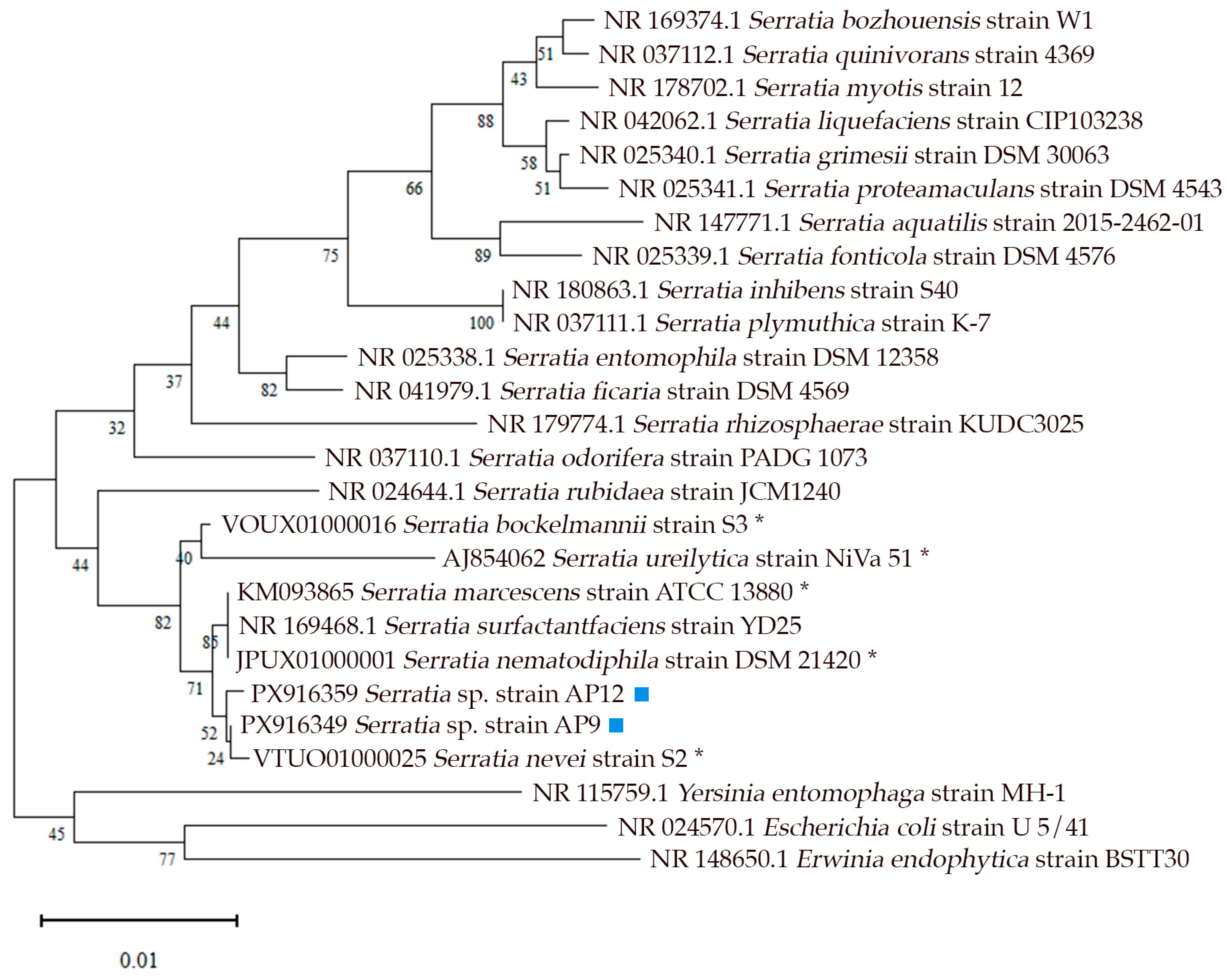
The 16S rRNA gene sequences of rhizobacterial strains AP9 and AP12 (1355 bp and 1370 bp, respectively) were analyzed using the EzBioCloud 16S database and phylogenetic reconstruction. Analysis via the EzBioCloud database revealed that both strains exhibited high sequence similarity to members of the genus Serratia. Strain AP9 displayed 99.85% similarity to S. marcescens ATCC 13880, 99.78% to S. nevei S2, 99.70% to S. nematodiphila DSM 21420 and S. surfactantfaciens YD25, and 99.55% to S. bockelmannii S3. Strain AP12 exhibited 99.78% similarity to both S. marcescens ATCC 13880 and S. surfactantfaciens YD25, 99.71% similarity to S. nevei S2, 99.64% to S. nematodiphila DSM 21420, and 99.56% to S. bockelmannii S3. According to the phylogenetic analysis (Figure 1), the isolates clustered with S. nevei S2, S. surfactantfaciens YD25, S. marcescens ATCC 13880, and S. nematodiphila DSM 21420 (71% bootstrap support). This allowed their classification as members of the genus Serratia.

3.4. Effects of Serratia sp. Strains on T. aestivum Seedling Germination and Growth Under Salinity

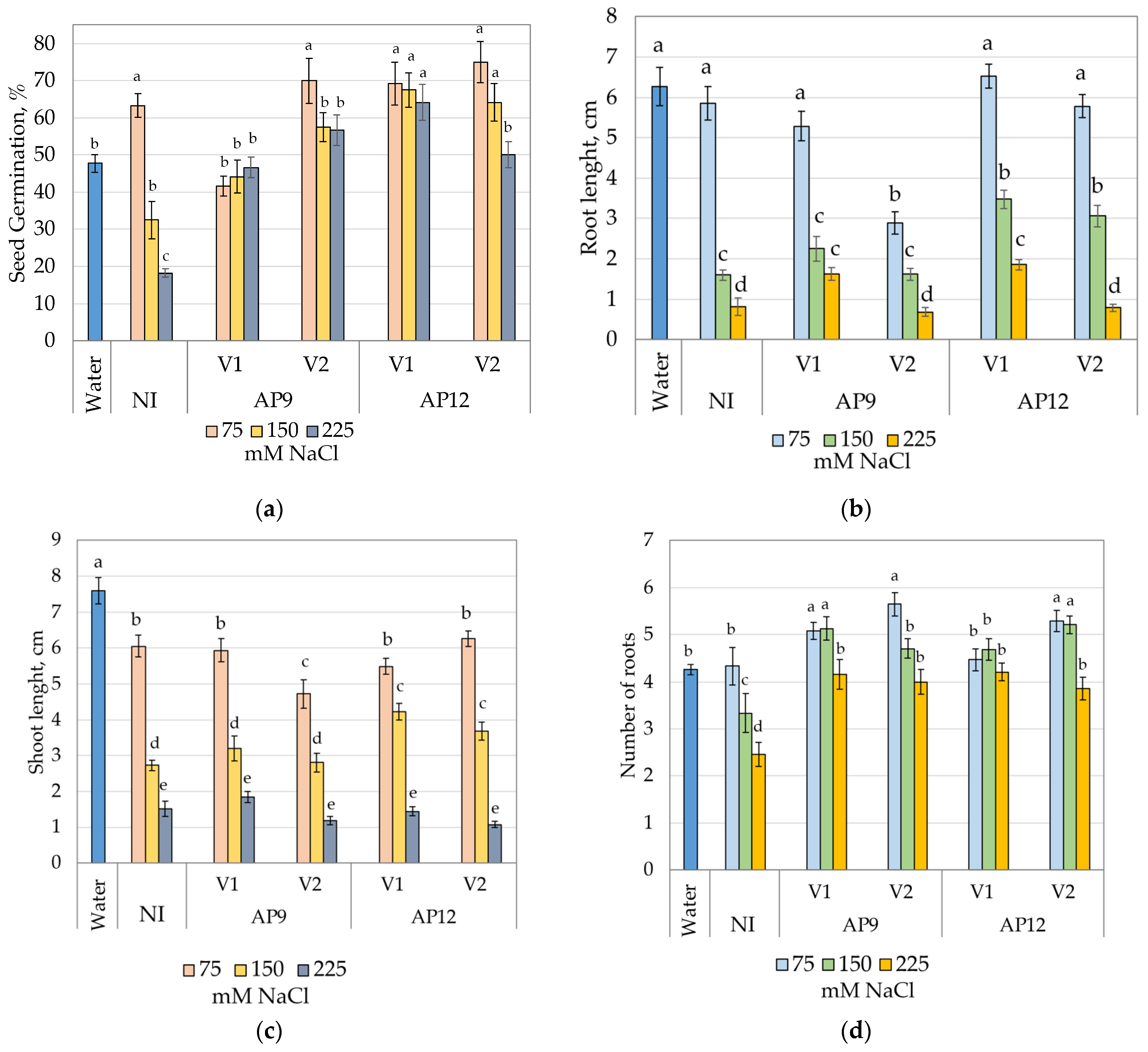
Seed germination at 150 and 225 mM NaCl in the control variants (without inoculation) was reduced (Figure 2a). No stimulatory effect of the bacterial inoculants was observed at 75 mM NaCl. However, at 150 mM NaCl, treatment with AP12 (V1 and V2) and AP9 (V2) led to a significant increase in seed germination compared to the non-inoculated control. At 225 mM NaCl, both strains, AP9 and AP12, in both treatment variants (V1 and V2), increased seed germination to levels obtained for the control seeds germinated in water. The results of the one-way analysis of variance confirmed statistically significant differences between the experimental variants.
Salinity (150 and 225 mM NaCl) caused a reduction in root and shoot length in non-inoculated plants (Figure 2b,c and Figure S1). Inoculation with AP9 demonstrated a stimulatory effect only in the V1 treatment at a concentration of 225 mM NaCl. The increase in root length was 99% compared to non-inoculated plants at the same salt concentration. In the V2 treatment variant, root length decreased by 51% at 75 mM NaCl and remained unchanged at 150 and 225 mM. Shoot length in seeds treated with strain AP9 did not change, except for the V2 treatment at 75 mM NaCl, where a 22% decrease was observed.
Inoculation of seeds with AP12 did not affect root and shoot length at 75 mM NaCl. Stimulatory effects were detected for root and shoot growth at 150 mM NaCl, with increases of 118% and 117% for roots and 55% and 35% for shoots, respectively, compared to the control (Figure 2b,c). At 225 mM NaCl, root length increased by 127% compared to the control, but only when the seeds were treated with the lower dose of bacterial cells (V1).
Seed inoculation with strains AP9 and AP12 influenced the number of roots (Figure 2d). In non-inoculated seeds, salinity resulted in a decrease in the number of primary roots. Inoculation with AP9 (both treatment variants) under 75 mM NaCl increased the root number by 17% and 30% compared to untreated plants, while inoculation with AP12 (treatment variant V2) increased it by 22%. When seeds were inoculated, regardless of the treatment variant (V1 or V2), the number of primary roots increased by 29–56% compared to the control under 150 mM NaCl. Under 225 mM NaCl, a stimulatory effect (ranging from 57% to 72%) was demonstrated for both strains compared to the control (non-inoculated seeds). Since positive effects on root length across the entire range of sodium chloride concentrations were observed for both strains in the V1 treatment (inoculum density of 108 CFU mL−1), it was selected for the next experiment.

3.5. Effects of Serratia sp. Strains on Stress Markers in T. aestivum Seedlings

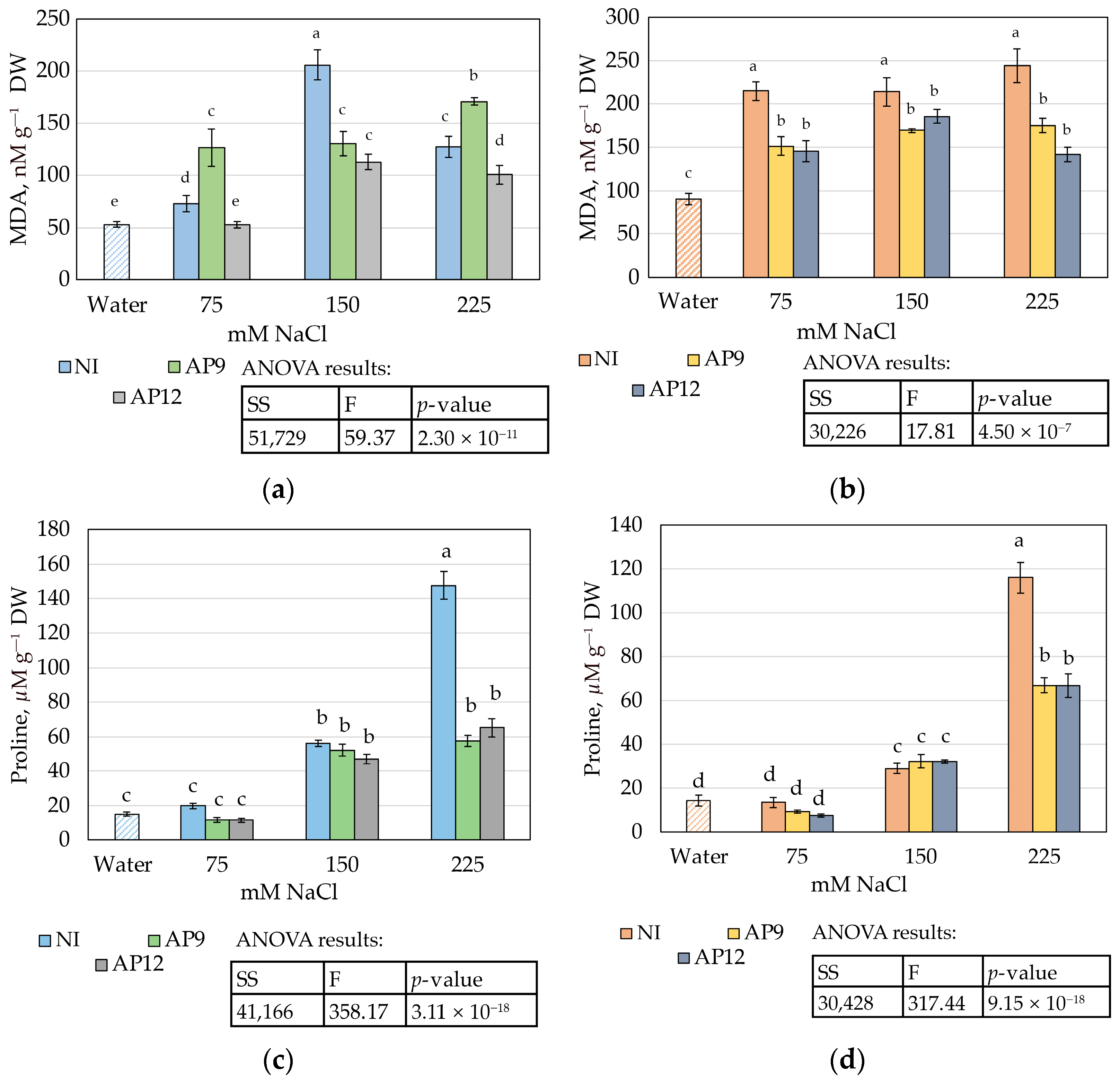
In non-inoculated plants, increasing concentrations of sodium chloride in the growth medium led to elevated levels of MDA in both roots and shoots (Figure 3a). Bacterial inoculation resulted in lower MDA content in leaves compared to non-inoculated plants. However, the plants still experienced stress, as indicated by higher MDA levels relative to the non-saline control. In the roots inoculated with strain AP12, the MDA content was reduced under salinity by 27% (75 mM), 45% (150 mM), and 21% (225 mM) compared to the control (Figure 3a,b). Inoculation with strain AP9 induced differential effects on MDA content compared to the control: at 75 and 225 mM, it increased by 73 and 34%, respectively, whereas at 150 mM, it decreased by 36%.
The content of proline, an indicator of salt stress, increased in the roots and leaves of seedlings with rising sodium chloride concentrations (150 and 225 mM) compared to the water control. Treatment with strains AP9 and AP12 led to a significant reduction in proline content under 225 mM NaCl compared to the control: by 61% and 56% in roots and by 42% in leaves, respectively, (Figure 3c,d). Under 75 mM and 150 mM NaCl, proline content remained unchanged following bacterial treatment.
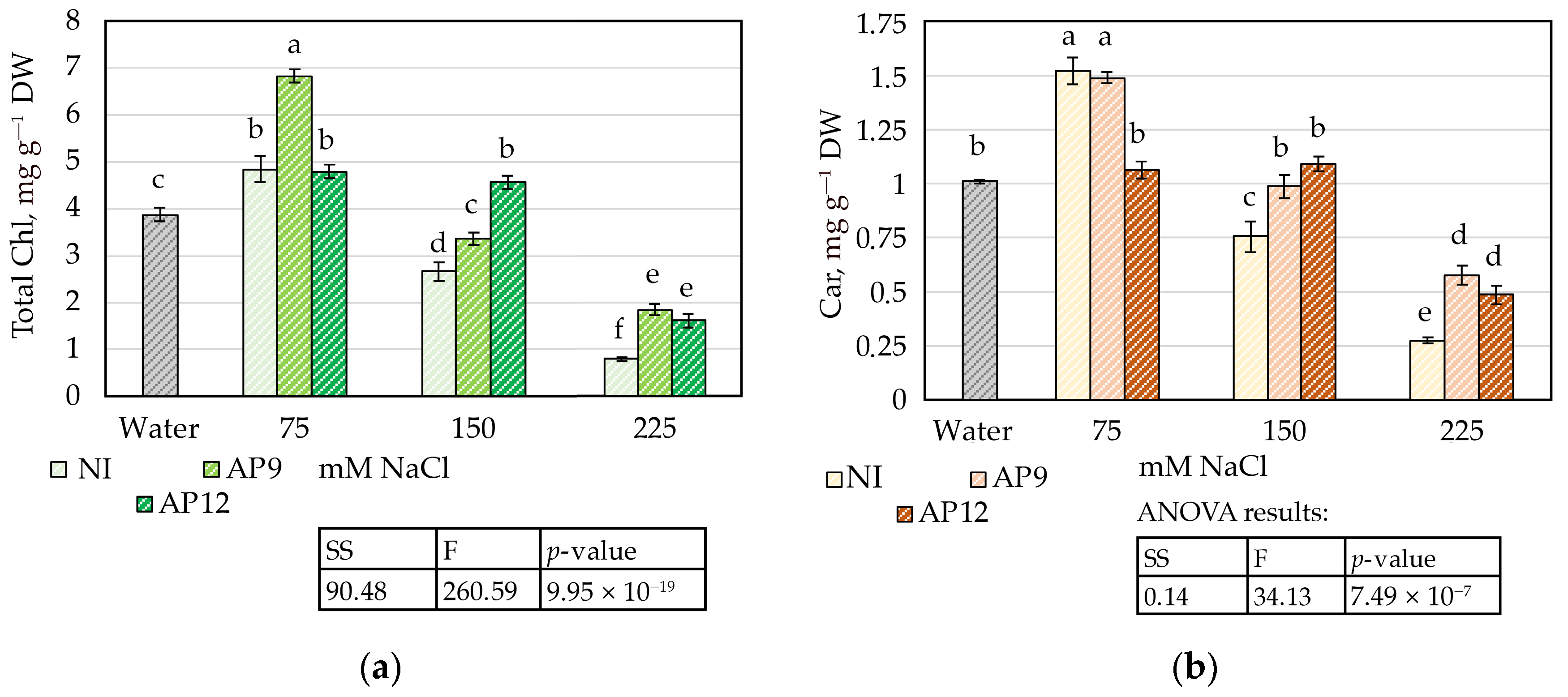
Sodium chloride at concentrations of 150 mM and 225 mM, compared to the water control, in the leaves of non-inoculated plants caused a reduction in chlorophyll (Chl) content by 31% and 79%, respectively, and in carotenoid (Car) content by 25% and 72%, respectively (Figure 4). This effect was less pronounced in the presence of bacteria. Treatment with the AP9 strain under 75 mM NaCl led to a significant 41% increase in Chl content. At 75 mM NaCl, Car content did not change upon inoculation with strain AP9 but decreased by 30% when treated with strain AP12 compared to non-inoculated seeds. Treatment with both bacterial strains led to an increase in the content of photosynthetic pigments under the influence of 150 mM and 225 mM NaCl compared to non-inoculated plants. Chl content increased by 26% and 130% in plants inoculated with strain AP9 at 150 mM and 225 mM NaCl, respectively, and by 71% and 101% in plants inoculated with strain AP12. Carotenoid content increased by 31% and 111% in plants inoculated with strain AP9 and by 44% and 78% with strain AP12, respectively.

4. Discussion

Soil salinization represents a major abiotic stress limiting plant growth and development, causing oxidative, osmotic, and ionic disturbances, which lead to Na+/K+ imbalance and disruption of cellular metabolism [2,3]. Seedlings of crop plants, particularly T. aestivum, are sensitive to salinity, exhibiting reduced seed germination vigor, inhibited root system growth, and increased levels of lipid peroxidation [43,44]. The present study demonstrates that inoculation of T. aestivum seeds with the rhizobacteria Serratia sp. AP9 and AP12 enhanced seedling tolerance to salt stress and improved their morphophysiological characteristics upon exposure to NaCl.
It is known that representatives of the Serratia genus can synthesize biologically active substances, including IAA and siderophores, and can increase the availability of nitrogen to plants through biological nitrogen fixation [15,16,17,18,19]. In our study, the highest production of IAA was observed for Serratia sp. strains AP3 and AP9.
Several in vitro studies showed that various PGP bacteria can exert different effects on root architecture. Specifically, they can stimulate the growth of primary roots in cereals, as well as the development of lateral roots and root hairs. In turn, some bacterial strains can reduce primary root elongation while simultaneously increasing the number and/or length of lateral roots and root hairs [45,46,47]. IAA is a key phytohormone produced by PGP bacteria that regulates root development [45,48]. In our study, the inoculation of wheat seeds with the Serratia sp. strains AP9 and AP12 showed an increase in the number of seminal roots and enhanced growth under saline conditions. We suppose that this leads to an increased absorptive surface area of the roots, thereby improving the efficiency of water and mineral uptake by plants under salinity. Strain AP12 exhibited the most pronounced positive effect on wheat root and shoot growth at 150 mM NaCl. Similar results have been reported by other researchers [15,16,17,18,19], who demonstrated that Serratia sp. strains improve plant growth through combined PGP mechanisms.
Compared to other PGP bacteria isolated from the rhizosphere of halophytes [9,11], AP9 and AP12 also demonstrate high salt tolerance—able to grow under 12–15% NaCl. Data on IAA production are closely related to halotolerant bacteria strains [11,49]. PGP traits, including phosphate solubilization and siderophore production, were also shown [9,11,49,50,51].
A marker of salt stress is an increased level of ROS, which intensifies lipid peroxidation processes, as indicated by the accumulation of MDA [36,52]. In our study, inoculation of T. aestivum with Serratia sp. AP12 reduced MDA content in both roots and leaves compared to non-inoculated plants, while inoculation with strain AP9 reduced it only in leaves. This indicates a mitigation of oxidative stress intensity and a protective effect exerted by the studied bacteria. Under high salinity (225 mM NaCl), proline content decreased in wheat plants treated with Serratia sp. strains. Proline is an osmolyte and a biomarker of salt stress [52], and the decline in its content in the presence of bacteria may indicate a decreased stress load on the plants.
Oxidative stress is one of the factors of photosynthetic pigment degradation [53]. Inoculation of wheat seeds with strains AP9 and AP12 did not reduce the pigment content in leaves under salt stress and, in fact, showed an increase compared to non-inoculated plants. Thus, the lowered level of oxidative stress in plants inoculated by Serratia sp. strains ensured the potential photosynthetic activity and reflected the overall positive effect of AP9 and AP12 on T. aestivum seedlings under saline conditions.
Serratia sp. strains are considered promising agents for the biological stimulation of plant growth due to their PGP properties [15,16,17,18,19]. They are characterized by a relatively low biological risk, making them attractive for use in sustainable agricultural technologies [54]. Previous studies have reported the role of Serratia spp. strains in stimulating plant growth [54,55], enhancing plant resistance to phytopathogens [56], and mitigating stress induced by heavy metals [34].
Our results demonstrate that Serratia sp. strains AP9 and AP12 can effectively enhance the salt tolerance of the glycophyte T. aestivum to moderate (150 mM NaCl) and high (225 mM NaCl) salinity by reducing oxidative stress and supporting growth processes. The strain AP12 exhibited pronounced stimulatory effects at high NaCl concentrations, indicating its potential for application in regions with saline soils.
In the present study, we examined the influence of Serratia sp. AP9 and AP12 strains in two treatment variants (~108 CFU·mL−1 and ~1016 CFU·mL−1) on seed germination, seedling size, and number of seminal roots of T. aestivum. The treatment of ~108 CFU·mL−1 is widely accepted in most publications [36,54,55]. We showed that, for both Serratia sp. strains, the stimulatory effects on plant growth under saline conditions were less pronounced at the 1016 CFU·mL−1 treatment compared to the 108 CFU·mL−1. It is likely that an excessively high density of bacterial cells may lead to an overload of phytohormonal signals or disrupt the optimal plant-microbe ratio, thereby reducing the interaction efficiency [57]. Consequently, an inoculum concentration of 108 CFU·mL−1 can be considered optimal for further research and for developing microbial preparations based on Serratia sp. strains to stimulate the growth of T. aestivum under saline conditions.
Despite the high degree of 16S rRNA sequence similarity of the isolated strains to S. marcescens, S. surfactantfaciens, S. nevei, and S. nematodophila, definitive species identification requires further confirmation through whole-genome sequencing. This is particularly important when considering the existence of phylogenetically close species within the genus Serratia that exhibit high 16S rRNA sequence homology [55].
Nevertheless, results obtained both in vitro and in vivo confirm the potential of the isolated Serratia sp. strains as effective growth-promoting and stress-protective agents capable of enhancing plant salinity tolerance and contributing to the development of environmentally sustainable agricultural practices.

5. Conclusions

Halotolerant rhizobacteria Serratia sp. were isolated and characterized from the rhizosphere of the halophyte A. prostrata. The strains Serratia sp. AP9 and AP12 possessed a complex of PGP traits, including the production of IAA, phosphate solubilization, and siderophore synthesis. Under saline conditions, inoculation of T. aestivum seeds with these strains enhanced seed germination vigor and promoted the development of the seedling root system compared to non-inoculated stressed plants. Exposure of inoculated plants to 150 and 225 mM NaCl resulted in increased chlorophyll content in the leaves, as well as reduced oxidative stress in both the shoots and roots. The obtained results indicate the potential of the Serratia sp. AP9 and AP12 strains as promising candidates for agro-biotechnological applications aimed at improving plant salinity tolerance. These findings may contribute to the development of environmentally safe technologies for sustainable agriculture.

Supplementary Materials

The following supporting information can be downloaded at https://www.mdpi.com/article/10.3390/applmicrobiol6030036/s1, Table S1: Physicochemical properties and ion composition of the bulk soil; Table S2: Morphological characteristics of strains isolated from the rhizosphere of A. prostrata; Table S3: Biochemical characteristics of strains isolated from the rhizosphere of A. prostrata; Figure S1: Effect of inoculation of T. aestivum seeds with Serratia sp. AP9 and AP12 strains on etiolated seedlings under 75, 150, and 225 mM NaCl.

Author Contributions

Conceptualization, A.S.T., O.V.V., and I.S.K.; methodology, A.S.T., O.V.V., and A.A.E.; software, A.S.T.; validation, A.S.T., O.V.V., and I.S.K.; formal analysis, A.S.T. and O.V.V.; investigation, A.S.T., O.V.V., G.I.S., and A.A.E.; resources, A.S.T. and I.S.K.; data curation, A.S.T.; writing—original draft preparation, A.S.T. and O.V.V.; writing—review and editing, A.S.T., O.V.V., G.I.S., A.A.E., and I.S.K.; visualization, A.S.T. and O.V.V.; supervision, I.S.K.; project administration, A.S.T.; funding acquisition, A.S.T. All authors have read and agreed to the published version of the manuscript.

Funding

This work was supported by the Russian Science Foundation, grant number 24-76-10062, https://rscf.ru/project/24-76-10062/, accessed on 26 January 2026.

Institutional Review Board Statement

Not applicable.

Informed Consent Statement

Not applicable.

Data Availability Statement

The 16S rRNA gene sequences generated in this study are openly available in the NCBI GenBank database. They can be accessed under the accession numbers PX916349 and PX916359.

Conflicts of Interest

The authors declare no conflicts of interest.

Abbreviations

The following abbreviations are used in this manuscript:
ACC1-Aminocyclopropane-1-carboxylate
ALAtavly Lake
ANOVAAnalysis of Variance
CarCarotenoid
CFUColony-forming units
ChlChlorophyll
DWDry weight
ECElectric conductivity
IAAIndolyl acetic acid
KLKurgi Lake
LBLuria-Bertani
MDAMalondialdehyde
MICMinimal inhibitory concentration
NCBINational Center for Biotechnology Information
NINon-inoculated
V1108 CFU mL−1
V21016 CFU mL−1
PGPPlant growth-promoting
ROSReactive oxygen species
SDStandard deviation
TVCTotal Viable Count

References

  1. Cuevas, J.; Daliakopoulos, I.N.; del Moral, F.; Hueso, J.J.; Tsanis, I.K. A Review of Soil-Improving Cropping Systems for Soil Salinization. Agronomy 2019, 9, 295. [Google Scholar] [CrossRef]
  2. Atta, K.; Mondal, S.; Gorai, S.; Singh, A.P.; Kumari, A.; Ghosh, T.; Roy, A.; Hembram, S.; Gaikwad, D.J.; Mondal, S.; et al. Impacts of Salinity Stress on Crop Plants: Improving Salt Tolerance through Genetic and Molecular Dissection. Front. Plant Sci. 2023, 14, 1241736. [Google Scholar] [CrossRef]
  3. Zhou, H.; Shi, H.; Yang, Y.; Feng, X.; Chen, X.; Xiao, F.; Lin, H.; Guo, Y. Insights into Plant Salt Stress Signaling and Tolerance. J. Genet. Genom. 2024, 51, 16–34. [Google Scholar] [CrossRef] [PubMed]
  4. Peng, M.; Jiang, Z.; Zhou, F.; Wang, Z. From Salty to Thriving: Plant Growth Promoting Bacteria as Nature’s Allies in Overcoming Salinity Stress in Plants. Front. Microbiol. 2023, 14, 1169809. [Google Scholar] [CrossRef]
  5. Gamalero, E.; Glick, B.R. Recent Advances in Bacterial Amelioration of Plant Drought and Salt Stress. Biology 2022, 11, 437. [Google Scholar] [CrossRef]
  6. Egamberdieva, D.; Wirth, S.; Bellingrath-Kimura, S.D.; Mishra, J.; Arora, N.K. Salt-Tolerant Plant Growth Promoting Rhizobacteria for Enhancing Crop Productivity of Saline Soils. Front. Microbiol. 2019, 10, 2791. [Google Scholar] [CrossRef]
  7. Chebotar, V.K.; Chizhevskaya, E.P.; Khonina, O.V.; Kostitsin, R.D.; Kurmanbayev, A.A.; Mukhambetov, B.; Pishchik, V.N.; Baganova, M.E.; Lapenko, N.G. Biotechnological Potential of Galophytes and Their Microbiomes for Agriculture in Russia and Kazakhstan. Russ. J. Plant Physiol. 2023, 70, 183. [Google Scholar] [CrossRef]
  8. Tugbaeva, A.S.; Ermoshin, A.A.; Shiryaev, G.I.; Kiseleva, I.S. Microbiome of the Soil and Rhizosphere of the Halophyte Spergularia marina (L.) Griseb in the Saline Sites of Lake Kurgi, the South Urals: Metagenomic Analysis. Microbiol. Res. 2025, 16, 64. [Google Scholar] [CrossRef]
  9. Christakis, C.A.; Daskalogiannis, G.; Chatzaki, A.; Markakis, E.A.; Mermigka, G.; Sagia, A.; Rizzo, G.F.; Catara, V.; Lagkouvardos, I.; Studholme, D.J.; et al. Endophytic Bacterial Isolates from Halophytes Demonstrate Phytopathogen Biocontrol and Plant Growth Promotion under High Salinity. Front. Microbiol. 2021, 12, 681567. [Google Scholar] [CrossRef]
  10. Li, Y.; Gao, M.; Zhang, W.; Liu, Y.; Wang, S.; Zhang, H.; Li, X.; Yu, S.; Lu, L. Halotolerant Enterobacter asburiae A103 Isolated from the Halophyte Salix linearistipularis: Genomic Analysis and Growth-Promoting Effects on Medicago sativa under Alkali Stress. Microbiol. Res. 2024, 289, 127909. [Google Scholar] [CrossRef] [PubMed]
  11. Albdaiwi, R.N.; Khyami-Horani, H.; Ayad, J.Y.; Alananbeh, K.M.; Al-Sayaydeh, R. Isolation and Characterization of Halotolerant Plant Growth Promoting Rhizobacteria from Durum Wheat (Triticum turgidum subsp. durum) Cultivated in Saline Areas of the Dead Sea Region. Front. Microbiol. 2019, 10, 1639. [Google Scholar] [CrossRef] [PubMed]
  12. Žerdoner Čalasan, A.; Hammen, S.; Sukhorukov, A.P.; McDonald, J.T.; Brignone, N.F.; Böhnert, T.; Kadereit, G. From Continental Asia into the World: Global Historical Biogeography of the Saltbush Genus Atriplex (Chenopodieae, Chenopodioideae, Amaranthaceae). Perspect. Plant Ecol. Evol. Syst. 2022, 54, 125660. [Google Scholar] [CrossRef]
  13. Bueno, M.; Lendínez, M.L.; Aparicio, C.; del Pilar Cordovilla, M. Germination and Growth of Atriplex prostrata and Plantago coronopus: Two Strategies to Survive in Saline Habitats. Flora 2017, 227, 56–63. [Google Scholar] [CrossRef]
  14. Mukhtar, S.; Mehnaz, S.; Mirza, M.S.; Malik, K.A. Isolation and Characterization of Bacteria Associated with the Rhizosphere of Halophytes (Salsola stocksii and Atriplex amnicola) for Production of Hydrolytic Enzymes. Braz. J. Microbiol. 2019, 50, 85–97. [Google Scholar] [CrossRef]
  15. Kulkova, I.; Wróbel, B.; Dobrzyński, J. Serratia spp. as Plant Growth-Promoting Bacteria Alleviating Salinity, Drought, and Nutrient Imbalance Stresses. Front. Microbiol. 2024, 15, 1342331. [Google Scholar] [CrossRef]
  16. Ali, S.; Khan, M.; Moon, Y.-S. Synergistic Effect of Serratia fonticola and Pseudomonas koreensis on Mitigating Salt Stress in Cucumis sativus L. Curr. Issues Mol. Biol. 2025, 47, 194. [Google Scholar] [CrossRef]
  17. Han, H.S.; Lee, K.D. Plant Growth Promoting Rhizobacteria Effect on Antioxidant Status, Photosynthesis, Mineral Uptake and Growth of Lettuce under Soil Salinity. Res. J. Agric. Biol. Sci. 2005, 1, 210–215. [Google Scholar]
  18. Egamberdieva, D.; Kucharova, Z.; Davranov, K.; Berg, G.; Makarova, N.; Azarova, T.; Chebotar, V.; Tikhonovich, I.; Kamilova, F.; Validov, S.Z.; et al. Bacteria Able to Control Foot and Root Rot and to Promote Growth of Cucumber in Salinated Soils. Biol. Fertil. Soils 2011, 47, 197–205. [Google Scholar] [CrossRef]
  19. Mahdi, I.; Hafidi, M.; Allaoui, A.; Biskri, L. Halotolerant Endophytic Bacterium Serratia rubidaea ED1 Enhances Phosphate Solubilization and Promotes Seed Germination. Agriculture 2021, 11, 224. [Google Scholar] [CrossRef]
  20. Haldar, A.; Sahoo, A.; Bandyopadhyay, S.; Das, K.; Gangopadhyay, S.; Dwivedi, B. Comparison of Different Methods of Electrical Conductivity Determination for Assessment of Salinity in Soils of Coastal Region, West Bengal. Int. J. Chem. Stud. 2021, 9, 116–121. [Google Scholar] [CrossRef]
  21. Karadağ, S.; Eren, E.; Çetinkaya, E.; Özen, S.; Deveci, S. Optimization of Sodium Extraction from Soil by Using a Central Composite Design (CCD) and Determination of Soil Sodium Content by Ion Selective Electrodes. Eurasian J. Soil Sci. 2016, 5, 89–96. [Google Scholar][Green Version]
  22. Kolmert, A.; Wikström, P.; Hallberg, K.B. A Fast and Simple Turbidimetric Method for the Determination of Sulfate in Sulfate-Reducing Bacterial Cultures. J. Microbiol. Methods 2000, 41, 179–184. [Google Scholar] [CrossRef]
  23. Richards, L.A. Diagnosis and Improvement of Saline and Alkali Soils; Agriculture Handbook No. 60; US Government Printing Office: Washington DC, USA, 1954.
  24. Nannipieri, P.; Ascher, J.; Ceccherini, M.T.; Landi, L.; Pietramellara, G.; Renella, G. Microbial Diversity and Soil Functions. Eur. J. Soil Sci. 2003, 54, 655–670. [Google Scholar] [CrossRef]
  25. Bogati, K.A.; Sewerniak, P.; Walczak, M. Unraveling the Effect of Soil Moisture on Microbial Diversity and Enzymatic Activity in Agricultural Soils. Microorganisms 2025, 13, 1245. [Google Scholar] [CrossRef] [PubMed]
  26. Bergey, D.H.; Holt, J.G.; Krieg, P.; Sneath, P.H. Bergey’s Manual of Determinative Bacteriology; Williams and Wilkins: Baltimore, MD, USA, 1994. [Google Scholar]
  27. Cappuccino, J.G.; Sherman, N. Microbiology: A Laboratory Manual, 10th ed.; Pearson Education: Boston, MA, USA, 2014. [Google Scholar]
  28. Kumar, A.; Singh, S.; Gaurav, A.K.; Srivastava, S.; Verma, J.P. Plant Growth-Promoting Bacteria: Biological Tools for the Mitigation of Salinity Stress in Plants. Front. Microbiol. 2020, 11, 1216. [Google Scholar] [CrossRef]
  29. Bric, J.M.; Bostock, R.M.; Silverstone, S.E. Rapid In Situ Assay for Indoleacetic Acid Production by Bacteria Immobilized on a Nitrocellulose Membrane. Appl. Environ. Microbiol. 1991, 57, 535–538. [Google Scholar] [CrossRef]
  30. Ribeiro, C.M.; Cardoso, E.J.B.N. Isolation, Selection and Characterization of Root-Associated Growth Promoting Bacteria in Brazil Pine (Araucaria angustifolia). Microbiol. Res. 2012, 167, 69–78. [Google Scholar] [CrossRef] [PubMed]
  31. Borisova, G.; Maleva, M.; Tripti; Voropaeva, O.; Chukina, N.; Tugbaeva, A.; Kumar, A. Amalgamation of Metal Tolerant PGPR Buttiauxella sp. EA20 with Birch Wood Biochar Enhanced Growth and Biofortification of Rapeseed under Copper Action. Front. Biosci. 2024, 16, 34. [Google Scholar] [CrossRef]
  32. Arnow, L.E. Colorimetric Determination of the Components of 3,4-Dihydroxyphenylalanine-Tyrosine Mixtures. J. Biol. Chem. 1937, 118, 531–537. [Google Scholar]
  33. Atkin, C.L.; Neilands, J.B.; Phaff, H.J. Rhodotorulic Acid from Species of Leucosporidium, Rhodosporidium, Rhodotorula, Sporidiobolum and Sporobolomyces and a New Alanine-Containing Ferrichrome from Cryptococcus melibiosum. J. Bacteriol. 1970, 103, 722–733. [Google Scholar] [CrossRef] [PubMed]
  34. Tripti; Kumar, A.; Maleva, M.; Borisova, G.; Rajkumar, M. Amaranthus Biochar-Based Microbial Cell Composites for Alleviation of Drought and Cadmium Stress: A Novel Bioremediation Approach. Plants 2023, 12, 1973. [Google Scholar] [CrossRef] [PubMed]
  35. Tamura, K.; Stecher, G.; Kumar, S. MEGA11: Molecular Evolutionary Genetics Analysis Version 11. Mol. Biol. Evol. 2021, 38, 3022–3027. [Google Scholar] [CrossRef] [PubMed]
  36. Saitou, N.; Nei, M. The Neighbor-Joining Method: A New Method for Reconstructing Phylogenetic Trees. Mol. Biol. Evol. 1987, 4, 406–425. [Google Scholar] [CrossRef] [PubMed]
  37. Tamura, K.; Nei, M. Estimation of the number of nucleotide substitutions in the control region of mitochondrial DNA in humans and chimpanzees. Mol. Biol. Evol. 1993, 10, 512–526. [Google Scholar] [CrossRef]
  38. Felsenstein, J. Confidence Limits on Phylogenies: An Approach Using the Bootstrap. Evolution 1985, 39, 783–791. [Google Scholar] [CrossRef]
  39. Srivastava, P.; Tiwari, S.P.; Srivastava, A.K.; Sharma, R. Optimization of Sterilization Parameters for Isolation of Endophytes from Allium sativum and Exploring its Antibacterial Activity. J. Pure Appl. Microbiol. 2024, 18, 961–979. [Google Scholar] [CrossRef]
  40. Lichtenthaler, H.K. Chlorophylls and Carotenoids: Pigments of Photosynthetic Membranes. Methods Enzymol. 1987, 148, 350–382. [Google Scholar]
  41. Maleva, M.; Borisova, G.; Filimonova, E.; Lukina, N.; Chukina, N.; Ermoshin, A.; Tugbaeva, A.; Voropaeva, O. Adaptive Redox Reactions Promote Naturalization of Rare Orchid Epipactis atrorubens on Serpentine Dumps Post Asbestos Mining. Horticulturae 2022, 8, 603. [Google Scholar] [CrossRef]
  42. Heath, R.L.; Packer, L. Photoperoxidation in Isolated Chloroplasts: I. Kinetics and Stoichiometry of Fatty Acid Peroxidation. Arch. Biochem. Biophys. 1968, 125, 189–198. [Google Scholar] [CrossRef]
  43. Saddiq, M.S.; Iqbal, S.; Hafeez, M.B.; Ibrahim, A.M.H.; Raza, A.; Fatima, E.M.; Baloch, H.; Jahanzaib; Woodrow, P.; Ciarmiello, L.F. Effect of Salinity Stress on Physiological Changes in Winter and Spring Wheat. Agronomy 2021, 11, 1193. [Google Scholar] [CrossRef]
  44. Jamil, M.; Lee, D.B.; Jung, K.Y.; Ashraf, M.; Lee, S.C.; Rha, E.S. Effect of Salt (NaCl) Stress on Germination and Early Seedling Growth of Four Vegetable Species. J. Cent. Eur. Agric. 2006, 7, 273–282. [Google Scholar]
  45. Grover, M.; Bodhankar, S.; Sharma, A.; Sharma, P.; Singh, J.; Nain, L. PGPR Mediated Alterations in Root Traits: Way toward Sustainable Crop Production. Front. Sustain. Food Syst. 2021, 4, 618230. [Google Scholar] [CrossRef]
  46. Ivanchenko, M.G.; Napsucialy-Mendivil, S.; Dubrovsky, J.G. Auxin-Induced Inhibition of Lateral Root Initiation Contributes to Root System Shaping in Arabidopsis thaliana. Plant J. 2010, 64, 740–752. [Google Scholar] [CrossRef] [PubMed]
  47. Vejan, P.; Abdullah, R.; Khadiran, T.; Ismail, S.; Nasrulhaq Boyce, A. Role of Plant Growth Promoting Rhizobacteria in Agricultural Sustainability—A Review. Molecules 2016, 21, 573. [Google Scholar] [CrossRef]
  48. Ma, Y.; Zhang, Y.; Xu, J.; Qi, J.; Liu, X.; Guo, L.; Zhang, H. Research on the Mechanisms of Phytohormone Signaling in Regulating Root Development. Plants 2024, 13, 3051. [Google Scholar] [CrossRef] [PubMed]
  49. Mapelli, F.; Marasco, R.; Roll, E.; Barbato, M.; Cherif, H.; Guesmi, A.; Ouzari, I.; Daffonchio, D.; Borin, S. Potential for Plant Growth Promotion of Rhizobacteria Associated with Salicornia growing in Tunisian Hypersaline Soils. Biomed. Res. Int. 2013, 2013, 248078. [Google Scholar] [CrossRef] [PubMed]
  50. Zhao, S.; Zhou, N.; Zhao, Z.Y.; Zhang, K.; Wu, G.H.; Tian, C.Y. Isolation of Endophytic Plant Growth-Promoting Bacteria Associated with the Halophyte Salicornia europaea and Evaluation of their Promoting Activity Under Salt Stress. Curr. Microbiol. 2016, 73, 574–581. [Google Scholar] [CrossRef]
  51. Ullah, S.; Bano, A. Isolation of plant-growth-promoting rhizobacteria from rhizospheric soil of halophytes and their impact on maize (Zea mays L.) under induced soil salinity. Can. J. Microbiol. 2015, 61, 307–313. [Google Scholar] [CrossRef]
  52. Patwa, N.; Pandey, V.; Gupta, O.P.; Yadav, A.; Meena, M.R.; Ram, S.; Singh, G. Unravelling Wheat Genotypic Responses: Insights into Salinity Stress Tolerance in Relation to Oxidative Stress, Antioxidant Mechanisms, Osmolyte Accumulation and Grain Quality Parameters. BMC Plant Biol. 2024, 24, 875. [Google Scholar] [CrossRef]
  53. Bacha, H.; Tekaya, M.; Drine, S.; Guasmi, F.; Touil, L.; Enneb, H.; Triki, T.; Cheour, F.; Ferchichi, A. Impact of Salt Stress on Morpho-Physiological and Biochemical Parameters of Solanum lycopersicum cv. Microtom Leaves. S. Afr. J. Bot. 2017, 108, 364–369. [Google Scholar] [CrossRef]
  54. Alvarado, C.A.; Durand, Z.H.; Rodriguez-Grados, P.M.; Tineo, D.L.; Takei, D.H.; Arbizu, C.I.; Contreras-Liza, S. The Growth-Promoting Ability of Serratia liquefaciens UNJFSC 002, a Rhizobacterium Involved in Potato Production. Int. J. Plant Biol. 2025, 16, 82. [Google Scholar] [CrossRef]
  55. Martínez, O.A.; Encina, C.; Tomckowiack, C.; Droppelmann, F.; Jara, R.; Maldonado, C.; Muñoz, O.; García-Fraile, P.; Rivas, R. Serratia Strains Isolated from the Rhizosphere of Raulí (Nothofagus alpina) in Volcanic Soils Harbour PGPR Mechanisms and Promote Raulí Plantlet Growth. J. Soil Sci. Plant Nutr. 2018, 18, 804–819. [Google Scholar] [CrossRef]
  56. Ortiz, A.; Sansinenea, E. The Possibility of Using Serratia Isolates for the Production of Biopreparations in the Protection of Plants against Diseases and Pests. Arch. Microbiol. 2023, 205, 288. [Google Scholar] [CrossRef] [PubMed]
  57. Bueno, C.B.; dos Santos, R.M.; de Souza Buzo, F.; de Andrade da Silva, M.S.R.; Rigobelo, E.C. Effects of Chemical Fertilization and Microbial Inoculum on Bacillus subtilis Colonization in Soybean and Maize Plants. Front. Microbiol. 2022, 13, 901157. [Google Scholar] [CrossRef]
Figure 1. A phylogenetic tree was constructed based on 16S rRNA gene sequences from Serratia sp. strains AP9 and AP12, other members of the genus Serratia, and Erwinia endophytica, Yersinia entomophaga, and Escherichia coli were used as the outer group (the order Enterobacterales). The tree was reconstructed using the neighbor-joining method. The percentages of replicate trees in which the associated taxa clustered together in the bootstrap test (1000 replicates) are shown at the nodes. Sequences obtained from EzBioCloud are marked with an asterisk (*). Blue squares indicate the investigated strains.
Applmicrobiol 06 00036 g001
Figure 2. Effect of Serratia sp. strains on seed germination (a), root length (b), shoot length (c), and root number (d) in T. aestivum seedlings grown under NaCl stress. Data represent mean values ± SD (n = 5 for seed germination; n = 50 for other parameters). Different lowercase letters denote statistically significant differences (p < 0.05) among treatment groups, as determined by one-way ANOVA, followed by Tukey’s post hoc test. V1 and V2 refer to inoculum densities of 108 and 1016 CFU mL−1, respectively. NI indicates the non-inoculated control.
Applmicrobiol 06 00036 g002
Figure 3. Content of MDA in (a) root and (b) leaf; proline content in (c) root and (d) leaf in T. aestivum seedlings under NaCl treatment. Data represent mean values ± SD for five replicates. Different lowercase letters denote statistically significant differences (p < 0.05) among treatment groups, as determined by one-way ANOVA, followed by Tukey’s post hoc test. NI means non-inoculated seeds.
Applmicrobiol 06 00036 g003
Figure 4. The content of photosynthetic pigments in the leaves of T. aestivum under NaCl treatment: (a) chlorophyll (Chl), (b) carotenoids (Car). Data represent mean values ± SD for five replicates. Different lowercase letters denote statistically significant differences (p < 0.05) among treatment groups, as determined by one-way ANOVA, followed by Tukey’s post hoc test. NI means non-inoculated seeds.
Applmicrobiol 06 00036 g004
Disclaimer/Publisher’s Note: The statements, opinions and data contained in all publications are solely those of the individual author(s) and contributor(s) and not of MDPI and/or the editor(s). MDPI and/or the editor(s) disclaim responsibility for any injury to people or property resulting from any ideas, methods, instructions or products referred to in the content.