Article

Isolation and Characterization of Flavin-Secreting Bacteria from Apple Roots and Evaluation of Their Plant Growth-Promoting Potential


by
Nivethika Ajeethan
1,*,
Lord Abbey
1 and
Svetlana N. Yurgel
1,2,*
1
Department of Plant, Food, and Environmental Sciences, Faculty of Agriculture, Dalhousie University, Halifax, NS B2N 5E3, Canada
2
USDA, ARS, Grain Legume Genetics and Physiology Research Unit, Prosser, WA 99350, USA
*
Authors to whom correspondence should be addressed.
Appl. Microbiol. 2026, 6(2), 22; https://doi.org/10.3390/applmicrobiol6020022
Submission received: 11 December 2025 / Revised: 12 January 2026 / Accepted: 14 January 2026 / Published: 26 January 2026

Abstract

Plant growth-promoting (PGP) bacteria are beneficial microbes that can help plants mitigate various biotic and abiotic stresses through different PGP functions. Flavins (FLs) are involved in flavoprotein-mediated reactions essential for plant metabolism and could act as PGP molecules. The aim of this study was to isolate and characterize potential FLs secreting bacteria from apple (Malus domestica [Suckow] Borkh) roots based on their fluorescence and to evaluate their PGP properties, including FLs secretion. A total of 26 bacteria with increased fluorescence in liquid culture were isolated from the apple roots. Based on 16S rRNA sequencing analysis, 11 genetically different strains mostly from Burkholderia and Rhizobia spp. were identified. All isolates secreted considerable amounts of riboflavin. In vitro plant assays showed that under nitrogen (N) limitation, inoculated alfalfa (Medicago sativa) plants yielded at least 25% more dry mass than non-inoculated plants, and inoculation with AK7 and FL112 enriched plant tissue N content compared to non-inoculated plants. This improved N acquisition was not linked to symbiotic N fixation. Additionally, the isolates exhibited some other PGP properties. However, no specific PGP functions were linked to improved plant N acquisition but could potentially be linked to the FLs secretion. For future investigation, the mechanisms underlying improved plant N uptake should be assessed to gain a more in-depth understanding.

1. Introduction

Apple (Malus domestica [Suckow] Borkh) production is a major revenue stream for orchard owners in Nova Scotia, Canada [1]. Plant health and development are influenced by interaction between the host plant and its microbiome [2,3]. Bacteria have a versatile metabolic system and are the most abundant members in plant microbiota, demonstrating their capacity to grow under nutrient-limited and unfavorable environmental conditions [4,5]. For instance, bacterial microbiomes influence plant growth, health, and development positively through plant growth-promoting (PGP) functions, and negatively by acting as plant pathogens [2]. Host plants manipulate their associated microbiomes by providing selective environments in their rhizospheres [6,7,8]. These selective environments promote the enrichment of PGP bacteria within root tissue and in root-associated soils [9]. PGP bacteria can provide nutrients such as N, phosphate and/or iron, and facilitate plant growth and development through phosphate solubilization, biological N fixation, or siderophore production [8,10,11]. Root-associated PGP microbes stimulate plant growth and protect plants against biotic and abiotic stresses by producing indole-3-acetic acid (IAA), gibberellins, and cytokinins; exhibiting 1-aminocyclopropane-1-carboxylic acid (ACC) deaminase activity; and/or the inducing of resistance against the biotic and abiotic stressors [2,10,12]. Therefore, the use of PGP microbes in agriculture represents a sustainable and eco-friendly approach to improving crop productivity while reducing reliance on synthetic agrochemicals.
Recent studies have shown that bacterial flavins (FLs) such as riboflavin (RF), flavin mononucleotide (FMN), and flavin adenine dinucleotide (FAD) can be potent PGP molecules [13,14,15]. RF, also known as vitamin B2, is an essential constituent of the coenzymes FMN and FAD. FAD and FMN are involved in various flavoprotein-mediated oxidation-reduction reactions [16] and serve as cofactors for enzymes that facilitate electron transfer reactions using tricyclic isoalloxazine ring to switch between oxidized and reduced states [17]. Flavoenzymes are important to plant life, which are vital in biosynthesis and maintenance of cofactors, coenzymes, and accessory plant pigments and phytohormones. Flavin monooxygenase enzymes are involved in auxin biosynthesis and indirectly influence N metabolism. For example, the exogenous application of RF in rice (Oryza sativa) promoted photosynthetic activity, increased grain weight, and improved overall yield [18]. Lumichrome is a breakdown product of RF [19] and can act as a plant growth-promotor [20].
Previously, it was shown that inoculation with FLs secreting bacteria, Sinorhizobium meliloti 1021, improved plant growth and phytochemical properties in lettuce (Lactuca sativa) and kale (Brassica oleracea var. acephala) compared to its mutant 1021ΔribBA, which has impaired FL secretion [15]. Additionally, FL production has been shown to improve rhizobium–legume symbiotic interaction [21]. However, little is known about the mechanisms underlying the effect of FL application on plant growth and physiology, or about the long-term impact of such inoculation on soil ecosystems. Moreover, the database showed that fewer than five studies have explored the effects of bacteria-derived FLs through inoculation with FLs secreting bacteria, rather than through exogenous application of synthetic FLs; to the best of our knowledge, the present study is the first to report on the isolation of FLs secreting bacteria from apple tree roots.
In this study, we used culture fluorescence (470/530 nm) as an indicator of bacterial FLs secretion in order to select FLs secreting bacteria from apple root-associated microbiome. Direct quantification of FL production using fluorescence spectroscopy or HPLC [22,23,24] is challenging to apply to a large-scale bacterial screening. However, it has been shown that the concentration of FLs in solutions is proportional to fluorescence intensity [25]. Therefore, measuring fluorescence intensity in bacterial liquid cultures may serve as a feasible alternative for this type of selection.
The objectives of this study were to (1) isolate and genetically characterize fluorescent bacteria associated with apple roots, (2) evaluate the PGP functions of the isolates, including FLs secretion, phosphate solubilization, ACC deaminase activity, and IAA production, and (3) assess the ability of the isolates to improve alfalfa plant growth. To our knowledge, this is the first study to isolate FLs secreting bacteria from apple roots based on their culture fluorescence, and to evaluate their PGP potential.

2. Materials and Methods

2.1. Isolation of Root-Associated Bacteria with Increased Fluorescence at 470/530 nm Wavelength

Apple tree root samples were collected from six mature apple orchards in the Annapolis Valley, Nova Scotia in 2019 and 2020 (Table S1). The sampling location and site description have been previously detailed by Ajeethan et al. [26]. Homogenized root tissue (200 mg) was diluted 1:100 (w/v) in sterile water, and 100 µL of the suspension was plated onto minimal mannitol medium containing NH4 (MMNH4) agar plates [27]. Plates were incubated at 28 °C, and single colonies appeared after five days. The colonies were re-streaked twice on the same medium to obtain pure culture prior to transferring into 5 mL culture tube with 2 mL MMNH4 broth and incubating on rotary shaker at 250 rpm and 28 °C and for 48 h. Cultures were then diluted 20-fold into the 2 mL fresh MMNH4 broth and incubated for an additional 7 days under dark conditions with continuous shaking on rotary shaker at 250 rpm and 28 °C. Each strain was cultured in triplicate. From each culture, 200 µL was transferred into sterile 96-well microplate (VWR® solid bottom assay plates, Mississauga, ON, Canada) and fluorescence intensity was measured using Bio-Tek Synergy H1 Hybrid Multi-Mode Reader (BioTek Instruments, Mississauga, ON, Canada) equipped with Gen5 software (version 3.08). Fluorescence intensity was measured at excitation wavelength of 470 nm and emission of 530 nm, corresponding to FMN, FAD, and RF fluorescence [21]. Readings were normalized to optical density of 600 nm (OD600). S. meliloti strains 1021 [28], known for high FLs secretion, and its mutant 1021ΔribBA, with impaired FLs production [21], served as reference strains. Isolates exhibiting significant increase in fluorescence compared to 1021ΔribBA (mutant) were selected for future study.

2.2. Analysis of Flavins (FLs) Secretion by Mass Spectrometry

The isolates were cultured in 3 mL of MMNH4 broth in three biological replicates on rotary shaker for 7 days at 28 °C at 250 rpm under dark conditions. Two mL of each culture were filtered using membrane filter (Minisart syringe filters 0.2 µm, Millipore sigma, ON, Canada) and the filtrates were submitted to the Metabolomics Innovation Centre (TMIC), University of Victoria, BC, Canada, for analysis with two biological replicates per sample. An additional 1 mL of culture per isolate was centrifuged at 20,000× g for 20 min. The supernatants were discarded, and the resulting pellets were dried at 37 °C for 24 h. Pellet weights were recorded using pre-weighed empty Eppendorf tubes (VWR®, Mississauga, ON, Canada) [21]. Ultra-performance liquid chromatography-mass spectrometry (UPLC-MRM/MS) was used to quantify the FLs (RF, FMN, and FAD). As per the TMIC protocol, 10 serially diluted standard solutions containing standard substances of riboflavin, FAD, and FMN were prepared in water and in a concentration range of 0.0001 to 2 µM for each compound. In total, 80 µL of each sample or 80 µL of each standard solution was mixed with 20 µL of an internal standard solution of riboflavin-13C/15N2 in methanol. Analysis was performed using a C18 LC column operated on positive ion detection mode on an Agilent 1290 UHPLC system coupled to an Agilent 6495B QQQ mass spectrometer (Agilent Technologies, Santa Clara, CA, USA). Concentrations of the detected analytes were calculated with internal standard calibration by interpolating the constructed linear-regression curves of individual compounds with analyte-to-internal standard peak area ratios measured from the sample solutions.

2.3. Phosphate Solubilization Assay

The plate assay using Pikovskaya (PVK) agar [29] was used to identify phosphate-solubilizing bacteria (PSB). PVK medium contains tricalcium phosphate as the sole phosphorus source. The phosphate solubilization was indicated by the formation of clear halos around the colonies. The diameters of both colony and halo were measured manually, and the phosphate-solubilizing index (PSI) was calculated using following formula [29],
PSI = [(Colony diameter + Halo zone diameter) − Colony diameter]/Colony diameter
Pseudomonas fluorescence F113 (P. fluorescence) with high potential to solubilize phosphate was used as a reference strain [30].

2.4. ACC Deaminase Enzyme Activity Test

An M9 minimal media [31] (per liter: 6.0 g Na2HPO4, 3.0 g KH2PO4 and 0.5 g NaCl, pH 7.4) amended with 3 mM ACC as sole N source [32] was used to identify ACC deaminase-producing bacteria, following the method described in Nascimento et al. [31] with slight modifications. The isolates were initially cultured on MMNH4 agar plates for 5 days at 28 °C. Single colonies were then plated onto M9 minimal media and incubated at 28 °C for an additional 5 days. Colonies on M9-ACC plates were qualitatively assessed using a numerical ranking scale from 1 to 6, where higher score indicated greater growth and, by inference, high ACC deaminase activity. Colonies, which showed higher growth, had higher numbers in the classification. Each assay was conducted in duplicate.

2.5. IAA Production Test

The IAA production was assessed using the Salkowski reagent as previously described [33,34,35]. Bacterial strains were cultured in MMNH4 broth at 28 °C with agitation at 150 rpm for 5 days. Subsequently, 100 μL of each culture was transferred into 5 mL of fresh MMNH4 broth amended with 5 mM L-tryptophan, as a key precursor for IAA biosynthesis [34]. Cultures were incubated in the dark at 28 °C with agitation at 150 rpm for 72 h [34]. After incubation, cultures were centrifuged at 10,000× g for 5 min. In total, 1 mL of the supernatant was mixed with 2 mL of the Salkowski reagent (contains 0.5 M FeCl3 in 35% perchloric acid in a proportion of 1:50 (v/v). The development of a pink color indicated the presence of IAA, and absorbance was measured at 520 using a spectrophotometer. The experiment was performed twice, with each treatment replicated in triplicate.

2.6. Plant Test

The plant assays were conducted as described previously [36,37]. Alfalfa seeds were scarified and sterilized with 95% concentrated sulfuric acid (H2SO4) for 5 min, followed by thorough rinsing with sterile water. Sterilized seeds were then dried in the laminar hood for 12 h. Dried seeds were spread on water agar plates and germinated at 4 °C for 36 h, followed by incubation at 30 °C for 24 h. The three-day-old seedlings (4 seedlings per box) were transferred to Magenta boxes (Bio-World, Dublin, OH, USA) containing 20 g of pebbles and vermiculite as growing medium. Each box received 150 mL of plant nutrient solution (PNS, Table S2) at a low N concentration (10 times less than the recommended rate). Bacterial cultures (4 mL per box, OD600 = 1) were dissolved in water and used for inoculation. Non-inoculated plants served as control. Plants were maintained under controlled conditions: 25/20 °C day/night temperature, 16/8 h photoperiod, and light intensity of 300 μmol m−2·s−1. After four weeks, shoots were harvested and their dry mass was measured. Dry mass for each inoculation was calculated as “Percentage increase to control”. Roots were examined for the presence of nodules. The experiment was conducted in three independent trials with five replicates per treatment and control. Each trial was repeated once for reproducibility.

2.7. Nitrogen (N) Balance Analysis

The same procedure described in Section 2.6 was used for seed sterilization and magenta box preparation. PNS was precisely measured and applied to each box. N was supplied in the form of urea with the concentration of 0.5 mM (0.5227 mg N per plant), representing a ten-fold reduction from the standard recommended rate. Two isolates, AK7 and FL112, were used as inoculums according to their higher and lower IAA production, respectively. Non-inoculated plants served as controls. After harvesting, the aerial part of the plants was dried in a 52100-10 Cole-Parmer mechanical convection oven dryer (Cole-Parmer Instrumental Company, Vernon Hills, IL, USA) at 35 °C to constant weights for 72 h. The dried samples were then grouped by treatment and sent for postharvest N analysis to the Nova Scotia Department of Agriculture Laboratory, Truro, NS. N content was determined using inductively coupled plasma mass spectrometry (ICP-MS) with a PerkinElmer 2100DV system (PerkinElmer, Waltham, MA, USA).

2.8. DNA Extraction

DNA was isolated using high salt DNA isolation protocol as described by Mahuku (2004) [38]. A loop full of fresh bacterial culture was transferred into a 1.5 mL Eppendorf tube consisting of 300 µL TES buffer. TES buffer was prepared by combining 0.2 M Tris-HCl (pH 8), 10 Mm EDTA (pH 8), 0.5 M NaCl, and 1% SDS. Proteinase K was used for protein inactivation, and high salt concentration facilitated the precipitation of polysaccharides. Bacterial cells were harvested from 24-hour-old cultures grown on the MMNH4 plates and suspended in 1 M NaCl. The suspension was vortexed vigorously and centrifuged at 1300× g for 18 min. The cells were then washed with sterile deionized water. Pellets were re-suspended in 500 µL of extraction buffer and 50 mg/mL proteinase K and DNA extraction procedure was followed as described by Mahuku (2004) [38]. Finally, 50 µL of DNA was eluted from the pellet with twice-repeated extractions with 250 µL 1x TE buffer (10 mM Tris-HCl adjusted to pH 8, 1 Mm EDTA). The DNA quality and quantity were assessed using Bio-Tek Synergy H1 Hybrid Multi-Mode Readers’ take3 plate and Gen5 software (version 3.08). A total of 30 µL of DNA was sent to Centre for Comparative Genomics and Evolutionary Bioinformatics (CGEB-IMR), Dalhousie University, Halifax, Nova Scotia, Canada for library preparation and 16S rRNA sequencing. As per the first round of sequencing analysis, to verify the presence of multiple ASVs in isolates AA4, O7, and E13, the second round of 16S rRNA extraction and sequencing was conducted. For each isolate, three individual colonies (biological replicates) were streaked on separate Petri plates and subjected to three rounds of purification by continuous streaking. Single colonies from each replicate were then submitted for the second round of 16S rRNA sequencing.

2.9. DNA Sequencing Process and Analysis

Samples were sequenced using Pacific Biosciences (PacBio) sequencing platform with 16S full-length primer set of primers (AGRGTTYGATYMTGGCTCAG…AAGTCGTAACAAGGTARCY) [39]. The sequence processing was performed using the standard operating procedure as outlined in the Microbiome Helper package v1.0 [40] with slight modifications. Using QIIME2’s (version 2020.8) DADA2 plug-in (version 1.10), the sequences were assigned into ASVs high resolution genomic groupings. Then ASVs were classified into corresponding bacterial taxonomy using QIIME2’s Naive Bayes approach using SILVA databases as the reference [41]. Evolutionary history was inferred using the Neighbor-Joining method [42,43]. The evolutionary distances were computed using the Maximum Composite Likelihood method [44] and are in the units of the number of base substitutions per site. Evolutionary analyses were conducted in Molecular Evolutionary Genetics Analysis version 11 (MEGA11) [45,46].

2.10. Statistical Analysis

All statistical analyses, including bacterial fluorescence quantification, FLs quantification, phosphate solubilization assay, IAA production assay, and alfalfa plant dry mass analysis, were performed using Minitab version 20 (Minitab Inc., State College, PA, USA) with three biological replicates, except for FLs quantification by mass spectrometry, where two biological replicates were maintained and alfalfa plant test had five replicates per treatment. Data obtained with different treatments were subjected to a one-way analysis of variance (ANOVA). Post hoc means were compared using the Fisher least significant difference test at α = 0.05.

3. Results

3.1. Quantification of Flavin Secretion by Fluorescence Characterization

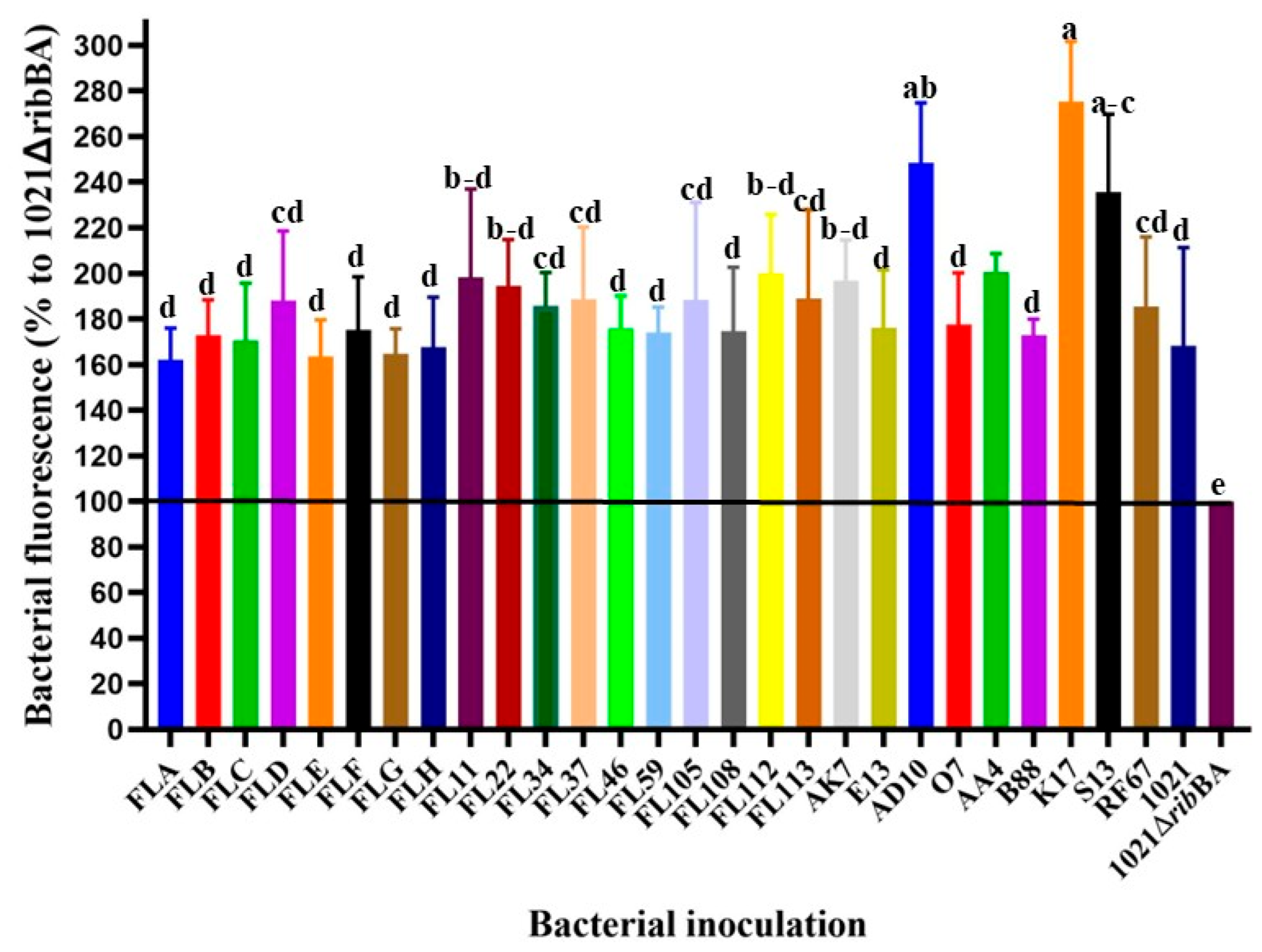
Isolation of fluorescence bacteria was isolated in three rounds. A total of 833 bacteria were screened for increased fluorescence at 470/530 nm (Table 1). S. meliloti strains 1021 and mutant were used as controls. Initial fluorescence measurements revealed a significant difference (p < 0.05) in fluorescence between 1021 and mutant (17,877 and 9879 fluorescence at 470/530 nm, respectively), confirming reduced flavin secretion by the mutant compared to the wild-type strain (Table S1). In total, 26 bacterial strains exhibiting significantly higher fluorescence than mutant were selected for further analysis (Figure 1; Table S3). Among these, isolates K17, S13, and AD10 also displayed significantly higher fluorescence than wild-type strain 1021 (Figure 1).
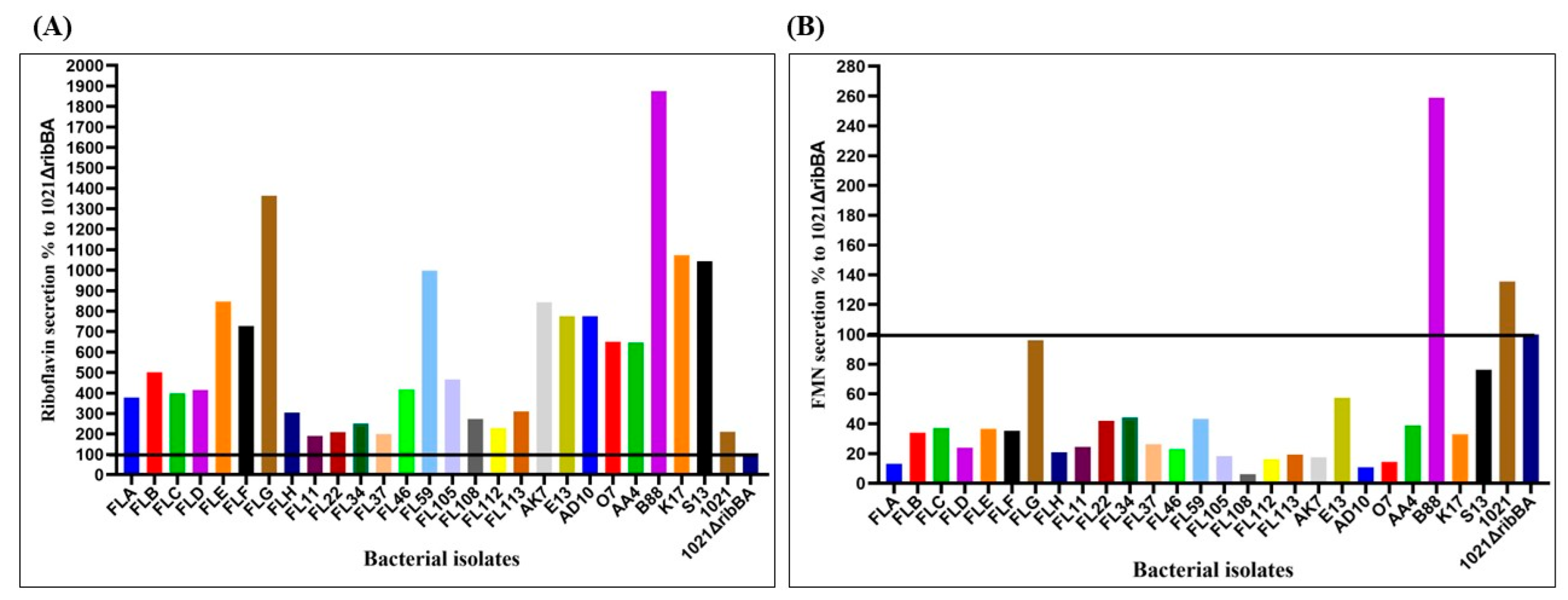
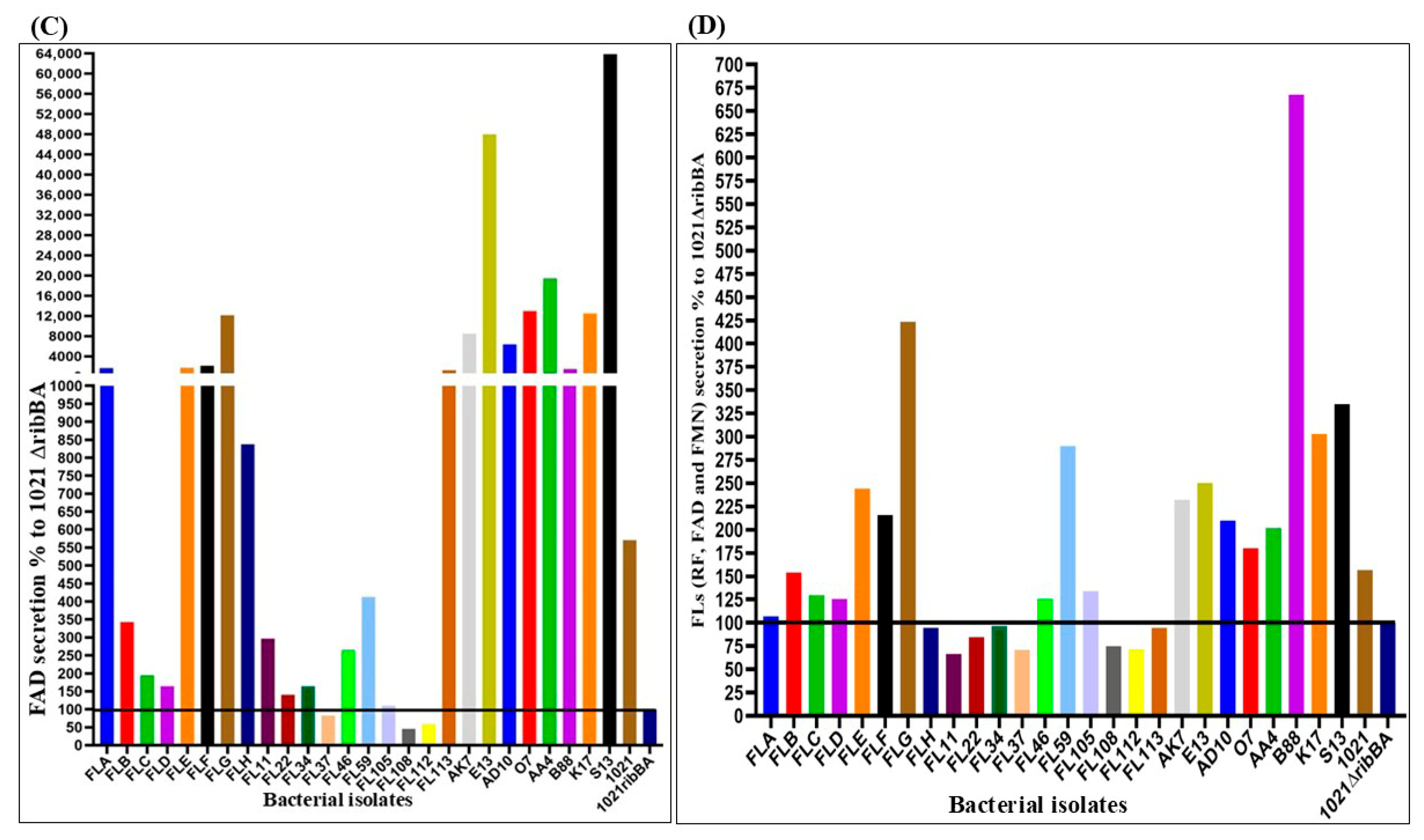
UPLC analysis showed that all the isolates secreted higher amount of RF compared to mutant (Figure 2A). At least 91% increase in RF secretion was observed for all isolates (Figure 2A). Strains FLB, FLD, FLE, FLF, FLG, FL46, FL59, FL105, AK7, E13, AD10, O7, B88, AA4, K17, and S13 exhibited significantly higher RF secretion compared to mutant (Table S4). Isolates S13 and E13 secreted significantly more FAD (Figure 2B) and only three isolates, FL37, FL108, and FL112, showed less FAD secretion than mutant (Figure 2C; Table S4). Interestingly, most isolates exhibited reduced FMN secretion compared to both 1021 and mutant, with the exception of isolate B88, which secreted significantly more FMN than the control strains (1021ΔribBA) (Figure 2C; Table S4). Overall, total FLs secretion (RF + FMN + FAD) was higher than mutant in most isolates, except for FLH, FL11, FL22, FL34, FL37, FL108, FL112, and FL113 (Figure 2D; Table S4). Particularly, isolate B88 secreted significantly more of total FLs than both parental strain 1021 and the mutant (Table S4).

3.2. Quantification Assay of Phosphate Solubilization of PGP Bacteria

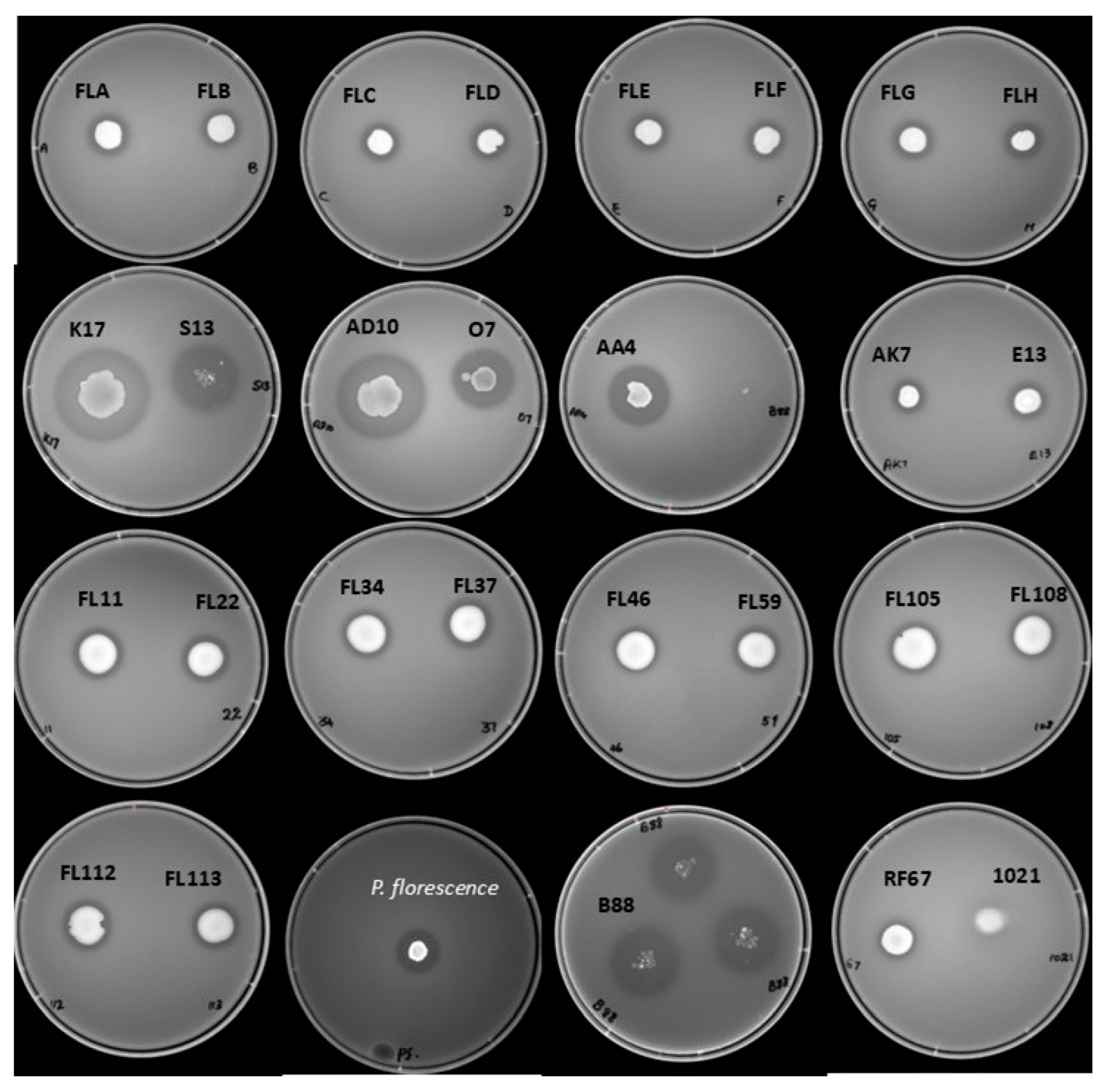
Pseudomonas fluorescence F113 was used as the reference strain to assess the phosphate-solubilizing ability of bacterial isolates. Our data indicated that isolates S13, B88, and AA4 exhibited higher levels of phosphate solubilization than P. fluorescence F113 (p < 0.05). Additionally, strains AD10, O7, and K17 showed comparable levels of phosphate solubilization to P. fluorescence F113 (Table 2, Figure 3). Isolates FLA, FLB, FLC, FLD, FLF, FLG, and FLH had a phosphate solubilization index (PSI) of approximately 0.5, while isolates FLE, FL22, FL34, and E13 had a PSI around 0.4. Notable, isolates S13 and B88 demonstrated approximately three-fold and two-fold higher phosphate solubilization, respectively, compared to P. fluorescence F113.

3.3. Qualitative Assay for ACC Deaminase Enzyme Activity and IAA Production Test

Isolate B88 produced significantly higher amounts of IAA than all other isolates, with approximately two-fold greater IAA production than FL113. FLC, FL112, and FL113 produced significantly lower amounts of IAA compared to the other isolates (Table 3). The highest IAA producers were isolates B88, AK7, AD10, K17, and S13 (Table 3).
All the isolates were able to utilize ACC as a sole N source (Table 3); however, they differed in their growth rate on this substrate. More specifically, isolates AK7, E13, FLF, S13, FL22, FL37, FL46, and FL59 exhibited the highest growth rates, while isolates FLC, FLH, and B88 showed the lowest growth rate on the selective media (Table 3).

3.4. Plant Growth Response to Bacterial Inoculation

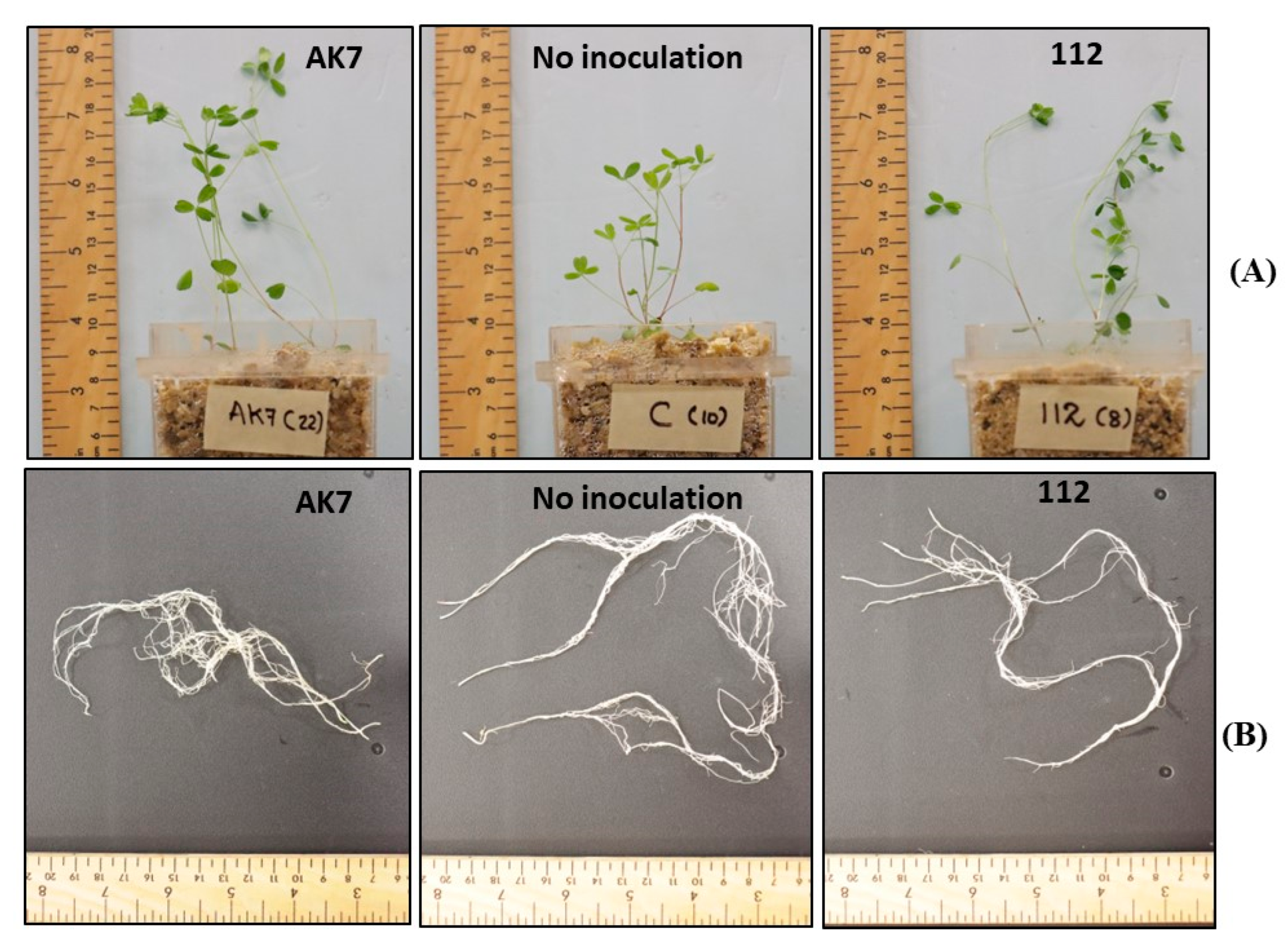
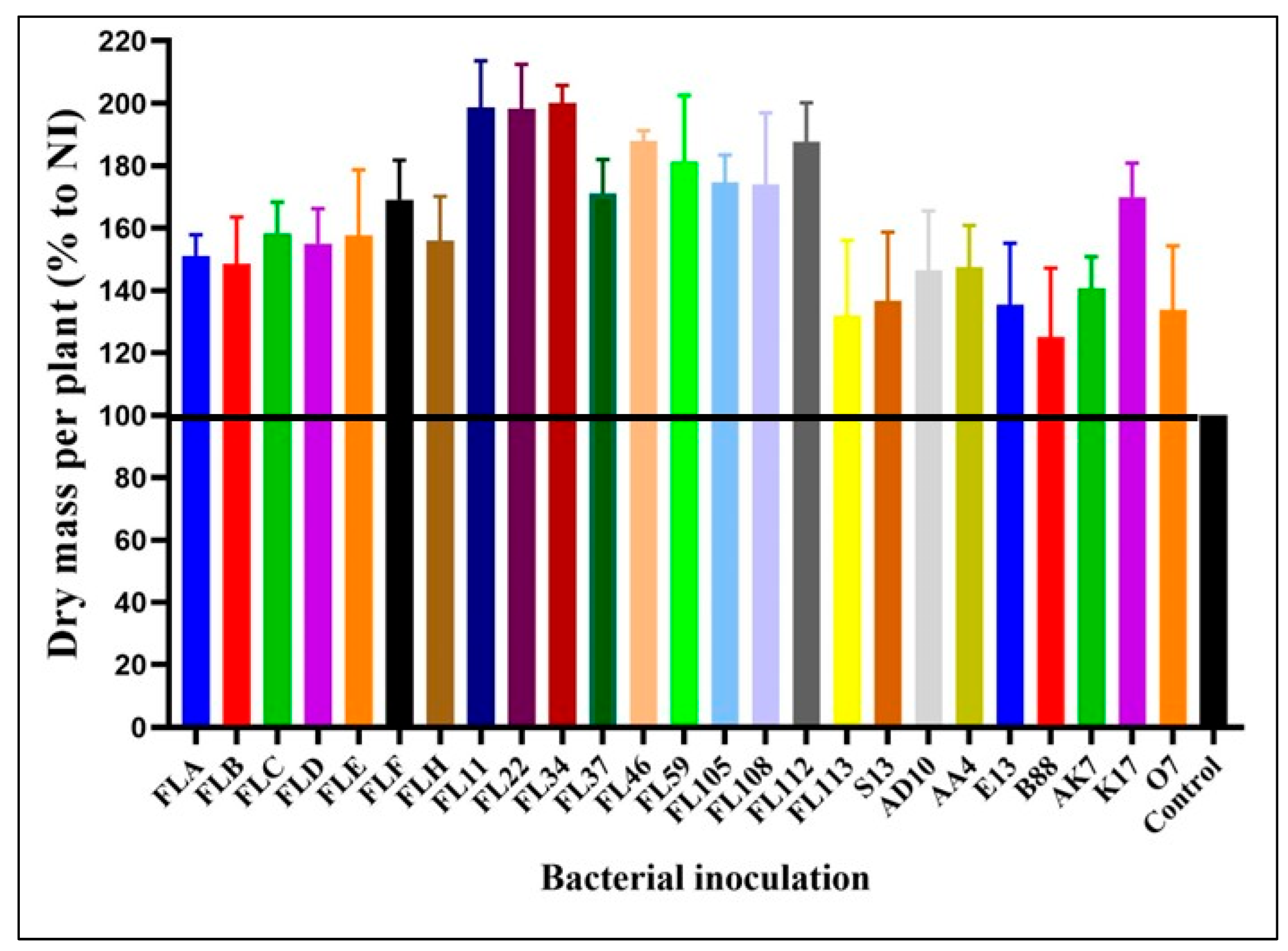
The inoculated plants appeared greener and healthier than the plants without inoculation (Figure 4A). The plants inoculated with all isolates showed significantly higher dry mass compared to non-inoculated control (Figure 5; Table S5). On average, at least a 25% increase in dry mass was observed in the inoculated plants. Particularly, plants inoculated with FL34, FL11, and FL22 yielded nearly twice the dry mass of the non-inoculated plants (Figure 5; Table S5).
N balance estimation was performed to compare the applied and postharvest amounts of N in aerial parts of the plants inoculated with AK7 and FL112, and those of non-inoculated plants. The analysis showed that inoculated plants accumulated more N than non-inoculated control. Specifically, 0.3017 mg and 0.3850 mg of N were accumulated in the shoots of plants inoculated with AK7 and FL112, respectively, whereas non-inoculated plants contained 0.1813 mg of N (Table 4). This estimation excluded root N content because separating the roots from the growth medium (vermiculite and pebbles) without significant tissue loss was not feasible. Previous studies estimate that roots account for between 12 and 22% of the total biomass of perennial plant until late flowering [47] (Table 4). Therefore, considering the applied N (0.5227 mg N/plant), no surplus of N was detected in inoculated plants at harvesting (Table 4). Furthermore, after harvesting, the root systems of inoculated alfalfa plants were examined for nodule formation. No nodules were observed (Figure 4B).

3.5. Genetic Characterization and Analysis

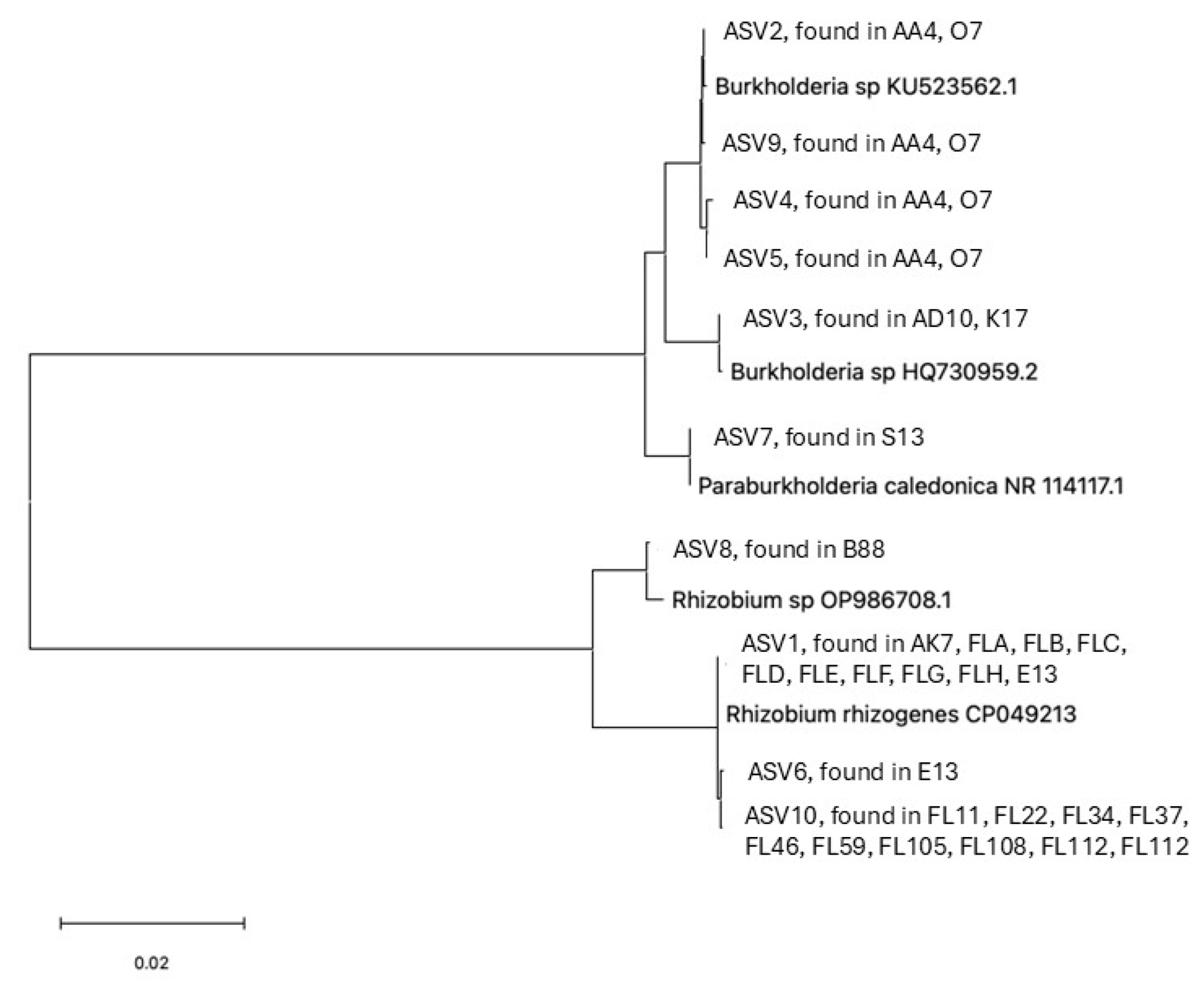
In nature, many native bacteria coexist as complex communities. Within these complexes, two or more bacteria species live symbiotically, and in some cases, members of the complex cannot be separated. Therefore, in this study, 16S rRNA PacBio amplicon sequencing was used to determine the complete taxonomic composition of the isolates. The results showed that most isolates were represented by a single ASV. The analysis identified 11 unique ASVs from orders Burkholderiales and Rhizobiales (Table S6; Figure 6). Strains FLA, FLB, FLC, FLD, FLE, FLF, FLG, FLH, FL11, FL22, FL34, FL37, FL46, FL59, FL105, FL108, FL112, FL113, B88, and AK7 were classified under order Rhizobiales and identified as Rhizobium rhizogenes spp. Strains AD10, K17 and S13 were categorized under order Burkholderiales. However, isolates AA4, O7, and E13 contained more than one ASV representing 16S rRNA (Figure 6; Table S6), which may indicate an obligatory symbiotic association of microbes. Both the first and second rounds of 16S rRNA sequencing consistently revealed multiple ASVs in AA4 and O7, all belonging to order Burkholderiales, suggesting these isolates represent stable microbial consortia. In the first round of sequencing, E13 exhibited two ASVs from R. rhizogenes spp. and one ASV from genus Luteibacter. However, in the second round of sequencing, only two R. rhizogenes ASVs were retained, and Luteibacter ASV was no longer detected (Table S6).

4. Discussion

PGP bacteria are a group of microorganisms that colonize plant roots and/or rhizosphere to improve plant growth. These PGPs are known to possess various functions that enhance plant growth and development or protect plants from biotic and abiotic stresses. Phytohormones, the availability of essential nutrients through various mechanisms, and plant protection against pathogens via antagonism or enhanced plant resistance [48,49,50] are some of the beneficial traits of PGP bacteria. The secretion of bacterial FLs (RF, FMN, and FAD) has been recently identified as a PGP trait [14,15]. RF is readily degraded to lumichrome through enzymatic or photochemical reactions, resulting in the production of more effective compounds that enhance PGP [19].
Sinorhizobium meliloti strain 1021 secretes a considerable amount of FLs [21]. Some studies have shown that lumichrome and RF derived from rhizobia can promote plant growth and affect stomatal function [14,19]. It has been demonstrated that the application of RF derivatives improves plant growth by increasing root respiration by 11–30%, enhancing CO2 supply for net carbon assimilation and photosynthetic activity [19]. It has been demonstrated that lumichrome application enhanced plant growth, dry matter accumulation, and photosynthetic activity [51]. The specific role of bacteria-derived FLs was addressed when S. meliloti 1021 mutant with reduced FLs secretion was found to be less competitive for nodulation compared to the parental strain [21]. Another study showed that inoculation of the wild-type of strain 1021 in kale and lettuce improved plant growth, photosynthetic rate, yield, and phytochemical properties such as chlorophylls a and b, total carotenoids, flavonoids, and phenolics, compared to the mutant strain 1021ΔribBA [15]. In the present study, 26 bacterial strains were isolated from apple roots based on fluorescence of their liquid culture by rapid plate screening, indicating potential FLs secretion. We tested FLs secretion of these isolates and confirmed, by using ultra-performance liquid chromatography-mass spectrometry, that all of them secreted higher amounts of RF than 1021ΔribBA. Additionally, isolate B88 exhibited the highest levels of RF and FMN secretions among all the isolates. Isolate S13 showed a higher FAD secretion among all isolates. Overall, isolates B88, FLG, S13, K17, FL59, and E13 were identified as strong FLs secretors out of 26 isolates.
In this study, 21 of the isolated strains belong to the Rhizobium group. Rhizobium spp. are well known plant-beneficial bacteria that play a vital role in sustainable agriculture [52,53]. They enhance nutrient availability through biological N fixation in legumes, phosphate solubilization, and siderophores production; Rhizobium spp. promotes plant growth via phytohormones production, mitigate environmental stress through ACC deaminase enzyme activity, and induce systemic resistance in host plants [13,52,54]. The present results showed that among 11 ASVs identified, three were classified as Rhizobium rhizogenes, which can induce tumors in plants, potentially impairing plant growth and development [55]. However, in the present study, no tumors or tumor-like structures were observed on alfalfa roots following inoculation. Some studies report that certain R. rhizogenes strains are beneficial to the plants. These strains are commonly used in plant propagation as rooting inducers due to their root-promoting capability, especially in hard-to-root species. The hairy roots induced by R. rhizogenes facilitate absorption of water and nutrients absorption. Root hairs also improve root-microbial interaction, particularly with PGP bacteria such as N-fixing bacteria and mycorrhizal fungi by increasing root surface area [56]. Additionally, R. rhizogenes can enhance the production of secondary metabolites such as alkaloids, flavonoids, and terpenes, which possess remarkable pharmacological, cosmetic, and nutraceutical values [57].
Based on 16S rRNA sequencing, five distinct strains of Burkholderia were identified in this study. Burkholderia is a widespread genus found in soil, water, and plant-associated environments, known for its metabolic diversity and adaptability to changing environmental conditions [58]. Burkholderia includes both pathogenic and nonpathogenic species. Some Burkholderia members are pathogenic to plants, humans, and animals. However, some of the members of Burkholderia genus show potential as plant-beneficial species [59,60]. They can fix atmospheric N, form root nodules in legumes [61], and promote plant growth through various mechanisms [59,62,63,64]. Li et al. [58] reported that endophytic bacteria Burkholderia gladioli isolated from Lycoris aurea secretes toxoflavins with potential fungicidal activity against plant pathogens [65].
In nature, two or more bacteria can coexist and form symbiotic relationships with one another [66]. Co-adaption within such consortia may enable them to perform important agroecological functions, including the cycling of organic carbon and N [67,68]. These microbial complexes play beneficial roles in promoting plant growth, maintaining soil health, and enhancing soil fertility [69]. Several studies reported that microbial consortia can function as biopesticides, biostimulants, or biofertilizers by managing plant diseases and pests, promoting plant development, and mitigating specific abiotic and biotic stresses in plants [69]. Bacterial complexes are critical to the survival and functionality of their constituent members, and the disruption of these interactions may impair the performance of the individual strains. Naturally, bacterial complexes can overcome the biological limitations associated with single bacterial strain. They tend to be more stable across a broad range of ecological and environmental conditions due to diverse modes of actions, nutritional needs and interactions such as mutualism and syntropy, commensalism, and antagonism that support their long-term existence [29,70]. Similarly, the microbial complex comprising isolates, AA4, E13, and O7, identified in this study, may contribute to sustainable agriculture by reducing dependence on synthetic chemical fertilizers and pesticides.
All bacteria isolated in this study exhibited certain PGP traits. A key characteristic of PGP bacteria is their ability to increase the availability of phosphate nutrients (HPO42− and H2PO4) by solubilizing phosphate from insoluble organic and inorganic resources such as Fe3+, Al3+, and Ca2+ compounds [29,71]. This is achieved through the production of organic acids during sugar metabolism, which chelate metal cations in soil solution, releasing phosphate ions for plant uptake [72]. Additionally, enzymes such as phytase and phosphatase play a significant role in liberating phosphate from inaccessible sources [73]. The present results demonstrated that several isolates showed strong phosphate-solubilizing activity. For example, strains S13, B88, and AA4 exhibited remarkably higher phosphate solubilization compared to Pseudomonas fluorescence F113, a known phosphate-solubilizing bacterium [30].
Phytohormones production is another important PGP function [74,75]. Bacteria-derived IAA can enhance host-plant root development, optimize nutrients uptake, regulate key metabolic pathways [76], and play a vital role in root nodule formation during the rhizobia–legume symbiosis [77]. Microbial biosynthesis of IAA can occur via tryptophan-dependent and -independent pathways [78]. These biosynthetic routes are mechanistically similar to those found in plants [79,80]. However, studies have shown that only a limited number of microorganisms produce IAA through tryptophan-independent pathways and this mechanism remains relatively underexplored [81]. In the tryptophan-dependent pathway, intracellular concentrations of L-tryptophan are often low, so significant IAA production requires the addition of exogenous tryptophan [80,81].
In the present study, bacterial isolates FL37, FL46, FL59, FL22, S13, E13, FLF, and AK7 exhibited higher ACC deaminase activity compared to other isolates. The enzymatic activity of ACC deaminase by PGP bacteria is one of the key mechanisms supporting plant growth and stress tolerance under both optimal and adverse environmental conditions [11,82]. Bacterial-derived ACC deaminase catalyzes the conversion of stress-induced ACC into ammonia and α-ketobutyrate, preventing the conversion into plant hormone ethylene. Elevated ethylene levels negatively affect various physiological processes, including plant growth and development, seed germination, aging, and senescence [9,83,84,85]. Therefore, microbial production of ACC deaminase plays a critical role in sustainable agriculture, mitigating the negative impact of environmental stress on crop productivity.
The results showed that inoculations with all isolates increased alfalfa dry weight under low N availability. Furthermore, tissue N in plants inoculated with isolates AK7 and FL112 was higher than in non-inoculated control. Root dry mass was estimated to be 22% of the total shoot dry mass [47]. While root mass estimation might introduce minor deviations in calculating the total postharvest N content in plant tissue, this error is expected to be negligible compared to the substantial differences observed between applied N and the postharvest N content.
The improvement in plant growth under N limitation suggests that the inoculated plant either acquired N from the nutrient solution more efficiently or received N from the bacteria strains. Several strains isolated in this study were identified as Rhizobium spp., a genus well known for symbiotic N-fixing association with legumes through nodulation [86]. Some research has indicated that rhizobia may also colonize internal plant tissue [87]. However, Rhizobium species typically exhibit a high degree of host specificity and can only establish N-fixing symbiosis with compatible leguminous plant hosts [88,89]. To verify the absence of symbiotic N fixation, the root system of the alfalfa plants inoculated with the isolates was examined and observed no nodule formation. Moreover, estimation of N balance showed no surplus N relative to the amount applied, indicating no additional nitrogen input beyond what was provided in the nutrient solution. Therefore, we could conclude that enhanced plant growth observed in inoculated plants was the result of improved N acquisition rather than biological N fixation.
Previous studies have indicated that major classes of plant hormone—auxin, cytokinins, abscisic acid, ethylene and gibberellins—play a regulatory role in N metabolism [90,91], as well as plant available form of N such as nitrate (NO3) and ammonium (NH4+) can act as signaling molecules in hormone signal transduction pathways [92,93]. FL-containing monooxygenases are involved in auxin biosynthesis. Auxin influences nutrient uptake and assimilation by modulating root development, the expression of nutrient transporters, and various metabolic pathways [94]. The observed increase in N in alfalfa tissues following bacterial inoculation may be linked to the activation of plant hormonal pathways. Further research is warranted to investigate the interplay between N acquisition, activation of hormonal regulation, and bacteria-derived FLs.
The study confirmed that the strains exhibited various PGP traits, including phosphate solubilization, ACC deaminase activity, and IAA production. However, no synergistic effect was observed between FLs secretion and other PGP functions. Despite this, the in vitro alfalfa plant trial demonstrated improved biomass and increased shoot N content following inoculation with these strains. This suggests that FLs secretion, along with other PGP mechanisms, may enhance photosynthetic activity and metabolic processes, ultimately promoting plant growth. The observed PGP effects are likely the result of a complex interplay among multiple functions trails. In apple orchards, beneficial microbes are essential for soil health maintenance, disease suppression, and the stabilization of microbial communities to prevent pathogen proliferation [95,96,97]. Root-associated microbes not only support plant growth and development but also bolster plant immunity and produce antimicrobial compounds. Thus, the development of microbial inoculants comprising synthetic communities of PGP microorganism presents a promising and sustainable alternative to conventional agrochemicals for crop production.

5. Conclusions

The indiscriminate global use of synthetic agrochemicals such as pesticides, fertilizers, and growth promoters has raised serious concerns regarding soil health and environmental sustainability. PGP bacteria offer an eco-friendly alternative, functioning as biofertilizers, biopesticides, and biostimulants to reduce the reliance on synthetic agrochemicals and promote sustainable crop production. In this study, we isolated and characterized root-associated bacteria capable of secreting FLs. These bacteria also demonstrated other beneficial PGP traits such as phosphate solubilization, IAA production, and ACC deaminase activity. Although inoculation with these bacteria led to improved plant N acquisition, there was no single PGP trait that could be definitively linked to this enhancement. Future research is needed to explore the use of FLs secreting bacterial inoculants for both leguminous and non-leguminous crops under different levels of N regime. Such studies will help to identify the specific trait and the mechanism responsible for improved plant N uptake and utilization.

Supplementary Materials

The following supporting information can be downloaded at: https://www.mdpi.com/article/10.3390/applmicrobiol6020022/s1, Table S1: Isolation of apple root-associated bacteria from different orchards; Table S2: Composition of Plant Nutrient Solution (PNS) per liter; Table S3: Quantification of wild-type 1021 and mutant 1021 (1021ΔribBA) fluorescence at 470/530 and UPLC analysis of FLs; Table S4: Quantification of FLs (RF, FMN and FAD); Table S5: Dry weight of alfalfa plants with and without inoculation of PGPB; Table S6: The BLAST version 2.14.1 similarity searches for strains isolated from apple roots in this study, only major ASVs representing at least 1% of reads were counted.

Author Contributions

Conceptualization, S.N.Y. and L.A.; Project administration, S.N.Y.; Supervision, S.N.Y. and L.A.; Investigation, S.N.Y. and N.A.; Methodology, S.N.Y. and N.A.; Validation, S.N.Y. and L.A.; Formal analysis, N.A.; Writing—original draft, S.N.Y. and N.A.; Writing—review and editing, S.N.Y., L.A., and N.A. All authors have read and agreed to the published version of the manuscript.

Funding

This research was funded by USDA ARS Projects 2090-21600-040-000D.

Institutional Review Board Statement

Not applicable.

Informed Consent Statement

Not applicable.

Data Availability Statement

The data for this study are available from the corresponding author upon reasonable request.

Acknowledgments

The authors thank all the laboratory team members for their support and suggestions and thank to University of Victoria Genome BC (UVic GBC)—Proteomics Centre of The Metabolomics Innovation Centre, Canada, for the flavin quantification and analysis.

Conflicts of Interest

The authors declare no conflicts of interest.

Abbreviations

The following abbreviations are used in this manuscript:
ACC 1-aminocyclopropane-1-carboxylic acid
ANOVA Analysis of variance
ASV Assigned sequence variant
CO2 Carbon dioxide
DNA Deoxyribonucleic acid
FADFlavin adenine dinucleotides
FLsFlavins
FMNFlavin mononucleotides
IAA Indole-3-acetic acid
N Nitrogen
PGP Plant growth promoting
PSB Phosphate-solubilizing bacteria
RFRiboflavin
RibBA3,4-Dihydroxy-2-butanone 4-phosphate synthase; GTP cyclohydrolase II
RNA Ribonucleic acid
rRNA Ribosomal ribonucleic acid
HPLCHigh-Performance Liquid Chromatography
UPLC Ultra-Performance Liquid Chromatography
MMNH4Minimal Mannitol medium containing NH4
ODOptical Density
PVKPikovskaya
PSIPhosphate Solubilization Index
PNSPlant Nutrient Solution

References

  1. Murton, J. Subsistence production and commodity production in the british imperial food system: The case of nova scotia apples. Hist. Soc. 2021, 54, 335–358. [Google Scholar] [CrossRef]
  2. de Souza, R.; Ambrosini, A.; Passaglia, L.M.P. Plant growth-promoting bacteria as inoculants in agricultural soils. Genet. Mol Biol. Braz. J. Genet. 2015, 38, 401–419. [Google Scholar] [CrossRef]
  3. Patil, R.; Satpute, R.; Nalage, D. Plant microbiomes and their role in plant health. Microenviron. Microecol. Res. 2023, 5, 2. [Google Scholar] [CrossRef]
  4. Kempes, C.P.; van Bodegom, P.M.; Wolpert, D.; Libby, E.; Amend, J.; Hoehler, T. Drivers of bacterial maintenance and minimal energy requirements. Front. Microbiol. 2017, 8, 31. [Google Scholar] [CrossRef]
  5. Kai, M.; Effmert, U.; Piechulla, B. Bacterial-plant-interactions: Approaches to unravel the biological function of bacterial volatiles in the rhizosphere. Front. Microbiol. 2016, 7, 108. [Google Scholar]
  6. Yue, H.; Yue, W.; Jiao, S.; Kim, H.; Lee, Y.H.; Wei, G.; Song, W.; Shu, D. Plant domestication shapes rhizosphere microbiome assembly and metabolic functions. Microbiome 2023, 11, 70. [Google Scholar] [CrossRef] [PubMed]
  7. Clouse, K.M.; Wagner, M.R. Plant Genetics as a Tool for Manipulating Crop Microbiomes: Opportunities and Challenges. Front. Bioeng. Biotechnol. 2021, 743, 140682. [Google Scholar] [CrossRef] [PubMed]
  8. Oleńska, E.; Małek, W.; Wójcik, M.; Swiecicka, I.; Thijs, S.; Vangronsveld, J. Beneficial features of plant growth-promoting rhizobacteria for improving plant growth and health in challenging conditions: A methodical review. Sci. Total Environ. 2020, 743, 140682. [Google Scholar] [PubMed]
  9. Saleem, M.; Arshad, M.; Hussain, S.; Bhatti, A.S. Perspective of plant growth promoting rhizobacteria (PGPR) containing ACC deaminase in stress agriculture. J. Ind. Microbiol. Biotechnol. 2007, 34, 635–648. [Google Scholar] [CrossRef]
  10. Olanrewaju, O.S.; Glick, B.R.; Babalola, O.O. Mechanisms of action of plant growth promoting bacteria. World J. Microbiol. Biotechnol. 2017, 33, 197. [Google Scholar] [CrossRef]
  11. Glick, B.R. Plant Growth-Promoting Bacteria: Mechanisms and Applications. Scientifica 2012, 2012, 963401. [Google Scholar] [CrossRef] [PubMed]
  12. Nadeem, S.M.; Ahmad, M.; Zahir, Z.A.; Javaid, A.; Ashraf, M. The role of mycorrhizae and plant growth promoting rhizobacteria (PGPR) in improving crop productivity under stressful environments. Biotechnol. Adv. 2014, 32, 429–448. [Google Scholar] [CrossRef]
  13. Jaiswal, S.K.; Mohammed, M.; Ibny, F.Y.I.; Dakora, F.D. Rhizobia as a Source of Plant Growth-Promoting Molecules: Potential Applications and Possible Operational Mechanisms. Front. Sustain. Food Syst. 2021, 4, 619676. [Google Scholar] [CrossRef]
  14. Matiru, V.N.; Dakora, F.D. The rhizosphere signal molecule lumichrome alters seedling development in both legumes and cereals. New Phytol. 2005, 166, 439–444. [Google Scholar] [CrossRef] [PubMed]
  15. Ajeethan, N.; Yurgel, S.N.; Abbey, L. Role of Bacteria-Derived Flavins in Plant Growth Promotion and Phytochemical Accumulation in Leafy Vegetables. Int. J. Mol. Sci. 2023, 24, 13311. [Google Scholar] [CrossRef] [PubMed]
  16. Gutiérrez-Preciado, A.; Torres, A.G.; Merino, E.; Bonomi, H.R.; Goldbaum, F.A.; García-Angulo, V.A. Extensive identification of bacterial riboflavin transporters and their distribution across bacterial species. PLoS ONE 2015, 10, e0126124. [Google Scholar] [CrossRef] [PubMed]
  17. Jordan, D.B.; Bacot, K.O.; Carlson, T.J.; Kessel, M.; Viitanen, P.V. Plant riboflavin biosynthesis: Cloning, chloroplast localization, expression, purification, and partial characterization of spinach lumazine synthase. J. Biol. Chem. 1999, 274, 22114–22121. [Google Scholar] [CrossRef] [PubMed]
  18. Wu, Y.; Cheng, S.; Ding, X.; Lin, X.; Deng, S.; Peng, L.; Tian, H. Exogenous Riboflavin Application at Different Growth Stages Regulates Photosynthetic Accumulation and Grain Yield in Fragrant Rice. Agriculture 2024, 14, 1979. [Google Scholar] [CrossRef]
  19. Phillips, D.A.; Joseph, C.M.; Yang, G.-P.; Martínez-Romero, E.; Sanborn, J.R.; Volpin, H. Identification of lumichrome as a Sinorhizobium enhancer of alfalfa root respiration and shoot growth. Proc. Natl. Acad. Sci. USA 1999, 96, 12275–12280. [Google Scholar] [CrossRef]
  20. Palacios, O.A.; López, B.R.; Palacios-Espinosa, A.; Hernández-Sandoval, F.E.; de-Bashan, L.E. The immediate effect of riboflavin and lumichrome on the mitigation of saline stress in the microalga Chlorella sorokiniana by the plant-growth-promoting bacterium Azospirillum brasilense. Algal Res. 2021, 58, 102424. [Google Scholar] [CrossRef]
  21. Yurgel, S.N.; Rice, J.; Domreis, E.; Lynch, J.; Sa, N.; Qamar, Z.; Rajamani, S.; Gao, M.; Roje, S.; Bauer, W.D. Sinorhizobium meliloti flavin secretion and bacteria-host interaction: Role of the bifunctional RibBA protein. Mol. Plant-Microbe Interact. 2014, 27, 437–445. [Google Scholar] [CrossRef]
  22. Yurgel, S.N.; Lynch, J.; Rice, J.; Adhikari, N.; Roje, S. Quantification of Flavin Production by Bacteria. Bio-Protocol 2014, 4, e1197. [Google Scholar] [CrossRef]
  23. Hustad, S.; Ueland, P.M.; Schneede, J. Quantification of riboflavin, flavin mononucleotide, and flavin adenine dinucleotide in human plasma by capillary electrophoresis and laser-induced fluorescence detection. Clin. Chem. 1999, 45, 862–868. [Google Scholar] [CrossRef] [PubMed]
  24. Sieber, R. Note Determination of flavins in dairy products by high-performance liquid chromatography using sorboflavin as internal standard. J. Chromatogr. 1990, 511, 359–366. [Google Scholar]
  25. Ghann, W.E.; Ho, C.-N.; Wardeska, J.; Jiang, Y.-L. Studies of Surfactants Effect on Riboflavin Fluorescence and Its Determination in Commercial Food Products and Vitamin Tablets. Master’s Thesis, East Tennessee State University, Johnson City, TN, USA, 2008. [Google Scholar]
  26. Ajeethan, N.; Ali, S.; Fuller, K.D.; Abbey, L.; Yurgel, S.N. Apple Root Microbiome as Indicator of Plant Adaptation to Apple Replant Diseased Soils. Microorganisms 2023, 11, 1372. [Google Scholar] [CrossRef] [PubMed]
  27. Somerville, J.E.; Kahn, M.L. Cloning of the Glutamine Synthetase I Gene from Rhizobium meliloti. J. Bacteriol. 1983, 156, 168–176. [Google Scholar] [CrossRef] [PubMed]
  28. Galibert, F.; Finan, T.M.; Long, S.R.; Pühler, A.; Abola, P.; Ampe, F.; Barloy-Hubler, F.; Barnet, M.J.; Becker, A.; Boistard, P.; et al. The composite genome of the legume symbiont Sinorhizobium meliloti. Science 2001, 293, 668–672. [Google Scholar] [CrossRef] [PubMed]
  29. Manzoor, M.; Abbasi, M.K.; Sultan, T. Isolation of Phosphate Solubilizing Bacteria from Maize Rhizosphere and Their Potential for Rock Phosphate Solubilization–Mineralization and Plant Growth Promotion. Geomicrobiol. J. 2017, 34, 81–95. [Google Scholar] [CrossRef]
  30. Oteino, N.; Lally, R.D.; Kiwanuka, S.; Lloyd, A.; Ryan, D.; Germaine, K.J.; Dowling, D.N. Plant growth promotion induced by phosphate solubilizing endophytic Pseudomonas isolates. Front. Microbiol. 2015, 6, 745. [Google Scholar] [CrossRef]
  31. Nascimento, F.X.; Tavares, M.J.; Franck, J.; Ali, S.; Glick, B.R.; Rossi, M.J. ACC deaminase plays a major role in Pseudomonas fluorescens YsS6 ability to promote the nodulation of Alpha- and Betaproteobacteria rhizobial strains. Arch. Microbiol. 2019, 201, 817–822. [Google Scholar] [CrossRef] [PubMed]
  32. Penrose, D.M.; Glick, B.R. Methods for isolating and characterizing ACC deaminase-containing plant growth-promoting rhizobacteria. Physiol. Plant. 2003, 118, 10–15. [Google Scholar] [CrossRef] [PubMed]
  33. Ehmann, A. The Van Urk-Salkowski reagent—A sensitive and specific chromogenic reagent for silica gel thin-layer chromatographic detection and identification of indole derivatives. J. Chromatogr. 1977, 132, 267–276. [Google Scholar] [CrossRef] [PubMed]
  34. Mohite, B. Isolation and characterization of indole acetic acid (IAA) producing bacteria from rhizospheric soil and its effect on plant growth. J. Soil Sci. Plant Nutr. 2013, 13, 638–649. [Google Scholar] [CrossRef]
  35. Gordon, S.A.; Weber, R.P. Colorimetric Estimation of Indoleacetic Acid (with One Figure). Plant Physiol. 1951, 26, 192–195. [Google Scholar] [PubMed]
  36. Yurgel, S.N.; Berrocal, J.; Wilson, C.; Kahn, M.L. Pleiotropic effects of mutations that alter the Sinorhizobium meliloti cytochrome c respiratory system. Microbiology 2007, 153, 399–410. [Google Scholar] [CrossRef] [PubMed]
  37. Yurgel, S.N.; Kahn, M.L. Sinorhizobium meliloti dctA mutants with partial ability to transport dicarboxylic acids. J. Bacteriol. 2005, 187, 1161–1172. [Google Scholar] [CrossRef] [PubMed]
  38. Mahuku, G.S. A Simple Extraction Method Suitable for PCR-Based Analysis of Plant, Fungal, and Bacterial DNA. Mol. Biol. Report. 2004, 22, 71–81. [Google Scholar] [CrossRef]
  39. Fichot, E.B.; Norman, R.S. Microbial phylogenetic profiling with the Pacific Biosciences sequencing platform. Microbiome 2013, 1, 10. [Google Scholar] [CrossRef]
  40. Comeau, A.M.; Douglas, G.M.; Langille, M.G.I. Microbiome Helper: A Custom and Streamlined Workflow for Microbiome Research. mSystems 2017, 2, 28066818. [Google Scholar] [CrossRef]
  41. Quast, C.; Pruesse, E.; Yilmaz, P.; Gerken, J.; Schweer, T.; Yarza, P.; Peplies, J.; Glöckner, F.O. The SILVA ribosomal RNA gene database project: Improved data processing and web-based tools. Nucleic Acids Res. 2013, 41, D590–D596. [Google Scholar] [CrossRef] [PubMed]
  42. Saitou, N.; Nei, M. The neighbor-joining method: A new method for reconstructing phylogenetic trees. Mol. Biol. Evol. 1987, 4, 406–425. [Google Scholar] [CrossRef]
  43. Felsenstein, J. Confidence limits on phylogenies: An approach using the bootstrap. Evolution 1985, 39, 783–791. [Google Scholar]
  44. Tamura, K.; Nei, M.; Kumar, S. Prospects for inferring very large phylogenies by using the neighbor-joining method. Proc. Natl. Acad. Sci. USA 2004, 101, 11030–11035. [Google Scholar]
  45. Tamura, K.; Stecher, G.; Kumar, S. MEGA 11: Molecular Evolutionary Genetics Analysis Version 11. Mol. Biol. Evol. 2021, 38, 3022–3027. [Google Scholar] [CrossRef] [PubMed]
  46. Stecher, G.; Tamura, K.; Kumar, S. Molecular Evolutionary Genetics Analysis (MEGA) for macOS. Mol. Biol. Evol. 2020, 37, 1237–1239. [Google Scholar] [CrossRef] [PubMed]
  47. Bell, K.L.; Hiatt, H.D.; Niles, W.E. Seasonal Changes in Biomass Allocation in Eight Winter Annuals of the Mojave Desert. J. Ecol. 1979, 67, 781–787. [Google Scholar] [CrossRef]
  48. Ferioun, M.; Bouhraoua, S.; Srhiouar, N.; Tirry, N.; Belahcen, D.; Siang, T.C.; Louahlia, S.; El Ghachtouli, N. Optimized drought tolerance in barley (Hordeum vulgare L.) using plant growth-promoting rhizobacteria (PGPR). Biocatal. Agric. Biotechnol. 2023, 50, 102691. [Google Scholar] [CrossRef]
  49. Zhang, H.; Kim, M.-S.; Sun, Y.; Dowd, S.E.; Shi, H.; Paré, P.W. Soil Bacteria Confer Plant Salt Tolerance by Tissue-Specific Regulation of the Sodium Transporter HKT1. Mol. Plant-Microbe Interact. 2008, 21, 737–744. [Google Scholar] [CrossRef]
  50. Aslantaş, R.; Çakmakçi, R.; Şahin, F. Effect of plant growth promoting rhizobacteria on young apple tree growth and fruit yield under orchard conditions. Sci. Hortic. 2007, 111, 371–377. [Google Scholar] [CrossRef]
  51. Dakora, F.D.; Matiru, V.N.; Kanu, A.S. Rhizosphere ecology of lumichrome and riboflavin, two bacterial signal molecules eliciting developmental changes in plants. Front. Plant Sci. 2015, 6, 700. [Google Scholar] [CrossRef]
  52. Fahde, S.; Boughribil, S.; Sijilmassi, B.; Amri, A. Rhizobia: A Promising Source of Plant Growth-Promoting Molecules and Their Non-Legume Interactions: Examining Applications and Mechanisms. Agriculture 2023, 13, 1279. [Google Scholar] [CrossRef]
  53. Dent, D.; Cocking, E. Establishing symbiotic nitrogen fixation in cereals and other non-legume crops: The Greener Nitrogen Revolution. Agric. Food Secur. 2017, 6, 7. [Google Scholar] [CrossRef]
  54. Gopalakrishnan, S.; Sathya, A.; Vijayabharathi, R.; Varshney, R.K.; Gowda, C.L.L.; Krishnamurthy, L. Plant growth promoting rhizobia: Challenges and opportunities. 3 Biotech 2015, 5, 355–377. [Google Scholar] [CrossRef]
  55. Offringa, I.A.; Melchers, L.S.; Regensburg-Tuink, A.J.G.; Costantinot, P.; Schilperoort, R.A.; Hooykaas, P.J.J. Complementation of Agrobacterium tumefaciens tumor-inducing aux mutants by genes from the TR-region of the Ri plasmid of Agrobacterium rhizogenes (hairy root disease/phytohormones). Proc. Natl. Acad. Sci. USA 1986, 83, 6935–6939. [Google Scholar] [CrossRef]
  56. Ying, W.; Wen, G.; Xu, W.; Liu, H.; Ding, W.; Zheng, L.; He, Y.; Yuan, H.; Yan, D.; Cui, F.; et al. Agrobacterium rhizogenes: Paving the road to research and breeding for woody plants. Front. Plant Sci. 2023, 14, 1196561. [Google Scholar] [CrossRef]
  57. Bagal, D.; Chowdhary, A.A.; Mehrotra, S.; Mishra, S.; Rathore, S.; Srivastava, V. Metabolic engineering in hairy roots: An outlook on production of plant secondary metabolites. Plant Physiol. Biochem. 2023, 201, 107847. [Google Scholar] [CrossRef]
  58. Hall, C.M.; Busch, J.D.; Shippy, K.; Allender, C.J.; Kaestli, M.; Mayo, M.; Sahl, J.W.; Schupp, J.M.; Colman, R.E.; Keim, P.; et al. Diverse Burkholderia species isolated from soils in the southern United States with no evidence of B. pseudomallei. PLoS ONE 2015, 10, e0143254. [Google Scholar] [CrossRef] [PubMed]
  59. Banik, A.; Mukhopadhaya, S.K.; Dangar, T.K. Characterization of N2-fixing plant growth promoting endophytic and epiphytic bacterial community of Indian cultivated and wild rice (Oryza spp.) genotypes. Planta 2016, 243, 799–812. [Google Scholar] [CrossRef] [PubMed]
  60. Eberl, L.; Vandamme, P. Members of the genus Burkholderia: Good and bad guys. F1000Research 2016, 5, 1007. [Google Scholar] [CrossRef]
  61. Lardi, M.; de Campos, S.B.; Purtschert, G.; Eberl, L.; Pessi, G. Competition experiments for legume infection identify Burkholderia phymatum as a highly competitive β-rhizobium. Front. Microbiol. 2017, 8, 1527. [Google Scholar] [CrossRef]
  62. Tapia-García, E.Y.; Hernández-Trejo, V.; Guevara-Luna, J.; Rojas-Rojas, F.U.; Arroyo-Herrera, I.; Meza-Radilla, G.; Vásquez-Murrieta, M.S.; Estrada-de los Santos, P. Plant growth-promoting bacteria isolated from wild legume nodules and nodules of Phaseolus vulgaris L. trap plants in central and southern Mexico. Microbiol. Res. 2020, 239, 126522. [Google Scholar] [CrossRef] [PubMed]
  63. Arshadl, M.; Frankenberger, W.T. Plant Growth-Regulating Substances in the Rhizosphere: Microbial Production and Functions. Adv. Agron. 1998, 62, 45–151. [Google Scholar]
  64. Vial, L.; Groleau, M.C.; Dekimpe, V.; Deziel, E. Burkholderia Diversity and Versatility: An Inventory of the Extracellular Products. J. Microbiol. Biotechnol. 2007, 17, 1407–1429. [Google Scholar] [PubMed]
  65. Li, X.; Li, Y.; Wang, R.; Wang, Q.; Lu, L. Toxoflavin Produced by Burkholderia gladioli from Lycoris aurea Is a New Broad-Spectrum Fungicide. Appl. Environ. Microbiol. 2019, 85, e00106-19. [Google Scholar] [CrossRef]
  66. Stolyar, S.; Van Dien, S.; Hillesland, K.L.; Pinel, N.; Lie, T.J.; Leigh, J.A.; Stahl, D.A. Metabolic modeling of a mutualistic microbial community. Mol. Syst. Biol. 2007, 3, 92. [Google Scholar] [CrossRef] [PubMed]
  67. Massot, F.; Bernard, N.; Alvarez, L.M.M.; Martorell, M.M.; Mac Cormack, W.P.; Ruberto, L.A.M. Microbial associations for bioremediation. What does “microbial consortia” mean? Appl. Microbiol. Biotechnol. 2022, 106, 2283–2297. [Google Scholar] [CrossRef]
  68. Bhatt, P.; Bhatt, K.; Sharma, A.; Zhang, W.; Mishra, S.; Chen, S. Biotechnological basis of microbial consortia for the removal of pesticides from the environment. Crit. Rev. Biotechnol. 2021, 41, 317–338. [Google Scholar] [CrossRef] [PubMed]
  69. Nunes, P.S.O.; Lacerda-Junior, G.V.; Mascarin, G.M.; Guimarães, R.A.; Medeiros, F.H.V.; Arthurs, S.; Bettiol, W. Microbial consortia of biological products: Do they have a future? Biol. Control 2024, 188, 105439. [Google Scholar]
  70. Gyaneshwar, P.; Naresh Kumar, G.; Parekh, L.J.; Poole, P.S. Role of soil microorganisms in improving P nutrition of plants. Plant Soil 2002, 245, 83–93. [Google Scholar] [CrossRef]
  71. de Andrade, L.A.; Santos, C.H.B.; Frezarin, E.T.; Sales, L.R.; Rigobelo, E.C. Plant growth-promoting rhizobacteria for sustainable agricultural production. Microorganisms 2023, 11, 1088. [Google Scholar] [CrossRef]
  72. Rawat, P.; Das, S.; Shankhdhar, D.; Shankhdhar, S.C. Phosphate-Solubilizing Microorganisms: Mechanism and Their Role in Phosphate Solubilization and Uptake. J. Soil. Sci. Plant Nutr. 2021, 21, 49–68. [Google Scholar] [CrossRef]
  73. Richardson, A.E.; Simpson, R.J. Soil microorganisms mediating phosphorus availability. Plant Physiol. 2011, 156, 989–996. [Google Scholar] [CrossRef]
  74. Khoso, M.A.; Wagan, S.; Alam, I.; Hussain, A.; Ali, Q.; Saha, S.; Poudel, T.R.; Manghwar, H.; Liu, F. Impact of plant growth-promoting rhizobacteria (PGPR) on plant nutrition and root characteristics: Current perspective. Plant Stress 2024, 11, 100341. [Google Scholar] [CrossRef]
  75. Damam, M.; Kalpana, K.; Bagyanarayana, G.; Rana, K. Plant Growth Promoting Substances (Phytohormones) Produced by Rhizobacterial Strains Isolated from the Rhizosphere of Medicinal Plants. Int. J. Pharm. Sci. Rev. Res. 2016, 24, 130–136. [Google Scholar]
  76. Patten, C.L.; Glick, B.R. Role of Pseudomonas putida indoleacetic acid in development of the host plant root system. Appl. Environ. Microbiol. 2002, 68, 3795–3801. [Google Scholar] [CrossRef] [PubMed]
  77. Thimann, K.V. On the physiology of the formation of nodules on legume roots. Proc. Natl. Acad. Sci. USA 1936, 22, 511–514. [Google Scholar] [CrossRef] [PubMed]
  78. Tang, J.; Li, Y.; Zhang, L.; Mu, J.; Jiang, Y.; Fu, H.; Zhang, Y.; Cui, H.; Yu, X.; Ye, Z. Biosynthetic pathways and functions of indole-3-acetic acid in microorganisms. Microorganisms 2023, 11, 2077. [Google Scholar] [CrossRef] [PubMed]
  79. Spaepen, S.; Vanderleyden, J.; Remans, R. Indole-3-acetic acid in microbial and microorganism-plant signaling. FEMS Microbiol. Rev. 2007, 31, 425–448. [Google Scholar] [CrossRef]
  80. Spaepen, S.; Vanderleyden, J. Auxin and plant-microbe interactions. Cold Spring Harb. Perspect. Biol. 2011, 3, a001438. [Google Scholar] [CrossRef]
  81. Patten, C.L.; Blakney, A.J.; Coulson, T.J. Activity, distribution and function of indole-3-acetic acid biosynthetic pathways in bacteria. Crit. Rev. Microbiol. 2013, 39, 395–415. [Google Scholar] [CrossRef]
  82. Chandra, D.; Srivastava, R.; Glick, B.R.; Sharma, A.K. Drought-Tolerant Pseudomonas spp. Improve the Growth Performance of Finger Millet (Eleusine coracana (L.) Gaertn.) Under Non-Stressed and Drought-Stressed Conditions. Pedosphere 2018, 28, 227–240. [Google Scholar] [CrossRef]
  83. Zhang, G.; Sun, Y.; Sheng, H.; Li, H.; Liu, X. Effects of the inoculations using bacteria producing ACC deaminase on ethylene metabolism and growth of wheat grown under different soil water contents. Plant Physiol. Biochem. 2018, 125, 178–184. [Google Scholar] [CrossRef] [PubMed]
  84. Ali, S.; Kim, W.C. Plant growth promotion under water: Decrease of waterlogging-induced ACC and ethylene levels by ACC deaminase-producing bacteria. Front. Microbiol. 2018, 9, 1096. [Google Scholar] [CrossRef]
  85. Gupta, S.; Pandey, S. ACC deaminase producing bacteria with multifarious plant growth promoting traits alleviates salinity stress in French Bean (Phaseolus vulgaris) plants. Front. Microbiol 2019, 10, 1506. [Google Scholar] [CrossRef] [PubMed]
  86. Masson-Boivin, C.; Sachs, J.L. Symbiotic nitrogen fixation by rhizobia—The roots of a success story. Curr. Opin. Plant Biol. 2018, 44, 7–15. [Google Scholar] [CrossRef] [PubMed]
  87. Chi, F.; Yang, P.; Han, F.; Jing, Y.; Shen, S. Proteomic analysis of rice seedlings infected by Sinorhizobium meliloti 1021. Proteomics 2010, 10, 1861–1874. [Google Scholar] [CrossRef] [PubMed]
  88. Wang, X.L.; Cui, W.J.; Feng, X.Y.; Zhong, Z.M.; Li, Y.; Chen, W.X.; Chen, W.F.; Shao, X.M.; Tian, C.F. Rhizobia inhabiting nodules and rhizosphere soils of alfalfa: A strong selection of facultative microsymbionts. Soil Biol. Biochem. 2018, 116, 340–350. [Google Scholar] [CrossRef]
  89. Peix, A.; Ramírez-Bahena, M.H.; Velázquez, E.; Bedmar, E.J. Bacterial associations with legumes. Crit. Rev. Plant Sci. 2015, 34, 17–42. [Google Scholar] [CrossRef]
  90. Kiba, T.; Kudo, T.; Kojima, M.; Sakakibara, H. Hormonal control of nitrogen acquisition: Roles of auxin, abscisic acid, and cytokinin. J. Exp. Bot. 2011, 62, 1399–1409. [Google Scholar] [CrossRef]
  91. Ristova, D.; Carré, C.; Pervent, M.; Medici, A.; Kim, G.J.; Scalia, D.; Ruffel, S.; Birnbaum, K.D.; Lacombe, B.; Busch, W.; et al. Combinatorial interaction network of transcriptomic and phenotypic responses to nitrogen and hormones in the Arabidopsis thaliana root. Sci. Signal. 2016, 9, rs13. [Google Scholar] [CrossRef]
  92. O’Brien, J.A.; Vega, A.; Bouguyon, E.; Krouk, G.; Gojon, A.; Coruzzi, G.; Gutiérrez, R.A. Nitrate transport, sensing, and responses in plants. Mol. Plant 2016, 9, 837–856. [Google Scholar] [CrossRef] [PubMed]
  93. Liu, Y.; von Wirén, N. Ammonium as a signal for physiological and morphological responses in plants. J. Exp. Bot. 2017, 68, 2581–2592. [Google Scholar] [CrossRef] [PubMed]
  94. Cheng, Y.; Dai, X.; Zhao, Y. Auxin biosynthesis by the YUCCA flavin monooxygenases controls the formation of floral organs and vascular tissues in Arabidopsis. Genes Dev. 2006, 20, 1790–1799. [Google Scholar] [CrossRef]
  95. Mazzola, M. Assessment and management of soil microbial community structure for disease suppression. Annu. Rev. Phytopathol. 2004, 42, 35–59. [Google Scholar] [CrossRef]
  96. Tardy, V.; Mathieu, O.; Lévêque, J.; Terrat, S.; Chabbi, A.; Lemanceau, P.; Ranjard, L.; Maron, P.A. Stability of soil microbial structure and activity depends on microbial diversity. Environ. Microbiol. Rep. 2014, 6, 173–183. [Google Scholar] [CrossRef] [PubMed]
  97. Santhanam, R.; Luu, V.T.; Weinhold, A.; Goldberg, J.; Oh, Y.; Baldwin, I.T. Native root-associated bacteria rescue a plant from a sudden-wilt disease that emerged during continuous cropping. Proc. Natl. Acad. Sci. USA 2015, 112, E5013–E5020. [Google Scholar] [CrossRef]
Figure 1. Fluorescence intensity of bacterial supernatant. Bacterial fluorescence intensity was measured at excitation of 470 nm and emission of 530 nm wavelength. Fluorescence intensity readings were presented in the percentage to mutant 1021 (1021ΔribBA) (100%). All the values are means of three replicates; mean values sharing same alphabetic letters are not significantly different from each other according to Fisher least significant difference (p < 0.05) test.
Applmicrobiol 06 00022 g001
Figure 2. Quantification of bacteria-derived flavins. (A) riboflavin (RF); (B) flavin mononucleotide (FMN); (C) flavin adenine dinucleotide (FAD); and (D) flavins (FLs: RF, FMN and FAD) secretion by the isolates. The values are compared to 1021ΔribBA (mutant) as 100%.
Applmicrobiol 06 00022 g002aApplmicrobiol 06 00022 g002b
Figure 3. Phosphate-solubilizing bacteria grown on Pikovskayas agar plates.
Applmicrobiol 06 00022 g003
Figure 4. Plant response to bacterial inoculation. (A) Shoots and (B) roots of the alfalfa plants without inoculation and inoculated with AK7 and 112.
Applmicrobiol 06 00022 g004
Figure 5. Dry mass of alfalfa plants with bacterial inoculation. Percentage increase to control. Non-inoculated plants were served as control.
Applmicrobiol 06 00022 g005
Figure 6. Phylogenetic tree describing evolutionary relationships of FLs secreting bacteria.
Applmicrobiol 06 00022 g006
Table 1. Screening of flavin-secreting bacteria according to their culture fluorescence intensity.
ScreeningRound 1
Number of Bacteria
Round 2
Number of Bacteria
Round 3
number of Bacteria
Initial 175188470
First screening7872282
Second screening3645114
Third screening252463
Fourth screening8 (final)1834
Fifth screening-10 (final)16
Sixth screening--8 (final)
Table 2. Ability of isolates to solubilize phosphate.
IsolatesColony + Halo Diameter (cm)Colony Diameter (cm)Halo Diameter (cm)Phosphate Solubilization Index (PSI)
FLA1.5001.0000.5000.50 ± 0.05 fgh
FLB1.5331.0330.5000.48 ± 0.02 fghi
FLC1.5001.0000.5000.50 ± 0.05 fgh
FLD1.5001.0000.5000.50 ± 0.05 fgh
FLE1.4331.0000.4330.43 ± 0.05 ghij
FLF1.4000.9330.4670.50 ± 0.06 fgh
FLG1.4670.9670.5000.52 ± 0.03 fg
FLH1.4330.9670.4670.48 ± 0.03 fghi
FL111.7671.3330.4330.33 ± 0.05 hij
FL221.7671.3000.4670.36 ± 0.04 ghij
FL341.8001.3330.4670.35 ± 0.04 ghij
FL371.7671.3330.4330.33 ± 0.05 hij
FL461.7001.3330.3670.28 ± 0.04 j
FL591.7331.3330.4000.30 ± 0.03 j
FL1051.8001.4000.4000.29 ± 0.02 j
FL1081.7001.3000.4000.31 ± 0.01 ij
FL1121.7671.3330.4330.33 ± 0.05 hij
FL1131.7671.3330.4330.33 ± 0.05 hij
AK71.2500.7500.5000.66 ± 0.04 f
E131.3330.9670.3670.38 ± 0.04 ghij
AA42.3670.9671.4001.45 ± 0.13 c
AD102.7331.2331.5001.25 ± 0.10 de
O72.2671.0001.2671.27 ± 0.13 d
B882.4500.7401.7102.31 ± 0.23 b
K173.3331.6001.7331.08 ± 0.04 e
S132.3670.5671.8003.20 ± 0.30 a
P. fluorescence F1131.4330.6670.7671.15 ± 0.01 de
10210.9670.9670.0000.00 ± 0.00 k
PSI: Phosphate solubilization index; all the values are means of three replicates; mean values sharing same alphabetic letters are not significantly different from each other according to Fisher least significant difference (p < 0.05) test.
Table 3. IAA production and ACC deaminase enzyme activity.
IsolatesIAA Production (OD 520)ACC Deaminase Activity
FLA0.219 + 0.01 de3
FLB0.190 + 0.03 e–h3
FLC0.157 + 0.01 j2
FLD0.205 + 0.03 ef5
FLE0.188 + 0.01 f–i3
FLF0.160 + 0.00 ij6
FLG0.166 + 0.01 g–j3
FLH0.183 + 0.01 f–j2
FL110.164 + 0.01 g–j4
FL220.172 + 0.00 g–j6
FL340.175 + 0.02 f–j5
FL370.162 + 0.01 hij6
FL460.172 + 0.01 g–j6
FL590.163 + 0.02 g–j6
FL1050.181 + 0.03 f–j3
FL1080.165 + 0.02 g–j5
FL1120.157 + 0.01 j4
FL1130.153 + 0.00 j4
AK70.272 + 0.01 ab6
E130.193 + 0.00 efg6
AA40.242 + 0.01 bcd3
AD100.268 + 0.01 abc3
O70.241 + 0.02 cd4
B880.292 + 0.01 a2
K170.259 + 0.01 bc4
S130.255 + 0.00 bc6
All the values are means of three replicates; mean values sharing same alphabetic letters are not significantly different from each other according to Fisher least significant difference (p < 0.05) test. In ACC deaminase test, having higher numbers means showing higher growth.
Table 4. Plant nitrogen accumulation.
IsolateShoots Dry Weight (mg)N% in ShootsN Found in Shoots (mg)Estimated Root Weight (mg) *Estimated N Content in RootsEstimated N Content in PlantsApplied N per Plant (mg)
AK711.32.670.30172.4860.06640.36810.5227
FL11213.92.770.38503.0580.08470.46970.5227
Control7.42.450.18131.6280.03990.22120.5227
* Root dry mass was estimated to be 22% of the total shoot dry mass.
Disclaimer/Publisher’s Note: The statements, opinions and data contained in all publications are solely those of the individual author(s) and contributor(s) and not of MDPI and/or the editor(s). MDPI and/or the editor(s) disclaim responsibility for any injury to people or property resulting from any ideas, methods, instructions or products referred to in the content.