
In Vitro Models for Emerging Infectious Disease Detection and Host–Pathogen Interaction Studies

 ,
,  , , , and
Abstract
1. Introduction
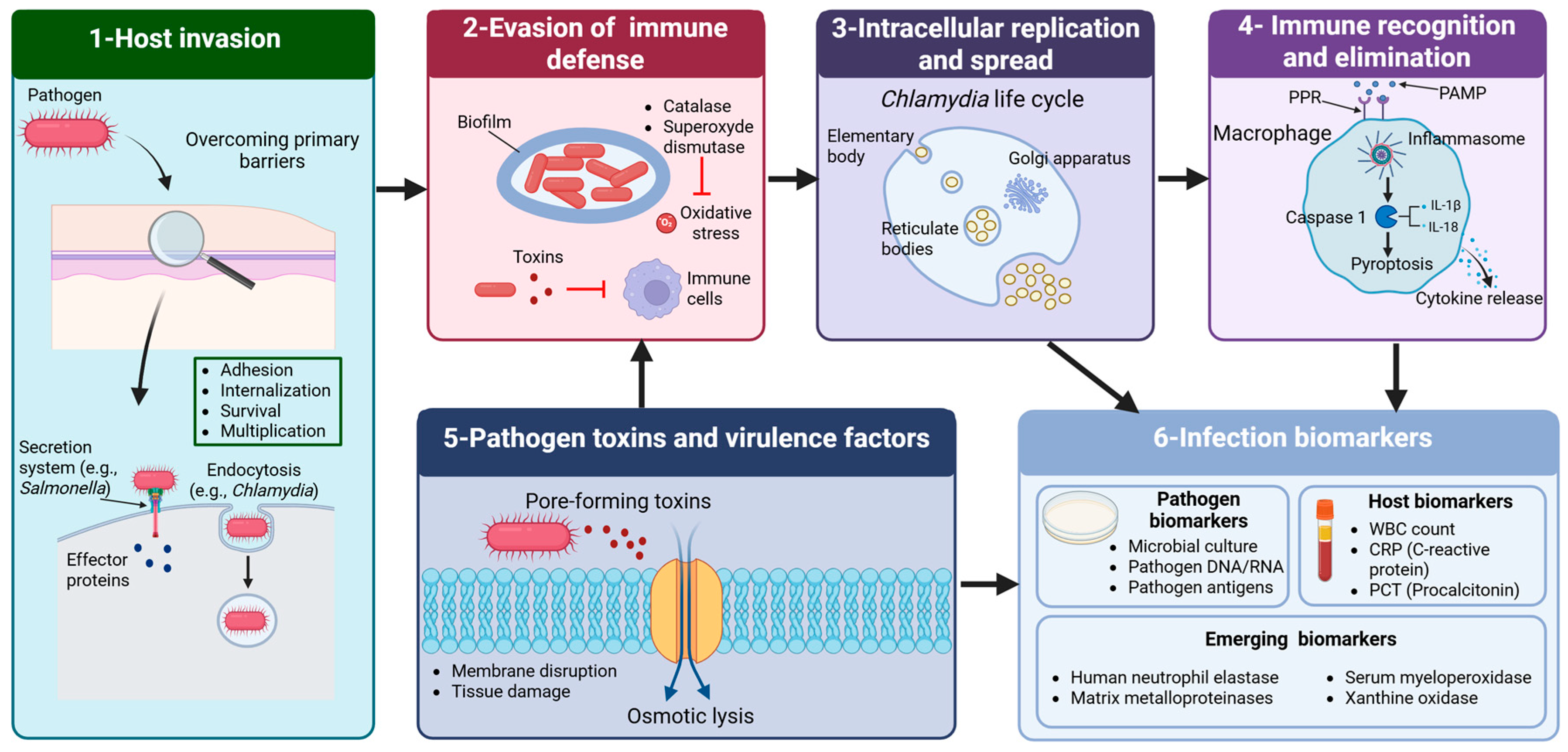
2. Host–Pathogen Interactions
2.1. Host Invasion by Overcoming Primary Barriers
2.2. Evasion of Host Defenses by Pathogens
2.3. Pathogen Replication Within the Host
2.4. Host Immune Control and Pathogen Elimination
2.5. Pathogen Toxins and Virulence Factors
2.6. Infection Biomarkers
3. Omics Approaches in Host–Pathogen Interaction
4. Technologies for Detecting Emerging Infections
4.1. Culture-Based Methods
4.2. Protein-Based Methods
4.3. Chemometric Methods
4.4. Molecular-Based Methods
4.4.1. Polymerase Chain Reaction-Based Methods
4.4.2. Loop-Mediated Isothermal Amplification
4.4.3. Fluorescence In Situ Hybridisation
4.4.4. High-Throughput Sequencing
4.5. Integration of AI and Digital Health Tools for Outbreak Detection
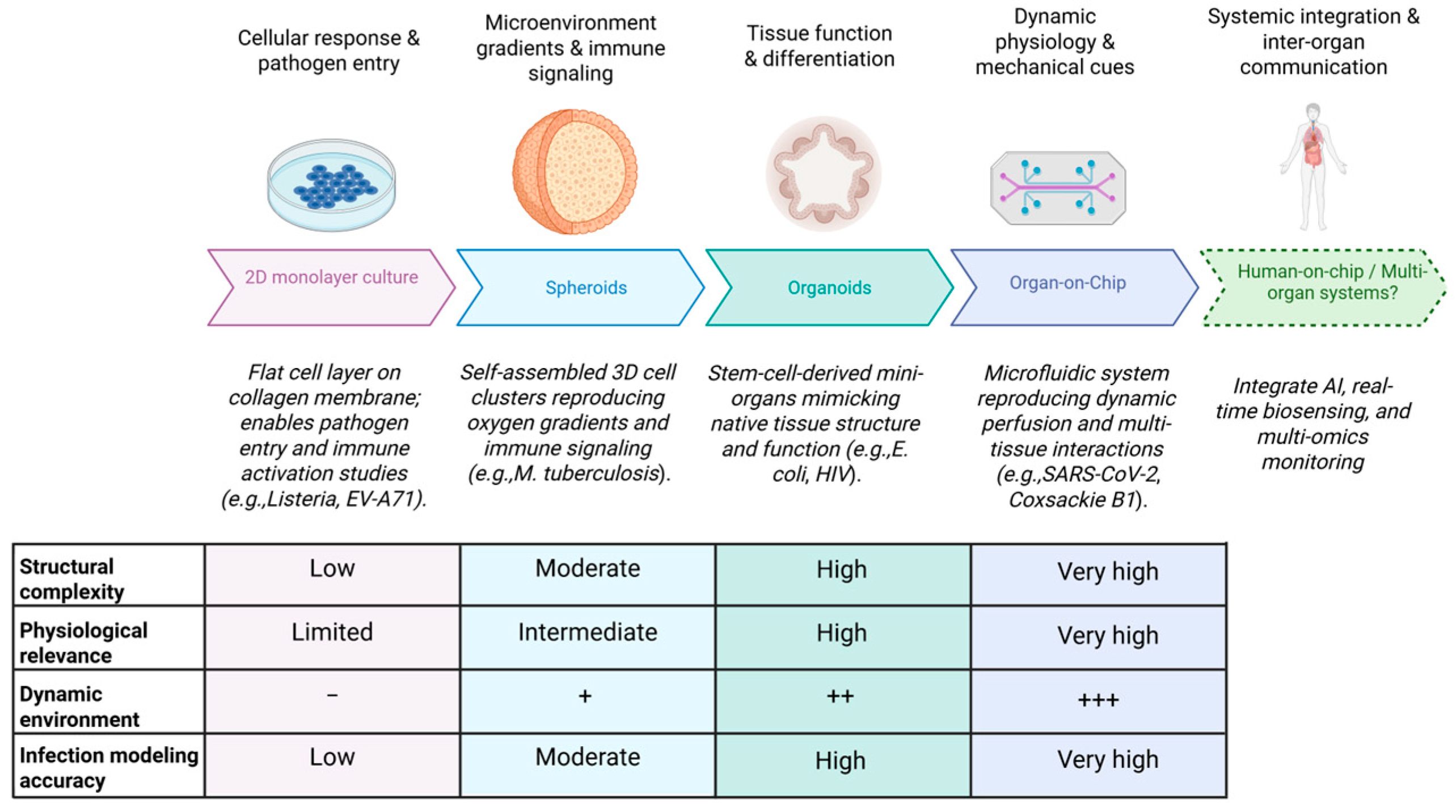
5. Modeling Emerging Infections
5.1. Traditional Two-Dimensional (2D) Cell and Tissue Culture
5.2. Advanced Three-Dimensional (3D) Technologies
5.2.1. Organ-on-Chip
5.2.2. Spheroids
5.2.3. Organoids
6. Conclusions
Author Contributions
Funding
Institutional Review Board Statement
Informed Consent Statement
Data Availability Statement
Conflicts of Interest
Abbreviations
| PRRs | Pattern Recognition Receptors |
| NLRP | NOD-Like Receptor Family Pyrin |
| AIM | Absent In Melanoma |
| ASC | Apoptosis-associated Speck-like protein containing a CARD |
| IL-1β | Interleukin-1 beta |
| IL-18 | Interleukin-18 |
| PCT | Procalcitonin |
| TNF-α | Tumor Necrosis Factor alpha |
| IL-1 | Interleukin-1 |
| IL-6 | Interleukin-6 |
| MMPs | Matrix Metalloproteinases |
| MALDI-ToF MS | Matrix-Assisted Laser Desorption/Ionisation Time of Flight Mass Spectrometry |
| ELISA | Enzyme-Linked Immunosorbent Assay |
| CLIA | Chemiluminescence ImmunoAssay |
| SNA | Serum Neutralisation Assay |
| IFA | ImmunoFluorescence Assay |
| FPA | Fluorescence Polarisation Assay |
| FTIR | Fourier Transform Infrared Spectroscopy |
| SERS | Surface-Enhanced Raman Spectroscopy |
| NIRS | Near-Infrared Spectroscopy |
| GC-MS | Gas Chromatography–Mass Spectrometry |
| DNA | Deoxyribonucleic Acid |
| RNA | Ribonucleic Acid |
| FISH | Fluorescence In Situ Hybridisation |
| NGS | Next-Generation Sequencing |
| PCR | Polymerase Chain Reaction |
| qPCR | Quantitative Polymerase Chain Reaction |
| CT | Cycle Threshold |
| LAMP | Loop-Mediated Isothermal Amplification |
| FIP | Forward Inner Primer |
| BIP | Backward Inner Primer |
| CLASI-FISH | Combinatorial Labelling and Spectral Imaging—Fluorescence In Situ Hybridisation |
| AI | Artificial Intelligence |
| 2D | Two-Dimensional |
| 3D | Three-Dimensional |
| OOC | Organs-On-Chip |
| HBV | Hepatitis B Virus |
| ALB | Albumin |
| TFN | Transferrin |
| HNF-4α | Hepatocyte Nuclear Factor 4 alpha |
| CYP450 | Cytochrome P450 |
| IL-8 | Interleukin-8 |
| MIP-3α | Macrophage Inflammatory Protein-3 alpha |
| SerpinE1 | Serine Protease Inhibitor E1 |
| MCP-A | Monocyte Chemotactic Protein A |
| TNFα | Tumor Necrosis Factor alpha |
| TGF-β1 | Transforming Growth Factor beta 1 |
| CD8+ | Cluster of Differentiation 8 positive |
References
- Han, H.; Wu, B.; Zhang, J.; Song, Y. Summary of global surveillance data of infectious diseases in January 2023. Dis. Surveill. 2023, 38, 132–134. [Google Scholar]
- Sabin, N.S.; Calliope, A.S.; Simpson, S.V.; Arima, H.; Ito, H.; Nishimura, T.; Yamamoto, T. Implications of human activities for (re) emerging infectious diseases, including COVID-19. J. Physiol. Anthropol. 2020, 39, 29. [Google Scholar] [CrossRef]
- Herndon, J.M. New Geophysical Mechanism Driving Major Species Extinction Events. Eur. J. Appl. Sci. 2024, 12, 517–530. [Google Scholar]
- Amarasiri, M.; Furukawa, T.; Nakajima, F.; Sei, K. Pathogens and disease vectors/hosts monitoring in aquatic environments: Potential of using eDNA/eRNA based approach. Sci. Total Environ. 2021, 796, 148810. [Google Scholar] [CrossRef] [PubMed]
- Penaranda, C.; Hung, D.T. Single-cell RNA sequencing to understand host–pathogen interactions. ACS Infect. Dis. 2019, 5, 336–344. [Google Scholar] [CrossRef] [PubMed]
- Colgan, A.M.; Cameron, A.D.S.; Kröger, C. If it transcribes, we can sequence it: Mining the complexities of host–pathogen–environment interactions using RNA-seq. Curr. Opin. Microbiol. 2017, 36, 37–46. [Google Scholar] [CrossRef] [PubMed]
- Sen, R.; Nayak, L.; De, R.K. A review on host–pathogen interactions: Classification and prediction. Eur. J. Clin. Microbiol. Infect. Dis. 2016, 35, 1581–1599. [Google Scholar] [CrossRef]
- Kunz, T.C.; Kozjak-Pavlovic, V. Diverse facets of sphingolipid involvement in bacterial infections. Front. Cell Dev. Biol. 2019, 7, 203. [Google Scholar] [CrossRef]
- Costa, T.R.D.; Harb, L.; Khara, P.; Zeng, L.; Hu, B.; Christie, P.J. Type IV secretion systems: Advances in structure, function, and activation. Mol. Microbiol. 2021, 115, 436–452. [Google Scholar] [CrossRef]
- De Jong, H.K.; Parry, C.M.; van der Poll, T.; Wiersinga, W.J. Host–pathogen interaction in invasive salmonellosis. PLoS Pathog. 2012, 8, e1002933. [Google Scholar] [CrossRef]
- Wang, J.; Chen, Y.-L.; Li, Y.-K.; Chen, D.-K.; He, J.-F.; Yao, N. Functions of sphingolipids in pathogenesis during host–pathogen interactions. Front. Microbiol. 2021, 12, 701041. [Google Scholar] [CrossRef] [PubMed]
- Maginnis, M.S. Virus–receptor interactions: The key to cellular invasion. J. Mol. Biol. 2018, 430, 2590–2611. [Google Scholar] [CrossRef]
- Tham, W.-H.; Lim, N.T.Y.; Weiss, G.E.; Lopaticki, S.; Ansell, B.R.E.; Bird, M.; Lucet, I.; Dorin-Semblat, D.; Doerig, C.; Gilson, P.R. Plasmodium falciparum adhesins play an essential role in signalling and activation of invasion into human erythrocytes. PLoS Pathog. 2015, 11, e1005343. [Google Scholar] [CrossRef] [PubMed]
- Zhu, W.; Filler, S.G. Interactions of Candida albicans with epithelial cells. Cell. Microbiol. 2010, 12, 273–282. [Google Scholar] [CrossRef]
- DeCanio, M.S.; Landick, R.; Haft, R.J.F. The non-pathogenic Escherichia coli strain W secretes SslE via the virulence-associated type II secretion system beta. BMC Microbiol. 2013, 13, 130. [Google Scholar] [CrossRef][Green Version]
- Worley, M.J. Salmonella type III secretion system effectors. Int. J. Mol. Sci. 2025, 26, 2611. [Google Scholar] [CrossRef]
- Roberts, J.R.; Frick-Cheng, A.E.; Styron, H.J.; Durie, C.L.; Chang, L.; Ohi, M.D. The Legionella pneumophila Dot/Icm Type IV secretion system is structurally and functionally resilient in absence of species-specific proteins Dis2 and Dis3. J. Mol. Biol. 2025, 437, 169310. [Google Scholar] [CrossRef] [PubMed]
- Jiang, X.; Li, H.; Ma, J.; Li, H.; Ma, X.; Tang, Y.; Li, J.; Chi, X.; Deng, Y.; Zeng, S. Role of Type VI secretion system in pathogenic remodeling of host gut microbiota during Aeromonas veronii infection. ISME J. 2024, 18, wrae053. [Google Scholar] [CrossRef]
- Caro-Astorga, J.; Álvarez-Mena, A.; Hierrezuelo, J.; Guadix, J.A.; Heredia-Ponce, Z.; Arboleda-Estudillo, Y.; González-Munoz, E.; de Vicente, A.; Romero, D. Two genomic regions encoding exopolysaccharide production systems have complementary functions in B. cereus multicellularity and host interaction. Sci. Rep. 2020, 10, 1000. [Google Scholar] [CrossRef]
- Freyberg, Z.; Harvill, E.T. Pathogen manipulation of host metabolism: A common strategy for immune evasion. PLoS Pathog. 2017, 13, e1006669. [Google Scholar] [CrossRef]
- Strumillo, S.T.; Kartavykh, D.; de Carvalho, F.F., Jr.; Cruz, N.C.; de Souza Teodoro, A.C.; Sobhie Diaz, R.; Curcio, M.F. Host–virus interaction and viral evasion. Cell Biol. Int. 2021, 45, 1124–1147. [Google Scholar] [CrossRef]
- Donelson, J.E.; Hill, K.L.; El-Sayed, N.M.A. Multiple mechanisms of immune evasion by African trypanosomes. Mol. Biochem. Parasitol. 1998, 91, 51–66. [Google Scholar] [CrossRef]
- König, R.; Stertz, S. Recent strategies and progress in identifying host factors involved in virus replication. Curr. Opin. Microbiol. 2015, 26, 79–88. [Google Scholar] [CrossRef] [PubMed]
- Burrell, C.J.; Howard, C.R.; Murphy, F.A. Fenner and White’s Medical Virology; Academic Press: Cambridge, MA, USA, 2016; ISBN 0123751578. [Google Scholar]
- Hayward, J.A.; Mathur, A.; Ngo, C.; Man, S.M. Cytosolic recognition of microbes and pathogens: Inflammasomes in action. Microbiol. Mol. Biol. Rev. 2018, 82, 10-1128. [Google Scholar] [CrossRef]
- Di Bella, S.; Marini, B.; Stroffolini, G.; Geremia, N.; Giacobbe, D.R.; Campanile, F.; Bartoletti, M.; Alloisio, G.; Di Risio, L.; Viglietti, G.; et al. The virulence toolkit of Staphylococcus aureus: A comprehensive review of toxin diversity, molecular mechanisms, and clinical implications. Eur. J. Clin. Microbiol. Infect. Dis. 2025, 44, 1797–1816. [Google Scholar] [CrossRef]
- Girma, A. Staphylococcus aureus: Current perspectives on molecular pathogenesis and virulence. Cell Surf. 2025, 13, 100137. [Google Scholar] [CrossRef]
- Tuipulotu, D.E.; Mathur, A.; Ngo, C.; Man, S.M. Bacillus cereus: Epidemiology, virulence factors, and host–pathogen interactions. Trends Microbiol. 2021, 29, 458–471. [Google Scholar] [CrossRef] [PubMed]
- Mehdizadeh Gohari, I.; Navarro, M.A.; Li, J.; Shrestha, A.; Uzal, F.; McClane, B.A. Pathogenicity and virulence of Clostridium perfringens. Virulence 2021, 12, 723–753. [Google Scholar] [CrossRef]
- Camargo, A.; Ramírez, J.D.; Kiu, R.; Hall, L.J.; Muñoz, M. Unveiling the pathogenic mechanisms of Clostridium perfringens toxins and virulence factors. Emerg. Microbes Infect. 2024, 13, 2341968. [Google Scholar] [CrossRef] [PubMed]
- Ou, L.; Ye, B.; Sun, M.; Qi, N.; Li, J.; Lv, M.; Lin, X.; Cai, H.; Hu, J.; Song, Y.; et al. Mechanisms of intestinal epithelial cell damage by Clostridium perfringens. Anaerobe 2024, 87, 102856. [Google Scholar] [CrossRef]
- Zhang, X.; Zhang, D.; Zhou, D.; Zheng, S.; Li, S.; Hou, Q.; Li, G.; Han, H. A comprehensive review of the pathogenic mechanisms of Pseudomonas aeruginosa: Synergistic effects of virulence factors, quorum sensing, and biofilm formation. Front. Microbiol. 2025, 16, 1619626. [Google Scholar] [CrossRef]
- Qin, S.; Xiao, W.; Zhou, C.; Pu, Q.; Deng, X.; Lan, L.; Liang, H.; Song, X.; Wu, M. Pseudomonas aeruginosa: Pathogenesis, virulence factors, antibiotic resistance, interaction with host, technology advances and emerging therapeutics. Signal Transduct. Target. Ther. 2022, 7, 199. [Google Scholar] [CrossRef] [PubMed]
- Jurado-Martín, I.; Sainz-Mejías, M.; McClean, S. Pseudomonas aeruginosa: An audacious pathogen with an adaptable arsenal of virulence factors. Int. J. Mol. Sci. 2021, 22, 3128. [Google Scholar] [CrossRef]
- Pakbin, B.; Brück, W.M.; Rossen, J.W.A. Virulence factors of enteric pathogenic Escherichia coli: A review. Int. J. Mol. Sci. 2021, 22, 9922. [Google Scholar] [CrossRef]
- Naidoo, N.; Zishiri, O.T. Presence, Pathogenicity, Antibiotic Resistance, and Virulence Factors of Escherichia coli: A Review. Bacteria 2025, 4, 16. [Google Scholar] [CrossRef]
- Montero, D.A.; Vidal, R.M.; Velasco, J.; George, S.; Lucero, Y.; Gómez, L.A.; Carreño, L.J.; García-Betancourt, R.; O’Ryan, M. Vibrio cholerae, classification, pathogenesis, immune response, and trends in vaccine development. Front. Med. 2023, 10, 1155751. [Google Scholar] [CrossRef] [PubMed]
- Hwang, H.; Hwang, B.-Y.; Bueno, J. Biomarkers in infectious diseases. Dis. Markers 2018, 2018, 8509127. [Google Scholar] [CrossRef]
- Seok, H.; Park, D.W. Role of biomarkers in antimicrobial stewardship: Physicians’ perspectives. Korean J. Intern. Med. 2024, 39, 413. [Google Scholar] [CrossRef]
- Heffernan, A.J.; Denny, K.J. Host diagnostic biomarkers of infection in the ICU: Where are we and where are we going? Curr. Infect. Dis. Rep. 2021, 23, 4. [Google Scholar] [CrossRef]
- Tegl, G.; Schiffer, D.; Sigl, E.; Heinzle, A.; Guebitz, G.M. Biomarkers for infection: Enzymes, microbes, and metabolites. Appl. Microbiol. Biotechnol. 2015, 99, 4595–4614. [Google Scholar] [CrossRef]
- Chen, C.; Wang, J.; Pan, D.; Wang, X.; Xu, Y.; Yan, J.; Wang, L.; Yang, X.; Yang, M.; Liu, G. Applications of multi-omics analysis in human diseases. MedComm 2023, 4, e315. [Google Scholar] [CrossRef]
- Hameed, S.; Zeeshan, F. Integrated Omics Approaches to Infectious Diseases; Hameed, S., Fatima, Z., Eds.; Springer: Singapore, 2021; ISBN 978-981-16-0690-8. [Google Scholar]
- Gioacchino, E.; Vandelannoote, K.; Ruberto, A.A.; Popovici, J.; Cantaert, T. Unraveling the intricacies of host-pathogen interaction through single-cell genomics. Microbes Infect. 2024, 26, 105313. [Google Scholar] [CrossRef] [PubMed]
- Fan, X.; Chen, L.; Chen, M.; Zhang, N.; Chang, H.; He, M.; Shen, Z.; Zhang, L.; Ding, H.; Xie, Y.; et al. Pan-omics-based characterization and prediction of highly multidrug-adapted strains from an outbreak fungal species complex. Innovation 2024, 5, 100681. [Google Scholar] [CrossRef]
- Zhou, H.; Negrón, O.; Abbondante, S.; Marshall, M.; Jones, B.; Ong, E.; Chumbler, N.; Tunkey, C.; Dixon, G.; Lin, H.; et al. Spatial transcriptomics identifies novel Pseudomonas aeruginosa virulence factors. Cell Genom. 2025, 5, 100805. [Google Scholar] [CrossRef]
- Li, J.; Guo, M.; Tian, X.; Wang, X.; Yang, X.; Wu, P.; Liu, C.; Xiao, Z.; Qu, Y.; Yin, Y.; et al. Virus-Host Interactome and Proteomic Survey Reveal Potential Virulence Factors Influencing SARS-CoV-2 Pathogenesis. Med 2021, 2, 99–112.e7. [Google Scholar] [CrossRef]
- Hildebrandt, F.; Iturritza, M.U.; Zwicker, C.; Vanneste, B.; Van Hul, N.; Semle, E.; Quin, J.; Pascini, T.; Saarenpää, S.; He, M.; et al. Host-pathogen interactions in the Plasmodium-infected mouse liver at spatial and single-cell resolution. Nat. Commun. 2024, 15, 7105. [Google Scholar] [CrossRef]
- Khan, M.M.; Ernst, O.; Manes, N.P.; Oyler, B.L.; Fraser, I.D.C.; Goodlett, D.R.; Nita-Lazar, A. Multi-Omics Strategies Uncover Host–Pathogen Interactions. ACS Infect. Dis. 2019, 5, 493–505. [Google Scholar] [CrossRef]
- Jha, A.K.; Huang, S.C.-C.; Sergushichev, A.; Lampropoulou, V.; Ivanova, Y.; Loginicheva, E.; Chmielewski, K.; Stewart, K.M.; Ashall, J.; Everts, B.; et al. Network Integration of Parallel Metabolic and Transcriptional Data Reveals Metabolic Modules that Regulate Macrophage Polarization. Immunity 2015, 42, 419–430. [Google Scholar] [CrossRef]
- Hasin, Y.; Seldin, M.; Lusis, A. Multi-omics approaches to disease. Genome Biol. 2017, 18, 83. [Google Scholar] [CrossRef] [PubMed]
- Zhang, Y.; Thomas, J.P.; Korcsmaros, T.; Gul, L. Integrating multi-omics to unravel host-microbiome interactions in inflammatory bowel disease. Cell Rep. Med. 2024, 5, 101738. [Google Scholar] [CrossRef] [PubMed]
- Bai, Y.; Liu, W.; Liu, Z.; Ding, D.; Jin, H.; Xiao, S.; Guo, J.; He, X.; Wang, Q.; Xiao, H. Multi-omics analysis of glycolytic reprogramming and ROS dynamics in host-specific responses to Salmonella typhi infection in mice. J. Adv. Res. 2025. [Google Scholar] [CrossRef]
- Seong, H.J.; Park, Y.M.; Kim, B.-S.; Yoo, H.J.; Kim, T.; Yoon, S.M.; Kim, J.-H.; Lee, S.-Y.; Lee, Y.K.; Lee, D.-W. Integrated multi-omics reveals different host crosstalk of atopic dermatitis-enriched Bifidobacterium longum Strains. npj Biofilms Microbiomes 2025, 11, 91. [Google Scholar] [CrossRef]
- Mohamed, S.H.; Hamed, M.; Alamoudi, H.A.; Jastaniah, Z.; Alakwaa, F.M.; Reda, A. Multi-omics analysis of Helicobacter pylori–associated gastric cancer identifies hub genes as a novel therapeutic biomarker. Brief. Bioinform. 2025, 26, bbaf241. [Google Scholar] [CrossRef] [PubMed]
- Li, X.; Wang, B.; Li, X.; He, J.; Shi, Y.; Wang, R.; Li, D.; Haitao, D. Analysis and validation of serum biomarkers in brucellosis patients through proteomics and bioinformatics. Front. Cell. Infect. Microbiol. 2025, 14, 1446339. [Google Scholar] [CrossRef]
- Wang, H.; Zhang, W.; Tang, Y.-W. Clinical microbiology in detection and identification of emerging microbial pathogens: Past, present and future. Emerg. Microbes Infect. 2022, 11, 2579–2589. [Google Scholar] [CrossRef] [PubMed]
- Lagier, J.-C.; Hugon, P.; Khelaifia, S.; Fournier, P.-E.; La Scola, B.; Raoult, D. The rebirth of culture in microbiology through the example of culturomics to study human gut microbiota. Clin. Microbiol. Rev. 2015, 28, 237–264. [Google Scholar] [CrossRef]
- Váradi, L.; Luo, J.L.; Hibbs, D.E.; Perry, J.D.; Anderson, R.J.; Orenga, S.; Groundwater, P.W. Methods for the detection and identification of pathogenic bacteria: Past, present, and future. Chem. Soc. Rev. 2017, 46, 4818–4832. [Google Scholar] [CrossRef]
- Foddai, A.C.G.; Grant, I.R. Methods for detection of viable foodborne pathogens: Current state-of-art and future prospects. Appl. Microbiol. Biotechnol. 2020, 104, 4281–4288. [Google Scholar] [CrossRef]
- Bonnet, M.; Lagier, J.C.; Raoult, D.; Khelaifia, S. Bacterial culture through selective and non-selective conditions: The evolution of culture media in clinical microbiology. New Microbes New Infect. 2020, 34, 100622. [Google Scholar] [CrossRef]
- Willinger, B. Culture-Based Techniques. In Human Fungal Pathogen Identification: Methods and Protocols; Springer: New York, NY, USA, 2017; pp. 195–207. [Google Scholar]
- Buss, J.E.; Cresse, M.; Doyle, S.; Buchan, B.W.; Craft, D.W.; Young, S. Campylobacter culture fails to correctly detect Campylobacter in 30% of positive patient stool specimens compared to non-cultural methods. Eur. J. Clin. Microbiol. Infect. Dis. 2019, 38, 1087–1093. [Google Scholar] [CrossRef] [PubMed]
- Gutiérrez-Bautista, J.F.; Tarriño, M.; González, A.; Olivares Durán, M.J.; Cobo, F.; Reguera, J.A.; Rodríguez-Granger, J.; Sampedro, A. Comparison of an enzyme linked-immunosorbent assay and a chemiluminescent immunoassay with an immunofluorescence assay for detection of phase II IgM and IgG antibodies to Coxiella burnetii. Microorganisms 2024, 12, 552. [Google Scholar] [CrossRef] [PubMed]
- Eremin, S.A.; Mukhametova, L.I.; Krylov, V.B.; Nifantiev, N.E. Fluorescence polarization assay for infection diagnostics: A review. Molecules 2024, 29, 4712. [Google Scholar] [CrossRef]
- Chen, X.-F.; Hou, X.; Xiao, M.; Zhang, L.; Cheng, J.-W.; Zhou, M.-L.; Huang, J.-J.; Zhang, J.-J.; Xu, Y.-C.; Hsueh, P.-R. Matrix-Assisted Laser Desorption/Ionization Time of Flight Mass Spectrometry (MALDI-TOF MS) Analysis for the Identification of Pathogenic Microorganisms: A Review. Microorganisms 2021, 9, 1536. [Google Scholar] [CrossRef] [PubMed]
- Dokuta, S.; Yadoung, S.; Jeeno, P.; Hongjaisee, S.; Khamnoi, P.; Manochomphu, S.; Danmek, K.; Maitip, J.; Chuttong, B.; Hongsibsong, S. Isolation and Identification of Microorganisms and Antibiotic Resistance Microorganisms from Beehives Located in Palm, Corn and Longan Plantations, Thailand. Microorganisms 2023, 11, 2855. [Google Scholar] [CrossRef] [PubMed]
- Chen, Y.; Peng, Y.; Zuo, J.; Yin, T. A rapid detection method of three foodborne pathogens based on physical and chemical Raman spectroscopy enhanced. Vib. Spectrosc. 2023, 129, 103612. [Google Scholar] [CrossRef]
- Jadhav, S.R.; Shah, R.M.; Karpe, A.V.; Morrison, P.D.; Kouremenos, K.; Beale, D.J.; Palombo, E.A. Detection of foodborne pathogens using proteomics and metabolomics-based approaches. FMICB 2018, 9, 3132. [Google Scholar] [CrossRef]
- Pandian, S.; Lakshmi, S.A.; Priya, A.; Balasubramaniam, B.; Zaukuu, J.-L.Z.; Durgadevi, R.; Abe-Inge, V.; Sohn, S.-I. Spectroscopic methods for the detection of microbial pathogens and diagnostics of infectious diseases—An updated overview. Processes 2023, 11, 1191. [Google Scholar] [CrossRef]
- Jayamohan, H.; Lambert, C.J.; Sant, H.J.; Jafek, A.; Patel, D.; Feng, H.; Beeman, M.; Mahmood, T.; Nze, U.; Gale, B.K. SARS-CoV-2 pandemic: A review of molecular diagnostic tools including sample collection and commercial response with associated advantages and limitations. Anal. Bioanal. Chem. 2021, 413, 49–71. [Google Scholar] [CrossRef]
- Ezrari, S.; Legrifi, I.; Taoussi, M.; Khadiri, M.; Belabess, Z.; Lahlali, R. Plant—Pathogen Interactions and Global Food Security. In Plant Pathogen Interaction; Springer: Singapore, 2023; ISBN 9789819948901. [Google Scholar]
- Crossley, B.M.; Bai, J.; Glaser, A.; Maes, R.; Porter, E.; Killian, M.L.; Clement, T.; Toohey-Kurth, K. Guidelines for Sanger sequencing and molecular assay monitoring. J. Vet. Diagnostic Investig. 2020, 32, 767–775. [Google Scholar] [CrossRef]
- Caméléna, F.; Moy, A.-C.; Dudoignon, E.; Poncin, T.; Deniau, B.; Guillemet, L.; Le Goff, J.; Budoo, M.; Benyamina, M.; Chaussard, M. Performance of a multiplex polymerase chain reaction panel for identifying bacterial pathogens causing pneumonia in critically ill patients with COVID-19. Diagn. Microbiol. Infect. Dis. 2021, 99, 115183. [Google Scholar] [CrossRef]
- Xie, N.G.; Wang, M.X.; Song, P.; Mao, S.; Wang, Y.; Yang, Y.; Luo, J.; Ren, S.; Zhang, D.Y. Designing highly multiplex PCR primer sets with Simulated Annealing Design using Dimer Likelihood Estimation (SADDLE). Nat. Commun. 2022, 13, 1881. [Google Scholar] [CrossRef]
- Qin, L.; Li, D.; Wang, Z.; Lan, J.; Han, C.; Mei, J.; Geng, J. Comparison of multiplex PCR capillary electrophoresis assay and PCR-reverse dot blot assay for human papillomavirus DNA genotyping detection in cervical cancer tissue specimens. Front. Public Health 2024, 12, 1421774. [Google Scholar] [CrossRef]
- Kim, S.; Kim, S. Bacterial pathogen detection by conventional culture-based and recent alternative (polymerase chain reaction, isothermal amplification, enzyme linked immunosorbent assay, bacteriophage amplification, and gold nanoparticle aggregation) methods in food samp. J. Food Saf. 2021, 41, e12870. [Google Scholar] [CrossRef]
- Zhang, S.; Li, X.; Wu, J.; Coin, L.; O’brien, J.; Hai, F.; Jiang, G. Molecular methods for pathogenic bacteria detection and recent advances in wastewater analysis. Water 2021, 13, 3551. [Google Scholar] [CrossRef]
- Zhang, Q.; Yang, F.; Gao, J.; Zhang, W.; Xu, X. Development of multiplex TaqMan qPCR for simultaneous detection and differentiation of eight common swine viral and bacterial pathogens. Brazilian J. Microbiol. 2022, 53, 359–368. [Google Scholar] [CrossRef]
- Chen, B.; Jiang, Y.; Cao, X.; Liu, C.; Zhang, N.; Shi, D. Droplet digital PCR as an emerging tool in detecting pathogens nucleic acids in infectious diseases. Clin. Chim. Acta 2021, 517, 156–161. [Google Scholar] [CrossRef]
- Notomi, T. Loop-mediated isothermal amplification of DNA. Nucleic Acids Res. 2000, 28, e63. [Google Scholar] [CrossRef] [PubMed]
- Avendaño, C.; Patarroyo, M.A. Loop-Mediated Isothermal Amplification as Point-of-Care Diagnosis for Neglected Parasitic Infections. Int. J. Mol. Sci. 2020, 21, 7981. [Google Scholar] [CrossRef]
- Yang, N.; Zhang, H.; Han, X.; Liu, Z.; Lu, Y. Advancements and applications of loop-mediated isothermal amplification technology: A comprehensive overview. Front. Microbiol. 2024, 15, 1406632. [Google Scholar] [CrossRef]
- Basu, J.; Sarkar, A.; Tapadar, P. Loop-mediated isothermal amplification as a point of care diagnostic tool. In Evolving Landscape of Molecular Diagnostics; Elsevier: Amsterdam, The Netherlands, 2024; pp. 143–167. [Google Scholar]
- Huang, Z.; Wang, D.; Zhou, J.; He, H.; Wei, C. The Improvement of Fluorescence In Situ Hybridization Technique Based on Explorations of Symbionts in Cicadas. Int. J. Mol. Sci. 2023, 24, 15838. [Google Scholar] [CrossRef] [PubMed]
- Rivera, D.E.; Lažetić, V.; Troemel, E.R.; Luallen, R.J. RNA Fluorescence in situ Hybridization (FISH) to Visualize Microbial Colonization and Infection in Caenorhabditis elegans Intestines. J. Vis. Exp. 2022, 185, e63980. [Google Scholar] [CrossRef] [PubMed]
- Kuo, J.-T.; Chang, L.-L.; Yen, C.-Y.; Tsai, T.-H.; Chang, Y.-C.; Huang, Y.-T.; Chung, Y.-C. Development of Fluorescence In Situ Hybridization as a Rapid, Accurate Method for Detecting Coliforms in Water Samples. Biosensors 2020, 11, 8. [Google Scholar] [CrossRef]
- Azevedo, A.S.; Fernandes, R.M.; Faria, A.R.; Silvestre, O.F.; Nieder, J.B.; Lou, C.; Wengel, J.; Almeida, C.; Azevedo, N.F. Spectral imaging and nucleic acid mimics fluorescence in situ hybridization (SI-NAM-FISH) for multiplex detection of clinical pathogens. Front. Microbiol. 2022, 13, 976639. [Google Scholar] [CrossRef] [PubMed]
- Chiu, C.Y.; Miller, S.A. Clinical metagenomics. Nat. Rev. Genet. 2019, 20, 341–355. [Google Scholar] [CrossRef]
- Heather, J.M.; Chain, B. The sequence of sequencers: The history of sequencing DNA. Genomics 2016, 107, 1–8. [Google Scholar] [CrossRef]
- Hilt, E.E.; Ferrieri, P. Next generation and other sequencing technologies in diagnostic microbiology and infectious diseases. Genes 2022, 13, 1566. [Google Scholar] [CrossRef]
- Gu, W.; Miller, S.; Chiu, C.Y. Clinical metagenomic next-generation sequencing for pathogen detection. Annu. Rev. Pathol. Mech. Dis. 2019, 14, 319–338. [Google Scholar] [CrossRef]
- Nafea, A.M.; Wang, Y.; Wang, D.; Salama, A.M.; Aziz, M.A.; Xu, S.; Tong, Y. Application of next-generation sequencing to identify different pathogens. Front. Microbiol. 2024, 14, 1329330. [Google Scholar] [CrossRef]
- Jabłońska, A.; Sadkowski, A.; Richert-Przygońska, M.; Styczyński, J. Next-generation sequencing for infectious disease diagnostics in pediatric patients with Malignancies or after hematopoietic cell transplantation: A systematic review. J. Clin. Med. 2025, 14, 6444. [Google Scholar] [CrossRef]
- Ahmadi, S.; Bempong, N.-E.; De Santis, O.; Sheath, D.; Flahault, A. The role of digital technologies in tackling the Zika outbreak: A scoping review. J. Public Health Emerg. 2018, 2, 20. [Google Scholar] [CrossRef]
- Ye, J. The Role of Health Technology and Informatics in a Global Public Health Emergency: Practices and Implications From the COVID-19 Pandemic. JMIR Med. Inform. 2020, 8, e19866. [Google Scholar] [CrossRef] [PubMed]
- Tilahun, B.; Gashu, K.D.; Mekonnen, Z.A.; Endehabtu, B.F.; Angaw, D.A. Mapping the Role of Digital Health Technologies in Prevention and Control of COVID-19 Pandemic: Review of the Literature. Yearb. Med. Inform. 2021, 30, 026–037. [Google Scholar] [CrossRef] [PubMed]
- Anema, A.; Kluberg, S.; Wilson, K.; Hogg, R.S.; Khan, K.; Hay, S.I.; Tatem, A.J.; Brownstein, J.S. Digital surveillance for enhanced detection and response to outbreaks. Lancet Infect. Dis. 2014, 14, 1035–1037. [Google Scholar] [CrossRef] [PubMed]
- Salim, M.F.; Satoto, T.B.T.; Daniel, D. Digital Health Interventions in Dengue SurveillanFce to Detect and Predict Outbreak: A Scoping Review. Open Public Health J. 2024, 17, 1–15. [Google Scholar] [CrossRef]
- Ezenwaji, C.O.; Alum, E.U.; Ugwu, O.P.-C. The role of digital health in pandemic preparedness and response: Securing global health? Glob. Health Action 2024, 17, 2419694. [Google Scholar] [CrossRef]
- Kaur, J.; Butt, Z.A. AI-driven epidemic intelligence: The future of outbreak detection and response. Front. Artif. Intell. 2025, 8, 1645467. [Google Scholar] [CrossRef]
- Rashid, Z.; Ahmed, H.; Nadeem, N.; Zafar, S.B.; Yousaf, M.Z. The paradigm of digital health: AI applications and transformative trends. Neural Comput. Appl. 2025, 37, 11039–11070. [Google Scholar] [CrossRef]
- Owolabi, B.O.; Owolabi, F.A. Predictive AI-driven epidemiology for tuberculosis outbreak prevention in achieving zero TB city vision. Int. J. Adv. Res. Publ. Rev. 2025, 2, 318–340. [Google Scholar] [CrossRef]
- Ou, G.; Tang, Y.; Liu, J.; Hao, Y.; Chen, Z.; Huang, T.; Li, S.; Niu, S.; Peng, Y.; Feng, J. Automated robot and artificial intelligence-powered wastewater surveillance for proactive mpox outbreak prediction. Biosaf. Health 2024, 6, 225–234. [Google Scholar] [CrossRef]
- Hutter, V.; Kirton, S.B.; Chau, D.Y.S. Immunocompetent human in vitro skin models. In Skin Tissue Models; Elsevier: Amsterdam, The Netherlands, 2018; pp. 353–373. [Google Scholar]
- Ramírez-Flores, C.J.; Tibabuzo Perdomo, A.M.; Gallego-López, G.M.; Knoll, L.J. Transcending Dimensions in Apicomplexan Research: From Two-Dimensional to Three-Dimensional In Vitro Cultures. Microbiol. Mol. Biol. Rev. 2022, 86, e0002522. [Google Scholar] [CrossRef]
- Roodsant, T.; Navis, M.; Aknouch, I.; Renes, I.B.; van Elburg, R.M.; Pajkrt, D.; Wolthers, K.C.; Schultsz, C.; van der Ark, K.C.H.; Sridhar, A. A human 2D primary organoid-derived epithelial monolayer model to study host-pathogen interaction in the small intestine. Front. Cell. Infect. Microbiol. 2020, 10, 272. [Google Scholar] [CrossRef]
- Hwang, K.S.; Seo, E.U.; Choi, N.; Kim, J.; Kim, H.N. 3D engineered tissue models for studying human-specific infectious viral diseases. Bioact. Mater. 2023, 21, 576–594. [Google Scholar] [CrossRef]
- Barua, N.; Huang, L.; Li, C.; Yang, Y.; Luo, M.; Wei, W.I.; Wong, K.T.; Lo, N.W.S.; Kwok, K.O.; Ip, M. Comparative study of two-dimensional (2D) vs. three-dimensional (3D) organotypic kertatinocyte-fibroblast skin models for Staphylococcus aureus (MRSA) infection. Int. J. Mol. Sci. 2021, 23, 299. [Google Scholar] [CrossRef]
- Engel, M.; Belfiore, L.; Aghaei, B.; Sutija, M. Enabling high throughput drug discovery in 3D cell cultures through a novel bioprinting workflow. SLAS Technol. 2022, 27, 32–38. [Google Scholar] [CrossRef]
- Ozbolat, I.T. 3D Bioprinting: Fundamentals, Principles and Applications; Academic Press: Cambridge, MA, USA, 2016; ISBN 0128030305. [Google Scholar]
- Beißner, N.; Lorenz, T.; Reichl, S. Organ on Chip. In Microsystems for Pharmatechnology; Springer International Publishing: Cham, Switzerland, 2016; pp. 299–339. [Google Scholar]
- Koban, R.; Lam, T.; Schwarz, F.; Kloke, L.; Bürge, S.; Ellerbrok, H.; Neumann, M. Simplified bioprinting-based 3D cell culture infection models for virus detection. Viruses 2020, 12, 1298. [Google Scholar] [CrossRef]
- Marrazzo, P.; Fischer, N.; Nastasi, C.; Cricca, M.; Fusco, D. Host–Pathogen Interactions: Organotypic Cultures to Unravel the Mysteries of the Primordial Hostility among Organisms. Pathogens 2022, 11, 362. [Google Scholar] [CrossRef]
- Wang, Z.; He, X.; Qiao, H.; Chen, P. Global Trends of Organoid and Organ-On-a-Chip in the Past Decade: A Bibliometric and Comparative Study. Tissue Eng. Part A 2020, 26, 656–671. [Google Scholar] [CrossRef]
- Tajeddin, A.; Mustafaoglu, N. Design and Fabrication of Organ-on-Chips: Promises and Challenges. Micromachines 2021, 12, 1443. [Google Scholar] [CrossRef] [PubMed]
- Leung, C.M.; de Haan, P.; Ronaldson-Bouchard, K.; Kim, G.-A.; Ko, J.; Rho, H.S.; Chen, Z.; Habibovic, P.; Jeon, N.L.; Takayama, S.; et al. A guide to the organ-on-a-chip. Nat. Rev. Methods Prim. 2022, 2, 33. [Google Scholar] [CrossRef]
- Cho, S.; Lee, S.; Ahn, S.I. Design and engineering of organ-on-a-chip. Biomed. Eng. Lett. 2023, 13, 97–109. [Google Scholar] [CrossRef] [PubMed]
- Morsink, M.; Willemen, N.; Leijten, J.; Bansal, R.; Shin, S. Immune Organs and Immune Cells on a Chip: An Overview of Biomedical Applications. Micromachines 2020, 11, 849. [Google Scholar] [CrossRef] [PubMed]
- Low, L.A.; Mummery, C.; Berridge, B.R.; Austin, C.P.; Tagle, D.A. Organs-on-chips: Into the next decade. Nat. Rev. Drug Discov. 2021, 20, 345–361. [Google Scholar] [CrossRef]
- Lacombe, J.; Soldevila, M.; Zenhausern, F. From organ-on-chip to body-on-chip: The next generation of microfluidics platforms for in vitro drug efficacy and toxicity testing. Prog. Mol. Biol. Transl. Sci. 2022, 187, 41–91. [Google Scholar]
- Singh, G.; Mishra, A.; Mathur, A.; Shastri, S.; Nizam, A.; Rizwan, A.; Dadial, A.S.; Firdous, A.; Hassan, H. Advancement of organ-on-chip towards next generation medical technology. Biosens. Bioelectron. X 2024, 18, 100480. [Google Scholar] [CrossRef]
- Dasgupta, Q.; Jiang, A.; Wen, A.M.; Mannix, R.J.; Man, Y.; Hall, S.; Javorsky, E.; Ingber, D.E. A human lung alveolus-on-a-chip model of acute radiation-induced lung injury. Nat. Commun. 2023, 14, 6506. [Google Scholar] [CrossRef]
- Baddal, B.; Marrazzo, P. Refining host-pathogen interactions: Organ-on-chip side of the coin. Pathogens 2021, 10, 203. [Google Scholar] [CrossRef] [PubMed]
- Kang, Y.B.; Sodunke, T.R.; Lamontagne, J.; Cirillo, J.; Rajiv, C.; Bouchard, M.J.; Noh, M. Liver sinusoid on a chip: Long-term layered co-culture of primary rat hepatocytes and endothelial cells in microfluidic platforms. Biotechnol. Bioeng. 2015, 112, 2571–2582. [Google Scholar] [CrossRef]
- Ortega-Prieto, A.M.; Skelton, J.K.; Wai, S.N.; Large, E.; Lussignol, M.; Vizcay-Barrena, G.; Hughes, D.; Fleck, R.A.; Thursz, M.; Catanese, M.T.; et al. 3D microfluidic liver cultures as a physiological preclinical tool for hepatitis B virus infection. Nat. Commun. 2018, 9, 682. [Google Scholar] [CrossRef]
- Villenave, R.; Wales, S.Q.; Hamkins-Indik, T.; Papafragkou, E.; Weaver, J.C.; Ferrante, T.C.; Bahinski, A.; Elkins, C.A.; Kulka, M.; Ingber, D.E. Human Gut-On-A-Chip Supports Polarized Infection of Coxsackie B1 Virus In Vitro. PLoS ONE 2017, 12, e0169412. [Google Scholar] [CrossRef]
- Thacker, V.V.; Sharma, K.; Dhar, N.; Mancini, G.; Sordet-Dessimoz, J.; McKinney, J.D. Rapid endotheliitis and vascular damage characterize SARS-CoV-2 infection in a human lung-on-chip model. EMBO Rep. 2021, 22, e52744. [Google Scholar] [CrossRef] [PubMed]
- Wang, J.; Wang, C.; Xu, N.; Liu, Z.-F.; Pang, D.-W.; Zhang, Z.-L. A virus-induced kidney disease model based on organ-on-a-chip: Pathogenesis exploration of virus-related renal dysfunctions. Biomaterials 2019, 219, 119367. [Google Scholar] [CrossRef]
- Almela, T.; Tayebi, L.; Moharamzadeh, K. 3D bioprinting for in vitro models of oral cancer: Toward development and validation. Bioprinting 2021, 22, e00132. [Google Scholar] [CrossRef]
- Dokmanovic, M.; Wu, W.J. Monitoring trastuzumab resistance and cardiotoxicity: A tale of personalized medicine. Adv. Clin. Chem. 2015, 70, 95–130. [Google Scholar]
- Zhuang, P.; Sun, A.X.; An, J.; Chua, C.K.; Chew, S.Y. 3D neural tissue models: From spheroids to bioprinting. Biomaterials 2018, 154, 113–133. [Google Scholar] [CrossRef] [PubMed]
- Shi, Y.; Ma, J.; Zhang, X.; Li, H.; Jiang, L.; Qin, J. Hypoxia combined with spheroid culture improves cartilage specific function in chondrocytes. Integr. Biol. 2015, 7, 289–297. [Google Scholar] [CrossRef]
- Ahn, S.; Kim, D.; Cho, K.; Koh, W.-G. Microfabrication methods for 3D spheroids formation and their application in biomedical engineering. Korean J. Chem. Eng. 2023, 40, 311–324. [Google Scholar] [CrossRef]
- Kochanek, S.J.; Close, D.A.; Johnston, P.A. High Content Screening Characterization of Head and Neck Squamous Cell Carcinoma Multicellular Tumor Spheroid Cultures Generated in 384-Well Ultra-Low Attachment Plates to Screen for Better Cancer Drug Leads. Assay Drug Dev. Technol. 2019, 17, 17–36. [Google Scholar] [CrossRef]
- Lee, D.; Pathak, S.; Jeong, J.-H. Design and manufacture of 3D cell culture plate for mass production of cell-spheroids. Sci. Rep. 2019, 9, 13976. [Google Scholar] [CrossRef] [PubMed]
- Banerjee, D.; Singh, Y.P.; Datta, P.; Ozbolat, V.; O’Donnell, A.; Yeo, M.; Ozbolat, I.T. Strategies for 3D bioprinting of spheroids: A comprehensive review. Biomaterials 2022, 291, 121881. [Google Scholar] [CrossRef]
- Rodrigues, J.; Heinrich, M.A.; Teixeira, L.M.; Prakash, J. 3D In Vitro Model (R)evolution: Unveiling Tumor–Stroma Interactions. Trends Cancer 2021, 7, 249–264. [Google Scholar] [CrossRef] [PubMed]
- Seo, J.; Ha, G.; Lee, G.; Nasiri, R.; Lee, J. Modeling tumor-immune interactions using hybrid spheroids and microfluidic platforms for studying tumor-associated macrophage polarization in melanoma. Acta Biomater. 2024, 190, 233–246. [Google Scholar] [CrossRef]
- Petrucciani, A.; Hoerter, A.; Kotze, L.; Du Plessis, N.; Pienaar, E. Agent-based model predicts that layered structure and 3D movement work synergistically to reduce bacterial load in 3D in vitro models of tuberculosis granuloma. PLoS Comput. Biol. 2024, 20, e1012266. [Google Scholar] [CrossRef]
- Sebrell, T.A.; Hashimi, M.; Sidar, B.; Wilkinson, R.A.; Kirpotina, L.; Quinn, M.T.; Malkoç, Z.; Taylor, P.J.; Wilking, J.N.; Bimczok, D. A novel gastric spheroid co-culture model reveals chemokine-dependent recruitment of human dendritic cells to the gastric epithelium. Cell. Mol. Gastroenterol. Hepatol. 2019, 8, 157–171. [Google Scholar] [CrossRef]
- Mutlu Burnaz, O.; Cagavi, E. Revealing nervous and cardiac system interactions by iPSC-Based platforms. In iPSCs—State of the Science; Elsevier: Amsterdam, The Netherlands, 2022; pp. 1–28. [Google Scholar]
- Sean, G.; Banes, A.J.; Gangaraju, R. Organoids and tissue/organ chips. Stem Cell Res. Ther. 2024, 15, 241. [Google Scholar] [CrossRef] [PubMed]
- Barrila, J.; Radtke, A.L.; Crabbé, A.; Sarker, S.F.; Herbst-Kralovetz, M.M.; Ott, C.M.; Nickerson, C.A. Organotypic 3D cell culture models: Using the rotating wall vessel to study host–pathogen interactions. Nat. Rev. Microbiol. 2010, 8, 791–801. [Google Scholar] [CrossRef]
- Corsini, N.S.; Knoblich, J.A. Human organoids: New strategies and methods for analyzing human development and disease. Cell 2022, 185, 2756–2769. [Google Scholar] [CrossRef] [PubMed]
- Huycke, T.R.; Gartner, Z.J. Setting boundaries for tissue patterning. Science 2022, 375, 26–27. [Google Scholar] [CrossRef] [PubMed]
- Karve, S.S.; Pradhan, S.; Ward, D.V.; Weiss, A.A. Intestinal organoids model human responses to infection by commensal and Shiga toxin producing Escherichia coli. PLoS ONE 2017, 12, e0178966. [Google Scholar] [CrossRef]
- dos Reis, R.S.; Sant, S.; Keeney, H.; Wagner, M.C.E.; Ayyavoo, V. Modeling HIV-1 neuropathogenesis using three-dimensional human brain organoids (hBORGs) with HIV-1 infected microglia. Sci. Rep. 2020, 10, 15209. [Google Scholar] [CrossRef]
- Millen, R.; De Kort, W.W.B.; Koomen, M.; van Son, G.J.F.; Gobits, R.; Penning de Vries, B.; Begthel, H.; Zandvliet, M.; Doornaert, P.; Raaijmakers, C.P.J.; et al. Patient-derived head and neck cancer organoids allow treatment stratification and serve as a tool for biomarker validation and identification. Med 2023, 4, 290–310.e12. [Google Scholar] [CrossRef]



| Method | Principles | Advantages | Disadvantages |
|---|---|---|---|
| Culture-based methods | Growth of microorganisms under favorable conditions for isolate colonies. |
|
|
| Protein-based methods (e.g: MALDI-ToF MS) | Matrix-assisted laser desorption/ionisation time of flight mass spectrometry. |
|
|
| Chemometric methods | Rely on variations in chemical bonds, such as C-H, O-H and N-H, and analyzing spectra obtained from techniques such as FTIR, SERS, NIRS or GC-MS. |
|
|
| Polymerase chain reaction methods | In vitro enzymatic amplification of a targeted DNA sequence by repeated thermal cycles (denaturation, hybridization, and renaturation). |
|
|
| Loop-Mediated Isothermal Amplification | Amplifying DNA or RNA at a constant temperature, usually 60 to 65 °C. |
|
|
| Fluorescence In Situ Hybridization | Use fluorescent probes binding to targeted DNA or RNA sequences. |
|
|
| High-throughput sequencing (IonTorrent platform) | Based on the release of hydrogen ions during DNA synthesis. |
|
|
Disclaimer/Publisher’s Note: The statements, opinions and data contained in all publications are solely those of the individual author(s) and contributor(s) and not of MDPI and/or the editor(s). MDPI and/or the editor(s) disclaim responsibility for any injury to people or property resulting from any ideas, methods, instructions or products referred to in the content. |
© 2026 by the authors. Licensee MDPI, Basel, Switzerland. This article is an open access article distributed under the terms and conditions of the Creative Commons Attribution (CC BY) license.
Share and Cite
Ezrari, S.; Ikken, A.; Grari, O.; Ou-zine, M.; Lahmer, M.; Saddari, A.; Maleb, A. In Vitro Models for Emerging Infectious Disease Detection and Host–Pathogen Interaction Studies. Appl. Microbiol. 2026, 6, 10. https://doi.org/10.3390/applmicrobiol6010010
Ezrari S, Ikken A, Grari O, Ou-zine M, Lahmer M, Saddari A, Maleb A. In Vitro Models for Emerging Infectious Disease Detection and Host–Pathogen Interaction Studies. Applied Microbiology. 2026; 6(1):10. https://doi.org/10.3390/applmicrobiol6010010
Chicago/Turabian StyleEzrari, Said, Abdessamad Ikken, Oussama Grari, Mohamed Ou-zine, Mohammed Lahmer, Abderrazak Saddari, and Adil Maleb. 2026. "In Vitro Models for Emerging Infectious Disease Detection and Host–Pathogen Interaction Studies" Applied Microbiology 6, no. 1: 10. https://doi.org/10.3390/applmicrobiol6010010
APA StyleEzrari, S., Ikken, A., Grari, O., Ou-zine, M., Lahmer, M., Saddari, A., & Maleb, A. (2026). In Vitro Models for Emerging Infectious Disease Detection and Host–Pathogen Interaction Studies. Applied Microbiology, 6(1), 10. https://doi.org/10.3390/applmicrobiol6010010