


Abstract
Zoological gardens represent unique sites for vector and vector-borne disease studies. They offer suitable breeding habitats for vector development and a diverse range of vertebrate hosts for blood feeding of insect vectors. This study aimed to assess the prevalence of avian blood parasites (Haemosporida, Trypanosomatida) in wild-caught mosquitoes (Culicidae) and Culicoides biting midges (Ceratopogonidae) from the largest and oldest zoo in Lithuania. Insects were collected in May–August 2023 using UV-light, CDC and BG-Sentinel traps; collected material was analysed using both microscopy and PCR-based methods for parasite detection. Overall, 504 parous biting midges (10 species) and 59 mosquitoes (three species) were investigated. Haemosporidians (Haemoproteus minutus (hTURDUS2), H. homogeneae (hSYAT16), and H. asymmetricus (hTUPHI01)) were identified in 5.4% of the 174 tested biting midges. Haemoproteus asymmetricus hTUPHI01 sporozoites were seen in only one individual of Culicoides kibunensis. Of 108 Culicoides females, 3.7% carried trypanosomatids—parasites infecting birds (Trypanosoma bennetti group) and mammals (T. theileri group). Among the 59 tested mosquitoes, two (3.4%) Cx. pipiens/torrentium mosquitoes were found to be PCR-positive for trypanosomatids (T. culicavium and Crithidia brevicula). No haemosporidian parasite DNA was detected in the mosquitoes examined. This pilot study indicates that avian blood parasites circulate within the Lithuanian Zoo, highlighting the need for further research on transmission pathways, vector–host interactions, and potential risks.
1. Introduction
Zoological gardens are often criticised for keeping wild animals in captivity; however, modern zoos play a major role in animal conservation by participating in reproduction and reintroduction programmes for endangered and vulnerable species [1,2,3,4]. The environments created in the zoos for these animals are favourable, providing food, shelter, protection against predation, and veterinary care are available around the clock [1,2,3,4]. Moreover, they are also protected from several factors that could lead to extinction in the wild [5]. However, life in captivity also brings new challenges, which can compromise animals’ health, such as high density, transmission of pathogens between different animal species, and exposure to bloodsucking insects, which can not only cause nuisance during blood feeding but also transmit various pathogens [6]. In fact, zoos provide a unique environment for vector development, mainly due to the presence of water bodies and dung for their breeding and an abundant source of blood for feeding [6,7]. The presence of blood-sucking insects and the coexistence of different species of vertebrate hosts in the same area create suitable conditions for research on the transmission of vector-borne pathogens.
Mosquitoes (Diptera: Culicidae) and Culicoides Latreille 1809 biting midges (Diptera: Ceratopogonidae) are well-known for transmitting various human and animal pathogens [8,9], including agents of avian malaria and closely related parasites, as well as trypanosomiasis [10,11,12,13]. The presence of vector-borne diseases has been repeatedly documented in zoos worldwide [6]. Mosquitoes are frequently reported as vectors of Eastern equine encephalitis virus, Plasmodium Marchiafava & Celli 1885 parasites, Usutu virus, West Nile virus, and Dirofilaria immitis Leidy 1856, while Culicoides are known to transmit Bluetongue virus (BTV), Schmallenberg virus (SBV), and Haemoproteus Kruse 1890 transmission [6,7,8,13,14,15]. Moreover, in several countries, wild and captive birds were found to be infected with different avian blood parasites, with the ones belonging to Haemosporida (Plasmodium, Haemoproteus, and Leucocytozoon Berestneff 1904) being the most frequently reported [16,17,18,19]. However, avian Trypanosoma Gruby 1843 (Kinetoplastea: Trypanosomatida) infections are less often documented in zoos, with most reports focusing on mammal-infecting Trypanosoma [20,21,22,23].
The Lithuanian Zoological Garden (LZG) is the biggest and oldest zoo in Lithuania, with the largest collection of animals in the country—209 overall species, 48 of which are listed in the IUCN (International Union for Conservation of Nature) Red List of Threatened Species, including 56 bird species [24]. However, research inside the Lithuanian Zoo is rare and even less is known about the presence of avian blood parasites circulating in the zoo area or their vectors. The aim of this study was to obtain information on the prevalence of avian haemosporidian and Trypanosoma parasites in wild-caught mosquitoes and biting midges in the LZG.
2. Materials and Methods
2.1. Insect Sampling and Dissection
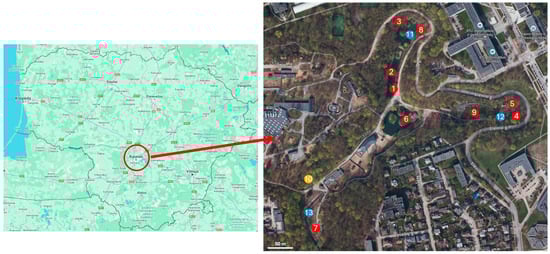
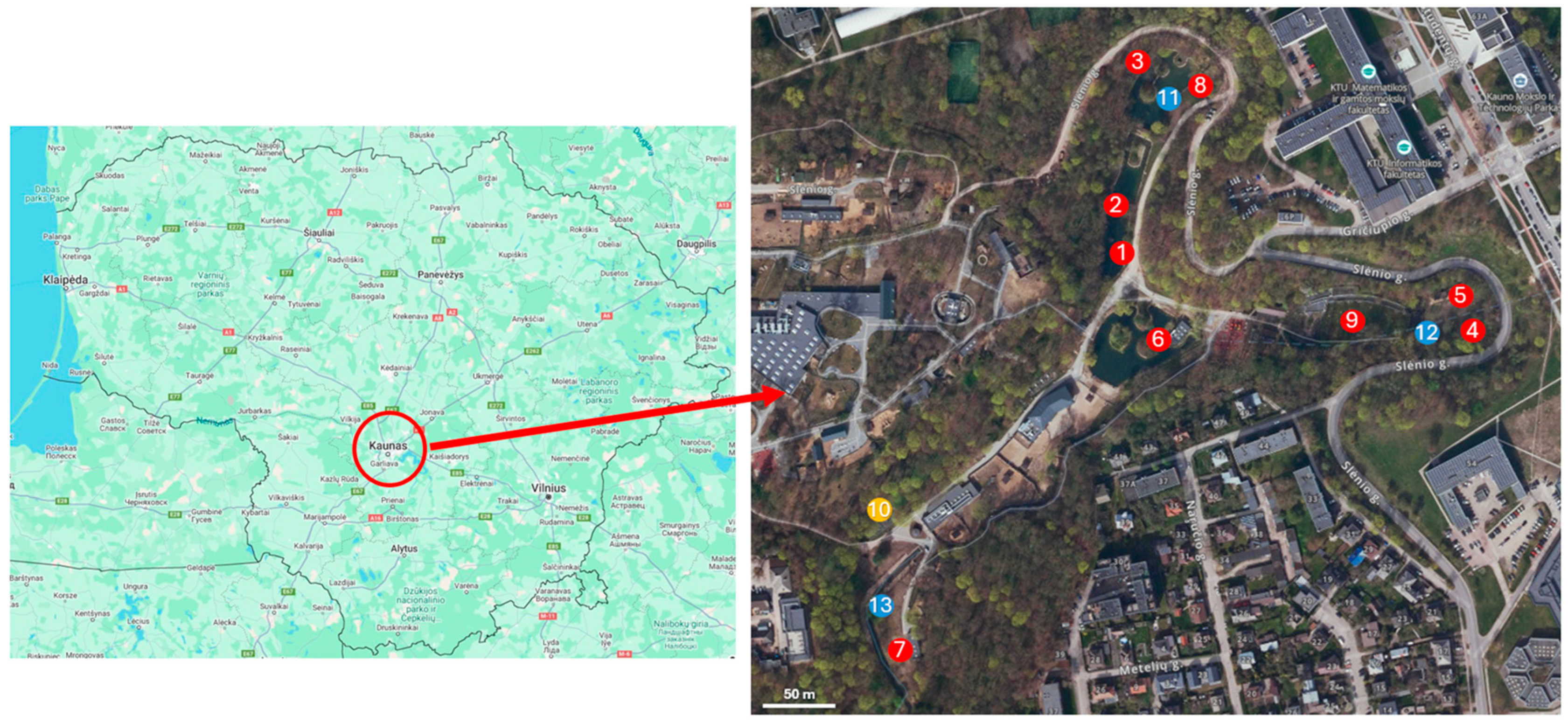
Insects were collected in 2023 at the LZG (54°54′10.854″ N, 23°57′0.326″ E) and its vicinity (Figure 1). Trapping was conducted for three nights during the summer of 2023: on the night of 31 May–1 June (average daily temperature was 14.3 °C), the night of 29–30 June (average daily temperature was 19.9 °C), and on the night of 1–2 August (average daily temperature was 20.2 °C). Air temperature (°C) was obtained from the Lithuanian Hydrometeorological Service (www.meteo.lt, accessed on 10 September 2025) from the automated weather station (AWS) located closest to the study site. Trapping places were chosen based on several factors, which are important for insect breeding and feeding, such as the presence of vertebrate hosts (mammals and birds), the presence of natural (small rivers running through the zoo territory) and artificial water bodies serving as sources of water for animals. The traps were hung 1.5–2 m above the ground, 3–6 h before sunset and turned off 2–3 h after sunrise.
Figure 1.
Map of Lithuania with the location of Lithuanian Zoological Garden marked as red circle (left). Study site and trapping locations in Lithuanian Zoological Garden (right): red dots indicate BG-Pro UV light traps (Biogents, Regensburg, Germany) for Culicoides, yellow dot—BGSentinel trap (Biogents, Regensburg, Germany) for mosquitoes, and blue dots—CDC traps BioQuip Products, Inc., CA, USA) for mosquitoes. The number inside the dots indicate the trap number. Scale bar: 50 m.
For Culicoides sampling, nine BG-Pro UV-light traps with battery-operated fans (Biogents, Regensburg, Germany) were used (Figure 1). Insects were collected directly into a small plastic container with tap water and a drop of liquid detergent and transported to the laboratory on the same day for further processing. Mosquitoes were collected with three CDC light traps (BioQuip Products Inc., Compton, CA, USA) and one BG-Sentinel (Biogents, Regensburg, Germany), both baited with CO2 (Figure 1). The trapping nights were the same as for Culicoides.
Freshly caught mosquitoes and Culicoides midges were sorted from all other insects for further processing using a Motic SMZ-171 BLED (Motic, Hong Kong, China) stereomicroscope. All female mosquitoes (excluding Ochlerotatus spp., based on the fact that the prevalence of avian parasites in mosquitoes of this genus is low [25]) and only parous Culicoides females, as indicated by a burgundy-pigmented abdomen, were dissected. The burgundy-coloured pigment in the abdomen of Culicoides females indicates the occurrence of at least one gonotrophic cycle, which means that the insect had at least one blood meal and therefore could be infected with blood parasites [14,26]. Dissection was conducted by gently removing the head and wings with sterile entomological needles and transferring them into a drop of Euparal for permanent morphological slide preparation for further morphological insect identification, which was performed using the Interactive Identification Key for female Culicoides (Diptera: Ceratopogonidae) from the West Palearctic region [27].
The remaining body parts of females were used for permanent preparations of the salivary gland and gut. For haemosporidian parasite detection, the thorax of Culicoides was crushed in a drop of physiological solution (0.9% NaCl) on an objective slide, while for trypanosomatid parasites, the same procedure was performed with the gut. It is important to mention that, as Culicoides are tiny insects, a portion of the collected parous females was dissected only for haemosporidian parasites, and another portion only for trypanosomatids, so that there would be enough material left for PCR-based analysis (see below).
Mosquito species were morphologically identified according to Becker et al. [28] and Gunay et al. [29] under a stereomicroscope, Motic SMZ-171 BLED (Motic, Hong Kong, China), and each mosquito female was dissected for both parasite groups: for haemosporidian parasites salivary glands were extracted from the anterior part of the thorax and crushed in a drop of physiological solution, while for trypanosomatids the same procedure was performed with the gut on the same objective slide. The remnants of dissected Culicoides and mosquitoes were transferred to a tube containing 96% ethanol and used for further PCR-based investigation.
Permanent preparations of salivary glands and gut were dried at room temperature, fixed in absolute methanol, and stained with a 4% Giemsa solution for 1 h [12]. Microscopy was conducted for all insects, which were PCR positive for the investigated parasites (see PCR protocols below). The entire preparation was screened under 1000× magnification using an Olympus BX-43 light microscope (Olympus, Tokyo, Japan) equipped with an Olympus DP12 digital camera (Olympus, Tokyo, Japan) and the image software Olympus CP-SOFT v.3.2 (Olympus, Tokyo, Japan).
2.2. PCR-Based Analysis
For the DNA extraction, the ethanol was completely removed from the samples by leaving the tubes open overnight to allow the alcohol to fully evaporate. After that, the SET buffer was added to the tube. DNA extraction was performed using an ammonium acetate protocol [30]. PCR-based methods were used separately for haemosporidian and trypanosomatid detection.
For the detection of haemosporidian parasites, a nested PCR, amplifying a 478 bp length fragment of the cytochrome b gene (cytb), was performed with outer primers HaemNFI (5′-CATATATTAAGAGAAITATGGAG-3′) and HaemNR3 (5′-ATAGAAAGATAAGAAATACCATTC-3′), and inner primers HaemF (5′-ATGGTGCTTTCGATATATGCATG-3′) and HaemR2 (5′-GCATTATCTGGATGTGATAATGGT-3′) [31,32]. For the detection of trypanosomatids, a nested PCR, amplifying a 749 bp length DNA fragment encoding SSU 18S rRNA, was performed with outer primers Tryp763 (5′-CATATGCTTGTTCAAGGAC-3′) and Tryp1016 (5′-CCCCATAATCTCCAATGGAC-3′), and inner primers TRYP99 (5′-TCAATCAGACGTAATCTGCC-3′) and TRYP957 (5′-CTGCTCCTTTGTTATCCCAT-3′) [33,34]. Temperature profiles in all PCRs were the same as in the original protocols.
One positive control for each parasite group (one sample of infected blood, positive for Plasmodium sp., as was detected both using PCR and microscopy and one Culicoides sample positive for Trypanosoma sp., as detected by both methods) and one negative control (nuclease-free water) were included in every PCR run. The success of DNA amplification was evaluated by electrophoresis using 2 µL of each PCR product in 2% agarose gel. Positive PCR samples were precipitated with an ammonium acetate protocol [30]. Feeding preference analysis was conducted with the abdomen of engorged females, and the results are shown in our previous research [35].
Sequencing was performed using a Big Dye Terminator V3.1 Cycle Sequencing Kit and ABI PRISMTM 3100 capillary sequencing robot (Applied Biosystems, Foster City, CA, USA) with corresponding primers. Obtained sequence electropherograms were analysed using the software Geneious Prime 2025.0.3 (https://www.geneious.com) to check for the presence of double-peaks (indicating mixed infections) and to create contig sequences, which were compared with other sequences in GenBank using the ‘Basic Local Alignment Search Tool’ (NCBI Web BLAST service, which runs BLAST+ (release ~2.17.0) on NCBI servers, https://blast.ncbi.nlm.nih.gov/Blast.cgi, accessed on 25 March 2025). All haemosporidian sequences were also compared to sequences deposited in the MalAvi database (currently at https://tavimalara.shinyapps.io/malavi_tables/, accessed on 12 June 2025). All obtained sequences were deposited in GenBank (PX610931-PX610932, PX610934-PX610935, PX611779-PX611780, PX610481-PX610486). Haemosporidian sequences were also deposited in the MalAvi database.
2.3. Identification of Culicoides obsoletus and Culicoides scoticus
For Culicoides obsoletus Meigen 1818 and Culicoides scoticus Downes & Kettle 1952 identification, a hemi-nested PCR protocol was used, with modifications, as these two species are cryptic and females cannot be identified solely by morphology [36,37]. Each reaction was performed with the primers from the original protocol C1-N-2191 (5′-CAGGTAAATTAAAATATAAACTTCTGG-3′) and C1-J-1718 (5′-GGAGGATTTGGAAATTGATTAGT-3′), which amplify a 522 bp fragment of cytochrome oxidase subunit I (COI) gene [37] and one species specific primers CO (5′-CAGGAGCTTCTGTAGATTTGGCT-3′ for C. obsoletus) and CS (5′-CAGGAGCCTCAGTTGACTTAGCA-3′ for C. scoticus), which amplify a 334 bp fragment of the same COI gene [36]. Two tubes of PCR mix were prepared for each specimen: the first tube containing primers C1-N-2191, C1-J-1718, and CO; the second tube containing primers C1-N-2191, C1-J-1718, and CS. The results of this analysis were evaluated by electrophoresis; no sequencing was needed, as each of the primers targets different Culicoides species.
2.4. Statistical Analysis
The prevalence of infection (%) was calculated as the proportion of infected insects among all investigated insects and was presented with 95% confidence limits for biting midges and 85% confidence limits for mosquitoes.
3. Results
3.1. Culicoides and Mosquito Species Composition in the Lithuanian Zoological Garden
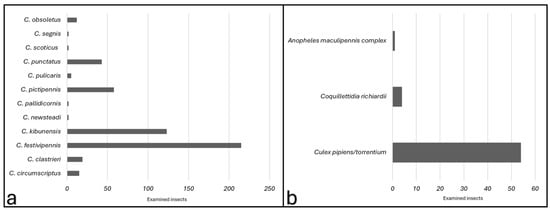
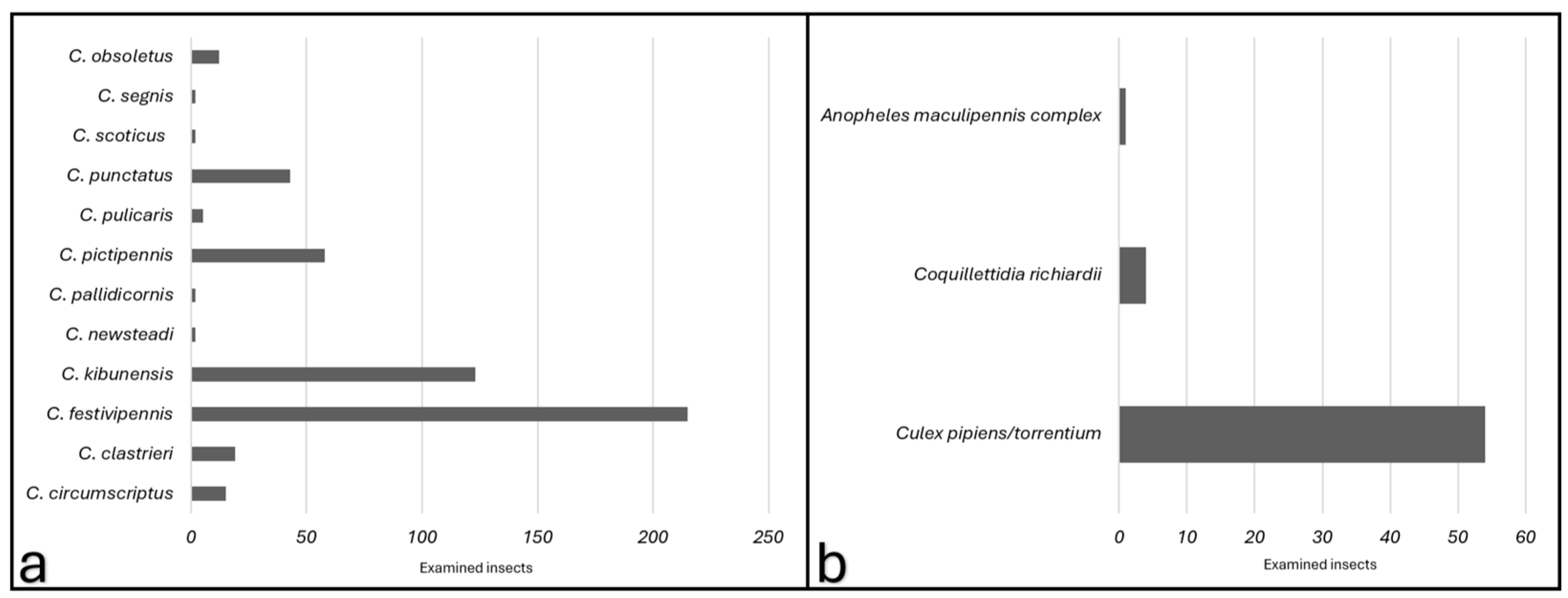
Overall, 504 Culicoides (202 nulliparous females, 282 parous females, and 20 males) belonging to 12 species (Figure 2) and 59 Culicidae belonging to three species were collected. Culicoides festivipennis Kieffer 1914 accounted for the majority of the biting midges collected (43.2%), followed by Culicoides kibunensis Tokunaga 1937 (24.7%), Culicoides pictipennis Staeger 1839 (11.7%), and Culicoides punctatus Meigen 1804 (8.6%) (Figure 2a). Most collected mosquitoes belonged to the Culex pipiens/torrentium species (91.5%), Coquillettidia richiardii Ficalbi 1889 accounted for 6.8%, and only one specimen (1.7%) of Anopheles maculipennis complex was collected (Figure 2b).
Figure 2.
Species of Culicoides biting midges (a) and Culicidae mosquitoes (b) collected in the Lithuanian Zoological Garden from May to August of 2023.
3.2. Parasites Detected in Culicoides Biting Midges
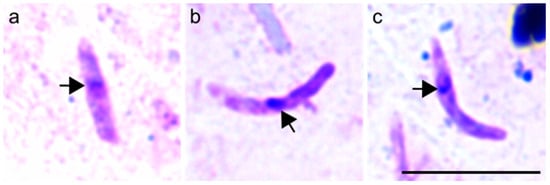
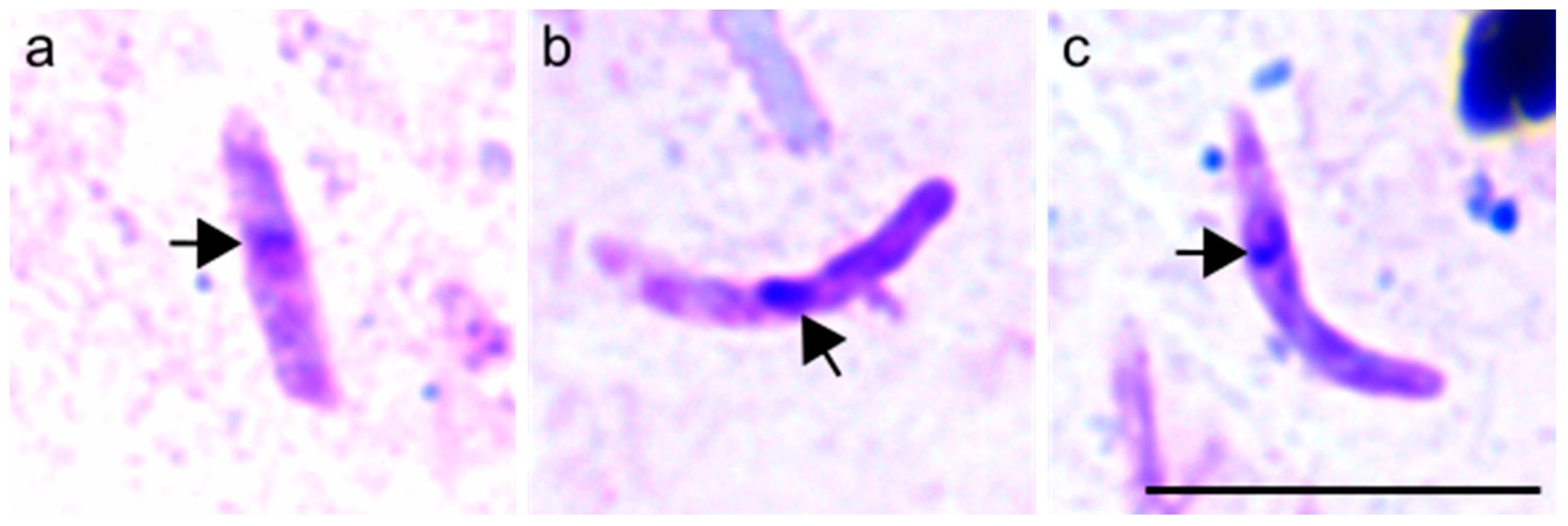
In total, 174 parous Culicoides were analysed for the presence of haemosporidian parasites and 108 for the presence of trypanosomatid parasites. Overall, eight Culicoides females (4.6%, CI 1.5–7.7) were found to be PCR-positive for haemosporidian parasites: four C. pictipennis, two C. festivipennis, and two C. kibunensis (Table 1). Three lineages of haemosporidian parasites Haemoproteus asymmetricus Valkiūnas et al. 2021 hTUPHI01, H. homogeneae Valkiūnas et al. 2019 hSYAT16, H. minutus Valkiūnas and Iezhova 1992 hTURDUS2, and two samples with a co-infection involving multiple Haemoproteus lineages. Only one sample was positive both by PCR and microscopy—one C. kibunensis specimen infected with H. minutus hTURDUS2 (Table 1, Figure 3).
Table 1.
Parasite species, lineages, and prevalence found in Culicoides and Culicidae mosquitoes in the Lithuanian Zoological Garden.
Figure 3.
Sporozoites of Haemoproteus asymmetricus (cytochrome b lineage hTUPHI01) in salivary gland preparation of Culicoides kibunensis captured at the Lithuanian Zoological Garden (a–c). Small triangle arrow: sporozoite nucleus. Methanol-fixed. Giemsa-stained. Scale bar = 10 μm.
Four out of 108 (3.7%, CI 0.1–7.3) biting midges were PCR-positive for Trypanosoma DNA (Table 1): one Culicoides scoticus Downes & Kettle 1952 and one C. kibunensis were positive for trypanosomes belonging to the T. theileri group, and two C. festivipennis were positive for T. bennetti group trypanosomes. All PCR-positive specimens were negative upon microscopic examination.
3.3. Parasites Detected in Culicidae mosquitoes
Overall, 59 mosquitoes were tested, out of which two (3.4%, CI 0–6.8) Cx. pipiens/torrentium were found to be PCR-positive for trypanosomatids, one for Trypanosoma culicavium Votýpka et al. 2011, and one for Crithidia brevicula Frolov & Malysheva 1989. No haemosporidian parasite DNA was found in the examined mosquitoes. All PCR-positive specimens were negative upon microscopic examination for both parasite groups.
4. Discussion
We present data from the first investigation of insect vectors conducted at the LZG. Despite the small sample size and limited trapping effort, the results of our study indicate the presence of both avian and mammalian blood parasites in vectors collected at the LZG. Understanding vector–parasite–host interactions inside zoological gardens is crucial for surveillance of vector species and pathogen transmission [6,20,38]. Pathogens are especially dangerous when they infect naïve species, which often happens in zoos where animals from different zoogeographical areas live close to each other. Notably, this environment facilitates the transmission of vector-borne pathogens, which can spread despite walls, barriers, and cages.
Although currently 34 species of Culicoides were recorded in Lithuania [39,40,41], we found 12 species in the LZG, which is located in the centre of the second largest city in Lithuania. Culicoides festivipennis, which accounted for the majority of all collected biting midges (Figure 2), naturally occurs alongside floodplains, river banks, reed belts, boglands and swampy areas [42] and especially prefers organically rich matter for breeding [43]. The high density of animals in the zoo naturally results in a large amount of organic matter in the environment, thus creating suitable breeding habitats for this Culicoides species. Culicoides kibunensis (24.7%) prefers swamps of eutrophic freshwater bodies, soil of stagnant water bodies, and acidic grasslands located considerably distant from swamps [44]; such habitats may be found in the animal enclosures inside the zoo. Culicoides pictipennis, the third most abundant species collected (11.7%), as previous research has shown, prefers ultra- to extremely acidic environments with a medium moisture level and a moderate to slightly increased organic content [44]; inside the zoo, such permanent conditions are provided by animal dung.
Although all three of these species have large palps, deep and wide sensory pits, and more sensilla coeloconica in their antennas, which are associated with ornithophilic feeding preference [45], they are considered opportunistic blood feeders, with their diet including mammals as well [35,45,46], which makes zoos an ideal breeding and living environment. Interestingly, previous research from European zoos noted a lower prevalence of the mentioned species, with C. festivipennis accounting for only 4% and C. kibunensis for 0.2% in Slovakia, without any records of C. pictipennis in the UK [47,48]. Several studies found high numbers of biting midges belonging to the subgenus Avaritia (i.e., Culicoides obsoletus, C. scoticus, Culicoides dewulfi Goetghebuer 1936, and Culicoides chiopterus Meigen 1830) in the zoos in the UK (76.6% of all collected biting midges) [47] and Slovakia (80.5%) [48], whereas in this study, it accounted for only 2.8%.
It is known that several Culicoides species use animal manure as breeding sites with four species of subgenus Avaritia (i.e., C. obsoletus, C. scoticus, C. dewulfi, and C. chiopterus) being recorded developing in the dung of various animals (llama/alpaca, chicken, cattle, cowpat, deer, horse, duck, rabbit, sheep, and pig), and four species of subgenus Culicoides (Culicoides deltus Edwards 1939, Culicoides pulicaris Linnaeus 1758, C. punctatus and Culicoides newsteadi Austen 1921) recorded developing in various manure (sheep, deer, rabbit, duck, horse and mixes of sheep/horse, and goat/horse) [42].
Three different genetic lineages of haemosporidian parasites were found in Culicoides (hTUPHI01, hTURDUS2, and hSYAT16) in this study. Previous studies have shown that hTURDUS2 and hTUPHI01 are the lineages with the highest prevalence in vectors in Lithuania, being particularly common in C. kibunensis and C. pictipennis [14]. In fact, these Culicoides species have been confirmed as competent vectors of these two Haemoproteus parasites (due to the detection of sporozoites in their salivary gland preparations), which are found infecting mainly black birds, Turdus merula Linnaeus 1758, and thrushes, Turdus philomelos Brehm 1831 (MalAvi database, https://tavimalara.shinyapps.io/malavi_tables/ accessed on 12 June 2025).
It is worth mentioning that H. asymmetricus hTUPHI01 and H. minutus hTURDUS2 have been reported to be the cause of death of Psittacidae birds kept in zoos in Europe [49]. One C. kibunensis female was PCR-positive for H. asymmetricus hTUPHI01, with the presence of sporozoites in their salivary gland confirmed (Table 1), which might represent a potential threat for the captive birds kept at LZG.
This is the second report of the lineage hSYAT16 in Lithuania, having been previously found in Spain, Germany, Portugal, Sweden, and Slovakia, always infecting black cap (Sylvia atricapilla Linnaeus 1758) (MalAvi database, accessed on 12 June 2025). In other words, since Haemoproteus parasites present a high host-specificity, the parasite lineages found in these Culicoides insects can be used to obtain new knowledge on the feeding preference of biting midges, not only at the class (Aves and Mammalia), but also at the bird species level [14].
Two Trypanosoma were found in Culicoides biting midges in this study: bird-infecting trypanosomes belonging to the T. bennetti group and mammal-infecting trypanosomes belonging to the T. theileri group. This is the first report of T. theileri group trypanosomes in C. scoticus biting midges. The T. theileri group consists of Trypanosoma theileri Laveran 1902, Trypanosoma melophagium Flu 1908, Trypanosoma cervi Kingston & Morton 1975, and Trypanosoma trinaperronei Garcia et al. 2020 [50,51]. Their known vectors are various dipteran insects, such as deer keds (Hippoboscidae), tabanids (Tabanidae) [52,53,54], mosquitoes (Culicidae) [10], Phlebotomus perfiliewi Parrot 1930 (Psychodidae) [55], and tsetse flies (Glossinidae) [56,57].
There are only a few reports of these trypanosomatids in Culicoides. For example, 15 years ago, trypanosomes from the T. theileri group were found in five (0.11%) Culicoides specimens (C. obsoletus, C. pulicaris, and C. punctatus) in the Czech Republic [58]. Moreover, several Culicoides species were found to be PCR-positive for these parasites in Lithuania [14,59]. Culicoides scoticus is well known for transmitting SBV and BTV in Europe [60,61]; however, its role in the transmission of avian trypanosomes is less studied, with a few reports of C. scoticus being PCR-positive for Haemoproteus parasites [14]. To date, there are no previous data on trypanosome occurrence in C. scoticus.
On the other hand, trypanosomes from the T. bennetti group (both T. everetti Molyneux 1973 and T. bennetti Kirkpatrick et al. 1986) are regularly found in biting midges, and Culicoides are proven vectors of these parasites [14]. The occurrence of these parasites in C. festivipennis and C. kibunensis biting midges during our study confirms previous data on the presence of avian trypanosomes in females of these two species [14].
In the present study, only three mosquito species were detected (Culex pipiens/torrentium, Cosquillettidia richiardii, and Anopheles maculipennis complex) out of 37, which are present in Lithuania [62]. Since mosquitoes belonging to the genus Ochlerotatus were not selected for this research, due to their known low prevalence of avian infection [63], mosquito diversity was not fully evaluated. Nevertheless, in zoos in the UK [64] and Japan [16], 11 mosquito species were detected, while in a zoo in Germany, 20 mosquito species were caught [17]. In a zoo in Brazil, 30 species or species groups were reported [38]. For a better understanding of the Culicidae diversity inside LZG, more entomological research is needed.
During this research, most of the mosquitoes caught were Culex pipiens/torrentium (Figure 2b). Similarly, in other zoos, Cx. pipiens also accounts for the majority of the collected mosquitoes (in Japan—56.0% [16] and 98.7% [65]; in Italy—65.4% [66]; in Germany—almost 33.0% [17]). This is not surprising, because Cx. pipiens females lay eggs and larvae develop in water bodies of various sizes and types, including artificial ponds and water containers. Moreover, females of this species can overwinter in sheds and cellars [28], which are usually abundant in zoos.
No haemosporidian parasites were detected in the studied mosquitoes, although they are known vectors of Plasmodium, the main agent of avian malaria [13,67,68]. Recent studies in Lithuania have shown that the overall Plasmodium prevalence in mosquitoes varied from 0.6% to 3.5% [63]. In studies conducted in Japanese zoos, the prevalence of Plasmodium was 0.6% [16] and 4.3% [69]. In a German zoo, most detected haemosporidian parasites belonged to the genus Haemoproteus, a parasite genus that mosquitoes do not transmit, and Plasmodium was found in only one mosquito co-infected with Leucocytozoon sp. [17].
The low presence of parasites in the studied mosquitoes highlights one of the difficulties in Plasmodium investigation in Culicidae: unlike Culicoides, whose abdomens present a burgundy pigment after the gonotrophic cycle (indicating a blood meal and potential parasite infection) [26], Culicidae mosquitoes do not exhibit such characteristics. In other words, it is likely that mosquito females that had never taken a blood meal, and therefore would not be infected with blood parasites, were processed. This limitation can be reduced by using alternative trapping methods, such as gravid-traps, or by dissecting the oviduct to assess signs of oviposition before the dissection for parasite detection.
Two Cx. pipiens/torrentium individuals were PCR-positive for trypanosomatid parasite DNA: one sequence showed 98.7% similarity with T. culicavium (GenBank accession number PP946103), and another showed 99.5% similarity with C. brevicula (OP748974). Trypanosoma culicavium, originally found and described from the stomodaeal valve of Cx. pipiens female in the Czech Republic [70], was later recorded in Cx. pipiens mosquitoes in Austria [10] and Lithuania [25], as well as in bird blood [71]. The presence of T. culicavium in mosquitoes indicates that the insect had taken a blood meal from an infected bird. Several studies reported the presence of monoxenous trypanosomatid in Culicidae mosquitoes, with C. brevicula being one of the most common [10,72,73,74]. This widespread Palearctic species seems to be a generalist with respect to its hosts, with reports in Nabidae, Gerridae, and Miridae [75], as well as in Culex mosquitoes [10,72] and flies from Calliphoridae, Muscidae, Heleomyzidae, Sepsidae, and Antomyidae [10,76]. Data obtained in this study complements previous research on trypanosomatids found in Culicidae mosquitoes.
In this study, the prevalence of parasites based on PCR results was higher than that detected by microscopic analysis. The detection of parasite DNA in insects indicates a potential role as vectors but does not confirm their competence to support parasite development [12]. Performing insect dissections and microscopic analyses can help resolve this issue, as the infective stages of parasites can be directly observed in vectors [12]. Nevertheless, when mammalian or avian parasites are detected in these vectors, it is possible to infer their feeding preferences, indicating which animal groups they are more likely to feed on [14]. This information contributes to understanding the dynamics between vectors and hosts, which is essential for preventing disease transmission in zoological gardens.
Zoos play an important role in animal species conservation, but the threat of vector-borne diseases is constantly present. It is essential for zoos to establish strategies to control these vectors to prevent potential harm to zoo animals. Some strategies, such as using mosquito fish (Gambusia sp.) and larvicides based on Bacillus thuringiensis var. israelensis or Bacillus sphaericus in water bodies, have shown some success in vector control in zoos [77,78]. Environmental modifications, such as increasing water flow at the edges of water bodies, can also reduce the number of breeding sites for Culicidae [77].
The small sample size and limited trapping effort prevent us from drawing more conclusions. More studies are needed not only at the LZG, but also in other zoos around the world. However, our study highlights the role that zoological gardens play in elucidating the transmission dynamics of vector-borne blood parasites. This is largely because zoos provide a controlled environment for investigating vector–host interactions that are otherwise challenging to assess in the wild. The fact that captive animals are kept in specific enclosures makes it possible to track how far vectors can fly after feeding. The same applies to the identification of blood meals. Given the complexity of ecological variables in natural habitats, zoological gardens stand out as accessible and insightful venues for advancing research on avian vector-borne diseases, ultimately contributing to better-informed conservation strategies and disease management efforts.
5. Conclusions
This article presents the first data on the species composition of vectors in the Lithuanian Zoological Garden (LZG) and the blood parasites they harbour within the zoo territory. Three avian Haemoproteus species (H. asymmetricus hTUPHI01, H. homogeneae hSYAT16, H. minutus hTURDUS2) and trypanosomes from two groups (T. theileri group infecting mammals and T. bennetti group infecting birds) were detected in Culicoides biting midges, while Trypanosoma culicavium and monoxenous trypanosomatid Crithidia brevicula were found in Culicidae mosquitoes. These findings demonstrate that the transmission of vector-borne parasites can occur within the LZG, which could result in the parasites being transmitted between wild and captive animals. Zoos have a pivotal role in species conservation, highlighting the importance of implementing measures to control vector densities and prevent the spread of vector-borne diseases. Additionally, zoological gardens provide a unique and controlled environment for investigating pathogen transmission dynamics.
Author Contributions
Conceptualisation, R.B. and C.R.F.C.; methodology, M.K., R.B., K.V.-P. and C.R.F.C.; validation, M.K., K.V.-P. and C.R.F.C.; formal analysis, M.K., K.V.-P. and C.R.F.C.; investigation, M.K., R.B., K.V.-P. and C.R.F.C.; data curation, C.R.F.C. and M.K.; writing—original draft preparation, M.K., K.V.-P. and C.R.F.C.; writing—review and editing, M.K., R.B., J.A., K.V.-P. and C.R.F.C.; visualisation, M.K.; supervision, C.R.F.C. and R.B.; project administration, C.R.F.C. and R.B.; funding acquisition, C.R.F.C. and R.B. All authors have read and agreed to the published version of the manuscript.
Funding
This project has received funding from the Research Council of Lithuania (LMTLT), agreements S-MIP-21-55 and S-MIP-22-50.
Data Availability Statement
The data presented in this study are available in the GenBank database (https://www.ncbi.nlm.nih.gov/genbank/, accessed on 12 June 2025, accession numbers PX610931-PX610932, PX610934-PX610935, PX611779-PX611780, PX610481-PX610486), and in the MalAvi database (https://tavimalara.shinyapps.io/malavi_tables/, accessed on 12 June 2025). Representative salivary gland and gut preparations are available on request at the Nature Research Centre (accession number 49825NS).
Acknowledgments
The authors are thankful to Sigitas Rimkevičius for the help with choosing the trapping sites inside the Zoological Garden. The authors would also like to thank German Alfredo Gutierrez Liberato for the help with insect sampling.
Conflicts of Interest
The authors declare no conflicts of interest.
References
- Beer, H.N.; Shrader, T.C.; Schmidt, T.B.; Yates, D.T. The Evolution of Zoos as Conservation Institutions: A Summary of the Transition from Menageries to Zoological Gardens and Parallel Improvement of Mammalian Welfare Management. JZBG 2023, 4, 648–664. [Google Scholar] [CrossRef] [Scilit]
- Mănduță, C.; Petrovici, M. The Importance of Zoological Gardens in the Conservation of Biodiversity. Ann. West Univ. Timis. Ser. Biol. 2023, 26, 23–42. [Google Scholar]
- Princée, F.P.G. Research in Zoological Gardens. Lutra 2001, 44, 75–80. [Google Scholar]
- Spooner, S.L.; Walker, S.L.; Dowell, S.; Moss, A. The Value of Zoos for Species and Society: The Need for a New Model. Biol. Conserv. 2023, 279, 109925. [Google Scholar] [CrossRef] [Scilit]
- Curry-Lindahl, K. Conservation of Nature—A Duty for Zoological Gardens. Int. Zoo Yearb. 1965, 5, 100–102. [Google Scholar] [CrossRef] [Scilit]
- Adler, P.H.; Tuten, H.C.; Nelder, M.P. Arthropods of Medicoveterinary Importance in Zoos. Annu. Rev. Entomol. 2011, 56, 123–142. [Google Scholar] [CrossRef] [Scilit]
- Tuten, H.C.; Bridges, W.C.; Paul, K.S.; Adler, P.H. Blood-feeding Ecology of Mosquitoes in Zoos. Med. Vet. Entomol. 2012, 26, 407–416. [Google Scholar] [CrossRef] [Scilit]
- Carpenter, S.; Groschup, M.H.; Garros, C.; Felippe-Bauer, M.L.; Purse, B.V. Culicoides Biting Midges, Arboviruses and Public Health in Europe. Antivir. Res. 2013, 100, 102–113. [Google Scholar] [CrossRef] [Scilit] [PubMed]
- Martinet, J.-P.; Ferté, H.; Failloux, A.-B.; Schaffner, F.; Depaquit, J. Mosquitoes of North-Western Europe as Potential Vectors of Arboviruses: A Review. Viruses 2019, 11, 1059. [Google Scholar] [CrossRef] [Scilit]
- Schoener, E.; Uebleis, S.S.; Cuk, C.; Nawratil, M.; Obwaller, A.G.; Zechmeister, T.; Lebl, K.; Rádrová, J.; Zittra, C.; Votýpka, J.; et al. Trypanosomatid Parasites in Austrian Mosquitoes. PLoS ONE 2018, 13, e0196052. [Google Scholar] [CrossRef] [Scilit]
- Svobodová, M.; Dolnik, O.V.; Čepička, I.; Rádrová, J. Biting Midges (Ceratopogonidae) as Vectors of Avian Trypanosomes. Parasites Vectors 2017, 10, 224. [Google Scholar] [CrossRef] [Scilit]
- Valkiūnas, G. Avian Malaria Parasites and Other Haemosporidia; CRC Press: Boca Raton, FL, USA; London, UK, 2005; ISBN 978-0-415-30097-1. [Google Scholar]
- Ventim, R.; Ramos, J.A.; Osório, H.; Lopes, R.J.; Pérez-Tris, J.; Mendes, L. Avian Malaria Infections in Western European Mosquitoes. Parasitol. Res. 2012, 111, 637–645. [Google Scholar] [CrossRef] [Scilit]
- Chagas, C.R.F.; Bernotienė, R.; Bobeva, A.; Bukauskaitė, D.; Ferraguti, M.; Gutiérrez-Lopez, R.; Kazak, M.; Mathieu, B.; Valavičiūte-Pocienė, K.; Santiago-Alarcon, D.; et al. A Literature Review on the Role of Culicoides in the Transmission of Avian Blood Parasites in Europe. Parasites Vectors 2025, 18, 329. [Google Scholar] [CrossRef] [Scilit]
- Nelson, E.; Thurston, W.; Pearce-Kelly, P.; Jenkins, H.; Cameron, M.; Carpenter, S.; Guthrie, A.; England, M. A Qualitative Risk Assessment for Bluetongue Disease and African Horse Sickness: The Risk of Entry and Exposure at a UK Zoo. Viruses 2022, 14, 502. [Google Scholar] [CrossRef] [Scilit]
- Ejiri, H.; Sato, Y.; Sawai, R.; Sasaki, E.; Matsumoto, R.; Ueda, M.; Higa, Y.; Tsuda, Y.; Omori, S.; Murata, K.; et al. Prevalence of Avian Malaria Parasite in Mosquitoes Collected at a Zoological Garden in Japan. Parasitol. Res. 2009, 105, 629–633. [Google Scholar] [CrossRef] [Scilit]
- Heym, E.C.; Kampen, H.; Krone, O.; Schäfer, M.; Werner, D. Molecular Detection of Vector-Borne Pathogens from Mosquitoes Collected in Two Zoological Gardens in Germany. Parasitol. Res. 2019, 118, 2097–2105. [Google Scholar] [CrossRef] [Scilit]
- Aguiar, L.M.D.; Marçal Júnior, O. Haemoparasites in Captive Birds at Uberlândia Zoo, State of Minas Gerais, Brazil. Biosci. J. 2021, 37, e37011. [Google Scholar] [CrossRef] [Scilit]
- Cocumelli, C.; Iurescia, M.; Diaconu, E.L.; Galietta, V.; Raso, C.; Buccella, C.; Stravino, F.; Grande, F.; Fiorucci, L.; De Liberato, C.; et al. Plasmodium matutinum Causing Avian Malaria in Lovebirds (Agapornis roseicollis) Hosted in an Italian Zoo. Microorganisms 2021, 9, 1356. [Google Scholar] [CrossRef] [Scilit] [PubMed]
- Ferreira, S.S.; Bueno, M.G.; Nery, C.V.C.; Rassi, F.B.; Monticelli, C.; Chagas, C.R.F.; Gonzalez, I.H.L.; Das Chagas Xavier, S.C.; Lisboa, C.V.; Ramos, P.L.; et al. Trypanosoma cruzi (Chagas, 1909) Transmission among Captive Wild Mammals, Triatomines and Free-Living Opossums from Surrounding Areas in the São Paulo Zoological Park, Brazil. PLoS Negl. Trop. Dis. 2025, 19, e0013055. [Google Scholar] [CrossRef] [Scilit] [PubMed]
- Huckins, G.L.; Eshar, D.; Schwartz, D.; Morton, M.; Herrin, B.H.; Cerezo, A.; Yabsley, M.J.; Schneider, S.M. Trypanosoma cruzi Infection in a Zoo-Housed Red Panda in Kansas. J. Vet. Diagn. Investig. 2019, 31, 752–755. [Google Scholar] [CrossRef] [Scilit]
- Minuzzi-Souza, T.T.C.; Nitz, N.; Knox, M.B.; Reis, F.; Hagström, L.; Cuba Cuba, C.A.; Hecht, M.M.; Gurgel-Gonçalves, R. Vector-Borne Transmission of Trypanosoma cruzi among Captive Neotropical Primates in a Brazilian Zoo. Parasites Vectors 2016, 9, 39. [Google Scholar] [CrossRef] [Scilit]
- Rashid, I.; Akbar, H.; Gharbi, M.; Riaz, F.; Islam, S.; Saleem, M.B.; Shahzad, S.; Shehzad, W.; Rouatbi, M.; Ashraf, K. First Report of Trypanosoma evansi Infection (Surra) in Puma (Felis concolor) of Lahore Zoo, Pakistan. J. Zoo Wildl. Med. 2017, 48, 918–921. [Google Scholar] [CrossRef] [Scilit]
- Noreikis, B.A. Lithuanian Zoological Garden 2024 Collection List. Annual Report, 2023. Available online: https://www.zoosodas.lt/wp-content/uploads/2024/01/LZS-Kolekcijos-sarasas-2024-galutinis.pdf (accessed on 25 March 2025).
- Valavičiūtė-Pocienė, K.; Kazak, M.; Iezhova, T.; Kalinauskaitė, G.; Bernotienė, R. Blood Parasites (Haemosporida, Trypanosomatida) in Culex pipiens: A Study and Review of Hibernating and Active Mosquitoes. Microbiol. Res. 2024, 15, 2184–2198. [Google Scholar] [CrossRef] [Scilit]
- Dyce, A.L. The Recognition of Nulliparous and Parous Culicoides (Diptera: Ceratopogonidae) without Dissection. Aust. J. Entomol. 1969, 8, 11–15. [Google Scholar] [CrossRef] [Scilit]
- Mathieu, B.; Cêtre-Sossah, C.; Garros, C.; Chavernac, D.; Balenghien, T.; Carpenter, S.; Setier-Rio, M.-L.; Vignes-Lebbe, R.; Ung, V.; Candolfi, E.; et al. Development and Validation of IIKC: An Interactive Identification Key for Culicoides (Diptera: Ceratopogonidae) Females from the Western Palaearctic Region. Parasites Vectors 2012, 5, 137. [Google Scholar] [CrossRef] [Scilit] [PubMed]
- Becker, N.; Petric, D.; Boase, C.; Madon, M.; Dahl, C.; Kraiser, A. Mosquitoes and Their Control, 1st ed.; Springer Science & Business Media: Berlin/Heidelberg, Germany, 2010. [Google Scholar]
- Gunay, F.; Picard, M.; Robert, V. Interactive Identification Key for Female Mosquitoes (Diptera: Culicidae) of Euro-Mediterranean and Black Sea Regions. Int. J. Infect. Dis. 2016, 53, 110–111. [Google Scholar] [CrossRef] [Scilit]
- Sambrook, J.F.; Russell, D.W. Molecular Cloning: A Laboratory Manual, 3rd ed.; Cold Spring Harbor Laboratory Press: New York, NY, USA, 2001; Volume 1. [Google Scholar]
- Bensch, S.; Stjernman, M.; Hasselquist, D.; Örjan, Ö.; Hannson, B.; Westerdahl, H.; Pinheiro, R.T. Host Specificity in Avian Blood Parasites: A Study of Plasmodium and Haemoproteus Mitochondrial DNA Amplified from Birds. Proc. R. Soc. Lond. B 2000, 267, 1583–1589. [Google Scholar] [CrossRef] [Scilit]
- Hellgren, O.; Waldenström, J.; Bensch, S. A New PCR Assay for Simultaneous Studies of Leucocytozoon, Plasmodium and Haemoproteus from Avian Blood. J. Parasitol. 2004, 90, 797–802. [Google Scholar] [CrossRef] [Scilit]
- Sehgal, R.N.M.; Jones, H.I.; Smith, T.B. Host Specificity and Incidence of Trypanosoma in Some African Rainforest Birds: A Molecular Approach. Mol. Ecol. 2001, 10, 2319–2327. [Google Scholar] [CrossRef] [Scilit]
- Valkiūnas, G.; Iezhova, T.A.; Carlson, J.S.; Sehgal, R.N.M. Two New Trypanosoma Species from African Birds, with Notes on the Taxonomy of Avian Trypanosomes. J. Parasitol. 2011, 97, 924–930. [Google Scholar] [CrossRef] [Scilit] [PubMed]
- Kazak, M.; Valavičiūtė-Pocienė, K.; Kondrotaitė, S.; Duc, M.; Bukauskaitė, D.; Hernández-Lara, C.; Bernotienė, R.; Chagas, C.R.F. Culicoides Biting Midges Feeding Behaviour as a Key for Understanding Avian Haemoproteus Transmission in Lithuania. Med. Vet. Entomol. 2024, 38, 530–541. [Google Scholar] [CrossRef] [Scilit]
- Pages, N.; Sarto, I.; Monteys, V. Differentiation of Culicoides obsoletus and Culicoides scoticus (Diptera: Ceratopogonidae) Based on Mitochondrial Cytochrome Oxidase Subunit I. J. Med. Entomol. 2005, 42, 1026–1034. [Google Scholar] [CrossRef] [Scilit]
- Simon, C.; Frati, F.; Beckenbach, A.; Crespi, B.; Liu, H.; Flook, P. Evolution, Weighting, and Phylogenetic Utility of Mitochondrial Gene Sequences and a Compilation of Conserved Polymerase Chain Reaction Primers. Ann. Entomol. Soc. Am. 1994, 87, 651–701. [Google Scholar] [CrossRef] [Scilit]
- Guimarães, L.D.O.; Simões, R.F.; Chagas, C.R.F.; Menezes, R.M.T.D.; Silva, F.S.; Monteiro, E.F.; Holcman, M.M.; Bajay, M.M.; Pinter, A.; Camargo-Neves, V.L.F.D.; et al. Assessing Diversity, Plasmodium Infection and Blood Meal Sources in Mosquitoes (Diptera: Culicidae) from a Brazilian Zoological Park with Avian Malaria Transmission. Insects 2021, 12, 215. [Google Scholar] [CrossRef] [Scilit] [PubMed]
- Pakalniškis, S.; Rimšaitė, J.; Sprangauskaitė-Bernotienė, R.; Butautaitė, R.; Podėnas, S. Checklist of Lithuanian Diptera. Acta Zool. Litu. 2000, 10, 3–58. [Google Scholar] [CrossRef] [Scilit]
- Bernotienė, R.; Turčinavičienė, J.; Petrašiūnas, A. New for the Lithuanian Fauna Species of the Biting Midges (Diptera: Ceratopogonidae). Bull. Lith. Entomol. Soc. 2023, 7, 099–102. [Google Scholar]
- Kazak, M.; Mathieu, B.; Fernandes, C.R.; Valavičiūtė-Pocienė, K.; Bernotienė, R. Update for Lithuanian Culicoides (Diptera: Ceratopogonidae) Fauna List with Records of Five New Species. Bull. Lith. Entomol. Soc. 2024, 8, 123–130. [Google Scholar]
- Werner, D.; Groschupp, S.; Bauer, C.; Kampen, H. Breeding Habitat Preferences of Major Culicoides Species (Diptera: Ceratopogonidae) in Germany. Int. J. Environ. Res. Public Health 2020, 17, 5000. [Google Scholar] [CrossRef] [Scilit]
- Zimmer, J.-Y.; Brostaux, Y.; Haubruge, E.; Francis, F. Larval Development Sites of the Main Culicoides Species (Diptera: Ceratopogonidae) in Northern Europe and Distribution of Coprophilic Species Larvae in Belgian Pastures. Vet. Parasitol. 2014, 205, 676–686. [Google Scholar] [CrossRef] [Scilit]
- Kameke, D.; Kampen, H.; Wacker, A.; Werner, D. Field Studies on Breeding Sites of Culicoides Latreille (Diptera: Ceratopogonidae) in Agriculturally Used and Natural Habitats. Sci. Rep. 2021, 11, 10007. [Google Scholar] [CrossRef] [Scilit] [PubMed]
- Augot, D.; Hadj-Henni, L.; Strutz, S.E.; Slama, D.; Millot, C.; Depaquit, J.; Millot, J.-M. Association between Host Species Choice and Morphological Characters of Main Sensory Structures of Culicoides in the Palaeartic Region. PeerJ 2017, 5, e3478. [Google Scholar] [CrossRef] [Scilit]
- Martínez-de la Puente, J.; Figuerola, J.; Soriguer, R. Fur or Feather? Feeding Preferences of Species of Culicoides Biting Midges in Europe. Trends Parasitol. 2015, 31, 16–22. [Google Scholar] [CrossRef] [Scilit] [PubMed]
- England, M.E.; Pearce-Kelly, P.; Brugman, V.A.; King, S.; Gubbins, S.; Sach, F.; Sanders, C.J.; Masters, N.J.; Denison, E.; Carpenter, S. Culicoides Species Composition and Molecular Identification of Host Blood Meals at Two Zoos in the UK. Parasites Vectors 2020, 13, 139. [Google Scholar] [CrossRef] [Scilit]
- Kasičová, Z.; Komorová, P.; Pastorek, P.; Schreiberová, A.; Friedman, M.; Kimáková, A.; Kočišová, A. Diversity, Abundance and Host Preference of Culicoides (Diptera: Ceratopogonidae), Potential Vectors and Nuisance Insect in Zoo Park Košice, Slovakia. Med. Res. Arch. 2021, 9, 1–11. [Google Scholar] [CrossRef] [Scilit]
- Ortiz-Catedral, L.; Brunton, D.; Stidworthy, M.F.; Elsheikha, H.M.; Pennycott, T.; Schulze, C.; Braun, M.; Wink, M.; Gerlach, H.; Pendl, H.; et al. Haemoproteus minutus Is Highly Virulent for Australasian and South American Parrots. Parasites Vectors 2019, 12, 40. [Google Scholar] [CrossRef] [Scilit]
- Garcia, H.A.; Blanco, P.A.; Rodrigues, A.C.; Rodrigues, C.M.F.; Takata, C.S.A.; Campaner, M.; Camargo, E.P.; Teixeira, M.M.G. Pan-American Trypanosoma (Megatrypanum) trinaperronei n. sp. in the White-Tailed Deer Odocoileus virginianus Zimmermann and Its Deer Ked Lipoptena mazamae Rondani, 1878: Morphological, Developmental and Phylogeographical Characterisation. Parasites Vectors 2020, 13, 308. [Google Scholar] [CrossRef] [Scilit]
- Brotánková, A.; Fialová, M.; Čepička, I.; Brzoňová, J.; Svobodová, M. Trypanosomes of the Trypanosoma theileri Group: Phylogeny and New Potential Vectors. Microorganisms 2022, 10, 294. [Google Scholar] [CrossRef] [Scilit]
- Böse, R.; Friedhoff, K.T.; Olbrich, S. Transmission of Megatrypanum Trypanosomes to Cervus dama by Tabanidae1. J. Protozool. 1987, 34, 110–113. [Google Scholar] [CrossRef] [Scilit] [PubMed]
- Böse, R.; Heister, N.C. Development of Trypanosoma (M.) theileri in Tabanids. J. Eukaryot. Microbiol. 1993, 40, 788–792. [Google Scholar] [CrossRef] [Scilit]
- Ganyukova, A.I.; Zolotarev, A.V.; Malysheva, M.N.; Frolov, A.O. First Record of Trypanosoma theileri-like Flagellates in Horseflies from Northwest Russia. Protistology 2018, 12, 223–230. [Google Scholar] [CrossRef] [Scilit]
- Calzolari, M.; Rugna, G.; Clementi, E.; Carra, E.; Pinna, M.; Bergamini, F.; Fabbi, M.; Dottori, M.; Sacchi, L.; Votýpka, J. Isolation of a Trypanosome Related to Trypanosoma theileri (Kinetoplastea: Trypanosomatidae) from Phlebotomus perfiliewi (Diptera: Psychodidae). BioMed Res. Int. 2018, 2018, 1–8. [Google Scholar] [CrossRef] [Scilit] [PubMed]
- Votýpka, J.; Rádrová, J.; Skalický, T.; Jirků, M.; Jirsová, D.; Mihalca, A.D.; D’Amico, G.; Petrželková, K.J.; Modrý, D.; Lukeš, J. A Tsetse and Tabanid Fly Survey of African Great Apes Habitats Reveals the Presence of a Novel Trypanosome Lineage but the Absence of Trypanosoma Brucei. Int. J. Parasitol. 2015, 45, 741–748. [Google Scholar] [CrossRef] [Scilit] [PubMed]
- Ngomtcho, S.C.H.; Weber, J.S.; Ngo Bum, E.; Gbem, T.T.; Kelm, S.; Achukwi, M.D. Molecular Screening of Tsetse Flies and Cattle Reveal Different Trypanosoma Species Including T. grayi and T. theileri in Northern Cameroon. Parasites Vectors 2017, 10, 631. [Google Scholar] [CrossRef] [Scilit]
- Galková, Z. Biting Midges as Vectors of Infectious Diseases and Their Distribution in CR. Bachelor Thesis, Charles University, Praha, Czech Republic, 2008. [Google Scholar]
- Kazak, M.; Valavičiūtė-Pocienė, K.; Bernotienė, R. The Study on Culicoides: The Environment They Live in and Trypanosomatids They Coexist. Insects 2025, 16, 770. [Google Scholar] [CrossRef] [Scilit]
- Foxi, C.; Delrio, G.; Falchi, G.; Marche, M.G.; Satta, G.; Ruiu, L. Role of Different Culicoides Vectors (Diptera: Ceratopogonidae) in Bluetongue Virus Transmission and Overwintering in Sardinia (Italy). Parasites Vectors 2016, 9, 440. [Google Scholar] [CrossRef] [Scilit]
- Sick, F.; Beer, M.; Kampen, H.; Wernike, K. Culicoides Biting Vectors for Arboviruses of Public Health and Veterinary Importance. Viruses 2019, 11, 376. [Google Scholar] [CrossRef] [Scilit]
- Bernotienė, R.; Lučiūnaitė, V. Mosquito (Diptera: Culicidae) Species New for Lithuanian Fauna. New Rare Lith. Fauna Insect Species 2011, 23, 099–100. [Google Scholar]
- Valavičiūtė-Pocienė, K.; Kalinauskaitė, G.; Chagas, C.R.F.; Bernotienė, R. Avian Haemosporidian Parasites from Wild-Caught Mosquitoes with New Evidence on Vectors of Plasmodium matutinum. Acta Trop. 2024, 256, 107260. [Google Scholar] [CrossRef] [Scilit]
- Hernandez-Colina, A.; Gonzalez-Olvera, M.; Lomax, E.; Townsend, F.; Maddox, A.; Hesson, J.C.; Sherlock, K.; Ward, D.; Eckley, L.; Vercoe, M.; et al. Blood-Feeding Ecology of Mosquitoes in Two Zoological Gardens in the United Kingdom. Parasites Vectors 2021, 14, 249. [Google Scholar] [CrossRef] [Scilit] [PubMed]
- Inumaru, M.; Yamada, A.; Shimizu, M.; Ono, A.; Horinouchi, M.; Shimamoto, T.; Tsuda, Y.; Murata, K.; Sato, Y. Vector Incrimination and Transmission of Avian Malaria at an Aquarium in Japan: Mismatch in Parasite Composition between Mosquitoes and Penguins. Malar. J. 2021, 20, 136. [Google Scholar] [CrossRef] [Scilit]
- Iurescia, M.; Romiti, F.; Cocumelli, C.; Diaconu, E.L.; Stravino, F.; Onorati, R.; Alba, P.; Friedrich, K.G.; Maggi, F.; Magliano, A.; et al. Plasmodium matutinum Transmitted by Culex pipiens as a Cause of Avian Malaria in Captive African Penguins (Spheniscus demersus) in Italy. Front. Vet. Sci. 2021, 8, 621974. [Google Scholar] [CrossRef] [Scilit]
- Glaizot, O.; Fumagalli, L.; Iritano, K.; Lalubin, F.; Van Rooyen, J.; Christe, P. High Prevalence and Lineage Diversity of Avian Malaria in Wild Populations of Great Tits (Parus major) and Mosquitoes (Culex pipiens). PLoS ONE 2012, 7, e34964. [Google Scholar] [CrossRef] [Scilit]
- Inci, A.; Yildirim, A.; Njabo, K.Y.; Duzlu, O.; Biskin, Z.; Ciloglu, A. Detection and Molecular Characterization of Avian Plasmodium from Mosquitoes in Central Turkey. Vet. Parasitol. 2012, 188, 179–184. [Google Scholar] [CrossRef] [Scilit] [PubMed]
- Ejiri, H.; Sato, Y.; Kim, K.-S.; Hara, T.; Tsuda, Y.; Imura, T.; Murata, K.; Yukawa, M. Entomological Study on Transmission Of avian Malaria Parasites in a Zoological Garden in Japan: Bloodmeal Identification and Detection of Avian Malaria Parasite DNA from Blood-Fed Mosquitoes. J. Med Èntomol. 2011, 48, 600–607. [Google Scholar] [CrossRef] [Scilit] [PubMed]
- Votýpka, J.; Szabová, J.; Rádrová, J.; Zídková, L.; Svobodová, M. Trypanosoma culicavium sp. nov., an Avian Trypanosome Transmitted by Culex Mosquitoes. Int. J. Syst. Evol. Microbiol. 2012, 62, 745–754. [Google Scholar] [CrossRef] [Scilit]
- Bernotienė, R.; Iezhova, T.; Eigirdas, V.; Jusys, V.; Kazak, M.; Binkienė, R. Neglected Avian Blood Parasites (Onchocercidae and Trypanosomatidae) in Migratory Passerines of the Temperate Zone, Eastern Baltic Region. Pathogens 2025, 14, 452. [Google Scholar] [CrossRef] [Scilit]
- Svobodová, M.; Volf, P.; Votýpka, J. Trypanosomatids in Ornithophilic Bloodsucking Diptera. Med. Vet. Entomol. 2015, 29, 444–447. [Google Scholar] [CrossRef] [Scilit]
- Schoener, E.R.; Harl, J.; Himmel, T.; Fragner, K.; Weissenböck, H.; Fuehrer, H.-P. Protozoan Parasites in Culex pipiens Mosquitoes in Vienna. Parasitol. Res. 2019, 118, 1261–1269. [Google Scholar] [CrossRef] [Scilit]
- Kostygov, A.Y.; Malysheva, M.N.; Ganyukova, A.I.; Razygraev, A.V.; Drachko, D.O.; Yurchenko, V.; Agasoi, V.V.; Frolov, A.O. The Roles of Mosquitoes in the Circulation of Monoxenous Trypanosomatids in Temperate Climates. Pathogens 2022, 11, 1326. [Google Scholar] [CrossRef] [Scilit] [PubMed]
- Kostygov, A.Y.; Grybchuk-Ieremenko, A.; Malysheva, M.N.; Frolov, A.O.; Yurchenko, V. Molecular Revision of the Genus Wallaceina. Protist 2014, 165, 594–604. [Google Scholar] [CrossRef] [Scilit]
- Ganyukova, A.I.; Zolotarev, A.V.; Frolov, A.O. Geographical Distribution and Host Range of Monoxenous Trypanosomatid Crithidia brevicula (Frolov et Malysheva, 1989) in the Northern Regions of Eurasia. Protistology 2020, 14, 70–78. [Google Scholar] [CrossRef] [Scilit]
- Tuten, H.C. Habitat Characteristics of Larval Mosquitoes in Zoos of South Carolina, USA. J. Am. Mosq. Control Assoc. 2011, 27, 111–119. [Google Scholar] [CrossRef] [Scilit] [PubMed]
- Thurber, M.I.; Gamble, K.C.; Krebs, B.; Goldberg, T.L. Molecular Detection of Plasmodium in Free-Ranging Birds and Captive Flamingos (Phoenicopterus chilensis) in Chicago. J. Zoo Wildl. Med. 2014, 45, 749–754. [Google Scholar] [CrossRef] [Scilit] [PubMed]

Disclaimer/Publisher’s Note: The statements, opinions and data contained in all publications are solely those of the individual author(s) and contributor(s) and not of MDPI and/or the editor(s). MDPI and/or the editor(s) disclaim responsibility for any injury to people or property resulting from any ideas, methods, instructions or products referred to in the content. |
© 2025 by the authors. Licensee MDPI, Basel, Switzerland. This article is an open access article distributed under the terms and conditions of the Creative Commons Attribution (CC BY) license (https://creativecommons.org/licenses/by/4.0/).