Article

Regional Virulence Differentiation of Puccinia striiformis f. sp. tritici in Russia During 2024–2025


1
All Russian Institute of Plant Protection, Shosse Podbelskogo 3, St. Petersburg 1986608, Russia
2
Institute for Cereal Crops Improvement, School of Plant Sciences and Food Security, George S. Wise Faculty of Life Sciences, Tel Aviv University, Tel Aviv 69978, Israel
*
Author to whom correspondence should be addressed.
Crops 2026, 6(5), 88; https://doi.org/10.3390/crops6050088
Submission received: 9 July 2026 / Revised: 30 August 2026 / Accepted: 9 September 2026 / Published: 16 September 2026

Abstract

Yellow (stripe) rust, caused by Puccinia striiformis f. sp. tritici (Pst), is a devastating disease of common wheat worldwide. The virulence variability of Pst isolates from common wheat was studied in geographically distant Russian regions (the North Caucasus, North-West, Volga, and Urals), which differ in climatic and environmental conditions, types of cultivated wheat (winter vs. spring wheat), and genotypes of commercial cultivars. A total of 95 isolates were tested for virulence on a differential set comprising 12 Avocet near-isogenic lines and 15 supplemental wheat varieties. In total, 38 distinct Pst pathotypes were identified: seven of them were detected in two regions, while a single pathotype was shared by three regions. Most pathotypes from the North Caucasus and North-West were clearly distinct from pathotypes in the Volga and Ural regions. The regional Pst collections were clearly divided into two major clusters: the first comprising the North-West and North-Caucasian collections (Dagestan, Krasnodar, and Rostov), and the second comprising the Volga and Ural collections. No virulence was detected to Yr5, Yr10, Yr15, Yr24, and the Moro variety. Isolates virulent to Yr17 were identified in the North Caucasus (Dagestan, Krasnodar, and Rostov) and Urals; however, no virulence to Yr17 was observed in the North-West and Volga regions.

1. Introduction

The pathogenic fungus Puccinia striiformis f. sp. tritici (Pst) causes one of the most important wheat diseases worldwide called yellow rust (Yr) or stripe rust. The Pst pathogen evolves rapidly, and its populations are characterized by substantial genetic variability in both virulence and pathotype composition [1]. The deployment of resistant cultivars represents an effective and environmentally sustainable approach to disease control. To ensure successful genetic protection, there is a need for information on both the effectiveness of resistance genes and the variability in the pathogen, and corresponding studies have been conducted in many parts of the world, including Russia [2,3,4,5,6,7,8,9,10].
Eighteen genetic lineages (race groups) of Pst have been recognized by the Global Rust Reference Center (GRRC) across the world [3,10]. First, aggressive races PstS1 and PstS2, adapted to high temperatures, were first detected in North Africa in the 1980s and triggered widespread yellow rust epiphytotics across multiple continents in the 2000s [11]. Though abundances of PstS1 and PstS2 declined substantially in the subsequent period due to displacement by novel virulent races, both lineages persist regionally. Notably, PstS2 was detected in Azerbaijan and Ukraine in the mid-2010s [2,12], and since 2020, it has been recorded in Russia (North-West and Dagestan) [13].
Prior to 2011, the Western European Pst population on common wheat was largely clonal, with sexual recombination contributing only marginally to genetic variation [10,14]. Races belonging to lineage PstS0 were prevalent. New virulent strains thus emerged through stepwise mutations within these clonal lineages [15,16,17]. Newly occurred races belonging to lineages PstS7 (Warrior), PstS8 (Kranich), PstS10 and PstS13 (Triticale aggressive) caused severe yellow rust epiphytotics in Europe during the 2010s [18,19,20]. These lineages spread rapidly across different parts of Europe, modifying the structure of regional Pst populations and causing severe epidemics in wheat varieties that had previously been resistant.
Outside Europe, similar structural changes in Pst populations and a tendency toward increased disease severity have also been reported not only in neighboring regions (e.g., North Africa) but also far away from Europe, confirming the high evolutionary potential and dispersal ability of the pathogen [20,21,22]. According to the Global Rust Reference Center (GRRC) survey [2], the PstS10 race group, highly prevalent across Europe, has also been recorded in South America, and its presence was confirmed in Australia in 2018 [23]. Within the European PstS10 lineage, at least four races have been identified, each adapted to locally grown wheat cultivars [2]. It is hypothesized that the PstS10 lineage arose through somatic hybridization and nuclear reassortment involving co-occurring parental isolates from the PstS0 and PstS7 lineages [10].
A distinct clade related to the PstS10 race group predominated in Serbia during the 2022/2023 growing season, whereas the Warrior lineage (PstS7) had been more widespread in 2016 [6]. PstS13 was prevalent in several South American countries, where it was first detected in 2017. In 2022, it was recorded for the first time in North Africa (Tunisia). In Europe, PstS13 was mainly found on triticale, but durum wheat, rye, spelt, and bread wheat were also affected. It has become one of the most widespread races in Australia [23]. The newly designated genetic group, PstS17, was first detected in East Africa (Ethiopia), although it had already been widespread in the Middle East since 2018. In 2021–2022, this group was also detected in the Baltic states, which border the North-Western part of Russia. The PstS17 group comprises two subgroups: Pst17 and Pst17v10. Isolates belonging to this group are avirulent to Avocet lines carrying Yr1, Yr3, Yr4, Yr5, Yr15, Yr25, and Yr27, but virulent to Yr2, Yr6, Yr7, Yr8, Yr17, Yr32, YrSp (Spalding Prolific), Avocet S (AvS), and Ambition (Amb). The two subgroups differ in their virulence to Yr10 and Yr24 (Pst17v10) [2].
The emergence of novel Pst races can rapidly alter disease pressure and provoke widespread epidemics, even in areas where resistant cultivars had previously provided effective control. Races with virulence to the widely deployed resistance gene Yr5 have been reported in Turkey, posing a significant threat to wheat production [24]. The Yr15 resistance gene, introduced into European wheat-breeding programs in the late 1990s, is now widely present in modern cultivars. Until recently, virulence to Yr15 was considered exceptionally rare. Among thousands of yellow rust accessions submitted to the GRRC from over 50 countries across six continents, only a single historical case (2002) had previously exhibited this virulence. However, during the 2025 growing season, Yr15 virulence was established in the UK, Belgium, the Netherlands, Denmark, Sweden, and France. Additional samples from Ireland, Germany, and France indicate further spread across broader areas of Europe [25]. In Russia, no virulent isolates were detected for Yr15, along with the Yr5, Yr10, and Yr24 genes, which, therefore, continue to be potentially effective for protection against yellow rust [8,14]; however, the donors of these genes are not utilized in Russian breeding programs, and consequently, these genes are absent from Russian wheat varieties [26].
Yellow rust has long been a regionally important disease of wheat in the North Caucasus, Russia [7]. Since the mid-2010s, its geographical distribution has widened, with regular occurrences in the North-West and sporadic reports from the Central and Central Black Earth regions, the Volga region, and Western Siberia [27,28,29]. The disease also remains significant in countries bordering Russia, including Kazakhstan [30,31,32,33], Latvia [34,35], Ukraine [36], Belarus [37] and Azerbaijan [38,39]. Since 2019, Pst virulence surveys across Russia have been conducted at the All-Russian Institute of Plant Protection. Pathotype characterization was carried out using internationally recognized differentials, namely, Avocet near-isogenic lines with Yr genes and differential varieties from both international and European collections. The surveys carried out during 2019–2023 revealed substantial variability within and among Russian Pst populations [8,9,13]. In the present study, we present the results of Pst monitoring in 2024–2025 in six Russian regions, comparing some of them with 2019–2023. Our main objectives were to (1) assess virulence variability and pathotype composition of Pst collections from geographically distant Russian locations and (2) compare the pathogen populations across the regions and analyze differentiation among them.

2. Materials and Methods

2.1. Yellow Rust Sampling, Recovery and Multiplication

During the 2024–2025 cropping seasons, common wheat leaves displaying Pst uredinia were collected from disease nurseries, breeding plots, and commercial fields across six agroecological regions of Russia: the North Caucasus (Dagestan, Krasnodar, and Rostov), the Middle Volga (Penza), the North-West (St. Petersburg), and the Southern Urals (Chelyabinsk) (Figure 1). During the 2024–2025 wheat-growing seasons, severe Pst development was observed in the North Caucasus and North-West regions. In the Volga region, the disease occurred at moderate levels in 2025. In the Southern Urals, yellow rust is an atypical wheat disease; until recently, the pathogen had not been detected in this region. Incidental symptoms were first recorded there in 2024 within wheat-breeding nurseries. In 2025, disease development increased substantially, reaching 30–50% in susceptible varieties. The North Caucasus is a winter wheat-growing zone. In the North-West, both winter and spring wheat are cultivated, whereas spring wheat predominates in the Volga region and the Southern Urals [40].
In total, 14 Pst samples were collected in Dagestan, 22 in Krasnodar, two in Rostov, 29 in the North-West, three in the Volga region, and eight in the Southern Urals during the 2024–2025 growing seasons (Supplementary Materials). All Pst samples were successfully multiplied, and a total of 95 isolates were obtained from the six locations. Typically, one or a single uredinial isolate was obtained from each rust sample and tested for infection type. However, for bulk-infected leaf samples collected from commercial fields, virulence pathotypes were determined using at least three single-pustule isolates per sample; 95 isolates were obtained during the 2024–2025 growing seasons. Sampling and isolation details are presented in Table S1.
Plant inoculation, pre- and post-inoculation plant growth, and urediniospore collection were performed following standard methods [5,41], with minor modifications [8]. The common winter wheat variety Michigan Amber, which is highly susceptible to yellow rust, was used for the multiplication of Pst samples and obtaining initial isolates. For urediniospore recovery, a 3–5 cm leaf segment bearing uredinia was excised from each sample and incubated in a Petri dish at 3–5 °C, with the basal end wrapped in cotton wool moistened with 0.004% benzimidazole solution. After 1–5 days, pieces of single lesions bearing fresh urediniospores were affixed with plastic film onto 10–12-day-old seedlings of the susceptible wheat variety Michigan Amber. Inoculated seedlings were incubated in a dew chamber (Versatile Environmental Test Chamber MLR-352H (SANYO Electric Co., Ltd. (SANYO Electric Co., Ltd., Osaka, Japan) at 10 °C for 24 h in darkness. Then, the film with infectious material was removedand chamber was programmed with a light cycle at 10 °C (8 h in darkness) and 16 °C (16 h of light). The first sporulation was typically observed 14–21 days post-inoculation. Urediniospores were harvested 18–20 days after inoculation and then every 4 days until leaf desiccation using a mini cyclone spore collector (https://www.tallgrassproducts.com/mini_cyclone_spore_collector, accessed on 7 September 2026). Fresh urediniospores, or those stored at 4 °C for less than two weeks, were subsequently tested on the host differential set.

2.2. Virulence Analysis

Pst isolates were characterized on a differential set consisting of 12 wheat lines in the Avocet (Av) spring wheat background (AvYr: 1, 5, 6, 7, 8, 9, 10, 15, 17, 24, Sp, 27) and on 15 supplemental wheat differentials. The supplemental set included seven varieties from the world set (Chinese 166, Lee, Heines Kolben, Vilmorin 23, Moro, Strubes Dickkopf, and Suwon 92/Omar) and eight varieties from the European set (Hybrid 46, Reichersberg 42, Heines Peko, Nord Desprez, Compair, Carstens V, Spaldings Prolific, and Heines VII) [42]. The Avocet S variety was used as a susceptible control.
Plant cultivation, inoculation, and virulence phenotyping were performed according to the standard protocol of the Global Rust Reference Center [42]. Three to five seeds of each differential wheat line were sown per pot and grown in a spore-proof greenhouse under a 16 h light/8 h dark photoperiod, with the temperature maintained at 20–23 °C and relative humidity at 60–70%. The seedlings were kept under these conditions until inoculation, which was carried out at the two-leaf stage, when the second leaf was approximately half-expanded (10–12 days after sowing). For each isolate, 10–20 mg of urediniospores was suspended in 5 mL of Novec™ 7100 in a glass flask and applied to the plants using an airbrush spray gun. Following inoculation, the plants were placed in a dark dew chamber at 10 °C for 24 h, after which they were transferred to a controlled-environment chamber (MLR-352H) set to 10 °C during the dark period (8 h) and 16 °C during the light period (16 h). Seedling infection types were scored 16–20 days post-inoculation based on the original scale proposed by Gassner and Straib, where: 0 = no visible uredia; 0 = necrotic flecks or necrotic areas without sporulation; 1 = necrotic and chlorotic areas with restricted sporulation; 2 = moderate sporulation with necrosis and chlorosis; 3 = sporulation with chlorosis; and 4 = abundant sporulation without chlorosis [42]. Infection types 0 to 2 were classified as resistant (pathogen avirulent), and infection types 3 to 4 as susceptible (pathogen virulent).

2.3. Data Analysis

Pst pathotypes, their relative abundances and distribution, and the frequencies of virulence to Yr genes or differential genotypes were analyzed.
Analyses of variability within and among the regional Pst collections of isolates were performed separately for isolate and pathotype (clone-corrected) data. Descriptive parameters, such as virulence frequency and relative virulence complexity RVC [43], were calculated for the regional collections and some other groups of isolates.
Dissimilarities between virulence profiles of isolates and pathotypes were calculated with the simple mismatch coefficient (sm) and utilized to analyze the structural variability of the Pst collections. The assignment-based KW dispersion within and KB distance between collections were calculated [44]. The permutation test (1000 random partitions) for differentiation statistics d i f K W for the KW dispersion was applied to estimate differentiation among the Pst collections and groups of interest.
The effective number of different isolates (ENDI) within a collection was estimated with the metric of functional trait dispersion D T , K W 1 . Values of ENDI range from 1, if all isolates are identical, to the actual number of isolates when they are absolutely different. To allow for comparison of variability within collections with different numbers of isolates, the normalized version nENDI of this indicator was calculated; estimates of nENDI belong to the [0; 1] interval.
The metric of individual singularity was used to discover untypical pathotypes [45]. The singularity of each Pst pathotype was determined based on the sm dissimilarity of that focus pathotype from all other pathotypes in a collection. The singularity of a whole collection in question was calculated for the clone-corrected data as the average singularity of all pathotypes that belong to that collection.
The effective number of different Pst collections (ENDC) was calculated according to [46] as the D A D W K B 1 metric based on the A D W = A D W K B dispersion (the average distance between collections within a given set of collections) with regard to the KB distance between collections (only polymorphic virulence loci were included). Values of ENDC range from 1, if all collections are identical, to the actual number of collections when they are absolutely different. The normalized version of this indicator (nENDC) was also calculated to compare different sets of collections; estimates of nENDC belong to the [0; 1] interval.
To analyze the congruency of results obtained with the three sets of 12, 15 and 27 differentials, as well as with the original and clone-corrected data (isolates and pathotypes, respectively), the Mantel test was employed to measure the association of relationships between the Pst collections and individuals (isolates or pathotypes). The Mantel test was performed with the corresponding matrices of KB distances between collections and sm dissimilarities between individuals using the MxComp program of the NTSYSpc package, version 2.2 (Exeter Software, Setauket, NY, USA).
UPGMA dendrograms of the relationships among the pathotypes in all Pst collections with regard to the simple mismatch dissimilarity between them were generated using the SAHN program of the NTSYSpc package, version 2.2 (Exeter Software, Setauket, NY, USA). The same software was used to construct the UPGMA dendrogram of relationships among the regional Pst collections with regard to the KB distance between them. Other calculations were performed with the VIRULENCE ANALYSIS TOOL (VAT) software [47] (accessed on 1 July 2026) and the FUNCTIONAL DIVERSITY ANALYSIS TOOLS (FDAT) software (accessed on 1 July 2026). Both packages are available at https://en-lifesci.tau.ac.il/profile/kosman (accessed on 1 July 2026). A complete description and list of references for data analysis are provided in Supplementary S3.

3. Results

3.1. Pathotype Characterization

A total of 95 Pst isolates collected from geographically distant regions of Russia—namely, the North Caucasus, the North-West, Volga, and the Urals (Figure 1)—were characterized for their virulence profiles using three differential sets consisting of 12, 15, and 27 wheat accessions. The number of tested isolates varied from six in the Rostov region to 29 in the Russian North-West (Table 1). Most presented results are based on the set of 27 differentials; this is the default case, and we do not mention this fact further. Altogether, 38 different pathotypes were detected; their virulence profiles are shown in Table S2 (Supplementary Materials).
Eight Pst pathotypes (among 38 in total) were identified in two (7) and three (1) regions (Table 1 and Table 2). All but one of these pathotypes originated from the North Caucasus (Dagestan, Krasnodar and Rostov regions), whereas only one common pathotype in the Dagestan, Krasnodar and North-West regions (p4, Table 3) was found outside the North Caucasus area. None of the pathotypes in the Volga and Ural Pst collections were shared with any other region.
The average relative virulence complexity of Pst isolates was similar in the Dagestan, Krasnodar and North-West regions (average RVC = 0.63 ÷ 0.66, 17 ÷ 18 virulences of 27; Table 3) and higher than in the other three regions; however, the range of RVC for individual isolates was much higher in the North-West collection (0.44–0.70). The lowest average RVC = 0.45 (around 12 virulences), with a very narrow range for individual isolates (0.41–0.48), was in the Ural region. For a pool of all Russian isolates, the average RVC was 0.62 (around 17 virulences) with a range of 0.41–0.74 (Table 2).
The average singularity of pathotypes was highest in the Ural region (14.4; Table 3), whereas the similar singularity estimates (8.33 ÷ 8.72) in the North Caucasian regions (Dagestan, Krasnodar and Rostov) were the lowest ones. The three most singular pathotypes, p17, p28 and p26, with singularities of 15.30, 15.06 and 14.40, belonged to the Ural (p17 and p28) and North-West collections (the virulence profiles of these pathotypes are shown in Table S2, Supplementary Materials). For a pool of all Russian pathotypes, the average singularity was 9.48 (Table 2).

3.2. Virulence Characterization

Virulence to 19 differentials (among 27) was detected at various frequencies (Table 3). No virulence to Yr5, Yr10, Yr15, and Yr24 among the Avocet lines and Moro was found in all isolates tested, whereas Yr6 (Avocet), Lee and Heines Kolben were ineffective against all isolates. Very high virulence frequencies in all collections were observed for resistance genes Yr8, Yr9, and Yr27 among the Avocet lines as well as for Suwon 92/Omar, Heines Peko, and Compair. Significant variation in virulence frequency among the regional Pst collections was observed for resistance genes Yr1, Yr7, Yr17, and YrSP and varieties Chinese 166, Vilmorin 23, Strubes Dickkopf, Hybrid 46, Reishesberg 42, Nord Desprez, Carstens V, Spaldings Prolific and Heines VII. Virulence frequencies for Vilmorin 23, Carstens V, and Heines VII were considerably lower in Pst collections from the Volga and Ural regions. All isolates from the Urals were avirulent to AvYrSp and Spaldings Prolific, whereas most isolates from other regions exhibited higher virulence frequencies on those differentials. Isolates virulent to Yr17 were identified in the North Caucasus (Dagestan, Krasnodar, and Rostov) and Ural regions; however, no virulence to Yr17 was observed in the North-West and Volga collections.

3.3. Relationships Among the Pst Pathotypes

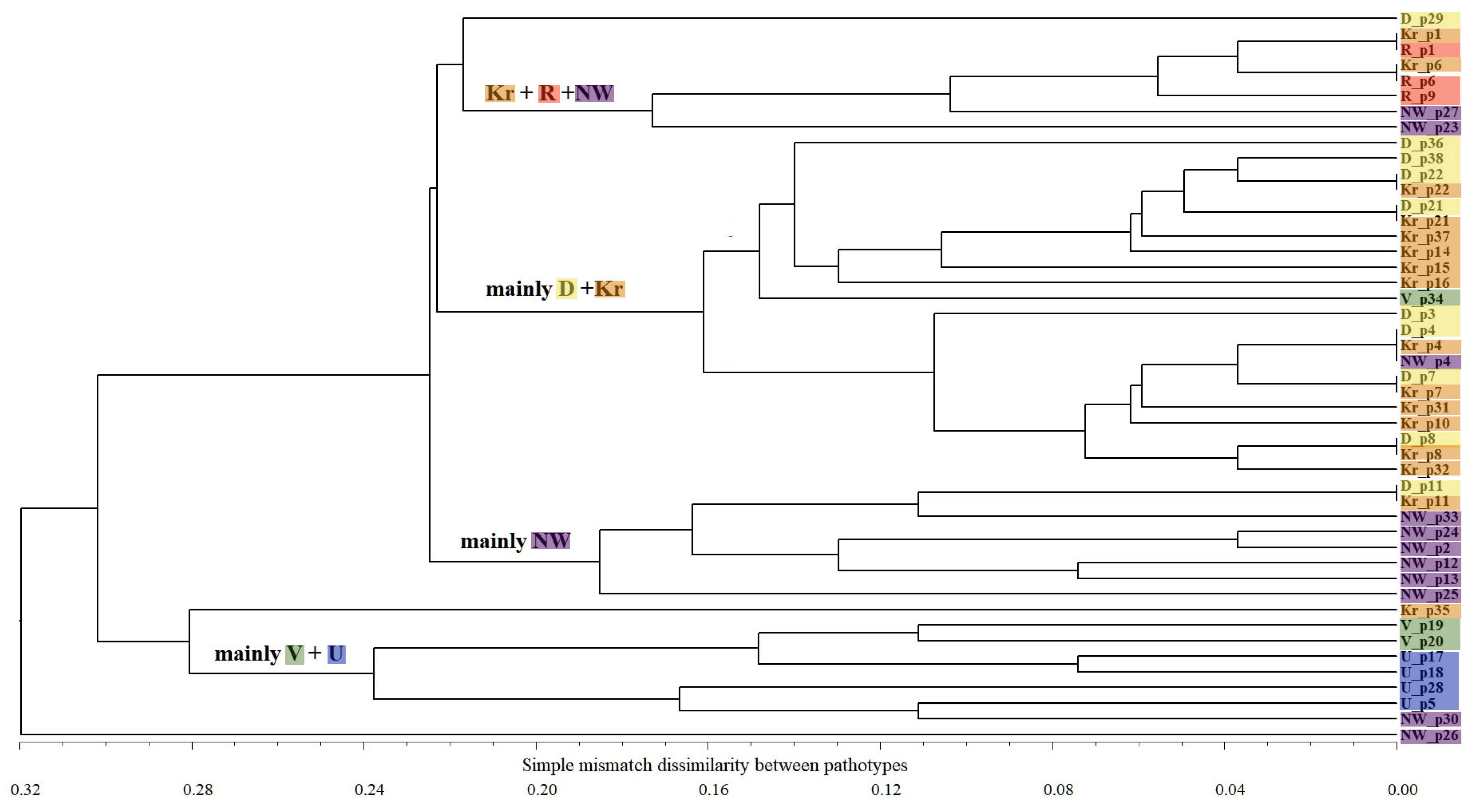
The UPGMA dendrogram generated with the simple mismatch dissimilarities between pathotypes (Figure 2) demonstrated a clear separation of most North-Caucasian (Dagestan, Krasnodar and Rostov) and North-Western Pst pathotypes from those in the Volga and Ural regions (with only a couple of exceptions). Moreover, the former group can be further subdivided into four clusters: (i) closely related pathotypes from the Krasnodar, Rostov and North-West regions; (ii) two different subgroups of the Dagestan and Krasnodar pathotypes; and (iii) a subgroup that mainly consists of pathotypes from the North-West collection. Such subdivision is a result of 2–3 existing distinct subgroups of Pst pathotypes within each of the Dagestan, Krasnodar and North-West collections (Figure S1, Supplementary Materials) and the relatively close similarity of several pathotypes from those regional subgroups.

3.4. Variability Within and Among Pst Collections

The highest and smallest estimates of variability within the Pst isolate collections were obtained in the North-West and Rostov regions, respectively, for both the KW dispersion and the normalized effective number of different isolates (KW = 0.220 and 0.049, and nENDI = 0.198 and 0.043, respectively; see Table 4 for the 27 differentials).
The most similar were Pst collections from the Dagestan and Krasnodar regions (KB = 0.082; see Table 5 for the 27 differentials), and the hypothesis of pairwise differentiation between them based on d i f K W was rejected at the p > 0.05 level. All other pairwise comparisons revealed statistically significant differentiation between the corresponding regional Pst collections (p < 0.01), with the largest distance between the easternmost Ural and westernmost North-West regions (KB = 0.304). Moreover, both the Volga and Ural collections strongly differed from the North-Caucasian (Dagestan, Krasnodar, and Rostov) and North-Western ones, with KB distances in the range from 0.236 to 0.304 (Table 5). Note that the KB distances between the North-West Pst collection and two North-Caucasian (Dagestan and Krasnodar) ones were about two times smaller than those between the former and the Volga collection (KB = 0.112 and 0.131 vs. 0.236; Table 5), despite the North-West region being much more distant geographically from the collection sites in North Caucasus than from those in the Volga region (with air distances of 1800 km (Krasnodar) and 2200 km (Dagestan) vs. 900–1200 km).
The effective numbers of different Pst collections (ENDC) equaled 2.52 and 2.53 of the six original ones for the isolate- and clone-corrected (pathotype) data, respectively. This means that the spatial heterogeneity of the overall Russian Pst collection represented by the six regional ones was at a moderate level, with nENDC = 0.304 and 0.306, based on the isolate and pathotype data, respectively. The extent of heterogeneity of the North-Caucasian Pst collection (Dagestan, Krasnodar and Rostov) was much lower, with ENDC = 1.41 (of the three regional collections) and nENDC = 0.205, though spatial differentiation still existed there.

3.5. Relationships Between Pst Collections

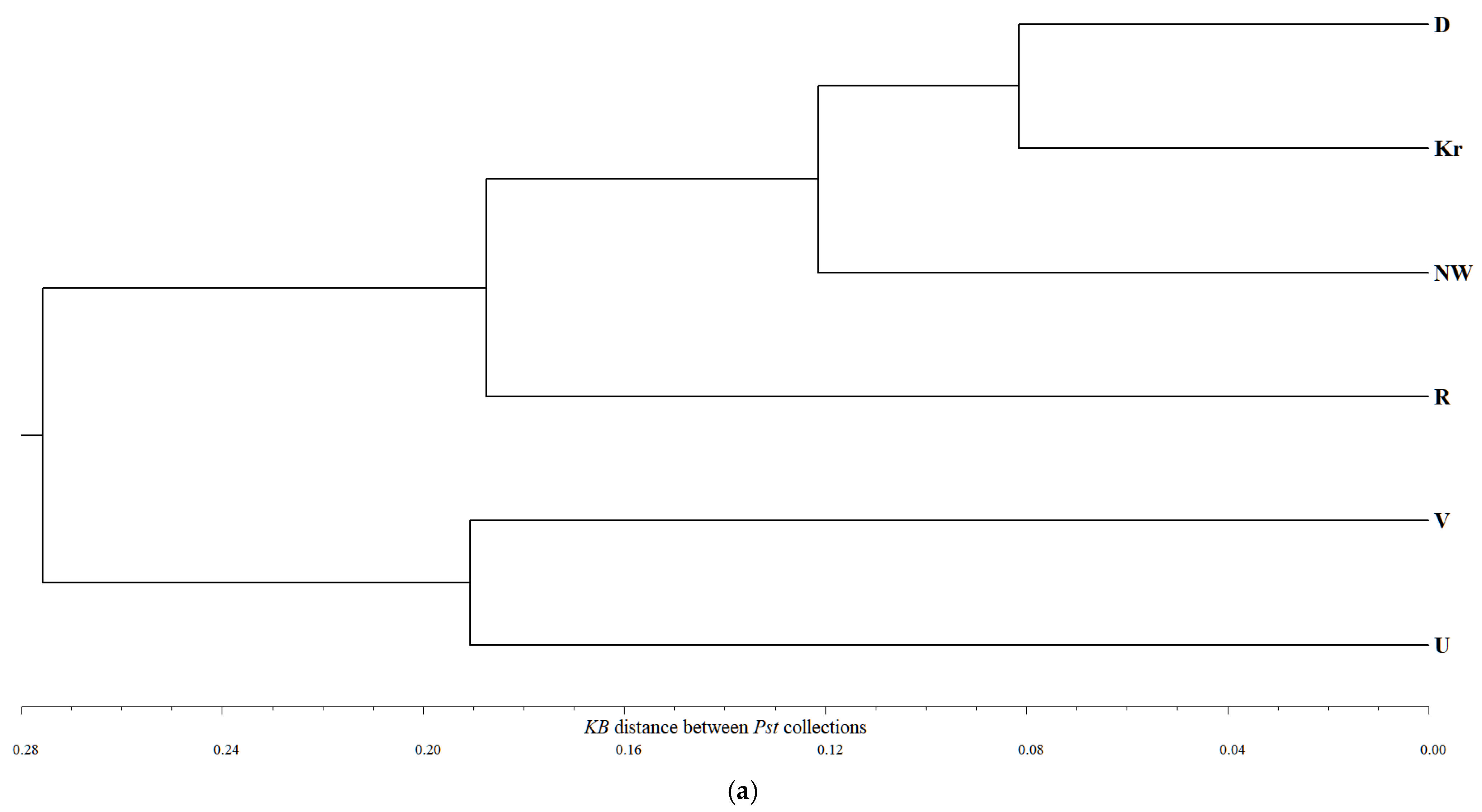
The UPGMA dendrogram generated with the KB distances clearly divided the regional Pst collections into two groups: (i) the North-West and North-Caucasian (Dagestan, Krasnodar and Rostov) collections, and (ii) the Volga and Ural collections (Figure 3a). Note that the Pst collections from the Dagestan and Krasnodar regions were more similar to those from the geographically distant North-West region (the air distances are about 2000 km) than to the collection from the neighboring Rostov region.

3.6. Comparison of Results for Various Sets of Differentials

The results obtained with the entire set of 27 differentials differed to some extent from those for its two components: 12 near-isogenic Avocet lines and 15 ‘old’ wheat differentials that possess a few Yr resistance genes (Table 2). The variability within the regional collections estimated based on the Avocet lines (e.g., nENDI values; Table 4) was generally lower than the corresponding estimates obtained with the sets of 15 and 27 differentials (the only exception was the Rostov Pst collection). More importantly, there were multiple qualitative disagreements in the rank order of the corresponding variability estimates. For example, based on the 12 differentials, the nENDI within the Dagestan collection was larger than for the Ural one (0.106 vs. 0.090; Table 4), whereas the opposite was established with the 27 differentials (0.127 vs. 0.174); a similar situation was observed when comparing the Krasnodar and North-West regions with nENDI = 0.174 vs. 0.133 and nENDI = 0.185 vs. 0.198 for the sets of 12 and 27 differentials, respectively (Table 4).
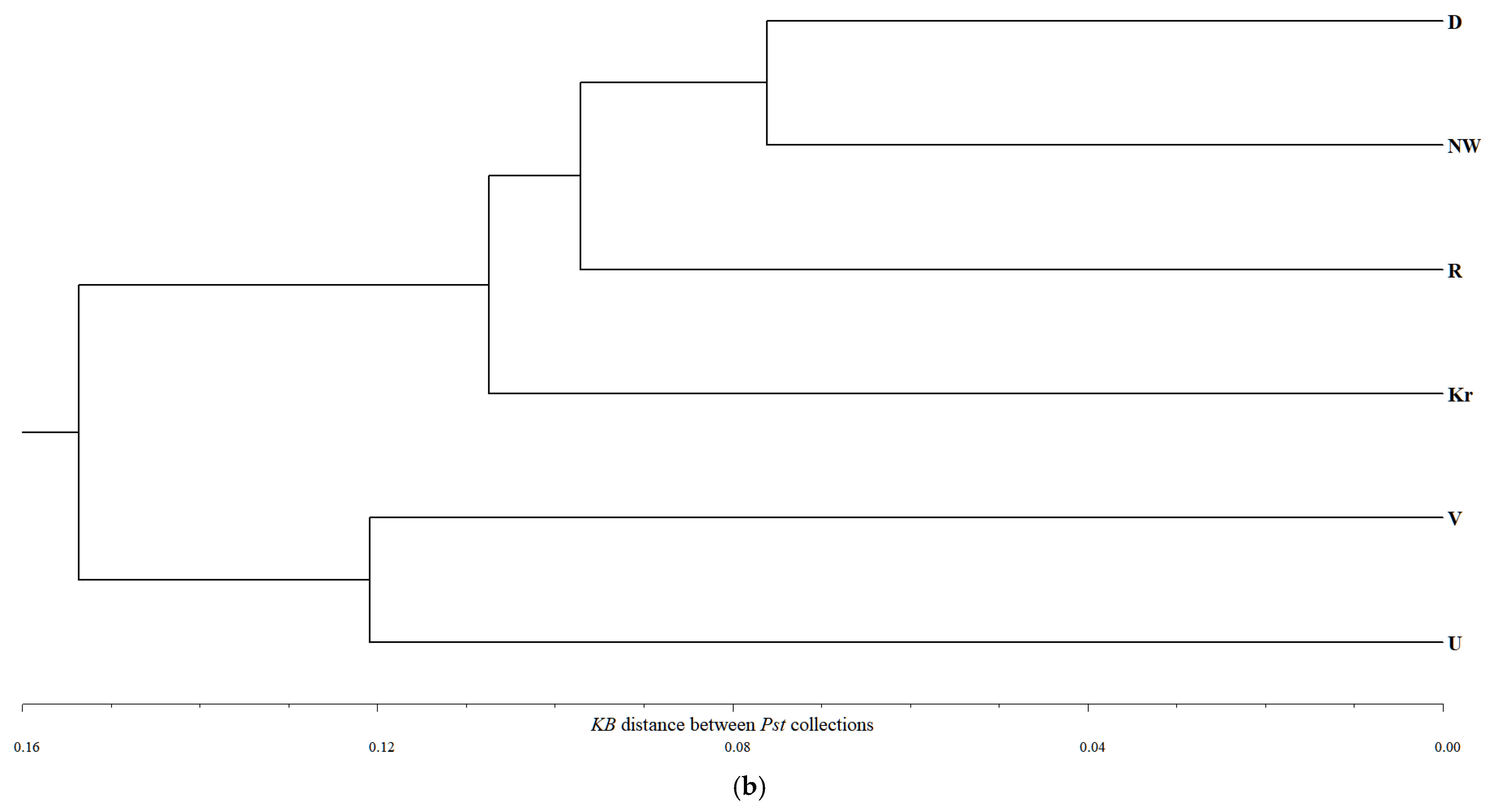
The pairwise KB distances between the regional collections estimated based on the 12 Avocet lines were smaller than those obtained with the whole set of 27 differentials (Table 5). For example, the North-West collection was much more similar to the Dagestan one for the set of 12 differentials (KB = 0.076 vs. 0.112); moreover, these two Pst collections from the North-West and Dagestan were statistically different for the 27 differentials, whereas they were statistically indistinguishable when analyzed with the set of 12 differentials (Table 5). The latter facts resulted in slightly different UPGMA dendrograms of relationships between the regional Pst collections, with the North-West collection being more closely related to the Dagestan one for the 12 Avocet differentials (Figure 3).
The extent of differentiation among all six regional Pst collections in terms of the normalized effective number of different collections also varied considerably depending on the differential set used: nENDC = 0.218, 0.347 and 0.304 for the isolate data with the sets of 12, 15 and 27 differential lines, respectively. Very similar nENDC estimates were obtained for the clone-corrected (pathotype) data.
The results obtained with the combined set of 27 differentials were more similar to those for 15 ‘old’ wheat differentials than to those for 12 Avocet lines. In particular, the extent of association (Mantel correlation) of the simple mismatch dissimilarities between Pst pathotypes for 27 differentials with the pathotypes based on the set of 15 differentials was 0.921 versus 0.616 for the 12 differentials. Comparing the pairwise KB distances between the regional collections, the association estimates were 0.986 for the sets of 27 vs. 15 differentials, and 0.754 for the sets of 27 vs. 12 differentials. The corresponding associations of the simple mismatch dissimilarities and KB distances for the sets of 12 Avocet lines and 15 ‘old’ differentials were much lower: 0.261 for pathotypes and 0.653 for the Pst collections. All estimates of association (Mantel correlation) were statistically significant at p < 0.03 .

4. Discussion

In this study, we characterized Pst samples collected from common wheat in 2024–2025 across the European part of Russia: the North-West region (NW, Saint Petersburg), three neighboring regions in the North Caucasus (Dagestan, D; Krasnodar, Kr; and Rostov, R), the Middle Volga region (V, Penza), and the Southern Ural region (U, Chelyabinsk) that is situated at the boundary between Europe and Asia. Winter wheat dominates in the North Caucasian regions, while spring wheat prevails in the Urals. Both winter and spring wheat are grown in the North-West and Volga regions [40].
Using the set of 27 differentials (12 Avocet near-isogenic lines and 15 additional wheat differentials), thirty-eight Pst pathotypes were identified among 95 isolates, with sixteen of them being singletons (detected only in a single isolate). Many pathotypes were closely related, differing only by a single v/a reaction in their virulence profiles. In the Russian Pst survey of 2019–2021 [8], seventy-nine virulence pathotypes among 117 isolates were identified based on 20 differentials (12 Avocet lines and eight supplemental wheat varieties), which reflects considerably higher pathotype richness (the number of pathotypes per isolate) compared with 2024–2025. Extremely high estimates of richness and number of singletons in the North-Caucasian Pst population from Krasnodar, Stavropol and Rostov were reported in 2013–2018 by Volkova et al. [7]: 182 virulence phenotypes among 186 isolates tested; i.e., almost all pathotypes were singletons. We revealed much lower richness of the Pst collections from the North Caucasus in our annual surveys conducted in 2019–2021 with 34 pathotypes of 50 isolates in total [8], whereas in the present study, the richness was even lower (34 pathotypes of 51 isolates in total). Note, however, that the 2013–2018 Pst study [7] was performed with 38 differentials, which was considerably more than in our surveys in 2019–2023 and 2024–2025 (20 and 27 differentials, respectively) and may potentially have resulted in a relatively larger number of pathotypes detected. Nevertheless, a tendency toward a decline in pathotype richness over time seemed apparent, both overall in Russia and in the North Caucasus specifically.
Like in Russia, estimates of the pathotype richness in several Pst collections worldwide were relatively high. Sharma-Poudyal et al. [4] studied 235 isolates from Algeria, Australia, Canada, Chile, China, Hungary, Kenya, Nepal, Pakistan, Russia, Spain, Turkey and Uzbekistan, and identified 129 and 169 virulence phenotypes with 20 single-gene lines and 20 US differentials, respectively. In 2011 and 2013, Pst collections from Saskatchewan and Alberta (Canada) were analyzed by Brar et al. [49]; virulence phenotypes of 59 isolates were differentiated into 33 pathotypes, of which 26 were represented by single isolates.
All Russian regional Pst collections were significantly divergent from each other, except those from Dagestan and Krasnodar. Nevertheless, common pathotypes were found in geographically very distant regions, including the North-West and Dagestan (around 2200 km apart) as well as the North-West and Krasnodar (1750 km apart). The presence of shared pathotypes across different locations within the North Caucasus area (Dagestan and Krasnodar; Krasnodar and Rostov) was not surprising and can be explained by the relative proximity of these regions, the same epidemiological zone for the pathogen in this territory, and rather similar environmental and climatic conditions. Meanwhile, the occurrence of common pathotypes in geographically distant locations, namely, the North Caucasus and the North-West, supports the hypothesis of aerial long-distance dispersal of the pathogen from the southern regions of the country to the western European part of Russia, either directly or in two steps via Ukraine. Many virulence phenotypes of Pst isolates sampled from various Russian regions during 2019–2021 were also closely related [8]. In addition, a long-distance migration of the pathogen between Russian regions was found possible using molecular analysis based on 20 SSR markers employed at the Global Rust Reference Center: among 108 Pst isolates, 53 multilocus genotypes (MLGs) were detected, seven of which were found in two or more geographically distant regions [9]. While long-distance dispersal of the rust pathogen is well documented, the possibility of mutations also cannot be discounted.
For virulence profiling and determining the race groups, the following standard set of 19 wheat differentials is used at the GRRC: near-isogenic lines with resistance genes Yr1, Yr2, Yr3, Yr4, Yr5, Yr6, Yr7, Yr8, Yr9, Yr10, Yr15, Yr17, Yr24, Yr25, Yr27, and Yr32, and Spaldings Prolific (Sp), Avocet S (AvS), and Ambition (Amb) varieties. In the present study, all but one of these differentials (excluding Ambition) were employed, along with several others. Based on the reduced set of 18 differentials (all GRRC differentials except Amb), comparison of the Russian pathotypes detected in 2024–2025 with the race groups identified at the GRRC did not reveal any identity between them.
The virulence profiles of the Russian Pst pathotypes did not match any of the PstS race groups recognized by the GRRC and widely applied in pathogen classification. However, several pathotypes were closely related to those groups, differing from them by up to two v/a reactions in their virulence formulae (Table 6). Only two Russian pathotypes differed from the PstS representatives by avirulence to one of the differentials (Table 6a): pathotype p5 ( p 5 ^ ), in its reduced form on 18 differentials, detected in the Southern Urals, differed from PstS1/2,v27 by avirulence to Yr2, while the North-Western pathotype p30 ( p 30 ^ ) differed from PstS1/2,v3,v27 by avirulence to YrSp. Using SCAR markers [11], we did not detect molecular patterns typical of PstS1 or PstS2 among the isolates collected from the Ural, Volga, and North-West regions (unpublished data).
We did not detect Pst isolates related in terms of virulence to the race groups PstS10, PstS15, and PstS17 in the North-West region of Russia, though they were previously reported at the GRRC in the bordering Baltic countries (Latvia and Estonia) [12]. The PstS10 race group is characterized by avirulence to Yr5, Yr8, Yr10, Yr15, Yr24, and Yr27. The PstS15 race group differs from it by additional virulence to Yr4 (Hybrid 46). In contrast, all isolates from the North-West were virulent to Yr8, and most of them were also virulent to Yr27 and Yr4, with only one and five exceptions, respectively. The PstS17 race group was characterized by a higher number of avirulence alleles (Yr1, Yr3, Yr4, Yr5, Yr9, Yr10, Yr15, Yr24, Yr25, and Yr27) and differed significantly from the North-Western and all other Russian isolates. Meanwhile, four pathotypes from the Krasnodar region and another six pathotypes from the whole territory of the North Caucasus were closely related to PstS7 and PstS10 (Table 6b) and PstS14 (Table 6c), respectively. Note that the PstS7, PstS10 and PstS14 race groups were associated with Western Europe [2].
Isolates from Azerbaijan collected in the mid-2010s belonged to the race groups PstS0, PstS2, PstS2,v27, and PstS7 (Warrior) according to Hovmøller et al. [12]. Dagestan and Azerbaijan form a single epidemiological zone, and the resistance genes Yr5, Yr15, and Yr24 are effective in both regions. However, although isolates virulent to Yr10 were first detected in Azerbaijan in 2015, this gene still retains its effectiveness in the Russian North Caucasus. Isolates belonging to the PstS2 race group were recorded in Azerbaijan in 2015–2017 [12]. The PstS2 isolates have been permanently detected in Dagestan since 2021 [13]; assignment of those isolates to the PstS2 race group was confirmed using SCAR markers.
Long-term Pst virulence surveys (2019–2025) in Russia indicate that Yr5, Yr10, Yr15, and Yr24 retain broad effectiveness against the pathogen, whereas virulence to other Yr genes varies across regions. Throughout the six-year monitoring period, no major shifts in pathogen virulence to the 29 differential lines were observed, either at the regional level or across Russia as a whole [8,14]. The pathogen structure is very dynamic, reflecting rapid Pst population shifts driven by host-mediated selection. Resistance breeding to yellow rust has traditionally been conducted in the North Caucasus regions of Russia for winter wheat. Molecular marker screening revealed that none of the studied Russian registered varieties carried Yr5, Yr10, Yr15, and Yr24, while Yr9, Yr17 and Yr18 genes and the 1AL.1RS translocation (carrying an uncharacterized Yr gene) were present in these varieties [26].
Historically, stripe rust was regarded as a disease of cooler and moist temperate regions; however, since 2000, it has appeared in warmer and more arid zones. The Russian Volga and Ural regions are not typical environments for yellow rust development. Isolate collections from these regions differed substantially from those from other regions studied, where yellow rust is a common disease. The Volga and Ural isolates were characterized by a lower virulence complexity (the average RVC of isolates) and a higher number of pathotype singletons. These areas are predominantly planted with spring wheat, for which resistance breeding to yellow rust had previously been largely neglected in Russia due to the perceived irrelevance of the disease [26].
Though it seems rather obvious that using distinct sets of differentials for virulence analysis (or SSR primers for determining and studying multilocus genotypes) can result in some discrepancy in the corresponding outcomes, this issue is not generally discussed. Comparative studies need to be performed based on the same set of virulence or molecular markers for the obtained results to be valid. Nevertheless, even then, an evaluation of a specific composition of a selected differential set is particularly important when near-isogenic lines are used along with varieties that possess a few resistance genes. This is the case in our research, as well as in most virulence studies of the Pst pathogen, when Avocet near-isogenic lines are used together with other wheat varieties. Comparing the results obtained with the set of 12 Avocet differentials versus the complete set of 27 differentials reveals clear differences in relationships between the North-West and Dagestan Pst collections that were statistically indistinguishable and more closely related when analyzed based on the Avocet lines, as opposed to the statistically significant differentiation among them for the whole set of differentials (Table 5; Figure 3). A deeper, further consideration of accurate methods of virulence data analysis for differential sets that consist of near-isogenic lines and varieties with several (or unknown) resistance genes is needed because, for the latter differentials, a shared avirulence reaction does not necessarily serve as evidence of the similarity of the isolates tested.
The high virulence variability observed within the Russian Pst population is unlikely to be driven by a single factor; rather, it appears to result from the interplay of several epidemiological and evolutionary processes. A primary driver seems to be the long-distance dispersal of urediniospores by wind, which facilitates gene flow across vast geographic areas. This mechanism is efficient because of frequent stripe rust outbreaks in countries bordering Russia, including Azerbaijan, Georgia, Kazakhstan, Latvia, Estonia, Ukraine, and Belarus [30,31,32,33,34,35,36,37,38,39,40]; in the case of an epidemic, each region may serve as an external source of initial inoculum. In addition to aerial dispersal, the year-round survival of the pathogen on volunteer cereals and wild grasses provides a “green bridge” that sustains pathogen populations between growing seasons, promotes local adaptation, and likely contributes to the maintenance of high genetic heterogeneity within regional populations [50,51]. Another critical factor is the possible role of sexual recombination. The alternate host Berberis spp. is widely distributed in wheat-growing areas of Russia, supporting the sexual stage of Pst and generating novel virulence combinations by genetic recombination [52]. Selection pressure of cultivated wheat varieties also plays an important role in shaping the complex and dynamic virulence landscape of the Russian Pst population.

5. Conclusions

A large-scale virulence analysis was performed on Pst collections originating from common wheat grown in geographically distant regions of Russia. As in previous years (2019–2023), all isolates tested remained avirulent to differential lines harboring the resistance genes Yr5, Yr10, Yr15, and Yr24. Moreover, the variability in the virulence frequency on the rest of the differentials during 2019–2025 was minor in each of the regional Pst collections and in the whole Russian population. Russian commercial wheat varieties do not possess these effective resistance genes; therefore, the latter could be promising candidates for marker-assisted breeding for yellow rust resistance in Russia. It was shown that most North-Caucasian (Dagestan, Krasnodar, and Rostov) and North-Western pathotypes were largely distinct from those in the Volga and Ural regions. Accordingly, the regional Pst collections were divided into two major clusters: one comprised the North-West and North-Caucasian collections, while the second one consisted of the pathogen collections from the Volga and Ural regions. Notably, identical pathotypes were identified in geographically distant regions, namely, the North Caucasus and the North-West, suggesting a possible role of long-distance dispersal in the epidemiology of yellow rust in Russia.

Supplementary Materials

The following supporting information can be downloaded at https://www.mdpi.com/article/10.3390/crops6050088/s1. Figure S1: UPGMA dendrograms of relationships between Pst pathotypes in the Dagestan, Krasnodar and North-West regions; Table S1: Sampling and isolation details for collections of Puccinia striiformis in regions of Russia in 2024–2025; Table S2: Virulence profiles of Russian Pst pathotypes. A complete list of references for data analysis is provided in Supplementary S3 [53,54,55,56,57,58,59,60,61,62,63].

Author Contributions

Conceptualization and data analysis design, E.G. and E.K.; methodology and experiments, E.G. and E.S.; data analysis, E.K.; interpretation of results, E.G., E.S. and E.K.; data acquisition and curation, E.G.; drafting this manuscript, E.G. and E.K. All authors have read and agreed to the published version of the manuscript.

Funding

This research was carried out within the state assignment of the Ministry of Science and Higher Education of the Russian Federation to FSBSI VIZR (state registration no. 125031003376-3, theme FGEU-2025-0005).

Data Availability Statement

The data used in this study are available from the corresponding author upon reasonable request.

Acknowledgments

We thank all colleagues for their excellent assistance in collecting and sending samples of yellow rust uredinia.

Conflicts of Interest

The authors declare no conflicts of interest.

References

  1. Liu, T.; Wan, A.; Liu, D.; Chen, X. Changes of races and virulence genes in Puccinia striiformis f. sp. tritici, the wheat stripe rust pathogen, in the United States from 1968 to 2009. Plant Dis. 2017, 101, 1522–1532. [Google Scholar] [CrossRef] [Scilit]
  2. Hovmøller, M.S.; Patpour, M.; Rodriguez-Algaba, J.; Thach, T.; Sørensen, C.K.; Justesen, A.F.; Hansen, J.G. GRRC 2022 Report of Stem and Yellow Rust Genotyping and Race Analyses; GRRC, Aarhus University: Aarhus, Denmark, 2023; Available online: https://agro.au.dk/fileadmin/www.grcc.au.dk/International_Services/Pathotype_YR_results/GRRC_annual_report_2022.pdf (accessed on 6 July 2026).
  3. GRRC Global Rust Reference Center. Definitions of Races and Genetic Groups. Available online: https://agro.au.dk/forskning/internationale-platforme/wheatrust/yellow-rust-tools-maps-and-charts/definitions-of-races-and-genetic-groups (accessed on 6 July 2026).
  4. Sharma-Poudyal, D.; Chen, X.M.; Wan, A.M.; Zhan, G.M.; Kang, Z.S.; Cao, S.Q.; Jin, S.L.; Morgounov, A.; Akin, B.; Mert, Z.; et al. Virulence characterization of international collections of the wheat stripe rust pathogen, Puccinia striiformis f. sp. tritici. Plant Dis. 2013, 97, 379–386. [Google Scholar] [CrossRef] [Scilit]
  5. Chen, X.; Wang, M.; Wan, A.; Bai, Q.; Li, M.; López, P.F.; Maccaferri, M.; Mastrangelo, A.M.; Barnes, C.W.; Cruz, D.F.C.; et al. Virulence characterization of Puccinia striiformis f. sp. tritici collections from six countries in 2013 to 2020. Can. J. Plant Pathol. 2021, 43, S308–S322. [Google Scholar] [CrossRef] [Scilit]
  6. Župunski, V.; Savva, L.; Saunders, D.G.O.; Jevtić, R. A recent shift in the Puccinia striiformis f. sp. tritici population in Serbia coincides with changes in yield losses of commercial winter wheat varieties. Front. Plant Sci. 2024, 15, 1464454. [Google Scholar] [CrossRef] [Scilit]
  7. Volkova, G.V.; Kudinova, O.A.; Matveeva, I.P. Virulence and diversity of Puccinia striiformis in South Russia. Phytopathol. Mediterr. 2021, 60, 119–127. [Google Scholar] [CrossRef] [Scilit]
  8. Gultyaeva, E.; Shaydayuk, E.; Kosman, E. Virulence diversity of Puccinia striiformis f. sp. tritici in common wheat in Russian regions in 2019–2021. Agriculture 2022, 12, 1957. [Google Scholar] [CrossRef] [Scilit]
  9. Gultyaeva, E.I.; Shaydayuk, E.L.; Kosman, E.G. SSR-based analysis of structural variation of the Russian population of Puccinia striiformis f. sp. tritici in 2019–2021. Plant Pathol. 2024, 73, 1761–1774. [Google Scholar] [CrossRef] [Scilit]
  10. Hovmøller, M.S.; Thach, T.; Rodriguez-Algaba, J.; Hansen, J.G.; Meyer, M.; Hodson, D.P.; Nazari, K.; Park, R.F.; Tam, R.; Möller, M.; et al. Long-term surveillance reveals hybridization by nuclear reassortment and intercontinental spread as major evolutionary drivers in wheat yellow rust. New Phytol. 2026, 251, 2091–2106. [Google Scholar] [CrossRef] [Scilit]
  11. Walter, S.; Ali, S.; Kemen, E.; Nazari, K.; Bahri, B.A.; Enjalbert, J.; Hansen, J.G.; Brown, J.K.M.; Sicheritz-Pontén, T.; Jones, J.; et al. Molecular markers for tracking the origin and worldwide distribution of invasive strains of Puccinia striiformis. Ecol. Evol. 2016, 6, 2790–2804. [Google Scholar] [CrossRef] [Scilit]
  12. Hovmøller, M.S.; Rodriguez-Algaba, J.; Thach, T.; Justesen, A.F.; Hansen, J.G. Report for Puccinia striiformis Race Analyses and Molecular Genotyping 2017; GRRC, Aarhus University: Slagelse, Denmark, 2018; Available online: https://agro.au.dk/fileadmin/Summary_of_Puccinia_striiformis_race_analysis_2017.pdf (accessed on 6 July 2026).
  13. Gultyaeva, E.I.; Shaydayuk, E.L. Structure of Russian populations of yellow rust pathogen for virulence and SSR markers in 2023. Mycol. Phytopathol. 2025, 59, 333–342. (In Russian) [Google Scholar] [CrossRef] [Scilit]
  14. Hovmøller, M.S.; Justesen, A.F.; Brown, J.K.M. Clonality and long distance migration of Puccinia striiformis f.sp. tritici in north-west Europe. Plant Pathol. 2002, 51, 24–32. [Google Scholar] [CrossRef] [Scilit]
  15. Domingues Carvalho, R.; Savva, L.; Rodriguez-Algaba, J.; Korolev, A.; Stephens, C.; Bryan, A.; Justesen, A.F.; Hovmøller, M.S.; Saunders, D.G.O. Virulence gains in the Puccinia striiformis f. sp. tritici PstS10 lineage correlate with expression polymorphism in a candidate Avr effector. Commun. Biol. 2026, 9, 790. [Google Scholar] [CrossRef] [Scilit]
  16. Al-Kanj, R.A.; Lababidi, G.; Al-Husien, N.; Hamwieh, A. Genetic diversity and population structure of the wheat stripe rust; Puccinia striiformis f. sp. tritici in Syria. Discov. Plants 2026, 3, 255. [Google Scholar] [CrossRef] [Scilit]
  17. de Vallavieille-Pope, C.; Ali, S.; Leconte, M.; Enjalbert, J.; Delos, M.; Rouzet, J. Virulence dynamics and regional structuring of Puccinia striiformis f. sp. tritici in France between 1984 and 2009. Plant Dis. 2012, 96, 131–140. [Google Scholar] [CrossRef] [Scilit]
  18. Hubbard, A.; Lewis, C.M.; Yoshida, K.; Ramirez-Gonzalez, R.H.; de Vallavieille-Pope, C.; Thomas, J.; Kamoun, S.; Bayles, R.; Uauy, C.; Saunders, D.G. Field pathogenomics reveals the emergence of a diverse wheat yellow rust population. Genome Biol. 2015, 16, 23. [Google Scholar] [CrossRef] [Scilit]
  19. Sørensen, C.K.; Hovmøller, M.S.; Leconte, M.; Dedryver, F.; de Vallavieille-Pope, C. New races of Puccinia striiformis found in Europe reveal race specificity of long-term effective adult plant resistance in wheat. Phytopathology 2014, 104, 1042–1051. [Google Scholar] [CrossRef] [Scilit]
  20. Hovmøller, M.S.; Walter, S.; Bayles, R.A.; Hubbard, A.; Flath, K.; Sommerfeldt, N.; Leconte, M.; Czembor, P.; Rodriguez-Algaba, J.; Thach, T.; et al. Replacement of the European wheat yellow rust population by new races from the centre of diversity in the near-himalayan region. Plant Pathol. 2016, 65, 402–411. [Google Scholar] [CrossRef] [Scilit]
  21. Shahin, A.A. Occurrence of new races and virulence changes of the wheat stripe rust pathogen (Puccinia striiformis f. sp. tritici) in Egypt. Arch. Phytopathol. Plant Prot. 2020, 53, 552–569. [Google Scholar] [CrossRef] [Scilit]
  22. Jevtić, R.; Župunski, V.; Živančev, D.; Orbović, B. Changes in Serbian yellow rust races reveal genotype-specific responses of yield and quality-related traits in commercial winter wheat. Microorganisms 2026, 14, 1217. [Google Scholar] [CrossRef] [Scilit]
  23. Ding, Y.; Cuddy, W.S.; Wellings, C.R.; Zhang, P.; Thach, T.; Hovmøller, M.S.; Qutob, D.; Brar, G.S.; Kutcher, H.R.; Park, R.F. Incursions of divergent genotypes, evolution of virulence and host jumps shape a continental clonal population of the stripe rust pathogen Puccinia striiformis. Mol. Ecol. 2021, 30, 6566–6584. [Google Scholar] [CrossRef] [Scilit]
  24. Akan, K.; Cat, A.; Yurduseven, M.; Tekin, Y.S.; Yeken, M.Z.; Tekin, M. Evaluation of the potential risk posed by emerging Yr5-virulent and predominant races of Puccinia striiformis f. sp. tritici on bread wheat (Triticum aestivum L.) varieties grown in Türkiye. J. Fungi 2025, 11, 635. [Google Scholar] [CrossRef] [Scilit]
  25. Rustwatch Wheat Rust Early Warning. Wheat Vulnerability to Yellow Rust in Europe in 2026. Available online: https://agro.au.dk/fileadmin/www.grcc.au.dk/Publications/Wheat_vulnerability_to_yellow_rust.pdf (accessed on 6 July 2026).
  26. Gultyaeva, E.I.; Shaydayuk, E.L.; Zuev, E.V. The potential of modern Russian winter and spring wheat (Triticum aestivum L.) varieties for genetic protection against leaf and yellow rust. Agric. Biol. 2025, 60, 485–502. [Google Scholar] [CrossRef] [Scilit]
  27. Ivanova, Y.N.; Rosenfread, K.K.; Stasyuk, A.I.; Skolotneva, E.S.; Silkova, O.G. Raise and characterization of a bread wheat hybrid line (Tulaykovskaya 10 × Saratovskaya 29) with chromosome 6Agi2 introgressed from Thinopyrum intermedium. Vavilov J. Genet. Breed. 2021, 25, 701–712. (In Russian) [Google Scholar] [CrossRef] [Scilit]
  28. Zeleneva, Y.V.; Sudnikova, V.P.; Buchneva, G.N. Immunological characteristics of soft winter wheat varieties in conditions of the CBR. Tr. Kuban. Gos. Agrar. Univ. 2022, 96, 95–99. (In Russian) [Google Scholar] [CrossRef] [Scilit]
  29. Sheshegova, T.K.; Volkova, L.V.; Shchekleina, L.M. Sources of complex resistance of spring soft wheat from the collection of the N.I. Vavilov All-Russian Research Institute of Plant Industry (VIR). Vestn. Voronezh State Agrar. Univ. 2023, 16, 49–58. [Google Scholar]
  30. Keishilov, Z.S.; Kokhmetova, A.M.; Urozaliev, R.A.; Nurzhuma, M.; Mukhametzhanov, K. Phytosanitary monitoring of wheat yellow rust (Puccinia striiformis) in Zhambyl and Turkestan regions. Izdenister Natigeler 2023, 3, 118–128. (In Kazakh) [Google Scholar] [CrossRef] [Scilit]
  31. Kokhmetova, A.; Rathan, N.D.; Sehgal, D.; Malysheva, A.; Kumarbayeva, M.; Nurzhuma, M.; Bolatbekova, A.; Krishnappa, G.; Gultyaeva, E.; Kokhmetova, A.; et al. QTL mapping for seedling and adult plant resistance to stripe and leaf rust in two winter wheat populations. Front. Genet. 2023, 14, 1265859. [Google Scholar] [CrossRef] [Scilit]
  32. Kokhmetova, A.; Sharma, R.C.; Rsaliyev, S.; Galymbek, K.; Baymagambetova, K.; Ziyaev, Z.; Morgounov, A. Evaluation of Central Asian wheat germplasm for stripe rust resistance. Plant Genet. Resour. Charact. Util. 2018, 16, 178–184. [Google Scholar] [CrossRef] [Scilit]
  33. Rsaliyev, S.; Rsaliyev, A.; Urazaliev, R.; Dubekova, S.; Serikbaikyzy, A. Population composition and virulence of Puccinia striiformis f. sp. tritici in Kazakhstan. Plant Prot. Sci. 2025, 61, 152–161. [Google Scholar] [CrossRef] [Scilit]
  34. Bankina, B.; Jakobija, I.; Bimšteine, G. Peculiarities of wheat leaf disease distribution in Latvia. Acta Biol. Univ. Daugavp. 2011, 11, 47–54. [Google Scholar]
  35. Feodorova-Fedotova, L.; Bankina, B. Occurrence of genetic lineages of Puccinia striiformis in Latvia agricultural sciences. Res. Rural Dev. 2020, 35, 27–32. [Google Scholar] [CrossRef] [Scilit]
  36. Chugunkova, T.V.; Pastukhova, N.L.; Topchii, T.V.; Pirko, Y.V.; Blume, Y.B. Harmfulness of wheat yellow rust and identification of resistance genes to its highly virulent races. Sci. Innov. 2023, 19, 66–78. [Google Scholar] [CrossRef] [Scilit]
  37. Zhukovsky, A.G.; Buga, S.F.; Krupenko, N.A.; Zhuk, E.I.; Radyna, A.A.; Poplavskaya, N.G.; Leshkevich, V.G.; Radivon, V.A.; Burnos, N.A.; Khalaev, A.N.; et al. Phytopathological situation in grain crops. Crop Farming Plant Grow. 2017, 2, 9–12. (In Russian) [Google Scholar]
  38. Karimova, A.M.; Gadzhiev, E.S. Otsenka vliyaniya bolezni zheltoi rzhavchiny na pokazateli produktivnosti genotipov myagkoi pshenitsy (Triticum aestivum L.). Uspekhi Sovrem. Estestvozn. 2021, 7, 12–19. [Google Scholar] [CrossRef] [Scilit]
  39. Karimova, A.M. Phytopathological assessment of Azerbaijan origin bread wheat (Triticum aestivum L.) genotypes against yellow rust. Agrar. Nauchn. Zh. 2023, 5, 16–23. (In Russian) [Google Scholar] [CrossRef] [Scilit]
  40. Afonin, A.N.; Greene, S.L.; Dzyubenko, N.I.; Frolov, A.N. (Eds.) Interactive Agricultural Ecological Atlas of Russia and Neighboring Countries. In Economic Plants and Their Diseases, Pests and Weeds; St. Petersburg University Press: St. Petersburg, Russia, 2008; Available online: http://www.agroatlas.ru (accessed on 6 July 2026).
  41. Hovmøller, M.S.; Rodriguez-Algaba, J.; Thach, T.; Sørensen, C.K. Race typing of Puccinia striiformis on wheat. Methods Mol. Biol. 2017, 1659, 29–40. [Google Scholar] [CrossRef] [Scilit]
  42. McIntosh, R.A.; Wellings, C.R.; Park, R.F. Wheat Rusts. An Atlas of Resistance Genes; CSIRO Australia: Canberra, Australia; Kluwer Academic Publishers: Dordrecht, The Netherlands, 1995. [Google Scholar]
  43. Kosman, E. Measure of multilocus correlation as a new parameter for study of plant pathogen populations. Phytopathology 2003, 93, 1464–1470. [Google Scholar] [CrossRef] [Scilit]
  44. Kosman, E.; Leonard, K.J. Conceptual analysis of methods applied to assessment of diversity within and distance between populations with asexual or mixed mode of reproduction. New Phytol. 2007, 174, 683–696. [Google Scholar] [CrossRef] [Scilit]
  45. Kosman, E.; Park, R.F. Singularity of pathogen isolates: Assessment and applications. Plant Pathol. 2026, 75, e70112. [Google Scholar] [CrossRef] [Scilit]
  46. Kosman, E.; Feijen, F.; Jokela, J. Effective number of different populations: A new concept and how to use it. Ecol. Evol. 2024, 14, e70303. [Google Scholar] [CrossRef] [Scilit]
  47. Schachtel, G.A.; Dinoor, A.; Herrmann, A.; Kosman, E. Comprehensive evaluation of virulence and resistance data: A new analysis tool. Plant Dis. 2012, 96, 1060–1063. [Google Scholar] [CrossRef] [Scilit]
  48. El Amil, R.E.; Ali, S.; Bahri, B.; Leconte, M.; de Vallavieille-Pope, C.; Nazari, K. Pathotype diversification in the invasive PstS2 clonal lineage of Puccinia striiformis f. sp. tritici causing yellow rust on durum and bread wheat in Lebanon and Syria in 2010–2011. Plant Pathol. 2020, 69, 618–630. [Google Scholar] [CrossRef] [Scilit]
  49. Brar, G.S.; Kutcher, H.R. Race characterization of Puccinia striiformis f. sp. tritici, the cause of wheat stripe rust, in Saskatchewan and Southern Alberta, Canada and virulence comparison with races from the United States. Plant Dis. 2016, 100, 1744–1753. [Google Scholar] [CrossRef] [Scilit]
  50. Gultyaeva, E.I.; Bespalova, L.A.; Ablova, I.B.; Shaydayuk, E.L.; Khudokormova, Z.N.; Yakovleva, D.R.; Titova, Y.A. Wild grasses as the reservoirs of infection of rust species for winter soft wheat in the Northern Caucasus. Vavilov J. Genet. Breed. 2021, 25, 638–646. [Google Scholar] [CrossRef] [Scilit]
  51. Cheng, P.; Chen, X.M.; See, D.R. Grass hosts harbor more diverse isolates of Puccinia striiformis than cereal crops. Phytopathology 2016, 106, 362–371. [Google Scholar] [CrossRef] [Scilit]
  52. Sinha, P.; Chen, X. Potential infection risks of the wheat stripe rust and stem rust pathogens on Barberry in Asia and Southeastern Europe. Plants 2021, 10, 957. [Google Scholar] [CrossRef] [Scilit]
  53. Kosman, E. Difference and diversity of plant pathogen populations: A new approach for measuring. Phytopathology 1996, 86, 1152–1155. [Google Scholar]
  54. Kosman, E. Measuring diversity: From individuals to populations. Eur. J. Plant Pathol. 2014, 138, 467–486. [Google Scholar] [CrossRef] [Scilit]
  55. Gultyaeva, E.I.; Shaydayuk, E.L.; Kosman, E. Regional and temporal differentiation of virulence phenotypes of Puccinia triticina Eriks. from common wheat in Russia during the period 2001–2018. Plant Pathol. 2020, 69, 860–871. [Google Scholar] [CrossRef] [Scilit]
  56. Czajowski, G.; Kosman, E.; Słowacki, P.; Park, R.F.; Czembor, P. Assessing new SSR markers for utility and informativeness in genetic studies of brown rust fungi on wheat, triticale and rye. Plant Pathol. 2021, 70, 1110–1122. [Google Scholar] [CrossRef] [Scilit]
  57. Kosman, E.; Ben-Yehuda, P.; Manisterski, J. Diversity of virulence phenotypes among annual populations of wheat leaf rust in Israel from 1993 to 2008. Plant Pathol. 2014, 63, 563–571. [Google Scholar] [CrossRef] [Scilit]
  58. Scheiner, S.M.; Kosman, E.; Presley, S.J.; Willig, M.R. Decomposing functional diversity. Methods Ecol. Evol. 2017, 97, 809–820. [Google Scholar] [CrossRef] [Scilit]
  59. Scheiner, S.M.; Kosman, E.; Presley, S.J.; Willig, M.R. The units of biodiversity. Ecol. Monogr. 2025, 95, e70019. [Google Scholar] [CrossRef] [Scilit]
  60. Kosman, E.; Chen, X.; Dreiseitl, A.; McCallum, B.; Lebeda, A.; Ben-Yehuda, P.; Gultyaeva, E.; Manisterski, J. Functional variation of plant-pathogen interactions: New concept and methods for virulence data analyses. Phytopathology 2019, 109, 1324–1330. [Google Scholar] [CrossRef] [Scilit]
  61. Sun, X.; Kosman, E.; Sharon, O.; Ezrati, S.; Sharon, A. Significant host- and environment-dependent differentiation among highly sporadic fungal endophyte communities in cereal crops-related wild grasses. Environ. Microbiol. 2020, 22, 3357–3374. [Google Scholar] [CrossRef] [Scilit]
  62. Kosman, E.; Burgio, K.R.; Presley, S.J.; Willig, M.R.; Scheiner, S.M. Conservation prioritization based on trait-based metrics illustrated with global parrot distributions. Divers. Distrib. 2019, 25, 1156–1165. [Google Scholar] [CrossRef] [Scilit]
  63. Kosman, E.; Dinoor, A.; Herrmann, A.; Schachtel, G.A. Virulence Analysis Tool (VAT). 2008. User Manual. Available online: https://en-lifesci.tau.ac.il/profile/kosman (accessed on 6 July 2026).
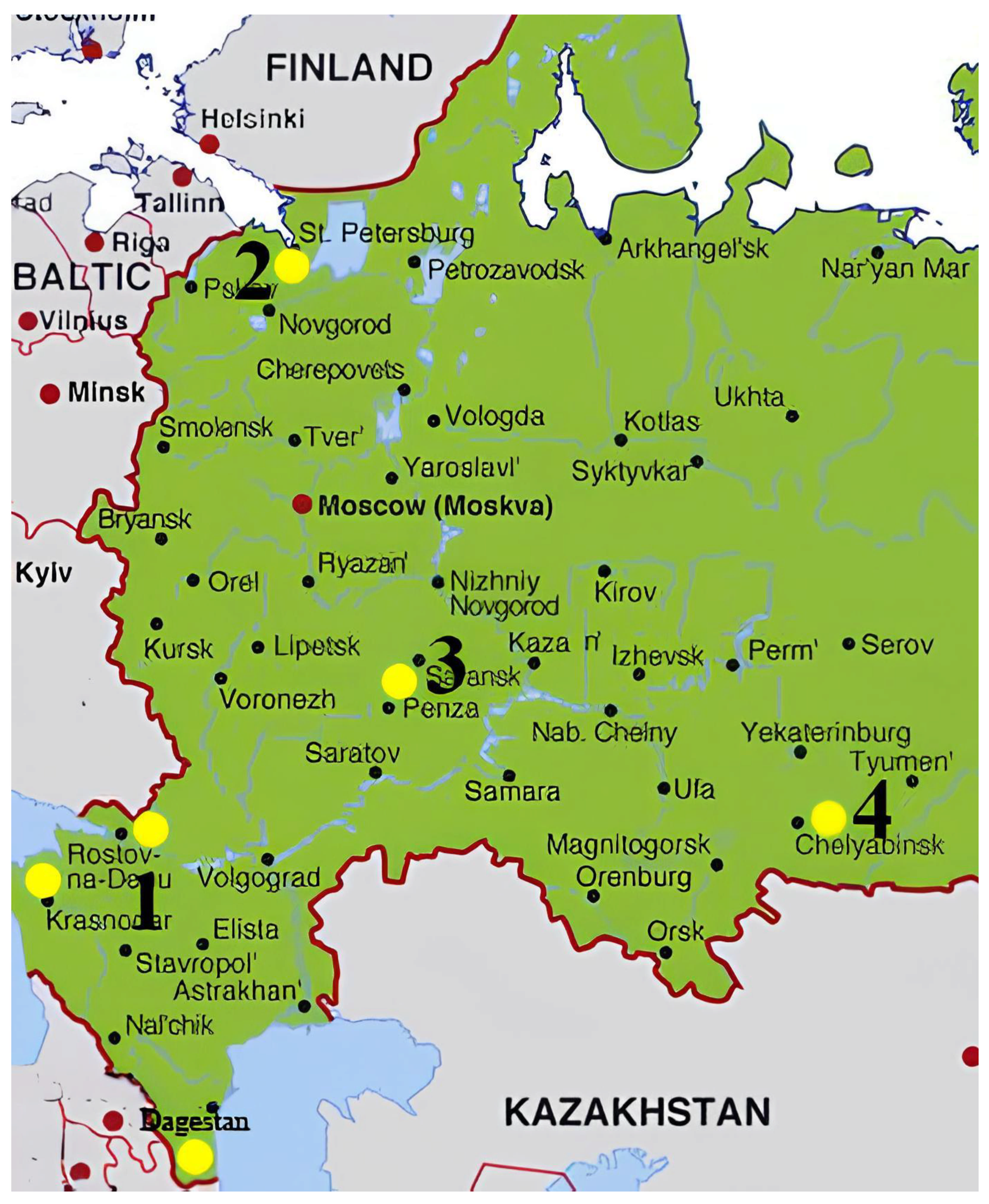
Figure 1. Collection sites of Puccinia striiformis in Russian regions during 2024–2025: 1—North Caucasus (three sites), 2—North-West, 3—Volga, and 4—Urals.
Crops 06 00088 g001
Figure 2. UPGMA dendrogram of relationships among all 38 pathotypes identified in six regional Puccinia sttriiformis collections of isolates for the set of 27 differentials; the dendrogram was constructed based on the sm (simple mismatch) dissimilarity between virulence pathotypes. Region abbreviation and coloring: D—Dagestan (yellow), Kr—Krasnodar (orange), R—Rostov (red), NW—North-West (violet), V—Volga (green), and U—Urals (blue). Pathotype designations include the corresponding region and pathotype number: D_p29 means pathotype number 29 (p29) from Dagestan; Kr_p1 and R_p1 are the same pathotype p1 from the Krasnodar and Rostov regions, respectively, etc.
Crops 06 00088 g002
Figure 3. UPGMA dendrograms of relationships among the regional Puccinia striiformis collections of isolates for the sets of 27 (a) and 12 (b) differentials; the dendrograms were constructed based on the KB distance between collections with regard to the simple mismatch dissimilarity between virulence pathotypes of isolates. Region abbreviations: D—Dagestan, Kr—Krasnodar, R—Rostov, NW—North-West, V—Volga, and U—Urals.
Crops 06 00088 g003aCrops 06 00088 g003b
Table 1. Composition of the Russian regional Puccinia striiformis collections in 2024–2025.
RegionN 1PathotypesComposition and Frequency (%) of Pathotypes
D 21610p7 = 38 3, p4 = 6, p8 = 6, p11 = 6, p21 = 6, p22 = 6, p3 = 12, p29 = 6, p36 = 6, p38 = 6
Kr2616p7 = 11, p11 = 7, p21 = 7, p22 = 7, p1 = 4, p4 = 4, p6 = 4, p8 = 4, p14 = 15, p15 = 7, p16 = 7, p10 = 7, p31 = 4, p32 = 4, p35 = 4, p37 = 4
R63p1 = 33, p6 = 33, p9 = 33
NW2911p4 = 24, p13 = 24, p2 = 17, p12 = 10, p23 = 3, p24 = 3, p25 = 3, p26 = 3, p27 = 3, p30 = 3, p33 = 3
V83p20 = 50, p19 = 37, p34 = 13
U104p5 = 40, p18 = 30, p17 = 20, p28 = 10
1 N—number of isolates in each collection. 2 Region abbreviations: D—Dagestan, Kr—Krasnodar, R—Rostov, NW—North-West, V—Volga, and U—Urals. 3 Designation of pathotypes and their frequency: p7 = 38 means the pathotype number 7 with 38% frequency, etc. Pathotypes occurring in two or more regions are indicated in bold; virulence profiles of pathotypes are shown in Table S2 (Supplementary Materials). Pathotypes detected in two or more regions are indicated in bold.
Table 2. Characterization of Puccinia striiformis pathotypes identified in the six Russian regions.
ParametersD 1KrRVUNWTotal
Average RVC of isolates 20.660.650.560.590.450.630.62
RVC range of pathotypes0.59–0.740.52–0.740.52–0.590.56–0.700.41–0.480.44–0.700.41–0.74
Average singularity of pathotypes8.338.58.7211.3914.049.989.48
Prevailing pathotypes, their avirulence formulae (in parentheses) and absolute abundances 3
p1 (AvocetYr: 1, 5, 7, 10, 15, 17, 24; Chinese 166, Moro, Strubes Dickkopf, Hybrid 46, Reishesberg 42, Nord Desprez) 31 302 30003 3
p4 (AvocetYr: 1, 5, 9, 10, 15, 17, 24; Chinese 166, Moro, Nord Desprez)1100079
p6 (AvocetYr: 1, 5, 10, 15, 17, 24; Chinese 166, Moro, Strubes Dickkopf, Hybrid 46, Reishesberg 42, Nord Desprez)0120003
p7 (AvocetYr: 1, 5, 10, 15, 17, 24; Chinese 166, Moro, Nord Desprez)5400009
p8 (AvocetYr: 1, 5, 10, 15, 17, 24; Chinese 166, Moro)1100002
p11 (AvocetYr: 5, 7, 10, 15, 17, 24; Vilmorin 23, Moro, Strubes Dickkopf, Reishesberg 42, Heines Peko)1200003
p21 (AvocetYr: 5, 7, 10, 15, 17, 24; Moro, Nord Desprez, Compair)1100002
p22 (AvocetYr: 5, 10, 15, 17, 24; Moro, Nord Desprez)1200003
1 Region abbreviations: D—Dagestan, Kr—Krasnodar, R—Rostov, NW—North-West, V—Volga, and U—Urals. 2 RVC—relative virulence complexity. 3 Pathotypes occurring in two or more regions: designation (avirulence formula) and number of isolates with this pathotype in a given collection; for example, Pst pathotype p1 was identified for one, two and three isolates in the Dagestan, Rostov and whole Russian collections, respectively.
Table 3. Virulence frequency of isolates in the Russian regional collections of Puccinia striiformis in 2024–2025.
Yr Genes 1Line with Their Yr GenesD 2KrRVUNWRussia 3
Yr1Avocet/Yr131.357.701005037.946.3
Yr5Avocet/Yr50000000
Yr6Avocet/Yr6100100100100100100100
Yr7Avocet/Yr781.388.566.710010027.669.5
Yr8Avocet/Yr810069.21001009010090.5
Yr9Avocet/Yr987.596.210087.510072.487.4
Yr10Avocet/Yr100000000
Yr15Avocet/Yr150000000
Yr17Avocet/Yr176.319.233.301009.5
Yr24Avocet/Yr240000000
YrSpAvocet/YrSP10096.210062.5010085.3
Yr27Avocet/Yr2793.896.210010010096.696.8
Yr1Chinese 16631.357.701005037.946.3
Yr7, Yr22, Yr23Lee100100100100100100100
Yr6, Yr+Heines Kolben100100100100100100100
Yr3, Yr+Vilmorin 2393.892.310012.5093.176.8
Yr10Moro0000000
YrSD, Yr25, Yr+Strubes Dickkopf87.576.9012.55055.258.9
YrSu, Yr+Suwon 92/Omar10010010010010096.698.9
Yr4, Yr+Hybrid 4693.892.3012.5082.867.4
Yr7, Yr+Reishesberg 4287.580.8087.54096.677.9
Yr2,Yr6,Yr25, Yr+Heines Peko87.588.51001008089.789.5
YrND, Yr3Nord Desprez18.823.1010006938.9
Yr8, Yr18, Yr19Compair93.884.610010010010094.7
Yr32, Yr25, Yr+Carstens V93.810010012.5062.169.5
YrSP, Yr6Spaldings Prolific87.596.210062.5089.780
Yr2, Yr25, Yr+ 3Heines VII10096.2100504096.687.4
1 Information on the Yr genes is provided following Hovmøller et al. [41] and El Amil et al. [48]; 2 region abbreviations: D—Dagestan, Kr—Krasnodar, R—Rostov, NW—North-West, V—Volga, and U—Urals; 3 pool of all isolates collected in the six Russian regions.
Table 4. Variability within Puccinia striiformis collections sampled in six Russian regions, as established with three sets of differentials.
RegionN 1Pathotypes 2KW DispersionENDI 3nENDI 4
12 515 627 7121527121527121527
D 81679100.1250.1670.1482.603.082.910.1060.1390.127
Kr261010160.1920.210.2025.345.515.620.1740.1800.185
R63130.11100.0491.491.001.220.0980.0000.043
V83330.0830.20.1481.482.091.830.0680.1560.118
U103440.1170.2670.21.813.092.560.0900.2320.174
NW29610110.1610.2760.224.727.836.550.1330.2440.198
1 N—number of isolates in each collection; 2 number of pathotypes in each collection for the corresponding set of 12, 15 and 27 differentials; 3 effective number of different isolates in each collection for the corresponding set of differentials: 1 E N D I N ; 4 normalized effective number of different isolates in each collection for the corresponding set of differentials aiming to compare samples of different sizes (numbers of isolates): 0 n E N D I 1 ; 5 set of 12 wheat Yr single-gene differentials in the Avocet spring wheat background (Table 1); 6 set of 15 supplemental wheat differentials (Table 1) (the corresponding data are shown in italics); 7 combined set of 27 (12 Avocet + 15 supplemental) wheat differentials (the corresponding data are shown in bold); 8 region abbreviations: D—Dagestan, Kr—Krasnodar, R—Rostov, NW—North-West, V—Volga, and U—Urals.
Table 5. KB distance and significance of pairwise differentiation between Puccinia striiformis collections from the Russian regions, calculated with the virulence phenotypes of isolates in the sets of 27 and 12 differentials.
D 1KrRNWVU
D00.082 2,30.1680.1120.2730.272
Kr0.077 400.1890.1310.2690.286
R0.0760.11300.2060.2930.273
NW0.0760.1320.11800.2360.304
V0.1150.1250.1810.15900.191
U0.1420.1310.1810.1960.1210
1 Region abbreviations: D—Dagestan, Kr—Krasnodar, R—Rostov, NW—North-West, V—Volga, and U—Urals. 2 Based on d i f K W , distances with no statistically significant extent of differentiation between the corresponding collections are shown in bold; rejection (acceptance) of the hypothesis of “no differentiation” was done at the p < 0.01 (p > 0.05) level. 3 Results based on the set of 27 differentials are shown above the diagonal. 4 Results based on the Avocet set of 12 differentials (below diagonal) are shown in italics.
Table 6. Relationships between the Russian Pst pathotypes and the PstS race groups: (a) Urals, Volga and North-West; (b) Krasnodar region; and (c) North Caucasus.
6 (a) U 1U, VUNW
Race GroupVirulence Formula p 5 ^  2 p 18 ^ , p 19 ^ p 28 ^ p 30 ^
PstS1/2 3-, 2, -, -, -, 6, 7, 8, 9, -, -, -, -, 25, -, -, -, AvS 42 5, 27 6
PstS1/2, v11, 2, -, -, -, 6, 7, 8, 9, -, -, -, -, 25, -, -, -, AvS 25, 27
PstS1/2, v3-, 2, 3, -, -, 6, 7, 8, 9, -, -, -, -, 25, -, -, -, AvS 27, Sp
PstS1/2, v27-, 2, -, -, -, 6, 7, 8, 9, -, -, -, -, 25, 27, -, -, AvS21, 258, 173, Sp
PstS1/2,v1, v271, 2, -, -, -, 6, 7, 8, 9, -, -, -, -, 25, 27, -, -, AvS 4, 25
PstS1/2,v3, v27-, 2, 3, -, -, 6, 7, 8, 9, -, -, -, -, 25, 27, -, -, AvS2, 3 Sp
PstS61, 2, -, -, -, 6, 7, -, 9, -, -, 17, -, -, 27, -, -, AvS 8, 171, 25
PstS13 (Triticale)-, 2, -, -, -, 6, 7, 8, 9, -, -, -, -, -, -, -, -, AvS 1, 27
6 (b) KrKrKr
Race GroupVirulence Formula p 14 ^ , p 15 ^ p 16 ^ p 37 ^
PstS7 (Warrior)1, 2, 3, 4, -, 6, 7, -, 9, -, -, 17, -, 25, -, 32, Sp, AvS17, 2725, 278, 17
PstS91, 2, 3, 4, -, 6, -, -, 9, -, -, -, -, 25, 27, 32, -, AvS7, Sp
PstS10 (Warrior (-))1, 2, 3, 4, -, 6, 7, -, 9, -, -, 17, -, 25, -, 32, Sp, AvS17, 278, 278, 17
6 (c) RKrD, KrKr
Race GroupVirulence Formula p 9 ^ p 10 ^ , p 32 ^ p 21 ^ , p 22 ^ , p 38 ^ p 35 ^
PstS14-, 2, 3, -, -, 6, 7, 8, 9, -, -, 17, -, 25, -, 32, (Sp), AvS25, 274, 271, 4
PstS161, 2, 3, (4), -, 6, 7, 8, 9, -, -, 17, -, 25, 27, 32, -, AvS 1, Sp17, Sp2, 17
1 Region abbreviations: D—Dagestan, Kr—Krasnodar, R—Rostov, NW—North-West, V—Volga, and U—Urals; 2 designation of a reduced virulence profile of the corresponding pathotype for the set of 18 differentials (e.g., p 5 ^ means the reduced virulence profile of pathotype p5); 3 designation of race groups according to GRRC [10]; 4 virulence profile of the corresponding race group, where figures and symbols designate virulence and avirulence (-) corresponding to Yr genes 1, 2, 3, 4, 5, 6, 7, 8, 9, 10, 15, 17, 24, 25, 27, and 32, and the resistance specificity of Spalding Prolific (Sp) and Avocet S (AvS), respectively; 5 designates a mismatch between the corresponding pathotype and race group because of avirulence of that pathotype to this specific differential (e.g., p5 and PstS1/2 are avirulent and virulent on Yr2, respectively); 6 bold font is used to designate a mismatch between the corresponding pathotype and race group due to virulence of that pathotype to this specific differential (e.g., p5 and PstS1/2 are virulent and avirulent to Yr27, respectively).
Disclaimer/Publisher’s Note: The statements, opinions and data contained in all publications are solely those of the individual author(s) and contributor(s) and not of MDPI and/or the editor(s). MDPI and/or the editor(s) disclaim responsibility for any injury to people or property resulting from any ideas, methods, instructions or products referred to in the content.