Article

Placement and Rate of Cricket Frass Regulate Fertility Restoration and Chinese Kale Biomass in Tropical Acidic Sandy Soil


Department of Plant Science, Faculty of Agricultural Technology, Sakon Nakhon Rajabhat University, Sakon Nakhon 47000, Thailand
*
Author to whom correspondence should be addressed.
Crops 2026, 6(4), 64; https://doi.org/10.3390/crops6040064
Submission received: 7 May 2026 / Revised: 24 June 2026 / Accepted: 29 June 2026 / Published: 3 July 2026

Abstract

The extent to which cricket frass placement and rate regulate fertility restoration and crop response in tropical acidic sandy soil remains insufficiently resolved. This greenhouse bioassay tested whether incorporated or surface-applied cricket frass differentially improved soil fertility and Chinese kale biomass, and whether these responses were rate-dependent. Cricket frass was applied by incorporation or surface placement at 3.125, 6.25, and 12.5 Mg (tonnes) ha−1 and compared with an unamended control. The frass had pH of 6.95, EC 19.6 mS cm−1, 10.7 g N kg−1, 8446 mg P kg−1, and 12,425 mg K kg−1 and a C:N ratio of 16.8. At 12.5 Mg ha−1, incorporation produced the greatest shoot dry biomass (7.16 g plant−1), exceeding surface placement (4.78 g plant−1) and the control (1.70 g plant−1). High-rate incorporation increased NH4+–N, net ammonification, available P, and microbial activity, reduced exchangeable acidity, and promoted greater nutrient uptake. Pearson correlation analysis showed that shoot biomass was strongly associated with plant nutrient uptake, soil P, pH, CEC, NH4+–N, and net ammonification, and was negatively associated with soil Al and exchangeable acidity. Both placement methods improved fertility and yield relative to the control, but incorporation was superior at the high rate. Surface placement remains useful where soil disturbance must be minimized, although field validation with larger soil volumes and rainfall-driven processes is required.

1. Introduction

Insect frass is increasingly recognized as a circular economy organic amendment because it recycles nutrients from insect production into agricultural soils [1]. Among insect-derived amendments, cricket frass is particularly relevant in regions where edible cricket farming generates a continuous by-product stream. However, its agronomic value depends not only on nutrient composition, but also on how the material is placed in soil and at what rate it is applied.
Acidic sandy soils provide a suitable test system for evaluating this amendment because they are characterized by low nutrient retention capacity, low organic C, weak buffering capacity, and potential Al toxicity [2]. These constraints are widespread in Northeast Thailand and other tropical regions and frequently limit crop productivity.
Cricket frass has demonstrated potential as an organic fertilizer because it supplies N, P, K, Ca, Mg, organic C, and biologically active organic residues [3]. Nevertheless, nutrient release from frass can vary with amendment–soil contact, mineralization, surface exposure, and rate-dependent salt or cation effects.
Cricket frass can be incorporated into soil before planting or placed on the soil surface when minimizing soil disturbance is operationally desirable. These placement methods are expected to differ in amendment–soil contact, nutrient diffusion, exposure to drying, and the retention of mineralized N. Application rate must also be carefully managed because insufficient amounts may fail to correct nutrient and acidity constraints, whereas excessive amounts may increase residual salts, cation imbalance, production costs, and environmental risk.
Previous studies have examined incorporated versus surface-applied organic amendments in crop systems [4] and the effects of cricket frass rate or timing on crop production [5]. However, few studies have tested the combined effects of placement and rate in acidic sandy soils. Autaiwat and Butnan [6] examined N transformation under microcosm conditions but did not evaluate crop performance. Butnan et al. [7] subsequently examined soil charge characteristics, but plant responses to the combined placement rate effect remained unresolved.
The research question was whether placement method and application rate regulate soil fertility restoration and Chinese kale biomass in tropical acidic sandy soil. We hypothesized that incorporation would improve fertility and biomass more strongly than surface placement because of greater amendment–soil contact, especially at higher rates, whereas surface placement would still outperform unamended soil. This hypothesis predicts that the strongest biomass response should coincide with higher mineral N availability, available P, microbial activity, nutrient uptake, and lower exchangeable acidity. The objective was to evaluate the effects of incorporated and surface-applied cricket frass at different rates on soil physicochemical and microbiological properties, Chinese kale biomass, tissue nutrient contents, plant nutrient uptake, and relationships among these variables.

2. Materials and Methods

2.1. Soil and Cricket Frass Characteristics

The soil used in this study is an Ultisol, randomly sampled from 0 to 15 cm depth within the experimental and practical training plots (17°11′9.81″ N, 104°5′17.10″ E) at the Faculty of Agricultural Technology, Sakon Rajabhat University, Sakon Nakhon, Thailand. The soil was air-dried in the shade, sieved through a 2 mm mesh, and stored for later experiments. A representative subsample was taken to analyze the initial soil properties (Table 1).
Cricket (Brachytrupes portentosus) frass was collected through random sampling from a commercial cricket farm in Sakon Nakhon, Thailand. Extraneous materials, including residual feed, dead cricket parts, and other debris, were removed; the frass was then sieved through a 2 mm mesh and applied as a fine granular material (<2 mm). A representative sample of the processed frass was analyzed to determine its initial characteristics (Table 1). Before the experiment, both the soil and the processed cricket frass were stored in sealed polypropylene containers.

2.2. Experimental Design and Setup

The experiment was conducted in a greenhouse from August to September 2022, with average ambient conditions of 30.4 °C and 78.6% relative humidity. A completely randomized design with three replications and seven treatments was used: an unamended control and cricket frass applied either incorporated into the soil or surface-applied at three rates (3.125, 6.25, and 12.5 Mg (tonnes) ha−1, assigned as low, medium, and high rates). These rates were chosen based on the general recommendation of 6.25 Mg ha−1 for organic soil amendments in sandy soils of Northeast Thailand. Chinese kale (Brassica alboglabra var. alboglabra) was used as a short-cycle vegetable bioassay crop because it responds rapidly to changes in soil nutrient supply.
Pots (14.3 cm height, 18.0 cm top diameter, and 13.5 cm bottom diameter), with an approximate volume of 2.8 L, were filled with 3.0 kg of dry soil. Cricket frass was applied according to treatment, either incorporated throughout the soil or placed on the soil surface. The field-equivalent rates were calculated from the soil bulk density of 1.38 g cm−3 and a 15 cm effective rooting depth, equivalent to 2070 Mg soil ha−1. The dry amendment additions were 4.53, 9.06, and 18.12 g pot−1 for the low, medium, and high rates, respectively. After correction for the initial frass moisture content (6.81%), the actual fresh weights applied were 4.84, 9.68, and 19.36 g pot−1. The pot volume was selected for a controlled short-cycle greenhouse bioassay rather than as a substitute for field root zone volume. This limitation was considered in interpretation; consequently, the results are used to compare treatment responses under controlled conditions and require field validation with larger soil volumes.
Based on the cricket frass composition (Table 1) and the field-equivalent application rates, the low, medium, and high treatments supplied 33.4, 66.9, and 133.8 kg N ha−1; 26.4, 52.8, and 105.6 kg P ha−1; 38.8, 77.7, and 155.3 kg K ha−1; 10.8, 21.5, and 43.1 kg Ca ha−1; and 4.1, 8.1, and 16.3 kg Mg ha−1, respectively.
After the amendment application, the soil in all pots was pre-incubated for 15 days. During this time, soil moisture was maintained at 65% of the water-holding capacity (WHC) by weighing the pots daily and adding water as needed.

2.3. Plant Growth and Biomass Measurements

Chinese kale seeds were germinated, and seedlings were grown in nursery trays for 15 days. Healthy, uniform seedlings were transplanted into prepared pots, with one seedling per pot. Soil moisture was maintained at 65% WHC through daily watering throughout the experiment.
Plants were harvested 45 days after planting. Shoots were cut at the soil surface and oven-dried at 65 °C to constant weight to determine dry shoot biomass.
On the day of harvest, soil bulk density was measured. For chemical and microbiological analyses, the entire soil mass in each pot was thoroughly homogenized after plant removal, and a representative subsample was then collected. Fresh subsamples were analyzed immediately for NH4+–N, NO3–N, and microbial activity. The remaining soil was air-dried. Roots were carefully separated from the air-dried soil, rinsed, and oven-dried at 65 °C until constant weight for dry root biomass measurement. The bulk soil was finally sieved through a 2 mm mesh for additional physicochemical analyses.

2.4. Soil, Frass, and Plant Tissue Analyses

Soil particle size distribution was analyzed using the pipette method [8] to determine soil texture. Water-holding capacity was measured using the maximum water-holding capacity method [9], and bulk density was assessed using the core method [10]. Soil exchangeable acidity and exchangeable Al were determined following Pansu and Gautheyrou [10]. Exchangeable acidity was extracted with 1.0 M KCl and titrated with 0.00125 M NaOH. Exchangeable Al was then measured by adding 0.95 M NaF (4% w/v) to the soil suspension and titrating with 0.00125 M HCl, using phenol red as the indicator, as described by Coscione et al. [11]. Soil microbial activity was evaluated by measuring fluorescein diacetate hydrolysis activity, following Green et al. [12].
The pH of soil and cricket frass was measured in deionized water at sample-to-water ratios of 1:1 (w/v) for soil and 1:5 (w/v) for frass. Electrical conductivity (EC) was measured for both materials at a 1:5 (w/v) sample-to-water ratio.
Soil and cricket frass properties were further analyzed as follows: organic C was determined through wet oxidation with 0.167 M K2Cr2O7 and concentrated H2SO4 (approximately 18 M), followed by back-titration of the excess dichromate with 0.5 M FeSO4 [13]. Ammonium and NO3 were extracted with 2.0 M KCl and quantified by steam distillation [14] using a micro-Kjeldahl machine (Pro-Nitro S 4002851, JP Selecta, Barcelona, Spain). Total N was determined by digesting samples with concentrated H2SO4 and a catalyst mixture (K2SO4:CuSO4·5H2O:Se, 100:10:1 w/w/w), followed by steam distillation of the digest [15]. Phosphorus was analyzed following Jones [16] by extracting with Bray-2 solution (0.03 M NH4F and 0.1 M HCl). Color development was achieved using Murphy reagent, 0.32 M H3BO3 (2% w/v), and 0.14 M ascorbic acid (2.5% w/v), and absorbance was measured at 820 nm using a UV-Vis spectrophotometer (Hitachi U-5100, Hitachi High-Tech Corporation, Tokyo, Japan). Exchangeable cations (K, Ca, Mg, and Na) were extracted with 1.0 M NH4OAc and analyzed by flame atomic absorption spectrometry (Flame AAS novAA® 350, Analytik Jena, Jena, Germany). Cation exchange capacity (CEC) was determined on the same NH4OAc-saturated samples [10]. After replacement of adsorbed NH4+ with 1.71 M acidified NaCl (10% w/v), the displaced NH4+ was quantified through steam distillation to calculate CEC.
The content of N, P, K, Ca, and Mg in the Chinese kale’s shoot tissue were measured after wet digestion with a perchloric acid mixture [17]. Nitrogen in the digest was determined using the steam distillation method [18]. Phosphorus content was assessed by the molybdenum blue method and measured with UV-Vis spectrophotometry. The cations were quantified using Flame AAS.

2.5. Data Calculation and Statistical Analysis

The ammonification was calculated using the formula: Net ammonification rate = ([NH4+–N]t2 − [NH4+–N]t1)/t, where [NH4+–N]t2 and [NH4+–N]t1 represent soil NH4+–N concentrations (mg kg−1) at harvest and at the start of the experiment, respectively, and t denotes the duration (days) from the beginning of the experiment to harvest. This equation is adapted from the net nitrification rate calculation described by Bi et al. [19].
The cation ratios of soil structure stability (CROSS) were calculated according to Rengasamy and Marchuk [20] as CROSS = ([Na] + 0.56 [K])/(([Ca] + 0.60 [Mg])/2)1/2; where [Na], [K], [Ca], and [Mg] are exchangeable concentrations of Na, K, Ca, and Mg, respectively, in cmolc kg−1.
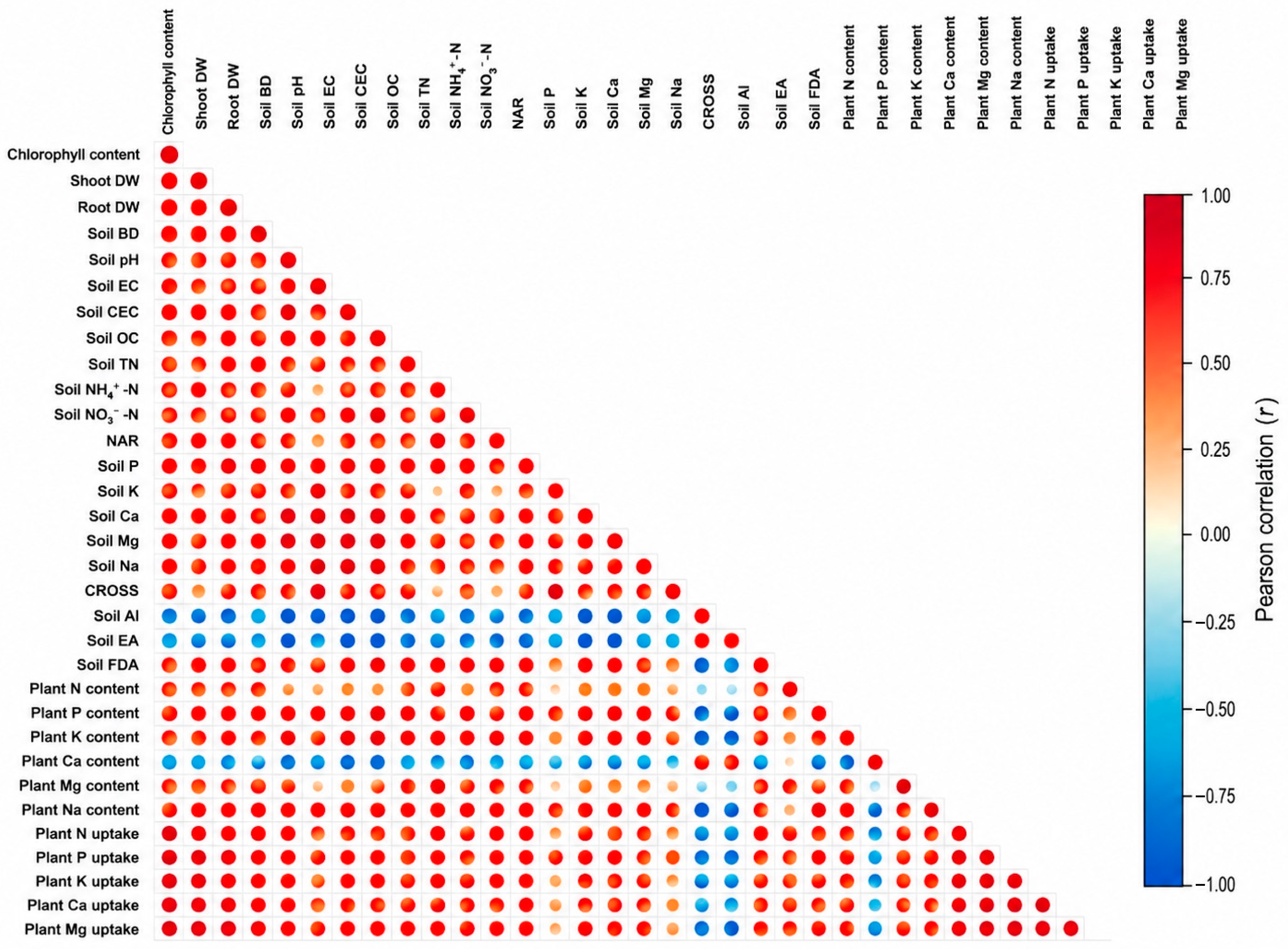
Analysis of variance was conducted under a completely randomized design to evaluate treatment effects on soil physicochemical and microbiological properties, Chinese kale biomass, tissue nutrient contents, and plant nutrient uptake. The experiment included seven treatments and three replications (21 experimental units), giving 6 treatment degrees of freedom, 14 error degrees of freedom, and 20 total degrees of freedom. Treatment means were compared using Tukey’s honest significant difference (HSD) test at p < 0.05. Pearson correlation analysis was performed to examine pairwise relationships among soil properties, plant biomass, tissue nutrient contents, and plant nutrient uptake; the correlation matrix was visualized as a correlogram. All statistical analyses were conducted using R software version 4.3.3 (R Core Team, Vienna, Austria).

3. Results

3.1. Soil Physicochemical and Microbiological Properties

Soil bulk density (1.51–1.59 g cm−3) and pH (3.89–4.97) significantly increased with higher application rates within the same method, but not between different methods at the same rate (Table 2a). Soil EC increased significantly with rate and was significantly higher for surface placement than for incorporation at high rates (0.331 vs. 0.256 mS cm−1). Soil cation exchange capacity, organic C, and NO3–N concentrations significantly increased from the unamended controls (1.92 cmolc kg−1 for CEC, 3.85 g kg−1 for organic C, and 1.35 mg kg−1 for NO3–N) with higher application rates (2.25–2.86 cmolc kg−1 for CEC, 4.28–5.25 g kg−1 for organic C, 1.63–1.84 mg kg−1 for NO3–N) within each method, except at the low rates of NO3–N (1.58 and 1.51 mg kg−1 for incorporated and surface-applied, respectively), where there were no significant differences between incorporated and surface-applied treatments at equal rates. For specific nutrients, soil total N was significantly higher for incorporated than surface-applied at low (0.195 vs. 0.160 g kg−1) and medium rates (0.226 vs. 0.187 g kg−1). Soil NH4+–N concentrations were significantly higher in all rates for incorporated (5.44–16.08 mg kg−1) than surface-applied (4.40–8.36 mg kg−1). Soil P concentrations were significantly higher for incorporated than surfaced at medium (57.4 vs. 47.2 mg kg−1) and high rates (84.4 vs. 78.0 mg kg−1). The application of cricket frass significantly increased the net ammonification rate (0.084–0.320 mg N kg−1 day−1) compared with the unamended treatment (0.026 mg N kg−1 day−1), except at the low surface application rate (0.061 mg N kg−1 day−1). Moreover, the net ammonification rate increased with increasing cricket frass application rates under both application methods.
Soil K concentrations were significantly higher for the surface placement than for the incorporation at high rates (130.3 vs. 62.4 mg kg−1) (Table 2b). Soil Ca and Mg concentrations significantly increased from control (141 mg Ca kg−1 and 15.8 mg Mg kg−1) with higher rates (172–235 mg Ca kg−1 and 24.2–46.3 mg Mg kg−1), but showed no significant differences between incorporated vs. surfaced methods at the same rate. Surface placement of the cricket frass led to significantly higher soil Na concentration than incorporation at their high rates (9.64 vs. 7.84 mg kg−1 for surfaced and incorporated, respectively), and medium (6.93 and 6.48 mg kg−1 for incorporated and surfaced, respectively) and high rates of each method significantly increased Na over the unamended treatment (4.14 mg kg−1). The application of cricket frass in all treatments (0.123–0.274) increased CROSS relative to the control (0.090), with the increase being rate-dependent, particularly under surface application.
Application of cricket frass by either method significantly reduced soil Al concentrations (0.57–4.65 mg kg−1) and exchangeable acidity (0.509–0.631 me 100 g−1) compared to the unamended control (8.25 mg kg−1 and 0.785 me 100 g−1) (Table 2b). Both soil acidity parameters declined as frass rates increased, with the incorporation method leading to significantly lower exchangeable acidity than surface application at the high rate (0.509 vs. 0.568 me 100 g−1).
Microbial activity (fluorescein release) increased with cricket frass application (329–401 mg kg−1) compared to the unamended control (304 mg kg−1) (Table 2b), except for surface placement at the low rate (305 mg kg−1). Activity generally rose with increasing rates, and incorporation (329–401 mg kg−1) produced significantly higher activity than surface placement (305–363 mg kg−1).

3.2. Biomass Yield of Chinese Kale

Chlorophyll content, indicated by the SPAD method, significantly increased only at the highest application rates (56.2 for incorporated and 55.9 for surface-applied) compared to the unamended control (46.4) (Table 3). No significant differences were observed between application methods: incorporated (46.1–56.2) versus surface-applied (47.9–55.9).
Shoot dry and root dry weights of Chinese kale significantly increased with cricket frass application at medium and high rates for both methods (Table 3). At equivalent rates, only the high rate of the incorporated application produced significantly greater shoot dry weight than the surface counterpart (7.16 vs. 4.78 g plant−1). Root dry weight showed no significant differences between the application methods at any rate.

3.3. Tissue Elemental Contents

Tissue N content significantly increased with incorporation from 18.9 g kg−1 at low to 31.2 g kg−1 at high rates (Table 4), while surface application significantly increased only at high (26.3 g kg−1) relative to its low rate (19.6 g kg−1); both low rates were significantly lower than the unamended treatment (27.3 g kg−1), whereas incorporated medium and high rates were not significantly different from surface high rate. At equivalent rates, incorporation-applied treatments produced significantly higher tissue N contents than surface counterparts at medium (26.4 vs. 19.1 g kg−1) and high (31.2 vs. 26.3 g kg−1). Tissue P content significantly increased from 1.29 to 3.23 g kg−1 with incorporation and from 1.86 to 3.56 g kg−1 with surface application; all amended treatments were significantly higher than the unamended treatment (0.68 g kg−1). The significant differences in tissue P between the application methods occurred at low (surface > incorporation) and medium (incorporation > surface), but not at high levels.
Tissue K contents significantly increased from 16.1 to 25.9 g kg−1 with incorporation and from 14.6 to 19.9 g kg−1 with surface application (Table 4); all treatments were significantly higher than the unamended control (8.3 g kg−1), with the incorporation method significantly higher than the surface method at medium (21.0 vs. 15.7 g kg−1) and high rates (25.9 vs. 19.9 g kg−1). On the contrary, tissue Ca contents significantly declined with increasing rate for both application methods (incorporation: 5.11 to 3.82 g kg−1; surface: 4.78 to 4.11 g kg−1), remaining below the unamended control (6.04 g kg−1); incorporation was significantly higher than surface-applied only at medium (4.53 vs. 3.53 g kg−1). Meanwhile, tissue Mg contents increased with increasing incorporation rates (1.44 to 1.66 g kg−1) but showed no significant change with increasing the rates of surface application (1.37–1.52 g kg−1); only incorporated medium (1.63 g kg−1) and high rates (1.66 g kg−1) were significantly higher than the control (1.47 g kg−1), and incorporation was significantly higher than surface placement at medium rates (1.63 vs. 1.39 g kg−1). Tissue Na content rose steadily with rate for both methods (incorporation: 0.453 to 0.839 g kg−1; surface: 0.355 to 0.842 g kg−1), all treatments were significantly greater than the control (0.137 g kg−1), with no differences between methods at equivalent rates.

3.4. Plant Elemental Uptakes

Plant uptake of N, Ca, and Mg showed no significant difference at low and medium application rates compared to the unamended control, but increased significantly at the high rate under incorporation of cricket frass (N: 223.1 mg plant−1, +384%; Ca: 27.3 mg plant−1, +166%; Mg: 11.89 mg plant−1, +379%) (Table 5). At the same high rate, uptake under surface application was significantly lower than incorporation (N: 125.7 mg plant−1, +173%; Ca: 19.6 mg plant−1, +91%; Mg: 7.27 mg plant−1, +193%).
Plant P, K, and Na uptake responded earlier. Surface-applied cricket frass at a low rate significantly increased P uptake (3.73 mg plant−1, +227%) relative to the unamended control (1.14 mg plant−1). In contrast, K and Na uptakes showed no significant difference from the unamended control, and a similar trend for P, K, and Na was observed with frass incorporated at a low rate. At the medium rate, both incorporation and surface application significantly increased P (6.65 and 6.10 mg plant−1, +484 and +436%), K (50.4 and 46.2 mg plant−1, +256 and +227%), and Na (1.60 and 1.62 mg plant−1, +599 and +609%) compared to the unamended control. At the high rate, uptake surged and was significantly higher under incorporation (P: 23.12 mg plant−1, +1930%; K: 185.1 mg plant−1, +1208%; Na: 6.00 mg plant−1, +2519%) than under surface application (P: 16.93 mg plant−1, +1386%; K: 95.5 mg plant−1, +575%; Na: 4.04 mg plant−1, +1664%).

3.5. Pearson Correlation Among Soil, Structural, and Plant Response Variables

Pearson correlation analysis showed coherent associations among soil fertility indicators, structural risk indicators, nutrient uptake, and Chinese kale biomass (Figure 1). Shoot dry weight was strongly and positively correlated with plant K uptake (r = 0.986), Mg uptake (r = 0.995), N uptake (r = 0.973), P uptake (r = 0.981), and Ca uptake (r = 0.982). Shoot dry biomass was also positively correlated with soil NH4+–N (r = 0.831), net ammonification (r = 0.831), soil P (r = 0.903), pH (r = 0.881), CEC (r = 0.833), and fluorescein release (r = 0.738).
By contrast, shoot dry biomass was negatively correlated with soil Al (r = −0.722) and exchangeable acidity (r = −0.705), confirming that acidity reduction was closely linked to plant performance. Plant Ca content was negatively correlated with plant K content (r = −0.698) and K uptake (r = −0.608), indicating K-Ca antagonism at the plant tissue level. CROSS was strongly correlated with residual soil K (r = 0.994) and soil Na (r = 0.830) and moderately correlated with bulk density (r = 0.68–0.69), supporting the interpretation that short-term structural responses were related to soluble and exchangeable monovalent cations.

4. Discussion

4.1. Soil Fertility Responded Differently to Incorporated Versus Surface-Applied Methods and Rates of Cricket Frass

The results support the hypothesis that placement method and rate determine the soil and plant response to cricket frass in acidic sandy soil. Application methods—incorporation versus surface placement—differentially affected soil fertility. By increasing cricket frass–soil contact, incorporation exerted a stronger influence than surface placement on NH4+–N concentration, net ammonification, available P (Table 2a), exchangeable acidity, and microbial activity (Table 2b). Although several soil properties showed no differences between methods at equivalent rates at harvest, this single sampling time may have masked transient effects because soil physicochemical and microbiological processes are dynamic. Previous work by Autaiwat and Butnan [6] and Butnan et al. [7] similarly reported time-dependent responses and consistently greater incorporation effects on pH, organic C, dissolved organic C, available P, microbial activity, and surface charges. The Pearson correlation results further supported the fertility mechanism because shoot biomass was positively associated with NH4+–N, net ammonification, soil P, pH, CEC, and fluorescein release, and negatively associated with soil Al and exchangeable acidity (Figure 1).
Lower soil K concentrations in the incorporated treatments, particularly at the high rate (Table 2b), likely reflected greater plant K uptake and possible luxury K consumption. This interpretation is consistent with plant K uptake being higher under high-rate incorporation than under surface application (Table 5), leaving less residual K in the incorporated soil. Because the harvest soil sample was obtained after homogenizing the whole pot, the high residual K measured in the high-rate surface treatment probably represented both exchangeable and soluble soil K and K remaining in surface-applied frass that had not been taken up by the plant. Thus, the higher K concentration under surface placement should be interpreted as residual K after limited plant acquisition rather than as evidence of greater K use efficiency.
Within each application method, increasing cricket frass rates unexpectedly raised soil bulk density (Table 2a), contrary to the decreases commonly reported after organic amendments [21]. We attribute this short-term increase to Na- and K-induced clay dispersion. The frass contained substantial Na and K (1247 and 12,425 mg kg−1, respectively; Table 1), and soil Na and K rose with application rates (Table 2). These cations elevate zeta potential, enlarge hydration shells around clays, and intensify interparticle repulsion, thereby promoting dispersion [20]. Consistent with this mechanism, the CROSS values were higher in frass-amended than unamended soil and increased with rate, particularly under surface placement (Table 2b). Pearson correlation analysis also linked CROSS strongly with residual soil K and Na and moderately with bulk density (Figure 1), supporting a cation-driven structural response. Despite these immediate effects, organic amendments may improve soil structure over longer periods by increasing organic binding agents and modifying clay surface charge [22]. Thus, the observed increase in bulk density should be interpreted as a short-term pot response rather than as evidence of persistent structural degradation.
Soil acidity amelioration was central to this study, given the initial pH of 4.06—classified as extremely acidic [23]. As in many tropical acidic soils, colloidal surfaces were likely dominated by H+ and Al3+ [24], consistent with the high exchangeable Al (10.65 mg kg−1) (Table 1), a phytotoxic level for several tropical crops [25]. Cricket frass mitigated acidity through several complementary mechanisms: (i) dissolution of basic salts, including K, Ca, and Mg carbonates, whose bicarbonate neutralizes H+ [26,27]; such salts are common in animal manures [28]; (ii) displacement of H+ and Al3+ from exchange sites by frass-derived base cations, followed by neutralization in soil solution [29]; (iii) provision of negatively charged organic functional groups that adsorb H+, as indicated by concurrent increases in organic C, CEC, and pH (Table 2a), and decrease in exchangeable acidity and Al (Table 2b); and (iv) additional H+ consumption during ammonification and phosphate reactions [27,30,31]. The negative correlations of soil Al and exchangeable acidity with shoot biomass and nutrient uptake (Figure 1) confirm that acidity alleviation was closely linked with crop response.
Our results demonstrated that cricket frass functions as a multifunctional fertility amendment, enhancing biochemical and microbiological properties by increasing organic C, nutrient retention, and buffering capacity. As a nutrient-rich input, it provides a single-source nutrient supply while stimulating microbial mineralization, enabling rapid nutrient availability [6,7]. These attributes make cricket frass particularly suitable for short-cycle, high-demand crops such as vegetables and certain ornamental crops.

4.2. Application Rates and Methods Determine the Growth and Yield of Chinese Kale

Across placement methods, the low frass rate (3.125 Mg ha−1) was insufficient to increase economic yield. Although it slightly improved some fertility indicators, it did not increase shoot dry weight or root dry weight relative to the unamended control (Table 3). The correlation analysis showed that biomass was associated with coordinated improvements in mineral N, available P, acidity alleviation, and nutrient uptake (Figure 1), indicating that the low rate did not generate a sufficiently integrated fertility response.
The study soil was severely degraded, as indicated by its fertility status (Table 1). Its pH was 4.06—extremely acidic [23]—and exchangeable Al was 10.56 mg kg−1, exceeding the phytotoxic threshold of 5 mg kg−1 [25]. Key indicators of nutrient supply, organic C, and buffering capacity were all below critical to moderate thresholds: 1.5–2.5 g total N kg−1, 4.28 mg NH4+–N kg−1, 30 mg NO3–N kg−1, 10–17 mg P kg−1, 117–274 mg K kg−1, 1000–2000 mg Ca kg−1, 122–365 mg Mg kg−1, 9.9–17.4 g organic C kg−1, and 12–25 cmolc CEC kg−1 [32]. Although the low frass rate (3.125 Mg ha−1) altered several soil properties under both application methods (Table 2), it did not increase Chinese kale dry biomass, including shoot dry weight and root dry weight, relative to the unamended control (Table 3), indicating insufficient nutrient provision and acidity amelioration at this low rate.
Chinese kale biomass increased at the medium (6.25 Mg ha−1) and high (12.5 Mg ha−1) frass rates across application methods (Table 3). Although soil fertility under these rates remained below critical thresholds—particularly for plant nutrients (Table 2)—the measured concentrations represent residual pools after the kale uptake within a closed pot system, where nutrients supplied by the frass could not be replenished. At the medium rate, yields did not differ between incorporation and surface placement (Table 3). At the high rate, incorporation produced significantly greater biomass than surface placement, indicating that the placement effect became decisive only when the input level was high enough to generate a clear fertility response.
The better growth of Chinese kale under high-rate incorporation, relative to high-rate surface placement, reflected greater effective nutrient acquisition. Although this advantage was detectable at harvest mainly for soil NH4+–N, net ammonification, available P (Table 2a), exchangeable acidity, and microbial activity (Table 2b), nutrient uptake provided stronger integrative evidence. At 12.5 Mg ha−1, incorporation increased plant uptake above surface placement by 97.4 mg N plant−1 (+77.5%), 6.19 mg P plant−1 (+36.6%), 89.6 mg K plant−1 (+93.8%), 7.7 mg Ca plant−1 (+39.3%), and 4.62 mg Mg plant−1 (+63.5%) (Table 5). The correlation analysis confirmed this interpretation because shoot dry biomass was strongly related to total plant nutrient uptake, especially uptake of N, P, K, Ca, and Mg (Figure 1). Surface placement may also have increased exposure of mineralized NH4+ to NH3 volatilization, especially near the frass–soil interface where localized pH and dissolved salts could be higher than in the bulk soil. Although NH3 volatilization was not measured directly, the lower NH4+–N and net ammonification under surface placement compared with incorporation are consistent with reduced retention of mineral N in the pot soil.
Beyond nutrient supply, greater kale growth under incorporation may also reflect a more extensive absorptive root interface. Although bulk root biomass did not differ between placement methods at the high rate (Table 3), root hair density and root architecture—key determinants of nutrient acquisition [33,34]—may have differed. Because root hairs contribute little to total root biomass, such differences are seldom captured by bulk root measurements [34]. The greater nutrient uptake under high-rate incorporation (Table 5), together with the strong positive correlations between biomass and nutrient uptake (Figure 1), supports this mechanism. This interpretation remains tentative because root architecture was not measured directly.
Cricket frass contained high K (12,425 mg kg−1; Table 1), which likely promoted luxury K uptake and K-Ca antagonism. Soil K and Ca both increased with application rate (Table 2), but tissue K increased while tissue Ca declined (Table 4), indicating antagonistic nutrient balance rather than simple biomass dilution. The negative correlation between tissue Ca and tissue K and between tissue Ca and plant K uptake (Figure 1) further supports this interpretation. Although K-Ca antagonism was evident, it did not limit biomass under high-rate incorporation because the benefits of greater N and P availability, lower exchangeable acidity, and higher microbial activity outweighed the Ca decline.
Meanwhile, cricket frass contained relatively high Na (1247 mg kg−1) and EC (19.6 mS cm−1) (Table 1), exceeding the Thailand organic fertilizer standard of 6 mS cm−1 [35]. Nevertheless, across methods and rates, soil Na remained 4.14–9.64 mg kg−1 and EC 0.180–0.331 mS cm−1 (Table 2a), while tissue Na was 0.137–0.842 g kg−1 (Table 4)—all below thresholds for soil Na phytotoxicity of 161–460 mg kg−1 [32], salinity effects of 0.39 mS cm−1 [36], and plant tissue Na toxicity of 5 g kg−1 [37].
Although less effective than incorporation in improving fertility, growth, and yield, surface placement at medium and high rates still improved soil properties and Chinese kale biomass relative to the unamended control (Table 3). Thus, surface placement may be useful where soil disturbance is undesirable or where reduced tillage costs are operational priorities. However, extrapolation from this greenhouse bioassay to field systems should be made with caution because the 2.8 L pot volume, limited rooting volume, rainfall, runoff, leaching, soil heterogeneity, repeated applications, and local frass price and availability can alter agronomic and economic performance.

5. Conclusions

This study demonstrates that cricket frass can restore key fertility functions in tropical acidic sandy soil when placement and rate are properly matched. Incorporation provided the strongest agronomic response because greater frass–soil contact enhanced mineral N availability, net ammonification, available P, microbial activity, and nutrient uptake while reducing exchangeable acidity. These linked responses, supported by Pearson correlation analysis, explain why high-rate incorporation produced the greatest Chinese kale biomass.
The practical conclusion is not that more frass is always better, but that the rate must be high enough to overcome the combined constraints of acidity, low nutrient retention, and low nutrient supply. The low rate (3.125 Mg ha−1) was agronomically insufficient, whereas the medium and high rates improved biomass. At 12.5 Mg ha−1, incorporation was clearly superior to surface placement for short-cycle Chinese kale production under controlled greenhouse conditions.
Surface placement remains a plausible option where soil disturbance or tillage costs must be minimized, but it should not be treated as equivalent to incorporation for high-demand vegetable production. Because this experiment used a small controlled pot system, field studies with larger rooting volumes, rainfall-driven leaching, repeated applications, soil structure monitoring, and cost–benefit analysis are required before large-scale recommendations can be made.

Author Contributions

Conceptualization, S.B.; methodology, S.J. and S.B.; software, S.J. and S.B.; validation, S.B.; formal analysis, S.J. and S.B.; investigation, S.J. and S.B.; resources, S.B.; data curation, S.B.; writing—original draft preparation, S.B.; writing—review and editing, S.J. and S.B.; visualization, S.B.; supervision, S.B.; project administration, S.B.; funding acquisition, S.J. and S.B. All authors have read and agreed to the published version of the manuscript.

Funding

The work was funded by the Research and Development Fund for Students, Sakon Nakhon Rajabhat University FY 2022 (Grant No. 17/2565). Additional support was provided by the Fundamental Fund (FF), FY 2022 (Grant No. 6/2565), granted by Thailand Science Research and Innovation and administered through Sakon Nakhon Rajabhat University.

Data Availability Statement

The data that support this study will be shared upon reasonable request to the corresponding author.

Acknowledgments

We thank Theerapat Chumpla, Saranya Autaiwat, and Janista Duangpukdee for their assistance with data collection and laboratory analyses. Special thanks are extended to Pranee Sriraj for the facility support.

Conflicts of Interest

The authors declare no conflicts of interest.

References

  1. Beesigamukama, D.; Tanga, C.M.; Sevgan, S.; Ekesi, S.; Kelemu, S. Waste to value: Global perspective on the impact of entomocomposting on environmental health, greenhouse gas mitigation and soil bioremediation. Sci. Total Environ. 2023, 902, 166067. [Google Scholar] [CrossRef] [PubMed]
  2. Sriraj, P.; Butnan, S. Detrimental effects of eucalyptus and rice husk biochars on three consecutive corn cropping cycles in a tropical acidic sandy soil. Malay. J. Soil Sci. 2025, 29, 144–156. [Google Scholar]
  3. Sriraj, P.; Toomsan, B.; Butnan, S. Effects of neem seed extract on nitrate and oxalate contents in amaranth fertilized with mineral fertilizer and cricket frass. Horticulturae 2022, 8, 898. [Google Scholar] [CrossRef]
  4. Cox, J.; Hue, N.V.; Ahmad, A.; Kobayashi, K.D. Surface-applied or incorporated biochar and compost combination improves soil fertility, Chinese cabbage and papaya biomass. Biochar 2021, 3, 213–227. [Google Scholar] [CrossRef]
  5. Toonsiri, P.; Klangsinsirikul, S. The effects of rate and timing of cricket frass application on Kalmegh (Andrographis paniculata) production in low-fertility soils. Int. J. Agric. Technol. 2025, 21, 1597–1604. [Google Scholar] [CrossRef]
  6. Autaiwat, S.; Butnan, S. Nitrogen transformation for varying application rates of incorporated and surfaced placements of cricket faeces in a tropical sandy soil. Trop. Agric. 2024, 101, 497–509. [Google Scholar]
  7. Butnan, S.; Autaiwat, S.; Sriraj, P. Effects of cricket feces application on soil colloid surface charges and carbon fractions: A nutrient retention improving opportunity in tropical acidic sandy soil. Soil Sci. Annu. 2026, 77, 217311. [Google Scholar] [CrossRef]
  8. Kroetsch, D.; Wang, C. Particle size distribution. In Soil Sampling and Methods of Analysis, 2nd ed.; Carter, M.R., Gregorich, E.G., Eds.; CRC Press: Boca Raton, FL, USA, 2008; pp. 713–725. [Google Scholar]
  9. Wilke, B.M. Determination of chemical and soil properties. In Manual for Soil Analysis—Monitoring and Assessing Soil Bioremediation; Margesin, R., Schinner, F., Eds.; Springer: Heidelberg, Germany, 2005; pp. 47–95. [Google Scholar]
  10. Pansu, M.; Gautheyrou, J. Handbook of Soil Analysis: Mineralogical, Organic and Inorganic Methods; Springer: Heidelberg, Germany, 2006; p. 993. [Google Scholar]
  11. Coscione, A.R.; de Andrade, J.C.; van Raij, B. Revisiting titration procedures for the determination of exchangeable acidity and exchangeable aluminum in soils. Commun. Soil Sci. Plant Anal. 1998, 29, 1973–1982. [Google Scholar] [CrossRef]
  12. Green, V.S.; Stott, D.E.; Diack, M. Assay for fluorescein diacetate hydrolytic activity: Optimization for soil samples. Soil Biol. Biochem. 2006, 38, 693–701. [Google Scholar] [CrossRef]
  13. Nelson, D.W.; Sommers, L.E. Total carbon, organic carbon, and organic matter. In Methods of Soil Analysis. Part 2. Chemical and Microbiological Properties; Spark, D.L., Ed.; SSSA Book Ser. 5; SSSA: Madison, WI, USA, 1982; pp. 539–579. [Google Scholar]
  14. Stevenson, F.J. Nitrogen—Inorganic forms. In Methods of Soil Analysis. Part 2. Chemical and Microbiological Properties; Spark, D.L., Ed.; SSSA Book Ser. 5; SSSA: Madison, WI, USA, 1982; pp. 643–698. [Google Scholar]
  15. Bremner, J.M.; Mulvaney, C.S. Nitrogen—Total. In Methods of Soil Analysis. Part 2. Chemical and Microbiological Propterties; Spark, D.L., Ed.; SSSA Book Ser. 5; SSSA: Madison, WI, USA, 1982; pp. 595–624. [Google Scholar]
  16. Jones, J.B. Laboratory Guide for Conducting Soil Tests and Plant Analysis; CRC Press: Boca Raton, FL, USA, 2001; p. 384. [Google Scholar]
  17. Miller, R.O. Nitric-perchloric acid wet digestion in an open vessel. In Handbook of Reference Methods for Plant Analysis; Kalra, Y.P., Ed.; CRC Press: Boca Raton, FL, USA, 1988; pp. 57–61. [Google Scholar]
  18. Horneck, D.A.; Miller, R. Determination of total nitrogen in plant tissue. In Handbook of Reference Methods for Plant Analysis; Kalra, Y.P., Ed.; CRC Press: Boca Raton, FL, USA, 1998; pp. 75–83. [Google Scholar]
  19. Bi, Q.-F.; Chen, Q.-H.; Yang, X.-R.; Li, H.; Zheng, B.-X.; Zhou, W.-W.; Liu, X.-X.; Dai, P.-B.; Li, K.-J.; Lin, X.-Y. Effects of combined application of nitrogen fertilizer and biochar on the nitrification and ammonia oxidizers in an intensive vegetable soil. AMB Express 2017, 7, 198. [Google Scholar] [CrossRef] [PubMed]
  20. Rengasamy, P.; Marchuk, A. Cation ratio of soil structural stability (CROSS). Soil Res. 2011, 49, 280–285. [Google Scholar] [CrossRef]
  21. Du, Y.; Cui, B.; Zhang, Q.; Wang, Z.; Sun, J.; Niu, W. Effects of manure fertilizer on crop yield and soil properties in China: A meta-analysis. Catena 2020, 193, 104617. [Google Scholar] [CrossRef]
  22. Marchuk, A.; Rengasamy, P.; McNeill, A. Influence of organic matter, clay mineralogy, and pH on the effects of CROSS on soil structure is related to the zeta potential of the dispersed clay. Soil Res. 2013, 51, 34–40. [Google Scholar] [CrossRef]
  23. Slattery, W.J.; Conyers, M.K.; Aitken, R.L. Soil pH, alumunium, manganese and lime requirement. In Soil Analysis: An Interpretation Manual; Peverill, K.I., Sparrow, L.A., Reuter, D.J., Eds.; CSIRO Publishing: Collingwood, Australia, 1999; pp. 103–128. [Google Scholar]
  24. Bojórquez-Quintal, E.; Escalante-Magaña, C.; Echevarría-Machado, I.; Martínez-Estévez, M. Aluminum, a friend or foe of higher plants in acid soils. Front. Plant Sci. 2017, 8, 1767. [Google Scholar] [CrossRef] [PubMed]
  25. Sumner, M.E.; Noble, A.D. Soil acidification: The world story. In Handbook of Soil Acidity; CRC Press: Boca Raton, FL, USA, 2003; pp. 15–42. [Google Scholar]
  26. Ozlu, E.; Kumar, S. Response of soil organic carbon, pH, electrical conductivity, and water stable aggregates to long-term annual manure and inorganic fertilizer. Soil Sci. Soc. Am. J. 2018, 82, 1243–1251. [Google Scholar] [CrossRef]
  27. Weil, R.R.; Brady, N.C. The Nature and Properties of Soils; Pearson Education Limited: New York, NY, USA, 2017; p. 1082. [Google Scholar]
  28. Li-Xian, Y.; Guo-Liang, L.; Shi-Hua, T.; Gavin, S.; Zhao-Huan, H. Salinity of animal manure and potential risk of secondary soil salinization through successive manure application. Sci. Total Environ. 2007, 383, 106–114. [Google Scholar] [CrossRef] [PubMed]
  29. Hue, N. Soil acidity: Development, impacts, and management. In Structure and Functions of Pedosphere; Giri, B., Kapoor, R., Wu, Q.-S., Varma, A., Eds.; Springer Nature: Singapore, 2022; pp. 103–131. [Google Scholar]
  30. Sposito, G. The Chemistry of Soils; Oxford University Press: Oxford, UK, 2016; p. 272. [Google Scholar]
  31. Barrow, N.J.; Hartemink, A.E. The effects of pH on nutrient availability depend on both soils and plants. Plant Soil 2023, 487, 21–37. [Google Scholar] [CrossRef]
  32. Hazelton, P.; Murphy, B. Interpreting Soil Test Results: What Do All the Numbers Mean? CSIRO Publishing: Melbourne, Australia, 2007; p. 152. [Google Scholar]
  33. Rongsawat, T.; Peltier, J.-B.; Boyer, J.-C.; Véry, A.-A.; Sentenac, H. Looking for root hairs to overcome poor soils. Trends Plant Sci. 2021, 26, 83–94. [Google Scholar] [CrossRef] [PubMed]
  34. De Pessemier, J.; Moturu, T.R.; Nacry, P.; Ebert, R.; De Gernier, H.; Tillard, P.; Swarup, K.; Wells, D.M.; Haseloff, J.; Murray, S.C.; et al. Root system size and root hair length are key phenes for nitrate acquisition and biomass production across natural variation in Arabidopsis. J. Exp. Bot. 2022, 73, 3569–3583. [Google Scholar] [CrossRef] [PubMed]
  35. Department of Agriculture. Announcement of the Department of Agriculture on Organic Fertilizer Standards B.E. 2548. In Royal Gazette; Series 109d; Royal Gazette: Bangkok, Thailand, 2005; Volume 122, pp. 9–10. [Google Scholar]
  36. Salachna, P.; Piechocki, R.; Byczyńska, A. Plant growth of curly kale under salinity stress. J. Ecol. Eng. 2017, 18, 119–124. [Google Scholar] [CrossRef]
  37. Reuter, D.J.; Edwards, D.G.; Wilhelm, N.S. Temperate and tropical crops. In Plant Analysis: An Interpretation Manual; Reuter, D., Robinson, J.B., Eds.; CSIRO Publishing: Collingwood, Australia, 1997; pp. 83–278. [Google Scholar]
Figure 1. Pearson correlation correlogram showing pairwise relationships among soil physicochemical and microbiological properties, Chinese kale growth and dry biomass traits, tissue nutrient contents, and plant nutrient uptake variables in response to cricket frass placement method and application rate. Circle color indicates the direction and strength of Pearson’s correlation coefficient (r), with red representing positive correlations and blue representing negative correlations; larger circles indicate stronger correlations. BD = bulk density; EC = electrical conductivity; CEC = cation exchange capacity; OC = organic C; TN = total N; NH4+–N = ammonium–N; NO3–N = nitrate–N; NAR = net ammonification rate; CROSS = cation ratio of soil structural stability; Al = exchangeable Al; EA = exchangeable acidity; FDA = fluorescein diacetate hydrolysis activity; DW = dry weight.
Crops 06 00064 g001
Table 1. Initial characteristics of soil and cricket frass used in this study.
PropertySoilCricket Frass
Soil particle distribution
Sand (%)75.3
Silt (%)21.4
Clay (%)3.3
Soil textureLoamy sand
Bulk density (g cm−3)1.380.39
Water-holding capacity (%w w−1)31.85
pH †4.066.95
Electrical conductivity (mS cm−1)0.15119.6
Cation exchange capacity (cmolc kg−1)2.2773.6
Organic C (g kg−1)3.8180.2
C:N ratio25.316.8
Total N (g kg−1)0.1510.7
NH4+–N (mg kg−1)1.67110.3
NO3+–N (mg kg−1)0.551.1
P (mg kg−1)18.88446
K (mg kg−1)31.112,425
Ca (mg kg−1)1343446
Mg (mg kg−1)14.81301
Na (mg kg−1)3.811247
Al (mg kg−1)10.65nd ‡
Exchangeable acidity (me 100 g−1)0.80nd
† Material: H2O to 1:1 for soil and 1:5 for cricket frass. ‡ nd = not detectable.
Table 2. Soil physicochemical and microbiological properties, as affected by different application rates of incorporated and surface-applied cricket frass. (a) Bulk density, pH, electrical conductivity, cation exchange capacity, organic C, N, and P. (b) Concentrations of basic and acidic cations and microbial activity (fluorescein release).
(a)
AmendmentBDpHECCECOCTNNH4+–NNO3–NNARP
(g cm−3)(Soil:H2O = 1:1)(mS cm−1)(cmolc kg−1)(g kg−1)(g kg−1)(mg kg−1)(mg kg−1)(mg N kg−1 Soil Day−1)(mg kg−1)
Un1.52 ± 0.001 bc3.89 ± 0.046 d0.180 ± 0.014 e1.92 ± 0.17 c3.85 ± 0.05 d0.160 ± 0.009 c2.82 ± 0.15 f1.35 ± 0.02 c0.026 ± 0.003 f25.5 ± 1.61 f
IncLOW1.53 ± 0.009 bc4.24 ± 0.029 c0.199 ± 0.010 d2.25 ± 0.06 b4.28 ± 0.10 c0.195 ± 0.009 b5.44 ± 0.13 de1.58 ± 0.06 bc0.084 ± 0.003 de38.6 ± 0.71 e
IncMEDIUM1.54 ± 0.014 b4.46 ± 0.055 b0.233 ± 0.005 c2.47 ± 0.16 b4.75 ± 0.02 b0.226 ± 0.004 a10.66 ± 1.57 b1.71 ± 0.06 ab0.200 ± 0.035 b57.4 ± 2.05 c
IncHIGH1.59 ± 0.010 a4.97 ± 0.020 a0.256 ± 0.006 b2.86 ± 0.015 a5.18 ± 0.02 a0.235 ± 0.004 a16.08 ± 1.08 a1.84 ± 0.09 a0.320 ± 0.024 a84.4 ± 0.93 a
SurfLOW1.51 ± 0.020 c4.27 ± 0.015 c0.200 ± 0.008 d2.26 ± 0.04 b4.28 ± 0.10 c0.160 ± 0.009 c4.40 ± 0.89 ef1.51 ± 0.07 bc0.061 ± 0.020 ef36.2 ± 1.40 e
SurfMEDIUM1.52 ± 0.013 bc4.48 ± 0.075 b0.236 ± 0.007 c2.45 ± 0.10 b4.82 ± 0.03 b0.187 ± 0.005 b6.92 ± 0.49 cd1.63 ± 0.10 ab0.117 ± 0.011 cd47.2 ± 0.45 d
SurfHIGH1.58 ± 0.009 a4.91 ± 0.030 a0.331 ± 0.005 a2.85 ± 0.07 a5.25 ± 0.05 a0.234 ± 0.006 a8.36 ± 0.65 bc1.83 ± 0.16 a0.149 ± 0.015 bc78.0 ± 1.45 b
p-value<0.001<0.001<0.001<0.001<0.001<0.001<0.001<0.001<0.001<0.001
F-test******************************
CV (%)0.770.973.554.141.273.2810.935.3813.892.54
(b)
AmendmentKCaMgNaCROSSAlExchangeable acidityFluorescein release
(mg kg−1)(mg kg−1)(mg kg−1)(mg kg−1)(mg kg−1)(me 100 g−1)(mg kg−1 soil)
Un26.7 ± 3.16 d141 ± 3.15 c15.8 ± 1.36 e4.14 ± 0.50 d0.090 ± 0.009 d8.25 ± 1.45 a0.785 ± 0.015 a304 ± 8.16 d
IncLOW57.9 ± 3.81 bc172 ± 7.70 b27.2 ± 0.94 cd4.44 ± 0.26 d0.145 ± 0.010 bc4.35 ± 1.30 b0.604 ± 0.016 b329 ± 8.70 c
IncMEDIUM59.4 ± 5.38 bc190 ± 21.06 b33.7 ± 0.94 b6.93 ± 0.91 bc0.155 ± 0.012 b2.85 ± 0.26 bc0.606 ± 0.007 b385 ± 0.35 a
IncHIGH62.4 ± 5.83 b235 ± 4.05 a42.3 ± 1.50 a7.84 ± 0.60 b0.148 ± 0.013 bc0.57 ± 0.29 c0.509 ± 0.004 d401 ± 6.25 a
SurfLOW44.7 ± 1.85 c182 ± 9.96 b24.2 ± 0.35 d5.49 ± 0.48 cd0.123 ± 0.006 c4.65 ± 1.13 b0.631 ± 0.014 b305 ± 12.05 d
SurfMEDIUM60.5 ± 1.09 bc190 ± 2.26 b29.5 ± 1.01 bc6.48 ± 0.23 bc0.155 ± 0.003 b2.25 ± 0.45 bc0.618 ± 0.018 b355 ± 2.40 b
SurfHIGH130.3 ± 12.04 a233 ± 9.10 a46.3 ± 3.33 a9.64 ± 0.71 a0.274 ± 0.015 a0.60 ± 0.26 c0.568 ± 0.011 c363 ± 2.55 b
p-value<0.001<0.001<0.001<0.001<0.001<0.001<0.001<0.001
F-test************************
CV (%)9.225.275.138.886.7026.352.081.99
*** p ≤ 0.001; values are means (n = 3). LOW, MEDIUM, and HIGH refer to application rates of incorporated (Inc) and surface-applied (Surf) cricket frass at 3.125, 6.25, and 12.5 Mg ha−1. Means followed by the same superscript letters in the same column do not differ significantly at p ≤ 0.05 according to Tukey’s HSD test. BD = bulk density; EC = electrical conductivity; CEC = cation exchange capacity; NAR = net ammonification rate; OC = organic C; TN = total N; CROSS = cation ratio of soil structural stability.
Table 3. Chlorophyll content in leaves and dry biomass of Chinese kale, including shoot dry weight (shoot DW) and root dry weight (root DW), as affected by different application rates of incorporated and surface-applied cricket frass.
AmendmentChlorophyll ContentBiomass (g Plant−1)
(SPAD Unit)Shoot DWRoot DW
Un46.4 ± 1.64 b1.70 ± 0.19 d0.16 ± 0.032 c
IncLOW46.1 ± 3.55 b1.76 ± 0.18 d0.16 ± 0.027 c
IncMEDIUM48.8 ± 0.79 b2.40 ± 0.21 cd0.31 ± 0.085 b
IncHIGH56.2 ± 0.06 a7.16 ± 0.05 a0.56 ± 0.015 a
SurfLOW47.9 ± 0.55 b1.98 ± 0.50 d0.15 ± 0.015 c
SurfMEDIUM47.0 ± 2.33 b2.96 ± 0.29 c0.32 ± 0.015 b
SurfHIGH55.9 ± 2.60 a4.78 ± 0.52 b0.54 ± 0.035 a
p-value<0.001<0.001<0.001
F-test*********
CV (%)4.059.9112.67
*** p ≤ 0.001; values are means (n = 3). LOW, MEDIUM, and HIGH refer to application rates of incorporated (Inc) and surface-applied (Surf) cricket frass at 3.125, 6.25, and 12.5 Mg ha−1. Means followed by the same superscript letters in the same column do not differ significantly at p ≤ 0.05 according to Tukey’s HSD test.
Table 4. Tissue elemental content in Chinese kale, as affected by different application rates of incorporated and surface-applied cricket frass.
AmendmentNPKCaMgNa
(g kg−1)(g kg−1)(g kg−1)(g kg−1)(g kg−1)(g kg−1)
Un27.3 ± 2.10 ab0.68 ± 0.05 e8.3 ± 1.40 d6.04 ± 0.31 a1.47 ± 0.053 b0.137 ± 0.026 e
IncLOW18.9 ± 1.21 c1.29 ± 0.05 d16.1 ± 1.72 c5.11 ± 0.01 b1.44 ± 0.017 b0.453 ± 0.088 cd
IncMEDIUM26.4 ± 3.23 b2.76 ± 0.22 b21.0 ± 1.34 b4.53 ± 0.19 bc1.63 ± 0.025 a0.667 ± 0.008 b
IncHIGH31.2 ± 4.55 a3.23 ± 0.10 ab25.9 ± 0.37 a3.82 ± 0.02 d1.66 ± 0.070 a0.839 ± 0.053 a
SurfLOW19.6 ± 1.40 c1.86 ± 0.19 c14.6 ± 0.38 c4.78 ± 0.39 b1.37 ± 0.050 b0.355 ± 0.028 d
SurfMEDIUM19.1 ± 1.07 c2.06 ± 0.14 c15.7 ± 1.20 c3.53 ± 0.07 d1.39 ± 0.069 b0.547 ± 0.052 bc
SurfHIGH26.3 ± 1.17 b3.56 ± 0.33 a19.9 ± 1.00 b4.11 ± 0.20 cd1.52 ± 0.070 ab0.842 ± 0.077 a
p-value<0.001<0.001<0.001<0.001<0.001<0.001
F-test******************
CV (%)10.18.246.74.773.649.89
*** p ≤ 0.001; values are means (n = 3). LOW, MEDIUM, and HIGH refer to application rates of incorporated (Inc) and surface-applied (Surf) cricket frass at 3.125, 6.25, and 12.5 Mg ha−1. Means followed by the same superscript letters in the same column do not differ significantly at p ≤ 0.05 according to Tukey’s HSD test.
Table 5. Elemental uptakes of Chinese kale, as affected by different application rates of incorporated and surface-applied cricket frass.
AmendmentPlant Elemental Uptake (mg Plant−1)Relative Change (%)
NPKCaMgNaNPKCaMgNa
Un46.1 ± 2.85 c1.14 ± 0.05 e14.2 ± 3.71 e10.3 ± 1.47 c2.48 ± 0.21 c0.23 ± 0.03 d
IncLOW33.3 ± 4.13 c2.26 ± 0.20 de28.2 ± 2.98 de9.0 ± 0.95 c2.53 ± 0.29 c0.80 ± 0.22 cd−289899−122250
IncMEDIUM62.9 ± 3.68 c6.65 ± 1.06 c50.4 ± 6.45 c10.9 ± 0.81 c3.92 ± 0.38 c1.60 ± 0.13 c36484256658599
IncHIGH223.1 ± 33.97 a23.12 ± 0.65 a185.1 ± 3.82 a27.3 ± 0.25 a11.89 ± 0.58 a6.00 ± 0.42 a384193012081663792519
SurfLOW38.8 ± 10.22 c3.73 ± 1.22 d29.0 ± 7.89 de9.4 ± 1.91 c2.72 ± 0.69 c0.70 ± 0.19 cd−16227105−910206
SurfMEDIUM56.8 ± 8.16 c6.10 ± 0.90 c46.2 ± 1.80 cd10.4 ± 0.81 c4.12 ± 0.55 c1.62 ± 0.28 c23436227266609
SurfHIGH125.7 ± 16.21 b16.93 ± 1.07 b95.5 ± 14.80 b19.6 ± 1.37 b7.27 ± 1.13 b4.04 ± 0.73 b1731386575911931664
p-value<0.001<0.001<0.001<0.001<0.001<0.001
F-test******************
CV (%)18.199.8911.248.6112.3316.63
*** p ≤ 0.001; values are means (n = 3). LOW, MEDIUM, and HIGH refer to application rates of incorporated (Inc) and surface-applied (Surf) cricket frass at 3.125, 6.25, and 12.5 Mg ha−1. Means followed by the same superscript letters in the same column do not differ significantly at p ≤ 0.05 according to Tukey’s HSD test.
Disclaimer/Publisher’s Note: The statements, opinions and data contained in all publications are solely those of the individual author(s) and contributor(s) and not of MDPI and/or the editor(s). MDPI and/or the editor(s) disclaim responsibility for any injury to people or property resulting from any ideas, methods, instructions or products referred to in the content.