Article

Effects of Rice Straw Mulching on Nematode Communities in Upland-Paddy Rice Systems in Salt-Affected Soils


1
Soil Science Department, College of Agriculture, Can Tho University, Can Tho City 900000, Vietnam
2
Gulbali Institute, Charles Sturt University, Wagga Wagga, NSW 2678, Australia
3
Impact Ag, P.O. Box 1938, Armidale, NSW 2350, Australia
4
Graduate School of Bio-Applications and Systems Engineering, Tokyo University of Agriculture and Technology, 2-24-16 Naka-cho, Koganei-shi 184-8588, Tokyo, Japan
*
Author to whom correspondence should be addressed.
Crops 2026, 6(3), 53; https://doi.org/10.3390/crops6030053
Submission received: 5 March 2026 / Revised: 15 May 2026 / Accepted: 25 May 2026 / Published: 26 May 2026
(This article belongs to the Topic Soil Health and Nutrient Management for Crop Productivity)

Abstract

Rice straw mulching is a soil management practice that influences soil microbial communities. However, its effects on nematode communities under upland rice systems in salt-affected soils remain unclear. This study examined nematode community responses to rice straw mulching at rates of 0, 3.5, 7.0, and 10.5 t ha−1 in paddy fields at two sites, Lieu Tu and Long Phu, in Soc Trang Province, Mekong Delta, Vietnam. A total of 37 and 35 nematode genera were identified in Lieu Tu and Long Phu, respectively. Bacterivores were the dominant group, followed by herbivores. Acrobeloides, Hirschmanniella, Chronogaster, Aporcelaimellus, and Prismatolaimus were prevalent in Long Phu, while Acrobeloides, Prismatolaimus, Hirschmanniella, and Alaimus dominated in Lieu Tu. The highest mulching rate (10.5 t ha−1) increased total nematode abundance, particularly cp1 and cp2 groups in Long Phu, while the application of 7.0 t ha−1 increased the proportion of omnivorous feeders in Lieu Tu. Mulching increased total nematode biomass and metabolic footprints, indicating improved soil fertility. At Long Phu, mulching also increased biodiversity, as reflected by the higher species richness and Shannon–Wiener indices. The highest mulching application rate (10.5 t ha−1) increased the relative abundance of cp2 functional guilds at both sites. Mulching reduced the relative abundance of plant-parasitic nematodes at both sites, and increased cowpea yield from 5.1 to 13.9 t ha−1 and 5.67 to 9.70 t ha−1 at Lieu Tu and Long Phu, respectively. These findings suggest that the rice straw mulching at 10.5 t ha−1 improves soil structure and nematode diversity, thereby supporting agricultural sustainability in salt-affected soils under climate change conditions.

1. Introduction

Rice (Oryza sativa L.) is the dominant cultivated crop in the Mekong Delta (MD) region of southern Vietnam, where it is grown on 82% of the country’s total agricultural land [1]. The practice of cultivating three rice crops per year is an intensive cropping pattern commonly adopted in the area; however, environmental issues such as water pollution [2] and soil degradation [3] have occurred due to the overuse of chemical fertilizers and pesticides. Additionally, the MD is experiencing climate change-induced saline intrusion [4,5] that negatively affects soil properties and crop productivity due to the accumulation of water-soluble salts [6,7,8]. Dry season alternative upland crops and the associated management practice of rice straw mulching have successfully been trialed in saline-affected areas of the MD [9,10,11]. The legume cowpea (Vigna unguiculata) was selected as the upland crop and has shown suitability for its saline tolerance, water use efficiency [12] and nitrogen fixing capabilities contributing to soil fertility [13], yet the implications of these changes on soil nematode communities had not been explored in depth.
Climate change has led to significant alterations in soil properties in the Mekong Delta, primarily due to increased salinity intrusion and drought stress [14]. These changes can, in turn, influence the composition of soil nematode communities. Previous studies have shown that saline conditions negatively affect the community composition, trophic structure, and diversity of soil-dwelling nematodes [15,16,17]. Free-living nematodes (FLN) include bacterivores, fungivores, omnivores, and predators, which feed on a variety of soil organisms and organic matter such as bacteria, fungi, other nematodes, or small soil invertebrates. They play an important role in the soil food web by promoting organic matter decomposition, nutrient cycling, and improving soil fertility [18]. In contrast, plant-parasitic nematodes (PPN) are among the most significant pests in paddy rice, contributing to an annual global yield reduction of up to 20% [19]. Rice root-knot nematodes (Meloidogyne graminicola) can reduce rice productivity by up to 85% under upland conditions in sandy soils and by 55% in clay soils [20]. In the MD, Hirschmanniella oryzae is another PPN species commonly associated with irrigated paddy rice systems and yield reductions [16] with its distribution reported in many Asian countries [21].
To adapt to climate change and mitigate the risks associated with intensive rice monoculture, innovative cropping systems should be developed. These systems should incorporate salt- and drought-tolerant crops, along with improved utilization of agricultural biomass. Changing from continuous rice production to upland cropping systems promotes beneficial nematode communities and can reduce the infestation of plant-parasitic nematodes [22]. Our previous study reported that the use of sesame and soybean in continuous rice cultivation enhanced the beneficial nematode community composition and reduced the number of Hirschmanniella [23]. Similarly, Win [24] reported that the growth of chickpea and blackgram in a rice paddy field reduced the abundance and number of galls infected by Meloidogyne graminicola. The intercropping system of alfalfa and maize also promoted beneficial nematode growth [25]. The use of straw mulching in conjunction with upland crops impacts the soil characteristics and consequently plant growth, with enhanced water availability in soybean fields [26], increased root occurrence of maize [27] and promoted microbial community structure and functions in maize [28]. These characteristics may drive changes in nematode communities through the creation of microhabitats.
Mulching is an agricultural practice that strongly affects soil organisms, particularly the composition of the nematode community and their ecological indices. For instance, straw mulching types (rice, rapeseed, and their mix) at rates of 30 t ha−1 in a walnut orchard field in southwestern China reduced the total number of nematodes but enhanced the metabolic footprint of higher trophic levels [29]. Soil amendments are also considered positive practices used to maintain soil health in agriculture. The application of organic matter significantly promoted soil nematodes, particularly the production and respiration of fungivores [30]. The application of both raw and composted residues also influenced the nematode community [31,32] with belowground nematode populations being significantly driven by aboveground plant biomass [33]. Nematodes can be used to assess soil health, with those belonging to functional guilds cp4 and cp5 serving as indicators of soil stability and maturity due to their sensitivity, larger body size, and slower reproductive cycles [34,35]. Nematodes are commonly used to assess the effects of salinity [36] or environmental changes [37] because of their sensitivity to microhabitats [38]. However, the effects of rice straw mulching during the dry season in salt-affected soils have not been well documented. In particular, when applied during the upland phase of the cowpea cropping season, its impacts on soil nematode community composition and functional structure in salt-affected soils of the Mekong Delta remain poorly understood.
Therefore, we hypothesize that rice straw mulching may promote changes in nematode community composition through improved soil water availability, particularly in salt-affected soils where water is a limiting factor. This study aims to (i) examine changes in nematode community composition, particularly trophic structure, metabolic footprint, and diversity under rice straw mulching, and (ii) evaluate how different mulching rates affect cowpea yield. The experiment was conducted under varying mulching rates in salt-affected soils of the Mekong Delta, with cowpea used as an alternative crop.

2. Materials and Methods

2.1. Experiment Designs

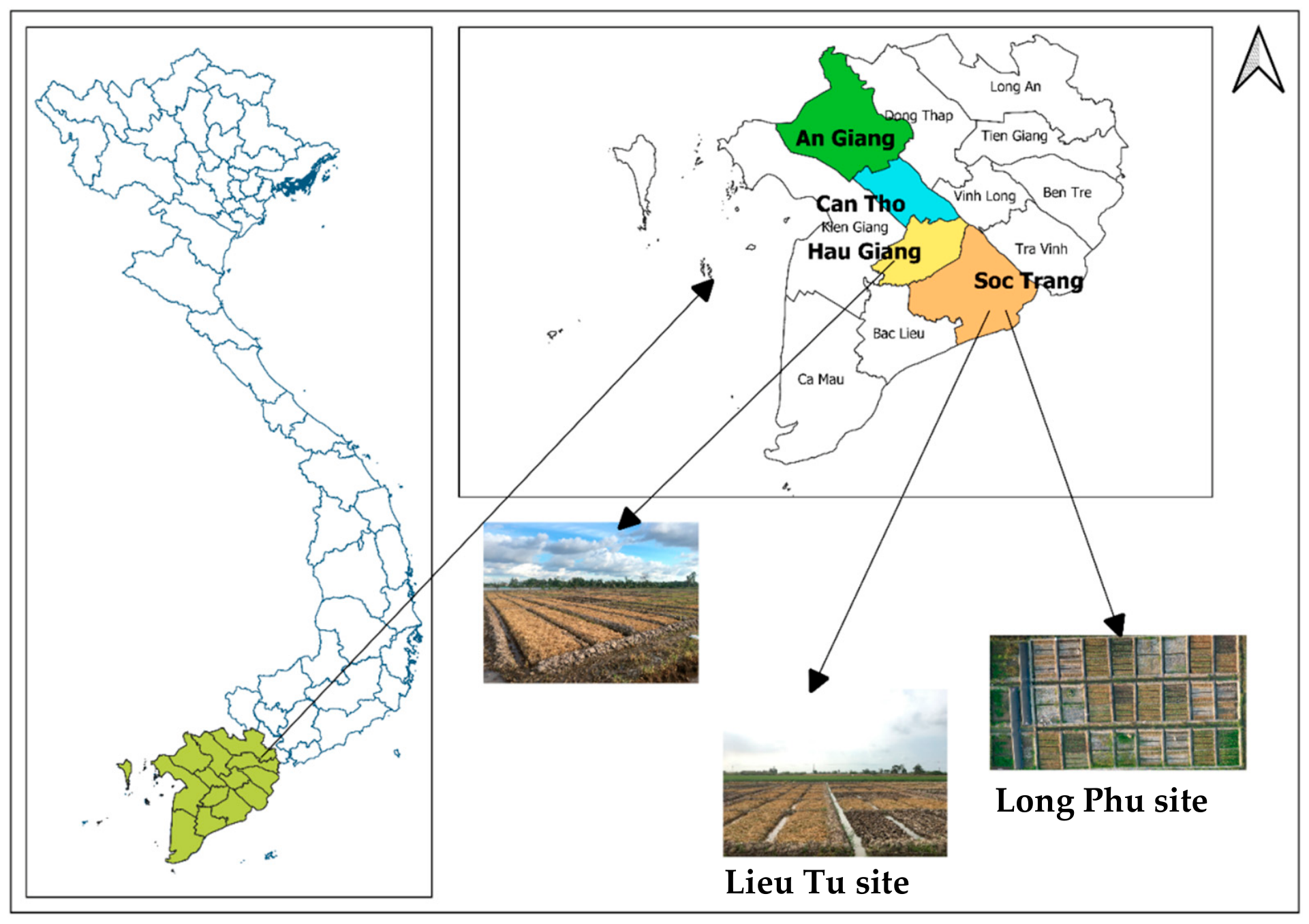
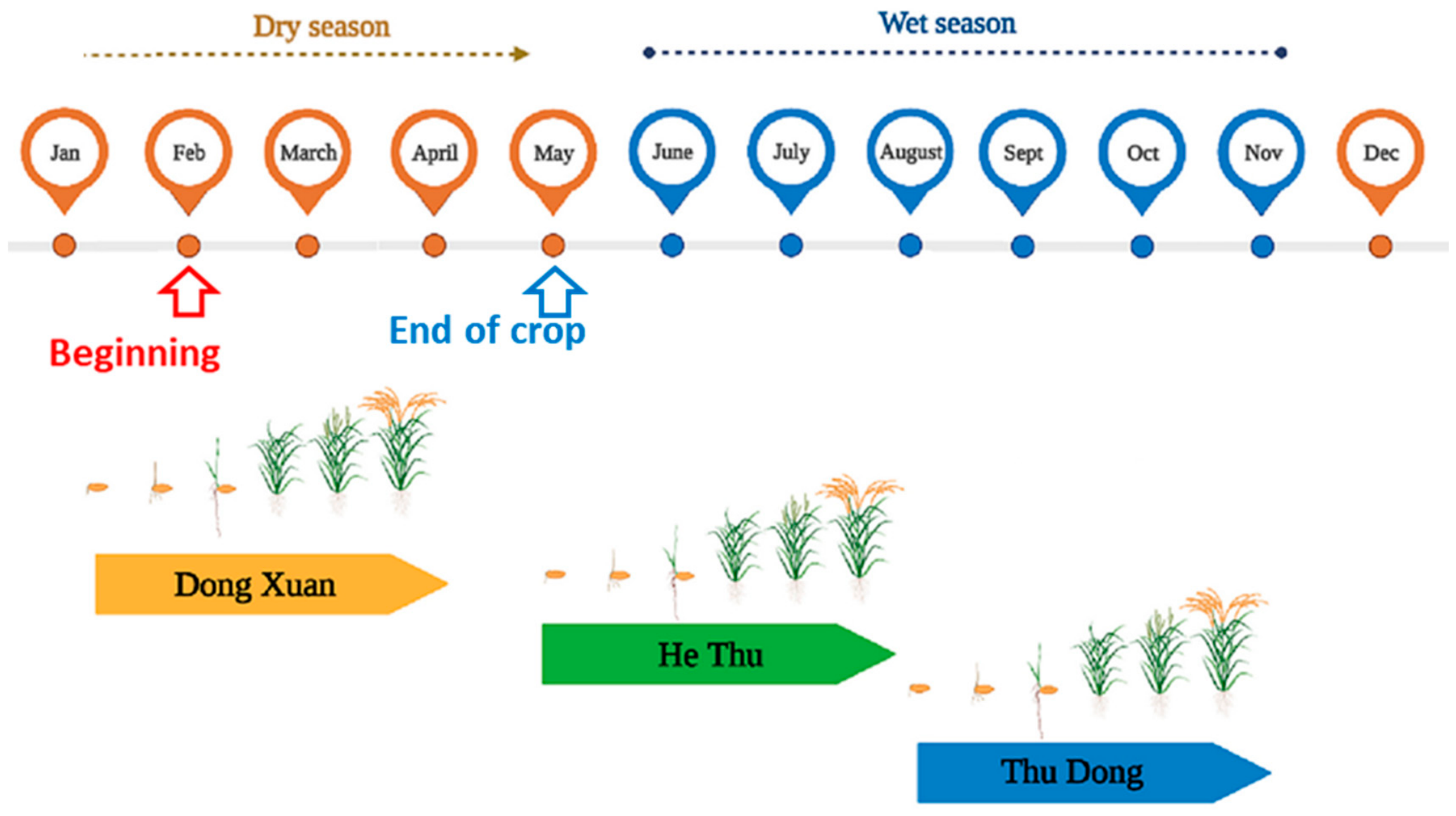
A field trial was conducted at two different sites at Long Phu and Lieu Tu, Soc Trang province (Figure 1). The soil type is classified as Salic Fluvisols at Long Phu, with the main soil texture of Lieu Tu and Long Phu being silty clay [39]. This paddy field had traditionally practiced triple rice cultivation (three rice crops per year) until the past 3 years, when upland crops were introduced during the dry season. Details in crop timing are shown below (Figure 2). Initial soil properties were analyzed and reported in Table 1.
The experiment was conducted using a randomized complete block design with three independent replicates, in which treatments were randomly assigned within each block. The study was carried out in the paddy rice fields located in Long Phu and Lieu Tu. The mulching rates were selected based on the availability of rice straw yield from a typical single rice crop (7.0 t ha−1), with additional treatments representing a 50% decrease (3.5 t ha−1) and a 50% increase (10.5 t ha−1) to evaluate rate-dependent effects. The mulching application rates were no mulching (M0), 3.5 t ha−1 (M1), 7.0 t ha−1 (M2) and 10.5 t ha−1 (M3). Five treatments were set up with three replicates each field trial. Each plot had an area of 25 m2 with dimensions of 5 m × 5 m. Cowpea (Vigna unguiculata) was sown in the dry season in February 2023 with the different mulching rates applied (M0, M1, M2, M3), and a fallow (without mulching, no crop) treatment used as a reference control.

2.2. Sampling and Analysis

2.2.1. Soil Sampling

Soil samples were collected at the beginning of the cowpea crop in February 2023 (rice was the previous crop) and at the end of cowpea growth period in May 2023, corresponding to a two-year field experiment conducted at the two field locations (Figure 2). In each plot, five soils cores were collected randomly from 0 to 20 cm depth using an auger. These five sub-samples were thoroughly mixed to form one composite sample per plot, which was then used for nematode extraction.

2.2.2. Nematode Extraction

A sub-sample (20 g) of homogenous moist soil from each plot was used for nematode extraction using the Baermann’s funnel method [41] that may help improve the extraction efficiency in clay soil. Nematodes suspensions were collected after 48 h at room temperature. Hot formaldehyde 4% solution was used to kill nematodes and specimens were stored. A few drops of 1% Rose Bengal solution were added to dye the nematodes. The total numbers of individual nematodes were counted under a microscope and converted to the density per 100 g of dry soil. Fifty individuals were randomly picked, or all nematode individuals were collected for identification when the total number was fewer than 50. Nematodes were mounted in a drop of concentrated glycerin (99.5%) on a glass slide and sealed with a paraffin ring for nematode identification. All nematodes were assigned to five trophic groups; bacterivore, fungivore, PPN, omnivore and predator [42]. The classification of nematode colonizer–persister (c-p) value was based on life history strategies [43,44]. For example, nematodes of cp1 have a short generation time, high fecundity, and are mainly bacterivorous that feed on enriched media. Nematodes of cp2, cp3, and cp4 have longer generation times, greater sensitivity to adverse conditions and soil disturbance, and are mainly bacterivorous, fungivorous, predator, and small omnivores. Nematodes of cp5 have the longest generation time, largest body, lowest fecundity, greatest sensitivity to soil disturbance, and are mainly omnivores and predators [45]. The maturity index (MI), plant parasitic index (PPI) and the ratio of total bacterivore and fungivore to the total PPN were calculated [42]. The number of genera (S), density (N), H’ Shannon–Weiner diversity, and species richness Margalef (d) were calculated using a PRIMER package version 6 [46]. Metabolic footprints and community indices were calculated using the NINJA online program at https://sieriebriennikov.shinyapps.io/ninja/ accessed on 10 October 2025 [47,48]. Nematode metabolic footprints quantify carbon utilization by different food web components and provide information on energy flow through various trophic groups, which gives additional descriptive information on food web form and soil functions [45,48,49,50]. For example, the enrichment footprint is the metabolic footprint of nematodes, which rapidly responds to the resource enrichment. The structure footprint is the metabolic footprint of higher trophic levels, which may have a regulatory function in the food web and which are indicative of the abundance of organisms of similar functions in non–nematode taxa. The herbivorous, bacterivorous, omnivorous, fungivorous and predator footprints are based on the nematode indicators of carbon and energy entering the soil food web through their respective channels.

2.3. Yield Collection

Cowpea beans were collected upon maturity until harvest completion. All weights were measured and summed to determine the total fresh yield (t ha−1).

2.4. Data Analysis

Data were analyzed using one-way ANOVA to determine the effects of rice straw mulching on nematode community composition and their ecological indices. Nematode abundances were log-transformed Log (X + 1) prior to statistical analysis to assess data normality and to test for homogeneity of variances using Levene’s test. Post hoc tests were applied to compare significant differences among treatments using Tukey’s HSD test. Differences with a p-value < 0.05 were considered statistically significant.

3. Results

3.1. Rice Straw Mulching Affected Nematode Community Composition

3.1.1. Nematode Abundance

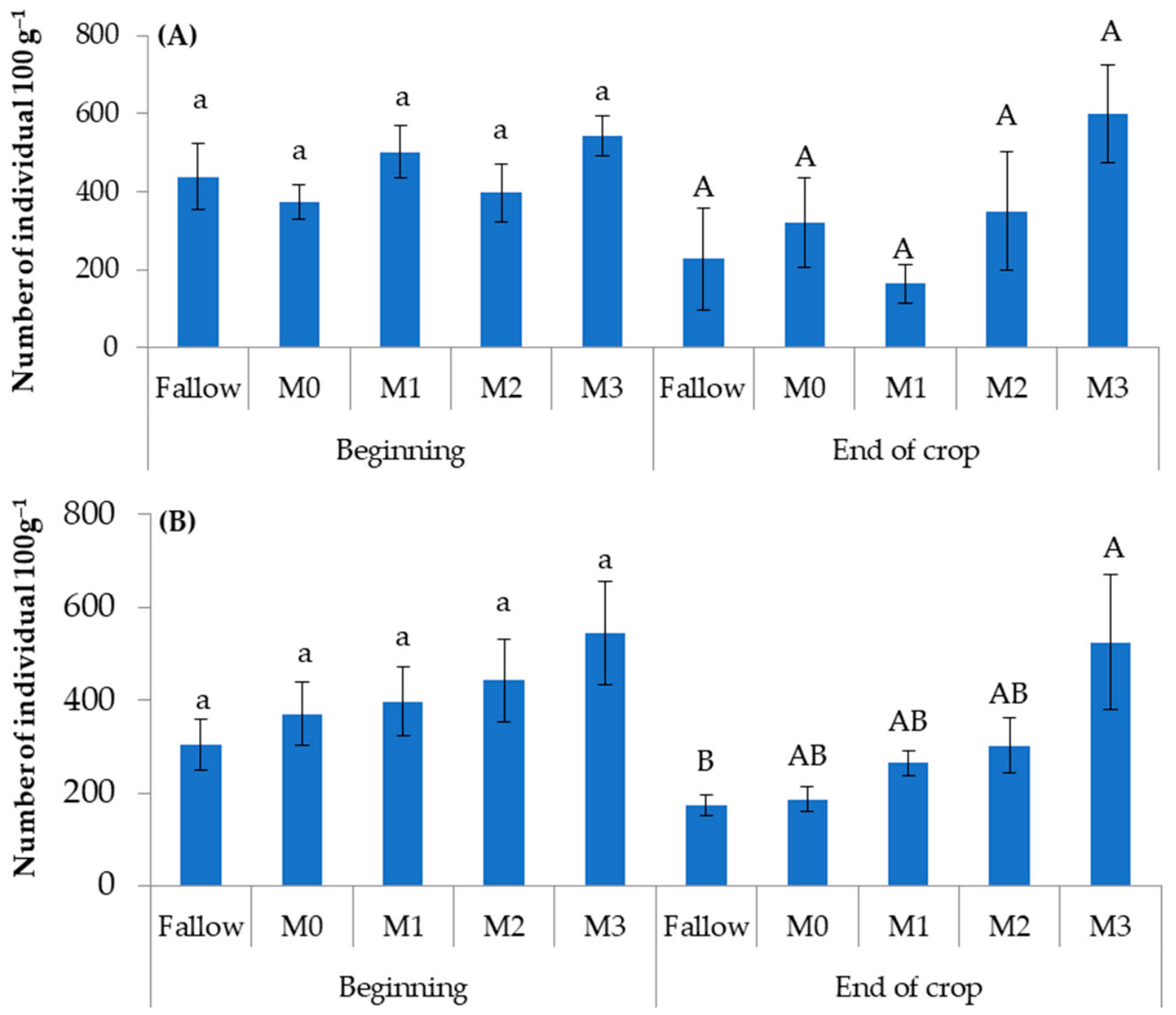
The application of rice straw mulching did not affect the total abundance of the nematode community in soils at the Lieu Tu site, but it tended to increase the abundance at M3 (10.5 t ha−1) (Figure 3A). In Long Phu, the abundance of nematodes increased with higher mulching rates and was significantly higher (p < 0.05) at M3 compared to the fallow treatment at the end of the cowpea season (Figure 3B).

3.1.2. Taxonomic Composition of Nematodes

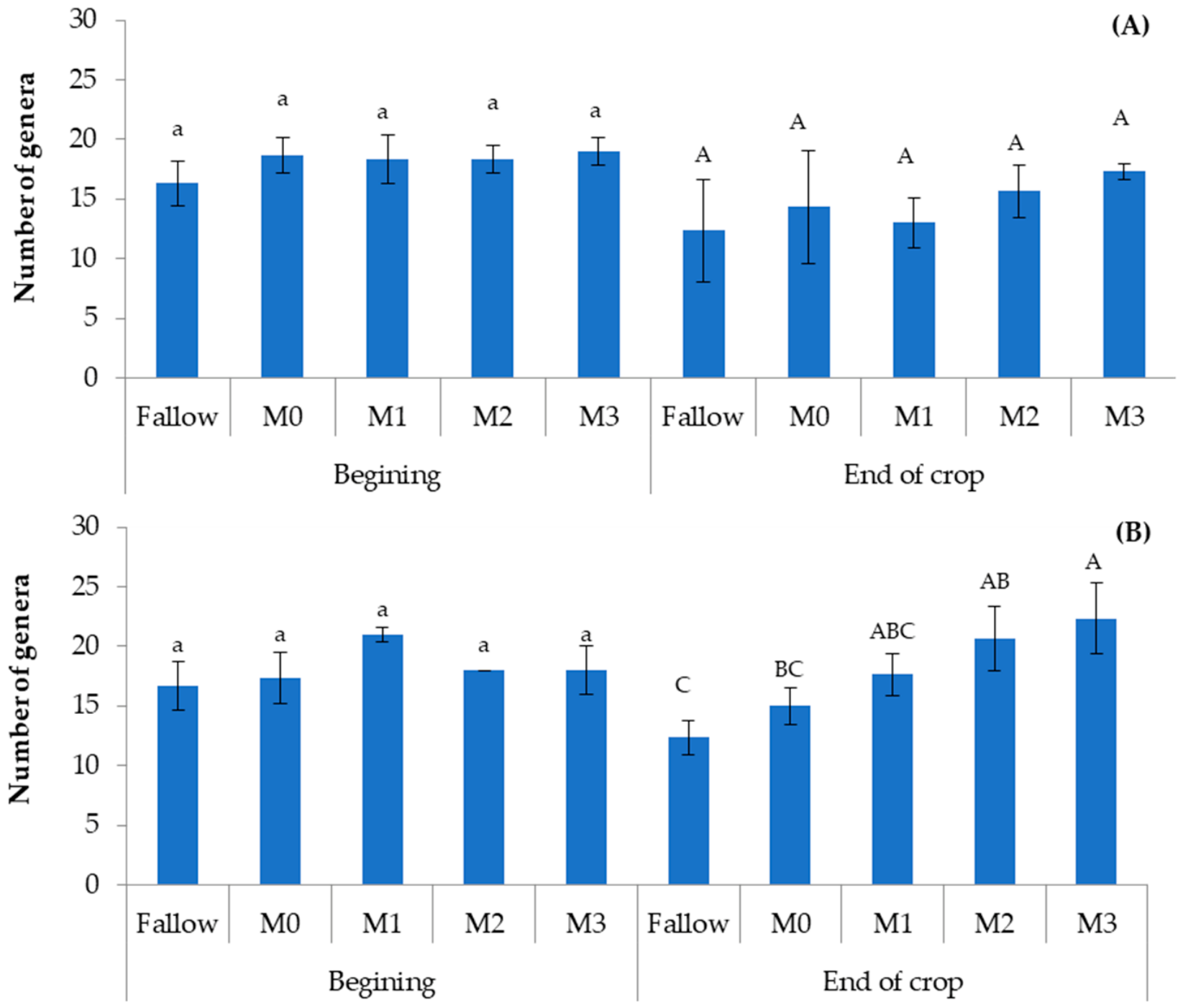
In Lieu Tu, a total of 37 nematode genera were recorded, including 33 genera at the beginning and 37 genera at the end of the cowpea season. In Long Phu, a total of 35 genera were identified, with 31 genera at the beginning and 35 genera at the end of the cowpea season. The number of genera did not differ among the rice straw mulching treatments in Lieu Tu at either sampling time (Figure 4A). In Long Phu, the number of genera was significantly higher (p < 0.05) in the 10.5 t ha−1 treatment compared to the fallow and no mulching treatments (Figure 4B).
The most abundant genus at the Lieu Tu site at the beginning of the cowpea crop season was Acrobeloides, accounting for 23.1%, followed by Hirschmanniella (21.3%) and Mesodorylaimus (5.1%). At the end of the crop, the most abundant genera were Acrobeloides (23.2%), Mesorhabditis (15.0%), Hirschmanniella (11.3%), and Aphelenchoides (5.9%) (Figure S1A,B). At the Long Phu site, the most dominant genus at the beginning of the season was Acrobeloides (16.7%), followed by Hirschmanniella (12.7%), Chronogaster (9.1%), Aporcelaimus (4.9%), Prismatolaimus (4.5%), and Mesodorylaimus (4.5%). At the end of the crop, the dominant genera were Acrobeloides (23.6%), Hirschmanniella (12.9%), Aphelenchoides (5.3%), and Mesorhabditis (4.1%) (Figure S2A,B).
In Lieu Tu, the density of Aporcelaimus was significantly greater (p < 0.05) in the M3 treatment compared to the M1 and M2 treatments at the beginning of the season. Mylonchulus had the greatest abundance (p < 0.01) in M2 compared to the fallow, M1, and M3 treatments. Thornenema was more prevalent (p < 0.05) in M3 than in M0, while Tylenchorhynchus was more abundant (p < 0.01) in M0, M1, and M3 than in fallow. The density of Tylenchus was higher (p = 0.03) in M3 compared to M1 (Table S1). At the end of the crop season, Acrobeloides was more abundant (p < 0.05) in M3 than in M1, and Amphidelus was more abundant (p < 0.05) in M3 than in M0 and M2 treatments. Aphelenchoides was more abundant (p = 0.007) in M2 and M3 than in fallow, and more abundant in M3 than in M1. Aporcelaimus was more abundant (p < 0.05) in M3 than in M1. Mononchus was significantly more abundant (p = 0.001) in M2 and M3 than in fallow and M0 treatments (Table S2).
In Long Phu, the density of the bacterivore genus Mesorhabditis was greater (p < 0.01) in M3 than in M0, M1, and M2 treatments. The density of Panagrolaimus was lower (p < 0.05) in M2 than in fallow and M3 treatments at the beginning of the crop season (Table S3). At the end of the crop season, the density of the bacterivore genus Acrobeloides was greater (p < 0.05) in M3 than in fallow, and Diploscapter was more abundant (p < 0.05) in M3 than in fallow and M1 treatments. Panagrolaimus was more abundant (p < 0.05) in M2 than in fallow and M1 treatments (Table S4).

3.2. Trophic Structures of Nematode Community Changes Under Rice Straw Mulching

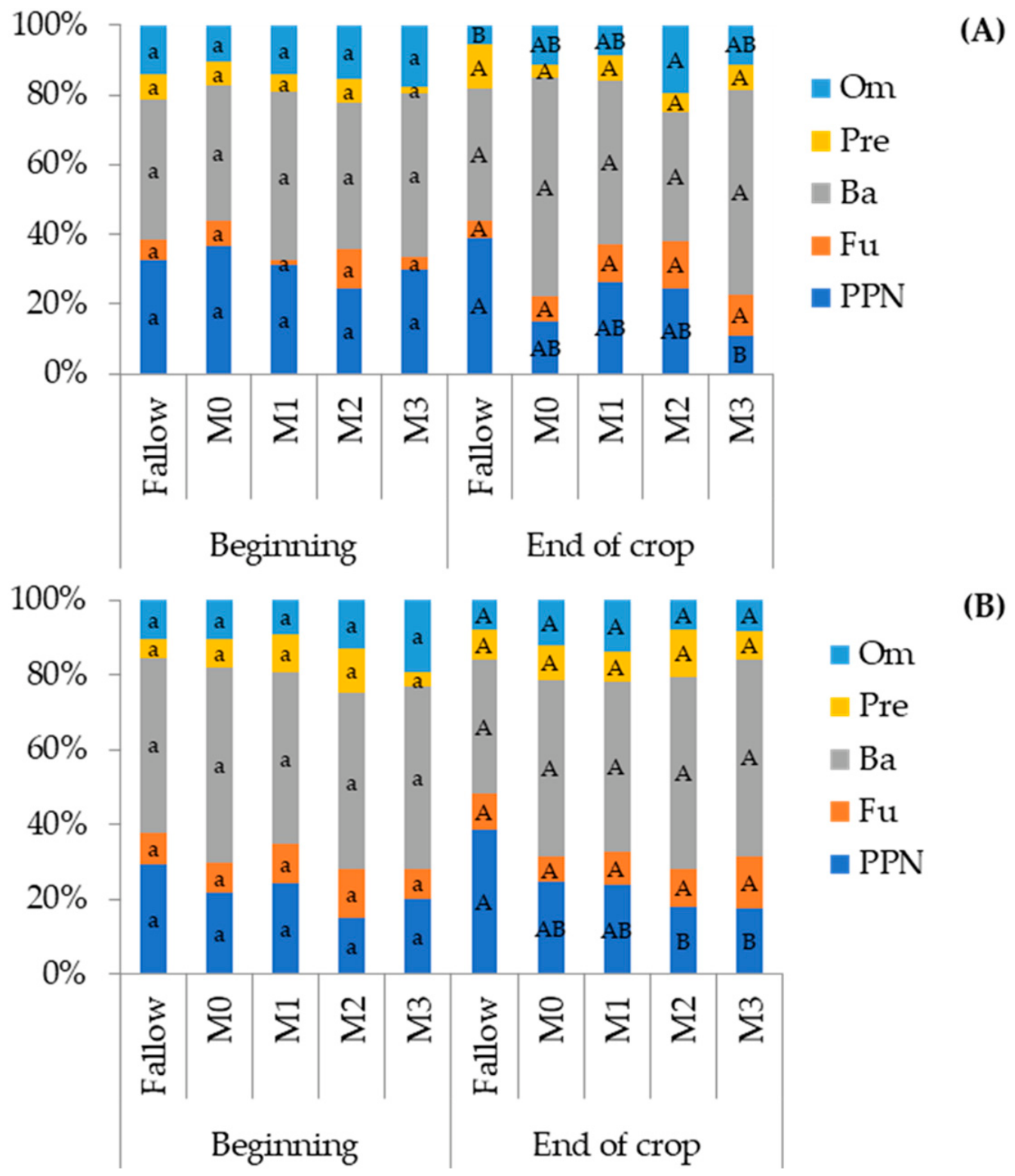
At the beginning of the season at Lieu Tu, there were no differences among mulching application rates in the proportions of plant-parasitic nematodes (PPN), bacterivores (Ba), fungivores (Fu), omnivores (Om), and predators (Pre). However, there was a significant difference in omnivores (p < 0.05) between the M2 and fallow treatments, and the percentage of PPN in M3 was significantly lower (p < 0.05) than in the fallow treatment (Figure 5A).
In Long Phu, the percentage of PPN in M3 was significantly lower than in the fallow treatment (Figure 5B).

3.3. Functional-Guilds of Free-Living Nematode Community Changes Under Rice Straw Mulching

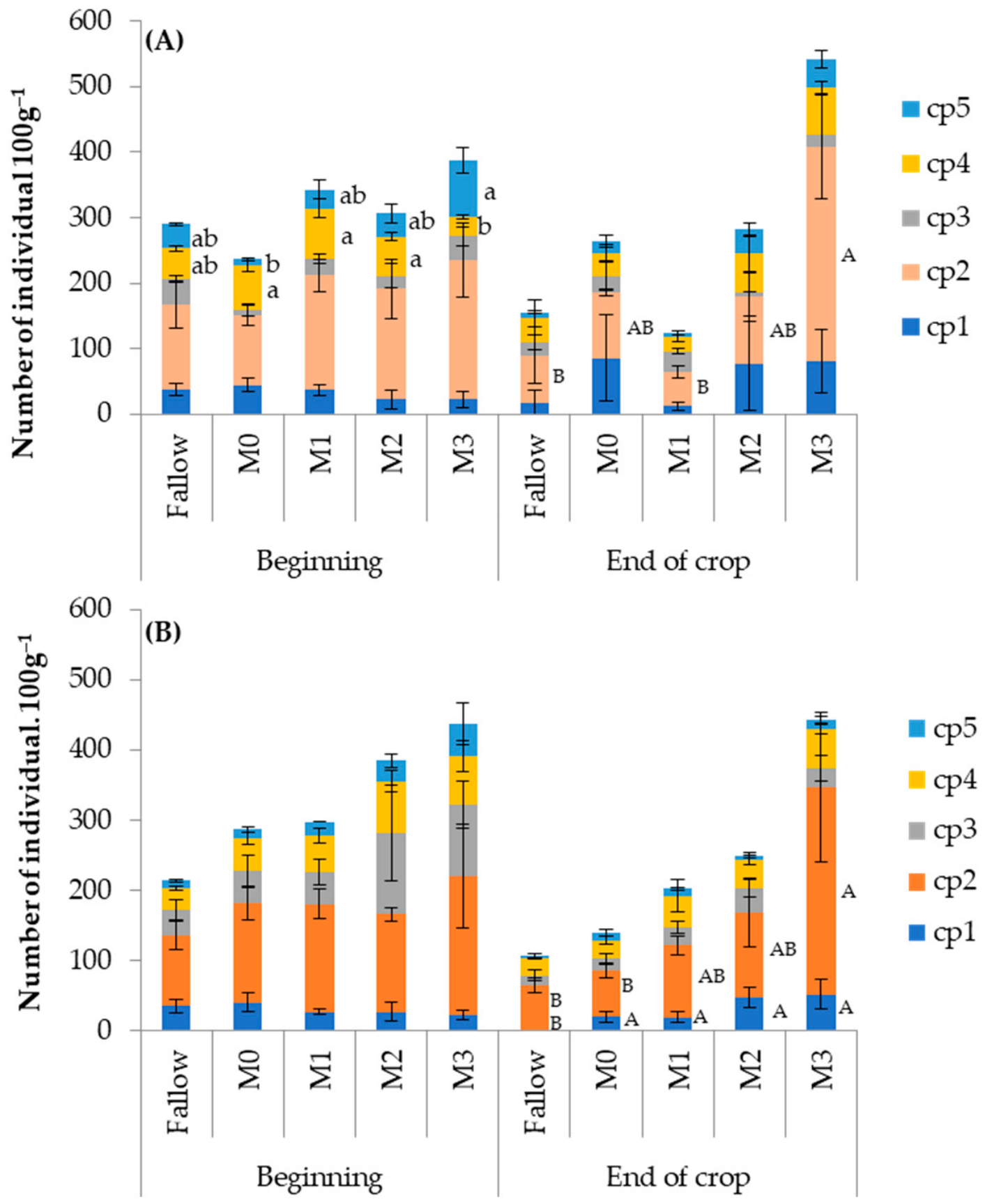
In Lieu Tu, there were no differences among mulching application rates in the density of cp1, cp2, and cp3 groups in soils at the beginning of the season. However, cp4 density was significantly higher (p < 0.05) in M3 compared to M0, M1, and M2 treatments. The abundance of cp5 was also significantly greater (p < 0.05) in M3 than in M0 (Figure 6A). By the end of the season, cp2 abundance was significantly higher (p < 0.01) in M3 than in M1 and the fallow treatment. In Long Phu, cp1 abundance was significantly higher in M3 than in the fallow treatment at the end of the season, while cp2 abundance was significantly higher in M3 than in both M1 and the fallow treatment (Figure 6B).

3.4. Effects of Rice Straw Mulching on Total Biomass and Metabolic Footprints of Nematode Community

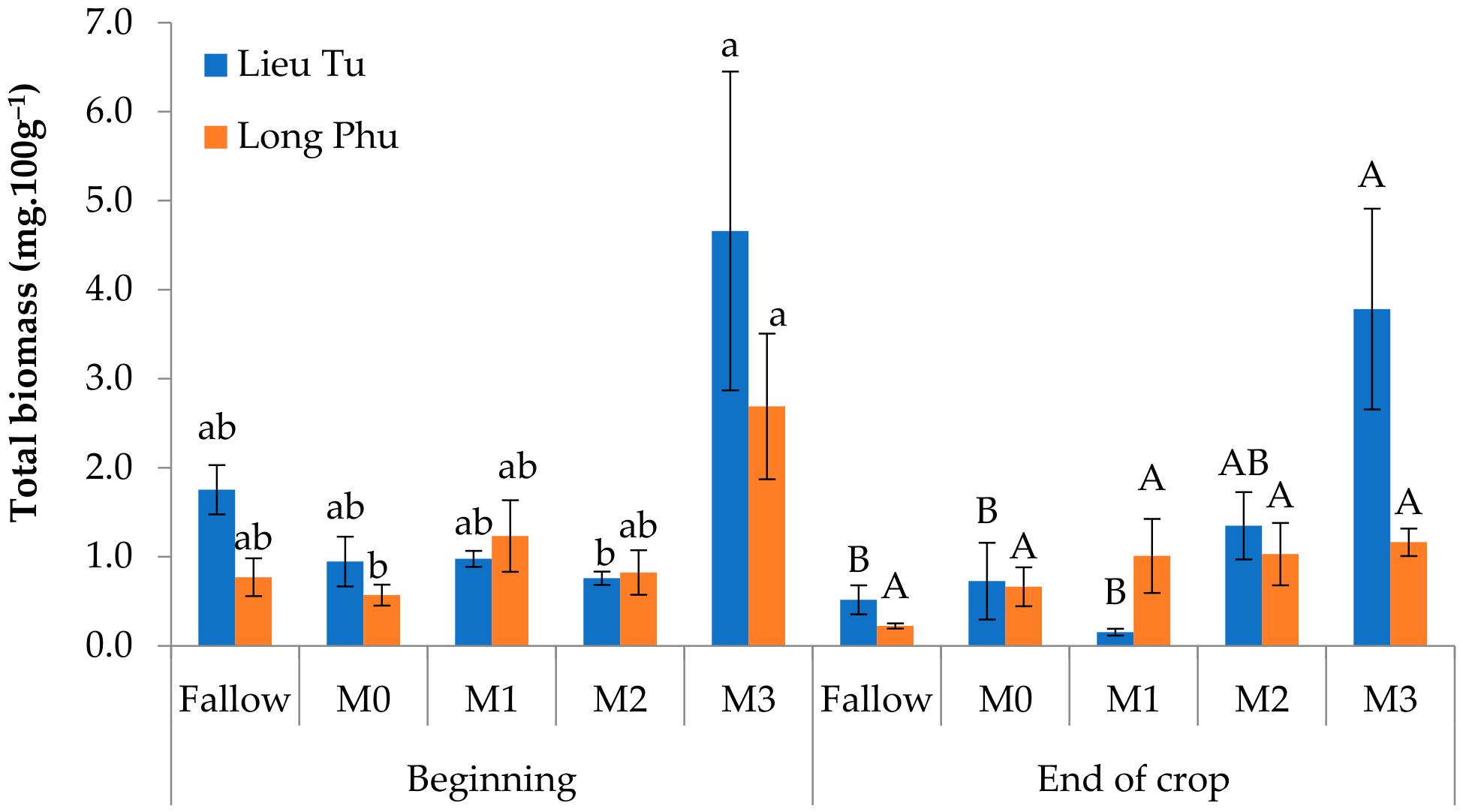
In soil ecology, nematode biomass is an important ecological indicator because nematodes occupy multiple trophic levels and contribute substantially to soil ecosystem functioning and biomass distribution, particularly across taxa with contrasting body sizes [51]. In this study, nematode biomass varied among treatments and was influenced by straw mulching, depending on soil conditions. In Lieu Tu, the total biomass of nematodes was significantly greater (p < 0.05) in the M3 treatment compared to M2 in soil at the beginning of the season. By the end of the season, total biomass was significantly higher in M3 than in the fallow, M0, and M1 treatments (Figure 7). In Long Phu, the total biomass was significantly higher in M3 than in M0 at the beginning of the season, and whilst not significant, it tended to increase in the soil with higher mulching rates.
In the Lieu Tu trial, the composite footprint (p = 0.008), structure footprint (p = 0.019), and omnivore footprint (p = 0.028) were significantly greater in M3 than in M0, M1, and M2 treatments in soils at the beginning of the season (Table 2). The composite footprint was significantly greater (p = 0.007) in M3 than in the M1 and fallow treatments at the end of the season. The structure footprint, bacterivore footprint, and omnivore footprint in M3 were significantly greater (p < 0.05) than in the M1 treatment at the end of the season.
In the Long Phu trial, the composite footprint, structure footprint, bacterivore footprint, and omnivore footprint were highest in M3 compared to other treatments at the beginning of the season, but the differences were not significant. At the end of the season, the composite footprint (p = 0.05) and bacterivore footprint (p = 0.019) were significantly higher in M3 compared to the fallow treatment, and the enrichment footprint (p = 0.016) in M3 and M2 was greater than in both the fallow and M0 treatments.

3.5. Ecological Index of Nematode Community Changes by the Mulching Effects

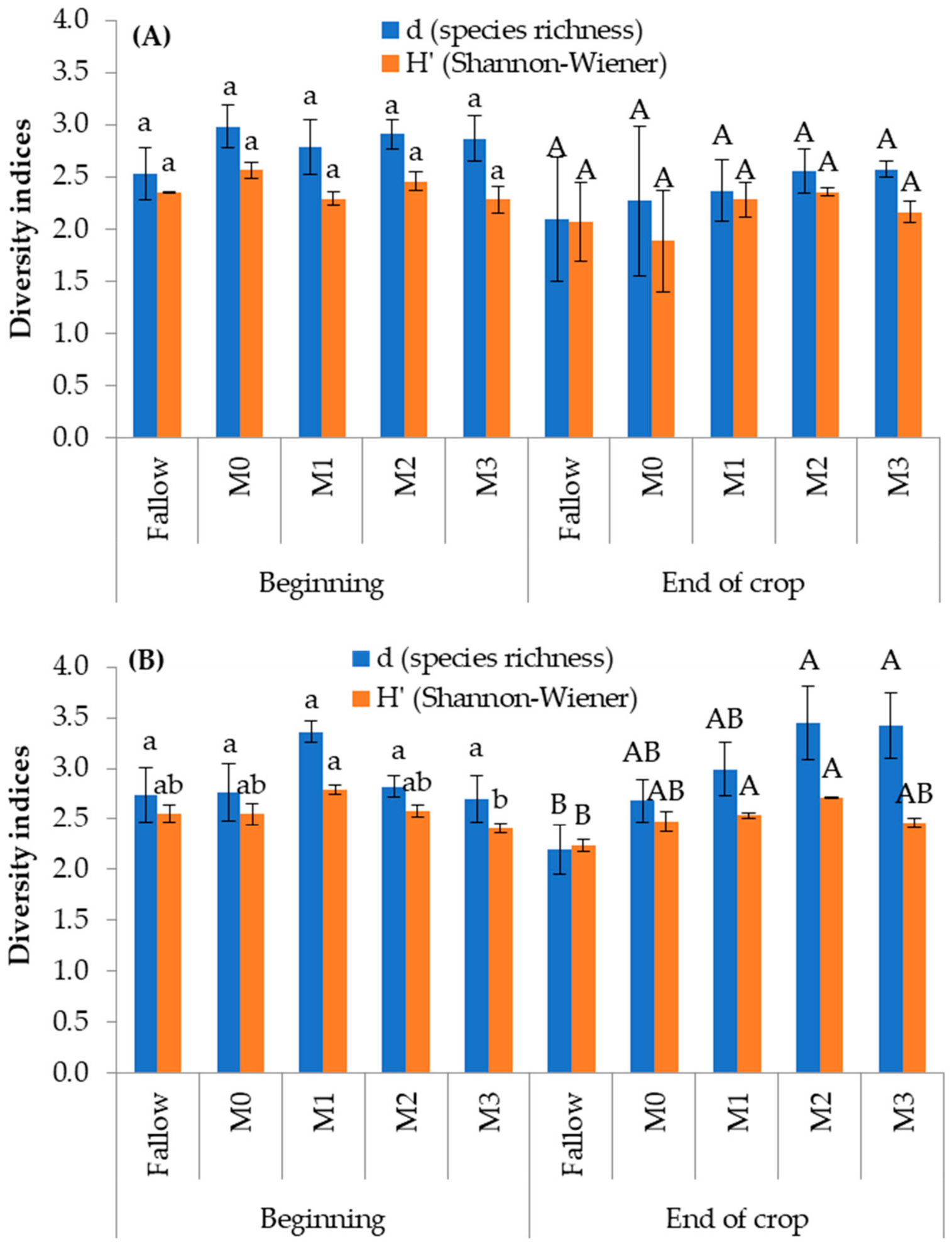
In Lieu Tu, there were no significant differences in biodiversity indices such as species richness (d) and the Shannon–Wiener index (H′) among mulching treatments, though these indices tended to increase in soils with higher amounts of rice straw mulching (Figure 8A). In Long Phu, at the end of the season, species richness was significantly higher (p < 0.05) in M2 and M3 than in the fallow treatment, whereas the Shannon–Wiener index H′ was significantly higher in M1 and M2 compared to the fallow treatment (Figure 8B).

3.6. Effects of Rice Straw Mulching on General Soil Chemical Properties

Rice straw mulching significantly increased soil pH at the Long Phu site and soil organic matter at both the Lieu Tu and Long Phu sites (Table 3). However, rice straw mulching had no significant effects on soil electrical conductivity (EC) or available phosphorus (Olsen-P) at either site.

3.7. Effects of Rice Straw Mulching on Cowpea Yields

Higher rice straw mulching increased cowpea yields (Table 4). In Lieu Tu, the application of 7.0 t ha−1 significantly increased (p < 0.001) yield compared with the lower rates at M0 and M1, as well as the higher rate at M3. In Long Phu, both 7.0 t ha−1 and 10.5 t ha−1 significantly increased yields (p < 0.001) compared with the control (M0) and lower rate (M1) treatments.

4. Discussion

4.1. Rice Straw Mulching Induces Changes in Nematode Community Composition

The differences in nematode community composition between locations can be explained by soil types and properties, and climatic effects [15,52] which are primary factors affecting nematodes [53]. In our study, soil properties differed between the two sites in terms of electrical conductivity (EC) and cation content (Table 1), particularly soil organic carbon. Our previous study reported that increased soil EC and soluble sodium concentrations as a result of saline intrusion led to changes in the belowground nematode community [16]. Soil pH was also a related factor [54]. In our study, rice straw mulching tended to increase soil pH at higher application rates, with a significant increase observed at the Long Phu site. Changes in soil pH may have contributed to shifts in the composition of the soil nematode community. Soil pH is widely recognized as a major abiotic factor influencing nematode community composition, trophic structure, and ecological functioning in agricultural soils [55,56,57]. According to Griffiths et al. [58,59], environmental factors, including soil depth and temporal variation, significantly influenced bacterial community structure, with soil pH identified as a key driver of bacterial biogeography and community composition. Furthermore, rice straw application enhanced soil organic matter significantly at both sites, providing a natural resource base for soil organisms, including nematodes. Soils rich in organic matter provide abundant food resources for bacterivores and fungivores, thus influencing the abundance of these groups. Organic carbon is well known to be a critical factor affecting nematode communities in soil [60], as it directly and indirectly affects their food sources, habitat, and overall soil health [61]. Fertilization and soil management practices also induce changes in soil properties [62,63] that drive changes in nematodes and other soil organism community composition [64]. For instance, organic amendments like rice straw mulching increase organic matter and microbial biomass [29,30], supporting bacterivores and promoting a more diverse nematode community. Chemical fertilizers might support fewer nematode groups by altering the pH of soil habitats or creating imbalances in microbial communities [65,66]. The growth of leguminous plants has promoted nematode community composition and enhanced the soil available nitrogen [25]. Beneficial nematodes have responded rapidly to changes in soil properties, like increased nitrogen availability, from the growth of upland crops in a paddy rice rotation [23,67,68].
In this trial, higher mulching rates enhanced the abundance of nematodes belonging to the cp1 and cp2 functional guilds in the soil and also increased the proportion of omnivorous nematodes, particularly at the more severely saline site in Lieu Tu (Figure 6). Importantly, the results indicated a reduction in the relative abundance of plant-parasitic nematodes across the study sites. Straw mulching provides favorable conditions, such as improved soil moisture [9], enhanced microbial activity [69], and better overall soil ecological health [70], and directly alters the network of bacterial–fungal community [71]. Straw mulching application provides more residues to support microbial activity, where bacteria and fungi are the main communities involved. Liu et al. [22] reported that the greater abundance of bacterivore genus Acrobeloides and fungivore genus Filenchus were recorded in upland conditions. In our study, the fungivore genus Aphelenchoides was dominant at the end of the season. This observation is consistent with the findings of Sohlenius [72] and Okada et al. [73], who reported that lower densities of Aphelenchoides were observed under wetter soil conditions. In soil ecosystems, predatory nematodes play a crucial role in suppressing populations of plant-parasitic nematodes, contributing to sustainable integrated pest management practices. In addition, the importance of bacterivorous and fungivorous nematodes in suppressing plant-parasitic species such as Meloidogyne incognita has been reported in recent studies [74]. Previous studies have also indicated that straw returning is considered a conservation practice that helps maintain a balance between beneficial free-living nematodes and plant-parasitic nematodes in the soil ecosystem [75].

4.2. Trophic Structure and Functional Guilds of Nematode Community Responded to Rice Straw Mulching

Rice straw mulching induced changes in the nematode trophic structure in our study, especially in the omnivore and plant-parasitic nematode groups (Figure 5). Mulching increased the abundance of omnivores whilst reducing the abundance of plant-parasitic nematodes in soils. Based on the functional guilds of nematodes, results showed that the abundance of cp1, cp2 and cp4 increased with higher rates of rice straw mulching. Straw mulching induces changes in soil conditions like water content, temperature, and further supports the composition and activity of soil microbial communities. These include bacteria and fungi, which play a major role in shaping nematode communities [63,76]. Bacterivorous nematodes, for instance, thrive in soils with high bacterial populations, while fungivorous nematodes are more prevalent in soils with abundant fungal networks [77]. High organic matter also enhances soil structure, which can support a broader range of nematode trophic groups. In our study, high-rate mulching increased soil pH and soil organic matter content (Table 3). These changes may have contributed to shifts in the soil nematode community composition. Soil pH and nutrient availability, particularly nitrogen and carbon levels, directly influence the types of bacteria and fungi present, indirectly shaping nematode communities, as different nematodes prefer specific microbial populations.
Nematodes are highly sensitive to soil moisture and temperature [78,79] and they responded to climate and plant resource type [17]. Moist soils provide an ideal environment for nematode movement and feeding, whereas drought can reduce nematode populations or limit them to specific groups adapted to low moisture. In paddy rice fields, soil organic matter tends to accumulate under long-term submergence compared with aerobic conditions [80]. Higher levels of soil organic matter can promote the abundance of bacterivore feeders in upland cropping systems. For example, the increased microbial community abundance is associated with higher populations of bacterivore and fungivore nematodes in upland soils [81,82]. Similarly, greater abundance of bacterivores, omnivores, fungivores and predators have been reported in soils cultivated with rye or hairy vetch compared to fallow conditions [83]. Therefore, our results suggest that mulching is a feasible management practice for enhancing soil microbial communities and increasing the populations of bacterivores and fungivore nematodes. This, in turn, may improve crop productivity and contribute to the development of sustainable agricultural systems.

4.3. Effects of Rice Straw Mulching on Metabolic Footprints and Ecological Indices

The metabolic footprints of bacterivorous and omnivorous nematodes were highest in M3 (10.5 t ha−1) compared to fallow or M0 (without mulching) treatments (Table 2). This can be explained by the fact that mulching enhances microbial activity and other soil physicochemical properties [23,84], which likely increases food resources for nematodes across different trophic levels in the soil habitat. Additionally, the application of mulching can stimulate greater food resources both above and belowground, and reduce the water loss that potentially supports higher trophic functional guilds such as omnivores and predators due to prey–predator interactions in the soil food web [48]. Previous studies have shown that the application of compost enhances the abundance of bacterivorous nematodes across various cropping systems [85], indicating that rice straw mulching can serve as an effective resource for supplying energy to support microbial activity. Similarly, the application of organic amendments has been reported to increase the biomass and activity of soil bacterial communities [86]. The abundance of FLN, particularly bacterivorous and fungivorous nematodes, typically increases significantly following the addition of organic soil amendments [85]. We recommend that utilizing rice straw mulch is an applicable technique for improving soil conditions and supporting beneficial soil nematode communities.

4.4. Mulching as Suitable Practices for Increasing Crop Yield

Mulching improves soil conditions by reducing evaporation, increasing moisture retention, improving nutrient availability, and decreasing salinity [87]. In our study, cowpea yield significantly increased at higher mulching rates (7.0–10.5 t ha−1) at both sites (Table 3). Mulching has been widely reported as a sustainable agricultural practice that reduces soil degradation, restores ecosystems [88], and enhances crop yield [89]. Previous studies have also reported that straw mulching can inhibit pathogen infestation [90,91]. In our study, a clear reduction in plant-parasitic nematodes was observed in soils receiving higher mulching rates, possibly contributing to improved plant growth. Rice straw mulching proves to be a suitable management practice associated with upland crop growth in salt-affected soils in the Mekong Delta, Vietnam.

5. Conclusions

Rice straw mulching altered nematode community composition, with responses varying between sites. Notably, mulching rates of 7.0 and 10.5 t ha−1 stimulated the higher trophic levels such as omnivorous nematodes and the enrichment of cp2 groups. Furthermore, higher mulching rates reduced the relative abundance of plant-parasitic nematodes and resulted in increased yields of cowpea at application rates of 7.0 and 10.5 t ha−1. These results suggest that higher mulching rates provide favorable soil conditions for belowground nematode communities, reflecting improved soil maturity, fertility, and a balanced C/N ratio. Mulching at 10.5 t ha−1 increased total biomass, composite footprint, structure footprint, and predator footprint of the nematode community, while also enhancing nematode diversity at Long Phu. Straw mulching may help mitigate salinity stress and support nematode groups sensitive to saline conditions. These findings highlight rice straw mulching and cowpea growth as an effective management practice for enhancing soil ecological function that could support agricultural sustainability, particularly in salt-affected and climate-stressed soils.

Supplementary Materials

The following supporting information can be downloaded at: https://www.mdpi.com/article/10.3390/crops6030053/s1, Figure S1A,B: Relative abundance of nematode community composition in Lieu Tu; Figure S2A,B: Relative abundance of nematode community composition in Long Phu; Tables S1 and S2: Abundance of nematode community composition among treatments at the beginning and end of the crop in Lieu Tu; Tables S3 and S4: Abundance of nematode community composition among treatments at the beginning and end of the crop in Long Phu.

Author Contributions

N.V.S.: Writing—original draft, Visualization, Methodology, Investigation, Data curation, Conceptualization, Writing—Review and Editing. B.K.: Methodology, Resources, Writing—Review and Editing. J.R.: Methodology, Writing—Review and Editing. L.T.N.T.: Methodology, Investigation, Data curation. N.T.K.P.: Visualization, Methodology, Writing—Review and Editing. C.M.K.: Review and Editing; K.T.: Review and Editing. J.C.: Review and Editing. All authors have read and agreed to the published version of the manuscript.

Funding

This research was funded by ACIAR, grant number SLAM/2022/175 and APC was funded by the Ministry of Education and Training in Vietnam, grant number B2024-TCT-05.

Data Availability Statement

The data presented in this study are available on request from the corresponding author.

Acknowledgments

The authors are grateful to the farmers where the field trials were conducted. We sincerely thank Cao Dinh An Giang and Tran Duy Khanh for their assistance in managing and maintaining the field trials.

Conflicts of Interest

Author Jessica Rigg was employed by the company Impact Ag Australia. The remaining authors declare that the research was conducted in the absence of any commercial or financial relationships that could be construed as a potential conflict of interest. The Impact Ag Australia had no role in the design of the study; in the collection, analyses, or interpretation of data; in the writing of the manuscript, or in the decision to publish the results.

References

  1. Vu, D.T.; Yamada, T.; Ishidaira, H. Assessing the impact of sea level rise due to climate change on seawater intrusion in Mekong Delta, Vietnam. Water Sci. Technol. 2018, 77, 1632–1639. [Google Scholar] [CrossRef] [Scilit] [PubMed]
  2. Stone, E.C.; Hornberger, G.M. Impacts of management alternatives on rice yield and nitrogen losses to the environment: A case study in rural Sri Lanka. Sci. Total Environ. 2016, 542, 271–276. [Google Scholar] [CrossRef] [Scilit] [PubMed]
  3. Cassman, K.G.; Harwood, R.R. The nature of agricultural systems-food security and environmental balance. Food Policy 1995, 20, 439–454. [Google Scholar] [CrossRef] [Scilit]
  4. Tran, T.V.; Tran, D.X.; Myint, S.W.; Huang, C.Y.; Pham, H.V.; Luu, T.H.; Vo, T.M.T. Examining spatiotemporal salinity dynamics in the Mekong River Delta using landsat time series imagery and a spatial regression approach. Sci. Total Environ. 2019, 687, 1087–1097. [Google Scholar] [CrossRef] [Scilit]
  5. Wassmann, R.; Phong, N.D.; Tho, T.Q.; Hoanh, C.T.; Khoi, N.H.; Hien, N.X.; Vo, T.B.T.; Tuong, T.P. High-resolution mapping of flood and salinity risks for rice production in the Vietnamese Mekong Delta. Field Crops Res. 2019, 236, 111–120. [Google Scholar] [CrossRef] [Scilit]
  6. Kruse, J.; Koch, M.; Khoi, C.M.; Braun, G.; Sebesvari, Z.; Amelung, W. Land use change from permanent rice to alternating rice-shrimp or permanent shrimp in the coastal Mekong Delta, Vietnam: Changes in the nutrient status and binding forms. Sci. Total Environ. 2020, 703, 134758. [Google Scholar] [CrossRef] [Scilit]
  7. Wang, T.Y.; Xu, Z.H.; Pang, G.B. Effects of irrigating with brackish water on soil moisture, soil salinity, and the agronomic response of winter wheat in the Yellow River Delta. Sustainability 2019, 11, 5801. [Google Scholar] [CrossRef] [Scilit]
  8. Truc, N.N.; Mihova, L.; Mukunoki, T.; Do, D.M. Effect of saline intrusion on the properties of cohesive soils in the Red River Delta, Vietnam. Mar. Georesources Geotechnol. 2020, 38, 23–39. [Google Scholar] [CrossRef] [Scilit]
  9. Nhien, C.T.; Giang, C.D.A.; Kaveney, B.; Condon, J.; Minh, D.D.; Khanh, T.D.; Khoi, C.M. Assessment of the potential application of the chameleon soil moisture sensor to grow the upland crop in the Mekong River Delta, Vietnam. Adv. Agric. 2026, 2026, 7723355. [Google Scholar] [CrossRef] [Scilit]
  10. Thi Nhien, C.; Dinh An Giang, C.; Kaveney, B.; Condon, J.; Duy Khanh, T.; Duy Minh, D.; Long, V.N.; Van Loc, N.; Khoi, M.C. Growth and yield responses of maize, beetroot, and quinoa to salinity and straw mulching. Plant Soil Environ. 2025, 71, 681–694. [Google Scholar] [CrossRef] [Scilit]
  11. Nhien, C.T.; Kha, N.N.M.; Khanh, T.D.; Giang, C.D.A.; Minh, D.D.; Binh, T.T.N.; Khoi, C.M. Effect of straw mulching on maize (Zea mays L.) productivity in salt-affected soil in the Mekong River Delta, Vietnam. Int. J. Agric. Environ. Res. Malwa Int. J. Publ. 2025, 11, 1244–1255. [Google Scholar] [CrossRef] [Scilit]
  12. Jayawardhane, J.; Goyali, J.C.; Zafari, S.; Igamberdiev, A.U. The response of cowpea (Vigna unguiculata L.) plants to three abiotic stresses applied with increasing intensity: Hypoxia, salinity, and water deficit. Metabolites 2022, 12, 38. [Google Scholar] [CrossRef] [Scilit]
  13. Kaveney, B.; Khoi, C.M.; Minh, D.D.; Thi Kim Phuong, N.; An Giang, C.D.; Barrett-Lennard, E.; Khanh, T.D.; Condon, J. Investigating the suitability of chameleon soil moisture sensors to improve water use of upland crops under conditions of temporal salinity. Agric. Water Manag. 2025, 316, 109602. [Google Scholar] [CrossRef] [Scilit]
  14. Smajgl, A.; Toan, T.Q.; Nhan, D.K.; Ward, J.; Trung, N.H.; Tri, L.Q.; Tri, V.P.D.; Vu, P.T. Responding to rising sea levels in the Mekong Delta. Nat. Clim. Change 2015, 5, 167–174. [Google Scholar] [CrossRef] [Scilit]
  15. Wang, J.Q.; Li, M.; Zhang, X.H.; Liu, X.Y.; Li, L.Q.; Shi, X.Z.; Hu, H.W.; Pan, G.X. Changes in soil nematode abundance and composition under elevated CO2 and canopy warming in a rice paddy field. Plant Soil 2019, 445, 425–437. [Google Scholar] [CrossRef] [Scilit]
  16. Sinh, N.V.; Chau, M.K.; Vo, Q.M.; Le, V.K.; Nguyen, T.K.P.; Araki, M.; Perry, R.N.; Tran, A.D.; Dang, D.M.; Tran, B.L.; et al. Impacts of saltwater intrusion on soil nematodes community in alluvial and acid sulfate soils in paddy rice fields in the Vietnamese Mekong Delta. Ecol. Indic. 2021, 122, 107284. [Google Scholar] [CrossRef] [Scilit]
  17. Zhao, C.; Li, Y.; Zhang, C.; Miao, Y.; Liu, M.; Zhuang, W.; Shao, Y.; Zhang, W.; Fu, S. Considerable impacts of litter inputs on soil nematode community composition in a young Acacia crassicapa plantation. Soil Ecol. Lett. 2021, 3, 145–155. [Google Scholar] [CrossRef] [Scilit]
  18. Buchan, D.; Gebremikael, M.T.; Ameloot, N.; Sleutel, S.; De Neve, S. The effect of free-living nematodes on nitrogen mineralisation in undisturbed and disturbed soil cores. Soil Biol. Biochem. 2013, 60, 142–155. [Google Scholar] [CrossRef] [Scilit]
  19. Nicol, J.M.; Turner, S.J.; Coyne, D.L.; Nijs, L.d.; Hockland, S.; Maafi, Z.T. Current nematode threats to world agriculture. In Genomics and Molecular Genetics of Plant-Nematode Interactions, 1st ed.; Jones, J., Gheysen, G., Fenoll, C., Eds.; Springer: Dordrecht, The Netherlands, 2011; pp. 21–43. [Google Scholar]
  20. Soriano, I.R.S.; Prot, J.C.; Matias, D.M. Expression of tolerance for Meloidogyne graminicola in rice cultivars as affected by soil type and flooding. J. Nematol. 2000, 32, 309–317. [Google Scholar]
  21. Bridge, J.; Coyne, D.L.; Kwoseh, K.C. Nematode parasites of tropical root and tuber crops. In Plant Parasitic Nematodes in Subtropical and Tropical Agriculture, 2nd ed.; Luc, M., Sikora, R.A., Bridge, J., Eds.; CAB International Publishing: London, UK, 2005; pp. 221–258. [Google Scholar]
  22. Liu, T.; Whalen, J.K.; Shen, Q.R.; Li, H.X. Increase in soil nematode abundance due to fertilization was consistent across moisture regimes in a paddy rice–upland wheat system. Eur. J. Soil Biol. 2016, 72, 21–26. [Google Scholar] [CrossRef] [Scilit]
  23. Nguyen, V.S.; Nguyen, T.K.P.; Araki, M.; Perry, R.N.; Linh, B.T.; Chau, M.K.; Min, Y.Y.; Toyota, K. Effects of cropping systems and soil amendments on nematode community and its relationship with soil physicochemical properties in a paddy rice field in the Vietnamese Mekong Delta. Appl. Soil Ecol. 2020, 156, 103683. [Google Scholar] [CrossRef] [Scilit]
  24. Win, P.P.; Kyi, P.P.; De Waele, D. Effect of agro-ecosystem on the occurrence of the rice root-knot nematode Meloidogyne graminicola on rice in Myanmar. Australas. Plant Pathol. 2011, 40, 187–196. [Google Scholar] [CrossRef] [Scilit]
  25. Teshita, A.; Feng, Y.; Qian, R.; Wang, X.; Khan, W.; Gao, Y. Alfalfa and maize intercropping enhances soil nematode structure and food web complexity in low-nitrogen soils. Appl. Soil Ecol. 2023, 186, 104809. [Google Scholar] [CrossRef] [Scilit]
  26. Li, F.; Zhang, G.; Chen, J.; Song, Y.; Geng, Z.; Li, K.; Siddique, K.H.M. Straw mulching for enhanced water use efficiency and economic returns from soybean fields in the loess plateau China. Sci. Rep. 2022, 12, 17111. [Google Scholar] [CrossRef] [Scilit] [PubMed]
  27. Thidar, M.; Gong, D.; Mei, X.; Gao, L.; Li, H.; Hao, W.; Gu, F. Mulching improved soil water, root distribution and yield of maize in the loess plateau of Northwest China. Agric. Water Manag. 2020, 241, 106340. [Google Scholar] [CrossRef] [Scilit]
  28. Liu, B.; Dai, Y.; Cheng, X.; He, X.; Bei, Q.; Wang, Y.; Zhou, Y.; Zhu, B.; Zhang, K.; Tian, X.; et al. Straw mulch improves soil carbon and nitrogen cycle by mediating microbial community structure and function in the maize field. Front. Microbiol. 2023, 14, 1217966. [Google Scholar] [CrossRef] [Scilit]
  29. Song, D.; Tariq, A.; Pan, K.; Chen, W.; Zhang, A.; Sun, X.; Ran, Y.; Zeng, F. Effects of straw mulching practices on soil nematode communities under walnut plantation. Sci. Rep. 2020, 10, 15351. [Google Scholar] [CrossRef] [Scilit] [PubMed]
  30. Luo, J.; Zhang, X.; Kou, X.; Xie, H.; Bao, X.; Mahamood, M.; Liang, W. Effects of residue mulching amounts on metabolic footprints based on production and respiration of soil nematodes in a long-term no-tillage system. Land Degrad. Dev. 2021, 32, 2383–2392. [Google Scholar] [CrossRef] [Scilit]
  31. Nahar, M.S.; Grewal, P.S.; Miller, S.A.; Stinner, D.; Stinner, B.R.; Kleinhenz, M.D.; Wszelaki, A.; Doohan, D. Differential effects of raw and composted manure on nematode community, and its indicative value for soil microbial, physical and chemical properties. Appl. Soil Ecol. 2006, 34, 140–151. [Google Scholar] [CrossRef] [Scilit]
  32. Li, J.M.; Wang, D.C.; Fan, W.; He, R.C.; Yao, Y.Y.; Sun, L.; Zhao, X.Y.; Wu, J.G. Comparative effects of different organic materials on nematode community in continuous soybean monoculture soil. Appl. Soil Ecol. 2018, 125, 12–17. [Google Scholar] [CrossRef] [Scilit]
  33. Yeates, G.W. Effects of plants on nematode community structure. Annu. Rev. Phytopathol. 1999, 37, 127–149. [Google Scholar] [CrossRef] [Scilit] [PubMed]
  34. Ekschmitt, K.; Bakonyi, G.; Bongers, M.; Bongers, T.; Bostrom, S.; Dogan, H.; Harrison, A.; Nagy, P.; O’Donnell, A.G.; Papatheodorou, E.M.; et al. Nematode community structure as indicator of soil functioning in European grassland soils. Eur. J. Soil Biol. 2001, 37, 263–268. [Google Scholar] [CrossRef] [Scilit]
  35. Du Preez, G.C.; Daneel, M.S.; Wepener, V.; Fourie, H. Beneficial nematodes as bioindicators of ecosystem health in irrigated soils. Appl. Soil Ecol. 2018, 132, 155–168. [Google Scholar] [CrossRef] [Scilit]
  36. Su, Y.Z.; Wang, X.F.; Yang, R.; Yang, X.; Liu, W.J. Soil fertility, salinity and nematode diversity influenced by Tamarix ramosissima in different habitats in an arid desert Oasis. Environ. Manag. 2012, 50, 226–236. [Google Scholar] [CrossRef] [Scilit]
  37. de Goede, R.G.M. Terrestrial Nematodes in a Changing Environment. Ph.D. Thesis, Agricultural University, Wageningen, The Netherland, 1993. [Google Scholar]
  38. Tsiafouli, M.A.; Bhusal, D.R.; Sgardelis, S.P. Nematode community indices for microhabitat type and large scale landscape properties. Ecol. Indic. 2017, 73, 472–479. [Google Scholar] [CrossRef] [Scilit]
  39. Soil Survey Staff. Keys to Soil Taxonomy; US Department of Agriculture (USDA): Washington, DC, USA, 1998. [Google Scholar]
  40. Kaveney, B.; Barrett-Lennard, E.; Chau Minh, K.; Dang Duy, M.; Nguyen Thi, K.P.; Kristiansen, P.; Orgill, S.; Stewart-Koster, B.; Condon, J. Inland dry season saline intrusion in the Vietnamese Mekong River Delta is driving the identification and implementation of alternative crops to rice. Agric. Syst. 2023, 207, 103632. [Google Scholar] [CrossRef] [Scilit]
  41. Van Bezooijen, J. Methods and Techniques for Nematology; Wageningen University: Wageningen, The Netherlands, 2006. [Google Scholar]
  42. Yeates, G.W.; Bongers, T.; Degoede, R.G.M.; Freckman, D.W.; Georgieva, S.S. Feeding-habits in soil nematode families and genera—An outline for soil ecologists. J. Nematol. 1993, 25, 315–331. [Google Scholar] [PubMed]
  43. Bongers, T. The maturity index-an ecological measure of environmental disturbance based on nematode species composition. Oecologia 1990, 83, 14–19. [Google Scholar] [CrossRef] [Scilit]
  44. Bongers, T.; Bongers, M. Functional diversity of nematodes. Appl. Soil Ecol. 1998, 10, 239–251. [Google Scholar] [CrossRef] [Scilit]
  45. Ferris, H.; Bongers, T.; de Goede, R.G.M. A framework for soil food web diagnostics: Extension of the nematode faunal analysis concept. Appl. Soil Ecol. 2001, 18, 13–29. [Google Scholar] [CrossRef] [Scilit]
  46. Clarke, K.R.; Gorley, R.N. Primer v6: User Manual/Tutorial (Plymouth Routines in Multivariate Ecological Research); PRIMER-E Ltd.: Plymouth, UK, 2006. [Google Scholar]
  47. Sieriebriennikov, B.; Ferris, H.; de Goede, R.G.M. Ninja: An automated calculation system for nematode-based biological monitoring. Eur. J. Soil Biol. 2014, 61, 90–93. [Google Scholar] [CrossRef] [Scilit]
  48. Ferris, H. Form and function: Metabolic footprints of nematodes in the soil food web. Eur. J. Soil Biol. 2010, 46, 97–104. [Google Scholar] [CrossRef] [Scilit]
  49. Sanchez-Moreno, S.; Nicola, N.L.; Ferris, H.; Zalom, F.G. Effects of agricultural management on nematode-mite assemblages: Soil food web indices as predictors of mite community composition. Appl. Soil Ecol. 2009, 41, 107–117. [Google Scholar] [CrossRef] [Scilit]
  50. Ciobanu, M.; Popovici, I.; Zhao, J.; Stoica, I.A. Patterns of relative magnitudes of soil energy channels and their relationships with environmental factors in different ecosystems in Romania. Sci. Rep. 2015, 5, 17606. [Google Scholar] [CrossRef] [Scilit] [PubMed]
  51. Van den Hoogen, J.; Geisen, S.; Routh, D.; Ferris, H.; Traunspurger, W.; Wardle, D.A.; de Goede, R.G.M.; Adams, B.J.; Ahmad, W.; Andriuzzi, W.S.; et al. Soil nematode abundance and functional group composition at a global scale. Nature 2019, 572, 194–198. [Google Scholar] [CrossRef] [Scilit]
  52. Ma, Q.H.; Yu, H.Y.; Liu, X.D.; Xu, Z.Z.; Zhou, G.S.; Shi, Y.H. Climatic warming shifts the soil nematode community in a desert steppe. Clim. Change 2018, 150, 243–258. [Google Scholar] [CrossRef] [Scilit]
  53. Kitagami, Y.; Matsuda, Y. Forest types matter for the community and co-occurrence network patterns of soil bacteria, fungi, and nematodes. Pedobiologia 2024, 107, 151004. [Google Scholar] [CrossRef] [Scilit]
  54. Burns, N.C. Soil pH effects on nematode populations associated with soybeans. J. Nematol. 1971, 3, 238–245. [Google Scholar]
  55. Korthals, G.W.; Bongers, T.; Kammenga, J.E.; Alexiev, A.D.; Lexmond, T.M. Long-term effects of copper and ph on the nematode community in an agroecosystem. Environ. Toxicol. Chem. 1996, 15, 979–985. [Google Scholar] [CrossRef]
  56. Li, C.; Wang, X.; Chen, B.; Wang, L.; Xie, Z.; Wang, J.; Yang, Z. Fertilization restructures nematode assemblages by modifying soil pH in croplands of northeast China. Front. Environ. Sci. 2023, 11, 1207379. [Google Scholar] [CrossRef] [Scilit]
  57. Norton, D.C. Abiotic soil factors and plant-parasitic nematode communities. J. Nematol. 1989, 21, 299–307. [Google Scholar] [PubMed]
  58. Griffiths, R.I.; Whiteley, A.S.; O’Donnell, A.G.; Bailey, M.J. Influence of depth and sampling time on bacterial community structure in an upland grassland soil. FEMS Microbiol. Ecol. 2003, 43, 35–43. [Google Scholar] [CrossRef]
  59. Griffiths, R.I.; Thomson, B.C.; James, P.; Bell, T.; Bailey, M.; Whiteley, A.S. The bacterial biogeography of British soils. Environ. Microbiol. 2011, 13, 1642–1654. [Google Scholar] [CrossRef] [Scilit]
  60. Quist, C.W.; Gort, G.; Mooijman, P.; Brus, D.J.; van den Elsen, S.; Kostenko, O.; Vervoort, M.; Bakker, J.; van der Putten, W.H.; Helder, J. Spatial distribution of soil nematodes relates to soil organic matter and life strategy. Soil Biol. Biochem. 2019, 136, 107542. [Google Scholar] [CrossRef] [Scilit]
  61. Giesselmann, U.C.; Borchard, N.; Traunspurger, W.; Witte, K. Long-term effects of charcoal on nematodes and other soil meso- and microfaunal groups at historical kiln-sites—A pilot study. Eur. J. Soil Biol. 2019, 93, 103095. [Google Scholar] [CrossRef] [Scilit]
  62. Roth, E.; Samara, N.; Ackermann, M.; Seiml-Buchinger, R.; Saleh, A.; Ruess, L. Fertilization and irrigation practice as source of microorganisms and the impact on nematodes as their potential vectors. Appl. Soil Ecol. 2015, 90, 68–77. [Google Scholar] [CrossRef] [Scilit]
  63. Birkhofer, K.; Bezemer, T.M.; Bloem, J.; Bonkowski, M.; Christensen, S.; Dubois, D.; Ekelund, F.; Fliessbach, A.; Gunst, L.; Hedlund, K.; et al. Long-term organic farming fosters below and aboveground biota: Implications for soil quality, biological control and productivity. Soil Biol. Biochem. 2008, 40, 2297–2308. [Google Scholar] [CrossRef] [Scilit]
  64. Mills, A.A.; Price, G.W.; Fillmore, S.A.E. Responses of nematode, bacterial, and fungal populations to high frequency applications and increasing rates of biosolids in an agricultural soil. Appl. Soil Ecol. 2020, 148, 103481. [Google Scholar] [CrossRef] [Scilit]
  65. Neher, D.A. Nematode communities in organically and conventionally managed agricultural soils. J. Nematol. 1999, 31, 142–154. [Google Scholar] [PubMed]
  66. Hoa, H.T.T.; Thuc, D.; Van, H.T.N.; Tuyet, T.T.A.; Hau, D.V.; Hoa, T.D.; Rehman, H. Nitrogen fertilization effects on methane and nitrous oxide emissions from wetland rice fields of central Vietnam. Int. J. Agric. Biol. 2018, 20, 1759–1767. [Google Scholar] [CrossRef]
  67. Sun, X.M.; Zhang, X.K.; Zhang, S.X.; Dai, G.H.; Han, S.J.; Liang, W.J. Soil nematode responses to increases in nitrogen deposition and precipitation in a temperate forest. PLoS ONE 2013, 8, e82468. [Google Scholar] [CrossRef] [Scilit] [PubMed]
  68. Djigal, D.; Brauman, A.; Diop, T.A.; Chotte, J.L.; Villenave, C. Influence of bacterial-feeding nematodes (Cephalobidae) on soil microbial communities during maize growth. Soil Biol. Biochem. 2004, 36, 323–331. [Google Scholar] [CrossRef] [Scilit]
  69. Li, Y.; Zhang, X.; Yang, N.; Hao, H.; Bilyera, N.; Zhang, X.; Li, T.; Yue, S.; Zhai, B.; Zamanian, K.; et al. Long-term straw and plastic film mulching have divergent effects on maize rhizosphere enzyme activity and bacterial community structure. Agric. Ecosyst. Environ. 2024, 364, 108894. [Google Scholar] [CrossRef] [Scilit]
  70. Qiao, Y.-C.; Jiang, X.-X.; Zan, J.-P.; Chen, X.-H.; Liu, F.; Zhang, W.-S.; He, G.-P.; Peng, J.-Z.; Wu, Y.-J.; Yang, S.-G. Effects of different mulching practices on soil microbial community structure, function, and interaction networks in a chieh-qua cultivation. Front. Microbiol. 2026, 17, 1691984. [Google Scholar] [CrossRef] [Scilit]
  71. Wang, Y.; Liu, L.; Luo, Y.; Awasthi, M.K.; Yang, J.; Duan, Y.; Li, H.; Zhao, Z. Mulching practices alter the bacterial-fungal community and network in favor of soil quality in a semiarid orchard system. Sci. Total Environ. 2020, 725, 138527. [Google Scholar] [CrossRef] [Scilit]
  72. Sohlenius, B. Influence of climatic conditions on nematode coexistence: A laboratory experiment with a coniferous forest soil. Oikos 1985, 44, 430–438. [Google Scholar] [CrossRef] [Scilit]
  73. Okada, H.; Niwa, S.; Takemoto, S.; Komatsuzaki, M.; Hiroki, M. How different or similar are nematode communities between a paddy and an upland rice fields across a flooding-drainage cycle? Soil Biol. Biochem. 2011, 43, 2142–2151. [Google Scholar] [CrossRef] [Scilit]
  74. Kato, R.; Nguyen, S.V.; Perry, R.N.; Toyota, K. Contribution of soil free-living nematode communities to suppression of meloidogyne incognita in organic fields. Russ. J. Nematol. 2026, 34, 1–11. [Google Scholar] [CrossRef] [Scilit]
  75. Sauvadet, M.; Autfray, P.; Rafenomanjato, A.; Ripoche, A.; Trap, J. Conservation agriculture improves the balance between beneficial free-living and plant-parasitic nematodes for low-input rainfed rice crop. Appl. Soil Ecol. 2025, 209, 106029. [Google Scholar] [CrossRef] [Scilit]
  76. Klusmann, C.; Cesarz, S.; Ciobanu, M.; Ferlian, O.; Jochum, M.; Schädler, M.; Scheu, S.; Sünnemann, M.; Wall, D.H.; Eisenhauer, N. Climate-change effects on the sex ratio of free-living soil nematodes—Perspective and prospect: Perspective paper. Soil Org. 2022, 94, 15–28. [Google Scholar] [CrossRef]
  77. Helder, J.; Vervoort, M.; van Megen, H.; Rybarczyk-Mydłowska, K.; Quist, C.; Smant, G.; Bakker, J. Phytopathogenic nematodes. In Principles of Plant-Microbe Interactions: Microbes for Sustainable Agriculture; Lugtenberg, B., Ed.; Springer International Publishing: Cham, Switzerland, 2015; pp. 91–102. [Google Scholar]
  78. Bakonyi, G.; Nagy, P. Temperature- and moisture-induced changes in the structure of the nematode fauna of a semiarid grassland—Patterns and mechanisms. Glob. Change Biol. 2000, 6, 697–707. [Google Scholar] [CrossRef] [Scilit]
  79. Briar, S.S.; Culman, S.W.; Young-Mathews, A.; Jackson, L.E.; Ferris, H. Nematode community responses to a moisture gradient and grazing along a restored riparian corridor. Eur. J. Soil Biol. 2012, 50, 32–38. [Google Scholar] [CrossRef] [Scilit]
  80. Xuan, D.T.; Guong, V.T.; Rosling, A.; Alstrom, S.; Chai, B.L.; Hogberg, N. Different crop rotation systems as drivers of change in soil bacterial community structure and yield of rice, Oryza sativa. Biol. Fertil. Soils 2012, 48, 217–225. [Google Scholar] [CrossRef] [Scilit]
  81. Liu, M.; Chen, X.; Qin, J.; Wang, D.; Griffiths, B.; Hu, F. A sequential extraction procedure reveals that water management affects soil nematode communities in paddy fields. Appl. Soil Ecol. 2008, 40, 250–259. [Google Scholar] [CrossRef] [Scilit]
  82. Zhong, S.; Zeng, H.C.; Jin, Z.Q. Response of soil nematode community composition and diversity to different crop rotations and tillage in the tropics. Appl. Soil Ecol. 2016, 107, 134–143. [Google Scholar] [CrossRef] [Scilit]
  83. Ito, T.; Araki, M.; Higashi, T.; Komatsuzaki, M.; Kaneko, N.; Ohta, H. Responses of soil nematode community structure to soil carbon changes due to different tillage and cover crop management practices over a nine-year period in Kanto, Japan. Appl. Soil Ecol. 2015, 89, 50–58. [Google Scholar] [CrossRef] [Scilit]
  84. Linh, T.B.; Van, K.L.; Van Elsacker, S.; Cornelis, W.M. Effect of cropping system on physical properties of clay soil under intensive rice cultivation. Land. Degrad. Dev. 2016, 27, 973–982. [Google Scholar] [CrossRef] [Scilit]
  85. Thoden, T.C.; Korthals, G.W.; Termorshuizen, A.Z. Organic amendments and their influences on plant-parasiticand free-living nematodes: A promising method fornematode management? Nematology 2011, 13, 133–153. [Google Scholar] [CrossRef] [Scilit]
  86. Zhong, S.; Zeng, H.C. Effect of peanut (Arachis hypogaea L.)/cowpea (Vigna unquiculata L.) intercropping combined with organic mature application on soil microfauna. Geoderma 2019, 354, 113863. [Google Scholar] [CrossRef] [Scilit]
  87. Ngosong, C.; Okolle, J.N.; Tening, A.S. Mulching: A sustainable option to improve soil health. In Soil Fertility Management for Sustainable Development; Panpatte, D.G., Jhala, Y.K., Eds.; Springer: Singapore, 2019; pp. 231–249. [Google Scholar]
  88. Bogunović, I.; Filipović, V. Mulch as a nature-based solution to halt and reverse land degradation in agricultural areas. Curr. Opin. Environ. Sci. Health 2023, 34, 100488. [Google Scholar] [CrossRef] [Scilit]
  89. Demo, A.H.; Asefa Bogale, G. Enhancing crop yield and conserving soil moisture through mulching practices in dryland agriculture. Front. Agron. 2024, 6, 1361697. [Google Scholar] [CrossRef] [Scilit]
  90. Quintanilla-Tornel, M.A.; Wang, K.-H.; Tavares, J.; Hooks, C.R.R. Effects of mulching on above and below ground pests and beneficials in a green onion agroecosystem. Agric. Ecosyst. Environ. 2016, 224, 75–85. [Google Scholar] [CrossRef] [Scilit]
  91. Naresh, P.; Singh, I. Organic mulching in regenerative agriculture enhances saprotrophs and concomitantly reduces pathogenic fungal genera. J. Sustain. Agric. Environ. 2025, 4, e70066. [Google Scholar] [CrossRef] [Scilit]
Figure 1. The field experiment layout at Lieu Tu and Long Phu sites.
Crops 06 00053 g001
Figure 2. Cropping seasons in the triple-rice intensive system in the MD and sampling points (arrows), adapted from Kaveney [40]. The first sampling (February 2023) was conducted at the beginning of the cowpea crop (rice was the previous crop), while the second sampling (May 2023) was carried out at the end of the cowpea crop. He Thu, Thu Dong, and Dong Xuan refer to the three rice cropping seasons in the MD.
Crops 06 00053 g002
Figure 3. Abundance (mean ± SE, n = 3) under rice straw mulching at Lieu Tu (A) and Long Phu (B) field trials, Soc Trang province. Different letters indicate the significant differences among treatments at p < 0.05 by Tukey HSD test.
Crops 06 00053 g003
Figure 4. Number of genera (mean ± SE, n = 3) under rice straw mulching at Lieu Tu (A) and Long Phu (B) field trials, Soc Trang province. Different letters indicate the significant differences among treatments at p < 0.05 by Tukey HSD test.
Crops 06 00053 g004
Figure 5. Proportion of each trophic structure (mean, n = 3) in soils at the beginning and end of the cowpea cropping season in Lieu Tu (A) and Long Phu (B). Different letters indicate significant differences among treatments at p < 0.05, as determined by the Tukey HSD test. Trophic structures include omnivores (Om), predators (Pre), bacterivores (Ba), fungivores (Fu), and plant-parasitic nematodes (PPN).
Crops 06 00053 g005
Figure 6. Abundance of each functional guild, cp (colonizer–persister) (mean ± SE, n = 3) in soils at the beginning and end of the cowpea cropping season in Lieu Tu (A) and Long Phu (B). Different letters indicate significant differences among treatments at p < 0.05, as determined by the Tukey HSD test.
Crops 06 00053 g006
Figure 7. The biomass of nematodes (mean ± SE, n = 3) in soils from Lieu Tu and Long Phu. Different lowercase and uppercase letters indicate significant differences among treatments at p < 0.05 at the beginning and end of the season, respectively, within each trial, as determined by the Tukey HSD test.
Crops 06 00053 g007
Figure 8. Diversity indices of the nematode community (mean, n = 3) in soils from Lieu Tu (A) and Long Phu (B). Different lowercase and uppercase letters indicate significant differences among treatments at p < 0.05 at the beginning and end of the season, respectively, within each trial, as determined by the Tukey HSD test.
Crops 06 00053 g008
Table 1. Initial soil properties at two field trials in Lieu Tu and Long Phu sites.
Soil PropertiesLieu Tu SiteLong Phu Site
Sand (%)1.501.60
Silt (%)54.450.7
Clay (%)44.147.7
Soil texture (0–15 cm)Silty claySilty clay
Bulk density (g cm−3)1.211.10
pH(H2O) 1:55.325.30
EC1:5 (mS cm−1)1.220.50
ECe (mS cm−1)7.833.23
Exchangeable K (cmol (+) kg−1)0.6190.664
Exchangeable Na (cmol (+) kg−1)2.872.26
Exchangeable Ca (cmol (+) kg−1)1.782.63
Exchangeable h Mg (cmol (+) kg−1)10.111.5
CEC (cmol (+) kg−1)15.917.3
ESP (%)18.013.1
C total (g kg−1)13.817.8
N total (g kg−1)1.251.56
P total (g kg−1)0.2940.380
Available N (mg kg−1)31.120.4
Available P (mg kg−1)5.047.73
Available Si (mg kg−1)96.5141
Saline–sodic soilSlightly saline
Table 2. Metabolic footprints (mean ± SE, n = 3) of nematode community among treatments in Lieu Tu and Long Phu trials. Different letters indicate significant differences among treatments, as determined by the Tukey HSD test. ns—not significant.
The Metabolic Footprints (µgC 100 g−1) of Nematode Community Among Treatments in Lieu Tu
TimeTreatmentComposite FootprintEnrichment FootprintStructure FootprintHerbivore FootprintFungivore FootprintBacterivore FootprintPredator FootprintOmnivore Footprint
BeginningFallow288.6 ± 47.7 ab11.9 ± 3.2 a180.7 ± 22.1 ab60.7 ± 16.6 a2.1 ± 0.7 a50 ± 11.8 a23.4 ± 6.5 a152.4 ± 27.4 ab
M0180.8 ± 33 b12.8 ± 2.9 a95.4 ± 32.4 b47.9 ± 6.4 a2.4 ± 0.4 a38.6 ± 7.6 a17.8 ± 5.7 a74.1 ± 30.5 b
M1223.6 ± 11.7 b10.1 ± 2.6 a101.4 ± 24.3 b59.1 ± 24.7 a0.9 ± 0.7 a67 ± 10.2 a20.5 ± 5.5 a76 ± 31.1 b
M2173.2 ± 24.2 b8.5 ± 2 a84 ± 2.3 b32.9 ± 4.1 a3.8 ± 2.4 a56.1 ± 22.1 a20.8 ± 4.6 a59.6 ± 5.1 b
M3623.4 ± 194.2 a6.7 ± 3.2 a493.4 ± 199.9 a56.5 ± 4.2 a1.9 ± 0.4 a77.7 ± 23.2 a7.9 ± 1.6 a479.4 ± 201.2 a
p-value0.008ns0.019nsnsnsns0.028
End of cropFallow108.1 ± 40 b6.4 ± 6.1 a58.7 ± 19.3 ab27.7 ± 9.73.1 ± 2.823.2 ± 13.8 ab22.7 ± 7.631.4 ± 17.2 ab
M0144.8 ± 65.9 ab22.4 ± 16.9 a75.8 ± 49 ab20.4 ± 8.82.1 ± 1.150 ± 10.2 ab13.8 ± 9.158.5 ± 39.4 ab
M144.2 ± 11.1 b4.4 ± 1.6 a19.2 ± 7.7 b12 ± 2.51.6 ± 0.216.4 ± 4.3 b8.7 ± 4.85.5 ± 1.8 b
M2220.6 ± 21.1 ab21 ± 18 a155 ± 39 ab21.1 ± 24.2 ± 0.942.6 ± 24.1 ab21 ± 8.2131.8 ± 47 ab
M3542.8 ± 131.3 a25.1 ± 13.8 a402 ± 121.9 a22.8 ± 4.17.6 ± 3.4116.4 ± 32.4 a36.8 ± 5.4359.3 ± 125.2 a
p-value0.007ns0.025nsns0.038ns0.030
The Metabolic Footprints (µgC 100 g−1) of Nematode Community Among Treatments in Long Phu
TimeTreatmentComposite footprintEnrichment footprintStructure footprintHerbivore footprintFungivore footprintBacterivore footprintPredator footprintOmnivore footprint
BeginningFallow152.4 ± 22.4 a10.1 ± 1.2 a89.1 ± 25.7 a30.9 ± 3.6 a2.4 ± 0.3 a34.5 ± 5.6 a13.1 ± 5.5 a71.5 ± 31.6 a
M0138.5 ± 26.9 a12.2 ± 4.1 a67 ± 14.5 a26.9 ± 10.1 a2.5 ± 1 a46.2 ± 10.2 a26.8 ± 15.5 a36 ± 5.2 a
M1222.7 ± 64.2 a11 ± 3.1 a79.6 ± 17.7 a101.9 ± 50.9 a4.7 ± 2.1 a40.5 ± 5.7 a35.7 ± 17.5 a39.9 ± 15.5 a
M2182.1 ± 47 a9.4 ± 1.6 a123.7 ± 37.8 a19.2 ± 3.1 a3.2 ± 1.5 a50.1 ± 18 a35.9 ± 13 a73.6 ± 28.2 a
M3440.9 ± 122.7 a8.6 ± 2 a225.2 ± 88.5 a153.9 ± 64.2 a2.9 ± 1.4 a71.7 ± 31.2 a15.5 ± 3.1 a197 ± 86.4 a
p-valuensnsnsnsnsnsnsns
End of cropFallow59.5 ± 6.6 b1 ± 0.2 b22.3 ± 4.5 a24.4 ± 4.7 a1 ± 0.2 a13.2 ± 2.5 b11.1 ± 3.8 a9.8 ± 2.5 a
M0118.9 ± 29.2 ab5.1 ± 2.2 b56.9 ± 19.8 a40.7 ± 28.9 a1.4 ± 0.7 a21.5 ± 2.6 ab11.9 ± 1.5 a43.4 ± 20.2 a
M1176.1 ± 60.3 ab6.5 ± 1.8 ab77.3 ± 31.6 a65.5 ± 26.5 a1.7 ± 0.2 a33.9 ± 4.6 ab17.1 ± 8.6 a57.9 ± 26.6 a
M2179.6 ± 51.7 ab13.4 ± 3.5 a82.4 ± 24.9 a58.9 ± 18.2 a2.7 ± 1.3 a38.1 ± 17.1 ab22.3 ± 8.2 a57.6 ± 32.3 a
M3242.2 ± 34.9 a19.1 ± 9.3 a99.8 ± 27.2 a48.9 ± 19.8 a7.3 ± 4 a89.2 ± 34.1 a28.1 ± 5.7 a68.6 ± 28.2 a
p-value0.050.016nsnsns0.019nsns
Table 3. General soil chemical parameters at harvest.
Lieu Tu
TreatmentMulching Rates (t ha−1)pH (1:5/w:v)EC (1:5/w:v)
(mS cm−1)
%OMP-Olsen (mg·kg−1)
M005.40.62.4 b15.3
M13.55.70.42.9 ab14.7
M27.05.60.53.9 a19.2
M310.55.90.42.9 ab15.4
p-valuensns*ns
Long Phu
TreatmentMulching rates (t ha−1)pH (1:5/w:v)EC (1:5/w:v)
(mS cm−1)
%OMP-Olsen (mg·kg−1)
M005.6 b0.33.6 b19.1
M13.56.0 a0.33.5 b17.8
M27.06.2 a0.34.6 a19.6
M310.56.1 a0.24.3 a16.7
p-value*ns**ns
Note: Values are means (n = 3). Different letters indicate significant differences among treatments according to the LSD test at (*) p < 0.05; (**) p < 0.01; ns: non-significant differences. %OM: organic matter (%).
Table 4. Cowpea yield among treatments.
TreatmentRice Straw
Mulching Rates
(t ha−1)
Yield (t ha−1)
Lieu TuLong Phu
M005.1 c5.7 b
M13.58.2 b6.1 b
M27.013.9 a8.2 a
M310.58.4 b9.7 a
p-value******
Note: Values are means (n = 3). Different letters indicate significant differences among treatments according to the LSD test at (***) p < 0.001.
Disclaimer/Publisher’s Note: The statements, opinions and data contained in all publications are solely those of the individual author(s) and contributor(s) and not of MDPI and/or the editor(s). MDPI and/or the editor(s) disclaim responsibility for any injury to people or property resulting from any ideas, methods, instructions or products referred to in the content.