1. Introduction
Efficient water management has become a critical component of sustainable agricultural production, particularly under conditions of increasing water scarcity and climate variability [
1,
2,
3]. Irrigation plays a key role in maintaining plant growth, productivity, and water use efficiency, especially in high-value cropping systems [
4,
5].
In peach nursery production, irrigation management is particularly important during the early stages of plant development, when graft establishment and initial vegetative growth determine the quality of planting material [
6]. Successful graft union formation depends on complex physiological processes, including callus formation, cell division, and vascular reconnection between rootstock and scion [
7,
8]. These processes are highly dependent on plant water status and soil moisture availability, which influence cell turgor, metabolic activity, and the transport of assimilates and hormones [
9,
10].
Despite the recognized importance of irrigation, most previous studies have focused on mature orchards and yield optimization, with limited attention given to the nursery stage [
11,
12,
13]. However, irrigation requirements during graft establishment may differ substantially from those of established trees, as young plants are more sensitive to both water deficit and excess soil moisture [
14]. Insufficient irrigation may limit physiological activity and delay graft union formation, while excessive irrigation can reduce soil aeration and negatively affect root function [
15].
Successful graft establishment is a physiologically complex process involving callus formation, cell division, and vascular reconnection between rootstock and scion [
16,
17]. These processes are highly dependent on plant water status and soil moisture availability, which influence cell turgor, metabolic activity, and the transport of assimilates and hormones [
18,
19]. Insufficient irrigation may limit callus formation and delay vascular differentiation due to reduced turgor and metabolic constraints, while excessive irrigation can reduce oxygen availability in the root zone and negatively affect root activity and nutrient uptake [
20]. Therefore, irrigation depth is not only a management variable but also a key factor regulating the physiological conditions required for successful graft union formation [
21].
In this context, evaluating different irrigation depths allows the identification of thresholds at which water availability optimally supports graft establishment while maintaining efficient resource use. The selected irrigation levels were designed to represent a gradient from water-limited to potentially excessive conditions, enabling the assessment of both productivity responses and water use efficiency under commercial nursery conditions.
Recent studies have highlighted the importance of optimizing irrigation strategies to improve water productivity and plant performance under varying environmental conditions [
22,
23,
24]. Research on irrigation scheduling and deficit irrigation has demonstrated that a moderate water supply can enhance water use efficiency while maintaining crop performance, whereas both excessive and insufficient irrigation may lead to reduced physiological activity and diminishing returns [
25,
26,
27]. However, these approaches have been predominantly evaluated in mature orchards, greenhouse systems, or controlled environments, with limited emphasis on the nursery stage under field conditions.
Recent research has also emphasized the strong linkage between water availability and plant physiological processes, particularly in grafted plants, where successful establishment depends on callus formation, stomatal regulation, and hydraulic conductance [
28,
29,
30,
31,
32]. These processes are especially critical during early developmental stages, when plants exhibit high sensitivity to both water deficit and excess. Despite these advances, most studies focus on individual aspects of plant response and rarely integrate multiple performance indicators within a single analytical framework.
Consequently, there remains a lack of field-based studies that simultaneously evaluate graft establishment, nursery survival, and water productivity under practical nursery conditions [
33,
34,
35,
36]. This limitation restricts the ability to define irrigation strategies that balance plant performance and resource use efficiency during the nursery stage.
Unlike previous studies focusing primarily on mature orchards [
37,
38], this study advances existing knowledge by providing a field-based and integrative evaluation of irrigation thresholds during the nursery stage of peach production. While previous research has typically examined irrigation effects on individual indicators such as yield or water productivity, the present study simultaneously evaluates graft establishment, nursery survival, and irrigation water productivity within a unified framework. This approach enables a more comprehensive assessment of irrigation–plant interactions and allows the identification of optimal irrigation levels that balance plant performance and resource use efficiency under practical nursery conditions.
Therefore, the objective of this study was to evaluate the effects of irrigation depth and fertilization on graft establishment, nursery survival, and water use efficiency in peach nursery production under field conditions. It was hypothesized that moderate irrigation levels, in combination with fertilization, would enhance graft success and nursery survival while maximizing water productivity, whereas both deficit and excessive irrigation would reduce overall system efficiency.
2. Materials and Methods
2.1. Experimental Site and Climatic Conditions
The field experiment was conducted over two growing seasons (2024–2025) in a commercial peach nursery in northwestern Romania, characterized by a temperate continental climate with warm summers and moderate precipitation during the growing season.
Meteorological data, including daily air temperature and rainfall, were obtained from the nearest meteorological station. During the experimental period, seasonal rainfall distribution showed variability, with periods of water deficit occurring mainly during summer months, which justified the application of irrigation treatments. Mean air temperature during the growing season ranged from approximately 15 to 28 °C.
Reference evapotranspiration was estimated based on standard meteorological data and used to assess water balance dynamics. During the growing season, monthly ET0 values ranged from approximately 50 mm in April to peak values of about 140 mm in June and July. The cumulative evapotranspiration during the main growing period (April–September) was approximately 550 mm. Mean daily ET0 values during the summer months reached approximately 4.5–5.5 mm day−1, indicating high atmospheric water demand. These conditions reflect a substantial evapotranspiration deficit during the growing season and support the need for supplemental irrigation.
2.2. Soil Characteristics
The soil at the experimental site was classified as a loamy alluvial soil, developed on fluvial deposits and typical for agricultural areas in the region. Soil samples were collected prior to the establishment of the experiment from depths of 0–30 cm and 30–50 cm and analyzed using standard pedological and agrochemical methods.
The soil exhibits a slightly acidic to neutral reaction, with an average pH of 6.70. The organic matter content was relatively high (4.12%), indicating good soil fertility. The base saturation degree was 89.6%, reflecting favorable chemical conditions for plant growth.
The soil texture was classified as clay loam, with clay content ranging between 33% and 40%, which supports moderate to high water retention within the active root zone (0–30 cm). The groundwater table was located at a depth of approximately 2–3 m, indicating no direct influence on root zone saturation under normal conditions.
Bulk density was estimated at 1.30 g cm−3, field capacity at 32% (v/v), and permanent wilting point at 17% (v/v). Electrical conductivity was considered low (<1 dS m−1), indicating non-saline conditions.
2.3. Plant Material
The experiment included two peach (Prunus persica (L.) Batsch) cultivars commonly used in commercial nursery production: ‘Redhaven’ and ‘Cresthaven’. The cultivars were grafted onto locally myrobalan plum (Prunus cerasifera L.) rootstocks, commonly used in peach nursery production due to their adaptability and compatibility with a wide range of peach cultivars.
Grafting was performed during the summer (July) using the dormant bud (T-budding) technique, which is widely applied in commercial nursery production.
During the graft healing period, environmental conditions were characterized by moderate temperatures and adequate soil moisture, ensuring favorable conditions for callus development and graft union formation. Irrigation was applied according to the experimental design to maintain soil moisture within the active root zone.
Standard nursery management practices were applied throughout the growing season, including weed control, pest and disease management, and soil maintenance. These practices were uniformly applied across all treatments to minimize external variability and ensure that observed differences were primarily related to irrigation and fertilization treatments.
2.4. Experimental Design and Treatments
The experiment was designed as a factorial design in a randomized complete block design, with three experimental factors: irrigation depth, fertilization level, and cultivar. Each block contained all treatment combinations, which were randomly assigned to minimize the influence of environmental heterogeneity.
Four irrigation depths were applied during the growing season to represent different water supply conditions for nursery plant development. These included a rainfed control (0 mm) and three irrigation depths (10 mm, 20 mm, and 30 mm) applied at each irrigation event. The selected irrigation depths were designed to represent a gradient of water supply conditions, ranging from water-limited to moderate and potentially excessive irrigation levels.
These values were chosen based on regional irrigation practices and the expected water requirements of young nursery plants with shallow root systems. Moderate irrigation levels (10–20 mm) were selected to maintain soil moisture within the active root zone (0–30 cm), where most water uptake occurs during early plant development. These levels are consistent with typical irrigation amounts applied in nursery production to avoid water stress while preventing excessive soil moisture. The highest irrigation level (30 mm) was included to simulate potential over-irrigation conditions, allowing the assessment of negative effects such as reduced soil aeration and decreased irrigation water productivity.
In addition to irrigation treatments, fertilization levels were included to evaluate the combined effects of water and nutrient availability on nursery performance. Fertilization was applied using a commercial NPK fertilizer (Azomureș, Târgu Mureș, Romania). The fertilized treatment (N8P8K8) was supplied through fertigation during the growing season, in conjunction with irrigation water, while the control treatment (N0P0K0) received no fertilizer.
The fertilization level (N8P8K8) was selected to reflect a standard nutrient supply commonly used in commercial nursery practices, and the inclusion of a non-fertilized control allowed the evaluation of the interaction between water and nutrient availability.
Two peach cultivars, ‘Redhaven’ and ‘Cresthaven’, commonly used in commercial nursery production, were included in the experiment.
Each treatment combination was replicated three times. Individual plots measured 10 m × 2 m (20 m2) and contained 120 grafted plants. Buffer zones of 1 m were maintained between plots to minimize lateral water movement and border effects. The experimental layout ensured uniform growing conditions across treatments while minimizing the influence of environmental variability on plant development.
2.5. Irrigation Management
Irrigation was applied using a sprinkler irrigation system (SC APAN Agriculture Equipments SRL, Brăila, Romania) installed in the nursery field. The system consisted of lateral lines equipped with sprinklers spaced at 12 m × 12 m, with an average discharge rate of 0.6–0.8 L s−1 per sprinkler, operating at a pressure of 2.5–3.0 bar.
Irrigation scheduling was based on soil moisture potential monitoring using tensiometers (SC Tehnofavorit SA, Bonțida, Romania) installed at a depth of 20 cm within the active root zone (0–30 cm). Irrigation was applied when soil water potential reached a threshold range 40–55 kPa, corresponding to moderate soil water tension levels commonly used to avoid plant water stress while maintaining adequate soil moisture.
Although irrigation events generally occurred at intervals of 7–10 days during the growing season, the timing was not fixed and was adjusted according to soil moisture conditions, rainfall, and atmospheric water demand. This approach allowed irrigation to respond to actual field conditions rather than predefined intervals.
At each irrigation event, water was applied according to the assigned treatment depth (0, 10, 20, or 30 mm), allowing a controlled comparison of water supply levels among treatments.
2.6. Total Water Consumption
Total water consumption during the growing season was computed by adding the irrigation water applied and the effective rainfall reported during the experiment.
The equation used to compute total water consumption (
TWC) is as follows [
39]:
where
TWC is total water consumption (m
3 ha
−1),
I is cumulative irrigation input (m
3 ha
−1), and
Pe is effective precipitation during the growing season (m
3 ha
−1). Effective precipitation was assessed using FAO techniques, accounting for rainfall distribution and the fraction of precipitation that contributed to soil water availability.
This parameter was used to assess the overall water supply available to nursery plants under various irrigation treatments.
2.7. Measurements and Data Collection
Graft establishment success was expressed as graft take percentage (
GT), computed as follows [
40]:
where
Ns is the number of successful grafts and
Nt is the overall number of grafted plants per plot.
Nursery productivity was evaluated as the number of marketable grafted trees ha
−1 (
NT), computed as follows [
40]:
where
Nm is the number of marketable trees in the plot, and
A is the plot area in hectares. Only trees that met commercial nursery requirements were considered in the final count.
Water use coefficient was assessed using graft take and nursery survival rate factors. The water utilization coefficient for graft take was determined as follows [
40]:
where
TWC is total water consumption (m
3 ha
−1) and
GT is graft take (%).
The water use coefficient for nursery survival rate was estimated as follows [
40]:
where
NT is nursery survival rate (trees ha
−1). Lower coefficient values indicate more efficient water use.
2.8. Irrigation Water Productivity
Irrigation water productivity (
IWP) was used to evaluate the efficiency of irrigation water use under different irrigation treatments. It was calculated as follows as the ratio between nursery performance and the amount of irrigation water supplied, following commonly used approaches in water productivity studies [
40]:
where
Y represents nursery productivity, expressed either as graft take (%) or as the number of marketable plants (trees ha
−1), and I represents the total irrigation water during the growing season (m
3 ha
−1).
Accordingly,
IWP was expressed as % m
−3 when based on graft take and as trees m
−3 when based on plant survival. Higher
IWP values indicate more efficient use of irrigation water in relation to nursery performance [
41].
To ensure consistency, all water-related variables were expressed using standardized units throughout the manuscript. Irrigation water was expressed as mm per event and m3 ha−1 per growing season.
In practical nursery terms, these indicators provide a direct measure of production efficiency, as they reflect the ability of irrigation inputs to generate marketable plants. Higher
IWP values indicate improved conversion of water into graft success and plant survival, which are key determinants of nursery profitability and planting material quality [
42].
In this study, water-related indicators were defined and used consistently to distinguish between different aspects of water use. Water use efficiency (WUE) is a general concept describing the relationship between plant performance and water use, often applied at the physiological or system level.
Irrigation water productivity (IWP) specifically refers to the ratio between plant productivity and the amount of irrigation water applied, reflecting the efficiency of irrigation inputs under field conditions.
The water use coefficient represents the amount of water required to achieve a unit of plant response (e.g., graft take or number of marketable plants) and therefore expresses water consumption per unit of output.
These indicators were used consistently throughout the study to differentiate between water input efficiency (IWP), water consumption efficiency (water use coefficient), and the broader concept of water use efficiency.
2.9. Statistical Analysis
Prior to statistical analysis, data were tested for normality and homogeneity of variance to ensure compliance with ANOVA assumptions. Normality was assessed using the Shapiro–Wilk test, while homogeneity of variance was evaluated using Levene’s test. In all cases, the data met the assumptions required for ANOVA.
Data were analyzed using analysis of variance (ANOVA) to evaluate the effects of irrigation depth, fertilization level, and cultivar, as well as their interactions. The statistical model included main effects and their two-way and three-way interactions.
Mean comparisons were performed using the least significance differences (LSD) test at a significance level of p ≤ 0.05.
All statistical analyses were performed using PAST software (version 4.10; Natural History Museum, University of Oslo, Oslo, Norway), which is widely used for statistical analysis in biological and environmental sciences and provides reliable tools for ANOVA and post hoc testing.
3. Results
3.1. Climatic Conditions and Water Balance
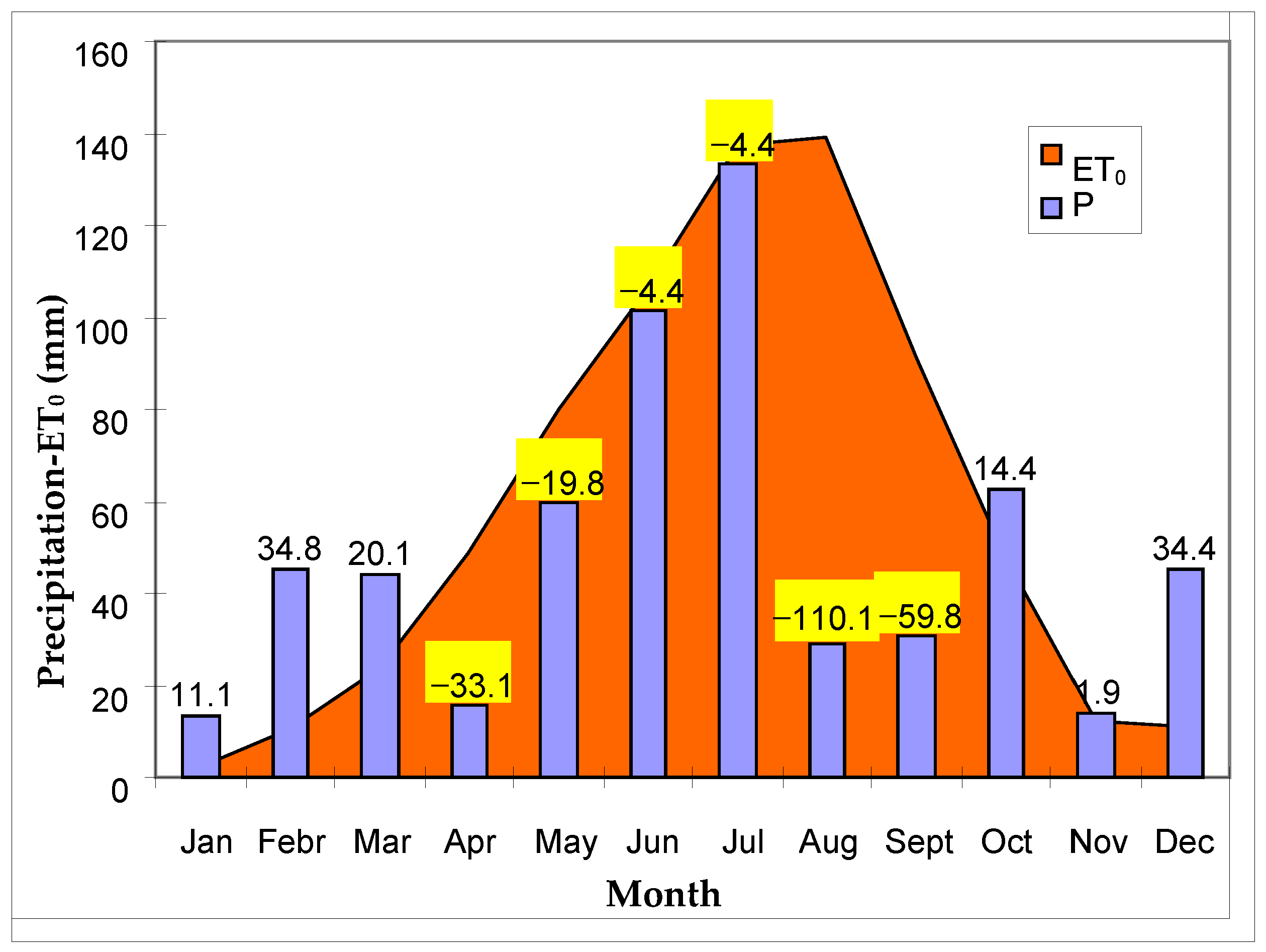
The monthly water balance, expressed as the difference between precipitation and reference evapotranspiration, showed distinct periods of water deficit and excess during the growing season (
Figure 1).
Water deficit conditions were observed primarily during the summer months, particularly in July and August, while water surplus occurred mainly in spring and autumn. These variations reflect temporal fluctuations in water availability under field conditions and provide context for interpreting the effects of irrigation treatments on graft establishment and nursery performance.
3.2. Effects of Irrigation on Graft Take
The irrigation regime had a statistically significant effect on graft establishment in both peach cultivars (
Table 1). Graft take ranged from 85.25% to 98.75% in ‘Redhaven’ and from 91.15% to 98.25% in ‘Cresthaven’. Under irrigated conditions, graft take consistently exceeded 90%, with the highest values recorded at 30 mm. The most pronounced increase was observed between the rainfed treatment and optimal irrigation levels (10–20 mm), whereas further increases to 30 mm resulted in smaller gains. Total water consumption increased from 3780 to 4497 m
3 ha
−1.
Supplemental irrigation improved graft take across all treatments, with values consistently exceeding 90% under irrigated conditions and approaching maximum levels at the highest irrigation depth. The most pronounced improvements were observed when irrigation increased from rainfed to moderate levels, whereas further increases in irrigation resulted in smaller relative gains. This pattern suggests that optimal irrigation was sufficient to meet the physiological water requirements for callus development and vascular reconnection during graft establishment. Total water consumption increased progressively with irrigation; however, improvements in graft take were not proportional to additional water applied. This is also reflected in the water use coefficient, which did not decrease with increasing irrigation, indicating reduced efficiency at higher irrigation levels. Response patterns were similar between cultivars, with only minor differences in graft take observed across irrigation treatments. This consistency suggests that both cultivars exhibit comparable sensitivity to soil moisture conditions during the early grafting phase. While supplemental irrigation enhances graft establishment, increasing irrigation depth beyond moderate levels provides limited additional benefits in relation to water use. These findings highlight the importance of optimizing irrigation input during nursery propagation to improve water use coefficient while maintaining high graft success.
3.3. Water Use and Water Productivity During Graft Establishment
Irrigation water productivity (IWP) for graft establishment varied with irrigation norm (
Table 2). In ‘Redhaven’, IWP increased from 0.0133 to 0.0146% m
−3 between 10 and 20 mm, followed by a slight decrease to 0.0139% m
−3 at 30 mm. In ‘Cresthaven’, IWP increased progressively from 0.0038 to 0.0079% m
−3 across irrigation levels, although values remained lower than those observed in ‘Redhaven’.
Moderate irrigation improved irrigation water productivity, whereas higher irrigation inputs provided smaller proportional gains relative to the amount of water supplied. This indicates that additional water supplied at higher irrigation depths contributed less efficiently to graft success than optimal levels.
Differences in irrigation water productivity between cultivars were relatively small, with ‘Redhaven’ showing slightly higher values across treatments. However, both cultivars exhibited similar response patterns, characterized by increased efficiency under moderate irrigation and a decline at the highest irrigation level.
3.4. Effects of Irrigation and Fertilization on Nursery Survival Rate
The irrigation regime had a significant effect on nursery survival rate in both cultivars (
Table 3). Nursery survival ranged from 22,855 to 69,857 trees ha
−1 in ‘Redhaven’ and from 17,046 to 55,070 trees ha
−1 in ‘Cresthaven’. Total water consumption increased from 3780 to 4498 m
3 ha
−1 across treatments. The water use coefficient decreased from 0.1654 to 0.0611 m
3 tree
−1 in ‘Redhaven’ and from 0.2218 to 0.0811 m
3 tree
−1 in ‘Cresthaven’ between 0 and 20 mm, followed by an increase at 30 mm, indicating reduced efficiency at higher irrigation levels.
The most pronounced response was observed under moderate irrigation, where nursery survival reached maximum levels, particularly in ‘Redhaven’. Increasing irrigation from low to optimal levels significantly improved survival in both cultivars, whereas further increases in irrigation did not result in proportional gains. In ‘Redhaven’, survival declined at the highest irrigation level, while in ‘Cresthaven’ values remained relatively stable, indicating minor cultivar-specific differences in response to increased water availability.
Although total water consumption increased with irrigation depth, the water use coefficient varied considerably between treatments. The lowest water use coefficient, indicating the highest efficiency, was observed under moderate irrigation, while both water-limited and excessive irrigation conditions were associated with reduced efficiency. A similar pattern was found in ‘Cresthaven’, although overall productivity was slightly lower compared to ‘Redhaven’.
3.5. Irrigation Water Productivity for Nursery Survival Rate
Irrigation water productivity for nursery survival varied significantly among irrigation levels (
Table 4). In ‘Redhaven’, IWP increased from 51.57 to 78.34 trees m
−3 between 10 and 20 mm, followed by a sharp decrease to 28.07 trees m
−3 at 30 mm. In ‘Cresthaven’, the highest value was recorded at 10 mm (95.48 trees m
−3), with lower values at 20 mm (59.26 trees m
−3) and 30 mm (42.25 trees m
−3). Although the highest IWP value was recorded at 10 mm in ‘Cresthaven’, this reflects higher efficiency under low water input rather than superior overall plant performance.
Irrigation water productivity exhibited a nonlinear response to increasing irrigation depth. In both cultivars, optimal irrigation levels produced the highest or near-highest efficiency, whereas further increases in irrigation resulted in reduced productivity per unit of applied water. This pattern indicates that moderate irrigation maximized returns relative to water input, while higher irrigation levels reduced marginal gains.
Differences between cultivars were observed, with ‘Redhaven’ generally showing higher efficiency under optimal irrigation, while ‘Cresthaven’ exhibited a more gradual decline in productivity with increasing irrigation. Despite these differences, both cultivars displayed similar overall trends, characterized by increased productivity under moderate irrigation and reduced efficiency at higher irrigation levels.
These results suggest that, although supplemental irrigation enhances total nursery production, the optimal irrigation level of maximizing water productivity may vary slightly between cultivars. In both cases, excessive irrigation reduced water use efficiency, even when total production remained relatively high.
3.6. Relationships Between Water Consumption and Nursery Performance
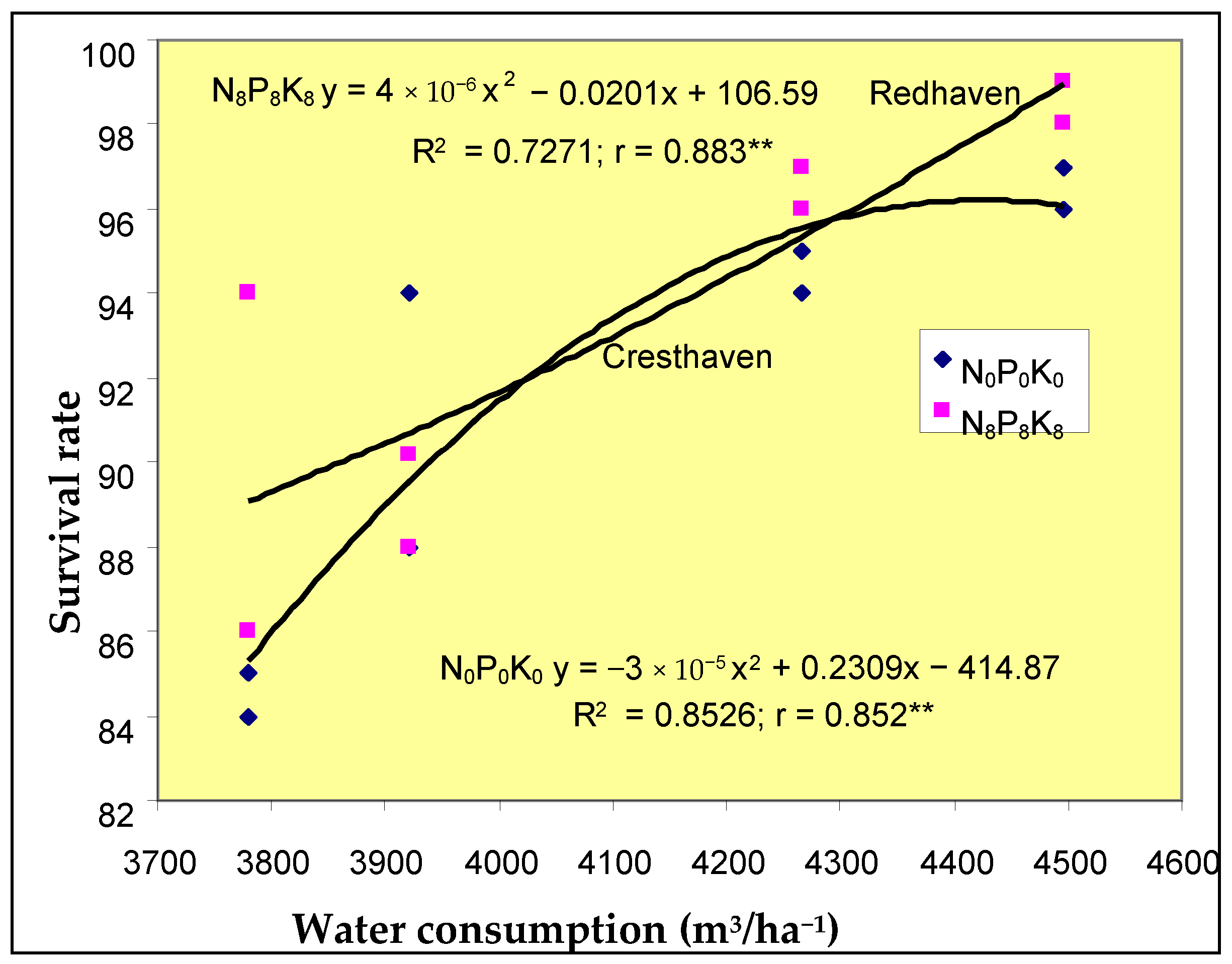
Regression analysis indicated statistically significant positive relationships between total water consumption and nursery survival rate during the graft establishment stage in both peach cultivars (
Figure 2 and
Figure 3). The high coefficient of determination (R
2) indicates the proportion of variability in nursery survival explained by water consumption within the studied range. The relationships were statistically significant, indicating that the observed patterns are unlikely to be due to random variation. In ‘Redhaven’, total water consumption explained a substantial proportion of the variability in graft survival, as reflected by a high coefficient of determination (R
2), while a similar but slightly weaker relationship was observed in ‘Cresthaven’.
The fitted quadratic models suggest that survival rate increased with increasing water consumption across irrigation treatments. However, the curvature of the regression lines indicates that the rate of increase in survival diminished at higher levels of water input. Although additional irrigation continued to improve survival, the proportional gains became smaller as water consumption increased, suggesting diminishing returns within the studied range of conditions.
These results highlight that, while water availability is a key factor influencing graft establishment, increasing water inputs beyond moderate levels may not lead to proportional improvements in plant performance.
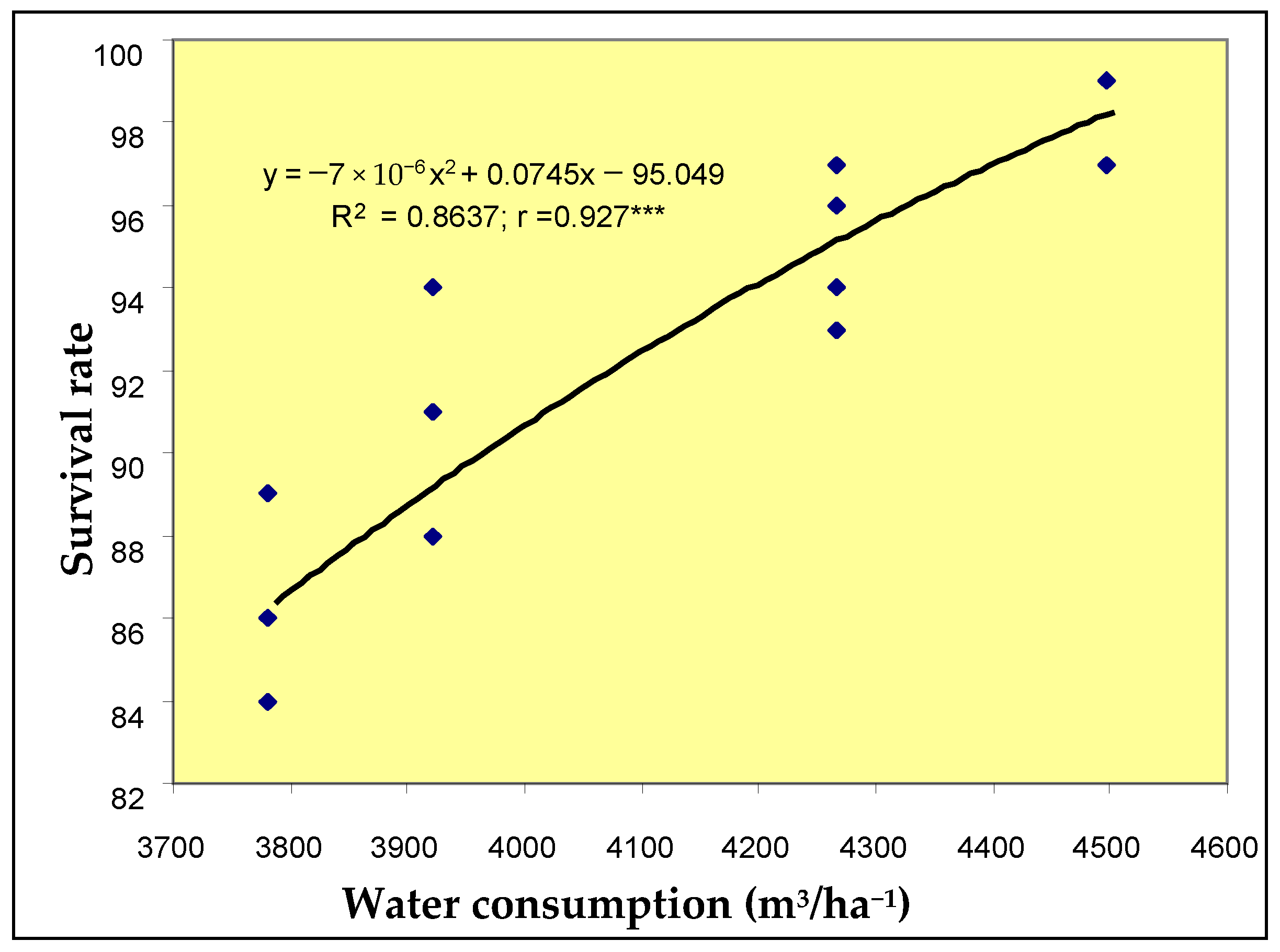
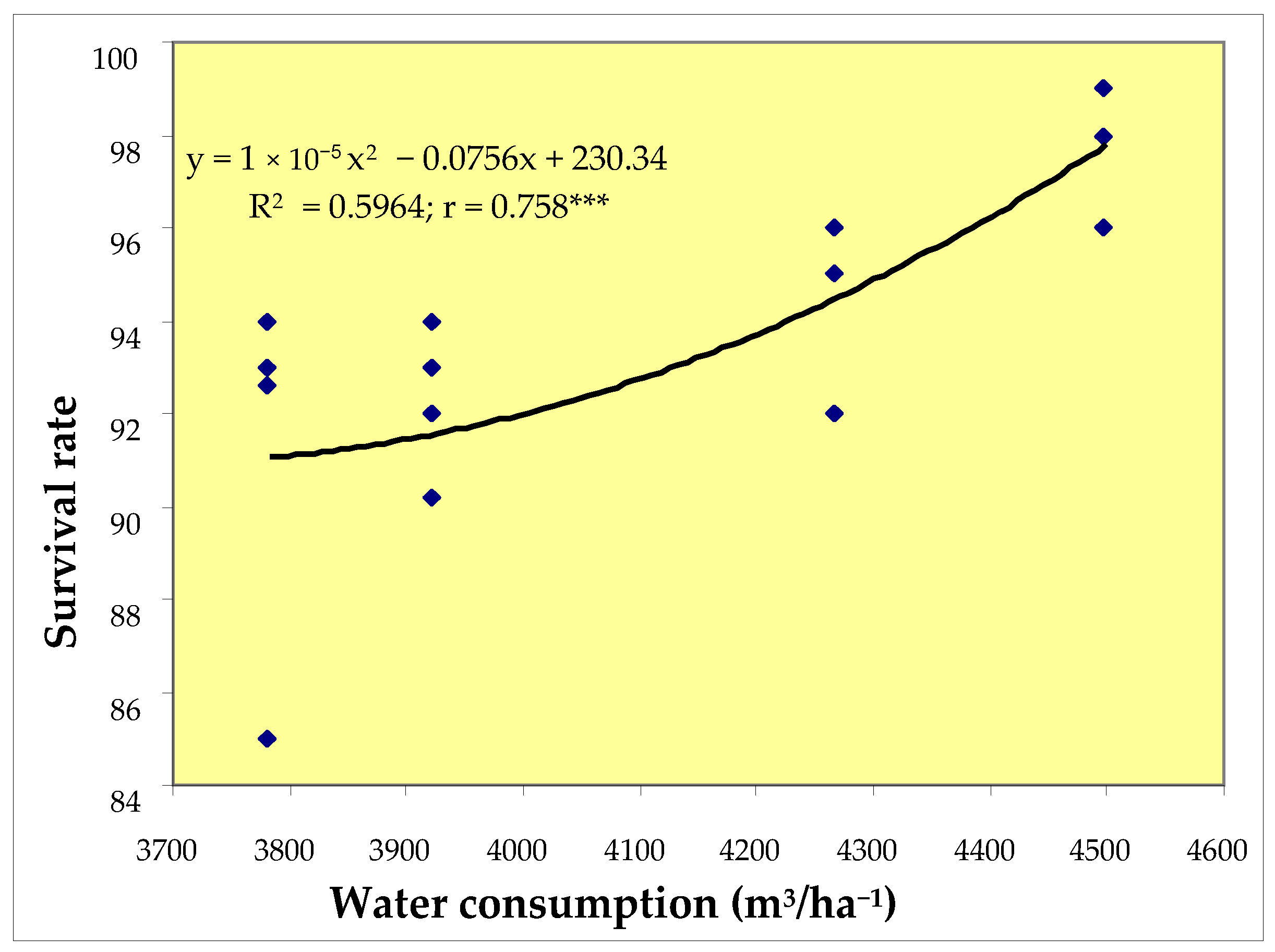
Under both fertilization regimes, nursery survival rate showed a strong positive relationship with total water consumption (
Figure 4). Survival increased with increasing water input, particularly at low to moderate irrigation levels, while the rate of improvement declined at higher water inputs, indicating a nonlinear response.
The fitted quadratic models suggest that plant response to irrigation was most pronounced under conditions of limited to moderate water availability, where increases in soil moisture resulted in substantial gains in nursery survival. At higher levels of water input, the response became less pronounced, with smaller incremental improvements per unit of applied water. This pattern indicates a transition from water-limited to non-limiting conditions, beyond which additional irrigation provides reduced marginal benefits.
Similar trends were observed across both fertilization regimes, suggesting that the overall response to water availability was consistent despite differences in nutrient supply. These results indicate that, although irrigation enhances nursery survival, increasing water inputs beyond moderate levels may not lead to proportional improvements in plant performance.
The regression analysis highlights that optimizing irrigation levels is essential to balance plant development and water use efficiency, particularly under conditions of increasing water scarcity.
3.7. Soil Moisture Dynamics
Seasonal soil moisture dynamics in the 0–30 cm root zone are presented in
Table 5. The data show clear temporal variation in soil water reserves and highlight the effect of irrigation treatments throughout the growing season.
At the beginning of the growing season, soil water reserves were similar across treatments, remaining close to field capacity. As the season progressed, soil moisture declined under rainfed conditions due to increased evapotranspiration. In contrast, irrigated treatments maintained higher soil moisture levels, particularly during July and August, when water deficit conditions were more pronounced. These results confirm the role of irrigation in stabilizing soil water availability during critical growth periods.
4. Discussion
Efficient irrigation management plays a critical role in plant establishment and water use efficiency in nursery production systems. The results of the present study are consistent with previous research on fruit tree systems, which shows that moderate irrigation levels generally optimize plant performance and resource use efficiency [
43,
44,
45,
46]. Similar response patterns have been reported in studies on peach and other fruit crops, where excessive irrigation does not proportionally increase growth or yield, while optimal water supply supports physiological activity and vegetative development.
However, the magnitude of plant response depends on environmental conditions, soil properties, and plant material. The nursery stage is particularly sensitive to water availability compared to mature orchards, as young plants have less developed root systems and a higher dependence on soil moisture. In addition, differences between cultivars and fertilization regimes may further influence plant responses, contributing to variability across studies.
The improved graft establishment observed under moderate irrigation can be explained by the physiological requirements of graft union formation. Adequate soil moisture maintains cell turgor, which is essential for cell division and callus formation at the graft interface. Moreover, optimal water availability supports metabolic activity and facilitates vascular reconnection between rootstocks and scion, enabling the transport of water, nutrients, and assimilates. Hormonal regulation, particularly involving auxins, also plays a key role in coordinating vascular differentiation under favorable hydration conditions [
47,
48].
Under water-limited conditions, reduced soil moisture constrains plant water status, leading to decreased turgor and limited assimilated transport, which may delay callus formation and vascular differentiation. Conversely, excessive irrigation can reduce oxygen availably in the root zone, creating hypoxic conditions that impair root respiration and metabolic activity. This reduces the energy production required for nutrient uptake and root growth. In addition, excessive water may promote nutrient leaching and limit nutrient availability, further constraining plant development. Prolonged high soil moisture can also negatively affect root system development, reducing the efficiency of water and nutrient uptake [
49,
50]. These soil–water–plant interactions explain why increasing irrigation beyond moderate levels did not proportionally improve plant response.
The decline in irrigation water productivity at higher irrigation depths reflects the combined effects of reduced physiological responsiveness and increased non-productive water losses. When irrigation exceeds plant requirements, a larger proportion of water is lost through deep percolation or remains unavailable for plant uptake. Similar patterns have been reported in fruit cropping systems, where optimal irrigation regimes optimize both productivity and resource efficiency [
51].
Although higher IWP values were occasionally observed at lower irrigation levels, these were primarily associated with reduced water input rather than improved overall plant response. The nonlinear relationships observed between water consumption and nursery performance further support this interpretation, as plant responses were more pronounced at low to moderate irrigation levels, whereas additional water inputs resulted in progressively smaller gains [
52].
The nonlinear relationship between irrigation depth and water productivity reflects the interaction between plant physiological response and water availability. At low irrigation levels, growth performance is constrained by limited water availability, resulting in reduced growth despite the relatively high apparent water use efficiency due to low input levels. As irrigation increases to optimal levels, physiological processes such as cell expansion, photosynthesis, and nutrient uptake operate under near-optimal conditions, leading to substantial gains in plant performance.
Beyond this optimal range, additional irrigation does not result in proportional gains in plant response. This is due to physiological saturation, where key processes such as photosynthesis and biomass accumulation reach a plateau, while excess water contributes to non-productive losses through deep percolation and reduced soil aeration. Consequently, water productivity declines at higher irrigation depths, as the marginal benefit of additional water decreases. These results explain why moderate irrigation provides an optimal balance between maximizing plant growth and maintaining water use efficiency.
Although irrigation was the dominant factor influencing growth performance, the factorial design of the experiment indicates that responses were also shaped by interactions with fertilization and cultivar. Adequate soil moisture enhances nutrient mobility and root uptake, improving nutrient use efficiency and supporting plant vigor. Under optimal irrigation conditions, fertilization likely contributes to more efficient biomass accumulation and improved graft success, while under suboptimal moisture conditions, nutrient uptake may be limited despite fertilizer availability.
From a practical perspective, the results indicate that irrigation management in nursery systems should aim to maintain soil moisture within a range that supports physiological processes while avoiding excess water application. In the context of increasing water scarcity, optimizing irrigation input rather than maximizing water use is essential for improving resource efficiency [
53,
54].
Recent advances in sustainable irrigation research further support this perspective. Strategies such as deficit irrigation and precision water management have been shown to improve water use efficiency while maintaining crop productivity [
55]. These approaches emphasize the identification of crop-specific water thresholds and precise timing of irrigation, which are essential for balancing productivity and resource conservation. In addition, sustainable irrigation should be considered within an integrated management framework that includes soil conditions, fertilization, and environmental constraints [
56]. Emerging technologies, including sensor-based irrigation systems and data-driven decision tools, further enhance water productivity by enabling more precise control of water inputs and reducing losses [
57].
These developments reinforce the findings of the present study, suggesting that moderate irrigation levels may represent an efficient strategy within integrated and sustainable nursery systems, although optimal thresholds may vary depending on environmental conditions and management practices.
Finally, it should be noted that the results are derived from a specific set of environmental and management conditions, including a single experimental location. Therefore, their applicability to other regions, soil types, and climatic conditions should be interpreted with caution. In addition, this study did not include direct measurements of plant physiological responses, such as photosynthetic activity, stomatal conductance, or plant water status, which could provide further insight into the mechanisms underlying the observed relationships.
5. Conclusions
The results of this study demonstrate that irrigation depth has a significant influence on graft establishment, nursery survival, and water use efficiency in peach nursery production. Moderate irrigation (20 mm per irrigation event) provided the best balance between plant performance and water use efficiency, resulting in graft take values exceeding 95% and maximum nursery survival (up to 69,857 tree ha−1).
Both insufficient and excessive irrigation negatively affected plant responses. Rainfed conditions limited graft establishment and survival, while excessive irrigation (30 mm) increased total water consumption (up to 4497 m3 ha−1) without proportional gains in plant performance and reduced irrigation water productivity.
From a practical perspective, these results indicate that irrigation scheduling in nursery systems should aim to maintain moderate soil moisture conditions, avoiding both water deficit and over-irrigation. The use of irrigation depths of approximately 10–20 mm per event, combined with soil moisture monitoring, represents an effective strategy for optimizing plant development and water use.
This study also highlights that irrigation water productivity is maximized under moderate irrigation levels, confirming that increasing water inputs beyond plant requirements leads to reduced efficiency. Therefore, water-saving strategies in nursery production should focus on optimizing irrigation input rather than maximizing water application.
These findings provide practical guidance for nursery managers by identifying irrigation thresholds that improve both plant quality and resource use efficiency under field conditions. Future research should focus on refining irrigation scheduling through continuous soil moisture monitoring using sensor-based technologies and evaluating these strategies under different climatic and soil conditions.