Review

The Role of Leaf Morphology and Sustainable Management Practices on Optimizing Nitrogen Use Efficiency of Upland Rice: A Review

by
Faith S. Olanlokun
1,
Oyeyemi A. Dada
1 and
Khayelihle Ncama
2,*
1
Department of Crop Protection and Environmental Biology, University of Ibadan, Ibadan 200005, Nigeria
2
Department of Horticulture, Durban University of Technology, Durban 4000, South Africa
*
Author to whom correspondence should be addressed.
Crops 2026, 6(2), 46; https://doi.org/10.3390/crops6020046
Submission received: 6 March 2026 / Revised: 5 April 2026 / Accepted: 13 April 2026 / Published: 14 April 2026

Abstract

Nitrogen is an essential macronutrient for plant growth, photosynthesis, and grain yield. However, the nitrogen use efficiency (NUE) of crops remains relatively low, leading to nitrogen losses and environmental concerns. This is particularly important in upland rice because it is a high nitrogen user, but research of its NUE is limited. This literature review explored the contributions of leaf morphology, specifically leaf size and leaf angle, to nitrogen utilization efficiency in upland rice under varying rates of nitrogen fertilization. It also evaluated sustainable nitrogen management practices across diverse cropping systems. Findings reveal that nitrogen fertilization significantly influences leaf development, canopy structure, and nitrogen remobilization, all of which directly affect photosynthetic efficiency and yield. Breeding strategies focusing on moderate leaf size and erect leaf angles improve the nitrogen uptake and use by rice. In addition, sustainable farming practices, including precision nitrogen management, conservation agriculture, and intercropping with legumes, are effective in enhancing NUE and reducing nitrogen losses across various rice production systems. Future research should focus on identifying the thresholds of nitrogen rates that optimize leaf morphology across diverse upland rice genotypes and unravel the genetic and physiological mechanisms linking nitrogen application to leaf development.

1. Introduction

Wetland rice systems dominate global rice production and land use, but upland rice ecosystems play a crucial role in specific agroecological zones, particularly in the tropical regions of Africa. Upland rice accounts for approximately 11% of global rice production [1]. It is typically cultivated on unbounded, sloped, or level lands where water retention is minimal, relying solely on rainfall for growth. Consequently, upland rice is exposed to a unique set of agronomic challenges including erratic rainfall, low soil fertility, and reduced yield potential compared to irrigated lowland systems. These stressors amplify the importance of nitrogen use efficiency (NUE), which is relevant to yield sustainability and mitigating environmental consequences associated with nitrogen losses through leaching, volatilization, and denitrification. Notably, such losses often reach 15–30% although they can be substantially reduced through agronomic optimization, particularly by applying nitrogen at appropriate rates and timings [2].
Nitrogen is an essential element for all plants because of its importance in the synthesis of numerous vital biomolecules such as amino acids, proteins, nucleic acids, chlorophyll, and plant hormones [3]. Thus, application of N fertilizer has become a major factor responsible for the increase in various crop yields over the past five decades [4]. It is an irreplaceable critical macronutrient required for plant growth and development [5]. Its importance in improving photosynthesis and plant metabolism cannot be overstressed. Studies have shown that it regulates production of cell wall components like cellulose, hemicellulose, and pectin, which play prominent role in leaf inclination angle [6,7]. Nitrogen affects plant growth by playing a pivotal role in the biosynthesis of growth-promoting substances like auxins, which have a direct influence on cell elongation and leaf angle [8,9]. It is also essential for chloroplast formation as a precursor for enhancing photosynthetic capacity of chlorophyll. Its uptake regulates leaf growth and expansion by influencing cell division and expansion. The leaf veins dictate the sink–source relationships, thus regulating the allocation of assimilated to leaves which affects the leaf size [10,11]. The importance of nitrogen in upland rice cultivation cannot be underestimated. It has been reported that nitrogen deficiency caused retarded growth, reduced panicle, small leaf size, a number of spikelets and ultimate grain yield. Little wonder why the performance of upland rice improved tremendously under adequate nitrogen supply as reported by [12].
Nitrogen deficiency results in smaller leaves that indirectly reduce leaf inclination angles and decrease photosynthetic capacity [13]. Although the importance of nitrogen in enhancing the performance of economically important cereal crops like rice is well established, much of the existing literature has primarily focused on yield responses to its application. The response of upland rice yield to mineral fertilizer application on different soil types and regions is well documented [14,15]. Nevertheless, the link between the extent to which the applied nitrogen fertilizer applied influence over leaf inclination and photosynthate partitioning is not well understood. This review explored the physiological and agronomic contributions to leaf size and angle and associated these variables to Nitrogen Use Efficiency (NUE) in upland rice. Findings indicated that research in optimizing nitrogen management for improved upland rice productivity, especially in relation to photosynthetic structure, remains a complex challenge. Nitrogen is very influential to leaf morphology, which is important in determining leaf angle towards regulating cell wall composition and turgor pressure for improved cell volume expansion and leaf enlargement. Nonetheless, the influence of nitrogen on the interplay between turgor pressure, growth regulators, and leaf architecture remain unclear.

2. Components of Nitrogen Use Efficiency

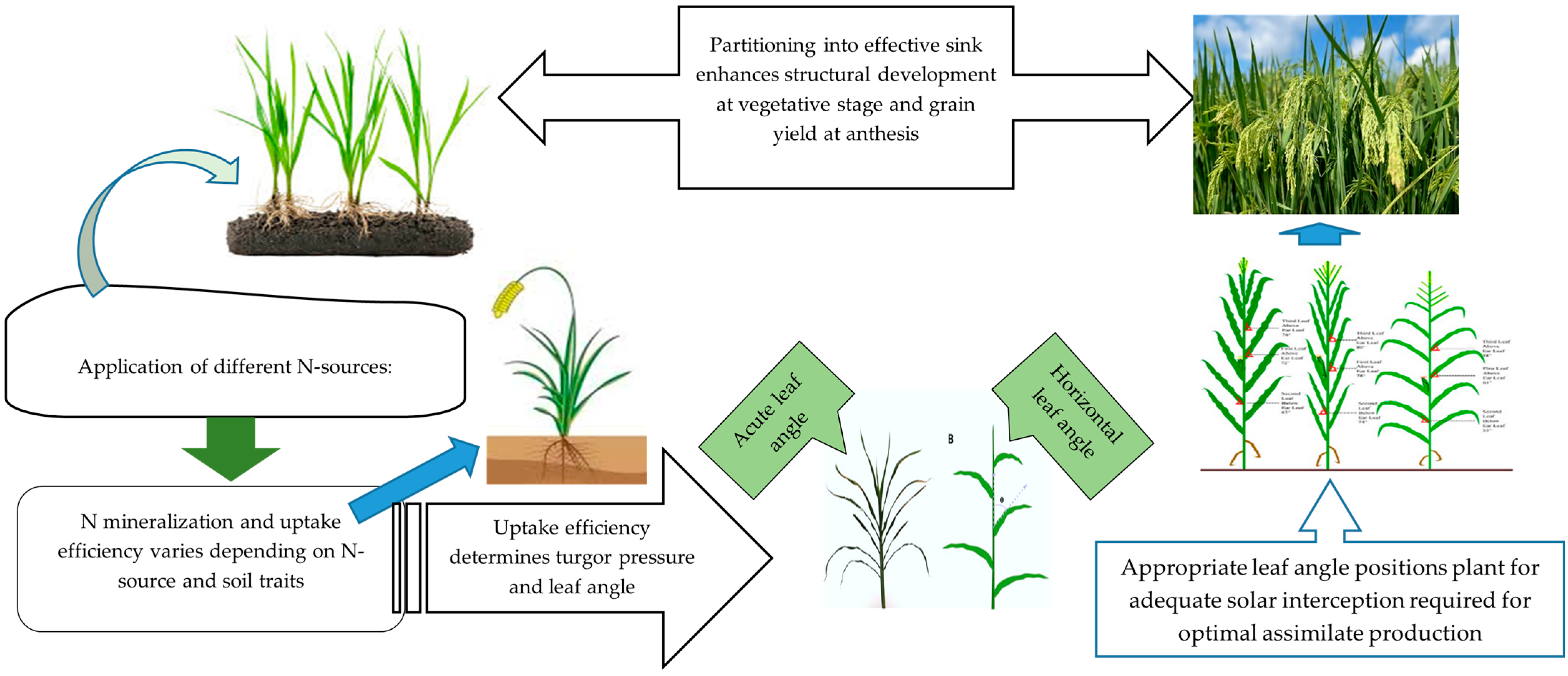
Understanding the interplay between nitrogen application, leaf morphological traits, and Nitrogen Use Efficiency [NUE] is critical in upland rice improvement programs (Figure 1). Leaf attributes such as size and angle are known to modify canopy architecture, light interception, photosynthetic efficiency, and nitrogen assimilation, which substantially affect crop productivity under varying nitrogen rates and regimes [16]. The NUE, generally defined as the grain yield per unit of nitrogen applied or supplied, is influenced by both genetic and environmental factors. The NUE can be dissected into two key components: nitrogen uptake efficiency (NUpE) and nitrogen utilization efficiency (NUtE). Nitrogen is taken up and transported dynamically across growth stages in upland rice as influenced by both NUpE and NUtE [17]. During the vegetative phase, adequate nitrogen availability promotes vigorous tillering, which determines the potential number of panicles on rice plants [18]. At the reproductive stage, nitrogen supports spikelet formation, reduces spikelet abortion, and increases hull size-factors that collectively contribute to sink strength and grain yield. Moreover, nitrogen accumulation in culms and leaf sheaths prior to heading, and its remobilization during grain filling, is essential for the carbohydrate supply needed to develop grains. Recent studies emphasize the significance of aligning nitrogen application with crop growth stages. Kongchum et al. [19] demonstrated that optimizing the timing of nitrogen fertilization, particularly before flooding, significantly improved N uptake and grain yield in drill-seeded rice systems. These findings underscore the need for cultivar-specific and stage-targeted nitrogen fertilization strategies to improve NUE and avoid the negative consequences of both under- and over-fertilization.
NUpE governs the plant’s ability to extract nitrogen from the soil, while NUtE reflects how the absorbed nitrogen is effectively converted into biomass and grain yield. The integration of leaf architectural traits into NUE optimization strategies and models presents a promising research field for improving upland rice performance, particularly in resource-limited or deficient environments.

3. Nitrogen Use Efficiency (NUE) in Upland Rice Fields

Nitrogen use efficiency (NUE) is a critical measure of how well a plant utilizes nitrogen to produce biomass and grain yield, reflecting the effectiveness of nitrogen applications in cropping systems. While the average NUE in crops is around 40–50%, the unutilized nitrogen can contribute to environmental pollution, including water and air contamination, which in turn negatively impacts biodiversity and environment [20]. The average NUE in upland rice is unpredictable, however reports from several studies summited that it hovers between 15 and 20 kg grain kg−1 N applied. It thus implies that approximately 50–67 kg N is required for each 1 ton of grain yield. These inefficiencies in nitrogen utilization also heighten farmers’ economic losses due to carryover costs of excess nitrogen application. Thus, improving NUE is vital to achieving sustainable arable crop production and rice breeding programs are increasingly focused on enhancing NUE by developing cultivars that require less nitrogen input but maintain or improve productivity [21]. The efficient use of nitrogen in rice farming reduces environmental impacts, while supporting sustainable agronomic practices. NUE in rice is influenced by three core physiological processes: nitrogen uptake, assimilation, and remobilization.
Nitrogen uptake is heavily influenced by root system architecture, transporter gene expression, and the availability of soil nitrogen [22]. Nitrogen assimilation explains absorbability and the enzymatic conversion of nitrogen into amino acids and proteins. The principal enzymes like nitrate reductase (NR), nitrite reductase (NiR), and glutamine synthetase (GS) play central roles in this transformation, enabling nitrogen to support photosynthesis, growth, and chlorophyll production [23]. Nitrogen remobilization involves reallocating nitrogen from senescing tissues (especially older leaves) to younger, developing organs and grains during the reproductive phase. This internal recycling is crucial in upland rice, where external nitrogen availability is often limited [24,25]. Understanding these integrated processes provides a foundation for the development of novel strategies to improve NUE in rice, whether through molecular breeding, root trait optimization, or nitrogen-sensitive agronomic management.
Improving nitrogen absorption and utilization efficiency, while minimizing environmental pollution is a vital challenge for upland rice cultivation [26]. Unlike lowland rice, upland rice faces several constraints, including poor soil fertility, low water availability, and shallow root zone which limit nitrogen uptake and subsequent utilization [27]. Under such limiting conditions, NUtE becomes a primary determinant of productivity, as it reflects how well the plant can allocate internally absorbed nitrogen into photosynthetically active tissues and grain yield. In upland rice, NUE is influenced by various factors, including root traits, nitrogen assimilation pathways, and the plant’s ability to withstand abiotic stress [28]. For example, Foulkes et al. [29] found that rice genotypes with compact canopies and erect leaf angles had higher NUE under nitrogen-limited conditions, while Peng et al. [30] emphasized the role of efficient root systems in enhancing nitrogen uptake from deeper soil layers (Table 1). These findings highlight the importance of optimizing both root architecture and leaf morphology to improve NUE in upland rice. Breeding efforts have focused on identifying upland rice genotypes with improved nitrogen uptake efficiency and better nitrogen remobilization to the grain for synthesizing amino acids [31]. These traits, in addition to favorable canopy architecture, are essential for maximizing NUE under nutrient-limited conditions [15].

4. Leaf Morphology and Its Role in Accumulation of Assimilates

Leaf morphology plays a central and irreplaceable role in photosynthesis and, by extension, the plant’s ability to accumulate assimilates, as leaves are the primary organs for capturing solar energy and absorbing carbon dioxide. In rice, specific morphological traits such as leaf size, shape, angle, and number critically determine the plant’s capacity to intercept light which directly influences biomass production and grain yield [34,35]. For instance, broader leaves maximize surface area for light absorption, while upright leaf angles minimize self-shading, allowing better light penetration through the canopy. These architectural traits work synergistically to optimize canopy photosynthesis, particularly in dense plantings or low-nitrogen conditions [36].
Nitrogen availability significantly modulates these leaf morphological traits. High nitrogen levels promote cell proliferation, leading to larger leaves, an increased leaf area index (LAI), and greater total leaf dry mass, all of which enhance photosynthetic capacity [37]. Conversely, nitrogen deficiency restricts leaf expansion, reduces leaf thickness and chlorophyll content, thereby negatively impacting light interception and production of assimilates [38]. The degree of leaf greenness, often measured using SPAD meters, serves as a reliable indicator of the plant’s nitrogen status and photosynthetic activity. Greener leaves signal higher chlorophyll content and nitrogen assimilation, while declining greenness can indicate early nitrogen deficiency or physiological stress, making SPAD-based assessment a valuable tool for precision nitrogen management in rice farming [39].
Furthermore, adequate nitrogen supply is crucial for delaying the leaf senescence process. Nitrogen sustains chlorophyll synthesis and suppresses stress-induced hormonal signals like abscisic acid (ABA), thereby prolonging the photosynthetic duration of key leaves, especially the flag leaf, which is a fundamental photo-assimilate source during grain filling [40]. This “stay-green” trait, associated with improved nitrogen remobilization efficiency, ensures sustained assimilation flow to developing grains, enhancing overall crop performance and yielding stability under varying nitrogen regimes [39,40]. Thus, the influence of nitrogen on leaf morphology—through its impact on LAI, dry mass, and longevity—forms the integral physiological and structural foundation for efficient accumulation of assimilates in upland rice.

5. Influence of Nitrogen on the Interplay of Turgor Pressure, Growth Regulators, and Leaf Architecture

Nitrogen is a key driver of plant performance, not only through its known role in photosynthesis and metabolism but also in the less explored mechanical and biochemical dynamics that govern leaf architecture. One of the major unexplored aspects is how nitrogen interacts with internal hydraulic forces and plant hormones to influence leaf formation and functions. Turgor pressure, the hydrostatic force within plant cells, governs cellular expansion and contributes significantly to organ shape, including leaves. Nitrogen influences turgor by modulating osmolyte concentration and water uptake capacity in cells, thereby altering internal pressure and contributing to tissue rigidity and expansion [41]. This is particularly critical in fast-growing tissues like leaf lamina, where cell expansion defines final leaf size and curvature. The biosynthesis of plant growth regulators such as auxins, gibberellins, and cytokinin, which regulate leaf initiation, expansion, and orientation, is explained as one of the functional roles of nitrogen in plants. For example, auxin distribution affects cell wall loosening and expansion at the base of the lamina, thereby altering leaf angle according to Luo et al. [8] and Li et al. [9]. These hormonal effects often interact with cell wall remodeling processes. Leng et al. [6] and Zhang et al. [7] reported that nitrogen availability influences the deposition of cell wall components such as cellulose, hemicellulose, and pectin—all which impact tissue stiffness and leaf inclination. Adequate N has direct influence in increasing DNA synthesis, cytokinesis and cell expansion. Cellular growth in plants is linked directly to adequate supply of nitrogen. Sufficient nitrogen supply enhance water uptake and sustain turgor pressure. On the contrary, consistent low N supply results in poor cell division and associated plant architecture. In upland rice, cell division and expansion is regulated by N concentration which influences the division of mesophyll cells and increases the rate of elongation of epidermal cells.
Aquaporins play a significant role in nitrogen metabolism in angiosperm, especially in members of the plasma membrane intrinsic proteins, nodulin-like intrinsic proteins, and tonoplast intrinsic proteins subfamilies. These are known to transport molecules including ammonia and urea, helping to adjust their movement between the cytoplasm and the vacuole. Gaining insight into how nitrogen compounds pass through the plasma membrane via aquaporins can help us better to control nitrogen uptake and ultimately improve NUE in plants. Different nitrogen forms, such as nitrate and ammonium, influence plant water uptake and aquaporin expression in distinct ways, depending on the species. In plants that prefer nitrate, this form acts as an important signaling molecule that stimulates plasma membrane intrinsic proteins expression and enhances root hydraulic conductivity. In contrast, in plants that favor ammonium, ammonia promotes the expression of both plasma membrane intrinsic proteins and tonoplast intrinsic proteins, leading to increased water uptake. Overall, the regulation of aquaporins by various nitrogen species offers a promising mechanism for improving plant tolerance to water stress and enhancing water use efficiency.

6. Leaf Size and Angle Influence Photosynthetically Active Radiation Capturing

Leaf size determines the surface area available for photosynthesis, directly influencing the plant’s capacity to assimilate carbon and nitrogen. Larger leaves provide a greater surface area for light capturing and gas exchange, which are the processes implicated for determining rates of photosynthesis. However, excessive leaf size may lead to self-shading within the canopy and reducing light interception efficiency in the lower canopy layers. The increase in leaf size may lead to excessive vegetative growth at the expense of reproductive development, which can reduce yield and nitrogen efficiency. Gu et al. [42] demonstrated that rice genotypes with moderately sized leaves achieved higher NUE compared to those with excessively large or small leaves, as the former balanced light capture and nitrogen partitioning effectively.
Leaf angle, the inclination between the leaf blade midrib and the culm in cereals, is a major parameter in shaping plant architecture. This crucial trait significantly influences light interception, assimilate production efficiency, and ultimately, crop yield. By optimizing leaf orientation, plants can maximize the extent to which solar energy, a fundamental driver of crop production, is captured [43]. The distribution of leaf angles within a canopy (leaf angle distribution—LAD) directly impacts the distribution of photosynthetically active radiation (PAR) across leaves. This spatial distribution of light within the canopy profoundly influences plant productivity. Various mathematical models, such as de Wit’s functions and the Dual-parameter Beta function, have been developed to describe LAD in different crop canopies [44]. Accurate modeling of LAD is essential to understanding how rice canopy architecture affects light interception, photosynthetic performance, and, ultimately, nitrogen use efficiency. While earlier models like de Wit’s function and the Dual-parameter Beta function provided foundational insights, they lacked crop specificity and dynamic responsiveness under field conditions. Recent technological advances have introduced data-driven, rice-specific models that enable more detailed and accurate simulations of LAD and related canopy characteristics. One such model is the RPIOSL (Rice-specific Prospect-based Inversion Optical Simulation Leaf) model, which integrates radiative transfer theory with rice canopy optical properties to estimate variables such as leaf angle, chlorophyll content, and dry matter. By applying hyper spectral data, RPIOSL enhances the simulation of light transmittance and reflectance through the canopy and improves estimations of light absorption patterns critical to photosynthesis and NUE [45].
Complementing this is the rise in machine learning-based approaches for LAD analysis. A notable example is the integration of Line Segment Transformer (LETR) with Mask R-CNN, which enables high-throughput, image-based extraction of leaf inclination angles in rice fields. This method uses deep learning and computer vision to reconstruct LAD from real-time field images, providing rapid, accurate measurements of canopy structure without destructive sampling. Such tools are crucial in selecting genotypes with favorable canopy traits for breeding programs focused on improving NUE [46]. These models offer powerful tools for linking canopy structural traits to nitrogen utilization dynamics. They support the development of rice ideotypes that optimize light use efficiency, minimize nitrogen losses, and improve yield potential in both high- and low-input systems. Several factors, including light conditions, crop genotype, nitrogen levels, and plant density, can significantly influence leaf angle [47]. For instance, increasing nitrogen rates have been shown to increase leaf angle, resulting in a more horizontal orientation [48], while reducing basal nitrogen application tends to produce more erect leaves, improving canopy light penetration and transmittance [49]. These physiological changes are not merely structural, but they have functional implications for crop productivity and nitrogen use efficiency. Erect leaf angles help reduce mutual shading in the canopy, allowing better light distribution to lower leaves. This enhances photosynthetic efficiency throughout the canopy and supports more uniform biomass accumulation. Moreover, a more vertical leaf architecture is associated with improved nitrogen remobilization during grain filling, as light-stimulated leaves remain active longer and contribute to reproductive tissues.
The effect of leaf angle on photosynthetic efficiency has been extensively studied in cereal crops, particularly rice [50,51]. Nonetheless, the interaction or influence of nitrogen on leaf angles remains unclear. Cultivars with erect leaves exhibit superior light interception, higher photosynthesis, greater crop growth, reduced photo-inhibition, and, ultimately, higher yields compared to those with horizontally positioned leaves [52,53,54,55,56,57,58]. Recent research underscores the pivotal role of leaf angles in optimizing photosynthetic efficiency and grain yield in rice [5,59,60]. Cultivars exhibiting erect leaves facilitate superior light penetration into the canopy, enhancing photosynthetic performance and reducing photo-inhibition. This architectural trait is particularly advantageous under high-density planting conditions, where light distribution becomes a limiting factor. For instance, a study by Yao et al. [61] demonstrated that rice plants with steeper leaf angles exhibited improved light distribution within the canopy, leading to enhanced photosynthetic rates and increased grain yield. Similarly, Guo and Lv [62] evaluated photosynthetic light-response curves across various canopy positions and found that erect leaf orientation significantly boosts photosynthetic capacity, especially in lower canopy layers. Moreover, genetic analyses have identified key regulators of leaf inclination. Xing et al. [63] revealed that the OsIAA6 gene interacts with auxin response factors to modulate leaf angle, offering potential targets for breeding programs aimed at optimizing canopy architecture for better light utilization. These findings collectively suggest that breeding for erect leaf traits can be a viable strategy to enhance photosynthetic efficiency and grain yield in rice cultivation.
The enhanced performance of erect–leaved varieties is attributed to several factors. Erect leaves optimize light interception, ensuring that more light reaches the lower canopy while minimizing excessive light exposure and potential photo-inhibition in the upper canopy. Vertical leaf angles minimize self-shading, allowing for greater light penetration into the lower canopy, particularly in dense planting systems [64]. This is highly beneficial in upland rice, where high planting densities are common. Erect leaves facilitate the interception of high light intensities, which is crucial for efficient nitrogen utilization during grain filling [65]. Erect leaves facilitate better light interception and photosynthetic efficiency in the mid and lower canopy, mitigating nitrogen stress by improving overall plant productivity. Research by Yoshida [66] and Katsura et al. [67] highlighted the importance of integrating leaf morphological traits, particularly leaf angles, into breeding programs aimed at improving NUE in upland rice. These studies suggest that selecting intermediate leaf size and erect leaf angles can significantly enhance the nitrogen efficiency of upland rice cultivars. Leaf angle is a critical determinant of plant architecture and productivity. It influences light interception, distribution, and photosynthetic efficiency. Factors like nitrogen levels, light conditions, and plant density significantly impact leaf angle. Upright leaves are associated with improved light utilization, reduced self-shading, enhanced nitrogen use efficiency, and higher yields. Breeding programs should prioritize breeding for erect leaf angles to improve nitrogen efficiency and yield potential of upland rice cultivars.

7. Impact of Nitrogen Fertilization Rate on Yield, Canopy Morphology of Upland Rice, and NUE

Increased nitrogen application often results in larger leaves and more horizontal leaf angles, which can increase vegetative biomass but may also lead to mutual shading and reduced light interception efficiency in the canopy. This can limit effective utilization of applied nitrogen, especially at high planting densities [68]. In contrast, lower nitrogen application rates tend to promote smaller leaves with more upright leaf angles, improving light penetration into the lower layers of the canopy and optimizing nitrogen use efficiency [69]. Thus, nitrogen application rates must be carefully managed to strike a balance between vegetative growth and efficient nitrogen assimilation. It is appropriate to ensure equilibrium between morphological development and adequate N assimilation to promote optimal crop yield without compromising environmental safety due to surplus supply of N to crops. To ascertain this, N assimilation must be optimized by regulating uptake, transport and utilization in metabolic processes. Leaf morphology that serves as the major structure for N assimilation should be synchronized to align with N supply. According to Farhan et al. [70], the need to regulate N that is required for crop metabolism is connected to balancing its concentration with the required photo-assimilate distribution, thereby reducing the environmental pollution caused by excessive N fertilization. Thus, it is appropriate to systematically derive the precise yield and harvest index model necessary for ensuring appropriate N assimilation and utilization required to achieve high NUE in the desired crop.
It is estimated that 80% of leaf N is allocated to chloroplasts and approximately 50% of that N is in the form of photosynthetic proteins, including those important for the light harvesting process, electron transport, and the enzymatic machinery of carbon metabolism [33]. According to Noor et al. [71], N application positively impacts plants’ photosynthesis and physiological mechanisms, which determines yield. Reports have shown that upland rice was responsive to nitrogen fertilizers rate (NFR) and N fertilization at various NFRs, resulting in increased stem height that could alter the pattern of mutual shading. Zhang et al. [72] also found that an increase in N fertilization positively influenced culm height in rice plants. Similar findings were also reported by Jahan et al. [73]. An increase in culm height and culm density contributes to aboveground biomass [74], while increasing panicle density contributed to grain yield. The addition of nitrogen increased the performance of yield attributes, consequently increasing aboveground biomass and grain yield. An increase in grain yield with increased NFR was also reported by Ali et al. [75], while Chen et al. [76], as well as Jahan et al. [73], reported similar results for an increase in grain yield as well as aboveground biomass under increased N supply. Suitable NFR increased and improved the source-to-sink relationship and dry matter accumulation, which is a component for increasing the grain yield and profitability of upland rice. Agronomic adjustment in N fertilization would enhance resource use efficiency. Nitrogen fertilization is known to positively influence resource use efficiency, productivity, and profitability of upland rice.
Singh et al. [77] found that enhanced transportation of nitrogen to the leaves resulted in a larger leaf area index at higher nitrogen levels. In both field and pot environments, nitrogen applications improved grain production, number of grains per panicle, number of tillers, culm height, length of the flag leaf, total and shoot dry matter, 1000-grain weight, and harvest index [78]. Nitrogen has also been reported to enhance grain filling and sink size by reducing the number of degenerated spikelets and increasing hull size. Furthermore, nitrogen influences leaf angles and overall canopy structure, thereby regulating solar interception and light transmittance within the canopy. These changes can contribute remarkably to the distribution of assimilates and nitrogen use efficiency by improving light distribution across canopy layers and maintaining photosynthetic activity during reproductive stages.

8. Strategies for Improving NUE Through Leaf Trait Optimization

8.1. Breeding Approaches

Breeding programs focusing on optimizing leaf morphology have shown a significant potential in improving nitrogen use efficiency (NUE) in rice [28,29]. Leaf traits such as erect leaf angles and moderate leaf sizes are associated with improved canopy architecture, enhanced light penetration, and reduced mutual shading, leading to increased photosynthesis and more efficient nitrogen utilization [22,79]. Selecting for these traits ensures that nitrogen is allocated effectively towards reproductive development rather than excessive vegetative growth, especially under limited input conditions [9,73]. Recent advances in genomics and molecular breeding have enabled the identification of key genes associated with leaf morphology and NUE. For example, the NAL1 gene, also known as Narrow Leaf 1, regulates leaf width and enhances photosynthetic rate and yield in rice. Manipulating NAL1 expression has been shown to improve biomass accumulation and nitrogen productivity [80]. Similarly, OsNRT2.3b, a nitrate transporter gene, is linked to enhanced nitrate uptake and translocation, thereby increasing NUE by improving nitrogen availability for developing tissues [81]. Recent developments in marker-assisted selection (MAS) and genomic tools have accelerated the integration of NUE-related traits into elite rice cultivars. For instance, Li et al. [9] developed intragenic markers for 14 NUE-related genes, facilitating the efficient identification and incorporation of beneficial alleles into breeding pipelines. Marker-assisted selection (MAS) is increasingly being used to incorporate such traits into upland rice breeding programs [30].

8.2. Agronomic Practices

Agronomic practices such as optimal nitrogen fertilization timing and rate adjustment, tailored to specific upland rice cultivars, can significantly improve nitrogen use efficiency (NUE). Synchronizing nitrogen applications with key physiological stages such as tillering, panicle initiation, and flowering ensures nitrogen availability aligns with crop demand, thereby enhancing nitrogen uptake and internal efficiency [82]. Aligning application timing with physiological demand helps reduce nitrogen loss and supports effective partitioning of assimilates toward reproductive structures. Split nitrogen applications have been particularly effective in increasing grain yield, improving chlorophyll content, and reducing nitrogen losses by avoiding early-season over-application. Studies have shown that splitting nitrogen into multiple doses leads to better canopy development, sustained leaf function, and higher dry matter production in rice [83]. Controlled-release and blended nitrogen fertilizers also offer a viable strategy to enhance NUE in upland systems. These fertilizers release nitrogen gradually over time, matching plant uptake capacity and reducing environmental losses through leaching and volatilization. For example, controlled-release urea has been shown to significantly increase yield and nitrogen recovery efficiency compared to conventional urea [29]. Similarly, blended formulations have improved post-anthesis nitrogen accumulation, translocation, and grain filling efficiency in rice [84].
Equally, the need to minimize the influence of abiotic stressors, especially drought and high evapotranspiration, is very germane to improving morphological traits in upland rice stains. Leaf architecture for instance, is the most morphological traits that is primarily affected by abiotic stressors. This could be linked to poor nitrogen uptake and extreme evapotranspiration which adversely affects the turgor pressure which impinges on leaf angle and inclination. When a cell loses water, the pressure against the cell wall is reduced thus causing the leaf to become droop, and mineral uptake is also reduced. As the moisture-limiting condition continues it causes a decline in evapotranspiration which contributes to reducing turgor pressure. Eventually, stomata are closed with an eventual decline in photosynthesis leading to retarded growth. Hence, the management of the irrigation schedule to ensure continuous moisture supply is consequential to ensuring better leaf architecture and improved nitrogen uptake. Studies by Bista et al. [85] and Moonmoon et al. [86] showed that the uptake of essential minerals decreased with the incidence of drought on rice field, while uptake of nitrogen significantly affected morphology of rice genotypes.

8.3. Sustainable Smart Farming Systems for Improved Nitrogen Use Efficiency

Sustainable practices, including precision nutrient management and conservation agriculture, are reliable strategies to enhance NUE while minimizing environmental impacts. Ali et al. [16] emphasized the importance of nitrogen management, based on soil and crop requirements. Localized fertilizer application has been shown to promote deep root development in upland rice, enhancing nitrogen uptake and utilization. Beyond upland rice, nitrogen sustainability can be further improved through modern conservation practices and diverse cropping systems. Recent studies have demonstrated that crop rotations involving nitrogen-fixing legumes and reduced tillage systems significantly improve soil nitrogen retention and reduce synthetic nitrogen dependency [87,88]. Conservation agriculture practices, such as minimal soil disturbance and maintaining permanent soil cover, have been shown to improve nitrogen cycling and reduce nitrogen losses in rice-based systems [89]. In lowland rice systems, improved water management strategies, particularly alternate wetting and drying (AWD), continue to show positive impacts on reducing nitrogen leaching and increasing nitrogen uptake efficiency [90]. In intercropping systems, recent evidence supports the integration of upland rice with legumes to enhance nitrogen availability and canopy coverage, resulting in improved NUE [91]. Precision nitrogen management strategies, including split nitrogen application, use of controlled-release fertilizers, and sensor-based nitrogen application, have proven highly effective across various cropping systems in synchronizing nitrogen supply with crop demand, improving NUE and reducing nitrogen losses [12,92]. Overall, sustainable nitrogen management practices across diverse cropping systems remain essential for improving NUE, creating safe agroecosystems and supporting long-term agricultural productivity.

9. Conclusions

Enhancing NUE in upland rice is essential for sustainable agriculture, particularly in regions with limited resources. Leaf morphology including leaf size and angle plays a crucial role in optimizing light interception, photosynthesis, and nitrogen assimilation, which directly influence NUE. According to the literature, choosing upland rice cultivars with intermediate leaf sizes and erect leaf angles can greatly improve their nitrogen efficiency. The architecture and production of plants are significantly influenced by the leaf angle. It affects photosynthetic efficiency as well as light distribution and interception. Leaf angle depends heavily on variables including plant density, light levels, and nitrogen content. Higher yields, better light use, less self-shading, and more effective nitrogen use are all linked to upright leaves. Future research should focus on identifying the threshold nitrogen fertilization rates that optimize specific leaf morphological traits across diverse upland rice genotypes. Additionally, studies should investigate the genetic and physiological mechanisms linking nitrogen application to leaf development for supporting the breeding of nitrogen-efficient, high-yield upland rice varieties.

Author Contributions

Conceptualization, F.S.O. and O.A.D.; methodology, F.S.O.; validation, O.A.D. and K.N.; writing—original draft preparation, F.S.O.; writing—review and editing, K.N.; supervision, O.A.D.; project administration, O.A.D. All authors have read and agreed to the published version of the manuscript.

Funding

The article processing charges of this literature review was supported by the DUT University Research Capacity Development Grant.

Data Availability Statement

No new data was created or analyzed in this study. Data sharing is not applicable to this manuscript, as it is a literature review.

Acknowledgments

The authors acknowledge their institutions for support with the access to the internet and research engines. The authors have reviewed and edited the output and take full responsibility for the content of this publication.

Conflicts of Interest

The authors declare no conflicts of interest.

References

  1. Jaruchai, W.; Monkham, T.; Chankaew, S.; Suriharn, B.; Sanitchon, J. Evaluation of stability and yield potential of upland rice genotypes in North and Northeast Thailand. J. Integr. Agric. 2018, 17, 28–36. [Google Scholar] [CrossRef]
  2. Anas, M.; Liao, F.; Verma, K.K.; Sarwar, M.A.; Mahmood, A.; Chen, Z.-L.; Li, Q.; Zeng, X.-P.; Liu, Y.; Li, Y.-R. Fate of nitrogen in agriculture and environment: Agronomic, eco-physiological and molecular approaches to improve nitrogen use efficiency. Biol. Res. 2020, 53, 47. [Google Scholar] [CrossRef]
  3. Fukushima, A.; Kusano, M. A network perspective on nitrogen metabolism from model to crop plants using integrated ‘omics’ approaches. J. Exp. Bot. 2014, 65, 5619–5630. [Google Scholar] [CrossRef] [PubMed]
  4. Fox, T.; DeBruin, J.; Haug Collet, K.; Trimnell, M.; Clapp, J.; Leonard, A.; Li, B.; Scolaro, E.; Collinson, S.; Glassman, K.; et al. A single point mutation in Ms44 results in dominant male sterility and improves nitrogen use efficiency in maize. Plant Biotechnol. J. 2017, 15, 942–952. [Google Scholar] [CrossRef]
  5. Raina, R.; Mazahar, S. Nitrogen: A key macronutrient for the plant world. In Advances in Plant Nitrogen Metabolism; CRC Press: Boca Raton, FL, USA, 2022; pp. 19–27. [Google Scholar]
  6. Leng, Z.; Liu, K.; Wang, C.; Qi, F.; Zhang, C.; Li, D.; Wang, N.; Ma, J. A comparative analysis of major cell wall components and associated gene expression in autotetraploid and its donor diploid rice (Oryza sativa L.) under blast and salt stress conditions. Plants 2023, 12, 3976. [Google Scholar] [CrossRef] [PubMed]
  7. Zhang, F.; Fang, C.; Liang, W. Molecular mechanisms regulating lamina joint development in rice. Agronomy 2024, 14, 1562. [Google Scholar] [CrossRef]
  8. Luo, L.; Zhang, Y.; Xu, G. How does nitrogen shape plant architecture? J. Exp. Bot. 2020, 71, 4415–4427. [Google Scholar] [CrossRef]
  9. Li, S.; Fang, H.; Zhang, Y. Determination of the leaf inclination angle (LIA) through field and remote sensing methods: Current status and future prospects. Remote Sens. 2023, 15, 946. [Google Scholar] [CrossRef]
  10. Cai, Z.; Xie, T.; Xu, J. Source–sink manipulations differentially affect carbon and nitrogen dynamics, fruit metabolites and yield of Sacha Inchi plants. BMC Plant Biol. 2021, 21, 160. [Google Scholar] [CrossRef]
  11. Liu, Y.; Dai, Y.; Liu, Z.; Sun, S.; Wu, S.; Du, J.; Chen, Y.; Zhang, X.; Chen, D. Boll/leaf ratio improves the source-sink relationship and lint yield during the boll setting stage of cotton. Field Crops Res. 2024, 310, 109342. [Google Scholar] [CrossRef]
  12. Wu, J.; Liao, Q.; Shah, F.; Li, Z.; Tao, Y.; Wang, P.; Xiong, L.; Yuan, Q.; Wu, W. The potential role of nitrogen management in enhancing grain yield and lodging resistance of shanlan upland rice (Oryza sativa L.). Agronomy 2025, 15, 614. [Google Scholar] [CrossRef]
  13. Liu, Z.; Gao, J.; Zhao, S.; Sha, Y.; Huang, Y.; Hao, Z.; Ke, L.; Chen, F.; Yuan, L.; Mi, G. Nitrogen responsiveness of leaf growth, radiation use efficiency and grain yield of maize (Zea mays L.) in Northeast China. Field Crops Res. 2023, 291, 108806. [Google Scholar] [CrossRef]
  14. Sun, Y.; Huang, S.; Yu, X.; Zhang, W. Differences in fertilization impacts on organic carbon content and stability in a paddy and an upland soil in subtropical China. Plant Soil 2015, 397, 189–200. [Google Scholar] [CrossRef]
  15. Asai, H.; Saito, K.; Kawamura, K. Application of a Bayesian approach to quantify the impact of nitrogen fertilizer on upland rice yield in sub-Saharan Africa. Field Crops Res. 2021, 272, 108284. [Google Scholar] [CrossRef]
  16. Ali, A.M.; Salem, H.; Bijay-Singh, M. Site-specific nitrogen fertilizer management using canopy reflectance sensors, chlorophyll meters and leaf color charts: A Review. Nitrogen 2024, 5, 828–856. [Google Scholar] [CrossRef]
  17. Zhao, Y.; Islam, S.; Alhabbar, Z.; Zhang, J.; O’Hara, G.; Anwar, M.; Ma, W. Current progress and future prospect of wheat genetics research towards an enhanced nitrogen use efficiency. Plants 2023, 12, 1753. [Google Scholar] [CrossRef] [PubMed]
  18. Liu, X.; Wang, H.; Zhou, J.; Hu, F.; Zhu, D.; Chen, Z.; Liu, Y. Effect of N fertilization pattern on rice yield, N use efficiency and fertilizer–N fate in the Yangtze River Basin, China. PLoS ONE 2016, 11, e0166002. [Google Scholar] [CrossRef]
  19. Kongchum, M.; Harrell, D.L.; Ahmed, A.; Adotey, N.; Leonards, J.; Fluitt, J. Nitrogen fertilization timing and rate influence N recovery efficiency and rice yield. Agron. J. 2024, 116, 3231–3239. [Google Scholar] [CrossRef]
  20. Shrestha, J.; Karki, T.B.; Hossain, M.A. Application of nitrogenous fertilizer in rice production: A Review. J. Nepal Agric. Res. Counc. 2022, 8, 16–26. [Google Scholar] [CrossRef]
  21. Neeraja, C.N.; Voleti, S.R.; Subrahmanyam, D.; Surekha, K.; Rao, P.R. Breeding rice for nitrogen use efficiency. Indian J. Genet. Plant Breed. 2019, 79, 208–215. [Google Scholar] [CrossRef]
  22. Kiba, T.; Krapp, A. Plant Nitrogen Acquisition under low availability: Regulation of uptake and root architecture. Plant Cell Physiol. 2016, 57, 707–714. [Google Scholar] [CrossRef]
  23. Xu, G.; Fan, X.; Miller, A.J. Plant nitrogen assimilation and use efficiency. Annu. Rev. Plant Biol. 2012, 63, 153–182. [Google Scholar] [CrossRef] [PubMed]
  24. Kong, L.; Xie, Y.; Hu, L.; Feng, B.; Li, S. Remobilization of vegetative nitrogen to developing grain in wheat (Triticum aestivum L.). Field Crops Res. 2016, 196, 134–144. [Google Scholar] [CrossRef]
  25. Chen, S.; Elrys, A.S.; Du, S.; Yang, W.; Cai, Z.; Zhang, J.; Meng, L.; Müller, C. Soil nitrogen dynamics regulate differential nitrogen uptake between rice and upland crops. J. Integr. Agric. 2026, 25, 302–312. [Google Scholar] [CrossRef]
  26. Zhang, H.; Zhang, J.; Yang, J. Improving nitrogen use efficiency of rice crop through an optimized root system and agronomic practices. Crop Environ. 2023, 2, 192–201. [Google Scholar] [CrossRef]
  27. Zhang, Y.J.; Cheng, Y.D.; Xu, J.-N.; Wang, C.; Liu, G.-S.; Yang, J.-C. The effects of water and nitrogen on the roots and yield of upland and paddy rice. J. Integr. Agric. 2020, 19, 1363–1374. [Google Scholar] [CrossRef]
  28. Sajjad, N.; Bhat, E.A.; Shah, D.; Manzoor, I.; Noor, W.; Shah, S.; Ali, R. Nitrogen uptake, assimilation, and mobilization in plants under abiotic stress. In Transporters and Plant Osmotic Stress; Academic Press: Cambridge, MA, USA, 2021; pp. 215–233. [Google Scholar]
  29. Foulkes, M.J.; Murchie, E.H. Optimizing canopy physiology traits to improve the nutrient utilization efficiency of crops. In The Molecular and Physiological Basis of Nutrient Use Efficiency in Crops; John Wiley & Sons, Inc.: Hoboken, NJ, USA, 2011; pp. 65–82. [Google Scholar]
  30. Peng, S.; Khush, G.S.; Virk, P.; Tang, Q.; Zou, Y. Progress in ideotype breeding to increase rice yield potential. Field Crops Res. 2008, 108, 32–38. [Google Scholar] [CrossRef]
  31. Rakotoson, T.; Dusserre, J.; Letourmy, P.; Ramonta, I.R.; Cao, T.V.; Ramanantsoanirina, A.; Roumet, P.; Ahmadi, N.; Raboin, L.M. Genetic variability of nitrogen use efficiency in rainfed upland rice. Field Crops Res. 2017, 213, 194–203. [Google Scholar] [CrossRef]
  32. Zhang, S.; Shen, T.; Yang, Y.; Li, Y.C.; Wan, Y.; Zhang, M.; Allen, S.C.; Tang, Y. Controlled-release urea reduced nitrogen leaching and improved nitrogen use efficiency and yield of direct-seeded rice. J. Environ. Manag. 2018, 220, 191–197. [Google Scholar] [CrossRef]
  33. Xiong, D.L.; Chen, J.; Yu, T.T.; Gao, W.L.; Ling, X.X.; Li, Y.; Peng, S.; Huang, J. SPAD based leaf nitrogen estimation is impacted by environmental factors and crop leaf characteristics. Sci. Rep. 2015, 5, 13389. [Google Scholar] [CrossRef]
  34. Makino, A. Photosynthesis, grain yield, and nitrogen utilization in rice and wheat. Plant Physiol. 2011, 155, 125–129. [Google Scholar] [CrossRef]
  35. Zhao, H.; Liu, X.; Wang, J.; Qian, Q.; Zhang, G. The coordinated regulation mechanism of rice plant architecture and its tolerance to stress. Front. Plant Sci. 2022, 13, 1087378. [Google Scholar] [CrossRef]
  36. Luo, Y.L.; Tang, Y.H.; Zhang, X.; Li, W.Q.; Chang, Y.L.; Pang, D.W.; Xu, X.; Li, Y.; Wang, Z. Interactions between cytokine and nitrogen contribute to grain mass in wheat cultivars by regulating the flag leaf senescence process. Crop J. 2018, 6, 538–551. [Google Scholar] [CrossRef]
  37. Mu, X.; Chen, Y. The physiological response of photosynthesis to nitrogen deficiency. Plant Physiol. Biochem. 2021, 158, 76–82. [Google Scholar] [CrossRef]
  38. Kumar, S.; Sharma, T.; Singh, R.S.; Kumar, S.V. Advancements in Precision Nitrogen Management for Sustainable Agriculture. In Sustainable Agroecosystems-Principles and Practices; IntechOpen: London, UK, 2025. [Google Scholar] [CrossRef]
  39. Zheng, B.; Guo, Y.; Ma, Y.; Shi, L.; Deng, Q.; Li, B. Comparison of architecture among different cultivars of hybrid rice using a spatial light model based on 3-D digitising. Funct. Plant Biol. 2008, 35, 900–910. [Google Scholar] [CrossRef]
  40. Zhang, Z.; Li, Z.; Chen, J.; Li, Q.; Chen, L.; Chen, H.; Huang, J.; Lin, W. Effects of Nitrogen Management on Protein Expression of Flag Leaves at Grain-Filling Stage in Large Panicle Rice. Acta Agron. Sin. 2011, 37, 842–854. [Google Scholar] [CrossRef]
  41. Duan, H.; Liu, L.; Wang, W.; Li, S.; Shi, Z.; Liang, G.; Liu, W. Stay-Green Trait Enhances Grain Yield, Nutritional Quality, and Seed Germination Ability in Oat (Avena sativa L.) on the Qinghai–Tibet Plateau. Plants 2025, 14, 2500. [Google Scholar] [CrossRef]
  42. Drobnitch, S.T.; Donovan, T.C.; Wenz, J.A.; Flynn, N.E.; Schipanski, M.E.; Comas, L.H. Can nitrogen availability impact plant performance under water stress? A review of traits, mechanisms, and whole plant effects. Plant Soil 2025, 511, 45–67. [Google Scholar] [CrossRef]
  43. Gu, J.; Chen, Y.; Zhang, H.; Li, Z.; Zhou, Q.; Yu, C.; Yang, J.; Kong, X.; Liu, L.; Wang, Z. Canopy light and nitrogen distributions are related to grain yield and nitrogen use efficiency in rice. Field Crops Res. 2017, 206, 74–85. [Google Scholar] [CrossRef]
  44. Van Zanten, M.; Pons, T.L.; Janssen, J.A.M.; Voesenek, L.A.C.J.; Peeters, A.J.M. On the relevance and control of leaf angle. Crit. Rev. Plant Sci. 2010, 29, 300–316. [Google Scholar] [CrossRef]
  45. Portes, T.D.A.; Melo, H.C.D. Light interception, leaf area and biomass production as a function of the density of maize plants analyzed using mathematical models. Acta Sci. Agron. 2014, 36, 457–463. [Google Scholar] [CrossRef]
  46. Xiang, S.; Jin, Z.; Li, J.; Yu, F.; Xu, T. RPIOSL: Construction of the radiation transfer model for rice leaves. Plant Methods 2024, 20, 1. [Google Scholar] [CrossRef] [PubMed]
  47. Akbar, J.U.M.; Kamarulzaman, S.F.; Muzahid, A.J.M.; Rahman, M.A.; Uddin, M. A comprehensive review on deep learning assisted computer vision techniques for smart greenhouse agriculture. IEEE Access 2024, 12, 4485–4522. [Google Scholar] [CrossRef]
  48. Soleymani, A. Light response of sunflower and canola as affected by plant density, plant genotype and N fertilization. J. Photochem. Photobiol. B Biol. 2017, 173, 580–588. [Google Scholar] [CrossRef]
  49. Lv, H.; Zhang, F.; Li, X. Effects of nitrogen fertilization on leaf angle and canopy light interception in winter wheat. Field Crops Res. 2008, 108, 1–6. [Google Scholar]
  50. Huang, M.; Shan, S.; Zhou, X.; Chen, J.; Cao, F.; Jiang, L.; Zou, Y. Leaf photosynthetic performance related to higher radiation use efficiency and grain yield in hybrid rice. Field Crops Res. 2016, 193, 87–93. [Google Scholar] [CrossRef]
  51. Cao, Y.; Zhong, Z.; Wang, H.; Shen, R. Leaf angle: A target of genetic improvement in cereal crops tailored for high-density planting. Plant Biotechnol. J. 2022, 20, 426–436. [Google Scholar] [CrossRef]
  52. Hayashi, K.I.; Ito, H. Studies on the Form of Plant in Rice Varieties with Particular Reference to the Efficiency in Utilizing Sunlight.: I. The significance of extinction coefficient in rice plant communities. Jpn. J. Crop Sci. 1962, 30, 329–333. [Google Scholar] [CrossRef][Green Version]
  53. Tanaka, A.; Yoshida, S.; Mae, T. Studies on the mechanism of high yield in rice plants. VI. On the relation between leaf angle and photosynthesis. Proc. Crop Sci. Soc. Jpn. 1968, 37, 120–125. [Google Scholar]
  54. Yoshida, S. Physiological aspects of grain yield in rice. Annu. Rev. Plant Physiol. 1981, 32, 437–464. [Google Scholar]
  55. Murchie, E.H.; Lawson, T.; Andrews, T.J. Shade avoidance: The genetic and physiological basis of stem elongation in plants. Plant Cell Environ. 1999, 22, 861–871. [Google Scholar]
  56. Sinclair, T.R.; Sheehy, J.E. Photosynthesis, nitrogen use efficiency and crop yield. Plant Soil 1999, 212, 1–27. [Google Scholar]
  57. Sakamoto, T.; Mae, T.; Oikawa, T. Leaf angle distribution and its effects on light interception and dry matter production in rice canopies. Field Crops Res. 2006, 97, 1–11. [Google Scholar]
  58. Kumagai, T.; Yoshida, S.; Mae, T. Leaf angle and its effects on photosynthesis and yield in rice. Field Crops Res. 2014, 166, 112–121. [Google Scholar]
  59. Burgess, A.J.; Retkute, R.; Herman, T.; Murchie, E.H. Exploring relationships between canopy architecture, light distribution, and photosynthesis in contrasting rice genotypes using 3D canopy reconstruction. Front. Plant Sci. 2017, 8, 734. [Google Scholar] [CrossRef]
  60. Cheng, Y.; Xiao, F.; Huang, D.; Yang, Y.; Cheng, W.; Jin, S.; Li, G.; Ding, Y.; Paul, M.J.; Liu, Z. High canopy photosynthesis before anthesis explains the outstanding yield performance of rice cultivars with ideal plant architecture. Field Crops Res. 2024, 306, 109223. [Google Scholar] [CrossRef]
  61. Yao, X.; Sun, H.; Zhou, S.; Li, L. Evaluating photosynthetic light response models for leaf photosynthetic traits in paddy rice (Oryza sativa L.) under field conditions. Plants 2024, 14, 23. [Google Scholar] [CrossRef]
  62. Guo, Y.; Lv, Y. Evaluation of models for describing photosynthetic light–response curves and estimating parameters in rice leaves at various canopy positions. Agronomy 2025, 15, 125. [Google Scholar] [CrossRef]
  63. Xing, M.; Wang, W.; Fang, X.; Xue, H. Rice OsIAA6 interacts with OsARF1 and regulates leaf inclination. Crop J. 2022, 10, 1580–1588. [Google Scholar] [CrossRef]
  64. Mubarak, A.N.M.; Musthapha, M.; Roshana, M.R.; Kumara, A.D.N.T. Influence of canopy architecture on the light interception, photosynthetic and biomass productivity in irrigated elite Sri Lankan rice varieties. J. Agric. Sci.-Sri Lanka 2022, 17, 148–160. [Google Scholar] [CrossRef]
  65. Sinclair, T.R.; Sheehy, J.E. Erect leaves and photosynthesis in rice. Science 1999, 283, 1455. [Google Scholar] [CrossRef]
  66. Yoshida, S. Fundamentals of Rice Crop Science; International Rice Resistance Institute: Los Baños, Philippines, 1981. [Google Scholar]
  67. Katsura, K.; Maeda, S.; Horie, T.; Shiraiwa, T. Analysis of yield attributes and crop physiological traits of Liangyoupeijiu, a hybrid rice recently bred in China. Field Crops Res. 2007, 103, 170–177. [Google Scholar] [CrossRef]
  68. Amanullah, K.R.A.; Khalil, S.K. Plant density and nitrogen effects on maize phenology and grain yield. J. Plant Nutr. 2009, 32, 246–260. [Google Scholar] [CrossRef]
  69. Luo, C.; Guo, Z.; Xiao, J.; Dong, K.; Dong, Y. Effects of applied ratio of nitrogen on the light environment in the canopy and growth, development and yield of wheat when intercropped. Front. Plant Sci. 2021, 12, 719850. [Google Scholar] [CrossRef]
  70. Farhan, M.; Sathish, M.; Kiran, R.; Mushtaq, A.; Baazeem, A.; Hasnain, A.; Moustafa, M.; Hakim, F.; Naqvi, S.A.H.; Mubeen, M.; et al. Plant Nitrogen metabolism: Balancing resilience to nutritional stress and abiotic challenges. Phyton 2024, 93, 31-9457. [Google Scholar] [CrossRef]
  71. Noor, H.; Ding, P.; Ren, A.; Sun, M.; Gao, Z. Effects of nitrogen fertilizer on photosynthetic characteristics and yield. Agronomy 2023, 13, 1550. [Google Scholar] [CrossRef]
  72. Zhang, J.; Tong, T.; Potcho, P.M.; Huang, S.; Ma, L.; Tang, X. Nitrogen effects on yield, quality and physiological characteristics of giant rice. Agronomy 2020, 10, 1816. [Google Scholar] [CrossRef]
  73. Jahan, A.; Islam, A.; Sarkar, M.I.U.; Iqbal, M.; Ahmed, M.N.; Islam, M.R. Nitrogen response of two high yielding rice varieties as influenced by nitrogen levels and growing seasons. Geol. Ecol. Landsc. 2022, 6, 24–31. [Google Scholar] [CrossRef]
  74. Hussain, N.; Ahmed, M.; Duangpan, S.; Hussain, T.; Taweekun, J. Potential impacts of water stress on rice biomass composition and feedstock availability for bioenergy production. Sustainability 2021, 13, 10449. [Google Scholar] [CrossRef]
  75. Ali, Z.; Naeem, M.; Ghulam Muhu-Din Ahmed, H.; Hafeez, A.; Ali, B.; Sarfraz, M.H.; Iqbal, R.; Ditta, A.; Abid, I.; Mustafa, A.E.Z.M. Diversity and association analysis of physiological and yield indices in rice germplasm. ACS Agric. Sci. Technol. 2024, 4, 317–329. [Google Scholar] [CrossRef]
  76. Chen, Z.; Wang, Q.; Ma, J.; Zou, P.; Jiang, L. Impact of controlled-release urea on rice yield, nitrogen use efficiency and soil fertility in a single rice cropping system. Sci. Rep. 2020, 10, 10432. [Google Scholar] [CrossRef]
  77. Singh, H.; Verma, A.; Ansari, M.W.; Shukla, A. Physiological response of rice (Oryza sativa L.) genotypes to elevated nitrogen applied under field conditions. Plant Signal. Behav. 2014, 9, e29015. [Google Scholar] [CrossRef]
  78. Dada, O.A.; Togun, A.O.; Adediran, J.A.; Nwilene, F.E. Effect of compost on agro-botanical components responsible for rice (Oryza sativa) grain yield in southwestern Nigeria. J. Agric. Sustain. 2014, 6, 88–109. [Google Scholar]
  79. Chapepa, M.B.; Muchero, W.; Nyamugafata, P. Leaf angle: A critical determinant of plant architecture and productivity. J. Plant Sci. 2020, 8, 1–10. [Google Scholar]
  80. Fujita, D.; Trijatmiko, K.R.; Tagle, A.G.; Sapasap, M.V.; Koide, Y.; Sasaki, K.; Tsakirpaloglou, N.; Gannaban, R.B.; Nishimura, T.; Yanagihara, S.; et al. NAL1 allele from a rice landrace greatly increases yield in modern indica cultivars. Proc. Natl. Acad. Sci. USA 2013, 110, 20431–20436. [Google Scholar] [CrossRef]
  81. Aluko, O.O.; Surya, K.; Oluwafemi, M.A.; Chuanzong, L.; Guang, Y.; Haobao, L.; Qian, W. Unlocking the potentials of nitrate transporters at improving plant nitrogen use efficiency. Front. Plant Sci. 2023, 14, 1074839. [Google Scholar] [CrossRef] [PubMed]
  82. Sajjad, M.; Hussain, K.; Wajid, S.A.; Saqib, Z.A. The impact of split nitrogen fertilizer applications on the productivity and nitrogen uses efficiency of rice. Nitrogen 2024, 6, 1. [Google Scholar] [CrossRef]
  83. Peng, S.; Buresh, R.J.; Huang, J.; Zhong, X.; Zou, Y.; Yang, J.; Dobermann, A.; Wang, G.; Liu, Y.; Hu, R.; et al. Improving nitrogen fertilization in rice by site specific N management. A review. Agron. Sustain. Dev. 2010, 30, 649–656. [Google Scholar] [CrossRef]
  84. Yuan, M.; Wu, G.; Wang, J.; Liu, C.; Hu, Y.; Hu, R.; Zhou, Y.; Zhang, X.; Wang, W.; Sun, Y. Blended controlled-release nitrogen fertilizer increases rice post-anthesis nitrogen accumulation, translocation and nitrogen-use efficiency. Front. Plant Sci. 2024, 15, 1354384. [Google Scholar] [CrossRef]
  85. Bista, D.R.; Heckathorn, S.A.; Jayawardena, D.M.; Mishra, S.; Boldt, J.K. Effects of drought on nutrient uptake and the levels of nutrient-uptake proteins in roots of drought-sensitive and-tolerant grasses. Plants 2018, 7, 28. [Google Scholar] [CrossRef]
  86. Moonmoon, S.; Fakir, S.A.; Islam, T. Effect of Drought Stress on Morphological and Physiological Traits at Panicle Initiation Stage in Six Rice Genotypes (Oryza sativa L.). Turk. J. Agric.-Food Sci. Technol. 2023, 11, 1110–1115. [Google Scholar] [CrossRef]
  87. Jat, S.L.; Jat, H.S.; Rakshit, S.; Sharma, P.R.; Kumar, B.; Kakraliya, M.; Gathala, M.K.; Bijarniya, D.; Kalwania, K.C.; Singh, Y.; et al. Maize as an alternative to resource-intensive rice: Empirical insights from on-farm participatory study under diverse agricultural scenarios in the Indo-Gangetic Plains of Northwestern India. Front. Sustain. Food Syst. 2025, 9, 1700854. [Google Scholar] [CrossRef]
  88. Dada, O.A.; Akinsola, O.P. Cobalt mediated nitrogen fixation by different cowpea cultivars enhanced the performance of upland NERICA7. Niger. J. Ecol. 2023, 19, 140–154. [Google Scholar]
  89. Zou, Y.; Liu, Z.; Chen, Y.; Wang, Y.; Feng, S. Crop rotation and diversification in China: Enhancing sustainable agriculture and resilience. Agriculture 2024, 14, 1465. [Google Scholar] [CrossRef]
  90. Sriphirom, P.; Chidthaisong, A.; Towprayoon, S. Effect of alternate wetting and drying water management on rice cultivation with low emissions and low water used during wet and dry season. J. Clean. Prod. 2019, 223, 980–988. [Google Scholar] [CrossRef]
  91. Galo, E. Performance of Upland Rice Intercropped Legumes and Level of Nitrogen Fertilizer. Int. J. Agric. Biosci. 2025, 14, 740–747. [Google Scholar]
  92. Lu, J.; Wang, H.; Miao, Y.; Zhao, L.; Zhao, G.; Cao, Q.; Kusnierek, K. Developing an active canopy sensor-based integrated precision rice management system for Improving grain yield and quality, nitrogen use efficiency, and lodging resistance. Remote Sens. 2022, 14, 2440. [Google Scholar] [CrossRef]
Figure 1. Relationship between nitrogen fertilizer sources, leaf morphology and grain yield of upland rice.
Crops 06 00046 g001
Table 1. Nitrogen use efficiency (NUE) in upland rice field.
Relationship Between NUE and Upland Rice MorphologyNUE and Morphological IndicatorsConclusionReference
Canopy architecture and root traits on rice NUECompact canopies and erect leaves improved NUE under nitrogen-limited conditionsAppropriate leaf inclination optimized NUE[32]
Root systems and NUEDeep and efficient root systems improve nitrogen uptake from deeper soil layersDevelopment of breeding programs targeting root traits for upland rice is highly relevant[30]
Nitrogen rates and rice yield and physiological traitsOptimal nitrogen applications improved yield, NUE, and culm heightNitrogen timing strategies and canopy management should be explored to maximize NUE[27]
Physiological traits and NUE under abiotic stressorsRoot traits and nitrogen assimilation pathways critical under abiotic stressNitrogen stress should be minimized, while better root traits that enhance NUE be ensured to facilitate good leaf architecture[33]
Timing of nitrogen fertilization in drill-seeded rice systemsOptimized nitrogen timing before flooding improved NUEExtend similar nitrogen timing studies to upland rice ecosystems[18]
Genetic markers and NUE-related traitsIdentified intragenic markers for NUE genes to support marker-assisted selectionIdentification of additional genes related to leaf morphology is essential to improving NUE in upland rice[9]
Disclaimer/Publisher’s Note: The statements, opinions and data contained in all publications are solely those of the individual author(s) and contributor(s) and not of MDPI and/or the editor(s). MDPI and/or the editor(s) disclaim responsibility for any injury to people or property resulting from any ideas, methods, instructions or products referred to in the content.