Determination of Capsaicin and Dihydrocapsaicin in Habanero Pepper (Capsicum chinense Jacq.) Hybrids Cultivated in Yucatán, México

 ,
,  ,
,
Abstract
1. Introduction
2. Materials and Methods
2.1. Plant Material and Growth Conditions
2.2. Extraction Procedure
2.3. Separation and Quantification of Capsaicinoids
2.4. Analytical Perfomance of the HPLC-FLD Method
2.5. Conversion to Scoville Heat Units (SHU)
2.6. Statistical Analysis
3. Results and Discussion
3.1. Identification and Chromatographic Separation of Capsaicinoids
3.2. Method Validation
3.3. Capsaicinoid Content in Habanero Pepper Hybrids
4. Conclusions
Author Contributions
Funding
Institutional Review Board Statement
Informed Consent Statement
Data Availability Statement
Conflicts of Interest
Abbreviations
| HPLC | High-Performance Liquid Chromatography |
| SHU | Scoville Heat Units |
| DW | Dry Weight |
| C | Capsaicin |
| DHC | Dihydrocapsaicin |
| SD | Standard Deviation |
| ANOVA | Analysis of Variance |
| LC-MS | Liquid Chromatography–Mass Spectrometry |
| GC-MS | Gas Chromatography–Mass Spectrometry |
| UV | Ultraviolet |
References
- Carrizo García, C.; Barfuss, M.H.J.; Sehr, E.M.; Barboza, G.E.; Samuel, R.; Moscone, E.A.; Ehrendorfer, F. Phylogenetic Relationships, Diversification and Expansion of Chili Peppers (Capsicum, Solanaceae). Ann. Bot. 2016, 118, 35–51. [Google Scholar] [CrossRef] [PubMed]
- Ramchiary, N.; Kehie, M.; Brahma, V.; Kumaria, S.; Tandon, P. Application of Genetics and Genomics towards Capsicum Translational Research. Plant Biotechnol. Rep. 2014, 8, 101–123. [Google Scholar] [CrossRef]
- Forero, M.; Quijano, C.; Pino, J. Volatile Compounds of Chile Pepper (Capsicum annuum L. Var. glabriusculum) at Two Ripening Stages. Flavour Fragr. J. 2009, 24, 25–30. [Google Scholar] [CrossRef]
- Howard, L.; Wildman, R. Antioxidant Vitamin and Phytochemical Content of Fresh and Processed Pepper Fruit (Capsicum annuum). In Handbook of Nutraceuticals and Functional Foods, 2nd ed.; CRC: Boca Raton, FL, USA, 2006; pp. 165–191. ISBN 978-0-8493-6409-9. [Google Scholar]
- Kumar, O.A.; Tata, S.S. Ascorbic Acid Contents in Chili Peppers (Capsicum, L.). Not. Sci. Biol. 2009, 1, 50–52. [Google Scholar] [CrossRef]
- Purkayastha, J.; Alam, S.; Gogoi, H.; Singh, L.; Veer, V. Molecular Characterization of “Bhut Jolokia” the Hottest Chilli. J. Biosci. 2012, 37, 757–768. [Google Scholar] [CrossRef] [PubMed]
- Barbero, G.F.; Liazid, A.; Azaroual, L.; Palma, M.; Barroso, C.G. Capsaicinoid Contents in Peppers and Pepper-Related Spicy Foods. Int. J. Food Prop. 2016, 19, 485–493. [Google Scholar] [CrossRef]
- Sarpras, M.; Gaur, R.; Sharma, V.; Chhapekar, S.S.; Das, J.; Kumar, A.; Yadava, S.K.; Nitin, M.; Brahma, V.; Abraham, S.K.; et al. Comparative Analysis of Fruit Metabolites and Pungency Candidate Genes Expression between Bhut Jolokia and Other Capsicum Species. PLoS ONE 2016, 11, e0167791. [Google Scholar] [CrossRef]
- Korel, F.; Bagdatlioglu, N.; Balaban, M.O.; Hişil, Y. Ground Red Peppers: Capsaicinoids Content, Scoville Scores, and Discrimination by an Electronic Nose. J. Agric. Food Chem. 2002, 50, 3257–3261. [Google Scholar] [CrossRef] [PubMed]
- Scoville, W.L. Note on Capsicums. J. Am. Pharm. Assoc. 1912, 1, 453–454. [Google Scholar] [CrossRef]
- ASTA Method 21.3: Pungency of Capsicums. and Their Oleoresins (HPLC Method—Preferred). Available online: https://astaspice.org/resources/asta-method-21-3-pungency-of-capsicums-and-their-oleoresins-hplc-method-preferred (accessed on 10 September 2025).
- Barbero, G.F.; Palma, M.; Barroso, C.G. Determination of Capsaicinoids in Peppers by Microwave-Assisted Extraction-High-Performance Liquid Chromatography with Fluorescence Detection. Anal. Chim. Acta 2006, 578, 227–233. [Google Scholar] [CrossRef]
- Collins, M.D.; Wasmund, L.M.; Bosland, P.W. Improved Method for Quantifying Capsaicinoids in Capsicum Using High-Performance Liquid Chromatography. HortScience 1995, 30, 137–139. [Google Scholar] [CrossRef]
- Giuffrida, D.; Dugo, P.; Torre, G.; Bignardi, C.; Cavazza, A.; Corradini, C.; Dugo, G. Characterization of 12 Capsicum Varieties by Evaluation of Their Carotenoid Profile and Pungency Determination. Food Chem. 2013, 140, 794–802. [Google Scholar] [CrossRef]
- Nwokem, C.O.; Agbaji, E.B.; Kagbu, J.A.; Ekanem, E.J. Determination of Capsaicin Content and Pungency Level of Five Different Peppers Grown in Nigeria. N. Y. Sci. J. 2010, 3, 17–21. Available online: https://www.sciencepub.net/newyork/ny0309/03_3176ny0309_17_21.pdf (accessed on 5 February 2026).
- Ryu, W.-K.; Kim, H.-W.; Kim, G.-D.; Rhee, H.-I. Rapid Determination of Capsaicinoids by Colorimetric Method. J. Food Drug Anal. 2017, 25, 798–803. [Google Scholar] [CrossRef]
- Fabela-Morón, M.F.; Cuevas-Bernardino, J.C.; Ayora-Talavera, T.; Pacheco, N. Trends in Capsaicinoids Extraction from Habanero Chili Pepper (Capsicum Chinense Jacq.): Recent Advanced Techniques. Food Rev. Int. 2020, 36, 105–134. [Google Scholar] [CrossRef]
- Asnin, L.; Park, S.W. Isolation and Analysis of Bioactive Compounds in Capsicum Peppers. Crit. Rev. Food Sci. Nutr. 2015, 55, 254–289. [Google Scholar] [CrossRef]
- Azmir, J.; Zaidul, I.S.M.; Rahman, M.M.; Sharif, K.M.; Mohamed, A.; Sahena, F.; Jahurul, M.H.A.; Ghafoor, K.; Norulaini, N.A.N.; Omar, A.K.M. Techniques for Extraction of Bioactive Compounds from Plant Materials: A Review. J. Food Eng. 2013, 117, 426–436. [Google Scholar] [CrossRef]
- Chinn, M.S.; Sharma-Shivappa, R.R.; Cotter, J.L. Solvent Extraction and Quantification of Capsaicinoids from Capsicum chinense. Food Bioprod. Process. 2011, 89, 340–345. [Google Scholar] [CrossRef]
- Acunha, T.D.S.; Crizel, R.L.; Tavares, I.B.; Barbieri, R.L.; Pereira De Pereira, C.M.; Rombaldi, C.V.; Chaves, F.C. Bioactive Compound Variability in a Brazilian Capsicum Pepper Collection. Crop Sci. 2017, 57, 1611–1623. [Google Scholar] [CrossRef]
- Karnka, R.; Rayanakorn, M.; Watanesk, S.; Vaneesorn, Y. Optimization of High-Performance Liquid Chromatographic Parameters for the Determination of Capsaicinoid Compounds Using the Simplex Method. Anal. Sci. 2002, 18, 661–665. [Google Scholar] [CrossRef]
- Nascimento, P.L.A.; Nascimento, T.C.E.S.; Ramos, N.S.M.; Silva, G.R.; Gomes, J.E.G.; Falcão, R.E.A.; Moreira, K.A.; Porto, A.L.F.; Silva, T.M.S. Quantification, Antioxidant and Antimicrobial Activity of Phenolics Isolated from Different Extracts of Capsicum frutescens (Pimenta malagueta). Molecules 2014, 19, 5434–5447. [Google Scholar] [CrossRef]
- Sanatombi, K.; Sharma, G.J. Capsaicin Content and Pungency of Different Capsicum spp. Cultivars. Not. Bot. Horti Agrobot. Cluj-Napoca 2008, 36, 89–90. Available online: https://www.notulaebotanicae.ro/index.php/nbha/article/view/345/346 (accessed on 5 February 2026).
- Cuevas-Glory, L.F.; Sosa-Moguel, O.; Pino, J.; Sauri-Duch, E. GC–MS Characterization of Volatile Compounds in Habanero Pepper (Capsicum chinense Jacq.) by Optimization of Headspace Solid-Phase Microextraction Conditions. Food Anal. Methods 2015, 8, 1005–1013. [Google Scholar] [CrossRef]
- NORMA Oficial Mexicana NOM-189-SCFI-2017; Chile Habanero de la Península de Yucatán (Capsicum chinense Jacq.)–Especificaciones y Métodos de Prueba.|Guías, Proyectos, Investigaciones de Ciencias Alimentarias|Docsity. Unidad de Normatividad: Puebla, Mexico. Available online: https://www.docsity.com/es/docs/norma-oficial-mexicana-nom-189-scfi-2017-chile-habanero-de-la-peninsula-de-yucatan-capsicum-chinense-jacq-especificaciones-y-metodos-de-prueba/7233963/ (accessed on 10 September 2025).
- Canto-Flick, A.; Balam-Uc, E.; Bello-Bello, J.J.; Lecona-Guzmán, C.; Solís-Marroquín, D.; Avilés-Viñas, S.; Gómez-Uc, E.; López-Puc, G.; Santana-Buzzy, N.; Iglesias-Andreu, L.G. Capsaicinoids Content in Habanero Pepper (Capsicum chinense Jacq.): Hottest Known Cultivars. HortScience 2008, 43, 1344–1349. [Google Scholar] [CrossRef]
- Gurung, T.; Techawongstien, S.; Suriharn, B.; Techawongstien, S. Impact of Environments on the Accumulation of Capsaicinoids in Capsicum Spp. HortScience 2011, 46, 1576–1581. [Google Scholar] [CrossRef]
- Muñoz-Ramirez, L.; Peña, L.; Avilés-Viñas, S.; Canto-Flick, A.; Guzmán Antonio, A.; Santana-Buzzy, N. Behavior of the Hottest Chili Peppers in the World Cultivated in Yucatan, Mexico. HortScience 2018, 53, 1772–1775. [Google Scholar] [CrossRef]
- Hervert-Hernández, D.; Sáyago-Ayerdi, S.G.; Goñi, I. Bioactive Compounds of Four Hot Pepper Varieties (Capsicum annuum L.), Antioxidant Capacity, and Intestinal Bioaccessibility. J. Agric. Food Chem. 2010, 58, 3399–3406. [Google Scholar] [CrossRef]
- Wahyuni, Y.; Ballester, A.-R.; Sudarmonowati, E.; Bino, R.J.; Bovy, A.G. Secondary Metabolites of Capsicum Species and Their Importance in the Human Diet. J. Nat. Prod. 2013, 76, 783–793. [Google Scholar] [CrossRef] [PubMed]
- Thán, M.; Németh, J.; Szilvássy, Z.; Pintér, E.; Helyes, Z.; Szolcsányi, J. Systemic Anti-Inflammatory Effect of Somatostatin Released from Capsaicin-Sensitive Vagal and Sciatic Sensory Fibres of the Rat and Guinea-Pig. Eur. J. Pharmacol. 2000, 399, 251–258. [Google Scholar] [CrossRef]
- Abdel-Salam, O.M.E. (Ed.) Capsaicin as a Therapeutic Molecule; Springer: Basel, Switzerland, 2014; Volume 68, ISBN 978-3-0348-0827-9. [Google Scholar]
- Molina-Torres, J.; García-Chávez, A.; Ramírez-Chávez, E. Antimicrobial Properties of Alkamides Present in Flavouring Plants Traditionally Used in Mesoamerica: Affinin and Capsaicin. J. Ethnopharmacol. 1999, 64, 241–248. [Google Scholar] [CrossRef]
- de la Cruz Tun Dzul, J. Chile habanero: Características y tecnología de producción; SAGARPA: Mexico City, México, 2001. [Google Scholar]
- Todd, P.H.; Bensinger, M.G.; Biftu, T. Determination of Pungency Due to Capsicum By Gas-Liquid Chromatography. J. Food Sci. 1977, 42, 660–665. [Google Scholar] [CrossRef]
- Guillen, N.G.; Tito, R.; Mendoza, N.G. Capsaicinoids and Pungency in Capsicum chinense and Capsicum baccatum Fruits. Pesqui. Agropecuária Trop. 2018, 48, 237–244. [Google Scholar] [CrossRef]
- Sarpras, M.; Ahmad, I.; Rawoof, A.; Ramchiary, N. Comparative Analysis of Developmental Changes of Fruit Metabolites, Antioxidant Activities and Mineral Elements Content in Bhut Jolokia and Other Capsicum Species. LWT 2019, 105, 363–370. [Google Scholar] [CrossRef]
- Bosland, P.W.; Votava, E.J. Peppers: Vegetable and Spice Capsicums, 2nd ed.; Crop Production Science in Horticulture Series; CABI: Cambridge, UK, 2012; ISBN 978-1-84593-825-3. [Google Scholar]
- Bosland, P.W.; Baral, J.B. ‘Bhut Jolokia’—The World’s Hottest Known Chile Pepper Is a Putative Naturally Occurring Interspecific Hybrid. HortScience 2007, 42, 222–224. [Google Scholar] [CrossRef]
- Hamed, M.; Kalita, D.; Bartolo, M.E.; Jayanty, S.S. Capsaicinoids, Polyphenols and Antioxidant Activities of Capsicum annuum: Comparative Study of the Effect of Ripening Stage and Cooking Methods. Antioxidants 2019, 8, 364. [Google Scholar] [CrossRef]
- Olguín-Rojas, J.A.; Fayos, O.; Vázquez-León, L.A.; Ferreiro-González, M.; Rodríguez-Jimenes, G.d.C.; Palma, M.; Garcés-Claver, A.; Barbero, G.F. Progression of the Total and Individual Capsaicinoids Content in the Fruits of Three Different Cultivars of Capsicum chinense Jacq. Agronomy 2019, 9, 141. [Google Scholar] [CrossRef]
- Soares, R.; Ribeiro, C.; Ragassi, C.; Carvalho, S.; Maldonade, I.; Filho, J.; Braz, L.; Reifschneider, F. New Brazilian Lines of Habanero Pepper (Capsicum chinense): Morpho-Agronomic and Biochemical Characterization in Different Environments. Sci. Hortic. 2019, 261, 108941. [Google Scholar] [CrossRef]
- Cisneros-Pineda, O.; Torres-Tapia, L.; Gutiérrez-Pacheco, L.; Contreras-Martín, F.; Gonzalez, T.; Peraza-Sanchez, S. Capsaicinoids Quantification in Chili Peppers Cultivated in the State of Yucatan, Mexico. Food Chem. 2007, 104, 1755–1760. [Google Scholar] [CrossRef]
- Orellana-Escobedo, L.; Garcia-Amezquita, L.E.; Olivas, G.I.; Ornelas-Paz, J.J.; Sepulveda, D.R. Capsaicinoids Content and Proximate Composition of Mexican Chili Peppers (Capsicum spp.) Cultivated in the State of Chihuahua: Contenido de Capsaicinoides y Composición Proximal de Chiles Mexicanos (Capsicum spp.) Cultivados En El Estado de Chihuahua. CyTA—J. Food 2013, 11, 179–184. [Google Scholar] [CrossRef]
- Palma-Orozco, G.; Orozco-Álvarez, C.; Chávez-Villeda, A.A.; Mixtega-Martínez, A.; Castro-Muñoz, R. Capsaicin Content in Red Habanero Chilli (Capsicum chinense Jacq.) and Its Preservation after Drying Process. Future Foods 2021, 4, 100070. [Google Scholar] [CrossRef]
- González-Zamora, A.; Sierra-Campos, E.; Luna-Ortega, J.G.; Pérez-Morales, R.; Ortiz, J.C.R.; García-Hernández, J.L. Characterization of Different Capsicum Varieties by Evaluation of Their Capsaicinoids Content by High Performance Liquid Chromatography, Determination of Pungency and Effect of High Temperature. Molecules 2013, 18, 13471–13486. [Google Scholar] [CrossRef]
- Alghamdi, M.; Rathinasabapathy, T.; Komarnytsky, S. Capsaicinoid Profiles, Phenolic Content, and Antioxidant Properties of Chili Peppers Grown in Urban Settings. Int. J. Mol. Sci. 2025, 26, 4916. [Google Scholar] [CrossRef]
- Pavón-Pérez, J.; Peña-Farfal, C.; Aranda, M.; Henriquez-Aedo, K. Optimization and Validation of a Liquid Chromatographic Method for Determination of Capsaicin in Chili Peppers. J. Chil. Chem. Soc. 2019, 64, 4475–4479. [Google Scholar] [CrossRef]
- Topuz, A.; Ozdemir, F. Assessment of Carotenoids, Capsaicinoids and Ascorbic Acid Composition of Some Selected Pepper Cultivars (Capsicum annuum L.) Grown in Turkey. J. Food Compos. Anal. 2007, 20, 596–602. [Google Scholar] [CrossRef]
- Lozada, D.N.; Coon, D.L.; Guzmán, I.; Bosland, P.W. Heat Profiles of ‘Superhot’ and New Mexican Type Chile Peppers (Capsicum spp.). Sci. Hortic. 2021, 283, 110088. [Google Scholar] [CrossRef]
- Guijarro-Real, C.; Adalid-Martínez, A.M.; Pires, C.K.; Ribes-Moya, A.M.; Fita, A.; Rodríguez-Burruezo, A. The Effect of the Varietal Type, Ripening Stage, and Growing Conditions on the Content and Profile of Sugars and Capsaicinoids in Capsicum Peppers. Plants 2023, 12, 231. [Google Scholar] [CrossRef] [PubMed]
- Rodriguez-Uribe, L.; Hernandez, L.; Kilcrease, J.P.; Walker, S.; O’Connell, M.A. Capsaicinoid and Carotenoid Composition and Genetic Diversity of Kas I and Ccs in New Mexican Capsicum annuum L. Landraces. HortScience 2014, 49, 1370–1375. [Google Scholar] [CrossRef]
- Toscano, S.; Trivellini, A.; Cocetta, G.; Bulgari, R.; Francini, A.; Romano, D.; Ferrante, A. Effect of Preharvest Abiotic Stresses on the Accumulation of Bioactive Compounds in Horticultural Produce. Front. Plant Sci. 2019, 10, 1212. [Google Scholar] [CrossRef] [PubMed]
- Wang, F.; Xue, Y.; Fu, L.; Wang, Y.; He, M.; Zhao, L.; Liao, X. Extraction, Purification, Bioactivity and Pharmacological Effects of Capsaicin: A Review. Crit. Rev. Food Sci. Nutr. 2022, 62, 5322–5348. [Google Scholar] [CrossRef]




| Parameter | Capsaicin | Dihydrocapsaicin |
|---|---|---|
| Calibration range (ppm) | 20–300 | 10–150 |
| Number of calibration points (n) | 5 | 5 |
| Regression equation | y = 41.996x + 255.29 | y = 49.969x + 199.52 |
| Coefficient of determination (R2) | 0.9981 | 0.9986 |
| LOD (ppm) | 18.68 | 8.39 |
| LOQ (ppm) | 56.61 | 25.43 |
| LOD (mg g−1 DW) | 2.99–7.47 | 1.34–3.35 |
| LOQ (mg g−1 DW) | 9.06–22.65 | 4.07–10.18 |
| Instrumental precision (%RSD, n = 6) | 1.88 | 2.57 |
| C | DHC | Total Capsaicinoids | SHU | ||
|---|---|---|---|---|---|
| mg g−1 DW | mg g−1 DW | mg g−1 DW | |||
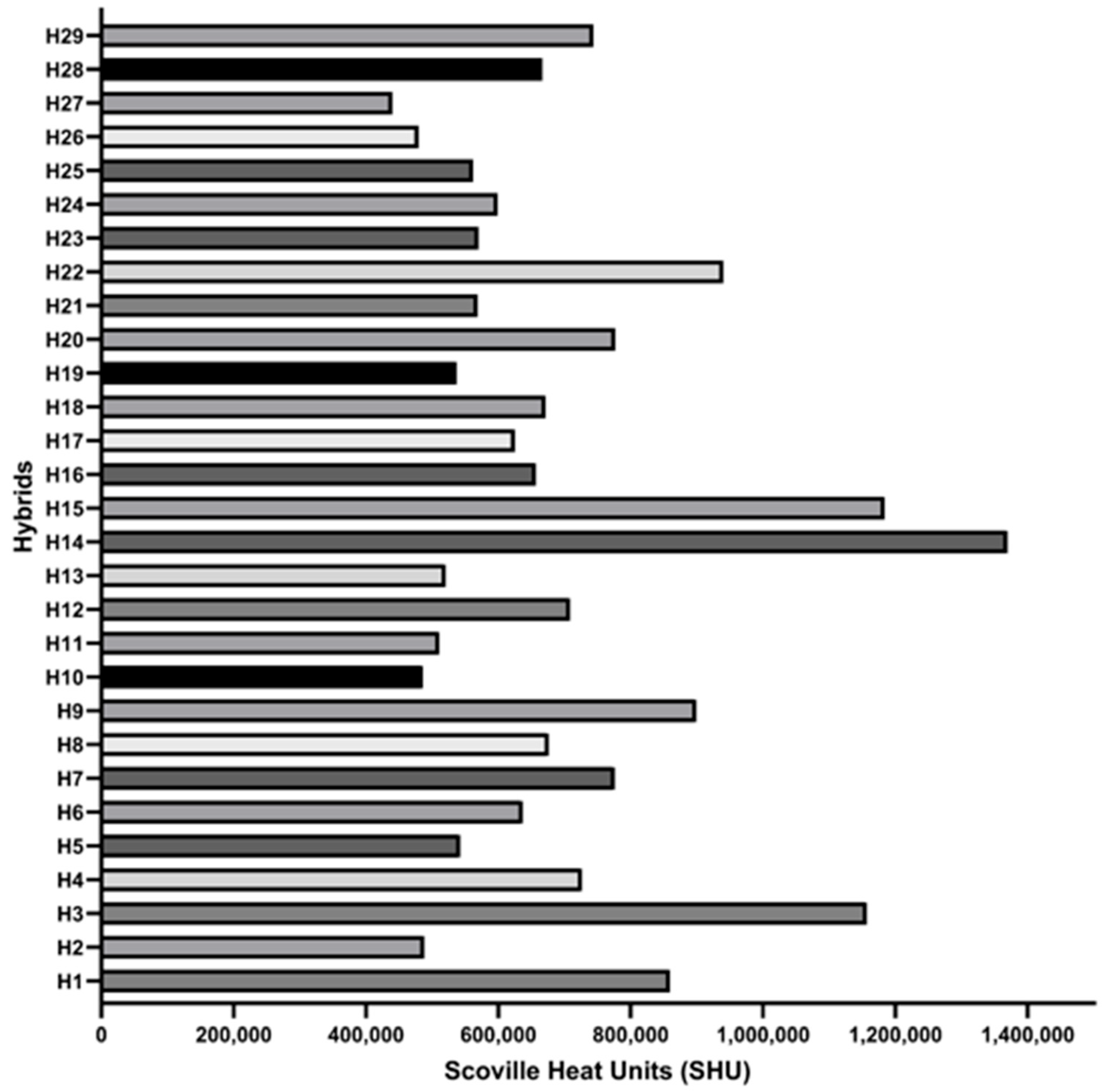
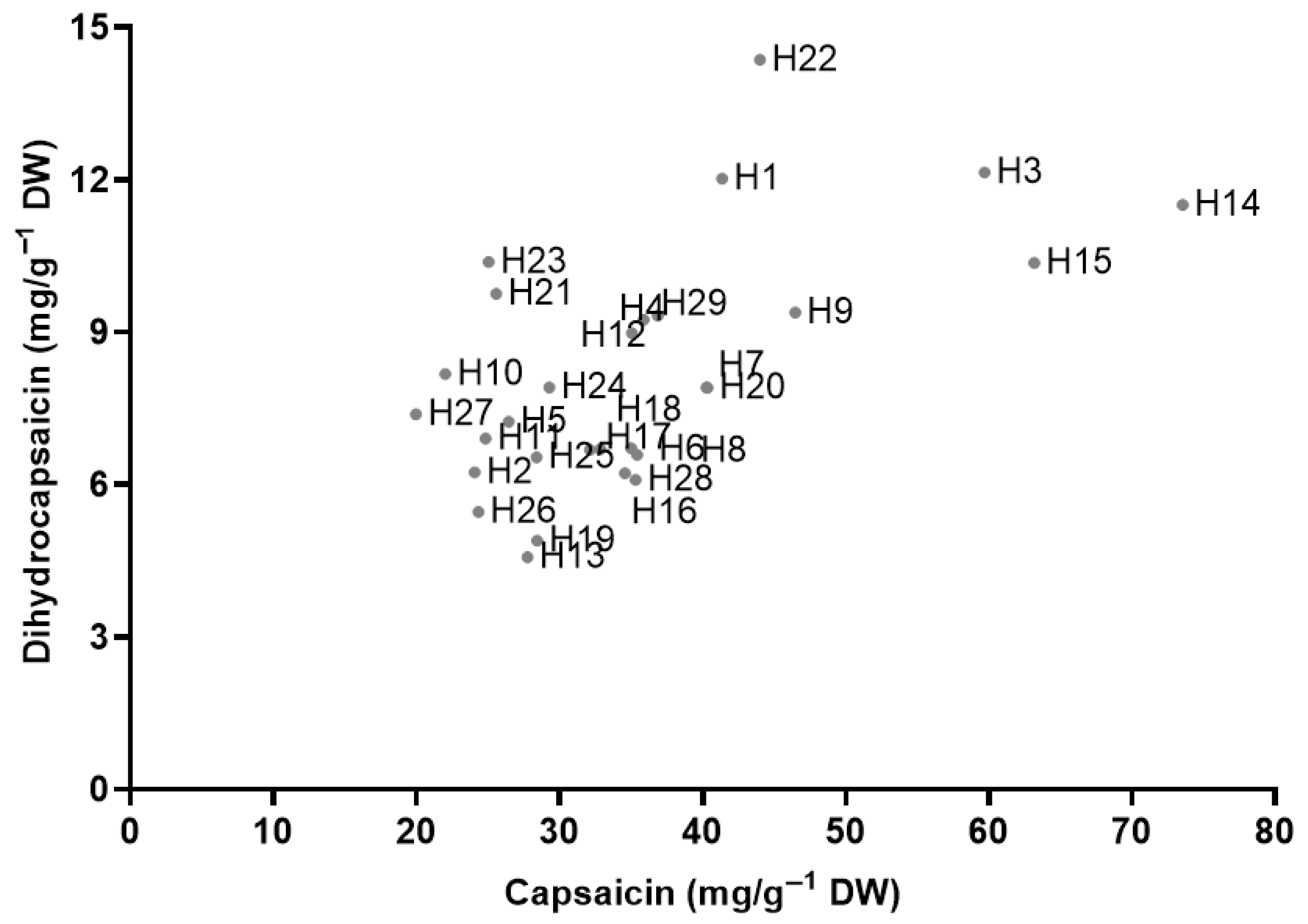
| Hybrids | H1 | 41.36 ± 2.19 f | 12.02 ± 0.47 b | 53.38 ± 2.67 d | 859,457 |
| H2 | 24.06± 1.09 nop | 6.24 ± 0.27 lmn | 30.30 ± 1.37 pqr | 487,852 | |
| H3 | 59.71 ± 0.22 c | 12.14 ± 0.01 b | 71.85 ± 0.23 b | 1,156,762 | |
| H4 | 35.88 ± 0.08 g | 9.24 ± 0.16 de | 45.12 ± 0.24 f | 726,415 | |
| H5 | 26.44± 1.87 klm | 7.23 ± 0.69 hijk | 33.67± 2.57 mno | 542,026 | |
| H6 | 32.84 ± 0.36 hi | 6.69 ± 0.21 jklm | 39.53 ± 0.57 ijk | 636,497 | |
| H7 | 40.27 ± 0.97 f | 7.91 ± 0.14 fg | 48.17 ± 1.11 e | 775,592 | |
| H8 | 35.42 ± 0.86 g | 6.58 ± 0.14 klm | 41.99 ± 1.00 ghi | 676,117 | |
| H9 | 46.47 ± 5.97 d | 9.38 ± 1.54 de | 55.85 ± 7.52 cd | 899,128 | |
| H10 | 22.00± 2.05 opq | 8.17 ± 0.82 f | 30.17 ± 2.87 pqr | 485,651 | |
| H11 | 24.83 ± 0.69 mn | 6.90 ± 0.22 ijkl | 31.73 ± 0.91 opq | 510,838 | |
| H12 | 35.04 ± 1.48 gh | 8.98 ± 0.52 e | 44.02 ± 2.00 fgh | 708,699 | |
| H13 | 27.74 ± 0.01 jkl | 4.57 ± 0.08 rs | 32.30 ± 0.09 nop | 520,069 | |
| H14 | 73.55 ± 0.50 a | 11.50 ± 0.04 b | 85.05 ± 0.55 a | 1,369,360 | |
| H15 | 63.18 ± 0.27 b | 10.36 ± 0.02 c | 73.54 ± 0.24 b | 1,183,915 | |
| H16 | 34.57 ± 0.10 gh | 6.22 ± 0.08 mn | 40.78 ± 0.19 ij | 656,592 | |
| H17 | 32.12 ± 1.04 i | 6.68 ± 0.23 jklm | 38.81 ± 1.27 jk | 624,786 | |
| H18 | 34.99 ± 3.33 gh | 6.71 ± 0.81 ijklm | 41.70 ± 4.14 ghij | 671,336 | |
| H19 | 28.43 ± 0.34 jk | 4.89 ± 0.03 qr | 33.33± 0.37 mno | 536,549 | |
| H20 | 40.32 ± 0.93 f | 7.90 ± 0.24 fgh | 48.22 ± 1.17 e | 776,263 | |
| H21 | 25.57± 1.98 lmn | 9.75 ± 0.86 cd | 35.32 ± 2.84 lm | 568,665 | |
| H22 | 44.00 ± 0.74 e | 14.36 ± 0.06 a | 58.36 ± 0.81 c | 939,608 | |
| H23 | 25.03 ± 0.24 mn | 10.38 ± 0.13 c | 35.41 ± 0.38 lm | 570,083 | |
| H24 | 29.28 ± 0.23 j | 7.91 ± 0.06 fg | 37.18 ± 0.30 kL | 598,651 | |
| H25 | 28.38 ± 0.77 jk | 6.53 ± 0.18 lm | 34.91 ± 0.96 lmn | 562,021 | |
| H26 | 24.31± 0.13 mno | 5.46 ± 0.15 opq | 29.76 ± 0.28 pqr | 479,204 | |
| H27 | 19.95 ± 0.94 qrs | 7.38 ± 0.36 ghi | 27.33 ± 1.31 rs | 439,979 | |
| H28 | 35.31 ± 0.01 g | 6.09 ± 0.11 mno | 41.40 ± 0.12 hij | 666,512 | |
| H29 | 36.86 ± 0.15 g | 9.32 ± 0.10 de | 46.18 ± 0.04 ef | 743,407 |
Disclaimer/Publisher’s Note: The statements, opinions and data contained in all publications are solely those of the individual author(s) and contributor(s) and not of MDPI and/or the editor(s). MDPI and/or the editor(s) disclaim responsibility for any injury to people or property resulting from any ideas, methods, instructions or products referred to in the content. |
© 2026 by the authors. Licensee MDPI, Basel, Switzerland. This article is an open access article distributed under the terms and conditions of the Creative Commons Attribution (CC BY) license.
Share and Cite
Muñoz-Ramírez, L.S.; Peña-Yam, L.P.; Pech-Jiménez, C.; Canto-Flick, A.; Guzman-Antonio, A.A.; Santana-Buzzy, N. Determination of Capsaicin and Dihydrocapsaicin in Habanero Pepper (Capsicum chinense Jacq.) Hybrids Cultivated in Yucatán, México. Crops 2026, 6, 18. https://doi.org/10.3390/crops6010018
Muñoz-Ramírez LS, Peña-Yam LP, Pech-Jiménez C, Canto-Flick A, Guzman-Antonio AA, Santana-Buzzy N. Determination of Capsaicin and Dihydrocapsaicin in Habanero Pepper (Capsicum chinense Jacq.) Hybrids Cultivated in Yucatán, México. Crops. 2026; 6(1):18. https://doi.org/10.3390/crops6010018
Chicago/Turabian StyleMuñoz-Ramírez, Liliana S., Laura P. Peña-Yam, Cristina Pech-Jiménez, Adriana Canto-Flick, Adolfo A. Guzman-Antonio, and Nancy Santana-Buzzy. 2026. "Determination of Capsaicin and Dihydrocapsaicin in Habanero Pepper (Capsicum chinense Jacq.) Hybrids Cultivated in Yucatán, México" Crops 6, no. 1: 18. https://doi.org/10.3390/crops6010018
APA StyleMuñoz-Ramírez, L. S., Peña-Yam, L. P., Pech-Jiménez, C., Canto-Flick, A., Guzman-Antonio, A. A., & Santana-Buzzy, N. (2026). Determination of Capsaicin and Dihydrocapsaicin in Habanero Pepper (Capsicum chinense Jacq.) Hybrids Cultivated in Yucatán, México. Crops, 6(1), 18. https://doi.org/10.3390/crops6010018