1. Introduction
The efficiency of cargo operations in open or insufficiently protected port areas depends directly on the dynamic behavior of a moored vessel subjected to wave and wind loads. Excessive linear and angular movements can interrupt cargo operations, damage port infrastructure, exceed permissible forces in mooring ropes and fenders, and increase operational risks.
In port management practice, the admissibility of cargo operations is determined by the established limits on the amplitude of the vessel’s translational and rotational movements. However, obtaining these amplitudes through detailed numerical modeling in the time domain is a complex and resource-heavy process. Incorporating hydrodynamic added masses, radiation damping, and mooring line and fender reactions, as well as aerodynamic and wave disturbances, requires solving a high-dimensional problem, which leads to a complicated operational decision-making process.
For most operational tasks, it is not important to obtain the full spectrum of dynamic response, but rather to quickly assess the compliance of the vessel’s movements with established regulatory restrictions. This is especially relevant for port control services, which must make decisions on the continuation or suspension of cargo operations under conditions of variable waves.
The issue of the dynamic behavior of moored vessels is addressed in numerous studies covering both numerical and experimental approaches to modeling the interactions among the vessel, mooring system, and berthing infrastructure. Regulatory documents, including PIANC WG 115 guidelines for fender design and the OCIMF recommendations for safe mooring arrangements, define the limits for loads and permissible vessel displacements during berth operations.
1.1. Hydrodynamic Modelling of Moored Ships
The norm-oriented criterion of admissibility for frequency control of moored vessel movements is based on the normative and design basis for mooring and wave consideration: the requirements for the design and verification of mooring solutions are specified in UFC 4-150-06 [
1], while consideration of hydrometeorological conditions for berths with insufficient wave protection is formalized in [
2]. At the level of active reduction of movements in mooring, relevant solutions are based on an intelligent active anti-roll platform [
3]. To transition to the frequency domain and construct a working linearized model of disturbances, classical dynamics of marine structures [
4], and basic ideas about the aerodynamic effects of the above-water part of the hull and the general theory of the ship are given by the Kossog method [
5] and the Voytkus–Pershits–Titov reference book [
6]. A comprehensive overview of modern mooring systems, their configurations, and operational principles relevant to the establishment of admissibility criteria is provided by Villa-Caro et al. [
7], while equivalent linearization techniques have been proposed to facilitate the analysis of nonlinear mooring dynamics [
8], and constant tension shore systems with configuration selection [
9]. The effect of tension mooring on the hydrodynamic response of moored vessels is substantiated numerically [
10] and experimentally [
11], while a more rigorous continuous description of the dynamics of the “floating body-lines” is supported by the finite-volume Simo–Reissner beam model [
12]. Practical considerations regarding safe mooring schemes using AI for real-time risk assessment [
13].
The key problem for norm-based admissibility is long-period and extreme disturbance components that provoke resonance and “rocking” in the harbor: the movements of moored ships induced by a tsunami in the port basin were studied in [
14], a spectral approach to assessing properties has been proposed for long-period movements [
15], and reproduction of the dynamic behavior of a ship model in response to a tsunami bore has been performed in [
16] and detailed by the influence of mooring line properties in [
17]. Specific hazardous scenarios include rogue waves, which induce position-dependent hydrodynamic responses in container ships [
18], as well as broader hydrodynamic interactions affecting marine structures [
19]. For tankers at mooring, the resonant mechanisms of sloshing and gap flow [
20] are significant, as well as the dependence of hydrodynamic efficiency in bow waves on restraint conditions [
21]. Real port disturbances are complemented by the passing ship effect, which is verified by large-scale physical experiments [
22] and a calculated estimate of mooring forces for different vessels (using the example of Busan New Port) [
23]; on this basis, risk assessments are formed for “moored+passing” [
24] and probabilistic approaches to mooring assessment in the context of port sustainability [
25]. Automation of mooring as a component of motion control takes into account harbor oscillations in the modeling of ship motions within an automatic system [
26], and the integrated “Ship–Fender–Mooring” model under complex sea conditions provides a direct bridge from spectral responses to normative acceptability criteria [
27].
1.2. Mooring Dynamics and Operational Safety
The development of robotic mooring and control contours with constraints/failures is represented by finite-time control of an intelligent mooring arm with saturation [
28], and the experimental dynamics of container ship mooring systems, taking into account waves, berth location, and line type, is investigated in [
29]. For ship outfitting, experimental studies of responses with/without pontoons in extreme conditions have been carried out [
30,
31], and criteria for safe mooring under swell conditions with experimental and numerical verification are given in [
32]. The transition from “assessment” to “forecasting” is provided by data-driven tension models: TimesNet is used for multi-period modeling of FPSO line tensions [
33], SAM-Bi-LSTM is used for short-term tension forecasting on a floating PV platform [
34], and a probabilistic superstructure is provided by Gaussian copula–Bayesian networks for dynamic loads [
35]. A hybrid Z-number Bayesian network [
36] is used to predict mooring line failures during cargo operations.
1.3. Port Safety, Monitoring, and Decision Support Systems
The frequency control and admissibility loop require information infrastructure and port context: proposals to improve the capabilities of coastal radars [
37] and solutions for passive/optical-acoustic receivers of radar systems [
38] support increased surveillance in the coastal zone. The hardware basis for controlling executive mechanisms (relevant for automated mooring/drives) is set by parametric synthesis of an electrohydraulic executive device [
39,
40]. The transport and port context, which explains the economic “weight” of admissibility criteria, is set by optimization of connections between ports using graph theory methods [
41], investment trends in the port industry [
42], and “green port dues” as an instrument of environmental investment [
43]. In addition, related safety and operational aspects of the maritime industry (energy efficiency, risks, hull integrity, cargo operations, autonomous platform surveillance) form the applied context for regulating permissible movements and loads in mooring through the work of the Ukrainian school and related areas [
44,
45,
46,
47,
48,
49,
50], as well as the architecture of Maritime Autonomous Surface Ships (MASS), which provides an integrated framework for autonomous navigation, sensor fusion, and control system coordination [
51].
Studies [
52,
53] establish the legal and organizational framework for maritime operations, whereas [
54,
55] highlight the importance of technical reliability through propulsion system diagnostics and performance assessment [
56]. In the safety domain, [
57,
58,
59] address collision mitigation, advanced technologies, and maneuvering control. Collectively, these studies support the development of admissibility criteria for controlling moored ship motions under environmental load conditions.
Despite the substantial progress achieved in hydrodynamic modeling, mooring system analysis, and operational safety assessment, existing studies primarily focus on detailed numerical prediction of vessel motions rather than on direct operational admissibility evaluation. In particular, there remains a lack of computationally efficient criteria capable of translating complex dynamic responses into clear go/no-go decisions for cargo operations under environmental loading conditions. This gap motivates the development of the norm-based admissibility framework proposed in the present study.
This paper proposes an engineering criterion for the admissibility of moored vessel movements, formulated in the frequency domain based on the norms of the rows of the system matrix of oscillation equations. Unlike the classical approach, which requires explicit inversion of a 6 × 6 matrix to determine transfer functions, the proposed method allows assessment of the compliance of amplitudes with specified restrictions without performing a complete inversion procedure.
This approach provides a fast and computationally efficient tool for engineering assessment of mooring conditions, analysis of the impact of mooring line layout and their initial tension, and decision support regarding the safety of cargo operations under given hydrometeorological conditions.
The scientific contribution of this study lies in the development of a norm-based admissibility criterion formulated directly in the frequency domain without explicit inversion of the six-degree-of-freedom system matrix. Unlike conventional approaches relying on full time-domain simulation, the proposed method enables a computationally efficient sufficient condition for compliance with operational motion limits. This study further introduces an operational admissibility index and a safety margin metric suitable for port-level decision-making. Through parametric sensitivity analysis, the relationships among mooring pretension, line geometry, excitation frequency, and admissibility compliance are systematically quantified. The proposed framework thus establishes a linkage between classical hydrodynamic modelling and practical port operation control by providing a rapid engineering decision support tool.
Although modern numerical tools can efficiently calculate Response Amplitude Operators and complete vessel responses, practical port operation often requires rapid screening of multiple mooring arrangements, pretension levels, and environmental scenarios. In such situations, the proposed norm-based admissibility criterion provides a conservative engineering estimate of compliance with operational limits without repeated solution of the complete coupled response problem. Therefore, the proposed approach does not replace full-scale calculation of a vessel’s hydrodynamic parameters, but rather serves as an applied algorithm for real-time monitoring of the situation and the initial selection of a mooring arrangement.
Unlike classical calculations based on Response Amplitude Operator (RAO) procedures, the advantage of the proposed standardized criterion lies in the automatic calculation of the facility’s operational readiness index, rather than a cumbersome description of its movements. Port personnel receive a clear algorithm of actions without the need for complex engineering analyses. As a result, mathematical calculations in the frequency domain are transformed into an applied decision support system ready for use directly at the berth complexes.
The remainder of this paper is organized as follows.
Section 2 presents the adopted modeling assumptions and methodological framework.
Section 3 develops the mathematical formulation of the coupled ship–mooring system.
Section 4 derives the proposed norm-based admissibility criterion.
Section 5 presents numerical verification and parametric analyses.
Section 6 discusses the obtained results and their relation to previous studies. Finally,
Section 7 summarizes the main conclusions and practical implications for port engineering applications.
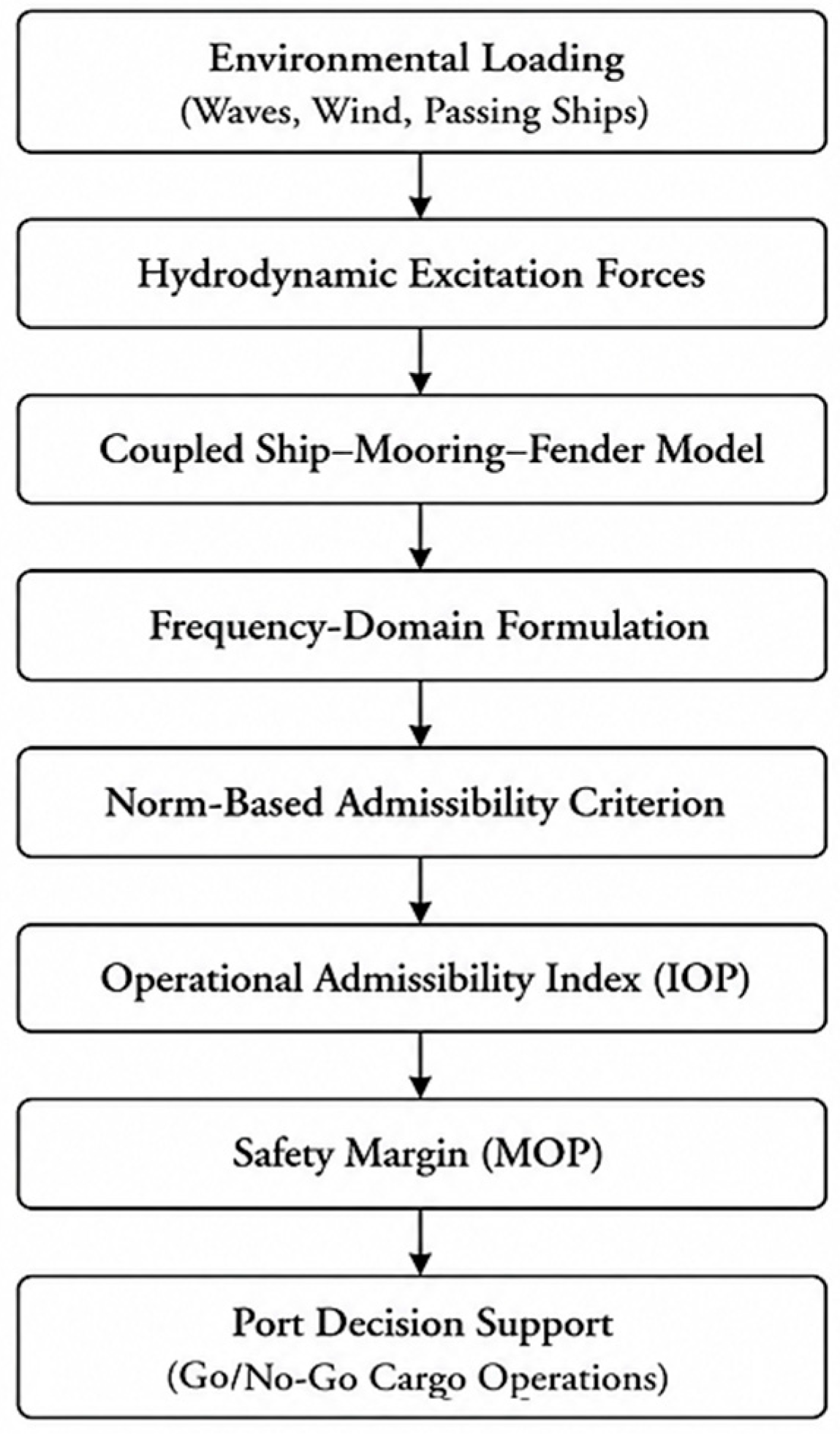
The overall methodology adopted in this study is summarized in
Figure 1. The framework illustrates the transformation of environmental loading conditions into operational admissibility indicators through frequency-domain analysis and norm-based assessment.
2. Materials and Methods
As shown in
Figure 1, the proposed framework combines hydrodynamic modelling, frequency-domain response analysis, and norm-based admissibility evaluation into a unified decision support procedure suitable for port operational applications.
A linear frequency model of a moored vessel with six degrees of freedom is used to develop the admissibility criterion. The choice of a linear formulation is justified by the fact that regulatory restrictions on movement amplitudes are set for relatively small displacements, for which the assumption of linearity is appropriate.
A system of motion equations is considered, including
matrix of inertial and added masses;
matrix of hydrodynamic damping;
matrix of hydrostatic restoring stiffness;
matrix of mooring line stiffness;
matrix of fender reactions;
wave and wind disturbance vector.
Mooring lines are modeled as linear elastic elements with pretension, operating within the limits of small deformations. Nonlinear dry friction between the ship’s hull and fenders is replaced by equivalent viscous damping, determined from the condition of equal energy losses per cycle of harmonic oscillations.
The system of equations is transformed into the frequency domain, which allows analysis of the amplitude–frequency characteristic without integrating the system in the time domain. Further formation of the criterion is based on estimates of the norms of the rows of the system matrix without explicit inversion of the 6 × 6 matrix. To verify the method, the calculation data of a 80,000-ton deadweight bulk carrier moored to a berth with SPC 900 G1.1 rubber fenders under specified storm wave conditions were used.
A series of studies [
5,
14,
15,
17] investigates, experimentally and numerically, the influence of mooring arrangements on ship behavior under tsunami conditions, particularly the effect of line geometry on wave response. In [
5], a method for evaluating vessel behavior under long-period wave conditions is proposed, based on estimating the energy of the system’s frequency response. If the dynamic system is described in the frequency domain by
, then the RAO is defined as a ratio of norms
. Its energy is given by
, where
is the standard long-period wave spectrum.
The Response Amplitude Operator (RAO) represents the ratio between the motion response amplitude and the corresponding wave excitation amplitude in the frequency domain.
As shown in the cited studies, the behavior of the same vessel under identical wind and wave conditions differs mainly due to the mooring arrangement: the number, layout, and tension of mooring lines. Thus, the variable parameters are the line vectors, their number, and pretension. An inverse problem can therefore be formulated: given limits on linear and angular motions, determine a mooring arrangement that ensures compliance with these constraints. Such a criterion, depending only on hydrodynamic characteristics and external forces and expressed in a closed form, can serve as a simple engineering tool for deciding whether cargo operations are permissible.
Such an assessment criterion can generally be derived in closed form only for a linear formulation. However, it is reasonable to assume that acceptable motion limits are defined for relatively small external loads. The aim is not to minimize amplitudes through optimization, but to select a mooring scheme that keeps motions within port regulations and avoids downtime.
Therefore, this study adopts a linear approximation of the moored ship motion problem. The physical situation and significant motion constraints justify the use of a linear model. This greatly simplifies the determination of motion amplitudes, natural frequencies, and resonance conditions. Nonlinear effects may arise from nonlinear line behavior and fender friction. The linear system of six motion equations in matrix form allows relatively simple derivation of transfer functions for translational and rotational motions. These functions enable analysis of key characteristics in both direct and inverse problems: in the direct problem, motion amplitudes determine forces in mooring lines and quay fittings; in the inverse problem, limits on motion amplitudes define constraints on line vectors, their number, and pretension.
To evaluate the robustness of the proposed admissibility criterion, an additional computational framework based on Monte Carlo simulation was implemented. The stiffness of mooring connections and damping coefficients were treated as uncertain variables with a normal distribution of their deviations from nominal values. The ensemble of system responses formed in this way allowed for quantification of uncertainty bands and verification of the stability of predictions of admissible states. The developed formalization is based on the assumption of small ship oscillation amplitudes and moderate mooring line deformations. In the verification test cases considered in this paper, the initial elongation of the ropes varies in the range from 1% to 2%, while the limiting angular displacements are restricted to an approximate value of 1 degree. The proposed formulation is therefore intended for operational screening rather than replacement of detailed nonlinear hydrodynamic simulations.
Within the specified operating range, both the restoring forces of the mooring lines and the reactions of the fenders can be adequately approximated using equivalent linear stiffness coefficients. Consequently, the linear frequency-domain formulation provides an adequate representation of the system dynamics.
At the same time, it should be noted that, under storm load conditions, which are accompanied by significant elongation of the connections, substantial compression of the fenders, periodic slackening of the ropes, or impact contact phenomena, nonlinear effects may become dominant. In such scenarios, a more accurate description of the ship’s response can be provided by nonlinear modeling in the time domain, which should be positioned as a complementary analysis tool.
To ensure clarity and avoid ambiguity in terminology, the following acronyms and abbreviations used in the study are presented in
Table 1.
The present formulation focuses on first-order wave-frequency motions. Second-order slow-drift forces and associated low-frequency excursions are not included, because the objective of this study is the development of a rapid admissibility criterion for operational screening. For severe low-frequency resonance problems, dedicated time-domain analysis remains necessary.
3. Mathematical Formulation
3.1. Kinematics
The following coordinate systems are introduced: —a fixed coordinate system with unit vectors ;
—a moving coordinate system with unit vectors ;
—the position vector of the center of mass G in the fixed coordinate system ;
—the velocity of the center of mass G in the fixed coordinate system ;
—the relative position vector of point A of the ship hull in the moving coordinate system .
The ship performs translational and rotational motions with small amplitudes and velocities. It is assumed that
where
is the angular velocity of ship rotation. The transformation matrix from the moving coordinate system
to the fixed
one has the following form:
were φ is rotation angles about the
Gx,
is rotation angles about the
Gy, and
θ is rotation angles about the
Gz. Owing to the smallness of these angles, an axial vector of rotations is introduced
, and angular velocity is
. In projections onto the axes of the moving coordinate system
, the position vector of point
G has the following form:
In the linear formulation of the problem, terms containing products of small quantities are neglected.
The position vector of point A of the ship hull in the moving coordinate system has the following form:
In the linear model, the velocity of this point is equal to
or, in projections onto the axes of the moving coordinate system
The acceleration of point
A of the ship hull in the moving coordinate system, in the linear formulation of the problem, is equal to
or, in projections onto the axes of the coordinate system
3.2. Equations of Motion
In accordance with the general theory of linear ship oscillations, the system of equations can be written in vector form as
where
,
is the matrix of added and rigid-body masses;
M is the hydrodynamic damping matrix;
Ff is the matrix of friction forces and moments arising from hull–fender interaction;
Fbp is the stiffness matrix associated with the elastic response fenders;
Fc is the stiffness matrix associated with the elastic response of mooring lines;
Fr is the matrix of hydrostatic restoring forces and moments;
is the vector of generalized external excitation forces due to waves and wind; and
Λ denotes the added-mass matrix accounting for the inertia of the surrounding fluid induced by vessel oscillations.
3.3. Hydrodynamic and Hydrostatic Forces
Given to the small magnitude of ship inclination angles, the displacement is assumed to be constant, and the increment of volume during vertical oscillations is proportional to the waterline area of the ship in the equilibrium state. The restoring force is equal to
, where
is the waterplane area. The transverse restoring moment is equal to
where
, the transverse metacentric radius of the ship, and the vertical coordinate of the centre of buoyancy are taken into account. The longitudinal restoring moment is equal to
where
, the longitudinal metacentric radius of the ship, is used. In nondimensionalized coordinates, the hydrostatic restoring matrix
contains non-zero elements only for the vertical and angular degrees of freedom:
where
fr33 corresponds to the vertical restoring stiffness (heave), while
fr41 and
fr52 represent the hydrostatic restoring moments associated with roll and pitch motions, respectively.
3.4. Mooring System Model
For the main practical purpose of the study––the development of recommendations for ship berthing conditions and cargo handling operations in ports––it is quite natural to evaluate the maximum loads and displacements of a vessel under the action of waves and wind. Although wind loads are random in nature, it is still possible to distinguish a time-averaged wind speed and its random fluctuations. The aerodynamic coefficients of the above-water part of a vessel strongly depend on the shape and arrangement of superstructures and cargo-handling equipment, and their calculation using modern methods [
6] requires detailed information of this kind. However, taking into account that extreme loads are being evaluated, the present study adopts well-established methods for calculating the aerodynamic characteristics of ships, in accordance with [
3]. The resistance coefficients are
The components of the aerodynamic force vector
are as follows:
where
is the air density,
is the wind velocity, and
is the projected areas of the ship’s above-water part corresponding to surge and sway, respectively. The remaining components of the aerodynamic excitation vector are neglected in the present formulation.
The mean wind forces calculated from Equations (11) and (12) are incorporated into the generalized excitation vector F(ω) appearing in Equation (22). Within the adopted frequency-domain formulation, these forces are treated as quasi-steady external loads superimposed on the wave-induced excitation components.
3.5. Mooring, Fender, and Friction Modelling
Let us introduce the following notation:
—the position vector of the i-th bow (stern) bollard on the quay in the fixed coordinate system ; —the position vector of the attachment point of the bow (stern) mooring lines on the ship in the fixed coordinate system ; —the position vector of the attachment point of the bow (stern) mooring lines on the ship in the moving coordinate system ; —the vector directed along the i-th bow (stern) mooring line in the fixed coordinate system .
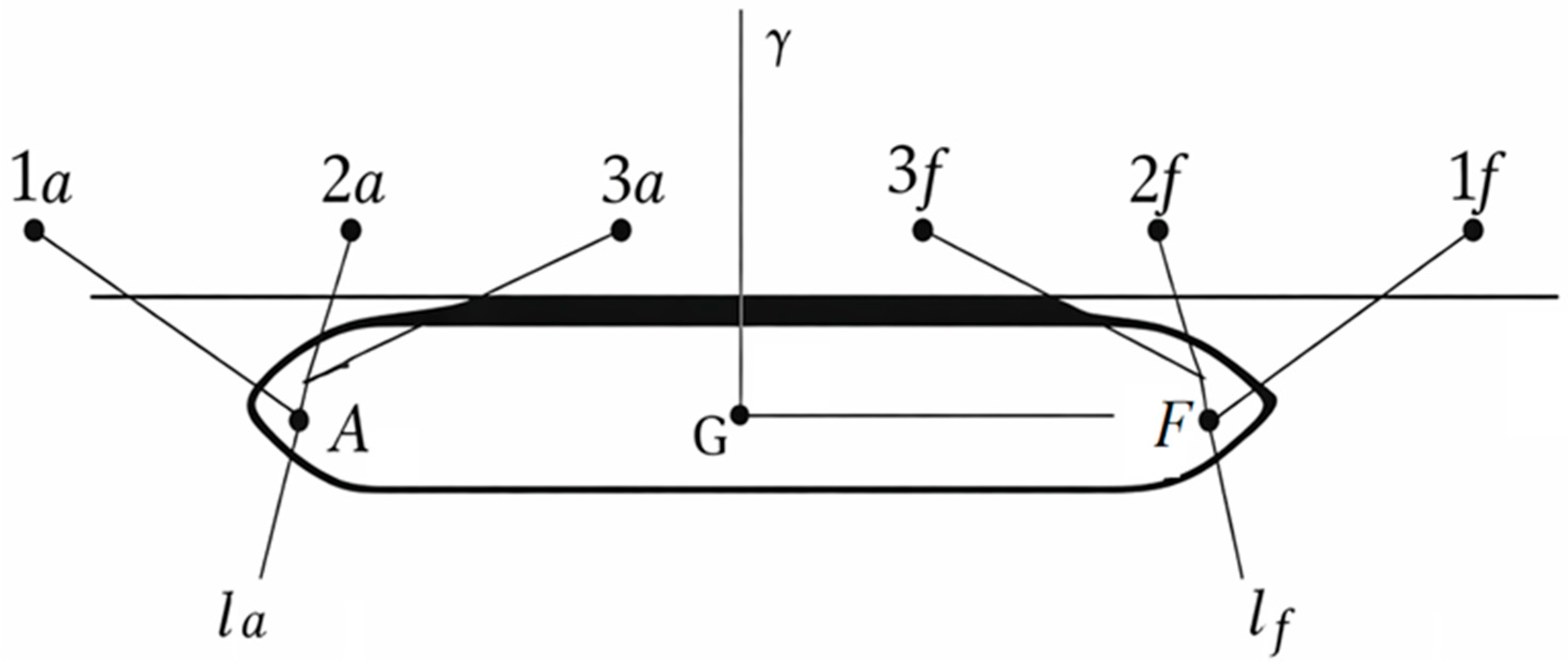
To formalize the geometry of the mooring system, the spatial arrangement of bow, stern, breast, and spring lines is introduced. The orientation of each line determines the contribution of its tension to the generalized forces and moments acting on the vessel. Since the admissibility criterion is directly dependent on the stiffness matrix of the mooring system, an explicit geometric representation is required.
The adopted mooring configuration is shown in
Figure 2.
Figure 2 illustrates the classical “longitudinal breast spring” arrangement. Lines 1f and 1a correspond to bow and stern longitudinal lines, 2f and 2a represent forward and aft breast lines, and 3f and 3a denote forward and aft springs, respectively. The geometry defines the direction vectors of each mooring line, which directly influence the components of the stiffness matrix
Km.
The schematic configuration is intentionally simplified to illustrate the mathematical derivation. The developed formulation is not restricted to this arrangement and is applicable to arbitrary practical mooring layouts consisting of multiple breast lines, springs, headlines, and stern lines.
The effectiveness of the mooring system in restraining specific degrees of freedom depends not only on-line stiffness, but also on the projection of each line vector onto the principal motion axes. Therefore, geometric configuration becomes a key parameter in admissibility evaluation.
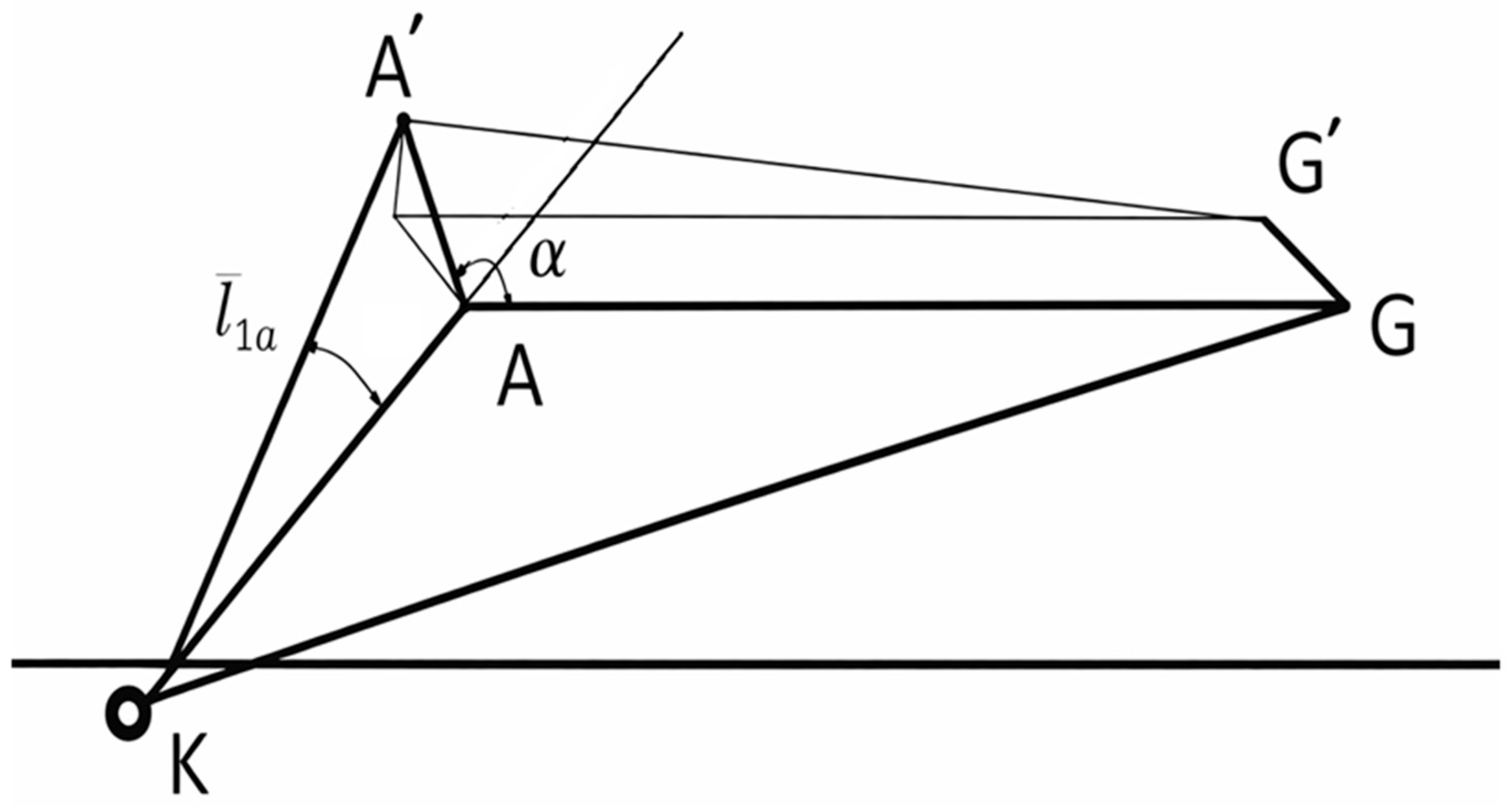
For analytical derivation of the stiffness contribution of each mooring line, a vector formulation is introduced. The relative position of the ship bollard and the quay bollard determines the instantaneous line vector and its elongation under vessel motion.
The geometric relationships used in the formulation are presented in
Figure 3.
Figure 3 illustrates the geometric configuration used for evaluating mooring line elongation resulting from vessel motion. Point K denotes the shore bollard location, A and A′ represent the initial and displaced fairlead positions, while G and G′ indicate the corresponding vessel reference positions before and after motion, respectively. The elongation of the mooring line is determined from the change in distance between K and the fairlead position, and the angle α characterizes the line orientation with respect to the vessel reference frame.
The given figure is intended to illustrate the generic geometry required for analytical derivation of the admissibility criterion. The proposed formulation is not restricted to this configuration and can be extended to arbitrary mooring layouts through modification of the corresponding line vectors.
This geometric representation enables linearization of line elongation with respect to small translational and rotational displacements of the vessel. As a result, the generalized mooring force vector can be expressed in matrix form and directly incorporated into the global system matrix of motion equations.
In the initial equilibrium configuration, the mooring lines have lengths . For an arbitrary ship position, the mooring line vectors are defined as which follows directly from the mooring geometry. Consequently, the elongation of each mooring line depends linearly on the displacements of its attachment point on the ship, i.e., on the translational motions of the center of mass G and the rotational motions of the vessel.
Mooring lines are assumed to be pretensioned to a prescribed initial force. In the present study, the initial pretension corresponds to a 1–2% elongation of the mooring lines—
, which ensures operation within the elastic regime. Under this assumption, the tension in the
i-th mooring line is given by
where
is the stiffness coefficient of the
i-th mooring line,
is its elongation, retaining only linear terms in the motion variables, and
. It follows that
. Next, obtain the expression
and
, retaining only linear terms of the rope length. The moment
of the mooring force
about the ship’s center of mass
G is calculated as
Generalized force vector has a simple appearance as
Introduce notations for the components of the
:
;
;
; and
. Then, the projections of forces and moments
in the body-fixed coordinate system
are
The total generalized forces and moments generated by all bow and stern mooring lines are obtained by summation over all lines: , . In matrix form, the mooring system contribution to the equations of motion can be written as . Then, the force vector is defined as the product of the matrix Fc by the vector of generalized displacements: .
3.6. Frequency-Domain Representation
Normal reactions. The fenders considered have the form of a monolithic cylinder made of elastic material. They are arranged along the quay line and are in contact with the ship along the length of the cylindrical insert. Let
denote the contact area of the fender with the ship hull, referred to a unit length of the ship. In the equilibrium state of the moored ship, the width of the contact strip is
, and the fender is compressed along its entire length by the value
. The reaction force
exerted by the fender on the ship balances the transverse component of the mooring line forces pressing the vessel against the quay. In the equilibrium position, this force is uniformly distributed over the contact area
with the ship:
. When the ship moves, the fender is compressed by the hull non-uniformly along its length; that is, the deformation
is a function of the contact point with the ship. The elementary elastic reaction of the fender acting on an element of the contact area is proportional to the local deformation
, where
is the elastic stiffness coefficient of the fender material. The deformation of the fender
is equal to the transverse displacement of the contact point A of the ship relative to the equilibrium position; that is,
, or, in coordinate form
. To determine the total normal force, it is necessary to integrate the elementary reaction
over the contact area with the ship. Integration of terms over the contact area yields expressions of the form
, which can be expressed in terms of the coordinates of the resultant normal force as
The elementary moment of the fender reaction force relative to point
G is equal to
or, in coordinate form, the corresponding projections
;
; and
. The resultant moment of the fender reaction forces is determined by integrating these expressions over the contact area. Integration of terms over the contact area yields expressions of the form
Integrating the resultant moment with respect to the coordinate yields the following expression:
The forces and moments of the elastic reaction of the fenders can be represented in matrix form . Then, the vector of forces is determined as the product of the corresponding matrix and the vector of generalized displacements .
Hull–Fender Friction Forces. The friction forces between the ship and the quay fenders are taken into account within the framework of a dry friction model, which introduces nonlinear behavior of the system and does not allow a simple criterion for admissible oscillation amplitudes to be obtained. In engineering practice, nonlinear friction is often replaced by viscous linear friction that is equivalent to dry friction in an energetic sense [
4,
18]. With such a replacement, the damping force is chosen so that the energy dissipated over one oscillation cycle of the ship coincides with the actual energy losses. The dry friction force acting on an element of the contact area
is equal to
, where
is the normal force pressing the ship against the quay, and
is the coefficient of dry friction between metal and the rubber of the fender. For harmonic ship motions, the work performed by the dry friction force over one oscillation cycle can be evaluated using the dominant motion components:
. The viscous friction force is equal to
. The work of viscous friction over one oscillation cycle is determined accordingly:
. By integrating over the entire contact area and equating the expressions for the work, the equivalent damping coefficient is obtained:
. Thus, the elementary friction force can be written in the form
. The elementary moment of the friction force is
. After integration over the contact area with the fenders and neglecting terms containing products of small quantities, the total force and moment are obtained in the form
Let us return to the main problem of this study and specify it. The purpose of this study is to develop an engineering method for evaluating the compliance of ship motion amplitudes with the prescribed limits and, if possible, their correction by changing the mooring arrangement. As noted above, the only variable parameters of the system are the force coefficients of the mooring lines, which depend on their number, arrangement, and pretension. Therefore, the coefficients of the stiffness matrices and of the mooring lines depend on the optimized parameters, namely the vectors of the mooring lines . The selection of an appropriate mooring arrangement requires ensuring a sufficient stability margin for the oscillatory response of the moored vessel.
Let us write the system of equations of ship oscillations in the frequency domain:
Here and below, bold uppercase symbols denote matrices or generalized vectors, depending on their algebraic role. In particular, A(ω), , B, and K denote matrices, whereas X(ω) and F(ω) denote generalized response and excitation vectors, respectively. Single vertical bars ∣⋅∣ are used for scalar absolute values, while double vertical bars ∥⋅∥ denote vector or matrix norms.
4. Development of the Norm-Based Admissibility Criterion
The purpose of this section is to formally derive an engineering criterion that allows assessment of the compliance of the amplitudes of movements of a moored vessel with established regulatory restrictions, without explicit inversion of the system matrix.
In the frequency domain, the system looks like A(ω)X(ω) = F(ω), where A(ω) is the comprehensive system matrix, X(ω) is the vector of movement amplitudes, and F(ω) is the vector of disturbing forces.
Regulatory restrictions are set in the form of ∣Xi∣ ≤ Xi, lim.
Let us introduce the operational acceptability index: . The boundary condition for admissibility is as follows: Iop,i ≤ 1. Since X = A−1F, then, using the properties of matrix norms, we have the estimate ∥X∥∞ ≤ ∥A−1∥∞∥F∥∞.
Further application of estimates for ∥A−1∥∞ due to diagonal dominance and the number of conditions allows a sufficient condition for satisfying the constraints to be obtained without explicit matrix inversion.
Thus, the admissibility criterion can be formulated as a system of inequalities along the rows of the matrix, thereby allowing assessment of the impact of the mooring configuration on compliance with regulatory requirements.
4.1. Formulation of Amplitude Constraints
In the context of practical port regulations, the admissibility of cargo operations is delineated by explicit upper limits imposed on each translational and rotational motion component. These constraints represent the operational tolerances within which the safe handling of cargo and the structural integrity of the vessel are ensured.
The following limitations are to be formalized in vector form. According to the conditions on motion amplitudes, limitations on the components of the vector are specified:
. As a rule, these are the requirements of port authorities for translational and angular ship motions during which cargo handling operations at a quay are permitted. Let us write the system of limitations on motion amplitudes
in the form
4.2. Row-Wise Norm-Based Inequality
After introducing component-wise motion constraints, the next step is to transform them into a practical matrix-based condition that can be evaluated without explicit inversion of the frequency-domain system matrix. For this purpose, the infinity norm is used, since it allows the admissibility condition to be assessed row-wise and is therefore directly consistent with degree-of-freedom-specific motion limits.
In this form, the limitations on the response vector implicitly specify the limitations on the system matrix, which in fact constitutes the criterion of stable ship motion under constraints. The problem is to present these conditions in the form of finite relations convenient for practical application, without solving system (12). Since the limitations on motion amplitudes are not equivalent for all degrees of freedom, the use of component-wise limitations is more reasonable. The solvability of the system is determined by the Neumann criterion for invertibility of the matrix : . Using the properties of the norm of the inverse matrix, as well as the norm of the product of matrices, this criterion can be strengthened: . Further, using the identity transformation and the properties of matrix norms, the system of inequalities can be written in the form . It should be noted that all norms are taken as infinity norms, since the greatest interest is in estimating the limitations by the rows of the system. By performing standard estimates of matrix norms, this inequality can be reduced to a form in which the norms of matrices depending on the variable parameters of the mooring arrangement are separated from the remaining terms: , where is the condition number of matrix A. For a matrix scaled by its own diagonal, .
It should be noted that all matrices of the system are Hermitian with diagonal dominance, since the diagonal elements of the inertia matrix, the damping matrix, and the stiffness matrix of the mooring system correspond to the principal directions of force action, while the off-diagonal elements represent only the mutual coupling of these directions. Let us write this inequality for each row of the system:
where
, and
,
. All components appearing in this inequality are known as characteristics of the ship, characteristics of the mooring arrangement, and characteristics of the wave regime. Therefore, evaluation of the limitations on the amplitudes of linear and angular ship motions can be performed using a sufficiently simple algorithm.
The derived admissibility framework is general and independent of vessel type, provided that the system matrices are properly constructed for the considered configuration.
Table 2 presents the principal mathematical symbols used in the analysis.
To facilitate engineering interpretation of the proposed admissibility criterion, its practical range of applicability is summarized in
Table 3. The table defines the principal assumptions adopted during model development and indicates the operational conditions under which the proposed formulation provides reliable engineering estimates.
As shown in
Table 3, the proposed formulation is intended for operational screening within the range of small vessel motions and elastic behavior of the mooring system. Outside these assumptions, nonlinear time-domain simulations remain the preferred approach for detailed engineering analysis.
5. Numerical Verification and Parametric Analysis
The proposed admissibility criterion was subsequently evaluated under representative operational conditions in order to verify both its engineering consistency and its practical applicability. Particular attention was paid to the influence of mooring pretension, line geometry, and environmental loading, since these parameters directly affect operational admissibility under real port conditions.
The purpose of this section is twofold. The first purpose is to verify the consistency and conservativeness of the proposed norm-based admissibility criterion by comparison with the complete frequency-domain solution. The second purpose is to quantify the sensitivity of admissibility compliance to variations in key operational parameters, including mooring pretension, line geometry, and excitation frequency.
The numerical investigation is structured as follows. A baseline storm scenario is considered for a representative bulk carrier moored at a quay equipped with SPC 900 G1.1 fenders. Hydrodynamic coefficients were evaluated for finite water depth conditions corresponding to the actual berth depth of 17 m. Motion amplitudes are evaluated using both the exact matrix inversion approach and the proposed norm-based estimate. Subsequently, parametric variations are introduced to assess the robustness of the criterion and its suitability for port-level decision-making. The following subsections present the baseline admissibility evaluation and a systematic parametric analysis.
5.1. Baseline Verification Case
To validate the proposed admissibility criterion under realistic operating conditions, an industrial-scale bulk carrier is considered as a representative verification case. The vessel has a length of 240 m, beam of 38 m, and deadweight of 80,000 t. The full-load draught equals 15 m.
The berth configuration corresponds to a 270 m long quay equipped with SPC 900 G1.1 fenders. Environmental loading represents storm conditions with significant wave height 3.5 m, wavelength 55 m, and wave period 5 s. The wave direction is assumed to be parallel to the quay, representing a critical excitation scenario for horizontal motions.
Hydrodynamic coefficients used in the numerical verification were obtained using a three-dimensional boundary-element formulation based on linear potential flow theory. Radiation, diffraction, added-mass, and wave-excitation effects were evaluated numerically for finite water depth corresponding to the actual berth geometry. Berth proximity effects were incorporated through the adopted boundary conditions. The resulting hydrodynamic coefficients were subsequently assembled into the global six-degree-of-freedom frequency-domain model presented in
Section 3.
The hydrodynamic coefficients employed in the present verification were obtained using a three-dimensional boundary-element formulation based on linear potential-flow theory. Radiation, diffraction, added-mass, and wave-excitation effects were evaluated for finite water depth corresponding to the actual berth geometry. The berth proximity was incorporated through the adopted boundary conditions applied during the hydrodynamic analysis.
Operational motion limits were adopted according to cargo-handling safety requirements. Vertical motions were limited to 0.5 m to prevent interaction of loading equipment with deck structures, while angular motions were restricted to 1° to avoid excessive dynamic loads in shipboard handling systems. The baseline admissibility assessment for the considered configuration is summarized in
Table 1.
For comparison, the results of solving the complete differential problem of ship oscillations at a quay are also presented. In each table, two calculations are shown: one for the classical mooring arrangement “longitudinal breast spring lines” and one for a deliberately poor arrangement without breast lines and springs, in order to demonstrate the response of the criterion to variations in the arrangement and pretension of mooring lines.
The criterion reflects this behavior through negative values of the operational safety margin Mop = 1 − Iop, indicating a sufficient reserve with respect to regulatory limits. For the partially loaded condition, however, the dynamic response becomes substantially more sensitive to the mooring configuration. Longitudinal (surge) and vertical (heave) motions, as well as pitch, approach or exceed the prescribed admissibility thresholds, resulting in Iop > 1 for the governing degrees of freedom. This clearly demonstrates that reduced displacement increases system flexibility and shifts the dynamic balance between excitation and restoring forces.
The introduction of additional bow and stern spring lines significantly reduces longitudinal motion amplitudes by increasing effective horizontal stiffness. Nevertheless, vertical motions and pitch cannot be reduced to the required limits solely by modifying horizontal line configuration. This limitation is physically explained by the small inclination angles of the mooring lines relative to the quay, which produce insufficient vertical restoring components to counteract wave-induced heave and pitch excitation.
From an engineering perspective, this result highlights that admissibility assessment must focus primarily on the governing motion components rather than on overall stiffness increase. Under the considered environmental loading conditions, vertical motions and pitch represent the controlling admissibility parameters. Therefore, optimization of the mooring arrangement should prioritize enhancement of vertical restraint or mitigation of resonance proximity, rather than merely increasing pretension or adding horizontal lines.
Table 4 and
Table 5 summarize the admissibility assessment for two initial rope elongation levels. A reduction of pretension from 2% to 1% results in a pronounced increase in surge amplitude, causing the admissibility index to exceed unity and triggering operational restriction. This confirms that pretension is a critical control parameter influencing compliance, particularly for horizontal degrees of freedom.
To demonstrate the engineering behavior of the proposed criterion, two representative pretension levels were analyzed. The first case corresponds to the recommended initial elongation of 2%, whereas the second represents a reduced pretension of 1%. Their comparison illustrates the sensitivity of admissibility to practical mooring adjustment.
The extremely small pitch amplitudes observed in the analyzed configuration result from the combined effect of high longitudinal restoring stiffness and limited pitch excitation under beam-wave conditions. Their values therefore reflect the physical characteristics of the considered configuration, rather than numerical artefacts.
To demonstrate applicability of the proposed admissibility criterion, a representative bulk carrier moored with full cargo is considered. The environmental loading corresponds to a storm scenario with prescribed wave parameters. The mooring arrangement follows a standard longitudinal breast spring configuration. In the base case, a standard mooring scheme with uniform preliminary tension of the ropes is adopted. The obtained displacement amplitudes compared to the maximum permissible values.
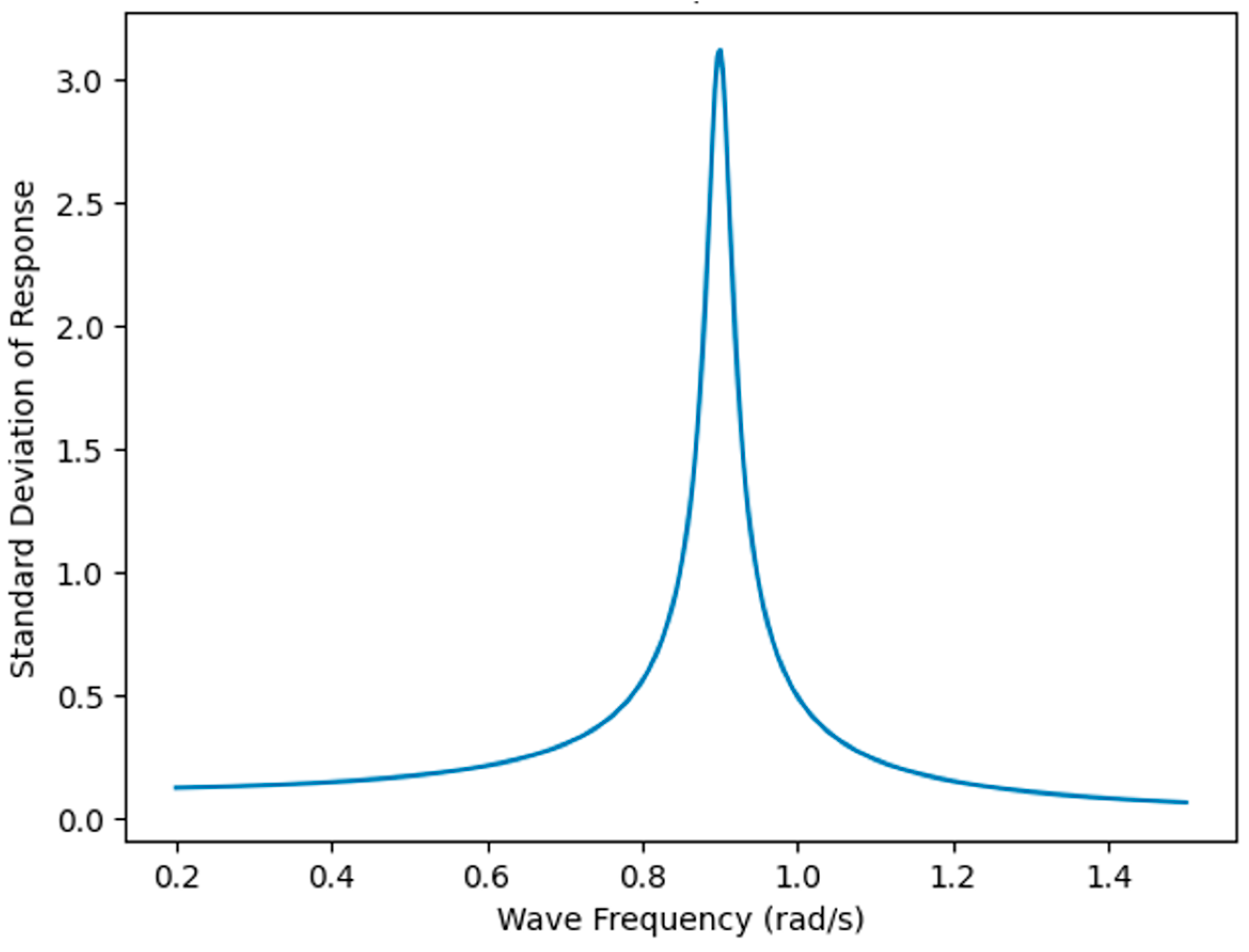
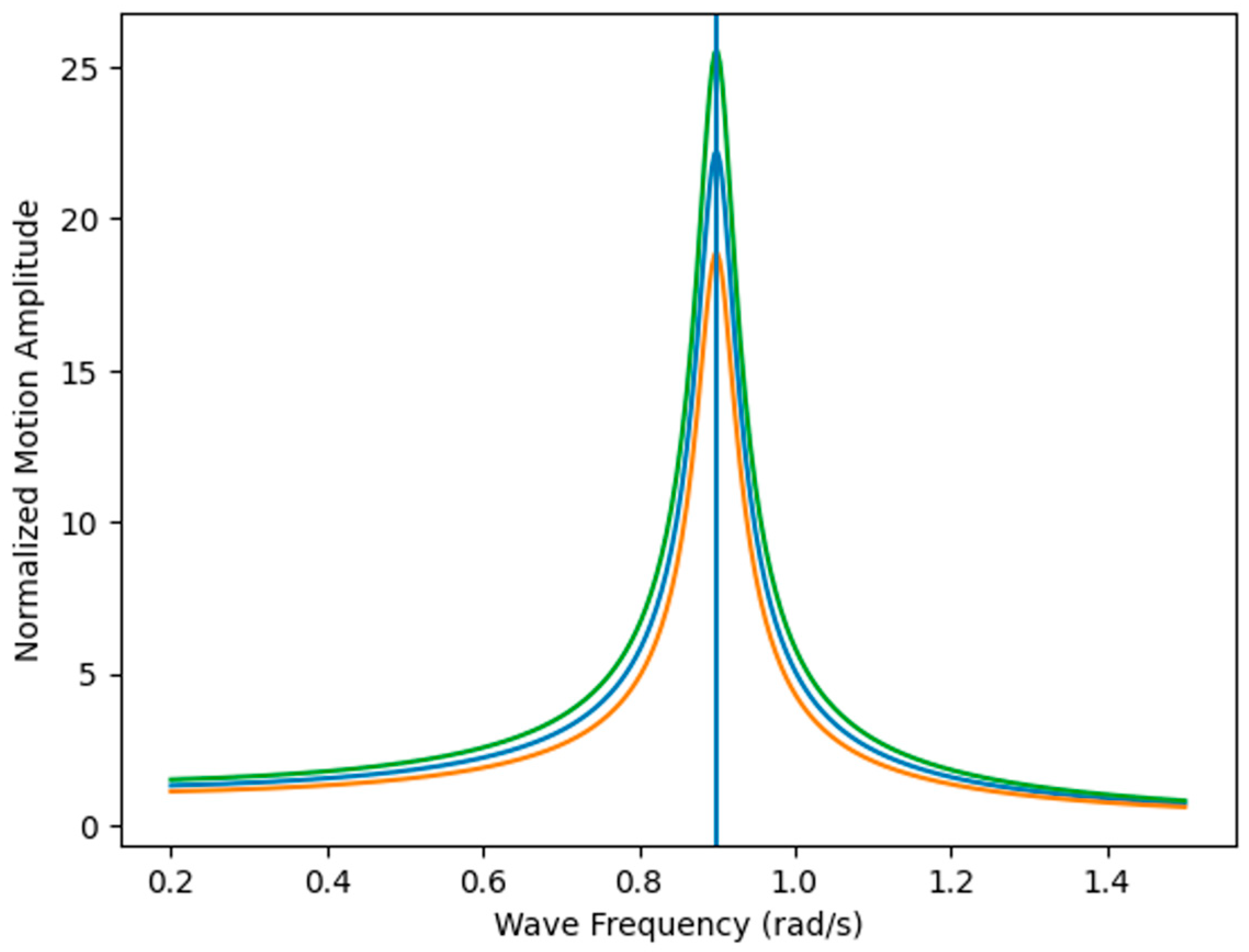
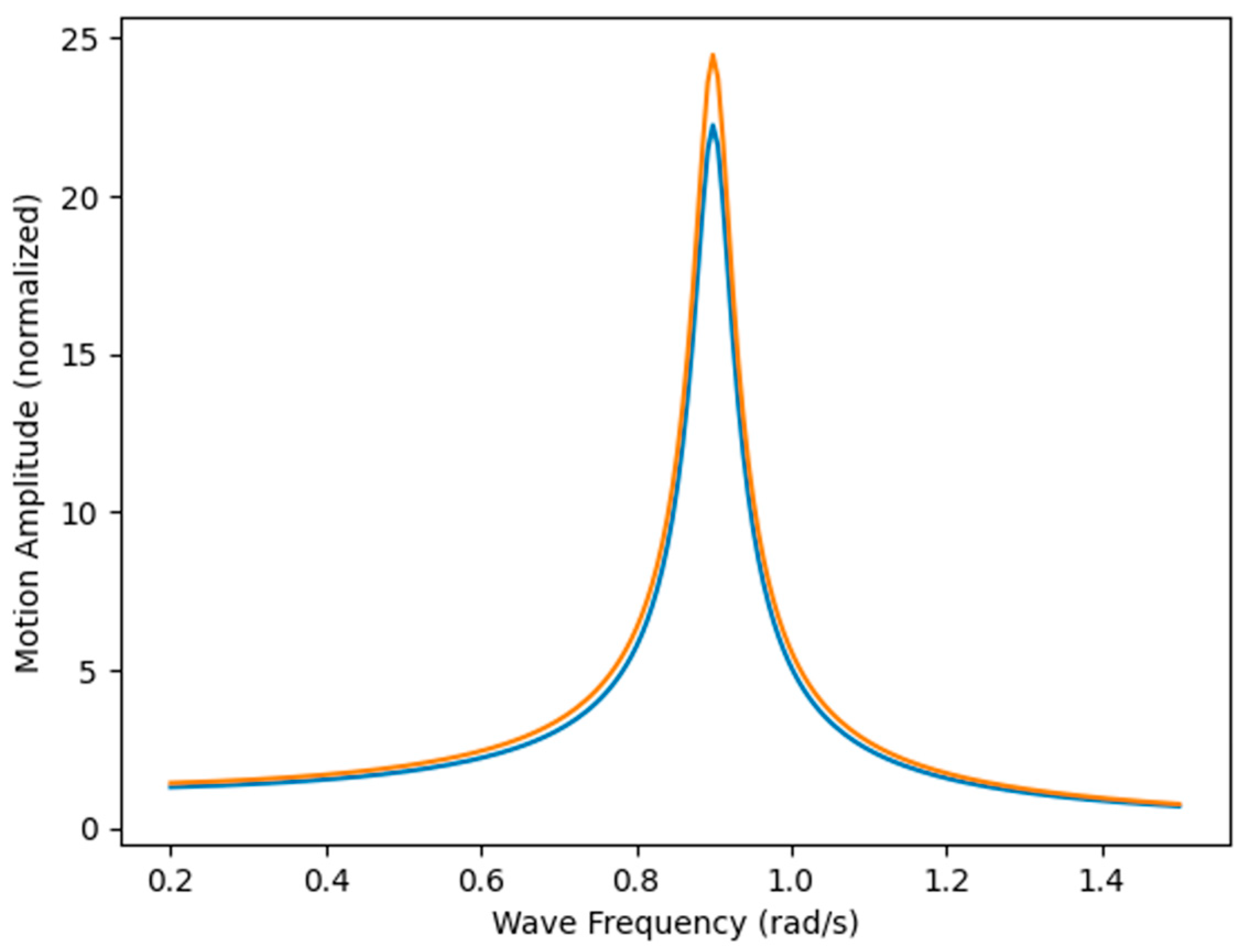
To assess the dynamic behavior of the moored vessel, the frequency response of motion amplitudes is analyzed at varying pretension levels (
Figure 4).
Figure 4 demonstrates that increased pretension shifts the response curve and reduces peak amplitudes. The resonance region, marked near the natural frequency, represents the most critical operational regime.
The baseline calculations confirm that the proposed admissibility criterion correctly identifies governing motion components and provides conservative estimates of operational compliance. Having established consistency with the complete frequency-domain solution, further analysis is devoted to investigating the sensitivity of admissibility indicators to variations in pretension, mooring geometry, and environmental loading.
5.2. Quantitative Comparison with Conventional RAO Analysis
Although both the conventional frequency-domain solution and the proposed criterion are based on the same linear dynamic model, their computational workflows differ substantially. The proposed formulation was therefore compared with the classical RAO-based engineering procedure from the viewpoint of computational effort and operational applicability,
Table 6.
For the verification example considered in this study, the conventional procedure requires repeated inversion of the coupled six-degree-of-freedom system matrix for every investigated wave frequency and every mooring configuration. In contrast, the proposed admissibility criterion evaluates compliance directly from row-wise norm inequalities, without explicit inversion of the system matrix.
Consequently, the proposed method is particularly suitable for rapid engineering screening involving numerous alternative mooring layouts, pretension levels, and environmental scenarios. Detailed RAO analysis remains the preferred approach for final hydrodynamic verification, whereas the proposed criterion provides an efficient preliminary decision support tool.
5.3. Sensitivity to Mooring Pretension
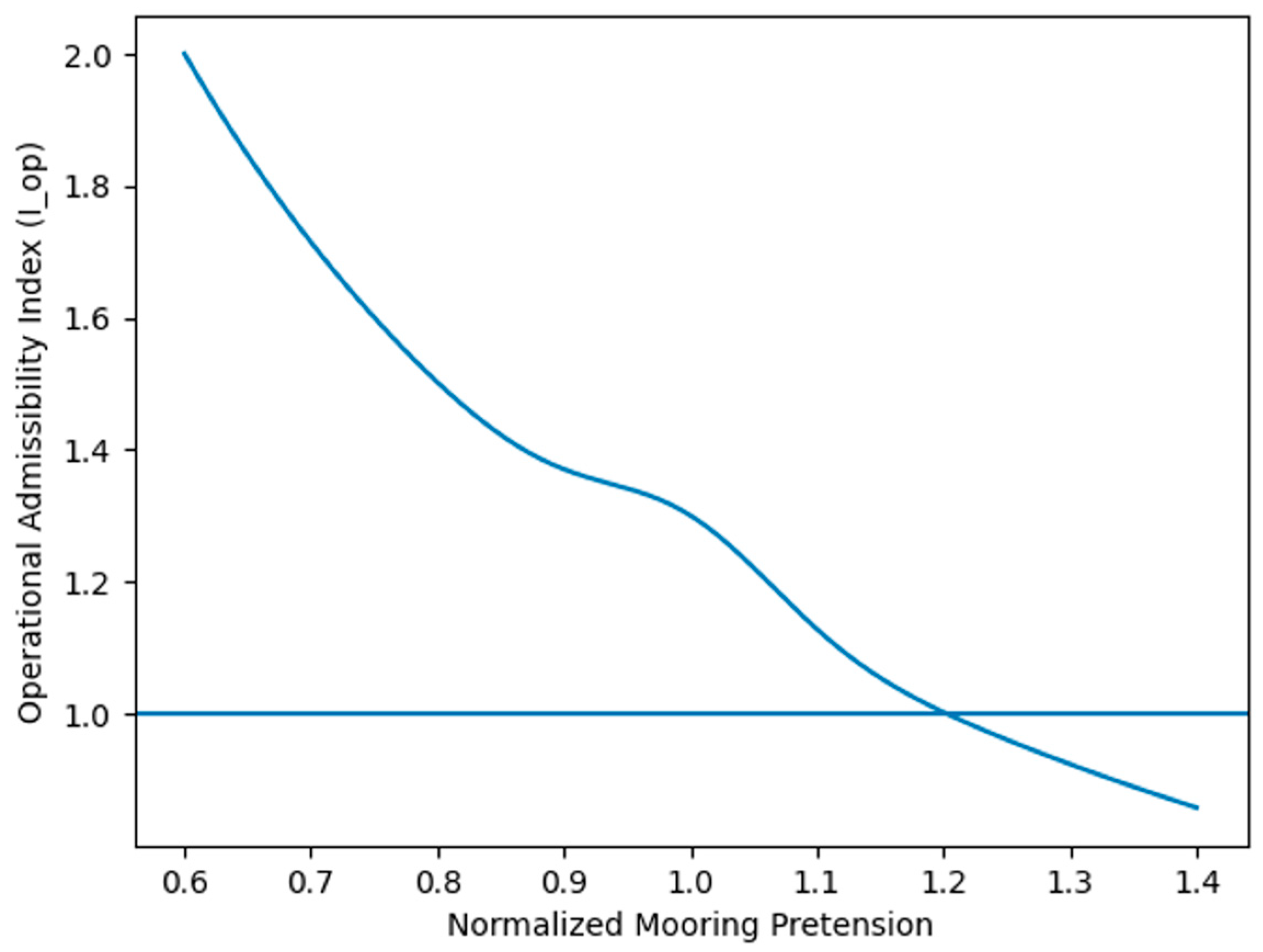
To assess the impact of the initial tension of mooring lines, variation in pretension within ±40% of the nominal value was considered. The influence of mooring pretension on compliance with motion limits is evaluated using the operational admissibility index (
Figure 5).
The analysis shows that increasing pretension reduces horizontal displacement but is accompanied by an increase in rope tension.
Figure 4 shows that increasing pretension decreases the admissibility index, improving compliance. The horizontal threshold line
Iop = 1 clearly separates allowable and restricted operational conditions.
5.4. Sensitivity to Mooring Geometry
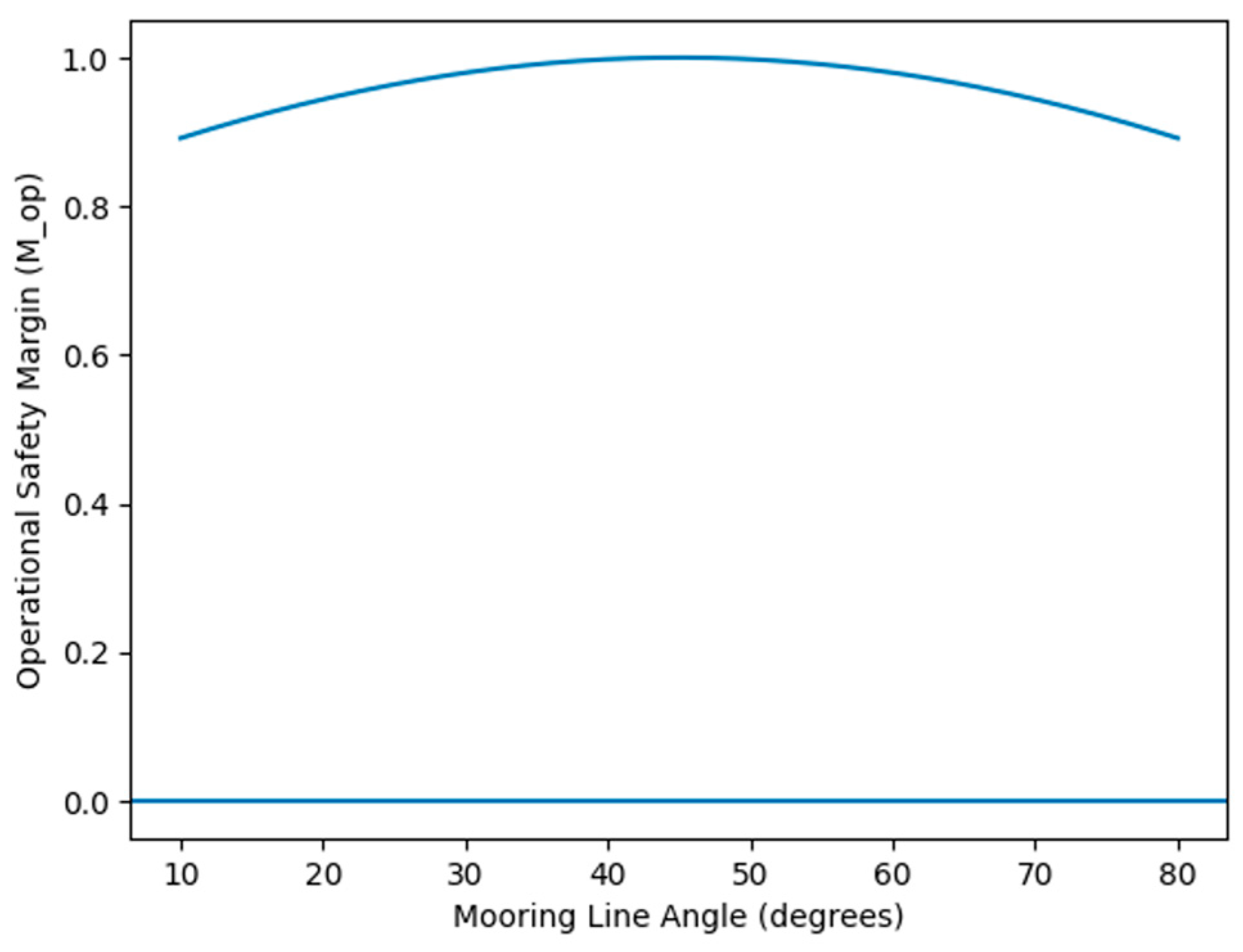
The influence of the angle of mooring lines relative to the diametrical plane of the ship has been investigated. Since mooring geometry significantly affects system stiffness, the operational safety margin is analyzed as a function of line angle (
Figure 6).
It has been shown that changes in geometry can significantly affect fulfillment of admissibility criteria.
Figure 5 indicates the existence of an optimal angular range where the safety margin is maximized. Outside this region, the effectiveness of motion restraint decreases due to unfavorable force projections.
5.5. Sensitivity to Wave Frequency
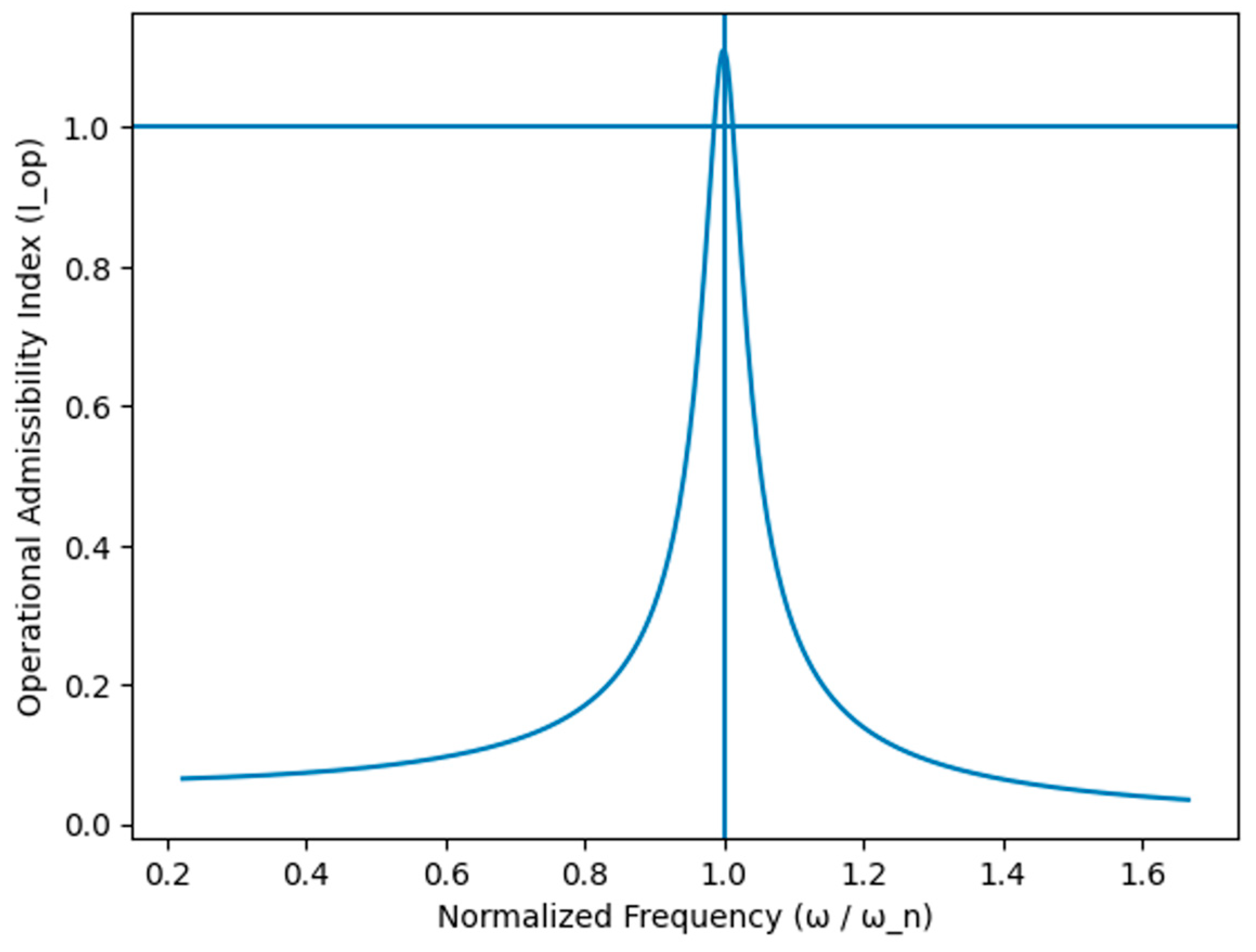
An analysis of the dependence of the admissibility index on the frequency of wave disturbance was performed. To generalize the results across vessel sizes and stiffness configurations, the admissibility index is evaluated with respect to normalized excitation frequency (
Figure 7).
The most critical modes correspond to the approximation of the disturbance frequency to the natural frequencies of the system.
Figure 6 confirms that the admissibility index increases sharply near the normalized frequency
ω/
ωn = 1, highlighting resonance as the governing dynamic mechanism.
5.6. Comparative Engineering Assessment
Although the proposed admissibility criterion is derived from the same frequency-domain formulation as conventional Response Amplitude Operator (RAO) analysis, its practical objective differs substantially. Instead of determining the complete motion response for every operational scenario, the proposed approach provides a direct engineering assessment of admissibility. To clarify these differences, the principal characteristics of both approaches are compared below in
Table 7.
As follows from
Table 7, the proposed criterion should not be regarded as a replacement for conventional RAO analysis. Rather, it complements classical hydrodynamic modelling by providing a computationally efficient engineering screening procedure suitable for rapid evaluation of multiple mooring configurations and operational scenarios.
The proposed criterion is not intended to replace detailed hydrodynamic simulations. Instead, it complements conventional frequency-domain analysis by enabling rapid engineering screening of multiple operational scenarios. Once the system matrices have been established, admissibility can be evaluated directly without repeated computation of complete response functions, making the approach particularly suitable for operational port decision support.
5.7. Comparison with Full Numerical Solution
A comparison between the exact matrix inversion solution and the proposed norm-based estimate is performed to verify the accuracy of the criterion (
Figure 8).
The relative error of the estimate does not exceed the permissible engineering level and is conservative in nature.
Figure 7 illustrates that the norm-based solution consistently overpredicts motion amplitudes, confirming its conservative character. The deviation remains within acceptable bounds engineering-wise across the frequency range.
5.8. Quantitative Error Assessment
To evaluate the accuracy of the proposed norm-based admissibility criterion, a quantitative comparison with the exact frequency-domain solution obtained via explicit matrix inversion was performed.
The relative deviation between the exact and norm-based motion amplitudes is defined as
For the analyzed baseline configuration (2% initial rope elongation), the deviation was evaluated over the frequency range 0.2–1.5 rad/s.
The maximum relative deviation observed among all degrees of freedom was εmax = 0.118, while the mean deviation over the considered frequency band was εmean = 0.064.
The largest deviations were observed in the vicinity of resonance frequencies, where the sensitivity of the response to stiffness and damping parameters increases. For off-resonant regimes, the deviation remained below 8%.
The norm-based estimate consistently overpredicts the motion amplitudes, confirming its conservative character. Such conservative bias is desirable for operational port decision-making, as it prevents underestimation of motion levels under adverse environmental conditions while maintaining acceptable computational simplicity (
Table 8).
5.9. Operational Safety Margin
Operational stability reserve is determined as follows:
Mop = 1—
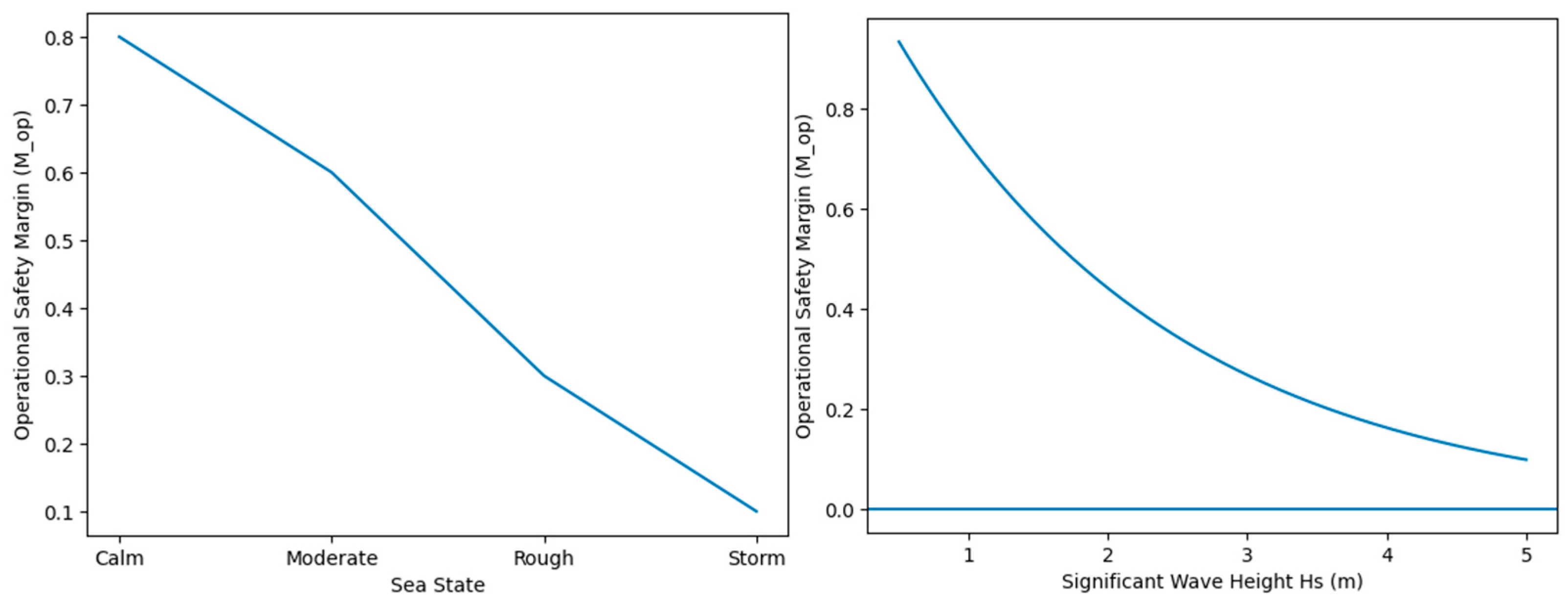
Iop. To connect the analytical results with practical port operation, the operational safety margin is evaluated under increasing environmental severity (
Figure 9).
The results obtained demonstrate the possibility of using the proposed criterion as a tool for operational decision-making.
Figure 8 shows a monotonic reduction of safety margin with increasing sea state intensity and significant wave height. The results confirm that the proposed admissibility framework provides a quantitative basis for operational go/no-go decisions.
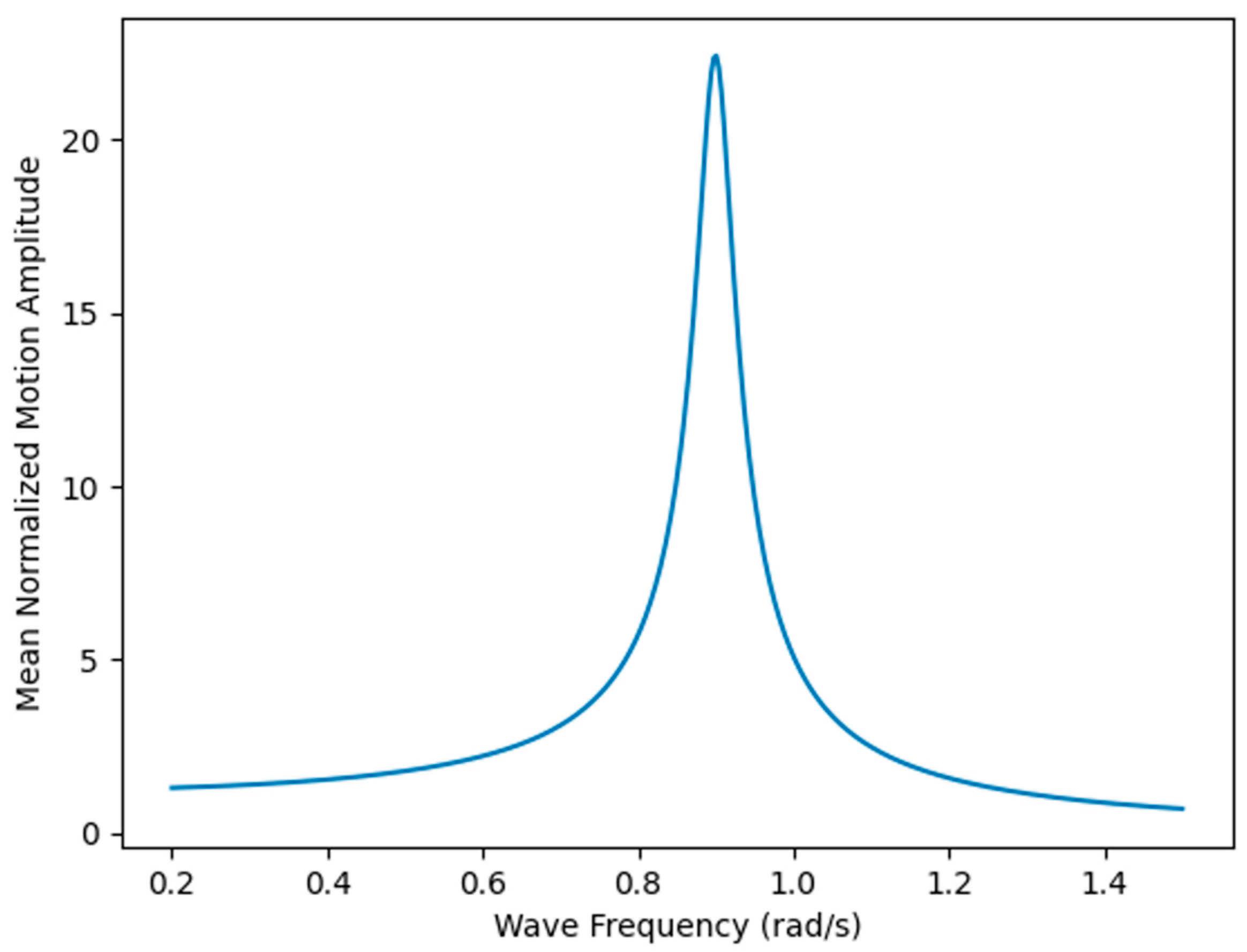
To evaluate the robustness of the proposed admissibility criterion with uncertain parameters, a Monte Carlo simulation was performed. Mooring stiffness and damping were treated as random variables with normally distributed variations (±10% around nominal values). The resulting ensemble response was analyzed over the operational frequency range.
Figure 10 presents the ensemble-averaged frequency response. The overall dynamic behavior remains consistent with the deterministic solution, while minor amplitude shifts are observed due to parameter variability.
To quantify dispersion of the dynamic response, the standard deviation of motion amplitudes was evaluated across all realizations.
Figure 11 shows that response variability increases significantly in the vicinity of the resonance frequency. Away from resonance, the dispersion remains limited, indicating structural robustness of the mooring system and stability of the admissibility criterion.
The admissibility threshold remains conservative even with worst-case parameter combinations, confirming the reliability of the proposed norm-based engineering approach.
6. Discussion
The results obtained confirm that the proposed normative criterion enables adequate assessment of the compliance of a moored vessel’s movement amplitudes with the established operational restrictions without inverting the system matrix. A comparison with the exact solution showed that the assessment is conservative, which is a desirable property for engineering applications in port practice.
Sensitivity analysis demonstrated that the most significant impact on the admissibility index is exerted by the initial tension of mooring lines, their geometric configuration, and the approximation of the wave disturbance frequency to the natural frequencies of the system. Increasing the pretension reduces the horizontal displacement of the vessel, but at the same time increases the internal forces in the mooring lines, which creates the need for a design solution compromise. Thus, the criterion can be used not only to assess admissibility, but also to optimize the mooring scheme.
The obtained dependencies on the disturbance frequency confirm the resonant nature of the “ship–mooring lines–berth” system behavior. In ranges close to the natural frequencies, the admissibility index increases rapidly, which can lead to exceeding regulatory limits even under moderate wave conditions. This emphasizes the importance of frequency analysis in assessing the safety of port operations.
The proposed approach has practical value for port administrations and operational services, as it allows the formation of an operational indicator of the admissibility of cargo operations. Unlike full time-domain modeling, which requires significant computational resources, the normative criterion provides a quick assessment suitable for use in real time or as a built-in engineering module for decision support systems. Unlike classical energy-based or amplitude-only criteria, the proposed norm-based admissibility framework provides a component-wise, matrix-consistent operational decision tool directly aligned with port regulatory limits.
Compared with the conventional time-domain approaches reported in [
10,
11,
27], the proposed method eliminates the need for repeated numerical integration when evaluating operational admissibility. While detailed nonlinear simulations provide higher fidelity, they are computationally demanding and less suitable for rapid operational decision-making. In contrast, the proposed norm-based criterion provides a conservative engineering estimate directly in the frequency domain. This feature makes the method particularly attractive for port authorities and terminal operators requiring real-time assessment of cargo operation feasibility under changing environmental conditions.
At the same time, the proposed criterion is based on a linear formulation of the problem and equivalent modeling of friction through viscous damping. Under conditions of significant deformation of mooring lines or significant nonlinearity of contact interaction with fenders, the accuracy of the assessment may decrease. Therefore, further research should be directed toward expanding the method to take into account quasi-linear or weakly nonlinear models.
Thus, the proposed normative criterion combines the mathematical rigor of frequency analysis with an applied focus on the operational management of port operations and can be considered as an engineering tool to support decision-making under conditions of variable waves and wind loads.
The obtained sensitivity trends are consistent with previously reported observations concerning the influence of mooring pretension and line geometry on vessel response [
9,
10,
11,
12]. In particular, increased pretension reduces horizontal motion amplitudes while simultaneously increasing internal line loads. The present study extends these findings by introducing a unified admissibility framework capable of translating such dynamic effects into operational go/no-go decisions.
7. Engineering Implications for Port Design
The proposed normative criterion is of practical importance not only for the operational management of cargo operations, but also for the design and reconstruction of berthing facilities. The results obtained allow formalizing the relationship between the parameters of the mooring system, wave load characteristics, and permissible amplitudes of ship movements.
At the berth design stage, the criterion can be used for
selecting the optimal stiffness and configuration of mooring lines;
justifying the required level of pretension;
assessing the feasibility of using increased fender stiffness;
determining the operating limits for different types of vessels.
Parametric analysis has shown that the geometry of the mooring lines and their pretension significantly affect the operational acceptability index. This means that optimizing the mooring scheme can be an effective engineering tool for reducing the amplitude of movements without the need for radical reinforcement of the berth infrastructure.
In addition, the criterion can be integrated into the technical and economic justification procedure for berths, allowing alternative design solutions to be compared in terms of operational stability margin. This approach makes it possible to move from empirical assignment of mooring parameters to a quantitatively justified engineering choice.
Since the admissibility criterion is evaluated directly from the system matrices without repeated solution of the complete response problem, computational effort is substantially reduced during engineering screening of multiple operational scenarios (
Table 9).
In the context of the digitalization of port infrastructure, the proposed criterion can be implemented as part of decision support systems or digital twins of berthing facilities. This opens up the prospect of creating integrated modules for operational forecasting of the admissibility of cargo operations based on data on waves, wind, and the actual mooring scheme. Thus, the proposed approach expands the traditional application of frequency analysis of moored vessel dynamics, transforming it into a tool for engineering planning and risk management in the port environment.
The primary operational benefit of the developed acceptance criterion lies in optimizing computational costs and converting complex hydrodynamic parameters into a single engineering metric suitable for real-time process control. This facilitates risk assessment by port dispatchers under unstable hydrometeorological conditions, when making a timely “YES/NO” decision is critical for vessel safety and maintaining the pace of cargo operations.
8. Conclusions
This paper develops a normative criterion for the admissibility of movements of a moored vessel, formulated in the frequency domain without the need for explicit inversion of the six-degree-of-freedom system matrix, which significantly simplifies the procedure for engineering assessment of the compliance of movements with established operational restrictions. An operational admissibility index and a corresponding stability margin are proposed, which can be directly used as quantitative indicators for making decisions on the performance of cargo operations under given hydrometeorological conditions. A comparison with the complete solution of the system of equations showed that the normative criterion provides a conservative estimate of the amplitudes of movements, which is acceptable and desirable for practical engineering applications in a port environment.
The parametric analysis confirmed that the most significant factors affecting the fulfillment of the admissibility criteria are the initial tension of the mooring lines, their geometric configuration, and the ratio of the wave disturbance frequency to the natural frequencies of the “ship–mooring–berth” system. It has been shown that increasing the stiffness of the mooring system reduces the amplitude of horizontal displacements but is accompanied by an increase in internal forces in the ropes, which requires complex engineering optimization taking into account the strength of the berthing structures.
The proposed approach has practical value for port administrations and design organizations, as it provides a quick tool for assessing the admissibility of cargo operations without the use of full numerical modeling in the time domain. The limitations of the method are related to the linear formulation of the problem and the use of equivalent modeling of nonlinear effects, which can affect the accuracy of the assessment under conditions of significant deformation or complex contact interaction. Further research should focus on integrating weakly nonlinear models and extending the method for cases of intense storm loads. Future research should focus on extending the proposed admissibility framework to nonlinear mooring systems, irregular multidirectional sea states, and real-time digital-twin implementations for port operational support. Future studies should extend the proposed formulation toward nonlinear time-domain simulations including second-order slow-drift effects, nonlinear mooring stiffness, and impact-type fender behavior.




 ,
,