1. Introduction
Digital transformation has profoundly altered the way urban passenger and freight transport is planned, operated, and experienced. Its most visible manifestations are integrated platforms, real-time information systems, digital payments, data analytics, and shared mobility applications [
1,
2,
3], but the process also affects the relationships between operators, users, and public authorities and alters the behavioral patterns upon which the urban transportation system relies. On the mobility side, this transition manifests itself in Mobility as a Service (MaaS), shared micromobility, flexible on-demand transport, and smart mobility ecosystems [
1,
4,
5]. In urban logistics, it is expressed, primarily, in the digitization of the last mile, the algorithmic optimization of routes and fleets, real-time traceability, and the progressive integration of electric vehicles into distribution [
6,
7,
8]. That digitalization supports organizational issues such as choice, collaboration, and optimization, in both passenger and freight transport systems [
9].
Beyond these visible manifestations, the process has an equally decisive aspect. Behaviors themselves change, as does the way the associated demand is anticipated and managed. Users adopt routines that combine transport modes and services in ways that would be unfeasible without intermediary applications. Operators adjust their supply to time series that their legacy systems could not process. Public authorities, for their part, are beginning to base their planning decisions on data whose coverage, granularity, and frequency were unimaginable just a few years ago. Behavior and demand forecasting evolve together in digitalized urban services because forecasts guide operational decisions that, in turn, reshape observed practices [
2,
10].
The available literature addresses both aspects in a fragmented manner. Review research has proliferated in recent years, but in doing so, it has reproduced disciplinary and sectoral boundaries: there are reviews on MaaS adoption, on gender and digital mobility, on micromobility, on smart mobility, on demand-responsive transport, on carpooling, on the last mile, on artificial intelligence applied to delivery, and on platform-based delivery work. What is lacking are analyses that frame the urban digital transition as a single process. The separation between passenger mobility and freight logistics is the most visible, but not the only one. The technological, social, institutional, and economic aspects of the transition are often treated in isolation, and the link between the development of predictive models and their actual implementation conditions is rarely examined systematically. The result is an expanding field in which syntheses accumulate without fully communicating with one another. A structured field, however, would give current and future research a basis on which to develop new concepts, along with a unified view of barriers, enablers, and gaps that would help both researchers and practitioners advance the digitalization of urban transportation.
In light of this fragmentation, this study adopts an umbrella review approach to examine existing syntheses on urban mobility and logistics as a single body of evidence. Its main novelty lies in bringing together two fields that have largely developed separately and analyzing them as part of the same process of urban digital transformation. This makes it possible to identify convergences, contrasts, and gaps across both fields and to propose an integrative framework for analyzing barriers, enablers, and research gaps.
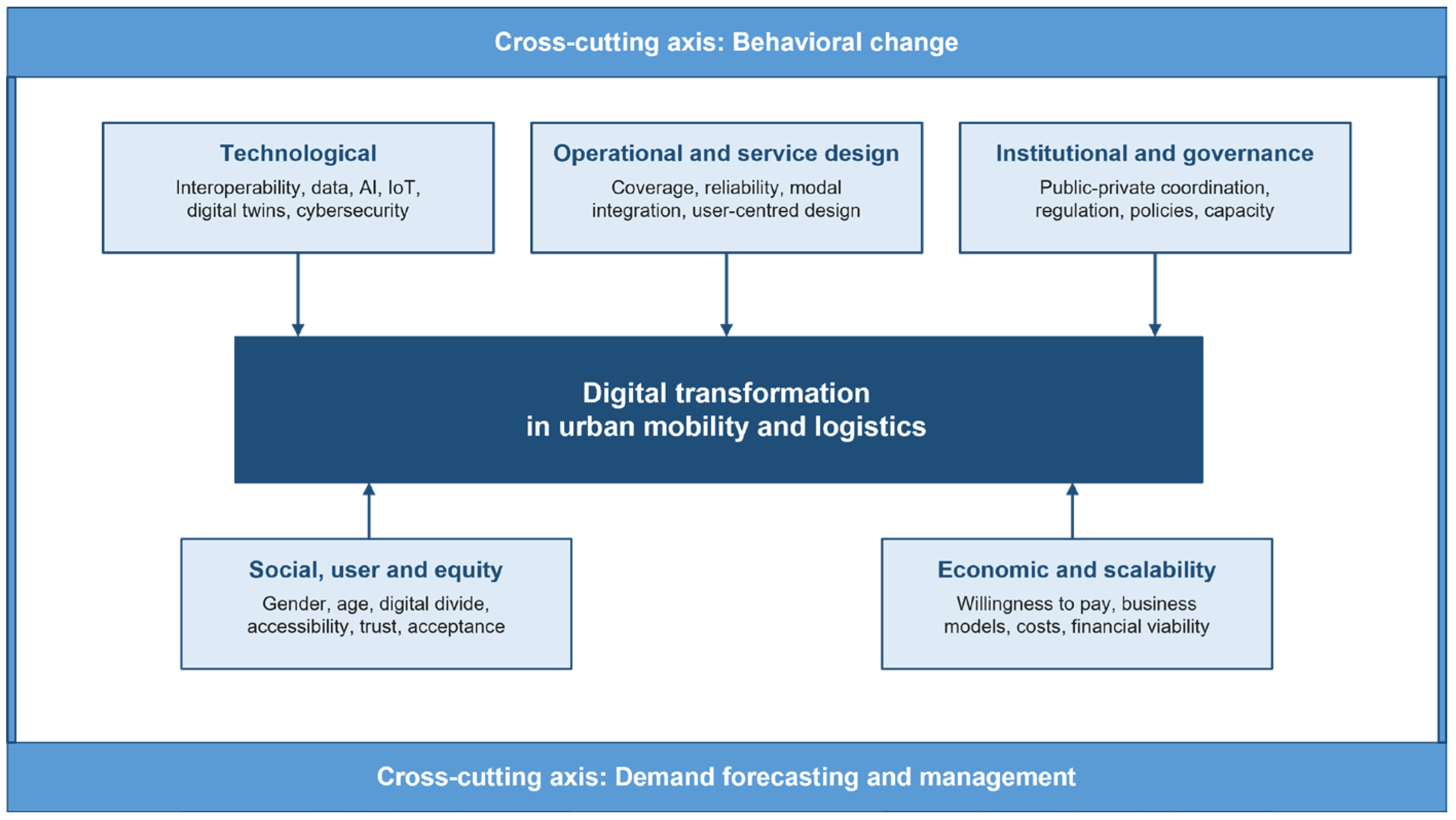
To fulfill this function, this study is organized around three objectives. The first is to critically synthesize the evidence from previous reviews on the digitalization of urban mobility and logistics, identifying barriers, enablers, and research gaps. The second is to develop the proposed framework, based on five interdependent dimensions (technology; operation and service design; society, user, and equity; institution, regulation, and governance; and economics and scalability) and two cross-cutting axes (behavioral change and demand forecasting). The third is to translate these findings into directions for future research, identifying priorities for empirical work and for evaluation across different contexts.
From these objectives, five research questions are derived:
RQ1. What types of barriers appear most frequently in reviews on digitalization and urban mobility or logistics?
RQ2. What enablers are identified for the implementation and consolidation of digital solutions in these areas?
RQ3. What structural similarities and differences do urban mobility and logistics present in relation to these barriers and enablers?
RQ4. What does the review literature say about behavioral change and demand forecasting, and what gaps remain in their treatment?
RQ5. What knowledge gaps should guide the future research agenda in this field?
The main contribution of this work is to provide an analytical framework that allows for a systematic examination of the digitalization of urban mobility and logistics, identifying barriers and enablers, comparing both fields, and deriving knowledge gaps to guide future research. More specifically, the framework enables both fields to be examined through the same five dimensions and two cross-cutting axes, thereby revealing shared mechanisms and interdependencies that sector-specific approaches may overlook.
Section 2 develops the conceptual framework.
Section 3 describes the methodology.
Section 4 presents the results, organized first by dimension and then by cross-cutting axes, highlighting similarities and differences between urban mobility and logistics.
Section 5 discusses the implications, revisits the research questions, and acknowledges the study’s limitations. Finally,
Section 6 concludes with the findings and identifies future research directions derived from the identified gaps.
4. Results
4.1. General Characterization of the Corpus
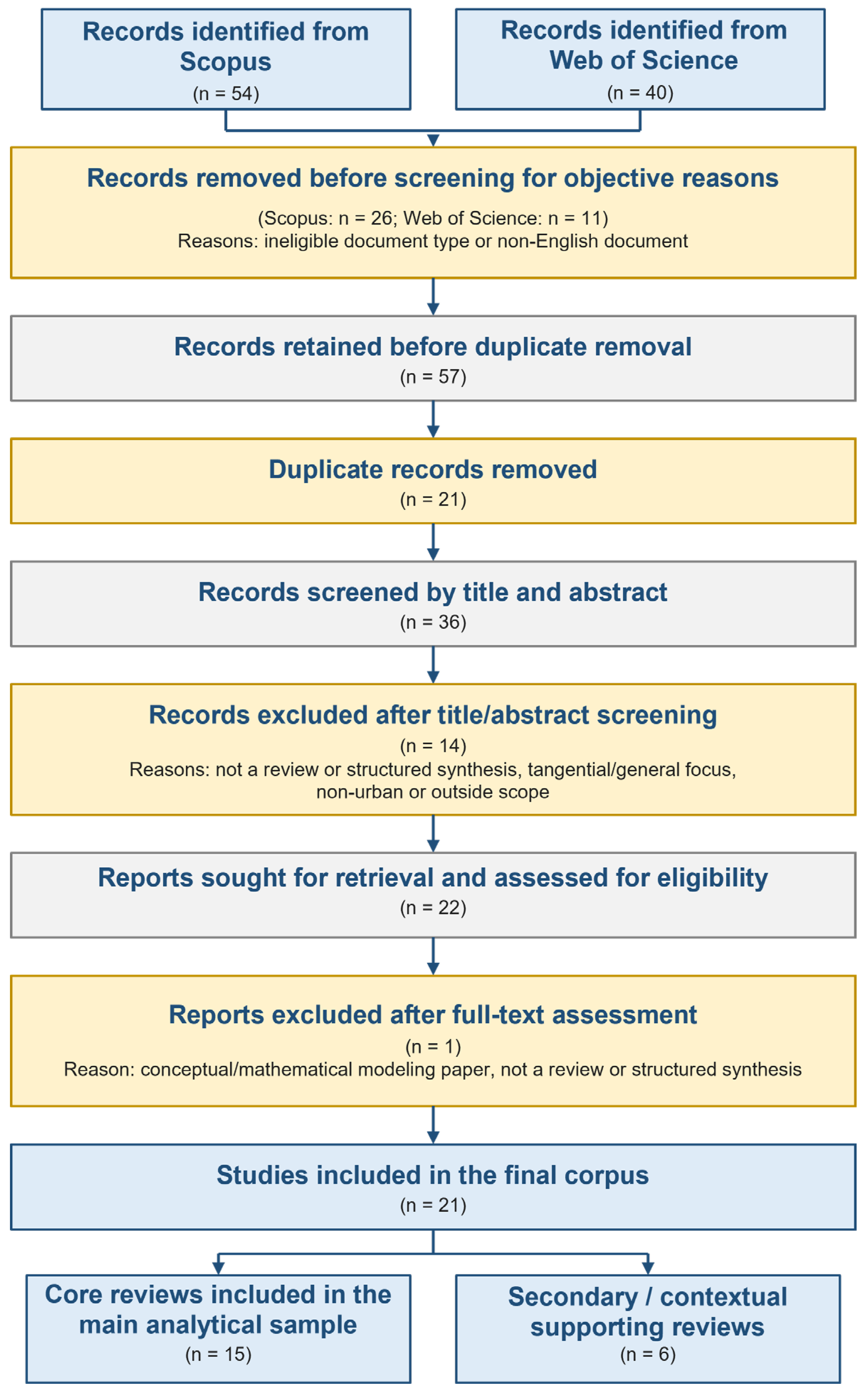
The final sample reflects the current state of the field, which is expanding yet heterogeneous. Of the 21 documents included, 18 primarily address digitalized urban mobility and 3 focus on digital urban logistics, the latter concentrated on specific subfields such as the last mile, working conditions in delivery, and artificial intelligence applied to operational optimization [
6,
7,
8]. This asymmetry is not a bias in the search, which applied equivalent descriptors in both areas but rather corresponds to the actual state of the literature, and constitutes a finding of the study in itself.
Table 1 lists the included documents and distinguishes between core reviews and secondary or contextual reviews, in accordance with the criteria outlined in
Section 3.3.
Three features of the corpus shape the interpretation of the results. The first is the thematic concentration in MaaS, smart mobility, micromobility, demand-responsive transport, and shared mobility, which reflects that review research has advanced most in areas where digitalization has produced visible services oriented directly toward the end user. The second is methodological diversity: systematic reviews, scoping reviews, environmental scans, bibliometric analyses, and framework-based structured reviews coexist, making direct comparison between studies difficult. The third is geographic and population heterogeneity. Some reviews adopt a broad international perspective, while others are anchored in specific contexts, whether due to territorial density, level of development, or demographic characteristics of the user population [
22,
23,
25,
26]. This variety has a direct consequence: the barriers and enablers identified are not universal, and what works in a well-funded city with high digital penetration may prove irrelevant, or counterproductive, in other settings.
Before turning to the analysis by dimension, it is worth noting a cross-cutting feature of the sample. The corpus shows a clear imbalance in favor of the technological dimension over the attention given to social, institutional, and economic factors. Although the search strategy, centered on digitalization descriptors, predisposes the retrieval of technology-anchored studies, several of the reviews themselves acknowledge that this imbalance is a feature of the field and not a mere artifact of the search [
4,
5].
4.2. Technological Dimension
Digital platforms, data integration, artificial intelligence, the Internet of Things, digital twins, and advanced optimization models make up the technological toolkit that runs throughout the corpus [
1,
2,
5]. The recurring message, however, is not that technology is lacking but rather that having it is rarely enough. The difficulties most frequently identified in the reviews do not stem from technical shortcomings but from problems of system integration, coordination deficits among stakeholders, security vulnerabilities, or a failure to adapt to the actual context of use.
In MaaS, the tension between technological capacity and implementation conditions is especially visible. Butler et al. [
1] show that the system’s viability depends not only on a digital interface integrating planning, booking, and payment but also on resolving cybersecurity issues and building cooperative ecosystems between public and private operators. Li et al. [
4] dig deeper into the academic origin of the problem and argue that the MaaS literature itself has prioritized the development of enabling technologies and platform logic over an understanding of users’ actual needs.
Munhoz et al. [
3] contribute a revealing finding to the debate on smart mobility. Although technology occupies a central place in the field’s discourse, the factors that industry professionals consider priorities for increasing the intelligence of urban mobility are mostly governance-related, not technological. Mitieka et al. [
5] document, in parallel, a recent evolution strongly driven by advances in big data, artificial intelligence, and real-time technologies and warn that the literature continues to place a disproportionate weight on the technological dimension. Taken together, these findings point to a distance between what professional practice demands and what academic research prioritizes.
The case of micromobility is illustrative. Orozco-Fontalvo et al. [
12], in their review of dockless shared e-scooters, show that the actual performance of these systems depends not on the vehicle or the mobile app but on factors that are seemingly secondary yet decisive. These include redistribution and collection logistics, the lifespan of the vehicles, and the regulatory framework each city sets for their deployment. A technologically mature solution can fail or produce unintended consequences if it is not coordinated with urban management, local regulation, and integration with other transport modes.
In flexible mobility and demand-responsive transport, an additional concern arises: the difficulty of evaluating and comparing experiences. Liyanage et al. [
24] show that the deployment of on-demand mobility is conditioned by a combination of social, technological, and economic factors that vary by context, which makes it difficult to draw generalizable conclusions. Along the same lines, Baier et al. [
13] argue that digitalization has fostered a proliferation of demand-responsive transport systems with highly diverse configurations and that this diversity complicates comparing experiences and identifying what actually works and under what conditions.
In urban logistics, the evidence is more fragmented but points in the same direction. Nalluri et al. [
7], from a technical and bibliometric approach, show that artificial intelligence and machine learning are establishing themselves as an emerging trend in last-mile optimization, with promising results in routing, capacity, and first-time delivery. Ferreira and Esperança [
8] reinforce this interpretation through the integration of electric vehicles and artificial intelligence. Even so, the focus on technical performance leaves equally relevant issues less explored, such as how to implement these solutions in real urban environments, the governance frameworks required, the necessary infrastructure, or the systemic effects they generate beyond immediate operational efficiency.
Technology is, ultimately, the starting point of digitalization, but it is rarely enough to explain it. The most recent literature appears to be shifting from an instrumental view toward approaches that conceive of technology as part of complex urban systems, where sustainability, intelligence, and the capacity to adapt to disruptions are articulated as interdependent dimensions [
27,
28]. That same complexity justifies the subsequent analysis of operational and service design factors, where many of the most decisive barriers have their real origin.
4.3. Operational and Service Design Dimension
While the previous section showed that technology is a necessary but not sufficient condition, this one focuses on the design and operational decisions that determine how that technology translates into a service for the user. At this level, coverage, flexibility, reliability, modal integration, fare structure, ease of use, and the ability to adapt to diverse contexts and user profiles are, according to the reviewed literature, factors at least as decisive for the success of a digital solution as the sophistication of the platform that supports it [
1,
4,
13].
The most critical assessment comes from MaaS. Li et al. [
4] argue that its development has been overly guided by a provider-oriented approach, in which the platform’s capabilities dictate the service offering rather than travelers’ actual needs. This orientation produces persistent mismatches between what the system offers and what users demand and leaves more innovative approaches to capturing complex mobility preferences and designing personalized experiences relatively unexplored. Butler et al. [
1] complement this analysis with a practical implication: integrated packages and subscriptions simplify ticketing and payment, which increases acceptance. That said, a low price alone is not enough to trigger behavioral change. The determining factor is the perception of value, which depends on how the user experience is structured, which modal combinations are offered, and how simple it is to access the service.
The literature on demand-responsive transport examines these issues with a notable degree of operational detail. Baier et al. [
13] observe that digitalization has driven a wide variety of configurations but that many fail to establish themselves as a permanent transport option. The reviewed evidence attributes their success to a specific combination of context; stakeholder objectives; and concrete operational decisions, such as fleet size, stop patterns, level of service, ride sharing, and integration with the public transit network. To handle this complexity, the authors propose a four-step evaluation framework that integrates objectives, external and internal conditions, and the weighting of results. They conclude that there is still no standardized way to evaluate the performance of these systems that simultaneously incorporates operational efficiency, environmental impacts, social benefits, and regional differences.
Liyanage et al. [
24] offer a useful historical perspective. Demand-responsive transport is not a radically new phenomenon, but an evolution of traditional forms of on-demand transport that digitalization has profoundly reshaped. The shift to mobile app-based services and real-time tracking has blurred the line between conventional public transit and shared mobility, creating a hybrid space whose operating rules are not yet established. The operational attributes that define success are very specific: reliability; affordability; accessibility; route flexibility; and the ability to plan, book, and pay from a single interface.
Orozco-Fontalvo et al. [
12] reinforce this argument from micromobility. Their review of e-scooters shows that the variables determining the system’s actual performance are not the most visible ones, the vehicle or the app, but the most operational ones, such as redistribution and collection logistics, vehicle lifespan, pricing structure, and the local regulatory framework. The review also identifies integration with public transport and MaaS as one of the potentially most valuable contributions of micromobility, though it stresses that such integration requires very specific operational and regulatory decisions that most cities have not yet satisfactorily resolved.
In urban logistics, the pattern is similar, though with an important nuance. Nalluri et al. [
7] and Ferreira and Esperança [
8] show that artificial intelligence, machine learning, electric vehicles, and optimization tools are reshaping the organization of the last mile, but research remains focused on operational efficiency metrics. Studies on routing, capacity, emissions reduction, and delivery performance predominate. The least developed area is the design decisions that allow the move from proof of concept to stable implementation. Among these, the coordination of heterogeneous fleets, integration with urban regulation, the allocation of implementation costs, and the measurement of performance beyond immediate technical efficiency stand out. In logistics, as in mobility, turning a digital infrastructure into a viable, sustainable, and coordinated urban operation requires much more than implementing the right technology.
4.4. Social, User, and Equity Dimension
The reviews analyzed show that digitalization does not affect all users equally. Age, gender, income level, digital skills, prior mobility habits, and trust in platforms influence both adoption and the benefit each person derives from the new services [
1,
12,
14,
22,
29]. This heterogeneity is not only a matter of equity. It is also a design challenge because a service that fails to incorporate the actual diversity of its users is unlikely to take hold.
The case of micromobility illustrates this with concrete evidence. Orozco-Fontalvo et al. [
12] show that the user profile for shared e-scooters is predominantly male, young, and relatively high-income. This pattern contrasts with the common narrative that presents these systems as accessible and sustainable solutions. The review also reports an important finding: a significant share of the trips captured replace journeys previously made on foot, by bicycle, or by public transit. This substitution effect calls into question the net contribution of micromobility to equity and to the sustainability of the urban system.
In MaaS, McIlroy [
14] conducts a gender-focused review. Although a growing number of studies mention this dimension, the available evidence remains fragmented and does not allow robust conclusions about differences in adoption, use, or preferences. What does emerge consistently is that the effects of MaaS on gender equity depend on specific design decisions, such as the structure of service packages, perceived safety across modes, travel patterns associated with caregiving roles, and the explicit consideration of diverse needs. Without addressing that diversity, systems tend to reproduce preexisting inequalities in access.
An [
22] addresses the digital divide from the perspective of aging, a population segment that the smart mobility literature has tended to underrepresent despite its growing demographic weight. The very technologies that could improve older adults’ autonomy and accessibility create new barriers when their design requires digital skills that many do not have or do not wish to acquire. Usability, design adaptation, and tailoring to specific needs are conditions, not optional improvements, without which digitalization widens exclusion rather than reducing it.
Li et al. [
4] add a more cognitive argument. They note that the MaaS literature has paid insufficient attention to users’ psychological needs, such as how they perceive the value of the service, what builds their trust, and what frictions deter them from using it. This omission partly explains why technically sound systems fail to reach expected adoption rates. A service can be robust, integrated, and well-priced and still fail to take hold if it is not understandable or trustworthy to the users it targets.
In demand-responsive transport and flexible mobility, the social dimension appears less explicitly but is no less relevant for it. Liyanage et al. [
24] link the success of deployment to public acceptance and to the systems’ ability to offer services perceived as reliable, accessible, and affordable, attributes that depend as much on technical design as on social and cultural factors that are hard to standardize. Baier et al. [
13] add that these systems serve stakeholders with very different objectives and expectations, which means their evaluation cannot be limited to operational efficiency indicators.
Aguiléra and Pigalle [
10] round out the picture on carpooling with a broader observation. Their review identifies three key factors for understanding the future of this form of shared mobility: the digitalization of platforms, the spread of collaborative consumption, and changes in work routines associated with remote work. None of them alone explains the trajectory of carpooling, and the empirical evidence on the interaction between technological and behavioral transformations remains limited.
In urban logistics, equity emerges from a different angle. Useche et al. [
6] show that the digitalization of the last mile, centered on delivery platforms and algorithmic work management, has generated new psychosocial and safety risks for delivery workers. This is a social dimension of digital change that does not appear in the debate on passenger mobility, and it is a reminder that equity affects those who sustain the service from the labor side, not only end users.
Taken together, these findings show that equity in digitalized urban transport goes beyond access and differences in adoption. It also concerns how benefits, costs, and risks are distributed among users, workers, firms, and urban areas; whose needs are reflected in service design and data; and who participates in implementation decisions. Digitalization may reproduce existing inequalities when services concentrate on profitable markets, when some groups are poorly represented in the data, or when efficiency gains depend on transferring pressure and risk to platform workers. Equity should therefore be understood as having distributive, procedural, territorial, and labor-related dimensions.
4.5. Institutional, Regulatory, and Governance Dimension
Some of the most persistent obstacles to implementing digital solutions are not technical but institutional. This dimension is especially relevant in contexts with public and private operators that have different objectives, incentives, and capabilities, which covers most real urban environments [
1,
12,
15,
26].
Anthony Jnr [
15] offers the most articulate argument on this matter in his review of sustainable mobility governance in smart cities. His central thesis is that no digital innovation translates into real improvements in accessibility, sustainability, and inclusion without governance models capable of coordinating policies, infrastructure, operators, and social needs in an integrated way. The proposal of a conceptual model with key indicators reflects that the field still lacks the tools needed to govern the digital transition coherently, which limits both the evaluation of services and accountability for their results.
In MaaS, Butler et al. [
1] identify public–private cooperation as one of the most significant supply-side barriers. The integration of modes, operators, and payment systems is not a technical interoperability problem. It requires agreements among actors with often divergent interests; a shared vision of the service’s role in the urban ecosystem; and clear mechanisms for sharing responsibilities, data, and risks. Without that framework, even technically advanced platforms may struggle to attract operators willing to integrate.
Micromobility shows the shaping role of regulation with particular clarity. Orozco-Fontalvo et al. [
12] show that differences between cities in how they regulate e-scooter systems are not mere administrative details but determine whether deployment is orderly or chaotic, whether the service integrates with public transit or competes with it, and whether it generates conflicts in public space or coexists with other uses. The same technology produces very different outcomes depending on the regulatory framework. Regulation does not merely accompany digitalization, it shapes it.
In demand-responsive transport and flexible mobility, governance determines not only how the service is regulated but how its success is defined. Baier et al. [
13] show that these systems simultaneously serve frequently divergent objectives, such as operational efficiency for the operator, accessibility for the user, cost reduction for the administration, and environmental sustainability for the city. There is no neutral metric that weighs them all equally, so evaluating one of these systems involves prior decisions about priorities. Liyanage et al. [
24] reinforce this interpretation by showing that the deployment of on-demand mobility depends as much on appropriate organizational and commercial frameworks as on public acceptance.
In urban logistics, the institutional dimension manifests itself differently. Nalluri et al. [
7], despite their markedly technical approach, show that research on artificial intelligence in the last mile has advanced more in optimization than in implementation, coordination, and systemic effects. Ferreira and Esperança [
8] situate the integration of electric vehicles and artificial intelligence within a framework that requires operational coordination, viable economic conditions, and adaptation to the urban environment. Logistics digitalization requires governance frameworks capable of connecting operational efficiency, environmental sustainability, urban regulation, and real infrastructure constraints.
Governance operates, in short, as a precondition. Many innovations fail not for lack of technology but for lack of coordination among actors, the absence of adapted regulatory frameworks, and the difficulty of aligning public and private objectives [
1,
15].
4.6. Economic and Scalability Dimension
Economic viability is a condition that the literature on urban digitalization has been slow to place at the center of its analysis. Many digitalized services have proven technologically viable, well-designed, and institutionally supported yet have failed to take hold because their economic models were not sustainable without exceptional conditions or subsidies difficult to maintain over time [
1,
7,
8,
13,
24]. Willingness to pay, pricing structure, implementation costs, and scalability determine whether a solution survives beyond the pilot phase.
Butler et al. [
1] show that, in MaaS, willingness to pay is a more complex barrier than it appears. It is not simply that users are price-sensitive; the perception of added value is hard to build when the service integrates modes the user already knows separately and whose combined cost may be opaque. Integrated packages help simplify that perception, but reducing the price is not enough on its own to change behavior. What drives adoption is clarity about what the user gains by using MaaS instead of existing alternatives, and that clarity depends as much on pricing design as on the ability to communicate value credibly to very different user profiles.
The argument by Li et al. [
4] about the mismatch between MaaS supply and actual user needs also lends itself to an economic reading. A service that does not address real needs is unlikely to generate sustained demand, and without sustained demand, it is hard to establish a viable business model. Investing in more user-centered design methods is not an incidental expense but a requirement for the system’s economic scalability.
In demand-responsive transport and flexible mobility, the economic tension takes a particular form. These systems are not justified by direct profitability alone because in many cases, they have been designed to address accessibility and territorial cohesion needs that the market alone does not satisfy. Baier et al. [
13] note that this multiplicity of objectives makes them hard to evaluate with a single metric, which complicates demonstrating their viability to funders and administrations. Liyanage et al. [
24] add that the reduction in technology costs and the improvement of algorithms have markedly lowered the cost of deploying these services, but the balance among flexibility, reliability, accessibility, and operating costs remains hard to achieve without some form of public support.
In micromobility, Orozco-Fontalvo et al. [
12] focus on the actual cost structure. The logistics of redistributing and collecting e-scooters, the accelerated wear of the vehicles, and differences in regulatory frameworks between cities generate very different cost structures that directly determine the economic viability of the service. Integration with public transit and MaaS could reinforce its systemic value and distribute those costs better, but the available literature does not yet offer sufficient evidence on the conditions under which such integration is truly viable.
In urban logistics, the economic dimension revolves around a tension specific to the sector: the simultaneous pressure to improve operational efficiency, reduce environmental externalities, and sustain viable deployment models. Nalluri et al. [
7] show where the most immediate economic promise lies, with advances in capacity optimization, dynamic routing, and improved first-attempt delivery rates. Ferreira and Esperança [
8] add that the combination of electric vehicles and artificial intelligence can improve the environmental, operational, and economic performance of the last mile. Its scalability, however, is limited by adoption costs, infrastructure availability, fleet coordination, and regulatory alignment.
Scalability warrants a final clarification. It is not merely quantitative growth but the ability to replicate, adapt, and sustain a digitalized service under territorial, institutional, and economic conditions very different from those of the original implementation context. Mitieka et al. [
5] note that the literature has tended to assume that digital innovation generates value almost automatically and has paid less analytical attention to the conditions under which models are economically viable and to the actual capacity to scale beyond major cities in developed countries. The summary of barriers, enablers, and illustrative implementation mechanisms across the five dimensions is presented in
Table 2.
The mechanisms summarized in
Table 2 also illustrate the interdependence of the five dimensions. Weak governance can restrict data sharing and service integration, thereby limiting operational performance and scalability. Similarly, digital exclusion can reduce the potential user base, weaken sustained demand, and undermine the economic viability of services such as MaaS. These interactions show that implementation outcomes rarely arise from a single dimension and should instead be understood as the result of cross-dimensional alignments or misalignments.
4.7. Cross-Cutting Themes: Behavioral Change and Demand Forecasting
The five dimensions analyzed so far provide a map of barriers and enablers, but they do not exhaust the analysis. Two questions cut across all five dimensions and deserve specific attention. The first is how the behavior of those who use and operate digitalized urban services is changing, including operational and labor practices. The second is what tools are currently used to anticipate the demand associated with these services and to respond to it. This section summarizes what the review literature says on the matter and, above all, what it does not yet say.
In mobility, the evidence converges on recurring determinants linked to perceived value and cost, prior mobility habits, and sociodemographic heterogeneity (gender, age, and digital divide), along with changes in routines associated with remote work and the sharing economy [
1,
10,
14,
22]. What the reviews address less, and which is key to interpreting impacts, are the behavioral changes that emerge beyond initial adoption: on one hand, mode substitution and its net effects on the system, especially when new services displace trips previously made by active modes or public transit [
12]; on the other, the stability of use over time, which depends less on price as an incentive and more on an accumulated perception of value and service experience [
1]; and, beyond the end user, labor practices in digitalized services, where algorithmic work management introduces frictions and risks that condition the social sustainability of the service [
6]. Behavioral change is therefore not limited to acceptance; it includes substitution patterns, dynamics of sustained use, and transformations in operational and labor practices. Even so, the reviews agree on three gaps: a lack of longitudinal evidence on post-adoption effects, limited integration of social heterogeneity (gender, age, and digital divide) into comparable evaluations, and a weak empirical link between behavioral changes and system performance at the urban scale.
Regarding demand forecasting, the literature shows a clear asymmetry between technical sophistication and application maturity. In logistics, Nalluri et al. [
7] document that artificial intelligence and machine learning are establishing themselves as an emerging trend in last-mile optimization, with promising results in routing, capacity allocation, and first-time delivery. Ferreira and Esperança [
8] reinforce this perspective through the integration of electric vehicles and predictive models. In mobility, Son et al. [
2] summarize how the Internet of Things, artificial intelligence, digital twins, and optimization techniques are being incorporated into smart transportation planning to anticipate flows, adjust supply, and simulate scenarios. The sophistication of available models has grown quickly, but their actual degree of integration into urban planning has not kept pace. Five gaps emerge from the reviews. Most of the evidence relies on short-term pilot studies, not on longitudinal deployments that would allow observation of how models behave when demand changes. The data feeding them come mostly from large cities in developed countries, which limits their ability to anticipate behaviors in peripheral, low-density, or developing contexts [
23,
25,
26]. To this, we add that most are built on assumptions of user homogeneity that the equity literature itself challenges [
4,
14,
22], so they often predict aggregate demand that obscures relevant heterogeneities. Mobility and logistics data also remain largely separate, which prevents the joint modeling of urban land use by people and goods. And, there persists, perhaps as the underlying limitation, a distance between the sophistication of the models and the institutional frameworks capable of incorporating them into operational and planning decisions [
5,
15]. Having a predictive model is not the same as being able to incorporate it into governance.
This gap also involves issues that go beyond institutional capacity. The practical value of predictive models depends on the quality, coverage, timeliness, and representativeness of the data on which they are trained. Their use in public decision-making also requires uncertainty to be made explicit, responsibilities for model-supported decisions to be clearly assigned, and outputs to be sufficiently understandable and auditable. Without these conditions, technically accurate models may reproduce existing biases, obscure the needs of underrepresented groups, or face limited acceptance among public officials and citizens. Data quality, accountability, transparency, and public legitimacy should therefore be treated as implementation conditions rather than as secondary technical concerns.
The link between behavioral change and demand forecasting is, in reality, the same issue seen from two sides, and this parallelism is observed in both mobility and urban logistics. Predictive models serve to anticipate behaviors and, when integrated into decision-making, also help modify them by reorganizing supply and operations on the basis of those models. The review literature has not yet addressed this feedback loop systematically, although it is one of the most fertile areas for future research.
4.8. Research Gaps and Future Directions
The dimensions and cross-cutting axes analyzed make it possible to map not only what the literature has established but also what is not yet well understood. The gaps identified are not mere thematic absences. They reveal unquestioned assumptions, underrepresented populations, excluded contexts, and methodological limitations that constrain the practical usefulness of accumulated knowledge [
5].
Table 3 summarizes the main gaps, and the following paragraphs develop the most relevant ones.
The technocentric bias is the most widespread gap. Many reviews identify it [
4,
5], and the composition of the corpus itself confirms it. The dimensional coding described in
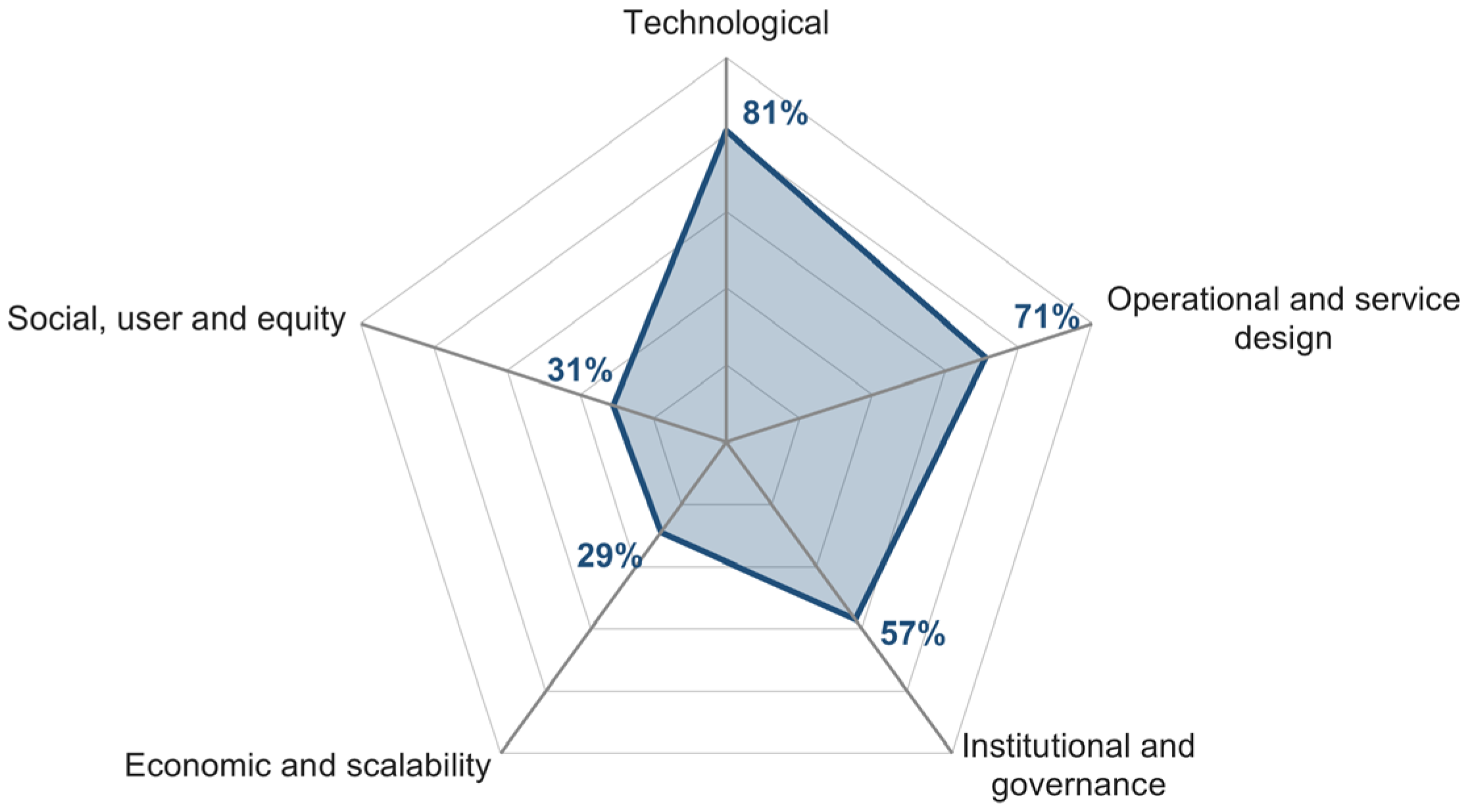
Section 3.3 shows that 81% of the reviews substantively address the technological dimension and 71% the operational one, compared to 57% for the institutional dimension and only 31% for the social and 29% for the economic dimensions (
Figure 3). The weight of the literature continues to fall on platforms, artificial intelligence, the Internet of Things, and data integration, while the social, institutional, and economic dimensions receive comparatively less attention. Correcting this imbalance does not mean abandoning technology, but ceasing to treat it as the main explanatory variable and placing it as one component, important but not the only one, of the sociotechnical assemblage that underpins the transition.
Alongside this, attention to user diversity remains fragmented. Reviews on gender, aging, accessibility, and the digital divide show that this dimension is critical to the success of digitalized services [
12,
14,
22], but its treatment in the general literature remains limited. This has practical implications: predictive models and service designs that ignore this diversity tend to reproduce preexisting inequalities.
From a methodological standpoint, standardized evaluation frameworks are lacking. Baier et al. [
13] illustrate this for demand-responsive transport, Liyanage et al. [
24] for flexible mobility, and Nalluri et al. [
7] for the last mile. The field accumulates experience but draws comparable lessons from it less than would be desirable. Developing shared indicators and frameworks that go beyond technical performance and incorporate accessibility, equity, sustainability, and social acceptance emerges repeatedly as a methodological priority.
A geographic bias with conceptual implications also stands out. The concentration of studies in large cities and developed countries is not only a problem of sample representativeness. It also affects the validity of the conclusions [
23,
25,
26]. Solutions generated in contexts with high urban density, solid institutional infrastructure, and users with high digital literacy are implicitly calibrated for those conditions. Their application in medium-sized cities, peripheral environments, or developing countries requires adaptations that the current literature does not always allow to be identified precisely.
Another gap concerns the architecture of the field itself. The separation of urban mobility and urban logistics as largely independent fields of study limits understanding of the systemic effects of the urban digital transition and hinders the design of integrated policies. People and goods share the same urban space, the same infrastructure, and many of the same pressures toward digitalization, yet the review literature mostly treats them as distinct domains. Connecting the two fields is more than a methodological choice. Their integration is emerging as a line of research with the potential to shape the field in the coming years.
Finally, two gaps align with the cross-cutting axes analyzed. Behavioral change has been studied mainly as initial adoption, leaving the substitution effects, the evolution of routines, and post-adoption dynamics less explored. And, demand forecasting reveals a persistent distance between the sophistication of available models and the maturity of the institutional and data frameworks that would need to incorporate them. This gap appears with particular frequency in the reviews and hinders the translation of technical advances into operational and planning decisions.
5. Discussion
Taken together, these reviews point to a central argument. The digitalization of urban mobility and logistics is not explained by technology alone [
1,
7,
8,
15,
24]. Although research on smart mobility, MaaS, and digital logistics has advanced considerably, the technological focus remains dominant, something reflected both in what is studied and in how planning is done.
Viewed through the lens of the literature on sociotechnical transitions [
16,
17], the picture these works paint is recognizable. Digital innovation takes hold when it is integrated with the regulatory framework, the practices of use, and the economic models in which it is embedded, and when those elements are reorganized at the same time. What the reviews add to that general framework is a concrete map of where this articulation breaks down in urban mobility and logistics, such as coordination between public and private operators, the alignment of supply with users’ actual needs, attention to heterogeneous user profiles, and economic sustainability beyond the pilot phase.
There are signs, however, that the literature is beginning to correct this bias. In MaaS, the most mature field in the corpus, the shift is clearly visible. Butler et al. [
1] place social equity and public–private cooperation at the center of their analysis, and Li et al. [
4] question whether the development of MaaS has been overly guided by platform logic and call for a shift toward genuinely user-centered design methods. The fact that these approaches now appear in well-established reviews points to a maturing field, although the gap between academic analysis and design practice remains wide.
Another implication concerns the structure of the field. Urban mobility and logistics share the same digital transition, but not the same level of academic maturity. Mobility already has a relatively well-established conceptual framework, with recognizable taxonomies; numerous reviews on adoption, gender, micromobility, demand-responsive transport, and carpooling; and an increasingly sophisticated theoretical debate. Digital urban logistics is still a field under construction, more dispersed and dependent on specific technical subfields. This asymmetry has direct methodological consequences, and comparisons between the two fields (
Table 4) should be read with that underlying difference in mind. It is not that urban logistics matters less but that the available corpus still offers a smaller critical mass of comparable syntheses; moving toward broader and more integrative reviews in digital urban logistics could reduce this asymmetry in the coming years.
The importance of the five dimensions varies across contexts. In rural and low-density areas, such as those examined in the RUMOBIL initiatives discussed by Porru et al. [
25], dispersed demand, population aging, limited familiarity with digital tools, and dependence on public support may be more decisive than the technology itself. In developing-country contexts, the cases reviewed by Firzan et al. [
23], including Jakarta, show that integrating and formalizing existing shared or flexible transport services may be a more immediate priority than introducing advanced optimization solutions. In Saudi cities such as Riyadh and Jeddah, Shaik et al. [
26] identify high car dependence, limited public transport development, and fragmented governance as major barriers. These examples show that the framework should be applied with close attention to context, since the relative weight of technological, operational, social, institutional, and economic barriers differs across territories.
Finally, the two cross-cutting axes reveal their own limits. Behavioral change has been studied mainly as initial adoption, with less attention to what happens afterward, including substitution effects, the consolidation or abandonment of use, the evolution of routines, and user learning. For demand forecasting, the diagnosis is parallel. Models are increasingly sophisticated, yet they operate on non-representative data and within institutional frameworks that rarely incorporate them into planning. Their interaction is where the most promise lies. Neither axis advances fully without the other, a connection the review literature has not yet exploited.
5.1. Practical Implications
In mobility, the evidence suggests that launching a digital service requires preconditions that are not technological, such as a governance framework able to align public and private operators, a service design centered on the actual diversity of users, and an understandable fare structure that helps build a perception of value. In logistics, the pattern is similar. The adoption of digital or artificial intelligence tools, unless integrated into a broader urban strategy that incorporates sustainability, working conditions, and social responsibility, tends to produce local efficiency gains but not a transformation of the system. In both fields, the main bottleneck is not technological availability but the institutional capacity to translate innovation into a stable and equitable urban service.
For local authorities, this means using digital and predictive tools to support specific decisions, such as adjusting service frequencies, identifying areas with poorer coverage, allocating vehicles, or improving the management of urban deliveries. Before these tools are introduced, it is necessary to define who manages the data, how data quality and privacy are ensured, who updates the models, and who holds final responsibility for the decisions made. Pilot projects should not be assessed only in terms of accuracy or operational improvements but also in terms of cost, ease of use, effects on different groups, and their actual usefulness for planning. In addition, when model outputs affect public services or the allocation of resources, human oversight and regular monitoring should always be maintained.
Transport operators and logistics firms should also focus on service reliability, interoperability, the needs of users and customers, working conditions, and the medium- and long-term viability of the proposed solutions. For researchers, the framework makes it possible to examine not only whether a technology works but also why the same solution may produce different results depending on the urban, institutional, and economic context. In this sense, digital transformation should be understood as a process of organizational and governance change, rather than simply as the introduction of new technologies.
The framework can also guide future empirical research. In case studies, the five dimensions can be used to organize interviews, document analysis, user surveys, and operational indicators. In comparative studies, the same structure can be applied across cities or services to explain why similar digital solutions produce different results. It can also support policy evaluation before, during, and after implementation by considering not only technical performance but also user response, institutional coordination, equity effects, and economic viability. The two cross-cutting axes add a temporal and decision-oriented perspective by examining how behavior changes and how predictive tools are incorporated into practice.
5.2. Answers to the Research Questions
To conclude the analysis, we revisit the five questions that guided this study.
RQ1. The most frequent barriers are not technical but institutional (weak coordination between public and private actors, and fragmented regulation), operational (coverage, reliability, modal integration, and heterogeneous metrics), social (digital divide; biases by gender, age, and income), and economic (willingness to pay, fragile business models, and scaling difficulties). Technological barriers appear, but rarely as the most decisive.
RQ2. Enablers converge on five conditions, namely effective interoperability between systems, service design centered on user diversity, integrated governance able to align policies and operators, viable economic models beyond the pilot phase, and sensitivity to the local context. None of them works in isolation.
RQ3. Urban mobility and logistics share the same digital transition but navigate it unevenly. Mobility has a more mature review literature and prioritizes the user perspective. Logistics focuses more on operational efficiency, shows less comparative development, and addresses equity mainly through the working conditions of delivery.
RQ4. For behavioral change, the literature prioritizes initial adoption and pays less attention to substitution effects, the consolidation of use, and post-adoption dynamics. For demand forecasting, the sophistication of models grows faster than the institutional maturity needed to incorporate them into operational and planning decisions.
RQ5. The cross-cutting gaps fall into seven areas, namely technocentric bias, fragmented attention to user diversity, the absence of comparable evaluation frameworks, a scarcity of longitudinal studies, reliance on evidence from large cities in developed countries, a lack of integration between mobility and logistics, and the dual gap in behavior and forecasting described in RQ4.
5.3. Study Limitations
This study has limitations that should be explicitly acknowledged. The search was restricted to Scopus and Web of Science and to publications in English. This may have excluded relevant studies published in Spanish, Portuguese, French, or other languages, as well as local or regional evidence that is not indexed in these databases. This limitation may be especially important in urban logistics, where municipal initiatives, operational experiences, and regulatory analyses are often published in national-language journals or institutional reports. As a result, the review may underrepresent evidence from Latin America, Southern Europe, and other non-English-speaking contexts. This language restriction may also have contributed to the imbalance between mobility and logistics, although it does not fully explain it. The search was conducted in March 2026 and therefore does not include works published after that date; given the pace of change in the field, this temporal restriction may affect the comprehensiveness of the synthesis. The exclusion of document types such as conference papers, book chapters, and proceedings ensures methodological homogeneity but may omit useful empirical evidence. The final corpus of 21 documents is sufficient for a review of reviews but reflects the actual asymmetry between mobility and logistics, with only three reviews on the logistics side, of which only one plays a core role. Comparisons between the two fields should be read with that asymmetry in mind. Finally, the classification into core and secondary reviews, although guided by explicit criteria, retains an interpretive component that other teams might assess differently.
6. Conclusions and Directions for Future Research
This study has synthesized the review literature on the digitalization of urban mobility and logistics through a systematic review of reviews. The field shows notable expansion, growing thematic diversification, and persistent fragmentation across subfields, methodological approaches, and application contexts. The asymmetry between the relative maturity of the mobility literature and the less consolidated body of work on digital urban logistics is one of the features that define the current state of the field. This article proposes treating it as a substantive finding and a priority research direction, not only as a limitation. The framework is therefore integrative at the conceptual level, but its current empirical basis is stronger for passenger mobility than for urban logistics, since only three of the 21 included reviews focus primarily on the latter.
The results support three conclusions. Digitalization cannot be interpreted as an exclusively technological process. The effectiveness of platforms, smart systems, and artificial intelligence depends on their integration with operational, regulatory, social, and economic factors that no technology resolves on its own. The proposed taxonomy of barriers and enablers, organized into five dimensions and two cross-cutting axes, shows that barriers and enablers are not symmetrical. Overcoming a barrier does not automatically generate the corresponding enabler because they operate on different levels and with different actors. And, the technocentric bias of the literature affects not only the knowledge produced but also the solutions designed, the populations considered, and the questions prioritized. Equity and governance, together with the two axes of the framework, therefore require greater analytical attention.
As a framework article, this work offers a reusable lens for organizing the evidence and guiding future research. The analysis identifies lines of work on behavioral change that go beyond initial adoption and incorporate substitution effects, sustained use, and operational frictions. In parallel, it outlines challenges and opportunities in data- and AI-driven demand forecasting, for both passenger mobility and urban logistics, including how to integrate these capabilities into planning and management decisions. It also points to cross-cutting priorities, namely strengthening equity and accessibility, generating implementation evidence in diverse contexts, and advancing data integration approaches that allow impacts to be assessed at the system level.
Taken together, the findings show that decisions on urban digitalization should consider technology, service design, equity, governance, and economic viability jointly. For public authorities and operators, this means moving beyond isolated pilot projects and embedding digital tools in stable planning, monitoring, and decision-making processes. For researchers, the framework provides a common basis for comparing mobility and logistics across different urban contexts and for testing how the five dimensions interact in practice.