1. Introduction
Urban mobility policy faces a structural tension. Cities must accommodate dense and diverse travel demand while cutting emissions, reallocating street space, improving air quality, and reducing private-car dependence. This becomes especially visible around rail stations and multimodal nodes, where public transport, walking, cycling, and shared services coexist with persistent demand for convenient parking.
Mobility hubs respond to this problem by making multimodal travel easier to understand, use, and trust [
1,
2,
3,
4,
5]. A hub can reduce transfer penalties, improve first- and last-mile connectivity, support shared and active modes, and increase the practical usability of public transport. Yet this promise weakens when the surrounding access regime continues to make car use cheap, legible, and low-friction.
This article operationally defines a mobility hub as a place where three conditions coincide: multiple modes sit within a short and legible walking distance; they allow users to complete an integrated trip; and the surrounding access conditions, including parking, curb use, wayfinding, and search time, shape the relative attractiveness of each option. This definition treats the hub as a managed access system rather than as a fixed infrastructure label.
The literature has advanced on definitions, typologies, planning models, governance arrangements, and spatial design [
4,
5,
6,
7,
8,
9,
10]. It has also started to examine willingness to pay for hub services, preferences for shared modes, and hub location in relation to demand and micromobility patterns [
9,
11,
12,
13,
14]. However, fewer studies examine how a mobility hub performs when the same local context also improves private car access.
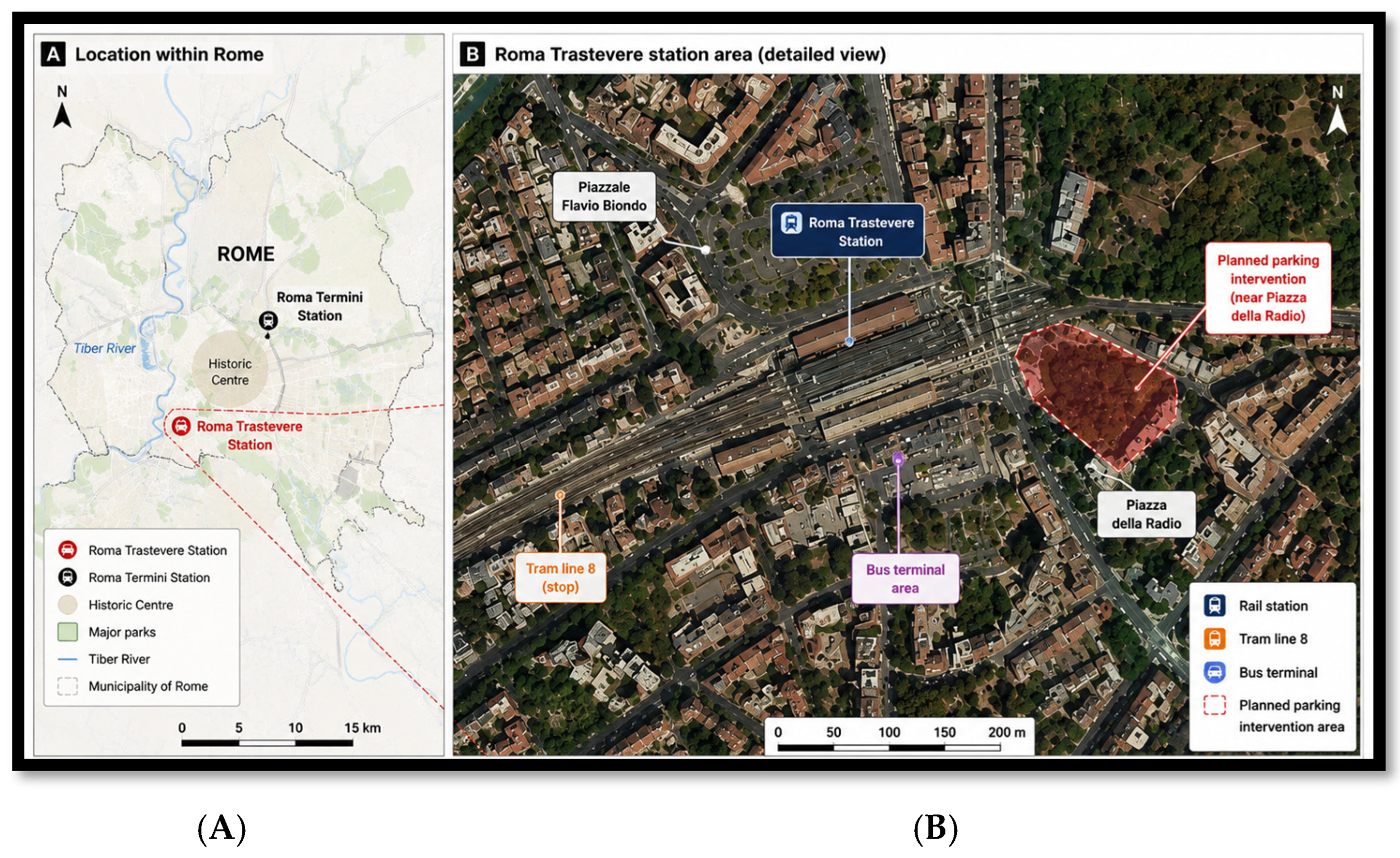
Rome Trastevere provides a useful setting for that question (see
Figure 1). The station sits in a dense mixed urban fabric, connects rail with surface public transport, walking, cycling, and shared services, and has gradually acquired several functional traits associated with a mobility hub. At the same time, the mobility hub at Piazzale Flavio Biondo, whose completion took place a few months after the survey was administered, is located close to the planned parking intervention near Piazza della Radio, allowing the analysis to test how users respond when access frictions fall for private cars [
15,
16,
17,
18].
The paper addresses three research questions (RQs). RQ1 asks whether higher parking prices reduce the relative attractiveness of car access at an evolving mobility hub. RQ2 investigates whether removing parking search time increases predicted car use enough to weaken existing multimodal patterns. RQ3 ponders whether improvements in shared-mobility search conditions compete mainly with car access or also draw users away from public transport and walking.
To answer these questions, the paper uses an on-site stated preference (SP) survey administered to actual users of the Trastevere node in Rome. A multinomial logit (MNL) model supports scenario-based sample enumeration under alternative parking and shared-mobility conditions. This design does not produce a citywide demand forecast but rather behavioural evidence for a specific access field in which parking, public transport, walking, and shared services compete.
The paper contributes by linking the mobility-hub debate with parking policy and SP mode-choice evidence, by shifting attention from hub inventories to comparative access conditions, and by showing that cities must govern parking regulation and service quality together. The evidence should be interpreted as ex ante SP evidence based on an on-site user sample, not as direct evidence of realized behavioural change after implementation.
The article proceeds accordingly.
Section 2 reviews the literature and defines the empirical gap.
Section 3 presents the Rome Trastevere, the SP design, the sample, the MNL specification, and the simulation scenarios.
Section 4 reports model estimates and sample-enumeration results.
Section 5 derives policy implications from the evidence in the scenario.
Section 6 and
Section 7 discuss limitations, future research, and conclusions.
2. Literature Review
The mobility-hub literature has expanded rapidly, but it still lacks full conceptual consolidation. The most robust review contributions describe a recognizable physical place where cities coordinate multiple transport modes and mobility services through interchange design, digital integration, and stronger first- and last-mile connectivity [
4,
5,
6,
10]. Even within this broad conceptualization, authors still disagree on the minimum conditions a hub must satisfy. Some definitions treat public transport as constitutive; others accept clusters of shared-mobility services with weaker direct transit integration [
4,
5,
10]. The distinction matters since it changes the object of the analysis. A study may evaluate interchange infrastructure, a service bundle, a station-area intervention, or a wider governance ecosystem while using the same label. The definitional debate has matured, even if it has not faded away. Recent reviews converge on a common core built around physical proximity between modes, recognizability, support for intermodal transfer, and some degree of service integration. The disagreement currently concerns boundary conditions rather than the core logic itself: whether public transport must lie inside the hub or only within walking distance, whether shared mobility is mandatory or only desirable, and how strongly digital integration should enter the definition. This shift from taxonomy to operationalization matters and suggests the central research problem no longer lies in naming the object, but in understanding what the object does under given conditions.
A second stream of work examines typology, location, and spatial fit. Here, the literature reaches a clearer conclusion: no single-hub model fits all urban contexts [
3,
6,
8,
9]. Neighbourhood, district, gateway, and city-centre hubs serve different functions and rely on alternative combinations of density, land-use mix, transfer demand, and service intensity. Scholars have also developed more systematic approaches to site selection by using micromobility traces, accessibility measures, demand indicators, and multi-actor criteria [
8,
9,
13]. These studies have advanced the field, moving the debate beyond abstract hub advocacy and toward questions of territorial suitability. They also show that spatial fit conditions operational success. A poorly located hub rarely compensates for weak demand or fragmented access by design alone. This spatial literature also aligns mobility hubs with the broader research on station areas and urban interchanges. Evidence on rail-transit investment also shows that station-area interventions can affect surrounding urban values, confirming that transport nodes interact with land-use intensity and local accessibility beyond their transport function [
19]. Studies on transport interchanges, transit-oriented development, and node-place relationships show that performance depends not only on the quantity of services present, but also on the quality of transfer, legibility of space, and surrounding urban intensity. Mobility-hub research incorporates that lesson. A hub succeeds when local urban structure, service offer, and access environment reinforce one another rather than pull in opposite directions. The digital dimension pushes the literature further in the same direction. Mobility service (MaaS) research does not collapse into mobility-hub research, but the two intersect in an important way. A physical hub lowers transfer friction in space, while digital integration lowers transfer friction in information, booking, and payment. The literature increasingly treats these two dimensions as complementary rather than substitutable. This article investigates search time and access convenience as behavioural variables rather than as peripheral design details.
A third body of research addresses implementation and governance. These contributions matter since they move beyond a narrowly physical reading of the concept [
4,
5,
7,
8]. They show that hub development depends on coordination among municipalities, transport operators, infrastructure managers, shared-mobility providers, digital intermediaries, and, in some cases, private developers. Pilot projects and guidance documents repeatedly stress the need to align planning, funding, procurement, branding, maintenance, and performance monitoring [
5,
7,
8]. This literature underlines two points with particular force. Hub implementation rarely succeeds when institutions fragment responsibility across separate silos, and cities must treat the hub as a managed service environment, not merely as a built form.
A fourth and especially relevant line of work focuses on users, service quality, and behavioural response. Earlier studies on urban interchanges showed that information, waiting conditions, safety, and ease of transfer shape perceived quality and therefore affect the practical usability of multimodal environments [
20,
21]. More recent hub-specific studies have investigated preferences for shared electric modes, willingness to use neighbourhood hubs, attitudes toward service bundles, multimodality at destination, and the role of integrated information [
11,
12,
13,
14,
22]. Together, these contributions establish that users do not respond only to the presence of modes, but rather to the effort required to identify, reach, understand, and trust them. In other words, users experience the hub as an access environment rather than as a static inventory of options. That insight brings parking back to the centre of the discussion. A substantial transport literature, even when it does not use the language of mobility hubs, suggests that parking supply, parking pricing, parking cash-out schemes, employer-paid parking, and parking search frictions shape mode choice in consequential ways [
23,
24,
25,
26,
27,
28]. This evidence remains highly relevant since any hub competes with alternative access regimes, and private cars draw much of their practical advantage from parking conditions at both trip ends. When parking becomes easier, faster, or cheaper, the relative burden of multimodal transfer rises. When parking becomes scarce, priced, or uncertain, non-car options gain ground. The hub literature often acknowledges this issue implicitly, yet empirical studies still rarely test it directly at the node level.
With specific reference to this stream of literature, and in particular to behavioural response to given policy interventions, SP methods play a relevant role in such investigations. In more detail, this methodological approach has been used in mobility-hub research since many of the relevant policy questions concern services, combinations of modes, or design configurations that do not yet exist in practice (see
Table 1). Rather than measuring only observed use, this literature asks how travellers evaluate hypothetical changes in access, service integration, shared-mobility availability, digital support, pricing, and urban design. This use of SP methods also connects with a broader urban-transport policy literature in which hypothetical choice experiments help assess how different individuals evaluate proposed policy measures before implementation, including cases where preferences and mutual perceptions may diverge substantially [
29]. In doing so, it has helped shift mobility-hub research from a largely definitional and planning-oriented debate toward a more behaviourally relevant account of how users might respond to different hub configurations. One major theme concerns the relationship between hubs and first- and last-mile access. Studies of Delft Campus railway station and integrated micromobility public transport systems show that access and egress choices depend on concrete travel attributes rather than on the general attractiveness of multimodality as an idea. Cost, availability, weather, luggage, travel time, integrated payment, reservation options and the possibility of carrying micromobility tools/items on public transport all affect SPs, although not with the same intensity across cases. One study emphasizes the role of emerging access modes at a small rail hub [
13], while another extends the analysis by modelling heterogeneous responses to integrated micromobility and public transport through a hierarchical latent class framework [
14]. A second line of work treats mobility hubs as instruments for mode substitution. This stream of literature asks whether shared electric cars, e-bikes, e-scooters or other hub-based services attract users away from private cars, public transport, walking or cycling. The answer is not uniform: evidence from Amsterdam indicates that public transport users switch to shared electric mobility-hub modes more readily than car users, while cyclists and pedestrians show stronger inertia, especially when they engage in shorter trips [
12]. Other work on electric mobility hubs (eHUBS) further complicates the picture by showing that shared modes may complement each other rather than simply compete, so the hub can operate as a flexible service portfolio instead of a single substitute for the private car [
30]. User heterogeneity represents another recurring theme. Mobility-hub demand rarely appears as a homogeneous response to infrastructure provision. Several studies show, in different ways, that socio-demographic characteristics, digital skills, current travel habits, car ownership, scooter ownership, education and life-cycle position shape stated acceptance or use [
11,
14,
31,
32]. This strand of research challenges a simple supply-led view of hubs and placing shared services near public transport does not guarantee adoption unless the offer matches the capabilities, routines, and constraints of different user groups. A fourth theme concerns the design and integration of the hub itself. Here, the object of analysis moves beyond mode choice and asks which physical, digital and urban-design elements users value. Evidence from four European living-lab areas shows that respondents attach greater willingness to pay for visible and spatially tangible forms of integration, such as proximity between shared mobility and public transport or placemaking strategies, with respect to digital and informational integration, even when they recognize the latter as necessary for hub functioning [
11]. Related work broadens this perspective by linking hub acceptance to green and smart urban features, suggesting mobility hubs can operate not only as transport interfaces but also as visible public-space interventions [
33]. More recent studies also use SP evidence to test behavioural transferability across contexts. One study examines eHUBS mode-choice models between Amsterdam and Manchester and shows that model transfer requires caution, even when the policy object appears similar [
34]. This finding matters for policy because many cities borrow hub concepts from international examples, while local mode cultures, baseline travel behaviour and service familiarity may alter the behavioural response. SP methods thus support not only the estimation of user preferences, but also the assessment of how context-dependent those preferences might be.
This paper repositions the mobility-hub debate around behavioural competition rather than infrastructural presence. Existing research has clarified what mobility hubs are, how they can be located and designed, and how users typically respond to shared-mobility or integration attributes. Yet less attention has been paid to what happens when the same urban node that supports multimodal access also reduces the effort required to use the private car. This paper addresses that unresolved tension by examining Rome Trastevere as a real urban station area where public transport, walking, cycling and shared mobility coexist with a parking intervention that may improve car accessibility.
The paper integrates three research streams that usually develop separately. Mobility-hub studies tend to focus on definitions, typologies, governance, service bundles and design features. Parking policy studies examine how supply, price and search frictions influence mode choice and urban accessibility. SP studies estimate how users respond to changes in time, cost and service attributes. By bringing these perspectives together, the paper frames parking not as an external background condition but as a central component of the hub’s competitive access environment.
Additionally, it tests a policy contradiction that real cities often face but the literature rarely investigates directly. Urban authorities may invest in shared mobility, public-space redesign, transfer quality and active-mode access while also expanding parking capacity or making car access easier nearby. This combination, potentially perverse, can weaken the behavioural effect of mobility-hub interventions, even when the physical hub appears well designed. Rome Trastevere allows the analysis to assess this contradiction empirically by comparing how users react to changes in parking search time, parking cost and shared-mode search conditions.
Finally, the paper also treats the mobility hub as a contested field of modal competition rather than as a static infrastructure object. Rome Trastevere already concentrates rail services, surface public transport, walkable urban fabric and shared-mobility options; however, the nearby parking intervention can, in practice, alter the relative attractiveness of the private car. The empirical focus, therefore, shifts from asking whether the station can be labelled a mobility hub to asking whether its multimodal configuration remains behaviourally resilient when car access becomes more convenient.
These three elements define the paper’s added value. The analysis provides ex ante SP evidence on a real urban node where multimodal access and improved car access coexist.
3. Data and Method
This section develops the empirical strategy used to examine how parking conditions and shared-mobility frictions shape mode choice at Rome Trastevere. The analysis begins by situating the station within its urban and policy context, clarifying why it can be interpreted as an evolving mobility hub embedded in a contested access field (
Section 3.1). It then moves from place to measurement, describing the two-stage survey process through which the pilot survey informed the routed SP design (
Section 3.2). The empirical basis of the analysis is then defined by presenting the sampling strategy and data-collection procedure (
Section 3.3). The behavioural model follows, with a multinomial logit specification used to estimate modal preferences across the available alternatives (
Section 3.4). Finally, the estimated model is translated into policy-relevant simulation scenarios that assess how changes in parking search time, parking cost and shared-mode search time affect predicted choice probabilities (
Section 3.5). Taken together, these steps connect the spatial and policy conditions of the node with the behavioural evidence used to evaluate alternative access-management scenarios.
3.1. Case Study: Rome Trastevere as an Evolving Mobility Hub
Rome Trastevere represents a meaningful case since it combines a major urban rail station, surface public transport, pedestrian access, cycling opportunities, and shared-mobility options within a dense urban fabric (See
Figure 1). Rete Ferroviaria Italiana (RFI) identifies Roma Trastevere as a passenger station with six tracks and regular regional connections towards key metropolitan destinations, including Fiumicino Airport, Civitavecchia, Viterbo, Roma Ostiense, and Roma Termini [
16]. Buses and trams extend this rail function into the surface public transport network. The station also concentrates competing claims over a constrained access field. Piazzale Flavio Biondo, the station forecourt, and the nearby Piazza della Radio corridor accommodate station access, public transport stops, pedestrian crossings, short-stay circulation, service vehicles, shared-mobility vehicles, and private-car movements. Users therefore evaluate parking not only as a stock of spaces but also as a combination of time, effort, certainty, and price. Existing parking conditions combine regulated paid parking, informal search behaviour, short-stay stopping, and the planned Piazza della Radio parking intervention. Rome’s ordinary on-street paid-parking tariff provides the benchmark for the monetary scenarios used later in the paper: Roma Servizi per la Mobilità (RSM) reports a standard tariff of EUR 1 per hour outside restricted-traffic zones and EUR 1.2 per hour inside them, with additional short-stay and longer-duration options [
35]. The EUR 1 and EUR 1.5 hourly increases used in the simulations, therefore, represent policy-relevant changes around a realistic local pricing order of magnitude.
The analysis considers Trastevere as an evolving mobility hub rather than as a fully consolidated hub with a stable user identity. The site already concentrates rail access, surface public transport, walking connections, cycling possibilities, and shared services. However, user recognition, legibility, and governance integration remain incomplete. This status makes the case suitable for testing whether parking conditions can affect the behavioural competitiveness of multimodal access.
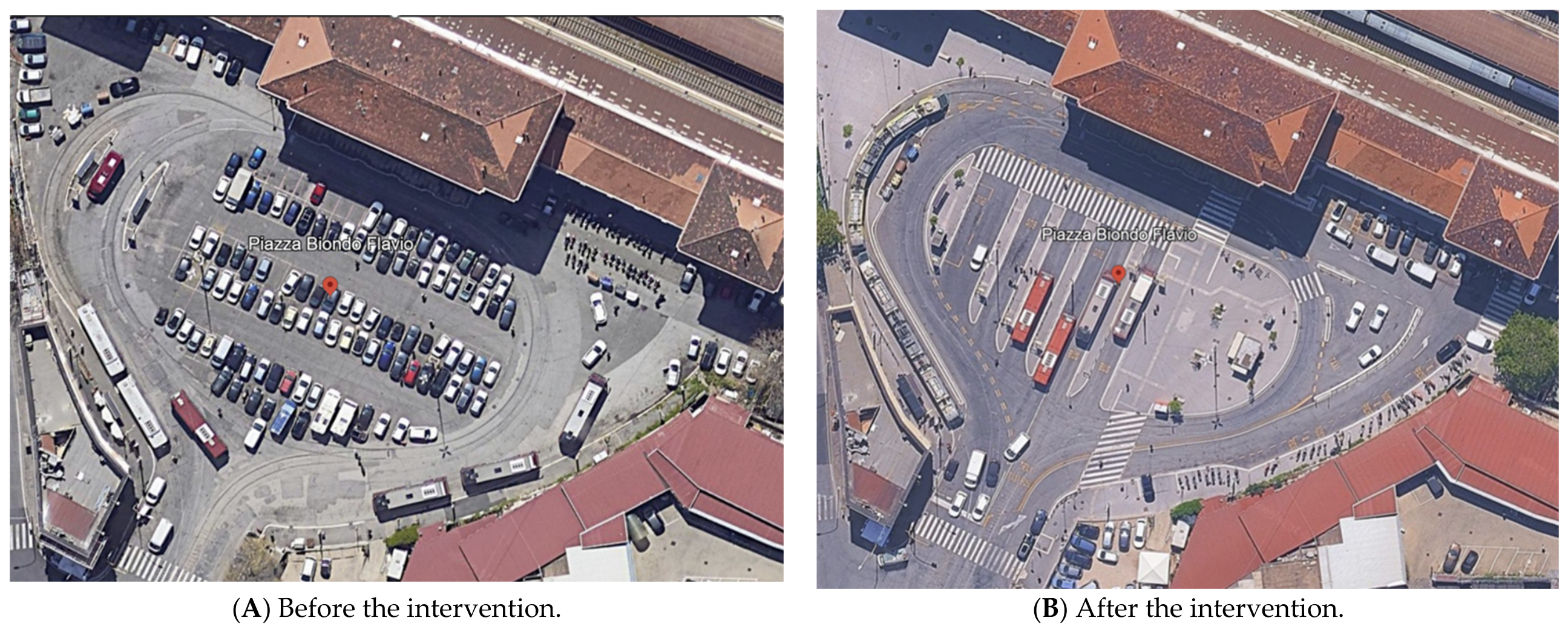
Figure 2 presents an aerial view of Piazzale Flavio Biondo and the front area of Roma Trastevere station before and after the intervention. The image locates the intervention site within its immediate urban context and clarifies the spatial concentration of the station forecourt, the adjacent public transport interface, and the surrounding access environment.
3.2. Survey Design
The empirical investigation unfolds in two stages. General guidance on efficient stated-choice design and Ngene-based experimental design workflows also stresses that attribute selection, choice-set construction, and design efficiency affect the reliability of estimated behavioural parameters [
36,
37]. The research team first conducted a pilot survey on-site in April 2024 and collected 83 responses, while the Piazzale Flavio Biondo mobility hub was not fully completed. This phase unveiled how users experience the node and their socio-demographic/trip profiles, while also giving useful information for refining the subsequent SP instrument. The pilot also showed that Trastevere did not operate uniformly for all users: some used it as a transfer environment, while others relied on one main mode after passing through the station area.
The SP survey was administered on-site in two waves between June and early July 2024. The random design was developed through a sequential procedure that identified the feasible transport alternatives, defined the relevant attributes and levels, generated randomized choice sets in Ngene, translated the coded levels into realistic attribute values, and organized the resulting scenarios for survey administration. The experiment considered seven alternatives: private car, shared car, shared e-moped, shared bike, shared e-scooter, public transport, and walking, with the alternatives shown to respondents according to trip distance and feasibility. For short distances between 250 m and 1000 m, respondents evaluated walking, cycling, and e-scooter options, while for longer distances they faced combinations of private car, public transport, bike, e-scooter, e-moped, and car sharing. Four attributes described the alternatives: travel time, travel cost, waiting/parking search time, and vehicle propulsion type. The first three were defined with respect to realistic service conditions and varied by +/−15% around current levels. In more detail, travel time measures the number of minutes required to travel from the hub to the respondent’s final destination. travel cost indicates the monetary cost, in euros, associated with using each alternative for that trip. For the car alternative, Travel cost accounts for both variable costs linked to distance travelled and fixed parking costs. waiting/parking search time definition differs according to the alternative considered: for private car, it represents the minutes spent looking for an available parking space; for public transport, it captures waiting time before boarding; for shared modes, it measures the time required to access an available vehicle. Electric propulsion dichotomously differentiates vehicle propulsion type in electric or non-electric, only for the bike alternative. The design used nine choice sets for each choice experiment and four distance-based experimental paths, producing scenarios in which respondents compared feasible, realistic combinations of modes and attribute levels rather than abstract or unavailable alternatives. waiting/parking search time captures the friction involved in locating and accessing a specific mode and converts service availability or parking supply into practical accessibility. The design traded some experimental breadth for stronger behavioural credibility, which fits the paper’s aim of informing policy design at a specific hub rather than estimating a universal mobility model. This choice is also coherent with SP design guidance, which prioritizes plausible choice situations and efficient attribute variation over exhaustive but behaviourally unrealistic choice sets [
36,
37].
3.3. Sample and Data Collection
The final sample includes 204 valid responses from users intercepted around Piazzale Flavio Biondo and the station forecourt. Interviewers approached respondents face to face, explained the academic purpose of the research, and invited them to complete the questionnaire through an online form accessed via a QR code. Before completing the questionnaire, all respondents received a short explanation of the voluntary nature of participation, the anonymous treatment of responses, the absence of directly identifying personal data collection, and their right to decline or interrupt the interview at any time without consequence. The on-site intercept design captured preferences from people with a real and immediate connection to the node, rather than hypothetical responses from residents or city users detached from Trastevere. The sample is not statistically representative of all Rome travellers, and the results should not be interpreted as citywide demand estimates. It is, nevertheless, appropriate for the paper’s behavioural objective because all respondents were exposed to the daily access conditions of the Trastevere node.
Table 2 reports the descriptive summary of respondent characteristics and trip-related variables. The average socio-demographic profile is relatively young, with the 18–24 and 25–34 groups accounting for a large share of respondents. Many respondents are students or workers, and work-related travel represents the dominant trip purpose. Data reveal a gap between infrastructure and recognition. A large majority of respondents did not initially report familiarity with the term ‘mobility hub’, and many still did not identify Trastevere as one after being provided with a short definition. The hub may therefore exist institutionally and spatially before it exists cognitively. This weak legibility matters because users cannot respond to an integrated system if they experience it as a loose collection of options.
3.4. Modelling Approach
The model estimates behaviour through a multinomial logit (MNL) specification implemented in Apollo and grounded in random utility theory [
38,
39]. The methodological choice taken in this paper concerning the use of MNL is motivated by the willingness to ensure a transparent baseline for a node-specific ex ante policy exercise, considering that using more advanced and sophisticated models would, on the one hand, ensure richer behavioural detail, but also require larger samples and stronger measurement blocks. Given our interest in providing the reader with a preliminary investigation of the relevance and relative importance of each policy attribute rather than a detailed and articulated analysis of the preference structure, the paper adopts a simpler yet informative and less data-greedy modelling stance.
The model focuses on average behavioural responses to policy-relevant changes rather than on the full distribution of unobserved heterogeneity, and provides a transparent structure for translating survey evidence into comparative scenarios. The MNL specification imposes the independence of irrelevant alternatives assumption. The substitution patterns generated by the model should therefore be interpreted as conditional on this proportional-substitution structure.
3.5. Simulation Scenarios
The paper provides a scenario analysis based on sample enumeration and uses Monte Carlo simulations to account for uncertainty in parameter estimates, thereby producing confidence intervals around the predicted probabilities. In each scenario, attributes of selected alternatives change while observed choice sets do not. Simulations do not introduce new modes, destinations, or users. They investigate predicted probabilities for the surveyed users change when selected policy components vary.
Baseline scenario reproduces the SP design. Scenario 1 sets the car parking search time to zero and should be interpreted as the removal of the parking search component within the tested SP range. Scenario 2 increases parking cost by EUR 1 per hour, while Scenario 3 increases it by EUR 1.5. Scenario 4 combines higher parking costs with lower search times for shared modes, representing an integrated package of car restraint and shared-mobility improvement. Simulations rest on the following assumptions: the estimated marginal sensitivities to travel cost, travel time, parking search time, and shared-mode search time remain stable across the tested changes; respondents can react through the alternatives included in their feasible SP choice sets; parking search time and parking price affect only the private car alternative, while shared-mode search-time reductions affect the related shared alternatives. Results should be interpreted as directional ex ante evidence for policy comparison, not as aggregate traffic volume forecasts post implementation.
4. Results and Simulations
Taken together, the data support a precise empirical framing. Trastevere is not analyzed here as a fully mature mobility hub with a stable behavioural identity, but rather as a strategic node in transition, where multiple modes coexist and where future accessibility conditions, especially around parking and shared services, can influence whether multimodal use is consolidated or undermined. This makes it an especially informative case for policy-oriented behavioural modelling.
Table 3 reports MNL estimates.
The time, waiting-time, and parking search time coefficients in
Table 3 are not interpreted as transferable value-of-time estimates or welfare parameters. They support a local scenario analysis of access management options around Rome Trastevere. In this setting, waiting time and parking search time capture not only clock time, but also uncertainty, perceived effort, reliability, spatial legibility, and the risk of not finding a usable option. The parking search coefficient should therefore be read as a local sensitivity parameter within the tested SP range, not as a general monetary valuation of parking search time. It may also absorb unobserved access-quality components that the stated-preference design does not measure separately. The estimated MNL model produces a coherent behavioural structure. Cost and travel time both enter with the expected negative sign and are statistically meaningful, confirming respondents are sensitive to generalized cost in standard ways. Search time also matters and is especially useful from an interpretive standpoint since it translates operational frictions into behavioural effects. This is a valuable result for mobility-hub analysis. In fact, users do not respond only to abstract modal categories, but to the practical effort required to locate, access, and complete a trip with a given option. The positive and statistically significant coefficient for “currently used mode” indicates that respondents tend to favour the mode they already use when it appears among the feasible alternatives. This result should be interpreted as evidence of modal inertia, not as a comparison between car users, public transport users, and shared-mobility users.
The internal consistency of the estimates is important. It confirms that respondents processed choice tasks in a behaviorally plausible way. The model does not produce erratic signs or implausible ranking patterns. Instead, it reproduces a familiar structure from transport-demand analysis: users penalize time and money, react to access friction, and retain a residual baseline preference for some alternatives over others even after controlling observed attributes.
Table 4 reports attribute direct elasticities by mode. travel cost produces the largest elasticities in absolute value for most modes, especially for shared and micromobility alternatives, where values are generally around or above −1. This indicates that respondents react more strongly to price changes than to changes in travel time or waiting/parking search time for these alternatives. Public transport represents a partial exception, since the elasticities for Travel cost, travel time, and waiting/parking search time are all relatively small and similar in magnitude. travel time elasticities remain consistently moderate, ranging approximately from −0.12 to −0.50, while waiting/parking search time elasticities are smaller overall, with values generally above −0.25 in absolute terms and almost zero for private-car parking search. This last result should not be interpreted as evidence that waiting or parking search frictions are behaviourally irrelevant; rather, it partly reflects the scale of the underlying variables, since relatively large estimated coefficients for waiting/parking search time may translate into lower elasticities when the absolute magnitude of the attribute variation is limited. The relatively low travel time coefficient should be interpreted in this local access context. It does not indicate that respondents disregard time. Rather, it suggests that, within the tested SP range, monetary cost and search-related frictions carry more behavioural weight than marginal differences in Travel time. This is plausible for short urban access trips around a multimodal node, where small time differences may be less salient than direct charges, uncertainty, and the effort needed to locate or access a usable option.
Alternative-specific constants indicate a baseline hierarchy of preferences that is itself informative. Walking and public transport occupy the strongest positions, suggesting that for many trips linked to the Trastevere node, compact urban form and transit availability already give non-car modes an important structural advantage. By contrast, private car do not emerge as the dominant default option in the baseline condition. This matters since it shows that Rome Trastevere is not a case in which car use must first be displaced from a position of overwhelming behavioural dominance. Rather, it is a case in which a multimodal balance already exists and may either be reinforced or weakened depending on policy choices.
Another important result concerns resilience. The baseline structure is not fragile in the sense it can be instantly overturned by one change in one attribute. Rather, it is conditionally stable: public transport and walking retain a strong position unless policy actively worsens the multimodal bundle or systematically privileges car access. This matters. It suggests that hub policy does not need to produce dramatic behavioural revolutions to be truly successful. Protecting and incrementally improving an already favourable modal balance can itself be a meaningful policy achievement. Resilience bears an analytical implication. The hub already benefits from a latent behavioural structure that favours public transport and walking for many observed trips. Yet scenario results show that this structure remains conditional rather than guaranteed. It can withstand marginal changes, but it is not immune to policies systematically lowering the perceived burden of car use while failing to improve the ease of shared and collective modes.
Table 5 summarizes the scenario-based sample-enumeration results and shows how modal probabilities shift under alternative parking and shared-mobility conditions. Baseline sample-enumeration results make this interpretation more concrete. Public transport is the most likely choice, with a predicted probability of about 0.45, followed by walking at about 0.18. Private car reaches about 0.12, while e-scooters and e-mopeds occupy an intermediate position; bikes and shared cars remain the least likely alternatives in the baseline. This pattern is consistent with the spatial and functional nature of the node. Trastevere is an urban station where short access and egress trips, interchange behaviour and destination proximity give walking and transit strong relevance. At the same time, the presence of e-scooters and e-mopeds suggests that emerging shared modes form part of the realistic competitive set for users performing short urban connections.
The simulation exercise is deliberately conservative. It does not assume that the new parking intervention drastically changes the composition of the user population, level of congestion, supply of public transport, availability of shared fleets, or distribution of destinations. It also does not assume that users change their residential or work location in response to the intervention. The exercise modifies only the attributes that can be directly associated with the policy levers this paper evaluates. This makes the results easier to interpret. Observed shifts derive from changes in generalized cost rather than from unobserved changes in the wider travel environment.
Table 5 reports confidence intervals around the predicted probabilities. This strengthens the interpretation by shifting attention from differences between individual point estimates to the direction, relative magnitude, and consistency of the scenario patterns. The scenario discussion consequently uses the estimated coefficients as inputs for comparing local access-management configurations, not as stand-alone monetary valuations. The simulated probabilities should be read as directional policy evidence for Rome Trastevere rather than as welfare-ready estimates. It is important to note that changes in the probabilities of e-scooter, e-moped, and shared-car alternatives reflect the MNL proportional-substitution structure and should not be interpreted as direct evidence of observed market substitution among close modal alternatives.
Scenario 1 sets car parking search time to zero and therefore removes only the parking search component included in the SP design, leaving all other attributes and alternatives unchanged. It should not be read as a broad improvement in overall car attractiveness or as a condition in which car use becomes generally easier, cheaper, faster, or more reliable. The simulated result is revealing. Car probability increases only marginally, by about 0.9% relative to the baseline, while public transport and walking remain essentially unchanged. The modal structure does not collapse into car dependence, suggesting that the Trastevere node retains some behavioural resilience when car access becomes easier. However, the result should not be read as evidence that parking supply is neutral. Even a small increase in car probability can become relevant when repeated over many daily trips, reinforced by habit formation, or replicated across several station areas. The modest probability change reflects the full choice structure rather than the isolated parking search coefficient alone. Travel cost, travel time, alternative-specific constants, the current-mode term, and the attractiveness of competing modes remain unchanged. In the Rome Trastevere sample, public transport and non-car alternatives already hold strong baseline positions, so removing one car-related friction does not automatically produce a large modal shift.
The second scenario increases car parking cost by EUR 1/h. The predicted effect is stronger than the parking search-removal scenario and works in the opposite direction: car probability falls by about 14.7%, while bike, e-scooter, e-moped and shared car increase. Public transport remains virtually unchanged, confirming its role as the dominant and stable baseline alternative rather than as the main absorber of the displaced car probability. Results suggest that users react more strongly to a monetary increase in parking cost than to the removal of parking search time. This asymmetry is important because it identifies pricing as a more effective steering instrument than parking convenience is a destabilizing force in the tested range.
Scenario 3 increases the hourly parking cost by EUR 1.5 and produces a stronger version of the pattern observed in Scenario 2. Car probability falls by about 22.4% relative to the baseline, while bike, e-scooter, e-moped and shared car increase more clearly than under the EUR 1 increase. The modal hierarchy remains broadly stable, but the larger price increase strengthens the shift away from private car rather than merely reproducing the previous scenario. This does not imply that the response to parking pricing is linear over a wider range of prices. It only shows that, within the tested range, a larger increase in parking cost produces a stronger reduction in predicted car choice.
The fourth scenario combines higher parking costs with lower search time for shared modes, constituting the most policy-relevant scenario because it represents a coordinated package rather than a single isolated measure. The simulation assumes that parking becomes more costly while shared modes become easier to find and use near the hub. Under this condition, e-scooter and e-moped probabilities increase markedly, shared car also gains probability, and car probability reaches its lowest simulated value. Public transport remains the dominant alternative, although it decreases slightly relative to the baseline, together with walking and biking. This suggests that the coordinated package does not simply shift users from car to public transport; rather, it redistributes part of the probability toward shared and flexible modes while keeping public transport at the centre of the modal structure.
The result shows that push and pull measures work best when aligned. Pricing parking discourages car access, while lower search frictions make non-car alternatives more credible at the precise moment when users reconsider their choice. The combined scenario also clarifies the role of shared mobility. It does not imply that shared modes seamlessly replace public transport or walking as the backbone of access to Trastevere. Instead, it suggests that shared micromobility can play a complementary role by covering the specific first- and last-mile segments that walking or public transport alone do not easily serve. Shared car remains low in absolute probability, but increases in relative terms under the pricing and combined scenarios. E-scooters and e-mopeds, however, show the most policy-relevant response since they combine higher baseline relevance with stronger gains under the coordinated package. This indicates that not all shared modes contribute equally to hub performance and that service mix matters for policy design.
Overall, simulation results support a relational interpretation of hub performance. Modal outcomes emerge from the balance between alternatives, not from the isolated quality of any single service. A well-designed hub can still underperform if parking access remains cheap, legible and abundant, while sustainable alternatives retain search frictions or fragmented service logic. Conversely, modest improvements in shared modes become more effective when the parking regime stops subsidizing private car use. The policy-relevant lesson is therefore not that parking must disappear, but that parking price, parking certainty and shared-service usability should be governed together.
Modelling results support a sharper theoretical interpretation of mobility hubs. What matters is not only the co-presence of modes, but the relative generalized cost of moving through the access system surrounding the hub. Travel time, monetary cost and search frictions jointly shape whether a hub functions as a meaningful alternative to the car or as a visually multimodal environment with limited behavioural force. In this sense, Rome Trastevere shows that the hub is not the end point of policy; it is the local arena in which wider choices about parking, pricing and operational quality become behaviourally visible.
5. Policy Implications
Policy implications are deliberately limited to what SP evidence and scenario simulations support. Results originate from actual users intercepted at Rome Trastevere and their responses inform ex ante policy design for comparable dense station-area access environments. They should not be read as observed post-intervention modal shifts or as aggregate forecasts for Rome as a whole.
In what follows, the paper discusses the most relevant policy implications.
Parking pricing emerges as the clearest steering instrument. Removing the car parking search time raises predicted car probability only marginally, by about 0.9% relative to the baseline. By contrast, a EUR 1/h parking-cost increase reduces predicted car probability by about 14.7%, while public transport remains the dominant alternative. A EUR 1.5/h increase strengthens this pattern further, reducing car probability by about 22.4%. Rome should therefore treat parking price, duration and turnover as mobility-management variables rather than as purely fiscal or supply-side decisions.
Reducing shared-mobility search frictions will not imply replacing public transport. Scenario 4 combines higher parking costs with lower search time for shared modes. Under this package, e-scooter and e-moped probabilities increase markedly, shared car also gains in relative terms, and car probability reaches its lowest simulated value. Public transport remains the dominant alternative, although it decreases slightly relative to the baseline. This result supports targeted operational measures such as clearer wayfinding, reliable vehicle availability, designated pick-up and drop-off areas, fleet rebalancing and better digital information. These measures matter because users respond to the effort required to find and use an option, not only to its formal presence near the hub.
The hub constitutes a competitive access environment rather than a bounded infrastructure object. Simulations show that modal probabilities change when parking price, parking search time and shared-mode search time change, even though the physical node remains the same. They also show that not all access levers have the same behavioural implications: parking search time produces only a marginal car response, parking pricing generates a clearer reduction in car probability, and lower shared-mode search time matters most when combined with parking-cost increases. Policy should therefore define the intervention perimeter as the station plus its access field: parking, curb allocation, pedestrian continuity, surface public transport, shared mobility and information. This broader perimeter reduces the risk that one intervention improves the multimodal bundle while another simultaneously makes car access more attractive.
Shared performance indicators should be used to coordinate parking and mobility-hub governance. Separate decisions on station-space design, parking supply, tram operations, shared-mobility concessions and information systems jointly shape generalized access cost. Trastevere indicates that a city can invest in multimodal infrastructure and still weaken its effect if it manages adjacent parking and curb space through a separate logic. Authorities should monitor relative travel cost, transfer time, search time, parking occupancy, turnover, informal stopping, shared-vehicle availability and user recognition of the integrated offer within one evaluation framework. Elasticity results also suggest that monitoring should distinguish between price, time, and access-friction sensitivity, since these dimensions do not affect all modes with the same intensity.
Overall, the policy message is more specific than a general endorsement of mobility hubs. In the Trastevere access field, parking pricing and coordinated reductions in shared-mode search frictions appear more policy-relevant than simply adding services to the station area. These findings support coordinated access management, while the ex-ante nature of the evidence requires caution in translating predicted probabilities into realized behavioural change.
6. Limitations and Future Research
This study has some limitations. The empirical analysis is based only on actual Trastevere users intercepted on-site. It does not include potential users living or working in the surrounding area who might change their behaviour in response to future service or parking changes. The sample is strategically relevant but not statistically representative.
A second limitation concerns timing. The analysis estimates expected behaviour before the full stabilization of the surrounding access configuration. It provides ex ante SP evidence rather than revealed behaviour after implementation. This is appropriate for prospective policy evaluation, but it implies results should be read as informed expectations, not as definitive evidence of realized behavioural change or aggregate traffic effects.
Future research should extend the analysis in four directions. Before-and-after studies should compare stated responses with observed parking occupancy, station access choices, public transport use and shared mobility use once the local access configuration has stabilized. Richer models should be estimated to relax the independence of irrelevant alternatives assumption and capture preference heterogeneity more explicitly through mixed logit, latent class or hybrid-choice specifications [
40,
41,
42]. Comparative work should test whether similar access-management effects appear at other nodes in Rome or in other Southern European metropolitan contexts. Finally, dedicated subgroup analysis should examine equity impacts by income, age, disability, digital literacy, car ownership and care responsibilities, since the present average model cannot support distributional claims. The model does not aim to produce transferable values of time or welfare-ready estimates. Future research could benchmark implied values of time against Italian and European evidence, test alternative model specifications, and use larger samples to separate pure clock-time effects from uncertainty, reliability, and search-friction components.
7. Summary and Conclusions
This article argues that the real test of a mobility hub begins where infrastructure stops. The Rome Trastevere case indicates, within an ex-ante SP framework, that hub effectiveness depends on the relative attractiveness of the access system surrounding the node, not simply on the physical co-location of services. Travel cost, travel time, and waiting/parking search time all shape modal preferences in expected ways, but their policy meaning differs across scenarios. Easier parking alone produces only a marginal predicted increase in private-car probability in this sample. Parking pricing, by contrast, reduces predicted car use more clearly, while the coordinated package combining higher parking cost and lower shared-mode search time strengthens the role of flexible shared alternatives without displacing public transport as the dominant option.
Future work on mobility hubs should look less for ideal types and more for behavioural mechanisms. The key issue is no longer whether a site can be labelled a hub, but whether the package of conditions surrounding it changes the relative generalized cost of competing modes in the intended direction. This shift would bring the literature closer to the practical decisions that cities must take.
These considerations also matter for the mobility-hub literature itself. Future evaluation should move beyond inventories of available services and focus more directly on comparative access conditions, behavioural substitution, uncertainty around expected effects, and policy sequencing. A hub becomes effective when users perceive the non-car option as the easier, clearer and more reliable choice. In that sense, the relevant unit of analysis is not the hub in isolation, but the competitive field of access that the city creates around it.
Results support a clear strategic claim. Cities should not imagine that multimodal infrastructure will deliver sustainable outcomes on its own. They must align parking regulation, curb management, shared-service quality, information systems and spatial design if they want the hub to perform as intended. Without that alignment, even a carefully assembled node remains exposed to policy decisions that quietly restore the advantage of the private car. The wider implication is straightforward. Mobility hubs are governed by multimodal interfaces, not self-executing objects of sustainable mobility. If cities want hubs to change behaviour, they must govern every metre around them with the same discipline as the hub itself.
In the end, the hub survives only if policy stops following the yellow brick road back to the car.