1. Introduction
Maritime pilotage is a safety-critical profession in which judgement, coordination, and local expertise are continuously exercised under operational pressure [
1]. As pilot-age environments increasingly confront demands for decarbonisation, digital transformation, and system-wide efficiency, the inquiry has shifted from the relevance of sustainability to pilot practice to the effective integration of sustainability-related competencies in pilot training and professional development [
2,
3].
Research on marine pilotage has primarily focused on safety, fatigue, workload, communication, and operational performance, whereas the integration of sustainability principles into pilotage training has received little attention [
4,
5]. In particular, the research gap lies in the insufficient examination of training-related barriers that hinder the systematic integration of sustainability competencies. The authors aimed to address this gap by conducting this study.
This study presents an innovative viewpoint by reconceptualising sustainability problems in pilotage as a training-integration challenge rather than only an evaluative concern, and how the surrounding conditions shape its practical development as a professional competence. Furthermore, the research posits that marine pilots may possess an inherent understanding of sustainability; nevertheless, the successful incorporation of sustainability into training is hindered by institutional, operational, and pedagogical obstacles. Consequently, the principal hypothesis posits that the insufficient incorporation of sustainability principles into maritime pilot training is not primarily due to a lack of professional relevance, but rather to inadequacies in training design, system support, and implementation conditions.
The study is therefore guided by one overarching research question and three related sub-questions. The main research question is: How do operational, institutional, pedagogical, and digital conditions shape the integration and practical development of sustainability thinking competency in maritime pilotage training? More specifically, the study addresses the following sub-questions: (RQ1) Which conditions emerge as the main barriers to the integration of sustainability thinking competency into maritime pilotage training? (RQ2) Which conditions function as enablers of stronger sustainability competency integration in maritime pilotage training? (RQ3) What actionable drivers can be derived to strengthen the practical embedding of sustainability thinking across the environmental, social, and economic dimensions of pilotage training?
To address these questions, the study employs an exploratory quantitative design based on primary survey data from active maritime pilots across multiple countries. The analytical approach draws on the theory-informed reanalysis of a previously validated questionnaire and combines deductive item mapping, inter-coder reliability, composite analytical conditions, and structured interpretive synthesis. This makes it possible to examine uneven integration patterns, operational friction, and competency-related weaknesses, and to translate these into a structured understanding of the barriers, enablers, drivers, and risks affecting the integration of sustainability thinking in pilotage training.
The article is organised into five sections. Following the introduction,
Section 2 sets out the methodological framework, including the study’s empirical basis, the coding procedure, and the analytical strategy.
Section 3 presents the empirical findings, moving from respondent profiles and pillar-level response patterns to cross-domain mapping, composite analytical conditions, and the final managerial synthesis.
Section 4 discusses the implications of the findings for pilotage training, institutional and digital conditions, and future research.
Section 5 concludes the article.
2. Theoretical Background
This part provides a focused narrative assessment of the literature on marine pilotage, sustainability concepts, and competency enhancement in professional training environments. A narrative approach was deemed suitable, as the objective of the review is not to provide a comprehensive or systematic overview of previous studies but to develop the conceptual and scientific basis for the research challenge. The review focuses on the professional intricacies of pilotage, the growing importance of sustainability-oriented skills, and the insufficient attention in the literature to the training-related obstacles that could impede their effective integration into pilotage practice.
2.1. Maritime Pilotage as a Safety-Critical and System-Embedded Professional Practice
Maritime pilotage is a professional activity that is universally recognised as vital to safety. It helps ships move through, approach, manoeuvre, berth, and leave ports in waters that are limited and operationally difficult [
6]. The research repeatedly demonstrates that pilots provide local expertise, passage-planning guidance, and risk-based judgment that are crucial to safe port operations, especially in complex environmental and traffic conditions [
7,
8].
At the same time, pilotage is not an independent navigational duty; rather, it is an integrated practice influenced by interactions with masters, bridge teams, tug services, vessel traffic services, port infrastructure, and other operational entities [
9,
10]. Recent research characterises pilotage as a synchronised and intricately interconnected endeavour, wherein the efficacy of communication, collaboration, and organisational factors directly influences performance [
11].
These traits make pilotage important not just for safety when navigating, but also for the overall performance and long-term success of ports [
12]. Recent research suggests that pilotage can impact operational efficiency, environmental results, and the long-term viability of seaports by playing a role in decision-making, coordination, and risk management [
13].
2.2. Sustainability Thinking as a Relevant Competency in Maritime Contexts
In this study, sustainability thinking is seen not only as a general sustainability. It is important because it helps professionals link short-term operational choices to long-term effects on the environment, society, and economy, especially in situations where there are ambiguity, interdependence, and conflicting goals [
14].
These changes need both technology and people who can make smart choices when there are operational limits, uncertainty, and many people working together [
15]. These transitions require not only technological solutions but also professionals capable of making balanced decisions under operational constraints, uncertainty, and multi-actor coordination [
16]. Emerging new studies on the sustainability of seaports and maritime operations show that people are still the most important component of putting sustainable policies into action, especially when safety, timing, compliance, and operational trade-offs come into play [
17]. In this setting, pilotage is especially pertinent as pilots function at the intersection of maritime navigation, port efficiency, and immediate operational adjustment [
18].
Even though this is important, sustainability thinking has not yet been properly theorised or systematically included in the pilotage literature as a professional skill on its own [
19,
20]. Previous research has predominantly focused on safety, workload, fatigue, communication, and technical proficiency, but the sustainability aspect has often been examined indirectly through emissions, efficiency, human factors, or system resilience. This indicates a robust conceptual framework for investigating sustainability thinking in pilotage; nonetheless, there remains insufficient direct focus on the definition, development, and integration of this competency into pilot training and professional practice [
21,
22,
23].
2.3. Training, Lifelong Learning, and Competency Development in Pilotage
The research indicates that proficiency in marine pilotage cannot be confined to initial qualification; rather, it must be regarded as a dynamic amalgamation of technical expertise, situational assessment, communication, collaboration, and contextually informed decision-making [
24]. Research on pilotage performance and simulator-based evaluation indicates that advanced ship-handling proficiency encompasses not only precision in manoeuvring but also strategic planning, foresight, coordination, and the capacity to react amid operational ambiguity. This means that pilotage should be seen as an ongoing professional process for developing skills, not just a one-time certification event [
25,
26].
In this situation, training and lifelong learning are vital. Full-mission simulators and other advanced training environments are widely recognised as excellent tools for preparing maritime workers for hazardous, high-stakes, and procedurally difficult scenarios, while also providing assessment and skill reinforcement [
27,
28]. The literature indicates that the efficacy of simulation is contingent not only on technological accessibility but also on the calibre of scenario design, feedback mechanisms, assessment standards, and the congruence between training objectives and operational realities [
29].
These factors are especially important for pilots, as they work in a dangerous, fast-paced workplace that is changing due to digitalisation, environmental challenges, and the increasing integration of systems. Studies on competence retention in safety-critical occupations indicate that refresher training and ongoing reinforcement are essential for sustaining sophisticated professional performance over time [
30]. The pilotage literature has scrutinised technical competence, simulator training, human factors, and decision-making; nevertheless, there has been insufficient focus on integrating sustainability-oriented capabilities into pilot training and professional development [
23]. This indicates a clear need to investigate not only the knowledge pilots should possess but also the potential obstacles to the systematic integration of these competencies into training methodologies.
2.4. From Sustainability Awareness to Training Bottlenecks: A Persistent Gap in the Literature
The literature increasingly acknowledges that maritime pilotage is linked to overarching concerns of safety, efficiency, environmental performance, and port sustainability; nonetheless, the incorporation of sustainability principles into pilotage training remains inadequately investigated [
31]. Most studies to date have focused on fatigue, workload, communication, risk, simulation, and operational performance. Sustainability, on the other hand, has mostly been seen as a contextual issue rather than a specific training skill that must be developed [
32].
At the same time, new research shows that pilotage can affect the environmental consequences, operational efficiency, and overall sustainability performance of seaports [
33]. This means that sustainability-related judgment is professionally relevant, not only on the side [
34]. Nevertheless, the literature provides an inadequate elucidation of how such cognitive processes are transformed into training frameworks, educational goals, revision methodologies, or competency models for pilots [
35].
This shows a more specific gap: the field has not examined closely enough the problems that can prevent sustainability thinking from being properly incorporated into maritime pilotage training. Some of these bottlenecks could be institutional priorities, problems with curriculum design, insufficient focus on sustainability in simulator scenarios, operational cultures that are primarily focused on short-term safety and efficiency, or a lack of alignment between emerging sustainability needs and current professional development models. In other words, sustainability is becoming increasingly important in maritime systems, but the literature does not do a good job of explaining how to teach pilots to think and act in ways consistent with it.
To fill this gap, the next part outlines the methodological framework utilised in this investigation. It describes the research design, the creation and organisation of the survey tool, the characteristics of the respondents, and the method used to identify the main problems that hinder the incorporation of sustainability thinking into maritime pilotage training.
3. Methodology
This study adopts an exploratory, theory-informed quantitative design to examine how sustainability thinking is integrated into maritime pilotage training. The analysis is based on a previously developed and validated questionnaire administered to active maritime pilots and reinterprets the resulting dataset through an analytical framework centred on training integration. Rather than treating the instrument solely as a measure of sustainability-related awareness, the present methodology uses it as an empirical basis for examining how sustainability thinking is reinforced, constrained, or unevenly embedded across professional training conditions.
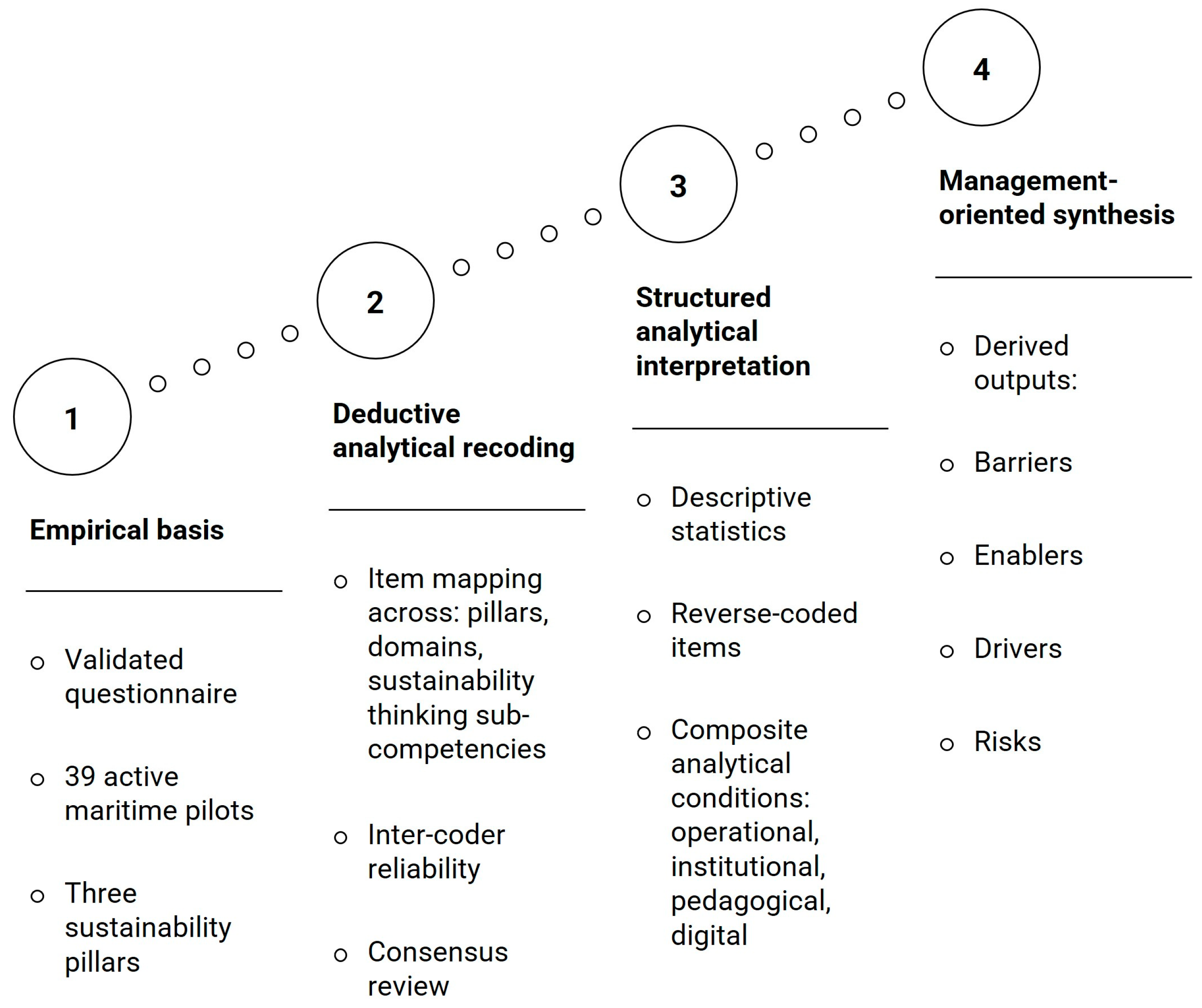
The methodological design comprised four sequential stages. First, the study established the validated questionnaire and respondent dataset as its empirical basis. Second, all questionnaire items were deductively reclassified according to sustainability pillars, integration domains, and dominant sustainability thinking competency (STC) and sub-competencies, with coding agreement assessed through an inter-coder reliability procedure. Third, theory-informed composite analytical conditions were constructed to support a structured interpretation of stronger and weaker integration patterns across the dataset. Fourth, the results of this interpretive process were synthesised into a management-oriented framework of barriers, enablers, drivers, and risks affecting the integration of sustainability thinking into maritime pilotage training (see
Figure 1).
3.1. Research Design and Empirical Basis
The study is exploratory and quantitative, based on a cross-sectional survey design. This design was considered appropriate because the topic remains underexplored and because the study seeks to generate empirically grounded insights into how sustainability-related competencies may be unevenly embedded in maritime pilotage training and professional development. More specifically, the research does not aim to assess training performance experimentally, examine causal relationships, or develop a universally generalisable predictive model. Instead, it seeks to identify analytically meaningful patterns of uneven integration, operational friction, and system-related constraints within a highly specialised professional context.
The empirical basis of the study is a previously developed questionnaire designed to assess sustainability thinking among maritime pilots across three sustainability pillars: environmental, social, and economic. The instrument was originally developed by the authors using two complementary foundations: first, the literature on maritime pilotage, including themes such as safety, decision-making, communication, workload, environmental responsibility, and operational performance; and second, the conceptualisation of sustainability thinking as a multidimensional competency integrating environmental, social, and economic perspectives. The questionnaire was therefore designed not merely to capture self-assessments and viewpoints on sustainability-related pilotage practices, but to translate this construct into pilotage-relevant statements linked to operational judgement, coordination, responsibility, efficiency, and professional behaviour.
The instrument included demographic questions together with analytical items measured on a five-point Likert scale ranging from 1 (“strongly disagree”) to 5 (“strongly agree”). To strengthen internal coherence and reduce acquiescence bias, reverse-worded items were incorporated and later reverse-coded during analysis. During the initial validation stage, the questionnaire demonstrated acceptable internal consistency for exploratory research. Cronbach’s alpha coefficients [
36] were 0.74 for the environmental section, 0.80 for the social section, and 0.735 for the economic section, with an overall alpha of 0.89 (see
Supplementary Material S2). These values indicate that the instrument provides a sufficiently coherent basis for assessing sustainability thinking as a multidimensional construct.
The present study uses this validated questionnaire as the empirical basis for examining the integration of sustainability thinking into maritime pilotage training. Although the instrument was originally structured around the three sustainability pillars, its analytical value in this article lies in the potential to reinterpret the same item set through a training-focused lens. More specifically, the dataset is used here to examine how sustainability-related competencies are reinforced, constrained, or unevenly embedded across operational, institutional, pedagogical, and digital conditions. In this sense, the contribution of the present methodology does not lie in developing a new instrument, but in applying a theory-informed analytical framework that enables the identification of training-related barriers, enablers, drivers, and risks from an already established empirical base.
The sample consisted of 39 active maritime pilots from different regions of the world who completed the questionnaire online. The respondents represented a professionally specialised and internationally distributed group considered suitable for an exploratory study in a niche operational domain. The questionnaire was disseminated through accessible professional and digital channels, including direct contacts and online pathways relevant to the maritime pilot community. Because the target population is highly specialised, the sample is treated as exploratory and non-probabilistic rather than statistically representative of the global sample pilotage profession. Nevertheless, it provides valuable primary evidence from experienced practitioners and is methodologically appropriate for a preliminary examination of an underexplored training-related issue. The overall methodological sequence adopted in this study is summarised in
Figure 1.
3.2. Deductive Item Mapping, Inter-Coder Reliability, and Composite Condition Construction
To adapt the validated questionnaire to the analytical objective of the present study, a deductive item-mapping procedure was undertaken. Whereas the original instrument was organised around the three sustainability pillars—environmental, social, and economic—the present analysis required an additional layer to examine how sustainability thinking is integrated into training-related competence. Each questionnaire item was therefore classified according to three parallel dimensions: (i) its original sustainability pillar, (ii) its dominant integration domain, and (iii) its dominant sustainability thinking sub-competency (see
Supplementary Material S1).
To support analytical consistency, four integration domains were defined ex ante. The
operational domain refers to items associated with real-time pilotage execution, manoeuvring decisions, timing, coordination, and resource-related judgement in practical settings. The
institutional domain refers to items associated with organisational routines, formal expectations, professional norms, broader coordination structures, and the extent to which sustainability-related practice is embedded in institutional arrangements. The
pedagogical domain encompasses items related to training, mentoring, debriefing, reflection, and structured learning reinforcement. The
digital domain encompasses the use, credibility, perceived usefulness, and practical support of digital tools and decision-support systems in pilotage practice. These four domains, together with their main analytical focus, are summarised in
Table 1.
In parallel, each item was mapped to one dominant sustainability thinking sub-competencies [
33]. This step was informed by the sustainability thinking framework previously developed in maritime education research and by the associated coding protocol. The sustainability thinking sub-competencies considered in the coding process were critical and systems thinking; anticipatory or future thinking: information management and digital citizenship; anticipatory or future thinking: cultural sensitivity and global citizenship; normativity: professional responsibility and ethics; problem-solving and strategic thinking; and interpersonal, self-understanding, and leadership. To support consistency in item assignment, observable characteristics associated with these sub-competencies were also used during coding. In this way, each item was linked not only to a theoretical competency category but also to a behavioural or interpretive logic relevant to pilotage and training practice. The STC sub-competencies and their observable interpretive characteristics are summarised in
Table 2.
To further reduce subjectivity, the coding protocol was applied independently by two coders using a shared codebook. Coding agreement was assessed through Cohen’s kappa, and discrepancies were subsequently discussed until consensus was reached. A third expert with familiarity in maritime pilotage, sustainability-related competence, and professional training reviewed the final agreed codebook to confirm conceptual consistency and domain relevance. This procedure strengthened the methodological robustness of the study by ensuring that the analytical reinterpretation of the questionnaire was transparent, replicable, and not solely dependent on one researcher’s judgement.
Following the deductive item mapping, theory-informed composite analytical conditions were constructed. Items assigned to the same integration domain were grouped to form four composite conditions: Operational, Institutional, Pedagogical, and Digital. These conditions were calculated as the arithmetic mean of the items assigned to each domain, after reverse-coding the relevant verification items where applicable. These composite conditions were not treated as newly validated psychometric scales, but as theory-informed analytical constructs designed to support higher-level interpretation of the data in relation to the current study objective.
For reasons of readability, only the summary definitions of the integration domains and sub-competencies are presented in the main manuscript, while the full codebook, item-mapping matrix, inter-coder agreement sheet, and composite condition construction matrix are provided in
Supplementary Materials S3.
3.3. Structured Analytical Interpretation
The analytical approach combined descriptive statistical analysis with cross-item interpretive analysis. First, item-level means and standard deviations were examined to identify patterns of stronger and weaker support, as well as greater variability, across the sustainability dimensions. This made it possible to distinguish elements suggestive of stronger competency integration from those pointing to implementation difficulties or broader systemic constraints.
Once the composite analytical conditions were established, the dataset was examined using a structured analytical interpretation procedure. This stage combined item-level descriptive statistics, reverse-coded verification items, composite conditions, and the interpretive logic provided by the codebook to identify stronger and weaker patterns of integration across the dataset. The analysis, therefore, did not rely on descriptive statistics alone, even though means and internal variation remained important empirical inputs. Instead, descriptive outputs were interpreted through the combined lens of sustainability pillars, integration domains, and dominant STC sub-competencies.
In the context of this study, structured analytical interpretation refers to the systematic reading of the empirical results in relation to recurring areas of stronger reinforcement, weaker translation into practice, uneven competency development, and context-specific friction. Particular attention was given to patterns indicating tension between awareness and application, between formal and informal reinforcement, and between individually held sustainability-oriented values and system-supported training conditions. Reverse-coded items were used not only as internal consistency checks, but also as signals of contradiction or fragility in the practical integration of sustainability thinking.
This interpretive stage was important because the questionnaire had originally been designed to assess sustainability thinking rather than training integration as such. The procedure adopted here made it possible to reorganise the dataset around integration patterns relevant to the present study objective, without requiring the development of a new instrument.
3.4. Derivation of Barriers, Enablers, Drivers, and Risks
The final methodological stage involved deriving barriers, enablers, drivers, and risks from the structured interpretation of the dataset. In this study, barriers were defined as recurrent empirical patterns suggesting obstacles to the effective integration of sustainability thinking into pilotage training. Enablers were defined as conditions already favourable to such integration. Drivers were understood as actionable operational, institutional, pedagogical, or digital levers capable of strengthening sustainability-related competency integration. Risks referred to the likely consequences of leaving the identified barriers unaddressed.
This derivation was based on a structured interpretive synthesis rather than on descriptive statistics alone. More specifically, the classification drew on four interrelated sources of evidence: (i) item-level descriptive patterns, including stronger and weaker mean scores; (ii) the logic of the deductive codebook; (iii) the composite analytical conditions; and (iv) the relevance of each item to the dominant STC sub-competencies and their observable interpretive characteristics. Through this process, the analysis moved from response patterns to a management-oriented interpretation capable of identifying not only where integration appeared weak or fragmented, but also which forms of intervention might strengthen it.
The resulting synthesis informed both the
Section 4 and
Section 5 of the paper. It also provided the basis for the cross-cutting framework developed later in the manuscript, through which the study positions sustainability thinking in maritime pilotage training not only as a competency issue, but also as an operational, institutional, pedagogical, and digital integration challenge. The derivation matrix supporting the identification of barriers, enablers, drivers, and risks is provided in
Supplementary Materials S3.
4. Results
This section presents the empirical findings of the study, with particular attention to the response patterns that inform the identification of barriers, enablers, drivers, and risks affecting the integration of sustainability thinking into maritime pilotage training. Rather than repeating a general appraisal of sustainability awareness, the analysis is organised to show how the original survey responses can be reinterpreted through the training-related framework developed in the methodology. The section begins with a concise profile of the respondent group and a summary of the original pillar-level response patterns, before re-examining the same evidence through the integration domains and the final managerial synthesis.
4.1. Respondent Profile and Pillar-Level Response Patterns
The respondent group consisted of 39 active maritime pilots from multiple world regions, providing an exploratory but professionally credible sample for the purposes of this study. As shown in
Table 3, most participants were in mid- to senior-career stages and reported substantial pilotage experience, which is relevant given the study’s focus on sustainability-related competencies within a profession shaped by accumulated judgment and operational responsibility. The sample also displayed strong educational attainment, with most respondents holding undergraduate or postgraduate qualifications. Although the group was internationally distributed, it was not regionally balanced and remained strongly male-dominated, reflecting the broader profile of the maritime sector. Accordingly, the sample should be understood as internationally diverse and analytically relevant, but not statistically representative of the global sample pilotage profession.
The first analytical layer of the results summarises the item-level response patterns across the three original sustainability pillars of the validated questionnaire: environmental, social, and economic. As shown in
Table 4, the three pillars do not display the same degree of consistency. The social pillar contains the strongest concentration of highly rated items, particularly those related to ethics, communication, safety culture, and team learning. The environmental pillar shows a more uneven pattern, with stronger responses in forecasting- and compliance-related items and more moderate responses where sustainability-related action depends on coordination, infrastructure, or structured reflection. The economic pillar indicates a generally positive orientation towards resilience and digital support, but also reveals weaker confidence in the practical usefulness of current efficiency-support tools. At this stage, these pillar-level patterns are interpreted as early signals of potential bottlenecks, which are examined more explicitly in the subsequent cross-domain analysis. In this sense, the pillar-level results provide the descriptive foundation for the reanalysis developed in the following sections.
Building on these pillar-level patterns, the next section reinterprets the same evidence using the deductive mapping framework to identify how the questionnaire items cluster across the operational, institutional, pedagogical, and digital integration domains.
4.2. Cross-Mapping of Sustainability Pillars and Integration Domains
Building on these pillar-level patterns, the next analytical step reinterpreted the questionnaire items using the deductive mapping framework to identify how the original sustainability responses clustered across the four integration domains: operational, institutional, pedagogical, and digital. This cross-mapping was necessary because the three original pillars alone do not fully explain how sustainability thinking is translated into training-related competence. By reclassifying the same items across the integration domains, the analysis enables identification of where sustainability-related responses are primarily expressed in real-time practice, organisational embedding, structured learning, or digital enablement.
The cross-mapping showed that a substantial proportion of the item-level evidence clustered within the operational domain. This suggests that many sustainability-related judgements in maritime pilotage are still understood primarily through the lens of immediate professional action, including manoeuvring decisions, forecasting, timing, communication, and resource-related trade-offs. This was particularly evident in items related to environmental forecasting, ethical conduct under pressure, communication with multicultural crews, and resilience-oriented judgment. In contrast, the institutional domain captured a different type of pattern, especially where sustainability-related action appeared to depend on formal routines, reporting logic, professional legitimacy, or broader coordination structures. Items linked to pollution-risk reporting, public trust, sustainability–efficiency tension, and coordinated practices such as shore power or just-in-time arrival were especially relevant in this regard.
The pedagogical domain highlighted a more specific, yet strategically important set of items related to mentoring, debriefing, reflective learning, and post-operation review. Although fewer items were coded primarily into this domain, they were highly relevant to the present study because they pointed most directly to whether sustainability thinking is reinforced through structured training mechanisms rather than left to informal professional experience alone. Finally, the digital domain captured a narrower yet analytically significant cluster of responses regarding the perceived usefulness, credibility, and practical support of digital tools in pilotage-related decision-making. Here, the results suggested that digitalisation is viewed positively in principle, but that confidence in current tools remains uneven.
Taken together, the cross-mapping indicates that sustainability thinking in maritime pilotage is not concentrated in a single analytical domain. Rather, it is distributed across immediate operational judgement, institutional structures, pedagogical reinforcement, and digital support conditions. This finding is important because it shows that the uneven integration of sustainability thinking cannot be understood solely as a matter of awareness within the environmental, social, or economic pillars. Instead, it reflects a broader pattern in which the translation of sustainability into professional competence depends on how these responses are embedded across the domains that shape pilotage training and practice.
A complete version of the cross-mapping matrix is presented in
Supplementary Materials S3 to support methodological transparency. The next section develops this interpretation further by aggregating the cross-mapped items into composite analytical conditions.
4.3. Composite Analytical Conditions
To move beyond item-level interpretation, the authors aggregated cross-mapped questionnaire responses into four theory-informed composite analytical conditions:
Operational,
Institutional,
Pedagogical, and
Digital. These conditions were derived from the deductive coding framework described in the methodology and were intended to capture the principal domains through which sustainability thinking may be reinforced, constrained, or unevenly embedded in maritime pilotage training.
Table 5 summarises the composition, theoretical meaning, and interpretive profile of these four analytical conditions.
Taken together, the composite conditions indicate that sustainability thinking is not equally supported across the domains that structure pilotage training and professional practice. The Operational condition emerged as the most densely populated and most strongly represented of the four. This suggests that sustainability-related judgement is most readily expressed when it is closely connected to immediate pilotage practice, such as manoeuvring decisions, forecasting, communication, timing, and resilience-oriented operational reasoning. This pattern is consistent with the earlier pillar-level findings, which showed stronger endorsement where sustainability considerations were closely aligned with established professional and safety-related logics.
By contrast, the Institutional condition displayed a more uneven profile. While some items indicated relatively strong support where sustainability-related action is embedded in formal reporting, safety culture, and public legitimacy, other responses suggested that broader organisational routines and coordinated system practices remain less consistently supportive. Institutional embedding therefore appears to be present, but not yet sufficiently consolidated to ensure that sustainability-related competence is reinforced across the full range of pilotage-related contexts.
The Pedagogical condition was represented by fewer items, but it was especially important from the perspective of the present study because it captured the extent to which sustainability thinking is supported through mentoring, debriefing, post-operation learning, and reflective reinforcement. The resulting pattern suggests that pedagogical support is present but less robust than operationally embedded forms of sustainability-related judgement. This finding is particularly significant because it indicates that some of the weaker areas identified in the earlier results may be linked less to deficits of awareness and more to limited formal reinforcement through training structures.
The Digital condition emerged as the narrowest and most fragile of the four. Although some responses pointed to openness towards digital support and recognition of its potential contribution to efficiency and predictability, weaker responses associated with confidence in current decision-support tools suggest that digital enablement remains uneven. In analytical terms, this means that digitalisation may be recognised as relevant to sustainability-oriented judgement, but not yet fully trusted as a practical support condition within pilotage training and professional decision-making.
It should also be noted that the distribution of items across the four analytical conditions was not fully balanced, with the instrument showing a denser concentration of operationally oriented items and comparatively fewer items coded primarily as pedagogical or digital. This pattern is analytically informative. It may reflect the practice-oriented nature of pilotage as a profession, but it also suggests that future versions of the instrument could be strengthened by incorporating a more balanced set of items that explicitly address training reinforcement and digital enablement.
Overall, the composite analytical conditions indicate that the integration of sustainability thinking is strongest where it is already embedded in operational judgement, but weaker where it depends on pedagogical reinforcement, broader institutional coordination, or trusted digital support. This shifts the interpretation of the dataset from isolated item-level weaknesses to a more structured understanding of where the main integration constraints are located. These composite patterns, in turn, provide the analytical basis for the final results subsection, which translates the evidence into a management-oriented synthesis of barriers, enablers, drivers, and risks.
4.4. Barriers, Enablers, Drivers, and Risks
The final analytical step translated the evidence from the pillar-level response patterns, the cross-mapping procedure, and the composite analytical conditions into a management-oriented synthesis of barriers, enablers, drivers, and risks affecting the integration of sustainability thinking into maritime pilotage training. As shown in
Table 6, this synthesis was derived by combining item-level empirical patterns, the deductive coding framework, and the domain-based interpretation developed in the preceding subsections.
Overall, the table shows that the strongest enablers are concentrated in operationally and socially embedded forms of professional judgement, particularly those linked to ethics, communication, safety culture, forecasting, reporting, resilience-oriented reasoning, and team learning. By contrast, the most recurrent barriers are associated with conditions that depend more heavily on institutional consistency, pedagogical reinforcement, and digital credibility. These include coordination-dependent environmental practices, reflective learning mechanisms, sustainability-related legitimacy and value alignment, and confidence in current decision-support tools.
The synthesis also identifies a broader cross-domain integration pattern, indicating that some of the most relevant challenges are not confined to a single analytical domain but emerge through the interaction of operational, institutional, pedagogical, and digital conditions. In this respect, the results suggest that sustainability thinking is already recognised across several areas of professional practice, but that its translation into structured, trainable, and systemically supported competence remains uneven. These findings provide the immediate analytical basis for the discussion that follows.
5. Discussion
This section interprets the empirical findings in relation to the study objectives and the wider literature on maritime pilotage, sustainability, and professional development. The results indicate that sustainability-oriented thinking is already present in pilotage practice; however, its incorporation into training remains uneven and is constrained by a combination of operational, institutional, pedagogical, and digital factors. The discussion therefore moves beyond descriptive reporting to examine what these patterns imply for the development of sustainability-related competence in maritime pilotage and for the future design of training and professional development systems.
Overall, the findings suggest that the principal challenge is not the absence of sustainability awareness, but its inconsistent translation into structured and professionally reinforced competence. Across the three sustainability pillars, different degrees of maturity are evident. The social pillar appears the most established, particularly in relation to ethics, communication, safety culture, and team learning. The environmental pillar is stronger where sustainability aligns with forecasting, pollution-risk awareness, and operational review, but weaker where it depends on coordination, infrastructure, or deliberate reflective reinforcement. The economic pillar shows openness to resilience-oriented judgement and digital support, but less confidence in the practical usefulness of current tools and less consistent embedding in routine decision-making. When considered through the four analytical conditions developed in this study, these patterns suggest that sustainability thinking is strongest where it is already anchored in operational judgement and socially embedded professional norms, and weaker where it depends on institutional consistency, pedagogical reinforcement, or digital credibility.
This overall interpretation provides the basis for the more focused discussion that follows. The next parts of the discussion consider the implications of the findings for maritime pilotage training and professional development, then examine the wider institutional and digital conditions that affect the practical embedding of sustainability thinking, and finally reflect on the study’s research implications, including future instrument refinement.
5.1. Implications for Maritime Pilotage Training and Professional Development
Taken together, the results suggest that integrating sustainability thinking into maritime pilotage training requires a broader competency-based approach that extends beyond technical ship-handling and compliance-oriented instruction. Sustainability-related competence needs to be embedded in practical learning, operational decision-making, and continuing professional development rather than treated as an additional topic external to core pilotage practice. The most promising route for integration is therefore not to add a separate sustainability layer to existing training, but to connect sustainability-related judgement to forms of professional reasoning already recognised by pilots as legitimate, credible, and operationally relevant.
This implication is visible across the three sustainability pillars. In the environmental dimension, stronger patterns appear where sustainability overlaps with forecasting, pollution-risk awareness, and operational review, whereas weaker patterns emerge where action depends on coordination, infrastructure, or deliberate reflective reinforcement. In the social dimension, communication, ethics, safety culture, and team learning are already strongly embedded in pilotage practice, meaning that training does not need to construct these competences from the outset so much as reinforce them systematically, especially where workload, time pressure, and inconsistent mentoring may weaken their continuity. In the economic dimension, pilots appear receptive to resilience-oriented judgement and to the idea of digital support, yet less convinced by the practical usefulness of current tools and by the routine embedding of sustainability-related trade-offs in decision-making. This suggests that efficiency, resilience, and digital support should not be framed as abstract innovation themes but linked directly to realistic operational scenarios and applied professional judgement.
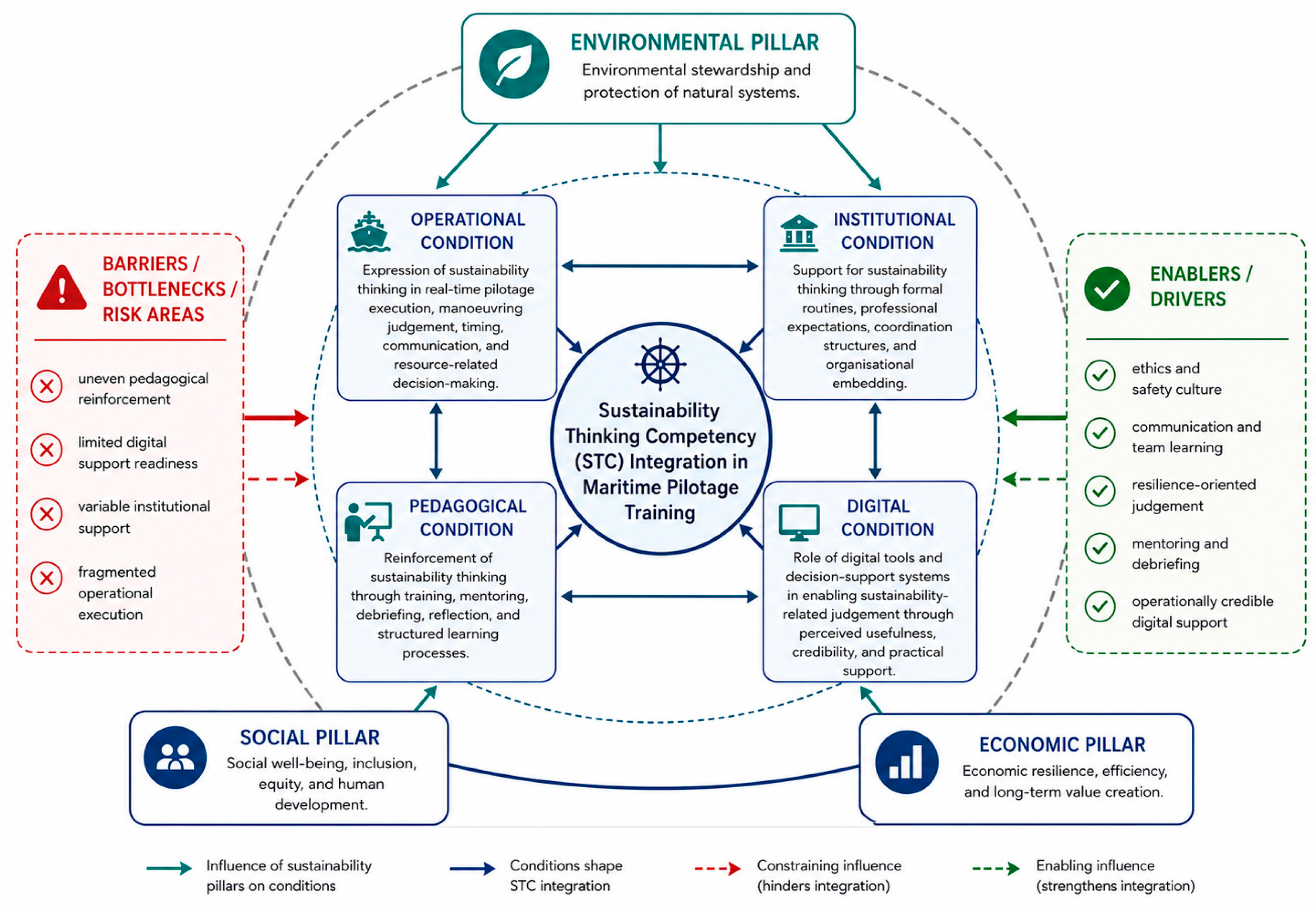
Figure 2 synthesises these implications through an integrative framework in which the three sustainability pillars are mediated by four analytical conditions—operational, institutional, pedagogical, and digital—that shape the extent to which STC becomes embedded in maritime pilotage training. Within this structure, the framework highlights the principal areas of constraint, namely weak pedagogical reinforcement, uneven institutional consistency, low digital credibility, and fragmented operationalisation. At the same time, it identifies the main enabling anchors for integration, particularly ethics and safety culture, communication and team learning, resilience-oriented judgement, mentoring and debriefing, and operationally credible digital support.
Viewed in these terms, the study reveals not only barriers and risk areas, but also a set of opportunities and success factors for advancing sustainability integration in pilotage training.
Table 7 summarises this discussion-oriented synthesis by showing how the main challenges identified in the analysis relate to practical opportunities for integration and to existing professional strengths on which future training development can build.
As
Table 7 indicates, the main challenges remain concentrated in weak pedagogical reinforcement, uneven institutional consistency, limited digital credibility, and fragmented operationalisation. At the same time, the results point to clear opportunities for improvement through simulator-based integration, reflective debriefing, structured mentoring, and more operationally credible digital support. Importantly, several success factors are already present within pilotage practice, particularly ethics and safety culture, communication and team learning, and resilience-oriented judgement, which provide a strong professional base for more systematic sustainability-oriented competence development.
In this sense, the framework does more than summarise the findings visually. It shows that integrating sustainability into pilotage training depends on whether existing professional strengths are deliberately leveraged to reduce the most recurrent bottlenecks. For training design, this implies embedding sustainability-related decision points within simulator-based exercises, debriefings, mentoring pathways, recurrent learning, and reflective operational dialogue. More broadly, it suggests that pilotage training should be understood as a professional development system in which sustainability-related competence is progressively reinforced, normalised, and made credible in practice across the full span of professional life.
5.2. Institutional, Digital, and Cross-Domain Implications
Sustainability integration in maritime pilotage cannot be secured through training alone. Several of the weaker patterns identified in this study are linked to broader institutional and system-level conditions, including coordination-dependent environmental practices, limited reflective reinforcement, and uneven confidence in digital support. Even well-designed training is therefore likely to have only partial effect if pilots continue to operate within organisational settings characterised by rigid schedules, weak coordination, limited feedback opportunities, or technologies that are poorly aligned with operational practice.
This interpretation becomes more significant in a maritime context increasingly shaped by decarbonisation, data use, and compliance exposure. The 2023 IMO GHG Strategy set the direction towards net-zero GHG emissions from international shipping by or around 2050 [
35]. In April 2025, MEPC 83 approved the IMO Net-Zero Framework, although the IMO later clarified that formal adoption discussions were adjourned and would continue in 2026 [
37,
38].
At the regional level, the EU Emissions Trading System has applied to maritime transport since 1 January 2024, while FuelEU Maritime has applied since 1 January 2025 [
39,
40]. Collectively, these developments show that ship-port operations are increasingly assessed not only in terms of safety and efficiency, but also in relation to emissions, fuel choices, and compliance-related performance.
From this perspective, sustainability integration is unlikely to become robust unless it is reinforced by organisational routines and professional standards. If environmental reflection, systematic debriefing, or sustainability-oriented coordination are not part of everyday working practice, training risks becoming detached from workplace culture. This is particularly relevant for pilotage because several of the weaker signals identified in this study, such as just-in-time arrival support, coordination-dependent environmental action, and uneven confidence in efficiency-support tools, are closely linked to the inter-organisational processes currently prioritised in port-call optimisation. The growing importance of standardised digital collaboration among ports, terminals, carriers, pilotage, towage, and other maritime services reinforces the point that some of the barriers identified here are not merely individual training gaps, but also indicators of incomplete alignment between pilotage training and the operational logic of coordinated, lower-emission, data-enabled port calls [
35,
41].
The digital gap identified here should therefore not be read simply as a reluctance to use technology. In this study, digital credibility refers to the extent to which digital tools and decision-support systems are perceived as trustworthy, usable, operationally relevant, and professionally legitimate within real pilotage practice, such that they can credibly support sustainability-related judgement and training integration. From this perspective, pilots may recognise the value of digital support in principle yet remain unconvinced when available systems are difficult to use, insufficiently integrated, or not credible under real operational conditions.
Digital credibility, therefore, does not stand apart from the rest of the problem; it interacts directly with institutional support and pedagogical reinforcement. This is consistent with IMO work on e-navigation and maritime digitalisation, which has increasingly emphasised interoperability, standardisation, data-sharing, and governance as necessary conditions for meaningful digital integration in maritime operations [
42,
43]. In this sense, digital credibility does not stand apart from the rest of the problem; it interacts directly with institutional support and pedagogical reinforcement.
More broadly, the study points to a cross-domain integration challenge. The most fragile areas of sustainability integration do not belong to one condition alone, but emerge where pedagogical reinforcement, institutional consistency, and digital credibility intersect. The challenge cannot therefore be reduced to education alone, nor to technology alone. In practical terms, pilotage training is unlikely to achieve full sustainability integration unless it is supported by working environments that make training aims repeatable, coordinated, and operationally meaningful. This interpretation is also consistent with wider international reporting that frames maritime transport as increasingly shaped by decarbonisation pressures, digital transformation, resilience, and trade facilitation [
44].
6. Conclusions
This study examined how sustainability thinking is integrated into maritime pilotage training by reinterpreting a validated questionnaire through four analytical conditions: operational, institutional, pedagogical, and digital. The results show that sustainability-oriented thinking is already present in pilotage practice, but that its translation into training-related competence remains uneven. The principal challenge is therefore not the absence of awareness, but the inconsistent extent to which sustainability-related judgment is reinforced, coordinated, and embedded in ways that make it professionally actionable and repeatable.
The study contributes by shifting attention from broad sustainability assessment towards the conditions that shape competency integration in pilotage training. In particular, it shows that sustainability thinking appears strongest where it is already anchored in operational judgement and socially embedded professional norms, and weaker where it depends on pedagogical reinforcement, institutional consistency, or digital credibility. The resulting synthesis of barriers, enablers, drivers, and risks offers a more applied basis for understanding sustainability as a training and professional development issue rather than as a purely attitudinal one.
From a practical perspective, the results suggest that sustainability should not be treated as an additional topic external to core pilotage training. Instead, it needs to be embedded in simulator-based exercises, reflective debriefing, mentoring, recurrent learning, and operational decision-making, while being supported by organisational routines and digitally credible working conditions. The study also highlights an important implication for the instrument itself: because it was originally developed from a scoping review and an expanded search process incorporating white and grey literature, and structured around the three sustainability pillars, the present reanalysis revealed a denser concentration of operationally oriented items and comparatively less explicit coverage of pedagogical and digital conditions.
The study is subject to the limitations of an exploratory design based on a non-probabilistic sample of 39 maritime pilots and on the reinterpretation of an instrument originally structured around sustainability pillars rather than training-integration domains. Future research could apply the instrument to other maritime populations and further refine its pedagogical and digital coverage. Overall, the study concludes that sustainability thinking in maritime pilotage is not absent, but incompletely integrated, and that its future development will depend on whether training systems, organisational settings, and digital infrastructures make that competence learnable, credible, and repeatable in practice.