1. Introduction
The progress made on autonomous vehicles (AVs) is part of a broader global context considering the ongoing environmental, economic, and social impacts of car-based mobility. An example of this is the European Union where the transport sector generates almost 25% of total greenhouse gas emissions and close to 70% of those emissions come from road transport. While road safety is still an important public health issue, the World Health Organization estimates that there are approximately 1.19 million deaths each year because of traffic collisions. In such circumstances and given the potential of transformative technology to provide safety and efficiency, and to alter the travel experience, automation is seen as a breakthrough innovation. Increasing users’ time utility and comfort during travel and providing additional services during the journey are highly anticipated [
1,
2].
AVs continue to evolve and affect how global auto-mobility systems function and how auto-mobility is perceived and experienced by individuals. With the advancement of automation, the ability to keep working or to engage in productive leisure activities or entertainment [
3] allows travel time to be repurposed. This change is likely to affect the value of time (VOT), a concept in transport economics that is treated as one of the most important for determining decisions of mode and travel behaviour [
4]. In conjunction with this, the addition of digital systems, onboard entertainment, and comfort features is more likely to increase ease of travel which is now classified as burdensome [
5]. These issues, paired with user perceptions of differing automation levels affecting their safety and comfort negatively, raise questions about users’ WTP for additional services and features [
6].
The existing research has analysed the VOT or WTP concerning AVs; however, the existing research has yet to consolidate into a singular framework that systematically addresses the relationships involving the valuation of travel time, onboard services, comfort, the perception of congestion, and the behavioural expectations of consumers. Specifically, the perception of congestion, while almost always an implicit part of time valuation, is pivotal when it comes to the formation of stress, the perceived reliability of a service, and the evaluations of services overall. Additionally, the relationships of these variables as they pertain to PAVs and SAVs are still largely unexplored [
7]. This is an especially pertinent issue concerning shared mobility, where the perception of congestion, crowding, and loss of control may drastically change how users evaluate the utility of time and the overall value of the service provided.
Continuing developments have further emphasised that the speed at which autonomous mobility is advancing is changing user expectations, comfort perceptions, and perceptions of time value. The investigations conducted between 2023 and 2026 illustrate how automation and sophisticated in-vehicle services influence productivity and emotional comfort in travel, which in turn influence one’s VOT and WTP [
8,
9,
10]. Similarly, there is more visibility on how users differentiate between private and SAVs about trust and perception of safety and onboard digital services [
11,
12]. There is an increasing level of integration and complexity required in an updated review to explain the interconnectedness of the level of automation, service features, and the resulting behavioural outcomes.
Ref. [
10] used Structural Equation Modelling to analyse the willingness to use (WTU) and WTP for AVs in a developing country. The paper does analyse some psychological factors such as trust, safety, and demographic concerns, but does so mostly, and without relating time, time perception, VOT, service, or the related attributes in a behavioural framework.
Ref. [
9] also studies the economic impacts of labour time in AVs by means of a computable general equilibrium model. The study focuses on the productivity and macroeconomics of changes in VOT. Although the study focuses on the economics of travel time in the context of AV, the study ignores the perception of safety and the perception of service that influence the individual’s acceptance of the AV system.
Moreover, Ref. [
13] studied the joint ownership of cars and the types of vehicles purchased by travellers under different perceptions of the safety and security of AVs. Although their equilibrium-based framework captures some of the effects of risk perception on the adoption of AVs, it does not consider an overarching service or time-of-value service attributes, nor does it situationally examine the PAVs versus SAVs in a comprehensive behavioural-economic-service framework.
The literature on autonomous vehicles is expanding, but current studies mostly focus on WTP, VOT, psychological constructs, and service attributes. Considering these elements independently prevents a holistic understanding of user behaviour and acceptance.
Therefore, this study attempts to fill this gap by discussing the economic, psychological, and service dimensions of autonomous mobility in a connected manner. This study incorporates these various dimensions into one framework and aims to understand user behaviour in the private and shared autonomous vehicle domain. The selection of VOT, WTP, psychological constructs, and service attributes was based on their consistent identification in prior literature as key determinants of user acceptance in autonomous mobility, as well as their strong influence on behavioural responses and decision-making processes.
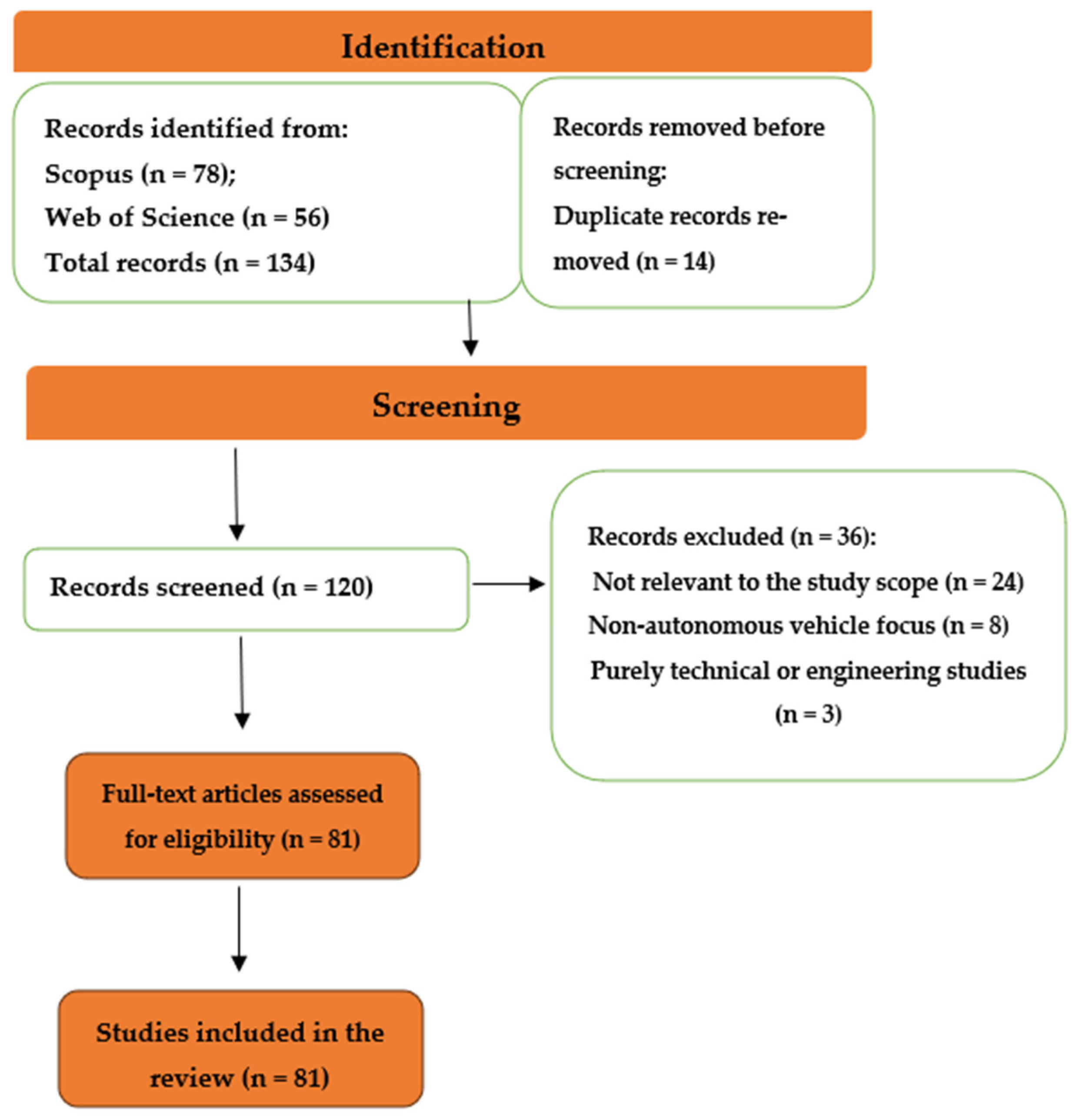
In line with these objectives, a systematic review was conducted following a transparent and structured system for study identification, screening, and synthesis in accordance with PRISMA guidelines. 81 peer-reviewed articles were analysed and selected based on the clarity of objectives, methodology, and relevance to the research focus. Predefined inclusion criteria were applied, particularly focusing on user behaviour, VOT, WTP, psychological and service attributes in the context of autonomous mobility.
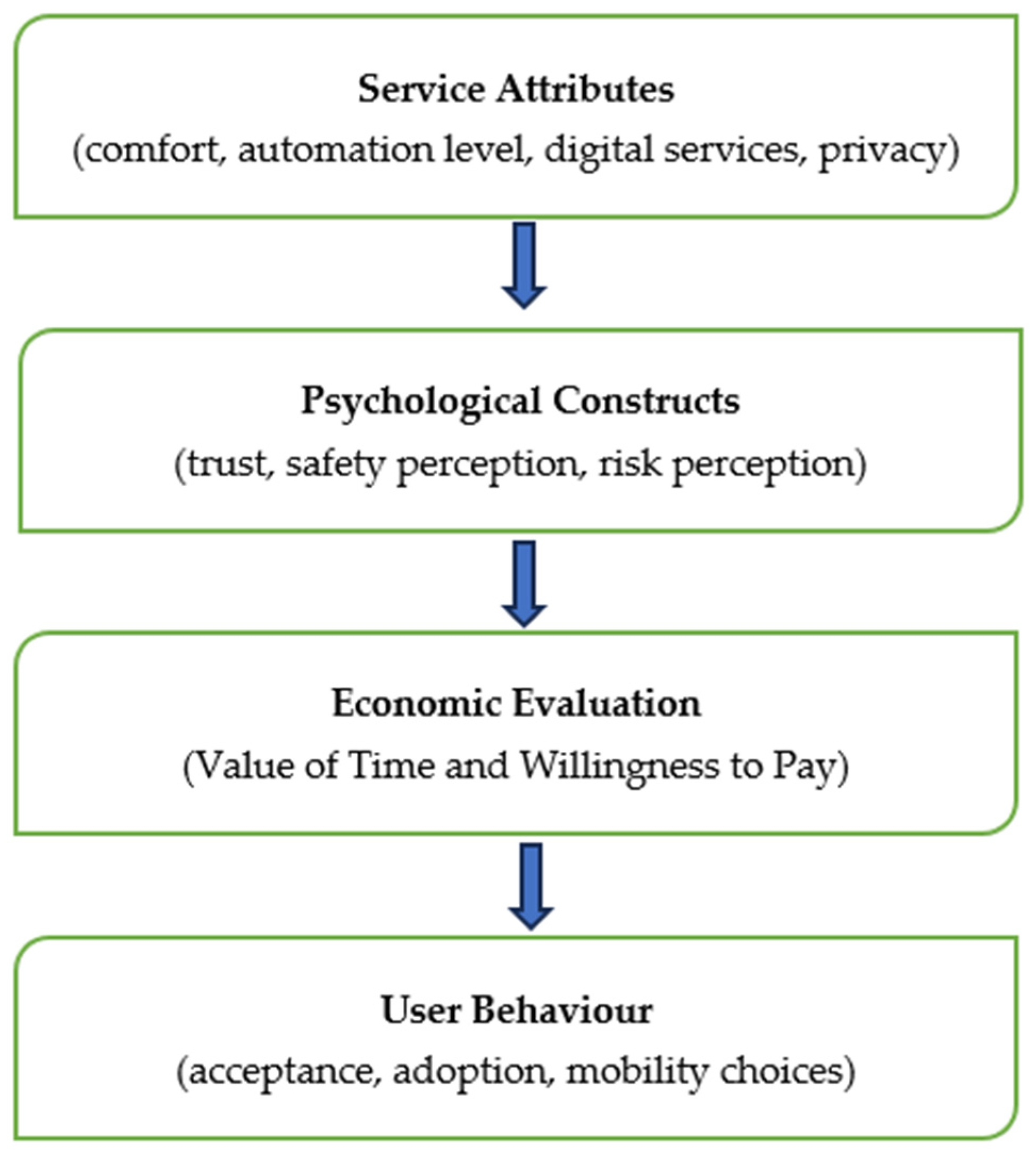
To conceptualise the relationships between the key dimensions identified in this review, a conceptual framework is presented in
Figure 1. The framework illustrates a sequential relationship in which service attributes (such as comfort, automation level, digital services, and privacy) influence psychological constructs (including trust, safety perception, and risk perception). These, in turn, shape the economic evaluation of autonomous mobility through VOT and WTP, ultimately affecting user behaviour in terms of acceptance, adoption, and mobility choices.
The rest of the paper is organised as follows.
Section 2 details the review methodology centred on the research protocol and search strategy as well as the study selection criteria.
Section 3 describes the literature’s thematic synthesis based on the VOT, WTP, comfort, safety perception, and digital services.
Section 4 analyses the central findings, presenting convergences and divergences across studies.
Section 5 highlights principal research gaps and offers recommendations for prospective research, and then closes the paper.
2. Materials and Methods
This study adopts a systematic literature review approach to ensure a structured, transparent, and reproducible synthesis of existing research on user behaviour in autonomous mobility. Given the fragmented nature of the literature, where economic, psychological, and service-related factors are often examined in isolation, a systematic approach is necessary to identify patterns, relationships, and gaps across studies.
Following PRISMA 2020 guidelines, this review enables a rigorous selection and evaluation of relevant studies, while supporting a thematic integration of key behavioural determinants. This approach also ensures that the research questions are grounded in the literature and that the analysis moves beyond descriptive summarisation toward a structured and comparative synthesis.
This study adopts a systematic literature review methodology following the PRISMA 2020 guidelines (Preferred Reporting Items for Systematic Reviews and Meta-Analyses). The review was performed based on transparency and clarity principles that are typically embraced in systematic review literature research and in accordance with the PRISMA 2020 guidelines for reporting systematic reviews, study identification, screening, and selection.
Figure 2 is an illustration of the review process flow.
2.1. Planning Phase
In the planning stage of the review, a protocol was established that explains the procedures for defining target scopes of the study, research goals, research questions, developed a search strategy, and setting measures for inclusion and exclusion so that the procedures for data collection, and synthesis were addressed.
The review comprises behavioural aspects of autonomous mobility focusing on the VO, WTP, the perception of safety, comfort, and the perception of the digital services that may be offered onboard. The review protocol was registered in the Open Science Framework (OSF) (DOI: 10.17605/OSF.IO/ZHSVJ) to enhance transparency, reproducibility, and methodological rigour.
2.2. Search Strategy and Study Identification
A systematic search was carried out in two primary scholarly databases: Web of Science (WoS) and Scopus. These two databases were chosen because of their comprehensive peer-reviewed literature coverage in the fields of transportation research, technology adoption, and studies in mobility.
The selection of keywords was guided by the most frequently examined behavioural determinants in the autonomous mobility literature, particularly those related to economic valuation (value of time and willingness to pay), psychological constructs (trust and perceived safety), and service-related attributes (comfort and digital services). These dimensions were consistently identified in prior studies as key drivers of user acceptance, which informed the development of the search strategy.
The search was designed by integrating keywords and Boolean search operators pertaining to autonomous mobility and user behaviour. The first iteration of the search string was designed as follows: (“autonomous vehicle*” OR “self-driving vehicle*” OR “automated driving” OR “autonomous mobility”) AND (“value of time” OR “travel time valuation” OR “in-vehicle time” OR “time perception”) AND (“willingness to pay” OR WTP OR “cost perception”) AND (comfort OR “onboard service*” OR “digital service*” OR “perceived safety”) AND (behaviour* OR accept* OR adoption OR choice) AND (congestion OR “traffic congestion” OR “traffic jam”). The query was highly restrictive; hence, combining multiple behavioural constructs led to an extremely low yield of records. As a result, a searching technique, known as iterative searching, was used. In this incremental method, primary descriptive terms pertaining to autonomous mobility (e.g., “autonomous vehicle”, “self-driving vehicle”, “automated driving”, and “autonomous mobility”) were searched in conjunction with each of the behavioural dimensions individually, such as VOT, WTP, comfort, perceived safety, onboard services, and behavioural acceptance.
This strategy enhanced the retrieval of such studies so that they were congruous with the empirical studies and research aims of the investigation.
The review primarily relied on database-based search strategies (Web of Science and Scopus). Snowballing techniques (backward and forward citation tracking) were not systematically applied, as the study aimed to ensure consistency and reproducibility through structured database queries.
2.3. Screening, Data Extraction and Synthesis
This systematic review utilised a multi-stage screening method, in line with the established protocol. Initial searches conducted across multiple databases returned 134 records. Duplicates were promptly removed, followed by screening of titles and abstracts, and subsequently full texts, to ascertain the relevance of each study to the review. Studies were eligible for inclusion if they represented peer-reviewed, empirical articles published in English, between the years 2015 and 2026 and concerned with user perceptions, behaviours, or decision-making of autonomous vehicles. Studies were excluded if they were purely technical engineering studies. After the screening and eligibility assessment process, 81 studies were included in the final review, of which 31 were from Web of Science and 50 from Scopus.
For each study included in this review, key information was extracted, including methodology, behavioural framework, and main findings. The evidence was then synthesised using a thematic analysis, structured around key behavioural dimensions. Specifically, 40 studies addressed VOT, 35 studies examined WTP, 50 studies focused on psychological factors such as trust and perceived risk, and 30 studies analysed service-related attributes including comfort and digital services. It is important to note that several studies investigated multiple dimensions simultaneously; therefore, individual studies may be represented in more than one category.
This structure promoted a more organised review of the literature and patterns, relationships, and discrepancies among studies. Literature organised along thematic lines reflects and deepens user behaviour analysis and autonomous mobility studies, revealing key areas of research and providing a structure for future research.
In accordance with the PRISMA 2020 flow diagram, the selection of studies, which provided an overview of the identification, screening, and assessment of inclusion and exclusion criteria, is illustrated in
Figure 2.
3. Research Questions
To operationalise the objectives of this systematic literature review, a set of clearly defined research questions was formulated. These questions guide the review process and structure the synthesis of empirical evidence related to user behaviour in autonomous mobility. These questions aim to move beyond descriptive summaries by explicitly examining the relationships and interdependencies between key behavioural determinants in autonomous mobility.
The selection of the research questions is grounded in the need to address the fragmented nature of existing literature on autonomous mobility. Previous studies have consistently examined economic factors (VOT, WTP), psychological constructs, and service attributes as key determinants of user acceptance; however, these dimensions are typically analysed independently. The research questions are therefore structured to capture both the individual influence of these factors and, more importantly, their interdependencies. In addition, the questions consider contextual variations, particularly between private and shared mobility, as well as differences in how travel time is perceived and evaluated. This combination enables a more comprehensive and structured understanding of user behaviour, while also supporting the identification of methodological gaps in current research.
Table 1 presents a structured summary of the research questions alongside their corresponding motivations.
4. Results
The systematic review concludes with the elucidation of 81 peer-reviewed empirical studies focused on user behaviour in the scope of autonomous mobility. Considering the hypothetical perspective of literature on the adoption of AVs, the review focused primarily on SP surveys, integrated with discrete choice modelling surveys. This method was frequently used to project user behaviour in decision-making under varying degrees of automation, service, and cost.
Most studies of this systematic review used the multinomial mixed model and the multinomial logit model. The most recent contributions of this model appear to prefer the latent class model in behavioural modelling to incorporate psychology. The evolving methodology demonstrates the realisation that the acceptance of autonomous mobility cannot be explained solely by the visible attributes.
Despite the limited number of experimental and simulation studies, they provided valuable information on user responses to automation, human–machine interaction, perceived comfort, and related safety behaviour. The experiential and emotional responses to automation that surveys cannot address were explored in depth in this type of research.
For a study review, it was noted that Europe, Asia, and North America, where strong research and policy interest exists regarding autonomous mobility, have reported most studies. Developing regions have fewer studies on user behaviour, showing imbalances in the literature.
When looking at vehicle types, most studies have focused on PAVs, leaving SAV studies comparatively under-represented. Considering that automation of shared vehicles is essential for the achievement of most sustainability and congestion reduction objectives, this is an important omission. In terms of levels of automation, both partial and full automation were considered, with full automation often serving as a hypothetical benchmark to examine the far-reaching behavioural consequences of adopting autonomous mobility.
4.1. RQ1—Value of Time, Comfort, Safety, and User Acceptance
4.1.1. Value of Travel Time VOT
All the studies reviewed show a strong consensus that automation will change the way in which both the perception and valuation of travel time will occur. The traditional transport economic assumptions that travel time is a disutility are being challenged within the context of autonomous mobility. All the literature reviewed showed that when users are no longer responsible for the driving task, travel time is more flexible, more usable, and in some cases travel time is a positive entity [
13,
14,
15].
To further contextualise these findings, earlier literature conceptualised the VOT through a unidimensional perspective, primarily framing it as a cost to be minimised. From this perspective, travel time was a net loss of time that did not contribute gainfully in a constructive or effective manner. Thus, the valuation of travel time was a constant within transport economics literature. Automated mobility literature does not escape this perspective, and this literature is summarised in [
11,
16], among others. Most literature, however, is based on what [
14] notes as the foundational perspective of the range of available econometric models, the so-called “fixed disutility” perspective, and the literature on econometric models of travel disutility is based on models that assume VOT does not change in terms of range of situational variables (i.e., safety, comfort, or even the aspects of the travel in and of itself, the so-called qualitative aspects of travel).
The assumptions above are where the literature on AVs are market disruptors. Without driving, the traveller’s role as ‘driver’ transitions to ‘passenger-user’ and is free to either work, relax, digitally disengage, or disengage completely from the driving task. This observation is getting a lot of traction and attention in the literature. Ref. [
9] demonstrates the change with a microeconomic model and argues that VOT is not a fixed or linear parameter once passengers are free to spend their time on other activities. The results indicate that if productive activities decrease personal time disutility, this results in a lower VOT than driving in a traditional car.
Ref. [
15] furthers this argument with empirical evidence: design elements such as automated vehicles’ interior decor, individual travellers’ personal space, the arrangement of seats, ambient noise levels, and access to digital or other work-related support tools all qualitatively and quantitatively affect travellers’ time perception when in transit. In environments with the automated vehicle interior design configuration conducive to sustaining concentration and comfort or entertainment, VOT declines significantly, whereas in environments with the design configuration that is restrictive or uncomfortable the opposite is true. The differences between PAVs and SAVs were also mentioned, and the work of [
12] showed that users of PAVs perceive travel time more positively, as they are more private, allow for more personal control, and have more predictable travel conditions. In contrast to this, Ref. [
17] showed that Avs are in the users’ shared travel, so they have some uncertainty and discomfort around co-passengers, shared space, and the overall travel safety, and thus users perceive travel time more negatively and value it more. Further work accommodates the individual-level VOT to the system-level impact. Ref. [
16] argues that the potential to redistribute travel time towards productive activities can alter the structure of long-term labour and social time use. In the same way, modelling of automated networks has been shown by [
12] to have a strong impact on empty repositioning, parking avoidance, mode shift, congestion in a system, and therefore the cost of a fleet. In such systems, VOT is embedded in the decision-making of autonomous fleets, rather than remaining a preference of the end user.
All these studies show that VOT in autonomous mobility is flexible and context-dependent. It varies with the vehicle automation level, the vehicle type (PAV compared to SAV), the available productive or leisure activities, the comfort level and the digital services, and the perceived trust and safety. This means that the way VOT has traditionally been approached is due to change in contemporary travel behaviour research, particularly considering automation that is changing the meaning of time spent travelling.
Table 2 provides a structured overview of the key studies on the value of time and time perception in autonomous mobility.
As shown in
Table 2, the literature consistently indicates that the value of time in autonomous mobility is highly context-dependent and influenced by interactions between comfort, safety, service attributes, and user characteristics.
4.1.2. Comfort and In-Vehicle Experience
While the value of time provides a central economic perspective, the literature further emphasises that user acceptance of autonomous mobility is strongly shaped by experiential and perceptual factors, particularly comfort, safety perception, and digital service attributes. Passengers trained in research have AV comfort when they feel a sense of control, emotional calmness, and protection from abrupt changes in the driving behaviour of AVs in automated driving situations. In past behavioural, technical, and human–machine interaction research, these variables were foundational in explaining cause and effects of discomfort, explaining and outlining primary variables that lead to AV unacceptability [
24,
25]. From these explanations and relationships, psychology ascertained comfort variables to be transparency, promptness, humanised interaction, and systems-behaviour predictability.
Studies that were based on these findings predict that comfort will always be a significant predictor of acceptance of AVs. Users see decreased driving load, improved interior driving conditions, smooth ride changes (driving dynamics changes), and a positive AV experience. Truth and predictability of system behaviour were primary psychological variables surrounding comfort. Very early empirical studies like Oehl, Ref. [
26] have shown that comfort expectations have disproportionate, positive effects on the profile’s acceptability of passengers, especially with regard to comfort expectations like decreased ride stress ergonometric ride quality. In more recent studies, passengers view AVs as personalised quarters, with comfort as an emotionally neutral state superseding poor or absent cognitive tasking, motion sickness, secondary driving tasks, and an ability to do important non-driving tasks [
27,
28]. These studies show that the comfort level of the passengers is the predominant characteristic influencing the perception of the service quality, and this affects the initial behavioural response to utilising mobility options with AVs. The comfort of the passengers and the service quality.
4.1.3. Safety Perception and Trust
Recent studies have shown that perceptions of comfort are deeply connected with perceptions of safety when it comes to autonomous mobility services. These studies show that potential users of AV systems realise the possible benefits of such systems, including reduced driving effort. Despite this, users’ perceptions regarding safety and trust, as well as their perceptions regarding the reliability of such systems and trust in system reliability, are the most important contributors to the users’ acceptance of such systems. Insight from these studies implies that users’ trust in comfort, safety and ease of use directly impacts the likelihood of adoption of autonomous mobility services across various demographics [
22].
In most studies examining users’ perspectives on AVs, safety perception has remained the strongest predictor of acceptance. Although there are many studies that show strong and positive correlations with AV adoption and WTP, AV users cite perception of system reliability, automation function transparency, and the system’s perceived ability to monitor and respond to hazards as the principal determinants of their acceptance [
29]. There is an increase in acceptance of AVs [
27] when users are made aware of safety features, regulatory approvals, driver-monitoring features, and emergency safety control features. Acceptance is lower, even when users will save time and will be comforted, if perceived safety information includes gaps, or negative scenarios, such as system failures, and overall high gaps of safety and autonomy information [
20,
30]. The findings show that the need for validation and safety as autonomous systems must be reconciled.
4.1.4. Digital Services and User Experience
The sense of digital services as compulsory, and not optional as previously argued, prevails in AV-related services. The more users experience high-quality seamless connectivity, human-system integration, and infotainment, the more satisfaction is gained and motivation is advanced. Therefore, more users’ AV services are provided with inclusive Wi-Fi, lighting that responds to the user, customised screens, and a business-like layout [
29,
31]. The perception of digital features and their usefulness correlates with the deep connectivity and ability to work on the road. Digital reliability increases confidence and trustworthiness perceived by younger users and more tech-savvy users [
18] and the trustworthiness is less perceived because of bad interfaces and concerns over data privacy. All of these demonstrate that digital services are a means to connect the sense of comfort, the perception of safety, and the overall travel experience.
4.1.5. User Acceptance
One of the patterns across the literature is the observable difference in comfort, perception of safety, and digital service expectations in PAVs and SAVs. PAV users have more appreciation for privacy, personal space, and control over the interior of the module which makes them more appreciative of higher-level comfort and other features added to the vehicle [
27,
32]. On the other hand, SAV users have more concern over safety and perceived social comfort and express concern over dirty and unmonitored public places and over control which causes their discomfort [
30,
33]. Studies have shown that even if there are apparent financial and environmental advantages, perceived loss of control, privacy, and potential social friction will inhibit readiness to use SAVs [
34]. Furthermore, unless SAV passengers can somehow alleviate discomfort, reduce the sense of social control, or pay for privacy (partitioned vehicles, occupancy tracking, and other sanitation technology), they are likely to simply ignore SAV pay-per-use services [
30]. This clearly indicates the necessity of specialised design and marketing for the SAV and PAV-based autonomous mobility services.
Table 3 summarises the key studies on comfort, safety perception, and digital service attributes in autonomous mobility, highlighting their role in shaping user acceptance.
As shown in
Table 3, user acceptance emerges from the interaction between perceived comfort, trust in system safety, and the quality of digital services, reinforcing the need for integrated behavioural frameworks rather than isolated factor analysis.
Automated travel, in most cases, means travel time is re-experienced in qualitatively different ways. Travel time is experienced as a part of a broader ecosystem of services that provides reliability, predictability, and stability, as well as environmentally stable conditions or a mix of the above. All these conditions influence the perception of time as productive, neutral, or even stressful [
8]. Therefore, the value of travel time under automation cannot be understood as a purely mechanical or purely quantitative construct.
In addition, behavioural segmentation analyses show that many user groups do not internalise automated travel time in the same way. Differences in technological familiarity, prior driving experience, and uncertainty tolerance, among others, significantly influence perceived time utility [
44]. For some users, having responsibility removed is a great way to relax and opens the opportunity to do other things. For others, especially those who are reluctant to adopt and cede control, the absence of manual control can be uncomfortable and evoke strong feelings [
3].
Another critical dimension concerns the interaction between comfort and safety. Modifications that add to a person’s comfort can make that person’s time spent in a vehicle more bearable, but only if that person has enough trust in the system. Empirical studies show that improvements in ride smoothness, cabin environment, and digital connectivity enhance the in-vehicle experience; however, these improvements translate into acceptance only when automation is perceived as reliable. It is only if a person considers the automated system reliable that they are more likely to accept the offer. Simply put, having a reliable automated system is the only reason an individual can accept increased time spent in a vehicle.
With increasing levels of automation, especially in completely automated situations, the time spent travelling can become a more positive experience than a mere interval between the start and end of a journey. When this happens, the value of the overall experience is the result of good system design and good communication and is within the expectations of the users. The positive perception of not having to control the vehicle, especially when the automated system takes care of the driving, adds to the positive perception of the VOT spent travelling.
Taken together, these findings indicate that an understanding of how to value automated travel time cannot be anchored solely in traditional economic constants. Instead, it considers a behavioural approach integrating psychological safety, comfort, designed experience, and the ownership dimension. Therefore, automation shifts travel time from a predetermined cost to a variable condition determined by system reliability, perceived control, and user adaptation.
4.2. RQ2—Psychological Constructs and Willingness to Pay
The synthesis of research on WTP suggests psychological constructs are significant drivers of economic valuation of customer mobility. Trust in the automation system, perceived safety, and perceived risk are the driving forces of an individual’s WTP for autonomous services, often more than the traditional cost–time trade-off [
45,
46].
Ref. [
47] shows that the more reliable, transparent, and predictable an autonomous system is perceived to be, the higher the WTP. On the other hand, the more uncertainty there is in liability, performance, and decision-making of the system, as well as in the areas of cybersecurity and ethics, WTP is much reduced, even when automation offers significant time savings or extra comfort. Behavioural heterogeneity is the most remarkable phenomenon in the studies conducted. WTP differs in each demographic, level of familiarity with technology, income bracket, and even the purpose of the trip. Younger and more technologically confident individuals are more likely to value digital services and productivity improvements. Automation sceptics, on the other hand, tend to value services less, regardless of the level of service improvements or automation offered.
Beyond psychological influences, the literature also highlights how economic benefits, service attributes, and perceived risks jointly shape WTP across different autonomous mobility contexts. In the works provided, early and recent empirical works show that WTP for autonomous mobility depends largely on the time savings and functional attributes of the service. Multiple stated preference experiments show that WTP increases when AVs permit passengers to rest, work, or multitask during travel, and travel burden is lessened and in-vehicle productivity increases [
7,
48]. This pattern is consistent with more recent data, such as in [
20] for younger people in China where the WTP and AV service acceptance have moved along the construct of perceived travel time usefulness and in [
11], where higher WTP for AV services, especially in developing regions is reported as awareness of the environment and economic benefits of the service increases.
Recent behavioural studies indicate that economic preferences regarding autonomous services are influenced by behavioural trade-offs such as users’ perceived convenience, environmental effects, and service operational features. Empirical modelling frameworks that integrate simulation and stated preference methods indicate that users adopt strategies that favour their individual convenience, even if those strategies impose greater costs and environmental detriments to the overall system. These findings suggest that service utility and behavioural preference may be the primary factors that determine users’ willingness to fund autonomous mobility services in different operational conditions [
49].
On the other hand, people will show lower WTP when there are perceived safety concerns, possible breach of privacy, or financial costs that exceed the possible gains from automation. The presence of perceived risks and uncertainty has been documented in many empirical evaluations, such as the use of mixed logit models and comparative preference experiments, that show a WTP decline even when there are potential time savings [
37,
48,
50]. The same results are found in the works of [
27] where social attitudes of distrust and negative perceptions of automation in driving constitute a disincentive to WTP in the sample of Chinese respondents, and in [
28] where concerns about privacy and cyber-security led to a WTP, and to a WTP level, a decline in the use of autonomous buses.
Safety and trust appear to be the strongest influences on WTP. Users look for the safety and reliability of the systems and their safety before they are WTP extra, even though automation likely gives them improved productivity and comfort. Investigations factoring in explanatory safety communication, regulatory framing, and/or real-world demonstrations show significantly increased WTP [
48,
50]. Most recent findings re-confirm this [
37] emphasising the fact that public trust in automation is still very low and safety perceptions are directly and, subsequently, significantly associated with WTP and WTP behavioural intentions. Ref. [
18] also points out that risk perceptions tend to decrease the perceived ease of use, subsequently inhibiting WTP within the younger cohort. On the other hand, when there is uncertainty regarding the safety information, the level of automation is unknown, and there is a lack of information, WTP decreases rather sharply, even for participants for whom saving time is rather important. In Alberta [
39] some of the major factors that span across the demographic groups and suppress WTP are lack of trust, concern about system malfunctions and fear of the consequences of the system malfunctioning in a car crash. In addition, Ref. [
31] demonstrates low levels of WTP for AV services, irrespective of the economic and environmental gains, among low-tech trust respondents, a pattern which [
28] finds for autonomous buses offered to the public.
Studies indicate that digital services and facility improvements have become payment catalysts—accessibility, ease of use, and seamless integration. Enhanced digital efforts during trips aimed at workspace users, either busy or leisure travellers, boost WTP [
27,
37]. Onboard services that are high quality create a positive gap in WTP among users of subscription services. This is evident in bundled offerings described in the AV services model of [
18,
25] and also concurs that the intention to pay is driven more prominently by comfort and ease of system use among younger user cohorts. Still, unrivalled elements create differences in the case of PAVs and SAVs. On premium services, PAVs users are more likely to WTP to cover their comfort and customisation of the onboard environment. SAV users have a higher WTP for comfort onboard and deliver faster WTP to remove other users [
27,
32]. The variation within special attention value contexts brought up by [
32] explains how and why the personal space and privacy restrictions inform people’s attitudes toward the monetary value they pay for the provision of economically autonomous services.
Interactions of WTP for service bundles with trust, income and ride purpose indicate heterogeneity among different user groups. Different sociodemographic strata show different profiles of economically based WTP, as evidenced by [
10,
50] which speaks to the need for diversified service offer configurations.
To synthesise the diverse findings across studies,
Table 4 organises the key determinants of WTP in autonomous mobility, highlighting their behavioural roles and interdependencies.
As shown in
Table 4, willingness to pay is not determined by a single factor but emerges from the interaction between perceived benefits (e.g., productivity and comfort), psychological conditions (e.g., trust and risk), and contextual elements such as vehicle type and user characteristics. This confirms that WTP in autonomous mobility is inherently multidimensional and behaviourally driven.
WTP in autonomous mobility extends beyond purely monetary considerations, reflecting the interplay between trust, perceived risk, and individual behavioural attitudes towards technology. In investment and economic modelling, social trust is a construct and mediator. The attributes of the service, such as price, save travel time, and improve comfort, are WTP and affect the social value and economic value, as well as value and social construct.
The perception of risk and the feeling of trust in the reliability of a system are inversely proportional. Less trust in a system’s reliability causes a great behavioural shift in the social WTP. This cognitive shift goes far to engage and pay socially to a system, and not to close more gaps of behavioural calm. In this scenario, the perception of the system’s reliability acts as a behavioural risk control limit instead of a linear social cognitive system control [
3,
24].
A major shift in the reviewed evidence shows the importance of trust related to parameters of the institution and governance frameworks. Besides technical reliability, users’ trust in the oversight, accountability, and protection of data systems is instrumental to the economic acceptance of autonomous systems. When institutional credibility is low, no matter how advanced the technology is, people lack the WTP [
44,
53,
56].
Furthermore, the role of moderation brought about familiarity and experience. In the case of users who have encountered advanced driving assistance and have automated features, the WTP is more stable and less volatile. This adaptation effect is the impact of the gradual normalisation of automation, and it demonstrates that the psychological resistance to automation is temporary.
Collectively, the evidence indicates that WTP for autonomous mobility cannot be adequately explained through traditional cost–time frameworks alone, but must incorporate psychological dimensions such as trust, perceived safety, and user experience. In this way, modelling frameworks that operationalise price and travel time neglect the effect of psychology on the adoption of the technology.
4.3. RQ3—Behavioural Differences Between PAVs and SAVs
The literature consistently demonstrates that behavioural preferences differ significantly between PAVs and SAVs, with these differences shaped by an interplay of psychological, service-related, and economic factors rather than isolated determinants. In general, users tend to exhibit a stronger preference for PAVs, primarily due to their association with higher levels of comfort, privacy, personal space, and control over the in-vehicle environment. These attributes contribute to a greater perceived utility and sense of convenience, reinforcing the attractiveness of private ownership [
57]. Empirical evidence suggests that individuals often prefer maintaining ownership or transitioning to PAVs rather than adopting shared mobility options, even when shared services are economically competitive, indicating the persistence of ownership-oriented behaviour and inertia effects [
58,
59].
In contrast, SAVs are frequently perceived with greater scepticism, largely due to concerns related to social interaction, lack of personal space, and reduced control over travel conditions. These concerns extend to issues such as cleanliness, crowding, and potential behavioural conflicts with other passengers, which introduce additional psychological costs to shared mobility usage. Such perceptions significantly influence mode choice behaviour and reduce the relative attractiveness of SAVs, particularly in contexts where users value autonomy and predictability in their travel experience [
60]. Moreover, empirical findings indicate that even when SAVs offer operational or cost advantages, these benefits may be offset by perceived discomfort and uncertainty, highlighting the importance of subjective experience in shaping adoption decisions.
Trust and the perception of safety are the primary factors differentiating PAVs and SAVs. PAVs are generally seen as safer because of the end control and familiarity with the service. In contrast, users of SAVs exhibit a lack of trust in the service, especially in unfamiliar locations and during nighttime travel. This trust gap explains the willingness to engage with the service and the perception of travel time given trust in the system, as users are more likely to perceive travel time as valuable when trust in the system is established [
61]. Factors such as trust, risk, and previous experience are key psychological factors that explain the differences within the mobility options.
Moreover, the literature review indicates the divergence in user preferences, which explains to some extent, the differences in behaviour between SAVs and PAVs. These behavioural differences are influenced by socio-demographic factors, previous travel patterns, and exposure to mobility services. For example, younger users and those who are familiar with shared mobility services are more likely to adopt SAVs, and in contrast, user groups characterised by private car ownership are more likely to prefer PAVs [
57,
62]. Behavioural changes are also impacted by variables such as travel purpose, service availability and costs which further complicate the user decision-making process.
Another important dimension relates to the valuation of travel time. Evidence suggests that both PAVs and SAVs reduce the perceived disutility of travel time; however, this effect is more pronounced for PAVs due to higher levels of comfort and personalisation. Studies indicate that reductions in the value of travel time are significantly greater for private autonomous travel compared to shared alternatives, reflecting differences in the perceived quality of the travel experience [
63,
64]. This distinction further influences willingness to pay and reinforces user preference towards private ownership models.
In addition, several studies indicate that users are willing to accept lower levels of comfort, privacy, and control in exchange for reduced travel costs, particularly in the context of shared autonomous mobility. This trade-off highlights the role of economic constraints in shaping user behaviour, where individuals with lower income levels or prior experience with shared mobility services are more likely to prefer SAVs despite their perceived disadvantages [
59,
62]. Conversely, higher-income users tend to prioritise comfort and autonomy, reinforcing their preference for PAVs [
57,
58]. This demonstrates that behavioural preferences are not absolute but are conditional upon individual characteristics such as income, age, and prior mobility experience [
60,
61].
In the end, behavioural differences between PAVs and SAVs are the result of multi-layered interactions between psychological, service-related, and economic factors. While SAVs offer broader societal and environmental benefits, such as improved system efficiency and reduced private vehicle ownership [
65], their adoption remains constrained by user-related barriers. This reflects a fundamental paradox in autonomous mobility: despite the system-level advantages of shared mobility, individual users continue to prefer private vehicle-based solutions. This highlights the urgent need to improve user experience and address behavioural barriers to support the transition towards more sustainable mobility practices.
4.4. RQ4—Conceptualisations of Travel Time in Autonomous Mobility
This section aims to examine how travel time is reconceptualised in autonomous mobility, moving beyond its traditional interpretation as a fixed disutility toward a more dynamic and experience-based construct. Traditionally, travel time in transport economics has been viewed as a uniform cost that has to be minimised in travel behaviour models. However, recent studies show that automation fundamentally transforms the valuation of travel time, from a purely negative cost to a productive value with the potential for value creation in the activity space.
Recent empirical and modelling studies show that the value of travel time and how this value is created is highly context-bound and heterogeneous under autonomous driving conditions. Travel time, rather than being viewed as a wasted resource, can be an opportunity for productive, leisure, or digitally mediated activities. Research on in-vehicle time use shows that passengers have a strong expectation to use automated vehicles to perform work, leisure, or entertainment activities, which alters the perceived value of travel time [
5,
13]. These findings reinforce the notion that due to the ability to shift driving away from the user, automation allows for a partial re-evaluation of the travel times as users can reallocate their focus and cognitive resources elsewhere.
Besides the economic perspective of travel time, the literature distinguishes between travel time perception and VOT. VOT reflects the economic value users place on specific amounts of travel time, whereas travel time perception reflects the subjective experience of time as perceived by users. This distinction becomes more relevant as users no longer engage in the driving task and can engage in other activities. Because of this, time perception, in this context, is influenced by the quality of the experience inside the vehicle, including the ability to perform multiple activities, and the level of cognitive engagement of users [
5,
13,
14].
Studies have shown that when users engage in activities they consider worthwhile, travel time is experienced in a positive light. Disruptions to the travel experience, in this instance, may shift users’ perceptions in a negative way, but the disruption itself is unlikely to improve the perception of time [
21,
28]. Lack of engagement and the absence of trust in the system also shift users’ perceptions of travel time in a negative light, despite the presence of automation [
34,
37,
61]. Time perception is variable and is influenced by the psychological state of the users and the conditions and context of the service, including broader travel conditions.
Additionally, various behavioural and modelling studies suggest that contextual factors, such as trip purpose and travel conditions, user expectations, and the reliability of automation, affect travel time perception when using AVs. For instance, some modelling frameworks that accommodate behavioural heterogeneity describe how travellers assign an economic value to travel time differently depending on how they perceive the time to be used (i.e., productively or comfortably) during automated trips. Also, some studies on the VOT in the context of automated driving scenarios suggest that travel time perception can be positive when users can perform other activities like work during the trip [
5,
17,
47].
Across the literature, travel time perception in autonomous mobility is dynamic and influenced by behavioural, technological and contextual factors. These findings contradict the assumptions of conventional transport models that favour static travel time estimates. Thus, the emerging literature advocates for a behavioural modelling approach to be developed to capture, in a more flexible way, activity-based time use, perceptions of technological trust, and user attitudes toward automation.
Moreover, when looking at key behaviours like trust, safety, and service quality, travel time perception is strongly affected. Studies show that if people trust the automated system and think it is reliable, travel time perception improves because stress and uncertainty decrease, reducing the negative perception of travel time [
52,
61]. On the other hand, systems that break down, situations that reduce users’ sense of control, and systems that do not ensure safety can increase anxiety. This anxiety negatively impacts travel experiences [
38,
39].
In addition to services, other features also affect travel time perception. For example, high-quality digital connectivity, smooth and safe rides, and comfortable seats can enable activities that help reduce the negative perception of travel [
27,
31]. Travel time perception is also affected by behavioural heterogeneity, as users differ in their perceptions of the technology and services provided, as well as their socio-demographic characteristics [
44,
64]. Travel time perception results from the interaction of psychological, economic, and service-related factors, and can be understood as an emergent outcome under different travel conditions.
While existing studies have examined travel time from economic, behavioural, or activity-based perspectives, they often treat these dimensions in isolation. This review contributes by integrating these perspectives and highlighting how travel time in autonomous mobility should be understood as a dynamic and multi-dimensional construct shaped by the interaction between user perception, service conditions, and technological context. This provides a more comprehensive interpretation that moves beyond traditional static representations of the value of travel time.
4.5. RQ5—Methods Used to Study User Behaviour in Autonomous Mobility
User behaviour research in autonomous mobility has focused on SP experiments and their integration with discrete choice modelling. Given the developmental stage of autonomous mobility and the absence of practitioner behaviour data, SP bias is understandable. SP survey designs, such as [
29,
30], demonstrate the manipulation of automation, travel time, safety, cost, comfort, and digital services to understand the behaviours of users when presented with hypothetical mobility scenarios. Using experimental survey environments, researchers examine the behaviours of users about novel technologies, the absence of which would render a survey irrelevant.
In these surveys, the SP practice of employing discrete choice modelling is the norm. The first studies to arrive at these surveys used the MNL model, and the most recent studies have used mixed logit or random parameter logit models to describe preference heterogeneity within and across user groups [
20,
37]. This methodological shift reflects a growing recognition that travellers do not evaluate autonomous mobility services uniformly, but rather exhibit substantial variation in attitudes toward automation, technological trust, and perceived risk.
Recent methodological developments further extend traditional choice modelling approaches by incorporating latent psychological variables into behavioural models. HCMs, which integrate psychometric indicators with observed travel choices, have become increasingly prominent in the literature. These models enable researchers to account for psychological constructs such as trust in automation, perceived safety, technological curiosity, and perceived control when analysing user acceptance of autonomous mobility systems [
31,
34]. By linking latent attitudes with observable travel decisions, HCM frameworks provide a more comprehensive explanation of behavioural responses to emerging mobility technologies.
Beyond survey-based approaches, experimental and simulator-based studies have also been employed to analyse human–machine interaction and behavioural responses during automated driving scenarios. Laboratory experiments and driving simulators are particularly useful for studying cognitive workload, takeover performance, trust calibration, and perceived comfort in automated vehicles [
30,
66]. These experimental methodologies complement choice modelling by providing insights into experiential and emotional responses that are difficult to capture through traditional survey instruments.
More recently, a new stream of research has begun to explore user-centred and generative design approaches as complementary methodologies for studying autonomous mobility adoption. Unlike traditional survey-based methods, generative approaches allow users to actively participate in imagining and designing future interaction scenarios with autonomous systems. Techniques such as user enactment enable participants to simulate prospective interactions with automated vehicles, revealing previously unarticulated preferences, emotional reactions, and comfort-related needs [
67]. These methods are particularly valuable for identifying behavioural dimensions that remain invisible in predefined survey attributes.
At a broader methodological level, emerging research also highlights the potential of artificial intelligence and generative design techniques to support the development of user-centred autonomous mobility systems. Generative design models, which have been applied in various engineering and design fields, can automatically generate and evaluate multiple design alternatives based on predefined functional and behavioural criteria [
47]. Within the context of autonomous mobility, such approaches provide new opportunities to integrate user preferences into iterative design processes for vehicle interiors, interaction interfaces, and mobility service structures.
Taken together, the reviewed literature reveals a clear methodological evolution in the study of autonomous mobility behaviour. While stated preference surveys and discrete choice models remain foundational tools for analysing user preferences, recent research increasingly integrates psychological modelling, experimental methods, and participatory design approaches. This methodological diversification reflects the recognition that user acceptance of autonomous mobility cannot be fully understood through traditional economic choice frameworks alone, but requires interdisciplinary approaches that capture behavioural, psychological, and experiential dimensions of human interaction with automated transport systems.
Across the reviewed studies, a wide range of modelling approaches, data sources, and behavioural variables have been employed to analyse user preferences in autonomous mobility contexts.
To provide a structured overview of these methodological approaches,
Table 5 and
Table 6 summarise the key methods, data sources, and behavioural variables identified in the reviewed studies.
Table 5 provides a detailed overview of the methodological diversity across the reviewed studies, highlighting the wide range of modelling approaches, data sources, and behavioural variables used to analyse user behaviour in autonomous mobility.
Table 6 shows that stated preference surveys combined with discrete choice models dominate the literature, while more recent studies increasingly incorporate psychological constructs and experimental approaches.
The studies summarised in
Table 6 show an emerging trend in the progression of the literature on AV acceptance over the last ten years. In this area of research, one of the first studies performed an initial assessment of user preferences, along with a WTP for autonomous driving technological developments (2016 to 2018). Most of these studies, because of the sparse availability of AV technologies, employed the stated preference (SP) approach to experimentation. The studies employed the logit and mixed logit models of AV user behaviour to draw conclusions on the response of a participant to the availability of AV technologies among the travel options, and the effect of travel-related attributes (cost and time) on the user’s choice to utilise the AV technology.
Advancements in technology and widespread public discussion of AVs led studies from 2019 to 2022 to move away from simple economic preference modelling to behavioural and psychological analysis of technology acceptance. From a behavioural perspective, trust in automated systems, perceived risk, privacy, comfort, and technology social perception were proposed as the primary determinants of AV usage intention. This change was also seen in the methods used, as authors focused more on SEM, behavioural studies, and driving simulation experiments to understand the hidden relationships of psychological determinants on behavioural user acceptance.
Further studies post-2023 illustrate a more nuanced understanding of how to explain the adoption of AVs. Researchers have noted the growing demand to analyse and explain user heterogeneity in terms of the socio-demographic variables of age, familiarity with technology, and knowledge of AVs. In addition, several studies have analysed direct engagement with AV technologies and their impact on trust and WTP. Simultaneously, a new body of work has begun to use big data and social media analytics to study the public’s perception of AVs, signalling a growing emphasis on social dynamics rather than the individual’s decision-making in the context of technology adoption.
While numerous studies have addressed the economic modelling of choice behaviour and the analysis of underlying psychological factors, most of these studies have not attempted to incorporate these dimensions, despite recent methodological developments in HCM, which integrates latent psychological factors and travel behaviour data into a single model. Although feedback studies offer the potential to understand perceptions of the alternatives in terms of travel behaviour and technology adoption, studies in this context have yet to analyse the interplay between psychological constructs and actual behavioural responses. Most choice models have also not addressed the psychological biases and behavioural attitudes that shape travel and technology adoption decisions. As a result, there remains a considerable gap in research that develops more sophisticated modelling frameworks, such as HCM, that incorporate latent behavioural variables in travel behaviour and technology adoption studies.
4.6. Interactions Between Key Determinants of User Behaviour
The literature reviewed suggests that user behaviour in autonomous mobility cannot be explained by isolated determinants such as VOT, WTP, psychological factors, or service characteristics. Instead, these dimensions operate as an interconnected system where changes in one directly influence the others. Recent studies increasingly focus on the interdependence between psychological, economic, and service-related factors.
A central interaction identified across the literature is the relationship between trust, perceived safety, and economic valuation. Trust in automation and perceived system reliability are consistently shown to reduce perceived travel disutility, thereby transforming travel time from a burden into a potentially productive or even enjoyable experience [
5,
17,
37]. This shift directly affects both VOT and WTP. When users trust the system, they are more likely to perceive travel time as valuable and are therefore WTP for autonomous services. Conversely, when trust is low, perceived risk increases, leading to higher perceived disutility of travel time and a reduction in WTP, even in scenarios where objective benefits such as time savings or cost reductions are present [
37,
52,
56].
The role of comfort and service attributes as mediators also emerges in the literature. The findings suggest that improvements in vehicle design and ride quality, along with features that provide digital connectivity, positively affect perceived travel time quality and reduce cognitive load [
27,
28,
31]. The impact of these changes on acceptance and economic valuation is contingent upon perceived safety and trust. Improved comfort and service attributes do influence acceptance and WTP, but only when the system is perceived as predictable and dependable. Trust acts as a precondition, whereby improvements in comfort and service do not lead to positive outcomes in the absence of trust.
Another important relationship emerges between economic and psychological trade-offs in the context of shared autonomous travel. Studies show that users are willing to accept reduced comfort, privacy, and control in exchange for lower travel costs [
48,
49]. This trade-off highlights the need to consider psychological costs alongside service attributes when explaining WTP. Although shared autonomous vehicles offer economic and environmental benefits, concerns related to sharing space and interacting with others introduce negative perceptions. As a result, many users still prefer private autonomous vehicles, even when shared options are economically attractive [
30,
33,
34].
The importance of context is further highlighted by the interaction between vehicle type (PAV vs. SAV) and behavioural determinants. PAVs are more positively perceived in terms of comfort, privacy, and control. These perceptions lead to increased values of VOT and WTP. Perceived productivity in PAV travel and reduced travel burden contribute to lower travel disutility and higher acceptance [
11,
12]. In contrast, SAVs are often associated with uncertainty in shared environments, leading to lower comfort, lower perceived safety, and lower intention to use the service. Even when considering the same determinant, its behavioural implications may differ depending on the mobility context.
Another contextual factor that further shapes these interactions is congestion perception. Unlike conventional driving, where congestion directly increases travel disutility, autonomous mobility allows users to partially offset this effect through productive or leisure activities during travel. As a result, congestion interacts with the value of travel time rather than acting as a fixed cost.
In this context, the impact of congestion depends on other determinants. High levels of comfort, digital connectivity, and system reliability can reduce the negative perception of congestion, while low trust and perceived safety may amplify stress and uncertainty, particularly in shared mobility scenarios [
30,
37]. This effect is also reflected in behavioural trade-offs, where users may tolerate congestion if it is associated with improved travel experience, but may reject it when combined with discomfort or lack of control, especially in SAV contexts [
33,
34,
48].
The impact of socio-demographic and experiential factors is also highlighted in the literature. These factors moderate how users perceive interactions between determinants and include income, age, technological familiarity, and experience with shared mobility [
10,
44,
56]. They influence how users evaluate trade-offs between cost, comfort, and safety. For example, higher-income users may prefer PAVs due to comfort and privacy, whereas lower-income users may be more inclined toward SAVs. This reflects variation in behavioural responses across user groups.
An additional important interaction involves digital services and behavioural perception. Research shows that satisfaction, perceived usefulness, and acceptance increase when users experience reliable digital connectivity and user-friendly interfaces, particularly when systems are integrated with infotainment features [
29,
31]. However, these effects are closely linked to trust and privacy concerns. Poor interface design or concerns about data security can reduce trust and negatively affect behavioural intention, even when advanced technologies are available [
73]. This indicates that the impact of digital services depends strongly on user perception.
The findings also suggest that the value of travel time is an outcome of these interactions rather than a fixed assumption. Travel time is shaped by comfort, trust, service quality, and the ability to use time productively or for leisure activities. In this context, travel time cannot be treated as a purely economic variable, and traditional models based on fixed values may not fully capture behavioural responses in autonomous mobility [
14].
Overall, the evidence illustrates that user behaviour in autonomous mobility is shaped by the interaction between economic, psychological, and service-related factors. Comfort and digital services influence user experience, while cost introduces behavioural trade-offs. These interdependencies highlight the need for integrated modelling approaches that better capture the complexity of user decision-making. This is reflected in the increasing use of hybrid and interdisciplinary frameworks that attempt to account for these interactions. This integrated perspective represents an important contribution of the review, as it provides a more comprehensive understanding of how multiple factors jointly influence user behaviour in autonomous mobility.
5. Discussion
5.1. Behavioural Insights from the Literature
The reviewed literature reveals a clear shift in how user behaviour is conceptualised within autonomous mobility contexts. There is a consensus among researchers that the traditional thinking of “travel time as an inconvenience” is not applicable anymore when talking about travel in AVs [
14]. Studies show that the perception of travel time for AV users is changing and that it is becoming more usable and at times valuable to users due to the introduction of additional comfort-enhancement features and automated onboard services [
6,
29]. The difference between VOT and WTP shows a shift in user perception, where users have less sensitivity to the travel time and an increased acceptance of paid premium services when users can perform productive or restful activities onboard [
10,
20].
The second prevailing theme among current research explores consumer perceptions of safety and the ensuing level of trust attached to their perceptions of the system. Although automated systems and in-vehicle amenities may enhance the way people view travel time and provide a more comfortable experience, safety will always be seen as an area of key importance rather than an area that is weighed against other features such as ridesharing [
12]. Most of the research has come to a consensus that without a sufficient level of confidence in the reliability of the system and a clear disclosure of the safety features employed by the system, any enhancements to comfort or service quality will not result in an increase in WTP or an increase in acceptance of the system [
39,
48]. Therefore, safety should be regarded as one of the basic building blocks that will have an impact on consumers’ evaluation of all the other features associated with automatic mobility, rather than one of the many features that can be evaluated.
The literature notes these shared trends, but there are also some glaring gaps. One prominent theme involves differences in how onboard services are valued, especially in SAVs. Digital onboard services, along with comfortable seating, are viewed positively by some authors [
27,
50]. On the other hand, there are authors who ignore positive service quality and, instead, emphasise the loss of privacy and the presence of social discomfort, which negatively impacts the acceptance of the service [
32,
33]. Lack of consensus also holds regarding the extent of the VOT in autonomous driving. It has been noted that some studies suggest that there are significant reductions due to the ability to multitask [
10] while other studies suggest more moderate reductions, which depend on the purpose of the trip, the characteristics of the user, and the ownership model of the vehicle [
11,
12].
A user’s behavioural patterns in autonomous mobility are a result of a complicated mix of the interplay of time perception, safety, trust, comfort, and the attributes of the service. The body of literature seems to agree to some extent that it is due to automation that fundamentally changes how the users’ perception of the VOT and the value of the service are rendered. However, in most of the literature there seems to be a gap in the analysis of the context, user, and mobility format about the VOT and services during automation. This lack of coherence shows that there is a gap and a need to integrate psychological thinking, automation, and service technology to understand the user’s acceptance of autonomous mobility.
5.2. Policy and Service Design Implications
These findings have important implications for the planning of autonomous mobility services and the writing of transport policies. The literature suggests that changes in travel time perception when using AVs will affect the structuring and pricing of mobility services. Travel time is viewed as an economic resource. Users increasingly perceive travel time as an opportunity for either productive activities or recreational ones. Consequently, providers will focus on the value of services designed for digital, interactive, and individualised experiences. These services may also promote higher trip value and support price differentiation for autonomous mobility services.
The need for a strong perception of safety and trust reiterates the need for an unambiguous design of the system to be accompanied by regulations. The authorities and system operators need to focus on the safety certification, the provision of unequivocal details regarding the system, and the implementation of pilot projects for the creation of a safety framework. To achieve economically viable autonomous mobility systems, operators must create an economically viable system that also creates value in the system from the perspective of the users. Along the lines of mobility, trust, perceived safety, and comfort must be prioritised along with pricing, service quality, and regulations.
5.3. Limitations of the Review
This review is subject to limitations, including reliance on two databases (Scopus and Web of Science), the predominance of stated preference studies, and limited availability of real-world behavioural data.
6. Research Gaps and Future Research Directions
While there has been some research on autonomous mobility literature, one main issue is the scattered study of the constituent behavioural determinants. Most of the literature focuses on the study of VOT, WTP, comfort, safety, and the like, studying one at a time and in a very controlled experimental environment. Often, within narrowly defined experimental settings, experimental study models will only provide partial and incomplete user behavioural model explanations. Research has shown that comfortable onboard services directly affect time perception. Time perception, in turn, affects WTP. In addition, safety perceptions affect the relevance of all other attributes [
16,
48]. Integrative behavioural models that study the various dimensions of autonomous mobility will respond to calls.
The limited and sometimes external treatment of psychological constructs such as trust, perceived risk, comfort, and control is the second gap. While numerous studies acknowledge the significance of these latent factors, they are often treated as variables, focusing on descriptions rather than structurally embedded components of choice behaviour. As [
18,
46] suggest, the use of HCM techniques to connect psychometric factors and observable behaviours should provide a potential unexplored area. Psychological constructs should be integrated in a manner that captures the role of latent attitudes resulting from automation, service provision, and safety in shaping the acceptance of and WTP for autonomous systems.
The literature is mostly concerned with examining PAVs, with little proposed investigation of issues related to SAVs. This imbalance is concerning as the anticipated societal benefits of automation, such as reduced congestion and increased sustainability, rely on the use of shared, automated vehicles. Studies have shown that the SAV context presents additional behavioural dimensions, such as privacy, social unease, and loss of control, which significantly affect how users evaluate services [
33]. Future studies should separate PAV from SAV contexts and adopt different service-specific modelling frameworks. frameworks.
Another ongoing challenge is the consistent representation of the value of travel time. Throughout the studies of AVs, VOT is often treated as a fixed or uniformly reduced parameter, or reduced uniformly, even though there is a mounting body of literature suggesting that the perception of time is a function of context. Factors such as the purpose of the trip, the opportunity to engage in productive or leisure activities, the level of discomfort, the reliability of the automation, and several others influence the travel time experience and how time is perceived [
9,
11]. Future studies are encouraged to incorporate a dynamic, activity-based approach to autonomous mobility that incorporates and integrates time use, service quality, and context as an interdependent variable affecting the VOT.
In the end, most of the previous studies depend on stated preference experiments with preset attributes and choices which may limit the possibilities of finding new user expectations and needs in the case of developing autonomous mobility systems. Although SP and discrete choice models remain fundamental, they are less suited to capturing unanticipated preferences, particularly where there is little to no real-life experience with AVs. New and user-centred design methods such as user enactment and artificial intelligence generative design provide additional methods to capture unexpressed user needs in the areas of trust, comfort, and interaction design [
67]. For now, combining these innovative methods with traditional SP and hybrid choice models is the best option for future studies.
These gaps together highlight the call for more integrated, psychologically informed, and sensitive studies on user behaviours in autonomous mobility systems. Closing these gaps will be important in the development of behavioural models that explain and give design guidance for autonomous mobility systems that are trustworthy, acceptable, and responsive to the needs of the user.
7. Conclusions
This systematic review covers 81 empirical studies spanning the years 2015 to 2026, analysing behavioural patterns related to the adoption of autonomous mobility. The review findings reveal substantial structural limitations in the existing literature, pinpointing primary areas that require further exploration to gain clearer insights into consumer behaviour regarding autonomous mobility systems.
First, the review illustrates that the behavioural variables influencing the adoption of autonomous mobility are often studied in isolation. VOT, WTP, perception of comfort and safety, and digital services are typically analysed as independent variables within controlled experimental settings. However, the review of the studies shows that these behavioural variables are strongly interrelated. Comfort influences perceived travel time, safety determines the importance of service attributes, and both primary factors influence the WTP. This shows that an integrated behavioural framework is needed to capture the interconnectedness of multiple variables that affect complex consumer behaviour.
Second, the literature indicates insufficient integration of psychological constructs into behavioural modelling approaches. While trust, perceived risk, perceived control, emotional comfort, and other psychological constructs are seen as important factors in accepting automated mobility systems, they are often only treated as illustrative and not as fully integrated components of behavioural models. Recent methodological advancements, especially hybrid choice modelling, offer the potential to combine latent psychological factors and actual travel behaviour. From this perspective, the review highlights the importance of including latent psychological factors in the analysis to explain variations in user acceptance, and particularly the WTP for autonomous mobility services.
Third, the review indicates that the literature on PAVs is heavily biassed compared to studies on SAVs. Most empirical studies address private automation cases, while the contexts of shared autonomous mobility are still in their infancy. This is concerning, especially since the anticipation of societal benefits of automation, especially the reduction in traffic and the improvement of sustainability, is likely to be realised only in shared mobility systems. The research available indicates that SAV adoption is affected by behavioural aspects such as concerns regarding privacy, social unease, hygiene, and the loss of control over the travel environment. These considerations point to the fact that shared autonomous mobility services will require behavioural and service design frameworks that are different from those applicable to privately owned AVs.
Fourth, the review highlights persistent gaps regarding the understanding of travel time in the literature on autonomous mobility. In various studies, the time value of travel is still treated as static or uniformly diminished, considering automation. However, the studies reviewed showed that travel time perception is context-specific and influenced by multiple interrelated factors, including the purpose of the journey, the provision of in-vehicle service, comfort, automation, and the reliability of the system. These considerations demonstrate the need for future research to incorporate dynamic and activity-centred models that are likely to encapsulate the behavioural and experiential aspects of automated travel.
The review points out methodological shortcomings due to the relatively nascent state of research on autonomous mobility. Most of the research conducted to date has utilised stated preference studies with fixed attributes and hypothetical scenarios. Although this method remains one of the most widely used approaches, it does not facilitate the identification of surprising user expectations and behaviours. Other methods, such as experimental research, research using simulators, user enactment research, and generative design (or some combination of these methods), may better appreciate unobserved behaviours related to trust, comfort, and interaction with automated systems.
The results of the review reveal that understanding the adoption of autonomous mobility systems is primarily a behavioural challenge and not a challenge related to emerging technologies. The deployment of autonomous mobility systems will require integrated research that considers the functioning of technologies, the design of services, the psychological dimensions, and the mobility system architecture.
Future research should focus on integrated behavioural modelling, long-term research into behavioural adaptation, and context-based modelling that recognises clear differentiations between privately owned and shared autonomous mobility ecosystems. This is important for the development of autonomous mobility systems that are technically feasible, behaviourally acceptable, economically viable, and socially beneficial.