
Inferring Behavioral Regimes in Urban Mobility via Spatio-Temporal Optimal Transport


Abstract
1. Introduction
2. Related Work
2.1. Gravity, Radiation, and Dynamic Spatial Interaction Models
2.2. Human Mobility Regularities and Behavioral Variability
2.3. Optimal Transport, Entropic Regularization, and Mobility
2.4. Dynamic Traffic Assignment and Time-Expanded Networks
2.5. Entropy, Discrete Choice, and Behavioral Interpretation
2.6. Positioning of This Study
3. Methodology
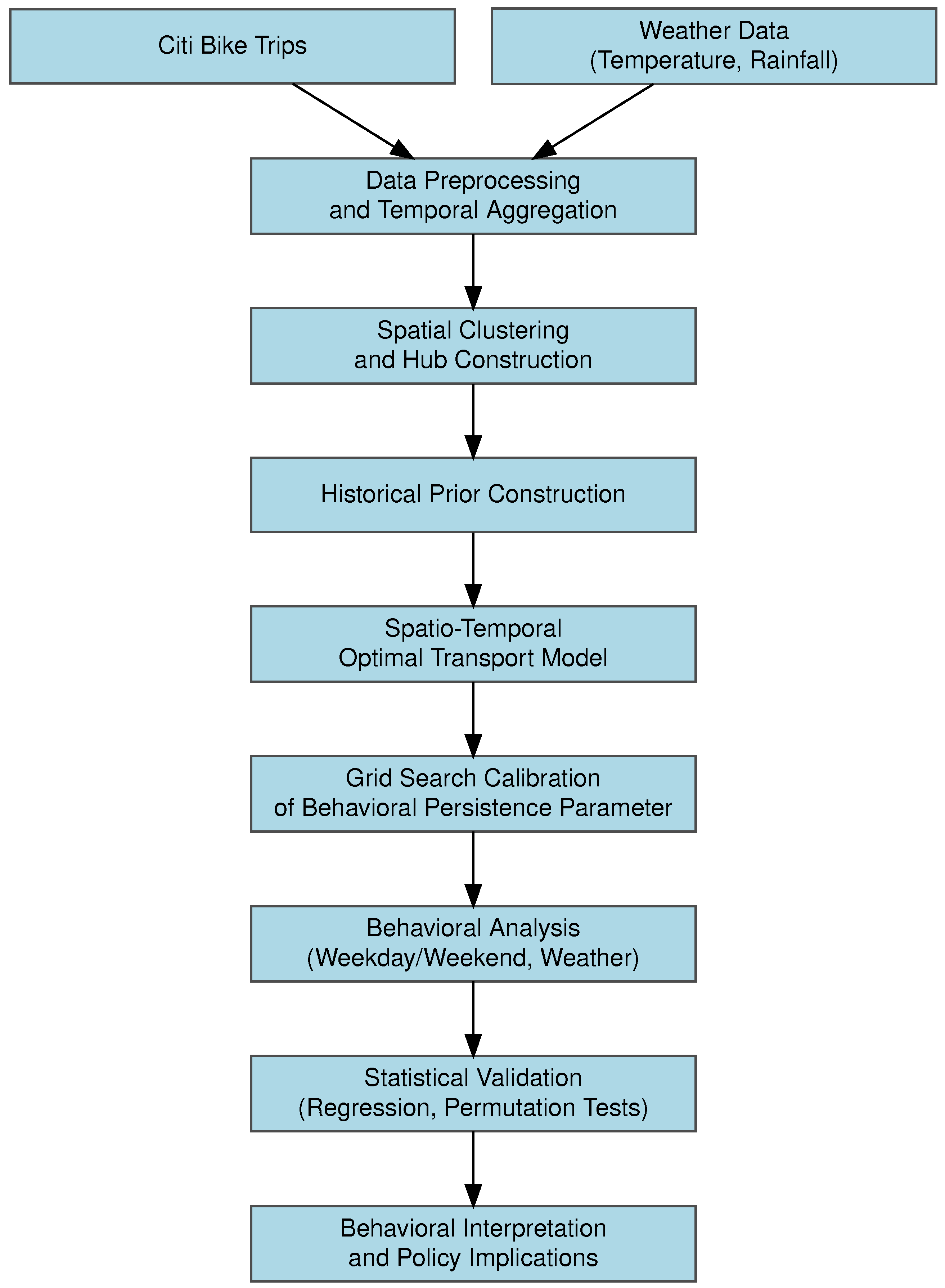
3.1. Overview of the ST-OT Framework
3.2. From Gravity Models to Entropic Optimal Transport
3.3. Spatio-Temporal Extension via Time-Expanded Networks
3.4. Behavior-Aware Transport via Prior Regularization
3.5. Dynamic Calibration as Behavioral Inference
4. Data and Preprocessing
4.1. Bike-Sharing Data and Its Preprocessing
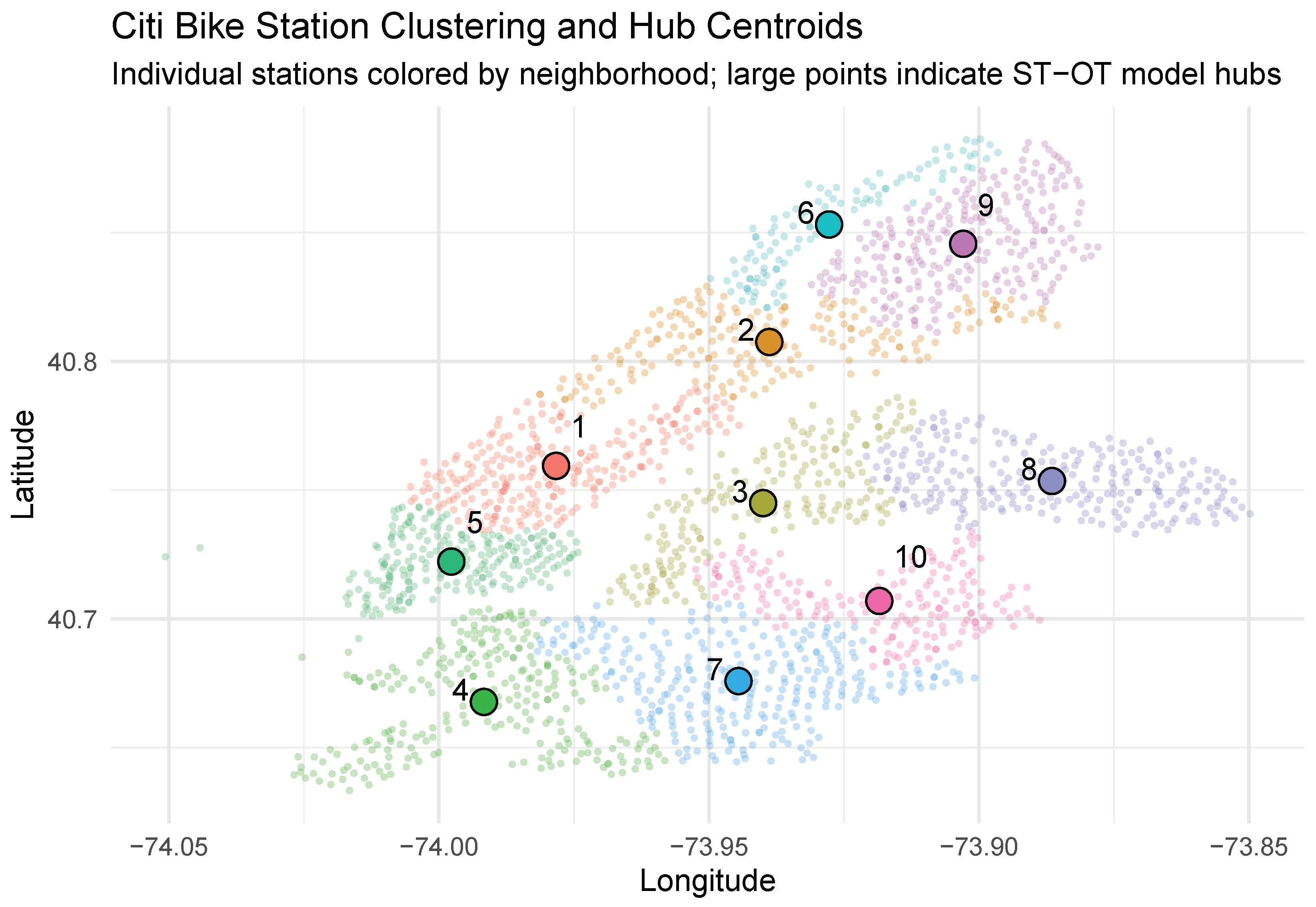
4.1.1. Spatial Aggregation: Construction of Virtual Hubs
- Pre-clustering (Euclidean space). On this stage, the stations are first grouped using k-means clustering with , reducing the dimensionality while preserving spatial coverage.
- Network-aware clustering (mobility space). To incorporate actual travel constraints, we compute pairwise cycling distances between cluster centroids using the Open Source Routing Machine (https://router.project-osrm.org/, accessed on 10 March 2026). Based on this network distance matrix, we apply the Partitioning Around Medoids (PAM) algorithm to obtain the final clusters (Kaufman and Rousseeuw [51]; Park and Jun [52]).
4.1.2. Temporal Aggregation
4.1.3. Construction of Behavioral Priors
4.2. Weather Data
- Precipitation: binary indicator (Rainy vs. Clear),
- Temperature: categorical bins (three equal-frequency regimes: Cold, Moderate, Warm).
5. Results
- Behavioral persistence refers to the calibrated parameter , which governs the degree of adherence to historical mobility patterns encoded in the prior.
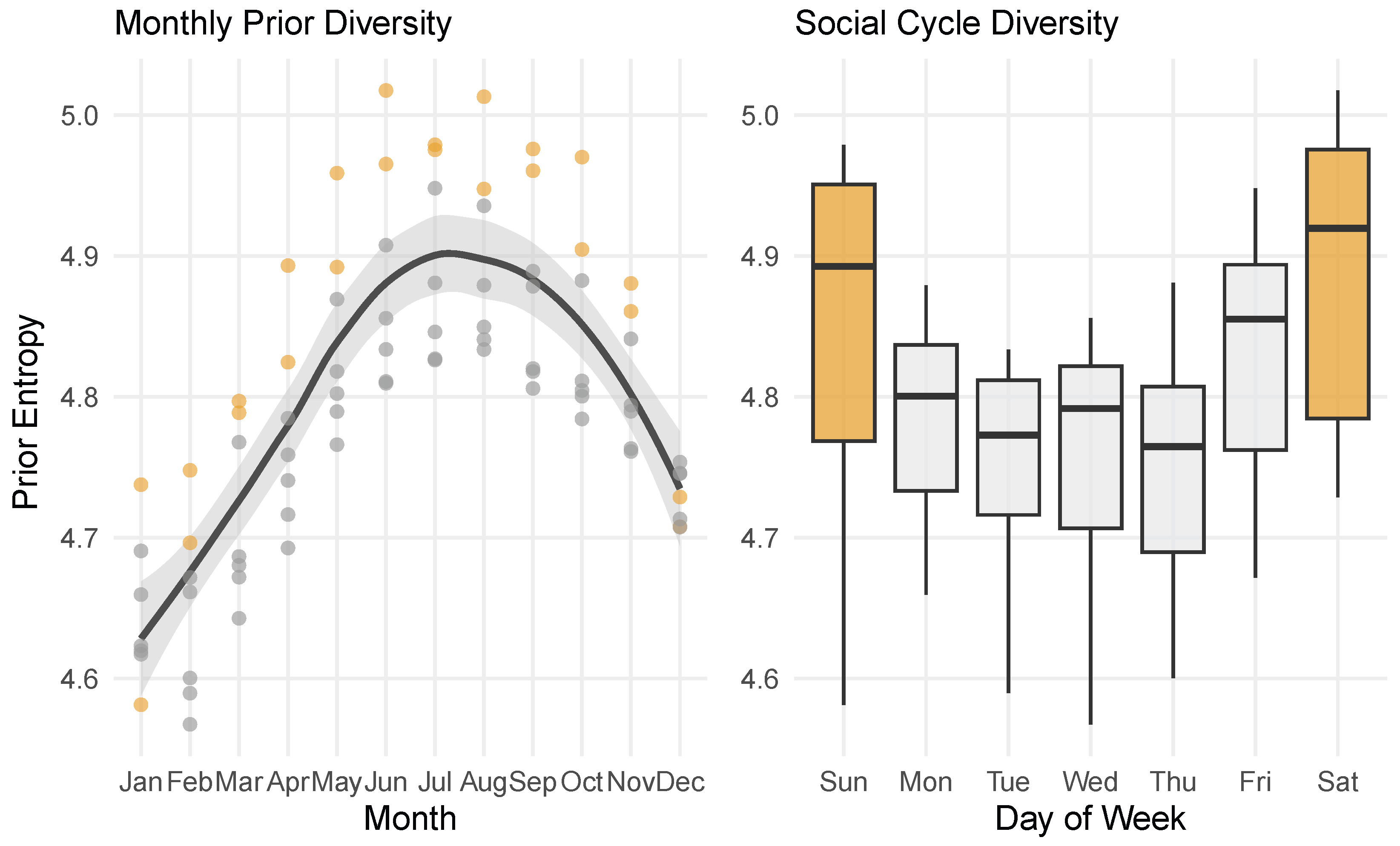
- Behavioral entropy refers to the Shannon entropy of the prior distribution , capturing the intrinsic structural uncertainty of historically observed mobility patterns.
- Behavioral variability refers to the dispersion observed in realized origin–destination flows .
- Behavioral flexibility is used as an interpretive aggregate notion describing the joint effect of structural entropy and behavioral persistence, rather than a separately estimated quantity.
5.1. Model Fit
- CPC:where denotes the observed number of trips departing from zone i in hour v and arriving in zone j in hour v in day t, and denotes the respective estimated flow at t, computed using the calibrated value of the entropy parameter.
- MAE:
5.2. Behavioral Dynamics
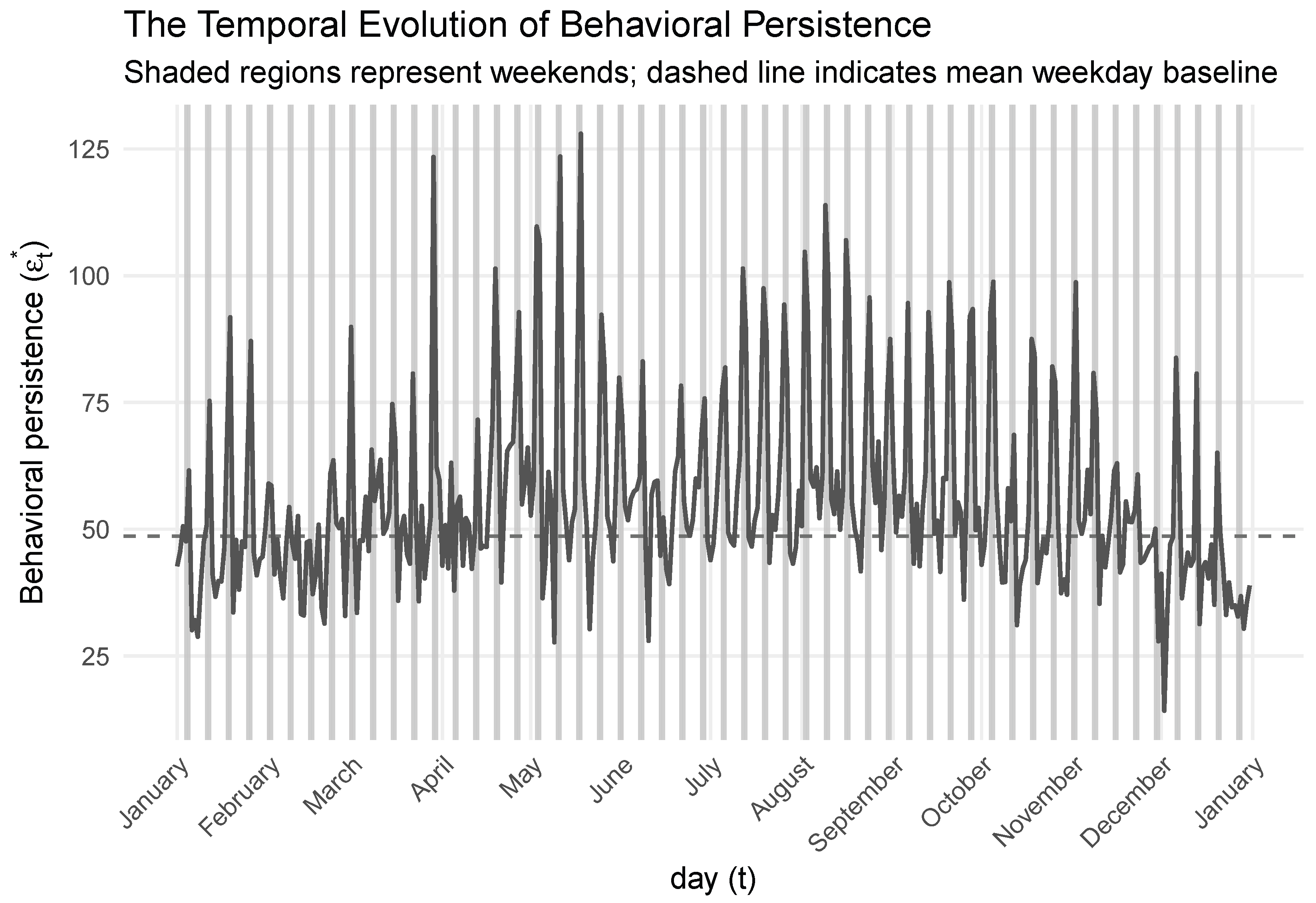
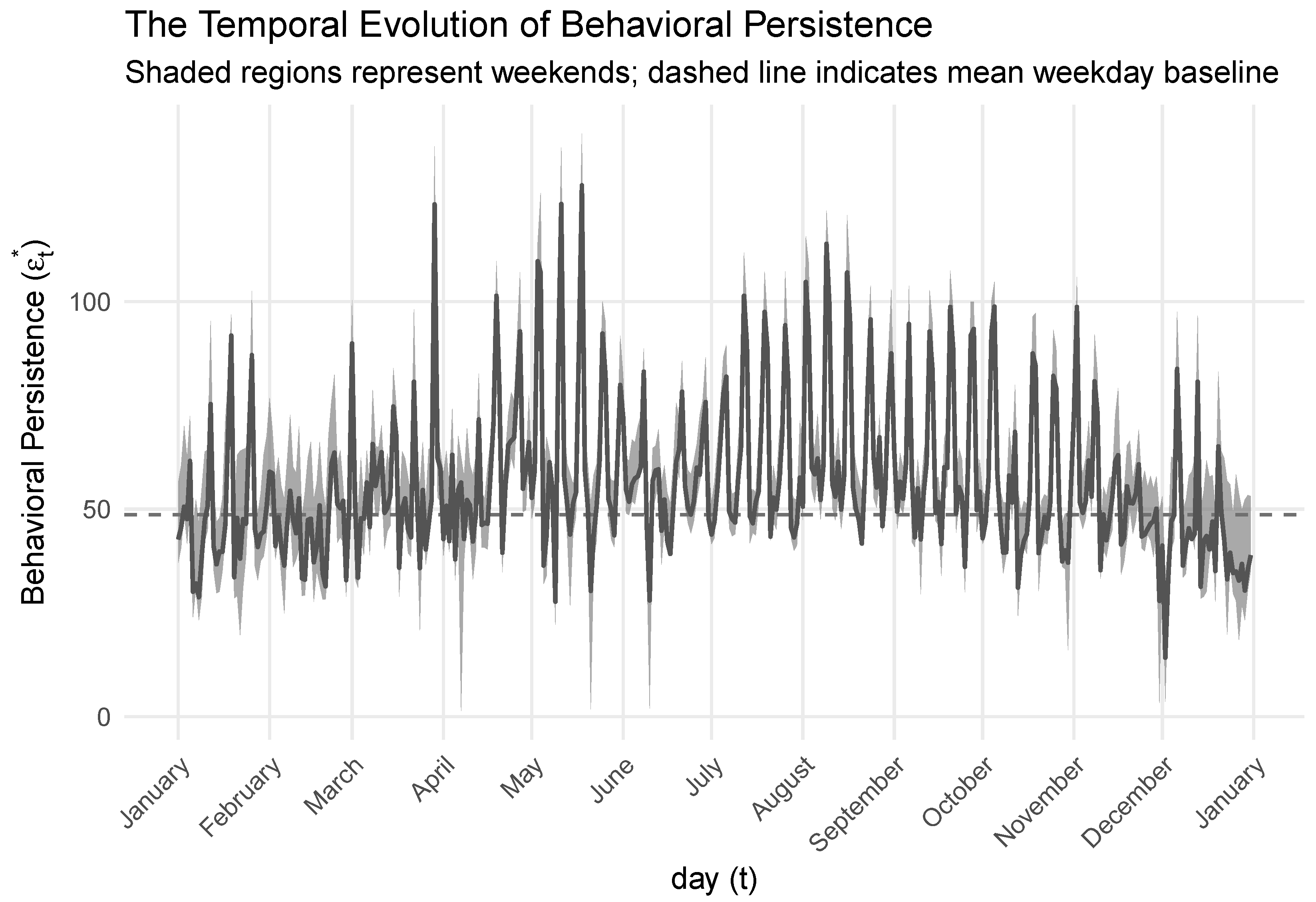
- Cost-sensitive regime: characterized by consistently low values, indicating that flows are primarily governed by travel cost, with limited influence of the prior.
- Prior-adherent regime: marked by elevated values, indicating reduced sensitivity to instantaneous travel cost and stronger adherence to historical mobility patterns.
- High + high : strong adherence to dispersed (structurally diverse) priors;
- Low + high : strong adherence to more structured priors;
- High + low : weak adherence to dispersed priors;
- Low + low : weak adherence to more structured priors.
5.2.1. Weekday–Weekend Comparison
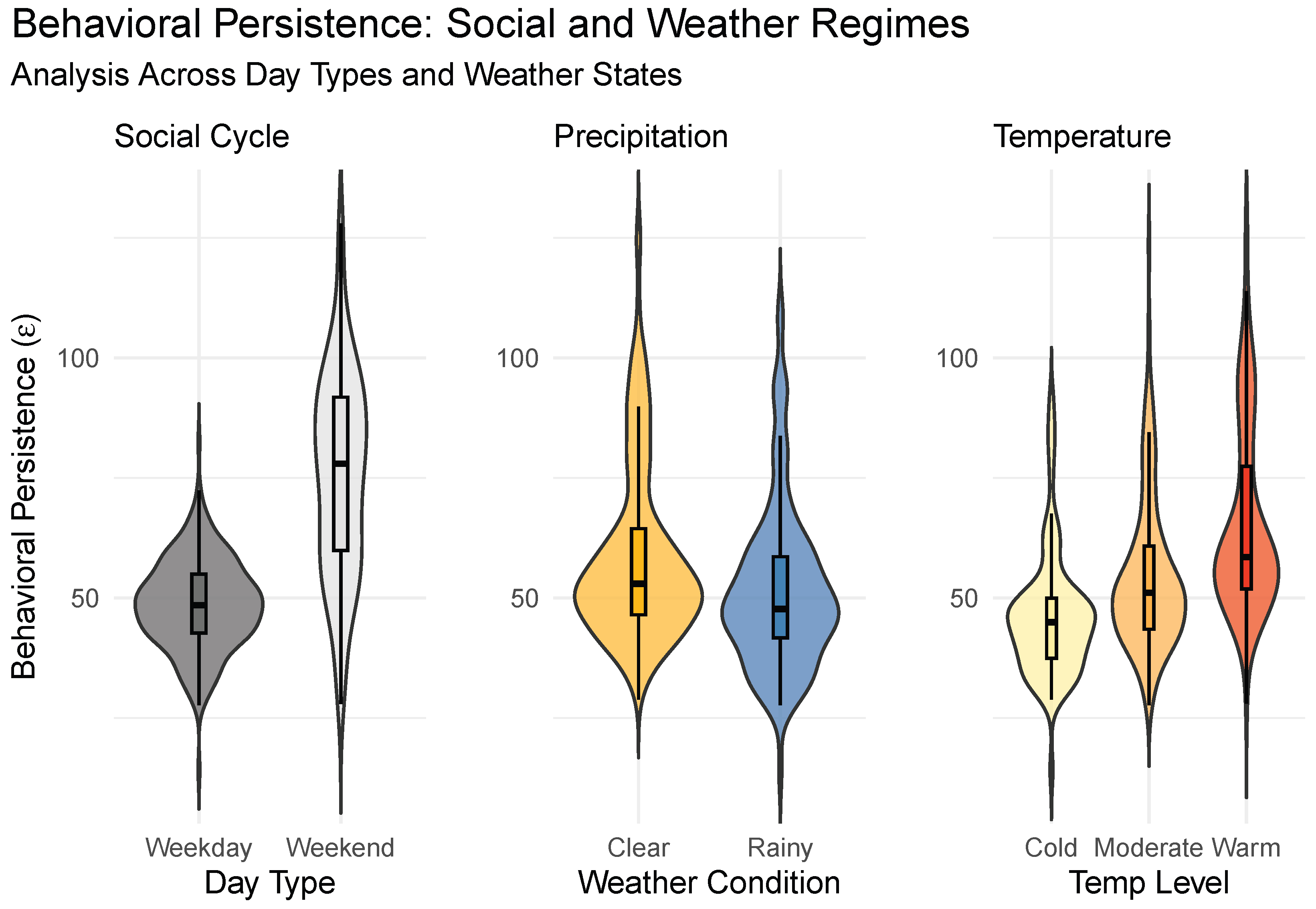
- Weekdays: narrow, low-variance distributions, indicating stable and predictable routing behavior.
- Weekends: wider, more dispersed distributions with heavier tails, indicating increased behavioral heterogeneity in trip patterns.
5.2.2. Weather-Induced Modulation
5.3. Statistical Validation
5.3.1. Distributional Testing
5.3.2. Regression Analysis
- A strong and significant weekend effect (, );
- A negative precipitation effect (, );
- A significant interaction between weekend and temperature (, ) indicates that the effect of temperature on behavioral persistence is amplified during weekends. In contrast, the interaction between weekend and precipitation () is not statistically significant, providing no evidence of a differential precipitation effect across weekdays and weekends.
5.4. Behavioral Interpretation and System-Level Insights
- Exploration–optimization trade-off: Variation in captures the balance between prior-driven and cost-minimizing behavior, providing a quantitative measure of urban movement preferences.
- Resilience: The relative stability of during weekdays suggests that commuting patterns are robust to moderate environmental shocks.
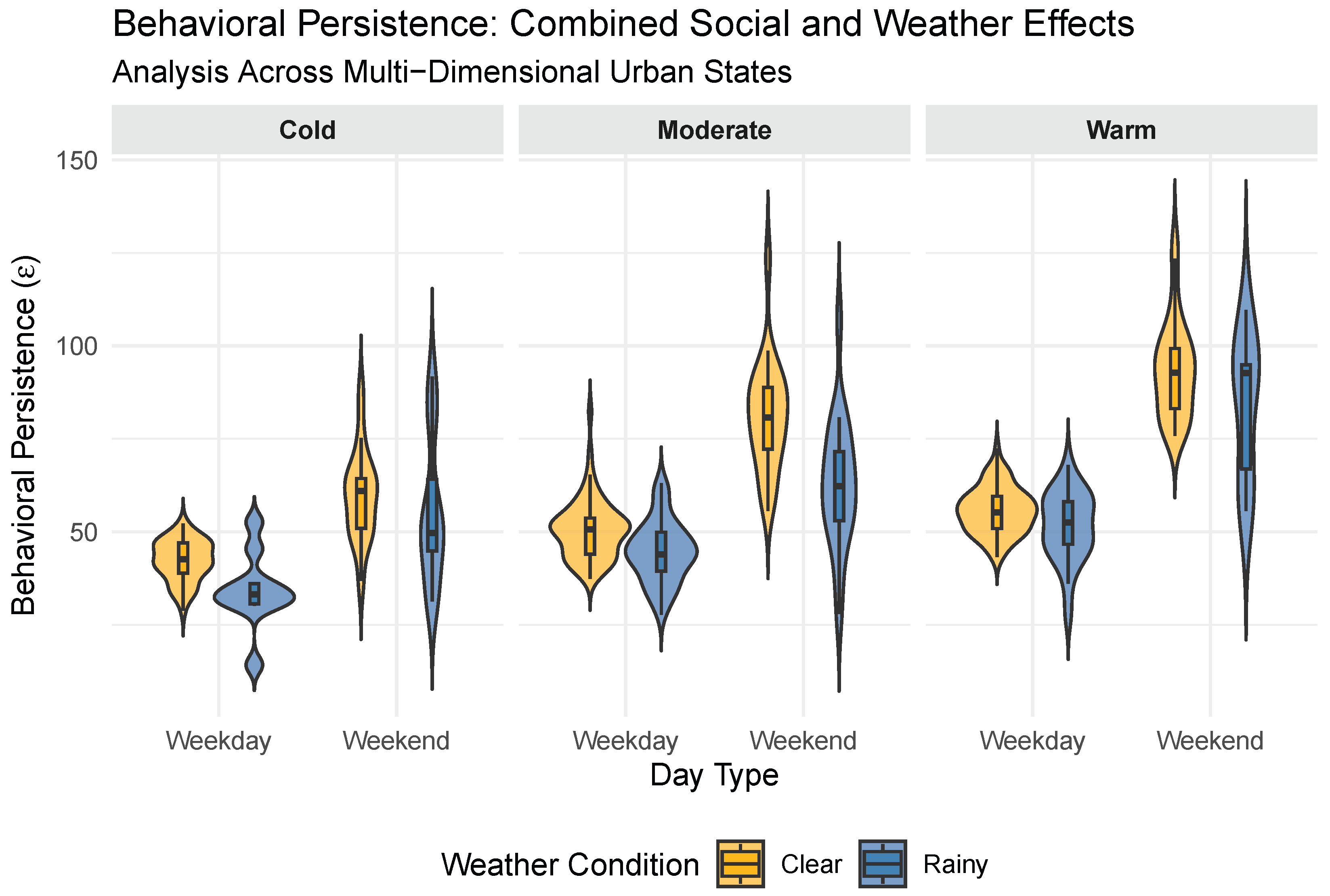
- Elasticity: More pronounced reductions in behavioral persistence under adverse weather conditions on weekends, relative to weekdays, reflect a contraction of discretionary mobility, indicating that such trips are highly sensitive to external conditions.
5.5. Summary of the Findings and Policy Implications
- Behavioral regimes (prior-driven versus cost-dominated): The calibrated behavioral persistence parameter identifies distinct mobility regimes. Weekdays are characterized by a commuter-driven regime with stable and cost-efficient flow structures, whereas weekends correspond to a more discretionary regime with higher behavioral variability and stronger adherence to historical mobility patterns (behavioral priors).
- Weather-induced shifts: Adverse weather conditions, in particular precipitation and low temperatures, are associated with a systematic reduction in . This effect is modest on weekdays, consistent with necessity-driven commuting behavior, but substantially stronger on weekends, reflecting a contraction of discretionary travel. In this sense, environmental conditions are consistent with acting as behavioral filters that selectively reduce discretionary mobility.
- State-dependent sensitivity to external shocks: Interaction effects indicate that the impact of environmental conditions is conditional on the temporal regime (weekday vs weekend). Weekend mobility exhibits significantly higher sensitivity to temperature fluctuations.
6. Conclusions
Author Contributions
Funding
Institutional Review Board Statement
Informed Consent Statement
Data Availability Statement
Conflicts of Interest
Appendix A
References
- Burgalat, J.; Pallares, G.; Foucras, M.; Dupuis, Y. A Literature Review of Public Transport OD Matrix Estimation. Future Transp. 2026, 6, 45. [Google Scholar] [CrossRef]
- Wilson, A.G. A Statistical Theory of Spatial Distribution Models. Transp. Res. 1967, 1, 253–269. [Google Scholar] [CrossRef]
- Kane, L.; Behrens, R. Transport Planning Models—An Historical And Critical Review. In Proceedings of the Annual South African Transport Conference, Pretoria, South Africa, 15–19 July 2002. [Google Scholar]
- Cascetta, E. Transportation Systems Analysis: Models and Applications; Springer Optimization and Its Applications; Springer: Boston, MA, USA, 2009; Volume 29. [Google Scholar] [CrossRef]
- Simini, F.; González, M.C.; Maritan, A.; Barabási, A.L. A Universal Model for Mobility and Migration Patterns. Nature 2012, 484, 96–100. [Google Scholar] [CrossRef]
- Tsekeris, T.; Stathopoulos, A. Gravity Models for Dynamic Transport Planning: Development and Implementation in Urban Networks. J. Transp. Geogr. 2006, 14, 152–160. [Google Scholar] [CrossRef]
- Huang, Q.; Zhu, X.; Liu, C.; Wu, W.; Liu, F.; Zhang, X. Spatial-Temporal Evolution and Determinants of the Belt and Road Initiative: A Maximum Entropy Gravity Model Approach. Chin. Geogr. Sci. 2020, 30, 839–854. [Google Scholar] [CrossRef]
- Ma, Z.; Zhu, D. Discovering Governing Spatial Interaction Mechanisms in Dynamic Urban Systems. arXiv 2026, arXiv:2603.19537. [Google Scholar] [CrossRef]
- González, M.C.; Hidalgo, C.A.; Barabási, A.L. Understanding Individual Human Mobility Patterns. Nature 2008, 453, 779–782. [Google Scholar] [CrossRef]
- Hasan, S.; Schneider, C.M.; Ukkusuri, S.V.; González, M.C. Spatiotemporal Patterns of Urban Human Mobility. J. Stat. Phys. 2013, 151, 304–318. [Google Scholar] [CrossRef]
- Gentile, G.; Noekel, K. (Eds.) Modelling Public Transport Passenger Flows in the Era of Intelligent Transport Systems: COST Action TU1004 (TransITS); Springer Tracts on Transportation and Traffic; Springer International Publishing: Cham, Switzerland, 2016. [Google Scholar] [CrossRef]
- Duan, X.; Zhang, T.; Xu, Z.; Wan, Q.; Yan, J.; Wang, W.; Tian, Y. Discovering Urban Mobility Structure: A Spatio-Temporal Representational Learning Approach. Int. J. Digit. Earth 2023, 16, 4044–4072. [Google Scholar] [CrossRef]
- Oh, S.; Park, S.; Ko, E.; Shim, J.; Rhim, C. Spatiotemporal Dynamics and Behavioral Patterns of Micro-Electric Vehicle Trips for Sustainable Urban Mobility. Sustainability 2026, 18, 1018. [Google Scholar] [CrossRef]
- Cabanas-Tirapu, O.; Danús, L.; Moro, E.; Sales-Pardo, M.; Guimerà, R. Human Mobility Is Well Described by Closed-Form Gravity-like Models Learned Automatically from Data. Nat. Commun. 2025, 16, 1336. [Google Scholar] [CrossRef]
- Cuturi, M. Sinkhorn Distances: Lightspeed Computation of Optimal Transport. In Proceedings of the 27th International Conference on Neural Information Processing Systems—Volume 2; Curran Associates Inc.: Red Hook, NY, USA, 2013; NIPS’13; Volume 2, pp. 2292–2300. [Google Scholar]
- Galichon, A. Optimal Transport Methods in Economics; Princeton University Press: Princeton, NJ, USA, 2016. [Google Scholar]
- Peyré, G.; Cuturi, M. Computational Optimal Transport. Found. Trends Mach. Learn. 2019, 11, 355–607. [Google Scholar] [CrossRef]
- Essid, M.; Solomon, J. Quadratically Regularized Optimal Transport on Graphs. SIAM J. Sci. Comput. 2018, 40, A1961–A1986. [Google Scholar] [CrossRef]
- Tong, A.; Huang, J.; Wolf, G.; van Dijk, D.; Krishnaswamy, S. TrajectoryNet: A Dynamic Optimal Transport Network for Modeling Cellular Dynamics. Proc. Mach. Learn. Res. 2020, 119, 9526–9536. [Google Scholar] [PubMed]
- Bao, H.; Sakaue, S. Sparse Regularized Optimal Transport with Deformed q. Entropy 2022, 24, 1634. [Google Scholar] [CrossRef]
- Marechal, M.; de Grange, L. Generalization of Beckmann’s Transformation for Traffic Assignment Models with Asymmetric Cost Functions. J. Adv. Transp. 2024, 2024, 2921485. [Google Scholar] [CrossRef]
- Train, K.; McFadden, D. The Goods/Leisure Tradeoff and Disaggregate Work Trip Mode Choice Models. Transp. Res. 1978, 12, 349–353. [Google Scholar] [CrossRef]
- Wu, L. Entropical Optimal Transport, Schrödinger’s System and Algorithms. Acta Math. Sci. 2021, 41, 2183–2197. [Google Scholar] [CrossRef]
- Chen, Y.; Georgiou, T.T.; Pavon, M. Stochastic Control Liaisons: Richard Sinkhorn Meets Gaspard Monge on a Schrödinger Bridge. SIAM Rev. 2021, 63, 249–313. [Google Scholar] [CrossRef]
- Hua, C.i.; Porell, F. A Critical Review of the Development of the Gravity Model. Int. Reg. Sci. Rev. 1979, 4, 97–126. [Google Scholar] [CrossRef]
- Erlander, S.; Stewart, N.F. The Gravity Model in Transportation Analysis: Theoryand Extensions; VSP: Leiden, The Netherlands, 1990. [Google Scholar]
- Hong, I.; Jung, W.S.; Jo, H.H. Gravity Model Explained by the Radiation Model on a Population Landscape. PLoS ONE 2019, 14, e0218028. [Google Scholar] [CrossRef]
- Song, C.; Qu, Z.; Blumm, N.; Barabási, A.L. Limits of Predictability in Human Mobility. Science 2010, 327, 1018–1021. [Google Scholar] [CrossRef]
- Train, K.E. Discrete Choice Methods with Simulation, 2nd ed.; Cambridge University Press: Cambridge, MA, USA, 2009. [Google Scholar] [CrossRef]
- Marin, V.; Molinero, C.; Arcaute, E. Uncovering Structural Diversity in Commuting Networks: Global and Local Entropy. Sci. Rep. 2022, 12, 1684. [Google Scholar] [CrossRef]
- Chen, Y.; Georgiou, T.T.; Pavon, M. On the Relation Between Optimal Transport and Schrödinger Bridges: A Stochastic Control Viewpoint. J. Optim. Theory Appl. 2016, 169, 671–691. [Google Scholar] [CrossRef]
- Léonard, C. A Survey of the Schrödinger Problem and Some of Its Connections with Optimal Transport. Discret. Contin. Dyn. Syst. 2014, 34, 1533–1574. [Google Scholar] [CrossRef]
- Zhu, C.; Müller, H.G. Autoregressive Optimal Transport Models. J. R. Stat. Soc. Ser. B Stat. Methodol. 2023, 85, 1012–1033. [Google Scholar] [CrossRef]
- Zhu, J.; Guha, A.; Do, D.; Xu, M.; Nguyen, X.; Zhao, D. Functional Optimal Transport: Regularized Map Estimation and Domain Adaptation for Functional Data. J. Mach. Learn. Res. 2024, 25, 1–49. [Google Scholar]
- Lonardi, A.; Szell, M.; De Bacco, C. Cohesive Urban Bicycle Infrastructure Design through Optimal Transport Routing in Multilayer Networks. J. R. Soc. Interface 2025, 22, 20240532. [Google Scholar] [CrossRef]
- Friesz, T.L.; Mookherjee, R. Solving the Dynamic Network User Equilibrium Problem with State-Dependent Time Shifts. Transp. Res. Part B Methodol. 2006, 40, 207–229. [Google Scholar] [CrossRef]
- Zhong, R.X.; Sumalee, A.; Friesz, T.L.; Lam, W.H.K. Dynamic User Equilibrium with Side Constraints for a Traffic Network: Theoretical Development and Numerical Solution Algorithm. Transp. Res. Part B Methodol. 2011, 45, 1035–1061. [Google Scholar] [CrossRef]
- Fu, H.; Akamatsu, T.; Satsukawa, K.; Wada, K. Dynamic Traffic Assignment in a Corridor Network: Optimum versus Equilibrium. Transp. Res. Part B Methodol. 2022, 161, 218–246. [Google Scholar] [CrossRef]
- Zhou, H.; Bouyekhf, R.; El Moudni, A. Modeling and Entropy Based Control of Urban Transportation Network. Control Eng. Pract. 2013, 21, 1369–1376. [Google Scholar] [CrossRef]
- Ibeas, Á.; Cordera, R.; dell’Olio, L.; Coppola, P. Modelling the Spatial Interactions between Workplace and Residential Location. Transp. Res. Part A Policy Pract. 2013, 49, 110–122. [Google Scholar] [CrossRef]
- Ermagun, A.; Levinson, D.M. Development and Application of the Network Weight Matrix to Predict Traffic Flow for Congested and Uncongested Conditions. Environ. Plan. B Urban Anal. City Sci. 2019, 46, 1684–1705. [Google Scholar] [CrossRef]
- Buffa, L.; Mazzilli, D.; Piombo, R.; Saracco, F.; Cimini, G.; Patelli, A. Maximum Entropy Modelling of Sub-Optimal Transport. Commun. Phys. 2025, 9, 39. [Google Scholar] [CrossRef]
- Knight, P.A. The Sinkhorn–Knopp Algorithm: Convergence and Applications. SIAM J. Matrix Anal. Appl. 2008, 30, 261–275. [Google Scholar] [CrossRef]
- Sinkhorn, R.; Knopp, P. Concerning Nonnegative Matrices and Doubly Stochastic Matrices. Pac. J. Math. 1967, 21, 343–348. [Google Scholar] [CrossRef]
- Lambert, M.; Chewi, S.; Bach, F.; Bonnabel, S.; Rigollet, P. Variational Inference via Wasserstein Gradient Flows. In Proceedings of the 36th International Conference on Neural Information Processing Systems; Curran Associates Inc.: Red Hook, NY, USA, 2022; NIPS ’22; pp. 14434–14447. [Google Scholar]
- Lenormand, M.; Huet, S.; Gargiulo, F.; Deffuant, G. A Universal Model of Commuting Networks. PLoS ONE 2012, 7, e45985. [Google Scholar] [CrossRef]
- Barthélemy, M. Spatial Networks. Phys. Rep. 2011, 499, 1–101. [Google Scholar] [CrossRef]
- González Ramírez, H.; Leclercq, L.; Chiabaut, N.; Becarie, C.; Krug, J. Travel Time and Bounded Rationality in Travellers’ Route Choice Behaviour: A Computer Route Choice Experiment. Travel Behav. Soc. 2021, 22, 59–83. [Google Scholar] [CrossRef]
- Louail, T.; Lenormand, M.; Cantu Ros, O.G.; Picornell, M.; Herranz, R.; Frias-Martinez, E.; Ramasco, J.J.; Barthelemy, M. From Mobile Phone Data to the Spatial Structure of Cities. Sci. Rep. 2014, 4, 5276. [Google Scholar] [CrossRef]
- El Joubari, O.; Ben Othman, J.; Veque, V. A Stochastic Mobility Model for Traffic Forecasting in Urban Environments. J. Parallel Distrib. Comput. 2022, 165, 142–155. [Google Scholar] [CrossRef]
- Kaufman, L.; Rousseeuw, P.J. Finding Groups in Data: An Introduction to Cluster Analysis, 1st ed.; Wiley Series in Probability and Statistics; Wiley: Hoboken, NJ, USA, 1990. [Google Scholar] [CrossRef]
- Park, H.S.; Jun, C.H. A Simple and Fast Algorithm for K-medoids Clustering. Expert Syst. Appl. 2009, 36, 3336–3341. [Google Scholar] [CrossRef]
- Venigalla, M.M.; Chatterjee, A.; Bronzini, M.S. A Specialized Equilibrium Assignment Algorithm for Air Quality Modeling. Transp. Res. Part D Transp. Environ. 1999, 4, 29–44. [Google Scholar] [CrossRef]
- Atwal, K.S.; Anderson, T.; Pfoser, D.; Züfle, A. Commuting Flow Prediction Using OpenStreetMap Data. Comput. Urban Sci. 2025, 5, 2. [Google Scholar] [CrossRef]
- Siegel, S.; Castellan, N.J., Jr. Nonparametric Statistics for the Behavioral Sciences, 2nd ed.; Mcgraw-Hill Book Company: New York, NY, USA, 1988. [Google Scholar]
- Good, P.I. (Ed.) Permutation, Parametric and Bootstrap Tests of Hypotheses, 3rd ed.; Springer Series in Statistics; Springer: New York, NY, USA, 2005. [Google Scholar] [CrossRef]
- Newey, W.K.; West, K.D. A Simple, Positive Semi-Definite, Heteroskedasticity and Autocorrelation Consistent Covariance Matrix. Econometrica 1987, 55, 703. [Google Scholar] [CrossRef]
- Schuijbroek, J.; Hampshire, R.C.; van Hoeve, W.J. Inventory Rebalancing and Vehicle Routing in Bike Sharing Systems. Eur. J. Oper. Res. 2017, 257, 992–1004. [Google Scholar] [CrossRef]
- Eren, E.; Uz, V.E. A Review on Bike-Sharing: The Factors Affecting Bike-Sharing Demand. Sustain. Cities Soc. 2020, 54, 101882. [Google Scholar] [CrossRef]



| Symbol | Description |
|---|---|
| Estimated origin–destination flow matrix at time t | |
| Historical prior flow distribution | |
| Estimated historical prior distribution | |
| Transport cost matrix | |
| Calibrated behavioral persistence parameter | |
| Shannon entropy of the historical prior | |
| || | Kullback–Leibler divergence between estimated flows and prior |
| Regression coefficients | |
| Regression error term | |
| Weekend indicator variable | |
| Daily precipitation | |
| Daily temperature | |
| CPC | Common Part of Commuters goodness-of-fit metric |
| MAE | Mean Absolute Error |
| PAM | Partitioning Around Medoids clustering algorithm |
| ST-OT | Spatio-Temporal Optimal Transport |
| Day Type | Number of Days | Mean () | SD () | Mean () | SD () |
|---|---|---|---|---|---|
| Weekday | 261 | 0.9387 | 0.0112 | 1.4208 | 0.4877 |
| Weekend | 104 | 0.9101 | 0.0129 | 1.4953 | 0.7079 |
| Total | 365 | 0.9306 | 0.0174 | 1.4420 | 0.5593 |
| Term | Estimate | p.Value |
|---|---|---|
| (Intercept) | 35.652 | 0.000 |
| (Weekend) | 19.714 | 0.000 |
| (Rain) | −0.277 | 0.003 |
| (Temp) | 0.906 | 0.000 |
| (Weekend·Rain) | −0.362 | 0.151 |
| (Weekend·Temp) | 1.027 | 0.000 |
Disclaimer/Publisher’s Note: The statements, opinions and data contained in all publications are solely those of the individual author(s) and contributor(s) and not of MDPI and/or the editor(s). MDPI and/or the editor(s) disclaim responsibility for any injury to people or property resulting from any ideas, methods, instructions or products referred to in the content. |
© 2026 by the authors. Licensee MDPI, Basel, Switzerland. This article is an open access article distributed under the terms and conditions of the Creative Commons Attribution (CC BY) license.
Share and Cite
Osipenko, M.; Meng, F. Inferring Behavioral Regimes in Urban Mobility via Spatio-Temporal Optimal Transport. Future Transp. 2026, 6, 110. https://doi.org/10.3390/futuretransp6030110
Osipenko M, Meng F. Inferring Behavioral Regimes in Urban Mobility via Spatio-Temporal Optimal Transport. Future Transportation. 2026; 6(3):110. https://doi.org/10.3390/futuretransp6030110
Chicago/Turabian StyleOsipenko, Maria, and Fanqi Meng. 2026. "Inferring Behavioral Regimes in Urban Mobility via Spatio-Temporal Optimal Transport" Future Transportation 6, no. 3: 110. https://doi.org/10.3390/futuretransp6030110
APA StyleOsipenko, M., & Meng, F. (2026). Inferring Behavioral Regimes in Urban Mobility via Spatio-Temporal Optimal Transport. Future Transportation, 6(3), 110. https://doi.org/10.3390/futuretransp6030110