Article

Inferring Behavioral Regimes in Urban Mobility via Spatio-Temporal Optimal Transport

1
Department of Business and Economics, Berlin School of Economics and Law, Badensche Str. 50-52, 10875 Berlin, Germany
2
School of Business and Economics, Humboldt-Universität zu Berlin, Unter den Linden 6, 10099 Berlin, Germany
*
Author to whom correspondence should be addressed.
Future Transp. 2026, 6(3), 110; https://doi.org/10.3390/futuretransp6030110
Submission received: 16 April 2026 / Revised: 13 May 2026 / Accepted: 19 May 2026 / Published: 21 May 2026

Abstract

Predicting origin–destination flows in high-density bike-sharing systems remains challenging due to the lack of models that jointly capture temporal dynamics and behavioral variability in urban mobility. In this study, we introduce a spatio-temporal optimal transport framework with dynamically calibrated behavioral regularization that integrates physical network costs with historical mobility priors to infer latent behavioral structure in trip patterns. Unlike static or purely predictive approaches, the proposed framework captures temporal spillovers across hourly intervals, allowing for the continuous evolution of mobility flows. We reinterpret the regularization parameter as a behavioral persistence indicator governing the trade-off between cost minimization and prior adherence. This parameter is dynamically calibrated over a 12-month period using Kullback–Leibler divergence from historical priors, enabling a behavioral diagnostic perspective on mobility regimes. Empirically, we uncover statistically significant regime shifts: weekday mobility is dominated by cost-efficient flows, whereas weekend behavior exhibits stronger adherence to historical mobility patterns and greater variability. We further identify systematic weather-related modulation, with adverse conditions associated with reduced behavioral persistence and patterns consistent with a contraction of discretionary mobility. These findings demonstrate that the proposed framework yields an interpretable behavioral metric for urban mobility systems. This has implications for adaptive mobility management, enabling data-driven rebalancing strategies that respond to temporal variation in behavioral regimes.

1. Introduction

Urban mobility systems are complex adaptive systems shaped by the interplay of infrastructure, environmental conditions, and human behavior. Accurately estimating origin–destination (O–D) flows remains a central problem in transportation science, underpinning applications ranging from infrastructure planning to real-time system operations (Burgalat et al. [1]). Classical approaches, most notably the doubly constrained gravity model introduced by Wilson [2], model spatial interaction as a function of origin demand, destination attractiveness, and generalized travel cost. These models have proven remarkably robust and interpretable, forming the backbone of transport planning (Kane and Behrens [3]).
However, traditional gravity-based formulations rely on assumptions of stationarity and instantaneous flow adjustment, which limit their ability to capture the inherently dynamic and stochastic nature of urban mobility (Cascetta [4]). In particular, they do not account for temporal propagation effects, behavioral heterogeneity, or exogenous shocks such as weather events. Extensions such as the radiation model proposed by Simini et al. [5] omit parameter calibration but still largely operate in static settings and do not explicitly incorporate temporal ordering or behavioral adaptation. Dynamic extensions of the gravity-like models, e.g., in Tsekeris and Stathopoulos [6], Huang et al. [7], Ma and Zhu [8], introduce temporal indices but do not consider structural changes due to behavioral factors.
Recent advances in data availability, particularly from bike-sharing systems, mobile devices, and GPS traces, have enabled a shift toward data-driven mobility modeling. Studies such as those by González et al. [9], Hasan et al. [10], Gentile and Noekel [11], Duan et al. [12], Oh et al. [13] demonstrate that human mobility exhibits strong regularities punctuated by bursts of exploration, suggesting that aggregate flow patterns emerge from a mixture of routine and stochastic behavior. This duality motivates modeling frameworks that can simultaneously capture cost-optimal routing and behavioral variability. Cabanas-Tirapu et al. [14] show that data-calibrated gravity-like models are capable of capturing mobility patterns and are competitive with complex machine learning models in predicting mobility flow.
In parallel, the field of optimal transport (OT) has emerged as a powerful mathematical framework for modeling flow systems. The entropic regularization approach introduced by Cuturi [15] enables efficient computation via the Sinkhorn algorithm while establishing a deep connection to classical gravity models through an entropy-regularized formulation (Wilson [2]). Subsequent work has leveraged OT in applications ranging from economics (Galichon [16]) to machine learning (Peyré and Cuturi [17]), highlighting its flexibility in incorporating prior information and behavioral constraints.
Despite these advances, two key gaps remain in the literature. First, while OT provides a robust matching framework, most mobility applications remain purely spatial (Essid and Solomon [18]), implicitly assuming instantaneous transport and failing to incorporate sequential ordering inherent in urban flows (Tong et al. [19]). Second, while entropy regularization is often treated as a numerical device, its behavioral interpretation, as a proxy for uncertainty, flexibility, or bounded rationality (e.g., in Bao and Sakaue [20]), has not been systematically exploited in empirical urban studies.
This paper addresses both gaps by introducing a spatio-temporal optimal transport (ST-OT) framework that explicitly models the temporal propagation of flows while enforcing causal ordering. Specifically, we embed the transport problem in a time-expanded network and impose a directed acyclic graph (DAG) structure to ensure that flows respect physical travel times and temporal feasibility. This formulation is closely related to Dynamic Traffic Assignment (DTA) models (e.g., Marechal and de Grange [21]), but differs in that it treats flow allocation as a probabilistic inference problem rather than a deterministic equilibrium, thereby allowing for stochastic deviations from cost-optimal routing.
To address the second gap, we reinterpret the regularization parameter ( ϵ ) as a time-varying behavioral parameter governing the trade-off between cost minimization and adherence to historical mobility patterns. Rather than fixing ϵ a priori, we calibrate it dynamically from observed data, allowing it to vary across time in response to social cycles and environmental conditions. This perspective is informed by connections to discrete choice theory, particularly random utility models (e.g., Train and McFadden [22]), where stochasticity reflects unobserved preferences.
To operationalize this behavioral interpretation, we extend the standard OT formulation by introducing a prior distribution, yielding a Kullback–Leibler (KL) regularized problem that anchors flows to historical patterns. This connects our approach to recent Bayesian formulations of transport (e.g., Wu [23]; Chen et al. [24]).
Empirically, we apply the framework to high-resolution bike-sharing data from New York City. The results reveal systematic temporal variation in the calibrated behavioral parameter, indicating distinct mobility regimes associated with social cycles and environmental conditions.
The contributions of this work are threefold. First, we develop a spatio-temporal OT framework that integrates temporal causality and flow propagation within a unified optimization setting. Second, we provide a behavioral interpretation of model regularization by treating the KL-weight as a dynamically calibrated parameter. Third, we demonstrate empirically that this parameter captures regime shifts in urban mobility and their dependence on social and environmental factors. To our knowledge, existing approaches do not jointly integrate temporally causal flow propagation, entropy-regularized optimal transport, and data-driven behavioral calibration.
Taken together, these contributions position ST-OT as a diagnostic framework for analyzing latent behavioral dynamics in urban mobility systems, with implications for adaptive transport policy and real-time system management.
The remainder of the paper is structured as follows. Section 2 reviews the relevant approaches. Section 3 presents the proposed spatio-temporal optimal transport framework. Section 4 describes the data and preprocessing steps. Section 5 reports empirical results and behavioral analyses. Section 5.3 provides statistical validation. Section 6 concludes with a discussion of findings, limitations, and implications.

2. Related Work

2.1. Gravity, Radiation, and Dynamic Spatial Interaction Models

The gravity model has formed the backbone of spatial interaction and O–D flow estimation since Wilson’s entropy-maximizing derivation, in which flows arise from a trade-off between origin mass, destination attractiveness, and travel cost under global constraints on production and attraction Wilson [2]. Subsequent work extended this framework, examining the structural form, theoretical underpinnings, and empirical calibration of gravity-type models across a wide range of spatial systems Hua and Porell [25]. In parallel, a large body of literature has explored variants with alternative cost functions, constraints, and multi-level structures, confirming the robustness yet also highlighting the limitations of gravity-based approaches when confronted with heterogeneous and evolving urban systems (Erlander and Stewart [26]).
To address some of these limitations, Simini et al. proposed the radiation model, which eschews parameter calibration and instead derives flows from intervening opportunities in a mass-transport analogy (Simini et al. [5]). Comparative studies show that radiation and gravity models can both reproduce broad mobility patterns, but their relative performance depends strongly on context, and both are typically deployed in static form, neglecting temporal ordering and behavioral adaptation (Hong et al. [27]). Extensions toward dynamic gravity or time-varying interaction models introduce temporal indices and lag structures but often preserve the basic instantaneous or period-aggregated nature of the underlying equilibrium (Tsekeris and Stathopoulos [6]; Huang et al. [7]; Ma and Zhu [8]).

2.2. Human Mobility Regularities and Behavioral Variability

The increasing availability of high-resolution mobility traces from mobile phones, GPS devices, and bike-sharing systems has revealed that human mobility is neither purely random nor strictly regular. Gonzalez et al. showed that individual trajectories exhibit a high degree of temporal and spatial regularity, with strong tendencies to return to a small set of preferred locations, yet also display occasional long-distance exploratory trips (González et al. [9]). Similar dual regularity–exploration patterns have been documented in other datasets, suggesting that aggregate flows emerge from a mixture of routine behavior and stochastic deviations (Song et al. [28]), transitions in networks (Gentile and Noekel [11], Duan et al. [12]), or mixted structure (Oh et al. [13]). This behavioral heterogeneity has motivated models that incorporate both cost-minimizing structure and probabilistic choice, for example through random utility theory and discrete choice formulations in Train [29].
Within urban systems, entropy-based measures have been used to quantify the diversity and concentration of commuting flows, revealing how monocentric or polycentric structures evolve over time (Marin et al. [30]). While these studies document structural changes, for example, increasing spatial dispersion of destinations, they generally do not connect the dynamics to explicit behavioral mechanisms or to optimization-based flow models.

2.3. Optimal Transport, Entropic Regularization, and Mobility

OT provides a geometric framework for comparing distributions by solving for the minimum-cost plan that moves one distribution into another under a prescribed ground cost Peyré and Cuturi [17]. Cuturi’s introduction of entropic regularization and the Sinkhorn algorithm made OT computationally tractable for large-scale applications, while also revealing a close connection to classical gravity models: the entropy-regularized OT solution corresponds to a maximum-entropy flow subject to marginal constraints and cost penalties, effectively recovering a doubly constrained gravity form with an explicit entropy term (Cuturi [15]). This link has spurred the use of OT in spatial interaction, economics, and machine learning, where the regularization parameter plays a dual role as both a numerical smoothing factor and a control on dispersion of the transport plan (Peyré and Cuturi [17]).
Beyond static settings, OT has been extended to dynamic and prior-informed formulations. Schrödinger bridge problems interpret transport as an inference task between stochastic processes that interpolate between initial and final distributions under a reference dynamics, yielding solutions that minimize a KL divergence relative to a prior path measure (Chen et al. [31]). This perspective naturally leads to OT with prior or KL-regularized OT, where flows are encouraged to remain close to historical patterns while still accommodating new cost structures (Léonard [32]). Recent work has begun to explore dynamic OT models for time series of distributions, as well as OT-based methods for functional data (Zhu and Müller [33]; Zhu et al. [34]), but applications to urban mobility remain scarce and abstract away from detailed network and temporal constraints.
Within transport and mobility, OT has primarily been used for network design and infrastructure planning rather than for behavioral diagnostics. For example, OT-inspired routing in multilayer networks has been applied to design cohesive bicycle infrastructure that adapts link capacities to cyclist flows in Lonardi et al. [35]. However, these approaches typically focus on cost-efficient network adaptation, rather than on quantifying behavioral variability.

2.4. Dynamic Traffic Assignment and Time-Expanded Networks

DTA models consider the temporal evolution of flows on networks, often formulating the problem on a time-expanded graph where nodes represent time–space states and arcs encode travel-time-feasible movements (Friesz and Mookherjee [36]; Zhong et al. [37]). Subsequent work has derived closed-form solutions for dynamic system-optimal and dynamic user-equilibrium assignments in corridor networks, characterizing the relationship between system-optimal flows and user-equilibrium queuing delays (Fu et al. [38]). These models preserve temporal causality and physical feasibility but are deterministic or equilibrium-based, and do not incorporate KL-based behavioral priors on flows.
In parallel, researches revisited entropy from a dynamical systems perspective, interpreting transportation networks as thermodynamic systems in which entropy measures disorder or variability in flows (Zhou et al. [39]). This interpretation aligns closely with concepts from information theory and discrete choice modeling, where randomness reflects unobserved preferences and bounded rationality (Galichon [16]).
Time-expanded network formulations have also been used in public transport and bike-sharing contexts, for example to optimize repositioning or to schedule vehicle movements, but often with deterministic shortest-path or minimum-cost flow formulations (Ibeas et al. [40]). In contrast, our work adopts a probabilistic perspective within a time-expanded network, combining the causal structure of DTA with the flexibility and behavioral interpretation of KL-regularized OT.

2.5. Entropy, Discrete Choice, and Behavioral Interpretation

The behavioral interpretation of entropic regularization in mobility models can be traced to discrete choice theory and random utility models (Train and McFadden [22], Train [29]). In such settings, the scale of the error term controls the degree of randomness in choices, providing a natural analogue to the entropic regularization parameter in OT: low noise (low entropy) corresponds to deterministic, cost-driven behavior, while high noise yields more diffuse, exploratory patterns. Recent work has highlighted these connections by showing that entropy-regularized OT can be viewed as a continuous analogue of discrete choice, in which transport plans represent mixtures over many possible routes or pairings rather than single deterministic matches (Peyré and Cuturi [17]).
Despite this conceptual link to stochastic control (Chen et al. [31]), most empirical urban applications using entropic OT treat the regularization parameter merely as a tuning knob chosen for numerical stability or to approximate unregularized plans (Peyré and Cuturi [17]). Consequently, its potential as a time-varying behavioral indicator reflecting shifting urban regimes remains largely unexplored in traditional spatial interaction modeling (Ermagun and Levinson [41]). Emerging research on mobility entropy in commuting networks in Marin et al. [30] uses entropy measures to uncover structural diversity and resilience but does not tie these directly to an underlying behavioral parameter.
Recent study in Buffa et al. [42] further explores maximum-entropy transport formulations to model sub-optimal or stochastic flows, emphasizing that real-world systems often deviate from strict optimality due to uncertainty, noise, and behavioral heterogeneity. Our work is related to Buffa et al. [42]. However, as Buffa et al. [42] trade off random and cost-minimizing structures, our work contrasts cost-minimizing optimal behavior with spatial sub-optimal behavioral patterns, such as leasure trips.

2.6. Positioning of This Study

Overall, the literature leaves two key gaps unresolved: the lack of temporally causal, spillover-aware formulations in OT-based mobility models, and the absence of an interpretable, data-driven characterization of the regularization parameter as a behavioral state indicator. Addressing these limitations is essential for moving from purely predictive flow estimation toward behavioral inference in urban mobility systems.
Relative to existing studies, our ST-OT framework contributes along two main dimensions. Structurally, it extends gravity-like spatial interaction models by embedding them in a time-expanded, DAG-constrained network. This formulation enforces causal propagation of flows and accommodates temporal spillovers across hourly boundaries, thereby bridging ideas from Dynamic Traffic Assignment and entropy-regularized optimal transport (Cuturi [15]; Fu et al. [38]). Behaviorally, the framework leverages the KL-divergence to quantify behavioral persistence and elevates the regularization parameter from a purely numerical device to a calibrated, time-varying state variable—behavioral persistence. This quantity can be empirically linked to social rhythms (e.g., weekdays versus weekends) and environmental shocks (e.g., adverse weather conditions). By combining KL-regularized priors with a dynamic calibration of the regularization parameter, our approach situates OT-based O–D estimation within a broader behavioral and temporal context that, to our knowledge, has not been systematically explored in the urban mobility literature.

3. Methodology

3.1. Overview of the ST-OT Framework

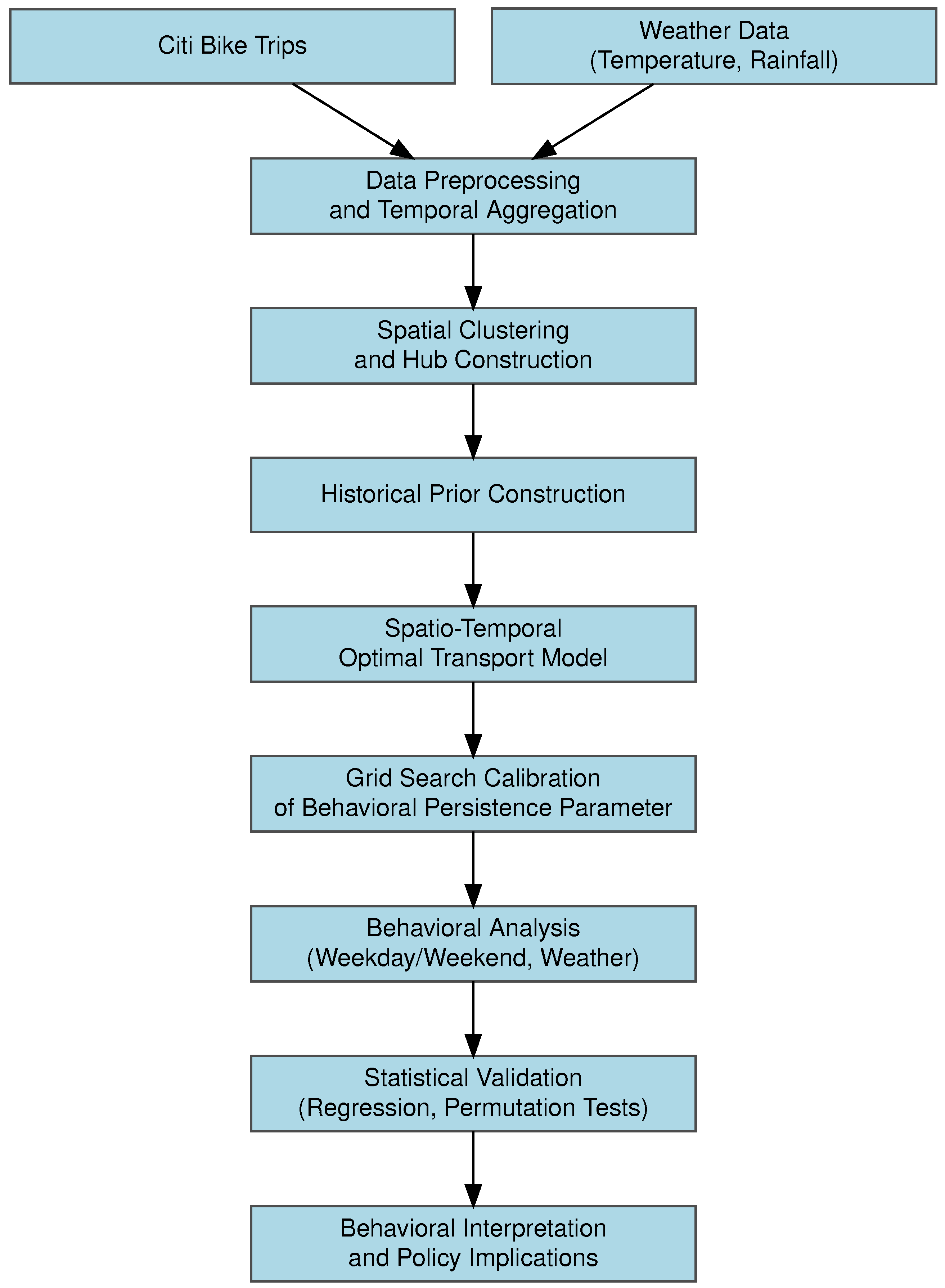
To provide an overview of the proposed framework, Figure 1 summarizes the complete methodological pipeline of the study. Starting from raw bike-sharing and weather data, the framework integrates spatial clustering, temporal aggregation, historical prior construction, spatio-temporal optimal transport calibration, and subsequent behavioral inference and statistical validation. The figure highlights the sequential structure of the proposed ST-OT framework and the interaction between data processing, transport optimization, and behavioral analysis components.

3.2. From Gravity Models to Entropic Optimal Transport

The estimation of spatial interaction flows traditionally relies on the doubly constrained gravity model introduced by Wilson [2]. Given origin masses O = { O i } i = 1 n and destinations D = { D j } j = 1 m , the flow matrix T = { T i j } i n , j m is defined as
T i j = A i O i B j D j exp ( β C i j )
where C i j denotes the generalized travel cost, β is the distance-decay parameter, and A i , B j are balancing factors ensuring marginal constraints.
Wilson’s formulation can be derived from a maximum entropy principle, establishing a direct connection between spatial interaction modeling and statistical physics (Knight [43]). This insight provides the conceptual bridge to modern entropy-regularized OT.
Following the computational formulation introduced by Cuturi [15], we consider the entropy-regularized OT problem:
min P U ( a , b ) P , C ϵ H ( P ) ,
where P is the transport plan, C is the cost matrix, U ( a , b ) is the set of couplings with marginals a , b , and H ( P ) = i j P i j log P i j is the Shannon entropy.
This formulation recovers the gravity model under exponential cost kernels and appropriate marginal constraints, with ϵ playing a role analogous to the inverse distance-decay parameter ( ϵ 1 / β and P i j exp C i j / ϵ ). Moreover, it offers significant computational advantages via the Sinkhorn–Knopp algorithm (Sinkhorn and Knopp [44], Knight [43]), which scales to large networks.
While ϵ is often introduced as a numerical regularization parameter, it admits a behavioral interpretation across multiple theoretical domains. For instance, in statistical physics, ϵ corresponds to temperature, governing the trade-off between energy minimization and disorder (as e.g., in Buffa et al. [42]). In economics, ϵ 1 aligns with cost sensitivity in discrete choice theory, related to the random utility framework of Train and McFadden [22]. In information theory, ϵ controls the divergence from deterministic transport (Peyré and Cuturi [17]).
This multi-faceted interpretation motivates treating ϵ as a latent behavioral state variable, rather than a fixed hyperparameter. In this work, we interpret ϵ primarily as a measure of behavioral persistence, capturing the degree to which mobility deviates from purely cost-minimizing patterns. We estimate ϵ t dynamically, allowing it to reflect temporal shifts in mobility behavior.

3.3. Spatio-Temporal Extension via Time-Expanded Networks

A key limitation of classical OT formulations is the assumption of instantaneous transport. To address this, we extend the problem into a time-expanded state space, a technique closely related to dynamic network flow models and traffic assignment formulations (e.g., Marechal and de Grange [21]).
We define nodes in a spatio-temporal graph as ( i , u ) , where i denotes a spatial zone and u 1 , , T denotes a discrete time step. The transport plan P is now defined over pairs ( ( i , u ) , ( j , v ) ) , representing flows departing from ( i , u ) and arriving at ( j , v ) .
We introduce a composite cost function that jointly penalizes spatial distance and temporal inconsistency:
C ( ( i , u ) , ( j , v ) ) = d i s t ( i , j ) + γ | ( v u ) h i j | if v u if v < u ,
where d i s t ( i , j ) is the network-based travel distance, h i j is the expected travel time, and γ is a scaling factor to bring spatial and temporal costs into a comparable numerical range.
The constraint v u enforces causality, ensuring that flows cannot propagate backward in time. The feasible transport graph is acyclic by construction, as edges exist only from time layer u to v u . Our extension incorporates temporal order-preservation by expanding the state space into a spatio-temporal grid ( i , u ) , where i is a spatial zone and u is a discrete time step. It also captures temporal spill-over effects, allowing flows originating in one time interval to satisfy demand in subsequent intervals—a critical feature in real-world mobility systems.

3.4. Behavior-Aware Transport via Prior Regularization

To incorporate behavioral persistence, we extend the standard OT to its spatio-temporal version, ST-OT, by introducing a reference measure (prior) Q , yielding a KL regularized problem (see, e.g., Cuturi [15]):
min P P , C + ϵ K L ( P Q ) ,
where
K L ( P Q ) = i , u , j , v P ( i , u ) , ( j , v ) log P ( i , u ) , ( j , v ) Q ( i , u ) , ( j , v ) ,
and ( i , u ) and ( j , v ) denote the origin and destination space–time nodes. In the KL-regularized formulation used here, larger values of ϵ t increase the penalty for deviating from the prior, thereby inducing stronger adherence to historical mobility patterns.
The above ST-OT formulation has several important interpretations. It ensures temporal stability, preventing unrealistic deviations from historically observed behavior. It can be viewed as a Bayesian update, where Q encodes prior beliefs about mobility patterns (see Lambert et al. [45]). It connects to Schrödinger bridge problems, which interpret transport as an inference problem under constraints (see Chen et al. [31]).
In contrast to standard entropy regularization (which biases toward uniformity, see Cuturi [15]), KL regularization biases toward behaviorally plausible flows, preserving structural patterns (Chen et al. [31]).
For clarity, Table 1 summarizes the principal notation, parameters, and behavioral indicators used throughout the paper.

3.5. Dynamic Calibration as Behavioral Inference

We model mobility as a sequence of daily ST-OT problems indexed by t = 1 , , T :
P ^ t ( ϵ t ) = arg min P t { P t , C + ϵ t K L ( P t | | Q t ) } ,
where Q t represents the behavioral prior, obtained from historical data, ϵ t is a time-varying behavioral parameter, and C is the ground cost.
Let u , v { 1 , , H } denote hourly time bins and let i , j { 1 , , Z } denote the spatial hubs, where H and Z denote the total number of temporal intervals and spatial units, respectively. For each day t, the optimal transport plan P ^ t R ( Z × H ) × ( Z × H ) is defined as the solution to (1) over the set of admissible transport plans, satisfying the marginal constraints
( j , v ) P ( i , u ) , ( j , v ) , t = a ( i , u ) , t , ( i , u ) P ( i , u ) , ( j , v ) , t = b ( j , v ) , t ,
where a ( i , u ) , t and b ( j , v ) , t define probability distributions for day t over origin and destination space–time nodes ( i , u ) and ( j , v ) , respectively, with
i , u a ( i , u ) , t = j , v b ( j , v ) , t = 1 .
The prior Q t is defined over the same spatio-temporal support and normalized to form a probability distribution, but does not necessarily satisfy the marginal constraints, which are enforced by the optimization.
We estimate ϵ t via grid search, selecting
ϵ t = arg max ϵ t C P C ( P ^ t ( ϵ t ) , P t ) ,
where C P C (Common Part of Commuters) measures overlap between predicted and observed flows ( P t ), which is a standard metric to evaluate mobility flow models (Lenormand et al. [46]). We perform grid search with refinement over an equally spaced range of ϵ t values.
This procedure reframes parameter tuning as behavioral inference, where ϵ t captures the latent degree of behavioral persistence in the system on day t. The resulting sequence ϵ t defines a time series of behavioral persistence indicators, which we interpret as a macroscopic state variable of the urban mobility system.
By analyzing ϵ t , we move beyond prediction toward diagnosing the internal state of the mobility system, identifying regimes of high behavioral persistence (flows closely aligned with historical patterns), cost-efficient regimes (flows primarily driven by travel cost minimization), and externally constrained states (e.g., weather-induced shifts).
This perspective aligns with statistical physics, where phase-transition-like behavior is observed as system parameters vary (e.g., Song et al. [28]; Barthélemy [47]), complex systems theory, where macroscopic patterns emerge from micro-level interactions (e.g., González et al. [9]; González Ramírez et al. [48]), and urban analytics, where behavioral regimes shift across temporal and environmental contexts (e.g., Louail et al. [49]; El Joubari et al. [50]).
We emphasize that this procedure constitutes a calibration step (in the spirit of indirect inference), rather than a structural estimation of ϵ t from a behavioral likelihood. Such formal behavioral estimation framework for ϵ t is left for future research.

4. Data and Preprocessing

This study integrates high-resolution mobility and environmental data to capture both structural and exogenous drivers of urban behavior.

4.1. Bike-Sharing Data and Its Preprocessing

We use trip-level data from the Citi Bike system in New York City, obtained from the official public repository (https://s3.amazonaws.com/tripdata/index.html, accessed on 10 March 2026). The dataset spans January–December 2024 and January–December 2025, containing detailed records of individual trips, including trip start and end timestamps, origin and destination station identifiers, and geographic coordinates of stations.
The 2024 dataset is used to construct behavioral priors ( Q t ), while the 2025 dataset is reserved for model calibration and evaluation, ensuring temporal separation between training and inference.
Raw trip data is subject to several preprocessing steps to ensure consistency and reliability. Trips with missing station IDs, implausible durations (e.g., excessively long), same origin and destination points or incomplete timestamps are discarded. All timestamps are converted to a unified timezone and rounded to the nearest minute. Trips exceeding a predefined upper bound (5 h) or outside of the considered time interval (7 a.m.–11 a.m.) were excluded from the analysis. These steps ensure that the resulting dataset reflects typical user behavior in the considered time span.

4.1.1. Spatial Aggregation: Construction of Virtual Hubs

Direct modeling at the station level leads to high-dimensional and sparse O–D matrices. To address this, we aggregate stations into a reduced set of virtual hubs, representing coherent urban neighborhoods.
We adopt a two-stage clustering strategy designed to balance computational tractability with geographic realism:
  • Pre-clustering (Euclidean space). On this stage, the stations are first grouped using k-means clustering with k = 100 , reducing the dimensionality while preserving spatial coverage.
  • Network-aware clustering (mobility space). To incorporate actual travel constraints, we compute pairwise cycling distances between cluster centroids using the Open Source Routing Machine (https://router.project-osrm.org/, accessed on 10 March 2026). Based on this network distance matrix, we apply the Partitioning Around Medoids (PAM) algorithm to obtain the final clusters (Kaufman and Rousseeuw [51]; Park and Jun [52]).
This procedure yields clusters that respect physical barriers (e.g., rivers, bridges), reflect true cycling accessibility rather than Euclidean proximity, and produce balanced and interpretable neighborhoods.
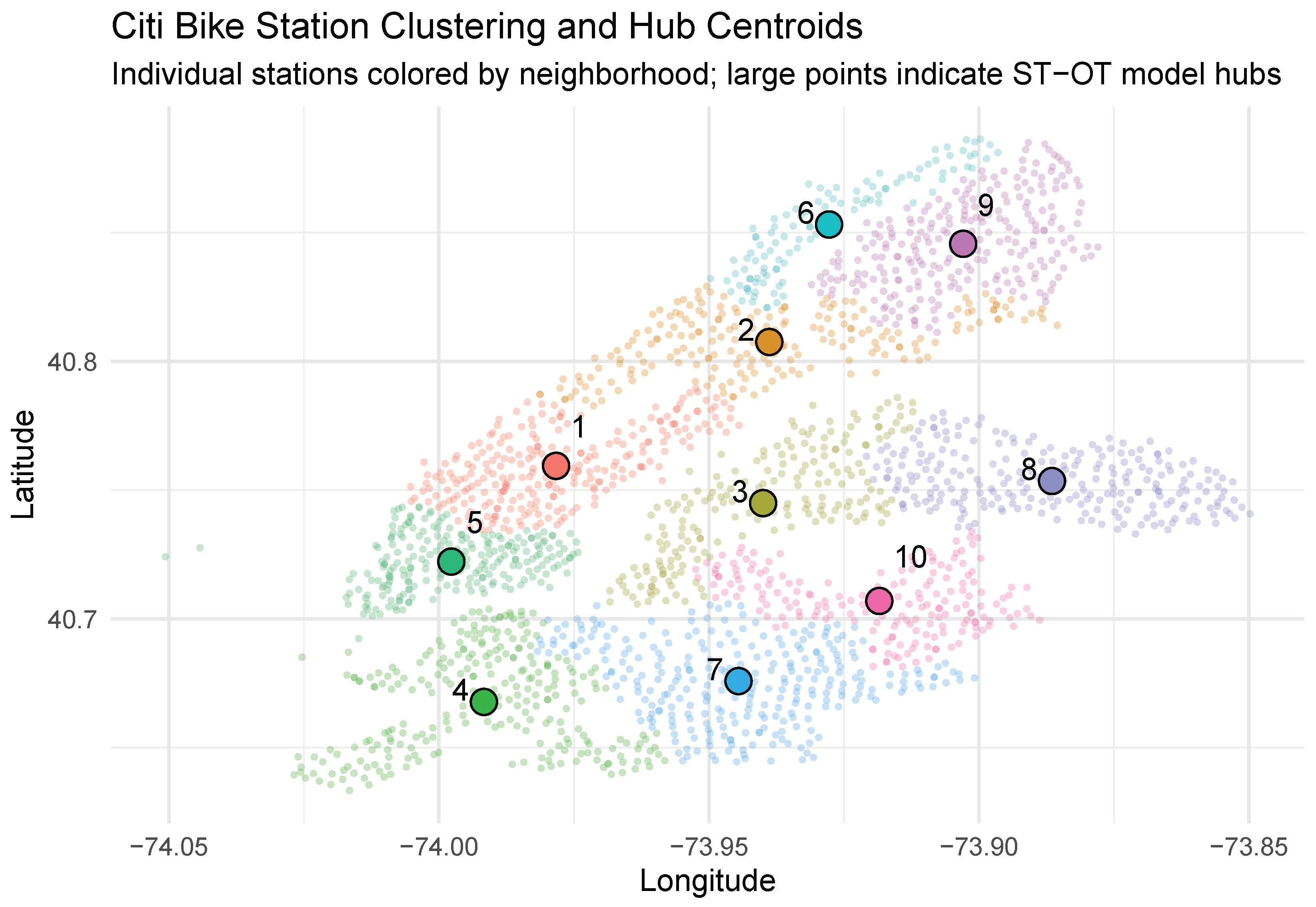
The final system consists of Z = 10 virtual hubs illustrated in Figure 2, forming the spatial units of the O–D matrices. The number of hubs (10) was selected to balance spatial resolution and computational tractability. The traveling distances between these hubs build the basis for the ground cost matrix C in (1).
Since spatial aggregation introduces a known bias, where intrazonal flows ( i = j ) are artificially assigned zero cost, we conduct an intrazonal cost adjustment by introducing a nearest-neighbor heuristic (Venigalla et al. [53]):
d i i = 0.5 · min j i ( d i j ) .
This adjustment approximates the expected travel distance within a zone by assuming that trips originate near the center and terminate near the boundary (or vice versa). This correction prevents self-loop dominance in the transport plan and ensures that the temporal penalty term remains active for intrazonal trips.

4.1.2. Temporal Aggregation

Trips are aggregated into discrete hourly intervals, constructing time-indexed O–D matrices. Formally, let u , v 1 , , H denote hourly time bins and let i , j { 1 , Z } denote spatial units. For each day t, we define the observed flow P t R ( Z × H ) × ( Z × H ) with entries P ( i , u ) , ( j , v ) , t computed as the number of trips departing from zone i in hour u and arriving in zone j in hour v .
To focus on structurally comparable dynamics, the analysis is restricted to the morning peak window (07:00–11:00, H = 5 ), which captures high demand intensity, strong commuter regularity as well as sensitivity to external disruptions. We note that restricting the analysis to the morning peak window excludes a small number of trips that extend beyond the boundary. However, given the short duration of bike-sharing trips, such effects are limited and do not materially affect the comparative behavioral analysis. A systematic sensitivity analysis with respect to the time window is left for future work.
This temporal aggregation aligns naturally with the ST-OT formulation, where flows can propagate across adjacent time steps.

4.1.3. Construction of Behavioral Priors

A central component of the proposed framework is the prior distribution Q t in (1), representing historical mobility tendencies. We use the following estimation procedure to obtain the priors.
For each combination of month m and weekday w, we compute an empirical O–D distribution:
Q ^ m , w = 1 | D m , w | t D m , w P t ,
where D m , w denotes all days in 2024 corresponding to month m and weekday w.
To obtain a valid reference measure for the KL-regularized formulation, the aggregated matrix is normalized to define a probability distribution over the spatio-temporal support:
Q ^ m , w Q ^ m , w ( i , u ) , ( j , v ) Q ^ ( i , u ) , ( j , v ) , m , w .
For each day t in 2025, the prior is then selected as Q t = Q ^ m ( t ) , w ( t ) , thereby constructing a library of priors indexed by seasonal (monthly) and weekly patterns.
The resulting prior Q ^ t can be interpreted as a behavioral baseline, encoding persistent mobility structures such as habitual commuting corridors, recurring spatial interactions, and typical temporal propagation patterns. Conditioning on both month and weekday allows the prior to capture systematic temporal heterogeneity while averaging out day-specific noise, thereby balancing statistical robustness with behavioral specificity.

4.2. Weather Data

To account for environmental effects, we incorporate daily weather observations from the National Oceanic and Atmospheric Administration (https://www.ncei.noaa.gov/access/search/data-search/daily-summaries, accessed on 12 March 2026), including daily minimum and maximum temperature, and total precipitation recorded in the same time period in the New York Central Park weather station.
To analyze the effects of ambient weather, we use precipitation amount and average temperature, computed as the average between the maximum and the minimum day temperature.
Moreover, to isolate environmental effects on mobility behavior, weather variables are discretized into interpretable regimes:
  • Precipitation: binary indicator (Rainy vs. Clear),
  • Temperature: categorical bins (three equal-frequency regimes: Cold, Moderate, Warm).
This discretization enables non-parametric comparisons (e.g., violin plots), interaction analysis (e.g., Weekend · Rain), and interpretable behavioral segmentation.
Weather variables are aligned temporally with the mobility data and later used to stratify behavioral regimes.

5. Results

In this section, we present the results of our analysis. We, first, check the goodness of fit of our model. Next, we explore the calibrated behavioral persistence ϵ t for different social and weather induced regimes constituting behavioral dynamics. We, then, conduct statistical inference on the underlying dependence structure.
To avoid ambiguity in terminology, we explicitly distinguish between four related but conceptually separate notions used throughout the paper.
  • Behavioral persistence refers to the calibrated parameter ϵ t , which governs the degree of adherence to historical mobility patterns encoded in the prior.
  • Behavioral entropy refers to the Shannon entropy of the prior distribution H ( Q t ) , capturing the intrinsic structural uncertainty of historically observed mobility patterns.
  • Behavioral variability refers to the dispersion observed in realized origin–destination flows P t .
  • Behavioral flexibility is used as an interpretive aggregate notion describing the joint effect of structural entropy and behavioral persistence, rather than a separately estimated quantity.
In the remainder of the paper, we use these terms consistently according to these definitions.

5.1. Model Fit

Since we analyze the calibrated entropic parameter ϵ t obtained from our ST-OT model, it is necessary to evaluate the model fit to ensure that the model provides an adequate representation of the observed data.
To assess the model fit, we employ commonly used evaluation metrics for flow models, namely the Common Part of Commuters (CPC) and the Mean Absolute Error (MAE) (Lenormand et al. [46]; Atwal et al. [54]).
We consider 10 neighborhood hubs and 5 h of trips (7 a.m.–11 a.m.), resulting in a total of N = 5 × 10 = 50 O-D hour pairs. Consequently, the dynamic O-D matrix has dimension ( 50 × 50 ) .
For each day, indexed by t, we compare the estimated O-D matrix with the ground-truth matrix computed from the observed data. The evaluation metrics are defined on a per-day basis (t) as follows:
  • CPC:
    C P C t = 2 ( i , u ) , ( j , v ) min ( P ( i , u ) , ( j , v ) , t , P ^ ( i , u ) , ( j , v ) , t ( ϵ t ) ) ( i , u ) , ( j , v ) P ( i , u ) , ( j , v ) , t + ( i , u ) , ( j , v ) P ^ ( i , u ) , ( j , v ) , t ( ϵ t ) ,
    where P ( i , u ) , ( j , v ) , t denotes the observed number of trips departing from zone i in hour v and arriving in zone j in hour v in day t, and P ^ ( i , u ) , ( j , v ) , t ( ϵ t ) denotes the respective estimated flow at t, computed using the calibrated value of the entropy parameter.
  • MAE:
    M A E t = 1 ( Z H ) 2 ( i , u ) , ( j , v ) P ( i , u ) , ( j , v ) , t P ^ ( i , u ) , ( j , v ) , t ( ϵ t ) .
The resulting statistics over all days t are presented in Table 2.
Note that the adopted CPC and MAE formalize reconstruction accuracy metrics, not a behavioral regularity score, and therefore naturally vary with regime complexity.
Overall, the results indicate a good model fit, which is slightly better for weekdays, possibly due to their more predictable nature. Considering the high values of the goodness-of-fit criteria reported above, we conclude that the model adequately captures the structural and behavioral characteristics of the network under study.

5.2. Behavioral Dynamics

We proceed by analyzing the temporal evolution of the entropy of the estimated historical priors Q ^ t , which we interpret as a measure of structural variability in the urban mobility network. We distinguish between structural entropy, captured by H ( Q ^ t ) , and behavioral persistence, captured by the calibrated parameter ϵ t . While the former reflects the intrinsic diversity of historically observed mobility patterns, the latter quantifies the extent to which realized flows deviate from or adhere to these patterns under current conditions.
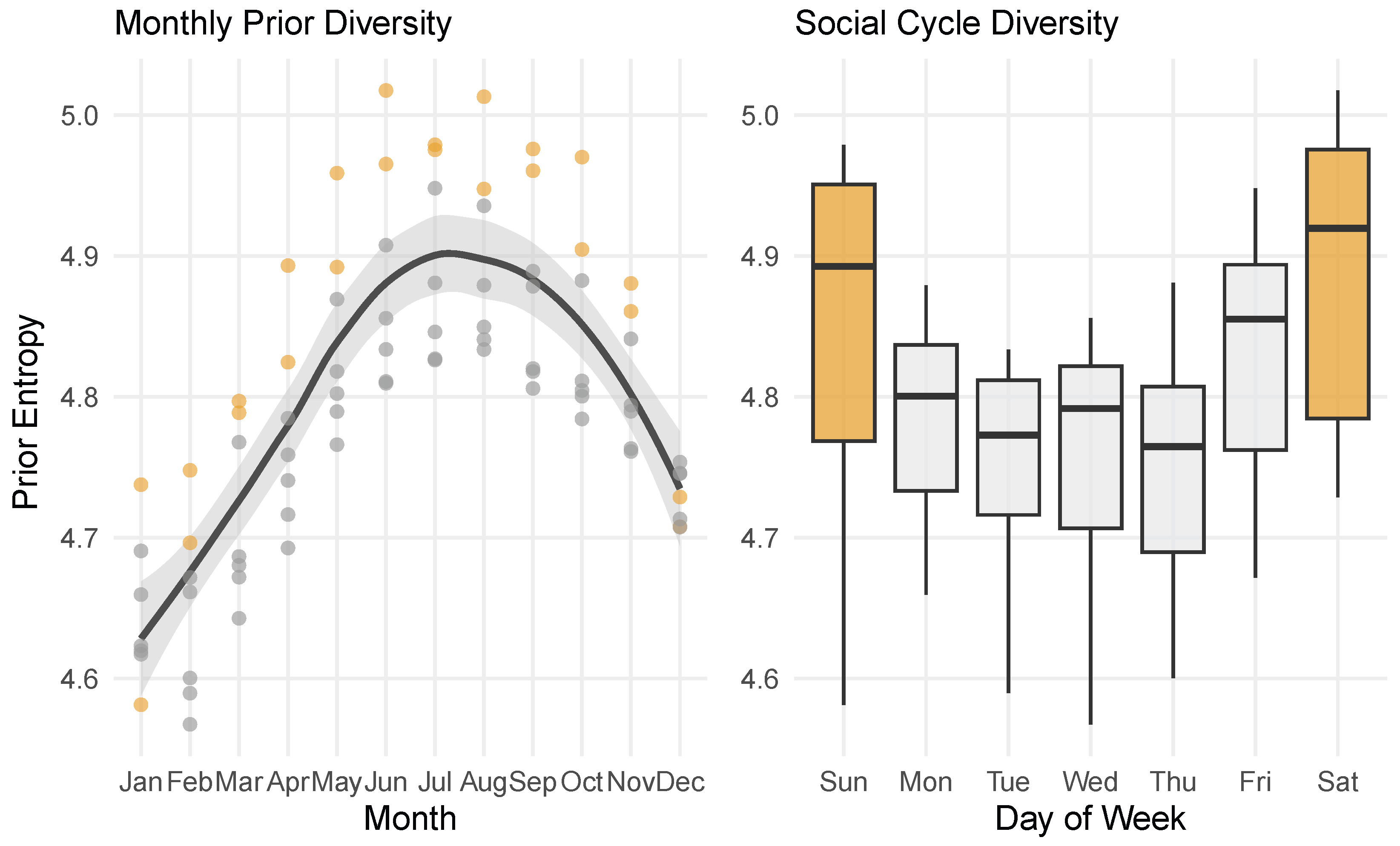
As illustrated in Figure 3, the entropy H ( Q ^ t ) exhibits a clear seasonal pattern across both months of the year and days of the week. Higher entropy, indicating more exploratory and less predictable mobility patterns, is observed during the spring and summer months, as well as on weekends.
This suggests that periods in which both the prior entropy H ( Q ^ t ) and the calibrated behavioral persistence ϵ t are high correspond to high-entropy mobility regimes, characterized by exploratory and less constrained behavior. Conversely, low prior entropy combined with low ϵ t corresponds to more structured, cost-driven behavior. Intermediate regimes arise when high and low levels of entropy and behavioral persistence interact.
Next, we examine the temporal evolution of the calibrated behavioral persistence parameter ϵ t . While the presented ϵ t is selected by maximizing CPC, we assess the robustness of this calibration to the choice of evaluation metric. In particular, we repeat the procedure using MAE as the objective. The resulting estimates are highly consistent across the two criteria, with near-identical temporal patterns and regime distinctions. This indicates that the inferred behavioral dynamics are not driven by a specific goodness-of-fit measure, but reflect stable features of the data. Bootstrap-based sensitivity diagnostics further indicate that the estimated behavioral persistence parameter remains stable under moderate perturbations of the trip data. The details are given in Appendix A.
Although ϵ t is estimated via a data-driven calibration procedure, its temporal stability and systematic response to exogenous covariates suggest that it captures structured behavioral variation rather than model misspecification. Moreover, note that ϵ t is estimated conditional on regime-specific priors Q ^ t , and therefore reflects behavioral adherence relative to the corresponding baseline rather than differences between weekday and weekend priors.
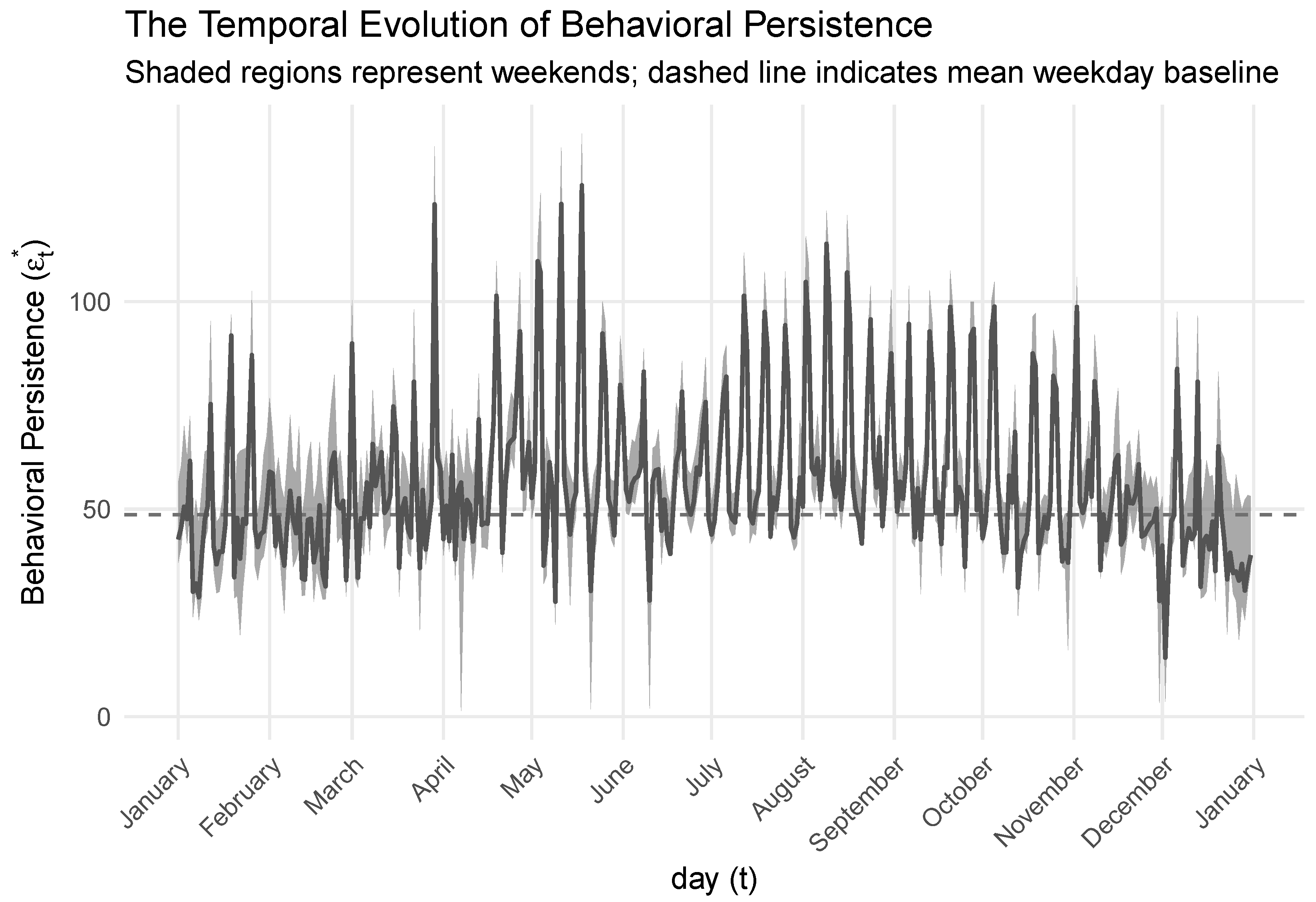
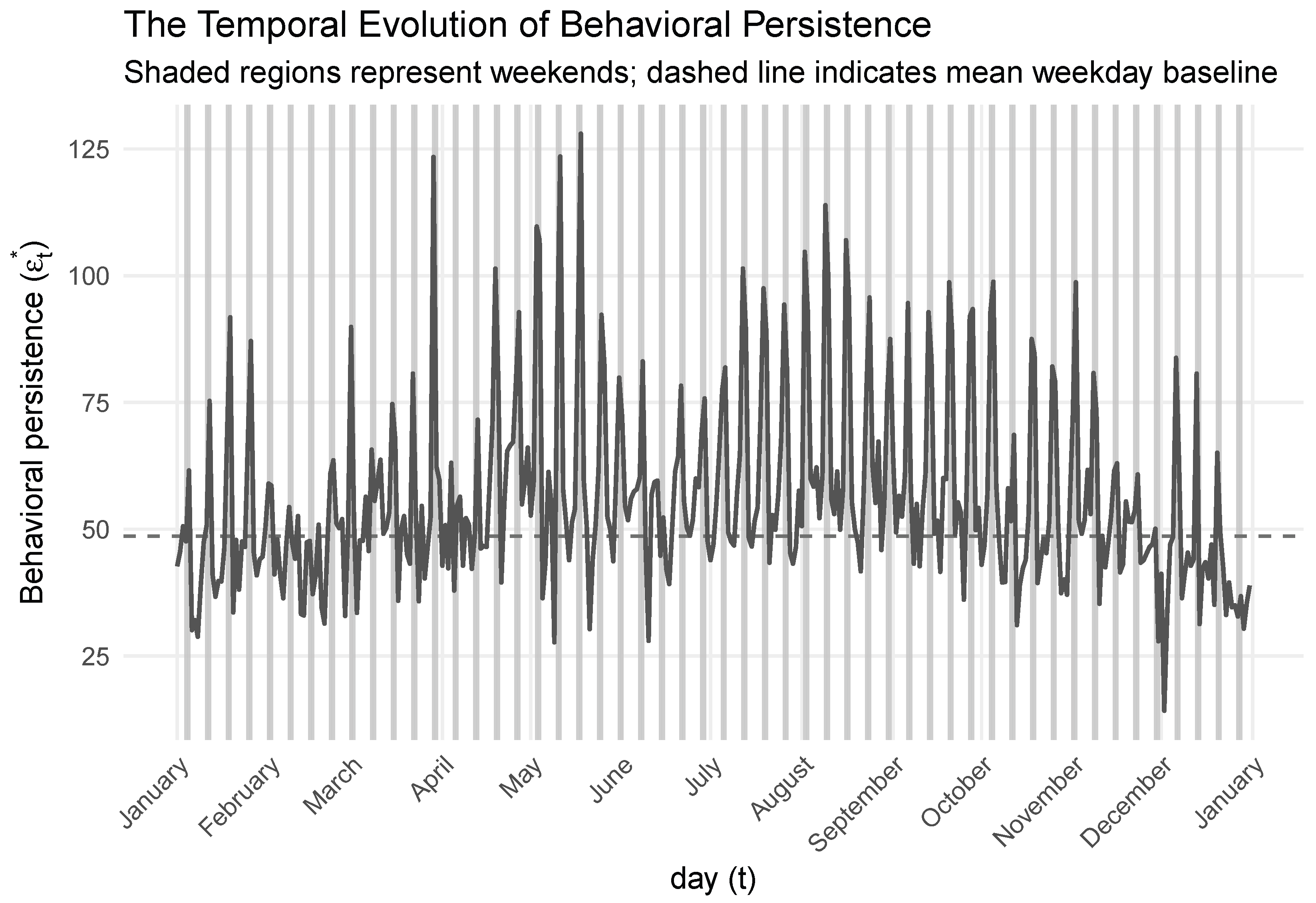
Over the 2025 observation period, ϵ t exhibits pronounced temporal structure, with clear periodic patterns aligned with both seasonal and weekly cycles (Figure 4).
The longitudinal trajectory of the calibrated behavioral persistence parameter ( ϵ t ) in Figure 4 highlights the rhythmic expansion and contraction of the effective behavioral space. While the weekday baseline remains consistent near the optimal trips cost structure, the weekend peaks represent a systematic shift toward stronger behavioral persistence, which is particulary sensitive to meteorological conditions (as discussed below).
Two dominant regimes emerge:
  • Cost-sensitive regime: characterized by consistently low ϵ t values, indicating that flows are primarily governed by travel cost, with limited influence of the prior.
  • Prior-adherent regime: marked by elevated ϵ t values, indicating reduced sensitivity to instantaneous travel cost and stronger adherence to historical mobility patterns.
This bimodal structure provides empirical evidence for the existence of distinct behavioral regimes in urban mobility.
During weekdays (lower ϵ t ), mobility patterns are predominantly efficiency-driven: individuals tend to select cost-optimal routes under time constraints, and the influence of historical priors is comparatively weak. In contrast, weekends (higher ϵ t ) are characterized by more discretionary, leisure-oriented behavior, where mobility patterns exhibit stronger adherence to habitual destinations such as parks, recreational areas, or specific neighborhoods in the considered time intervall 7 a.m.–11 a.m.
In terms of the interaction between prior entropy and behavioral persistence, the following combinations arise:
  • High H ( Q t ) + high ϵ t : strong adherence to dispersed (structurally diverse) priors;
  • Low H ( Q t ) + high ϵ t : strong adherence to more structured priors;
  • High H ( Q t ) + low ϵ t : weak adherence to dispersed priors;
  • Low H ( Q t ) + low ϵ t : weak adherence to more structured priors.
This decomposition highlights that exploration is not solely captured by ϵ t , but emerges from the joint state of prior variability and behavioral persistence.
Overall, this structure suggests that weekdays, typically associated with low ϵ t and lower H ( Q ^ t ) , correspond to more cost-efficient and structured mobility regimes with reduced reliance on prior behavior. Conversely, weekends, often characterized by higher ϵ t and higher H ( Q ^ t ) , reflect more exploratory and prior-driven mobility patterns, leading to higher-entropy system states.

5.2.1. Weekday–Weekend Comparison

To quantify differences between social (weekday vs. weekend) regimes, we compare the distribution of ϵ t across these two groups.
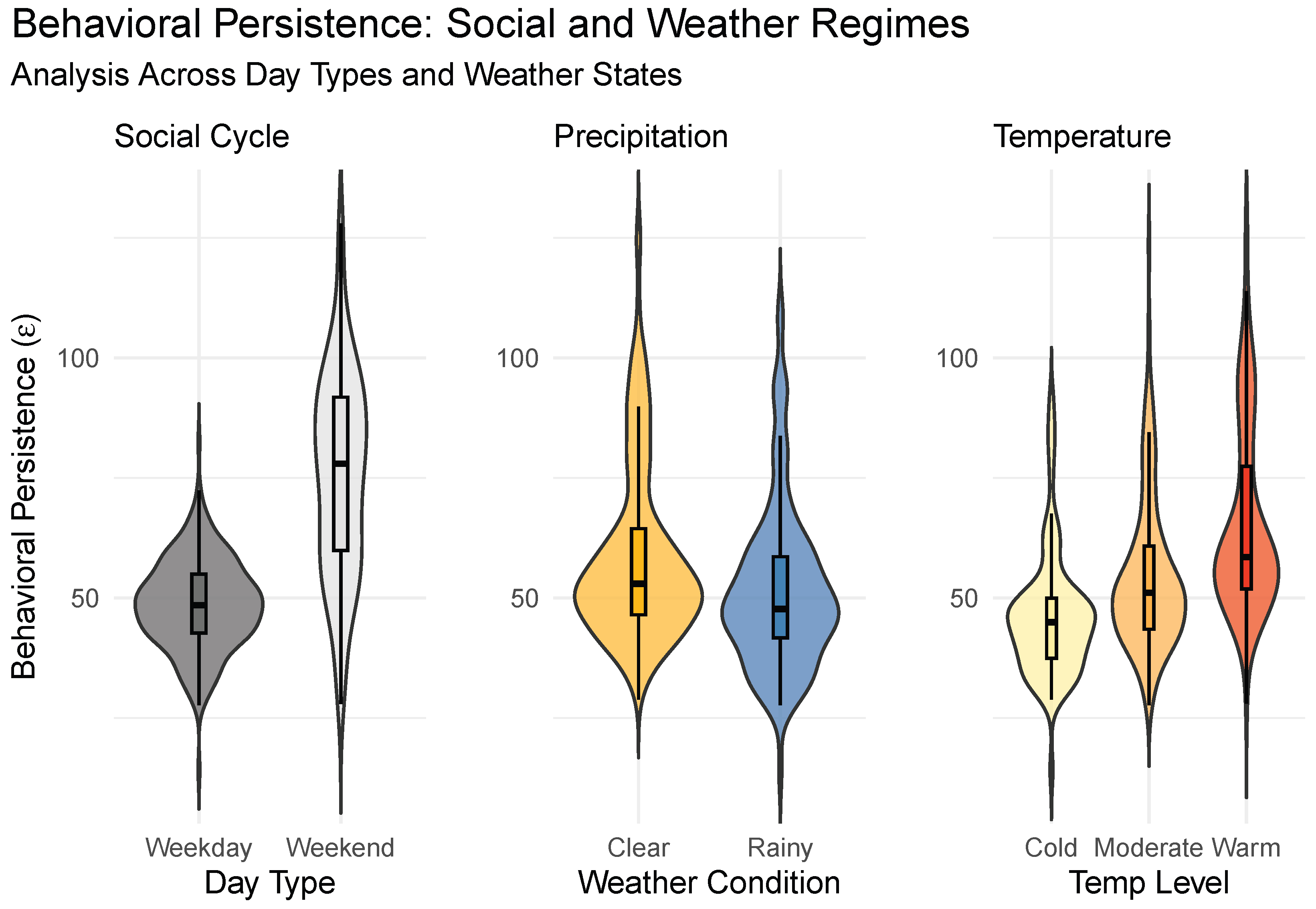
The results reveal a clear and statistically significant upward shift in ϵ t during weekends, indicating a transition from structured commuter behavior to more exploratory and prior-driven travel patterns. This shift is visible not only in mean values but also in distributional characteristics:
  • Weekdays: narrow, low-variance distributions, indicating stable and predictable routing behavior.
  • Weekends: wider, more dispersed distributions with heavier tails, indicating increased behavioral heterogeneity in trip patterns.
This phenomenon, illustrated by the violin plot in the left panel of Figure 5, is consistent with a phase-transition-like shift between behavioral regimes, whereby the system moves between a cost-dominated commuter regime and a more flexible, discretionary mobility regime driven by social context.

5.2.2. Weather-Induced Modulation

We next examine the effect of weather conditions, focusing on precipitation and temperature as exogenous shocks.
The analysis reveals a downward shift in ϵ t on rainy days (middle panel in Figure 5), indicating a shift toward more cost-dominated and less behaviorally flexible mobility patterns. From a behavioral perspective, this is consistent with the selective suppression of discretionary trips, leaving primarily essential, utility-driven journeys. Temperature regimes (cold, moderate, and warm) exhibit the opposite effect (right panel in Figure 5), with higher temperatures associated with increased ϵ t .
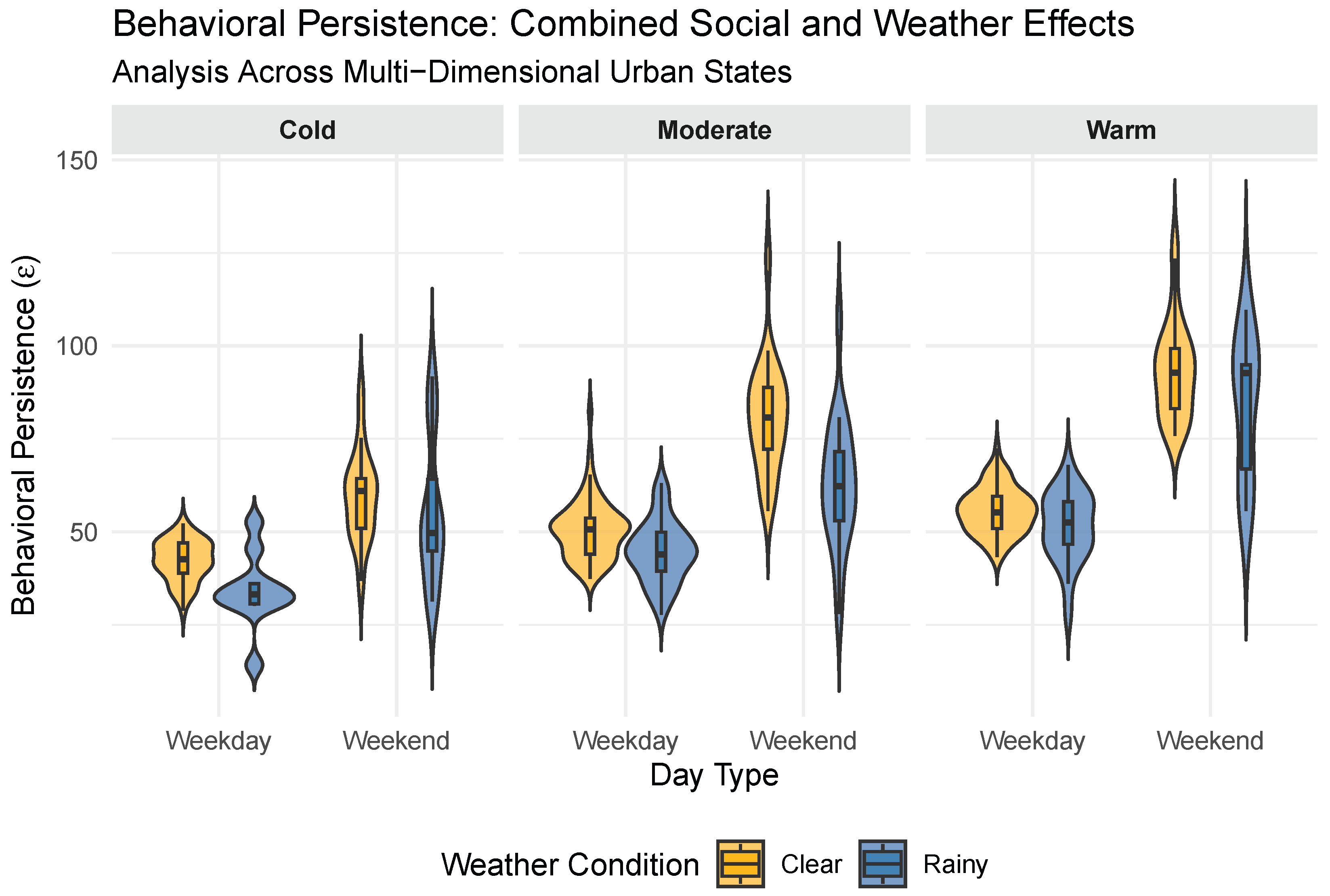
This effect is particularly pronounced during weekends, as shown in Figure 6, where high-entropy leisure activity appears most sensitive to disruption (in the considered time intervall 7 a.m.–11 a.m.). Notably, the magnitude of the shift is asymmetric and depends on the temperature regime.
To further explore environmental influences, we analyze ϵ t across temperature categories. The results suggest a positive association between temperature and behavioral persistence. This pattern is consistent with the existence of a behavioral “comfort regime,” in which favorable environmental conditions increase the diversity of mobility choices. Outside this range, individuals appear to prioritize minimizing exposure, leading to more constrained and predictable flows.
Figure 6 highlights a clear asymmetry between weekday and weekend behavior. Across all temperature regimes (cold, moderate, warm), weekday distributions remain consistently narrow and stable, indicating that commuting patterns are largely invariant to environmental conditions. The low ϵ t values suggest that travelers prioritize cost-efficient trajectories, while the limited dispersion reflects high predictability.
In contrast, weekend mobility exhibits stronger environmental sensitivity. Higher values of ϵ t across all regimes indicate that weekend mobility is more influenced by the prior than weekday commuting patterns. As temperature increases, the entire weekend distribution shifts upward, suggesting that environmental conditions systematically amplify behavioral variability.
Conversely, in cold or adverse weather conditions, behavioral persistence decreases, indicating a contraction of habitual, discretionary movement patterns. This suggests that environmental sensitivity is state-dependent, with behavioral flexibility acting as a mediating mechanism.
From a systems perspective, these findings suggest that urban mobility operates across distinct dynamical regimes, with weekends exhibiting higher responsiveness (and thus greater volatility) to external shocks, as reflected in the variability of ϵ t .

5.3. Statistical Validation

We now validate the results statistically using rank-based and permutation tests for the weekend effect, as well as regression-based inference on the joint effects of social and weather variables.

5.3.1. Distributional Testing

To formally assess differences between weekday and weekend ϵ t distributions, we employ the Wilcoxon–Mann–Whitney test (Siegel and Castellan Jr. [55]), which is robust to non-normality and tests for differences in central tendencies. The null hypothesis of identical distributions is rejected ( p < 0.01 ), indicating a statistically significant shift in ϵ t . A complementary permutation test (Good [56]) yields consistent results ( p < 0.01 ), reinforcing the robustness of this finding.

5.3.2. Regression Analysis

To control for confounding factors, we estimate the following linear model:
ϵ t = β 0 + β 1 Weekend t + β 2 Rain t + β 3 Temp t + β 4 ( Weekend t · Rain t ) + β 5 ( Weekend t · Temp t ) + β C C t + ε t .
Here, Weekend t is a binary indicator, Rain t denotes precipitation amount (in mm), and Temp t denotes temperature (in °C) on day t. The vector C t collects additional control variables, including the standardized entropy of the prior distribution Q t and seasonal (monthly and weekday-based) fixed effects. The disturbance term ε t captures unobserved factors. Given the time-series nature of ϵ t , we account for potential serial dependence and heteroscedasticity by computing heteroscedasticity- and autocorrelation-consistent (HAC) standard errors (Newey and West [57]), which are used to derive the reported p-values.
Note that ϵ t and H ( Q ^ t ) are deterministic functionals of the observed mobility data constructed via a fixed calibration pipeline; the regression is therefore interpreted as an associational analysis across time rather than a two-stage generated regressor framework.
The model exhibits substantial explanatory power ( R 2 = 0.73 ), with the joint significance of regressors confirmed by an F-test ( p < 0.01 ). The estimation results (Table 3) indicate the following:
  • A strong and significant weekend effect ( β 1 > 0 , p < 0.01 );
  • A negative precipitation effect ( β 2 < 0 , p < 0.01 );
  • A significant interaction between weekend and temperature ( β 5 > 0 , p < 0.01 ) indicates that the effect of temperature on behavioral persistence is amplified during weekends. In contrast, the interaction between weekend and precipitation ( β 4 ) is not statistically significant, providing no evidence of a differential precipitation effect across weekdays and weekends.
The magnitude and significance of the weekend coefficient suggest that social structure is the dominant explanatory factor, while environmental variables act as modulators. The weekend effect ( β 1 ) can be interpreted as reflecting a shift in the implicit valuation of time: on weekdays, time is treated as a constrained resource, consistent with lower values of ϵ t , whereas weekends exhibit greater temporal flexibility and higher behavioral persistence.
Environmental conditions, captured by β 2 and β 3 , act as behavioral filters that constrain mobility under adverse conditions. Among the interaction terms, only the weekend–temperature interaction ( β 5 ) is statistically significant, revealing regime-dependent heterogeneity in the response to temperature. This indicates that weekend mobility is significantly more responsive to environmental variation than weekday commuting patterns, while no differential precipitation effect is supported. This highlights the state-dependent nature of behavioral flexibility, with discretionary mobility exhibiting greater elasticity to external conditions.
The estimated coefficients should be interpreted as associational effects on the inferred behavioral state. In this context, β 1 captures systematic differences in ϵ t between weekdays and weekends, while β 2 and β 3 quantify how ϵ t co-varies with weather conditions. Interaction terms capture heterogeneity in these associations across temporal regimes.

5.4. Behavioral Interpretation and System-Level Insights

Our interaction analysis (Figure 6) indicates that ϵ t is not a static calibration parameter but a time-varying quantity capturing regime shifts in urban mobility behavior.
Synthesizing the results, we identify three key behavioral dimensions:
  • Exploration–optimization trade-off: Variation in ϵ t captures the balance between prior-driven and cost-minimizing behavior, providing a quantitative measure of urban movement preferences.
  • Resilience: The relative stability of ϵ t during weekdays suggests that commuting patterns are robust to moderate environmental shocks.
  • Elasticity: More pronounced reductions in behavioral persistence under adverse weather conditions on weekends, relative to weekdays, reflect a contraction of discretionary mobility, indicating that such trips are highly sensitive to external conditions.
These behavioral effects have implications for mobility management and system design, suggesting distinct strategies across high- and low-variability periods.
The regression results in Equation (2), reported in Table 3, provide a decomposition of these effects. The dominance of the weekend indicator ( β 1 ) suggests that temporal social structure is the primary determinant of regime shifts. The significant interaction between weekend and temperature ( β 5 ) highlights a context-dependent environmental modulation of discretionary mobility: favorable conditions amplify behavioral persistence, whereas adverse conditions shift behavior toward a more constrained, cost-dominated baseline.
Overall, these findings indicate that the mobility system exhibits regime-dependent contraction and expansion around a structural baseline governed by the interplay between social timing and environmental constraints. In this sense, ϵ t functions as an indicator of behavioral regime, enabling adaptive and context-aware modeling of urban mobility dynamics.

5.5. Summary of the Findings and Policy Implications

This study integrates behavioral inference into a spatio-temporal O–D modeling framework. By embedding KL-regularized optimal transport into a spatio-temporal framework and dynamically calibrating the regularization parameter ( ϵ t ), we uncover several consistent and statistically robust patterns in urban mobility:
  • Behavioral regimes (prior-driven versus cost-dominated): The calibrated behavioral persistence parameter ϵ t identifies distinct mobility regimes. Weekdays are characterized by a commuter-driven regime with stable and cost-efficient flow structures, whereas weekends correspond to a more discretionary regime with higher behavioral variability and stronger adherence to historical mobility patterns (behavioral priors).
  • Weather-induced shifts: Adverse weather conditions, in particular precipitation and low temperatures, are associated with a systematic reduction in ϵ t . This effect is modest on weekdays, consistent with necessity-driven commuting behavior, but substantially stronger on weekends, reflecting a contraction of discretionary travel. In this sense, environmental conditions are consistent with acting as behavioral filters that selectively reduce discretionary mobility.
  • State-dependent sensitivity to external shocks: Interaction effects indicate that the impact of environmental conditions is conditional on the temporal regime (weekday vs weekend). Weekend mobility exhibits significantly higher sensitivity to temperature fluctuations.
From an operational perspective, these findings suggest that static bike-sharing rebalancing strategies may be sub-optimal under dynamic behavioral regimes. Monitoring ϵ t enables adaptive system control by distinguishing between commuter-dominated corridors and discretionary mobility patterns (cf. Schuijbroek et al. [58]). Moreover, the observed weather-induced regime shifts imply that rebalancing intensity can be dynamically adjusted in response to exogenous conditions, potentially reducing operational costs while maintaining service levels (cf. Eren and Uz [59]). Overall, ϵ t provides a dynamic behavioral state indicator that supports context-aware mobility system management.

6. Conclusions

This paper introduces a spatio-temporal optimal transport (ST-OT) framework for modeling urban mobility that extends classical spatial interaction models by incorporating temporal structure and behavioral priors. The framework provides a unified probabilistic formulation that jointly represents spatial flows, temporal dynamics, and behavioral heterogeneity within a single optimization setting.
A central conceptual contribution is the reinterpretation of the KL-divergence regularization parameter as a time-varying behavioral indicator. Rather than serving solely as a calibration constant, this parameter is dynamically estimated and used to infer latent behavioral structure in urban mobility systems. This allows the model to move beyond prediction and toward behavioral interpretation of mobility regimes.
Empirically, analysis of bike-sharing data reveals robust and statistically significant behavioral regimes driven by social and environmental factors. We identify a clear separation between cost-dominated commuting behavior during weekdays and more prior-driven, discretionary mobility during weekends. This transition is reflected in systematic shifts in the calibrated behavioral persistence parameter. In addition, weather conditions, particularly precipitation and temperature, act as external constraints that modulate behavioral variability, reducing mobility flexibility under adverse conditions. Together, these results provide both quantitative evidence and qualitative interpretation of regime-dependent mobility behavior. While the empirical analysis is based on a single-city case study (New York City), the proposed ST-OT framework is fully general and can be applied to other urban mobility systems given comparable data availability.
From a methodological perspective, the proposed framework bridges optimal transport theory and behavioral inference in a consistent probabilistic structure. This integration enables a coherent interpretation of how spatial costs, temporal ordering, and behavioral persistence jointly shape observed mobility flows.
Despite these contributions, several limitations suggest directions for future research. First, the current estimation strategy relies on goodness-of-fit based calibration of the behavioral parameter. Future work could embed the model in a likelihood-based or Bayesian inference framework, enabling formal uncertainty quantification and statistical identification of behavioral persistence.
Second, the discretization of time into fixed hourly windows, while computationally convenient and consistent with standard mobility reporting practices, may introduce boundary effects for trips that span multiple intervals. Similarly, the restriction to a morning peak window (07:00–11:00) focuses the analysis on commuting behavior but does not fully capture cross-window or full-day mobility dynamics. Addressing these limitations through continuous-time formulations or adaptive temporal binning would allow for a more faithful representation of temporal continuity in travel behavior.
Third, future extensions could explicitly model cross-window coupling and multi-scale temporal dependencies, improving the representation of long-duration trips and system-wide temporal interactions. In addition, a more formal analysis of the dynamical properties of the inferred behavioral parameter—such as stability, regime transitions, and nonlinear dependencies—would strengthen the connection to complex systems theory.
Finally, integrating the calibrated behavioral persistence parameter into generative trip production and simulation models represents an important applied extension of this work, with direct relevance for forecasting and operational mobility system management.

Author Contributions

Conceptualization, M.O.; Methodology, M.O. and F.M.; Software, F.M.; Validation, M.O. and F.M.; Formal analysis, F.M.; Investigation, M.O. and F.M.; Data curation, F.M.; Writing—original draft, M.O. and F.M.; Writing—review & editing, M.O. and F.M.; Visualization, M.O.; Supervision, M.O.; Project administration, M.O. All authors have read and agreed to the published version of the manuscript.

Funding

This research received no external funding.

Institutional Review Board Statement

Not applicable.

Informed Consent Statement

Not applicable.

Data Availability Statement

The data presented in this study are openly available in https://github.com/omanya/Behavioral_ST-OT/, accessed on 20 April 2026.

Conflicts of Interest

The author declare no conflict of interest.

Appendix A

This appendix presents additional analyses to assess the robustness of the main findings with respect to the calibration procedure and sampling variability.
First, we examine the sensitivity of the calibrated behavioral persistence parameter ϵ t to the choice of calibration metric. In the baseline specification, ϵ t is selected by maximizing the CPC criterion. As a robustness check, we repeat the calibration using MAE as an alternative objective function, yielding the alternative series ϵ t , M A E . The resulting estimates are highly consistent with the baseline calibration, with a correlation coefficient of 0.9906, indicating that the inferred behavioral dynamics are not driven by the specific choice of calibration metric.
Second, we assess the stability of the calibrated parameter using bootstrap resampling of observed trips. For each bootstrap replication, the complete calibration pipeline is repeated and ϵ t is re-estimated. Due to the computational cost associated with repeatedly solving the spatio-temporal optimal transport problem, we employ a moderate number of bootstrap replications ( B = 100 ). The bootstrap analysis is therefore intended primarily as a sensitivity and stability assessment rather than as a high-precision inferential procedure.
Figure A1. Comparison of alternative calibrations and bootstrap uncertainty for the behavioral persistence parameter ϵ t . The figure shows percentile-based 95% bootstrap confidence intervals obtained from trip-level resampling.
Futuretransp 06 00110 g0a1
The resulting confidence intervals are shown in Figure A1. Overall, the bootstrap intervals remain comparatively narrow relative to the temporal variation in ϵ t , suggesting that the inferred behavioral regimes are stable with respect to moderate perturbations of the observed mobility data. Taken together, these results support the robustness of the main findings to both the calibration criterion and sampling variability.

References

  1. Burgalat, J.; Pallares, G.; Foucras, M.; Dupuis, Y. A Literature Review of Public Transport OD Matrix Estimation. Future Transp. 2026, 6, 45. [Google Scholar] [CrossRef]
  2. Wilson, A.G. A Statistical Theory of Spatial Distribution Models. Transp. Res. 1967, 1, 253–269. [Google Scholar] [CrossRef]
  3. Kane, L.; Behrens, R. Transport Planning Models—An Historical And Critical Review. In Proceedings of the Annual South African Transport Conference, Pretoria, South Africa, 15–19 July 2002. [Google Scholar]
  4. Cascetta, E. Transportation Systems Analysis: Models and Applications; Springer Optimization and Its Applications; Springer: Boston, MA, USA, 2009; Volume 29. [Google Scholar] [CrossRef]
  5. Simini, F.; González, M.C.; Maritan, A.; Barabási, A.L. A Universal Model for Mobility and Migration Patterns. Nature 2012, 484, 96–100. [Google Scholar] [CrossRef]
  6. Tsekeris, T.; Stathopoulos, A. Gravity Models for Dynamic Transport Planning: Development and Implementation in Urban Networks. J. Transp. Geogr. 2006, 14, 152–160. [Google Scholar] [CrossRef]
  7. Huang, Q.; Zhu, X.; Liu, C.; Wu, W.; Liu, F.; Zhang, X. Spatial-Temporal Evolution and Determinants of the Belt and Road Initiative: A Maximum Entropy Gravity Model Approach. Chin. Geogr. Sci. 2020, 30, 839–854. [Google Scholar] [CrossRef]
  8. Ma, Z.; Zhu, D. Discovering Governing Spatial Interaction Mechanisms in Dynamic Urban Systems. arXiv 2026, arXiv:2603.19537. [Google Scholar] [CrossRef]
  9. González, M.C.; Hidalgo, C.A.; Barabási, A.L. Understanding Individual Human Mobility Patterns. Nature 2008, 453, 779–782. [Google Scholar] [CrossRef]
  10. Hasan, S.; Schneider, C.M.; Ukkusuri, S.V.; González, M.C. Spatiotemporal Patterns of Urban Human Mobility. J. Stat. Phys. 2013, 151, 304–318. [Google Scholar] [CrossRef]
  11. Gentile, G.; Noekel, K. (Eds.) Modelling Public Transport Passenger Flows in the Era of Intelligent Transport Systems: COST Action TU1004 (TransITS); Springer Tracts on Transportation and Traffic; Springer International Publishing: Cham, Switzerland, 2016. [Google Scholar] [CrossRef]
  12. Duan, X.; Zhang, T.; Xu, Z.; Wan, Q.; Yan, J.; Wang, W.; Tian, Y. Discovering Urban Mobility Structure: A Spatio-Temporal Representational Learning Approach. Int. J. Digit. Earth 2023, 16, 4044–4072. [Google Scholar] [CrossRef]
  13. Oh, S.; Park, S.; Ko, E.; Shim, J.; Rhim, C. Spatiotemporal Dynamics and Behavioral Patterns of Micro-Electric Vehicle Trips for Sustainable Urban Mobility. Sustainability 2026, 18, 1018. [Google Scholar] [CrossRef]
  14. Cabanas-Tirapu, O.; Danús, L.; Moro, E.; Sales-Pardo, M.; Guimerà, R. Human Mobility Is Well Described by Closed-Form Gravity-like Models Learned Automatically from Data. Nat. Commun. 2025, 16, 1336. [Google Scholar] [CrossRef]
  15. Cuturi, M. Sinkhorn Distances: Lightspeed Computation of Optimal Transport. In Proceedings of the 27th International Conference on Neural Information Processing Systems—Volume 2; Curran Associates Inc.: Red Hook, NY, USA, 2013; NIPS’13; Volume 2, pp. 2292–2300. [Google Scholar]
  16. Galichon, A. Optimal Transport Methods in Economics; Princeton University Press: Princeton, NJ, USA, 2016. [Google Scholar]
  17. Peyré, G.; Cuturi, M. Computational Optimal Transport. Found. Trends Mach. Learn. 2019, 11, 355–607. [Google Scholar] [CrossRef]
  18. Essid, M.; Solomon, J. Quadratically Regularized Optimal Transport on Graphs. SIAM J. Sci. Comput. 2018, 40, A1961–A1986. [Google Scholar] [CrossRef]
  19. Tong, A.; Huang, J.; Wolf, G.; van Dijk, D.; Krishnaswamy, S. TrajectoryNet: A Dynamic Optimal Transport Network for Modeling Cellular Dynamics. Proc. Mach. Learn. Res. 2020, 119, 9526–9536. [Google Scholar] [PubMed]
  20. Bao, H.; Sakaue, S. Sparse Regularized Optimal Transport with Deformed q. Entropy 2022, 24, 1634. [Google Scholar] [CrossRef]
  21. Marechal, M.; de Grange, L. Generalization of Beckmann’s Transformation for Traffic Assignment Models with Asymmetric Cost Functions. J. Adv. Transp. 2024, 2024, 2921485. [Google Scholar] [CrossRef]
  22. Train, K.; McFadden, D. The Goods/Leisure Tradeoff and Disaggregate Work Trip Mode Choice Models. Transp. Res. 1978, 12, 349–353. [Google Scholar] [CrossRef]
  23. Wu, L. Entropical Optimal Transport, Schrödinger’s System and Algorithms. Acta Math. Sci. 2021, 41, 2183–2197. [Google Scholar] [CrossRef]
  24. Chen, Y.; Georgiou, T.T.; Pavon, M. Stochastic Control Liaisons: Richard Sinkhorn Meets Gaspard Monge on a Schrödinger Bridge. SIAM Rev. 2021, 63, 249–313. [Google Scholar] [CrossRef]
  25. Hua, C.i.; Porell, F. A Critical Review of the Development of the Gravity Model. Int. Reg. Sci. Rev. 1979, 4, 97–126. [Google Scholar] [CrossRef]
  26. Erlander, S.; Stewart, N.F. The Gravity Model in Transportation Analysis: Theoryand Extensions; VSP: Leiden, The Netherlands, 1990. [Google Scholar]
  27. Hong, I.; Jung, W.S.; Jo, H.H. Gravity Model Explained by the Radiation Model on a Population Landscape. PLoS ONE 2019, 14, e0218028. [Google Scholar] [CrossRef]
  28. Song, C.; Qu, Z.; Blumm, N.; Barabási, A.L. Limits of Predictability in Human Mobility. Science 2010, 327, 1018–1021. [Google Scholar] [CrossRef]
  29. Train, K.E. Discrete Choice Methods with Simulation, 2nd ed.; Cambridge University Press: Cambridge, MA, USA, 2009. [Google Scholar] [CrossRef]
  30. Marin, V.; Molinero, C.; Arcaute, E. Uncovering Structural Diversity in Commuting Networks: Global and Local Entropy. Sci. Rep. 2022, 12, 1684. [Google Scholar] [CrossRef]
  31. Chen, Y.; Georgiou, T.T.; Pavon, M. On the Relation Between Optimal Transport and Schrödinger Bridges: A Stochastic Control Viewpoint. J. Optim. Theory Appl. 2016, 169, 671–691. [Google Scholar] [CrossRef]
  32. Léonard, C. A Survey of the Schrödinger Problem and Some of Its Connections with Optimal Transport. Discret. Contin. Dyn. Syst. 2014, 34, 1533–1574. [Google Scholar] [CrossRef]
  33. Zhu, C.; Müller, H.G. Autoregressive Optimal Transport Models. J. R. Stat. Soc. Ser. B Stat. Methodol. 2023, 85, 1012–1033. [Google Scholar] [CrossRef]
  34. Zhu, J.; Guha, A.; Do, D.; Xu, M.; Nguyen, X.; Zhao, D. Functional Optimal Transport: Regularized Map Estimation and Domain Adaptation for Functional Data. J. Mach. Learn. Res. 2024, 25, 1–49. [Google Scholar]
  35. Lonardi, A.; Szell, M.; De Bacco, C. Cohesive Urban Bicycle Infrastructure Design through Optimal Transport Routing in Multilayer Networks. J. R. Soc. Interface 2025, 22, 20240532. [Google Scholar] [CrossRef]
  36. Friesz, T.L.; Mookherjee, R. Solving the Dynamic Network User Equilibrium Problem with State-Dependent Time Shifts. Transp. Res. Part B Methodol. 2006, 40, 207–229. [Google Scholar] [CrossRef]
  37. Zhong, R.X.; Sumalee, A.; Friesz, T.L.; Lam, W.H.K. Dynamic User Equilibrium with Side Constraints for a Traffic Network: Theoretical Development and Numerical Solution Algorithm. Transp. Res. Part B Methodol. 2011, 45, 1035–1061. [Google Scholar] [CrossRef]
  38. Fu, H.; Akamatsu, T.; Satsukawa, K.; Wada, K. Dynamic Traffic Assignment in a Corridor Network: Optimum versus Equilibrium. Transp. Res. Part B Methodol. 2022, 161, 218–246. [Google Scholar] [CrossRef]
  39. Zhou, H.; Bouyekhf, R.; El Moudni, A. Modeling and Entropy Based Control of Urban Transportation Network. Control Eng. Pract. 2013, 21, 1369–1376. [Google Scholar] [CrossRef]
  40. Ibeas, Á.; Cordera, R.; dell’Olio, L.; Coppola, P. Modelling the Spatial Interactions between Workplace and Residential Location. Transp. Res. Part A Policy Pract. 2013, 49, 110–122. [Google Scholar] [CrossRef]
  41. Ermagun, A.; Levinson, D.M. Development and Application of the Network Weight Matrix to Predict Traffic Flow for Congested and Uncongested Conditions. Environ. Plan. B Urban Anal. City Sci. 2019, 46, 1684–1705. [Google Scholar] [CrossRef]
  42. Buffa, L.; Mazzilli, D.; Piombo, R.; Saracco, F.; Cimini, G.; Patelli, A. Maximum Entropy Modelling of Sub-Optimal Transport. Commun. Phys. 2025, 9, 39. [Google Scholar] [CrossRef]
  43. Knight, P.A. The Sinkhorn–Knopp Algorithm: Convergence and Applications. SIAM J. Matrix Anal. Appl. 2008, 30, 261–275. [Google Scholar] [CrossRef]
  44. Sinkhorn, R.; Knopp, P. Concerning Nonnegative Matrices and Doubly Stochastic Matrices. Pac. J. Math. 1967, 21, 343–348. [Google Scholar] [CrossRef]
  45. Lambert, M.; Chewi, S.; Bach, F.; Bonnabel, S.; Rigollet, P. Variational Inference via Wasserstein Gradient Flows. In Proceedings of the 36th International Conference on Neural Information Processing Systems; Curran Associates Inc.: Red Hook, NY, USA, 2022; NIPS ’22; pp. 14434–14447. [Google Scholar]
  46. Lenormand, M.; Huet, S.; Gargiulo, F.; Deffuant, G. A Universal Model of Commuting Networks. PLoS ONE 2012, 7, e45985. [Google Scholar] [CrossRef]
  47. Barthélemy, M. Spatial Networks. Phys. Rep. 2011, 499, 1–101. [Google Scholar] [CrossRef]
  48. González Ramírez, H.; Leclercq, L.; Chiabaut, N.; Becarie, C.; Krug, J. Travel Time and Bounded Rationality in Travellers’ Route Choice Behaviour: A Computer Route Choice Experiment. Travel Behav. Soc. 2021, 22, 59–83. [Google Scholar] [CrossRef]
  49. Louail, T.; Lenormand, M.; Cantu Ros, O.G.; Picornell, M.; Herranz, R.; Frias-Martinez, E.; Ramasco, J.J.; Barthelemy, M. From Mobile Phone Data to the Spatial Structure of Cities. Sci. Rep. 2014, 4, 5276. [Google Scholar] [CrossRef]
  50. El Joubari, O.; Ben Othman, J.; Veque, V. A Stochastic Mobility Model for Traffic Forecasting in Urban Environments. J. Parallel Distrib. Comput. 2022, 165, 142–155. [Google Scholar] [CrossRef]
  51. Kaufman, L.; Rousseeuw, P.J. Finding Groups in Data: An Introduction to Cluster Analysis, 1st ed.; Wiley Series in Probability and Statistics; Wiley: Hoboken, NJ, USA, 1990. [Google Scholar] [CrossRef]
  52. Park, H.S.; Jun, C.H. A Simple and Fast Algorithm for K-medoids Clustering. Expert Syst. Appl. 2009, 36, 3336–3341. [Google Scholar] [CrossRef]
  53. Venigalla, M.M.; Chatterjee, A.; Bronzini, M.S. A Specialized Equilibrium Assignment Algorithm for Air Quality Modeling. Transp. Res. Part D Transp. Environ. 1999, 4, 29–44. [Google Scholar] [CrossRef]
  54. Atwal, K.S.; Anderson, T.; Pfoser, D.; Züfle, A. Commuting Flow Prediction Using OpenStreetMap Data. Comput. Urban Sci. 2025, 5, 2. [Google Scholar] [CrossRef]
  55. Siegel, S.; Castellan, N.J., Jr. Nonparametric Statistics for the Behavioral Sciences, 2nd ed.; Mcgraw-Hill Book Company: New York, NY, USA, 1988. [Google Scholar]
  56. Good, P.I. (Ed.) Permutation, Parametric and Bootstrap Tests of Hypotheses, 3rd ed.; Springer Series in Statistics; Springer: New York, NY, USA, 2005. [Google Scholar] [CrossRef]
  57. Newey, W.K.; West, K.D. A Simple, Positive Semi-Definite, Heteroskedasticity and Autocorrelation Consistent Covariance Matrix. Econometrica 1987, 55, 703. [Google Scholar] [CrossRef]
  58. Schuijbroek, J.; Hampshire, R.C.; van Hoeve, W.J. Inventory Rebalancing and Vehicle Routing in Bike Sharing Systems. Eur. J. Oper. Res. 2017, 257, 992–1004. [Google Scholar] [CrossRef]
  59. Eren, E.; Uz, V.E. A Review on Bike-Sharing: The Factors Affecting Bike-Sharing Demand. Sustain. Cities Soc. 2020, 54, 101882. [Google Scholar] [CrossRef]
Figure 1. Overview of the proposed ST-OT framework, including preprocessing, spatial aggregation, prior construction, behavioral calibration, and statistical analysis.
Futuretransp 06 00110 g001
Figure 2. Ten spatial hubs and corresponding centroids obtained using a two-stage clustering procedure consisting of Euclidean pre-clustering followed by PAM clustering based on network riding distances.
Futuretransp 06 00110 g002
Figure 3. Dynamics of the prior entropy H ( Q ^ m , w ) across months and weekdays. Weekends are highlighted in yellow. The quantity H ( Q ^ m , w ) denotes the Shannon entropy of the historical flow distribution.
Futuretransp 06 00110 g003
Figure 4. Temporal evolution of the calibrated behavioral persistence parameter ϵ t over the observation period. Shaded regions correspond to weekends, and the dashed line indicates the mean value.
Futuretransp 06 00110 g004
Figure 5. Violin plots of the distributions of the calibrated behavioral persistence parameter ϵ t across different explanatory factors: social regime (left panel), precipitation conditions (middle panel), and temperature regimes (right panel).
Futuretransp 06 00110 g005
Figure 6. Violin plots of the distributions of the calibrated behavioral persistence parameter ϵ t across weekdays and weekends under different weather regimes. Colors distinguish clear (orange) and rainy (blue) conditions, while panels correspond to cold (left), moderate (middle), and warm (right) temperature regimes.
Futuretransp 06 00110 g006
Table 1. Notation and model parameters used in the proposed ST-OT framework.
SymbolDescription
P t Estimated origin–destination flow matrix at time t
Q t Historical prior flow distribution
Q ^ t Estimated historical prior distribution
C t Transport cost matrix
ϵ t Calibrated behavioral persistence parameter
H ( Q ^ t ) Shannon entropy of the historical prior
K L ( P t || Q t ) Kullback–Leibler divergence between estimated flows and prior
β 0 , , β 5 Regression coefficients
ε t Regression error term
Weekend t Weekend indicator variable
Rain t Daily precipitation
Temp t Daily temperature
CPCCommon Part of Commuters goodness-of-fit metric
MAEMean Absolute Error
PAMPartitioning Around Medoids clustering algorithm
ST-OTSpatio-Temporal Optimal Transport
Table 2. Spatio-temporal model performance metrics (CPC and MAE) in total and per day type.
Day TypeNumber of DaysMean ( CPC t )SD ( CPC t )Mean ( MAE t )SD ( MAE t )
Weekday2610.93870.01121.42080.4877
Weekend1040.91010.01291.49530.7079
Total3650.93060.01741.44200.5593
Table 3. The estimation results of the linear interaction model in (2) with HAC standard errors for p-values computation.
TermEstimatep.Value
β 0 (Intercept)35.6520.000
β 1 (Weekend)19.7140.000
β 2 (Rain)−0.2770.003
β 3 (Temp)0.9060.000
β 4 (Weekend·Rain)−0.3620.151
β 5 (Weekend·Temp)1.0270.000
Disclaimer/Publisher’s Note: The statements, opinions and data contained in all publications are solely those of the individual author(s) and contributor(s) and not of MDPI and/or the editor(s). MDPI and/or the editor(s) disclaim responsibility for any injury to people or property resulting from any ideas, methods, instructions or products referred to in the content.