
Cooperative Connected and Automated Mobility: A Survey



Abstract
1. Introduction
2. System Architecture and Technical Pillars
2.1. Communication Architecture
2.2. Cooperative Perception
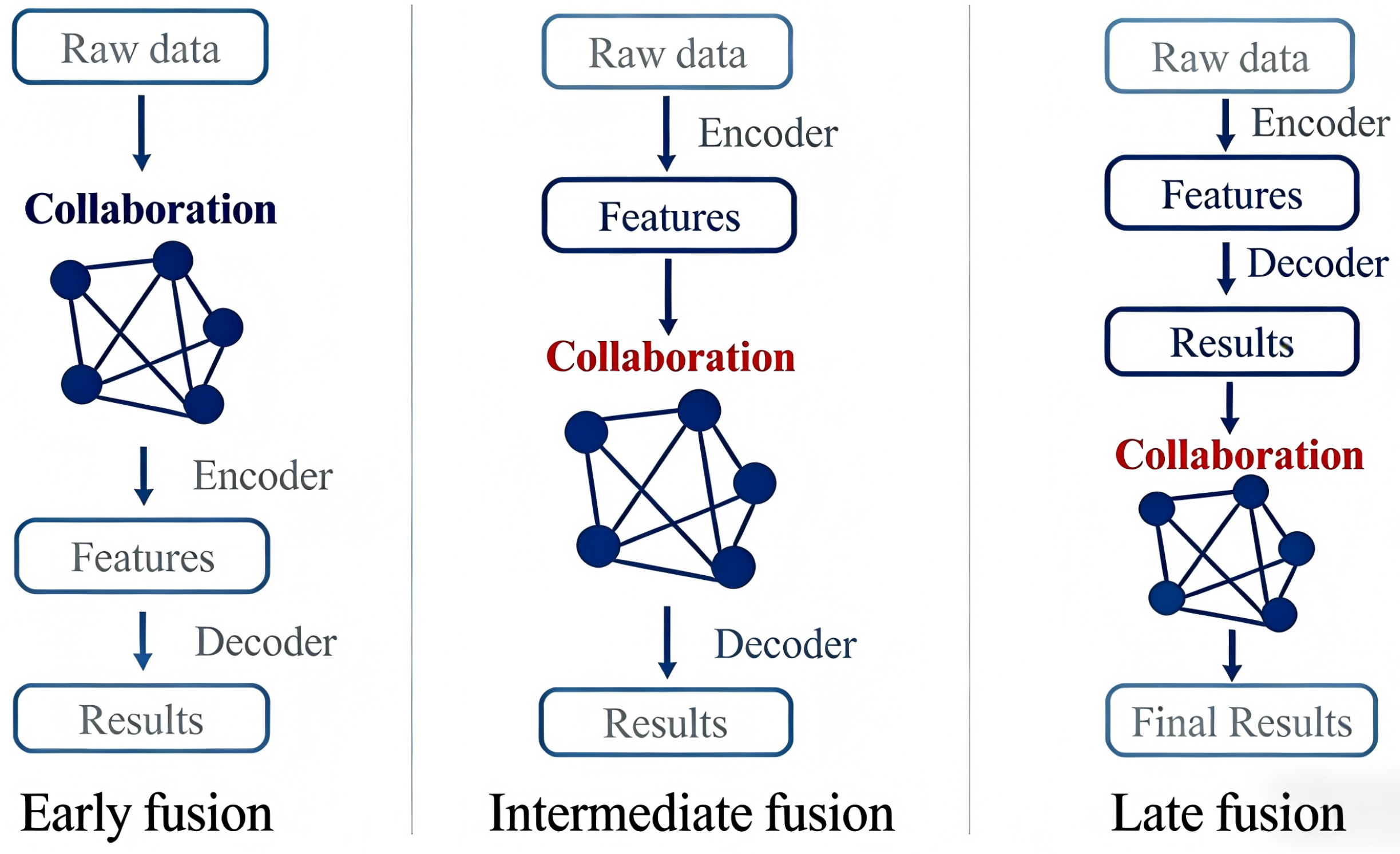
- Early fusion aggregates and fuses raw data from on-board/roadside sensors, achieving high perception accuracy but imposing strict requirements on communication bandwidth and data synchronization. Recent studies have reduced bandwidth requirements by compressing raw point clouds through point clustering and sparsification [24].
- Late fusion fuses detection results of each perception node, with a small communication overhead but certain information loss. Fusion reliability can be improved through simplified target representation and motion consistency verification, suitable for V2I collaborative scenarios between roadside units and vehicles [27].
2.3. Cooperative Decision-Making and Planning
- Cooperative methods rely on V2V real-time communication to realize space-time resource reservation and distributed negotiation between vehicles [39]. Local behavior collaboration is achieved through interactive information synchronization, which is mainly suitable for high-frequency vehicle interaction scenarios such as lane changing, short-distance overtaking, and car-following [40], effectively reducing the probability of multi-vehicle conflicts and improving local traffic flow efficiency [41].
- Game theory-based methods model interactive decision-making relationships between vehicles and between vehicles and roads through Nash equilibrium, Stackelberg game, and other models, accurately depicting the interest demands and behavioral logic of traffic participants. They are mainly suitable for scenarios with multi-agent non-cooperative games, such as right-of-way allocation [42,43], mixed traffic flow collaboration [44], and accident collision avoidance [45], yielding decision outputs that are more aligned with natural human driving interaction patterns.
- Optimization-based methods take Model Predictive Control (MPC) and linear quadratic regulator (LQR) as core technical carriers. Trajectory schemes are dynamically adjusted through rolling optimization and feedback mechanisms [46], which can effectively handle vehicle dynamics constraints, road boundary constraints, and obstacle avoidance requirements [47]. They are mainly suitable for scenarios with strict requirements on real-time performance, such as high-speed platooning, precise obstacle avoidance, and complex merging scenarios [48].
- Learning-based methods take MARL as the core, adopting the paradigm of centralized training and decentralized execution [49]. Through massive scene data training, adaptive decision-making for complex dynamic traffic environments is realized without relying on accurate dynamics and environment models. They are mainly suitable for dynamic and complex scenarios such as congestion evacuation, highway merging, and large-scale vehicle collaboration, and have become a research hotspot and breakthrough direction in recent years [50].
2.4. Cooperative Control
3. Key Technologies
3.1. V2X Communication Technology
3.2. On-Board Units (OBU)
3.3. High-Precision Perception Fusion
4. Core Challenges
4.1. System Reliability
4.2. Functional Safety and SOTIF
4.3. Cybersecurity
5. Future Directions
5.1. Cross-Standard Collaborative Modeling of Functional Safety and SOTIF
- Scenario-based testing with coverage guarantees: Develop systematic methods to generate and prioritize edge cases and corner scenarios that challenge both perception and decision modules, ensuring that the testing coverage is quantifiable and traceable to operational design domains (ODD).
- Uncertainty-aware perception with confidence bounds: Integrate uncertainty quantification into perception pipelines (e.g., Bayesian deep learning, ensemble methods) to provide downstream modules with reliable confidence estimates, enabling safe decision-making under sensing ambiguity.
- Runtime monitoring with safe fallback mechanisms: Design lightweight monitors that detect prediction errors or out-of-distribution inputs in real time and trigger pre-defined fallback behaviors without violating safety constraints.
5.2. Construction of Full-Stack Cybersecurity Defense System for Vehicle-Road-Cloud Collaboration
5.3. Integrated Technical System Optimization of Vehicle-Road-Cloud Collaboration
6. Conclusions
Author Contributions
Funding
Data Availability Statement
Conflicts of Interest
References
- Li, H.; Meng, W.; Han, Z.; Zhang, Z.; Yang, Y. Vehicle platoon in road traffic: A survey of modeling, communication, controlling and perspectives. Physica A 2025, 674, 130757. [Google Scholar] [CrossRef]
- Liu, B.; Han, W.; Wang, E.; Xiong, S.; Qiao, C.; Wang, J. An Efficient Message Dissemination Scheme for Cooperative Drivings via Cooperative Hierarchical Attention Reinforcement Learning. IEEE Trans. Mob. Comput. 2024, 23, 5527–5542. [Google Scholar] [CrossRef]
- Liu, Q.; Xiong, P.; Zhu, Q.; Xiao, W.; Li, G.; Hu, G. A cooperative lateral and vertical control strategy for autonomous vehicles based on multi-agent deep reinforcement learning. Proc. Inst. Mech. Eng. Part D J. Automob. Eng. 2026, 240, 665–680. [Google Scholar] [CrossRef]
- Dong, L.; Li, X.; He, X.; Hua, M.; Zhou, Q.; Sun, C.; Jiang, K. Robustness-enhanced cooperative adaptive cruise control for multi-task scenarios via generalised joint multi-agent reinforcement learning. Neurocomputing 2026, 664, 132036. [Google Scholar] [CrossRef]
- Hua, M.; Chen, D.; Jiang, K.; Zhang, F.; Wang, J.; Wang, B.; Zhou, Q.; Xu, H. Communication-Efficient MARL for Platoon Stability and Energy-Efficiency Co-Optimization in Cooperative Adaptive Cruise Control of CAVs. IEEE Trans. Veh. Technol. 2025, 74, 6076–6087. [Google Scholar] [CrossRef]
- Olivari, E.; Carboni, A.; Caballini, C.; Pasquale, C.; Dalla Chiara, B.; Sacone, S. Planning and Control Strategies for Truck Platooning: A Benefit-Driven Literature Review. Future Transp. 2025, 5, 187. [Google Scholar] [CrossRef]
- Han, Y.; Zhang, L.; Meng, D.; Zhang, Z.; Hu, X.; Weng, S. A Value-Based Parallel Update MCTS Method for Multi-Agent Cooperative Decision-Making of Connected and Automated Vehicles. IEEE Trans. Intell. Transp. Syst. 2026, 27, 1400–1415. [Google Scholar] [CrossRef]
- Li, S.; Wang, H.; Hu, J. Ecological driving at an actuated signalized intersection: A practical solution of Vehicle-Road-Cloud Integration system. Transp. Res. Part C Emerg. Technol. 2025, 177, 105198. [Google Scholar] [CrossRef]
- Chen, J.; Zhang, Y.; Zhou, Y.; Wu, Y.; Chung, E.; Sartoretti, G. Learning-Based Lane Selection and Driving Orders for Connected Automated Vehicles at Multi-Lane Freeway Merging Sections. IEEE Trans. Intell. Transp. Syst. 2026, 27, 3369–3382. [Google Scholar] [CrossRef]
- Cao, X.; Wang, S.; Ren, X. IRS-Enhanced V2X Communication and Computation Systems: Resource Allocation and Performance Optimization. IEEE Internet Things J. 2025, 12, 9180–9194. [Google Scholar] [CrossRef]
- Li, Q.; Shi, C.; Xiong, Z.; Xiong, J.; Chen, M. Cooperative Fault-Tolerant Positioning Based on Model-Mixed Robust Gaussian Belief Propagation. IEEE Internet Things J. 2025, 12, 21537–21551. [Google Scholar] [CrossRef]
- Wang, S.; Ding, Y.; Ding, X.; Tan, X. Solving the Vehicle Cooperation Problem at Signal-Free Intersection via an Asynchronous Deep Reinforcement Learning Approach. IEEE Internet Things J. 2025, 12, 23357–23372. [Google Scholar] [CrossRef]
- Xu, C.; Wang, G.; Wei, M.; Zhang, P.; Peng, B. Intelligent Transportation Vehicle Road Collaboration and Task Scheduling Based on Deep Learning in Augmented Internet of Things. IEEE Trans. Veh. Technol. 2025, 74, 2198–2209. [Google Scholar] [CrossRef]
- Gabilondo, A.; Fernandez, Z.; Martin, A.; Zorrilla, M.; Angueira, P.; Montalban, J. Dynamic Mobile Network Slicing Through Vehicular Traffic Analysis. IEEE Open J. Veh. Technol. 2025, 6, 1464–1480. [Google Scholar] [CrossRef]
- Mohammed, S.F.; Pan, Z.; Al-Gunid, H.M.; Qasem, Z.A.H. Optimizing end-to-end latency in C-V2X networks: A novel FD-RAN and MEC integration approach. Veh. Commun. 2025, 55, 100955. [Google Scholar] [CrossRef]
- Lu, Z.; Zhao, Y.; Xu, C.Z. RCSIL: RIS-Assisted Cooperative Channel State Information Localization for V2X System. IEEE Internet Things J. 2025, 12, 1016–1031. [Google Scholar] [CrossRef]
- Saad, M.M.; Tariq, M.A.; Ajmal, M.; Kim, D.; Srivastava, G. Federated Multiagent Reinforcement Learning for Resource Allocation in NR-V2X Mode 2. IEEE Internet Things J. 2025, 12, 23402–23417. [Google Scholar] [CrossRef]
- Xu, Y.; Zheng, L.; Wu, X.; Tang, Y.; Liu, W.; Sun, D. Joint Resource Allocation for UAV-Assisted V2X Communication with Mean Field Multi-Agent Reinforcement Learning. IEEE Trans. Veh. Technol. 2025, 74, 1209–1223. [Google Scholar] [CrossRef]
- Yang, C.; Kwong, C.F.; Chieng, D.; Kar, P.; Yau, K.-L.A.; Chen, Y. Navigating the Road Ahead: A Comprehensive Survey of Radio Resource Allocation for Vehicle Platooning in C-V2X Communications. IEEE Commun. Surv. Tutor. 2025, 27, 1326–1362. [Google Scholar] [CrossRef]
- Di Renzo, M.; Zappone, A.; Debbah, M.; Alouini, M.-S.; Yuen, C.; de Rosny, J.; Tretyakov, S. Smart Radio Environments Empowered by Reconfigurable Intelligent Surfaces: How It Works, State of Research, and The Road Ahead. IEEE J. Sel. Areas Commun. 2020, 38, 2450–2525. [Google Scholar] [CrossRef]
- Li, K.; Dai, Z.; Cui, H.; Wang, X.; Song, H. VRAR: Video-Radar Automatic Registration Method Based on Trajectory Spatiotemporal Features and Bidirectional Mapping. IEEE Trans. Circuits Syst. Video Technol. 2025, 35, 8707–8722. [Google Scholar] [CrossRef]
- Chen, S.; Wang, H.; Shi, Y.; Zhao, L.; Hu, J.; Xu, H.; Song, Y. S&C-V2X: Integrated Satellite-Cellular V2X Networks - Evolution of C-V2X from 5G to 6G. IEEE Commun. Mag. 2026, 64, 175–181. [Google Scholar] [CrossRef]
- Li, K.; Dai, Z.; Huang, X.; Dong, S.; Wang, S. HMT-SUV: Hierarchical Multi-sensor Tracking with Single-source Uncertainty Verification for Resolving Target Existence Ambiguity. Expert Syst. Appl. 2026, 310, 131297. [Google Scholar] [CrossRef]
- Zhao, C.; Ding, D.; Lei, C.; Wang, S.; Ji, Y.; Du, Y. Safety Field-Based Vehicle-Infrastructure Cooperative Perception for Autonomous Driving Using 3D Point Clouds. IEEE Trans. Intell. Transp. Syst. 2025, 26, 4676–4691. [Google Scholar] [CrossRef]
- Yazgan, M.; Graf, T.; Liu, M.; Fleck, T.; Zöllner, J.M. A Survey on Intermediate Fusion Methods for Collaborative Perception Categorized by Real World Challenges. arXiv 2024, arXiv:2404.16139. [Google Scholar] [CrossRef]
- Wang, K.; Ma, Q.; Jiang, Y.; Lu, J. Uncertainty Quantification for Safety of the Intended Functionality of Autonomous Driving: A Comprehensive Survey. IEEE Trans. Instrum. Meas. 2025, 74, 3602549. [Google Scholar] [CrossRef]
- Jiang, J.; Xu, X.; He, C.; Liang, C.; Chen, T.; Wang, K.; Zhou, M.; Bai, A. A review of Link-level uncertainty in the perception-decision-control pipeline of connected and autonomous vehicles: Generation, evolution, propagation, and amplification. Proc. Inst. Mech. Eng. Part D J. Automob. Eng. 2025. [Google Scholar] [CrossRef]
- Huang, C.; Feng, F.; Duan, C.; Chen, Z.; Mao, P.; Yuan, X.; Zhu, X. To lock the authentic signals: Mitigating GNSS spoofing with INS-aided tracking. Inf. Fusion 2026, 126, 103596. [Google Scholar] [CrossRef]
- Wang, Z.; Fu, Z.; Wu, Z.; Zhu, C.; Ji, B. Barrier Lyapunov Function-Based Prescribed-Time Cooperative Guidance Law with Field-of-View Constraint. IEEE Trans. Control Syst. Technol. 2025, 33, 2217–2229. [Google Scholar] [CrossRef]
- Abdi, B.; Rokhi, Z.; Vidal, C.; Emadi, A. Scene-Centric Vehicle Trajectory Prediction at Cooperative Intersection Using Decision-Aware Attention Graph Transformer. IEEE Trans. Intell. Transp. Syst. 2025, 26, 19322–19333. [Google Scholar] [CrossRef]
- Wang, H.; Niu, Y.; Chen, L.; Li, Y.; Sotelo, M.A.; Li, Z.; Cai, Y. DAIR-V2XReid: A New Real-World Vehicle-Infrastructure Cooperative Re-ID Dataset and Cross-Shot Feature Aggregation Network Perception Method. IEEE Trans. Intell. Transp. Syst. 2024, 25, 9058–9068. [Google Scholar] [CrossRef]
- Sedar, R.; Kalalas, C.; Dini, P.; Vazquez-Gallego, F.; Alonso-Zarate, J.; Alonso, L. Knowledge Transfer for Collaborative Misbehavior Detection in Untrusted Vehicular Environments. IEEE Trans. Veh. Technol. 2025, 74, 425–440. [Google Scholar] [CrossRef]
- Zhang, B.; Wang, Y.; Zhang, C.; Jiang, J.; Luo, X.; Wang, X.; Zhang, Y.; Liu, Z.; Shen, G.; Ye, Y.; et al. FogFusion: Robust 3D object detection based on camera-LiDAR fusion for autonomous driving in foggy weather conditions. Proc. Inst. Mech. Eng. Part D J. Automob. Eng. 2025, 240, 2312–2322. [Google Scholar] [CrossRef]
- Geiger, A.; Lenz, P.; Stiller, C.; Urtasun, R. Vision meets robotics: The KITTI Dataset. Int. J. Robot. Res. 2013, 32, 1231–1237. [Google Scholar] [CrossRef]
- Sun, P.; Kretzschmar, H.; Dotiwalla, X.; Chouard, A.; Patnaik, V.; Tsui, P.; Guo, J.; Zhou, Y.; Chai, Y.; Caine, B.; et al. Scalability in Perception for Autonomous Driving: Waymo Open Dataset. In Proceedings of the IEEE/CVF Conference on Computer Vision and Pattern Recognition (CVPR), Seattle, WA, USA, 13–19 June 2020; pp. 2443–2451. [Google Scholar]
- Caesar, H.; Bankiti, V.; Lang, A.H.; Vora, S.; Liong, V.E.; Xu, Q.; Krishnan, A.; Pan, Y.; Baldan, G.; Beijbom, O. nuScenes: A Multimodal Dataset for Autonomous Driving. In Proceedings of the IEEE/CVF Conference on Computer Vision and Pattern Recognition (CVPR), Seattle, WA, USA, 13–19 June 2020; pp. 11618–11628. [Google Scholar]
- Wang, J.; Ma, Z.; Zhu, X.; Bai, J.; Huang, L. Cooperative decision making for connected automated vehicles in multiple driving scenarios. IET Intell. Transp. Syst. 2023, 17, 2131–2142. [Google Scholar] [CrossRef]
- Peng, R.; Yang, M.; Tao, R.; Zhang, M.; Zhang, R. Hierarchical Control Strategy for Cooperative On-Ramp Merging of Connected and Automated Vehicles on Multilane Highways. IEEE Internet Things J. 2025, 12, 34513–34527. [Google Scholar] [CrossRef]
- Hidalgo, C.; Arizala, A.; Iturbe-Olleta, N.; Brazalez, A.; Zubizarreta, A.; Asua, E.; Rastelli, J.P. A Cooperative Driving Framework for Platooning Using V2X Messages in Urban Environments. IEEE Trans. Veh. Technol. 2025, 74, 16813–16826. [Google Scholar] [CrossRef]
- Feng, T.; E, W.; Kong, X.; Li, B.; Wang, X.; Hu, X.; Ding, Y.; Zheng, J.; Duan, X. Multivehicle cooperative control strategy in freeway merging areas under visible light communication environment. Transp. B 2025, 13, 2475216. [Google Scholar] [CrossRef]
- Prathiba, S.B.; Raja, G.; Kumar, N. Intelligent Cooperative Collision Avoidance at Overtaking and Lane Changing Maneuver in 6G-V2X Communications. IEEE Trans. Veh. Technol. 2022, 71, 112–122. [Google Scholar] [CrossRef]
- Jing, D.; Yao, E.; Chen, R. Decentralized human-like control strategy of mixed-flow multi-vehicle interactions at uncontrolled intersections: A game-theoretic approach. Transp. Res. Part C Emerg. Technol. 2024, 167, 104835. [Google Scholar] [CrossRef]
- Sun, Z.; Qin, Z.; Ma, R.; Huang, T.; Gao, Z.; Ji, A. Microscopic right-of-way trading mechanism for cooperative decision-making: Theories and preliminary results. IEEE Trans. Intell. Transp. Syst. 2025, 26, 2461–2477. [Google Scholar] [CrossRef]
- Cui, Y.; Fang, S.; Chen, Q.; Wang, Y.; Hang, P.; Sun, J. A Game-Theoretic Framework of Interaction and Cooperative Driving for CAVs at Mixed Unsignalized Intersections. IEEE Internet Things J. 2026, 13, 1524–1538. [Google Scholar] [CrossRef]
- Guo, W.; Song, X.; Zhang, W.; Li, J.; Wu, X. Game-Theoretic Shared Control Strategy for Cooperative Collision Avoidance Under Extreme Conditions. IEEE Trans. Veh. Technol. 2025, 74, 246–262. [Google Scholar] [CrossRef]
- Koehler, M.; Mueller, M.A.; Allgoewer, F. Distributed MPC for Self-Organized Cooperation of Multiagent Systems. IEEE Trans. Autom. Control 2024, 69, 7988–7995. [Google Scholar] [CrossRef]
- Li, Y.; Liu, C.; Zheng, F. Robust fuzzy model predictive control for connected and automated vehicles in mixed platoons using a bidirectional vehicle dynamics strategy. Expert Syst. Appl. 2025, 267, 126057. [Google Scholar] [CrossRef]
- Mohammadi, M.; Maleki, M.; Taghavipour, A. Multi-Parametric model predictive control for vehicle platoons. Proc. Inst. Mech. Eng. Part D J. Automob. Eng. 2025, 240, 962–975. [Google Scholar] [CrossRef]
- Zhao, R.; Sun, Z.; Ji, A. A deep reinforcement learning approach for automated on-ramp merging. In Proceedings of the 2022 IEEE 25th International Conference on Intelligent Transportation Systems (ITSC), Macau, China, 8–12 October 2022; pp. 3800–3806. [Google Scholar] [CrossRef]
- Hua, M.; Qi, X.; Chen, D.; Jiang, K.; Liu, Z.E.; Sun, H.; Zhou, Q.; Xu, H. Multi-agent reinforcement learning for connected and automated vehicles control: Recent advancements and future prospects. IEEE Trans. Autom. Sci. Eng. 2025, 22, 16266–16286. [Google Scholar] [CrossRef]
- Parada, L.; Yu, K.; Angeloudis, P. IntNet: A Communication-Driven Multi-Agent Reinforcement Learning Framework for Cooperative Autonomous Driving. IEEE Robot. Autom. Lett. 2025, 10, 2478–2485. [Google Scholar] [CrossRef]
- Mu, Z.; Avedisov, S.S.; Moradipari, A.; Park, B.B. Formation and Investigation of Cooperative Platooning at the Early Stage of Connected and Automated Vehicles Deployment. IEEE Trans. Intell. Transp. Syst. 2026, 27, 5642–5656. [Google Scholar] [CrossRef]
- Li, M.; Wang, B.; Wang, S.; Ke, Z. Serial distributed reinforcement learning for enhanced multi-objective platoon control in curved road coordinates. Expert Syst. Appl. 2025, 269, 126493. [Google Scholar] [CrossRef]
- Yao, X.; Du, Z.; Sun, Z.; Calvert, S.C.; Ji, A. Cooperative lane-changing in mixed traffic: A deep reinforcement learning approach. Transp. A 2026, 22, 2343048. [Google Scholar] [CrossRef]
- Ji, A.; Huang, J.; Qin, Z.; Sun, Z.; Zhao, R.; Zheng, G. Cooperative merging for connected automated vehicles in mixed traffic: A multi-agent reinforcement learning approach. Artif. Intell. Transp. 2025, 2, 100007. [Google Scholar] [CrossRef]
- Berger, T.; Besselink, B. String Stability and Guaranteed Safety via Funnel Cruise Control for Vehicle Platoons. IEEE Trans. Autom. Control 2026, 71, 81–90. [Google Scholar] [CrossRef]
- Liu, W.; Hua, M.; Deng, Z.; Meng, Z.; Huang, Y.; Hu, C.; Song, S.; Gao, L.; Liu, C.; Shuai, B.; et al. A Systematic Survey of Control Techniques and Applications in Connected and Automated Vehicles. IEEE Internet Things J. 2023, 10, 21892–21916. [Google Scholar] [CrossRef]
- Fan, B.; Xie, H.; Li, T. Platoon Communication Power Control Under V2V Data Uncertainty: A Robust DRL Approach. IEEE Trans. Intell. Transp. Syst. 2025, 26, 21559–21573. [Google Scholar] [CrossRef]
- Gao, J.; Peng, Z.; Jang, S.; Piao, C. Platoon Control Leveraging Network Performance and State Estimation Under Dynamic V2V Network. IEEE Trans. Intell. Transp. Syst. 2025, 26, 12093–12105. [Google Scholar] [CrossRef]
- Liang, X.; Gao, W.; Hu, C.; Chai, T. Cooperative Adaptive Cruise Control of Connected and Autonomous Vehicles via Hybrid Iteration. IEEE Trans. Veh. Technol. 2025, 1–12. [Google Scholar] [CrossRef]
- Sun, Z.; Gao, Z.; He, X.; Li, Z.; Huang, T. Cooperative Merging in Mixed Traffic: A Mobile-Edge Hybrid Control Framework. IEEE Trans. Intell. Transp. Syst. 2025, 26, 4837–4850. [Google Scholar] [CrossRef]
- Rzig, I.; Jaafar, W.; Jebalia, M.; Tabbane, S. Energy-Efficient Vehicular Task Offloading Using Multi-Mode MEC and RIS-Equipped Aerial Platforms. IEEE Open J. Commun. Soc. 2025, 6, 7604–7619. [Google Scholar] [CrossRef]
- Qi, F.; Huang, Q.; Wang, Y.; Lin, P.; Hu, C.; Shi, X. IRS-Assisted Joint Broadcast/Multicast Resource Allocation and Cooperative Perception Optimization for 6G V2X Networks. IEEE Trans. Broadcast. 2025, 72, 106–116. [Google Scholar] [CrossRef]
- Li, S.; Zheng, H.; Wang, J.; Chen, C.; Xu, Q.; Wang, J.; Li, K. Influence of information flow topology and maximum platoon size on mixed traffic stability. Transp. Res. Part C Emerg. Technol. 2025, 171, 104950. [Google Scholar] [CrossRef]
- Wang, X.; Feng, F.; Zheng, J.; Hu, X.; Wenjuan, E.; Wang, X.; Xiao, Y.; Liu, Y.; Li, T. AutoML-BIMCTS: Optimizing Information Flow Topology for Heterogeneous Vehicle Platoons Under Communication Constraints. IEEE Internet Things J. 2025, 12, 40666–40685. [Google Scholar] [CrossRef]
- Yu, J.; Jiang, F.; Luo, Y.; Kong, W. Networked predictive control method of multi-vehicle cooperative control at communication-constrained unsignalized multi-intersection. IET Intell. Transp. Syst. 2023, 17, 929–942. [Google Scholar] [CrossRef]
- Li, Z.; Wang, Q.; Wang, J.; He, Z. A Flexible Cooperative MARL Method for Efficient Passage of an Emergency CAV in Mixed Traffic. IEEE Trans. Intell. Transp. Syst. 2024, 25, 8898–8912. [Google Scholar] [CrossRef]
- Gao, J.; Yu, B.; Chen, Y.; Wang, J.; Dai, Z.; Gao, K. Meta-MSCC: A foundation model for adaptive CAV control in highway weaving segments. Transp. Res. Part C Emerg. Technol. 2025, 181, 105397. [Google Scholar] [CrossRef]
- Chen, D.; Hu, J.; Sun, G.; Rong, F.; Zhang, P.; Huang, Y.; Cao, Z. Vehicle Sideslip Angle Redundant Estimation Based on Multi-Source Sensor Information Fusion. Mathematics 2026, 14, 183. [Google Scholar] [CrossRef]
- Hu, Z.; Chang, Y.; Chen, M.; Wang, B.; Yang, Z.; Qin, H. Cooperative Robust Fault-Tolerant Control for Vehicular Platoon Systems with Performance Limitations and Various Uncertainties. IEEE Trans. Veh. Technol. 2025, 74, 15065–15079. [Google Scholar] [CrossRef]
- Annu; Rajalakshmi, P. Towards 6G V2X Sidelink: Survey of Resource Allocation—Mathematical Formulations, Challenges, and Proposed Solutions. IEEE Open J. Veh. Technol. 2024, 5, 344–383. [Google Scholar] [CrossRef]
- Fan, X.; Bu, C.; Zhao, X.; Sui, J.; Mo, H. Incremental Double Q-Learning-Enhanced MPC for Trajectory Tracking of Mobile Robots. IEEE Trans. Instrum. Meas. 2025, 74, 3545523. [Google Scholar] [CrossRef]
- Liu, L.; Liu, S.; Shi, W. 4C: A Computation, Communication, and Control Co-Design Framework for CAVs. IEEE Wirel. Commun. 2021, 28, 42–48. [Google Scholar] [CrossRef]
- Maglogiannis, V.; Naudts, D.; Hadiwardoyo, S.; van den Akker, D.; Marquez-Barja, J.; Moerman, I. Experimental V2X Evaluation for C-V2X and ITS-G5 Technologies in a Real-Life Highway Environment. IEEE Trans. Netw. Serv. Manag. 2022, 19, 1521–1538. [Google Scholar] [CrossRef]
- Lang, P.; Tian, D.; Han, X.; Zhang, P.; Duan, X.; Zhou, J.; Leung, V.C.M. Towards 6G vehicular networks: Vision, technologies, and open challenges. Comput. Netw. 2025, 257, 110916. [Google Scholar] [CrossRef]
- Ferrag, M.A.; Lakas, A.; Tihanyi, N.; Debbah, M. LLM and AI Agents for Autonomous Systems: A Survey of Applications, Datasets, and Security Challenges. IEEE Open J. Intell. Transp. Syst. 2026, 7, 615–657. [Google Scholar] [CrossRef]
- Xue, S.; Gong, S.; Li, X. A Comparative Study of IEEE 802.11bd and IEEE 802.11p on the Data Dissemination Properties in Dynamic Traffic Scenarios. Appl. Sci. 2024, 14, 2099. [Google Scholar] [CrossRef]
- Srikanth, S.V.; Koshy, S.S.; Harin, R.; Prasad, M.; Krishna, C.M. India’s V2X Future: C-V2X vs. DSRC—A Comparative Study. In Proceedings of the 10th International Conference on Engineering and Emerging Technologies (ICEET), Dubai, United Arab Emirates, 27–28 December 2024; pp. 1–6. [Google Scholar]
- Khan, W.U.; Mahmood, A.; Bozorgchenani, A.; Jamshed, M.A.; Ranjha, A.; Lagunas, E.; Pervaiz, H.; Chatzinotas, S.; Ottersten, B.; Popovski, P. Opportunities for Intelligent Reflecting Surfaces in 6G Empowered V2X Communications. IEEE Internet Things Mag. 2024, 7, 72–79. [Google Scholar] [CrossRef]
- Liu, Y.; Zhao, J.; Xia, M.; Zhang, Q. Low-Latency V2X Communication with Non-Orthogonal Slicing: A Deterministic Network Calculus Approach. IEEE Trans. Veh. Technol. 2025, 74, 13759–13769. [Google Scholar] [CrossRef]
- Nair, A.; Tanwar, S. Resource allocation in V2X communication: State-of-the-art and research challenges. Phys. Commun. 2024, 64, 102351. [Google Scholar] [CrossRef]
- Huan, Z.; Sun, J.; Chen, Z.; Zhang, Z.; Sun, X.; Xiao, Z. Resource Allocation in V2X Networks: A Double Deep Q-Network Approach with Graph Neural Networks. Comput. Mater. Contin. 2025, 84, 5427–5443. [Google Scholar] [CrossRef]
- Xu, Y.; Zheng, L.; Wu, X.; Tang, Y.; Liu, W.; Sun, D. Energy-Efficient Resource Allocation for V2X Communications. IEEE Internet Things J. 2024, 11, 30014–30026. [Google Scholar] [CrossRef]
- Wang, J.; Topilin, I.; Feofilova, A.; Shao, M.; Wang, Y. Cooperative Intelligent Transport Systems: The Impact of C-V2X Communication Technologies on Road Safety and Traffic Efficiency. Sensors 2025, 25, 2132. [Google Scholar] [CrossRef]
- Yuan, J.; Sun, H.; Cao, R.; Huang, G. RL-IDS: A robust and lightweight intrusion detection system for in-vehicle network. J. Inf. Secur. Appl. 2026, 97, 104361. [Google Scholar] [CrossRef]
- Gong, B.; Li, Z.; Gong, M.; Zhu, H.; Meng, W.; Guo, C. Lightweight Continuous Authentication via IMU Fingerprinting for V2X. IEEE Trans. Intell. Transp. Syst. 2025, 26, 10483–10495. [Google Scholar] [CrossRef]
- Cao, L.; Wang, W.; Xie, Q.; Wei, D.; Zhang, L. SALT-V: Lightweight Authentication for 5G V2X Broadcasting. arXiv 2025, arXiv:2511.11028. [Google Scholar] [CrossRef]
- Rajasekaran, A.S.; Kumar Das, A.; Maria, A.; Sundar Kola, K.; Dharavat, N.; Jo, M. Lightweight Chebyshev Polynomial-Based Authentication and Signature Framework with Antenna Array for IoT-Enabled V2V and V2X Communications. IEEE Internet Things J. 2025, 12, 55227–55240. [Google Scholar] [CrossRef]
- Ren, R.; Zhao, J.; Zou, D.; Zhang, Q.; Wang, D.; Xu, W. Collaborative Computation in Integrated Sensing, Communication, and Computation System for Autonomous Driving. IEEE Trans. Intell. Transp. Syst. 2026, 27, 883–894. [Google Scholar] [CrossRef]
- Carballo-Hernandez, W.; Pelcat, M.; Bhattacharyya, S.S.; Carmona Galan, R.; Berry, F. Flydeling: Streamlined Performance Models for Hardware Acceleration of CNNs through System Identification. ACM Trans. Model. Perform. Eval. Comput. Syst. 2023, 8, 1–33. [Google Scholar] [CrossRef]
- Khan, M.J.; Khan, M.A.; Turaev, S.; Malik, S.; El-Sayed, H.; Ullah, F. A Vehicle-Edge-Cloud Framework for Computational Analysis of a Fine-Tuned Deep Learning Model. Sensors 2024, 24, 2080. [Google Scholar] [CrossRef]
- Xiao, W.; Li, P.; Tang, M.; Song, C.; Yu, D.; Liu, H.; Chen, D.; Chen, N. Real-Time Roadside 3-D Spatial Perception with LiDAR AIoT: An Edge-Cloud-Terminal Collaborative Sensing Prototype. IEEE Internet Things J. 2025, 12, 12624–12639. [Google Scholar] [CrossRef]
- Huang, M.; Zhang, W.; Zhang, G. Joint Service Placement and Task Offloading in Vehicle-Edge-Cloud Collaborative Networks. IEEE Trans. Intell. Transp. Syst. 2025, 26, 20577–20591. [Google Scholar] [CrossRef]
- Khattak, M.I.; Yuan, H.; Khan, A.; Ahmad, A.; Ullah, I.; Ahmed, M. Evolving Multi-Access Edge Computing (MEC) for Diverse Ubiquitous Resources Utilization: A Survey. Telecommun. Syst. 2025, 88, 71. [Google Scholar] [CrossRef]
- Zhang, J.; Wei, Z.; Liu, B.; Wang, X.; Yu, Y.; Zhang, R. Cloud-Edge-Terminal Collaborative AIGC for Autonomous Driving. IEEE Wirel. Commun. 2024, 31, 40–47. [Google Scholar] [CrossRef]
- Solouki, M.A.; Sini, J.; Violante, M. An Experimental Evaluation of Control Flow Checking for Automotive Embedded Applications Compliant with ISO 26262. IEEE Access 2023, 11, 51185–51198. [Google Scholar] [CrossRef]
- Liu, X.; Yan, R.; Kim, J.Y.; Xu, X. MPSO: An Optimization Algorithm for Task Offloading in Cloud-Edge Aggregated Computing Scenarios for Autonomous Driving. Mob. Netw. Appl. 2024, 30, 702–716. [Google Scholar] [CrossRef]
- Benmerar, T.Z.; Theodoropoulos, T.; Fevereiro, D.; Rosa, L.; Rodrigues, J.; Taleb, T.; Barone, P.; Giuliani, G.; Tserpes, K.; Cordeiro, L. Towards establishing intelligent multi-domain edge orchestration for highly distributed immersive services: A virtual touring use case. Clust. Comput. 2024, 27, 4223–4253. [Google Scholar] [CrossRef]
- Rahhal, M.; Gifre, L.; Armingol Robles, P.; Mateos Najari, J.; Zabala, A.; Jimenez, M.A.; Leira Osuna, R.; Munoz, R.; Gonzalez de Dios, O.; Vilalta, R. Edge Microservice Deployment and Management Using SDN-Enabled Whitebox Switches. Electronics 2026, 15, 246. [Google Scholar] [CrossRef]
- Dong, X.; Tian, W.; Ye, X.; Xu, Y.; Wu, T.; Wang, Z. A Federated Cloud-Based Auction Mechanism for Real-Time Scheduling of Vehicle Sensors in Vehicle-Road-Cloud Collaborative System. IEICE Trans. Commun. 2025, 108, 14–23. [Google Scholar] [CrossRef]
- Alcaide, S.; Kosmidis, L.; Hernandez, C.; Abella, J. Software-only based Diverse Redundancy for ASIL-D Automotive Applications on Embedded HPC Platforms. In Proceedings of the 33rd IEEE International Symposium on Defect and Fault Tolerance in VLSI and Nanotechnology Systems (DFT), Frascati, Italy, 19–21 October 2020; pp. 1–4. [Google Scholar]
- Hwang, K.Y.; Oh, S.Y.; Park, E.K.; Song, B.-K.; Kim, S.-I. Thermal Fault-Tolerant Asymmetric Dual-Winding Motors in Integrated Electric Braking System for Autonomous Vehicles. Machines 2024, 12, 708. [Google Scholar] [CrossRef]
- Liu, H.; Liu, J.; Jiang, G.; Jin, X. MSSF: A 4D Radar and Camera Fusion Framework with Multi-Stage Sampling for 3D Object Detection in Autonomous Driving. IEEE Trans. Intell. Transp. Syst. 2025, 26, 8641–8656. [Google Scholar] [CrossRef]
- Wang, M.; Li, D.; Casas, J.R.; Ruiz-Hidalgo, J. Adaptive Fusion of LiDAR Features for 3D Object Detection in Autonomous Driving. Sensors 2025, 25, 3865. [Google Scholar] [CrossRef]
- Wei, C.; Qin, Z.; Zimmer, W.; Wu, G.; Barth, M.J. HeCoFuse: Cross-Modal Complementary V2X Cooperative Perception with Heterogeneous Sensors. arXiv 2025, arXiv:2507.13677. [Google Scholar] [CrossRef]
- Wei, Z.; Zheng, L.; Liu, J.; Huang, T.; Han, Q.-L.; Zhang, W.; Zhang, F. MS-Occ: Multi-Stage LiDAR-Camera Fusion for 3D Semantic Occupancy Prediction. IEEE Robot. Autom. Lett. 2026, 11, 370–377. [Google Scholar] [CrossRef]
- Zhang, J.; Lu, Y.; Xu, X. PentaFusion: Differentiable attention weighting for real-time LiDAR-camera fusion in edge autonomous vehicles. Robot. Auton. Syst. 2026, 196, 105233. [Google Scholar] [CrossRef]
- Shi, K.; He, S.; Shi, Z.; Chen, A.; Xiong, Z.; Chen, J.; Luo, J. Radar and Camera Fusion for Object Detection and Tracking: A Comprehensive Survey. IEEE Commun. Surv. Tutor. 2026, 28, 3478–3520. [Google Scholar] [CrossRef]
- Lu, Y.; Jiang, B.; Liu, N.; Li, Y.; Chen, J.; Zhang, Y.; Wan, Z. CrossPrune: Cooperative pruning for camera–LiDAR fused perception models of autonomous driving. Knowl.-Based Syst. 2024, 289, 111522. [Google Scholar] [CrossRef]
- Cserni, M.; Rovid, A.; Szalay, Z. MM-VSM: Multi-Modal Vehicle Semantic Mesh and Trajectory Reconstruction for Image-Based Cooperative Perception. Appl. Sci. 2025, 15, 6930. [Google Scholar] [CrossRef]
- De Araujo, P.R.M.; Mounier, E.; Bader, Q.; Dawson, E.; Abdelaziz, S.I.K.; Zekry, A.; Elhabiby, M.; Noureldin, A. The NavINST Dataset for Multi-Sensor Autonomous Navigation. IEEE Access 2025, 13, 84659–84674. [Google Scholar] [CrossRef]
- Gong, H.; Li, Z.; Lu, C.; Du, G.; Gong, J. Leveraging Multi-Stream Information Fusion for Trajectory Prediction in Low-Illumination Scenarios: A Multi-Channel Graph Convolutional Approach. IEEE Trans. Intell. Transp. Syst. 2024, 25, 3854–3869. [Google Scholar] [CrossRef]
- Wang, J.; Wu, Z.; Liang, Y.; Tang, J.; Chen, H. Perception Methods for Adverse Weather Based on Vehicle Infrastructure Cooperation System: A Review. Sensors 2024, 24, 374. [Google Scholar] [CrossRef]
- Shi, P.; Yang, L.; Dong, X.; Qi, H.; Yang, A. Research Progress on Multi-Modal Fusion Object Detection Algorithms for Autonomous Driving: A Review. Comput. Mater. Contin. 2025, 83, 3877–3917. [Google Scholar] [CrossRef]
- Fang, Z.; Hu, S.; An, H.; Zhang, Y.; Wang, J.; Cao, H.; Chen, X.; Fang, Y. PACP: Priority-Aware Collaborative Perception for Connected and Autonomous Vehicles. IEEE Trans. Mob. Comput. 2024, 23, 15003–15018. [Google Scholar] [CrossRef]
- Wei, C.; Wu, G.; Barth, M.J. Cooperative Perception for Automated Driving: A Survey of Algorithms, Applications, and Future Directions. Proc. IEEE 2025, 1–27. [Google Scholar] [CrossRef]
- Li, Z.; Hu, C.; Zheng, X.; Wang, J.; Wang, H. V2V-APG: Adversarial Progressive Generalization for Vehicle-to-Vehicle Cooperative Perception. IEEE Internet Things J. 2025, 12, 54873–54884. [Google Scholar] [CrossRef]
- Ma, C.; Li, H.; Long, K.; Zhou, H.; Liang, Z.; Li, P.; Yu, H.; Li, X. Real-time identification of cooperative perception necessity in road traffic scenarios. Transp. Res. Part C Emerg. Technol. 2026, 185, 105547. [Google Scholar] [CrossRef]
- Ma, Y.; Zheng, Y.; Liu, Y.; Feng, Z.; Easa, S.M.; Wong, Y.D. Synthesizing perceived trajectory for placing cooperative roadside LiDAR: A hybrid simulation-deep learning framework. Transp. Res. Part C Emerg. Technol. 2026, 183, 105473. [Google Scholar] [CrossRef]
- Li, L.; Zhang, W.; Wang, X.; Cui, T.; Sun, C. NLOS Dies Twice: Challenges and Solutions of V2X for Cooperative Perception. IEEE Open J. Intell. Transp. Syst. 2024, 5, 774–782. [Google Scholar] [CrossRef]
- Le, V.A.; Chalaki, B.; Tzortzoglou, F.N.; Malikopoulos, A.A. Stochastic Time-Optimal Trajectory Planning for Connected and Automated Vehicles in Mixed-Traffic Merging Scenarios. IEEE Trans. Control Syst. Technol. 2025, 33, 1403–1417. [Google Scholar] [CrossRef]
- Han, T.; Chen, S.; Li, C.; Wang, Z.; Su, J.; Huang, M.; Cai, G. Epurate-Net: Efficient Progressive Uncertainty Refinement Analysis for Traffic Environment Urban Road Detection. IEEE Trans. Intell. Transp. Syst. 2024, 25, 6617–6632. [Google Scholar] [CrossRef]
- Kanak, A.; Ergun, S.; Atalay, A.S.; Persi, S.; Karci, A.E.H. A Review and Strategic Approach for the Transition towards Third-Wave Trustworthy and Explainable AI in Connected, Cooperative and Automated Mobility (CCAM). In Proceedings of the 27th Asia-Pacific Conference on Communications (APCC)—Creating Innovative Communication Technologies for Post-Pandemic Era, Jeju, Republic of Korea, 19–21 October 2022; pp. 108–113. [Google Scholar]
- ISO 26262-1:2018; Road Vehicles—Functional Safety. International Organization for Standardization: Geneva, Switzerland, 2018.
- Kochanthara, S.; Singh, T.; Forrai, A.; Cleophas, L. Safety of Perception Systems for Automated Driving: A Case Study on Apollo. ACM Trans. Softw. Eng. Methodol. 2024, 33, 1–28. [Google Scholar] [CrossRef]
- ISO 21448:2022; Road Vehicles—Safety of the Intended Functionality. International Organization for Standardization: Geneva, Switzerland, 2022.
- Swain, R.; Kaye, S.A.; Rakotonirainy, A. Shared intention and shared awareness for conditional automated driving: An online, randomized video experiment. Traffic Inj. Prev. 2025, 26, 398–406. [Google Scholar] [CrossRef]
- Soleimani, M.; Sari, A.A. A unified safety framework for automated vehicle development: Integrating ISO 26262, SOTIF, and UL 4600. Transp. Res. Interdiscip. Perspect. 2026, 36, 101831. [Google Scholar] [CrossRef]
- Cui, Y.; Zhou, H.; Zhang, Y.; Xue, F.; Zheng, J.; Lu, Z.; Chen, Y.; Li, C.; Jiang, Z.; Ma, H. An Iterative Intelligent Attack with Integrated Strategy for Resource-Constrained Internet of Vehicles. IEEE Internet Things J. 2025, 12, 12453–12467. [Google Scholar] [CrossRef]
- Sakhai, M.; Sithu, K.; Oke, M.K.S.; Wielgosz, M. Cyberattack Resilience of Autonomous Vehicle Sensor Systems: Evaluating RGB vs. Dynamic Vision Sensors in CARLA. Appl. Sci. 2025, 15, 7493. [Google Scholar] [CrossRef]
- Yousseef, A.; Lin, Y.Z.; Satam, S.; Latibari, B.S.; Pacheco, J.; Salehi, S.; Hariri, S.; Satam, P. Autonomous Vehicle Security: Hybrid Threat Modeling Approach. IEEE Open J. Veh. Technol. 2025, 6, 1774–1795. [Google Scholar] [CrossRef]
- Shang, C.; Cao, J.; Li, Z.; Niu, B.; Lam, K.-Y.; Chi, C.-H.; Li, H. A Hierarchical Encrypted Compression Scheme for Intra-Vehicle Network. IEEE Trans. Intell. Transp. Syst. 2025, 26, 11916–11930. [Google Scholar] [CrossRef]
- Lucas-Estañ, M.C.; Coll-Perales, B.; Shimizu, T.; Gozalvez, J.; Higuchi, T.; Avedisov, S.; Altintas, O.; Sepulcre, M. An Analytical Latency Model and Evaluation of the Capacity of 5G NR to Support V2X Services Using V2N2V Communications. IEEE Trans. Veh. Technol. 2023, 72, 2293–2306. [Google Scholar] [CrossRef]
- L3Pilot Consortium. L3Pilot Final Project Results. Available online: https://l3pilot.eu (accessed on 1 April 2026).
- TM Forum. China Mobile AI4Vehicle Case Study—Wuxi City Vehicle-Road-Cloud Collaboration v1.0.0. Available online: https://www.tmforum.org/resources/technical-specification/ig1476-china-mobile-ai4vehicle-case-study-wuxi-city-vehicle-road-cloud-collaboration-v1-0-0/ (accessed on 1 April 2026).
- China United Network Communications Co., Ltd. (Shanghai Unicom). Shanghai Unicom Builds China’s Largest 5G-A ’Double 20’ Connected Vehicle Demonstration Zone. Available online: http://vod.sasac.gov.cn/folder21/folder24/2025-06-19/X1ZFjGUuTZZCYo0P.html (accessed on 1 April 2026).
- Waymo LLC. Comparison of Waymo Rider-Only Crash Rates by Crash Type to Human Benchmarks at 56.7 Million Miles. Available online: https://pubmed.ncbi.nlm.nih.gov/40378124/ (accessed on 1 April 2026).
- Chia, W.M.D.; Keoh, S.L.; Goh, C.; Johnson, C. Risk Assessment Methodologies for Autonomous Driving: A Survey. IEEE Trans. Intell. Transp. Syst. 2022, 23, 16923–16939. [Google Scholar] [CrossRef]
- Abboush, M.; Ghannoum, E.; Rausch, A. An explainable hybrid deep learning-enabled intelligent fault detection and diagnosis approach for automotive software systems validation. Knowl.-Based Syst. 2026, 334, 114922. [Google Scholar] [CrossRef]
- Imghoure, A.; Omary, F.; El-Yahyaoui, A. Hybrid cryptography-based scheme with conditional privacy-preserving authentication and memory-based DOS resilience in V2X. Veh. Commun. 2024, 49, 100810. [Google Scholar] [CrossRef]
- Hellemans, W.; Le Jeune, L.; Rabbani, M.M.; Preneel, B.; Mentens, N. Toward a Real-Time Intrusion Detection System for Modern In-Vehicle Networks. IEEE Trans. Intell. Transp. Syst. 2025, 26, 18665–18679. [Google Scholar] [CrossRef]
- Aljabri, W.; Hamid, M.A.; Mosli, R. Lightweight and Adaptive Data-Driven Intrusion Detection System for Autonomous Vehicles. IEEE Trans. Intell. Transp. Syst. 2025, 26, 2282–2292. [Google Scholar] [CrossRef]
- Jiang, L.; Li, Q.; Che, X.; Chen, X. A Knowledge Distillation Enhanced Semi-Supervised Federated Learning Framework for Intrusion Detection in EV Charging Networks. IEEE Internet Things J. 2025, 12, 34360–34373. [Google Scholar] [CrossRef]
- Jiang, C.; Yin, S.; Yao, Z.; He, J.; Jiang, R.; Jiang, Y. Safety evaluation of mixed traffic flow with truck platoons equipped with (cooperative) adaptive cruise control, stochastic human-driven cars and trucks on port freeways. Physica A 2024, 643, 129802. [Google Scholar] [CrossRef]



| Decision Hierarchy | Computing Time * | Core Tasks | Adaptive Technologies |
|---|---|---|---|
| Route Planning (Strategic) | Global path planning, traffic flow coordination | Road network optimization, deep learning prediction | |
| Maneuver Planning (Tactical) | Vehicle behavior decision-making (lane change, overtaking, yielding) | Game theory, multi-agent reinforcement learning | |
| Motion Planning (Operational) | Local trajectory generation and optimization | Model predictive control, random trees |
| Method Type | Representative Technologies | Applicable Scenarios | Core Advantages |
|---|---|---|---|
| Cooperative | V2V communication + spatio-temporal reservation | Lane-changing, overtaking, car-following | Reduced multi-vehicle conflicts, improved local efficiency |
| Game Theory | Nash equilibrium, Stackelberg game | Unsignalized intersection right-of-way | Human-like interactive decisions |
| Optimization-based | MPC (Model Predictive Control) | High-speed platooning, obstacle avoidance, merging | Real-time dynamic trajectory adjustment |
| Learning-based | Multi-agent reinforcement learning (MARL) | Congestion evacuation, highway merging, large-scale coordination | Adaptive to complex dynamic environments |
| Control Architecture | Core Control Methodologies | Typical Application Scenarios | References |
|---|---|---|---|
| Distributed Control | RL (DRL/MARL), MPC, CACC, State Estimation | Platoon formation/stability, lane-changing, power control, topology-aware estimation | [24,52,53,54,58,63,64,65] |
| Centralized Control | Funnel Cruise Control, Networked Predictive Control | Platoon string stability, multi-intersection coordination | [56,66] |
| Hybrid Control | MARL, Mobile-Edge Hybrid Control, MEC+RIS | Cooperative merging in mixed traffic, emergency CAV passage, vehicular task offloading | [55,61,62,67] |
| V2X Category | Core Technologies | References |
|---|---|---|
| Technology Generation | DSRC/C-V2X, IEEE 802.11p/bd, LTE/5G/6G V2X | [77,78] |
| Core Enabling Technologies | IRS/RIS, network slicing, MEC, SAGIN | [10,16,79] |
| Resource Allocation | MARL/DRL, optimization, GNN, federated learning | [80,81,82,83] |
| Performance Optimization | Latency modeling, reliability, localization, QoS | [11,15,80,84] |
| Security & Privacy | Lightweight auth, intrusion detection, DDoS defense, privacy | [85,86,87,88] |
| 6G V2X Prospective | Terahertz, satellite-cellular, SAGIN | [22,75] |
| Architecture | Key Features | Representative References |
|---|---|---|
| Heterogeneous (CPU+GPU+FPGA) | Parallel acceleration, low-latency control | [91,92,93] |
| CPU+GPU | Deep learning inference, sensor fusion | [62,89,94,95] |
| FPGA/DSP | Dedicated accelerator, microsecond-level response | [96,97] |
| Edge-cloud collaborative | Task offloading, resource pooling | [94,95,97,98,99,100] |
| Redundancy & Reliability | Fault tolerance, self-diagnostics | [101,102] |
| Fusion Method | Key Features | Representative References |
|---|---|---|
| Early fusion | Raw data-level fusion (LiDAR+camera, LiDAR+radar, 4D radar) | [24,103,104,105,106,107,108] |
| Intermediate fusion | Feature-level fusion, attention mechanisms | [28,31,109,110,111,112,113,114] |
| Late fusion | Detection-level fusion, object tracking | [115,116,117,118,119] |
| Cooperative perception | V2X+on-board/roadside sensors | [22,92,115,116,120] |
Disclaimer/Publisher’s Note: The statements, opinions and data contained in all publications are solely those of the individual author(s) and contributor(s) and not of MDPI and/or the editor(s). MDPI and/or the editor(s) disclaim responsibility for any injury to people or property resulting from any ideas, methods, instructions or products referred to in the content. |
© 2026 by the authors. Licensee MDPI, Basel, Switzerland. This article is an open access article distributed under the terms and conditions of the Creative Commons Attribution (CC BY) license.
Share and Cite
Ji, A.; Ju, X.; Liu, N.; Chen, J.; Dai, Z. Cooperative Connected and Automated Mobility: A Survey. Future Transp. 2026, 6, 103. https://doi.org/10.3390/futuretransp6030103
Ji A, Ju X, Liu N, Chen J, Dai Z. Cooperative Connected and Automated Mobility: A Survey. Future Transportation. 2026; 6(3):103. https://doi.org/10.3390/futuretransp6030103
Chicago/Turabian StyleJi, Ang, Xilu Ju, Nieyangzi Liu, Junxian Chen, and Zhe Dai. 2026. "Cooperative Connected and Automated Mobility: A Survey" Future Transportation 6, no. 3: 103. https://doi.org/10.3390/futuretransp6030103
APA StyleJi, A., Ju, X., Liu, N., Chen, J., & Dai, Z. (2026). Cooperative Connected and Automated Mobility: A Survey. Future Transportation, 6(3), 103. https://doi.org/10.3390/futuretransp6030103