


Abstract
On 1 November 2024, the Federal Highway Administration issued a final rule updating the 23 CFR Part 630 Subpart J on Work Zone Safety and Mobility, detailing performance measures and reporting requirements. The rule suggests that state agencies should define formal performance measures that can be tracked consistently for the continuity of work zone program management across states. The objective is to help identify work zones needing mobility or safety improvements, as well as provide quantitative feedback on the best practices. The emergence of connected vehicle data over the past few years provides a scalable approach for agencies to calculate and monitor the performance measures defined in the CFR, covering, but not limited to, speed, travel time, queue length and duration, hard braking events and speed differentials. This paper describes techniques that use connected vehicle data to estimate different measures that map into the performance measures defined in this rule. A 2024 work zone in Illinois along I-24 was chosen to demonstrate the utility of the measures. The paper concludes with a discussion of ongoing work applying these derived measures to 101 work zones across 9 states in 2025 to demonstrate scalability.
Keywords:
work zones; connected vehicles; big data; performance measures; mobility; safety; CFR; freeways 1. Introduction
Work zones are essential for modernizing transportation systems, improving mobility, reducing delays and improving safety. However, they can present temporary challenges for agencies and the motoring public. The national work zone safety information clearinghouse estimated over 100,000 work zone crashes along United States (US) highways in 2023 [1]. During the same year, the total cost of traffic congestion in the US was estimated to be more than USD 70.4 billion, a 15% increase from the previous year [2].
Improving work zone safety and mobility is a common goal for federal and state agencies. The Federal Highway Administration (FHWA) recognizes that road construction activity on highways is continuing to increase. Recently, the FHWA updated its regulations governing traffic safety and mobility in highway work zones to facilitate consideration of the broader safety and mobility impacts of work zones in a more coordinated and comprehensive manner across all project development stages. Although the updated regulation provides a broad suggestion of performance measures, the FHWA is not prescriptive but instead encourages states to select performance measures that best suit their goals and objectives. It does suggest that states should look for opportunities to leverage scalable data sources in a manner that does not require large investments in field data collection equipment.
2. Objective
The objective of this paper is to define techniques for processing CV data to derive performance measures consistent with 23 CFR Part 630 Subpart J on Work Zone Safety and Mobility. Several examples are presented that not only define how performance measures can be calculated, but perhaps more importantly, how they can be visualized at scale to facilitate efficient prioritization and decision making by stakeholders responsible for managing construction work zone safety and mobility.
3. Background
One of the earliest focuses on highway safety at the federal level can be cited back to the Intermodal Surface Transportation Efficiency Act of 1991(ISTEA) [3]. Section 1051 of this legislation mandated the development of a work zone safety program. In response, the FHWA established the National Highway Work Zone Safety Program in October 1995 [4]. This program focused on enhancing the safety and efficiency of highway work zones for both workers and the traveling public. Its follow-up legislation, the Transportation Efficiency Act for the 21st Century (TEA-21) [5], continued or expanded on many of the provisions originating from the ISTEA.
As traffic volumes and congestion climbed, FHWA amended its regulation in 2004 [6]. This rule remained the cornerstone of federal policy for nearly two decades. However, the transportation landscape continued to evolve. In a significant recent development, the FHWA announced an update to the rule in late 2024 [6]. The updated rule seeks to further enhance safety and mobility by incorporating the latest technologies and best practices in work zone management.
State agencies use some form of measures in their policies for monitoring work zones in select stages of the project. To summarize a few, both the Indiana Department of Transportation (DOT) and the Ohio DOT use a policy-driven approach to manage work zone mobility. In Ohio, queues are monitored through freeway cameras where coverage is available [7], and in Indiana, queues are typically monitored by connected vehicle data [8,9]. The Illinois DOT employs intelligent transportation system (ITS) technology that uses real-time data from sensors and cameras to provide traffic information to drivers [10]. The Virginia, Iowa and Indiana DOTs routinely use probe-vehicle data for tracking mobility performance. There has been some effort at the national level to provide coarse resolution segment speed data, called the National Performance Management Research Data Set (NPMRDS), freely available to all states [11,12,13]. However, the latency of the data lags by a month and has a relatively coarse spatial resolution, extending up to 5 to 10 miles in rural areas. Consequently, NPMRDS data is limited for monitoring statewide work zones to identify emerging problems.
Portable traffic monitoring devices or queue warning systems [14,15,16] are sometimes used by agencies for monitoring queues at work zones. Advanced detection technologies that use radar sensors, video-based traffic measurement or Bluetooth/Wi-Fi tracking are also incorporated in some key work zones [17,18,19,20]. However, these techniques require infrastructure investment, high costs and site-specific planning, making it difficult to easily scale statewide. There is a lack of scalable, agile and cost-effective methods to provide performance measures to agencies.
Although there has been significant innovation across the work zone management space over the past two decades, perhaps the most promising scalable technology that does not require significant capital investment is connected vehicle (CV) data. Spatiotemporal visualizations built using CV data have shown the monitoring of queue length and duration and its propagation during the formation and recovery of these queues [21,22]. This paper discusses new opportunities for deriving many of the performance measures suggested in new rule making.
3.1. 23 CFR Part 630 Subpart J—Work Zone Safety and Mobility
On 1 November 2024, the FHWA published a final rule defining the 23 CFR Part 630 Subpart J on Work Zone Safety and Mobility [6]. The effective date of the final rule was 2 December 2024, with a compliance date of 31 December 2026. The focus is to encourage state agencies to leverage available data sources for data-driven monitoring of work zones throughout all stages. The key component is performance and programmatic reviews that can improve the consistency and continuity of work zone management practices across states. State agencies shall adopt at least one performance measure for safety and one for mobility for projects and programmatic reviews within their policies, not necessarily on the suggested list of measures. The reporting interval for work zone programmatic reviews was established as 5 years.
3.2. Connected Vehicle Data
Connected vehicle data refers to the vast amount of information collected by vehicles equipped with sensors and connectivity capability. A variety of CV data sources are now commercially available. It ranges from commercial trucks with pings every 10 to 60 s from approximately 1% of vehicles on Interstates to higher fidelity passenger car (PC) data with pings every 3 to 5 s from approximately 4–5% of vehicles [23,24,25]. This study focuses on CV data from trucks due to its nationwide longitudinal availability. Similar methodologies can be easily adapted to PC data as well.
3.3. Illustration of Scalability of CV Data
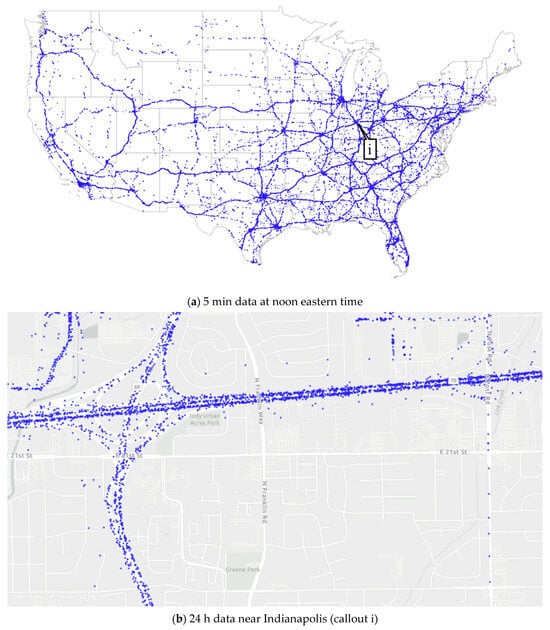
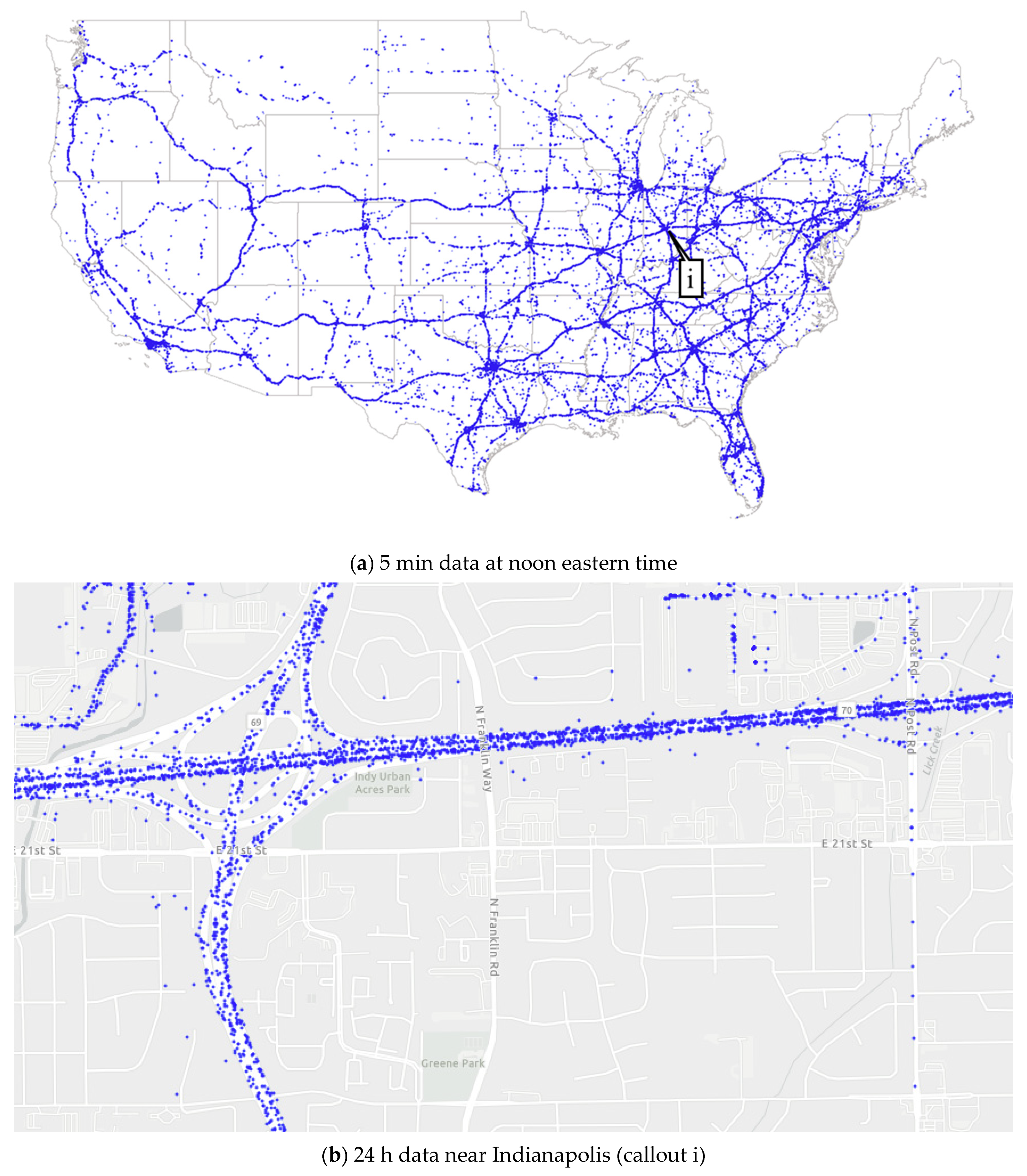
Each ping of a truck during its journey is referred to as a “waypoint”. Each waypoint is associated with a GPS location, time, instantaneous speed and heading. To visualize these trucks nationwide, Figure 1a shows a five-minute sample of 240,067 waypoints at noon eastern time on Sunday, 1 June 2025. Just five minutes of data provides a snapshot of traffic conditions across the major highways. Figure 1b shows waypoints from an urban area east of Indianapolis (callout i) over a day. As seen from Figure 1b, the routes and lanes are fully covered within a day’s worth of data. From one CV data provider of trucks, more than 175 million daily and 4.5 billion monthly records are streamed in near-real time. The continuous collection, storage and analysis of these waypoints were performed on a cloud platform to leverage efficiencies.
Figure 1.
National sample of connected vehicle data from commercial trucks on 1 June 2025.
4. Methodology
Table 1 presents a summary of performance measures suggested in the final rule and its potential data sources. While there are other sources or devices that can provide specific performance measures, CV data applies to several measures without the specific need for physical installations. The measures are broadly categorized into (a) work zone crash data, (b) safety surrogate data, (c) operational information and (d) exposure data.
Table 1.
Summary of performance measures suggested in 23 CFR Part 630 Subpart J.
There are some significant variations in coverage by alternative CV data sources. Specifically, truck data tends to have lower volumes but is more cost-effective. PCs may provide richer, more frequent, and denser data, but there is limited overnight data availability. Due to the higher temporal frequency and lower volumes in some areas, some measurements from CV truck data might have challenges.
Sensitive details on the number of fatalities or injuries are primarily collected and reported by state police or other agencies [26]. It is possible to estimate the approximate number of crashes within a work zone using CV data if the original equipment manufacturer (OEM) enables that capability, but due to its sensitive nature and privacy concerns, it is unlikely agencies will have access to CV crash data in the foreseeable future. Furthermore, the relatively low frequency of crash data results in only the most severe risks being identified quickly. Hence, CFR also suggests safety surrogate data as well. Each of the performance measures derived from the truck data (denoted with a notation) is discussed.
4.1. Work Zone Performance Measures
Most state agencies’ management and reporting practices are based upon a linear reference system that includes a route, direction and mile marker. One of the key steps in the methodology is linear referencing each of the CV waypoints using a pre-defined network of smart polygons. Smart polygons 0.1 miles in length and 120 ft wide are created covering the entire US Interstate network. Previous studies have detailed smart polygon generation and linear referencing techniques [27]. Linear referenced waypoints are then utilized for calculating performance measures.
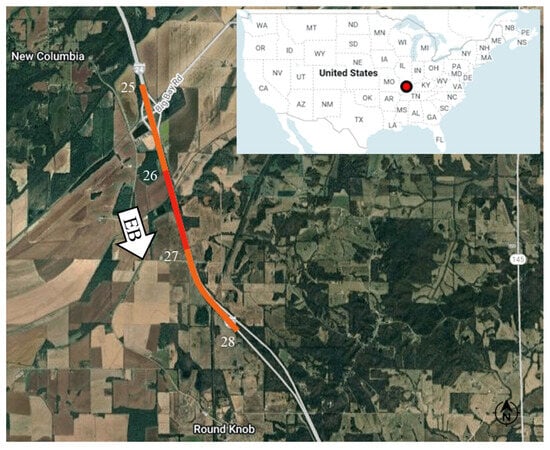
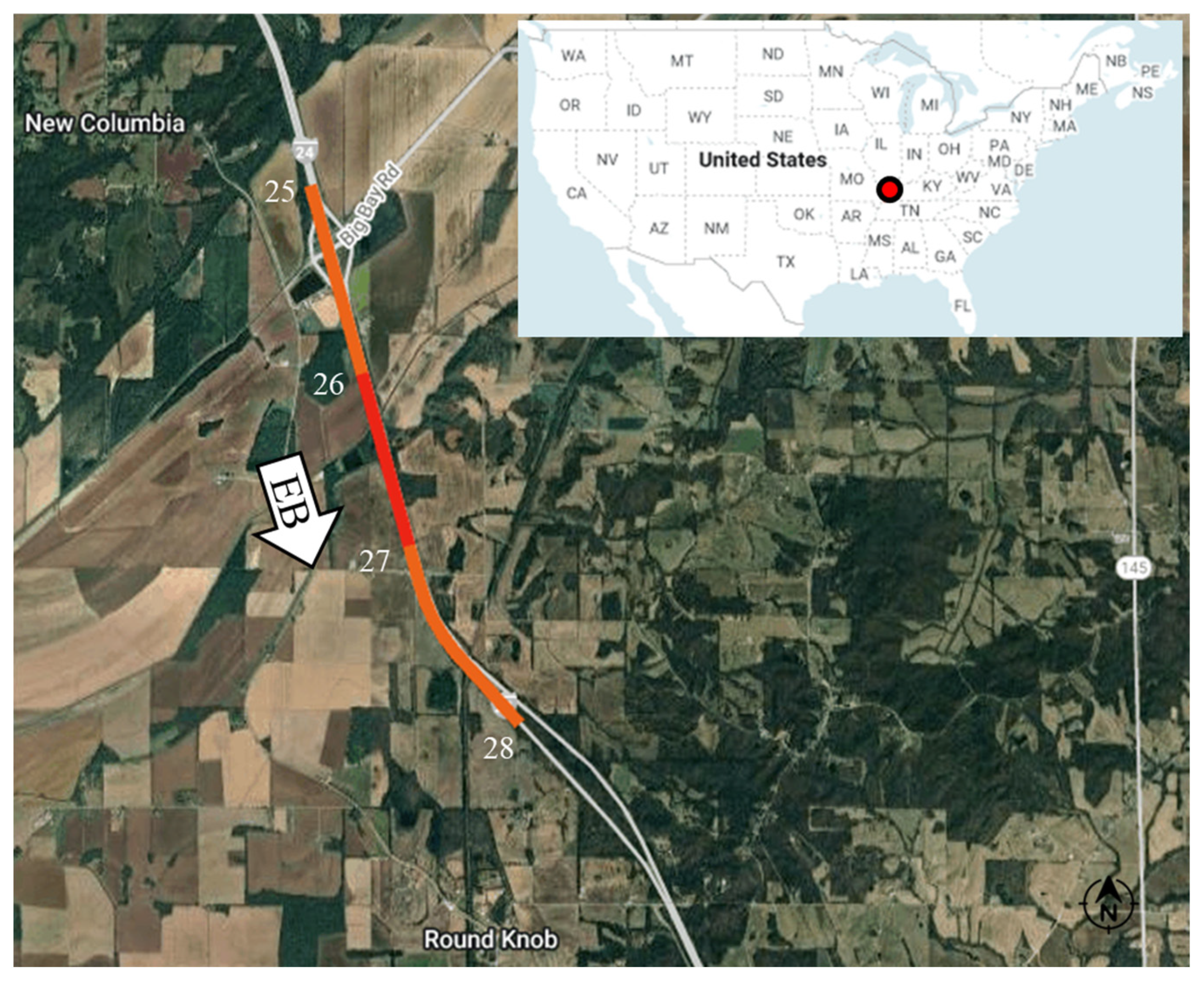
A work zone in Illinois (IL) was selected as a case study to demonstrate the development of work zone performance measures. Figure 2 shows the work zone in the eastbound (EB) direction along Interstate 24 in IL from mile marker (MM) 26 to 27 with a 1-mile buffer added on either side for analysis. The selected buffer can vary depending on a number of factors such as the length of the work zone, the anticipated impact on traffic and road geometry. This is a rural area with an Annual Average Daily Traffic (AADT) of around 21,000, as measured from a traffic count station. Mobility and safety performance measures are estimated using truck data. After a detailed case study, a later section presents national scalability across 101 work zones.
Figure 2.
Illinois work zone on Interstate 24 in EB direction.
4.2. Speeds (M1)
Traffic speed is one of the key types of information for tracking mobility in work zones. Instantaneous speeds from all the waypoints within the boundary of the work zone area are utilized.
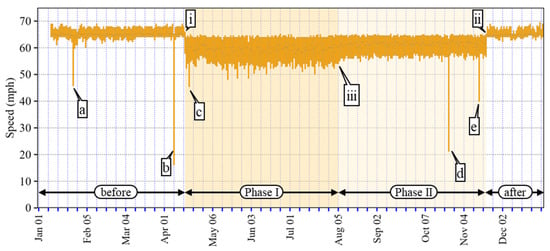
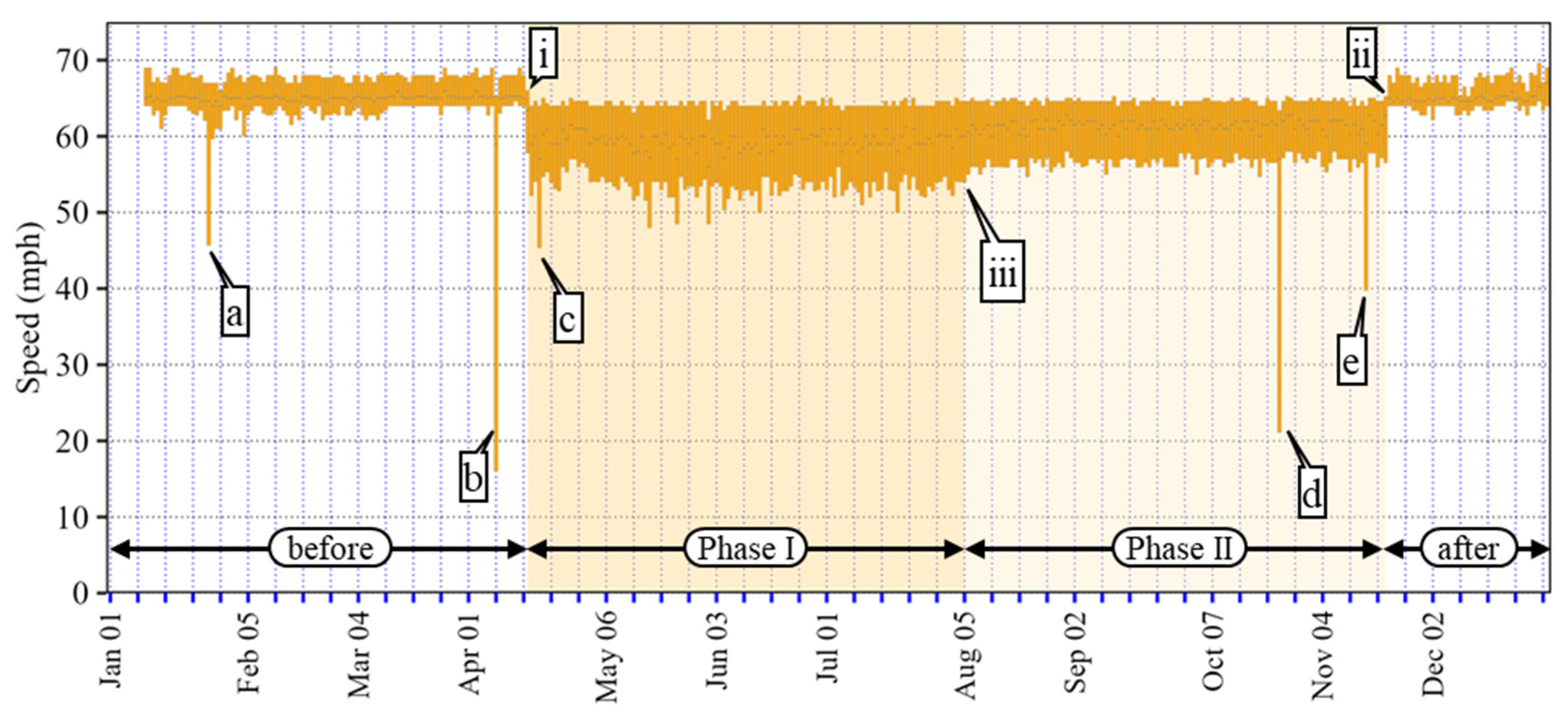
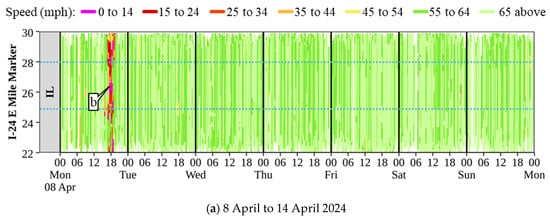
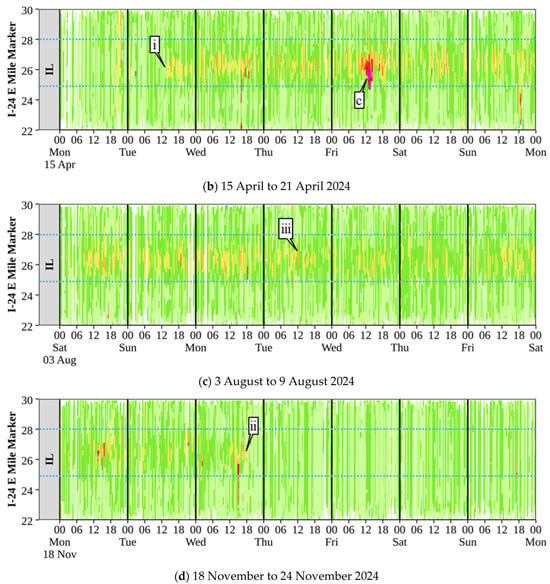
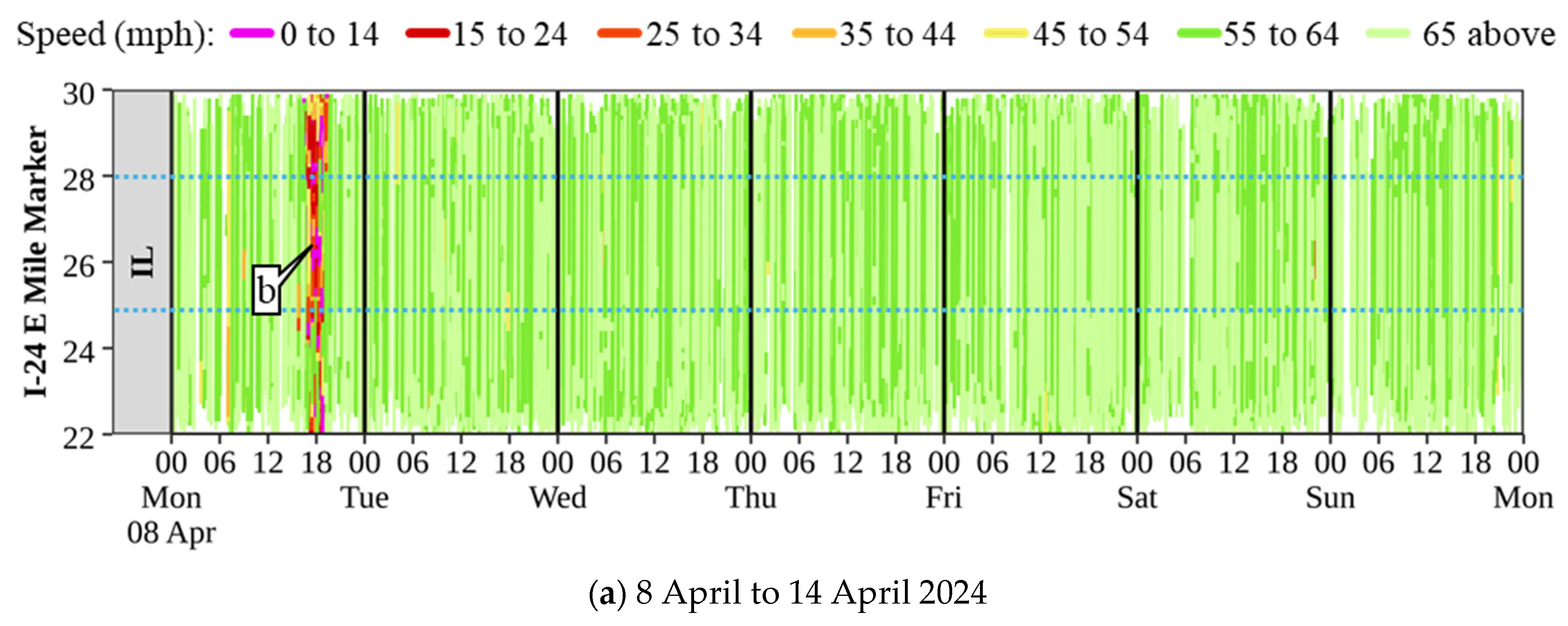
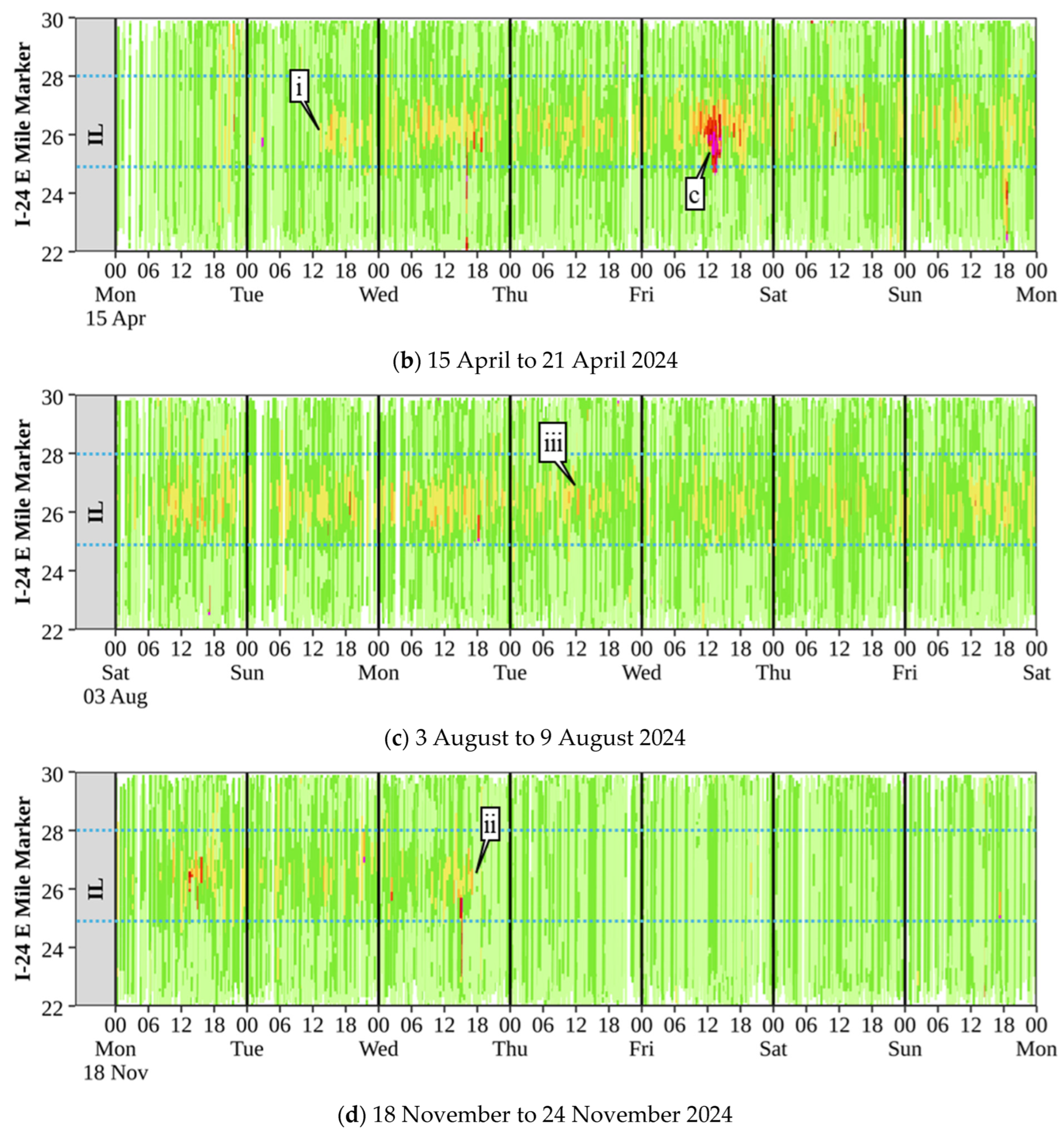
Figure 3 shows daily speed quantiles for the IL work zone for 2024. The bottom, middle and top edges of the bar represent the 25th percentile, 50th percentile or median and 75th percentile speeds for the entire day. Data was not available for the first week in January. The median speeds were generally around 65 mph. Callout i shows the location of the first drop in speeds on Tuesday, 16 April 2024, to 60 mph, indicating the start of the work zone activity. The information was also cross-verified with the project engineer, who confirmed the EB traffic was reduced to a single lane on this day. Spatiotemporal traffic speed “heatmaps” are actively used to identify congestion and visualize queue propagation on Interstates [21,27]. Figure 4 shows a select week’s heatmaps for IL I-24 in the EB direction for an 8-mile section from MM 22 to 30. The work zone area is highlighted with blue dotted lines. Slower speeds started around 1 PM on Tuesday in Figure 4b (callout i), also indicating the start of work zone activity. The slower speeds continued for several subsequent months, as seen in Figure 3. Callout ii shows the location of the speeds returning to free flow (pre-construction levels) on Wednesday, 20 November 2024, indicating the end of work zone activity for 2024. The heatmap in Figure 4d (callout ii) also confirms the speeds returning back to normal at around 4 PM. During the week of 5 August, the speeds were observed to improve slightly. This indicated a change in the work zone setup that resulted in improved mobility. This might have been due to a combination of factors such as location of work activity or cross-over traffic. The heatmap in Figure 4c (callout iii) also shows speeds improving during several hours after noon on Tuesday, 6 August 2024. For ease of discussion, the time periods for the IL work zone for 2024 are divided as follows:
Figure 3.
Traffic speed for IL I-24 EB work zone in 2024.
Figure 4.
Weekly spatiotemporal traffic speed heatmaps for IL I-24 EB from MM 22 to 30.
- “Before” construction period prior to 15 April;
- “Phase I” period from 16 April to 6 August;
- “Phase II” period from 7 August to 20 November;
- “After” construction period post 21 November.
The interquartile range of speed, a measure of reliability, is given by the length of the bars in the speed plot (Figure 3). This range increased during phase I (around 12 mph) and phase II (around 8 mph) compared to about 5 to 6 mph during the before and after periods.
The long tails of speeds on particular days are indicative of specific events causing speeds to decrease significantly. Callout a and b show two such days during the before periods on 26 January and 8 April, when the 25th percentile speeds dropped to 46 and 16 mph, respectively. Callout c shows a slowdown on 19 April, during the first week of phase I. Callouts d and e point to two other days during phase II on 24 October and 15 November, lowering the 25th percentile speeds to 21 and 40, respectively. The lowest of all the days on 8 April (callout b) corresponds to the impact due to a solar eclipse event [28,29]. The heatmap in Figure 4a (callout b) shows the impact on the day of the eclipse, as the work zone was located within the path of totality. Concrete barriers were placed in the work zone on Friday, 19 April (callout c), causing a slowdown. The speed plot allows the agency to conduct agile monitoring of mobility through work zones, which, coupled with heatmaps, reveals insights on the time of an event, its duration or the extent of it.
4.3. Travel Time (M2)
Travel time is another operational measure identified in the final rule. The first and last waypoint for each of the truck trips passing through the work zone was used to estimate the travel time.
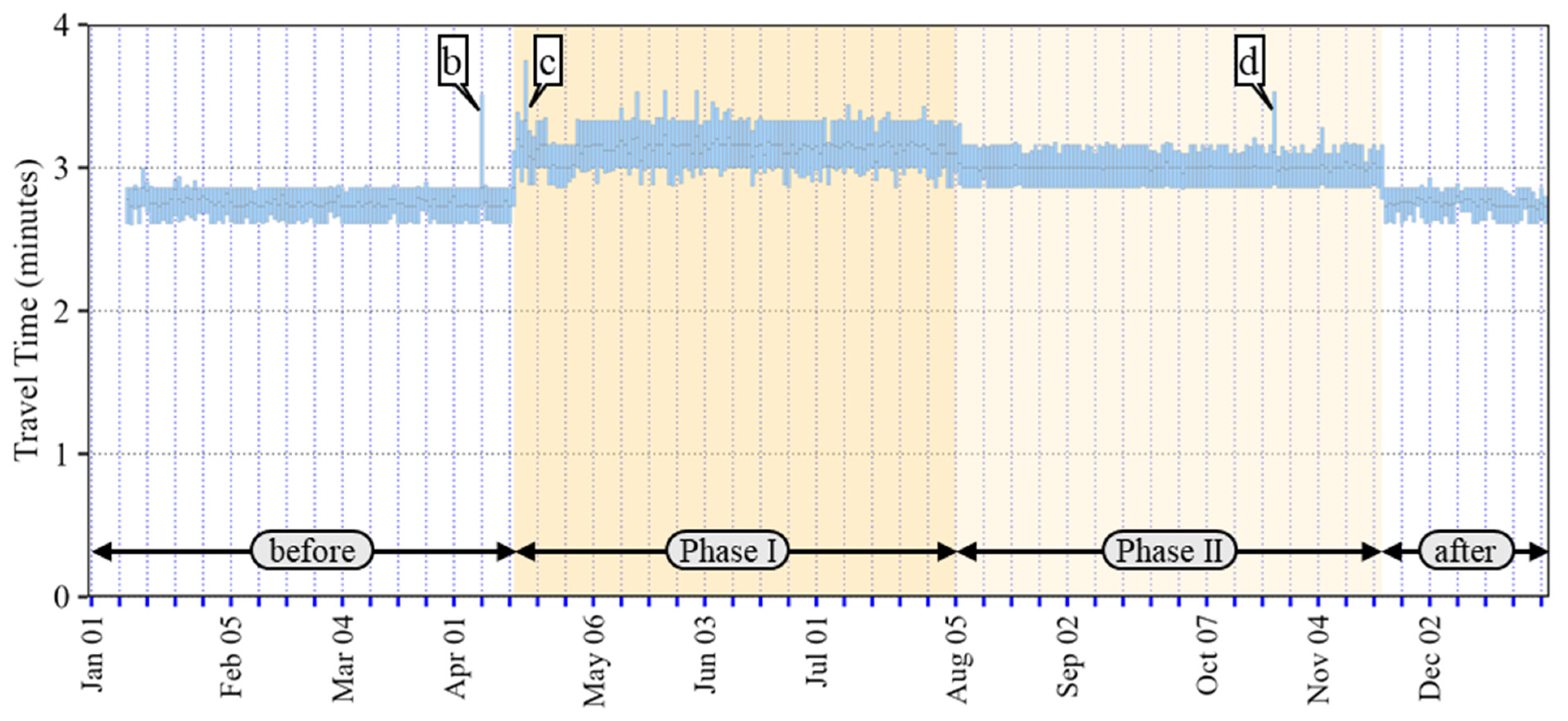
Figure 5 shows daily travel times through the IL work zone (Figure 2). As seen in the speeds, travel times also show similar changes longitudinally in 2024. During the before period, the travel times were around 2.8 min. They increased to 3.2 min during phase I (15% increase) and to 3 min during phase II (7% increase). Travel times in the after-construction period mimicked those in the before period. A spike in travel time was seen on 8 April, 19 April and 24 October, as shown by callouts b, c and d, respectively. These also correspond to the respective events called out in the speed plot (Figure 3) and heatmaps (Figure 4).
Figure 5.
Travel time for IL I-24 EB work zone in 2024.
4.4. Queue Length (M3)
Queue lengths usually indicate a stretch of traffic that is moving slowly or is completely stopped. Typically, situations are considered congested or as queued traffic on Interstates if speeds are lower than 45 mph. States are allowed to define their preferred speed thresholds for congested conditions. During the analysis, a queue is considered only when the congested traffic lasts at least 15 min and more than 0.5 miles in length. Any shorter queues or durations were considered short temporary impacts that would not be accurately captured by the 10 to 60 s temporal latency of CV truck data.
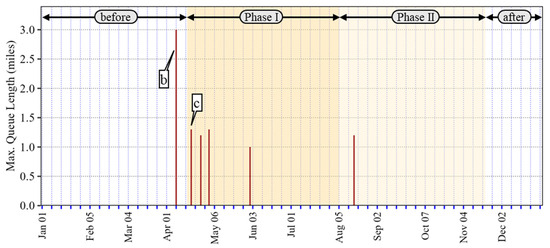
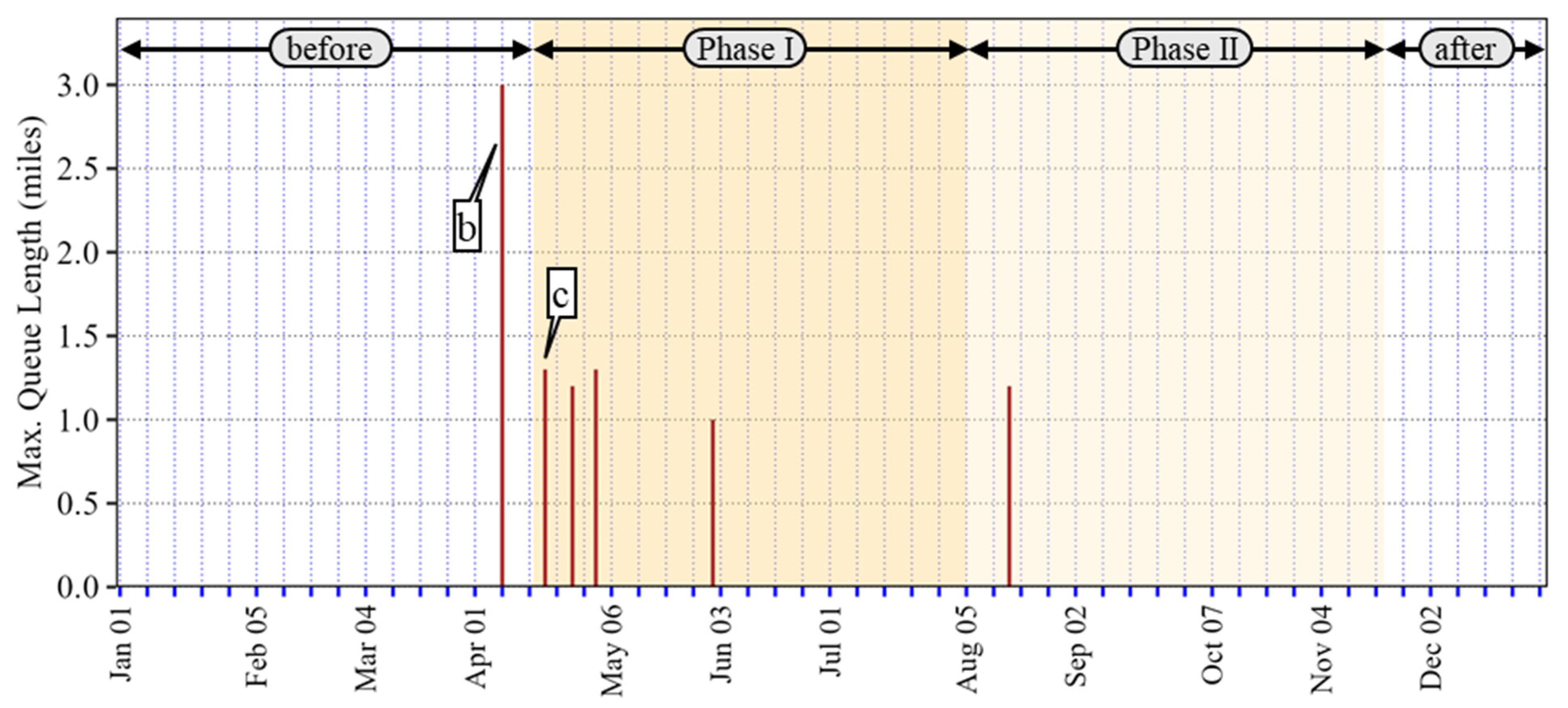
Figure 6 shows the daily maximum queue length for the IL work zone in 2024. Six different days had queue lengths of 1 mile or greater, of which one occurred during the before-construction period (callout b) on the day of the eclipse, and four days were in phase I and one in phase II. A recurrence of queues over multiple days or significantly longer queues would warrant agencies’ further attention for proactive management.
Figure 6.
Maximum queue length for IL I-24 EB work zone in 2024.
4.5. Queue Duration (M4)
Queue duration is defined as the time difference between the start of the queue, i.e., the first time speeds dropped below 45 mph, and the end of the queue, i.e., traffic speeds are greater than 45 mph throughout the work zone. If there is more than one queue that was identified on a single day, the maximum of all the queue durations is shown.
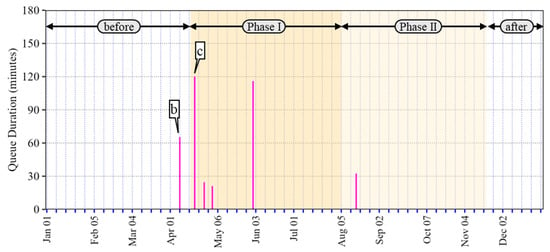
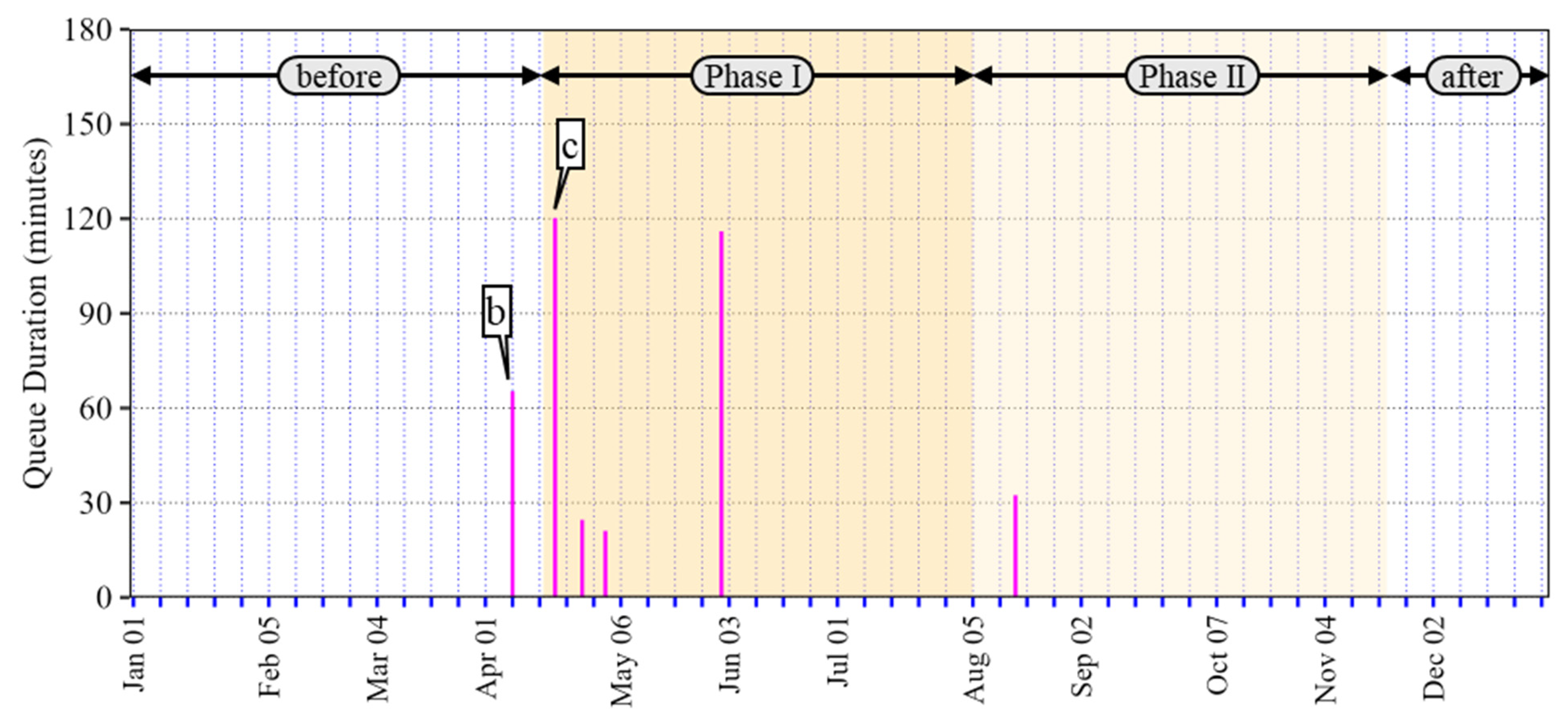
Figure 7 shows the daily queue duration for the IL work zone in 2024. The same six days that were identified in Figure 6 are observed with durations ranging from 20 min to 2 h. Callout b and callout c point to eclipse day and barrier placement day, respectively, as discussed in the speed plot (Figure 3) and heatmaps (Figure 4).
Figure 7.
Queue duration for IL I-24 EB work zone in 2024.
4.6. Congested Mile-Hours (M5)
Queue length or queue duration usually conveys only the spatial or temporal extent of the queue, respectively. Congested mile-hours are defined as the area of the congested regime in a time–space diagram that combines both spatial and temporal dimensions.
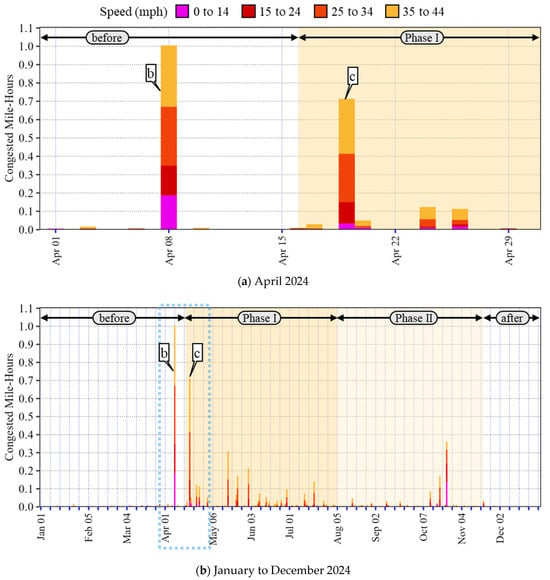
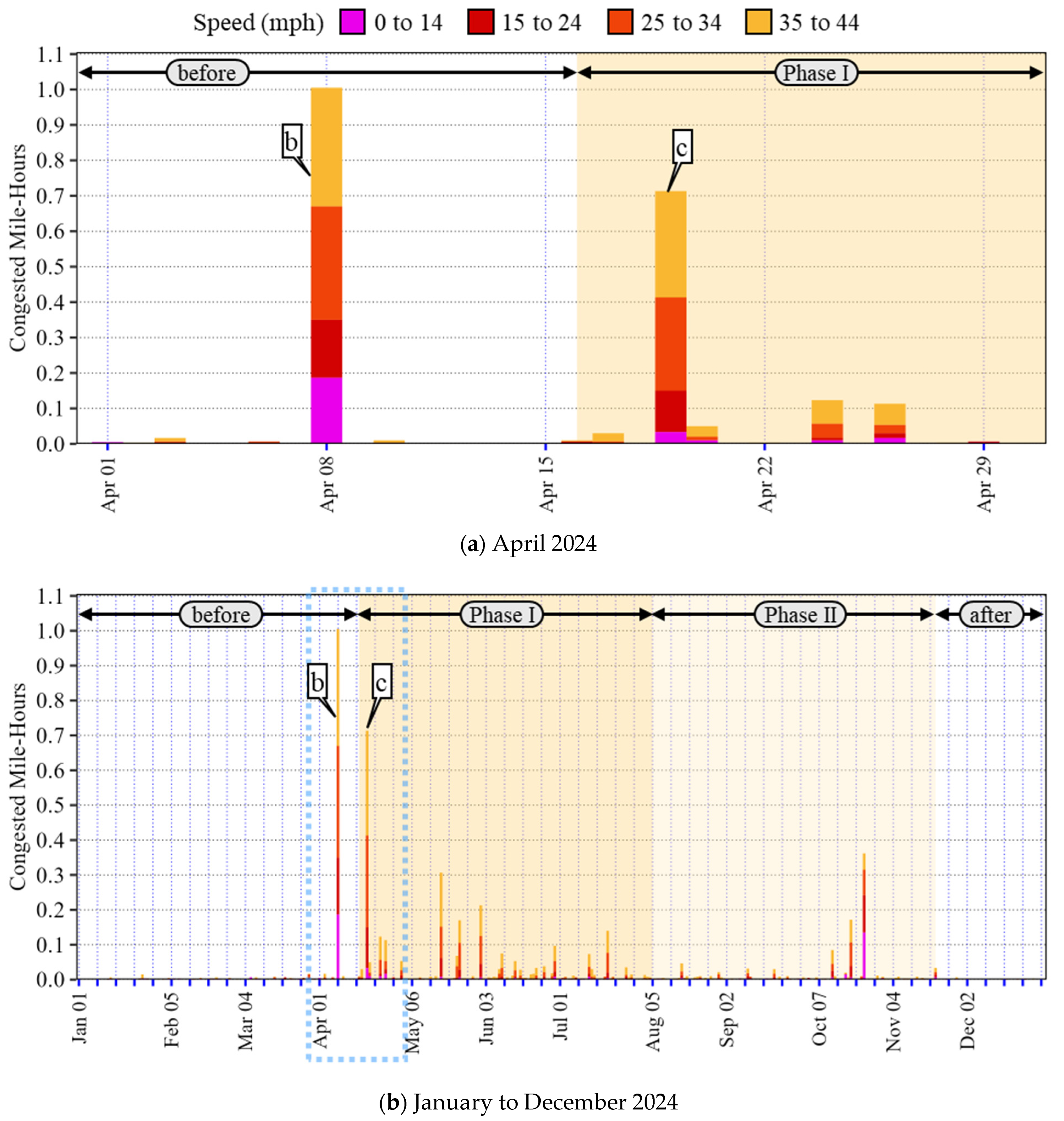
Figure 8 shows congested mile-hours for the IL work zone. It is categorized into 4 speed bins by its severity and stacked daily. Figure 8a shows only the month of April 2024. Callouts b and c show the eclipse day and barrier placement day, respectively. Figure 8b shows the entire year of 2024 with each bar corresponding to a day. The time window shown in Figure 8a is highlighted by a blue dashed box in Figure 8b. Except for the day of the eclipse (callout b), most days with significant congested mile-hours were observed during phase I or phase II.
Figure 8.
Congested mile-hours for IL I-24 EB work zone in 2024.
4.7. Hard Braking and Hard Acceleration Events (S1)
One of the promising surrogate measures for safety is hard braking events. Previous studies have shown a strong correlation between hard braking events and crashes on freeways [30,31,32]. Acceleration was estimated for every two consecutive waypoints from the same CV using Equation (1).
where and are instantaneous speeds from the same CV with two consecutive waypoints recorded at times and . For trucks, the difference between and is usually 10 to 60 s. It is important to note that due to the temporal fidelity of trucks, it is possible to miss some of the hard braking or hard acceleration events.
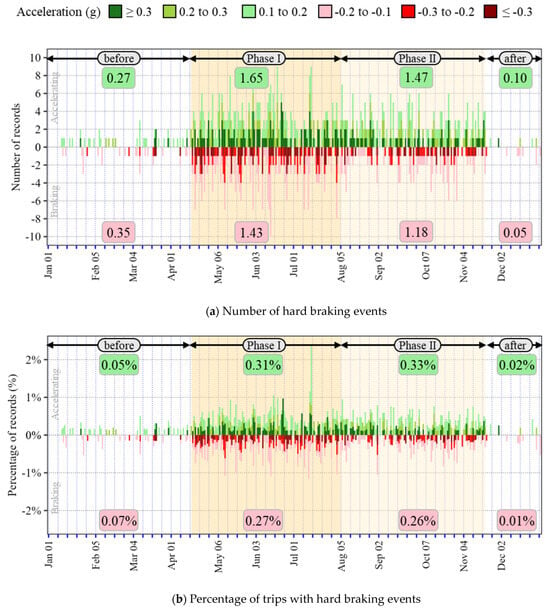
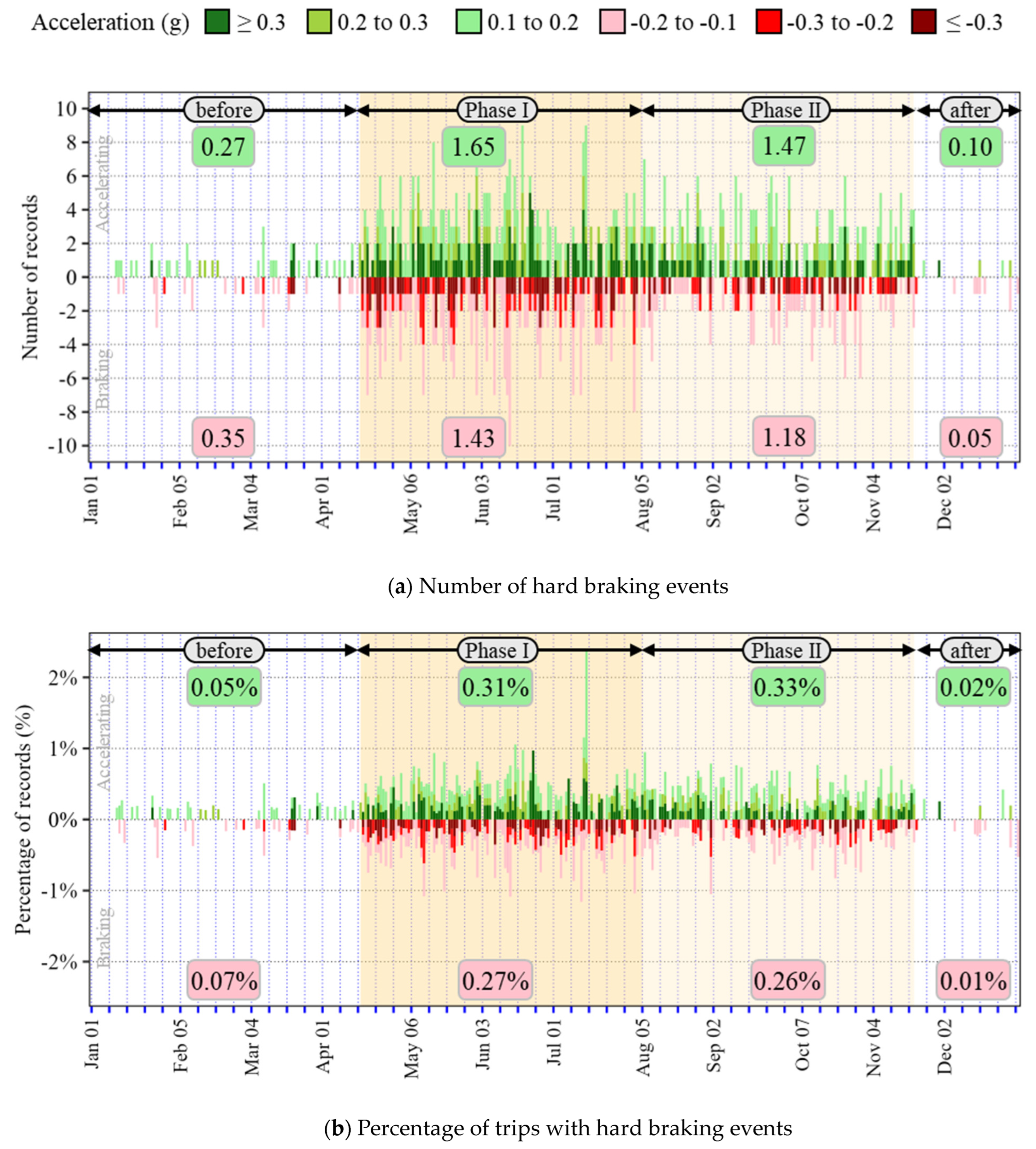
Figure 9a,b show the number and percentage of hard braking (negative sign or red) and hard acceleration events (positive sign or green) each day for the IL work zone, respectively. The percentages of hard braking or hard acceleration are computed as the ratio between the number of unique events and the number of unique trips within the work zone. The estimation of braking also allows agencies to categorize the severity of these events. The values in the boxes represent daily averages for each of the phases.
Figure 9.
Hard braking and hard acceleration events for IL I-24 EB work zone in 2024.
- During phase I, the hard braking events per day (1.43) were approximately 4 times those of the period before construction (0.35) (Figure 9a).
- When the project entered phase II, the hard braking events per day decreased to 1.18. Similar trends can be observed for acceleration events.
Although truck data can be used to estimate these hard braking or hard acceleration events and provide a good understanding of trend changes, the higher ping rates, higher sample sizes and broader cross-section of car drivers in PC data yield better estimates.
4.8. Speed Differentials (S2)
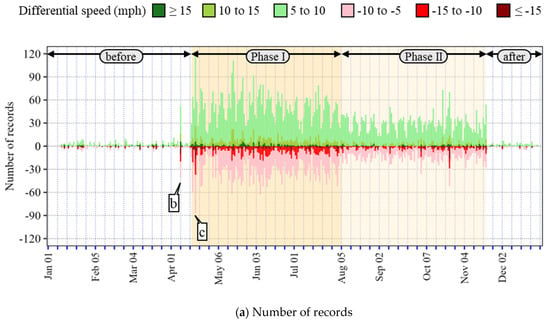
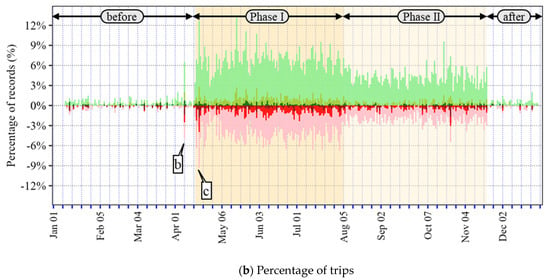
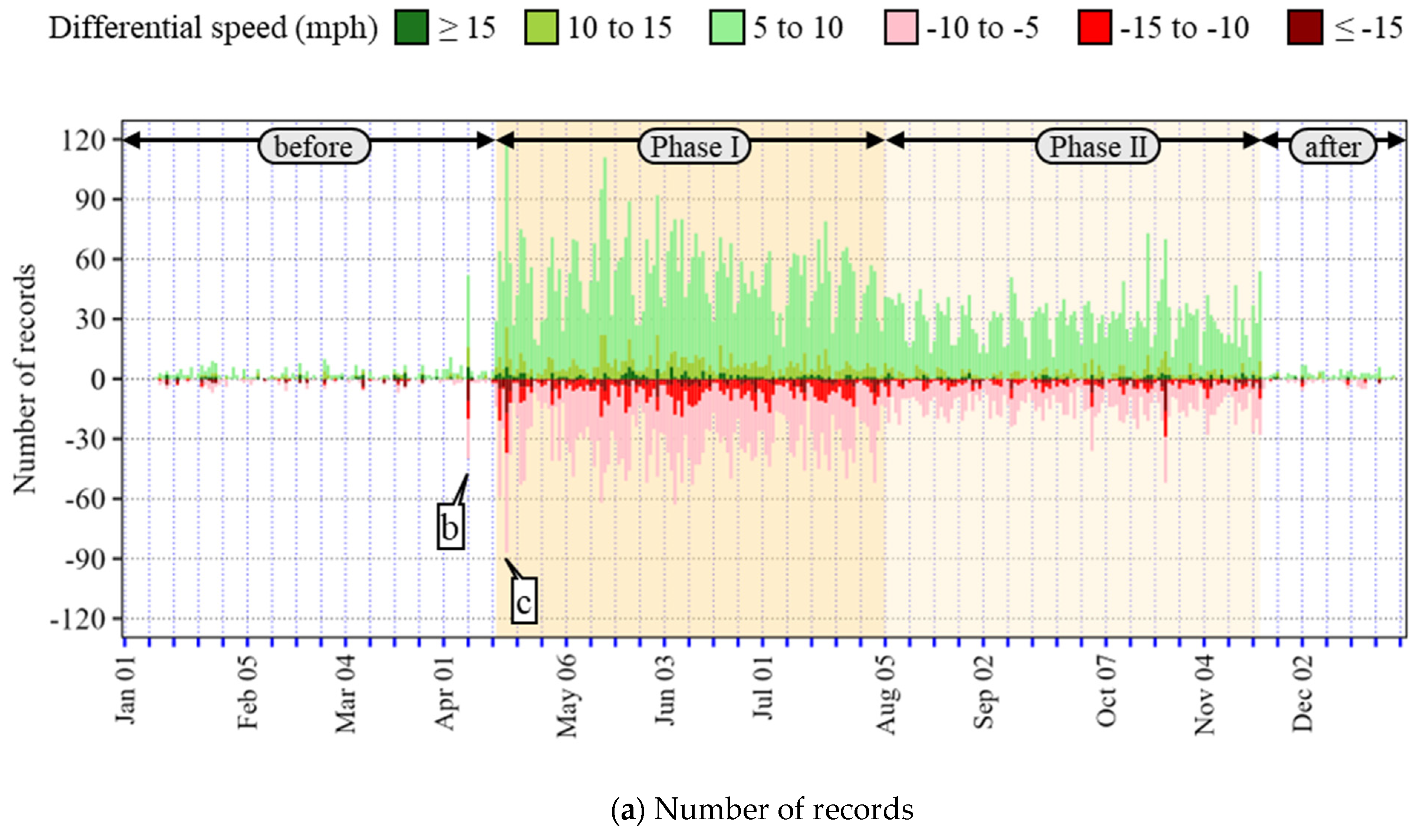
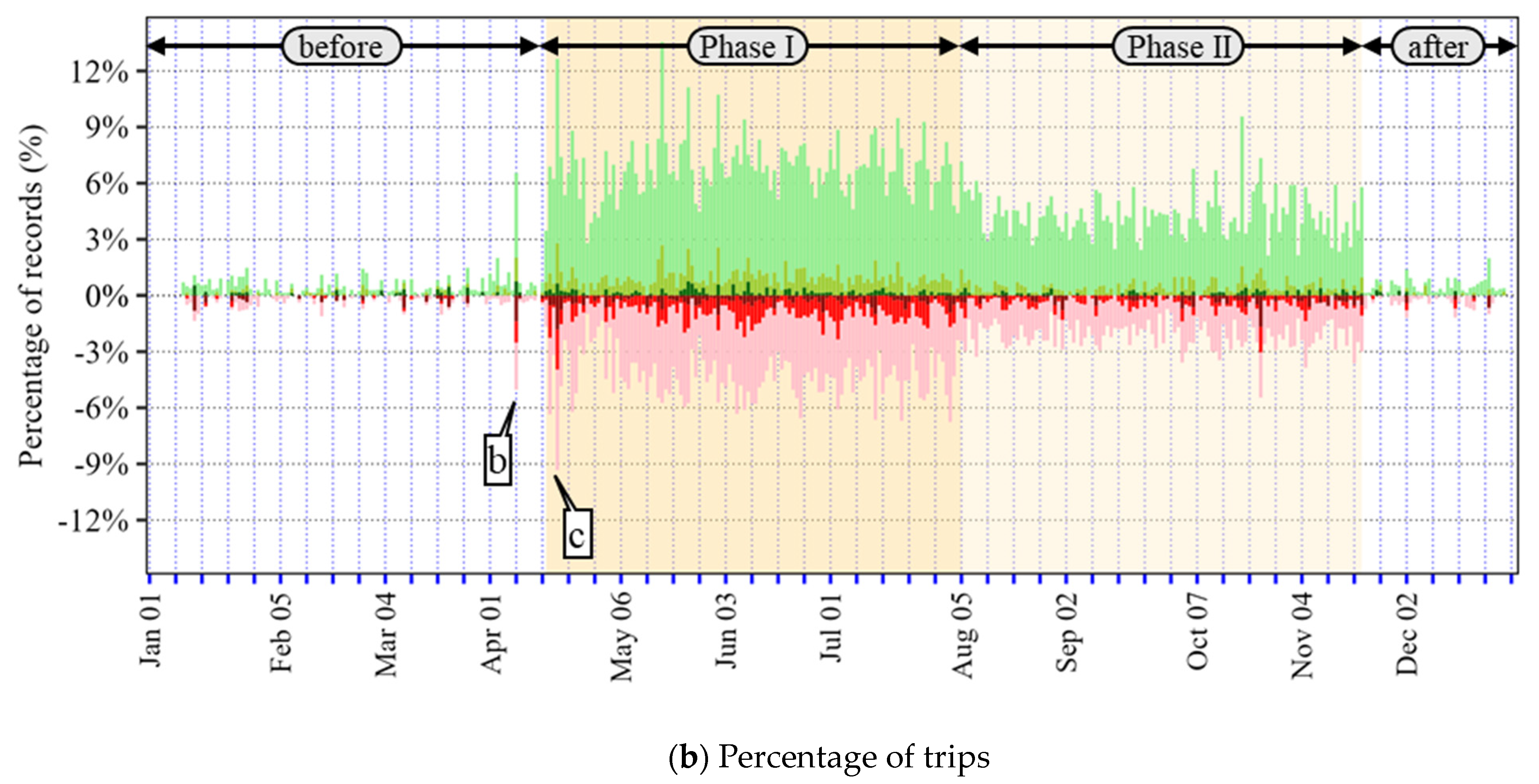
The speed differential is defined as the difference between the speeds of consecutive waypoints within the work zone area. The speed differential values were then categorized into three different severity levels of 5 to 10, 10 to 15 and greater than 15 mph. The negative sign (red) indicates a decrease, whereas the positive sign (green) indicates an increase in speed.
Figure 10a,b show the number and percentage of speed differentials for the IL work zone. No significant changes in speed were observed during the before or after periods except for eclipse day’s impact on April 8 (callout b). It is worth noting that speed decreases greater than 10 mph are observed more frequently compared to speed increases of the same severity. This indicates that there are gradual speed increases and, in contrast, some sudden speed decreases within the work zone.
Figure 10.
Speed differentials for IL I-24 EB work zone in 2024.
4.9. Other CAV Data (S3)
The evolution of CAVs presents an opportunity to obtain advanced safety-related attributes and measures. These developments are in the early stages, and a nationwide crowdsourced scale has yet to be operationalized. The current study does not cover these in detail; however, options are presented for future scope. Some advanced CAV data measures [33] for safety could involve:
- Seatbelt usage;
- Lane departure warnings;
- Collision mitigation braking;
- Lane keeping assist usage.
4.10. Vehicle Miles Traveled (E1)
The number of vehicles traveling is indicative of the traffic volume, which might be impacted due to a work zone. CV data is a representative sample of the traffic stream; however, the penetration rates might vary depending on the region. Hence, estimation of traffic volume solely based on CV volumes might not be an accurate indicator.
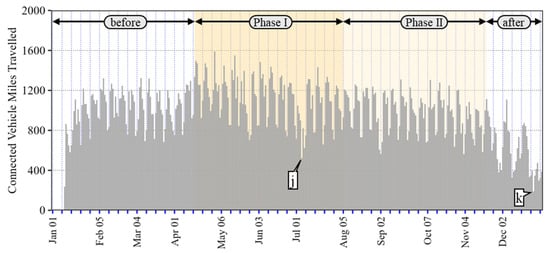
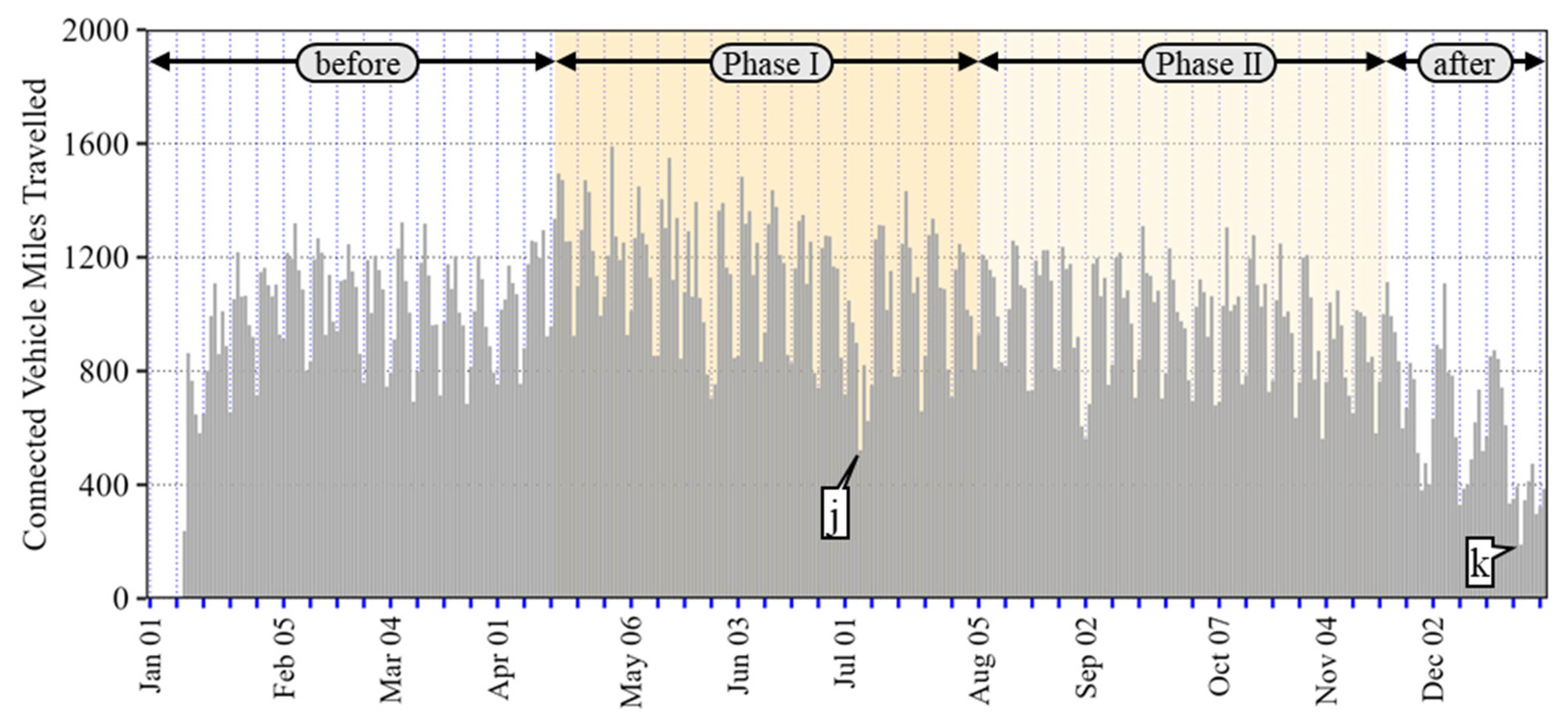
Figure 11 presents the daily vehicle miles of connected trucks through the IL work zone for 2024. The vehicle miles show a weekly trend and seasonal variation, with the winter months of December and January having lower volumes. Callouts j and k point to a drop in connected truck volume on 4 July and 25 December 2024, respectively, due to national holidays.
Figure 11.
Vehicle miles traveled for IL I-24 EB work zone in 2024.
4.11. Virtual Drive (E2)
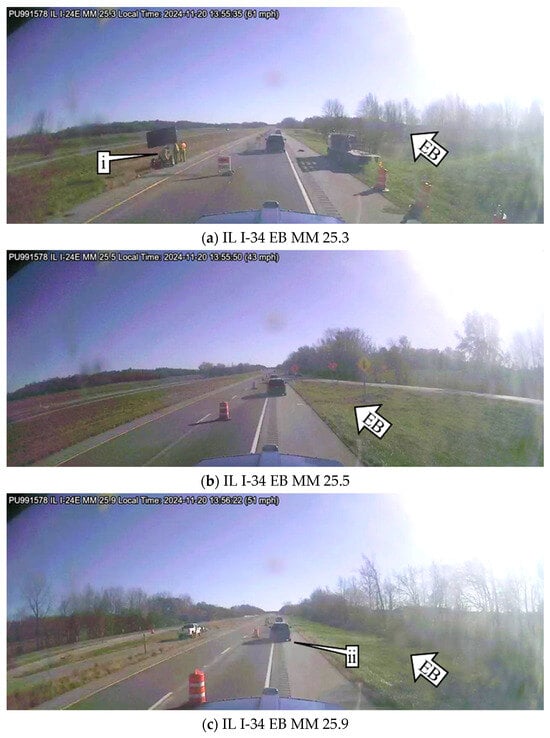
Images of work zones provide context to agencies on setup, signage and any other visual cues. Agency staff drive through their work zones occasionally. This requires a significant investment of time and effort for the staff. The recent growth in providers with the ability to fetch dash camera images from several trucks has presented agencies with an opportunity to obtain more frequent images from work zones through “virtual drives”. A previous study has detailed the coverage of trucks with the capability of providing dash camera images on US Interstates [34].
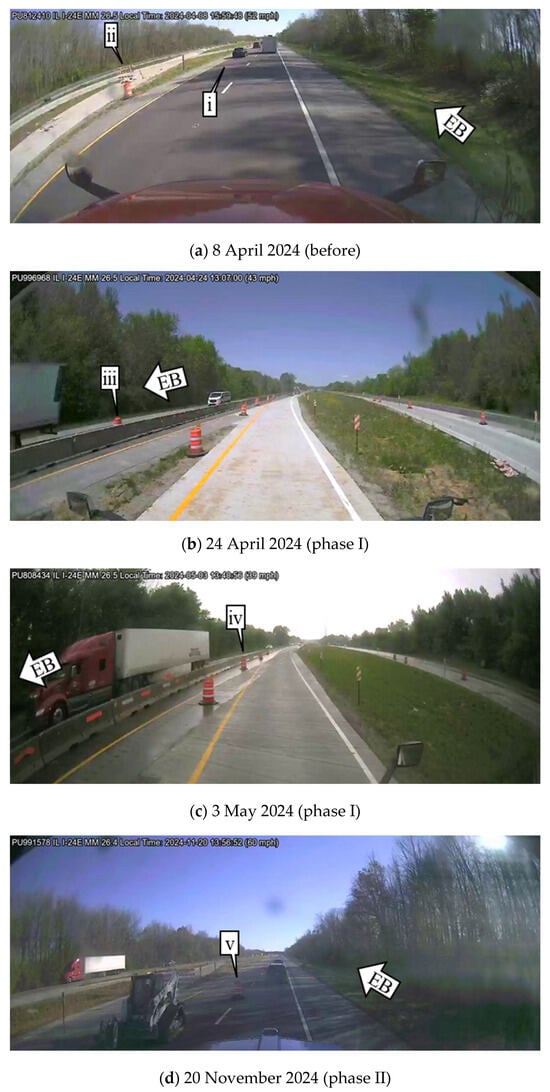
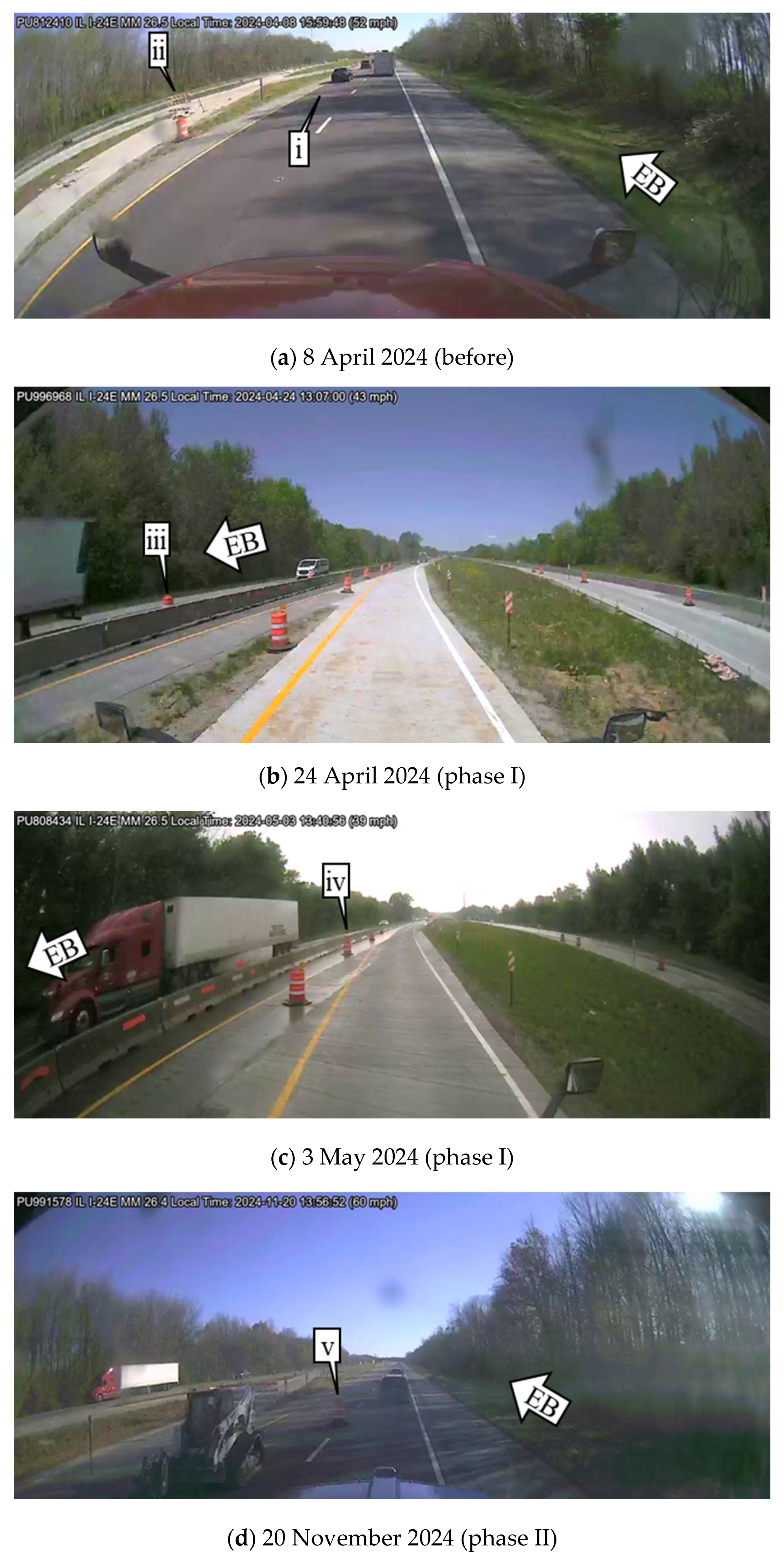
Figure 12 shows select dash images near MM 26.5 within the IL work zone. Each of the dash camera images is printed with a morphed truck identifier, state, route, direction of travel, mile marker, date, time and speed in the top left corner. Figure 12a shows a dash camera image from 8 April 2024 in the EB direction. Both lanes of travel were open, and traffic was moving normally (callout i). Callout ii shows barrels and a closed crossover lane. Figure 12b shows a dash camera image from a truck that is using the crossover lane from WB to EB on 24 April 2024, during phase I. This confirms the crossover lane was opened and operational for diverting traffic from the WB direction. The traffic in the EB direction was reduced to one lane. Callout iii points to the concrete barriers and barrels that were separating the opposing traffic. Figure 12c shows another dash camera image from 3 May during phase I, confirming similar conditions. Figure 12d shows a dash camera image from 20 November, the last day of phase II. Callout v shows that the concrete barriers were not present anymore; however, EB traffic was still restricted to one lane.
Figure 12.
Dash camera images at MM 26.5 for IL I-24 EB work zone.
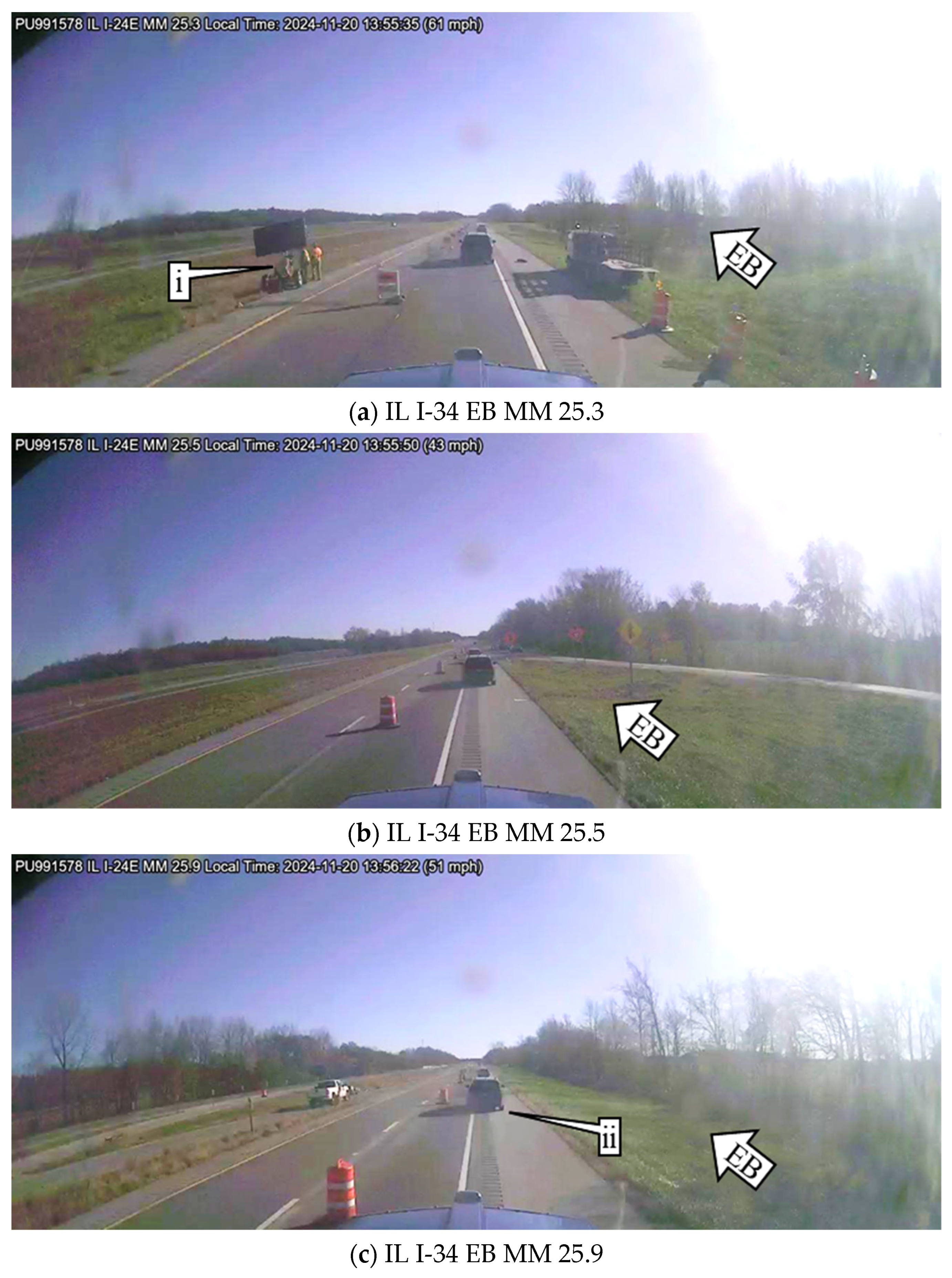
An additional set of images from the last day of phase II is further displayed in Figure 13. Callout i points to the sign being removed, indicating the work zone removal operation was underway around 2 PM on 20 November 2024. This re-confirms the earlier datasets and heatmap callout ii in Figure 4d. Callout ii points to drivers having to use the shoulder area due to the placement of barrels.
Figure 13.
Last day of lane closure on 20 November 2024, as the teardown operation was active.
Overall, these performance measures allow agencies to track their work zones to granular levels and make agile data-driven decisions that improve the safety and mobility of statewide work zones.
5. Evaluation of Scalability at a National Level
As part of the pooled fund study TPF-5(514), agencies identified work zones for performance monitoring in 2025. In total, 101 work zones across nine states were identified. Table 2 summarizes the state-wise Interstates covered and total miles of work zones. Illinois had the most, with 31 work zones, and Delaware had only 1 work zone due to limited Interstate coverage. Texas had the highest average miles per work zone due to the long work zones identified around the metropolitan areas.
Table 2.
Summary of 101 national work zones in 2025.
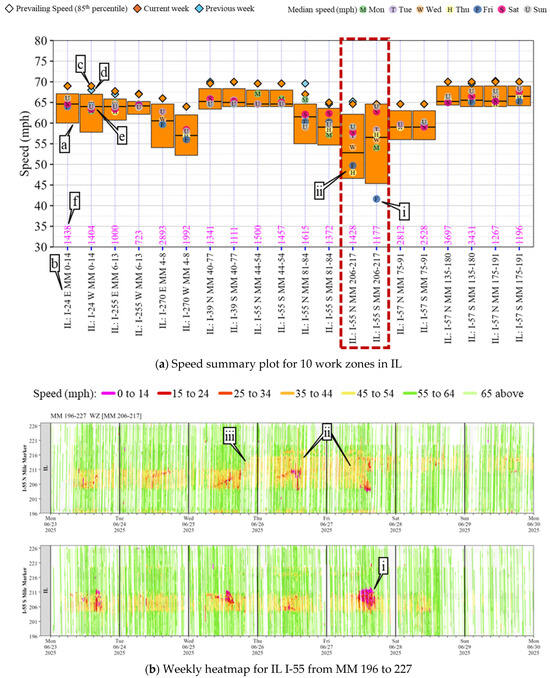
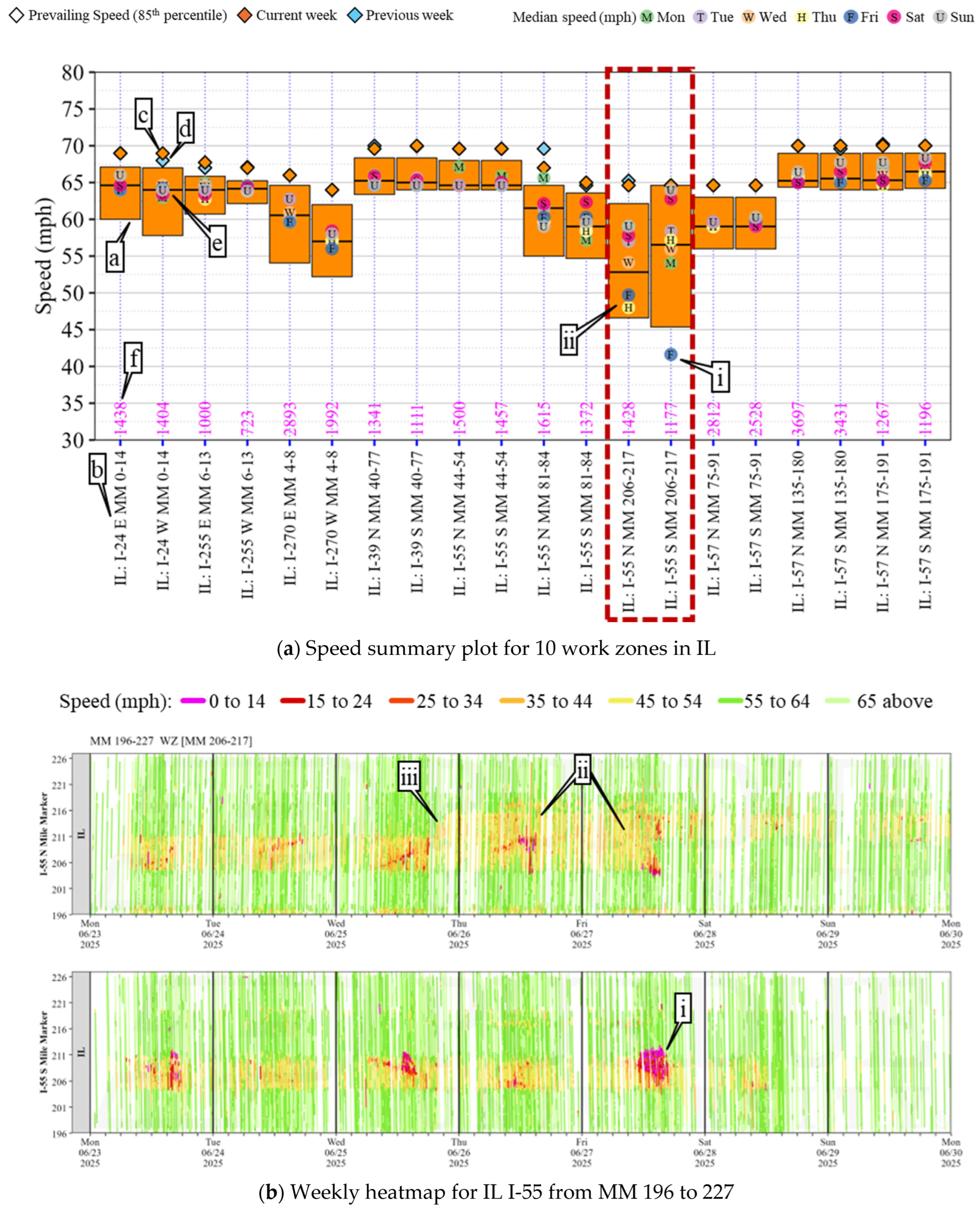
As the states started to converge on detailed options of performance measures, a common interest emerged in the operational and prevailing speeds through a work zone. Figure 14a shows speed summaries across 10 work zones in IL. Each bar corresponds to speeds for a work zone by the direction of travel. Both directions of travel are next to each other for each of the work zones. The bar (callout a) shows speed quantiles for a week. The name of the work zone (callout b) is shown as the state followed by the route, direction of travel and MM range on the horizontal axis. Prevailing speed is defined as the 85th percentile speed for all the waypoints within a work zone area for the entire week. Callout c and callout d show the prevailing speeds for the current week and the previous week, respectively. Both weeks’ prevailing speeds are shown on the same plot to quickly gauge if the speeds improved or worsened compared to the previous week. If the orange diamond (current week) is above the blue diamond (previous week), it indicates an improvement in the speeds during the analysis week. The median speed for each of the days is also shown on the bar (callout e) to quickly identify if a particular day had slower traffic or if the impacts were equivalent across days. Callout f points to the number of weekly truck trips analyzed. If the number of weekly trips is less than 100, the speed data might not be representative of the traffic conditions in the work zone due to lower truck volumes.
Figure 14.
Illinois work zones summary for the week of 23 June 2025.
Among the sample of 10 work zones identified in Figure 14a, the work zone along I-55 from MM 206 to 217, as highlighted by the red dashed lines, had the lowest 25th percentile speeds. After identifying a work zone of interest, it can be further evaluated using a deeper dive visualization of traffic speed heatmaps. Figure 14b shows a heatmap for the I-55 work zone for the same week of 23 June 2024. Callout i in Figure 14a points to the lowest speed on Friday for the southbound (SB) direction. This is confirmed by the callout i heatmap, which shows speeds below 25 mph for about 5 h from approximately 11 AM to 4 PM. The boundaries of work zones’ impact on traffic can also be seen from the yellow band on heatmaps throughout the week. Traffic speeds returned to normal in the SB direction midday on Saturday. Callout ii points to the lower speeds on Thursday and Friday in the northbound (NB) direction for the same work zone. Callout ii on heatmap confirms the drop in speed is due to the larger impacted region of the work zone compared to the previous days of the week. Callout iii points to a time on Wednesday at around 7 PM, when the work zone setup was extended downstream from MM 211 to MM 216. The active work zone operation from MM 206 to MM 211 in the NB direction was also cleared in the late afternoon on Friday.
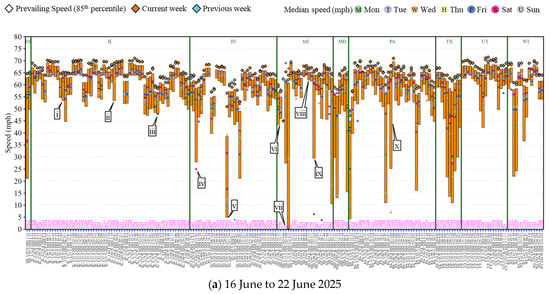
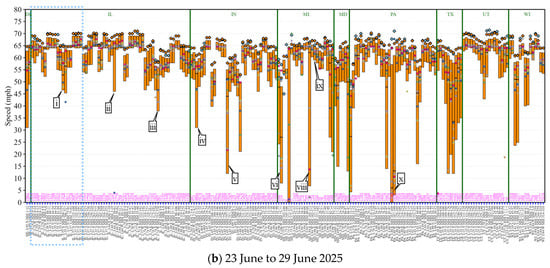
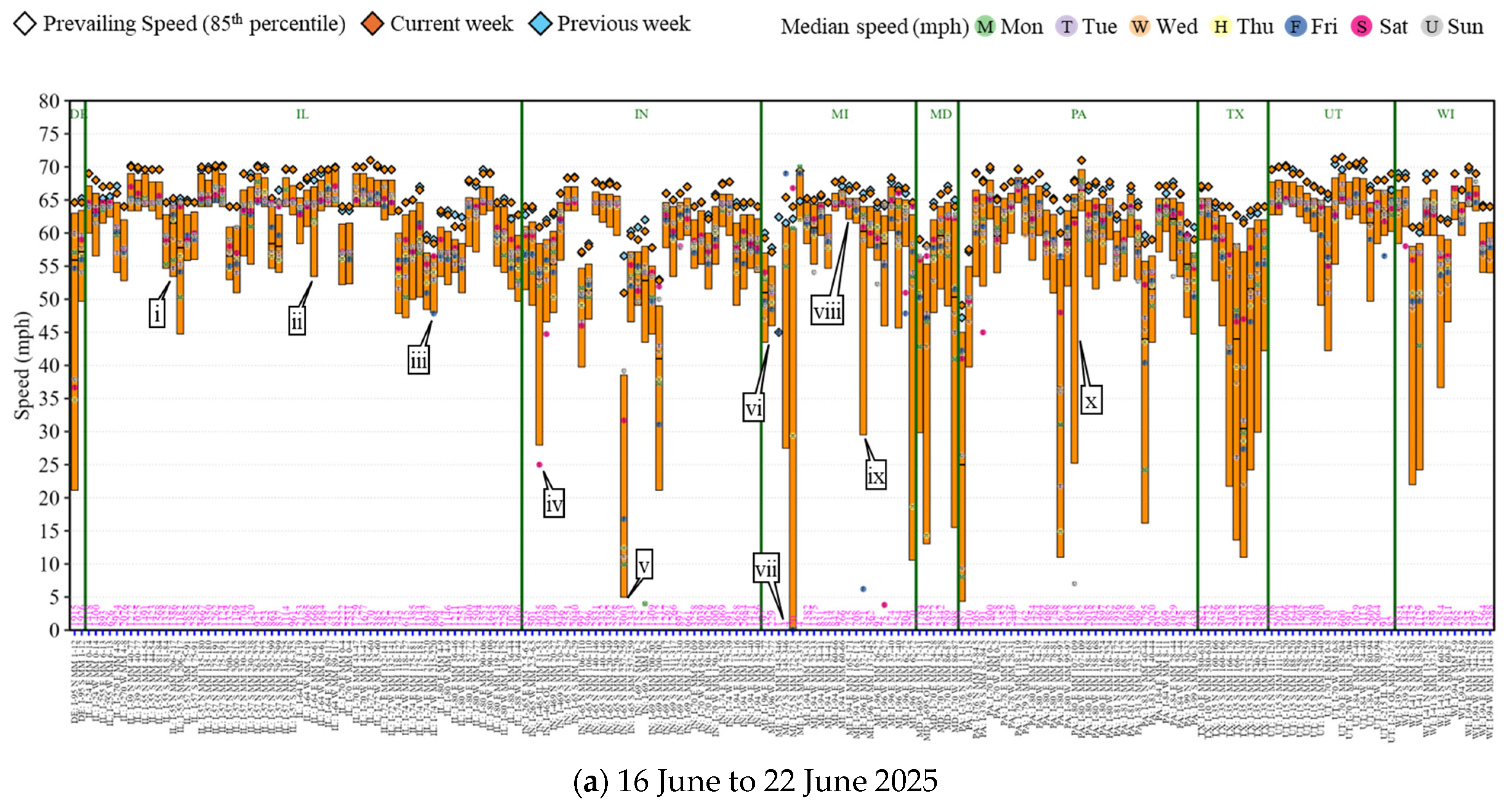
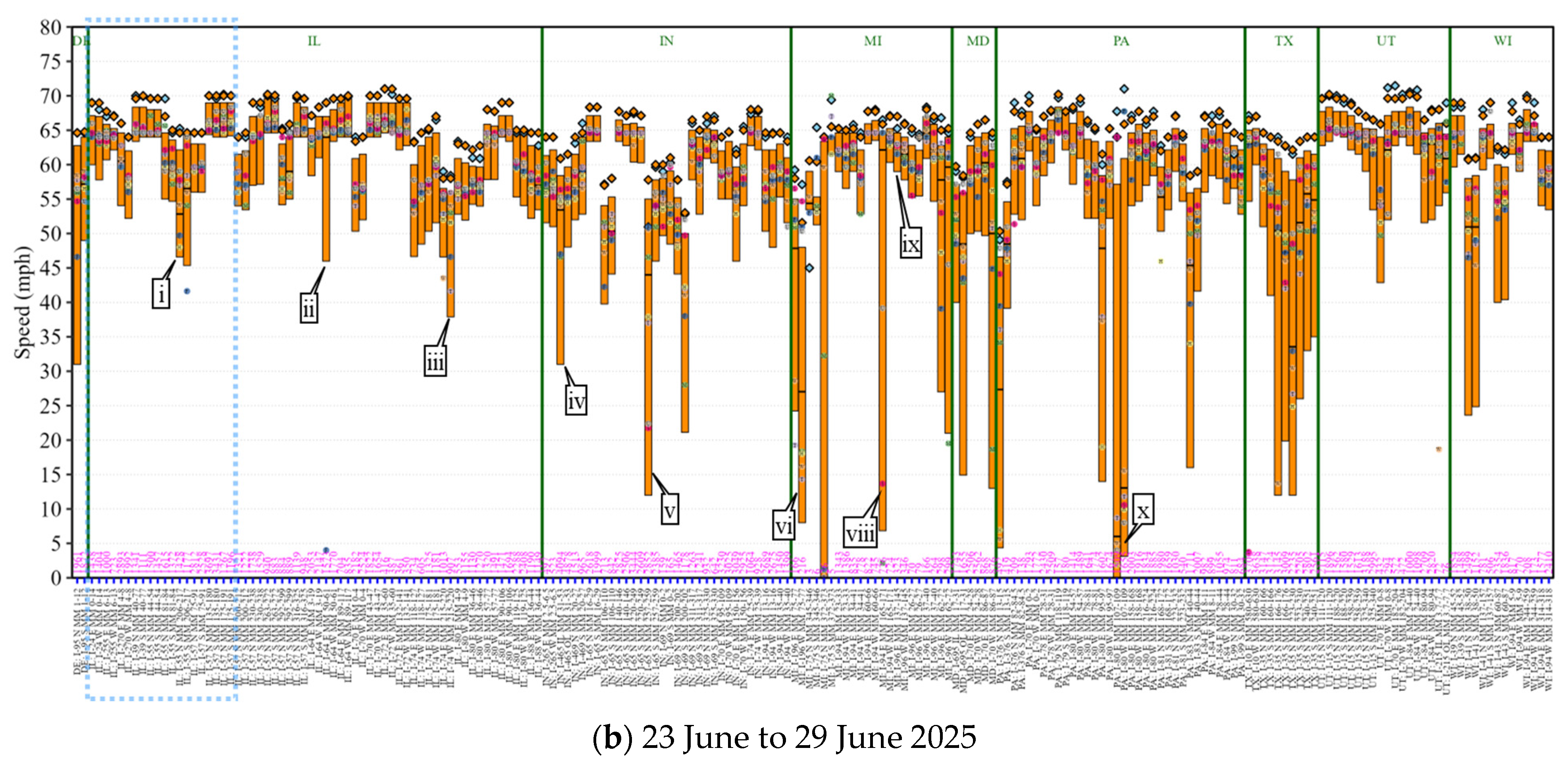
The weekly nationwide summary speed plots are generated for all 101 work zones and distributed to the respective agencies every week, along with traffic speed heatmaps for the respective work zones. This helps decision-makers quickly assess statewide performance week by week and identify areas that would require further investigation. An example of this is shown in Figure 15, which shows weekly summary speed plots for two consecutive weeks in June 2025. Figure 14a is a subset of the plot in Figure 15b highlighted by the blue box.
Figure 15.
Comparison of weekly speed summary plots across 101 national work zones.
The select 10 work zones that showed significant changes from the week of 16 June to the week of 23 June are highlighted by callouts i to x, respectively, in Figure 14a,b. Callout i points to the I-55 work zone that was discussed in Figure 14. Callouts i, ii, iii, vi, viii and x show work zones with a significant decrease in speed, whereas callouts iv, v and ix show work zones with speed improvements during the week of 23 June compared to the previous week. Callout vii points to a work zone in Michigan that had CV truck volumes of less than 10 over the entire week, indicating the speeds for this work zone were unreliable.
The visualizations presented allow stakeholders to quickly scan the statewide work zones and identify zones needing further attention on a weekly basis, allowing for agile data-driven monitoring of work zones.
6. Conclusions
The FHWA recently published a final rule in 23 CFR Part 630 Subpart J on Work Zone Safety and Mobility. This final rule suggested a list of performance measures that states can adopt for monitoring and reporting throughout all stages of construction work zones on highways.
- Table 1 provided a summary of CV data sources that can be used to produce performance measures defined in the final rule. This paper provided several examples illustrating how these performance measures could be collected from truck data.
- Figure 3 demonstrated how performance measures could be calculated and used to identify how construction phase changes can have subtle but measurable impacts on speeds.
- Figure 9 demonstrated the applicability of a surrogate safety measure, hard braking, and how it changes during different phases of the construction project. Although truck data can be used, even higher sample sizes and improved fidelity can be obtained from PC data.
- Figure 14a provided a graph that illustrates how multiple work zones within a state can be easily monitored by a one-page summary generated each week from CV data. Figure 14b illustrated how outliers in the one-page summary (Figure 14a) could be quickly investigated for the location and duration of those outliers. These system-level reports are particularly valuable to agencies for quickly identifying changes on a week-by-week basis.
- Figure 15 demonstrated the scalability of these techniques to large states or regions and how weekly variations could be monitored to flag unusual conditions for further scrutiny from either dash camera images or field visits.
In summary, methodologies are presented that use CV data to report performance measures in line with the proposed measures in the Safety and Mobility rule. This study also shows the scalability of the methodology and limitations for implementation and reporting.
6.1. Limitations
One of the key limitations of CV data is its penetration rates. Remote areas may have a lack of market penetration of CVs, which can influence the ability to calculate measures. Market forces can dictate the availability and reliability of CV data and its providers. As indicated earlier, some of our measures, such as queue length detection algorithms, might not work well in areas with lower-to-sparse truck volumes. In those situations, agencies may want to invest in CV data from PCs to improve sample size and fidelity. Due to the volume of CV data, it is essential to store and analyze it on cloud platforms for efficient and timely processing of the data. Since many agencies are just starting to integrate cloud platforms into their business processes, there will likely be additional staff and professional development required to efficiently integrate them into agencies’ operations.
6.2. Future Scope
A combination of CV data from PCs with trucks can massively improve several measures and represent a more robust sample. However, the cost of acquiring such data at a national level is significant and on the order of 20–40 times more costly. Agencies often have difficulty clearly identifying where/when their work zones are active, as field implementation always has slight variations from documented plans for a work zone due to practical reasons. The length of work zones as well as the precise start and end of work zone activity can be identified using a semi- or fully automated detection system. Emerging large language models will lead to techniques that could quickly assess dash camera images and detect changes or anomalies in work zones at scale. Agencies have expressed interest in inclusion of spatiotemporal data as one of the key metrics for work zone analytics.
Author Contributions
Conceptualization, R.S.S., J.P., J.M. (John McGregor) and D.M.B.; methodology, R.S.S.; software, R.S.S.; validation, J.D., M.O. and J.M. (Justin Mukai); formal analysis, R.S.S.; investigation, R.S.S.; resources, J.P. and J.M. (John McGregor); data curation, J.D., M.O., J.M. (Justin Mukai); writing—original draft preparation, R.S.S.; writing—review and editing, J.D., M.O., J.M. (Justin Mukai), J.P., J.M. (John McGregor) and D.M.B.; visualization, R.S.S.; supervision, J.P., J.M. (John McGregor) and D.M.B.; project administration, D.M.B.; funding acquisition, D.M.B. All authors have read and agreed to the published version of the manuscript.
Funding
This research was funded by the Joint Transportation Re-search Program and Pooled Fund Study (TPF-5(514)) led by the Indiana Department of Transpor-tation (INDOT) and supported by the state transportation agencies of Delaware, Illinois, Indiana, Maryland, Michigan, Pennsylvania, Texas, Utah, and Wisconsin, and the Federal Highway Admin-istration (FHWA).
Institutional Review Board Statement
Not applicable.
Informed Consent Statement
Not applicable.
Data Availability Statement
The datasets presented in this article are not readily available because the distribution of the raw data is restricted.
Acknowledgments
Connected vehicle truck trajectory data used in this study was provisioned from Omnitracs. Google Cloud Platform was utilized for cloud database warehousing and analytics. The dash camera images from commercial trucks used in this study were provided by Vizzion. The contents of this paper reflect the views of the authors, who are responsible for the facts and the accuracy of the data presented herein, and do not necessarily reflect the official views or policies of the sponsoring organizations. These contents do not constitute a standard, specification, or regulation. AI and LLMs were not used in drafting the contents of this manuscript.
Conflicts of Interest
The authors declare no conflicts of interest.
References
- NHTSA 2023 Fatality Analysis Reporting System (FARS) Annual Report File (ARF), National Highway Traffic Safety Administration (NHTSA), U.S. Department of Transportation. 2025. Available online: https://www.nhtsa.gov/research-data/fatality-analysis-reporting-system-fars (accessed on 17 July 2025).
- INRIX. INRIX 2024 Global Traffic Scorecard. Available online: https://inrix.com/scorecard/ (accessed on 21 July 2025).
- 102nd Congress, H.R.2950—Intermodal Surface Transportation Efficiency Act of 1991. Available online: https://www.congress.gov/bill/102nd-congress/house-bill/2950 (accessed on 18 July 2025).
- FHWA Highway Work Zone Safety Program. Available online: https://www.federalregister.gov/documents/1995/10/24/95-26226/highway-work-zone-safety-program (accessed on 18 July 2025).
- The Transportation Equity Act for the 21st Century. 2022. Available online: https://en.wikipedia.org/wiki/Transportation_Equity_Act_for_the_21st_Century (accessed on 18 July 2025).
- FHWA Work Zone Safety and Mobility and Temporary Traffic Control Devices. Available online: https://www.transportation.gov/bipartisan-infrastructure-law/regulations/2024-25065 (accessed on 30 July 2025).
- FHWA Work Zone Management Program. Available online: https://ops.fhwa.dot.gov/publications/fhwahop20029/app.html#15a (accessed on 21 July 2025).
- Sakhare, R.S.; Desai, J.C.; Mahlberg, J.; Mathew, J.K.; Kim, W.; Li, H.; McGregor, J.D.; Bullock, D.M. Evaluation of the Impact of Queue Trucks with Navigation Alerts Using Connected Vehicle Data. J. Transp. Technol. 2021, 11, 561–576. [Google Scholar] [CrossRef]
- INDOT Protect the Queue: INDOT’s Queue Awareness Program. Available online: https://www.in.gov/indot/safety/protect-the-queue-indots-queue-awareness-program/ (accessed on 8 December 2025).
- Sankar, P.; Boyapati, R.; Pate, A. Data-Driven Work Zone Process Reviews Case Study: Illinois Department of Transportation. Available online: https://ops.fhwa.dot.gov/publications/fhwahop23007/fhwahop23007.pdf (accessed on 24 July 2025).
- FHWA The National Performance Management Research Data Set (NPMRDS) and Application for Work Zone Performance Measurement. Available online: https://ops.fhwa.dot.gov/publications/fhwahop20028/index.htm (accessed on 21 July 2025).
- Pandit, D.M.; Kaushik, K.; Cirillo, C. Coupling National Performance Management Research Data Set and the Highway Performance Monitoring System Datasets on a Geospatial Level. Transp. Res. Rec. J. Transp. Res. Board. 2019, 2673, 583–592. [Google Scholar] [CrossRef] [Scilit]
- Turner, S.M.; Koeneman, P. Validating the National Performance Management Research Data Set (NPMRDS) for South Dakota. Available online: https://rosap.ntl.bts.gov (accessed on 8 December 2025).
- Khan, A.M. Intelligent Infrastructure-Based Queue-End Warning System for Avoiding Rear Impacts. IET Intell. Transp. Syst. 2007, 1, 138–143. [Google Scholar] [CrossRef] [Scilit]
- Ullman, G.L.; Iragavarapu, V.; Brydia, R.E. Safety Effects of Portable End-of-Queue Warning System Deployments at Texas Work Zones. Transp. Res. Rec. J. Transp. Res. Board. 2016, 2555, 46–52. [Google Scholar] [CrossRef] [Scilit]
- Sen, R.; Maurya, A.; Raman, B.; Mehta, R.; Kalyanaraman, R.; Vankadhara, N.; Roy, S.; Sharma, P.; Kyun, Q. A Sensor Network System to Monitor Road Traffic Queues. In Proceedings of the 10th ACM Conference on Embedded Network Sensor Systems, ACM, Toronto, ON, Canada, 6 November 2012; pp. 127–140. [Google Scholar]
- Park, J.; Marks, E.; Cho, Y.K.; Suryanto, W. Performance Test of Wireless Technologies for Personnel and Equipment Proximity Sensing in Work Zones. J. Constr. Eng. Manag. 2016, 142, 04015049. [Google Scholar] [CrossRef] [Scilit]
- Awolusi, I.; Marks, E.D. Active Work Zone Safety: Preventing Accidents Using Intrusion Sensing Technologies. Front. Built Environ. 2019, 5, 21. [Google Scholar] [CrossRef] [Scilit]
- Park, J.; Yang, X.; Cho, Y.K.; Seo, J. Improving Dynamic Proximity Sensing and Processing for Smart Work-Zone Safety. Autom. Constr. 2017, 84, 111–120. [Google Scholar] [CrossRef] [Scilit]
- Ban, X.; Hao, P.; Sun, Z. Real Time Queue Length Estimation for Signalized Intersections Using Travel Times from Mobile Sensors. Transp. Res. Part C Emerg. Technol. 2011, 19, 1133–1156. [Google Scholar] [CrossRef] [Scilit]
- Sakhare, R.S.; Li, H.; Bullock, D.M. Methodology for the Identification of Shock Wave Type and Speed in a Traffic Stream Using Connected Vehicle Data. Future Transp. 2023, 3, 1147–1174. [Google Scholar] [CrossRef] [Scilit]
- Khadka, S.; Li, P.; “Taylor”; Wang, Q. Developing Novel Performance Measures for Traffic Congestion Management and Operational Planning Based on Connected Vehicle Data. J. Urban Plan. Dev. 2022, 148, 04022016. [Google Scholar] [CrossRef] [Scilit]
- Sakhare, R.S.; Hunter, M.; Mukai, J.; Li, H.; Bullock, D.M. Truck and Passenger Car Connected Vehicle Penetration on Indiana Roadways. JTTs 2022, 12, 578–599. [Google Scholar] [CrossRef]
- Kandiboina, R.; Knickerbocker, S.; Bhagat, S.; Hawkins, N.; Sharma, A. Exploring the Efficacy of Large-Scale Connected Vehicle Data in Real-Time Traffic Applications. Transp. Res. Rec. 2024, 2678, 651–665. [Google Scholar] [CrossRef] [Scilit]
- Kandiboina, R.; Knickerbocker, S.; Hawkins, N.; Sharma, A. Leveraging Connected Vehicle Trajectories to Estimate Driver Compliance at Stop-Controlled Intersections: A Novel Approach. Transp. Res. Rec. J. Transp. Res. Board. 2025, 2468, 03611981251356499. [Google Scholar] [CrossRef] [Scilit]
- ARIES Automated Reporting Information Exchange System. Available online: https://www.ariesportal.com/ (accessed on 21 July 2025).
- Sakhare, R.S.; Desai, J.; Mathew, J.K.; McGregor, J.; Kachler, M.; Bullock, D.M. Measuring and Visualizing Freeway Traffic Conditions: Using Connected Vehicle Data; Purdue University: West Lafayette, IN, USA, 2024; Available online: https://doi.org/10.5703/1288284317751 (accessed on 30 July 2025).
- NASA’s Scientific Visualization Studio Scientific Vizualization Studio: The 2024 Total Solar Eclipse. Available online: https://svs.gsfc.nasa.gov/5123/#section_credits (accessed on 6 June 2024).
- NASA Solar System Exploration 2024 Indy Motor Speedway Solar Eclipse. Available online: https://solarsystem.nasa.gov/events/248/2024-indy-motor-speedway-solar-eclipse/ (accessed on 25 June 2024).
- Hunter, M.E. An Assessment of Connected Vehicle Data: The Evaluation of Intersections for Elevated Safety Risks and Data Representativeness. Master’s Thesis, Purdue University, West Lafayette, IN, USA, 2022. [Google Scholar]
- Park, S.; Son, S.; Park, J.; Oh, C.; Hong, S. Using Vehicle Data as a Surrogate for Highway Accident Data. Proc. Inst. Civ. Eng.—Munic. Eng. 2021, 174, 67–74. [Google Scholar] [CrossRef] [Scilit]
- Feng, S.; Wang, A.; Tian, Z.; Park, S. Exploring the Correlation between Hard-Braking Events and Traffic Crashes in Regional Transportation Networks: A Geospatial Perspective. Multimodal Transp. 2024, 3, 100128. [Google Scholar] [CrossRef] [Scilit]
- Formula Venture How Honda’s Advanced Driver Assistance Systems Help Make Driving Safer. Available online: https://www.formulaventure.com/how-hondas-advanced-driver-assistance-systems-help-make-driving-safe (accessed on 23 July 2025).
- Sakhare, R.S.; Desai, J.; Mathew, J.K.; Bullock, D.M. Assessing the Interstate Coverage of Commercial Trucks Capable of Providing Roadway Imagery via On-Vehicle Dash Camera in the United States. IEEE Access 2024, 12, 173517–173529. [Google Scholar] [CrossRef] [Scilit]

Disclaimer/Publisher’s Note: The statements, opinions and data contained in all publications are solely those of the individual author(s) and contributor(s) and not of MDPI and/or the editor(s). MDPI and/or the editor(s) disclaim responsibility for any injury to people or property resulting from any ideas, methods, instructions or products referred to in the content. |
© 2026 by the authors. Licensee MDPI, Basel, Switzerland. This article is an open access article distributed under the terms and conditions of the Creative Commons Attribution (CC BY) license.