


Developing a Framework for the Sustainability Assessment of Urban Transportation and Its Implementation

Abstract
1. Introduction
2. Overview of the Concept and Carried out Research
2.1. The Sustainable Assessment Approaches
2.2. Identification of an Appropriate Framework and Global Practices
2.3. The Dynamics of Proposed Framework
3. Materials and Methods
3.1. Framework Design
3.2. Sustainability Principles
- (a)
- Enhancing quality of life;
- (b)
- Preserving environmental and ecological systems;
- (c)
- Advancing economic development;
- (d)
- Determining fairness among demographic groups and across generations.
3.3. Goals of Sustainability
3.4. Objectives of Sustainability
3.5. Performance Measures
3.6. Questionnaire Design and Weighting Criteria
3.7. Determination of the Sample Size
4. Data Analysis
4.1. The Gap Between Initiatives and Perception
4.2. Statistical Analysis
- Reliability and Validity of Indicators
5. Results and Discussion
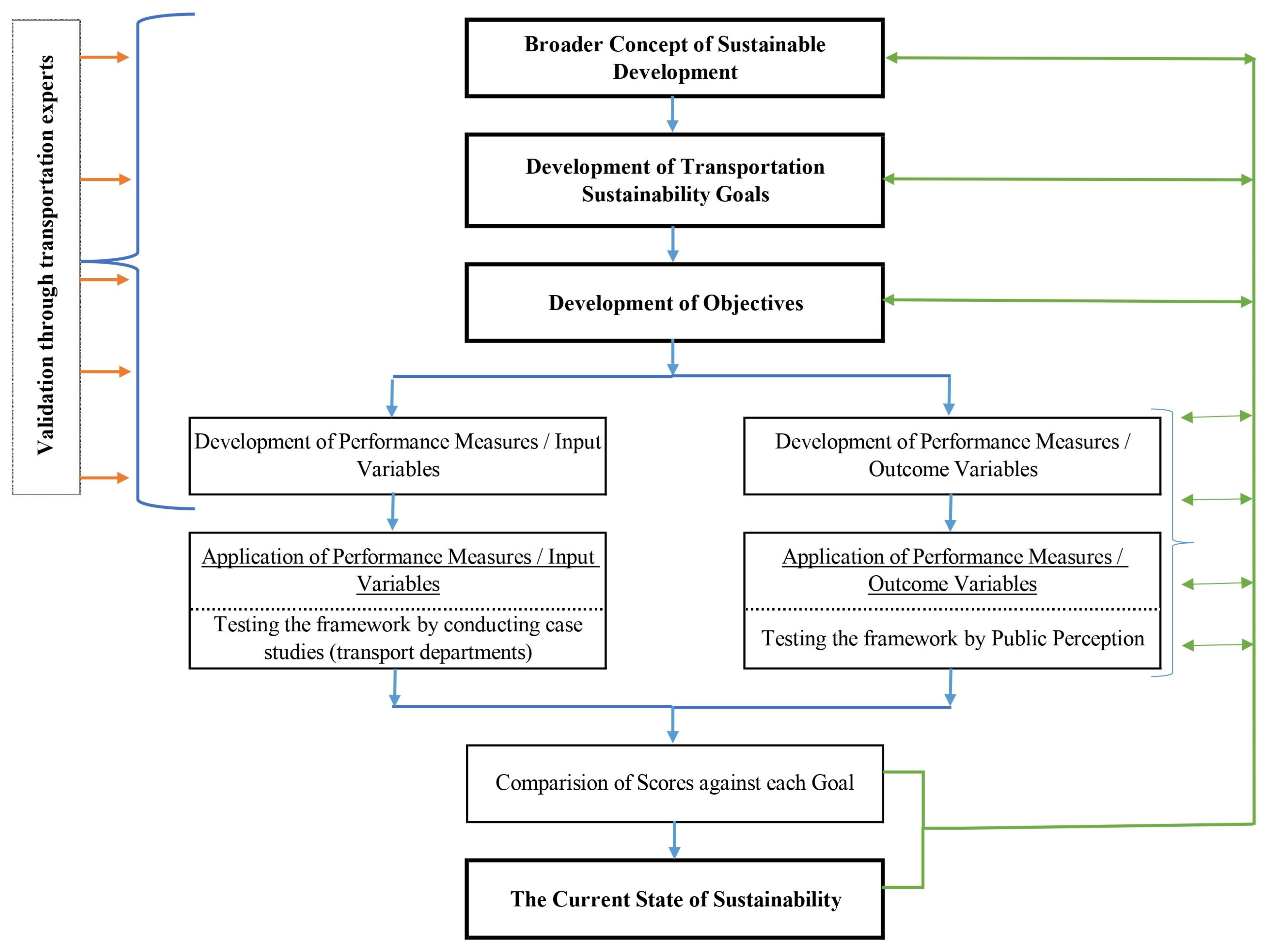
- The framework is predicated on a holistic viewpoint, specifically the sustainable development paradigm, aimed at enhancing the economic, environmental, and social performance of the transportation sector without adversely affecting the performance of other sectors.
- The framework evaluates sustainability and performance management concurrently for transportation departments, making it beneficial in regions where organizations have overlapping functions, such as in developing countries.
- The framework is able to gauge public sentiment regarding governmental measures aimed at achieving sustainability in urban transportation. The public perception derived from outcome variables throughout the framework’s implementation phase will validate the allocation of suitable resources established during the planning phase.
- In its third aspect of implementation, the framework achieves the development of procedures to assess the indicators, establish benchmarks, or set targets.
- Initially, the notion of sustainable transportation must be recognized. Transportation infrastructure and services must be designed as a cohesive network within the city, rather than offering specific services limited to one or two routes, transitioning from a corridor strategy to a network approach. Investments in transportation networks must also be economically viable. Strategic objectives, both long-term and short-term, must align to achieve the desired condition of transportation sustainability.
- Secondly, robust coordination among all levels of government—national, provincial, and local—is essential for the efficient utilization of resources and the achievement of sustainability goals. Additionally, a process must be established to evaluate the sustainability of the transportation system.
- Third, it is essential to sustain the current infrastructure and bus fleet, necessitating the allocation of sufficient finances. It is essential to reduce taxation and provide incentives to encourage greener technology and the use of electric vehicles. Both natural and anthropogenic heritage must be safeguarded throughout the planning and implementation of the transportation system.
- Finally, all stakeholders, including land use control departments, environmental agencies, transportation departments, and relevant private sector entities, must engage with the transportation department. Furthermore, the engagement of public opinion in transportation planning is a crucial element for successful projects.
Author Contributions
Funding
Institutional Review Board Statement
Informed Consent Statement
Data Availability Statement
Conflicts of Interest
Abbreviations
| PSR | Pressure–State–Response |
| TERM | Transport and Environment Reporting Mechanism |
| EEA | European Environmental Agency |
| UNCED | United Nations Conference on Environment and Development |
| AASHTO | American Association of State Highway and Transportation Officials |
References
- Benfield, F.K.; Replogle, M. The roads more traveled: Sustainable transportation in America-or not. Environ. Law Rep.-News Anal. 2002, 32, 10633. [Google Scholar]
- Barrella, E.M. Strategic Planning for a Sustainable Transportation System: A SWOT-Based Framework for Assessment and Implementation Guidance for Transportation Agencies; Georgia Institute of Technology: Atlanta, GA, USA, 2012. [Google Scholar]
- Cheng, Y.-H.; Chang, Y.-H.; Lu, I.J. Urban transportation energy and carbon dioxide emission reduction strategies. Appl. Energy 2015, 157, 953–973. [Google Scholar] [CrossRef]
- Hoxha, V.; Brahushi, V. Sustainable transportation in Prishtina, Kosovo. Urbani Izziv 2023, 34, 98–107. [Google Scholar] [CrossRef]
- Schneider, R.J. Theory of routine mode choice decisions: An operational framework to increase sustainable transportation. Transp. Policy 2013, 25, 128–137. [Google Scholar] [CrossRef]
- Kim, H.Y.; Lee, H.K. Enhanced validity and reliability of spatial decision support systems (SDSS) for sustainable transportation decision-making. Appl. Geogr. 2014, 51, 65–71. [Google Scholar] [CrossRef]
- Abbas, Z.; Aziz, A.; Hameed, R. Toward Sustainable Urban Transportation: Examining the Potential of Transport Departments in Lahore, Pakistan; No. 2023-01-5074. SAE Technical Paper; SAE International: Warrendale, PA, USA, 2023. [Google Scholar]
- Petty, S.; Banerjee, F.; Deakin, E.; Jacobsen, J.L.; Ysela Markle, P.P. Sustainable Transportation Practices in Europe; No. FHWA-PL-02-006; Federal Highway Administration: Washington, DC, USA, 2001.
- Transportation Research Board (TRB). Transportation Research Board, Annual Report 2005; Transportation Research Board: Washington, DC, UDA, 2005. [Google Scholar]
- Washington State Department of Transportation. The Gray Notebook 31; WSDOT: Olympia, WA, USA, 2011.
- EEA (European Environment Agency). Transport and Environment Reporting Mechanism (TERM); EEA: Copenhagen, Denmark, 2011.
- Kidd, C.V. The evolution of sustainability. J. Agric. Environ. Ethics 1992, 5, 1–26. [Google Scholar] [CrossRef]
- Gudmundsson, H.; Hall, R.P.; Marsden, G.; Zietsman, J. Planning for transportation. In Sustainable Transportation: Indicators, Frameworks, and Performance Management; Springer: Berlin/Heidelberg, Germany, 2016; pp. 51–80. [Google Scholar]
- WCED, Special Working Session. World commission on environment and development. Our Common Future 1987, 17, 1–91. [Google Scholar]
- Hall, R.P. Understanding and Applying the Concept of Sustainable Development to Transportation Planning and Decision-Making in the US. Ph.D. Thesis, Massachusetts Institute of Technology, Cambridge, MA, USA, 2006. [Google Scholar]
- Gudmundsson, H. Sustainable Mobility and Incremental Change—Some Building Blocks for IMPACT; Danish Transport Research Institute: Copenhagen, Denmark, 2007. [Google Scholar]
- Gudmundsson, H.; Hall, R.P.; Marsden, G. Framework for sustainability assessment by transportation agencies. Transp. Res. Rec. J. Transp. Res. Board 2011, 2242, 9–18. [Google Scholar] [CrossRef]
- Newman, P.; Kenworthy, J. Sustainability and Cities: Overcoming Automobile Dependence; Island Press: Washington, DC, USA, 1998. [Google Scholar]
- Kennedy, C.; Miller, E.; Shalaby, A.; Maclean, H.; Coleman, J. The four pillars of sustainable urban transportation. Transp. Rev. 2005, 25, 393–414. [Google Scholar] [CrossRef]
- Jeon, C.M. Incorporating Sustainability into Transportation Planning and Decision Making: Definitions, Performance Measures, and Evaluation; Georgia Institute of Technology: Atlanta, GA, USA, 2007. [Google Scholar]
- Banister, D. The sustainable mobility paradigm. Transp. Policy 2008, 15, 73–80. [Google Scholar] [CrossRef]
- Black, W. Sustainable Transportation: Problems and Solutions, Guildford; Guilford Press: New York, NY, USA, 2010. [Google Scholar]
- Theis, T.; Tomkin, J. What is sustainability. In Sustainability: A Comprehensive Foundation; Connexions: Houston, TX, USA, 2012. [Google Scholar]
- Gudmundsson, H. Making concepts matter: Sustainable mobility and indicator systems in transport policy. Int. Soc. Sci. J. 2003, 55, 199–217. [Google Scholar] [CrossRef]
- Schiller, P.L.; Kenworthy, J. An Introduction to Sustainable Transportation: Policy, Planning and Implementation; Routledge: Abingdon, UK, 2017. [Google Scholar]
- Zietsman, J. Incorporating Sustainability Performance Measures into the Transportation Planning Process; Texas A&M University: College Station, TX, USA, 2000. [Google Scholar]
- Karjalainen, L.E.; Juhola, S. Urban transportation sustainability assessments: A systematic review of literature. Transp. Rev. 2021, 41, 659–684. [Google Scholar] [CrossRef]
- Richardson, B.C. Sustainable transport: Analysis frameworks. J. Transp. Geogr. 2005, 13, 29–39. [Google Scholar] [CrossRef]
- Feng, C.-M.; Hsieh, C.-H. Implications of transport diversity for quality of life. J. Urban Plan. Dev. 2009, 135, 13–18. [Google Scholar] [CrossRef]
- Marsden, G.; Kimble, M.; Nellthorp, J.; Kelly, C. Sustainability assessment: The definition deficit. Int. J. Sustain. Transp. 2010, 4, 189–211. [Google Scholar] [CrossRef]
- Litman, T. Well Measured: Developing Indicators for Sustainable and Livable Transport Planning; Victoria Transport Policy Institute: Victoria, BC, Canada, 2021. [Google Scholar]
- Figueroa, M.J.; Ribeiro, S.K. Energy for road passenger transport and sustainable development: Assessing policies and goals interactions. Curr. Opin. Environ. Sustain. 2013, 5, 152–162. [Google Scholar] [CrossRef]
- Barrella, E.M.; Amekudzi, A.A.; Meyer, M.D. Evaluating sustainability approaches of transportation agencies through a strengths, weaknesses, opportunities, and threats framework. Transp. Res. Rec. J. Transp. Res. Board 2013, 2357, 41–49. [Google Scholar] [CrossRef]
- Gillis, D.; Semanjski, I.; Lauwers, D. How to monitor sustainable mobility in cities? Literature review in the frame of creating a set of sustainable mobility indicators. Sustainability 2015, 8, 29. [Google Scholar] [CrossRef]
- Castillo, H.; Pitfield, D.E. ELASTIC—A methodological framework for identifying and selecting sustainable transport indicators. Transp. Res. Part D Transp. Environ. 2010, 15, 179–188. [Google Scholar] [CrossRef]
- Ha, E.; Joo, Y.; Jun, C. An empirical study on sustainable walkability indices for transit-oriented development by using the analytic network process approach. Int. J. Urban Sci. 2011, 15, 137–146. [Google Scholar] [CrossRef]
- Haghshenas, H.; Vaziri, M.; Gholamialam, A. Evaluation of sustainable policy in urban transportation using system dynamics and world cities data: A case study in Isfahan. Cities 2015, 45, 104–115. [Google Scholar] [CrossRef]
- Al-Atawi, A.M.; Kumar, R.; Saleh, W. Transportation sustainability index for Tabuk city in Saudi Arabia: An analytic hierarchy process. Transport 2016, 31, 47–55. [Google Scholar] [CrossRef]
- Curiel-Esparza, J.; Mazario-Diez, J.L.; Canto-Perello, J.; Martin-Utrillas, M. Prioritization by consensus of enhancements for sustainable mobility in urban areas. Environ. Sci. Policy 2016, 55, 248–257. [Google Scholar] [CrossRef]
- Ngossaha, J.M.; Ngouna, R.H.; Archimède, B.; Nlong, J. Sustainability assessment of a transportation system under uncertainty: An integrated multicriteria approach. IFAC-PapersOnLine 2017, 50, 7481–7486. [Google Scholar] [CrossRef]
- Oses, U.; Rojí, E.; Gurrutxaga, I.; Larrauri, M. A multidisciplinary sustainability index to assess transport in urban areas: A case study of Donostia-San Sebastian, Spain. J. Environ. Plan. Manag. 2017, 60, 1891–1922. [Google Scholar] [CrossRef]
- Wey, W.-M.; Huang, J.-Y. Urban sustainable transportation planning strategies for livable City’s quality of life. Habitat Int. 2018, 82, 9–27. [Google Scholar] [CrossRef]
- Chen, Y.; Bouferguene, A.; Shen, Y.; Al-Hussein, M. Assessing accessibility-based service effectiveness (ABSEV) and social equity for urban bus transit: A sustainability perspective. Sustain. Cities Soc. 2019, 44, 499–510. [Google Scholar] [CrossRef]
- Marsden, G.; Kelly, C.; Snell, C. Selecting indicators for strategic performance management. Transp. Res. Rec. 2006, 1956, 21–29. [Google Scholar] [CrossRef]
- Marletto, G.; Mameli, F. A participative procedure to select indicators of policies for sustainable urban mobility. Outcomes of a national test. Eur. Transp. Res. Rev. 2012, 4, 79–89. [Google Scholar] [CrossRef]
- Mameli, F.; Marletto, G. Can National survey data be used to select a core set of sustainability indicators for monitoring urban mobility policies? Int. J. Sustain. Transp. 2014, 8, 336–359. [Google Scholar] [CrossRef]
- Munira, S.; Santoso, D.S. Examining public perception over outcome indicators of sustainable urban transport in Dhaka city. Case Stud. Transp. Policy 2017, 5, 169–178. [Google Scholar] [CrossRef]
- Wang, Q.; Tang, S.; Hu, J.; Chen, X.; Wang, L. Performance Measurement system for assessing transportation sustainability and community livability. Transp. Res. Rec. J. Transp. Res. Board 2015, 2531, 113–120. [Google Scholar] [CrossRef]
- Lopez-Escolano, C.; Campos, A.P.; Pardos, S.V.; Nedeliakova, E.; Stefancova, V. Incorporating bicycles into urban mobility: An opportunity for sustainable development. Commun.-Sci. Lett. Univ. Zilina 2017, 19, 68–73. [Google Scholar] [CrossRef]
- Miranda, H.d.F.; da Silva, A.N.R. Benchmarking sustainable urban mobility: The case of Curitiba, Brazil. Transp. Policy 2012, 21, 141–151. [Google Scholar] [CrossRef]
- Moeinaddini, M.; Asadi-Shekari, Z.; Shah, M.Z. An urban mobility index for evaluating and reducing private motorized trips. Measurement 2015, 63, 30–40. [Google Scholar] [CrossRef]
- Currie, G.; De Gruyter, C. Exploring links between the sustainability performance of urban public transport and land use in international cities. J. Transp. Land Use 2018, 11, 325–342. [Google Scholar] [CrossRef]
- Gouda, A.A.; Masoumi, H.E. Sustainable transportation according to certification systems: A viability analysis based on neighborhood size and context relevance. Environ. Impact Assess. Rev. 2017, 63, 147–159. [Google Scholar] [CrossRef]
- Lee, E.H.; Prozzi, J.; Lewis, P.G.T.; Draper, M.; Kim, B. From scores to strategy: Performance-based transportation planning in Texas. Eval. Program Plan. 2025, 111, 102611. [Google Scholar] [CrossRef]
- Lee, E.H.; Lee, E. Iterative DEA for public transport transfer efficiency in a super-aging society. Cities 2025, 162, 105957. [Google Scholar] [CrossRef]
- Lee, E.H. eXplainable DEA approach for evaluating performance of public transport origin-destination pairs. Res. Transp. Econ. 2024, 108, 101491. [Google Scholar] [CrossRef]
- Konstantinos, P.; Emrouznejad, A. Transforming Desirable and Undesirable Outputs into a Single Metric: Machine Learning-Enhanced DEA for Transportation Analysis. Available online: https://papers.ssrn.com/sol3/papers.cfm?abstract_id=5293595 (accessed on 26 June 2025).
- Holden, E.; Linnerud, K.; Banister, D. Sustainable development: Our Common Future revisited. Glob. Environ. Change 2014, 26, 130–139. [Google Scholar] [CrossRef]
- Litman, T. Well Measured-Developing Indicators for Sustainable and Livable Transport Planning-5 March 2021. 2021. Available online: https://www.scirp.org/reference/referencespapers?referenceid=2331775 (accessed on 26 June 2025).
- Cochran, W.G. Sampling Techniques; John Wiley & Sons: Hoboken, NJ, USA, 1977. [Google Scholar]
- Pakistan Bureau of Statistics. Official Website. Government of Pakistan. Available online: https://www.pbs.gov.pk (accessed on 26 June 2025).
- Nunnally, J.C. An overview of psychological measurement. In Clinical Diagnosis of Mental Disorders: A Handbook; Springer: Berlin/Heidelberg, Germany, 1978; pp. 97–146. [Google Scholar]
- Hair, J.F. Multivariate Data Analysis; Kennesaw State University: Kennesaw, GA, USA, 2009. [Google Scholar]
- Kaiser, H.F. An index of factorial simplicity. Psychometrika 1974, 39, 31–36. [Google Scholar] [CrossRef]


| Sr. No. | Method | Assessment Phenomena | Source |
|---|---|---|---|
| 1 | Indicators or framework development | Evaluate various aspects of urban transportation systems | [28,29,30,31,32,33,34] |
| 2 | Multicriteria decision analysis (MCDA), modeling, and simulation | Assessment of policies and plans | [35,36,37,38,39,40,41,42,43] |
| 3 | Participatory data collection methods | Evaluation of public perceptions | [44,45,46,47] |
| 4 | GIS methods | Performance evaluations and built-environment evaluations | [48,49] |
| 5 | Statistical data analysis | Assessment of public transportation systems and service performance | [50,51,52] |
| 6 | Documentary analysis | Assessment of policies and plans | [53] |
| Functional Goal | Impact Goal |
|---|---|
| Provide | Protect and Enhance |
|
|
| Ensure | Reduce |
|
|
| Area | Outcome Indicators | |||
|---|---|---|---|---|
| Safety | Safe travel (free from accidents and thefts) G—1,6 | |||
| Equity | Adequate and safe facilities for pedestrians and cyclists (non-motorized transport) G—1,3 | Accessibility for women (secure and comfortable travel for women) G—1,2,3,9,11 | Transport facilities for disabled people G—1,2,3,9,11 | Public transportation access from home, education, workplaces, and recreation places G—1,2,3,9,11 |
| Public Transport Efficiency | Public transport adequacy (availability, particularly in peak hours) G—2,3,9 | Public transport service quality (riding ease) G—2,3,5 | Diversity in availability of modes of transportation and flexibility in changing mode G—10 | |
| Affordability | Travel cost (travel cost per month). G—3,7,11 | Travel time (average time spent on daily trips) G—2,5,6,7,11 | ||
| Pollution | Noise pollution (by transportation) G—14 | Air pollution (by transportation) G—14,20 | Numbers of private vehicles (car, bike, etc.) G—14,20 | User adaptation and affordability of new technologies (e.g., hybrid, electric vehicles, etc.) G—14,16,19,20 |
| Land Use | Land transport facilities (adequate roads and parking facilities) G—14 | |||
| Governance | Public participation in planning of transportation projects G—12 | Resource efficiency (efficient use of government resources in transportation planning) G—4,5,8 | ||
| Climate Change/Hazards | Transport accessibility in all weather conditions G—6,15 | Weather forecasts (timely and reliable predictions available to public) G—15 | Early warning system (in case of any natural or manmade hazards) G—15 | Emergency exits (public transportation and infrastructure) G—15 |
| Heritage Protection | Protection of natural beauty, old buildings, and monuments during the execution of transportation projects G—17 | |||
| Sr. No. | Variable | Statistics |
|---|---|---|
| 1 | Gender | 63% male; 37% female |
| 2 | Age | 62% between 15 and 35 years |
| 3 | Education | 80% have at least secondary education |
| 4 | Mode of transport | 35% public transport; 40% private mode |
| 5 | Income | 49% (PKR 20,001–50,000)/month |
| 6 | Travel Costs | 60% (PKR 2000–10,000)/month |
| Sr. No. | Goal | Input Variables | Outcome Variables | |||||||
|---|---|---|---|---|---|---|---|---|---|---|
| Importance | Rating | Weight | Weighted Score | Importance | Rating | Weight | Weighted Score | |||
| Functional Goal (Provide) | ||||||||||
| 1 | Provide a safe transportation system (service and infrastructure) for users and the general public. | 4.86 | 3.76 | 0.052 | 0.196 | 4.42 | 3.25 | 0.055 | 0.180 | |
| 2 | Provide an accessible transport system to meet the basic needs of the people. | 4.71 | 3.33 | 0.050 | 0.168 | 4.50 | 2.94 | 0.056 | 0.166 | |
| 3 | Provide affordable and equitable transportation opportunities for all sections of society. | 4.78 | 3.17 | 0.051 | 0.162 | 4.43 | 3.02 | 0.055 | 0.167 | |
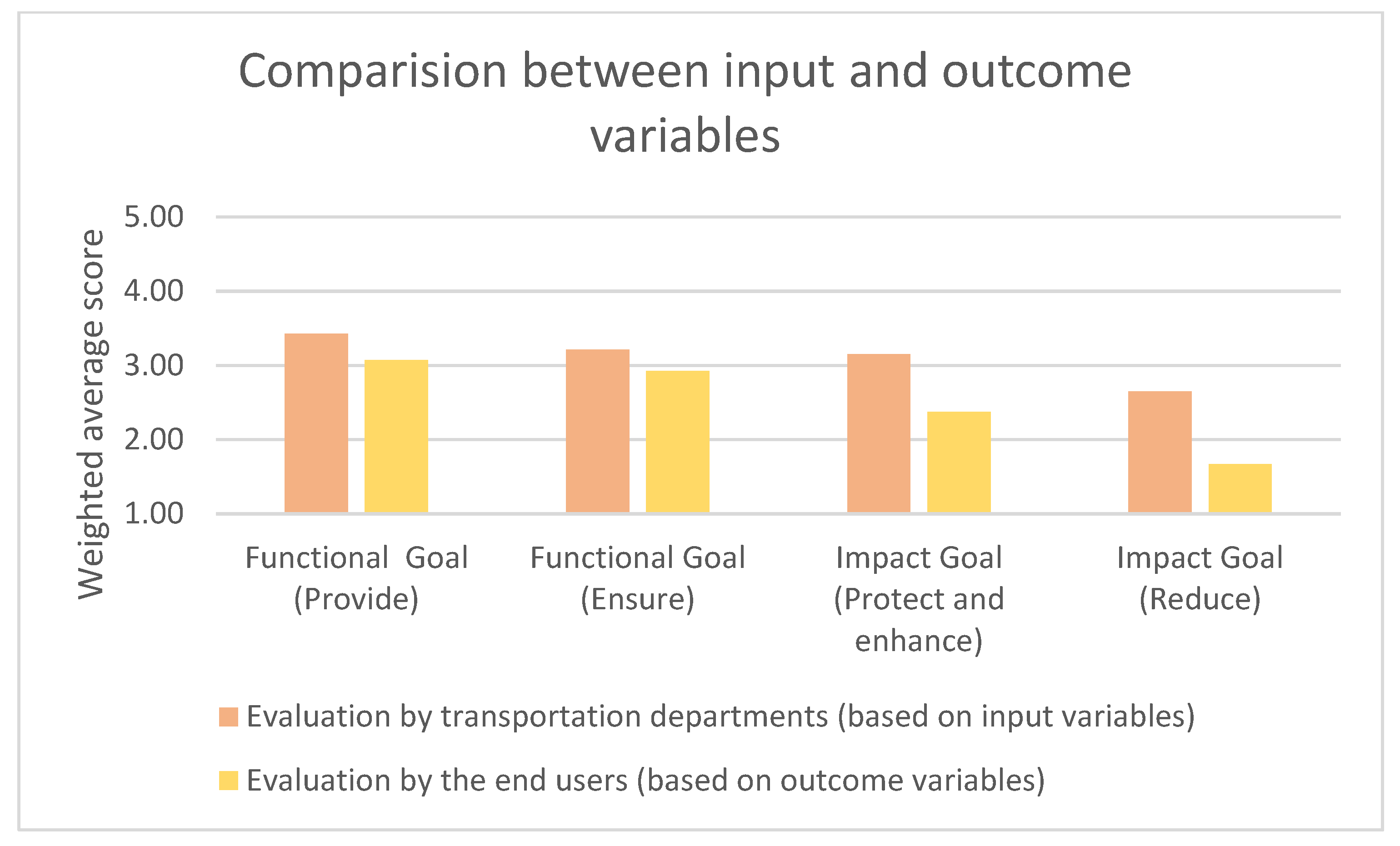
| Functional Goal (Provide) Score out of 5.0 | 3.42 | 3.07 | ||||||||
| Functional Goal (Ensure) | ||||||||||
| 4 | Ensure that the system makes the best use of new and existing assets. | 4.57 | 3.06 | 0.049 | 0.150 | 4.33 | 2.67 | 0.054 | 0.145 | |
| 5 | Maximize user-friendliness and consistency of transport services. | 4.65 | 3.23 | 0.050 | 0.161 | 4.56 | 3.00 | 0.057 | 0.171 | |
| 6 | Ensure a reliable transportation system, resilient to threats from all hazards. | 4.83 | 3.47 | 0.052 | 0.180 | 4.56 | 3.33 | 0.057 | 0.190 | |
| 7 | Ensure the development and operations of the transportation system support economic development and prosperity. | 4.55 | 3.24 | 0.049 | 0.158 | 4.78 | 3.06 | 0.060 | 0.183 | |
| 8 | Ensure the investments in the transportation system are feasible economically. | 4.72 | 3.33 | 0.051 | 0.169 | 4.33 | 2.67 | 0.054 | 0.145 | |
| 9 | Ensure transport for all, irrespective of location, income, gender, age, race, or disability. | 4.83 | 3.37 | 0.052 | 0.174 | 4.42 | 2.83 | 0.055 | 0.157 | |
| 10 | Ensure the transportation system involves all modes of transportation. | 4.67 | 3.11 | 0.050 | 0.156 | 4.00 | 3.00 | 0.050 | 0.150 | |
| 11 | Ensure the transportation system provides access to the services required to enable people to rise out of poverty, overcome social exclusion, and bring goods and services to the market, driving socio-economic growth. | 4.83 | 3.33 | 0.052 | 0.173 | 4.53 | 3.03 | 0.057 | 0.172 | |
| 12 | Ensure integrated, comprehensive, and inclusive planning for transportation projects/the system. | 4.70 | 3.33 | 0.050 | 0.168 | 4.00 | 2.67 | 0.050 | 0.133 | |
| 13 | Ensure that there are mechanisms to assess the sustainability of the transport system. | 4.83 | 2.67 | 0.052 | 0.138 | |||||
| Functional Goal (Protect) Score out of 5.0 | 3.21 | 2.92 | ||||||||
| Impact Goal (Protect and Enhance) | ||||||||||
| 14 | Protect environmental and ecological systems while developing and operating the transportation system. | 4.71 | 2.97 | 0.050 | 0.150 | 4.60 | 2.07 | 0.058 | 0.119 | |
| 15 | Ensure the transport system adapts to climate change. | 4.58 | 3.44 | 0.049 | 0.169 | 4.17 | 3.00 | 0.052 | 0.156 | |
| 16 | Enhance taxation and subsidies (minimize taxation and/or maximize subsidies for cleaner technologies). | 4.56 | 2.78 | 0.049 | 0.136 | 5.00 | 1.67 | 0.063 | 0.104 | |
| 17 | Ensure the planning of the transport system considers heritage protection. | 4.50 | 3.42 | 0.048 | 0.165 | 3.67 | 3.00 | 0.046 | 0.138 | |
| Impact Goal (Protect And Enhance) Score out of 5.0 | 3.15 | 2.37 | ||||||||
| Impact Goal (Reduce) | ||||||||||
| 18 | Minimize the waste generated from transportation-related activities. | 4.42 | 2.94 | 0.047 | 0.139 | |||||
| 19 | Reduce nonrenewable resource use and promote renewable energy to operate the transport system. | 4.73 | 2.23 | 0.051 | 0.113 | 5.00 | 1.67 | 0.063 | 0.104 | |
| 20 | Minimize transportation-related emissions of air pollution and greenhouse gases. | 4.28 | 2.81 | 0.046 | 0.129 | 4.67 | 1.67 | 0.058 | 0.097 | |
| Impact Goal (Reduce) Score out of 5.0 | 2.65 | 1.67 | ||||||||
| Overall Framework Score out of 5.0 | Σ | 93.31 | 1.00 | 3.15 | 79.95 | 1.00 | 2.68 | |||
Disclaimer/Publisher’s Note: The statements, opinions and data contained in all publications are solely those of the individual author(s) and contributor(s) and not of MDPI and/or the editor(s). MDPI and/or the editor(s) disclaim responsibility for any injury to people or property resulting from any ideas, methods, instructions or products referred to in the content. |
© 2025 by the authors. Licensee MDPI, Basel, Switzerland. This article is an open access article distributed under the terms and conditions of the Creative Commons Attribution (CC BY) license (https://creativecommons.org/licenses/by/4.0/).
Share and Cite
Abbas, Z.; Aziz, A.; Hameed, R. Developing a Framework for the Sustainability Assessment of Urban Transportation and Its Implementation. Future Transp. 2025, 5, 147. https://doi.org/10.3390/futuretransp5040147
Abbas Z, Aziz A, Hameed R. Developing a Framework for the Sustainability Assessment of Urban Transportation and Its Implementation. Future Transportation. 2025; 5(4):147. https://doi.org/10.3390/futuretransp5040147
Chicago/Turabian StyleAbbas, Zaheer, Amer Aziz, and Rizwan Hameed. 2025. "Developing a Framework for the Sustainability Assessment of Urban Transportation and Its Implementation" Future Transportation 5, no. 4: 147. https://doi.org/10.3390/futuretransp5040147
APA StyleAbbas, Z., Aziz, A., & Hameed, R. (2025). Developing a Framework for the Sustainability Assessment of Urban Transportation and Its Implementation. Future Transportation, 5(4), 147. https://doi.org/10.3390/futuretransp5040147